
Algebraic Attacks on Human Identification Protocols
∗
Hassan Jameel Asghar
1, Ron Steinfeld
2, Shujun Li
3, Mohamed Ali Kaafar
1,
Josef Pieprzyk
41
National ICT Australia, NICTA, Australia {hassan.asghar,dali.kaafar}@nicta.com.au
2
Clayton School of Information Technology,
Faculty of Information Technology,
Monash University, Clayton, Australia
Department of Computing,
Faculty of Engineering and Physical Sciences, University of Surrey, Guildford, Surrey, UK
4School of Electrical Engineering and Computer Science,
Science and Engineering Faculty,
Queensland University of Technology, Brisbane, Australia
July 13, 2016
Abstract
Human identification protocols are challenge-response protocols that rely on human computa-tional ability to reply to random challenges from the server based on a public function of a shared secret and the challenge to authenticate the human user. One security criterion for a human identification protocol is the number of challenge-response pairs the adversary needs to observe before it can deduce the secret. In order to increase this number, protocol designers have tried to construct protocols that cannot be represented as a system of linear equations or congruences. In this paper, we take a closer look at different ways from algebra, lattices and coding theory to obtain the secret from a system of linear congruences. We then show two examples of human identification protocols from literature that can be transformed into a system of linear congru-ences. The resulting attack limits the number of authentication sessions these protocols can be used before secret renewal. Prior to this work, these protocols had no known upper bound on the number of allowable sessions per secret.
1
Introduction
A human identification (or authentication) protocol in this paper is defined as a protocol that enables a human using a terminal to prove his/her identity to a remote server in the presence of an observer.
∗This is the full version of the paper with the titleOn the Linearization of Human Identification Protocols: Attacks
In this work, we assume that the observer is apassive attacker who has access to the terminal, and the communication link between the terminal and the server. Moreover, the observer can also see the interaction between the human and the terminal. In contrast, an active attacker may additionally masquerade as the server and send messages of its choice to the user. However, active attacks are much more challenging to handle in the context of human identification protocols, and therefore, following the norm, we only focus on the passive observer. A secure human identification protocol lets a user authenticate to a server with the same shared password (secret) multiple times in the presence of the observer without the fear of leakage of the password which can be used for impersonation. Since the user’s terminal is also in the hands of the adversary, the computations done by the user have to be mental. This is a severe constraint on the usability of such protocols as this results in an impractically high authentication time. Since the inception of this idea by Matsumoto and Imai in [1], protocol designers have attempted to decrease authentication time while providing high level of security.1
A general paradigm in the design of these protocols is the so-calledk-out-of-nparadigm, wherein the shared secret is a set of k objects out ofn publicly known objects. During authentication, the server sends a random challenge from some challenge space whose cardinality is a function ofn. For instance, a challenge can be a random sample ofnobjects where each object is present in the sample with probability 12. The users response is a publicly known functionf of the secret and the challenge. An example response function is the modulo 2 sum of the number of secret objects present in the challenge. The set of possible responses, i.e., the response space, is generally much smaller. Due to a small response space, the protocol is iterated a number of times such that the probability that an attacker randomly guesses the answer is below a defined threshold. Given such a protocol, the goal of the attacker is to find the secret after observing a certain number of challenge-response pairs; the lesser, the better from an adversarial perspective. Notice that the only secret information is the set of secret objects; the cardinality of this set, i.e., k, is also public. The security of the protocol thus depends on the functionf. A generic brute-force attack has time-complexityO( nk). As a first line of defence, this number should be high enough. This provides the first hurdle in constructing a practical human identification protocol, as the parameters n and k need to be large enough for security and small enough for usability.
Although protocol designers have attempted in vain to provide a secureand practical solution, we argue that the research in the security of such protocols is worth doing, due to the following main reasons:
1. The search of such protocols might eventually lead to a practical solution. One that is at least acceptable in higher risk situations. Research since the inception of the problem has come up with a number of interesting results in terms of the underlying mathematical problems (such as the learning in the presence of noise (LPN) problem used in [2]) used to constructf as well as generic attacks (for instance, the statistical attacks from Yan et al. [3]).
2. Human identification protocols can be modified to be used in resource-constrained devices. Such devices have one aspect common with humans: low memory and computational power. The Hopper and Blum (HB) human identification protocol [2] has been studied intensively for its application to RFID authentication [4]. To date, other proposed human identification protocols, the sum of k mins protocol from [2] and the Foxtail protocol from [5] to name a few, have not made progress in this line of research. Perhaps because their security has not been as comprehensively studied.
3. Such protocols can be used in a multi-factor authentication setting, where an auxiliary secure device can be given to the user. One example is the protocol from Catuogno and Galdi [6], where the device tells the user to send wrong responses to specific parts of the challenge in order
to confuse the observer. Under multi-factor authentication, we can use such auxiliary devices as computational aid for the human, thus making these protocols more practical.
With this in mind, we focus on an important goal of protocol designers: to increase the number of possible authentication sessions with a given secret. Since the protocols from Hopper and Blum in [2], an important goal has been to propose protocols that are secure against observations for at leastO(n2) sessions. One way to achieve this is to ensure that the functionf cannot be written as a system of linear equations or congruences inn. If this is not ensured, then one can, for instance, use Gaussian elimination to obtain the unique solution (secret) after observing aboutnchallenge-response pairs.
Our Contributions. In this paper, we look at the design goal of non-linearity off in detail. We first show how a system of linear congruences modulo some integerd≥2 can be attacked using dif-ferent techniques from algebra, lattices and coding theory. This is important since although Gaussian elimination can be used to obtain the secret after observingnchallenge-response pairs, the cardinality of the secret set k being less than n means that other attacks may be possible for a much smaller number of observations. We show that this is indeed possible for small values ofk andn. We then study two protocols from literature: the Catuogno and Galdi (CG) protocol from [6] and the modified form of the Foxtail protocol [5] from [7],2and show how they can be attacked by transforming them into a system of linear congruences. Both of these protocols were constructed with non-linearity of the response function in mind. Neither protocol has a known upper bound on the number of allowable sessions for the recommended parameters. The attacks shown here impose this limit. More specifi-cally, we show that the secret in the CG protocol can be obtained by observing only 80 sessions with the recommended parameters. And in the case of the modified Foxtail protocol, we show that it can be used for fewer than 500 sessions; a number less than the 711 mark obtained by the statistical attack from Yan et al. [3] on the original Foxtail protocol [5] due to which the protocol was modified in [7].
Organization. The rest of the paper is organized as follows. Section2 describes the related work, followed by preliminaries and background on human identification protocols in Section3. In Section4 we present a detailed analysis of possible attacks on a system of n linear congruences over integers modulod≥2 in then-element unknown binary vectorxof Hamming weightk. The goal of this section is to find feasible ways to obtainx with fewer than ncongruences. Equipped with this knowledge, we show an attack on the C protocol from [6] in Section 5 by describing how the protocol can be represented as a system of linear congruences. In Section6 we show how another protocol, namely the Foxtail protocol [5,7], can also be represented as a system of linear congruences. Here again, the analysis from Section3 proves useful in determining possible feasible attacks once a system of linear congruences is obtained. We discuss some of the implications of our results in Section7 and present concluding remarks in Section8.
2
Related Work
Consistent with the focus of this paper, we mostly limit this brief literature overview to proposals for human identification protocols constructed to avoid representation as a system of linear equations or congruences. The idea of authenticating a human in the aforementioned threat model was first put forward by Matsumoto and Imai [1], where the authors proposed the first human identification protocol. The protocol was broken in [8]. The initial research by Matsumoto and Imai has followed a string of proposals for human identification protocols [9–13] which were broken by subsequent attacks [3,14–17]. Most of these protocols were based on an ad-hoc design. By contrast, Matsumoto proposed another protocol based on linear algebra which can be used forO(n) sessions after which
Gaussian elimination can be used to find the unique secret [18]. The advantage of this protocol over the others is that the security of the protocol can be argued against what is known about the underlying mathematical problem. Since then various attempts have been made to construct protocols that avoid representation as a linear system of equations or congruences. These include the HB protocol and the sum of k mins protocol from Hopper and Blum [2], the Foxtail protocol from Li and Shum [5], the Asghar, Pieprzyk and Wang (APW) protocol [19], and the protocols from Catuogno and Galdi [6] to name a few. Among these protocols the Foxtail protocol was shown to be susceptible to a counting based statistical attack from Yan et al. [3], after which a fixed version of the protocol was proposed in [7]. The attack from Yan et al. applies to the original Foxtail protocol due to a contrived method of generating the challenges. Once that is removed, statistical attacks are no longer applicable. Likewise, the same holds for the other protocols mentioned above. Apart from this statistical attack, there are no known passive attacks on these protocols, barring the generic brute force and the meet-in-the-middle attack of complexityO( k/n2
) [2]. Recently, a timing based side-channel attack of time complexity
∼250 has been shown on the HB protocol by ˇCagalj and Perkovi´c [20], which exploits the difference in response times which are proportional to the cognitive load on humans when computing challenges of varying complexity. This attack is complementary to the algebraic attacks discussed in this paper.
3
Preliminaries and Background
3.1
Notation
Letxdenote a column vector. ThenxT denotes a row vector, whereT stands for transpose. Where
there is no chance of ambiguity, we shall refer to column or row vectors as simply vectors. For any two vectorsxandyhaving the same number of elements,x·yT =xT ·y denotes their dot product.
The length or Euclidean norm of a vectorx, denotedkxk, is defined aspPix2
i, wherexi is theith
element ofx. Ifxis binary, its Hamming weight, denotedwt(x), is defined askxk2; in other words,
the sum of the elements ofx. Letd≥2 be an integer. The setZd denotes the set of integers modulo
d. Znd is the set of all n-element vectors with entries from Zd. For a square matrix A, let det(A)
denote its determinant. For anyn≥1, In is the n×nidentity matrix. InM is the mirror image of
the identity matrixIn, i.e., the n×n matrix obtained by vertically flipping the diagonal ofIn. For
m, n≥1,0m,nand 1m,n represent them×n matrices of all zeros and all ones, respectively. When
m=n, we shall simply drop one of the two subscripts.
3.2
Background on Human Identification Protocols
We model human identification protocols as challenge-response protocols between a human user (the prover) and a server (the verifier). An authentication session, or simply a session, is a sequence of challenge-response pairs followed by a decision from the server. Given a challenge, the user response is a function of the challenge and a secret shared with the server (the verifier). Following convention, we shall call the shared secret, the password. Generally, the set of all possible challenges and responses, respectively termed the challenge space and the response space, is public information. Let pbe the probability that a response randomly selected from the response space is the correct response to a given challenge, where the probability is taken over all possible responses, challenges and passwords. The server might need to send multiple challenges so that the probability of an impersonator is below a certain confidence level. The number of roundsrin a protocol is defined as the number of challenge-response pairs required to obtain a certain confidence level. Letγbe the confidence parameter, which is defined as follows: fori≥1,γ=iif the success probability of the random response attack described above is 1
2i in asession. Thus, the number of roundsrin a session should satisfy
1 2γ ≥p
r⇒r≥ γ
log21p
To better understand the constructions of human identification protocols and to facilitate the ensuing analysis, we begin with the example of a protocol which is a modified version of the protocol from Hopper and Blum [2] and also resembles the protocol from Matsumoto proposed in [18]. The user and the server choose a binary vectorxofnelements as the shared password. During authentication, the server generates a random binary vectorcofnelements. The user computes the dot productcT·x
modulo 2, and sends the response bit to the server. Since the probability that a random response is the correct response to a given challenge is 12, we see from Eq. (1) that for a desired confidence parameter γ, the number of rounds per session is precisely γ. To help the user memorize the password, the weight of the vectorxis fixed atk, wherekis much smaller thann. The protocol can be generalized to any modulus d≥2, in which case the secret remains a binary vector but the challenge is now a random vector fromZn
d and the response is the dot product modulod. The number of rounds in this
case is given byllogγ
2d
m .
A brute force attack of time complexityO( nk
) can find the password xgiven enough response pairs. To estimate the number of challenge response pairs we see that given one challenge-response pair, a 1d fraction of the number of possible passwords nk
give the same response as the passwordx. Given m challenge-response pairs the fraction of total passwords agreeing with the m responses ofx is d1m. Here we have assumed a uniform distribution over the challenge, response and
password spaces. The expected number of challenge-response pairsmrequired to obtain a uniquex
is then
m >logd n
k
=log2
n k
log2d . (2)
Since this number is much smaller than n, it is generally ensured that the parametersk and nare large enough so that the brute force attack is infeasible. Given the infeasibility of the brute force attack, the adversary needs to look at other ways to attack this system. Notice that the bound above is the minimum necessary to obtain a unique password. Below this we will have multiple candidates for the password.
4
Attacking a System of Linear Congruences
Under the aforementioned threat model, the observer can record any number of challenge-response pairs (ci, ri) gathered over multiple sessions. After gatheringmchallenge-response pairs of the protocol
described in the previous section, the following system can be constructed:
Cx≡rmodd,
whereC is the challenge matrix, built frommrow vectorscTi ,ris the response vector whose entries are them responses, andx is the unknown binary vector with Hamming weightk. We now look at different ways, other than brute force, to attack this system of linear congruences to obtain the binary vectorxwith as small a value ofmas possible. We begin by discussing the inherent hardness of the problem from a complexity theoretic viewpoint.
4.1
Hardness of the Problem
in the worst case. However, as we shall see, in practice, in the average case, the problem can be easier for small values ofkandn.
When d = 2, this problem is also known as learning k parities without noise in the attribute efficient setting [25]. The reader might also find this problem somewhat similar to the Short Integer Solution (SIS) problem [26], which is stated as follows: given a uniformly random m×n matrix C with entries from Zd, where d and n are polynomially bounded in m, find an m-element non-zero
integer vectorx such that Cx ≡ 0modd and kxk ≤ k. Here k should be large enough so that a solution exists. In contrast the problem considered in this paper uses much smaller values ofd, asks for a binary solution and has a non-zero response vector.
4.2
Gaussian Elimination
Since there arenunknowns inx, the observer can collectnchallenge-response pairs to obtain a unique solution to the above system of linear congruences using the well-known efficient method of Gaussian elimination. However, uniqueness through Gaussian elimination is only guaranteed if thenrows (or columns) inCare linearly independent. Since eachci inC is generated randomly, thenvectors may
not always be linearly independent. But as we discuss in AppendixA, with high probability then rows are linearly independent. Even if that is not the case, the attacker can observe a little more thann challenge-response pairs and choose then that are linear independent. We also find bounds on the expected number of challenge-response pairs required to obtain a set of linearly independent vectors in AppendixA. Thus, we shall assume that the attacker can solve the above system of linear congruences to obtain the password x with high probability after observing n challenge-response pairs. Thus the first constraint on the usage of this protocol is that it cannot be used for more than n challenge-response pairs or nlog2d
γ sessions. But comparing this with Inequality (2), we see that
Gaussian elimination is not optimal in terms of the number of challenge-response pairsmrequired to obtain the password (since logd nk
is less thann). We therefore look at other feasible ways to find the password in the hope to find a more optimal solution.
4.3
Lattice-based Attack
We can represent the system of linear congruences as part of a lattice and then apply lattice basis reduction algorithms to find the password. More specifically, suppose the observer has m challenge-response pairs. Letci,j denote thejth element of the ith challenge, where 1≤i≤mand 1≤j≤n.
LetL be the lattice with the following basis vectors:
b1 = (1 0 0 . . . 0 µc1,1 µc2,1 . . . µcm,1) b2 = (0 1 0 . . . 0 µc1,2 µc2,2 . . . µcm,2)
.. .
bn = (0 0 0 . . . 1 µc1,n µc2,n . . . µcm,n)
bn+1 = (0 0 0 . . . 0 µd 0 . . . 0)
bn+2 = (0 0 0 . . . 0 0 µd . . . 0)
.. .
bn+m = (0 0 0 . . . 0 0 0 . . . µd)
bn+m+1 = (0 0 0 . . . 0 µr1 µr2 . . . µrm),
whereµ is a positive number which shall be explained later. The latticeLis then the set ofinteger
linear combinations of the above basis vectors. This lattice is a modified form of the lattice from [27] which is derived from the lattice from [28]. Consider the (n+m)-element vector
x1 x2 · · · xn 0 · · · 0
which is the same asx except that it is padded withmzeros at the end. Abusing notation we shall also call itx. This vector belongs toL. To see this, first define the quotients
n
X
j=1
ci,jxi =qid+ri
for 1≤i≤m. Suchqi’s should exist becausecTi ·x≡rimodd. Then we see that
n
X
i=1 xibi−
m
X
i=1
qibn+i−bn+m+1=x,
is indeed part ofL. Notice that xis a short vector in Lwith length (Euclidean norm) √k. Given a lattice reduction algorithm, such as the Lenstra-Lenstra-Lov´asz (LLL) algorithm [29], we can find a short vector whose length (Euclidean norm) is within a range which is exponential in the length of the shortest non-zero vector inL. Note that LLL algorithm only runs in polynomial time given such an exponential guarantee [30]. Thus, there is a trade-off between running time and the range of length of a short vector obtained. On the other hand, we can use the technique from [28] to show that if msatisfies Inequality (2) then with high probability the vectorsx and−xare theonly short vectors inL within the exponential bound mentioned above [27]. The LLL algorithm is then guaranteed to find the vector x in polynomial time. The parameter µ above plays a central role in determining the bound on this probability by ensuring that the short vectors inLare within this length [27,28]. The probabilistic result from [27] about finding the vectorxholds for a rather larged, and on top of that it is an upper bound on the probability. Thus, to see if the LLL algorithm can indeed find the vectorx in practice (in our case) is through actual experiments. Note that our persistence in using the LLL algorithm is just representational and the algorithm can be substituted by any other lattice reduction algorithm that is efficient in practice. An example being the block Korkin-Zolotarev (BKZ) algorithm [31]. BKZ is likely to give slightly better results at the expense of running-time.
We implemented the above lattice inSage,3 an open-source mathematics software, and used the implementation of LLL available therein to findxwith the default settings. The results are as shown in Figure1. For each value of the tuple (d, k, m, n, µ) the algorithm was run 10 times, each time with a new random system of congruences. Although the number of runs is not enough for high precision, it is sufficient for the main purpose of these simulations which is to show the difference in performance of the lattice-based attack with changes in the values of the variables involved. The fraction of times
x was found was noted as the success percentage. For each tuple (d, k, m, n), µ was assigned the values from 10 to 100 in steps of 10 with only the value ofµcorresponding to the highest success rate retained. The value ofm ranged from 10 ton, again in steps of 10. As expected, as mapproaches n, the success rate increases. Furthermore, form much smaller thann, the success rate is still high. The success rate is also high for smaller values ofk. On the other hand, smaller values of dgive the worst success rate. In particular, the success rate is lowest ford= 2. Finally, notice that askandn increase the success rate decreases, withk= 15 andn= 100 giving a success rate of 0.0 for all values ofd. This is expected as lattice reduction algorithms do not perform well for higher dimensions. In our case the dimension of the lattice is n+m+ 1. Regardless, we can see that small values of k and nare susceptible to lattice based attacks. We note that there is an improved lattice from [30] which was modified in [27] to obtain a better probability result in terms of the required number of challenge-response pairs,m. The firstn+mbasis vectors of this lattice are the same asL. The only difference is the last basis vector, which is given by
bn+m+1= 12 1 2 · · ·
1
2 µr1 µr2 · · · µrm
.
We can then see that the vector
x1−12 x2−12 · · · xn−12 0 · · · 0,
0 5 10 15 20
m
0.0 0.2 0.4 0.6 0.8 1.0
(a)k= 5, n= 20
0 10 20 30 40 50
m
0.0 0.2 0.4 0.6 0.8 1.0
(b)k= 5, n= 50
0 20 40 60 80 100
m
0.0 0.2 0.4 0.6 0.8 1.0
(c)k= 5, n= 100
0 5 10 15 20
m
0.0 0.2 0.4 0.6 0.8 1.0
(d)k= 10, n= 20
0 10 20 30 40 50
m
0.0 0.2 0.4 0.6 0.8 1.0
(e)k= 10, n= 50
0 20 40 60 80 100
m
0.0 0.2 0.4 0.6 0.8 1.0
(f)k= 10, n= 100
0 5 10 15 20
m
0.0 0.2 0.4 0.6 0.8 1.0
(g)k= 15, n= 20
0 10 20 30 40 50
m
0.0 0.2 0.4 0.6 0.8 1.0
(h)k= 15, n= 50
0 20 40 60 80 100
m
0.0 0.2 0.4 0.6 0.8 1.0
(i)k= 15, n= 100
Figure 1: The success of the LLL algorithm against different values ofd,k,mand n. Thex-axis in the graphs representsm. They-axis is the success percentage. Legend: #d= 2,5 d= 3,4d= 4,
d= 5, +d= 7,×d= 10,Fd= 15.
is part of the resulting lattice from whichxcan be easily extracted. The length (Euclidean norm) of this vector is far less than its counterpart in the latticeL. So, one can see why such a lattice should give the probabilistic assurance for a smaller value of m. However, to convert this lattice into an integer lattice, we need to multiply the basis by 2. The resulting lattice then has larger short vectors than its non-integer counterpart. As a result, we were not able to find better results from this lattice using Sage. Regardless, we observe that with value of n much larger than 100 the system of linear congruences under discussion is unlikely to be susceptible to lattice based attacks.
4.4
Coding Theory based Attack
If we let d be a prime, we can view the m×n matrix C as a random parity check matrix,4 and
Cx ≡rmodd can be thought of as the syndrome of some codeword, wherexis viewed as an error
vector of Hamming weightk. Findingx is thus the classic problem ofsyndrome decoding of random linear codes. Since the parity check matrix C is generated at random, there is no underlying code structure. In such a case, the best algorithms to find a solution to this problem belong to the class of algorithms called information set decoding [32]. Since the introduction of the technique by Prange [33], many improved variants of information set decoding have been proposed. Asymptotically, these algorithms have exponential time complexities, but for smaller values ofn andk, information set decoding can be feasible. Here we take the variant described in [34] as an example.
We first randomly permute the matrixC and transform it into the following form
C=
Im−l C1 0l,m−l C2
,
where Im−l is the (m−l)×(m−l) identity matrix, 0l,m−l is the l×(m−l) zero matrix, C1 is a
(m−l)×(n−m+l) matrix, and C2 is a l×(n−m+l) matrix. Notice that the configuration
above can be obtained with high probability [35,§4, p. 46]. Furthermore, the system of congruences has the property that permutations and elementary row operations can be done without affecting the unknown x [35, Lemma 3.1.3., §3, p. 27]. The only change can be a permuted x but by applying inverse permutations we can achieve the original form after a solution has been found. AfterC has been transformed in the above form, it is hoped thatpof thek“errors” fromxcorrespond to the last n−m+lcolumns (corresponding to columns ofC1andC2), and the remainingk−perrors belong to
the firstm−lcolumns. If we write the syndromeras r1 r2T then we find an (n−m+l) element vectorx2 (corresponding to the columns ofC1 andC2) of Hamming weight psuch that C2x2 equals r2modulod. If we find such a vector, we subtract C1x2 C2x2T
fromr. This gives us a vector that iszeroin its lastm−lelements. If the resulting vector has weightk−pwe have found the solution. One way to find the vectorx2of weightpis to divide the search space in half by considering vectors of weight p2 and finding collisions [34,36]. The total work required by the algorithm can be optimised by choosingpwhich minimizes the work factor (WF). Of particular interest is the case when p= 0 (and hencel = 0). This corresponds to the original (plain) information set decoding introduced by Prange [33]. This variant essentially randomly permutesCand then transforms it so that the firstm columns ofC become the identity matrix. If allkerrors of xcorrespond to the firstm columns, we have the solution. An estimate of the work required in this case is given by
n k
m k
,
which is the reciprocal of the probability that thekerrors are confined to themcolumns. Notice that since we want to find a uniquexwe choose anm >logd nk
.
Intuitively, if the Hamming weight ofxis small, this basic approach should be good enough. We see that this is indeed true for the parameter values under consideration. We taked= 2 as an example and choosen= 100 andk= 15. For the work factor derived in [34] we see that for allmin the range (log2
100 15
≈57.8,100) the best result is obtained whenp= 0 which corresponds to plain information set decoding. Figure 2 shows the work factor (WF) in log2-scale. We see that the value of WF is
always less than 214. Thus, for small values ofnandk, one can use information set decoding to find anxwith anmmuch smaller than n. We note that, following the discussion in AppendixA, we can use the above technique to find anxfor anydnot necessarily prime, also with a very high probability.
5
Linearization of the CG Protocol
50 60 70 80 90 100
m
0 2 4 6 8 10 12 14
lo
g2
W
F
Figure 2: The logarithmic plot of the work factor (WF) of the information set decoding algorithm described in [34] againstm.
of linear congruences. Such transformation may not be clear at first glance. We highlight this using a protocol from Catuogno and Galdi [6]. In [6] Catuogno and Galdi described several protocols. Of most interest is the “selective wrong-correct answer” protocol, which we refer to as the CG protocol. This protocol seems to avoid all attack strategies considered in [6] (more on this in the following). We briefly describe the protocol here.
The user and the server share a set of k objects out of n as the secret. We call thesek objects the pass-objects. A challenge from the server consists of two rows. Each row contains n2 objects. The user notes the row numbers in which thekpass-objects appear in the challenge. For exactly k2 pass-objects the user sends the correct row numbers as the response. For the remainingk
2 pass-objects
the user sends thewrong row number as the response. The server accepts the user by verifying the received response through its own copy of the shared secret. Note that all k responses are sent in the clear. The set of k2 pass-objects for which the wrong responses are to be sent changes for every challenge. Catuogno and Galdi argue that this can be achieved through an auxiliary device possessed by the user which specifies which pass-objects belong to the wrong response set [6]. Note that this device does not need to know the pass-objects. It only knows the parameter valuek, which is public. This means that the wrong responses are deterministic and hence the user cannot arbitrarily choose
k
2 wrong responses.
Catuogno and Galdi recommended the parameters n= 80 and k = 15. Exactly dk
2e= 8 of the
responses are wrong and bk
2c = 7 responses are correct. A random response has probability 2
−15
over different challenges pertaining to the condition
x=x1+x2.
In other words, even though the vectors are different over different challenges, their sum is constant, namely, the secret vectorx. Now observe that sending a wrong response from the challengecis the same as sending the correct response from the vector1−c, where1is then-element vector all entries of which are 1. Letr represent thesum of all the responses. Note that1·xT
2 =
k
2. Then
c·xT1 + (1−c)·xT2 =r
⇒c·xT1 −c·xT2 +1·xT2 =r
⇒c·xT1 −c·xT2 =r−k 2
⇒c·xT1 −c·xT2 ≡r− k 2 mod 2
⇒c·xT1 +c·xT2 ≡r+k 2 mod 2
⇒c·xT ≡r+k
2 mod 2 (3)
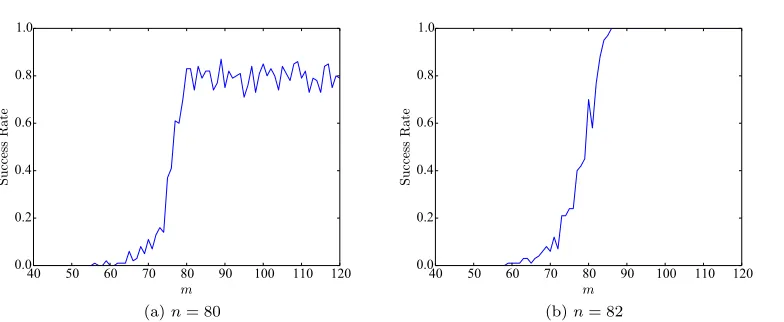
Since r and k2 are known, we can reduce them modulo 2 for each challenge, resulting in a system of linear congruences. Given m ≈ n = 80 challenge-response pairs, we can then apply Gaussian elimination to obtain the secretx. We implemented the CG protocol. From the challenge-response pairs thus obtained we constructed this system inSageand used thesolve right()method to obtain the solution. For each value ofm, we ran 100 simulations each time with a new secretxand random challenges. The result is shown in Figure 3a. After m = 77 challenge-response pairs we were able to obtain the secret more than 50 percent of the time. The peak is achieved at m = 80 where we find the secret more than 80 percent of the time. However, the success rate is never 100 percent. This is due to the fact that them×nmatrixC obtained frommchallenges described above has the peculiar characteristic that the highest possible rank is alwaysn−1 when n2 is even (recall that this matrix has rows which have exactly n
2 ones and
n
2 zeros). Therefore, any number ofm >=nrows are
linearly dependent. Gaussian elimination requiresnlinearly independent rows (or columns) to obtain a unique solution. Notice that Gaussian elimination still works when the rank is less than n. The only difference is that we get multiple solutions. We, therefore, do not get a unique solution from this linear system of congruences when n2 is even. On the other hand, if n2 is odd, the highest achievable rank isn, which means a unique solution is possible. This is illustrated in Figure 3b, where we use n= 82 and get the secret all the time afterm= 85 challenge-response pairs. The proof of why the rank of the matrixC is related to n2 being even or odd is given in AppendixB.
There are a number of interesting observations. First, the CG protocol uses one round per session. Thus, for a given confidence level γ ≥ 1, instead of nγ sessions achieved by the protocol described in Section3, we have a protocol that achieves approximately n sessions. If Gaussian elimination is optimal we can use the protocol for about 70 sessions, which for the same confidence levelγ = 15 would give only 6 sessions of the protocol described in Section 3. Below m = 70, one may apply the information set decoding attack mentioned in the last section. The attack should work withm greater than log2 8015
40 50 60 70 80 90 100 110 120
m
0.0 0.2 0.4 0.6 0.8 1.0
Su
cc
es
s
R
at
e
(a)n= 80
40 50 60 70 80 90 100 110 120
m
0.0 0.2 0.4 0.6 0.8 1.0
Su
cc
es
s
R
at
e
(b)n= 82
Figure 3: Success rate of findingxfrom the system of linear congruences built from Eq. (3).
Lastly, in the paper from Catuogno and Galdi [6] and the follow-ups [37,38], much attention has been given to show the feasibility of finding the secretxin the above protocol using the so-called SAT solvers. This line of attack works by representing the system in the form of boolean satisfiability clauses and then running a SAT solver to find the secret. The analysis from Catuogno and Galdi [6,37,38] shows that SAT solvers were only able to find the secret in the above protocol for much smaller values ofk and nand the complexity grows exponentially. This conclusion is perhaps not surprising since boolean satisfiability in general is an NP-Complete problem. However, despite this, SAT solvers are known to work efficiently in practice. In the following we attempt to explain why the SAT based attack did not work against this protocol.
5.1
SAT Solvers and Analysis of Weinshall’s Protocol
In the context of human identification protocols, SAT solvers have been used as a sort of optimised brute force strategy to find the secret. In particular, if a weakness is not known in a protocol, the SAT solver is not likely to find it, as the satisfiability clauses are constructed from what is known apriori about the information leakage of the protocol. Thus, for instance, if the only brute-force way to find the secret is to check all possible nkcombinations, then SAT solvers are not likely to find the secret in feasible time.
The interest in SAT solvers in the context of human identification protocols stems from the crypt-analysis of the Cognitive Authentication Scheme (CAS), proposed by Weinshall in [9], by Golle and Wagner [14]. By representing CAS as a series of boolean satisfiability clauses Golle and Wagner were able to find the password after a small number of observed sessions. Here we focus on the so-called
high complexity variant of CAS. The system usesnpictures out of which kare the user’s secret. The proposed parameter values are n = 80 and k = 30. A naive brute force strategy has complexity
80 30
≈273, which is arguably infeasible. The protocol is briefly described here.
The challenge consists of a grid of r = 8 rows and c = 10 columns giving us a set of 80 images which are randomly permuted. See Figure4for a sketch of the grid. The user starts from the top-left corner of the grid and does the following. If the picture in the current cell is one of the k secret images, the user moves down, otherwise the user moves right. This procedure is continued until the edge of the grid is reached. This could be either the bottom or right of the grid. Each cell at the edge is associated with a random binary number, with the right bottom cell containing two numbers, one at the bottom and one at the right.5 The user sends the number thus reached as the response.
As we can see there is some additional information leakage evident from the way the protocol is constructed. For instance, the starting cell is the top-left cell in the grid. Golle and Wagner [14] exploited this and other information that could be obtained from the protocol to build satisfiability clauses, and ran a SAT solver over these clauses to find a satisfying solution. The complexity of the attack, in terms of possible values of clauses, is proportional to the number of possible paths from the top-left corner to one of theexit points. Here we analyze the number of possible paths. A path is a route traversed from the top-left corner of the grid to one of the exit points. Figure4 represents the paths and the grid in the form of a graph, which we denote byG. We shall use this equivalent representation to enumerate the number of paths. Letrandcdenote the number of rows and columns in the grid. ThenP(r, c) denotes the total number of possible paths from the node labelled 0 in the figure to one of ther+cexit points. Note that an exit point is part of the path and can be viewed as a leaf node. We see thatP(r, c) is equal to the sum of paths in the bottom child and the right child
P(r, c) P(r, c−1)
P(r−1, c) 0
exit points
Figure 4: The number of paths P(r, c) in the graph G.
graphs ofG. By looking at these child graphs again, we see that we come across the same problem of finding paths in a reduced version of the graphG. Thus, we have the recurrence relation
P(r, c) =P(r, c−1) +P(r−1, c), (4)
with the boundary conditions
P(0, j) = 1, for 0≤j≤c,
P(i,0) = 1, for 0≤i≤r. (5)
These boundary conditions essentially mean that we have reached the exit points. In AppendixCwe show that this recurrence relation has the solution
P(r, c) = r+c
r
= r+c
c
.
This result can also be derived from a simple combinatorial argument as follows. First consider the exit points to the bottom. Each such exit point contains exactly r down steps. For each value of 0≤i≤c−1 there are exactly r−1+i ipossible waysisteps to the right exist in the path exiting to the bottom (the last step is always a downward step, hence the use of r−1). Therefore, the total number of paths that exit to the bottom is given by the sum overiwhich equals [39,§5, p. 137]
c−1
X
i=0
r−1 +i
i
=
r−1 +c
c−1
Similarly, the total number of paths that exit to the right are
c−1 +r
r−1
=
r−1 +c
c
.
Through Pascal’s formula [39, §5, p. 136], the sum of these two gives us
P(r, c) = r+c
c
= r+c
r
.
Thus, withr= 8 andc= 10 the above equation gives 43758 possible paths, consistent with the number obtained (seemingly) empirically by Yan et al. [3]. We can use Stirling’s approximation [39, §4, p. 83],
x!≈√2πxx e
x ,
to obtain
P(r, c)≈ r
r+c 2πrc
(r+c)r+c
rrcc .
Now, to ensure that the probability of reaching the exit points to the right is approximately the same as reaching the exit points at the bottom,randc should be approximately the same. Thus, we can use the fact thatn=rcto approximaterandcby√n. Using this in the above and simplifying, gives us
P(r, c)≈ 2 2√n
√ πn14
.
Forn= 80, the bound above is≈215.5. Thus we can see that the search space for the SAT solver is
much less than nk = 8030
≈273. To obtain an equivalent number we should haven≈1470, which is
surely impractical.
6
Linearization of the Foxtail Protocol
We now turn our attention to another human identification protocol named Foxtail, first proposed by Li and Shum in [5].6 The protocol has been analyzed by Yan et al. in [3] where it was shown to be vulnerable to statistical counting based attacks. A fix was proposed in [7] wherein the modified protocol was shown to resist the statistical attacks from Yan et al. [3]. We focus here on this fixed protocol. As in the case of the CG protocol, our attack essentially limits the number of allowable authentication sessions the protocol can be used. Here again, prior to our attack, an upper bound on the allowable sessions was not known. In essence, we show that the challenge-response pairs from the protocol can be represented by a set of quadratic equations. With linearization the secret can then be obtain inO(n2) challenge-response pairs using Gaussian elimination. Based on our analysis in the
previous sections we argue that other attack techniques are not likely to find the secret in feasible time.
The (modified) Foxtail protocol from [7] is as follows. Letn and k be defined as before. In the setup phase, the user and the server share a random binary vectorxof Hamming weightkas a secret. In an authentication session, the server sends a random vectorc from Zn4.7 The response from the
user is the Foxtail functionftdefined as
ft(x,c) =
c·xT mod 4 2
.
6This section contains some errors which are corrected in Appendix D. The same corrections apply to Section VI of the version of this paper titledOn the Linearization of Human Identification Protocols: Attacks based on Linear Algebra, Coding Theory and Lattices.
The server repeats the above process a fixed number of times (so that the probability of a successful random guess is low), and accepts the user if all the responses received are correct (according to the above function). Essentially, the Foxtail function maps the dot product betweencandxmodulo 4 to 0 if the result is in{0,1}, and to 1 if the result is in{2,3}. For a non-negative integera, let msb(a) denote the most significant bit in the binary representation ofa. For instance, ifa= 2, where 2 = 102
(in binary), we have thatmsb(a) = 1. Our first observation is the following.
Lemma 1. Forc∈Zn4 andx∈Zn2,
ft(x,c) =msb(c·xT mod 4).
Proof. If the dot product is in {0,1}, then the Foxtail function evaluates to 0. The most significant bit of both 0 = 002 and 1 = 012 is 0. On the other hand, if the dot product is in{2,3} the Foxtail
function evaluates to 1. The most significant bit of both 2 = 102 and 3 = 112 is 1, as required.
Consider an elementci ofc, where 1≤i≤n. Sinceci∈ {0,1,2,3}, we can write it as
ci=ci,0+ 2ci,1,
whereci,0 andci,1 both belong to{0,1}. Then, we can write
ft(x,c) = $
1 2
X
i
ci,0ximod 4
!
+1 2
X
i
2ci,1ximod 4
!%
. (6)
We have the following lemma.
Lemma 2.
1 2
X
i
2ci,1ximod 4
!
=X
i
ci,1ximod 2.
Proof. We have two possible cases pertaining to the product P
ici,1xi:
– P
ici,1xi = 2m for some integer m. The left hand side in this case yields
1
2(2·2mmod 4) = 1
2(0) = 0. The right hand side yields 2mmod 2 = 0, which is equal to the left hand side.
– P
ici,1xi= 2m+ 1 for some integerm. The left hand side gives us 12(4m+ 2 mod 4) = 12(2) = 1.
The right hand side evaluates to 2m+ 1 mod 2 = 1, again the same as the left hand side.
Using this result in Eq. (6), we get
ft(x,c) = $
1 2
X
i
ci,0ximod 4
!
+X
i
ci,1ximod 2
%
= $
1 2
X
i
ci,0ximod 4
!%
+X
i
ci,1ximod 2, (7)
where the last step is true sinceP
ici,1ximod 2 is always an integer. We have the following theorem.
Theorem 1.
$ 1 2
X
i
ci,0ximod 4
!%
=X
i
X
j>i
Proof. We again consider the possible cases related to the product P
ici,0xi:
– P
ici,0xi = 4m for some non-negative integer m. The left hand side evaluates to b12(4mmod
4)c= 0. For the right hand side, first notice that sinceci,0 and xi are both binary, the sum of
the products being 4m means that exactly 4m of the ci,0xi’s are 1. This means that exactly
4m
2
of theci,0cj,0xixj’s are 1. This implies that
4m
2
= 2m(4m−1)≡0 mod 2.
Hence, the right hand side is the same.
– P
ici,0xi= 4m+ 1 for some non-negative integerm. The left hand side evaluates to b
1 2(4m+
1 mod 4)c= 0. For the right hand side we see that now we have exactly 4m2+1
of the terms in the summation equal to 1. So, the right hand side also gives us
4m+ 1
2
= 2m(4m+ 1)≡0 mod 2.
– P
ici,0xi = 4m+ 2 for some non-negative integer m. The left hand side gives us b12(4m+
2 mod 4)c= 1. There are exactly 4m2+2
terms in the summation in the right hand side equal to 1. Thus the right hand side evaluates to
4m+ 2
2
= 2(4m2+ 3m) + 1≡1 mod 2.
– P
ici,0xi = 4m+ 3 for some non-negative integer m. The left hand side gives us b12(4m+
3 mod 4)c = 1. The summation in the right hand side has exactly 4m2+3 terms equal to 1. Thus, we get
4m+ 3
2
= 2(4m2+ 5m+ 1) + 1≡1 mod 2.
Again, the same as the left hand side.
The interpretation of the above result in light of Lemma 1 is as follows. First note that the left hand side above is equivalent to
msb X
i
ci,0ximod 4
!
.
This equals the carry-bit in adding the binary numbers ci,0xi, where we define the carry-bit as the
second digit from the right in the binary notation of the sumP
ici,0xi, considering the digits to the
left of the carry-bit as overflows (for instance, the carry bit of 5 = 1012 is 0). This can be easily
seen by noting that the last two digits of the sum can be in one of the four possible configurations: {00,01,10,11}, and the carry-bits are the first digits in these four configurations. It is easy to see that the carry-bit ofnbinary numbers is given by the sum modulo 2 of n2
possible products of pairs of these numbers.
Using the result of Theorem1in Eq. (7) we get
ft(x,c) =
X
i
X
j>i
ci,0cj,0xixj+
X
i
ci,1xi
mod 2
= (n
2)+n
X
i=1
c0iyimod 2
wherec0 is the n2
+nelement binary vector whose first n2
elements are theci,0cj,0’s and the rest of
thenelements are theci,1’s, and yis the n2
+nelement binary vector whose first n2elements are thexixj’s and the rest of thenelements are thexi’s. Since the Hamming weight ofxisk, it follows
thaty has Hamming weight k2
+k. Given a challenge vectorcone can easily construct the vector
c0. Let n0 = n2+n and k0 = k2+k. Givenm challenge-response pairs, we can thus construct a system of congruences
C0y≡rmod 2,
whereC0 is the m×n0 matrix built from c0i’s as defined above, and r is the vector ofm responses. Given m = n0 such pairs, we can solve this system uniquely using Gaussian elimination with high probability. For the parameter values n = 140, k = 14 considered in [7], this gives us n0 = 9870 andk0 = 105. For a given confidence level γ, we can then use this system for log22
γ n
0 = n0 γ =
9870
γ
sessions before secret renewal. Forγ= 20, we get about 493 sessions. This number is less than the 711 sessions mark obtained by the statistical attack from Yan et al. [3] on the original Foxtail, after which the protocol was modified in [7].
How about the case when m < n0? We see that the lattice-based attacks described in Section4.3
are not likely to find the secret sincen0 is way above the 100 mark. Information set decoding might be able to find the solution whenm≥log2( nk00
)≈834. For smaller m, however, the work required will be infeasible. Asmgrows we expect a corresponding decrease in the work factor. Figure5shows the work factor WF in log2-scale, which is the work factor obtained in [34]. We saw through the simulation that plain information set decoding performs better after m > 1956. To achieve a work factor of less than 250,m≥7110 is required. Notice that a work factor of 250 is not a bad choice for
infeasibility, as we should also take into consideration the time required in transforming such a large matrix.
0 2000 4000 6000 8000 10000
m
0 50 100 150 200 250 300 350 400
lo
g2
W
F
Figure 5: The logarithmic plot of the work factor (WF) of the information set decoding algorithm described in [34] againstmon the system of congruences derived from the Foxtail protocol.
7
Discussion
probabilityη∈(0,12). The resulting protocol can then be shown to be based on the NP-Hard problem of learning parity in the presence of the noise thus generated. In the sum ofkmins protocol, the secret is a set ofpairs of indices of x. Upon receipt of a challenge, the user chooses the minimum of the two digits in the challenge vector for each pair of secret indices and sends the response as the modulo dsum of the resulting digits. For this protocol, Hopper and Blum recommendedd= 10. They also showed that the protocol can be represented as a system of linear congruences in n2
unknowns. Thus, in light of our results, both the Foxtail protocol and the sum of k mins protocol can be
conjectured to achieve security againstO(n2) observed challenge-response pairs.8 This is an improve-ment over theO(n) challenge-response pairs obtained from the basic protocol described in Section3. Another illuminating way to look at the underlying mathematical problem in the two protocols dis-cussed in this paper is as a form of the Learing with Errors (LwE) problem [40]. Consider the Foxtail function first. We can write it as
Cx≡2r+emod 4,
whereris the response vector frommchallenges and eis an error vector. Rearranging, we get
Cx+e0≡r0mod 4,
wheree0= 3eandr0= 2r. This then can be considered as an LwE problem with the error vectore0
having the distributionχ, such thatχ(0) =χ(3) = 12 andχ(1) =χ(2) = 0. Similarly, if we consider the matrixC as composed ofmchallenges from the CG protocol, we arrive at
Cx+e≡rmod 2,
whereris them-element response vector, each element of which is obtained as a sum of responses from the protocol. The error vectorehas the trivial probability distributionχ(k2) = 1 and 0 otherwise.
More precisely the two problems can be considered as LwE with structured noise, where in the CG protocol we have the additional constraint that the rows of the matrixC have Hamming weight preciselyn
2. The fact that we show polynomial time attacks on the two protocols after observingO(n 2)
andO(n) samples in the two protocols, respectively, is consistent with the findings of Arora and Ge [41] and Ding [42] about learning in the presence of structured noise. Both these works leverage structured noise to represent the gathered samples (challenge-response pairs in our terminology) as a system of polynomials of degreeD < d, where D is the set of noise values with non-zero probability, and use linearization to obtain a solution with O(nD) samples. Therefore, by formulating the underlying
problem in the two protocols as LwE with structured noise, we may also use the attack from [41] and [42] to obtain a solution with the same sample complexity as our attacks. Note that the attack from Arora and Ge considers a broader definition of structured noise, e.g., at most 3 out of the given msamples are noisy, which also covers the pattern of structured noise considered here. For instance, the noise in the formulation of Foxtail as an LwE instance can be represented by the (quadratic) noise polynomial P(η) =η(η−3), which only evaluates to 0 when the noise η is either 0 or 3, i.e., the acceptable noise pattern [41].
8
Conclusion
We have presented a detailed analysis of the feasible ways to attack a system of linear congruences. We do not claim that the analysis is comprehensive, as there might be other ways to attack such a system. We have further taken two human identification protocols from literature and shown how they can be represented as a system of linear congruences. Using our analysis on attacks on such systems of congruences, we have shown how the security of these two protocols is reduced in terms of the number of allowable sessions before secret renewal. We have also put the protocols in context with
other human identification protocols proposed in literature in terms of the number of sessions allowed before secret renewal as a function of the protocol parameter. Moreover, we have shown how the underlying mathematical structure of the two protocols can be thought of as a contrived learning with errors (LwE) problem. An interesting open question is to construct a protocol that can resistO(n3) or
more observations while keeping the cardinality of the secret tok. This will be an improvement over the (conjectured)O(n2) bound reached by the Foxtail protocol discussed in this paper. As the
state-of-the-art protocols are arguably not practical for human authentication, an open research question is to find versions of these protocols secure against active attackers for authentication of resource constrained devices; a practice similar to the application of the HB protocol for RFID authentication.
Acknowledgments
The work of Ron Steinfeld was partially supported by ARC Discovery Grant DP150100285. We thank Matthieu Monteiro for pointing out errors in Section6 which are corrected in AppendixD.
References
[1] T. Matsumoto and H. Imai. Human identification through insecure channel. In EUROCRYPT ’91, pages 409–421. Springer-Verlag, 1991.
[2] N. J. Hopper and M. Blum. Secure Human Identification Protocols. InASIACRYPT ’01, pages 52–66. Springer-Verlag, 2001.
[3] Qiang Yan, Jin Han, Yingjiu Li, and Robert H. Deng. On Limitations of Designing Leakage-Resilient Password Systems: Attacks, Principals and Usability. In 19th Annual Network and Distributed System Security Symposium, NDSS ’12. The Internet Society, 2012.
[4] Ari Juels and Stephen A. Weis. Authenticating Pervasive Devices with Human Protocols. In
Proceedings of the 25th Annual International Conference on Advances in Cryptology, CRYPTO ’05, pages 293–308, Berlin, Heidelberg, 2005. Springer-Verlag.
[5] S. Li and H.-Y. Shum. Secure Human-Computer Identification (Interface) Systems against Peep-ing Attacks: SecHCI. IACR’s Cryptology ePrint Archive: Report 2005/268, http://eprint. iacr.org/2005/268, 2005.
[6] Luigi Catuogno and Clemente Galdi. A Graphical PIN Authentication Mechanism with Appli-cations to Smart Cards and Low-Cost Devices. In WISTP, volume 5019 of Lecture Notes in Computer Science, pages 16–35. Springer, 2008.
[7] Hassan Jameel Asghar, Shujun Li, Ron Steinfeld, and Josef Pieprzyk. Does Counting Still Count? Revisiting the Security of Counting based User Authentication Protocols against Statistical At-tacks. In 20th Annual Network and Distributed System Security Symposium, NDSS ’13. The Internet Society, 2013.
[8] Chih-Hung Wang, Tzonelih Hwang, and Jiun-Jang Tsai. On the Matsumoto and Imai’s Human Identification Scheme. InProceedings of the 14th Annual International Conference on Theory and Application of Cryptographic Techniques, EUROCRYPT ’95, pages 382–392, Berlin, Heidelberg, 1995. Springer-Verlag.
[9] Daphna Weinshall. Cognitive Authentication Schemes Safe Against Spyware (Short Paper). In
[10] M. Lei, Y. Xiao, S. V. Vrbsky, and C.-C. Li. Virtual Password using Random Linear Functions for On-line Services, ATM Machines, and Pervasive Computing. Computer Communications, 31(18):4367–4375, 2008.
[11] L. Sobrado and J.-C. Birget. Graphical Passwords. The Rutgers Scholar, 4, 2002.
[12] S. Wiedenbeck, J. Waters, L. Sobrado, and J.-C. Birget. Design and Evaluation of a Shoulder-Surfing Resistant Graphical Password Scheme. InAVI ’06, pages 177–184. ACM, 2006.
[13] X. Bai and W. Gu and S. Chellappan and X. Wang and D. Xuan and B. Ma. PAS: Predicate-Based Authentication Services against Powerful Passive Adversaries. In ACSAC ’08, pages 433–442. IEEE Computer Society, 2008.
[14] Philippe Golle and David Wagner. Cryptanalysis of a Cognitive Authentication Scheme (Ex-tended Abstract). In IEEE Symposium on Security and Privacy, SP ’07, pages 66–70. IEEE Computer Society, 2007.
[15] S. Li, S. A. Khayam, A.-R. Sadeghi, and R. Schmitz. Breaking Randomized Linear Generation Functions based Virtual Password System. In ICC ’10. IEEE, 2010.
[16] H. J. Asghar, S. Li, J. Pieprzyk, and H. Wang. Cryptanalysis of the Convex Hull Click Human Identification Protocol. In ISC ’10, pages 24–30. Springer-Verlag, 2010.
[17] S. Li, H. J. Asghar, J. Pieprzyk, A.-R. Sadeghi, R. Schmitz, and H. Wang. On the Security of PAS (Predicate-based Authentication Service). InACSAC ’09, pages 209–218. IEEE Computer Society, 2009.
[18] T. Matsumoto. Human-Computer Cryptography: An Attempt. InCCS ’96, pages 68–75. ACM, 1996.
[19] Hassan Jameel Asghar, Josef Pieprzyk, and Huaxiong Wang. A New Human Identification Pro-tocol and Coppersmith’s Baby-step Giant-step Algorithm. InProceedings of the 8th International Conference on Applied Cryptography and Network Security, ACNS ’10, pages 349–366, Berlin, Heidelberg, 2010. Springer-Verlag.
[20] Mario ˇCagalj and Toni Perkovi´c. Timing Attacks on Cognitive Authentication Schemes. IEEE Transactions on Information Forensics and Security, PP(99):1, 2014.
[21] E. Berlekamp, R. McEliece, and H. Van Tilborg. On the inherent intractability of certain coding problems. Information Theory, IEEE Transactions on, 24(3):384–386, 1978.
[22] Alexander Barg. Complexity Issues in Coding Theory. Electronic Colloquium on Computational Complexity (ECCC), 4(46), 1997.
[23] Rod G. Downey, Michael R. Fellows, Alexander Vardy, and Geoff Whittle. The Parametrized Complexity of Some Fundamental Problems in Coding Theory.SIAM J. Comput., 29(2):545–570, 1999.
[24] Hassan Jameel Asghar, Josef Pieprzyk, and Huaxiong Wang. On the Hardness of the Sum of k Mins Problem. Comput. J., 54(10):1652–1660, 2011.
[25] Arnab Bhattacharyya, Ameet Gadekar, and Ninad Rajgopal. On learning k-parities with and without noise. arXiv.org e-Print archive, arXiv:1502.05375 [cs.DS], http://arxiv.org/abs/ 1502.05375, 2015.
[26] Daniele Micciancio and Chris Peikert. Hardness of SIS and LWE with Small Parameters. In
[27] Yanbin Pan and Feng Zhang. A Note on the Density of the Multiple Subset Sum Problems. Cryptology ePrint Archive, Report 2011/525, 2011. http://eprint.iacr.org/.
[28] Jeffrey C. Lagarias and Andrew M. Odlyzko. Solving Low-density Subset Sum Problems.Journal of the ACM, 32(1):229–246, 1985.
[29] H.W. Lenstra, A.K. Lenstra, and L. Lov´asz. Factoring Polynomials with Rational Coefficients.
Mathematische Annalen, 261:515–534, 1982.
[30] Matthijs J. Coster, Antoine Joux, Brian A. LaMacchia, Andrew M. Odlyzko, Claus-Peter Schnorr, and Jacques Stern. Improved Low-Density Subset Sum Algorithms. Computational Complexity, 2:111–128, 1992.
[31] C. P. Schnorr and M. Euchner. Lattice Basis Reduction: Improved Practical Algorithms and Solving Subset Sum Problems. Math. Program., 66(2):181–199, 1994.
[32] Christiane Peters. Information-set Decoding for Linear Codes overFq. InProceedings of the Third International Conference on Post-Quantum Cryptography, PQCrypto ’10, pages 81–94, Berlin, Heidelberg, 2010. Springer-Verlag.
[33] Eugene Prange. The Use of Information Sets in Decoding Cyclic Codes. IRE Transactions on Information Theory, 8(5):5–9, 1962.
[34] Robert Niebuhr, Pierre-Louis Cayrel, Stanislav Bulygin, and Johannes Buchmann. On lower bounds for Information Set Decoding overFq. InProceedings of the 2nd International Conference on Symbolic Computation and Cryptography, SCC ’10, pages 143–157, 2010.
[35] Alexander Meurer. A Coding-Theoretic Approach to Cryptanalysis. PhD Dissertation. Available online at http://www.cits.rub.de/imperia/md/content/diss.pdf, 2012.
[36] Jacques Stern. A Method for Finding Codewords of Small Weight. In Proceedings of the 3rd International Colloquium on Coding Theory and Applications, pages 106–113, London, UK, 1989. Springer-Verlag.
[37] Luigi Catuogno and Clemente Galdi. On the Security of a Two-factor Authentication Scheme. In
Proceedings of the 4th IFIP WG 11.2 International Conference on Information Security Theory and Practices: Security and Privacy of Pervasive Systems and Smart Devices, WISTP ’10, pages 245–252, Berlin, Heidelberg, 2010. Springer-Verlag.
[38] Luigi Catuogno and Clemente Galdi. Analysis of a two-factor graphical password scheme. Inter-national Journal of Information Security, pages 1–17, 2014.
[39] Richard A. Brualdi.Introductory Combinatorics. Pearson Education, Inc., New Jersey, USA, 4th edition, 2004.
[40] Oded Regev. On Lattices, Learning with Errors, Random Linear Codes, and Cryptography. In
Proceedings of the Thirty-seventh Annual ACM Symposium on Theory of Computing, STOC ’05, pages 84–93, New York, NY, USA, 2005. ACM.
[41] Sanjeev Arora and Rong Ge. Learing Parities with Structured Noise. Hasso-Plattner-Institut: TR10-066, http://eccc.hpi-web.de/report/2010/066/, 2010.
[42] Jintai Ding. Algebraic Solvers for Certain Lattice-related Problems. InProceedings of the IEEE Information Theory Workshop, ITW ’11, pages 405–409. IEEE, 2011.
[44] Neal H. McCoy. Rings and Ideals. Carus Mathematical Monographs, 8, 1948.
[45] Wai-Sin Ching. Linear Equations over Commutative Rings. Linear Algebra and its Applications, 18(3):257–266, 1977.
[46] Marcus Nilsson and Robert Nyqvist. Number of Solutions of Linear Congruence Systems. arXiv.org e-Print archive, arXiv:1208.3550 [math.NT], http://arxiv.org/abs/1208.3550, 2012.
[47] Victor Shoup. A Computational Introduction to Number Theory and Algebra. Cambridge Uni-versity Press, New York, USA, 2nd edition, 2009.
[48] D. Bollman and H. Ramirez. On the Enumeration of Matrices Over Finite Commutative Rings.
The American Mathematical Monthly, 76(9):1019–1023, 1969.
[49] Guy Robin. Estimation de la fonction de Tchebychefθsur lek-i`eme nombre premier et grandes valeurs de la fonctionω(n) nombre de diviseurs premiers den. Acta Arithmetica, 42(4):367–389, 1983.
A
Random Square Matrices over
Z
dLetCbe a randomn×nmatrix with entries fromZd, whered≥2. Letxbe a random binary vector
ofn-elements.9 Letrbe ann-element vector defined as
Cx≡rmodd, (9)
then we are interested in finding when Gaussian elimination can be used to find the unique solution (i.e., a unique x) to the above system of linear congruences. The set Zd, together with the usual
operations of addition and multiplication, is a field whendis a prime, and a commutative ring with unity, otherwise. The two cases are therefore considered separately.
A.1
When
d
is Prime
Whendis a prime then Eq. (9) has a unique solution if only if det(C)6= 0 [43, §5.5, p. 189]. Now
det(C)6= 0 if and only if thencolumns ofC are linearly independent [43,§5.4, p. 188]. Equivalently,
det(C)6= 0 if and only if C has an inverse. Thus, if the matrixC is invertible the above system of linear equations has a unique solution. This solution can then be found through Gaussian elimination. We therefore find the probability thatCis invertible.
Let η(n, d) denote the number ofn×ninvertible matrices over Zd. Recall that an invertible C
is the same as havingn linearly independent rows. For the first row vector we havedn−1 choices,
since the only constraint on this vector is that it should not be the zero vector. The second vector should not be generated as a linear combination of the first vector, which gives usdn−dchoices for this vector. Generalizing, theith vector, where 1 ≤i≤n, should not be the linear combination of thei−1 previous vectors, implying that we havedn−di−1 choices for this vector. Thus,
η(n, d) =
n
Y
i=1
(dn−di−1).
Now, to calculate the invertibility probability,pinv, we see that there are a total of dn 2
n×nmatrices overZd. Therefore,
pinv=
Qn
i=1(d
n−di−1)
dn2 =
n
Y
i=1
(1−di−1−n) =
n
Y
i=1
(1−d−i).
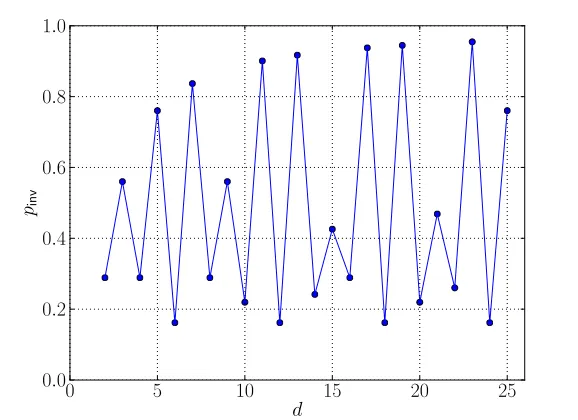
We would like to emphasize that the above result is not new, but we nevertheless present the derivation here for completeness. Figure6showspinvagainstdas the latter ranges from 2 to 25. For now, consider
only the prime values ofd. We see thatpinv is non-negligible. However, since it is less than 1 there
is a good chance that C is non-invertible. We are therefore also interested in finding the expected number of calls required to an oracle that returns a randomn-element vector fromZd, before we have
a set ofn linearly independent vectors. From the perspective of human identification protocols, this gives us the expected number of challenge-response pairs required to obtain a unique solution through Gaussian elimination. Aspinvis quite high, intuitively this number should be very close ton. We are
interested in finding a bound for the expected number of calls that is linear inn.
0 5 10 15 20 25
d
0.0 0.2 0.4 0.6 0.8 1.0
pinv
Figure 6: The probability that ann×nmatrix overZd is invertible.
We use the following simple strategy to obtainnlinearly independent vectors: We retain the first non-zero vector. Subsequently, if theith vector is linearly dependent on the set ofi−1 vectors thus obtained, we discard it. Otherwise we include it in the set. Notice that this strategy is optimal in terms of the number of oracle calls provided the probability of obtaining theith linearly independent vector does not depend on a specific set of i−1 linearly independent vectors. It is easy to see the strategy is optimal for obtaining the first vector. For the second vector, we see that if it is linearly dependent on the first vector, then replacing it with the first vector has no influence on the probability of the second vector being linearly independent. For the third vector, if it is dependent on one of the two vectors, replacing it with one of the vectors still gives us only two linearly dependent vectors and we are at the same place. Replacing it with both the vectors will give us one vector less and the probability to obtain 3 linearly independent vectors will be less than the case in which we discard this third vector. Continuing on this way, we see that this strategy is indeed optimal.
Let Xi denote the number of oracle calls required to obtain the ith linearly independent vector
given that we havei−1 linearly independent vectors. ThenXi is a geometric random variable whose
expected value is
E[Xi] =
dn dn−di−1,
which is the reciprocal of the probability that theith vector is linearly independent. Let X denote the total number of oracle calls required to obtainnlinearly independent vectors. Then
And therefore, the expected value is
E[X] = E[X1] + E[X2] +· · ·+ E[Xn]
= d
n
dn−d0 + dn
dn−d1 +· · ·+ dn dn−dn−1
= d
n
dn
1
1− 1
dn
+ 1
1− d dn
+· · ·+ 1 1−dn−1
dn
!
= 1
1−1
d
+ 1
1− 1
d2
+· · ·+ 1 1− 1
dn
= d
d−1 + d2
d2−1 +· · ·+ dn
dn−1
= d−1 + 1
d−1 +
d2−1 + 1
d2−1 +· · ·+
dn−1 + 1
dn−1
=
1 + 1
d−1
+
1 + 1
d2−1
+· · ·+
1 + 1
dn−1
=n+
n
X
i=1
1
di−1 (10)
Now, we show by induction that
di−1≥di−1 (11)
for alli≥1. First, leti= 1. This gives us d1−1≥d0⇒d−1≥1 ⇒d≥2, which is true by the
definition ofd. Now assume that for all positive integers less thanr,dr−1≥dr−1. Then
dr≥dr−1+ 1
⇒dr+1≥(dr−1+ 1)d
⇒dr+1≥dr−1d+d
⇒dr+1≥dr+d > dr+ 1
⇒dr+1−1> dr,
which proves the Inequality (11). Using this result in Eq. (10), gives us
E[X]≤n+
n
X
i=1
1 di−1.
By changing the variableitoj =i−1, we see that the sum above is translated into the sum of the firstnterms of a geometric series with the first term 1 and common ratio 1
d. Thus, the sum above is
1− 1
d
n
1−1
d
= d
n−1
dn
d d−1.
Therefore,
E[X]≤n+d
n−1
dn
d
d−1 < n+ d
d−1, (12)
where we have used the fact that dnd−n1 <1 for all d > 1 and n ≥0. Figure 7 shows the bounded

![Figure 2: The logarithmic plot of the work factor (WF) of the information set decoding algorithmdescribed in [34] against m.](https://thumb-us.123doks.com/thumbv2/123dok_us/7906832.1312844/10.612.184.430.84.270/figure-logarithmic-plot-work-factor-information-decoding-algorithmdescribed.webp)

![Figure 5: The logarithmic plot of the work factor (WF) of the information set decoding algorithmdescribed in [34] against m on the system of congruences derived from the Foxtail protocol.](https://thumb-us.123doks.com/thumbv2/123dok_us/7906832.1312844/17.612.183.430.389.568/figure-logarithmic-information-decoding-algorithmdescribed-congruences-foxtail-protocol.webp)
![Figure 7: The actual versus bounded expected number of calls E[Xn] to an oracle required to obtain linearly independent vectors in Znd.](https://thumb-us.123doks.com/thumbv2/123dok_us/7906832.1312844/25.612.176.427.91.300/figure-versus-bounded-expected-required-linearly-independent-vectors.webp)
