Security from LPN
?David Cash1, Eike Kitz2, and Stefano Tessaro3 1
Rutgers University 2
Ruhr University Bochum 3 University of California, Santa Barbara
Abstract. Secret-key authentication protocols have recently received a considerable amount of attention, and a long line of research has been devoted to devising efficient protocols with security based on the hard-ness of the learning-parity with noise (LPN) problem, with the goal of achieving low communication and round complexities, as well as highest possible security guarantees.
In this paper, we construct 2-round authentication protocols that are secure against sequential man-in-the-middle (MIM) attacks with tight reductions to LPN, Field-LPN, or other problems. The best prior pro-tocols had either loose reductions and required 3 rounds (Lyubashevsky and Masny, CRYPTO’13) or had a much larger key (Kiltz et al., EURO-CRYPT’11 and Dodis et al., EUROCRYPT’12). Our constructions follow from a new generic deterministic and round-preserving transformation enhancing actively-secure protocols of a special form to be sequentially MIM-secure while only adding a limited amount of key material and computation.
Keywords.Secret-key authentication, Man-in-the-Middle security, LPN, Field LPN.
1
Introduction
This paper constructs efficient provably-secure protocols forsecret-key authenti-cation, i.e., for the basic cryptographic task where one party, called theprover, proves to another – the verifier – that they share the same key. Theoretical constructions of such protocols (with strong security, to be defined below) exist from any one-way function. Moreover, practical two-round protocols can be built from any message-authentication code (MAC) by having one party authenticate a random challenge, and can be instantiated efficiently for example assuming AES-128 is unpredictable.
as efficient as possible, meaning that key-size, communication, and rounds are minimized. LPN problem provides confidence in security due to the failure to find polynomial-time algorithms for it and its variants, despite wide interest [7, 21, 5], and finding constructions of cryptographic primitives based on LPN has given rise to a substantial body of works [6, 14, 2, 17].
The motivation behind LPN-based authentication protocols is their potential to be implemented with different efficiency characteristics from protocols with security reductions to blockcipher security or to problems from number theory and related fields. For instance, the parallel nature of LPN-based protocols seems difficult to achieve with factoring or discrete-log type assumption. The potential efficiency benefits of LPN-based implementations are a subject of ongoing re-search, which has identified some advantageous scenarios [15] but also invented faster attacks [21]. We thus focus on developing techniques for protocol design and theoretical analysis that beat previous asymptotic runtimes, key sizes, and round complexity of protocols with similar security reductions. We make no specific claims of more efficient protocols in specific deployment scenarios.
Concurrently to the above, the recent interest on secret-key authentication has also motivated attempts to develop a better understanding of its founda-tions, providing theoretical constructions based on concrete number-theoretic assumptions like the Decisional Diffie-Hellman (DDH) assumption, or general assumptions like weak pseudorandom functions [10, 22]. We will also contribute to these lines of work with new constructions.
But before we turn to describing our contributions in detail, we first give an overview of different security notions for secret-key authentication, as well as of previous works.
Security notions.Several security notions for secret-key authentication
pro-tocols have been considered, inspired by corresponding notions for the task of public-key authentication [12]. The weakest, passive security, says that an at-tacker should not be able to fool the verifier after observing several sessions between an honest prover and an honest verifier. This seems unreasonably weak for most settings, so the strongerman-in-the-middle (MIM) securitynotion says that no attacker should be able to cause the verifier to accept in any session where a message has been changed. Realizing that MIM security from LPN seems diffi-cult to achieve efficiently, several works instead targeted an intermediate notion called active security which says that the attacker cannot fool the verifier after interacting with the prover arbitrarily and observing sessions passively.
The LPN Assumption (and its variants).Recall that for parameters`∈N
and 0 ≤ γ ≤ 1
2, the (decisional) Learning Parity with Noise (LPN) problem
obvious differences in the error distributions, this is the modulo 2 variant of the learning with error problem introduced in [27].
We are also going to consider a variant of the LPN problem, introduced and studied in [15], calledField LPN. TheField-LPN`,γ problem is very similar, however samples have the form (ri,ri◦s+ei) or (ri,r0i), where◦denotes multi-plication of `-bit vectors interpreted as elements of the extension fieldF2`,ei is a random vector where each component is 1 independently with probability γ, andr0i is uniform.
Prior constructions.Let us briefly outline the landscape of earlier works on
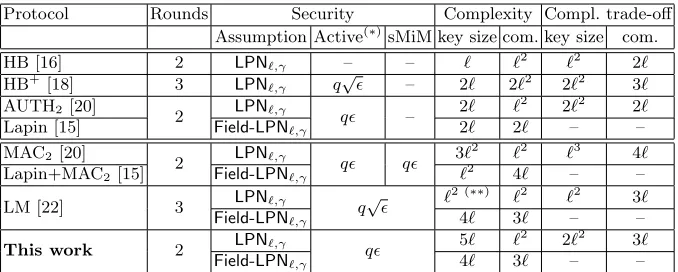
secret-key authentication. Table 1 summarizes some of these results.
Juels and Weis [18] first pointed out that a very simple two-round secret-key authentication protocol by Hopper and Blum [16], called the HB protocol, enjoys very low hardware complexity, and is hence amenable to implementations on RFID tags. Moreover, they proved that it is passively secure under the LPN assumption. Also in [18], they proposed a further three-round protocol, called HB+, which was proven actively secure in its sequential version under the LPN assumption, and later the proof was extended to its parallel version by Katz
et al. [19]. The round complexity was then reduced to two rounds by a new protocol of Kiltz et al.[20], and in contrast to HB+, this latter protocol enjoys a tight reduction to the hardness of LPN. Heyse et al. [15] then proposed an even more efficient two-round protocol, called Lapin, based on the hardness of thefieldLPN problem. We stress that three-round protocols are less attractive than two-round ones since the prover needs to keep astate (beyond the secret key), which is problematic on lightweight devices like RFID tags.
In contrast, progress has been significantly harder in the context of MIM security. On the one hand, researchers have attempted to design multiple HB-like protocols with MIM security [8, 11, 25, 13] without or only partial security proofs. Otherwise, provably MIM-secure constructions all in fact provide a full message-authentication code (MAC) secure under LPN or Field LPN [20, 10, 15]. Unfortunately, these constructions are significantly less efficient than the existing actively secure protocols mentioned above.
While following [3] the notion of MIM security traditionally allows an at-tacker to interact with arbitrarily many instances of the prover and the verifier concurrently, Lyubashevky and Masny [22] recently considered the notion of se-quential MIM (sMIM) security, which slightly weakens MIM to only allow the attacker to interfere with non-overlapping sequential sessions. They argue this notion is sufficient for situations in which keys are managed to never allow paral-lel session, and the sMIM notion is an interesting technical step towards improv-ing authentication protocol security beyond active security while maintainimprov-ing efficiency. Moreover, existing MIM attacks against actively secure protocols are often sequential (e.g., [26]). They give new protocols based on LPN and field-LPN that nearly match the complexities of actively-secure ones, but all require three rounds and suffer from a non-tight reduction to the underlying problem.
achieving both active security [10] and sMIM security [22]. Two-round MIM secure protocols from PRGs have recently been proposed [9].
All of our constructions come with reductions running in polynomial time and succeeding with probability polynomially proportional to that of a given attack. One may consider looser reductions via so-called complexity leveraging
where the reduction loses an exponential factor, with the view that one can enlarge the security parameter to compensate for the loss. Indeed one can prove (say) the AUTH2protocol from [20] as a fully-secure MAC with an exponential loss of security. A concrete instantiation of the result (assuming the BKW attack complexity is optimal [7]) will be more efficient than the other approaches we have outlined.
Polynomial reductions, however, are preferred as they are more robust to algorithmic advances against the underlying problems. Achieving them is, in our view, an interesting theoretical challenge that requires new techniques. In an implementation it is not clear to the authors if either approach (leveraging or polynomial reductions) is necessarily more secure given the many factors one must consider.
Our contributions. We provide the to-date most efficient constructions of
sMIM-secure authentication protocols based on the hardness of LPN, as well as on other assumptions. Our constructions are tworounds and the first message consists of a truly random challenge, and enjoy tight security reduction to the underlying assumption.
We improve upon the round complexity of existing sMIM-secure protocols without increasing key length and communication complexity, and without re-sorting to complexity leveraging. See Table 1 for a comparison of two of our new protocols to prior work. Note that our protocols are only a small constant factor less efficient than the best known actively (or even passively) secure protocols.
At the high level, our constructions follow from a generic transformation that upgrades a two round protocol of a special form to be sMIM-secure without introducing significant overhead. The required form is not especially contrived, but requires some care in its formalization and we present examples of such protocols to obtain our instantiations. We note that our reduction does not employ rewinding or forking lemmas like [22], and is tighter and (arguably, to our taste) simpler as a result.
Our first construction achieves sMiM security with a tight reduction to LPN, two rounds of communication, and only a modest increase in either key size or communication over [22]. Our second construction, from Field LPN, matches the key size and communication of prior work in two rounds instead of three and has a tight reduction. In fact, for an appropriate choice of components, the second construction can be understood as a two-round version of the three-round protocol from [22], though their proof does not cover the two round version.
Our last construction is based on an arbitrary weak PRF. The complexity of the construction is comparable to the one building a MAC from a weak PRF, using for example the constructions in [23, 24, 1]. However, our new protocols enjoy much better parallelism when compared to the naive approach, and is hence interesting on its own right. It is also fair to point out that [22] accom-plishes in three rounds the harder task of finding a generic construction from a (randomized) weakPRF. We observe however that the only known concrete instantiations of weak PRFs are based on LPN/LWE-type assumptions as well as on DDH, and for all these concrete instantiations our constructions are more efficient.
We remark that it is not hard to see that our proofs do not show (full) MIM security, but we are not aware of an explicit MIM attack against the protocols.
Organization. Section 2 contains basic definitions used below. In Section 3
we describe our transformation from weaker protocols of a special form, and in Section 4 we give several instantiations of the transformation.
Protocol Rounds Security Complexity Compl. trade-off
Assumption Active(∗)sMiM key size com. key size com.
HB [16] 2 LPN`,γ – – ` `2 `2 2`
HB+[18] 3 LPN`,γ q
√
– 2` 2`2 2`2 3`
AUTH2[20]
2 LPN`,γ q – 2` `
2 2`2 2`
Lapin [15] Field-LPN`,γ 2` 2` – –
MAC2 [20]
2 LPN`,γ q q 3`
2 `2 `3 4`
Lapin+MAC2[15] Field-LPN`,γ `2 4` – –
LM [22] 3 LPN`,γ q√ `
2 (∗∗) `2 `2 3` Field-LPN`,γ 4` 3` – –
This work 2 LPN`,γ q 5` `
2 2`2 3` Field-LPN`,γ 4` 3` – – Table 1: Authentication protocols based on LPN-related Assumptions. The security column lists the best possible security reduction from the given assumption, whereqis the number of tag and verification queries. (The two MAC2 protocols are even secure in the full MiM model.) The complexity column lists the key sizes and communication complexity of the protocol (with lower-order terms dropped), where` parameterizes the hardness of the assumption. AllLPN-based protocols offer a trade-off between key size and communication, which is listed in the last two columns. (∗): Reductions to active security only considered one challenge session, and thus did not have the factor q. We state the bound forqchallenge sessions for a fair comparison to MiM security. (∗∗): We remark that the key size of theLPN-based protocol in [22] is`2 but one may
be able to reduce it toO(`) by using analmost pairwise independent hash function.
2
Preliminaries
For a set X, x ← X$ denotes sampling x from X according to the uniform distribution. We use bold lowercase letters for vectors and bold uppercase letters for matrices, e.g.,x∈F`2,X∈F
`×n
linear maplcimplementing the finite field multiplication withcwhen interpreted
as an element inF2`.4
Symmetric authentication syntax. We are going to consider secret-key
authentication protocols, where a prover proves to a verifier that they hold the same secret key over two or more rounds.
More formally, anr-round symmetric authentication protocolwith associated key space K is a triple of algorithms Auth = (Gen,P,V) with the following properties:
– Key Generation. The probabilistic key-generation algorithm K ← Gen(1k) takes as input a security parameterk ∈N(in unary) and outputs a secret keyK∈ K.
– Interactive Execution. The probabilistic interactive algorithmsPandV, which we refer to as the prover and theverifier, take both as input a secret key
K ∈ K, synchronously interact with each other over r rounds, and finally
V always receives the last message and outputs a decision out(PK,VK) ∈ {accept,reject}.
We say that Authhas completeness error αif for all k∈N, Pr[out(PK,VK) =
reject;K←Gen(1k)]≤α. In this paper, we will focus on the simpler case of
two-roundprotocols, where additionally the first message is a random challengec∈ C for some set C. We call such protocols two-round random-challengesecret-key authentication protocols. In particular, in such protocols the prover simplifies to a probabilistic algorithm PK, taking the challenge and the secret key K, and producing the messaget to be sent back to the adversary. Moreover, for a challenge c∈ C and responset from the prover, the verifier is fully specified by an algorithmVK(c, t)∈ {accept,reject}.
Security.Several security notions for symmetric-key authentication protocols
have been considered in the literature. The weakest one, passive security, says that an attacker should not be able to fool the verifier after observing several sessions between a honest prover and a honest verifier. The stronger notion called
active security says that the attacker cannot fool the verifier after interacting with the prover arbitrarily and observing sessions passively.
This paper targets the security notion of(sequential) security against man-in-the-middle attacks (ors-mimsecurity, for short). Here, the adversary acts as a man-in-the middle in a sequence of independent sessions between the prover and the verifier, all with the same secret key. The adversary wins whenever it manages to let the verifier accept in some sessionandhas changed at least one of the messages sent by the prover or the verifier. We are going to formalize this notion for the relevant case of two-round protocols with random challenge.
Concretely, we describe this security notion via the following gameS-MIM
for an attacker A and a two-round random-challenge authentication protocol
Auth= (Gen,P,V) with challenge setC.
4
mainS-MIM: sid←0 K←$ Gen(1k) RunAC(),P(),V()
(1k)
Ret∃i: (c[i], t[i])6= (c0[i], t0[i])∧d[i] =accept
ProcedureC(): Ifc[sid] =⊥then
c[sid]← C$
Retc[sid]
ProcedureP(c0): Ifc0[sid] =⊥then
c0[sid]←c0,t[sid]←$ PK(c0) Rett[sid]
ProcedureV(t0):
t0[sid]←t0,c←$ C() d[sid]←VK(c, t0[sid]) sid←sid+ 1 Retd[sid]
In the game, the attacker makes calls to three oracles, C(·),P(·) and V(·). All oracles use a global variable sid to “synchronize” the sessions being sim-ulated. The first oracle returns, for every session, a new random challenge. The oracle P(c0) runs the prover on input c0 and returns the response t. Or-acle V(t0) checks that t0 is a valid response for the current session challenge
c[sid] (obtained by calling C()), and increases the session number. Note that there is a unique value c[sid] defined in every session, andP only provides (at most) one valid challenge-tag pair (c0, t) per session. The s-mim advantage is AdvsAuth-mim(A) = PrhS-MIMAuthA ⇒truei, and we say thatAuthis (t, r, )-s-mim -secure if for all attackersAwith time complexitytand running at mostrsessions, we have AdvsAuth-mim(A)≤.
Hash functions.Our constructions rely on almost pairwise-independent hash
functions.
Definition 1 (Almost pairwise-independent hash functions).Forδ≥1,
a function H:KH× X → Y isδ-almost pairwise-independent if
Pr [HKH(x) =y∧HKH(x
0) =y0]≤ δ |Y|2
for all distinct x, x0 ∈ X and all y, y0 ∈ Y, and where KH ← K$ H. Moreover, by itself,HKH(x)is uniformly distributed over Y.
The requirement that a single input has uniformly distributed output is not common, but will be useful in applications and satisfied by the construction given below. Moreover, Definition 1 impliesadaptivesecurity, i.e., when givenx,
HKH(x) =y, for anyx
0 andy0 chosenadaptivelydepending ony, the probability that HKH(x
0) =y0 is at mostδ/|Y|.
Lemma 2. If H is δ-almost pairwise-independent, then for every (unbounded) adversaryA and everyx∈ X, we have
Pr[HKH(x
0) =y0∧x06=x : KH $
← KH, (x0, y0)←$ A(HKH(x), x) ]≤ δ
Proof. Assume wlog thatA is deterministic, and letx0(x, y) andy0(x, y) be the values ofx0andy0output byAon inputsy, x, wherex0(x, y)6=xby assumption. Then,
PrhHKH(x
0) =y0 : KH $
← KH, (x0, y0)←$ A(HKH(x), x) i
=X
y
Pr [HKH(x) =y∧HKH(x
0(x, y)) =y0(x, y) ],
which is smaller than|Y| · δ |Y|2 =
δ
|Y|. ut
A construction. We will make use of the following key-length efficient
con-struction of a δ-almost-pairwise independent function, where KH =F2, Y =F and X =F` for some finite fieldF. The function, given KH = (a, b) ∈F2 and inputx= (x0, . . . , x`−1)∈F`, outputsHa,b(x) =P
`−1
i=0xi◦ai+b .
Lemma 3. The functionHabove isδ-almost pairwise independent forδ=`−1.
The folklore proof is given for completeness.
Proof. Fix x = (x0, x1, . . . , x`−1) and x0 = (x00, x01, . . . , x0`−1). Also, we define the polynomialpx(a) =P
`−1
i=0xi◦ai, and analogously, definepx0(a). Given two y, y0 ∈ F, we look at the number of keys (a, b) such that px(a) +b = y and
px0(a) +b=y0. This in particular implies thataneeds to satisfy
px(a)−px0(a) =
`−1
X
i=0
(xi−x0i)◦a
i=y−y0,
and since there exists iwith xi 6=x0i, note that by the Schwartz-Zippel lemma there are at most`−1 solutionsawith the above property, sincepx(a)−px0(a)
is a polynomial of degree at most`−1. Each suchadefines a uniqueb, and thus there are overall at most `−1 solutions, and each one of them is taken with probability |F|2.
Finally, note that the distribution of Ha,b(x) is, by itself, uniform, because the term bis uniform, and thus completely blinds the output. ut
3
Generic Construction
This section presents our main result, a generic construction of a two-round se-quential MIM-secure authentication protocol Auth. Our construction relies on a simpler two-round symmetric authentication protocolAuth0 used as a compo-nent and which satisfies a particular form of security, in addition to having a structured tag space, as we discuss next. Later below, we will provide several instantiations of this generic construction in Section 4 via constructions ofAuth0
3.1 Tools
Our construction is going to rely on an authentication protocolAuth= (Gen,P,V) whose responses given by the prover (which we calltags, following existing con-ventions in the literature)τ ←$ PK(c) are composed of two distinct components
τ = (τ1, τ2)∈ T1×T2. We refer toτ1andτ2as theleftandrighttag, respectively. In addition to this, we are going to require that the protocol satisfies two new properties which we now introduce and discuss.
Tag sparsity.The first property is a combinatorialproperty on the tag space
of Auth. We are going to require that given any challenge c, any secret key K, and any left component of the tag τ1, there are only few right components τ2 such thatτ = (τ1, τ2) is a valid tag for challengecand keyK. This is captured formally by the following definition.
Definition 4 (Right tag-sparsity). For an = (k), we say that Auth = (Gen,P,V)with tags inT1× T2, challenge spaceC, and key spaceKhas -sparse right tags(or alternatively, Authhas -right tag sparsity) if
PrhVK(c,(τ1, τ2)) =accept; τ2 $ ← T2
i
≤
for all c∈ C,K∈ K, andτ1∈ T1.
Note that one equivalent formulation is that for all K, c, and τ1, there are at most· |T2|validτ2.
ROR-CMA security.We also consider a new property calledreal-or-random
right-tag chosen-message security(orror-cmasecurity, for short), which is specific to protocols as above with tag space T1× T2. It considers a game where an attacker first receives a challenge c∗, then can obtain prover tags for arbitrary challenges of its choice, and at the end can issue exactly one verification query for the challenge c∗. The notion demands that the attacker cannot distinguish this game from another game where queries for challengesc6=c∗ have the right tagτ2 replaced by arandomelement from the same set. Formally, we introduce the following two games – denotedROR-CMA(0),ROR-CMA(1) – involvingAuth
as well as an adversary A which outputs a decision value in{true,false}at the end of the game:
mainROR-CMA(b): K←$ Gen(1k)
c∗← C$
(τ∗,state)←$ AT(·)(c∗
) d←VK(c∗, τ∗) RetA(state, d)
Procedure T(c): (τ1, τ21)
$
←PK(c),τ20 $ ← T2 Ifc=c∗ then
Retτ = (τ1, τ21) Else retτ = (τ1, τ2b)
Then, for an attacker A and a two-round protocolAuth, we define theror-cma advantageas
Accordingly, we say thatAuthis (t, q, )-ror-cma-secure if for allt-time attackers
Aissuing at mostq queries to oracleT(·), we haveAdvAuthror-cma(A)≤.
Relation to active security. We stress thatror-cmasecurity and
negligi-ble right-tag sparsity, when achieved simultaneously, do not even imply passive security. Indeed, it is easy to modify any protocol with these two properties into one accepting tags of the form (τ1,0) for every K and c (and hence becoming completely insecure) without invalidating these two properties. However, any such protocol can easily be enhanced to be secure againstactiveadversaries by blinding τ2 with a secret field elementK, either via addition or multiplication. (Note that negligible right-tag sparsity implies that the set of right tags has overwhelming size.)
Nonetheless, in order to better understand our construction below, it is im-portant to observe why the resulting protocol is not necessarily s-mim secure. Consider e.g. the protocol such that PK(c) = (τ1, τ2=PRFK(τ1kc)) for a ran-dom τ1 and pseudorandom function PRF with key K and n-bit output, and for which VK accepts (τ1, τ2) on input c if and only if PRFK(τ1kc) has Ham-ming distance at most 1 from τ2. One can verify that this protocol is ror-cma
secure and has negligible right-tag sparsity. But when the above tranformation is applied, resulting in tags (τ1, τ2 = PRFK(τ1kc) +K0), an attacker can eas-ily derive a new valid tag for c as (τ1, τ2+∆) for any weight-one ∆ – hence breaking s-mim security. (Similar counterexamples can be built when blinding via multiplication.)
3.2 The Generic Construction
We now turn to describing our generic construction transforming a ror-cma -secure two-round random challenge authentication protocol Auth0 with -right tag sparsity (for a small) into a sequential MIM secure two-round authentica-tion protocol.
Description. LetAuth0 = (Gen0,P0,V0) be two-round authentication protocol
with associated key spaceK, challenge spaceC, and split tag spaceT =T1× T2, where we assume that T2 =F is a finite field.5 We will use + and ◦ to denote addition and multiplication of field elements, respectively. Let H: KH× T1 → F be a hash function. We build a 2-round symmetric authentication protocol
Auth = (Gen,P,V) as follows. (The protocol Auth inherits the completeness error ofAuth0.)
– Key Generation. The key-generation algorithm Gen(1k) picks a key K
H $ ← KHforH, an elementKF
$
←F\ {0}, and generates a keyK0←$ Gen0(1k) for
Auth0. The key isK= (K0, KH, KF).
– Challenge. The challenge is generated by the verifierVas c← C$ .
5
– Response. The responseσ= (σ1, σ2) to challengec∈ C is computed by the proverPby first running τ= (τ1, τ2)
$
←P0K0(c) and
σ= (σ1, σ2) = (τ1, τ2◦KF+HKH(τ1))∈ T1×F.
– Verify. Given challenge c and response σ = (σ1, σ2), the verifier V recon-structs
τ= (τ1, τ2) = (σ1, (σ2−HKH(σ1))◦KF −1) and returns the decision{accept,reject} ←V0K0(c, τ).
Overhead. We note that our transformation does notincrease the tag size of
the underlying protocol Auth0, and thus retains its communication complexity. Moreover, the key length increases by addingKF and KH. Below, we will show thatHcan be instantiated with the hash-function construction given in Section 2, and thus these two additional keys consist overall ofthreefield elements.
3.3 Security
The following theorem establishes the concrete security of our generic construc-tion. In particular, it says that as long as for sufficiently small δ and , H is
δ-almost pairwise independent and Auth0 has both -right-tag sparsity and is
ror-cma-secure, then the construction iss-mim-secure.
Theorem 5 (Security of the generic construction). Assume thatH is
δ-almost universal and thatAuth0satisfies-right tag sparsity and has completeness errorα. Then, for alls-mim-attackersAinvoking at mostrsessions, there exists aror-cma-attackB such that
Advs-mimAuth (A)≤r·
Advror-cmaAuth0 (B) + r
|C|+δ |F|
|F| −1 +r·α
,
whereB has running time approximately equal to that ofA, and makes at most r queries to its oracle. In other words, if Auth0 is (t, r, )-ror-cma-secure, then Authis(t0, r, r·(+r/|C|+δ|F|/(|F| −1)))-s-mim-secure, wheret0≈t. Proof. Let A be an attacker for game S-MIM which calls its oracles for at mostr sessions. In the following, we are going to upper boundAdvsAuth-mim(A) =
PrhS-MIMAAuth⇒truei. The proof proceeds via a sequence of games.
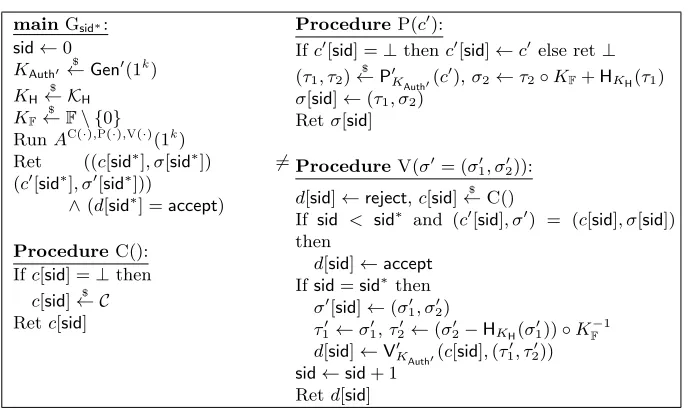
As our first step, we prove that it is sufficient to consider the first round where the attacker alters the communication between prover and verifier, and the latter still accepts. Formally, for all sid∗ ∈ {1, . . . , r}, let Winsid∗ be the
mainGsid∗:
sid←0
KAuth0←$ Gen0(1k)
KH
$ ← KH
KF←$ F\ {0} RunAC(·),P(·),V(·)
(1k)
Ret ((c[sid∗], σ[sid∗]) 6= (c0[sid∗], σ0[sid∗]))
∧(d[sid∗] =accept)
ProcedureC(): Ifc[sid] =⊥then
c[sid]← C$
Retc[sid]
ProcedureP(c0):
Ifc0[sid] =⊥thenc0[sid]←c0 else ret⊥
(τ1, τ2) $
←P0KAuth0(c 0
),σ2←τ2◦KF+HKH(τ1)
σ[sid]←(τ1, σ2) Retσ[sid]
ProcedureV(σ0= (σ01, σ
0
2)):
d[sid]←reject,c[sid]←$ C()
If sid < sid∗ and (c0[sid], σ0) = (c[sid], σ[sid]) then
d[sid]←accept Ifsid=sid∗then σ0[sid]←(σ10, σ
0
2)
τ10 ←σ01,τ20←(σ20 −HKH(σ
0
1))◦K−F1 d[sid]←V0KAuth0(c[sid],(τ
0
1, τ
0
2)) sid←sid+ 1
Retd[sid]
Fig. 1: Game Gsid∗forsid∗∈ {1, . . . , r}in the proof of Theorem 5. All oracles return ⊥ifsid>sid∗.
Sr
sid∗=1Winsid∗ be the event that S-MIMA
Auth outputs true in the first place.
Clearly, thereventsWin1, . . . ,Winrare disjoint, and therefore
Pr [Win] = Pr
" r
[
sid∗=1 Win∗sid
#
= r
X
sid∗=1
Pr [Win∗sid].
As our first step, we introducernew games G1, . . . ,Gr, where Gsid∗ only allows
the adversary A to executesid∗ sessions, and the verifier returnsreject for the firstsid∗−1 sessions unless the adversaryAhas been simply forwarding honestly generated messages. A formal description of Gsid∗ is given in Figure 1. There,
we implicitly assume that all oracles return⊥ wheneversid>sid∗. It is easy to see that by construction, Pr
GA
sid∗ ⇒true
≥Pr [Winsid∗]−(sid∗−1)α. The
offset depending on the completeness errorαis due to the fact that GA
sid∗always
accepts honest executions in sessions sid<sid∗, whereas this is not necessarily true inS-MIMAAuth. Therefore,
PrhS-MIMAAuth⇒truei= Pr [Win]≤r2α+ r
X
sid∗=1
Pr
GAsid∗⇒true. (1)
In the remainder of this proof, for everysid∗∈ {1, . . . , r}, we are going to prove an upper bound on Pr
GA
sid∗⇒true
. In particular, we now fix an arbitrary
sid∗∈ {1, . . . , r}, and let H0= Gsid∗.
ProcedureP(c0): // H1 Ifc0[sid] =⊥then
c0[sid]←c0 Else Ret⊥
(τ1, τ2) $
←P0KAuth0(c 0
) Ifc06=c[sid∗] then
τ2 $ ← T2
σ2←τ2◦KF+HKH(τ1)
σ[sid]←(τ1, σ2) Retσ[sid]
ProcedureP(c0): // H2 Ifc0[sid] =⊥then
c0[sid]←c0 Else Ret⊥
(τ1, τ2) $
←P0KAuth0(c 0
) Ifc0=c[sid∗] then
σ2 ←τ2◦KF+HKH(τ1)
Elseσ2 $ ← T2 σ[sid]←(τ1, σ2) Retσ[sid]
ProcedureP(c0): // H3 Ifsid<sid∗ andc0=c[sid∗]
then Ret⊥
Ifc0[sid] =⊥thenc0[sid]←c0 Else Ret⊥
(τ1, τ2) $
←P0KAuth0(c 0
) Ifc0=c[sid∗] then
σ2 ←τ2◦KF+HKH(τ1)
Elseσ2 $ ← T2 σ[sid]←(τ1, σ2) Retσ[sid]
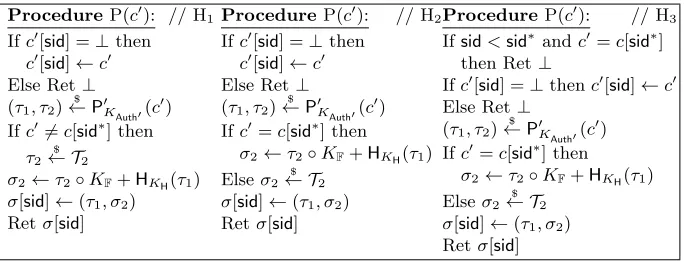
Fig. 2:Modified prover oracles in the games H1, H2, and H3.
of the respective procedures is given in Figure 2, and we now discuss them in detail.
We first transition to Game H1, where we will useror-cmasecurity ofAuth0 to replace the right half of every tag computed by P to a random component wheneverc0 6=c[sid∗], i.e., different from the random challenge used in the last round. The proof of the following lemma is given below.
Lemma 6. There exists an attacker B such that
Pr
HA0 ⇒true
−Pr
HA1 ⇒true
≤Advror-cmaAuth0 (B),
whereB has running time approximately equal to that ofA, and makes at most r queries to its oracle.
Subsequently, in Game H2, wheneverc06=c[sid∗], instead of generatingτ2 at random, we directly generate σ2 uniformly at random from the same set. Note that becauseKF6= 0, we have thatτ2·KF is a fresh random value, and thus the two games H1 and H2 are identical,
In the next game, Game H3, the procedurePreplies to a query c0 =c[sid∗] only if it is made in session sid∗, and otherwise returns ⊥. As c[sid∗] is chosen uniformly at random, and independent of the interaction between the adversary and the oracles in the firstsid∗−1 sessions, the “fundamental lemma” of game playing [4] yields
PrHA2 ⇒true−PrHA3 ⇒true
≤Pr [c[sid∗]∈ {c0[1], c0[2], . . . , c0[sid∗−1]}]≤ r |C| . (2) Therefore, putting together Equation (1), Lemma 6, and Equation (2), we obtain that there exists an attacker B making at most roracle queries and with time complexity close to the one ofA such that
PrhS-MIMAAuth⇒truei≤r·
AdvrorAuth-cma0 (B) + r
|C|+ Pr
HA3 ⇒true
In the rest of the proof, we give an upper bound on the probability that the game H3 outputs true. The argument is going to rely on the almost pairwise-independence of H and the right-tag sparsity of Auth0, and is from now on a purely information-theoretic argument. In particular, it does not rely on KAuth0
being hidden, but only on the fact that all the right tags in sessions prior tosid∗
are random.
Analysis of winning probability in H3. In the following, for notational
convenience we letσ[sid∗] = (σ1=τ1, σ2) andσ0[sid∗] = (σ10, σ02) be the original and modified values in the second-round of session sid∗. Similarly, we simply denote c =c[sid∗] and c0 =c0[sid∗]. Concretely, we are going to consider three different cases when analyzing the probability Pr
HA 3 ⇒true
: (1)c0 6=c, (2)
c0 = c and σ1 = σ01, and (3) c0 = c and σ1 6= σ01. We now analyze the three individual cases.
Case c0 6= c. Observe first that in session sid∗, the attacker obtains (τ1, σ2), where (τ1, τ2)
$
← P0K(c0sid∗) and σ2 $
← T2, and inputs (σ01, σ02) to V. It wins if (σ10, τ20) is a valid tag, whereτ20 = (σ20 −HKH(σ
0 1))◦K
−1 F .
The crucial point is that KF and KH have never been used prior to the computation ofτ20, as the oracle Phas only returned random right tags. So we can equivalently think of generating these uniformly at random for the first time at this point independent of the rest of the game, and consider the probability that V0K(c,(σ10, τ20)) verifies. Moreover, the value Y := HKH(σ
0
1) is going to be uniform (as we don’t evaluate the function on any other point) by theδ-almost pairwise independence ofH. Therefore, for every valuet∈F,
Pr [τ20 =t] = Pr
(σ20 −Y)◦K−1
F =t
= Pr [Y =KF◦t+σ20] = 1 |F|
.
However, by -right tag sparsity, we know that there are at most|F| possible valuestfor which (σ10, t) is a valid tag, and thus by the union bound
Pr
HA3 ⇒true | c06=c
= Pr [VK0 (c,(σ10, τ20)) =accept]≤· |F| · 1
|F| = . (3)
Case c0 = c, σ1 = σ10 = τ1 and σ2 6= σ20. In this case, in session sid ∗
, the attacker obtains (τ1, σ2), where (τ1, τ2)
$
←P0K(c) and σ2 $
←τ2◦KF+HKH(τ1).
Subsequently, it inputs (τ1, σ20) to V. It wins if VK0 (c,(τ1, τ20)) = accept, where
τ20 = (σ02−HKH(τ1))◦K
−1
F 6=τ2. Once again, we evaluateHonly with one input, and as aboveY =HKH(τ1) is uniformly distributed.
Now, given σ2, τ2, and σ20, we want to upper bound the probability that
τ20 =t6=τ2for some value t∈F, where the probability is over the choice ofKF andY.
Pr [τ20 =t | σ2=τ2◦KF+Y ] =
Pr [t◦KF+Y =σ02∧τ2◦KF+Y =σ2] Pr [τ2◦KF+Y =σ2]
.
at most 1/|F|, and thus the probability in the numerator is upper bounded by 1/(|F|(|F| −1)). Moreover, τ2 ◦KF +Y is clearly uniform (because Y is uniform), and thus the denominator is 1/|F|. Putting these together gives us Pr [τ20 =t | σ2=τ2◦KF+Y ]≤1/(|F| −1). Now, due to-right tag sparsity, there are at most· |F|right tagsτ20 that verify, and thus
PrHA3 ⇒true| c0=c∧σ1=σ10
≤· |F|
|F| −1 . (4)
Case c0 = c and σ1 =6 σ10. For the final case, the attacker obtains (τ1, σ2) as in the previous case, but inputs (σ10 6= τ1, σ20) to V, and the latter computes
τ20 = (σ02−HKH(σ
0 1))◦K
−1 F .
Here, we indeed evaluate HKH on two inputs. However, by Lemma 2, we
see that for every possible valuesσ10 and y0, chosen adaptively depending onτ1 andHKH(τ1),HKH(σ
0
1) =y0 with probability at mostδ/|F|. Therefore, for every possiblet such thatV0K(c,(σ01, t)) =accept, we have
Pr [τ20 =t] = Pr [HKH(σ
0) =K
F·t+σ 0
2]≤δ/|F|.
Now, due to -right tag sparsity, there are at most · |F| such right tags, and thus
Pr
HA3 ⇒true | c0=c∧σ16=σ01
≤· |F| ·
δ
|F|
=δ . (5)
Putting things together.To conclude the proof, we observe that all terms
in Equations (3), (4) and (5) are upper bounded by·δ· |F|
|F|−1, and thus we also have Pr
HA 3 ⇒true
≤·δ· |F|
|F|−1. ut
Proof (Lemma 6). The attacker B for ROR-CMA(b) is very simple. It simu-lates the execution of Hb to the attacker A. Initially,B uses its input challenge
c∗ as csid∗. Then, when simulating queries to P on input c0, it forwards them
to its own oracle T, to obtain a pair (τ1, τ2). Finally, B uses the one avail-able verification query to compute V’s decision bit in session sid∗. Finally, B
outputs the games Hb’s output. By inspection, it is not hard to verify that Pr
ROR-CMA(b)B
Auth0 ⇒true
= Pr
HA b ⇒true
, which concludes the proof of
the lemma. ut
4
Instantiations
Scheme Assump. Gen(1n) / ResponseP(c) / VerifyV(c, σ)
AuthLPN§4.1 LPN
Gen(1n) : (x1, . . . ,x5) $
←(F`2)5
P(c) = (R,R·(Mc·x1+x2) +x3◦e+Hx4,x5(R)∈F `×n 2 ×F
` 2 V(c,(R,z)) : |(z−Hx4,x5(R)−R·(Mc·x1+x2))◦x−31|small?
AuthTLPN§4.1 LPN
Gen(1n) : (X
1,X2,x3,x4) $
←(Fn2×`) 2×(
F`2)2 P(c) = (r,(X1·Mc+X2)·r+x3◦e+x4)∈F`2×Fn2 V(c,(r,z)) : |(z−x4−(X1·Mc+X2)·r)◦x−31|small?
AuthField-LPN§4.2Field-LPN
Gen(1n) : (x
1, . . . ,x4) $
←(F2`) 4
P(c) = (r,r◦(x1◦c+x2) +x3◦e+x4)∈F2`×F2` V(c,(R,z)) : |(z−x4−r◦(x1◦c+x2))◦x3−1+x4)|small?
Authddh§4.4 ddh
Gen(1n) : (x1, x2, X) $
←F2q×G
P(c) = (R, X·Rx1c+x2)∈
G×G
V(c,(r, z)) : X·Rx1c+x2=z?
Authwprf§4.3 wprf
(x0,0, . . . , x`,1,x1,x2) $
←D2`×F2
P(c) = (r,P`
i=1F(xi,ci, r) +Hx1,x2(r))∈D×F V(c,(r, z)) : P`
i=1F(xi,ci, r) +Hx1,x2(r) =z?
Table 2: News-mim-secure 2-round authentication protocols.
4.1 Instantiations from LPN
Learning Parity with Noise. For a parameter 0 < γ ≤ 1/2, we define
the Bernoulli distribution Bγ that assigns e ← Bγ$ the values 1 and 0 with probabilitiesγ and 1−γ, respectively. If Dis a distribution over D, thenx←$ Dn denotes the n-fold distribution where each component ofx ∈
Dn is chosen according toD.
To define the LPN`,γ problem in dimension` ∈Nand Bernoulli parameter 0< γ≤1/2 we introduce theLPNadvantage as the quantity
AdvLPN(A) = PrhALPNs,γ()⇒true
i
−PrhALPNs,1/2()⇒true
i ,
where s←$ F`
2 andLPNs,α (α∈ {γ,1/2}) returns (r,rT ·s+e) forr $ ←F`
2 and
e← Bα$ . Note that oracleLPNs,1/2always returns uniform (r, z) $
←F`2×F2. We say that theLPN`,γ is (t, q, )-hard if for all attackersAwith time complexityt, making at mostqoracle queries, we haveAdvLPN(A)≤.
ROR-CMA secure Protocol. Let n = O(`) denote the number of
repeti-tions, γ the parameter of the Bernoulli distribution, and γ0 := 1/4 +γ/2 con-trols the correctness error. The following authentication protocol Auth0LPN = {Gen0,P0,V0} originates from [20]. It has associated key space K = (F`
2)2, tag spaceT =T1× T2=F2`×n×Fn2, and challenge spaceC=F`2.
– Key Generation. The key-generation algorithm Gen0 outputs a secret key
K= (k1,k2) $ ←(F`
2)2.
– Challenge. The challenge is generated by the verifierV0 asc←$ F`2.
k2) +e), wheree← B$ n
γ. (Recall thatMcis the matrix representation of the
finite field multiplication withc.)
– Verification. Given challengec∈F`2and responseτ = (R,z)∈F `×n
2 ×Fn2, the verifierV0outputsacceptiff:rank(R) =nand|RT·(Mc·k1+k2)−z| ≤γ0n. With the choice ofγ0= 1/4+γ/2,Auth0LPNhas 2−O(n)completeness error [20, Th.
4]. Further, it has-sparse right tags, where= Pr[z≤γ0n|z $
←Fn2]≤2−O(n), using the Hoeffding bound.
The proof of the following theorem is postponed to Appendix A.2.
Theorem 7. IfLPN`,γ is(t, nq, )-hard, thenAuthLPN0 is(t0, q, )-ror-cma-secure with t≈t0.
There exists an alternativeror-cma-secure authentication protocol [10, 20] which definesτ2=RT ·k↓c+e, wherek↓c is the projection of kwith respect to all`
non-zero bits ofc∈ C:={F22` : |c|=`}.
MiM secure Protocol.As-mim-secure 2-round authentication protocolAuthLPN
is obtained via the generic transformation from Section 3. An example instan-tiation using the almost pairwise independent hash function from Section 2 is given in Table 2.
Trade-off.For allLPN-based protocols there exists a natural trade-off between
key-size and communication complexity, as we will explain now. In theror-cma -secure protocolAuthT0LPNwe can chose the key as (K1,K2)
$
←(Z`2×n)2and define the response to a challengec∈F`
2 as (r,(Mc·K1+K2)·r+e∈F`2×Fn2, where r←$ F`2. In the resulting s-mim-secure protocol we can use the specific pairwise independent hash function HS1,s2(r) := S1r+s2, where (S1,s2) ∈F
`×n 2 ×F
n 2. The response to a challengecis computed asσ= (r,z), where
z= ((Mc·K1+K2)·r+e)◦KF+S1r+s2
= (Mc·K1·MKF+K2·MKF+S1)·r+MKF·e+s2.
This can be rewritten asz= (Mc·X1+X2)·r+e◦x3+x4using the substitutions x1:=K1·MKF, X2:=K2·MKF+S1, x3:=KF, x4:=s2. The resulting protocolAuthTLPN is described in Table 2.
4.2 Instantiations from Field-LPN
Field Learning Parity with Noise.To define theField-LPN`,γproblem over
the extension field (F2`,◦,+) and Bernoulli parameter 0< γ≤1/2, we introduce theField-LPNadvantage as the quantity
AdvField-LPN(A) = PrhAFLPNs,γ()⇒truei−PrhAFLPNs,1/2()⇒true
i ,
where s←$ F2` and FLPNs,α returns (r,r◦s+e) for r $
← F2` and e $ ← B`
α. Note that FLPNs,1/2 always returns uniform (r,z)
$
Field-LPN`,γ is (t, q, )-hard if for all attackersAwith time complexitytmaking at mostqoracle queries, we haveAdvField-LPN(A)≤.
ROR-CMA secure Protocol. Letγ the parameter of the Bernoulli
distri-bution, and γ0 := 1/4 +γ/2 controls the correctness error. We use F = F2` to denote the finite field. The following authentication protocol Auth0Field-LPN= {Gen0,P0,V0}originates from [15]. It has associated key spaceK=F2, split tag spaceT =T1× T2=F×F, and challenge space C=F.
– Key Generation. The key-generation algorithm Gen0 outputs a secret key
K= (k1,k2) $ ←F2.
– Challenge. The challenge is generated by the verifierV0 asc←$ F.
– Response. The responseτ = (τ1, τ2) to challenge c ∈F is computed by the proverP0 as τ= (r,r◦(k1◦c+k2) +e), wherer
$
←F,e← B$ `γ.
– Verification. Given challengec∈Fand responseτ = (r,z)∈F2, the verifier
V0 outputsacceptiff|r◦(k1◦c+k2)−z| ≤γ0n.
As in theLPNcase,Auth0Field-LPNhas 2−O(`)completeness error and 2−O(`)-sparse
right tags. The proof of the following theorem is similar to that of Theorem 7 and is therefore omitted.
Theorem 8. IfField-LPN`,γis(t, q, )-hard, thenAuth0Field-LPNis(t0, q, )-ror-cma -secure witht0≈t.
MiM secure Protocol. We now apply our generic transformation from
Sec-tion 3 to Auth0Field-LPN to obtain a s-mim-secure protocol. The key consists of (k1,k2, KF,s1,s2), where we use the concrete pairwise-independent hash func-tionHs1,s2(r) =s1◦r+s2. The response to a challengecis computed asσ= (r,z), wherez= (r◦(k01◦c+k20) +e)◦KF+s1◦r+s2
= (r◦(k0
1 ◦KF ◦c+k02 ◦KF +s1) +e◦KF +s2. This can be written as z= (r◦(x1◦c+x2)+e◦x3+x4using the substitutionsx1:=k1◦KF, x2:=k2◦
KF+s1, x3:=KF, x4:=s2. The resulting simplified protocolAuthField-LPN
is given in Table 2.
4.3 Instantiations from weak PRFs
Weak Pseudorandom Function.LetFbe a function familyF :K×D→F.
To define the wprfF assumption over function familyF we introduce the wprf
advantage of an adversaryA as the quantity
AdvwprfF (A) = Pr[AFx() ⇒true]−Pr[AU()
⇒true],
wherex←$ K,Fxreturns (r, F(x, r)) forr $
←D, andUreturns uniform (r, z)←$ D×F. We say that F is a (t, q, )-weak PRF if for all attackers A with time complexityt, making at mostqoracle queries, we have AdvwprfF (A)≤.
ROR-CMA secure Protocol.We define an authentication protocolsAuth0wprf =
{Gen0,P0,V0}with associated key spaceK=K`, split tag spaceT =T
– Key Generation. The key-generation algorithm Gen0 outputs a secret key
K= (x1,0, . . . , x`,0, x1,1, . . . , x`,1) $ ←K2×`.
– Challenge. The challenge is generated by the verifierV0 asc← {$ 0,1}`. – Response. The responseτ = (τ1, τ2) to challengec∈ {0,1}` is computed by
the proverP0 as τ= (r, z=P`
i=1F(xi,ci, r)), wherer $ ←D. – Verification. Given challengec∈ {0,1}`and responseτ= (r, z)∈
D×F, the verifierV0 outputsacceptiffP`
i=1F(xi,ci, r) =z.
The protocol has perfect completeness and 1/|F|-sparse right tags. It is easy to extendAuth0wprf to randomized weak PRFs (with additive noise), as defined in [22]. This way we obtain protocols from a more general class of assumptions, such as Toeplitz-LPN [22]. The proof of the following theorem is in Appendix A.2.
Theorem 9. If F is a (t, q, )-weak PRF, then Auth0wprf is (t0, q, /`)-ror-cma
-secure witht0≈t.
4.4 Instantiation from DDH
The DDH Problem.LetGbe a family of groups withGn= (G, g, p), whereG
is a cyclic group of prime-orderpwithdlogpe=nandg generatesG. To define the ddhG problem over group family G we introduce theddh advantage as the quantity
AdvddhG (A) = PrhADDHx()⇒truei−PrhAU()
⇒truei,
where x←$ Zp andDDHx returns (R, Rx) forR $
←Zp, andU returns uniform
(R, Z)←$ G2. We say that ddhG is (t, q, )-hard if for all attackersAwith time complexitytmaking at mostqoracle queries, we haveAdvddh(A)≤. Note that classical ddh hardness is exactly (t0,1, 0)-hardness ofddhG and by the random self-reducibility of ddh we have that ddhG is (t, q, )-hard iff it is (t0,1, 0)-hard witht≈t0 and≈0.
ROR-CMA secure Protocol.We define an authentication protocolAuth0ddh=
{Gen0,P0,V0}with associated key spaceK =
Z2p, split tag spaceT =T1× T2= G×G, and challenge spaceC=Zp.
– Key Generation. The key-generation algorithm Gen0 outputs a secret key
K= (y1, y2) $ ←Z2p.
– Challenge. The challenge is generated by the verifierV0 asc←$ Zp.
– Response. The responseτ= (τ1, τ2) to challengec∈Fp is computed by the proverP0 as τ= (R, Ry1·c+y2), whereR←$
G.
– Verification. Given challenge c ∈ Zp and response τ = (R, Z) ∈ G2, the verifierV0 outputsacceptiffRy1·c+y2 =Z.
Theorem 10. If ddhG is (t, q, )-hard, then Authddh0 is (t0, q, )-ror-cma-secure with t0≈t.
The proof is similar to the one of Theorem 7 and is omitted.
MiM secure Protocol. We now apply our generic transformation from
Sec-tion 3 toAuth0ddhto obtain as-mim-secure protocol. By using the field structure of Zpin the exponent, we can use the concrete pairwise-independent hash function
Hs1,S2(R) =R s1·S
2∈G, where (s1, S2)∈Zp×G. The key ofAuthddhconsists of
(y1, y2, KF, s1, S2). We now show that the key ofAuthddh can be shrinked by two
elements, see Table 2. The response to a challengecis computed asσ= (R, Z), where Z = (Ry1·c+y2)KF·Rs1S
2 = Ry1KF·c+y2KF+s1S2. This can be written as
Z =Rx1c+x2S
2 using the substitutionsx1 :=y1KF, x2:=y2KF+s1, X :=
S3.The resulting simplified protocolAuthddh is given in Table 2.
Acknowledgements
David Cash was partially supported by NSF grant CNS-1453132.
Eike Kiltz was supported by a Sofja Kovalevskaja Award of the Alexander von Humboldt Foundation and ERC Project ERCC (FP7/615074).
Stefano Tessaro was partially supported by NSF grants CNS-1423566 and the Glen and Susanne Culler Chair.
This work was done in part while David Cash and Stefano Tessaro were visiting the Simons Institute for the Theory of Computing, supported by the Simons Foundation and by the DIMACS/Simons Collaboration in Cryptography through NSF grant CNS-1523467.
References
1. A. Akavia, A. Bogdanov, S. Guo, A. Kamath, and A. Rosen. Candidate weak pseudorandom functions in ac0 ; mod2. InITCS, pages 251–260, 2014.
2. B. Applebaum, D. Cash, C. Peikert, and A. Sahai. Fast cryptographic primitives and circular-secure encryption based on hard learning problems. In S. Halevi, editor,CRYPTO 2009, volume 5677 ofLNCS, pages 595–618, Santa Barbara, CA, USA, Aug. 16–20, 2009. Springer, Heidelberg, Germany.
3. M. Bellare and P. Rogaway. Entity authentication and key distribution. In D. R. Stinson, editor,CRYPTO’93, volume 773 ofLNCS, pages 232–249, Santa Barbara, CA, USA, Aug. 22–26, 1994. Springer, Heidelberg, Germany.
4. M. Bellare and P. Rogaway. The security of triple encryption and a framework for code-based game-playing proofs. In S. Vaudenay, editor,EUROCRYPT 2006, volume 4004 ofLNCS, pages 409–426, St. Petersburg, Russia, May 28 – June 1, 2006. Springer, Heidelberg, Germany.
5. D. J. Bernstein and T. Lange. Never trust a bunny. InRFIDSec, pages 137–148, 2012.
7. A. Blum, A. Kalai, and H. Wasserman. Noise-tolerant learning, the parity problem, and the statistical query model. In 32nd ACM STOC, pages 435–440, Portland, Oregon, USA, May 21–23, 2000. ACM Press.
8. J. Bringer, H. Chabanne, and E. Dottax. HB++: a Lightweight Authentication Protocol Secure against Some Attacks. InSecPerU, pages 28–33, 2006.
9. I. Damg˚ard and S. Park. Towards optimally efficient secret-key authentication from PRG. Cryptology ePrint Archive, Report 2014/426, 2014. http://eprint. iacr.org/2014/426.
10. Y. Dodis, E. Kiltz, K. Pietrzak, and D. Wichs. Message authentication, revisited. In D. Pointcheval and T. Johansson, editors,EUROCRYPT 2012, volume 7237 of LNCS, pages 355–374, Cambridge, UK, Apr. 15–19, 2012. Springer, Heidelberg, Germany.
11. D. N. Duc and K. Kim. Securing HB+ Against GRS Man-in-the-Middle Attack. InSCIS, 2007.
12. A. Fiat and A. Shamir. How to prove yourself: Practical solutions to identification and signature problems. In A. M. Odlyzko, editor, CRYPTO’86, volume 263 of LNCS, pages 186–194, Santa Barbara, CA, USA, Aug. 1987. Springer, Heidelberg, Germany.
13. H. Gilbert, M. J. B. Robshaw, and Y. Seurin. HB]: Increasing the security and efficiency of HB+. In N. P. Smart, editor, EUROCRYPT 2008, volume 4965 of LNCS, pages 361–378, Istanbul, Turkey, Apr. 13–17, 2008. Springer, Heidelberg, Germany.
14. H. Gilbert, M. J. B. Robshaw, and Y. Seurin. How to encrypt with the LPN prob-lem. In L. Aceto, I. Damg˚ard, L. A. Goldberg, M. M. Halld´orsson, A. Ing´olfsd´ottir, and I. Walukiewicz, editors, ICALP 2008, Part II, volume 5126 of LNCS, pages 679–690, Reykjavik, Iceland, July 7–11, 2008. Springer, Heidelberg, Germany. 15. S. Heyse, E. Kiltz, V. Lyubashevsky, C. Paar, and K. Pietrzak. Lapin: An efficient
authentication protocol based on ring-LPN. In A. Canteaut, editor, FSE 2012, volume 7549 ofLNCS, pages 346–365, Washington, DC, USA, Mar. 19–21, 2012. Springer, Heidelberg, Germany.
16. N. J. Hopper and M. Blum. Secure human identification protocols. In C. Boyd, editor,ASIACRYPT 2001, volume 2248 ofLNCS, pages 52–66, Gold Coast, Aus-tralia, Dec. 9–13, 2001. Springer, Heidelberg, Germany.
17. A. Jain, S. Krenn, K. Pietrzak, and A. Tentes. Commitments and efficient zero-knowledge proofs from learning parity with noise. In X. Wang and K. Sako, editors, ASIACRYPT 2012, volume 7658 ofLNCS, pages 663–680, Beijing, China, Dec. 2– 6, 2012. Springer, Heidelberg, Germany.
18. A. Juels and S. A. Weis. Authenticating pervasive devices with human protocols. In V. Shoup, editor,CRYPTO 2005, volume 3621 ofLNCS, pages 293–308, Santa Barbara, CA, USA, Aug. 14–18, 2005. Springer, Heidelberg, Germany.
19. J. Katz, J. S. Shin, and A. Smith. Parallel and concurrent security of the HB and HB+ protocols. Journal of Cryptology, 23(3):402–421, July 2010.
20. E. Kiltz, K. Pietrzak, D. Cash, A. Jain, and D. Venturi. Efficient authentication from hard learning problems. In K. G. Paterson, editor, EUROCRYPT 2011, volume 6632 ofLNCS, pages 7–26, Tallinn, Estonia, May 15–19, 2011. Springer, Heidelberg, Germany.
22. V. Lyubashevsky and D. Masny. Man-in-the-middle secure authentication schemes from LPN and weak PRFs. In R. Canetti and J. A. Garay, editors,CRYPTO 2013, Part II, volume 8043 ofLNCS, pages 308–325, Santa Barbara, CA, USA, Aug. 18– 22, 2013. Springer, Heidelberg, Germany.
23. U. M. Maurer and J. Sj¨odin. A fast and key-efficient reduction of chosen-ciphertext to known-plaintext security. In M. Naor, editor,EUROCRYPT 2007, volume 4515 ofLNCS, pages 498–516, Barcelona, Spain, May 20–24, 2007. Springer, Heidelberg, Germany.
24. U. M. Maurer and S. Tessaro. Basing PRFs on constant-query weak PRFs: Min-imizing assumptions for efficient symmetric cryptography. In J. Pieprzyk, editor, ASIACRYPT 2008, volume 5350 of LNCS, pages 161–178, Melbourne, Australia, Dec. 7–11, 2008. Springer, Heidelberg, Germany.
25. J. Munilla and A. Peinado. HB-MP: A Further Step in the HB-Family of Lightweight Authentication Protocols.Computer Networks, 51(9):2262–2267, 2007. 26. K. Ouafi, R. Overbeck, and S. Vaudenay. On the security of HB# against a man-in-the-middle attack. In J. Pieprzyk, editor, ASIACRYPT 2008, volume 5350 of LNCS, pages 108–124, Melbourne, Australia, Dec. 7–11, 2008. Springer, Heidel-berg, Germany.
27. O. Regev. On lattices, learning with errors, random linear codes, and cryptography. In H. N. Gabow and R. Fagin, editors,37th ACM STOC, pages 84–93, Baltimore, Maryland, USA, May 22–24, 2005. ACM Press.
A
Omitted proofs
A.1 Proof of Theorem 7
Proof. Let A be an adversary in the ROR-CMAAAuth0(b) security game. We
de-fine an adversary BLPNs,α() against the LPN
`,γ problem, where α ∈ {γ,12} is unknown.
AdversaryBLPNs,α: k02←$ Z`
2 c∗←$ F`
2
(τ∗,state0)←$ AT(·)(1k,c∗) Parseτ∗= (R∗,z∗)∈F`2×n×F
n 2
If|(R∗)T ·k02−z∗| ≤γ0nandrank(R) =n d←accept.
Elsed←reject
RetA(state, d)
ProcedureT(c): Ifc=c∗ then
z← B$ n γ R←$ F`2×n Else
( ˜R,z)←$ LPNns,α() RT ←R˜T ·(M
c−Mc∗)−1 τ1←R
τ2←z+RTk02 Ret (τ1, τ2)
Note that due to the finite field properties of the linear mapMc, matrixMc−
Mc∗ is always invertible forc6=c∗. AdversaryB implicitly definesk1:=sand
k2 := −Mc∗·k1+k02, where s is the LPN secret. As k02 is uniform, the key
k= (k1,k2) has the correct distribution. The definition ofK= (k1,k2) implies that
As K(c∗) =k02, the bitdis always computed correctly byB. We now consider the distribution of T(c). First note thatτ1is always a uniform matrix inF`2×n. Forc=c∗,zis Bernoulli distributed and, using Equation (6),τ2=RTk02+zis distributed as computed by proverP0. Further, forc6=c∗ we have
τ2= ˜RT ·s+e+RTk02
=RT ·(Mc−Mc∗)·k1+e+RTk02
=RT ·(Mc·k1+k2) +e,
wheree← B$ `
α. Ifα=12, thenτ1andτ2 are uniformly distributed and Pr[BLPNs,1/2() ⇒true] = Pr[ROR-CMAA
Auth0(0)⇒true].
If α = γ, then τ = (τ1, τ2) is distributed as computed by prover P0. Hence Pr
BLPNs,γ()⇒true = Pr[ROR-CMAA
Auth0(1)⇒true]. The last two equations
provide AdvLPN(B) =AdvAuthror-cma0 (A), where the running time ofB is
approxi-mately that ofA. ut
A.2 Proof of Theorem 9
Proof. LetAbe an attacker in theROR-CMA(1) game. We now describe games
G0, . . . ,G` that are exactly like theROR-CMA(1) game, but with modified pro-cedure T(c). For j ∈ {0, . . . , `−1}, letSj :{0,1}j →Fbe a random function, whereS0(ε) is defined to be 0. Note thatSj can be efficiently simulated by lazy evaluation.
mainGj:
K←$ Gen0(1k)
c∗ ← {$ 0,1}`
(τ∗,state)←$ AT(·)(c∗)
d←VK0 (c∗, τ∗) Ret A(state, d)
Procedure T(c): //Gj
r←$ D
Ifc|j =c∗|j then
z=P`
i=1F(xi,ci, r) Else
z=Sj(c|j) +P `
i=j+1F(xi,ci, r) Ret τ= (τ1←r, τ2←z)
Note that in game G0 all tagsτ are computed correctly by T and henceG0 =
ROR-CMA(1). Furthermore, in game G`, all tags except for challenge c∗ are uniform and henceG`=ROR-CMA(0). The following lemma completes the proof of Theorem 9.
Lemma 11. For anyj∈ {0, . . . , `−1}, there exists an attackerBj such that Pr
GAj ⇒true
−Pr
GAj+1⇒true
≤AdvwprfF (B).
AdversaryBO:
c∗ $
← {0,1}`
xi,k= (
undefined i=j+ 1∧k6=c∗j+1 uniform inK otherwise
(τ∗,state)←$ AT(·)(c∗) Parseτ∗= (r∗, z∗)∈D×F
IfP`
i=1F(xi,c∗ i, r
∗) =z∗
d←accept. Elsed←reject RetA(state, d)
ProcedureT(c): Ifc|j+1=c∗|j+1then
r←$ D;z=P`i=1F(xi,ci, r)
Else
ifcj+16=c∗j+1then (r, z0)
$
←O()
Elser←$ D;z0=F(xj+1,cj+1, r)
z=Sj(c|j) +z0+P `
i=j+2F(xi,ci, r)
τ1←r
τ2←z Ret (τ1, τ2)
AdversaryB knows all secrets xi,k exceptxj+1,1−c∗
j which he defines implicitly as the secret xfrom theFx oracle. In particular, he knows xi,c∗
i and the bit d is always computed correctly. It remains to analyze the distribution ofT(c). If
cj+1 = c∗j+1, then the output ofT(c) in games Gj and Gj+1 is identical. We now analyze the case cj+1 6= c∗j+1. If O = Fx, then z = Sj(c|j) +F(x, r) +
P`
i=jF(xi,ci, r) = Sj(c|j) +
P`
i=j+1F(xi,ci, r) and hence Pr[B
Fx()⇒true] = Pr[GAj ⇒true]. IfO=U, thenz=Sj(c|j)+z0+P
`
i=j+1F(xi,ci, r) =Sj(c|j+1)+
P`
i=j+1F(xi,ci, r) and hence Pr[BU
() ⇒true] = Pr[GA