Scholarship at UWindsor
Scholarship at UWindsor
Electronic Theses and Dissertations Theses, Dissertations, and Major Papers
2014
A Subjective Logic Library Constructed Using Monadic Higher
A Subjective Logic Library Constructed Using Monadic Higher
Order Functions
Order Functions
Bryan Gary St. Amour
University of Windsor
Follow this and additional works at: https://scholar.uwindsor.ca/etd
Recommended Citation Recommended Citation
St. Amour, Bryan Gary, "A Subjective Logic Library Constructed Using Monadic Higher Order Functions" (2014). Electronic Theses and Dissertations. 5187.
https://scholar.uwindsor.ca/etd/5187
This online database contains the full-text of PhD dissertations and Masters’ theses of University of Windsor students from 1954 forward. These documents are made available for personal study and research purposes only, in accordance with the Canadian Copyright Act and the Creative Commons license—CC BY-NC-ND (Attribution, Non-Commercial, No Derivative Works). Under this license, works must always be attributed to the copyright holder (original author), cannot be used for any commercial purposes, and may not be altered. Any other use would require the permission of the copyright holder. Students may inquire about withdrawing their dissertation and/or thesis from this database. For additional inquiries, please contact the repository administrator via email
Higher Order Functions
By: Bryan St. Amour
A Thesis
Submitted to the Faculty of Graduate Studies through the School of Computer Science in Partial Fulfillment of the Requirements for
the degree of Master of Science at the University of Windsor
Windsor, Ontario, Canada 2014
c
Higher Order Functions
By: Bryan St. Amour APPROVED BY:
Dr. R Caron
Department of Mathematics and Statistics
Dr. R Frost
School of Computer Science
Dr. R Kent, Advisor School of Computer Science
I hereby certify that I am the sole author of this thesis and that no part of this thesis has been published or submitted for publication.
I certify that, to the best of my knowledge, my thesis does not infringe upon anyone’s copyright nor violate any proprietary rights and that any ideas, techniques, quotations, or any other material from the work of other people included in my thesis, published or oth-erwise, are fully acknowledged in accordance with the standard referencing practices. Fur-thermore, to the extent that I have included copyrighted material that surpasses the bounds of fair dealing within the meaning of the Canada Copyright Act, I certify that I have ob-tained a written permission from the copyright owner(s) to include such material(s) in my thesis and have included copies of such copyright clearances to my appendix.
I declare that this is a true copy of my thesis, including any final revisions, as approved by my thesis committee and the Graduate Studies office, and that this thesis has not been submitted for a higher degree to any other University or Institution.
Subjective Logic is a recently emergent probabilistic logic system that allows for reasoning under uncertainty. Though algebraically expressive, there is a lack of software tooling to support computation, such as code libraries, calculators, and software for the development of decision support systems. With this motivation, we present a complete design for a li-brary of opinion data structures and operators constructed from higher order functions that are capable of representing and evaluating well-formed expressions of Subjective Logic. By leveraging monads, mathematical objects from Category Theory, we have enabled our operators to detect and propagate run-time errors without sacrificing compositionality. Fur-thermore, we have conducted a termination analysis on the expression evaluator and a complexity analysis on a representative subset of the operators. We have also proposed and implemented extensions to the set of Subjective Logic operators. Lastly, we provide examples of how to compute the values of Subjective Logic expressions.
This thesis is dedicated to my late grandfather, Arthur Rigo. Though I wonder whether you would understand the content of this thesis, I’ve no doubt you’d be damn proud of me.
This thesis concerns itself with automated reasoning systems, but there is just no reasoning with cancer. Here’s to you, kemosabe.
No worthwhile academic endevour can be done in isolation; the age of the lone genius working away in his tower are long behind us. Conducting academic research is a team effort, and this thesis would not have come together without the assistance of some key players. I would first like to thank my lab mates Paul Preney, Dave MacMillan, and Jeffery Drake for being there to bounce ideas off of. Especially to Paul: we may have a friendly rivalry when it comes to meta-programming, but you are by far the better programmer.
I would also like to extend my sincerest thanks to my thesis readers: Dr. Rick Caron from Mathematics and Statistics, and Dr. Richard Frost from Computer Science. Your comments and suggestions have helped shape my research in a positive way. Many thanks also go out to my thesis advisor Dr. Robert D. Kent. Bob, thank you for everything you have done over the years, from the excellent conversations on everything from women to quantum tunnelling, to the opportunities that you gave me for developing myself both academically and industrially. Finally, thanks for believing in me even during the times that I had all but given up on myself.
I also wish to acknowledge the love and support of my amazing parents, Gary and Lee Ann St. Amour, and to my awesome sister Kristen. Thank you for always being there for me. I would also like to extend my endless gratitude to my wife, Chelsey St. Amour. I
started the Master’s program as your boyfriend, and I’m finishing it as your husband. Words cannot express how thankful I am of your love and support throughout this adventure.
Author’s Declaration of Originality iv
Abstract v
Dedication vi
Acknowledgements vii
List of Figures xiii
List of Tables xiv
1 Introduction 1
1.1 Motivation . . . 1
1.2 The Problem Addressed . . . 4
1.3 Our Proposed Solution . . . 4
1.4 Thesis Contribution . . . 5
1.5 Organization of this Document . . . 6
2 Background 7
2.1 Decision Support Systems . . . 7
2.2 Automated Reasoning . . . 9
2.3 Reasoning With Uncertain Information . . . 11
2.3.1 Bayesian Probability . . . 12
2.3.2 Fuzzy Logic . . . 13
2.3.3 Dempster-Shafer Theory . . . 14
2.3.4 Subjective Logic . . . 16
2.4 Languages and Tools for Automated Reasoning . . . 20
2.4.1 Weka . . . 20
2.4.2 DSI Toolbox . . . 20
2.4.3 R . . . 21
2.4.4 Prolog . . . 21
2.4.5 Summary . . . 23
2.5 Functional Programming in Haskell . . . 23
2.6 Summary . . . 25
3 Thesis Statement 26 3.1 Thesis Problem . . . 26
3.2 Thesis Hypothesis . . . 27
3.3 Objectives . . . 27
3.4 Methodology . . . 28
4.1.1 Belief Vectors . . . 30
4.1.2 Frames of Discernment . . . 31
4.1.3 Belief Holders . . . 33
4.1.4 Subjective Logic Values . . . 34
4.1.5 Subjective Logic Expressions . . . 34
4.2 Opinions . . . 36
4.2.1 Binomial Opinions . . . 37
4.2.2 Multinomial Opinions . . . 37
4.2.3 Hyper Opinions . . . 38
4.2.4 The Opinion Type Class . . . 39
4.2.5 Belief Coarsening . . . 40
4.2.6 Accessing Opinions . . . 41
4.3 Operators . . . 43
4.3.1 Binomial Operators . . . 44
4.3.2 Multinomial and Hyper Operators . . . 51
4.4 Extensions to Subjective Logic . . . 59
4.4.1 Hypernomial to Multinomial Coarsening . . . 60
4.4.2 Uncoarsening from Binomial to Multinomial . . . 61
4.5 Limitations . . . 61
4.6 Summary . . . 62
5.2 Analysis of Complexity . . . 66
5.3 The Use of Haskell’s Type System . . . 68
5.4 The Use of Monads . . . 69
5.5 Example Computations . . . 70
5.5.1 Going to the Movies . . . 70
5.5.2 Observing Genetic Mutations . . . 73
5.6 Utilization Within UDMDSS . . . 74
5.7 Summary . . . 75
6 Conclusion 76 6.1 Conclusion . . . 76
6.2 Future Work . . . 77
6.2.1 Modifications to the Vector Representation . . . 77
6.2.2 Implementing Memoization . . . 77
6.2.3 Exploiting Parallelism . . . 78
7 Bibliography 79
2.1 Unified Data Management and Decision Support System (UDMDSS) [38] . 9
1.1 Imaginary distribution of guinea pig breeds . . . 2
1.2 Movie Preferences . . . 3
2.1 Subjective Logic Opinions . . . 18
2.2 Summary of Discussed Reasoning Tools . . . 22
4.1 Summary of binomial operators . . . 51
4.2 Summary of multinomial and hyper operators . . . 59
Introduction
1.1
Motivation
Imagine being in a courtroom where a man is being tried for murder. The prosecution has brought forth three witnesses who allegedly observed the event. Witness A is a close friend of the defendant, and has a high opinion of him. Witness B does not like the defendant at all, and has a very negative opinion of him. The third witness, Witness C, has no prior opinion of the defendant, and thus is very uncertain about his character.
The judge has never once interacted with the defendant and therefore must base his entire opinion of him on the evidence brought forth and by the witness testimonies. The judge does, however, have an opinion about each of the three witnesses. The judge golfs regularly with witness A, the judge knows witness B is the pastor at a local church, and witness C is a courtroom regular - always involved in some mischief or other. Therefore, while the judge can construct an opinion of the defendant by analyzing the opinions of the three witnesses and forming a consensus, he also takes into account his knowledge of the
Name of Breed % of Total Silky 25% American 40% Peruvian 25% Mixed 10%
Table 1.1: Imaginary distribution of guinea pig breeds
three, and discounts their opinions by his own opinions of them. The judge places great weight on the testimonies of witnesses A and B, and can barely belief a word of witness C’s statement.
Now imagine two sensors designed to measure two orthogonal properties of baby guinea pigs. Before they reach a certain age, male guinea pigs must be separated from their mothers (and sisters) because they reach sexual maturity very quickly. Therefore it is important to be able to measure the sex of the guinea pigs quickly and partition them ac-cordingly in order to avoid a combinatorial explosion of new children. Another important measurable trait is the breed of the guinea pig. If the pigs have been brought from many different litters, then it is important to be able to classify them as Silky, American, or Pe-ruvianbefore sending them to the pet store. This classification cannot be carried out with absolute certainty, as there can be mixed breed guinea pigs as well. Assume for simplicity that guinea pigs have a male/female birth ratio of 50/50, and that the probability of a guinea pig having a certain breed is given in Table 1.1.
M1 M2 M3 You 0.5 0.3 0.1 Bill 0.2 0.6 0.2 Ted 0.7 0.0 0.0
Table 1.2: Movie Preferences
Lastly, suppose you and two of your friends wish to see a movie. There are three movies currently playing in your local theatre: Star Wars - The Empire Strikes First (M1), Casablanca 2 (M2), and A Slug’s Life (M3). Each of you has a preference for each of the three movies, as depicted in Table 1.2. Is it possible for the three of you to come to a reasonable decision for which movie to see?
The above scenarios all share a common theme: they involve reasoning about uncertain or incomplete data. Many real-world reasoning scenarios must deal with this kind of data, and thus any automated system designed to aide decision-makers in these (and many other) kinds of situations must be able to take uncertainty into account.
This thesis is about the engineering of a library for constructing and evaluating expres-sions in Subjective Logic, a recently emergent extension to probabilistic logic [23] with support for reasoning under uncertainty. The library is designed to be a central component of Unified Data Management and Decision Support System (UDMDSS) [37, 41, 39], a decision support system that is under active research and development within our lab. We utilize the Haskellprogramming language [19] as it supports strong typing, has excellent support for programming with monads [64], and is overall an elegant purely functional
1.2
The Problem Addressed
Subjective Logic is a relatively new form of probabilistic logic that is currently under active development [23]. The novelty of Subjective Logic is that it directly handles uncertainty, and each and every operator for manipulating subjective opinions - the primary objects of Subjective Logic - takes this uncertainty into account. The result is a flexible calculus of opinions that can be used to model many kinds of situations that require reasoning under uncertainty [65, 32, 45, 55].
As Subjective Logic is still an area of active research, the operators, opinions, and even nomenclature, are evolving. As a result of this there is, to the best of our knowl-edge, no implementation of Subjective Logic available for use by application developers and researchers. Audun Josang has provided an implementation of some Subjective Logic operators, however the implementation is incomplete. The implementation was constructed before Subjective Logic had introducedhyper opinionsand other operators now found in the literature.
1.3
Our Proposed Solution
To combat this scarcity of implementations, we have developed a library of Subjective Logic operators using the Haskell programming language. We represent expressions of Subjective Logic as functions from an initial world state to some numeric output, and the operators of Subjective Logic as higher order functions. Therefore simple expressions of Subjective Logic can be combined to form larger more complex equations.
astate monad. Monads are ubiquitous in Haskell, and are a general design pattern that has been previously used to represent stateful computations [43], input/output [64], and formal [20, 44] and natural language [14] parsers.
In order to demonstrate the effectiveness of our library, we utilize it to implement some example calculations provided by Josang in the literature. Furthermore we prove that our set of operators terminates for all possible valid input equations. Lastly, we perform a complexity analysis on a representative subset of the operators.
We expect that our library will be found useful by the research community, and that it will spur the development of Subjective Logic-based reasoning applications.
1.4
Thesis Contribution
To realize the solution proposed above, in this thesis we have done the following:
• We developed SLHS, a Subjective Logic library that is type-safe, efficient, and com-positional, using the Haskell programming language (Chapter 4).
• We contributed two additional operators to Subjective Logic (Section 4.4).
• We proved that the evaluator of SLHS (the function that evaluates the Subjective Logic expressions) terminates for all valid Subjective Logic expressions (Section 5.1).
• We constructed example applications to demonstrate the effectiveness and ease of use of SLHS (Section 5.5).
1.5
Organization of this Document
Background
In this chapter we provide an introduction to the relevant background material pertain-ing to this thesis. We begin with a discussion of decision support systems, followed by an overview of automated reasoning. Next we discuss uncertain reasoning including
Dempster-Shafer Theory and Subjective Logic. We next discuss various tools for devel-oping uncertain reasoning applications. We conclude with a brief overview of theHaskell
programming language, as it is the language used for the program examples throughout this thesis.
2.1
Decision Support Systems
Decision support systems are information systems that are designed to aide users with var-ious decision-making tasks [74]. Examples of such tasks are those pertaining to manage-ment, planning, or operations. Typically decision support systems work with the kinds of unstructured or underspecified problems faced by managers and decision-makers in many
areas; involve the synthesis of models, analytics, and data; are targeted at non-technical people; and are designed to be flexible and adaptable in the face of new data or changes to the working environment [74].
In his 2002 book,Decision support systems: concepts and resources for managers[66], Daniel J Power breaks down Decision support systems into the following taxonomy:
• Communication-driven systems: systems that allow for more than one person to work on a shared task.
• Document-driven systems: systems that allow for the storage, retrieval and manipu-lation of unstructured data documents.
• Data-driven systems: systems that facilitate the manipulation of internal company data.
• Model-driven systems: systems that allow for access and modification of various models: whether they are financial, simulation, statistical, or other.
• Knowledge-driven systems: systems that contain problem solving expertise for the task at hand, typically encoded as facts and rules.
to base UDMDSS’s reasoning engine on Subjective Logic [38], a recently emergent ex-tension to probabilistic logic [23]. Each of the mentioned tools have their strengths and weaknesses, and in the next section we discuss the topic of automated reasoning and how they and others can be used for deductive, inductive, and abductive reasoning.
Figure 2.1: Unified Data Management and Decision Support System (UDMDSS) [38]
2.2
Automated Reasoning
carefully delineated strategies to control those inference rules” [81]. Reasoning can either be
• deductive: where from a set of initial facts and rules of the form “if X then Y”, we can compute the truth or falsity of theorems with absolute certainty through the use ofModus Ponens[76] For example: suppose we know for absolute certainty that all professors are cranky, and that Dr. X is a professor. We therefore must conclude that Dr. X is cranky.
• inductive: where from some observations we formulate a hypothesis and then verify that hypothesis by testing that it holds for new observations. In contrast with deduc-tion, inductive conclusions should not be certain, but probable, given the supporting evidence [6]. For example, a scientist may, after several observations of birds flying, construct the hypothesis that all birds fly. The scientist must modify her hypothesis upon observing an ostrich.
• abductive: where we compute the best possible hypothesis that explains some obser-vation [36]. As an example, physicians must use abductive reasoning every day in their work, as all that they can observe are symptoms, not the causes of those symp-toms. Therefore if there exist several competing explanations as to why the patient has a terrible cough, the doctor must abduce the most likely hypothesis, and then test that hypothesis to ensure its validity.
(data can be missing or unclear, the clerk may have entered the survey data into the system incorrectly, or a whole host of other issues) the focus of this thesis is on the development of a software library that can reason with uncertain information. As will be shown in Section 2.3.4, in the case of Subjective Logic, as the amount of evidence tends toward infinity, the amount of uncertainty tends to zero, leaving a pure probability.
2.3
Reasoning With Uncertain Information
Since the early days of Artificial Intelligence, researchers have been interested in modeling how humans perform various kinds of reasoning [70], and more recently (late 1980’s to early 1990’s) researchers have developed successful techniques for constructing artificial systems that can reason with uncertain information [70]. Tools that are used by researchers for handling uncertain or incomplete information include, but are not limited to
• Bayesian Probability
• Fuzzy Logic
• Dempster-Shafer Theory
• and more recently, Subjective Logic
2.3.1
Bayesian Probability
Bayesian Probability is an interpretation of the concept of probability that can be seen an extension of propositional logic [5]. It allows for reasoning with propositions whose truth values are uncertain. Being an evidential probability, the prior probability of a proposi-tion (the probability of the proposiproposi-tion being true prior to any evidence being accounted for) is assigned, and as evidence is accounted for, the probability of the proposition is up-dated through a mechanism called Bayesian Updating [57]. Unlike a frequentist view of probability, in which the probability of a proposition represents the frequency of the event occurring, in Bayesian Probability the probability of a proposition represents a state of belief [8].
Reasoning with Bayesian Probability amounts to the following:
1. Represent all sources of uncertainty as statistical random variables [12].
2. Determine and assign a prior probability distribution to the random variables.
3. As more evidence is made available, update the probability distributions by applying Bayes’ Formula:
P(A|B) = P(B|A)×P(A) P(B)
While Bayesian Probability appears to be a fairly simple method of extending propo-sitional logic to handle uncertainty, one issue that arises is when one wants to carry out abductive inference. Thebase rate fallacyoccurs when one assumes thatP(A|B) =P(B|A)
[42], and therefore when one wants to reason backwards from some observable evidence to the likely hypothesis, the conditional probabilities must first be inverted [35]. Subjective Logic, as will be shown, supports both deductive and abductive reasoning as operators, and thus no confusion can occur so long as the correct operator is chosen.
2.3.2
Fuzzy Logic
Fuzzy Logic is a many-valued logic that supports reasoning with approximate truth val-ues, rather than exact truths as in classical logic [63]. The term “fuzzy logic” was first introduced by Zadeh [83] in his description ofFuzzy Set Theory, and since then it has been applied to fields such as Control Theory, Automated Reasoning, and Machine Learning [3]. Given a predicateP and a variablex, let P(x)be a function that maps xto a value on the interval[0,1]. This function represents the degree of whichxsatisfiesP. For example, consider two predicatesRedandYellow. Given the variableorangerepresenting the colour orange, one observer might say that Red(orange) =0.4, and thatYellow(orange) =0.8. That is, the colour orange is more “yellow” than it is “red”. However a different observer might assign a different degree of membership to the colour.
be the minimum value of the two degrees of truth, and x OR y to be the maximum value. The negation of a degree of truth is 1 minus the degree.
Fuzzy Logic has been suggested as a method of handling uncertainty in the design of expert systems by Zadeh [86]. In fact, Zadeh claims that Fuzzy Logic subsumes both Probability Theory and Predicate Logic and allows for uncertainty to be handled in one single conceptual framework. It is claimed, however, by Russell and Norvig in their popular textbookArtificial Intelligence: A Modern Approach[70] that Fuzzy Logic is not a method of uncertain reasoning at all, because it simply replaces crisp truth values with approximate ones. Therefore, they claim that Fuzzy Logic is a method of representing vagueness, not uncertainty.
2.3.3
Dempster-Shafer Theory
Dempster-Shafer Theory is a mathematical and philosophical theory of evidence [72]. It is an extension of Bayesian Probability in which probabilities are assigned not to individ-ual random variables, but to sets of them. The belief of an individindivid-ual random variable is bounded above and below by two values: theplausibilityof the random variable, and the
belief of it.
Given aframe of discernment, a set containing all mutually exclusive atomic events that are of interest to our reasoning system, one constructs abasic belief assignment, or BBA, which assigns a measure of belief between zero and one to subsets of the frame. BBA’s are additive: ifX is a frame of discernment andmis a BBA overX, then∑x⊂Xm(x) =1.
Given a BBAmover a frameX, one can compute the belief and plausibility of a subset
AofX by the following expressions:
• bel(A) =∑B⊆Am(B)
• pl(A) =1−bel(A)
These two values bound the probability ofAfrom below and above. That is,bel(A)≤
P(A)≤pl(A). The real novelty of Dempster-Shafer Theory, however, isDempster’s Rule of Combination, which states how two BBA’s generated by two observations can be combined together [10]. Letm1 andm2 be two BBA’s over a frame of discernmentX. We combine
together the two BBA’s by computing what is referred to as thejoint mass, denoted asm1,2, by the following equation:
m1,2(/0) =0
m1,2(A) = (m1⊗m2) = 1
1−KB∩C
∑
=A6=/0m1(B)m2(C)K, which represents the amount of conflicting belief betweenm1andm2, is
∑
B∩C=/0
m1(B)m2(C)
other forms of belief combination such as the cumulative or average fusion of two beliefs [34]. Subjective Logic, which we introduce next, contains several operators for combining beliefs together [22, 31, 27, 26], that serve as better tools for combining evidence from different sources in different scenarios. Furthermore, Judea Peal has claimed that it is misleading to interpret belief functions as anything other than the probability that a given proposition is provable from a set of other propositions that have assigned probabilities [59, 58, 60].
Despite these criticisms, Dempster-Shafer Theory has seen much success when applied to problems such as sensor fusion [82, 54, 4] and neural network classification [11, 69].
2.3.4
Subjective Logic
Subjective Logic was introduced by Audun Josang [23] as an extension to probabilistic logic that fixes some of the issues with Dempster-Shafer Theory [34] that have been men-tioned in Section 2.3.3. Though it is relatively young and is under constant refinement, Subjective Logic has been shown to be effective across a range of areas that require un-certain reasoning, such as trust network analysis [32, 29], modeling trust on mobile ad-hoc networks [45, 47], and arguing with evidence [55, 30].
Subjective Opinions
The primary building blocks of Subjective Logic expressions are objects calledsubjective opinions[23]. Given a frame of discernment Θ, a subjective opinion over Θ is a 3-tuple
• Abelief vector, bΘ, of assigned belief mass that spans the reduced power setofΘ.
The reduced power set is defined asR(Θ) =2Θ\ {Θ,/0}.
• A scalar,uΘ, that represents the unassigned belief massuΘ+∑x∈R(Θ)bΘ(x) =1
• A vector of prior belief,aΘ, that spans the frameΘ
such that the following conditions hold:
1. ∀x∈R(Θ),bΘ(x)∈[0,1]
2. ∀x∈Θ,aΘ(x)∈[0,1]
3. uΘ∈[0,1]
4. uΘ+∑x∈R(Θ)bΘ(x) =1
5. ∑x∈ΘaΘ(x) =1
Opinions are written as ωΘA =hbAΘ,uAΘ,aAΘi, whereAis the (optional) agent who owns
that particular belief.
Elements ofR(Θ)such thatbΘ(x)>0 are called focal elements. Subjective opinions
where the focal elements are all singleton sets - that is, every focal element is simply an element ofΘ- are referred to asmultinomial opinions. Multinomial opinions defined over
frames of cardinality 2 are referred to asbinomial opinions. The most general of opinions, subjective opinions, are also referred to as hyper opinions. Lastly, opinions can either be
|Θ|=2 |Θ|>2 |R(Θ)|=2|Θ|−2 u>0 Uncertain Binomial Uncertain Multinomial Uncertain Hyper
u=0 Dogmatic Binomial Dogmatic Multinomial Dogmatic Hyper
Table 2.1: Subjective Logic Opinions
Binomial opinions have a special notation that is used to emphasize the binary nature of the frame of discernment [23]. Given a frameΘ={x,¬x}, the binomial opinion ofxis
written asωx=hbx,dx,ux,axi, where
• bxis the belief of eventxbeing true.
• dxis the belief of eventxbeing false.
• uxis the uncertainty of whetherxis true or false.
• axis the belief ofxbeing true prior to the collection of evidence.
Subjective Logic Operators
Subjective Logic includes a wealth of operators for working with all classes of opinions. It includes the traditional binary logic operators such asand,or, andnot, which are upgraded to incorporate uncertainty, as well as the set-theoretic operators unionand set-difference. In the case of absolute belief (bx=1) or disbelief (dx=1), these binomial operators behave the same as they would in traditional logic [50, 33].
Subjective logic also includes operators for working with multinomial opinions, such as cumulative and averagingfusion andunfusion [31, 26, 27, 22]. These operators allow for combining multinomial opinions from different sources. Subjective Logic also includes operators for performing transitive trust analysis [23, 32], where an agent A has an opinion of agent B, and agent B has an opinion of the event X. Agent A, through its opinion of agent B, can derive an opinion of event X by using one of several discountingoperators. Subjective Logic also includes an operator forbelief constraining[34], which can be used when multiple agents need to reach a consensus opinion. This operator is in fact equivalent in meaning to Dempster’s rule of combination [34].
2.4
Languages and Tools for Automated Reasoning
In Section 2.3 we introduced various systems for automated reasoning. In this section we discuss some languages and tools that have been developed for the previously mentioned systems. Note however that as far as we know, there do not exist any languages or tools for working with Subjective Logic.
2.4.1
Weka
Waikato Environment for Knowledge Analysis (WEKA) is a popular workbench for ma-chine learning [80]. It contains many popular algorithms and visualization techniques for performing data mining, data analysis, and predictive modeling. It is developed in the JAVA programming language, and is distributed asFree Softwareunder the GNU General Public License.
Though freely available, Weka requires all data to be described using a fixed number of attributes and all data must be stored in a single file or relational table [68]. There exist tools however for converting data into the format required for Weka [68].
2.4.2
DSI Toolbox
in Subjective Logic, we represent each numeric value as a rational number. As will be explained in Section 4.5, this representation may not always be desirable, as it removes the ability for prior beliefs to be populated with irrational numbers such as 1e.
2.4.3
R
R is a programming language and interactive environment for statistical computing [77]. It is popular among statisticians and data miners [13, 79], and is a powerful and free alterna-tive to other non-free statistical tools such as SAS [9] and SPSS [67]. R can be extended through user-defined packages, many of which are available through repositories such as theComprehensive R Archive Network (CRAN)andBioconductor, a project which focuses on the analysis of genomic data in molecular biology.
Though powerful, we believe the language is best suited for designing statistical soft-ware, not general purpose programming. For the development of our library for Subjective Logic, we chose to use the Haskell language over R, as we feel that Haskell has better support for everyday programming.
2.4.4
Prolog
Prologis a Logic Programming Language, which means that every computation must be expressed as a logical statement [75]. Despite this seemingly strange restriction, Prolog is a general-purpose programming language [75].
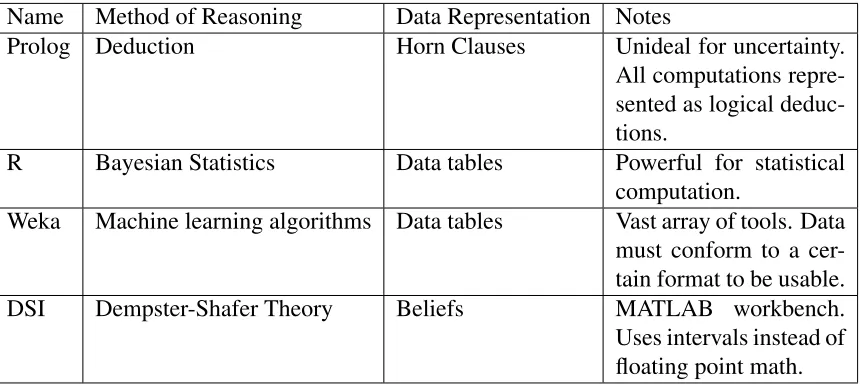
Name Method of Reasoning Data Representation Notes
Prolog Deduction Horn Clauses Unideal for uncertainty. All computations repre-sented as logical deduc-tions.
R Bayesian Statistics Data tables Powerful for statistical computation.
Weka Machine learning algorithms Data tables Vast array of tools. Data must conform to a cer-tain format to be usable. DSI Dempster-Shafer Theory Beliefs MATLAB workbench. Uses intervals instead of floating point math.
Table 2.2: Summary of Discussed Reasoning Tools
head:−X1,X2, ...X N
meaning the statementheadis true only when statementsX1 throughX Nare also true [17]. As an example of how one can represent computations in Prolog, the following program computes the factorial of a number:
factorial(0, X) :- X=1.
factorial(N, X) :- NN=N - 1, factorial(NN, X1), X =X1 ∗ N.
2.4.5
Summary
There currently exist many tools for developing automated reasoning systems, and we have summarized a few of them in the previous section and in Table 2.2. Due to it being quite young in comparison to other systems, there do not yet exist any comprehensive tools for developing applications with Subjective Logic. In the next section we present an overview of the Haskell programming language, our implementation language for a new Subjective Logic library, and in Chapter 4 we present SLHS: Subjective Logic in Haskell.
2.5
Functional Programming in Haskell
Haskellis a strongly typed, non-strict, pure functional programming language [19] which was initially developed to be a common language for researchers interested in non-strict, pure functional programming languages [18]. By non-strict, we mean that Haskell evalu-ates expressions in acall-by-needmanner: expressions are only evaluated if and when they are required [15]. Haskell is a functional programming language, where the meaning of
functionalis the style of programs as described by John Backus in his Turing award lecture:
Can Programming Be Liberated from the von Neumann Style?[2]. Lastly, Haskell is pure
in the sense that all functions are functions in the mathematical sense: they depend only on their inputs to produce their outputs. Haskell does not support the use of global state when writing programs.
we suggest the bookReal World Haskell[56].
Functions in Haskell are written as equations, with parameters separated by white space. For example, the function to compute factorials can be written as
factorial 0=1
factorial n=n ∗ factorial (n - 1)
All expressions in Haskell have types. For example, the type of the literal 5 is Int. Syntactically this is expressed as5 :: Int. The functionfactorialabove has the typeInt→
Int.
Lists in Haskell are enclosed in square braces, and their elements must be of all the same type. As an example, the following is a valid list:
names :: [String]
names=[’’John’’, ’’Paul’’, ’’George’’, ’’Ringo’’]
whereas the following is invalid:
things=[5, ’’seven’’, 2/3]
Types in Haskell can be organized into Type Classes, where each type in a type class must have certain required operations defined over it. For example, consider the following class:
class Monoid n where id :: n
(<>) :: n → n → n
which states that a type n satisfies the properties of being a Monoid if there exists a element id of type n, and there exists an operator for combining elements of type n. Unfortunately the additional requirement of associativity cannot be expressed in Haskell. Instances of the Monoid class can then be defined for individual types:
instance Monoid Int where id=0
One type class in particular gets special attention in Haskell. Types that are instances of class Monad are very popular in functional programming, and Haskell in particular [64]. Monads are mathematical objects from category theorythat are prevalent through-out Haskell. They were first introduced by Eugenio Moggi [52] and have subsequently been used for parsing [20, 44, 14], modeling state [43], and much more. Most impor-tantly, Haskell uses monads to handle input/output [64], which allows Haskell to read input from the user, and send output to the computer screen, while remaining a pure functional language. Types that are instances ofMonadrequire two operations to be present:
class Monad m where return :: a → m a
(>>=) :: m a → (a → m b) → m b
The first function, return, injects an object of type ainto an object of typem a, where
mis some monad. The second operator takes in an object of typem aon the left hand side, and a function f from ato m b on the right hand side, and returns an object of type m b. Informally, the operator unwraps the object of typeafrom the object of typema, and then applies the function to it to obtain a result.
2.6
Summary
Thesis Statement
In this chapter we describe the problem that this thesis addresses, our thesis hypothesis, and our research objectives. Lastly we outline the methodology that we followed in order to achieve those mentioned objectives.
3.1
Thesis Problem
As mentioned previously, there does not yet exist a comprehensive library of Subjective Logic operators that can be used for research, development, and experimentation. There exists a partial implementation of Subjective Logic operators by Audun Josang1, but at the time of this writing, to our knowledge no complete implementation exists.
We expect that such a library of operators should be efficient, type-safe, and compo-sitional. The library should be efficient in such a way that values are only computed as needed. The library should be type-safe in order to catch invalid Subjective Logic
expres-1http://folk.uio.no/josang/sl/Op.html
sions as early as possible. By leveraging a strong type system, the library should be able to catch many errors at the time of compilation. Finally, the library should be compositional in a sense that arbitrarily complicated Subjective Logic expressions should be able to be constructed from a small set of functions and operators.
3.2
Thesis Hypothesis
Motivated by the aforementioned problem, our hypothesis for this thesis is: Using monads and strong typing, it is possible to construct a general purpose Subjective Logic library that is type-safe, efficient, and compositional.
3.3
Objectives
The objectives of our research are the following:
• Develop a library of Subjective Logic operators using monadic higher order func-tions.
• Demonstrate the type safety of the library.
• Prove that the expression evaluator, therunfunction, terminates for all valid Subjec-tive Logic expressions.
3.4
Methodology
In order to satisfy the objectives of our research, we have done the following:
• We developed the library using the Haskell programming language due to it’s strong type system and excellent support for monadic programming.
• We discuss how Haskell’s strong type system allows for our library to reject certain classes of ill-formed Subjective Logic expressions.
• We utilize structural induction on the length of the input Subjective Logic expression to prove that our operators terminate.
• We analyze the time complexity of the operators based on the cardinality of elements in the frame of discernment that have non-zero belief mass assigned to them.
SLHS: Subjective Logic in Haskell
In this chapter we introduce the library SLHS: Subjective Logic in Haskell. SLHS is a library for constructing and evaluating expressions of Subjective Logic. It can be embedded into any existing Haskell project, and, through Haskell’s Foreign Function Interface, can be utilized by other programming languages, most notablyCandC+ +.
SLHS is designed to be simple to use: all Subjective Logic operators take in Subjec-tive Logic expressions as input, and return SubjecSubjec-tive Logic expressions as output, where Subjective Logic expressions are represented as functions that map some data (frames of discernment, belief mass assignments, configuration information) to some value - typically an opinion. Therefore the operators arehigher order functions. It will be shown that these Subjective Logic expressions, orSLExprs are a kind ofmonad, and therefore when working withSLExprs one may leverage Haskell’s excellent support for monadic programming. We use the monad operators provided by Haskell liberally within the implementation of SLHS, and we utilize Haskell’s do-notation- a syntactic sugar available when writing monadic programs - to keep the code concise and easy to read.
4.1
Core Components
In this section we will introduce components that form the nucleus of the library. These include the implementation details for objects such as the frame of discernment, belief vectors, as well as the theSLExpr type. The Subjective Logic operators are implemented as functions that take and return objects of type SLExpr, and the monadic interface of SLExpr controls how the expressions are combined.
4.1.1
Belief Vectors
We introduce a special type for representing belief vectors - containers whose elements are belief masses. The reason for introducing a new type instead of simply re-using an existing container type is so that in the future if analysis proves that a different container type provides more efficient operations, then the internal represent of our belief vectors can be changed without affecting any other portion of the SLHS code-base. For the time being we have chosen to use Haskell’s Map data type, which is a key-value store backed by an efficient red-black tree. It guarantees O(log2n)time for looking up individual elements, and allows us to traverse the entire tree inO(n)time. thus leads to very efficient Subjective Logic operators.
We start with the definition of the Vector type.
newtype Vector a=Vector { unVec :: M.Map a Rational }
Next we introduce some functions for converting belief vectors to and from standard Haskell lists.
toList :: Vector a → [(a, Rational)] toList=M.toList◦unVec
Finally, we introduce functions for interfacing with vectors.
value :: Ord a ⇒ Vector a → a → Rational value v x=fromMaybe 0◦M.lookup x $ unVec v
map :: (Rational → Rational) → Vector a → Vector a map f=Vector◦M.map f◦unVec
mapWithKey :: (a → Rational → Rational) → Vector a → Vector a mapWithKey f=Vector◦M.mapWithKey f◦unVec
fold :: (Rational → b → b) → b → Vector a → b fold f z=M.fold f z◦unVec
focals :: Vector a → [a] focals=M.keys◦unVec
elemsWhere :: (a → Bool) → Vector a → [(a, Rational)] elemsWhere p=filter (λ(k, _) → p k)◦toList
value retrieves the value associated with a particular key. map allows us to apply a function over each value, returning a new transformed vector. ThemapWithKey function allows us to map a function over the vector that takes the key into account. fold allows us to accumulate a vector into a single value by applying an operator between each element.
focalsreturns a list of keys that have non-zero mass. Lastly, elemsWherereturns a list of key-value pairs, where the key satisfies a certain predicate.
4.1.2
Frames of Discernment
We first introduce a new type representing a frame of discernment:
newtype Frame a=Frame (S.Set a) deriving (Eq, Ord)
By declaring this type using Haskell’snewtypekeyword, we are actually creating a kind of strongly discriminating type alias. That is, representationally Frame a is the same as Set a, however one cannot use a frame when expecting a set, and vice versa.
We then expose the set-theoretic operators that are required by the rest of the library implementation.
empty :: Frame a empty=Frame (S.empty)
isEmpty :: Eq a ⇒ Frame a → Bool isEmpty f=f==empty
union :: Ord a ⇒ Frame a → Frame a → Frame a union (Frame s1) (Frame s2)= Frame (s1 ‘S.union‘ s2)
isSubsetOf :: Ord a ⇒ Frame a → Frame a → Bool isSubsetOf (Frame s1) (Frame s2)=s1 ‘S.isSubsetOf‘ s2
intersection :: Ord a ⇒ Frame a → Frame a → Frame a
intersection (Frame s1) (Frame s2)=Frame (s1 ‘S.intersection‘ s2)
difference :: Ord a ⇒ Frame a → Frame a → Frame a difference (Frame s1) (Frame s2)=Frame (s1 S.\\ s2)
partition :: (a → Bool) → Frame a → (Frame a, Frame a) partition p (Frame s)=let (s1, s2) =S.partition p s
in (Frame s1, Frame s2)
partitionMany :: [a → Bool] → Frame a → [Frame a] partitionMany [] frm=[frm]
partitionMany (p:ps) frm=let (f1, f2) =partition p frm in f1 : partitionMany ps f2
size :: Frame a → Int size (Frame s)=S.size s
map :: (Ord a, Ord b) ⇒ (a → b) → Frame a → Frame b map f (Frame s)=Frame (S.map f s)
fold :: (a → b → b) → b → Frame a → b fold f z (Frame s)=S.fold f z s
toList :: Frame a → [a] toList (Frame s)=S.toList s
fromList :: Ord a ⇒ [a] → Frame a fromList xs=Frame $ S.fromList xs
singleton :: Ord a ⇒ a → Frame a singleton x=fromList [x]
member x (Frame s)=x ‘S.member‘ s
powerSet :: Ord a ⇒ Frame a → Frame (Frame a) powerSet (Frame s)=fromList frames
where
frames= Prelude.map fromList (subsequences (S.toList s))
reducedPowerSet :: Ord a ⇒ Frame a → Frame (Frame a) reducedPowerSet frm@(Frame s)=Frame $ S.map Frame rpset’
where
(Frame pset) =powerSet frm
pset’=S.map (λ(Frame x) → x) pset rpset=pset’ S.\\ S.fromList [S.empty] rpset’= rpset S.\\ S.fromList [s]
cross :: (Ord a, Ord b) ⇒ Frame a → Frame b → Frame (a, b)
cross (Frame s1) (Frame s2)= fromList [ (x, y) | x ← S.toList s1, y ← S.toList s2 ]
The cross function computes the cartesian product of two frames, and the functions
powerSetandreducedPowerSet compute the powerSet and reduced powerSet of the input frame.
4.1.3
Belief Holders
Subjective Logic opinions may include an optional belief holder. Belief holders play an important role for operators such as transitive discounting[32], where an agent’s opinion of an event is computed through its opinion of a secondary agent, who holds an opinion of the event in question. Other operators that utilize this information are the various belief fu-sion operators that are designed to merge opinions of events collected either from different sensors, or from the same sensor but across different periods of time.
We represent belief holders as a recursive data type in order to be able to capture com-plex yet ”imaginary” belief holders such as ”the consensus of agents A, B and C.”
data Holder a= None | Holder a
Since there are different ways in which two belief holders can be fused into an imag-inary holder, the Fuse data constructor above takes in an argument of type FusionType, which is shown below.
data FusionType=Cumulative | Averaging
deriving (Eq, Ord, Show)
4.1.4
Subjective Logic Values
Values in SLHS are represented by the following type:
data SLVal a=SLVal a | Err String deriving Show
Objects of typeSLVal aeither contain a value of typea, via theSLValdata constructor, or an error message, via the Err data constructor. By wrapping values in this interme-diate type, we thus allow all operators in SLHS to return either a value on success, or a detailed error message upon failure. This allows us to report issues with Subjective Logic expressions that can only be detected at run-time.
Objects of typeSLVal aare also monads. The required type class instance is
instance Monad SLVal where return=SLVal
SLVal x >>= f=f x Err e >>= _=Err e
4.1.5
Subjective Logic Expressions
Expressions in Subjective Logic are represented as functions from some input state to some output, such as an opinion, or a rational number.
TheSLExprtype is parametrized over three types:
• The type h represents the type that all belief holders within the Subjective Logic expression must have. For example, ifhis instantiated to Int, then all belief holders must be represented by objects that inhabit theInttype.
• The type a represents the types that make up the frames of discernment within the expression. Any given Subjective Logic expression can contain references to many frames, but for simplicity of implementation, we enforce the rule that all frames must be made up of elements of the same type. For example, all frames could be inhabited by elements of typeUserDefined, whereUserDefinedis a type that is created by the user of the library.
• The type t represents the output type of the function. The output type is, however, wrapped in the SLVal type so that we can return meaningful error messages to the users of the library. We also include the updated state in the output.
All functions of typeSLExprmap objects of typeSLStateto a pair: the new state after evaluation of the expression, and the result of the expression. SLStateis a simple aggregate type that allows us to thread the frames of discernment and the belief mass assignments over those frames for each belief holder.
data SLState h a= SLState
{ slsFrames :: [F.Frame a]
, slsBeliefVecs :: M.Map (F.Frame a) (M.Map (Holder h) (BeliefVector (F.Frame a))) , slsBaseRateVecs :: M.Map (F.Frame a) (M.Map (Holder h) (BaseRateVector a)) } deriving (Show)
run :: SLExpr h a t → SLState h a → SLVal (SLState h a, t) run (SLExpr f) st=f st
If the user does not care about the final state of the computation and only wants to see the final value, we provide the functionrun’:
run’ :: SLExpr h a t → SLState h a → SLVal t run’ (SLExpr f) st=liftM snd $ f st
Lastly, objects of type SLExpr form a monad, and thus we can take advantage of Haskell’s support for programming with monads. We provide the definitions forbindand
inject below. Furthermore, since all monads are applicative functors, and all applicative functors are functors, we provide those definitions also. This allows the user of our library to program in a monadic, applicative, or functorial style.
instance Monad (SLExpr h a) where
return x= SLExpr $λst → return (st, x)
ma >>= f=SLExpr $ λst → case (run ma st) of
Err e → Err e
SLVal (st’, a) → let mb=f a in case run mb st’ of Err e → Err e
SLVal r → SLVal r
instance Applicative (SLExpr h a) where pure=return
(<∗>)= ap
instance Functor (SLExpr h a) where fmap=liftA
4.2
Opinions
4.2.1
Binomial Opinions
We represent binomial opinions by four rational numbers corresponding to the belief, dis-belief, uncertainty, and base rate of the opinion, along with some additional meta-data: the belief holder and the frame of discernment it is defined over. In code, the binomial opinion looks like the following:
data Binomial h a=Binomial { bBelief :: Rational , bDisbelief :: Rational , bUncertainty :: Rational , bAtomicity :: Rational , bHolder :: Holder h
, bX :: a
, bNotX :: a }
Here we use Haskell’s record syntaxto define the data constructor. Haskell automati-cally creates the top-level functionsbBelief,bDisbelief,bUncertainty,bAtomicity,bHolder,
bX, andbNotXthat provide access to the respective items of the record.
Lastly, we also introduce a special type class called ToBinomial which allows us to define a range of types that can be converted to a binomial opinion. An example of such a type could be aBeta PDF. We will re-use this strategy for implementing multinomial and hyper opinions.
class ToBinomial op where
toBinomial :: op h a → Binomial h a
instance ToBinomial Binomial where toBinomial=id
4.2.2
Multinomial Opinions
belief holder, and a reference to the frame of discernment.
data Multinomial h a=Multinomial { mBelief :: BeliefVector a , mUncertainty :: Rational
, mBaseRate :: BaseRateVector a , mHolder :: Holder h
, mFrame :: F.Frame a }
Just as in the case of binomials, we introduce a type class to represent types that can be converted to multinomials. We provide the instance for multinomial opinions (the identity function) as well as an instance for binomial opinions, since binomial opinions are a special case of multinomial opinions.
class ToMultinomial op where
toMultinomial :: Ord a ⇒ op h a → Multinomial h a
instance ToMultinomial Multinomial where toMultinomial=id
instance ToMultinomial Binomial where
toMultinomial (Binomial b d u a h x y)=Multinomial b’ u a’ h f where
b’=V.fromList [ (x, b), (y, d) ] a’=V.fromList [ (x, a), (y, 1 - a) ] f =F.fromList [x, y]
4.2.3
Hyper Opinions
Hyper opinions share a similar structural layout to multinomial opinions except the belief vector spans the reduced power set of the frame, and is thus represented as aBeliefVector
with sub-frames as the keys, instead of elements of the frame.
data Hyper h a=Hyper { hBelief :: BeliefVector (F.Frame a) , hUncertainty :: Rational
, hBaseRate :: BaseRateVector a , hHolder :: Holder h
, hFrame :: F.Frame a }
class ToHyper op where
toHyper :: Ord a ⇒ op h a → Hyper h a
instance ToHyper Hyper where toHyper=id
instance ToHyper Multinomial where
where
b’=V.fromList◦map (first F.singleton)◦V.toList $ b
instance ToHyper Binomial where toHyper=toHyper◦toMultinomial
4.2.4
The Opinion Type Class
There are certain operations that are common amongst all opinions. One example of such operation is the probability expectation: for binomials, the probability expectation is a simple scalar, whereas for multinomial and hyper opinions the probability expectation is a vector over the frame of discernment, and the reduced power set of the frame, respectively.
class Opinion op h a where
type ExpectationType op h a :: ∗
expectation :: op h a → ExpectationType op h a getFrame :: op h a → F.Frame a
In order to accomodate a function such as probability expectation that returns a value of a different type depending on the type of the opinion, we use anindexed type family[40]. For each opinion type, we associate an ”expectation type”, which is the type one would obtain when querying the probability expectation of the opinion. The instances for each of the three opinion types follows.
instance Ord a ⇒ Opinion Binomial h a where type ExpectationType Binomial h a=Rational
expectation (Binomial b d u a _ _ _) = b+a ∗ u getFrame (Binomial _ _ _ _ _ f1 f2)=F.fromList [f1, f2]
instance Ord a ⇒ Opinion Multinomial h a where type ExpectationType Multinomial h a=V.Vector a
expectation (Multinomial b u a _ f)=V.fromList vals where
vals= map (λk → (k, V.value b k +V.value a k+u)) keys keys= F.toList f
getFrame (Multinomial _ _ _ _ frm)=frm
instance Ord a ⇒ Opinion Hyper h a where
type ExpectationType Hyper h a=V.Vector (F.Frame a)
where
vals= map (λk → (k, V.value b k +aval k+u)) keys keys= F.toList◦F.reducedPowerSet $ f
aval k=sum◦map (V.value a)◦F.toList $ k
getFrame (Hyper _ _ _ _ frm)= frm
4.2.5
Belief Coarsening
Coarsening is an operation that takes a hyper opinion and converts it into a binomial opin-ion. The inputs are an arbitrary hyper opinion and a subset of the frame of discernment for which the hyper opinion is defined over. Coarsening is a two-stage operation: First the frame of discernment is partitioned into two sets: the subset given as input, and everything else. These two subsets, taken together as a set, form a new binary frame with which the new binomial opinion will be defined over. Secondly, the belief masses associated with elements of the power set of the original frame via the hyper opinion input are split up and assigned to the elements of the new frame. The resulting belief mass assignment preserves additivity, and thus the new binomial opinion is valid. The operation for coarsening is given below.
coarsen :: (ToHyper op, Ord b) ⇒ SLExpr h a (op h b)
→ F.Frame b → SLExpr h a (Binomial h (F.Frame b)) coarsen op theta=liftM2 coarsen’ op (return theta)
where
coarsen’ op theta=Binomial b d u a holder theta (frm ‘F.difference‘ theta) where
b=sumSnd◦V.elemsWhere subset $ belief d=sumSnd◦V.elemsWhere emptyIntersect $ belief u=1 - b - d
a=sum◦F.toList◦F.map baseRate $ theta
belief =hBelief◦toHyper $ op
baseRate=V.value (hBaseRate◦toHyper $ op)
holder =hHolder◦toHyper $ op frm =hFrame ◦toHyper $ op
sumSnd =sum◦map snd
subset =(‘F.isSubsetOf‘ theta)
As a convenience, we also offer a function to coarsen a hyper opinion, not by an explic-itly given sub-frame, but by those elements of the frame that satisfy a given predicate.
coarsenBy :: (ToHyper op, Ord b) ⇒ SLExpr h a (op h b)
→ (b → Bool) → SLExpr h a (Binomial h (F.Frame b)) coarsenBy op pred=op >>=λop’ →
let (theta, _)=F.partition pred◦getFrame◦toHyper $ op’ in coarsen op theta
As an example, consider a frame of discernment containing the integer values one through twenty, and a hyper opinion ωA defined over the frame. We can then construct
a binomial opinionωPA(x) =hbP(x),dP(x),uP(x),aP(x)i, where the predicate P(x)denotes ”x
is even” by utilizing thecoarsenByfunction:
isEven :: Int → Bool isEven n=n ‘mod‘ 2==0
evenOpinion=coarsenBy isEven oldOpinion
whereoldOpinionis the initial hyper opinion.
4.2.6
Accessing Opinions
SLHS is built around combining together objects of typeSLExpr, which are functions from some world state to some value. Since Subjective Logic operators rely on opinions as in-puts, we require a method of obtaining the opinions stored in the state that is being threaded through behind the Subjective Logic expressions. The following functions do just that.
We start with fetching hyper opinions, as they are the most general. Given a belief holder h and an index idx corresponding to the idx’th frame of discernment in the state,
getHyperreturns either a hyper opinion held byhover theidxth frame, or a run-time error message.
getHyper :: (Ord h, Ord a) ⇒ h → Int → SLExpr h a (Hyper h a) getHyper holder idx=do
vecs ← liftM slsBeliefVecs getState rates ← liftM slsBaseRateVecs getState if idx>length frames
then err "getHyper: index out of range" else do let frm =frames !! idx
m ← do case M.lookup frm vecs of
Nothing → err "getHyper: no mass assignments for that frame" Just m → do
case M.lookup (Holder holder) m of
Nothing → err "getHyper: no mass assignment for that holder" Just m’ → return m’
a ← do case M.lookup frm rates of
Nothing → err "getHyper: no base rates for that frame" Just a → do
case M.lookup (Holder holder) a of
Nothing → err "getHyper: no base rate for that holder" Just a’ → return a’
let u=1 - V.fold (+) 0 m
return $ Hyper m u a (Holder holder) frm
While the above function looks fairly complicated, it simply unwraps the relevant state data from theSLExprmonad, checks to see if the index is within the bounds of the array of frames, and then looks to see if there are any mass assignments for that particular frame. If there are mass assignments for that frame, then we look up the particular mass assignment owned by the belief holder. If one exists, we return it, else we return an error message. We perform a similar unwrapping for checking for base rates, and then compute the uncertainty and return the resulting hyper opinion.
Next we have a way of obtaining multinomial opinions. Since multinomial opinions are a special case of hyper opinions, we first obtain the hyper opinion via a call togetHyper, and then check to see if we can safely convert that hyper opinion into a multinomial opinion. If so, we return it, else we return an error message.
getMultinomial :: (Ord h, Ord a) ⇒ h → Int → SLExpr h a (Multinomial h a) getMultinomial holder f=do
h ← getHyper holder f case maybeToMultinomial h of
Nothing → err "getMultinomial: not a multinomial opinion" Just m → return m
where
maybeToMultinomial (Hyper b u a h f)= let fs=V.focals b
bv’=map (λ(a, r) → ((F.toList a) !! 0, r)) bv in Just $ Multinomial (V.fromList bv’) u a h f else Nothing
The same trick applies to obtaining binomial opinions. We first obtain the relevant multinomial opinion and then see if we can safely convert it into a binomial opinion. If so, great! Otherwise we return an error message to the user.
getBinomial :: (Ord h, Ord a) ⇒ h → Int → a → SLExpr h a (Binomial h a) getBinomial holder f x=do
m ← getMultinomial holder f case maybeToBinomial x m of
Nothing → err "getBinomial: not a binomial opinion" Just b → return b
where
maybeToBinomial x (Multinomial b u a h f) =do guard (F.size f==2)
guard (x ‘F.member‘ f)
let y=fst◦head◦V.elemsWhere (/=x) $ b let b’=V.value b x
let d’=V.value b y let u’=1 - b’ - d’ let a’=V.value a x
return $ Binomial b’ d’ u’ a’ h x y
In the above code for maybeToBinomial we utilize the fact that theMaybe type is an instance of the type classMonadPlus, which gives us access to theguardfunction. Mon-adPlus can be thought of the set of types that are monads, but also have the additive prop-erties of monoids: a zero element (in the case of Maybe, the Nothing data constructor), and a method of combining two MonadPlus objects together, which in Haskell is called
mplus[21]. Unfortunately the rules for identity and associativity cannot be enforced in the language itself.
4.3
Operators
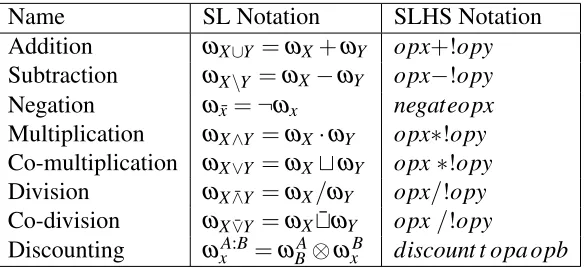
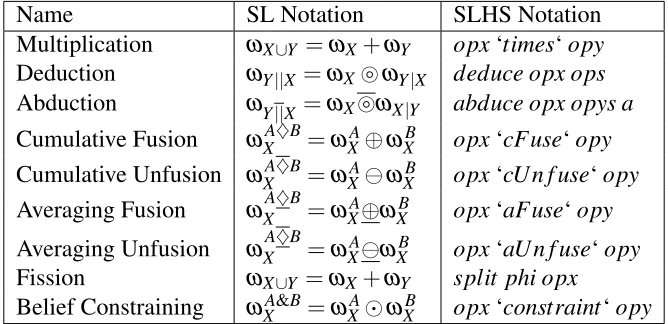
• We denote binary operators with a trailing exclamation mark ! in order to avoid con-flicting with Haskell’s mathematical operators. For example, binomial addition is denoted as+!.
• We use tildes as a prefix to denote co− operations. For example, the binomial co-multiplication operator is denoted as∼ ∗!.
• All n-ary operators, wheren>2 are denoted as simple functions, instead of symbolic operators.
Every operator is presented in its most general form. For example, instead of presenting two operators for averaging fusion(one for multinomial opinions, and another for hyper opinions) we implement only the version for hyper opinions. In order to achieve this level of code reuse, each operator accepts as parameters any object that can be converted into the correct opinion type by virtue of the ToBinomial, ToMultinomial, and ToHyper type classes.
4.3.1
Binomial Operators
Logical and Set-Theoretical Operators
The logical and set-theoretical binomial operators are those that have equivalent operators in logic and set theory. We will start with binomial addition. Addition of binomial opinions, denoted asωx∪y=ωx+ωy, is defined whenxandyare disjoint subsets of the same frame
of discernment [50]. Binomial addition is implemented as follows:
(+!) :: (ToBinomial op1, ToBinomial op2, Eq h, Eq b, Ord b) ⇒ SLExpr h a (op1 h (F.Frame b))
→ SLExpr h a (op2 h (F.Frame b)) → SLExpr h a (Binomial h (F.Frame b)) opx+! opy= do
opx’ ← liftM toBinomial opx opy’ ← liftM toBinomial opy
require (bHolder opx’==bHolder opy’) "opinions must have same holder" require (getFrame opx’==getFrame opy’) "opinions must have the same frame" return $ add’ opx’ opy’
add’ :: Ord a
⇒ Binomial h (F.Frame a) → Binomial h (F.Frame a) → Binomial h (F.Frame a) add’ opx@(Binomial bx dx ux ax hx xt xf) (Binomial by dy uy ay _ yt yf)=
Binomial b’ d’ u’ a’ hx (xt ‘F.union‘ yt) (xf ‘F.union‘ yf) where
b’=bx+by
d’=(ax ∗ (dx - by)+ay ∗ (dy - bx)) / (ax+ay) u’=(ax ∗ ux+ay ∗ uy) / (ax+ay)
a’=ax+ay
Here we see a pattern that we will re-use for all operator implementations. We start with a function whose inputs are of type SLExpr h a t, wheret is some type. Within that function, we unwrap the values from theSLExprmonad, verify that some requirements are met, and then send those values to a worker function that does the actual computation. We then wrap the result back into theSLExprmonad via thereturnfunction.
Binomial subtraction is the inverse operation of addition. In set theory it is equivalent to the set difference operator [50]. Given two opinions ωx and ωy where x∩y=y, the
difference,ωx\yis calculated as follows:
(-!) :: (ToBinomial op1, ToBinomial op2, Eq h, Eq b, Ord b) ⇒ SLExpr h a (op1 h (F.Frame b))
opx -! opy= do
opx’ ← liftM toBinomial opx opy’ ← liftM toBinomial opy
require (bHolder opx’==bHolder opy’) "opinions must have same holder" require (getFrame opx’==getFrame opy’) "opinions must have the same frame" return $ subtract’ opx’ opy’
subtract’ :: Ord a
⇒ Binomial h (F.Frame a) → Binomial h (F.Frame a) → Binomial h (F.Frame a) subtract’ (Binomial bx dx ux ax hx xt xf) (Binomial by dy uy ay _ yt yf)=
Binomial b’ d’ u’ a’ hx ft ff where
b’=bx - by
d’=(ax ∗ (dx+by) - ay ∗ (1+by - bx - uy)) / (ax - ay) u’=(ax ∗ ux - ay ∗ uy) / (ax - ay)
a’=ax - ay
ft=xt ‘F.difference‘ yt
ff=xt ‘F.union‘ xf ‘F.difference‘ ft
Negation is a unary operator that switches the belief and disbelief and inverts the atom-icity of a binomial opinion [23]. Given a binomial opinion ωx over a frameX ={x,¬x},
the negated opinionωx=ω¬x.
negate :: ToBinomial op ⇒ SLExpr h a (op h b) → SLExpr h a (Binomial h b) negate op=do
op’ ← liftM toBinomial op return $ negate’ op’
negate’ :: Binomial h a → Binomial h a
negate’ (Binomial b d u a h x y)=Binomial d b u (1 - a) h y x
Multiplication of two binomial opinions is equivalent to the logical andoperator [33]. Given two opinions ωx and ωy over distinct binary frames x and y, the product of the
opinions,ωx∧y, represents the conjunction of the two opinions.
(∗!) :: (ToBinomial op1, ToBinomial op2, Eq h, Ord b, Ord c) ⇒ SLExpr h a (op1 h b)
→ SLExpr h a (op2 h c)
→ SLExpr h a (Binomial h (F.Frame (b, c))) opx ∗! opy= do
opx’ ← liftM toBinomial opx opy’ ← liftM toBinomial opy
require (bHolder opx’==bHolder opy’) "opinions must have same holder" return $ b_times’ opx’ opy’
b_times’ (Binomial bx dx ux ax hx xt xf) (Binomial by dy uy ay _ yt yf)= Binomial b’ d’ u’ a’ hx t f
where
b’=bx ∗ by+((1 - ax) ∗ bx ∗ uy+(1 - ay) ∗ ux ∗ by)
/ (1 - ax ∗ ay) d’=dx+dy - dx ∗ dy
u’=ux ∗ uy+((1 - ay) ∗ bx ∗ uy+(1 - ax) ∗ ux ∗ by)
a’=ax ∗ ay
t =F.singleton (xt, yt)
f =F.fromList [(xt, yf), (xf, yt), (xf, yf)]
The resulting frame of discernment is a coarsened frame from the cartesian product of
{x,¬x}and{y,¬y}, where the element whose belief mass is designated the role of ”belief” for binomial opinions is {(x,y)}, and the element whose belief mass is given the role of ”disbelief” is{(x,¬y),(¬x,y),(¬x,¬y)}.
Binomial co-multiplication is equivalent to the logical or operator [33]. Given two opinions, again on distinct binary frames, ωx and ωy, the disjunctive binomial opinion
ωx∨y=ωxtωyis computed by the following function:
(~∗!) :: (ToBinomial op1, ToBinomial op2, Eq h, Ord b, Ord c) ⇒ SLExpr h a (op1 h b)
→ SLExpr h a (op2 h c)
→ SLExpr h a (Binomial h (F.Frame (b, c))) opx ~∗! opy=do
opx’ ← liftM toBinomial opx opy’ ← liftM toBinomial opy
require (bHolder opx’==bHolder opy’) "opinions must have same holder" return $ cotimes’ opx’ opy’
cotimes’ (Binomial bx dx ux ax hx xt xf) (Binomial by dy uy ay _ yt yf)= Binomial b’ d’ u’ a’ hx t f
where
b’=bx+by - bx ∗ by
d’=dx ∗ dy+(ax ∗ (1 - ay) ∗ dx ∗ uy+(1 - ax) ∗ ay ∗ ux ∗ dy)
/ (ax+ay - ax ∗ ay)
u’=ux ∗ uy+(ay ∗ dx ∗ uy+ax ∗ ux ∗ dy)
/ (ax+ay - ax ∗ ay) a’=ax+ay - ax ∗ ay
t =F.fromList [(xt, yt), (xf, yt), (xt, yf)] f =F.singleton (xf, yf)
Binomial multiplication and co-multiplication are duals to one another and satisfy De-Morgan’s law: ωx∧y=ωx∨y andωx∨y=ωx∧y, but they do not distribute over one another

![Figure 2.1: Unified Data Management and Decision Support System (UDMDSS) [38]](https://thumb-us.123doks.com/thumbv2/123dok_us/1415391.1174090/24.612.109.538.195.490/figure-unied-data-management-decision-support-udmdss.webp)