A Survey Paper on Greenboard Android
Application
Prof Manjiri Kokate1, Shweta Goyal2, Neha Thakur3, Snehal Virkar4
Assistant Professor,Dept. of Information Technology, JSPM’s BSIOTR, Savitribai Phule Pune University,
Maharashtra, India 1
B.E Student,Dept. of Information Technology, JSPM’s BSIOTR, Savitribai Phule Pune University,
Maharashtra, India2,3,4
ABSTRACT: GREENBOARD android application is a JQuery mobile oriented application allows us to access the
whole information about the College, Principal, Staffs, Students and Parents etc. This application provides a platform to manage college day to day activities. Here we will get the latest information about the students and staffs. This generic application designed for assisting the students of an institute regarding information on the courses, subjects, classes, assignments, grades and timetable and the placements. It also provides support that a faculty can also check about his daily schedule, can upload assignments, and notices to the students. Here administrator will manage the accounts of the student and faculties, makes the attendance report, and upload the latest information about the college campus. It can be used by educational institutes or colleges to maintain the records of students easily. It also facilitate us explore all the activities happening in the college. Different reports and Queries can be generated based on vast options related to students, batch, course, faculty, exams, semesters, certification and even for the entire college. This application helps students to keep in touch with the events that college is going to organize.
KEYWORDS:JQuery mobile, day to day activities, latest information, generic application, administrator, educational
institute.
I.INTRODUCTION
This generic application is based on Intranet that aims to all the levels of management providing information within an organization. This system can be used as an information management system for the college. For a given student/staff (Technical / Non-technical) the Administrator creates login id and password, using these student/ staff (Technical / Non-technical) can access the system to either upload or download some information from the database. The front-end will be HTML5, CSS3 pages for client side validation with Java Script where as all business logics will be in JQuery reside at middle layer. Third layer of database will be interacted with these layers, which would be phpMyadmin database.
College Staff uploads attendance, results and college notifications, online interface using this application. All data is thoroughly reviewed and validated on the server before actual record alteration occurs. All data is stored securely on servers managed by the college Administrator. The system decreases paperwork and time needed to access student records. This system provides a simple interface for the maintenance of student information. It can be used by educational institutes or colleges to maintain the records of students easily. Achieving this objective is difficult using a manual system as the information are scattered, can be redundant and collecting relevant information may be very time consuming. Our proposed system ensures to overcome these limitations. It can be used by educational institutes to maintain the records of students easily. The creation and management of accurate, up-to date information regarding a student’s academic career is critically important in the colleges.
them to share day-to-day notices and announcements, do day-to-day interaction, and share knowledge through Internet efficiently, without letting unauthorized outsiders see it. This collaboration not only takes place in the class room (i.e. teachers and students) but also regularly between management and students, placement officer and students, among teachers, among students etc. For a given student/staff (Technical / Non-technical) the Administrator creates login id and password, using these student/ staff can access the system to either upload or download some information from the database. All data is stored securely on SQL servers managed by the college Administrator. The system decreases paperwork and time needed to access student records.
Students require lot of information from colleges such as admission notices, timetables, events details etc. Currently information is distributed to students in two ways. In traditional approach, notices are displayed on physical notice boards of college which students check on regular basis. It leads to over-crowded notice board areas. Students cannot receive the information if they are not physically present in college. Moreover, it wastes lot of paper.
Second approach is to provide information on college websites. Students may access website from anywhere. It
does away with crowded notice boards and promotes paperless information dissemination. But, the major challenge in obtaining information from website is that it provides collective information pertaining to large groups of students. The onus of filtering the personalized information and performing calculations to do analysis is on the students.
II. LITERATURE SURVEY
In the paper [1], the author describes in the competitive environment of international higher education-related services, the concept of students as “customers” becomes a competitive imperative. Seeing students as “customers” increases a dialogue-based relationship between universities and students having a positive impact on students’ satisfaction. And students’ satisfaction has a significant positive effect on their loyalty which even can promote their success. In order to increase students’ satisfaction with their university, in this paper we propose a mobile application Fer Droid that can be used for data aggregation from different student information systems. Our application saves students’ precious time leaving them more time for other activities (e.g. studying, training and dating). We made both subjective (using students’ surveys) and objective analyses of Fer Droid and concluded that students are more satisfied and can retrieve information much quicker when using our solution than when using complex web pages on phones.
In the paper [2], the author describes that student Information Tracking System is an Android application to manage student attendance on mobile. In many colleges teachers use to take attendance manually. Main objective of this project is to add mobility and automation in the existing attendance process. This system helps teachers to take attendance through mobile and also keep in touch with student in some aspect. This System allow teachers to take attendance, edit attendance, view students bunks, send important documents in pdf format such as exam time table, question bank etc. and also helps teachers to inform students about the events that college is going to organize. This system also helps students in specifying bunks, deleting bunks, viewing their bunks. This system gives a prior intimation to student as soon as his attendance goes below the specified attendance deadline in the form of an alert. This system helps students to keep in touch with the events that college is going to organize.
In the paper [3], the author proposes a mobile app architecture that reuses the resources of the existing student information system of educational institutions. The educational institutions have an existing website that interacts with a data store to disseminate information to its stakeholders. The data store and the web resources have been reused for the mobile app. Web services are developed to fetch information from the data store. The data fetched via web services is presented via appropriate screens. Design of a complete new application requires a lot of effort during development and testing, to come up with a stable product. Reuse of existing infrastructure and software simplifies the task by focusing mainly on the new features and saves cost, time and effort. A prototype developed for University of Delhi using the proposed architecture is discussed in detail. The architecture enables delivery of individualized information to students on their mobile devices which is accessible anywhere and anytime. This keeps students informed and satisfied. The architecture can be replicated to design mobile app for any organization having a data store.
the staff and students as well as marks of the students will be updated by staff. This system (C.M.S ) is being developed for an engineering college to maintain and facilitate easy access to information. For this the users must be registered with the system after which they can access as well as modify data as per the permissions given to them.
In the paper [5], the author describes that Student Record Management System (SRMS) gives a straightforward interface to support of student data. It might be utilized by instructive universities or colleges to keep up the records of students effectively. The creation and administration of error less, exceptional data in regards to a student' scholarly profession is discriminatingly paramount in the colleges and in universities. Student information system manages all sorts of student details, academic related reports, college details, fee details, results, batch details, attendance details and other resource related details too. It tracks all the details of a student from very first moment to the end of the course which could be utilized for all reporting purpose, tracking of attendance, progress in the study, completed semesters, years, coming semester year curriculum details, fee details, project or any other assignment details, final exam result and all these will be available through a secure, online interface embedded in the college’s Student Record Management System.
III. PROPOSED SYSTEM
The purpose is to design a college website and android application which contains up-to date information of the college that should improve efficiency of college record management.
In these proposed system, Admin handles all the users. In these main modules are attendance, admission and academic details of student. Admin creates id and password for user and via email admin sends the mail to users their id and password so they can easily access the system and no other unauthorised person can misuse of this system.
Fig-3.1 Proposed System
Characteristics Of The Proposed System
1. User Friendly: - The proposed system is user friendly because the retrieval and storing of data is fast and data is
2. Reports are easily generated: - Reports can be easily generated in the proposed system so user can generate the report as per the requirement (monthly) or in the middle of the session. User can give the notice to the students so he/she become regular.
3. Very less paper work:-The proposed system requires very less paper work. All the data is feted into the computer
immediately and reports can be generated through computers. Moreover work becomes very easy because there is no need to keep data on papers.
4. Computer operator control:- Computer operator control will be there so no chance of errors. Moreover storing and
retrieving of information is easy. So work can be done speedily and in time
Architectural Diagram:-
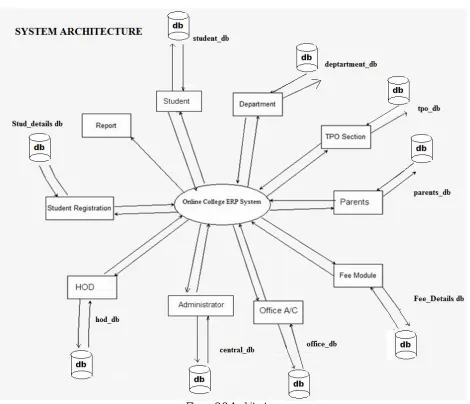
In college ERP system, the Administrator creates login id and password. Using these student/ staff can access the system to either upload or download some information from the database. All data is stored securely on SQL servers managed by the college Administrator. The system decreases paperwork and time needed to access student records.
Students require lot of information from colleges such as admission notices, timetables, events details etc. Currently information is distributed to students in two ways. In traditional approach, notices are displayed on physical notice boards of college which students check on regular basis. It leads to over-crowded notice board areas. Students cannot receive the information if they are not physically present in college. Moreover, it wastes lot of paper.
Second approach is to provide information on college websites. Students may access website from anywhere. It does away with crowded notice boards and promotes paperless information dissemination. But, the major challenge in obtaining information from website is that it provides collective information pertaining to large groups of students. The onus of filtering the personalized information and performing calculations to do analysis is on the students.
For instance, when the monthly attendance of students is uploaded on the application, several issues may arise in
Figure 3.2 Architecture
ADMINISTRATOR:
The administrator is responsible for entering the new student, promoting the student from one class to another, from one semester to another and from one year to another by managing the student accounts. The administrator also manages the faculty accounts like entering a new faculty, assigning the faculty to the subjects. The administrator also updates the college related information like calendar of events, information regarding any other events that occur in the college. The administrator will check the all the updates i.e. student updates, faculty updates, exam updates etc. The administrator has the highest level of power in the student information system.
TPO SECTION / PLACEMENT CELL:
the student information from the student database for selecting the eligible candidates list for placements. He/she also can send notifications to students regarding any information.
OFFICE SECTION:
The office section consists of two sections i.e. Student Section and Account Section. Student Section provides scholarship details and related information. Account section provides the Fee structure for the student and all fee details to the parents, principal and HOD.
FACULTY:
The staff can update the information regarding the student’s attendance, internal marks of the students and any information regarding the subjects they handle. They can also view the student details for better understanding the student performance and improving the efficiency of the student. The staffs also get the updates from the college regarding any events occurring in the college. They can also get the notifications from the placement cell and exam section.
STUDENT:
The student is of centre focus, because in every college student plays the very important role. Student can access the information of the college, course details, subject details, faculty details, training and placement cell information and exam section information. The course details include information regarding branch he/she is studying, the academic curriculum of the college, year wise subject offered by the branch, the subject details include the syllabus of the subjects, information regarding the staff handling the subjects, the subjects he/she presently registered for the semester he/she is presently studying, attendance and internal marks of the subjects, he/she can also ask any queries to the HOD regarding anything. The placement details include the information about the companies, the eligibility criteria for attending recruitments of the companies, the process of recruitment, the date and time of the recruitment. The placement cell updates the student’s information that got selected for a company.
IV. CONCLUSION AND FUTURE WORK
This paper assists in automating the existing manual system. This is a paperless work. It reduces the man power required. It provides accurate information always. Malpractice can be reduced.
All information can be saved and can be accessed at any time. The data which is stored in the repository helps in taking intelligent decisions by the management. All the stakeholders, faculty and management can get the required information without delay. The Advantage of the system it will save time reduces time and paper.
In future the system also provides the transportation facility as well as the collage hostel facility and e-library facility. It can also provide online payment of fees in collage and recruitment facility in future.
REFERENCES
[1] Hrvoje Maracic, Iva Bojic, Mario Kusek, “Accessing Student Information Systems Using Mobile Connected Devices,2013”, IEEE International Conference on Virtual Environments Human Computer Interfaces and Measurement Systems pp.1-7.
[2] Miss. Namrata N. Shahade, Miss. Priya A. Kawade, Mr. Satish L. Thombare, “Student Attendance Tracker System in Android,2014”, IEEE International Conference on Virtual Environments Human Computer Interfaces and Measurement Systems pp.1-5.
[3] Manasi Kawathekar, Kirti K. Bhate, Pankaj Belgoankar, “An Android Application for Student Information System,September 2015”, IEEE International Conference on Virtual Environments Human Computer Interfaces and Measurement Systems pp.1-6.
[4] Lalit Mohan Joshi, “A Research Paper on College Management System”, International Journal of Computer Applications (0975 – 8887), Volume 122 – No.11, July 2015.
[5] Er. Saurabh Walia, Er. Satinderjit Kaur Gill, “A Framework for Web Based Student Record Management System using PHP”, IJCSMC, Vol. 3, Issue. 8, August 2014.
comprehensive academic affairs management system based on SOA, in Proc. 2009 1stInternational Conference on Information Science and Engineering, Nanjing, Jiangsu, pp. 3261-3264 30.
[7] S. Jeyalatha, B. Vijayakumar,and G.S. Wadhwa, “Design and implementation of web based application for relational data maintenance in an university environment, in Proc. 2011” International Conference and Workshop on Current Trends in Information Technology , Dubai,pp. 105-112. [8] M-H.Lee, C -J.Yooand O.-B.Jang, “Embedded System Software Testing Using Mobile Service Based On SOA”, IJAST,vol. 1, (2008), pp. 55-64 [9] S.H. Al-Daajeh, R.E Al- Qutaish and Fuad Al-Qirem, “Engineering Dependability to Embedded Systems Software via Tactics”, IJSEIA, vol. 5,no.4,(2011),pp. 45-62.
[10] Ming-Syan Chen, Jiawei Han, Philip S yu. “Data Mining: An Overview from a Database Perspective[J]” IEEE Transactions on Knowledge and Data Engineering, l996, 8(6):866-883.
[11] D B Heras, D. Otero,and F. Arguello, “An eco feedback system for improving the sustainability Performance of universities, in Proc. 2011”, IEEE International Conference on Virtual Environments Human Computer Interfaces and Measurement Systems, Ottawa, ON 2011 , pp. 1 6. [12] Vishwakarma R Ganesh, “Android College Management System”, ISSN: 2278 – 1323,International Journal of Advanced Research in Computer Engineering & Technology (IJARCET), Volume 5, Issue 4, April 2016.