CHAKRAVARTY, PAYAL . An Event-Driven approach to Agent-Based Business Process Enactment. (Under the direction of Dr. Munindar P. Singh).
Agents enacting business processes in large open environments need to adaptively ac-commodate exceptions and opportunities. Multiagent approaches can help flexibly model business processes. This thesis proposes an event-driven architecture that enriches such models with events to support the agile enactment of processes.
Specifically, we place this architecture in a business process framework based on pro-tocols and policies, where agents’ behaviors are specified via rules. The agents interact via messages, and agreements between them are modeled by commitments. These messages and commitments provide only a high-level view of the interactions and fail to capture fine-grained details of how the interactions were carried out and whether they were carried out smoothly. There might be hindrances due to internal and external influences, resulting in anomalies in the business process enactment. Handling such exceptions or capturing opportunities deviate the protocol from its routine execution but would restore the process to an acceptable state. Our approach introduces fine-grained event monitoring at specific points of the process enactment that require special attention. Detected exceptions are han-dled by the policies of the involved agents. Monitoring processes and thereby recovering from errors spontaneously, results in a more reliable and proactive distributed system.
by
PAYAL CHAKRAVARTY
A thesis submitted to the Graduate Faculty of North Carolina State University
in partial fulfillment of the requirements for the Degree of
Master of Science
COMPUTERSCIENCE
Raleigh, NC 2007
APPROVEDBY:
DR. JAMESC. LESTER DR. XIASONGMA
DR. MUNINDARP. SINGH
Biography
Acknowledgments
It is a pleasure to thank the many people who made this thesis possible.
First and foremost, I thank my advisor, Dr. Singh, for his attention, guidance, insight and intellectual support during this research and preparation of the thesis. Right from my first semester here at school, he has inspired me in many ways. I thank my committee members, Drs.Xiaosong Ma, and James Lester, for their support.
I thank my current and former colleagues at the MultiAgent Systems lab, Ashok Mallya, Amit Chopra, Nirmit Desai and Yathiraj Udupi for their comments. They have helped me learn the basics of research, and to improve the quality of my thesis and my knowledge of the field. I am grateful to the Department of Computer Science and International Office at the university.
I am grateful to my parents and my sister for all their love and support, for making me what I am today. I would also like to thank all my friends and roommates here in Raleigh for their constant encouragement, for the fun-filled moments through the hectic semesters and for all the support they provided me during the tough times I faced with a fractured leg. I am eternally grateful to my husband, Ashish, for his love, encouragement, and pa-tience through the entire period I spent here working towards my Masters. He played an invaluable role in making this possible.
Contents
List of Figures vii
1 Introduction 1
1.1 Motivation. . . 1
1.2 Business Processes . . . 1
1.2.1 Agent-Based Business Processes . . . 2
Business Protocols . . . 2
1.3 Challenges. . . 2
1.4 Events . . . 4
1.5 Our Approach . . . 5
1.6 Contributions . . . 6
1.7 Organization. . . 6
2 Background: OWL-P, Commitments and The Specification Language 8 2.1 The OWL-P Framework . . . 8
2.2 Commitments . . . 10
2.3 The Specification Language . . . 11
2.3.1 Constraint Language Semantics . . . 12
2.3.2 Residuation . . . 12
2.4 Running Example . . . 13
3 Events in Business Processes 15 3.1 Event Processing Language . . . 16
3.1.1 Event Type . . . 16
3.1.2 Event Pattern Language . . . 17
3.1.3 Event Incorporated Rules. . . 18
3.2 Monitoring Decisions . . . 19
3.2.1 Receiver’s Perspective of the Shipping Protocol . . . 20
3.2.2 Shipper’s Perspective of the Shipping Protocol . . . 22
4 Architecture and Process Monitoring 25
4.1 Architecture . . . 25
4.2 Event Configuration . . . 27
4.2.1 Deriving Exception Patterns . . . 28
4.2.2 Generating Exception Handling Rules . . . 30
4.3 Process Monitoring . . . 31
4.3.1 Event Processing . . . 32
Transformation . . . 32
Pattern Matching . . . 32
Action. . . 33
4.3.2 Selective Subscription . . . 33
Test Cases to Demonstrate Selective Subscription . . . 35
4.3.3 Exception Detection and Recovery. . . 37
4.3.4 Nesting of Protocols . . . 39
5 Evaluation 42 5.1 Prototype . . . 42
5.2 Use Case 1: Shipping Protocol . . . 44
5.2.1 Handling Conditions and Violations: Shipping protocol under spe-cial conditions for perishable items . . . 44
5.2.2 Exploiting an Opportunity: Combining Orders to be Shipped . . . . 45
5.3 Use Case 2: Money Wiring Protocol . . . 45
5.3.1 Detecting an Unexpected or Unanticipated Exception . . . 47
5.3.2 Detecting an Expected or Anticipated Exception . . . 47
5.4 Use Case 3: Repair Protocol . . . 48
6 Discussion 55 6.1 Related Work . . . 56
6.2 Future Directions . . . 57
Bibliography . . . 58
A Appendix A 63 A.1 Rules for Shipper in Running Example . . . 63
A.2 Complex Events for Shipper . . . 65
A.3 Exception Handling Policy for Shipper . . . 65
List of Figures
2.1 Shipping protocol scenario . . . 9
2.2 Shipping protocol refined to include tracking by sensors at two checkpoints 14 3.1 Receiver’s perspective of shipment in the shipping protocol . . . 21
3.2 Shipper’s perspective of shipment in the shipping protocol . . . 23
3.3 Sender’s perspective of shipment in the shipping protocol . . . 24
4.1 Event-driven agent architecture . . . 26
4.2 Event configuration . . . 28
4.3 Selective subscription for a complex event pattern . . . 36
4.4 Selective subscription . . . 38
4.5 Tracking protocol nested within the shipping protocol . . . 40
4.6 Shipping protocol nested within another instance of the shipping protocol . 41 5.1 Tool aided agent configuration . . . 43
5.2 Handling conditions and violations: Shipping Protocol under Special Con-ditions for Perishable Items . . . 50
5.3 Exploiting an opportunity: Combining orders to be shipped . . . 51
5.4 Money wiring protocol . . . 51
5.5 Handling an unexpected exception from Bank’s perspective . . . 52
5.6 Handling an expected exception in money wiring protocol . . . 53
Chapter 1
Introduction
1.1
Motivation
Business process modeling and enactment in service-oriented computing environments is extremely complex due to the requirement of supporting autonomy, heterogeneity and
dynamism [Singh and Huhns, 2005]. Multiagent approaches to modeling and enacting
business processes [Jennings et al., 1996, O’Brien and Wiegand, 1998, Desai and Singh,
2004] that offer flexibility, have been around for some time. However, such processes may not be completely reliable and robust. They are often challenged by unexpected errors and anomalies from their routine behavior. In order to ensure that a smooth process is enacted, it is important to monitor the business events taking place during the process. This thesis applies an event-driven agent architecture for fine-grained monitoring in specific business situations during a normal business process enactment. By incorporating events into busi-ness rules, the agility and proactivebusi-ness of existing models are enriched. By forward error recovery, a more reliable distributed system is achieved.
1.2
Business Processes
documented process at all. A cross-enterprise business process specifies how different par-ties interact with each other in order to achieve a common business goal [Mallya,2006].
1.2.1
Agent-Based Business Processes
Agents are situated, persistent, and autonomous software entities, that have been suc-cessfully applied to solve problems in which collaboration, cooperation, or communication is required between independent partners, for example, in online auctions, distributed
in-formation processing, and human-computer interaction [Huhns and Singh, 1998]. One of
the most important application areas of intelligent agents has been in automating busi-nesses and developing newer, more productive ways of conducting business. Agents and multiagent systems have been applied in business process modeling and enactment exten-sively as monolithic workflows [Jennings et al., 1996] and later as protocols [Desai and Singh, 2004]. For our purposes, an agent-based business process can, be described as an interaction-oriented multiagent system where the agents act in accordance with some rules and commitments to conduct business.
Business Protocols
A business protocol is a public specification of the interactions that take place to enact a business process. A protocol is specified in terms of the commitments or contractual obligations between the different parties enacting the business process. Protocols enable flexibility in process enactment due to their ability to accommodate changes that might take place due to external and internal factors during execution, including change in local policies, government regulations or market preferences.
1.3
Challenges
for example, whether it is carried out smoothly. There might be hindrances due to internal and external factors during the process, which may result in exceptions and anomalies. For example, consider a scenario where some goods are being shipped. Sending a shipment does not ensure that the shipment actually reached its destination under the agreed upon circumstances. The factors that could be a hindrance in the process are an accident that leads to the damage of the shipped item, a change in export regulations that prevents the item from being delivered to the destination country, the breakdown of the transport carry-ing the item thereby causcarry-ing a delay, and the item becarry-ing a perishable one gettcarry-ing damaged due to weather conditions.
Exceptions can be defined as unusual situations during protocol execution. The differ-ent types of exceptions are [Eder and Liebhart,1995]:
• Basic failures: Associated with failures on the systems, e.g., system crash, network failure.
• Application failures: Failures of the applications invoked to execute tasks, e.g., un-expected data input.
• Expected exceptions: Events that can be predicted during the modeling phase but do not correspond to the normal behavior of the process. These exceptions can happen frequently and can cause a considerable amount of work to process. e.g., a flight cannot be booked because it is already booked up, a late payment.
• Unexpected exceptions: When the semantics of the process is not accurately modeled by the system. This type of exception cannot be predicted at the modeling stage and may require human intervention or even force the system to stop, e.g., changes in rules, a structural change in the organizational environment, or a change in the order processing of a very important client.
Opportunities are (desirable) exceptions. e.g., If merchant wants to ship goods before payment as a trial offer, the model should allow it if the customer agrees.
restored to a stable state that might be a deviation from the routine path of the process. Handling exceptions can prove to be challenging since it requires domain knowledge. For instance, while delayed payment might be acceptable in some circumstances, delayed ship-ment of food might not be acceptable. Unexpected exceptions are not part of the process model, hence difficult to handle. Effects of exceptions must be bounded. For exam-ple,merchant not paying the shipper must not affect the customer [Mallya,2006].
Since protocols are generic abstractions of business processes, the high-level interac-tions specified by the protocol are not sufficient in detecting such excepinterac-tions and opportu-nities. Moreover, handling such exceptions will deviate the protocol from its routine path. In order to detect early indications of an impending failure or an unexpected opportunity, it is important to have a microscopic view of the process enactment, to take appropriate action beforehand instead of relying completely on the high-level interactions.
1.4
Events
What are events? As Albek et al. [2005] describe, an event is a significant change in state. An event could be normal, an anticipated event, or an unanticipated event. An example of a normal event is the delivery of a package on time or the arrival of a flight on schedule. An anticipated or abnormal event is a slight deviation from the expected that can be prepared for. An example would be a delayed shipment or the disruption in flight schedule due to weather disturbance. A completely unanticipated event is something like a system crash or network attack. Anticipated events are, of course, easier to handle since we can specify a pattern for such an event and hence devise an appropriate response to it. Handling an unanticipated event would require estimating the amount of deviation from normal.
Event-Driven Architecture (EDA) handles events by managing and executing rules of the form [Chandy,2005]:
WHEN r e a l i t y d e v i a t e s f r o m e x p e c t a t i o n s
THEN u p d a t e e x p e c t a t i o n s and i n i t i a t e r e s p o n s e
respond to events.
In a service-oriented business process management scenario enacted by distributed agents, sensing involves detecting events across an extended environment from multiple sources or agents in real time. Analyzing involves aggregating such events and comparing the results with expected patterns. Responding involves updating expectations and invoking other processes and interacting with other agents in real time in order to bring the system to a stable and correct state.
Intelligent agents working together to monitor processes and workflows have been pro-posed earlier by Wang et al.[2002,2005]. While in previous approaches a multiagent sys-tem works towards monitoring events in workflows or processes enacted by other agents, in our approach every agent enacting a business process monitors business events in the process it is enacting itself. We understand the high-level interactions of a process enact-ment as complex events defined by patterns. The low-level steps that need to be followed in order to accomplish a complex event are simple events.
1.5
Our Approach
We have employed the advantage of events to enrich agent-based business process en-actment models. The challenges mentioned in Section1.3are addressed by an event-driven agent architecture that introduces fine-grained monitoring of business events at specific points of the process enactment that require special attention.
same protocol, the customer might track the shipment instead and could be responsible for sending an acknowledgment to the merchant once the shipment is received. Thus the same commitment can be viewed differently by the merchant and customer under different cir-cumstances. Monitoring the commitments results in a more detailed view of the interaction, thereby providing the opportunity to detect errors and anomalies and recover from them. In order to perform such event monitoring the agent might need to interact with other agents by instantiating a new protocol or by subscribing to sensors. By incorporating events into agents’ rules, all types of exceptions and opportunities are capable of being detected and handled.
1.6
Contributions
We place our event-driven agent architecture in a business process framework based on protocols called the OWL-P framework introduced by Desai et al.[2006b]. In this frame-work, agents’ behaviors are described via rules. By incorporating events into agents’ rules a more stable, robust and proactive business process is enacted.
Our contributions specifically include (1) an event-driven agent architecture, (2) a spec-ification language that combines event logic with rules, (3) a methodology to incorporate events for fine-grained monitoring, (4) an algorithm to help a designer derive high-level (complex) event patterns, (5) an algorithm to manage subscriptions to low-level events, and (6) exception handling with policies. This approach is applied on some well-known business scenarios. A proof-of-concept prototype has been implemented to demonstrate the feasibility of the architecture. Some experiments have been carried out to demonstrate the different perspectives of commitments and different scenarios under which event mon-itoring proves to be useful.
1.7
Organization
Chapter2discusses the background of protocol driven business process modeling and
Chapter 2
Background: OWL-P, Commitments
and The Specification Language
This chapter introduces some of the background concepts used as a basis for this work, including the OWL-P framework, the specification language used to define complex event patterns and describe commitments. It then proceeds to introduce the running example used for this thesis.
2.1
The OWL-P Framework
OWL-P, proposed by Desai et al. [2005], is a framework for specifying and enacting business processes based on protocols. A business protocol is a public specification of an interaction. It is an abstract, modular and publishable specification of rules that govern a business interaction between two or more business partners or roles. A protocol typically addresses a well-defined business purpose such as payment, shipping, or order placement. It is specified in terms of the commitments among the different parties.
known as its policies, produces the agent’s local process. Each agent hence programmat-ically consists of a knowledge base it consults, a rule base that defines its local process, and a queue to receive messages from other participating agents. Every commitment or message that is received or sent is asserted to the knowledge base as a proposition. This activates the rules and action is taken accordingly. In a rule-based system if the LHS of any rule holds, then the rule is fired and the action specified in the RHS are enacted. A logi-cal combination of the propositions in the knowledge base and policies ideally constitute the LHS of a rule. The business process is thus enacted by interaction among the agents following the rules of the protocol.
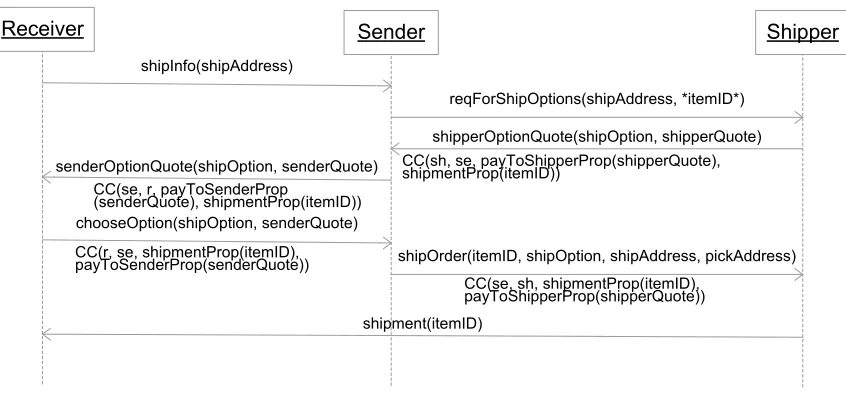
Figure2.1shows a scenario for the Shipping Protocol:
Receiver Sender Shipper
shipInfo(shipAddress)
reqForShipOptions(shipAddress, *itemID*)
shipperOptionQuote(shipOption, shipperQuote)
senderOptionQuote(shipOption, senderQuote)
chooseOption(shipOption, senderQuote)
shipment(itemID)
CC(sh, se, payToShipperProp(shipperQuote), shipmentProp(itemID))
CC(r, se, shipmentProp(itemID), payToSenderProp(senderQuote))
CC(se, r, payToSenderProp
(senderQuote), shipmentProp(itemID))
shipOrder(itemID, shipOption, shipAddress, pickAddress) CC(se, sh, shipmentProp(itemID),
payToShipperProp(shipperQuote))
Figure 2.1: Shipping protocol scenario
There are three roles involved in this protocol namely, the receiver, the sender and the shipper. The receiver is the customer who purchased some item from the merchant or the sender. The sender uses a third party, i.e., the shipper, to ship the item to the receiver.
The sequence of messages exchanged to enact this protocol are shown in Figure2.1. The
terms in the parantheses following the message name indicate the parameters or slots that uniquely identify the messages. The commitments created are represented as CC(..). Com-mitments are explained in Section2.2.
first rule indicates that if the shipper’s knowledge base (KB) contains a senderOptionQuote message and its shipOrderPolicy is also asserted to the KB, then the shipper should send the receiver a shipOrder message and create a commitment which indicates that the sender is committed to pay to the shipper if the shipper sends the shipment to the receiver.
c o n t a i n s (KB, s e n d e r O p t i o n Q u o t e P r o p ( ? s e n d e r Q u o t e , ? s h i p O p t i o n ) )
∧ c o n t a i n s (KB, s h i p O r d e r P o l i c y )
⇒ s e n d ( R e c e i v e r , s h i p O r d e r ( ? p i c k A d d r e s s , ? s h i p A d d r e s s , ? i t e m I D , ? s h i p O p t i o n ) )
∧ c r e a t e C o m m i t m e n t ( S e n d e r , S h i p p e r , s h i p m e n t P r o p ( ? i t e m I D ) , p a y T o S h i p p e r P r o p ( ? s h i p p e r Q u o t e ) )
c o n t a i n s (KB, s h i p O r d e r M s g P r o p ( ? p i c k A d d r e s s , ? s h i p A d d r e s s , ? i t e m I D , ? s h i p O p t i o n ) ) ∧ c o n t a i n s (KB, s h i p m e n t P o l i c y ( ? i t e m I D ) )
⇒ s e n d ( R e c e i v e r , s h i p m e n t ( ? i t e m I D ) )
2.2
Commitments
Commitments among agents represent the contractual obligations that exist among them. An agent can commit to bringing about a certain state in the environment in which it exists or to carry out a certain action. Commitments always exist within a well-defined social structure, which forms their context [Singh,1999]. Commitments provide a power-ful formalism for modeling and understanding interactive behavior in multiagent systems. For example, a customer’s agreement to pay the price for the item after it is delivered is a commitment that the customer has towards the merchant. Violations of commitments can be detected; in some important circumstances, violators can be penalized. Such enforce-ability of contracts is necessary in practical settings where the participants are autonomous and heterogeneous [Venkatraman and Singh,1999].
is called the precondition of the commitment. For example, the conditional commitment CC(c, b, goods(g), pay(p)) means that the customer c is committed to pay the bookstore
b an amount p if the bookstore delivers the book g to the customer. When the bookstore
delivers the goods, i.e., when the goods(g) proposition holds, the conditional commitment
CC(c, b, goods(g), pay(p)) is automatically converted into the base-level commitment C(c,
b, pay(p)) [Wan and Singh,2005].
2.3
The Specification Language
We use the event-based linear temporal logic I as introduced by Singh [2003] for for-malizing complex event patterns. I is the start symbol of the BNF for the language ofI. In
this BNF,slantindicates nonterminals, −→and|are meta-symbols of the BNF, /* and */
delimit comments, and all other symbols are terminals.
L1I −→dep |dep ∧I /*conjunction: interleaving*/
L2dep −→seq |seq ∨dep /* disjunction: choice*/
L3seq −→bool |event |event ·seq /* before: ordering*/
L4bool −→0 | ⊤
Dependency. A dependency is an expression generated by I. It specifies constraints on the occurrence and ordering of events.
Event Literal Set. Γ 6= {} is the set of event literals as generated by the nonterminal
event. Each eventeliteral has a complemente. Intuitively, initially, neither an event nor its complement holds; ultimately, one of them must hold.ΓD is the set of literals
mentioned in a dependency D and their complements. For example, Γe = {e, e}.
For a set of dependenciesD, we defineΓDasΓD = [
D∈D ΓD.
Let us consider a simple example. In the Shipping Protocol, let theshipOrder sent by the
sender to theshipper be denoted bya and the shipment sent by theshipper in response to
shipment can only be received if ashipOrder has been sent in the Shipping Protocol” as a dependencyE =a·b∨b.
2.3.1
Constraint Language Semantics
For a run τ ∈ UI and I ∈ I, τ |= I means that I is satisfied over the run τ. This
notion can be formalized as follows. Here,τi refers to the ith item inτ andτ[i,j]refers to
the subrun ofτ consisting of its elements from indexito indexj, both inclusive. |τ|is the last index ofτ and may beω for an infinite run. We use the following conventions in the specification of semantics below: e, f, e, f, etc. are literals; D, E, etc. are dependencies;
i, j, k, etc. are temporal indices; andτ, etc. are runs. The semantics ofIis
M1τ |=eiff(∃i:τi =e)
M2τ |=I1∨I2 iffτ |=I1orτ |=I2
M3τ |=I1∧I2 iffτ |=I1andτ |=I2
M4τ |=I1·I2 iff(∃i:τ[0,i]|=I1 andτ[i+1,|τ|]I2)
Denotation. The denotation[[D]]of a dependencyD is the set of runs that satisfyD, i.e.,
[[D]] ={τ :τ |=D}.
For example, the denotation of the dependencya·b∨ais the set of runs in which there is nobprecedingaor, if there is ashipment, theshipOrder precedes theshipment (a·b).
2.3.2
Residuation
Another important concept in this specification language is residuation. The residual of a dependencyDby an eventeis denoted byD/eand corresponds to the largest set of runs satisfying the given dependency. Formally, ν ∈ [[D]]/eiff (∀v : v ∈ie ⇒ (vν ∈ UI ⇒
vν ∈ [[D]])) The residual represents what remains in the dependency after a certain event has occurred for the dependency to be satisfied on any run. The following are residuation rules as given by Singh:
R2⊤/e .
=⊤
R3(E1∧E2)/e .
= ((E1/e)∧(E2/e))
R4(E1∨E2)/e .
= ((E1/e)∨(E2/e))
R5(e.E)/e .
=Eife6∈ΓE
R6D/e=. Dife6∈ΓD
R7(e′ ·E)/e= 0. ife∈Γ
E wheree′ is any event literal
R8(e·E)/e . = 0
Continuing with the above example, consider the dependency a· b ·c, where c denotes
ashipmentAcknowledgement sent by thereceiver to the shipper. The above dependency encodes that “shipOrder(a) is followed byshipment (b) is followed byshipmentAck (c).” The residual of this dependency witha isb·c, which is what is left to be done to satisfy the dependency aftera occurs. The residual of this dependency with some other literalx, however, is the dependency itself, since the dependency does not specify whetherxoccurs.
2.4
Running Example
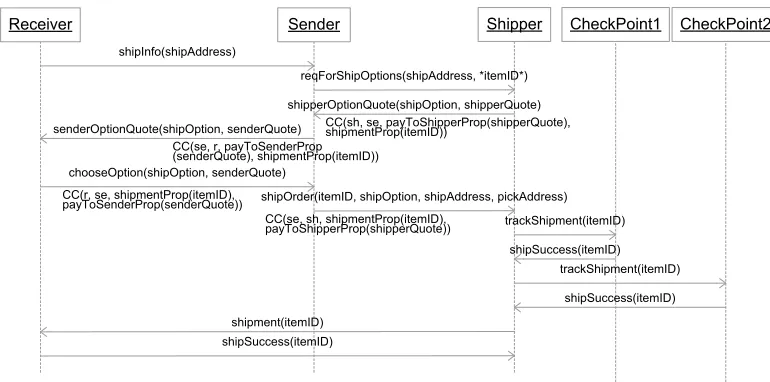
We illustrate our approach with an example interaction in which a shipper ships some
goods to a customer. The shipping protocol as shown in Figure2.1ends with aShipment
message from the shipper to the receiver. But this message surely does not capture the
fact whether the shipment was actually delivered or not. For example, theshipper might
have sent the package but it got misplaced on the way. Since the shipper is committed to shipping the package once the payment has been made by thereceiver, it is important for him to monitor this commitment. This is where we incorporate event monitoring into the
shipping protocol. At the point when the Shipper receives the shipOrder message from
the Sender, it will initiate tracking of the shipment by subscribing to checkpoints (e.g., RFID sensors). When all such sensors return a positive response and finally the receiver
too acknowledges the receipt of the shipment, the shipper can confirm that the shipment
Receiver Sender Shipper shipInfo(shipAddress)
reqForShipOptions(shipAddress, *itemID*)
shipperOptionQuote(shipOption, shipperQuote)
senderOptionQuote(shipOption, senderQuote)
chooseOption(shipOption, senderQuote)
shipSuccess(itemID)
CC(sh, se, payToShipperProp(shipperQuote), shipmentProp(itemID))
CC(r, se, shipmentProp(itemID), payToSenderProp(senderQuote))
CC(se, r, payToSenderProp (senderQuote), shipmentProp(itemID))
shipOrder(itemID, shipOption, shipAddress, pickAddress)
CC(se, sh, shipmentProp(itemID), payToShipperProp(shipperQuote))
CheckPoint1
trackShipment(itemID)
shipSuccess(itemID)
CheckPoint2
trackShipment(itemID)
shipSuccess(itemID)
shipment(itemID)
Figure 2.2: Shipping protocol refined to include tracking by sensors at two checkpoints
Chapter 3
Events in Business Processes
This chapter introduces our approach for achieving a proactive and reliable protocol-based business process enactment model. It introduces the Event Processing Language used to describe events and to incorporate them into business rules. It describes role-specific perspectives of commitments and how they can be used to deduce complex event patterns for fine-grained monitoring of processes.
In our approach, events are incorporated into the protocol-based enactment framework of OWL-P. The rules and policies are refined to accommodate events. The receipt of a message is a simple event. A simple event source could be any of the following:
• Agents participating in the protocol enactment
• Sensors (e.g., RFID sensors) which can provide information about external
condi-tions that may have an effect on an interaction
• Other software applications (e.g., timers, databases etc)
• Other non-participating agents
matching technique to do so. Consequently, the agents react to detected complex events by triggering rules.
3.1
Event Processing Language
This is the specification language that combines event logic with rules. Event
Process-ing Language (EPL) [Albek et al., 2005] comprises the following: Event Type, Complex
Event Patterns formalized by an Event Pattern Language and Rules with Events incorpo-rated into them.
As Chandy describes [2005] events are processed via rules of the form:
WHEN r e a l i t y d e v i a t e s s i g n i f i c a n t l y f r o m f r o m e x p e c t a t i o n s THEN r e s p o n d
Let us elaborate this rule by stating that if a simple event occurs and its occurrence leads to the satisfaction of some condition or a complex event, then an action should be taken. The processing of an event is hence split into two steps: one, in which if a simple event occurs, a complex event pattern is evaluated to see if the occurrence of the simple event affected it; and two, in which if a complex event pattern is satisfied then an action is taken. In order to express the WHEN clause or the first part of the rule, we use an Event Type to represent a simple event and Complex Event Patterns formalized by an Event Pattern
Language to represent the condition. The THEN clause is represented by business rules.
WHEN c o m p l e x e v e n t p a t t e r n e v a l u a t e s t o t r u e THEN a c t i v a t e b u s i n e s s r u l e
3.1.1
Event Type
An event type specifies the template to represent a simple event. Events are represented as tuples of data as described in [Luckham, 2002]. We represent an event by the tuple
e(message,source)where message and source are predefined public attributes [Luckham,
2002], denoting the message that causes the event and the event source. Event could also
be represented as e(commitment,self) which denotes a commitment in the agent’s own
shipment message is received from Checkpoint1 by the shipper. (Checkpointiis
abbrevi-atedPi below.) This can be represented by event e1 ase1(shipSuccess(itemID), P1). Or
if we consider the commitmentCC(se,sh,shipment(. . .),pay(. . .)), we can represent this by an event at the sender’s KB as:
ec(CC(se, sh,shipment(. . .),pay(. . .)),self)
3.1.2
Event Pattern Language
We use the event-driven linear temporal logic of Section 2.3 as the event pattern
lan-guage [Luckham, 2002] to formalize complex event patterns in our system. An example
complex event or dependency isD=a·b∨a∨b. The complex eventD[Luckham,2002] is generated from the aggregation of simple eventse1,e2, ande3. Here,∧and·are pattern operators that express the relationship between the events as introduced in Section 2.3. This expression checks for completeness of the event, or in other words, thatEis valid. In our approach we differentiate between the occurrence of an event and the conditions that would constitute its non occurrence. Hence, we create a complementary pair,EandE.
The above dependency D is split into an eventE and its corresponding complement
E in order to distinguish between the desirable and the undesirable conditions. We get
E = a·b, and E = a·b = a∨b. However E does not capture all the conditions under
whichE would fail. In order to ensure the non-occurrence ofE we addb·atoE, hence resulting inE =a∨b∨b·a. The eventEoccurs only ifaoccurs, followedb. E occurs if
adoes not occur orbdoes not occur or the occurrence ofbis followed by occurrence ofa. The second expression, hence, represents exceptions in the system.
Continuing with our running example, we could express a successful shipment by the complex event,
E=e1(shipSuccess(. . .), P1)· e2(shipSuccess(. . .), P2) · e3(shipSuccess(. . .),Receiver)
Or, more simply asE =e1·e2·e3. An exception will be detected if this sequence of events
does not happen.
We restrict our sequence expressions to have at most two operands for each operator. Hence the above expression can be reduced toE = e1 ·e2∧e2 ·e3. The implication of
occurs, which has a significance and a consequent action. Patterns for such normal complex events are designed by protocol designer once he has decided the commitments it wishes to monitor. The corresponding exception will beE =e1∨e2∨e3∨e2·e1∨e3·e2∨e3·e1.
Derivation of exception patterns from events have been explained further in Section4.2.1.
3.1.3
Event Incorporated Rules
Business action rules are represented in JESS [Friedman-Hill, 2003] according to the pattern:
c o n d i t i o n ⇒ a c t i o n
The condition is the evaluation of a complex event pattern to true. The action is any subse-quent process that follows. Examples of actions are:
• Instantiate a protocol. It could be the same or a different protocol. This leads to nested protocol enactment.
• Send messages to other participating agents.
• Call another application.
On incorporating events into the typical OWL-P rules for the Shipping Protocol intro-duced in Section2.4, the rule would look like:
c o n t a i n s (KB, s h i p m e n t E v e n t ) ⇒ s e n d ( r e c e i v e r , s h i p m e n t ( . . ) )
whereshipmentEvent is the complex event formed by aggregating simple events
shipOrderEvent,P1SuccessEvent, andP2SuccessEvent.
shipmentEvent = shipOrderEvent(shipOrderMsg,se) · P1SuccessEvent(shipSuccessMsg, P1) ·
P2SuccessEvent(shipSuccessMsg, P2)
3.2
Monitoring Decisions
As discussed in Chapter 1, event monitoring is injected into a business protocol at specific points that require special attention. How does one decide what business events are significant enough to be monitored? What analysis is required to design these complex event patterns? To be able to take such design decisions, the designer must be aware of the business needs and goals of the agent. For example, a shipper who intends to serve preferred customers better, may choose to track the item through checkpoints. The same shipper might refrain from tracking shipments for an ordinary customer. Thus the same process may be enacted in several ways depending on the needs of the agent. This can be understood in terms of perspectives on commitments.
The perspective of a protocol for a particular agent is the enactment of the protocol under specific circumstances suiting the agent’s own purpose. It is a customized version of the protocol that an agent enacts on the basis of the decisions it makes for monitoring commitments. The decision to monitor and hence the design of the complex event patterns depend on the agent’s perspective of the protocol.
The protocol is enacted as follows: Once the receiver makes a payment, the sender sends a shipOrder message to the shipper, who then sends the shipment to the receiver. These high-level interactions are specified by the protocol rules. We break this entire piece of action into multiple subactions depending on the role the agent is playing. These set of subactions are simple events that are aggregated to form the high-level complex event patterns which are of significance to the business.
Each perspective gives rise to a set of complex events which the agent monitors and handles. Our tool aids the designer in deriving exception patterns from the event patterns automatically. Different perspectives specific to the role and instance of the protocol are described below.
3.2.1
Receiver’s Perspective of the Shipping Protocol
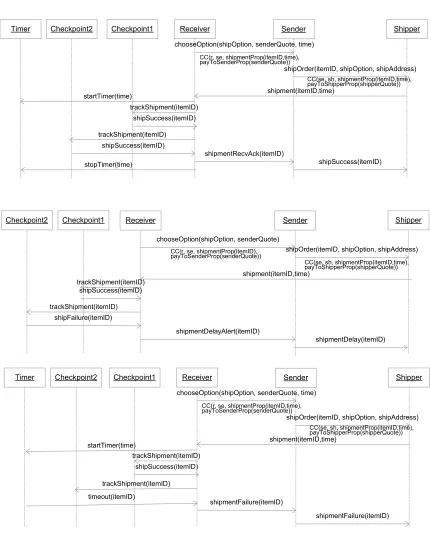
The receiver’s perspective might be to track the shipment with the aid of RFID sen-sors at intermediate points and a timer. This is illustrated in Figure3.1. Depending on the outcome of this monitoring the action of the receiver may vary. There are three situations shown in the figure. If the shipment is received within the agreed time, it sends a receive ac-knowledgment (shipRecvAck) to the sender. If the shipment did not reach an intermediate checkpoint, it sends a delay alert (shipmentDelayAlert) to the sender. If the timer timed out, i.e., the shipment did not reach it within the agreed upon time, it will notify the sender of the failure by sending the shipmentFailure message. Using the event processing language introduced in Section3.1, we can express the complex events and rules as follows:
Shipment received within the agreed upon time:
shipmentReceivedEvent = shipmentEvent(shipmentMsg,sh) · P1SuccessEvent(shipSuccessMsg, P1)
· P2SuccessEvent(shipSuccessMsg, P2)
shipmentReceivedEvent ⇒ shipmentRecvAck ∧ stopTimer
Receiver Sender Shipper
chooseOption(shipOption, senderQuote, time)
CC(r, se, shipmentProp(itemID,time), payToSenderProp(senderQuote))
shipOrder(itemID, shipOption, shipAddress)
CC(se, sh, shipmentProp(itemID,time), payToShipperProp(shipperQuote)) Checkpoint1 trackShipment(itemID) Checkpoint2 shipSuccess(itemID) trackShipment(itemID) shipSuccess(itemID) shipment(itemID,time)
Receiver Sender Shipper
chooseOption(shipOption, senderQuote)
CC(r, se, shipmentProp(itemID), payToSenderProp(senderQuote))
shipOrder(itemID, shipOption, shipAddress)
CC(se, sh, shipmentProp(itemID,time), payToShipperProp(shipperQuote)) Checkpoint1 trackShipment(itemID) Checkpoint2 shipSuccess(itemID) trackShipment(itemID) shipFailure(itemID) shipment(itemID,time) shipmentDelayAlert(itemID) shipmentRecvAck(itemID) shipSuccess(itemID) Timer startTimer(time)
Receiver Sender Shipper
chooseOption(shipOption, senderQuote, time)
CC(r, se, shipmentProp(itemID,time), payToSenderProp(senderQuote))
shipOrder(itemID, shipOption, shipAddress)
CC(se, sh, shipmentProp(itemID,time), payToShipperProp(shipperQuote)) Checkpoint1 trackShipment(itemID) Checkpoint2 shipSuccess(itemID) trackShipment(itemID) timeout(itemID) shipment(itemID,time) Timer startTimer(time) shipmentFailure(itemID) shipmentDelay(itemID) shipmentFailure(itemID) stopTimer(time)
3.2.2
Shipper’s Perspective of the Shipping Protocol
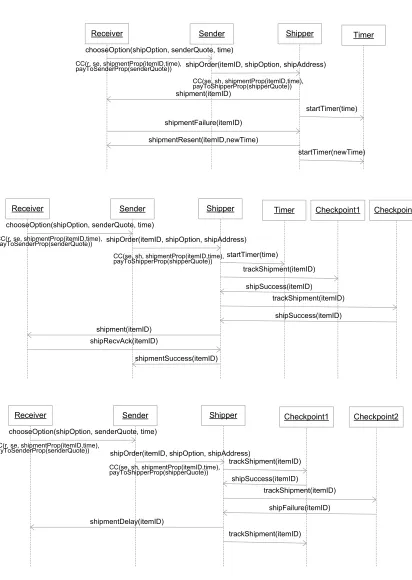
The shipper’s perspective of the same interaction is to set a timer and get an alert if the shipment was not delivered within the agreed upon time frame. In that case he would re-send the shipment. In another instance of the same protocol, the shipper might de-cide to take the responsibility of tracking the shipment through the inventory till its final destination. This is similar to the running example described in Section 2.4. Both these perspectives are shown in Figure3.2. The events for the shipper would be as follows for the first instance:
shipmentResendEvent = shipmentEvent(shipmentMsg,self) ·
shipmentFailureEvent(shipmentFailureMsg, se)
For the second instance the complex events and rules are defined as follows:
shipmentSendEvent = shipOrderEvent(shipOrderMsg,se) · P1SuccessEvent(shipSuccessMsg, P1) ·
P2SuccessEvent(shipSuccessMsg, P2)
shipmentSuccessEvent = shipOrderEvent(shipOrderMsg,se) · P1SuccessEvent(shipSuccessMsg, P1) ·
P2SuccessEvent(shipSuccessMsg, P2) ·
ReceiverSuccessEvent(shipRecvAckMsg, re)
contains(KB, shipmentSuccessEvent)⇒send(se, shipmentSuccess)
contains(KB, shipmentF ailureEvent)⇒shipmentF ailureP olicy
3.2.3
Sender’s Perspective of the Shipping Protocol
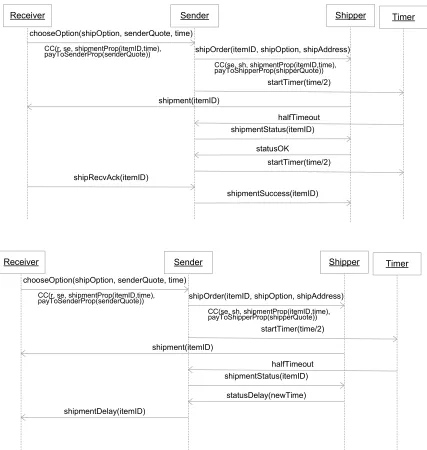
The sender has a different perspective. The sender, who might be obligated to serve the receiver better since it is a premium customer, might decide to inquire with the shipper after half the time has elapsed if the shipment will make it within the remaining time. Or he might choose to remain passive and forward all messages from the receiver to the shipper. For the first scenario some of the events and rules are as follows:
shipmentSuccessEvent = startTimerEvent(startTimerMsg,self) ·
shipmentReceivedEvent(shipRecvAckMsg, Receiver)
Receiver Sender Shipper
chooseOption(shipOption, senderQuote, time)
CC(r, se, shipmentProp(itemID,time),
payToSenderProp(senderQuote)) shipOrder(itemID, shipOption, shipAddress)
CC(se, sh, shipmentProp(itemID,time), payToShipperProp(shipperQuote))
Timer
startTimer(time)
Checkpoint1 Checkpoint2
trackShipment(itemID)
shipSuccess(itemID)
trackShipment(itemID)
shipSuccess(itemID)
shipment(itemID)
shipRecvAck(itemID)
shipmentSuccess(itemID)
Receiver Sender Shipper
chooseOption(shipOption, senderQuote, time)
CC(r, se, shipmentProp(itemID,time),
payToSenderProp(senderQuote)) shipOrder(itemID, shipOption, shipAddress)
CC(se, sh, shipmentProp(itemID,time), payToShipperProp(shipperQuote))
Checkpoint1 Checkpoint2
trackShipment(itemID)
shipSuccess(itemID)
trackShipment(itemID)
shipFailure(itemID)
shipmentDelay(itemID)
trackShipment(itemID)
Receiver Sender Shipper
chooseOption(shipOption, senderQuote, time)
CC(r, se, shipmentProp(itemID,time),
payToSenderProp(senderQuote)) shipOrder(itemID, shipOption, shipAddress)
CC(se, sh, shipmentProp(itemID,time), payToShipperProp(shipperQuote))
Timer
startTimer(time) shipment(itemID)
shipmentFailure(itemID)
shipmentResent(itemID,newTime)
startTimer(newTime)
Receiver Sender Shipper
chooseOption(shipOption, senderQuote, time) CC(r, se, shipmentProp(itemID,time),
payToSenderProp(senderQuote)) shipOrder(itemID, shipOption, shipAddress) CC(se, sh, shipmentProp(itemID,time), payToShipperProp(shipperQuote))
Timer
startTimer(time/2) shipment(itemID)
shipmentStatus(itemID) halfTimeout
statusOK
startTimer(time/2) shipRecvAck(itemID)
shipmentSuccess(itemID)
Receiver Sender Shipper
chooseOption(shipOption, senderQuote, time) CC(r, se, shipmentProp(itemID,time),
payToSenderProp(senderQuote)) shipOrder(itemID, shipOption, shipAddress) CC(se, sh, shipmentProp(itemID,time), payToShipperProp(shipperQuote))
Timer
startTimer(time/2)
shipment(itemID)
shipmentStatus(itemID) halfTimeout
statusDelay(newTime) shipmentDelay(itemID)
Chapter 4
Architecture and Process Monitoring
This chapter first describes the event-driven agent architecture. It then describes in de-tail how agents are configured to accommodate events and explains how process monitoring takes place.
4.1
Architecture
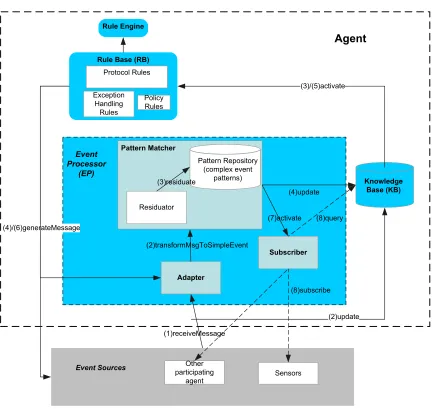
Our event-driven agent architecture is shown in Figure 4.1. The agent primarily con-sists of a rule base (RB), a knowledge base (KB) and an event processor (EP). Incoming messages from several event sources are processed by the EP. On detecting an event, the EP stores the event in the KB. The KB then activates rules in the rule base. In case of rules where events have not been introduced, the message is directly stored as a proposition in the KB which consequently activates protocol rules.
The event processor is the heart of the agent. It is similar to the concept of the Enterprise Service Bus [Mar´echaux, 2006] except that the subscriptions in the event processor are based on state changes and these subscriptions can be optimally managed.
These are the tasks carried out by the event processor:
• Receives messages and transforms them into events conforming to the event type
explained in Section3.1.
Rule Base (RB) Protocol Rules Policy Rules Subscriber Sensors Other participating agent Knowledge Base (KB) (4)update Pattern Matcher (8)subscribe (8)query (7)activate (1)receiveMessage Event Processor (EP) Exception Handling Rules Rule Engine Event Sources (3)/(5)activate Pattern Repository (complex event patterns) Residuator (3)residuate Adapter (2)transformMsgToSimpleEvent Agent (2)update (4)/(6)generateMessage
Figure 4.1: Event-driven agent architecture
residuation of the complex events with simple events.
• Manages subscriptions to event sources depending on the order in which it expects
events to occur and depending on whether the agent chooses to subscribe selectively or not.
The following modules constitute the EP:
Adapter. The adapter is the entry point for messages. It transforms incoming messages
events are then handed to the pattern matcher.
Pattern Matcher. The Pattern Matcher is responsible for aggregating simple events via
complex event patterns available in the pattern repository. It is hence responsible for detecting expected patterns in the incoming events. It is made up of two components:
• The pattern repository maintains the current state of the event and exception patterns. It is initialized during the configuration of the EP with the new event patterns, as designed and exception patterns, as derived.
• The residuator performs residuation as explained in Section 2.3 on the event patterns in the pattern repository and updates its state. If any of the dependen-cies or event patterns evaluate to true, that event is asserted to the knowledge base. Further, the Pattern Matcher activates the subscriber if selective subscrip-tion is turned on.
Subscriber. The subscriber consults the pattern repository to determine the upcoming
sim-ple events that might lead to the occurrence of a comsim-plex event. It decides which source to listen to next, in order to get relevant information. Selective subscription is optional.
4.2
Event Configuration
At the beginning of the protocol enactment, the agent undergoes an initial setup phase called Event Configuration. Event configuration involves the following distinct tasks:
• Generation of complex exception patterns from high-level event patterns.
• Initialization of the Pattern Repository with event and exception patterns.
• Generation of exception handling rules.
Exception Pattern Generator
Complemen t of event
pattern _ E Exception Pattern Filter Set of events to be
eliminated E' Designer Exception Handling Rule Generator describeExceptions _ Eex = E - E'
storeExceptionPatterns (Eex)
Event Pattern E Event Configurator Rule Generator Protocol Rules Tool Public Protocol Resources RB Protocol Rules Policy Rules Subscriber KB Pattern Matcher EP Exception Handling Rules Rule Engine Pattern Repository Residuator Adapter Agent storeEventPatterns(E)
Figure 4.2: Event configuration
4.2.1
Deriving Exception Patterns
Complex event and exception patterns are formalized by the pattern language described in Section3.1.2. The event processor derives patterns of exceptions from an event pattern
E in two simple steps.
• Complementing the complex eventE to generate all possible conditions
correspond-ing to E not happening. This pattern is represented as E, as explained in
• RefiningE by eliminating conditions that cannot happen or are uninteresting. This step requires designer input.
The failure of the shipment event, i.e., ShipmentEvent, or E, is computed by the
Exception Pattern Generator E = e1·e2 ∨e2·e3. On simplification, we obtain E =
e1∨e2∨e3 ∨e2·e1∨e3·e2 according to our event pattern language.
This complex event pattern can further be simplified by filtering out events that have no possibility of occurrence. For example,e2·e1indicates that theP2sends a success message
beforeP1. This is an impossible sequence. Or even if such a sequence occurs, under the
circumstance that P1 somehow misread and gave an erroneous response, the occurrence
ofe2 ·e1 would indicate an error. Thus this sequence can be removed from the exception
pattern E. Similarly e3 · e2 can also be eliminated. Another example where a simple
event may be filtered out is where an agent has subscribed to a timer to receive an alert
after some elapsed time to ensure event x occurs before the timeout occurs. This can be
represented by the event patterns,E = x·timeoutandE = x∨timeout∨timeout·x.
The eventtimeoutcan be ignored since it has no significant effect. HenceEwould reduce toE =x∨timeout·x.
The agent may also choose to be specific about a particular exception. For example, it may decide to split the entire exception pattern into different simple exceptions. It may, hence, choose to monitor the occurrence ofe1,e2ande3as separate exceptions each leading
to a different course of action. The task of elimination is performed by the exception pattern
filter or EPF with the aid of human input.
The EPF takes a set of events E′ as input from the protocol designer and performs
E−E′ to generateE
ex. Here,Eex =e1 ∨e2∨e3. This is the exception dependency that
the agent will check for in addition to the normal eventE. This exception can called
Ship-mentException. The combination of ShipmentEvent (E) and ShipmentException (Eex)
completes the check for a successful shipment. The Pattern Repository of the Pattern
Matcher module is initialized with such sets of event patterns and their corresponding
4.2.2
Generating Exception Handling Rules
Detected exceptions are handled by a new set of rules generated by the agent. The rules state that the agent’s internal policies should be triggered on occurrence of an excep-tion. Policy-driven exception management separates exception-handling from the normal business logic [Zeng et al., 2005]. The action taken is independent of the protocol and is the agent’s own private decision. The policy might be a simple action like sending a mes-sage or could be something more complicated like initiating another protocol. The latter would lead to nested protocols arising from event occurrences. This gives a flavor of a truly event-driven protocol-based business process enactment.
For example, continuing with our previous example, the rule to handle the exception
Eexis
c o n t a i n s (KB, Eex) ⇒ EexP o l i c y ( . . . )
or
c o n t a i n s (KB, S h i p m e n t E x c e p t i o n ) ⇒ S h i p m e n t E x c e p t i o n P o l i c y ( . . )
This rule means that if the eventShipException exists in the knowledge base the ShipEx-ceptionPolicy of the agent should be consulted to take a decision of the necessary action. The ShipmentExceptionPolicy is an internal business decision of the shipper. It might de-cide to act in several ways, some examples of which are given below.
• Resend the package and thereby reinitiate this entire process.
• Send a message to the customer informing it of a delay.
• Delegate the control of action to P1 who reported an exception, who in turn might
track the shipment via another checkpoint. This leads to a nested shipping protocol.
ProcedureconfigureEvent(E,E′,R): Configures the event pattern 1
repository with events and exceptions and generates exception handling rules
input : A set of complex event patternsE, set of exception filtering patternsE′
and a set of rulesR
output: A configured event pattern repositoryT and an updated set of rulesR T ← {};
2
foreachEninEdo 3
T ←T ∪En; 4
Eex n ←En−En′; 5
R =generateRule(Eex n, R);
6
T ←T ∪Eex n; 7
ProceduregenerateRule(Eex,R): Generate exception handling rules for 8
exceptionEexand add it to the set of rulesR
input : ExceptionEexand a set of rulesR. R={r}wherer=hE, Ai. Eis an event that triggers the rule to take an actionA
output: Updated set of rulesR r.E =Eex;
9
r.A =EexP olicy; 10
R ←R∪r;
11
returnR;
12
Algorithm 1: configureEvent(E,E′,R): Configures the event pattern repository
with events and exceptions and generates exception handling rules.
4.3
Process Monitoring
4.3.1
Event Processing
Once the event processor has been configured at the beginning of the protocol enact-ment, the agent is all set to begin monitoring. The runtime monitoring occurs in the order specified in Figure4.1. Continuing with our running example, let us consider the shipper agent who has committed to ship an item to the receiver. It has sent out the shipment and is now beginning to track the package. After deriving its role in the shipping protocol, the events ShipmentEvent (E) and ShipmentException (Eex) have been derived and stored in the pattern store as explained above in Section4.2. The shipper needs to match the event patternE = e1 ·e2 ·e3 and exception pattern E = e1 ∨e2 ∨e3. It has subscribed to P1
in order to get information about the status of the package. When P1 receives the
pack-age and forwards it to the next destination, it sends the messpack-ageshipSuccess(itemID)to the shipper. The sequence of action that occurs after the receipt of the message (Step 1 in Figure4.1) is described in the following subsections.
Transformation
Event transformation (Step 2 in Figure 4.1) is the process of converting a message re-ceived to a simple event conforming to the event template described in Section 3.1. The
transformation of an incoming messageM involves setting the message and source fields
for an event appropriately based on the message. For example, messageshipSuccess(itemID)
fromP1is transformed into evente1(shipSuccess(itemID), P1). The adapter then forwards
this event to the pattern matcher asking if this message has any effect on any events in the pattern repository.
Pattern Matching
The pattern matcher performs residuation (Step 3 in Figure4.1) on all complex event patterns in the pattern repository with this event. The details of residuation is explained in Section2.3.2. The complex event pattern in the pattern repository thus reduce to:
E/e1 .
= (e1·e2)/e1∧(e2·e3)/e1 orE/e1 .
=e2·e3
If any complex event pattern evaluates to true due to the occurrence of e1, then that
complex event activates some rule in the rule base (Step 5 in Figure4.1), the consequent action is taken. The action might involve sending messages to other agents as a part of the protocol (Step 6 in Figure4.1). These sent messages are again fed to the adapter (Step 6 in Figure4.1) to be transformed to simple events which might affect the complex patterns in the pattern repository. Next the pattern matcher activates the subscriber if selective sub-scription is turned on (Step 7 in Figure4.1), analyze event trends, and selectively subscribe (Step 8 in Figure4.1) to different event sources based on its prediction of what might hap-pen next and who might be responsible for it. This concept is explained in more detail in the Section4.3.2.
Action
As discussed earlier is Section 3.1, the action to be taken is driven by business rules. These rules are stored in the rule base. On the occurrence of eventE, if the rule base con-tains the ruleE ⇒x, actionxwill be implemented. For example, for ashipmentEvent, E, the following rule is activated.
c o n t a i n s (KB, E ) ⇒ s e n d ( r e c e i v e r , m e s s a g e )
This shows how the task of event monitoring is divided between the Event Processor
and the Rule Base. The event processor evaluates and detects complex events E and the
Rule Base executes business rules whenEoccurs.
The event processing steps as described in this section are summarized in Algorithm2.
4.3.2
Selective Subscription
ProcedureprocessEvent(T, M): Event processing is done in three steps.
1
Transform MessageM toe. Residuate the set of event patterns and exception patterns in event repositoryT withe. Get a set of event sources to subscribe to.
input : An event pattern repositoryT, a messageM
output: A residuated repositoryT′, a set of simple event sourcesS
subto subscribe to.
e.m =M;
2
e.s =M.sender;
3
Ssub={}; 4
foreachEinT do
5
E =E/e;
6
if (E ==⊤) then 7
updateKB(E);
8
Ssub=subscribe(E);
9
foreachEexinT do
10
Eex=Eex/e;
11
if (Eex==⊤) then 12
updateKB(Eex);
13
Ssub=Ssub∪subscribe(Eex);
14
Algorithm 2: processEvent(T, M): Process events with the help of the complex event patterns stored in the event repositoryT, on the receipt of a messageM
airline, however, does not need to subscribe to the emergency hurricane service on a regular basis.
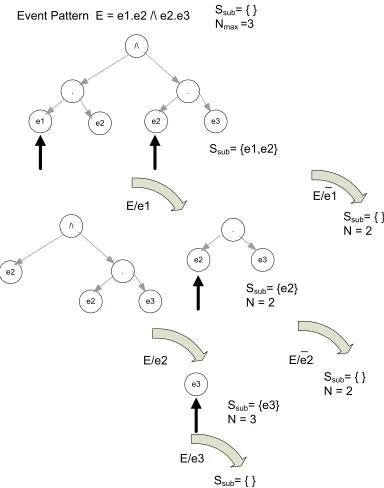
We demonstrate selective subscription with our running example. Saye1has occurred.
On residuating E with e1, the complex event pattern E reduces to E = e2 · e3. The
shipper can then subscribe to the source ofe2(shipSuccess(itemID), P2), which is P2 and
may unsubscribe itself from the source ofe1, which isP1 since it does not need any more
information from P1. If e1 had not happened, i.e., the package did not reach the first
checkpoint,P1, it would not make any sense to listen toP2. Since the events are specified
in a particular order, it is easy to predict what to expect next and from which agent. In some cases the agent may need to query its own knowledge base to check for a particular event in order to residuate patterns in the pattern repository.
Algorithm3implements Selective Subscription using our event pattern language. Every event pattern is represented by a binary tree similar to the one shown in Figure4.3. The dark arrows indicate the node that is being subscribed to. At every step, the set of nodes to be subscribed to is computed.
After the first round of residuation, the subscriber will subscribe to all those event sources that are the left children of a ‘·’ node, and to all other sources that are children of ‘∧’ or ‘∨’ nodes. This implies that if a complex event evaluates to true for a number of simple events AND’ed or OR’ed together, then subscribe to sources of all events that are operands of the AND or OR operator. If, however, there is a temporal operator ‘·’, then subscribe to the source of the event which is the left operand of the temporal operator, i.e., which will occur first. This management of subscriptions is described in Algorithm3.
Test Cases to Demonstrate Selective Subscription
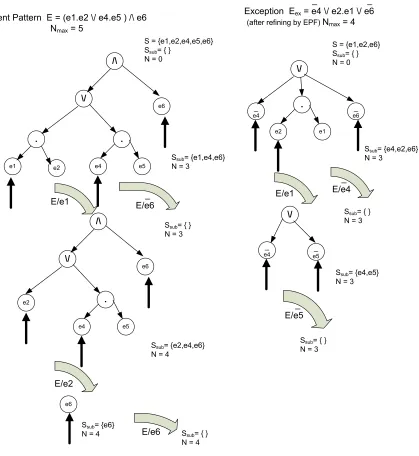
We used different order of simple events on some complex event patterns to demonstrate event monitoring, selective subscription, and exception detection and recovery. We use the complex event pattern E = (e1 · e2 ∨e4 ·e5)∧ e6 and a refined exception pattern
E = e4 ∨e2· e1∨ e6. We use different orders of occurrence of the simple events e1,
e2, e4, e5, ande6 to evaluate how selective subscription takes place. It is evident from the
/\
e1 e2
.
e2 e3
.
/\
e2
e2 e3
.
Event Pattern E = e1.e2 /\ e2.e3
E/e1
e2 e3
.
e3
E/e2
Ssub= {e1,e2}
Ssub= { }
Nmax =3
Ssub= {e2}
N = 2
Ssub= {e3}
N = 3
E/e3
Ssub= { }
_ E/e1
Ssub= { }
N = 2
_ E/e2
Ssub= { }
N = 2
Figure 4.3: Selective subscription for a complex event pattern
Hence, though the agent could have subscribed to six event sources, it ends up subscribing only to one event source in order to enact the process.
Proceduresubscribe(E): Find the set of event sourcesSto subscribe to for
1
a Complex Event PatternE
input : A complex event patternE =hex, rxiwheree=hm, si. eis a simple event represented in terms of messagemand its sources
output: A set of simple event sourcesS ={sx}
foreachdependency DinE do
2
foreachsequence seqinDdo
3
if (seq== e1·e2) then 4
S ←S∪e1.s; 5
returnS;
6
Algorithm 3: subscribe(E): Find the set of event sourcesSto subscribe to for a
Complex Event PatternE
of the simple events in different orders. At every step we represent the total number of subscriptions made till that step, by the number N. In many cases the expression can be evaluated without the need of subscribing to all event sources. In other words, if the number of available event sources isNmax, in most of our testsN ≤Nmax. Thus the resources and computing power that would be required to subscribe toNmax−N event sources, is saved.
4.3.3
Exception Detection and Recovery
Exceptions are detected as soon as any of the Exception patterns evaluate to true. Let us consider the circumstance in which after e1 occurs and then e2 fails due to a missing
package at P2, i.e., e2 occurs. On residuation of all the current patterns in the pattern
repository with e2, the exception Eex = e2 ∨ e3, will evaluate to true. Thus, a specific
exception is detected by aggregating simple events.
\/
e1 e2
.
e4 e5
.
Event Pattern E = (e1.e2 \/ e4.e5 ) /\ e6 Nmax= 5
E/e1
Ssub= {e1,e4,e6} N = 3
/\
Ssub= {e2,e4,e6} N = 4
_ E/e6
Ssub= { } N = 3
_ _ Exception Eex= e4 \/ e2.e1 \/ e6
(after refining by EPF) Nmax= 4
\/ _ e4 e2 e1 . _ e6
Ssub= {e4,e2,e6} N = 3
E/e1
\/
_
e5
Ssub= {e4,e5} N = 3
_ E/e5
Ssub= { } N = 3 S = {e1,e2,e4,e5,e6}
Ssub= { } N = 0
e6 \/ e2 e4 e5 . /\ e6 E/e2 e6
Ssub= {e6}
N = 4 E/e6 Ssub= { } N = 4
S = {e1,e2,e6} Ssub= { } N = 0
_ E/e4
Ssub= { } N = 3
_
e4
Figure 4.4: Selective subscription
the package and the shipper could start a whole new tracking protocol leading to nested protocol instantiation or the shipper could just send a message to the receiver notifying it of a delay.
error recovery, which is based on rolling system components back to the previous correct state. Forward error recovery, using exception handling mechanisms, is extensively ex-ploited in the specification of composite web services in order to handle error occurrences.
For instance, in BPEL4WS [BPEL, 2003], exception handlers (referred to as fault
han-dlers) can be associated to a (possibly nested) activity so that when an error occurs inside an activity, its execution terminates, and the corresponding exception handler is executed.
The different types of exceptions, i.e., basic, expected and unexpected exceptions can be handled by our approach. This has been demonstrated by the different use-cases in Chapter5.
4.3.4
Nesting of Protocols
In order to achieve process monitoring we often find protocols being instantiated during the enactment of another protocol. Nesting of protocols may occur in order to monitor events or as a consequent action of an event.
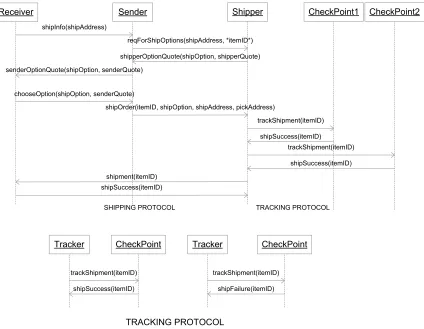
For instance, in our running example, we introduce sensors to track a shipment. The in-teractions between the sensor and the shipper can be perceived to be specified by a protocol called the Tracking Protocol shown in Figure4.5. In order to communicate with the check-points during the shipping protocol enactment, the shipper instantiates a tracking protocol with the checkpoints. Thus the tracking protocol is nested within the shipping protocol for process monitoring.
Receiver Sender Shipper shipInfo(shipAddress)
reqForShipOptions(shipAddress, *itemID*)
shipperOptionQuote(shipOption, shipperQuote)
senderOptionQuote(shipOption, senderQuote)
chooseOption(shipOption, senderQuote)
shipSuccess(itemID)
shipOrder(itemID, shipOption, shipAddress, pickAddress)
CheckPoint1
trackShipment(itemID)
shipSuccess(itemID)
CheckPoint2
trackShipment(itemID)
shipSuccess(itemID)
shipment(itemID)
Tracker CheckPoint
trackShipment(itemID)
shipSuccess(itemID)
Tracker CheckPoint
trackShipment(itemID)
shipFailure(itemID)
TRACKING PROTOCOL SHIPPING PROTOCOL
TRACKING PROTOCOL
Receiver Sender Shipper shipInfo(shipAddress)
reqForShipOptions(shipAddress, *itemID*)
shipperOptionQuote(shipOption, shipperQuote)
senderOptionQuote(shipOption, senderQuote)
chooseOption(shipOption, senderQuote)
shipOrder(itemID, shipOption, shipAddress, pickAddress)
CheckPoint1
trackShipment(itemID)
shipFailure(itemID)
CheckPoint2
shipDelay(itemID)
shipInfo(newShipAddress)
reqForShipOptions(newShipAddress, *itemID*)
shipment(itemID) shipSuccess(itemID)
Chapter 5
Evaluation
This chapter describes the prototype implemented and the use cases to evaluate our approach. The use cases cover different types of exceptions and opportunities.
5.1
Prototype
We demonstrate the feasibility of the architecture by implementing a prototype. Each agent is an independent J2EE application running multiple subscription and point-to-point communication channels with other agents and sensors. The rule base and knowledge base have been implemented using JESS [Friedman-Hill,2003]. We enact the local process of an agent by generating the Jess equivalent of its role skeleton and business logic stubs.
Figure5.1outlines the typical steps that need to be taken to configure an agent.
Initially, the protocol designer who wishes to incorporate process monitoring, needs to decide the specific events he wishes to monitor. He is aided by the Commitment Generator. The Commitment Generator takes input from the public protocol specifications and gener-ates all the commitments that will be created during the protocol enactment. The designer uses this to decide which commitments it wishes to monitor depending on its perspective. Based on his analysis, he designs the complex event patterns.
Commitments for Monitoring Public Protocol Specifications Commitment Generator _ E Complex Event Patterns E Exception Generator E’ Exception Pattern Filter Exception Patterns Eex Complex Event Patterns E Exception Patterns Eex Public Protocol Specifications RuleGenerator CodeGenerator RB Protocol Rules Policy Rules Subscriber KB Pattern Matcher EP Exception Handling Rules Rule Engine Pattern Repository Residuator Adapter Agent Event Source Information
Figure 5.1: Tool aided agent configuration
Next, the event and exception patterns are fed to the Rule Generator and Code Generator along with the public protocol specifications and information about other event sources. This step may also need some designer input. The Rule Generator generates the protocol rules which are JESS equivalent of the OWL-P protocol specifications. It also generates exception handling rules and outlines policy rules. The policies need to be manually defined by the designer.
Once the rules have been generated, the policies written and events configured, the code generator generates a J2EE-based agent that loads these rules into the Jess engine, and