1878
LEARNING
MANAGEMENT
SYSTEM
USING
MULTI-AGENT
TECHNOLOGY: A PROPOSED IMPLEMENTATION STRATEGY
Amer Al Nejam
College of Graduate Studies, Universiti Tenaga Nasional, Jalan IKRAM-UNITEN, Kajang, Malaysia
Alicia Y.C. Tang
College of Graduate Studies, Universiti Tenaga Nasional, Jalan IKRAM-UNITEN, Kajang, Malaysia
Azhana Ahmad
College of Information Technology, Universiti Tenaga Nasional, Jalan IKRAM-UNITEN, Kajang, Malaysia
Mohd. Sharifuddin Ahmad
College of Information Technology, Universiti Tenaga Nasional, Jalan IKRAM-UNITEN, Kajang, Malaysia
ABSTRACT
Conventional Learning Management System (LMS) lacks automation in the coordination and
management of student activities and courses management. This paper presents a conceptual
model that applies software agent technology to overcome some of the weaknesses of existing
LMSs. The paper discusses the use of software agent technology for assisting instructors to monitor learners’ activities and managing their profiles. The agent analyzes learners’ profiles and recommends the instructors of each learner’s level of interaction with the LMS. These interaction levels serve as indicators for the instructors to gauge the commitment of their students in studying
and submitting assignments through the LMS.
Keywords
: Multi-agent technology, Learning management system, Profile, Software agent.1.
INTRODUCTION
A Learning Management System (LMS) integrates all learning services and manages teaching
and learning activities. In an educational setting, an LMS is used to support teaching and learning
processes, usually include a variety of tools and functions such as course management tools, online
group chat and discussion, homework collections and grading, documentation, course evaluation
tracking, and reporting of course or classroom events (Genesereth & Ketchpel, 1994). An LMS
offers different levels of support to tripartite users (staff, students and lecturers).
However, having an LMS which is able to support student activities during the study of a
course is one of the challenges for educators and researchers in traditional LMSs. Therefore, we
propose a Learning Management System, which empowers software agents to monitor and track learner’s participation and progress, managing the learner’s profile and evaluating the learners
International Journal of Asian Social Science
Special Issue: International Conference on Teaching and Learning in Education, 2013
based on their interactions with the system. The proposed technique is expected to simplify the
complexities of monitoring problems and overcome some of the limitations within the existing
LMSs (Jennings, 1996). Furthermore, the agent-based LMS relieves the lecturers from manually
and constantly monitoring and evaluating the students.
The main objectives of this work are: (1) To develop an LMS that overcomes some of the traditional monitoring weaknesses of the current LMSs, (2) To monitor learners’ activities, and (3) To manage learners’ profiles.
2.
RELATED WORK
Many LMS systems have been developed, which are now in widespread use in the educational
institutions (Akram et al., 2011; Avgeriou&Papasalouros, 2003; Itmazi&Megías, 2005). Most of
the LMS systems are designed for a specific set of conditions and environments or to deal with the
traditional learning issues (Akram et al., 2011). We assert that the importance of the LMS in the university’s environment is not intended to replace the traditional face-to-face learning mode but to enhance students’ learning. Some of the LMS’s are commercial software, while others are Open Source. Table 1 shows some examples of the commercial and open- source LMSs.
Table- 1.
Some examples of the commercial and open- source LMSs
Free Open-Source Software Commercial Software Moodle<http://moodle.org>
eCollege
<http://www.ecollege.com/> Claroline
<http://www.claroline.net/>
Blackboard
http://www.blackboard.com ILIAS
<www.ilias.uni-koeln.de/ios/index-e.html>
LearningSpace
<http://www.lotus.com> Totaralms
http://www.totaralms.com/
Jommla
http://www.joomlalms.com/
Moodle (Modular Object-Oriented Dynamic Learning Environment) and ILIAS (Integrated
Learning, Information and cooperation System) are among the most popular Open Source LMSs
(Itmazi&Megías, 2005). The main features of the two LMSs are summarised in Section 2.1 and
Section 2.2.
2.1.
Moodle
Moodle is an Open Source Learning Management System, which is known as one of the
widespread and famous LMSs. Moodle has been translated to 30 languages and found in 1026
sites from 75 countries over the world (Itmazi&Megías, 2005). Moodle gives the educators the best
tools to manage and promote learning (Raadt, 2013; Jin, 2012). However, some of the missing
features are as follows: (1) Working Offline: Occasionally, students download their course contents
and they access the content on a CD-ROM to work offline. In this regard, the course placeholder
automatically returns to the location in their course where they were working the last time they
1880 items about students’ interests, which can intelligently and automatically obtain information from
profiles of teachers, students, and courses materials.
2.2.
Ilias
ILIAS is a web-based Open Source Learning Management System. It was developed at the
University of Cologne. ILIAS has been translated to at least 16 languages and found in 115 sites
from 18 countries over the world (ILIAS, 2013; Itmazi&Megías, 2005). It was developed using
PHP, MySQL and the Apache to work mainly under UNIX/Linux. ILIAS does not support the
Recommendation system, and it has the following weaknesses: A number of software is required for the installation process.
Some changes are required for proper working/running under Windows or Mac operating system.
2.3.
Comparing between ILIAS and Moodle
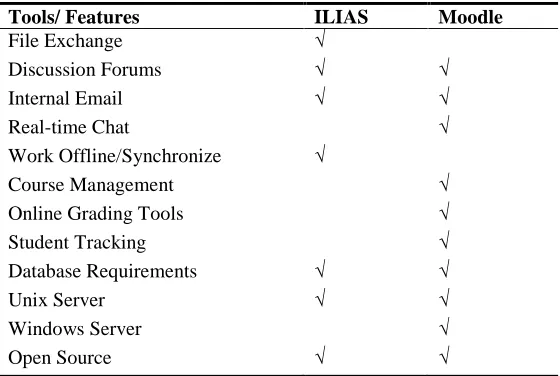
Table 2 shows the differences between ILIAS 2.3.8 and Moodle 1.1 (ILIAS, 2013; Raadt,
2013; Itmazi&Megías, 2005; Jin, 2012).
Table- 2. Comparison of the characteristics of ILIAS and Moodle Tools/ Features ILIAS Moodle
File Exchange √
Discussion Forums √ √
Internal Email √ √
Real-time Chat √
Work Offline/Synchronize √
Course Management √
Online Grading Tools √
Student Tracking √
Database Requirements √ √
Unix Server √ √
Windows Server √
Open Source √ √
The evolution process has brought improvements in existing learning management systems
(Akram et al., 2011). In designing useful and helpful LMS, the development and execution of the
following four basic tasks in a simple, smoothly, friendly and uniform user interfaces are
anticipated (Genesereth&Ketchpel, 1994; Avgeriou&Papasalouros, 2003).
Information distribution: The announcement of the tips for lecture, calendar, glossary, and sending of subjects materials.
Management of learning materials: The customization and modularization of the user interface to the needs of the instructor for updating the learning material.
Class management: The on-line marking of students’ assessments, tracking learners’ participation, management of learner’s profile and scheduling the class event.
These four tasks are the main problems that the LMS designers have to solve to ensure that a
convenient and useful LMS is developed. However, each university has its unique sets of
properties and methods of delivering the learning materials (Genesereth&Ketchpel, 1994),
customization of these tasks is therefore required.
3.
THE PROPOSED AGENT-BASED LMS FRAMEWORK
The proposed LMS framework utilizes the software agent technology. Among the features of
software agents are proactive, autonomous, flexible, social, and goal-directed behaviours (Votano
et al., 2004). In this work, we analyzed the above basic tasks, and apply multi-agent technology
based on the notion of agency developed by Wooldridge and Jennings (Votano et al., 2004;
Wooldridge & Jennings, 1995). The Wooldridge-Jennings agent may follow at least one of the
following behaviours:
Autonomy: agents should be able to perform the majority of their problem solving tasks without the direct intervention of humans or other agents, and they should have
self-control of their own actions and their own internal state.
Social ability: agents interact with other agents or humans via some kind of Agent Communication Language (ACL) to complete their own problem solving.
Responsiveness: agents perceive their environment, (which may be the physical world, a user via a graphical user interface, a collection of other agents, the Internet, or perhaps all
of these combined), and respond in a timely fashion to changes that occur.
Pro-activeness: agents do not simply act in response to their environment; they are able to exhibit goal-directed behaviour by taking the initiative where it is appropriate.
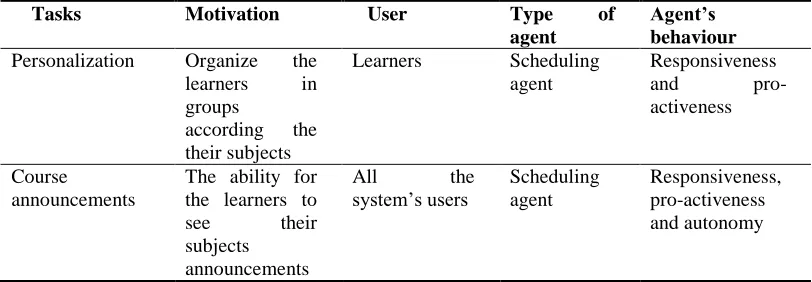
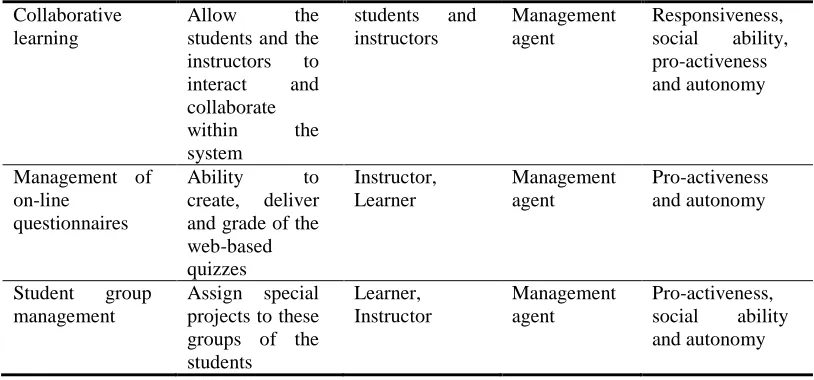
Table 3 shows the functions or the tasks which need to be implemented, the motivation for solving this problem, the users, the type of agent and the suitable agent’s behaviours that are used to implement those tasks. However, almost all of these tasks are already found and implemented in
the current LMSs, but they are implemented without the agent technology, and embedding the agent’s technology and behaviours in the software helps improve the effectiveness of the LMS and its tasks.
Table- 3. The list of the LMSs tasks which need to be implemented with software agent technology Tasks Motivation User Type of
agent
Agent’s behaviour Personalization Organize the
learners in groups
according the their subjects
Learners Scheduling agent
Responsiveness
and
pro-activeness
Course announcements
The ability for the learners to see their subjects
announcements
All the system’s users
Scheduling agent
1882 Pervasive
references
Learners need to access undirected tools related to them
All the system’s users
Scheduling agent
Responsiveness, pro-activeness and Social ability
Study toolkit Learners need access to the learning resources (not via normal HTML pages)
Learners Management agent
Responsiveness, autonomy and Social ability
Searching Users need to look for some information in the learning materials
Learners and instructors
Analyzing agent
Responsiveness, pro-activeness and social ability
Course creation and
customization
Ease the job of the instructors Administrators and instructors Management agent Pro-activeness, autonomy, social ability
Student tracking Track the learner’s actions and progress
Instructors, teachers and learners
reporting agent
Responsiveness, pro-activeness, autonomy and social ability Course
initialization
Make the courses ready for use
Administrators Management agent
Responsiveness , pro-activeness and autonomy Course backup
and restore
How to save and keep the information when the LMS fails to operate
Administrators Management agent
Responsiveness, pro-activeness, autonomy and social ability
Glossary Learners search
for the
definitions of some terms while they are studying Instructors, administrators and learners Management agent Pro-activeness, autonomy and social ability
Web page editing
The ability of the hypertext learning materials to be created or modified in the web page
Instructors, teachers and learners Management agent Pro-activeness and autonomy Student assignments management
Create on-line assignments for learners
Instructors and learners
Management agent
Pro-activeness, autonomy
Online support Provide more information about the LMS
All the system’s users
Management agent
Collaborative learning
Allow the students and the instructors to interact and collaborate within the system
students and instructors
Management agent
Responsiveness, social ability, pro-activeness and autonomy
Management of on-line
questionnaires
Ability to create, deliver and grade of the web-based quizzes
Instructor, Learner
Management agent
Pro-activeness and autonomy
Student group management
Assign special projects to these groups of the students
Learner, Instructor
Management agent
Pro-activeness, social ability and autonomy
Since our LMS only focuses on the class management activities, we will explain and discuss one
specific task related to class management, as presented in Section 3.1.
3.1.
Student Tracking
Problem: The process of tracking the learner’s actions and progress with the activity of the LMS system. Informing the learners or the instructors of the activities that the learners
have completed in their courses.
Motivation: Usually for normal classroom, the instructor is the one who is responsible to monitor, track, guide and evaluate the students’ activities and actions in the class. But in the virtual LMS class, the instructors do not have that physical interaction with the
students, thus they are not able to observe and guide their learning process. In this case,
the instructors are not able to know if the students study the corresponding learning
resources, interact and review the online exercises, work with their friends in group
projects, and note the announcements related to their courses.
Solution: By providing a recording mechanism of the activities, which the students perform according the course; the part that they have visited; how long they have spent
their time there; the kind of tools they used, with whom they interacted and chatted; and
with whom they have discussed. All these are needed to support the instructors with some tools to help him or her to observe and check in each student’s profile or group activities. User category: Instructors, teachers and learners.
Type of agent: Reporting agent.
Agent’s behaviour: Responsiveness, pro-activeness, autonomy and social ability.
Figure 1 depicts the general structure of the proposed LMS. The LMS monitors and evaluates
1884 Figure- 1. Main components of the proposed LMS
As shown in Figure 1, the main components of the proposed LMS are:
Learner: that interacts with the LMS by submitting or downloading assignments or class materials and other learner’s activities and actions.
Lecturer: that provides the courses’ general information at the beginning of the semester and evaluates learners from the LMS.
LMS: that implements the agent-based technology, analyzes the learners’ profiles and sends the evaluation results of each learner to the lecturer.
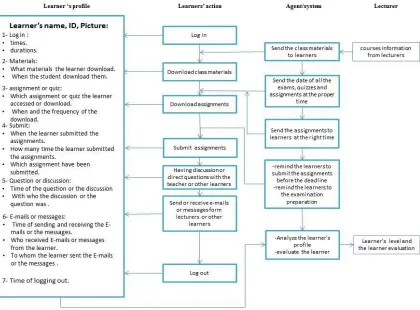
Figure 2 depicts the process of generating the learners’ profiles, the analyses, the learners’ evaluation of their interaction levels with the system, and their commitments within a learning
process.
The tasks and the actions specific to each of the three stages (lecturer, learner, and agent) in the
LMS are as follows:
1. Lecturer stage:
Provide the system with the courses’ information at the beginning of the semester (marks, number and time of tests and assignments).
Obtain learners levels and their evaluation from the system.
2. Learner stage:
Log on and out of the system.
Download assignments and class materials. Submit assignments.
Answer direct question from the teachers. Discuss with the teachers and other students.
Send messages or e-mail to teachers or other students.
3. Agent stage:
Send general schedule to students at the beginning of the classes which should include the number, marks and dates of quizzes, assignments, test and final exam. Automatically send the assignments and quizzes at its proper time.
Send lectures’ slides or materials every week before the class.
Send reminder to students to submit their assignments and quizzes before the deadline of submission.
Remind the students of the exam or quiz dates.
Analyze learners’ profiles and evaluate the learners and send the evaluation results to the lecturer.
All these stages work together in order to generate learning profiles of the students. Each profile contains information about students’ activities and their actions during the learning process, as shown below:
Student’s information (name, ID, picture, etc.). Student’s results.
List of subjects taken by the students. Student’s time table.
The log in time and number of times (frequency) the student submits and downloads assignments and quizzes.
The date of last access and the frequency of the student logging in and out to the system.
The student’s actions and transactions.
After generating all these information as students’ profile, the agent analyzes the profiles, and evaluates the students based on the information contained in the profiles. The agent then generates
1886 information about all the students. These interaction levels serve as good indicators for the lecturers
to know the commitment of their students in studying and submitting their assignments via the
LMS.
4.
CONCLUSION AND FURTHER WORK
This paper discussed the proposed Learning Management System using multi-agent
technology. The work focuses on class management activities, especially to facilitate the traditional evaluation and monitoring process for the lecturers to gauge their learners’ levels of commitment within the learning process. We believe that the proposed LMS will reduce the time of evaluating and monitoring the learners, help the lecturers to evaluate the learners, monitor the learners’ activities and manage their profiles. This research provides a foundation for future works in the application of agent technology in other LMS’s related problems, which facilitates the work of the instructors, lecturers and learners within the learning process.