`
A SCHEME FOR EFFICIENT PEER-TO-PEER LIVE VIDEO STREAMING OVER WIRELESS MESH NETWORKS
BEHRANG BAREKATAIN
A thesis submitted in fulfilment of the requirements for the award of the degree of
Doctor of Philosophy (Computer Science)
Faculty of Computing Universiti Teknologi Malaysia
iii
To our prophet, Mohammad, the messenger of truth, fraternization and kindness
To my dear and beloved wife who endured my absence for three years
To my dears 13 and 3 years old sons
To my dears mother, father, sister, and brother
To my dear defunct 20 years old brother
To my dears mother-, father-, and sisters-in-law
To my best supervisor, Professor Dr. Mohd Aizaini Maarof
To my best co-supervisor, Associate Professor Dr. Alfonso Ariza Quintana
iv
ACKNOWLEDGEMENT
v
ABSTRACT
vi
ABSTRAK
vii
TABLE OF CONTENTS
CHAPTER TITLE PAGE
DECLARATION ii
DEDICATION iii
ACKNOWLEDGMENT iv
ABSTRACT v
ABSTRAK vi
TABLE OF CONTENT vii
LIST OF TABLES xii
LIST OF FIGURES xiii
LIST OF SYMBOLS xviii
LIST OF ABBREVIATIONS xx
LIST OF APPENDICES xxv
1 INTRODUCTION 1
1.1 Overview 1
1.2 Background of the Problem 4
1.3 The Problem Statement 9
1.4 Purpose of the Research 11
1.5 Objectives of the Research 11
viii
1.7 Research Phases 12
1.8 Contributions of the Research 14
1.9 Significance of the Research 16
1.10 Organization of the Thesis 17
2 LITERATURE REVIEW 18
2.1 Introduction 18
2.2 Video Streaming 19
2.2.1 Classification and Applications 20
2.2.2 The H.264/MPEG-4 Standard 21
2.2.3 Challenges in Efficient Video Streaming 23
2.3 Peer-to-Peer Networks 23
2.3.1 Overview 23
2.3.2 Structure-based Classification of P2P Networks 26 2.3.3 Topology-based Classification of P2P Networks 27
2.4 Wireless Mesh Networks 29
2.4.1 Classification 31
2.4.2 Routing Protocols 32
2.4.3 Hybrid Routing Protocols 37
2.4.4 Mobility Management in WMNs 41
2.4.5 Research Gaps in Routing Protocols of WMNs 43
2.5 Network Coding 45
2.5.1 Definition and Applications 46
2.5.2 XoR-Based Network Coding 49
2.5.3 Galois Field 50
2.5.4 Random Network Coding 51
2.5.5 P2P Video Streaming Using RNC 55
2.5.6 Research Gaps in RNC 59
2.6 Performance Metrics 61
ix
3 RESEARCH METHODOLOGY 64
3.1 Introduction 64
3.2 Research Scheme Overview 65
3.3 Research Scheme Phases 66
3.3.1 Phase 1: Coefficients Matrix Generation Method 67 3.3.2 Phase 2: Hybrid Routing Protocol 73
3.3.3 Phase 3: The proposed Scheme 76
3.4 Experimental Setup of Research 78
3.4.1 Video Source 79
3.4.2 Simulation Tool and Parameters 79
3.4.3 Performance Metrics 81
3.4.4 Experimental Setup for EMGIM Evaluation 83 3.4.5 Experimental Setup for GREENIE Evaluation 89 3.4.6 Experimental Setup for GAZELLE Evaluation 94
3.4.7 Evaluation Process 95
3.5 Summary 96
4 COEFFICIENTS MATRIX GENERATION METHOD 97
4.1 Introduction 97
4.2 Introduction to EMGIM 98
4.3 Encoding Process 100
4.4 Operation of EMGIM 101
4.5 Decoding Process 106
4.6 Complexity Analysis 108
4.7 Evaluation of EMGIM 111
4.7.1 Experiment Setup 111
4.7.2 Simulation Parameters and Results 111
x
5 HYBRID ROUTING PROTOCOL 123
5.1 Introduction 123
5.2 GREENIE: The Proposed Hybrid Routing Protocol 125 5.2.1 The Assignation of the Routing Tasks 126 5.2.2 Implementation in the Link-Layer 126 5.2.3 Integration of the Proactive and Reactive in MRs 127 5.2.4 Route Discovery Modified to Promote Use of MRs 129 5.2.5 STA Location Management in the Link Layer 129 5.2.6 An Enhanced Distributed Locator Service 130
5.2.7 GREENIE Algorithm 132
5.3 Experiment Setup 135
5.3.1 Experiment Parameters 136
5.3.2 Experiment Results 136
5.4 Summary 151
6 A SCHEME 153
6.1 Introduction 153
6.2 GAZELLE at a Glance 154
6.3 GAZELLE Scheme Overview 156
6.4 Main Components Overview 157
6.5 Evaluation of GAZELLE 160
6.5.1 Experimental Setup 160
6.5.2 Scenario 1: Results and Discussion 161 6.5.3 Scenario 2: Results and Discussion 164 6.5.4 Scenario 3: Results and Discussion 165
6.5.5 Complementary Discussion 167
6.5.6 Conclusion 170
xi
7 CONCLUSION 172
7.1 Introduction 172
7.2 Objectives Revisited 172
7.3 Research Contributions 174
7.3.1 General Contributions 174
7.3.2 Specific Contributions 175
7.4 Research Implication 177
7.5 Recommendations for Future Works 177
7.6 Closing Remarks 180
REFERENCES 181
xii
LIST OF TABLES
TABLE NO. TITLE PAGE
2.1 Multiplication operation in GF(8) 50
3.1 Considered Performance Metrics in Different Phases 82 3.2 Simulation Parameters for EMGIM Evaluation over Hybrid
WMNs 88
3.3 Simulation Parameters for Evaluating the GREENIE 90
3.4 Routing Protocol Configuration in Simulation 93
4.1 Progressively Decoding in EMGIM Using Figure 4.1 108 4.2 Comparison between EMGIM and RNC-GJE in Summary 119 5.1 Comparison among Routing Protocols for TSRP Metric 140 5.2 How GREENIE Improves Video Distortion in Percent 149
5.3 Comparison of Considered Routing Protocols 150
6.1 Improvements by GAZELLE in Summary 170
xiii
LIST OF FIGURES
FIGURE NO. TITLE PAGE
1.1 Network Coding Efficiency in Streaming 4
1.2 RNC addresses the Content Reconciliation Problem 5 1.3 Scenarios Leading to the Research Gap Identification 8
1.4 Research Phases 13
2.1 A G12B2-based GoP 22
2.2 An overlay over an underlying network 25
2.3 Multi-Tree structure 28
2.4 A Taxonomy of Flat Routing Protocols in WMNs 33
2.5 Network coding efficiency in Streaming 46
2.6 RNC with the Gauss-Jordan Elimination Algorithm 53
2.7 The architecture of BM in LAVA and Vanilla 55
2.8 Mirshokraie's Scheme 57
3.1 Research Scheme Phases 66
3.2 Encoding process in Peers 70
3.3 Decoding process in Peers 72
xiv
3.5 Routing Operation Using GREENIE 77
3.6 Simple and Compound Modules in OMNET++ 79
3.7 EMGIM Simulation in OMNET++ 83
3.8 OSI and TCP/IP Models 84
3.9 Mesh Node Structure in the Implemented Simulator 91 3.10 Network Interface Card Structure in Mesh Nodes 91 3.11 STA Node Structure in the Implemented Simulator 92
3.12 Evaluation Process of Research Phases 95
4.1 Decoding Time using EMGIM and Gauss-Jordan Elimination 99
4.2 EMGIM Algorithm 104
4.3 Arithmetic Operations in EMGIM and Gauss-Jordan Methods 105 4.4 Progressively Decoding Process in EMGIM (Function) 107
4.5 VD in Percent in Scenario 1 114
4.6 DD in Percent in Scenario 1 114
4.7 ISD in Second in Scenario 1 115
4.8 EED in Second in Scenario 1 115
4.9 VD in Percent in Scenario 2 115
4.10 DD in Percent in Scenario 2 115
4.11 ISD in Second in Scenario 2 116
4.12 EED in Second in Scenario 2 116
xv
4.14 DD in Percent in Scenario 3 117
4.15 ISD in Second in Scenario 3 117
4.16 EED in Second in Scenario 3 117
4.17 Averaged Video Distortions in Percent 119
4.18 Improvement Comparison of Scenarios for Different Metrics 120
5.1 GREENIE Algorithm for Node N 133
xvi
5.17 PDV in mesh Nodes (Scenario B/No Aggregation) 144 5.18 PDV in STA Nodes (Scenario B/With Aggregation) 144 5.19 PDV in mesh Nodes (Scenario B/With Aggregation) 145 5.20 Routing Overhead in Mesh Nodes (No Aggregation) 145 5.21 Routing Overhead in Mesh Nodes (With Aggregation) 146 5.22 Averaged Number of Received Video Frames by STA 147 5.23 Averaged Number of Received Video Frames by Mesh 148 5.24 Averaged Video Distortion in Percent in Scenario A 149 5.25 Averaged Video Distortion in Percent in Scenario B 149 5.26 Improvements in Percent in Different Metrics Using
GREENIE 150
6.1 The Proposed Scheme (GAZELLE) 156
6.2 Comparison of VD in Percent in Four Integration Cases
(scenario 1) 162
6.3 Comparison of DD in Percent in Four Integration Cases
(scenario 1) 162
6.4 Comparison of ISD in Percent in Four Integration Cases
(scenario 1) 163
6.5 Comparison of EED in Percent in Four Integration Cases
(scenario 1) 163
6.6 Comparison of VD in Percent in Four Integration Cases
(scenario 2) 164
6.7 Comparison of DD in Percent in Four Integration Cases
(scenario 2) 164
6.8 Comparison of ISD in Percent in Four Integration Cases
xvii
6.9 Comparison of EED in Percent in Four Integration Cases
(scenario 2) 165
6.10 Comparison of VD in Percent in Four Integration Cases
(scenario 3) 166
6.11 Comparison of DD in Percent in Four Integration Cases
(scenario 3) 166
6.12 Comparison of ISD in Percent in Four Integration Cases
(scenario 3) 167
6.13 Comparison of EED in Percent in Four Integration Cases
(scenario 3) 167
xviii
LIST OF SYMBOLS
A1×n - A matrix of n generated coefficients entries using EMGIM
An×n - A diagonal matrix consists of n generated values in A1×n
ai - An entry on the main diagonal of a coefficients matrix
Bi - An original block
Bn×n - Original Matrix including n k-byte not coded blocks
Ci - A coefficients vector
Cn×n - Coefficients Matrix including n n-byte coefficients vectors
C-1n×n - Inverted coefficients matrix
f(t) - A function over positives values of t
GF(2m) - Galois Field of size 2m
GG - Number of generated packets using RNC-GJE
GM - Number of generated packets using EMGIM
k - Block size in bytes
xix
O - Big-O notation for measuring algorithm complexity
PG - Number of encoded blocks in a packet using RNC-GJE
PM - Number of encoded blocks in a packet using EMGIM
T(t) - Execution time for an algorithm with t inputs
Xi - An encoded block
xx
LIST OF ABBREVIATIONS
ABR - Associative Based Routing
AD - Absolute Delay
AODV - Ad-hoc On-demand Distance Vector
AODV-ST - Ad-hoc On-demand Distance Vector Spanning Tree AP - Access Point
ARP - Address Resolution Protocol ARQ - Automatic Repeat Request AVC - Advance Video Coding
BATMAN - Better Approach To Mobile Ad-hoc Networking
BM - Buffer Map
CDN - Content Delivery Network CI - Confidence Interval CPU - Central Processing Unit DCT - Discrete Cosine Transform DD - Dependency Distortion
xxi
DHT - Distributed Hash Table DR - Delivery Ratio
DSDV - Destination Sequence Distance Vector DSR - Dynamic Source Routing
DYMO - Dynamic MANET on-demand routing EED - End-to-End Delay
ESM - End System Multicasting EUI - Extended Unique Identifier FEC - Forward Error Checking FIFO - First-In-First-Out
FPS - Frame Per Second
GARP - Gratuitous Address Resolution Protocol
GF - Galois Field
GoP - Group-of-Pictures
HARQ - Hybrid Automatic Repeat Request HNN - Hopfield Neural Network
HOVER - Hybrid On-demand Distance Vector Routing
HS - Home Server
xxii
IERP - Inter zone Routing Protocol IETF - Internet Engineering Task Force INET - Internet Networking
INETMANET - Internet Networking MANET ISD - Initial Start-up Delay
ISO/IEC - International Organization for Standardization/ International Electrotechnical Commission
ITU-U - International Telecommunication Standardization Sector MAC - Medium Access Control
MANET - Mobile Ad-hoc Networks Mbps - Mega bit per second
MCMR - Mesh-Channel Multi-Radio MIMO - Multi-Input Multi-Output
MN - Mesh Node
MPEG - Moving Picture Experts Group MPR - Multi Point Relay
MR - Mesh Router
MSDU - MAC-layer Service Data Unit MTU - Maximum Transfer Unit
NC - Network Coding
NIC - Network Interface Card
xxiii
OMNET++ - Objective Modular Network Testbed in C++ OSI - Open System Interconnection
OVERSIM - Overlay Simulator P2P - Peer-to-Peer
PDA - Personal Digital Assistant PDV - Packet Delay Variation PPLive - Peer-to-Peer Live Video PPM - Push-Pull Mesh
PPStream - Peer-to-Peer Streaming
PRIME - Peer-to-Peer Receiver-Driven Mesh-based streaming PSNR - Peak Signal-to-Noise Ratio
QoS - Quality of Service QP - Quantization Parameter RANN - Route Announcement RFC - Request For Comments RNC - Random Network Coding RREP - Route Reply
RREQ - Route Request
SNCR - Source Node Compute Routing SopCast - Streaming over P2P
xxiv
SPT - Spanning Tree protocol
STA - Station
SVC - Scalable Video Coding TC - Topology Control
TCP/IP - Transmission Control Protocol/Internet Protocol TSRP - Total Successfully Received Packets
TTL - Time-To-Live
TX - Transmitter
UAVs - Unmanned Aerial Vehicles UDP - User Datagram Protocol UP2P - Unstructured P2P URR - Useful Received Rate VD - Video Distortion Wi-Fi - Wireless Fidelity
WLAN - Wireless Local Area network WMAC - Wireless Medium Access Control WMAN - Wireless Metropolitan Area Network WMN - Wireless Mesh Networks
xxv
LIST OF APPENDICES
APPENDIX TITLE PAGE
A Coefficients Matrix Determinant 202 B Complexity Analysis of Gauss-Jordan elimination
and EMGIM 206
C Important Simulation Codes in GREENIE Evaluation 208
CHAPTER 1
1INTRODUCTION
1.1 Overview
Video streaming over wireless networks, especially on mobile nodes, has become more popular due to the advances in the network access technologies (Dong-Hoon et al., 2013; Saeed et al., 2013). Video streaming refers to the process of disseminating a live video stream by a source to the network. Then, each node not only receives and playbacks the video stream, but it can also forward it to other nodes in the network. Based on Saeed et al. (2013), there will be more than 450 million mobile TV users by 2014 which account for a large amount of traffic over wireless networks. What can be inferred from this prediction is that it is necessary to have an efficient video streaming scheme for preventing the problem of low video quality.
2
Bandwidth utilization can be improved using the most recently used video compression standard, the H.264/MPEG-4 (Moving Picture Experts Group), (Richardson, 2010). The video encoder applies the compression rules on video frames before arranging them into groups of pictures (GoPs). Although employing an efficient video compression standard let nodes consume less amount of bandwidth, existing decoding dependencies among video frames can reduce the video quality on receivers (Akbari et al., 2007). In other words, based on the H.264/MPEG-4 standard, it is impossible to playback a successfully received video frame if its reference frame is not decoded yet. So, it is necessary to request the missed reference frame from the video source or a neighbor in the network.
In order to address this problem, peers in a Peer-to-Peer (P2P) network not only download the video stream from upstream peers, but they also concurrently serve the downstream peers by uploading video frames to them (Zhang et al., 2010a). This behavior reduces the effect of frame decoding dependency on the perceived video quality, because peers can immediately request missed video frames (e.g. a reference frame) from their neighbors instead of the video source with lower end-to-end delay. P2P video streaming has been one of great interest (Ramzan et al., 2012). P2P networks can be implemented as an overlay on top of the underlying network (Huang et al., 2007).
3
et al., 2012). In fact, each peer can have more than one neighbor in mesh-based P2P networks.
In mesh-based P2P streaming, a peer can concurrently download from more than one upstream peers and simultaneously serve many downstream peers. In this regard, there are always risks that peers receive the same content from their neighbors. Therefore, they need to make the contents held by different upstream peers consistent before downloading. This refers to content reconciliation problem which considerably wastes the limited available bandwidth in peers and increases the network complexity (Chen et al., 2010b).
Network coding (Ahlswede et al., 2000), especially random network coding (RNC) (Ho et al., 2003), efficiently addresses this problem in a mesh-based P2P streaming system, because it omits the need for content reconciliation among peers and makes all video blocks equivalent (Wang and Baochun, 2006; Cleju et al., 2011). Network coding has recently emerged as a promising approach for improving the performance of massive data distribution applications such as file distribution and video streaming (Heide et al., 2012).
4
implementation due to this fact that they can include STA and mobile mesh nodes with multi-hopping capability. STA nodes (e.g. Smartphones and PDAs), which operate in infrastructure mode and move with low speed, do not run and perform routing protocol and forwarding operation, respectively. On the other hand, mesh nodes can perform routing and forwarding. STA node and mesh node in this study are defined in IEEE 802.11 standard (IEEE, 2012) as a STA node which is associated to an access point (AP) and a mesh STA node, respectively. However, in order to avoid misunderstanding, this research calls them STA and mesh nodes in the rest of this thesis.
1.2 Background of the Problem
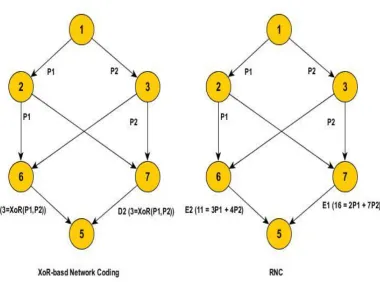
Figure 1.1 shows that network coding increases network throughput. Suppose that each link has the capacity of one bit per second. Peer 4 performs a simple XoR logical operation on the received bits A and B, then; it sends one bit XoR(A,B) in one transmission cycle instead of two. This reduces end-to-end delay between the source node 1 and destination nodes 6 and 7. Nodes 6 and 7 can extract bits B and A from bit XoR(A,B) with lower end-to-end delay, respectively. However, according to (Ho and Lun, 2008), RNC is more suitable than XoR-based network coding as follows. In contrary to the XoR-based network coding, RNC is topology independent.
5
Therefore, the problem of content reconciliation can be happened using XoR-based network coding. RNC provides higher network throughput without the necessity of having global knowledge about the whole network. RNC efficiently exploits the broadcast nature of wireless medium and improves the highlighted guidelines in order to mitigate the side effects of wireless channels.
In Figure 1.2, suppose that source node 1 sends two 8-byte packets P1=1 and P2=2 to the next hop. Peer 5 receives two same encoded packets D1 and D2 using XoR-based network coding and cannot decode P1 and P2 from them. This means that content reconciliation problem can be occurred in XoR-based network coding. So, XoR-based network coding is topology dependent and cannot always increase the network throughput.
On the other hand, using RNC, peers 6 and 7 generates encoded blocks E1 and E2 using four coefficients entries 3, 4, 2 and 7. Peer 5 easily decodes E1 and E2 by solving two linear equations 11=3P1+4P2 and 16=2P1+7P2.
6
What can be inferred is that RNC needs to generate some coefficients entries in encoding process and can easily decode encoded blocks if it receives these coefficients correctly. This is why peers 6 and 7 have to attach generated coefficients entries to the encoded blocks E1 and E2, respectively, before sending them to peer 5.
Generally, the video source divides the video stream into many fixed-size segments, each of them further divides into n k-byte blocks. These block are arranged in matrix Bn×k. Then, the RNC-Encoder select n2 random values in GF(2m) (Galois
Field) and arranges them in coefficients matrix Cn×n. The m is an integral value which
is set to 8 in computer communication. Finally, the encoded matrix Xn×k which includes
n k-byte encoded block can be generated by multiplying matrix Cn×n by Bn×k (Wang
and Li, 2007b). The video source attaches n-byte coefficients vector (n coefficients entries) to each k-byte encoded block in the form of one or more packets before transmitting it to the next hop. Encoding process can be performed by each intermediate node on the path toward the destination.
The destination node decodes video blocks as soon as it receives n linearly independent encoded blocks by RNC-Decoder. Since 2006, RNC-Decoders have used the Gauss-Jordan elimination method (Hoffman and Kunze, 1971) in the decoding process. This method progressively performs decoding process as soon as the first encoded block receives. Successfully decoding of all n encoded blocks is impossible if the RNC-Decoder finds that there is a linear dependency between two received coefficient vectors (Mirshokraie and Hefeeda, 2010).
Considering the RNC operation in encoding and decoding processes, there are three open issues in RNC which considerably affect its performance, especially in live video streaming (Wang and Baochun, 2007; Mirshokraie and Hefeeda, 2010; Peng et al., 2014) as follows:
7
because they cannot efficiently assign their upload bandwidth for transferring video blocks.
ii. Excessive decoding computational complexities due to using the Gauss-Jordan elimination method (Lee et al., 2012; Qureshi et al., 2012). The fact is that this complexity is not suitable for wireless nodes with low computation power (e.g. Smartphones and iPods) (Keller et al., 2012),
iii. Linear dependency among the coefficients vectors can degrade the number of innovative video blocks in receivers which can reduce the video quality (Qureshi et al., 2012).
Albeit RNC increases video quality, employing inefficient routing protocol can degrade the video quality in hybrid WMNs. In other words, time-varying channels, intra- and inter-interferences, long distance between source and destination in terms of the hop count and node mobility are some important challenges in WMNs which can reduce the perceived video quality (Kumar, 2012; Wei et al., 2012). These challenges can reduce the positive effects of using an efficient streaming method.
Proactive and reactive are two important routing protocol classifications in WMNs (Akyildiz and Wang, 2009). However, low scalability with large networks, high network overhead, large amount of data for maintenance when there are mobile nodes in a hybrid WMN and slow reaction in case of path failure are the most important challenges of proactive protocols (Kumar, 2012; Reddy et al., 2013; Sahingoz, 2013), while reactive protocols suffer from high latency and network overhead when they are employed in the backbone of a WMN (Rishiwal et al., 2008; AlAamri et al., 2013; Dhenakaran and Parvathavarthini, 2013). Moreover, based on these studies, reactive protocols imposes high network overhead and latency for finding paths in a dynamic network, but lesser than that of proactive protocols.
8
because the first uses routing tables for keep their locations, while the second one exchanges many RREQ and RREP messages for locating a path to STA nodes. This sharply increases routing and network overhead. Hence, employing an efficient locator service is necessary for locating STA nodes (Mase, 2011). A routing protocol should be efficiently designed in which it can exploit the advantages of this locator.
Moreover, implementation of the proposed hybrid routing protocol in the IP layer introduces some new challenges. Auto-configuration problem due to using protocol (DHCP) server (RFC791, 1981), inconsistency in routing table when two independent routing protocols are active in IP layer, large required storage for routing tables and high routing overhead are the most important challenges to name a few. Access points (APs) and STA nodes are not able to decode IP packets in the link layer. In fact, adding required functionalities in the IP layer to these nodes imposes very high cost.
9
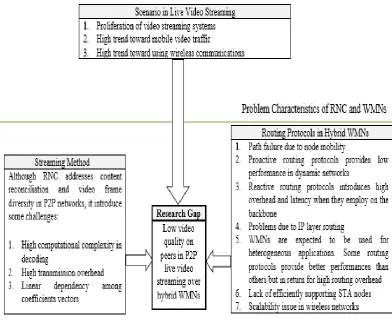
On the other hand, link layer routing not only addresses the mentioned challenges, but it also provide quick routing and hides the network complexity from upper layers (Faccin et al., 2006). Therefore, it is better to implement the hybrid routing protocol in the link instead of the IP layer this. Figure 1.3 summarizes considered research gaps by this study. Altogether, providing smooth video playback on peers in a hybrid WMN needs efficient video streaming method and routing protocol. In other words, by addressing existing challenges in random network coding and routing protocols in hybrid wireless mesh networks, smooth video playback can be provided on peers in a P2P live video streaming system over hybrid WMNs.
1.3 The Problem Statement
What can be inferred from Section 1.2 is that an efficient scheme not only has to exploit the advantages of the H.264/MPEG-4 standard and mesh-based P2P overlay networks, but it also needs to address existing open issues in RNC and routing protocols in WMNs. Recent studies such as the performed works by Anh et al. (2010), Wang et al. (2011) and Xingjun et al. (2012) show that RNC improves the perceived video quality on peers by addressing the content reconciliation problem in P2P networks and increasing the network throughput. Inefficient routing protocols in WMNs can noticeably affect the performance of RNC. In this regard, an efficient routing protocol which considers node mobility, stable paths, churning and interferences is needed. These problems are more visible when a delay sensitive stream such as a live video is propagating over the WMN. As a result, the big question is:
“How would a live video streaming scheme efficiently increase the perceived video quality on peers in P2P live video streaming over hybrid WMNs by integrating a novel coefficients matrix generation/inversion method and an enhanced hybrid routing protocol in random network coding and hybrid wireless mesh networks, respectively?”
10
i. What is the appropriate coefficients matrix generation method in which it addresses transmission overhead issue in RNC in which better video quality can be provided on peers?
ii. What is the appropriate coefficients matrix inversion method in which it addresses computational complexity issue in matrix inversion process due to using the Gauss-Jordan elimination method in RNC?
iii. What is the appropriate coefficients matrix generation method in which it addresses computational complexity and non-innovative video block issues due to checking and existing linear dependency in RNC, respectively?
This solution also needs to answer these sub-questions in a hybrid wireless mesh network:
i. How a hybrid routing protocol can efficiently exploit the advantages of proactive and reactive schemes, while it addresses their challenges? ii. How this hybrid routing protocol efficiently considers important issues
in hybrid WMNs such as time-varying channels, node mobility, interferences and churning for providing smooth video playback on mesh/STA nodes?
iii. How this hybrid routing protocol can efficiently exploit the advantages of a STA locator service for efficiently supporting them in a hybrid WMN?
iv. How this hybrid routing protocol can efficiently reduce the imposed routing overhead, end-to-end delay and packet delay variation?
Finally, the following sub-question can be answered by the proposed scheme by this research:
11
distortion, frame dependency distortion, initial start-up and end-to-end delays.
1.4 Purpose of the Research
The purpose of this research is to design a live video streaming scheme for efficient peer-to-peer live video streaming over hybrid wireless mesh networks in which it can provide high video quality on peers by introducing an efficient coefficients matrix generation/inversion method in RNC and hybrid routing protocol in hybrid WMNs.
1.5 Objectives of the Research
The main goal of the proposed scheme by this study is to provide high video quality on peers in a P2P overlay over a hybrid wireless mesh network.
Therefore, considering the background and the problem statement sections as well as the purpose of this research, three main objectives of this research can be propounded as follows:
i. To reduce the imposed decoding computational complexity and transmission overhead by RNC using a novel coefficients matrix generation and inversion method such that no linear dependency exists among the coefficients vectors,
ii. To finds the most stable path by proposing an enhanced hybrid routing protocol in hybrid WMNs which efficiently considers node mobility and exploits the advantages of a STA locator service,
12
1.6 Scope of the Research
Based on the previous sections, in this research:
i. Real live video trace file based on the H.264/MPEG-4 standard from (Arizona, 2009) is disseminated from a live video source to all peers, ii. A hybrid wireless mesh network is established as the underlying
network using INETMANET frameworks in OMNET++ (OMNET++, 2010). Then, a mesh-based P2P overlay network is constructed over the underlying network using OVERSIM framework,
iii. RNC is selected as an efficient streaming method for live video streaming in the constructed overlay. The video stream divides into some segments, each of them further divides into n k-byte blocks before encoding by the RNC method,
iv. A hybrid routing protocol, which is an intelligent integration of proactive and reactive schemes, routes frames among wireless mesh/STA nodes and mesh routers.
1.7 Research Phases
Chapter 3 explains the research phases in detail. In this section, Figure 1.4 briefly depicts the considered phases of the proposed scheme. The first and the second objective exist in the first and the second phase, respectively. The first phase deals with the encoding/decoding process using RNC.
13
PHASE 1
EMGIM: A novel and Efficient coefficients Matrix Generation and Inversion Method in
random network coding with very low computation complexity and transmission overhead.
PHASE 2
GREENIE: A Good hybrid Routing protocol in which it Efficiently and Effectively routes
packets in a hybrid wireless mesh Network and Intelligently Employs proactive and reactive
routing protocols based on the node mobility.
PHASE 3
GAZELLE: It is Generated based on AZonate vision for Efficient peer-to-peer Live video
streaming over hybrid wireless mesh network with Low video distortion, frame dependency
distortion, initial start-up delay, end-to-end delay and high network throughput among E
nd-users. Actually, it is an integration of EMGIM and GREENIE for efficient peer-to-peer live
video streaming over hybrid wireless mesh networks.
Figure 1.4 Research Phases
Finally, very low decoding computational complexity is imposed on RNC-Decoder using efficient matrix inversion method in EMGIM. In this regard, RNC can be more applicable for running on small gadgets such as Smartphones.
As soon as RNC generates the encoded blocks,it sends them to the second phase in order to deliver them to the final destination using GREENIE routing protocol. GREENIE efficiently routes these encoded blocks in figure of some link-layer frames. This hybrid routing protocol, which is based on proactive and reactive protocols, always look for the most stable path between source and destination. This path consists of more number of fixed nodes.
14
other routing protocols, because there is no need to keep the addresses of STA nodes in proactive tables or send many RREQ/RREP messages in reactive protocol. As a result, routing overhead can be sharply reduced. In the rest of this thesis, EMGIM and GREENIE are given names to the first and the second phase of this research scheme, respectively.
Finally, GAZELLE, the proposed scheme for efficient peer-to-peer live video streaming among end-users in a hybrid wireless mesh network, is considered as the third phase of the research. GAZELLE is an integration of EMGIM and GREENIE. By exploiting the advantages provided by the first two phases, GAZELLE not only provide efficient streaming method among peers, but it also effectively route generated encoded video blocks by the first phase in the second phase.
1.8 Contributions of the Research
This research addresses the existing issues in RNC in the following manner. Therefore, all nodes, especially, gadgets such as Smartphones, can better exploit the advantages of employing RNC for video streaming.
i. Gadgets (e.g. Smartphones) with low CPU processing power can easily exploit the advantages of RNC using low battery energy sources, because EMGIM sharply reduces the imposed decoding computational complexity on them. Therefore, these nodes can save their battery energy resources for other running application on them,
ii. The necessity of checking any linear dependency in the generated coefficients matrix in RNC can be completely removed if RNC uses the EMGIM's rules in coefficients matrix generation step. This increases the number of innovative video blocks in the network which results in less amount of video distortion. Therefore, better video quality can be provided,
15
just one instead of n bytes is attached as header to encoded block. This decreases the packet length. Therefore, more number of video blocks can be embedded in a packet which results in fewer number of transmission and less interferences in WMNs. Network throughput can be also increased. Better video quality is the final result of these advantages. In summary, better video quality can be provided in a wireless network by addressing transmission overhead issue in RNC.
Moreover, in order to increase the perceived video quality on receivers in WMNs, this study proposes an enhanced hybrid routing protocol in which,
i. Node mobility is efficiently considered in the designed hybrid routing protocol, GREENIE. In fact, the backbone of the MR is restricted to using proactive, while mobile nodes use reactive routing protocol. Therefore, the required path from a source to a destination can be established in a shorter time. This increases the network throughput while routing overhead can be sharply reduced. Nodes experience better video quality using GREENIE,
ii. GREENIE, in the second phase, finds the most stable path which consists of more number of fixed nodes. Hence, the amounts of video distortion, end-to-end delay and packet delay variation can be reduced in comparison with current routing protocols in hybrid WMNs. This results in better video quality on STA and mesh nodes, because more number of video frames can be delivered to them. In other words, network throughput can be improved. Based on this fact that GREENIE is implemented in the link instead f the IP layer, it is possible to have two independent proactive and reactive tables without any inconsistency between them. GREENIE first searches for a valid path in the proactive cache which results in finding the most stable path between a source and a destination,
16
Actually, GREENIE efficiently finds the route to a STA node as soon as the locator helps it to find the location of it.
Finally, efficient peer-to-peer live video streaming over hybrid wireless mesh networks can be provided using an integration of these methods in the form of a live video streaming scheme, named GAZELLE. GAZELLE exploits the advantages provided by EMGIM and GREENIE for providing high video quality on receivers. The fact is that the performance of RNC can be considerably affected by an inefficient routing protocol in the underlying network.
As a result, integration of the proposed coefficients matrix generation method in RNC and enhanced hybrid routing protocol in WMNs in form of a scheme can considerably increase the perceived video quality on receivers.
1.9 Significance of the Research
The research is significant and important from theoretical and practical perspectives. For example, high video quality on peers can be the most important issue when a lecturer is delivering a live speech to some students’ gadgets on campus. It is generally believed that live video streams have been one of the most important traffics over all computer networks, especially the Internet and wireless networks. The fact is that many people are eager to watch live or on-demand video streams using their gadgets (Saeed et al., 2013). Therefore, P2P video streaming over wireless mesh networks using random network coding has been of great interest for this purpose (Zhenyu et al., 2011).
17
1.10 Organization of the Thesis
In this chapter, four important issues in providing smooth video playback on peers in P2P live video streaming over hybrid WMNs including efficient video compression standard, network communication approach, streaming method, and reliable wireless infrastructure are discussed. Based on the third and the fourth issues, it is necessary to address existing challenges in RNC and hybrid WMNs for providing better video quality on peers.
REFERENCES
Abolhasan, M., Wysocki, T. and Dutkiewicz, E. (2004). A review of routing protocols for mobile ad hoc networks. Ad Hoc Networks. 2(1), 1-22.
Adamou, B. K. D., Shihong, Z. and Shiduan, C. (2008). Video streaming with network coding and opportunistic relay in wireless mesh networks. 33rd IEEE Conference on Local Computer Networks (LCN). 14-17 October. Montreal, QB, Canada IEEE, 572-573.
Ade, S. A. and Tijare, P. A. (2010). Performance Comparison of AODV, DSDV, OLSR and DSR Routing Protocols in Mobile Ad Hoc Networks. International Journal of Information Technology and Knowledge Management. 2(2), 545-548.
Ahlswede, R., Ning, C., Li, S. and Yeung, R. W. (2000). Network information flow. IEEE Transactions on Information Theory. 46(4), 1204-1216.
Ahmed, S. and Alam, M. S. (2006). Performance evaluation of important ad hoc network protocols. EURASIP Journal on Wireless Communications and Networking. 2006(2), 1-11.
Akbari, B., Rabiee, H. R. and Ghanbari, M. (2007). Packet loss recovery schemes for peer-to-peer video streaming. In Proceeding of International Conference on Network Services (ICNS2007). 19-25 June. Athens, Greece: IEEE, 94-103. Akyildiz, I. F. and Wang, X. (2005). A survey on wireless mesh networks.
Communications Magazine, IEEE. 43(9), 23-30.
Akyildiz, I. F., Wang, X. and Wang, W. (2005). Wireless mesh networks: a survey. Computer Networks. 47(4), 445-487.
Akyildiz, L. F. and Wang, X. (2009). Wireless Mesh Networks. (1th ed.) UK: John Wiley & Sons Ltd.
182
Alani, M. M. (2014). TCP/IP Model. S. Zdonik. (Ed.) Guide to OSI and TCP/IP Models. (pp. 19-50). New York , USA: Springer International Publishing. Alcock, S. and Nelson, R. (2011). Application flow control in YouTube video streams.
SIGCOMM Computer Communication Review. 41(2), 24-30.
Altman, D. G., Machin, D., Bryant, T. N., Gardner, M. J., Gardner, S., Bird, S., Campbell, M., Daly, L. E. and Morris, J. (2000). Statistics with confidence: confidence intervals and statistical guidelines. ed.) Boston: Blackwell BMJ. Amir, Y., Danilov, C., Musaloiu-Elefteri, R. and Rivera, N. (2007). An Inter-domain
Routing Protocol for Multi-homed Wireless Mesh Networks. IEEE International Symposium on a World of Wireless, Mobile and Multimedia Networks. 18-21 June. Espoo, Finland: IEEE, 1-10.
Amon, P., Rathgen, T. and Singer, D. (2007). File Format for Scalable Video Coding. IEEE Transactions on Circuits and Systems for Video Technology. 17(9), 1174-1185.
Androutsellis, T. and Diomidis, S. (2004). A survey of peer-to-peer content distribution technologies. ACM Computer Survey. 36(4), 335-371.
Anh, N., Baochun, L. and Eliassen, F. (2010). Chameleon: Adaptive Peer-to-Peer Streaming with Network Coding. Proceedings IEEE INFOCOM. 14-19 March. San Diego, CA: IEEE, 1-9.
Anton, H. and Rorres, C. (2010). Elementary Linear Algebra (Application Version). (10th ed.) United State of America: Wiley.
Anwar, F. M., Seung-wha, Y. and Ki-Hyung, K. (2010). Survey on service discovery for Wireless Sensor Networks. Second International Conference on Ubiquitous and Future Networks (ICUFN). 16-18 June. ShineVille Luxury Resort, Jeju Island, Korea (South): IEEE, 17-21.
Apostolopoulos, G., Tan, W.-t. and Wee, J. (2002). Video Streaming: Concepts, Algorithms, and Systems. HP Laboratories Palo Alto Report, USA.
Arizona, U. (2009). "Video Traces Research Group." from http://trace.eas.asu.edu/h264svc/.
183
Bahr, M. (2007). Update on the Hybrid Wireless Mesh Protocol of IEEE 802.11s. IEEE Internatonal Conference on Mobile Adhoc and Sensor Systems. 8-11 October. Pisa, Italy: IEEE, 1-6.
Banerjee, S., Bhattacharjee, B. and Kommareddy, C. (2002). Scalable application layer multicast. SIGCOMM Computer Communication Review. 32(4), 205-217. Baochun, L. and Di, N. (2011). Random Network Coding in Peer-to-Peer Networks:
From Theory to Practice. Proceedings of the IEEE. 99(3), 513-523.
Bashir, A., Changcheng, H., Nandy, B. and Seddigh, N. (2013). Classifying P2P activity in Netflow records: A case study on BitTorrent. IEEE International Conference on Communications (ICC). 9-13 June. Budapest: IEEE, 3018-3023.
Baumgart, I., Heep, B. and Krause, S. (2007). OverSim: A Flexible Overlay Network Simulation Framework. IEEE Global Internet Symposium. 11 May. Anchorage, AK: IEEE, 79-84.
Benyamina, D., Hafid, A., Gendreau, M. and Hallam, N. (2007). Managing Wireless Mesh Networks - Analysis and Proposals. Third IEEE International Conference on Wireless and Mobile Computing, Networking and Communications. 8-10 October. White Plains, NY, USA: IEEE, 47-47. Bioglio, V., Grangetto, M., Gaeta, R. and Sereno, M. (2013). A practical Random
Network Coding scheme for data distribution on peer-to-peer networks using rateless codes. Performance Evaluation. 70(1), 1-13.
Bo, L. and Hao, Y. (2007). Peer-to-peer live video streaming on the internet: issues, existing approaches, and challenges. Communications Magazine, IEEE. 45(6), 94 - 99.
Broch, J., Maltz, D. A., Johnson, D. B., Hu, Y.-C. and Jetcheva, J. (1998). A performance comparison of multi-hop wireless ad hoc network routing protocols. Proceedings of the 4th annual ACM/IEEE international conference on Mobile computing and networking. Dallas, Texas, USA: ACM, 85-97. Buford, J. F., Yu, H. and Lua, E. K. (2009a). Chapter 8 - Peer-to-Peer Content
Delivery. J. F. Buford, H. Yu and E. K. Lua. (Ed.) P2P Networking and Applications. (pp. 183-202). Boston: Morgan Kaufmann.
184
Capone, A., Carello, G., Filippini, I., Gualandi, S. and Malucelli, F. (2010). Routing, scheduling and channel assignment in Wireless Mesh Networks: Optimization models and algorithms. Ad Hoc Networks. 8(6), 545-563.
Castro, M., Druschel, P., Kermarrec, A.-M., Nandi, A., Rowstron, A. and Singh, A. (2003). SplitStream: high-bandwidth multicast in cooperative environments. SIGOPS Operating System Review. 37(5), 298-313.
Castura, J. and Mao, Y. (2006). Rateless coding over fading channels. Communications Letters, IEEE. 10(1), 46-48.
Chaba, Y., Singh, Y. and Joon, M. (2010). Simulation Based Performance Analysis of On-Demand Routing Protocols in MANETs. Second International Conference on Computer Modeling and Simulation. 22-24 January. Sanya, Hainan: IEEE, 80-83.
Chadagorn, A., Khalil, I., Cameron, C. and Tari, Z. (2013). PileCast: Multiple bit rate live video streaming over BitTorrent. Journal of Network and Computer Applications. 39(1), 167-168.
Chan, K. H. K., Chan, S. H. G. and Begen, A. C. (2010). SPANC: Optimizing Scheduling Delay for Peer-to-Peer Live Streaming. IEEE Transactions on Multimedia. 12(7), 743-753.
Chang, S. K., Ed. (2003). Data Structure and Algorithms. Software Engineering and Knowledge Engineering. Singapour, World Scientific Publishing.
Chawathe, Y., Ratnasamy, S., Breslau, L., Lanham, N. and Shenker, S. (2003). Making gnutella-like P2P systems scalable. Proceedings of the 2003 conference on Applications, technologies, architectures, and protocols for computer communications. Karlsruhe, Germany: ACM Digital Library, 407-418.
Chen, C. (2008). Peer-to-Peer Live Video Streaming Services: Past, Current, and the Future. Winter. 32(1), 1-8.
Chen, C., Oh, S., Gerla, M. and Sanadidi, M. (2010a). Pipeline Network Coding for Multicast Streams. 5th International Conference on Mobile Computing and Ubiquitous Networking (ICMU 2010). 26 - 28 April. Seattle, USA: IPSJ, 1-7. Chen, C. W., Li, Z. and Lian, S. (2010b). Intelligent Multimedia Communication:
Techniques and Applications. (1th ed.) Berlin Heidelberg: Springer.
185
Cheng, X., Mohapatra, P., Lee, S.-J. and Banerjee, S. (2008). Performance evaluation of video streaming in multihop wireless mesh networks. Proceedings of the 18th International Workshop on Network and Operating Systems Support for Digital Audio and Video. Braunschweig, Germany: ACM Digital Library, 57-62.
Chi, W. S., Shum, K. W. and Ho, Y. K. (2011). On the Sparsity of a Linear Network Code for Broadcast Systems with Feedback. International Symposium on Network Coding. 25-27 July. Beijing, China: IEEE, 1-4.
Chou, P., Wu, Y. and Jain, K. (2003). Practical Network Coding. In Allerton Conference on Communication, Control, and Computing. Monticello, IL, USA: IEEE, 1-7.
Chou, P. A. and Yunnan, W. (2007). Network Coding for the Internet and Wireless Networks. Signal Processing Magazine, IEEE. 24(5), 77-85.
Cleju, N., Thomas, N. and Frossard, P. (2011). Selection of network coding nodes for minimal playback delay in streaming overlays. IEEE Transactions on Multimedia. 3(15), 1103 - 1115
Costa, R. A., Munaretto, D., Widmer, J. and Barros, J. (2008). Informed Network Coding for Minimum Decoding Delay. 5th IEEE International Conference on Mobile Ad Hoc and Sensor Systems. 29 September - 2 October. Atlanta, Georgia: IEEE, 80-91.
Dabek, F., Li, J., Emil., Robertson, J., Frans Kaashoek, M. and Morris, R. (2004). Designing a DHT for low latency and high throughput. Proceedings of the 1st conference on Symposium on Networked Systems Design and Implementation. 29-31 March. San Francisco, California: USENIX Association, 1-7.
Darmohray, G. A. (1988). Gaussian techniques on shared-memory multiprocessors. Master. Lawrence Livermore National Lab., CA (USA) United States.
DENACAST. (2011). "DENACAST: P2P video streaming simulation framework." from http://www.omnetpp.org/omnetpp/doc_details/2260-denacast.
Dhenakaran, S. S. and Parvathavarthini, A. (2013). An Overview of Routing Protocols in Mobile Ad-Hoc Network. International Journal of Advanced Research in Computer Science and Software Engineering. 3(2), 251-259.
186
Dong-Hoon, S., Moses, D., Venkatachalam, M. and Bagchi, S. (2013). Distributed mobility management for efficient video delivery over all-IP mobile networks: Competing approaches. Network, IEEE. 27(2), 28-33.
Dong, N., Tuan, T., Tuan, P. and Viet, L. (2008). Internet Media Streaming Using Network Coding and Path Diversity. Global Telecommunications Conference. 30 Nov-4 Dec. USA: IEEE, 1-5.
Donghoon, K., Wei, W., Byung Eon, P., Lin, X. and Sung, S. (2012). NS-2 based wireless vehicular network performance study with high speed urban mobile relays. 7th International ICST Conference on Communications and Networking in China (CHINACOM). 8-10 August. China: IEEE, 591-595. Duy Ngoc, P., Van Duc, N., Van Tien, P., Ngoc Tuan, N., Xuan Bac, D., Trung Dung,
N., Kuperschmidt, C. and Kaiser, T. (2010). An expending ring search algorithm for Mobile Adhoc networks. International Conference on Advanced Technologies for Communications (ATC). 20-22 October. IEEE, 39-44. Eng Keong, L., Crowcroft, J., Pias, M., Sharma, R. and Lim, S. (2005). A survey and
comparison of peer-to-peer overlay network schemes. Communications Surveys & Tutorials, IEEE. 7(2), 72-93.
Faccin, S. M., Wijting, C., Kenckt, J. and Damle, A. (2006). Mesh WLAN networks: concept and system design. Wireless Communications, IEEE. 13(2), 10-17. Felber, P., Kermarrec, A.-M., Leonini, L., Rivière, E. and Voulgaris, S. (2012). PULP:
An adaptive gossip-based dissemination protocol for multi-source message streams. Peer-to-Peer Networking and Applications. 5(1), 74-91.
Feng, C. and Li, B. (2008). On large-scale peer-to-peer streaming systems with network coding. Proceeding of the 16th ACM international conference on Multimedia. 26-31 October. Vancouver, British Columbia, Canada: ACM Digital Library, 269-278.
Fragouli, C. and Soljanin, E. (2007a). Network Coding Applications. (1th ed.) USA: Now Publishers Inc.
Fragouli, C. and Soljanin, E. (2007b). Network Coding Fundamentals. (2th ed.) USA: Now Publishers Inc.
Fu, W. and Agrawal, D. P. (2013). Capacity of Hybrid Wireless Mesh Networks with Random APs. IEEE Transactions on Mobile Computing. 12(1), 136-150. Furht, B., Westwater, R. and Ice, J. (1998). Multimedia broadcasting over the Internet.
187
Garibian, L. (2013). Video Viewing via Mobile Doubles. MarketingProfs, United States.
Garnepudi, P., Damarla, T., Gaddipati, J. and Veeraiah, D. (2013). Proactive, reactive and hybrid multicast routing protocols for Wireless Mesh Networks. IEEE International Conference on Computational Intelligence and Computing Research (ICCIC). 26-28 December. Enathi: IEEE, 1-7.
Garroppo, R. G., Giordano, S. and Tavanti, L. (2010). Experimental evaluation of two open source solutions for wireless mesh routing at layer two. 5th IEEE International Symposium onWireless Pervasive Computing (ISWPC). 5-7 May. Modena, Italy: IEEE, 232-237.
Ghanbari, A., Rabiee, H. R., Khansariy, M. and Salehi, M. (2012). PPM - A Hybrid Push-Pull Mesh-Based Peer-to-Peer Live Video Streaming Protocol. 21st International Conference on Computer Communications and Networks. Munich, Germany: IEEE, 1-8.
Gibson, J. D. (2013). Mobile Communications Handbook. (3th ed.) Boca Raton, Florida, USA: CRC Press.
Gkantsidis, C. and Rodriguez, P. R. (2005). Network coding for large scale content distribution. 24th Annual Joint Conference of the IEEE Computer and Communications Societies. 13-17 March. Miami, FL, USA: IEEE, 2235-2245. Guo, J., Zhu, Y. and Li, B. (2004). Codedstream: live media streaming with overlay coded multicast. In Proceedings of SPIE/ACM Conference on Multimedia Computing and Networking. UK: SPIE, 1-12.
Hayoung, O. and Chong-kwon, K. (2013). Network Coding-Based Mobile Video Streaming over Unreliable Wireless Links. Communications Letters, IEEE. 17(2), 281-284.
Heide, J., Pedersen, M. V., Fitzek, F. H. P. and Larsen, T. (2008). Cautious view on network coding: From theory to practice. Communications and Networks. 10(4), 403- 411.
Heide, J., Pedersen, M. V., Fitzek, F. H. P. and Larsen, T. (2012). Chapter 4 - Network Coding in the Real World. M. Muriel and S. Alex. (Ed.) Network Coding. (pp. 87-114). Boston: Academic Press.
188
Ho, T., Koetter, R., Médard, M., Karger, D. R. and Effros, M. (2003). The Benefits of Coding over Routing in a Randomized Setting. IEEE International Symposium on Information Theory. 29 June - 4 July 2003. Yokohama, Japan: IEEE, 1-6. Ho, T. and Lun, D. S. (2008). Network Coding: An Introduction. (1th ed.) Cambridge,
U.K: Cambridge University Press.
Ho Yuet, K., Shum, K. W. and Chi-Wan, S. (2011). Generation of innovative and sparse encoding vectors for broadcast systems with feedback. IEEE International Symposium on Information Theory Proceedings. 31 July - 5 Aug. Russia: IEEE, 1161-1165.
Hoffman, K. and Kunze, R. (1971). Linear Algebra. (2th ed.) New Jersey, USA: Prentice-Hall.
Hou, I.-H. and Kumar, P. R. (2011). Broadcasting delay-constrained traffic over unreliable wireless links with network coding. Proceedings of the Twelfth ACM International Symposium on Mobile Ad Hoc Networking and Computing. 16-20 May. Paris, France: ACM Digital Library, 1-10.
Huang, J. and Zhang, X. (2012). Performance Comparison between P2P VoD with and without Network Coding. (1th ed.) Berlin Heidelberg: Springer.
Huang, Q., Jin, H. and Liao, X. (2007). P2P Live Streaming with Tree-Mesh based Hybrid Overlay. Proceedings of International Conference on Parallel Processing Workshops. 10-14 September. China: IEEE, 1-10.
Hui, W., Quan, H., Yong, X., Yichuan, W. and Yingang, Y. (2007). A Network-Based Local Mobility Management Scheme for Wireless Mesh Networks. Wireless Communications and Networking Conference. 11-15 March. Hong Kong: IEEE, 3792-3797.
Huszak, A. and Imre, S. (2010). Analysing GOP Structure and Packet Loss Effects on Error Propagation in MPEG-4 Video Streams. Proceedings of the 4th International Symposium on Communications, Control and Signal Processing. 3-5 March. Limassol, Cyprus: IEEE, 1-5.
Huynh-Thu, Q. and Ghanbari, M. (2008). Scope of validity of PSNR in image/video quality assessment. Electronics Letters. 44(13), 800-801.
189
Hyytiä, E. and Virtamo, J. (2005). Random waypoint model in n-dimensional space. Operations Research Letters. 33(6), 567-571.
IEEE (2012). New York, United States: LAN/MAN Standards Committee, IEEE IETF (2002). 04. United State: Institute for Systems Research, University of Maryland IETF (2010). 14. United States: Internet Engineering Task Force
Iyer, A., Rosenberg, C. and Karnik, A. (2009). What is the right model for wireless channel interference? IEEE Transactions on Wireless Communications. 8(5), 2662-2671.
Jacquet, P., Muhlethaler, P., Clausen, T., Laouiti, A., Qayyum, A. and Viennot, L. (2001). Optimized link state routing protocol for ad hoc networks. IEEE INMIC 2001 Technology for the 21st Century. 30 December 2001. Lahore, Pakistan: IEEE, 62-68.
Jafari, M., Keller, L., Fragouli, C. and Argyraki, K. (2009). Compressed network coding vectors. IEEE International Symposium on Information Theory. 28 June-3 July. Korea: IEEE, 109-113.
Jiang, X. and Xudong, W. (2008). A Survey of Mobility Management in Hybrid Wireless Mesh Networks. Network, IEEE. 22(6), 34-40.
Joa-Ng, M. and Lu, I. T. (1999). A peer-to-peer zone-based two-level link state routing for mobile ad hoc networks. IEEE Journal on Selected Areas in Communications. 17(8), 1415-1425.
Kai-Lung, H., Ge-Ming, C., Tai-Lin, C., Hsing-Kua, P., Yi-Chi, C. and Guan-Ming, S. (2013). A novel scalable video streaming system on P2P networks. International Conference on Computing, Networking and Communications. 28-31 Jan. USA: IEEE, 676-680.
Karakaya, M., Korpeoglu, I. and Ulusoy, O. (2009). Free Riding in Peer-to-Peer Networks. Internet Computing, IEEE. 13(2), 92-98.
Karrer, R. P., Pescape, A. and Huehn, T. (2008). Challenges in second-generation wireless mesh networks. EURASIP Journal on Wireless Communications and Networking. 2008(1), 1-10.
Kaur, R. and Kumar, M. (2012). A Novel Review on Routing Protocols in MANETs Undergraduate Academic Research Journal (UARJ). 1(1), 103-108.
190
10th international conference on Mobile systems, applications, and services. 25-29 June. Low Wood Bay, Lake District, UK: ACM Digital Library, 57-70. Keong, L., Crowcroft, J., Pias, M., Sharma, R. and Lim, S. (2005). A survey and comparison of peer-to-peer overlay network schemes. Communications Surveys & Tutorials, IEEE. 7(2), 72-93.
Khalili , R. and Salamatian, K. (2004). Evaluation Of Packet Error Rate In Wireless Networks. ACM International Conference on Modeling, Analysis and Simulation of Wireless and Mobile Systems. 4-6 October. France: ACM, 1-10. Kim, C., Ko, Y.-B. and Vaidya, N. H. (2010). Link-state routing without broadcast storming for multichannel mesh networks. Computer Networks. 54(2), 330-340.
Kioumourtzis, G., Bouras, C. and Gkamas, A. (2012). Performance evaluation of ad hoc routing protocols for military communications. International Journal of Network Management. 22(3), 216-234.
Koetter, R. and Medard, M. (2003). An algebraic approach to network coding. IEEE Transactions on Networking. 11(5), 782-795.
Koneiczny, M. (2008). Network Coding in Wireless Environment. Seminar on Internetworking. 10 July. Finland: Helsinki University of Technology, 1-5. Kotevski, Z. and Mitrevski, P. (2013). Hybrid fluid modeling approach for
performance analysis of P2P live video streaming systems. Peer-to-Peer Networking and Applications. 14(1), 1-17.
Kowsar, M. M. S. and Karim, M. R. (2012). A survey of mobility management in wireless mesh networks. 15th International Conference on Computer and Information Technology (ICCIT). 22-24 December. Chittagong, Bangladesh: IEEE, 316-320.
Kserawi, M., Sangsu, J., Dujeong, L., Jihoon, S. and Rhee, J. K. K. (2014). Multipath Video Real-Time Streaming by Field-Based Anycast Routing. IEEE Transactions on Multimedia. 16(2), 533-540.
Kulla, E., Hiyama, M., Ikeda, M. and Barolli, L. (2012). Performance comparison of OLSR and BATMAN routing protocols by a MANET testbed in stairs environment. Computer & Mathematic with Applications. 63(2), 339-349. Kumar, S. (2012). Reactive and Proactive Routing Protocols for Wireless Mesh
191
Advances and Future Trends in Information Technology. 21-23 March. Patiala, Punjab, India: IJCA, 13-17.
Le, A. N., Kum, D. W. and Cho, Y. Z. (2009). An Efficient Hybrid Routing Approach for Hybrid Wireless Mesh Networks. (1th ed.) Berlin Heidelberg: Springer Lee, S., Yinzhe, Y., Nelakuditi, S., Zhi-Li, Z. and Chen-Nee, C. (2004). Proactive vs
reactive approaches to failure resilient routing. Twenty-third AnnualJoint Conference of the IEEE Computer and Communications Societies. 7-11 March. Hong Kong: IEEE, 186-193.
Lee, U., Lee, S., Lee, K. and Gerla, M. (2012). Understanding Processing Overheads of Network Coding Based Content Distribution in VANETs. IEEE Transactions on Parallel and Distributed Systems. 24(11), 2304 -2318
Lee, W. Y. (1982). Mobile Communications Engineering. (1th ed.) USA: McGraw-Hill.
Li, S. Y. R., Yeung, R. W. and Ning, C. (2003). Linear network coding. IEEE Transactions on Information Theory. 49(2), 371-381.
Li , Y., Soljanin, E. and Spasojevic, P. (2011). Effects of the Generation Size and Overlap on Throughput and Complexity in Randomized Linear Network Coding. IEEE Transactions on Information Theory. 57(2), 1111-1123
Li, Y. S., Teng, H. Y. and Hwang, R. H. (2010). P2P SVC-encoded video streaming based on network coding. Proceedings of the 6th International Wireless Communications and Mobile Computing Conference. 28 June - 2 July. Caen, France: ACM Digital Library, 1277-1281.
Lin, H., Ma, J., Hu, J. and Yang1, K. (2012). PA-SHWMP: a privacy-aware secure hybrid wireless mesh protocol for IEEE 802.11s wireless mesh networks. EURASIP Journal on Wireless Communications and Networking. 2012(69), 1-17.
Lin , H. T., Lin, Y. Y. and Kang , H. J. (2013). Adaptive Network Coding for Broadband Wireless Access Networks. IEEE Transactions on Parallel and Distributed Systems. 24(1), 4-18
Ling, H., Jun, H. and Feng, Y. (2010). A noval hybrid wireless routing protocol for WMNs. International Conference On Electronics and Information Engineering (ICEIE). 1-3 August. Kyoto, Japan: IEEE, 281-285.
192
Lu, J., Xiao, S. and Wu, C. (2010). Efficient broadcasting for scalable video coding streaming using random linear network coding. Satellite Data Compression, Communications, and Processing VI. 24 August. San Diego, California, USA: SPIE, 1-16.
Lun, D. S., Medard, M. and Effros, M. (2008). On coding for reliable communication over packet networks. IEEE Transaction Information Theory. 3(4), 1-33. Maatta, J. and Braysy, T. (2009). A novel approach to fair routing in wireless mesh
networks. Eurasip Journal of Wireless Communications and Networking. 2009(1), 1-13.
MacKay, D. J. C. (2005a). Fountain codes. IEEE Proceedings on Communications. 152(6), 1062-1068.
MacKay, D. J. C. (2005b). Information Theory, Inference, and Learning Algorithms. (4th ed.) UK: Cambridge University Press.
Magharei, N. and Rejaie, R. (2006). Understanding mesh-based peer-to-peer streaming. Proceedings of the 2006 international workshop on Network and operating systems support for digital audio and video. Newport, Rhode Island: ACM Digital Library, 1-6.
Magharei, N. and Rejaie, R. (2009). PRIME: peer-to-peer receiver-driven mesh-based streaming. IEEE Transaction Network. 17(4), 1052-1065.
Magharei, N., Rejaie, R. and Yang, G. (2007). Mesh or Multiple-Tree: A Comparative Study of Live P2P Streaming Approaches. 26th IEEE International Conference on Computer Communications (INFOCOM 2007). 6-12 May. Anchorage, AK IEEE, 1424-1432.
Mahmod, Z. S. and Abdalla, A. H. (2012). A scalable routing protocol for hybrid wireless mesh networks. International Conference on Computer and Communication Engineering (ICCCE). 3-5 July. Kuala Lumpur, Malaysia: IEEE, 51-54.
Mase, K. (2011). Layer 3 wireless mesh networks: mobility management issues. IEEE Communications Magazine. 49(7), 156-163.
Maurina, S., Fitzpatrick, J., Trifan, L. and Murphy, L. (2010). An enhanced bridged-based multi-hop wireless network implementation. 5th Annual ICST Wireless Internet Conference (WICON). 1-3 March. Singapore: IEEE, 1-9.
193
International Conference on Advanced Information Networking and Applications Workshops 21-23 May. Niagara Falls: IEEE, 679-684.
Merani, M. L. and Saladino, D. (2010). Live Video and IP-TV. X. Shen, H. Yu, J. Buford and M. Akon. (Ed.) Handbook of Peer-to-Peer Networking. (pp. 985-1024). United States: Springer.
Minseok, O. (2008). A hybrid routing protocol for wireless Mesh Networks. IEEE International Symposium on Broadband Multimedia Systems and Broadcasting. 28 March - 2 April. Las Vegas, NV: IEEE, 1-5.
Mir, S., Pirzada, A. A. and Portmann, M. (2008). HOVER: hybrid on-demand distance vector routing for wireless mesh networks. Proceedings of the thirty-first Australasian Conference on Computer science Wollongong, Australia: Australian Computer Society, 63-71.
Mirshokraie, S. and Hefeeda, M. (2010). Live Peer-to-Peer Streaming with Scalable Video Coding and Network Coding. ACM Multimedia Systems (MMSys'10). 22-23 February 2010. Scottsdale, Arizona, USA: ACM Digital Library, 123-132.
Moayeri, F., Akbari, B., Khansari, M. and Ahmadifar, B. (2012). A distributed locality-aware neighbor selection algorithm for P2P video streaming over wireless mesh networks. Sixth International Symposium on Telecommunications (IST). 6-8 November. Tehran, Iran: IEEE, 639-643. Munoz-Gea, J. P., Malgosa-Sanahuja, J., Manzanares-Lopez, P., Sanchez-Aarnoutse,
J. C. and Martinez-Rojo, A. M. (2009). Simulation of a P2P Application Using OverSim. Proceedings of the 2009 First International Conference on Advances in Future Internet. 18-23 June. Athens: IEEE Computer Society, 53-60. Nakazawa, H., Yoshida, M., Ohzahata, S., Nakao, A. and Kawashima, K. (2010). A
method for controlling search in a pure P2P file sharing network. 8th Asia-Pacific Symposium on Information and Telecommunication Technologies (APSITT). 15-18 June. Kuching, Malaysia: IEEE, 1-6.
Naor, Z. (2007). Video streaming over wireless networks. IEEE Sarnoff Symposium. 30 April - 2 May. Nassau Inn, Princeton, NJ: IEEE, 1-5.
194
Nenad, K., Irini, R. and Branimir, R. (2012). A Neural Networks-Based Hybrid Routing Protocol for Wireless Mesh Networks. Sensors. 12(6), 7548-7575. Nguyen, K., Nguyen, T. and Cheung, S.-C. (2010). Video Streaming with Network
Coding. Journal of Signal Processing Systems. 59(3), 319-333.
Nichols, S. and Hua, K. A. (2011). Design and implementation of intelligent mesh nodes for wireless video stream sharing. Proceedings of the Third International Conference on Internet Multimedia Computing and Service. 5-7 August. Chengdu, China: ACM Digital Library, 13-16.
OMNET++. (2010). "Objective Modular Network Testbed in C++, Avaialble From http://www.OMNETPP.org." from http://www.OMNETPP.org/.
Ostovari, P., Khreishah, A. and Wu, J. (2013). Broadcasting with Hard Deadlines in Wireless Multi-hop Networks Using Network Coding. Wireless Communications and Mobile Computing. 1(16), 1-16.
Ozturk, M. and Clincy, V. (2012). Understanding the Effect of Network-coding and Video-encoding on Multimedia Streaming for Peer-to-Peer (P2P) Systems in Wireless Networks. The 2012 World Congress in Computer Science, Computer Engineering and Applied Computing (WORLDCOMP'12). 16-19 July. Las Vegas, Navada, USA: IEEE, 1-5.
Pang, C. and Pan, X. (2013). The optimation of random network coding in wireless MESH networks. Fifth International Conference on Machine Vision (ICMV 2012): Algorithms, Pattern Recognition, and Basic Technologies. 20 October. Wuhan, China: SPIE Digital Library, 1-11.
Papadimitriou, C. H. (2003). Computational complexity. (4th ed.) Chichester, UK John Wiley and Sons Ltd.
Passarella, A. (2012). A survey on content-centric technologies for the current Internet: CDN and P2P solutions. Computer Communications. 35(1), 1-32.
Peng, Y., Song, Q., Yu, Y. and Wang, F. (2014). Fault-tolerant routing mechanism based on network coding in wireless mesh networks. Journal of Network and Computer Applications. 37(1), 259–272.