Virtual Reality in Biology: Can We Become Virtual Naturalists?
Authors:
Juliano Morimoto
1*, Fleur Ponton
2Author’s affiliations:
1 – School of Biological Sciences, University of Aberdeen, Zoology Building, Tillydrone Ave,
Aberdeen AB24 2TZ, United Kingdom
2 - Department of Biological Sciences, Macquarie University, NSW 2109, North Ryde,
Australia
*To whom correspondence should be addressed:
Juliano Morimoto
School of Biological Sciences, University of Aberdeen, Zoology Building, Tillydrone Ave,
Abstract
Technological advances made Virtual and Mixed Reality (VMR) accessible at our fingertips.
However, only recently VMR has been explored for the teaching of biology. Here, we highlight
how VMR applications can be useful in biology education, discuss about caveats related to
VMR use that can interfere with learning, and look into the future of VMR applications in the
field. We then propose that the combination of VMR with Machine Learning and Artificial
Intelligence can provide unprecedented ways to visualise how species evolve in self-sustained
immersive virtual worlds, thereby transforming VMR from an educational tool to the centre of
biological interest.
Introduction
With increasing computational power, technologies that were costly or impossible to
implement in the past have now become accessible in laptops and mobile phones
[1,2]. These
technologies are now revolutionising the ways we interact with the world, how we learn, and
how we teach
[3]. Virtual and Mixed Reality (VMR) is one of these technologies which has
gained increasing attention in the academic and teaching communities. In fact, over the last
decade, there has been an exponential increase in publications of papers in topics involving
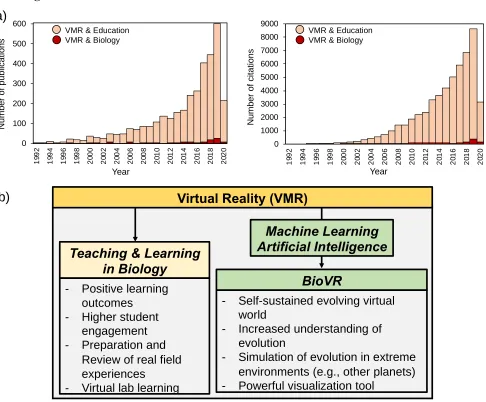
Virtual and Augmented Reality in education (Fig 1a). VMR can be defined as an alternate
world filled with computer-generated entities that interact with human sensory and motor
systems to cause a sense of ‘presence’ or ‘immersion’ in the subject
[4]. Despite its highly
technological nature, VMR has been around for decades, and it thought to have its origin when,
in the 1960s, Morton Heilig created one of the first immersive multi-sensory simulator that
included stimuli such as sound, scent, wind and vibration (called ‘Sensorama’)
[5,6]. Ever since,
VR technology has advanced significantly to the point that today there exists many platforms
for creating as well as experiencing VMR applications [e.g.,
[7-9]].
In the last decade, the use of VMR in teaching and learning has increased dramatically, and
spans across a variety of subjects
[10-13], including biology
[14,15]. A meta-analysis of sixteen
studies has shown that VMR surgical simulators decrease the time to complete surgical
procedures, suggesting a more efficient surgical skill acquisition
[16]. Furthermore, VMR
improves the learning of tasks that require spatial and visual memory, observation, as well as
control of emotional responses in stressful conditions
[17]. Importantly, autistic children have
been described as having positive engagement with VMR applications in educational settings
[18]
, suggesting that VMR can be used in a wide range of contexts and function as an inclusive
become an important educational tool in our century
[10]. But, what is the true power of VMR
in teaching and learning in biology? What can future developments in VMR teach us about
nature?
Here, we highlight the power and applicability of VMR by providing an overview of how VMR
applications are changing teaching and learning in biology. Next, we discuss the potential
caveats associated with VMR applications and discuss how VMR use can hinder (rather than
help) teaching and learning. Lastly, we look into the future of VMR technology and discuss
the directions in which future VMR developments can teach us about important principles of
nature, in which VMR can act as an independent, self-sustained virtual experimental world.
For brevity, we use a broad definition of VMR which includes all virtual types of applications,
from Augmented Reality (AR), Mixed Reality (MR) through to Virtual Reality
sensu stricto
(see Box 1). This paper’s objectives are to (1) provide a balanced view of the costs and benefits
of using VMR into the classroom for teaching evolutionary biology concepts and (2) provide
an innovative application of VMR (what we called ‘BioVMR’) in the classroom for an effective
teaching of evolutionary biology that encapsulates three domains of learning (i.e., cognitive,
affective, and psychomotor). Thus, this paper is conceptual in nature, and envisage to stimulate
further practical applications by qualified scientists and educators that possess the expertise
necessary to implement the ideas formalised here. Importantly, this paper does not aim to
provide a step-by-step guideline for the implementation of VMRs in the classroom, as these
guidelines are available elsewhere (see our discussions below). Having defined the scope of
this conceptual paper, we hope that this paper will help guide future developments in VMR
applied to biology in a constructive manner, stimulating collaborations across fields (e.g.,
Computer Science and Gaming) to develop new teaching technologies to facilitate and enhance
VMR uses in Biology education
While VMR in education has gained exponential attention of the academic community, VMR
in biology has advanced at a slower pace, comprising ~ 5% of academic publications in the
field (Fig 1a). Nonetheless, VMR has gained important applications in both secondary and
tertiary education biology courses
[13,19-21]. A number of VMR applications attempt to
reproduce the laboratory environment to students with otherwise no access to laboratory
facilities, with demonstrated benefits over traditional lectures [see e.g., Labster
[22]]. Other
VMR applications were designed to give the students an immersive experience of more specific
biological processes such as the cell structure
[23], spatial orientation
[24], and vision formation
in animals
[25]. Students report higher engagement and learning outcomes with immersive
experiences offered by VMR applications, which is encouraging for the use of VMR in biology
education
[11,13,14,26,27](Fig 1b). For example,
[24]designed an immersive interactive VMR
platform for visualisation and teaching of conformation and geometry of protein
crystallographic structures, whereby the test group was able to identify characteristics and
regions in the samples that were obfuscated in non-immersive programs
[24]. Thus, innovative
curricula that harness the power of new technologies can provide significant benefits to the
teaching and learning of biology
[28,29].
VMR applications could help learning and teaching of ecology by simulating field expeditions
in which students have to identify plants and/or animals in virtual reality, as in non-immersive
virtual field trips developed previously [e.g.,
[30,31]]. Students have in fact reported that
non-immersive virtual field trips provide a useful complement to the real field trip and could be a
powerful tool to prepare and revise real field trips (Spicer and Stratford 2001). This could also
complement units of taxonomy of plants and animals as well as provide virtual field experience
VMR, immersive scenarios could include representative environments from different
ecosystems (e.g., Amazon rainforest, tundra, desert) in which the aim is to identify the greater
number of plant species as well as the morphological traits that are shared amongst species.
It is important to mention that virtual systems have been developed to explore all aspects of
biology education. For instance, pervious digital material has been designed for teaching and
learning of astrobiology [for instance in the
Habitable Worlds
platform
[15]], although not yet
in the fully immersive platform of VMR.
Habitable Worlds
allows students to experience a
inquiry-driven learning environment designed to enhance students’ learning outcomes on
science through observation and modelling of virtual systems
[15]. The results are promising
as more than 70% of students had grades average or higher, and student engagement
significantly increased compared to benchmark
[15]. As such,
Habitable Worlds
provides some
guidelines for the design of digital platforms that could be transferable to VMR systems,
including automated feedback tailored to the students’ needs and student-educator interactions
(both in real-time and in forums)
[15]. It will be interesting for future developments of
Habitable Worlds
to expand the educational content from astrobiology to other subjects within
biology, as well as to include VMR experience and compare the performance of students with
traditional
versus
immersive platforms.
The potential misuses of VMR
As for any new technology, we are still discovering the limitations of VMR applications as
educational tools. VMR applications are attractive because they contain a wide variety of
sensory stimuli that give the participant a sense of immersion (presence). However, too many
stimuli – such as colours, shapes, characters, movement – can distract the participant and have
commonly referred to as
cognitive overload
[32]. A recent study has shown that university
students learned less and experienced higher cognitive overload when they experienced a
science lab in a fully-mounted VMR headset as oppose to the VMR scenes played on 2D
displays, in spite of higher feeling of presence (i.e., immersion) in the VMR scene as opposed
to the 2D screen display
[27]. This suggests that, in some cases, the very same attributes that
make VMR attractive can make VMR applications ineffective. Other negative effects of VMR
applications are motion sickness and dizziness caused by the immersive experience
[33-35],
which can preclude appropriate understanding of the material. Given the negative effects of
VMR, guidelines are urgently needed to minimise VMR misuses. Recent literature provides
comprehensive lists of fundamental characteristics of 3D virtual environments and general
features that can be adjusted to increase students’ engagement and learning in virtual systems
[see e.g.,
[36-38]]. Here, our point is to reiterate the importance of careful design and testing of
new VMR applications prior to implementation in the classroom in order to mitigate cognitive
overload and/or motion sickness, which could significantly hamper VMR’s educational
potential
[36]. Research is only beginning to uncover the positive and negative aspects of VMR
applications; future studies will provide more detailed evidence-based guidelines to build
effective VMR applications that maximise educational potential while minimising negative
effects of VMR misuse
[39,40].
The future: Can VMR teach us Biology?
The use of VMR technology in teaching and learning will very certainly be part of the future
of education across all disciplines, and the formulation of evidence-based guidelines for the
creation of VMR educational material is urgently needed. While we can teach and learn
Biology using VMR applications, a key question is ‘can VMR teach us anything about
that we are not criticising previous work in the field but instead aimed at conceptualising a new
way of harnessing the power of new technologies such as VMR to biology teaching and
learning.
Bio-inspired systems and the rise of artificial evolution
The parallels between natural and artificial evolutionary systems have long been recognised
and explored. While few artificial life systems exist
[41-43], perhaps the most famous example
comes from the work of Thomas Ray and the ‘Tierra’ system
[44]. The Tierra system simulates
artificial life in self-replicating, evolving entities (aka ‘algorithms’) confined within virtual
computer spaces, whereby the entities can be considered as uni- or multi-cellular entities that
experience errors in replication analogous to mutations in biological reproduction
[44-46].
Instead of solar energy and natural resources as in biological systems, artificial entities compete
for central processing unit (CPU) and memory space [analogous to energy and spatial resource,
respectively, as described in
[44]]. As a result, artificial Tierra entities become progressively
more adapted to exploit one another in order to gain advantage over the use of CPU and
memory
[44,47]. The outcome of this self-sustained virtual evolutionary world is remarkable
given that the system evolves differences in entity sizes, ecological specialisation (e.g.,
parasites) and population dynamics processes (e.g., extinction)
[44,46-48]. This provides an
unprecedented study case to compare and understand how different shapes and forms emerge
through evolutionary processes. However, visualisation of evolution in the Tierra system is not
straightforward and largely inaccessible to a broader audience due to the highly technical
language underlying the system. This poses a significant barrier to biologists with limited
computational expertise and it is, to some extent, visually unappealing for students of
to use artificial model systems such as Tierra as an effective educational tool in the classroom
while keeping the attention span and interest of students.
Can VMR and Artificial Intelligence (AI) revolutionise artificial evolutionary systems?
As discussed above, VMR is a powerful and appealing educational technology to teach biology.
This is because students and educators respond rationally as well as emotionally to the
educational material in the immersive experience, which can accentuate learning
[21,22,31,49,50].
Thus, VMR can be an appropriate way to overcome accessibility problems of artificially
evolving systems while increasing visual appealing to specialists and general audience.
The technological advances that allowed VMR to become an accessible tool has also allowed
for powerful statistical models of Machine Learning and Artificial Intelligence (AI) to
mushroom. Machine Learning are algorithms that process and learn with huge amounts of data
in order to perform a task without necessarily being explicitly programmed to do so
[51]. AI
attempts to simulate human intelligence in machine systems; this includes machine learning
but also (bio-inspired) robotics, ethics and philosophy associated with AI development
[52].
Importantly, AI advances have recently demonstrated that machines can learn from data
beyond human capabilities
[53,54]. Furthermore, a new area on the interface between VMR and
AI aims to integrate AI to entities in VMR
[55-57]. As a result, a key question emerges: can we
combine Machine Learning and AI with VMR to create a self-sustained evolving virtual world
(a ‘BioVR’)? If so, why should we combine VMR with AI? The answer to the first question is,
in our opinion, a sounding ‘yes’. We strongly believe that future technological advances have
the potential to create an immersive virtual world that reproduces the forces of evolution, which
can allow us to visualise and measure how species have evolved, how ecosystems are formed,
conditions across ecosystems in our changing world. In a sense, we could become ‘virtual
naturalists’. The learning benefits are unprecedented given that students can experience
inaccessible and inhospitable environments, observe evolution, adaptation, trophic interaction,
parasitism and many more biological processes without stepping outside the classroom.
Furthermore, the freedom given to the students within these BioVRs forms the perfect ground
for inquiry-based learning, where the students will observe and explore the environment,
measuring and experiencing the virtual environment to inquiry about the underlying virtual
biological phenomena
[15]. The BioVR could then eliminate the need for complex
computational expertise (at least from the users’ point of view) and provide a fully immersive,
artificial world upon which entities evolve following basic principles of biological evolution
in our and other planets, while students can explore the environment and learn from their own
virtual experience.
Practical implementation of BioVR by experts could be achieved through the following steps:
1.
Simulate an artificial ‘planet’ whereby entities will interact, compete, and evolve. In
this artificial planet, the ‘biotic’ rules are established, such as the basic environmental
conditions (e.g., gravity) and resource distribution (e.g., marine vs terrestrial landscapes)
[similar in concept to the ‘soup’ in Tierra
[44]and the concept of virtual environments
in
[55]].
2.
Design the ancestor entity, defining the rules of reproduction, mutation, and ecological
interactions with the resources in the planet. The ancestor entity is the ‘building block’
for artificial life to evolve in BioVR and without it, the system does not have the
evolving entity. The ancestor entity is equivalent to the ancestor species which gave
other words, without the ancestor entity to evolve, the system would resemble an
immersive version of Google Earth
[58].
3.
Gather a large empirical dataset of environment–traits–species interactions as a basic
starting-point for determining how different species evolve in different ecosystems (e.g.,
evolutionary convergences, divergences, character displacement) – we could call this
‘rules of evolution’. One way in which evolutionary rules could be extracted from this
dataset is using, for example, supervised learning models (see Box 2) to extract general
rules as to how species evolve (morphologically and behaviourally) across different
environments, commonality between functional traits across species in the same
environments, as well as the number, distribution, and behaviour of different species
within the same environment. Of course, this is optional as we may want to allow the
system free to create its own evolutionary rules along time (iterations). Nonetheless,
we believe that, if feasible, a good first proof-of-concept prototype should be based on
empirical data. Once these rules of evolution are estimated (or guessed), they are
applied to the ancestral entity which is allowed to evolve.
4.
Ideally, BioVRs are self-sustained, and thus it would be interesting to have the changes
and adaptations in one time point fed-back into the system for the next time point. For
example, imagine that a species evolves a remarkable adaptation to convert virtual
resource A into B. This transformation should be fed-back into the system so as to allow
new evolutionary rules, perhaps favouring other species to adapt and utilise virtual
resource B (which is being produced) instead of virtual resource A. Note that, over time,
the ancestral entity will then evolve and adapt to different virtual resources and
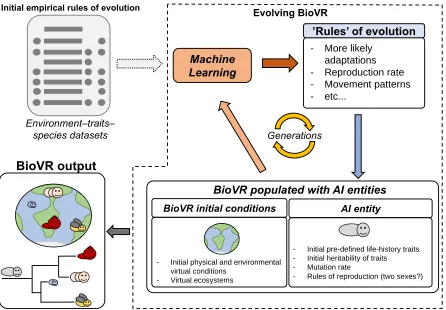
environments, thereby simulating evolution in a fully immersive system (Fig 2).
5.
Given this self-sustained cycle of interaction between entities and the environments,
an artificial ecosystem, fully accessible for exploration through VMR in inquiry-based
learning quests. This allows students and researchers to experience and study evolution
in this immersive environment, comparing the outcomes of evolutionary forces within
different environments within a BioVR and across BioVRs with different setups.
Furthermore, since data visualisation is key for understanding biological processes [e.g.,
[59]
] and is an essential component of affective learning
[49,50], the use of VR to create
BioVR worlds will allow VR to transcend the status of an educational tool that helps
learning and teaching in Biology to become the main technology for experiencing and
learning about virtual biological phenomena. It is important to mention that BioVRs,
have the potential to suffer from the same VMR misuses discussed above (e.g.,
cognitive overload) because the student and/or researchers can experience a highly
immersive, dynamic and stimuli-rich virtual environment. One way that this could be
minimised is by limiting the number of potential stimuli available at a given time; for
instance, limit drastic changes in colour and texture of the scene simultaneously.
Whether cognitive overload will affect BioVRs functionality remains contingent upon
trials of first prototypes of the BioVR concept.
We provided these steps in order to quick-start ideas around the practical challenges necessary
to realise the conceptual proposition made in this paper. We are not presumptuous of our
knowledge boundaries and understand that experts may have better implementation methods
and other tools that we are unaware. Having said that, these steps are aimed to foster open
discussions that can generate international collaborations which may make possible for BioVR
to reach the classroom as an effective educational tool of the future. It is important to mention
that while the idea of BioVRs may seem now allusive, attempts to merge the fields of VMR,
the astonishing ‘boost’ in computer power of our generation
[60,61]. We are also aware that
virtual environments, AI and semi-autonomous VMR agents have been developed for other
purposes such as direct or assist users into tasks [see e.g.,
[55]]. To our knowledge, concepts
similar to the one of BioVR as presented in this paper have never been conceptualised let alone
tested, which underscores the importance of opening this avenue of communication around the
concept of BioVR for future developments that aid education of Biology. Future research and
discussion should therefore aim at assessing the feasibility of the concepts proposed here
Conclusion
VMR can be a powerful ally in biology education. The use of VMR has provided promising
results for consolidating learning across secondary and tertiary biology education. With
increasing technology, the combination of VMR with Machine Learning and AI has the
potential to create a self-sustained evolving virtual world (BioVR) that allow us to uniquely
explore how life as we know evolves and responds to extreme climatic conditions.
Conflict of interest
The authors have no conflict of interests to declare.
References
1.
Kish, L. Moore's law and the energy requirement of computing versus performance.
IEE Proceedings Circuits, Devices and Systems 2004
,
151
, 190-194.
2.
Waldrop, M.M. The chips are down for Moore’s law.
Nature News 2016
,
530
, 144.
3.
Veletsianos, G.
Emerging technologies in distance education
; Athabasca University
Press: Canada, 2010.
4.
Yoh, M.-S. The reality of virtual reality. In Proceedings of Proceedings of the Seventh
International Conference on Virtual Systems and Multimedia, 2001. ; pp. 666-674.
5.
Heilig, M. Sensorama simulator, US patent no. 3050870. August: 1962.
6.
Mazuryk, T.; Gervautz, M. Virtual reality: history, applications, technology and future.
Citeseer 1996
,
1
.
7.
Ledermann, F.; Schmalstieg, D. APRIL: a high-level framework for creating
augmented reality presentations. In Proceedings of Virtual Reality, 2005. Proceedings.
VR 2005. IEEE; pp. 187-194.
9.
Wexelblat, A.
Virtual reality: applications and explorations
; Academic Press:
Cambridge, MA, 2014.
10.
Hoffman, H.; Vu, D. Virtual reality: teaching tool of the twenty-first century?
Academic
medicine: journal of the Association of American Medical Colleges 1997
,
72
,
1076-1081.
11.
Mikropoulos, T.A.; Natsis, A. Educational virtual environments: A ten-year review of
empirical research (1999–2009).
Computers & Education 2011
,
56
, 769-780.
12.
Davies, A.G.; Crohn, N.J.; Treadgold, L.A. Can virtual reality really be used within the
lecture theatre?
BMJ Simulation and Technology Enhanced Learning 2018
,
bmjstel-2017-000295.
13.
Makransky, G.; Thisgaard, M.W.; Gadegaard, H. Virtual simulations as preparation for
lab exercises: Assessing learning of key laboratory skills in microbiology and
improvement of essential non-cognitive skills.
PLoS ONE 2016
,
11
, e0155895.
14.
Shim, K.-C.; Park, J.-S.; Kim, H.-S.; Kim, J.-H.; Park, Y.-C.; Ryu, H.-I. Application of
virtual reality technology in biology education.
Journal of Biological Education 2003
,
37
, 71-74.
15.
Horodyskyj, L.B.; Mead, C.; Belinson, Z.; Buxner, S.; Semken, S.; Anbar, A.D.
Habitable Worlds: Delivering on the promises of online education.
Astrobiology 2018
,
18
, 86-99.
16.
Haque, S.; Srinivasan, S. A meta-analysis of the training effectiveness of virtual reality
surgical simulators.
IEEE Trans. Inf. Technol. Biomed. 2006
,
10
, 51-58.
17.
Jensen, L.; Konradsen, F. A review of the use of virtual reality head-mounted displays
in education and training.
Education and Information Technologies 2018
,
23
,
1515-1529.
18.
Strickland, D.; Marcus, L.M.; Mesibov, G.B.; Hogan, K. Brief report: Two case studies
using virtual reality as a learning tool for autistic children.
J. Autism Dev. Disord. 1996
,
26
, 651-659.
19.
Poland, R.; Baggott la Velle, L.; Nichol, J. The Virtual Field Station (VFS): using a
virtual reality environment for ecological fieldwork in A‐Level biological studies—
Case Study 3.
Br. J. Educat. Tech. 2003
,
34
, 215-231.
20.
De Jong, T.; Linn, M.C.; Zacharia, Z.C. Physical and virtual laboratories in science and
engineering education.
Science 2013
,
340
, 305-308.
21.
Thisgaard, M.; Makransky, G. Virtual learning simulations in high school: Effects on
cognitive and non-cognitive outcomes and implications on the development of STEM
academic and career choice.
Frontiers in psychology 2017
,
8
, 805.
22.
Bonde, M.T.; Makransky, G.; Wandall, J.; Larsen, M.V.; Morsing, M.; Jarmer, H.;
Sommer, M.O. Improving biotech education through gamified laboratory simulations.
Nat. Biotechnol. 2014
,
32
, 694.
23.
McClean, P.E.; Slator, B.M.; White, A.R. The virtual cell: An interactive, virtual
environment for cell biology. In Proceedings of EdMedia: World Conference on
Educational Media and Technology; pp. 1442-1443.
24.
Moritz, E.; Meyer, J. Interactive 3D protein structure visualization using virtual reality.
In Proceedings of Proceedings of the Fourth IEEE Symposium on Bioinformatics and
Bioengineering, 2004. BIBE 2004. ; pp. 503-507.
25.
Dominy, N.; Gochman, S. Tarsier Goggles: a virtual reality tool for experiencing the
optics of a dark-adapted primate visual system.
DArmouth Digital Commons 2018
.
26.
Mikropoulos, T.A.; Katsikis, A.; Nikolou, E.; Tsakalis, P. Virtual environments in
27.
Makransky, G.; Terkildsen, T.S.; Mayer, R.E. Adding immersive virtual reality to a
science lab simulation causes more presence but less learning.
Learning and Instruction
2017
.
28.
Eastwood, J.L.; Sadler, T.D. Teachers' implementation of a game-based biotechnology
curriculum.
Computers & Education 2013
,
66
, 11-24.
29.
Sadler, T.D.; Romine, W.L.; Menon, D.; Ferdig, R.E.; Annetta, L. Learning Biology
through innovative curricula: a comparison of game‐and nongame‐based approaches.
Science Education 2015
,
99
, 696-720.
30.
Spicer, J.I.; Stratford, J. Student perceptions of a virtual field trip to replace a real field
trip.
J. Comput. Assisted Learn. 2001
,
17
, 345-354.
31.
Minocha, S.; Tudor, A.-D.; Tilling, S. Affordances of mobile virtual reality and their
role in learning and teaching. In Proceedings of 31st British Human Computer
Interaction Conference, University of Sunderland’s St. Peter’s Campus, UK.
32.
Whitelock, D.; Romano, D.; Jelfs, A.; Brna, P. Perfect presence: What does this mean
for the design of virtual learning environments?
Education and Information
Technologies 2000
,
5
, 277-289.
33.
McCauley, M.E.; Sharkey, T.J. Cybersickness: Perception of self-motion in virtual
environments.
Presence: Teleoperators & Virtual Environments 1992
,
1
, 311-318.
34.
Regan, E.; Price, K. The frequency of occurrence and severity of side-effects of
immersion virtual reality.
Aviat. Space Environ. Med. 1994
.
35.
Ohyama, S.; Nishiike, S.; Watanabe, H.; Matsuoka, K.; Akizuki, H.; Takeda, N.;
Harada, T. Autonomic responses during motion sickness induced by virtual reality.
Auris. Nasus. Larynx 2007
,
34
, 303-306.
36.
Dalgarno, B.; Lee, M.J. What are the learning affordances of 3‐D virtual environments?
Br. J. Educat. Tech. 2010
,
41
, 10-32.
37.
Lindgren, R.; Tscholl, M.; Wang, S.; Johnson, E. Enhancing learning and engagement
through embodied interaction within a mixed reality simulation.
Computers &
Education 2016
,
95
, 174-187.
38.
O’Connor, E.A.; Domingo, J. A practical guide, with theoretical underpinnings, for
creating effective virtual reality learning environments.
Journal of Educational
Technology Systems 2017
,
45
, 343-364.
39.
Dunleavy, M.; Dede, C.; Mitchell, R. Affordances and limitations of immersive
participatory augmented reality simulations for teaching and learning.
Journal of
science Education and Technology 2009
,
18
, 7-22.
40.
Akçayır, M.; Akçayır, G. Advantages and challenges associated with augmented reality
for education: A systematic review of the literature.
Educational Research Review 2017
,
20
, 1-11.
41.
Langton, C.G. Studying artificial life with cellular automata.
Physica D: Nonlinear
Phenomena 1986
,
22
, 120-149.
42.
Langton, C.G.
Artificial life: An overview
; Mit Press: Cambridge, MA, 1997.
43.
Lehman, J.; Clune, J.; Misevic, D.; Adami, C.; Altenberg, L.; Beaulieu, J.; Bentley, P.J.;
Bernard, S.; Beslon, G.; Bryson, D.M. The surprising creativity of digital evolution: A
collection of anecdotes from the evolutionary computation and artificial life research
communities.
arXiv preprint arXiv:1803.03453 2018
.
44.
Ray, T.S. Evolution, ecology and optimization of digital organisms. In
Scientific
Excellence in Supercomputing: The IBM 1990 Contest Prize Papers
, Billingsley, D.,
Brown, Ed. Citeseer: Athens, GA, 1992; Vol. 1.
46.
Ray, T.S. Evolution, complexity, entropy and artificial reality.
Physica D: Nonlinear
Phenomena 1994
,
75
, 239-263.
47.
Ray, T.S.; Xu, C. Measures of evolvability in tierra.
Artif. Life Robot. 2001
,
5
, 211-214.
48.
Shao, J.; Ray, T.S. Maintenance of species diversity by predation in the Tierra system.
In Proceedings of Proceedings of the Alife XII Conference, Odense, Denmark; pp.
533-540.
49.
Harley, J.M.; Poitras, E.G.; Jarrell, A.; Duffy, M.C.; Lajoie, S.P. Comparing virtual and
location-based augmented reality mobile learning: emotions and learning outcomes.
Educational Technology Research and Development 2016
,
64
, 359-388.
50.
Riva, G.; Mantovani, F.; Capideville, C.S.; Preziosa, A.; Morganti, F.; Villani, D.;
Gaggioli, A.; Botella, C.; Alcañiz, M. Affective interactions using virtual reality: the
link between presence and emotions.
CyberPsychol. Behav. 2007
,
10
, 45-56.
51.
Bishop, C.M.
Pattern recognition and machine learning
; Springer-Verlag New York:
2006; Vol. 1, pp. 738.
52.
Russell, S.J.; Norvig, P.
Artificial intelligence: a modern approach
; Pearson Education
Limited: Upper Saddle River New Jersey, 2016.
53.
Chouard, T. The Go Files: AI computer wraps up 4-1 victory against human champion.
Nature News 2016
.
54.
Gibney, E. Google AI algorithm masters ancient game of Go.
Nature News 2016
,
529
,
445.
55.
Luck, M.; Aylett, R. Applying artificial intelligence to virtual reality: Intelligent virtual
environments.
Applied Artificial Intelligence 2000
,
14
, 3-32.
56.
Laukkanen, S.; Karanta, I.; Kotovirta, V.; Markkanen, J.; Rönkkö, J. Adding
intelligence to virtual reality. In Proceedings of Proceedings of the 16th European
Conference on Artificial Intelligence; pp. 1136-1141.
57.
Augusto, J.C.; Callaghan, V.; Cook, D.; Kameas, A.; Satoh, I. Intelligent environments:
a manifesto.
Human-Centric Computing and Information Sciences 2013
,
3
, 12.
58.
Gorelick, N.; Hancher, M.; Dixon, M.; Ilyushchenko, S.; Thau, D.; Moore, R. Google
Earth Engine: Planetary-scale geospatial analysis for everyone.
Remote Sens. Environ.
2017
,
202
, 18-27.
59.
Karr, T.L.; Brady, R. Virtual biology in the CAVE.
Trends Genet. 2000
,
16
, 231-232.
60.
Petrović, V.M. Artificial Intelligence and Virtual Worlds–Toward Human-Level AI
Agents.
IEEE Access 2018
,
6
, 39976-39988.
61.
Zhang, Z.; Cao, B.; Guo, J.; Weng, D.; Liu, Y.; Wang, Y. Inverse virtual reality:
intelligence-driven mutually mirrored world. In Proceedings of 2018 IEEE Conference
on Virtual Reality and 3D User Interfaces (VR); pp. 735-736.
62.
Milgram, P.; Takemura, H.; Utsumi, A.; Kishino, F. Augmented reality: A class of
displays on the reality-virtuality continuum. In Proceedings of Telemanipulator and
Telepresence Technologies; pp. 282-293.
63.
Serino, M.; Cordrey, K.; McLaughlin, L.; Milanaik, R.L. Pokémon Go and augmented
virtual reality games: a cautionary commentary for parents and pediatricians.
Curr.
Opin. Pediatr. 2016
,
28
, 673-677.
64.
Zsila, Á.; Orosz, G.; Bőthe, B.; Tóth-Király, I.; Király, O.; Griffiths, M.; Demetrovics,
Z. An empirical study on the motivations underlying augmented reality games: The
case of Pokémon Go during and after Pokémon fever.
Personality and Individual
Differences 2018
,
133
, 56-66.
65.
Michalski, R.S.; Carbonell, J.G.; Mitchell, T.M.
Machine learning: An artificial
intelligence approach
; Springer Science & Business Media: Berlin, Germany, 2013.
Figures
Fig 1 – VMR increasing importance in academic and educational context.
(a) Web of
Science Topic query of publications (left) and citations (right) that involves VMR and
education (orange) and VMR and biology (red). WoS searches were conducted on
12-May-2020 with search term queries ‘(virtual AND augmented) reality AND education’ or ‘(virtual
AND augmented) reality AND biology’. For each search, reviews and proceedings of
conferences were excluded. In total, there were 6,443 and 133 papers that fitted the selection
criteria, respectively. (b) Schematic overview of the potential for VMR to impact Biology.
On
one hand, VMR has increasingly been used for teaching of a variety of topics within Biology.
As technology advances, it may be possible to combine other cutting-edge technologies such
Virtual Reality (VMR)
Teaching & Learning
in Biology
- Positive learning outcomes
- Higher student engagement - Preparation and
Review of real field experiences
- Virtual lab learning
Machine Learning
Artificial Intelligence
BioVR
- Self-sustained evolving virtual world
- Increased understanding of evolution
- Simulation of evolution in extreme environments (e.g., other planets) - Powerful visualization tool
0 100 200 300 400 500 600 1 9 9 2 1 9 9 4 1 9 9 6 1 9 9 8 2 0 0 0 2 0 0 2 2 0 0 4 2 0 0 6 2 0 0 8 2 0 1 0 2 0 1 2 2 0 1 4 2 0 1 6 2 0 1 8 2 0 2 0 N u m b e r o f p u b lic a ti o n s 0 1000 2000 3000 4000 5000 6000 7000 8000 9000 1 9 9 2 1 9 9 4 1 9 9 6 1 9 9 8 2 0 0 0 2 0 0 2 2 0 0 4 2 0 0 6 2 0 0 8 2 0 1 0 2 0 1 2 2 0 1 4 2 0 1 6 2 0 1 8 2 0 2 0 N u m b e r o f c it a ti o n s Year Year
VMR & Education VMR & Biology
VMR & Education VMR & Biology
as Machine Learning and Artificial Intelligent to create a self-sustained evolving virtual world
(BioVR) that allows us to gain insights into biological processes.
Fig 2 –Conceptual overview of the steps to build a BioVR.
A supervised machine learning
algorithm is implemented to empirical environment-trait-species datasets in order to extract the
patterns (or ‘rules’) of evolution across environments. Meanwhile, the initial settings for the
BioVR world and the ancestral AI entity are also set. The settings include physical and
environmental conditions, as well as patterns of lifespan, movement, and reproduction of the
AI entity. Next, the ‘rules of evolution’ are incorporated into the BioVR and AI entity with
original settings, and the BioVR is allowed to evolve. Note that the evolution patterns in the
BioVR are then fed-back to the machine learning model, which is updated. This way, the only
input from empirical data is at the initial states, and BioVR are allowed to evolve independently
MachineLearning
’Rules’ of evolution - More likely
adaptations - Reproduction rate - Movement patterns - etc...
Environment–traits– species datasets
BioVR initial conditions
- Initial physical and environmental virtual conditions
- Virtual ecosystems
AI entity
- Initial pre-defined life-history traits - Initial heritability of traits - Mutation rate
- Rules of reproduction (two sexes?)
Generations
Evolving BioVR
Initial empirical rules of evolution
BioVR output
afterwards. As a result, we can measure and visualise species evolution as it happens, in an
immersive experience of the BioVR.
Boxes
Box 1 – The reality-virtuality continuum
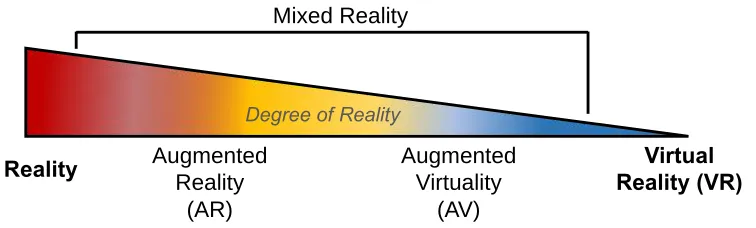
In a highly influential paper,
[62]proposed the reality-virtuality continuum (see Fig 3) to
classify VMR technology and applications. On one side of the spectrum is the real world
(reality) and, on the other side of the spectrum, the fully virtual world (virtuality) where Virtual
Reality (VR) in its strict sense resides. In between the extremes, stands Augmented Reality
(AR) – which relies mostly on real world elements but with the addition of virtual entities; the
best known (and controversial) example of AR has been Pokemon Go!
[63,64]– and Augmented
Virtuality (AV) with the opposite of AR, that is, mostly virtual world but with the addition of
‘real’ entities
[62]. AR and AV are cases of Mixed Reality (MR), where real and virtual
elements are intertwined within the application (see Fig 3). For the purpose of this paper and
for simplicity, we refer to AR, AV, and VR all as virtual and mixed reality (VMR) applications
because they all have some degree of virtuality.
Fig 3 – The reality-virtuality continuum.
AR – augmented reality; AV – augmented
virtuality; VR – virtual reality (based on Milgram et al., 1995).
Box 2 – Supervised and unsupervised machine learning.
Reality Reality (VR)Virtual
Degree of Reality
Augmented Reality
(AR)
Augmented Virtuality
Machine learning models can be broadly classified into
supervised
or
unsupervised
learning
algorithms, depending on the structure of the data
[65](Note: there are intermediate cases called
semi-supervised learning
which we will not consider here, see e.g.,
[66]for details).
Unsupervised learning algorithms use data in which the outcome is not yet labelled or identified,
and therefore the algorithm cannot ‘know’ the outcomes in advance. The algorithm then learns
how to classify and predict the outcome from new observations based on the inherent structure
of the data at hand. An example of unsupervised learning is the clustering of groups within a
dataset (Fig 4a). Conversely, supervised learning algorithms uses data in which the outcome is
known, and the algorithm learns how to predict the outcome of future observations based on
what was learnt from the information and outcomes obtained from previous data. An example
of supervised learning is the classification (or prediction, in the case of regression models) of
a new observation between two categories based on
n
number of characteristics or variables
(Fig 4b).
Unsupervised learning Supervised learning
a) b)
Variable 2
V
a
ri
a
b
le
1
Variable 2
V
a
ri
a
b
le
1
Variable 2
V
a
ri
a
b
le
1
V
a
ri
a
b
le
1