International Journal of Nanomedicine
Dove
press
O r I g I N a l r e s e a r c h
open access to scientific and medical research
Open access Full Text article
Temperature-dependent and time-dependent
effects of hyperthermia mediated by
dextran-coated la
0.7
sr
0.3
MnO
3
: in vitro studies
reihaneh haghniaz rinku D Umrani Kishore M Paknikar
centre for Nanobioscience, agharkar research Institute, Pune, Maharashtra, India
Background: The purpose of this study was to investigate the therapeutic efficacy of dextran-coated (Dex) La0.7Sr0.3MnO3 (LSMO) nanoparticles-mediated hyperthermia at different temperatures (43°C, 45°C, and 47°C) based on cell killing potential and induction of heat shock proteins in a murine melanoma cell (B16F1) line.
Methods: LSMO nanoparticles were synthesized by a citrate-gel method and coated with dextran. B16F1 cells were exposed to the Dex-LSMO nanoparticles and heated using a radiof-requency generator. After heating, the morphology and topology of the cells were investigated by optical microscopy and atomic force microscopy. At 0 hours and 24 hours post heating, cells were harvested and viability was analyzed by the Trypan blue dye exclusion method. Apoptosis and DNA fragmentation were assessed by terminal deoxynucleotidyl transferase-dUTP nick end labeling (TUNEL) assay and agarose gel electrophoresis, respectively. An enzyme-linked immunosorbent assay was used to quantify heat shock protein levels.
Results: Our data indicate that cell death and induction of heat shock proteins in melanoma cells increased in a time-dependent and temperature-dependent manner, particularly at temperatures higher than 43°C. The mode of cell death was found to be apoptotic, as evident by DNA frag-mentation and TUNEL signal. A minimum temperature of 45°C was required to irreversibly alter cell morphology, significantly reduce cell viability, and result in 98% apoptosis. Repeated cycles of hyperthermia could induce higher levels of heat shock proteins (more favorable for antitumor activity) when compared with a single cycle.
Conclusion: Our findings indicate a potential use for Dex-LSMO-mediated hyperthermia in the treatment of melanoma and other types of cancer.
Keywords: hyperthermia, Dex-LSMO nanoparticles, heat shock proteins, melanoma, apoptosis
Introduction
“Hyperthermia” refers to a treatment procedure in which body temperature is increased
to a few degrees above physiological temperature, between approximately 41°C and
47°C.1 These high temperatures are reported to kill cancerous cells selectively and are
thus useful in treating several types of cancer.2–4 This effect is because of irregular and
poor blood flow in the tumor that allows slow dissipation of heat, making cancerous
cells more thermosensitive than normal cells.5 Taking advantage of this differential
thermotolerance, whole body hyperthermia is used clinically to treat cancer. However, a major concern with this type of treatment is the lack of local and uniform heating in
the tumor region.6 This is especially true for deep-seated tumors, where noninvasive
external energy sources used for hyperthermia, such as warm water blankets, laser
ablation, microwaves, and radiowaves, inevitably damage adjacent normal tissues.6,7
correspondence: Kishore M Paknikar centre for Nanobioscience, agharkar research Institute, gg agarkar road, Pune 411 004, Maharashtra, India Tel +91 20 2565 4831
Fax +91 20 2565 1542 email [email protected]
Journal name: International Journal of Nanomedicine Article Designation: Original Research
Year: 2015 Volume: 10
Running head verso: Haghniaz et al
Running head recto: Hyperthermia mediated by Dex-LSMO DOI: http://dx.doi.org/10.2147/IJN.S78167
International Journal of Nanomedicine downloaded from https://www.dovepress.com/ by 118.70.13.36 on 23-Aug-2020
For personal use only.
This article was published in the following Dove Press journal: International Journal of Nanomedicine
25 February 2015
Dovepress haghniaz et al
To overcome this problem, various strategies are being developed to achieve localized hyperthermia.
Radiofrequency (RF)-induced hyperthermia mediated by nanoparticles is a promising strategy for the treatment of cancer because RF energy can penetrate deeply into tissues. Using this method, nanoparticles that become excited on exposure to RF are deposited in the tumor to promote
local-ized heating.8,9 The improved heating efficiency because
of the nanoparticles results in lowering of the RF field to a safe range (100–400 kHz), thereby minimizing nonspecific
heating of healthy tissues.10
Among the different nanoparticles explored for hyper-thermia, magnetic nanoparticles (MNPs) are of particular interest because of their many advantages. They can be
tar-geted to tumor tissue using an external magnetic field11 and
removed once therapy is completed. Further, they can be used in combined biomedical applications, such as hyperthermia
and magnetic resonance imaging.12,13
Application of MNPs in hyperthermia is based on their inherent property of heating upon exposure to an alternating magnetic field (eg, RF). The MNPs then dissipate the heat
into the tumor tissue and selectively kill cancerous cells.14
The mode of cell death depends on the temperature used for treatment, the duration of hyperthermia, and the vulnerability
of the cells to heat.15,16 Usually treatment at temperatures
above 50°C (known as thermoablation) destroys tumor cells
by necrosis, whereas treatment at a lower temperature (up to
47°C) results in apoptotic cell death.17 Therefore, controlling
the temperature during treatment is important. This highlights the need to either monitor the temperature during treatment or develop MNPs that stop heating once the required
tem-perature is reached.18
Lanthanum strontium manganese oxide (LSMO; La1–x
SrxMnO3) nanoparticles in a doping range of 0.2×0.3
are of much interest owing to their low Curie temperature,
which ranges from 320 to 370 K (47°C to 97°C), and their
self-controlled heating properties.19,20
Based on this rationale, we examined the possibility of using LSMO nanoparticles as a hyperthermia agent in the treatment of cancer. LSMO nanoparticles were coated with dextran sulfate to improve their bioavailability and lessen
their toxicity.21 These dextran-coated (Dex)-LSMO
nano-particles were found to display a low Curie temperature (360 K) and self-controlled heating properties on exposure
to RF.22,23
To evaluate the efficacy of hyperthermia mediated by Dex-LSMO nanoparticles, we selected murine melanoma (B16F1) cells as a cancer model, since this cancer is
reported to be resistant to conventional treatment such as
chemotherapy.24
Before treatment with hyperthermia, it was important to confirm that the Dex-LSMO nanoparticles themselves do not damage cells. We therefore evaluated the cytotoxic-ity of Dex-LSMO nanoparticles alone in various cell lines.
As reported elsewhere,21,23 we have noted a cell line-dependent
and concentration-dependent cytotoxic effect of Dex-LSMO nanoparticles. Nevertheless, coating of LSMO with dextran could significantly reduce cytotoxicity as compared with bare
LSMO.21,23,25 Based on our previous research, a Dex-LSMO
concentration of 250 μg/mL was found to be safe in melanoma
cells and therefore was used in further experiments.25
The results of an internalization study was performed using fluorescence microscopy to investigate intracellular
localization of nanoparticles.25 Cells incubated with
fluores-cein isothiocyanate-conjugated Dex-LSMO nanoparticles showed rapid uptake of nanoparticles into the cytoplasm
and nucleus.The observed internalization of Dex-LSMO
nanoparticles could be important for delivery of
therapeu-tic drugs directly into the intercellular compartment,26 cell
tracking, and contrast enhancement in magnetic resonance
imaging.25,27
In our continued efforts,we evaluated induction of
heat shock proteins (HSPs) in melanoma cells at different time points (ie, 0, 2, 4, 8, 12, 24, 48, and 72 hours) after
treatment with hyperthermia at 43°C.21 RF-induced
Dex-LSMO-mediated hyperthermia resulted in enhanced induc-tion of HSPs as compared with incubator hyperthermia (a
model mimicking conventional whole body hyperthermia).21
However, the mode of cell death and outcome of
Dex-LSMO-mediated hyperthermia at temperatures higher than 43°C was
not explored in those experiments. Thus, in the present work,
we investigated the in vitroefficacy of Dex-LSMO-mediated
hyperthermia at temperatures above 43°C (ie, 45°C and 47°C).
The results are compared with hyperthermia at 43°C in terms
of cellular morphology, mode of cell death, and induction of HSPs. We intend to use this information to select parameters for treatment of melanoma in our future in vivo studies.
Materials and methods
Materials
A murine melanoma (B16F1) cell line was obtained from the National Center for Cell Sciences, Pune, India. Dulbecco’s Modified Eagle’s Medium, fetal bovine serum,
Hoechst 33342, and a Click-iT® terminal deoxynucleotidyl
transferase-dUTP nick end labeling (TUNEL) Alexa Fluor®
594 Imaging Assay kit were obtained from Invitrogen
International Journal of Nanomedicine downloaded from https://www.dovepress.com/ by 118.70.13.36 on 23-Aug-2020
Dovepress hyperthermia mediated by Dex-lsMO
(Grand Island, NY, USA). Antibiotic–antimycotic solution
(100×) and trypsin phosphate versene glucose were sourced
from HiMedia Laboratories (Mumbai, India). Trypan blue, a GenElute Mammalian Genomic DNA Miniprep kit, radio-immunoprecipitation buffer, protease inhibitor cocktail, paraformaldehyde, standard heat shock proteins 70 and 90 (HSP70 and HSP90, respectively) and monoclonal antibod-ies (mAb70 and mAb90) were sourced from Sigma–Aldrich (St Louis, MO, USA). Triton™ X-100 and bovine serum albumin were purchased from Sisco Research Laboratories (Mumbai, India). Horse radish peroxidase-conjugated
anti-antibody and tetramethylbenzidine (TMB)-H2O2 substrate
were obtained from Bangalore Genei (Bangalore, India).
A Lambda DNA/EcoRI + HindIII marker was purchased
from Thermo Fisher Scientific (Waltham, MA, USA).
synthesis and coating of nanoparticles
LSMO nanoparticles were synthesized by a citrate-gel method
from metal acetate hydrate precursors as described elsewhere,28
and were further coated using dextran sulfate sodium salt as
explained in our earlier communication.23 Briefly,
presynthe-sized LSMO nanoparticles (200 mg) were dispersed in 10 mL of double-distilled water and bath-sonicated for 30 minutes. An equal concentration of dextran sulfate was added to the dispersion of LSMO nanoparticles and sonicated for another 30 minutes. The resulting mixture was shaken overnight at room
temperature, ie, ~25°C, to obtain Dex-LSMO nanoparticles.
X-ray diffraction
Phase formation and the crystal structure of the LSMO sample were investigated using X-ray diffraction. Powder X-ray diffraction was performed with the help of a desktop X-ray diffractometer (Model MiniFlex II, Rigaku, Tokyo,
Japan) with Cu Kα radiation (K value 0.9 and wavelength
1.5405 A°) and diffraction angle 2θ, ranging from 20° to
80°. The mean size of the crystallites was estimated using
Scherrer’s formula as shown below:
T = Kλ/(B cos θ)
where T is the crystallite size, K is a constant, λ is the X-ray
wavelength, B is the full width at half maximum of the
dif-fracted peak, and θ is the angle of diffraction.
high-resolution transmission electron
microscopy
High-resolution transmission electron microscopy (HRTEM) was carried out to determine the shape and particle size of
Dex-LSMO. Samples were drop-coated on carbon-coated copper microgrids and allowed to air-dry. Images were then acquired using HRTEM (model Tecnai-T30, FEI Company, Hillsboro, NJ, USA) at an accelerating voltage of 300 kV.
Fourier transform infrared spectroscopy
LSMO and Dex-LSMO nanoparticles were analyzed by Fourier transform infrared spectroscopy (Model Spectrum One, Perkin Elmer Inc, Waltham, USA) to confirm dextran coating over the LSMO core. Dextran sulfate was used as a reference for comparison of characteristic peaks. Powder samples were mixed with potassium bromide and
spectra were recorded in the 4,000–500 cm-1 wave number
range.
Vibrating sample magnetometry
The magnetic moment of the nanoparticles was studied using a vibrating sample magnetometer (EG and G PAR 4500, Princeton Applied Research Corp, Princeton, NJ, USA). The magnetic moment was measured at room tem-perature (300 K), with an applied field (H) ranging from
0 to ±3,500 Oe.
rF-induced heating potential of
Dex-lsMO nanoparticles
A high frequency generator (Model Hot Shot System 2, Ameritherm Inc, Scottsville, KY, USA) was used at a fre-quency of 365 KHz and a current of 700 A. The equipment consisted of a custom-made, water-cooled, five-turn spiral coil (Model ID 50 mm, Asetus Udyog, Bangalore, India) with an internal diameter of 50 mm. Various concentrations of nanoparticles (ie, 1, 5, and 10 mg/mL; total volume 1 mL) were prepared in phosphate-buffered saline (PBS), placed in the center of the coil, and exposed to RF. Increase in temperature was recorded up to 1,200 seconds using a fine spirit-filled thermometer. A plot of temperature versus time was drawn, and the specific absorption rate (SAR) value was calculated using the following formula:
SAR=
(
Csolvent Xmagnetic element)
×(
dT dt)
where Csolvent is the specific heat capacity of water (4.18 J/gK),
Xmagnetic element is the weight fraction of magnetic nanoparticles
in the sample (g/L), and dT/dt is the initial slope of the tem-perature (K) versus time (seconds) curve. The time period of the first 150 seconds was considered for calculating the slope.
International Journal of Nanomedicine downloaded from https://www.dovepress.com/ by 118.70.13.36 on 23-Aug-2020
Dovepress haghniaz et al
Optimization of hyperthermia
For optimization, unseeded tissue culture flasks
contain-ing Dex-LSMO nanoparticles (250 μg/mL in 5 mL culture
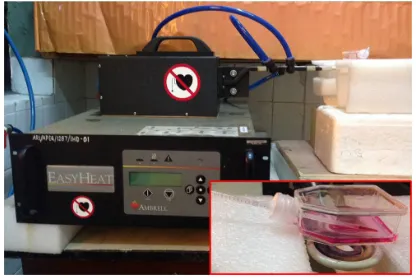
medium) were used. Hyperthermia was applied using a pancake-shaped copper coil (Model ID 14 mm, Asetus Udyog) attached to an RF generator (Hot Shot System 2, Ameritherm Inc, Figure 1). Several parameters, ie, power of the instrument, frequency of RF, and period of exposure were tested, and the temperature rise was measured by placing a spirit-filled thermometer inside the flasks (as shown in the inset to Figure 1).
The B16F1 cells (5×10⁵) were then seeded in 25 cm2
tis-sue culture flasks containing 5 mL of Dulbecco’s Modified Eagle’s Medium (supplemented with 10% fetal bovine serum and 1% antibiotic–antimycotic solution) and allowed to grow
for 48 hours at 37°C in the presence of 5% CO2. Flasks not
containing nanoparticles but exposed to RF served as the “RF” control. Culture flasks containing nanoparticles but not exposed to RF served as the “no RF” control.
hyperthermia to B16F1 murine
melanoma cells
After growing the B16F1 cells (5×10⁵) in tissue culture
flasks, a safe concentration of nanoparticles, ie, 250 μg/mL,
was added to each flask to ensure that the Dex-LSMO nanoparticles per se do not cause cell death. The flasks were exposed to an optimized RF condition (365 kHz, input cur-rent 700 A, power 8,000 W) for a total time of 6, 8.5, and
11 minutes to increase the temperature from 37°C to 43°C,
45°C, and 47°C, respectively. After reaching the desired
temperature, RF was switched off. To determine the effect of repeated cycles of hyperthermia, additional groups of cells were subjected to three cycles of hyperthermia at 15-minute intervals. All experiments were performed in triplicates.
effect of hyperthermia on cell
morphology
Cell morphology was viewed at 0 hours and 24 hours after treatment with RF-induced Dex-LSMO-mediated hyper-thermia using an inverted optical microscope (Model TS 100, Nikon, Tokyo, Japan). Topological changes were imaged using an atomic force microscope (AFM, Model MultiView-1,000, Nanonics Imaging Ltd, Jerusalem, Israel). AFM images were processed using WSxM software (version 4.0, Nanotec Electronica, Madrid, Spain).
effect of hyperthermia on cell viability
Cell viability was assessed by the Trypan blue dye exclu-sion method at 0 hours and 24 hours after RF-induced Dex-LSMO-mediated hyperthermia. After treatment, cells were collected by trypsinization, centrifuged, and the cell
pellet was resuspended in 1 mL of PBS. Next, 10 μL of
the resulting cell suspension was admixed with 10 μL of
Trypan blue (0.4% in PBS). The numbers of nonstained (viable) cells and stained (dead) cells were counted using a hemocytometer. Cell viability was then calculated by the following formula:
Viability (%) nonstained cells Stained cells + nonstained cells
= ×1000.
Three independent experiments were performed. The results were interpreted as the ratio of viable cells after hyperthermia treatment to that of the no RF control.
Detection of cell death by DNa
laddering assay
Agarose gel electrophoresis was performed to assess the immediate (0 hours) and long-term (up to 48 hours) impact of RF-induced Dex-LSMO-mediated hyperthermia on induction of apoptosis. Cells were exposed to RF-induced hyperthermia. DNA was isolated from the heated cells at three different time points, ie, 0, 24, and 48 hours, using a GenElute Mammalian Genomic DNA Miniprep kit according to the manufacturer’s instructions. Time points of 24 hours and 48 hours were included to allow DNA fragmentation to
occur. Equal volumes of DNA samples (20 μL) were then
loaded on 1% agarose gel (containing 5 μg/mL ethidium
bromide in 1× Tris-acetate-ethylenediaminetetraacetic acid
buffer, pH 8.5). Lambda DNA/EcoRI + HindIII was used as
a marker and electrophoresis was carried out at 90 V for 1.5 hours. Fragments of DNA on the gel were then visualized under ultraviolet light.
Figure 1 hot shot system 2 radiofrequency generator attached to a pancake-shaped coil. The pancake-shaped coil used for the temperature rise in the cell culture flask is magnified in the inset.
International Journal of Nanomedicine downloaded from https://www.dovepress.com/ by 118.70.13.36 on 23-Aug-2020
Dovepress hyperthermia mediated by Dex-lsMO
Detection of cell death by TUNel assay
To confirm the results of the DNA laddering assay and quantify the number of apoptotic cells, a TUNEL assay
was performed using a Click-iT® TUNEL Alexa Fluor® 594
Imaging Assay kit.
For the experiment, 5×10⁵ cells were grown on coverslips
placed in Petri plates. After 48 hours, the cells were exposed
to RF-induced Dex-LSMO-mediated hyperthermia (43°C,
45°C, or 47°C) . At 0 hours and after 24 hours of treatment,
the cells were fixed with paraformaldehyde (4% solution in PBS) for 15 minutes and permeabilized with Triton X-100 (0.25% in PBS) for 20 minutes at room temperature. TUNEL staining followed, according to the manufacturer’s protocol. Finally, the cells were counterstained with Hoechst 33342 for determination of the total cell number. Coverslips were mounted onto slides and observed using a fluorescence microscope (Model Eclipse E200, Nikon) under DAPI (excitation 330–380 nm, emission 435–485 nm for Hoechst) and tetramethylrhodamine (excitation 528–553 nm, emission 600–660 nm for TUNEL) filters. All images were captured at
400× magnification. The images were overlaid using
Image-Pro plus software (version 6, Media Cybernetics Inc, Silver Spring, MD, USA) to confirm colocalization of the TUNEL signal with the nucleus.
To quantify the apoptotic cells, three independent cell
counts (~100 cells per coverslip) were taken and the
percent-age of apoptotic cells was calculated using the following formula:
Apoptotic cells(%) TUNEL apoptotic cells Total cells
= ×100.
effect of hyperthermia on hsP induction
Cells (5×10⁵)were grown in 25 cm2 culture flasks and
exposed to hyperthermia. All the cells were then collected at 0 hours and 24 hours post treatment. Total protein was isolated using radioimmunoprecipitation buffer and pro-tease inhibitor cocktail, according to the manufacturer’s instructions.
Quantitative estimation of constitutive and inducible HSP70 and HSP90 was carried out by an indirect
enzyme-linked immunosorbent assay method. Briefly, antigens (50 μL
of isolated protein or HSP standards ranging from 2 to
15 μg/mL) were coated onto the surface of a 96-well
micro-titer plate at 4°C. On the following day, the wells were
thoroughly washed with PBS. The remaining protein-binding sites in the coated wells were blocked by using blocking
buffer (1% bovine serum albumin in PBS, 200 μL) and
the plate was incubated at 4°C overnight. After thorough
washing with PBS, 50 μL of monoclonal antibody at an
optimized concentration (ie, 1:5,000 mAb70 or 1:2,000 mAb90 in blocking buffer) was added to the respective wells and the plate was incubated at room temperature for 2 hours. Wells were washed with PBS containing 0.05% Tween 20.
Next, 50 μL of horseradish peroxidase-immunoglobulin G
(1:5,000 in blocking buffer) was added to each well and incubated at room temperature for 2 hours. After thorough
washing, 50 μL of substrate (TMB-H2O2) was added to
each well and allowed to react in the dark for 30 minutes.
Finally, the reaction was stopped by adding 12% H2SO4
(50 μL), and absorbance was read at 450 nm using a
microplate reader (Model Synergy HT Multi-Mode, BioTek Instruments Inc, Winooski, VT, USA). The data were used to produce standard plots for HSP70 and HSP90. The con-centrations of HSPs in the samples were then measured using standard plots and normalized to the cell numbers collected at the end of the treatment. The data are shown in picograms of HSP per cell.
statistical analyses
The results are shown as the mean ± standard error of the
mean of three replications. The statistical analysis was performed using one-way analysis of variance followed by
Dunnett’s multiple comparison test. A value of P0.05 was
considered to be statistically significant.
Results and discussion
X-ray diffraction
The well-resolved peaks shown in Figure 2 could be indexed to the respective profiles of the interlattice plane distances d (hkl) of LSMO (JCPDS 47-0444), suggesting cubic symmetry of the crystal. No extra peaks were found, suggesting correct phase formation and phase purity of LSMO. The broad peaks in the X-ray diffraction spec-trum pointed to a fine particle nature of LSMO. The size of the LSMO crystallite estimated by Scherrer’s formula
was ~20 nm.
high-resolution transmission electron
microscopy
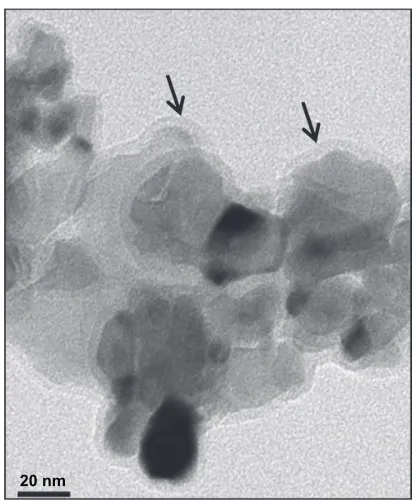
As reported earlier,25 HRTEM images showed an irregular
or nearly spherical shape of Dex-LSMO nanoparticles (Figure 3). A uniform layer of dextran around the LSMO core could be clearly observed (black arrows in Figure 3). The size of the Dex-LSMO nanoparticles was in a narrow range between 25 nm and 50 nm.
International Journal of Nanomedicine downloaded from https://www.dovepress.com/ by 118.70.13.36 on 23-Aug-2020
Dovepress haghniaz et al
Fourier transform infrared spectroscopy
The Fourier transform infrared spectra obtained are shown in Figure 4. Both LSMO and Dex-LSMO spectra exhibited a
characteristic band of Mn-O stretching (at 600 cm-1) assigned
to metal-oxygen bonds.29 In the case of dextran sulfate,
char-acteristic features at 1,100 cm-1 (C-O), 1,300 cm-1 (C-O),
1,650 cm-1 (C-O), 2,085 cm-1 (C-CH), 2,500 cm-1 (O-H),
2,950 cm-1 (C-H), and 3,500 cm-1 (O-H) could be seen. The
strong O-H band at 3,500 cm-1 in the dextran sulfate
spec-trum weakened in the Dex-LSMO specspec-trum. That suggests possible electrostatic interaction of LSMO with dextran via
O-H groups. In comparison with bare LSMO, additional
peaks at 1,300 cm-1 and 1,650 cm-1 (C-O) in Dex-LSMO
suggested dextran coating.
Vibrating sample magnetometry
It can be seen from the M-H curve (Figure 5) that the mag-netic moment of the synthesized nanoparticles saturated at
~3,000 Oe. The saturation moment was found to be ~27
emu/g for bare LSMO and ~21 emu/g for Dex-LSMO
nanoparticles. The lower saturation moment of Dex-LSMO could be attributed to their smaller size and the influence of coating on magnetization of the nanoparticles. Such mag-netization drops have been reported after coating of LSMO
with octadecylamine30 or coating of iron oxide nanoparticles
with silica.31 Hysteresis loops (inset to Figure 5) revealed that
LSMO and Dex-LSMO were predominantly ferromagnetic at room temperature. Importantly, the coercivity was found to be very small (less than 100 Oe), which could be due to the very small size of the particles.
rF-induced heating potential of
Dex-lsMO nanoparticles
As can be seen in Figure 6, a concentration-dependent increase in temperature was observed upon exposure to RF, which was more pronounced within the first 300 sec-onds. The temperature of the Dex-LSMO nanoparticles at
concentrations of 5 and 10 mg/mL rose to ~46°C within
300 seconds and 150 seconds, respectively, and then remained constant up to 1,200 seconds, suggesting “self-controlled” heating properties.
The estimated SAR value for Dex-LSMO at a concentra-tion of 5 mg/mL was 23 W/g. The obtained SAR value is comparable with that reported for LSMO nanoparticles in
the literature.29,32
0 500 1,000 1,500 2,000 2,500 3,000 3,500 4,000
20 30 40 50 60 70 80
Intensity (arbitrary units)
2θ (degrees)
(012
)
(110
)
(104
) (202
)
(024
)
(214
)
(220)
(006)
Figure 2 X-ray diffraction spectrum of lsMO nanoparticles.
Abbreviation: lsMO, la0.7sr0.3MnO3.
20 nm
Figure 3 high-resolution transmission electron microscopy image of
dextran-coated lsMO nanoparticles.
Notes: a uniform layer of dextran around the lsMO core can be observed (black arrows).
Abbreviation: lsMO, la0.7sr0.3MnO3.
International Journal of Nanomedicine downloaded from https://www.dovepress.com/ by 118.70.13.36 on 23-Aug-2020
Dovepress hyperthermia mediated by Dex-lsMO
Optimization of hyperthermia
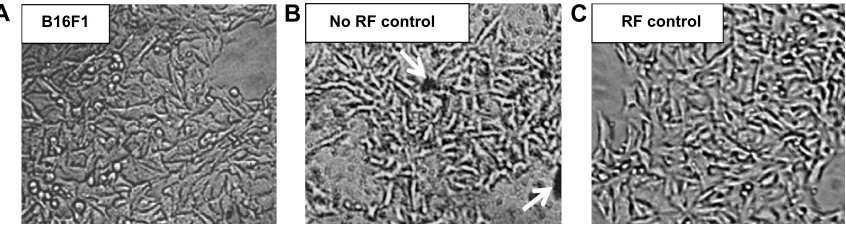
As can be seen from Figure 7, cell morphology was unaltered in the no RF controls (flasks containing nanoparticles, but not exposed to RF) and RF controls (flasks free of nanoparticles but exposed to RF), indicating no effect of nanoparticles or RF treatment alone. Moreover, no significant temperature rise was observed in RF controls, indicating that RF per se could not result in heating; therefore, the temperature rise observed after exposure to RF is mediated by Dex-LSMO nanoparticles.
effect of hyperthermia on cell
morphology
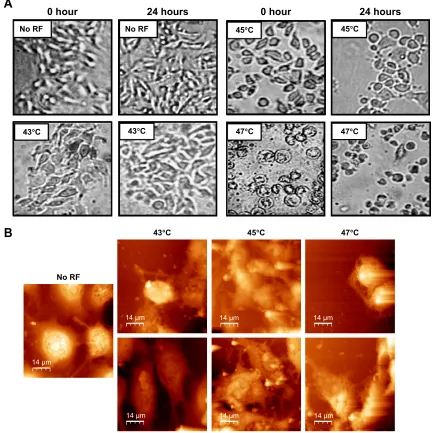
It could be clearly seen by optical microscopy (Figure 8A) that cells exposed to RF-induced Dex-LSMO-mediated hyperthermia showed immediate (0 hours) morphological changes, ie, loss of cell extensions, rounding up and detachment at all temperatures, as compared with no RF
controls. The cells heated up to 43°C regained their normal
morphology after 24 hours of incubation in fresh growth
medium; however, cells heated to 45°C and 47°C were not
4,000 3,500 3,000 2,500 2,000 1,500 1,000 500
0 20 40 60 80 100 120
Wavenumber (cm–1)
Dex-LSMO NPs Bare LSMO NPs
O-H
C-H O-H
C-CH
C-O
C-O C-O C-O
C-O
Mn-O Dex-sulfate
Transmittance (%
)
Figure 4 Fourier transform infrared spectra for Dex-sulfate, bare lsMO, and Dex-lsMO nanoparticles.
Abbreviations: Dex-sulfate, dextran sulfate sodium salt; Dex-lsMO, dextran-coated lsMO; lsMO, la0.7sr0.3MnO3; NP, nanoparticle.
Dex-LSMO LSMO
–3,000 –2,000 –1,000 0 1,000 2,000 3,000
–30 –20 –10 0 10 20 30
Moment (emu/g)
Field (Oe)
Dex-LSMO LSMO
–600 –400 –200 0 200 400 600 –20
–10 0 10 20
Figure 5 Plot of magnetic moment (M) versus field (H) at 300 K. Inset shows hysteresis loop for nanoparticles on an expanded scale.
Abbreviations: Dex-lsMO, dextran-coated lsMO; lsMO, la0.7sr0.3MnO3.
International Journal of Nanomedicine downloaded from https://www.dovepress.com/ by 118.70.13.36 on 23-Aug-2020
Dovepress haghniaz et al
able to revert to their normal slender morphology even after 24 hours of incubation.
Consistent with the optical microscopy results, AFM images of no RF control cells clearly showed defined boundaries with slender extensions joining neighboring cells (Figure 8B). After RF-induced Dex-LSMO-mediated
hyperthermia at 43°C, 45°C, and 47°C, unclear boundaries
and marked alterations in cell surface topology were observed at 0 hours (Figure 8B, upper panel). At 24 hours after treat-ment (Figure 8B, lower panel), cells that were heated at
43°C reverted to a stellate morphology with distinguishable
boundaries and a clear nucleus, whereas the cells treated at
45°C and 47°C showed a markedly altered morphology.
To the best of our knowledge, this is the first report showing topological changes in cells after hyperthermia treatment, as seen by AFM. Nonetheless, several research groups have studied morphological changes in cells by optical microscopy after hyperthermia treatment at
differ-ent temperatures (41°C–46°C) and heating periods.16,21,33
We also observed temperature-dependent changes in cell morphology, as reported by other researchers. However, it must be pointed out that these studies mainly focused on the
immediate response (at 0 hours) of cells after heat shock and
ignored post treatment recovery.34–36 In our experiment, cells
were visualized not only at 0 hours (immediate changes) but also at 24 hours post treatment to assess the long-term behavior of the cells.
Garcia et al37 observed immediate morphological changes
in B16F10 cells after hyperthermia at 45°C, which increased
in severity at 24 hours post treatment. These altered cells showed features of late apoptosis and necrosis on flow cyto-metry. Follow-up 14 days after hyperthermia demonstrated that the cells could not recover from the initial loss of viability occurring within 24 hours, indicating that the morphology at 24 hours post treatment determines the long-term fate of
the cell. Thus, in case of Dex-LSMO hyperthermia at 45°C
and 47°C, cell death is expected to be the final fate since
the altered cell morphology did not revert to normal within 24 hours after treatment.
effect of hyperthermia on cell viability
It has been reported that MNP-mediated hyperthermia can
contribute to cell death by damaging the cell membrane.9
Assuming that the effect of Dex-LSMO-mediated hyper-thermia is the same, the Trypan blue assay, which is sensitive to membrane permeability, was performed to confirm the morphological changes observed after hyperthermia.
As can be seen in Figure 9, the viability of B16F1 cells was almost 100% in no RF controls, indicating that Dex-LSMO per se was not cytotoxic. A significant decline in cell viability
(~15%) was seen immediately (0 hours) after a single cycle
of hyperthermia at 43°C; although it remained constant up to
24 hours. On the other hand, cells treated at 45°C and 47°C
showed a greater decrease in viable cell count at 0 hours after a single cycle of hyperthermia. As expected, hyperthermia at
47°C had a greater effect on cell viability as compared with
45°C. A resting period of 24 hours after a single cycle of
0 200 400 600 800 1,000 1,200 35
40 45 50 55
5 mg/mL 10 mg/mL 1 mg/mL
Time (s)
Temperature
(
°
C)
Figure 6 Induction heating curve for different concentrations of dextran-coated
lsMO nanoparticles.
Abbreviation: lsMO, la0.7sr0.3MnO3.
%) 1R5)FRQWURO 5)FRQWURO
$
%
&
Figure 7 Optical microscopic images (100×) of (A) B16F1 cells, (B) no rF control cells, and (C) rF control cells. arrows show aggregated dextran-coated lsMO
nanoparticles.
Abbreviations: lsMO, la0.7sr0.3MnO3; rF, radiofrequency.
International Journal of Nanomedicine downloaded from https://www.dovepress.com/ by 118.70.13.36 on 23-Aug-2020
Dovepress hyperthermia mediated by Dex-lsMO
hyperthermia further reduced the proportion of viable cells
to 17% at 45°C and to 4% at 47°C.
Further, exposure of cells to repeated cycles of hyper-thermia significantly reduced cell viability at 0 hours after treatment at all three temperatures (graph not shown).
At 43°C, repeated hyperthermia could not further reduce cell
viability after 24 hours, suggesting that cells can recover from
heat shock at 43°C. Nevertheless, cells treated by repeated
hyperthermia at 45°C and 47°C showed an ~100% reduction
in viability after 24 hours of rest, suggesting that repeated cycles of hyperthermia is a more effective treatment as com-pared with a single cycle of hyperthermia.
Overall, our results suggest that Dex-LSMO-mediated hyperthermia reduces cell viability in a time-dependent and temperature-dependent manner and that a minimum
tem-perature above 43°C is required to induce irreversible and
significant cell death in melanoma cells.
In our previous study, melanoma (A375) cells showed a reduction in viability immediately after
Dex-LSMO-mediated hyperthermia (43°C), but resumed proliferation
within 72 hours.21 Such a time-dependent and
temperature-dependent decrease in cell viability has also been reported by other researchers; however, the extent of cell death varied depending on cell type, with some cells being more
1R5)
1R5)
1R5) °&
°&
°& °& °&
°& °&
°&
°&
KRXU
$
%
KRXUV KRXU KRXUV
P
P
P P
P P
P
Figure 8 (A) Optical microscopic images (100×) of B16F1 cells at 0 hours and 24 hours after a single cycle of rF-induced dextran-coated lsMO-mediated hyperthermia
at different temperatures. (B) atomic force microscopy images of B16F1 cells, 0 hours (upper panel) and 24 hours (lower panel) after a single cycle of rF-induced dextran-coated lsMO-mediated hyperthermia at different temperatures as compared with no rF controls.
Abbreviations: lsMO, la0.7sr0.3MnO3; rF, radiofrequency.
International Journal of Nanomedicine downloaded from https://www.dovepress.com/ by 118.70.13.36 on 23-Aug-2020
Dovepress haghniaz et al
susceptible to heat than others. For example, Ito et al38
observed an instant cytostatic effect in rat T9 glioma cells
after hyperthermia at 43°C, which continued for 24 hours, but
then resumed to normal proliferation within 72 hours. Gao
et al39 reported excellent therapeutic efficacy of
magnetite-mediated hyperthermia in KB cells, reducing cell viability
by 56% and 78% at 45°C and 47°C, respectively.
Detection of cell death by DNa
laddering assay
During apoptosis, endogenous endonucleases cleave genomic DNA into oligonucleosome-sized fragments that
are multiples of ~180–200 base pairs. When resolved on
agarose gel, these fragments have a ladder appearance, which
is accepted as a universal hallmark of apoptosis.40,41 Thus,
it was important to study whether Dex-LSMO-mediated hyperthermia induces DNA laddering in melanoma cells.
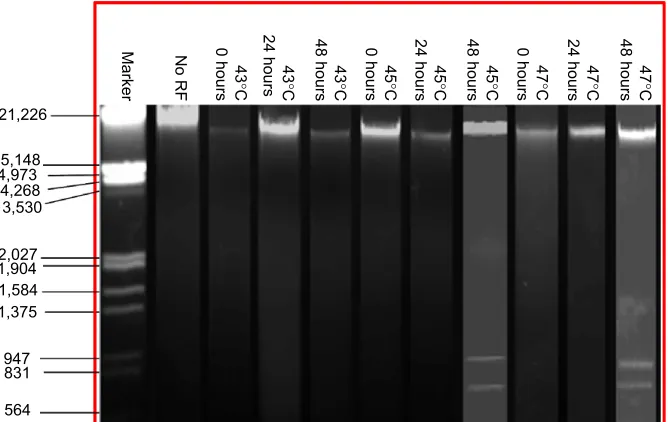
The electrophoretic pattern of DNA isolated from B16F1 cells treated with a single cycle of RF-induced Dex-LSMO-mediated hyperthermia is shown in Figure 10. It can be seen
that at 43°C DNA remained intact, in a manner similar to that
of the no RF controls, whereas DNA fragmentation appeared
48 hours after hyperthermia at temperatures of 45°C and 47°C.
This result suggests that heating at 43°C may not be able
to induce apoptosis, and therefore, not suitable for the treat-ment of melanoma. However, there is a possibility of a false result because of the smaller population of apoptotic cells. It has already been reported that the DNA ladder may not be visible on agarose gel in biological systems with fewer
apop-totic cells or with asynchronous apopapop-totic cells.41 Therefore;
it is likely that Dex-LSMO-mediated hyperthermia at 43°C
induced apoptosis in a few cells but was not detectable in the laddering assay. Thus, the result needs to be confirmed by other methods, such as the TUNEL assay.
On the other hand, degradation of DNA by endonu-cleases is a late event in apoptosis as it requires activation
of biochemical events involved in cleavage of DNA.41 This
might be the reason why DNA laddering was observed only
at 48 hours following treatment at 45°C and 47°C in our
experiments.
1R5 )
PLQXWHV° &
PLQXWHV
°&
PLQXWHV
°&
KRXU KRXUV
9LDELOLW\
Figure 9 Viability of B16F1 cells at 0 hours and 24 hours after a single cycle of rF-induced dextran-coated lsMO-mediated hyperthermia. ***P0.001, one-way analysis of variance followed by Dunnett’s test.
Abbreviations: lsMO, la0.7sr0.3MnO3; rF, radiofrequency.
21,226
5,148 4,973
4,268 3,530
2,027 1,904 1,584 1,375
947 831
564
47
°
C
48 hour
s
47
°
C
24 hour
s
47
°
C
0 hour
s
45
°
C
48 hour
s
45
°
C
24 hour
s
45
°
C
0 hour
s
43
°
C
48 hour
s
43
°
C
24 hours
43
°
C
0 hour
s
No RF
Marke
r
Figure 10 gel electrophoresis of DNa extracted from B16F1 cells at different time points (ie, 0, 24, and 48 hours) after a single cycle of rF-induced dextran-coated lsMO-mediated hyperthermia.
Abbreviations: lsMO, la0.7sr0.3MnO3; rF, radiofrequency.
International Journal of Nanomedicine downloaded from https://www.dovepress.com/ by 118.70.13.36 on 23-Aug-2020
Dovepress hyperthermia mediated by Dex-lsMO
Unfortunately, we could not get results for three cycles of RF-induced hyperthermia in this experiment, because the majority of the cells detached from the flasks within 24 hours (probably due to rapid cell death) and a sufficient quantity of DNA could not be obtained.
cell death detection by TUNel assay
In contrast with DNA laddering assay, TUNEL staining can quantify apoptotic cells and detect DNA strand
break-age in an individual cell.41 We performed the TUNEL assay
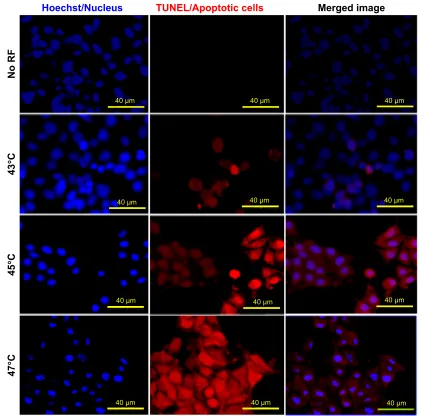
on our samples at 0 hours and 24 hours after hyperthermia. Representative fluorescence microscopic images of cells 24 hours after a single cycle of RF-induced hyperthermia at different temperatures are shown in Figure 11. Detection of
a TUNEL signal (apoptotic nuclei-specific red fluorescence) confirmed that apoptotic cell death occurred after hyper-thermia at all the temperatures tested.
In the control sample (no RF), cells showed normal blue
nuclei stained by Hoechst. At 43°C, a few apoptotic cells (red
color) could be seen, while the majority of the cells were
nor-mal. At 45°C and 47°C, marked apoptosis was observed, as
detected by an intense red color in the majority of cells. The TUNEL signal was colocalized with nuclei (merge images), confirming that the signal was due to DNA breakage and not background staining. Moreover, typical features of apoptotic cell death, namely condensed or fragmented nuclei, was
clearly seen at 45°C and 47°C, which confirmed that DNA
breakage was due to apoptosis not necrosis.
+RHFKVW1XFOHXV 781(/$SRSWRWLFFHOOV 0HUJHGLPDJH
1R5)
°
&
°
&
°
&
ȝP ȝP ȝP
ȝP ȝP ȝP
ȝP ȝP ȝP
ȝP ȝP ȝP
Figure 11 hoechst/TUNel staining of B16F1 cells 24 hours after a single cycle of rF-induced dextran-coated lsMO-mediated hyperthermia as compared with no rF control.
Abbreviations: lsMO, la0.7sr0.3MnO3; rF, radiofrequency; TUNel, terminal deoxynucleotidyl transferase-dUTP nick end labeling.
International Journal of Nanomedicine downloaded from https://www.dovepress.com/ by 118.70.13.36 on 23-Aug-2020
Dovepress haghniaz et al
As mentioned earlier, hyperthermia treatment can induce either apoptotic or necrotic cell death, depending on the tem-perature applied. However, in terms of anticancer activity, apoptosis is recognized as an important mode of cell death, since it leads to genetically determined omission of a single cell, whereas necrosis is traumatic cell death in an unregulated fashion and mostly involves large numbers of cells. While necrosis eventually involves swelling of nuclei, apoptosis exhibits typical nuclear characteristics such as chromatin
condensation and DNA fragmentation42,43 which could also
be seen in our study. The percentages of apoptotic cells
determined by counting ~300 cells are shown in Figure 12.
The apoptosis percentage at 0 hours after hyperthermia
were ~20%, ~74%, and ~82% at 43°C, 45°C, and 47°C,
respec-tively, whereas 98% of cells were found to be apoptotic
24 hours after treatment at temperatures of 45°C and 47°C.
When compared with no RF controls, apoptosis at 43°C
was not statistically significant at both time points after treatment.
On the basis of the TUNEL results, a minimum temperature
above 43°C is required for effective apoptosis in melanoma
cells. The marked apoptosis and DNA fragmentation observed
at 47°C suggests that a temperature of ~45°C might be needed
to achieve maximum cell death by apoptosis and avoid unwanted necrosis. However, investigation of other markers involved in apoptosis, such as caspases, is necessary.
effect of hyperthermia on induction
of hsPs
The results of enzyme-linked immunosorbent assays for HSP70 and HSP90 are shown in Figure 13A and B, respectively. There were no changes in HSP levels in the no RF controls when compared with the B16F1 cells, indicating that Dex-LSMO nanoparticles per se could not induce produc-tion of HSPs whereas Dex-LSMO-mediated hyperthermia resulted in temperature-dependent induction of HSPs when compared with no RF controls. The HSP70 concentration
increased by ~3-fold, ~4-fold, and ~13-fold at 0 hours and
by ~9-fold, ~10-fold, and ~38-fold at 24 hours at 43°C, 45°C,
and 47°C, respectively (Figure 13A). Likewise, the HSP90
concentration obtained was ~3-fold, ~5-fold, and ~13-fold
at 0 hours, and ~2-fold, ~8-fold, and ~40-fold at 24 hours
at 43°C, 45°C, and 47°C, respectively (Figure 13B). Taken
together, these results show that induction of HSPs by hyper-thermia increased with increasing temperature, and was higher at 24 hours post treatment when compared with 0 hours.
1R5) ° &
°& °& 1R5) °& °& °&
KRXU
KRXUV
$SRSWRWLFFHOOV
Figure 12 Percentage of apoptotic cells at 0 hours and 24 hours after treatment with a single cycle of rF-induced dextran-coated lsMO-mediated hyperthermia. **P0.01, ***P0.001, one-way analysis of variance followed by Dunnett’s test.
Abbreviations: lsMO, la0.7sr0.3MnO3; rF, radiofrequency.
B16F 1
No RF 43°C 0 hour
s
43°C 24 hour s
45°C 0 hour s
45°C 24 hour s
47°C 0 hour s
47°C 24 hours
B16F 1
No RF 43°C 0 hour
s
43°C 24 hour s
45°C 0 hour s
45°C 24 hour s
47°C 0 hour s
47°C 24 hour s
0 4 8 12 16 20 36 38 40
*** ***
*** ***
*** ***
HSP70 (pg/cell)
0 30 60 90 120 150 380 420
***
***
***
*** ***
HSP90 (pg/cell)
A
B
Figure 13 (A) hsP70 and (B) hsP90 induction at 0 hours and 24 hours after a single cycle of rF-induced dextran-coated lsMO-mediated hyperthermia. ***P0.001,
one-way analysis of variance followed by Dunnett’s test.
Abbreviations: hsP, heat shock protein; lsMO, la0.7sr0.3MnO3; rF, radiofrequency.
International Journal of Nanomedicine downloaded from https://www.dovepress.com/ by 118.70.13.36 on 23-Aug-2020
Dovepress hyperthermia mediated by Dex-lsMO
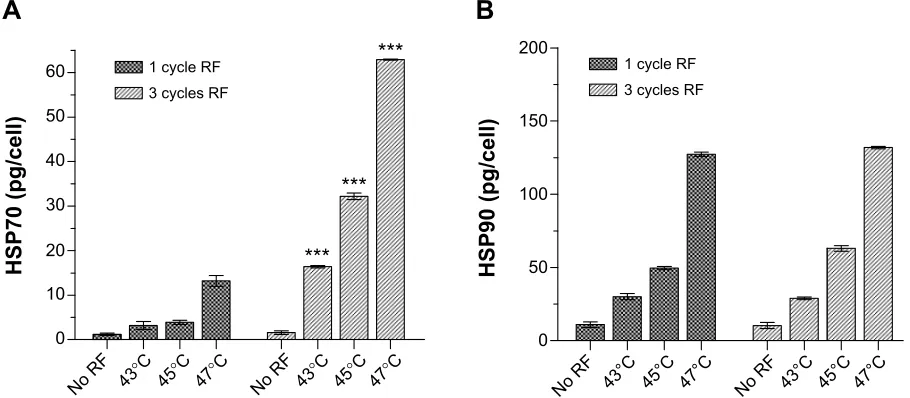
Further, repeated cycles of hyperthermia were found to induce HSP levels that were higher than after a single cycle of treatment. Three cycles of RF-induced Dex-LSMO-mediated hyperthermia could increase the HSP70 level
by ~10-fold, ~20-fold, and ~39-fold after heating at 43°C,
45°C, and 47°C, respectively (Figure 14A). However, the
HSP90 level was not significantly increased after repeated cycles of RF-induced Dex-LSMO-mediated hyperthermia when compared with a single cycle (Figure 14B). The exact reason for the unaltered level of HSP90 after repeated cycles of hyperthermia has yet to be identified. However, it is sus-pected that the machinery involved in induction of HSP90 is more sensitive to heat than that for HSP70.
Studies carried out by other research groups using hematopoietic and erythroleukemia cells showed that
hyper-thermia at 42.5°C and 43°C could induce HSP70 soon after
treatment,44,45 which is in agreement with our observations.
Vigor observed temperature-dependent effects (ranging from
38°C to 47°C) on induction of HSP70 after 30 minutes of
incubator hyperthermia.46 Ito et al38 reported an increase in
HSP70 expression in rat T9 glioma cells up to 24 hours, beyond which the HSP levels plummeted.
It is important to note that cells with elevated HSP levels
possess an increased ability (~4–10-fold) to tolerate future
hyperthermia treatments. This phenomenon, known as
thermo-tolerance, can last from a few hours to a few weeks.47 It needs to
be emphasized that the thermotolerance phenomenon is temper-ature-dependent and reversible. Moderate/mild hyperthermia
(ie, heating at 43ºC) is reported to promote thermotolerance
by inducing HSP expression in cells.48 It has been observed
that when these cells are reincubated at 37°C, HSP
expres-sion drops back to basal levels with time.21,49 However, with
an increase in temperature above a distinct threshold (usually above 43ºC), cells cannot achieve any further HSP induction and the protein-folding capacity of HSPs becomes exhausted. Overload of such non-functional HSPs causes protein misfold-ing and aggregation, resultmisfold-ing in cell death.
Keeping this fact in mind, the combined results of induc-tion of HSPs and cell viability observed in the present study suggest that the enhanced expression of HSP70 and HSP90
after Dex-LSMO-mediated hyperthermia at 43°C is probably
involved in thermotolerance, since cells could recover even after repeated cycles of hyperthermia. In contrast, the
enhanced level of HSPs at 45°C and 47°C might be involved
in promotion of apoptosis, since almost all the cells underwent cell death, 24 hours after repeated cycles of hyperthermia.
It is worth mentioning that HSPs are not only interesting because of their various biological functions but also because of their potential benefit in the treatment of cancer. In contrast with normal cells, tumor cells can express HSPs on their cell surface after hyperthermia. These surface-expressed HSPs (particularly HSP70 and HSP90) act as signals for the immune system and selectively sensitize tumor cells for
immune attack, resulting in antitumor activity.50–52 Based on
the enhanced expression of HSP70 observed in our study, it can be safely assumed that RF-induced Dex-LSMO-mediated hyperthermia may also cause immunogenicity and result in tumor regression.
1R5 )
°& °& °& 1R5) °& °& °& 1R5) & & & 1R5) & & &
F\FOH5)
F\FOHV5)
+63SJFHOO
$
%
F\FOH5) F\FOHV5)
+63SJFHOO
Figure 14 Induction of (A) hsP70 and (B) hsP90 after one or three cycles of rF-induced dextran-coated lsMO-mediated hyperthermia. ***P0.001, one-way analysis of
variance followed by Dunnett’s test.
Abbreviations: hsP, heat shock protein; lsMO, la0.7sr0.3MnO3; rF, radiofrequency.
International Journal of Nanomedicine downloaded from https://www.dovepress.com/ by 118.70.13.36 on 23-Aug-2020
Dovepress haghniaz et al
Conclusion
The present study demonstrates the excellent therapeutic efficacy of Dex-LSMO-mediated hyperthermia in mela-noma cells in vitro. This treatment was able to decrease cell viability, enhance apoptosis, and induce HSP expression in a time-dependent and temperature-dependent manner. These data, along with our earlier observation of internalization of
Dex-LSMO nanoparticles,25 highlight the potential of
Dex-LSMO nanoparticles as agents for inducing intracellular and localized hyperthermia to treat melanoma and other types of cancers.
Disclosure
The authors report no conflicts of interest in this work.
References
1. Jeon MJ, Ahn CH, Kim H, et al. The intratumoral administration of ferucarbotran conjugated with doxorubicin improved therapeutic effect by magnetic hyperthermia combined with pharmacotherapy in a hepato-cellular carcinoma model. J Exp Clin Cancer Res. 2014;33(1):1–11. 2. Akbarzadeh A, Samiei M, Davaran S. Magnetic nanoparticles:
prepara-tion, physical properties, and applications in biomedicine. Nanoscale Res Lett. 2012;7(1):1–13.
3. Hegyi G, Szigeti GP, Szasz A. Hyperthermia versus oncothermia: cel-lular effects in complementary cancer therapy. Evid Based Complement Alternat Med. 2013;2013:672873.
4. Pollert E, Kaman O, Veverka P, et al. Core-shell La1−xSrxMnO3 nano-particles as colloidal mediators for magnetic fluid hyperthermia. Philos Trans A Math Phys Eng Sci. 2010;368(1927):4389–4405.
5. Chatterjee DK, Diagaradjane P, Krishnan S. Nanoparticle-mediated hyperthermia in cancer therapy. Ther Deliv. 2011;2(8):1001–1014. 6. Moroz P, Jones SK, Gray BN. Magnetically mediated hyperthermia: current
status and future directions. Int J Hyperthermia. 2002;18(4):267–284. 7. Habash RWY, Bansal R, Krewski D, Alhafid HT. Thermal therapy.
Part 2: hyperthermia techniques. Crit Rev Biomed Eng. 2006;34(6): 491–542.
8. Silva AC, Oliveira TR, Mamani JB, et al. Application of hyperthermia induced by superparamagnetic iron oxide nanoparticles in glioma treat-ment. Int J Nanomedicine. 2011;6(3):591–603.
9. Cheng D, Li X, Zhang G, Shi H. Morphological effect of oscillating mag-netic nanoparticles in killing tumor cells. Nanoscale Res Lett. 2014;9(1): 1–8.
10. Ito A, Shinkai M, Honda H, Kobayashi T. Medical application of functionalized magnetic nanoparticles. J Biosci Bioeng. 2005;100(1): 1–11.
11. Mikhaylov G, Mikac U, Magaeva AA, et al. Ferri-liposomes as a novel MRI-visible drug delivery system for targeting tumors and their microenvironment. Nat Nanotechnol. 2011;6(9):594–602.
12. Martinez-Boubeta C, Balcells L, Cristofol R, et al. Self-assembled multifunctional Fe/MgO nanospheres for magnetic resonance imaging and hyperthermia. Nanomedicine. 2010;6(2):362–370.
13. Wang YM, Cao X, Liu GH, et al. Synthesis of Fe3O4 magnetic fluid used for magnetic resonance imaging and hyperthermia. J Magn Magn Mater. 2011;323(23):2953–2959.
14. Goya GF, Asin L, Ibarra RM. Cell death induced by AC magnetic fields and magnetic nanoparticles: current state and perspectives. Int J Hyperthermia. 2013;29(8):810–818.
15. Roti Roti JL. Cellular responses to hyperthermia (40°C–46°C): cell killing and molecular events. Int J Hyperthermia. 2008;24(1):3–15.
16. Harmon BV, Corder AM, Collins RJ, et al. Cell death induced in a murine mastocytoma by 42°C–47°C heating in vitro: evidence that the form of death changes from apoptosis to necrosis above a critical heat load. Int J Radiat Biol. 1990;58(5):845–858.
17. Cherukuri P, Glazer ES, Curley SA. Targeted hyperthermia using metal nanoparticles. Adv Drug Deliv Rev. 2010;62(3):339–345.
18. Todaka T, Kishino T, Enokisono N. Low Curie temperature material for induction heating self-temperature controlling system. J Magn Magn Mater. 2008;320(20):702–707.
19. Daengsakul S, Thomas C, Thomas I, et al. Magnetic and cytotoxicity properties of La1-xSrxMnO3 (0×0.5) nanoparticles prepared by a simple thermal hydro-decomposition. Nanoscale Res Lett. 2009;4(8): 839–845.
20. Thorat ND, Khot VM, Salunkhe AB, Ningthoujam RS, Pawar SH. Functionalization of La0.7Sr0.3MnO3 nanoparticles with polymer: studies on enhanced hyperthermia and biocompatibility properties for biomedi-cal applications. Colloids Surf B Biointerfaces. 2013;104:40–47. 21. Bhayani KR, Rajwade JM, Paknikar KM. Radio frequency induced
hyperthermia mediated by dextran stabilized LSMO nanoparticles: in vitro evaluation of heat shock protein response. Nanotechnology. 2013;24(1):015102.
22. Kale SN, Aurora S, Bhayani KR, et al. Cerium doping and stoichi-ometry control for biomedical use of La0.7Sr0.3MnO3 nanoparticles: microwave absorption and cytotoxicity study. Nanomedicine. 2006;2(4): 217–221.
23. Bhayani KR, Kale SN, Aurora S, et al. Protein and polymer immobi-lized La0.7Sr0.3MnO3 nanoparticles for possible biomedical applications.
Nanotechnology. 2007;18(34):345101.
24. Balivada S, Rachakatla RS, Wang H, et al. A/C magnetic hyperthermia of melanoma mediated by iron(0)/iron oxide core/shell magnetic nano-particles: a mouse study. BMC Cancer. 2010;10(119):1–9.
25. Haghniaz R, Bhayani KR, Umrani RD, Paknikar KM. Dextran stabi-lized lanthanum strontium manganese oxide nanoparticles for magnetic resonance imaging. RSC Adv. 2013;3(40):18489–18497.
26. Faraji AH, Wipf P. Nanoparticles in cellular drug delivery. Bioorg Med Chem. 2009;17(8):2950–2962.
27. Schweiger C, Hartmann R, Zhang F, Parak WJ, Kissel TH, Rivera-Gil P. Quantification of the internalization patterns of superparamagnetic iron oxide nanoparticles with opposite charge. JNanobiotechnology. 2012;10(28):1–11.
28. Ravi V, Kullkarni SD, Samuel V, et al. Synthesis of La0.7Sr0.3MnO3 at 800°C using citrate gel method. Ceram Int. 2006;33(6):1129–1132. 29. Thorat ND, Shinde KP, Pawar SH, Barick KC, Bettyc CA, Ningthoujamc RS.
Polyvinyl alcohol: an efficient fuel for synthesis of superparamag-netic LSMO nanoparticles for biomedical application. Dalton Trans. 2012;41(10):3060–3071.
30. Rajagopal R, Jani M, Kale SN, et al. La0.7Sr0.3MnO3 nanoparticles coated with fatty amine. Appl Phys Lett. 2006;89(2):023107.
31. Islam N, Abbas M, Sinha B, Joeng JR, Kim C. Silica encapsulation of sonochemically synthesized iron oxide nanoparticles. Electron Mater Lett. 2013;9(6):817–820.
32. Prasad NK, Rathinasamy K, Panda D, Bahadur D. TC-tuned biocompat-ible suspension of La0.73Sr0.27MnO3 for magnetic hyperthermia. J Biomed MaterRes B. 2008;85(2):409–416.
33. Khosroshahi ME, Ghazanfari L, Hasan-Nejad Z. Preliminary results of treating cancerous cells of lung (QU-DB) by hyperthermia using diode laser and gold coated Fe3O4/SiO2 nano-shells: an in-vitro assay. Iran
J Med Phys. 2012;9(4):253–263.
34. Nakayama J, Kageshita T, Nakashima M, Tsujisaki M, Imai K, Hori Y. Increase in shedding of intercellular adhesion molecule-1 in human malignant melanoma cell lines treated with hyperthermia in vitro.
Pigment Cell Res. 1996;9(3):154–158.
35. Fukao H, Ikeda M, Ichikawa T, et al. Effect of hyperthermia on the viability and the fibrinolytic potential of human cancer cell lines. Clin Chim Acta. 2000;296(1):17–33.
International Journal of Nanomedicine downloaded from https://www.dovepress.com/ by 118.70.13.36 on 23-Aug-2020
International Journal of Nanomedicine
Publish your work in this journal
Submit your manuscript here: http://www.dovepress.com/international-journal-of-nanomedicine-journal The International Journal of Nanomedicine is an international,
peer-reviewed journal focusing on the application of nanotechnology in diagnostics, therapeutics, and drug delivery systems throughout the biomedical field. This journal is indexed on PubMed Central, MedLine, CAS, SciSearch®, Current Contents®/Clinical Medicine,
Journal Citation Reports/Science Edition, EMBase, Scopus and the Elsevier Bibliographic databases. The manuscript management system is completely online and includes a very quick and fair peer-review system, which is all easy to use. Visit http://www.dovepress.com/ testimonials.php to read real quotes from published authors.
Dovepress
Dove
press
hyperthermia mediated by Dex-lsMO
36. Milani V, Frankenberger B, Heinz O, et al. Melanoma-associated antigen tyrosinase but not Melan-A/MART-1 expression and pre-sentation dissociate during the heat shock response. Int Immunol. 2005;17(3):257–268.
37. Garcia MP, Cavalheiro JRT, Fernandes MH. Acute and long-term effects of hyperthermia in B16-F10 melanoma cells. PLoS One. 2012;7(4): e35489.
38. Ito A, Shinkai M, Honda H, Wakabayashi T, Yoshida J, Kobayashi T. Augmentation of MHC class I antigen presentation via heat shock protein expression by hyperthermia. Cancer Immunol Immunother. 2001;50(10): 515–522.
39. Gao F, Cai Y, Zhou J, et al. Pullulan acetate coated magnetite nano-particles for hyperthermia: preparation, characterization and in vitro experiments. Nano Res. 2010;3(1):23–31.
40. Bakshi H, Sam S, Rozati R, et al. DNA fragmentation and cell cycle arrest: a hallmark of apoptosis induced by crocin from Kashmiri saffron in a human pancreatic cancer cell line. Asian Pac J Cancer Prev. 2010; 11(3):675–679.
41. Collins RJ, Harmon BK, Gobe GC, Kerr JFR. Internucleosomal DNA cleavage should not be the sole criterion for identifying apoptosis. Int J Radiat Biol. 1992;61(4):451–453.
42. Nikoletopoulou V, Markaki M, Palikaras K, Tavernarakis N. Crosstalk between apoptosis, necrosis and autophagy. Biochim Biophys Acta. 2013;1833(12):3448–3459.
43. Ouyang L, Shi Z, Zhao S, et al. Programmed cell death pathways in cancer: a review of apoptosis, autophagy and programmed necrosis.
Cell Prolif. 2012;45(6):487–498.
44. Sharif-Khatibi L, Kariminia A, Khoei S, Goliaei B. Hyperthermia induces differentiation without apoptosis in permissive temperatures in human erythroleukaemia cells. Int J Hyperthermia. 2007;23(8):645–655.
45. Nijhuis EH, Poot AA, Feijen J, Vermes I. Hsp70- and p53-reponses after heat treatment and/or X-irradiation mediate the susceptibility of hematopoietic cells to undergo apoptosis. Int J Radiat Biol. 2008; 84(2):99–105.
46. Vigor KL. Antibody targeted nanoparticles for imaging and therapy of cancer. Doctoral dissertation. London, UK: University College London; 2010.
47. Christophi C, Winkworth A, Muralihdaran V, Evans P. The treatment of malignancy by hyperthermia. Surg Oncol. 1998;7(1):83–90. 48. Samali A, Holmberg CI, Sistonen L, Orrenius S. Thermotolerance and
cell death are distinct cellular responses to stress: dependence on heat shock proteins. FEBS Lett. 1999;461(3):306–310.
49. Tang Y. Cancer therapy combining modalities of hyperthermia and chemotherapy: in vitro cellular response after rapid heat accumulation in the cancer cell. Doctoral dissertation. Miami, FL, USA: Florida International University; 2010.
50. Multhoff G, Botzler C, Wiesnet M, et al. Stress-inducible 72-kDa heat-shock protein (HSP72) is expressed on the surface of human tumor cells, but not on normal cells. Int J Cancer. 1995;61(2):272–279. 51. Sreedhar AS, Csermely P. Heat shock proteins in the regulation of
apoptosis: new strategies in tumor therapy: a comprehensive review.
Pharmacol Ther. 2004;101(3):227–257.
52. Torigoe T, Tamura Y, Sato N. Heat shock proteins and immunity: application of hyperthermia for immunomodulation. Int J Hyperthermia. 2009;25(8):610–616.
International Journal of Nanomedicine downloaded from https://www.dovepress.com/ by 118.70.13.36 on 23-Aug-2020