BY RASHMI B. HALKER, MD ERIC V. HASTRITER, MD DAVID W. DODICK, MD
I
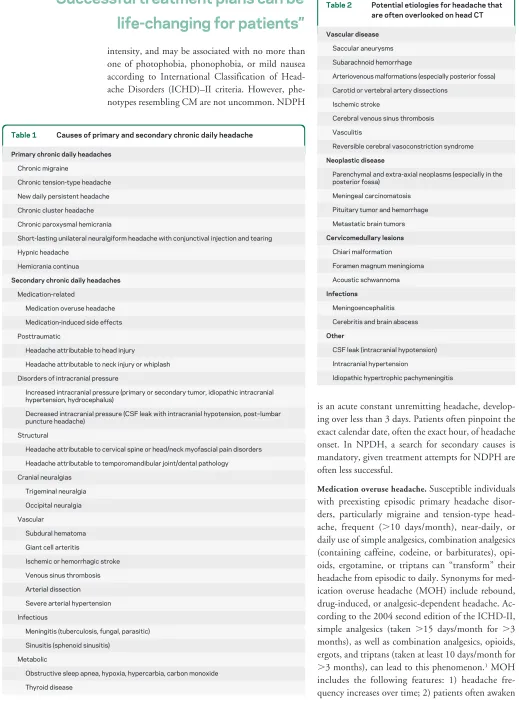
ndividuals presenting with chronic daily headache (CDH) are considered among the most difficult and labor-intensive patients in a neurologist’s practice. However, when treated successfully, they can be the most rewarding. Successful treatment plans can be life-changing for patients. Unfortunately, due to both patient and physician-related factors, many individuals with CDH lapse from medical care and seek alternative therapies, and some continue spiraling downward, fu-eled by medication misuse and overuse.CDH is not a diagnosis but the presence of head-ache on at least 15 days/month for at least 3 months. Patients with CDH need secondary etiologies ex-cluded through appropriate investigations before establishing treatment programs. Table 1 lists sec-ondary causes of CDH to which the clinician must be alert. Imaging is frequently necessary to exclude secondary causes, and in the majority of cases, MRI is superior to CT because of causes that are often overlooked or not visible on head CT (table 2). In this article, we review primary CDH and discuss evidence-based treatment strategies.
PRIMARY CDHShort-duration CDH.Determining
the usual duration (greater or less than 4 hours) of individual headache episodes will refine the differen-tial diagnosis in patients with primary CDH. The prototypical short-lasting primary CDH (⬍4 hours) is chronic cluster headache (CCH), a trigeminal
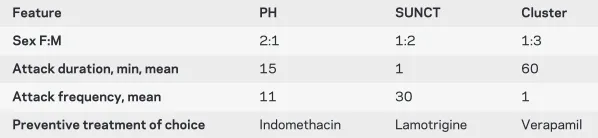
au-tonomic cephalalgia (TAC) characterized by severe orbital or temporal pain with accompanying cranial autonomic features such as nasal congestion or lacri-mation. Cluster headache becomes chronic if attacks occur for more than 1 year with remissions lasting less than 1 month. Other TACs that may mimic CCH include chronic paroxysmal hemicrania (CPH), short-lasting unilateral neuralgiform head-aches with conjunctival injection and tearing (SUNCT) syndrome, and short-lasting unilateral neuralgiform headaches with autonomic symptoms but without lacrimation and conjunctival injection (SUNA). These differ in terms of attack duration and frequency, and have different therapeutic options (table 3).
Hypnic headache (HH) occurs usually in the el-derly exclusively during sleep. Patients typically awaken with moderately intense and generalized headache without associated symptoms that lasts less than 60 minutes. The headache tends to occur at predictable times each night. In addition to lithium, melatonin, and indomethacin showing benefit, caf-feine before bedtime can paradoxically be effective.
Long-duration CDH. Long-duration primary CDH diagnoses include chronic migraine (CM), chronic tension-type headache (CTTH), hemicrania con-tinua (HC), and new daily persistent headache (NDPH). CTTH usually evolves from episodic tension-type headache, and tricyclic antidepressants with cognitive-behavioral measures are first-line treatment options. HC is a continuous side-locked unilateral, moderately severe headache with exacer-bations of severe pain lasting hours to days, with cranial autonomic symptoms accompanying exacer-bations. By strict diagnostic criteria, patients experi-ence substantial relief after a short therapeutic trial of indomethacin (25–75 mg 3 times a day). NDPH re-sembles CTTH in that it is typically bilateral, press-ing or tightenpress-ing in quality, mild to moderate in From the Mayo Clinic Hospital, Phoenix, AZ.
Address correspondence and reprint requests to Dr. David W. Dodick, Mayo Clinic Hospital, 5777 E Mayo Blvd., Phoenix, AZ 85054; [email protected]
Author disclosures are provided at the end of the article.
Neurology®Clinical Practice2011;76 (Suppl 2):S37–S43
Chronic Daily
Headache
intensity, and may be associated with no more than one of photophobia, phonophobia, or mild nausea according to International Classification of Head-ache Disorders (ICHD)–II criteria. However, phe-notypes resembling CM are not uncommon. NDPH
is an acute constant unremitting headache, develop-ing over less than 3 days. Patients often pinpoint the exact calendar date, often the exact hour, of headache onset. In NPDH, a search for secondary causes is mandatory, given treatment attempts for NDPH are often less successful.
Medication overuse headache.Susceptible individuals with preexisting episodic primary headache disor-ders, particularly migraine and tension-type head-ache, frequent (⬎10 days/month), near-daily, or daily use of simple analgesics, combination analgesics (containing caffeine, codeine, or barbiturates), opi-oids, ergotamine, or triptans can “transform” their headache from episodic to daily. Synonyms for med-ication overuse headache (MOH) include rebound, drug-induced, or analgesic-dependent headache. Ac-cording to the 2004 second edition of the ICHD-II, simple analgesics (taken ⬎15 days/month for ⬎3 months), as well as combination analgesics, opioids, ergots, and triptans (taken at least 10 days/month for
⬎3 months), can lead to this phenomenon.1MOH
includes the following features: 1) headache fre-quency increases over time; 2) patients often awaken
“Successful treatment plans can be
life-changing for patients”
Table 1 Causes of primary and secondary chronic daily headache
Primary chronic daily headaches
Chronic migraine
Chronic tension-type headache
New daily persistent headache
Chronic cluster headache
Chronic paroxysmal hemicrania
Short-lasting unilateral neuralgiform headache with conjunctival injection and tearing
Hypnic headache
Hemicrania continua
Secondary chronic daily headaches
Medication-related
Medication overuse headache
Medication-induced side effects
Posttraumatic
Headache attributable to head injury
Headache attributable to neck injury or whiplash
Disorders of intracranial pressure
Increased intracranial pressure (primary or secondary tumor, idiopathic intracranial hypertension, hydrocephalus)
Decreased intracranial pressure (CSF leak with intracranial hypotension, post–lumbar puncture headache)
Structural
Headache attributable to cervical spine or head/neck myofascial pain disorders
Headache attributable to temporomandibular joint/dental pathology
Cranial neuralgias
Trigeminal neuralgia
Occipital neuralgia
Vascular
Subdural hematoma
Giant cell arteritis
Ischemic or hemorrhagic stroke
Venous sinus thrombosis
Arterial dissection
Severe arterial hypertension
Infectious
Meningitis (tuberculosis, fungal, parasitic)
Sinusitis (sphenoid sinusitis)
Metabolic
Obstructive sleep apnea, hypoxia, hypercarbia, carbon monoxide
Thyroid disease
Table 2 Potential etiologies for headache that are often overlooked on head CT
Vascular disease
Saccular aneurysms
Subarachnoid hemorrhage
Arteriovenous malformations (especially posterior fossa)
Carotid or vertebral artery dissections
Ischemic stroke
Cerebral venous sinus thrombosis
Vasculitis
Reversible cerebral vasoconstriction syndrome
Neoplastic disease
Parenchymal and extra-axial neoplasms (especially in the posterior fossa)
Meningeal carcinomatosis
Pituitary tumor and hemorrhage
Metastatic brain tumors
Cervicomedullary lesions
Chiari malformation
Foramen magnum meningioma
Acoustic schwannoma
Infections
Meningoencephalitis
Cerebritis and brain abscess
Other
CSF leak (intracranial hypotension)
Intracranial hypertension
early with headache (despite this not being a feature of original headache); 3) a proportion of attacks may become nondescript, losing migrainous or auto-nomic features, and begin resembling tension-type headache; 4) a lowered threshold for stress or exer-tion to precipitate headaches is present; 5) escalating doses of analgesics are required; and 6) headaches occur within predictable time frame after analgesic consumption, with reduced efficacy.
Patients with CDH overusing analgesics must discontinue or taper overused drugs because of the risk of tolerance, habituation, and dependence; the potential for renal, hepatic, and gastrointestinal side effects; and the possibility that medication overuse (MO) may prevent optimal outcomes. Treatment begins with headache education, specifically the role of MO in perpetuating daily headache. Comorbid conditions, including depression and anxiety, need to be addressed. Lifestyle changes, including caffeine cessation, improved sleep hygiene, increased exercise, and stress management strategies are important.2
Set-ting realistic expectations, including sharing infor-mation that the headache may worsen before it improves and that withdrawal symptoms can last 2–10 days, and providing the patient with support and close follow-up are important to successful treat-ment plans. Simple analgesics, ergots, triptans, and many combination analgesics can be abruptly stopped, whereas opioids and butalbital-containing analgesics should be tapered gradually. Phenobarbi-tal, a long-acting barbiturate alternative, can be sub-stituted and tapered in patients using butalbital; low doses of clonidine can help with withdrawal symp-toms in opioid overuse. While appropriate
prophy-lactic medications are being instituted, symptomatic analgesics (nonsteroidal anti-inflammatory drugs, di-hydroergotamine, or corticosteroids) in limited doses (ⱕ2 treatment days per week) from drug classes other than those being overused can help alleviate withdrawal symptoms.
Therapeutic goals in MOH are elimination of daily or near-daily acute medication use, restoration of episodic headache pattern, and effective prophy-lactic and acute treatment establishment. In long-standing daily or continuous headache, it may be unrealistic to expect pain-free interval restoration, and goals become decreasing daily headache inten-sity, restoring patient’s functioning, reducing headache-related disability, improving quality of life, and providing acute treatment strategies for severe headaches.
TREATMENT OPTIONS FOR CHRONIC MIGRAINE
AND OTHER CHRONIC DAILY HEADACHECM is
characterized by at least a 3-month history of head-aches occurring ⬎15 days/month, meeting criteria for migraine on ⬎8 days/month, in the absence of medication overuse.1 However, a diagnosis of CM
can confidently be made in a patient with⬎15 head-ache days per month and a past history of migraine. According to ICHD-II, when CM is associated with MOH, only a diagnosis of probable CM and proba-ble MOH can be made, and only after withdrawal of overused medications and the persistence of head-ache can a diagnosis of CM be made. Practically, withdrawing acute medications as the only therapeu-tic intervention is extraordinarily difficult in clinical practice. Acute MO occurs in two-thirds of patients with CM, and the use of prophylactic medications has been shown to be effective without withdrawal of acute medications. The most pragmatic approach is initiating prophylactic therapy while minimizing acute medications to 2 days/week.
Most with CM have a history of episodic mi-graine with gradual transition toward more frequent headaches; however, in 30% the transition can be abrupt. Controlled epidemiologic studies have iden-tified attack frequency (⬎4/month), obesity (body mass index⬎30), MO, life stressors, snoring/sleep apnea/sleep disturbance, caffeine consumption, fe-male gender, head injury, low education/socioeco-nomic status, and prior history of episodic migraine as risk factors promoting CM.3
Aggressive approaches, involving pharmacologic and nonpharmacologic options, are often required to treat CM (figure). Avoiding identifiable triggers and regulating daily activities to a schedule can help. Ad-dressing risk factors including poor sleep, excessive caffeine intake, lack of exercise, dehydration, and
Table 3 Trigeminal autonomic cephalalgias (short-duration chronic daily headache disorders)
Feature PH SUNCT Cluster
Sex F:M 2:1 1:2 1:3
Attack duration, min, mean 15 1 60
Attack frequency, mean 11 30 1
Preventive treatment of choice Indomethacin Lamotrigine Verapamil
Abbreviation: PH⫽paroxysmal hemicrania; SUNCT⫽short-lasting unilateral neuralgiform headache with conjunctival injection and tearing.
Chronic Headache
• Headache at least 15 days per month for at least 3 months
• Exclude secondary etiologies: MRI better than CT
• Medication overuse headache
䡩 Headaches transformed from episodic to daily
䡩 Simple or combination analgesics, opioids, ergotamine, or triptans
䡩 Risk of tolerance, habituation, and dependence
anxiety and depression are all nonpharmacologic ar-eas that can aid in successful treatment of CDH. Functional imaging studies have shown anxiety and attention to pain can inhibit central antinociceptive networks. Relaxation training, biofeedback, stress management, and cognitive-behavioral therapy allow patients to exert control over otherwise automatic physiologic responses that influence pain modula-tion. A recent randomized control trial involving 203 adults with CTTH demonstrated combining tricy-clic antidepressants with stress management therapy was more efficacious than either alone.4
Well-designed trials demonstrated the efficacy of these techniques, and have been given a grade A recom-mendation from the United States Headache Con-sortium Guidelines and the American Academy of Neurology Practice Parameter in the management of migraine.5
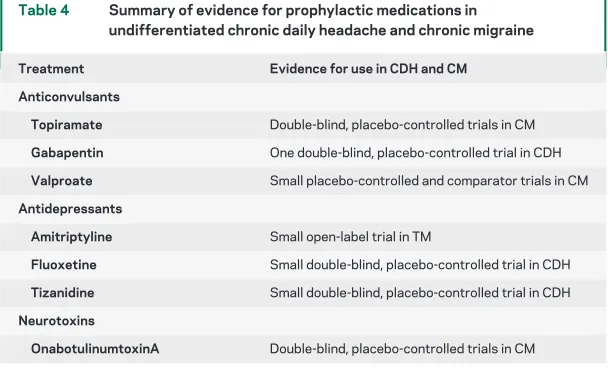
Patients with migraine with frequent, disabling, or refractory headaches, or with contraindications or overuse of acute analgesics, benefit from prophylactic treatment. Drug selection should be based on comor-bid conditions, avoiding drugs that may exacerbate another condition. While a number of prophylactic medications have been evaluated for the treatment of primary CDH (table 4), the largest properly conducted placebo-controlled trials in subjects with CM have evaluated efficacy of topiramate and onabotulinumtoxinA.
A small-scale (n ⫽ 28) double-blind, placebo-controlled trial demonstrated low-dose topiramate (50 mg/day) may be effective in reducing headache frequency in patients who had CM with MO. Re-sponder rate (ⱖ50% improvement in monthly head-ache frequency) in topiramate vs placebo-treated subjects was, respectively, 71% and 7%.6Two larger,
randomized, double-blind, placebo-controlled, parallel-group clinical trials were performed with topiramate in patients with CM. Significant reduction in the mean monthly rate of migraine/migrainous days (6.4⫾ 5.8) compared to placebo (4.7⫾6.1; p⫽0.010) and a mean reduction from baseline of migraine days per month (5.6⫾ 6.0) compared to placebo (4.1⫾6.1;p⫽0.032) was observed in the United States,7whereas reduction in mean monthly
migraine days (⫺3.5⫾6.3) was noted compared to placebo (0.2⫾4.7p⫽0.02) in a study conducted in the European Union. In this study, patients with acute MO reported mean monthly reduction in mi-graine days by 3.5⫾7.1 days, which was significant compared to placebo with an increase of 0.8⫾4.8 days (p⫽0.03). Similar data on MO were unavail-able from the US trial, but secondary analysis was performed and showed a trend toward significance (p⫽0.059). The European trial responder rate of at least 50% reduction of migraine days was significant for topiramate (22% vs 0%p⫽0.012), but not in the US trial.
Figure Approach to the patient with chronic migraine (CM), with or without acute medication overuse
Systematic series of exploratory controlled trials failed to show superiority of onabotulinumtoxinA over placebo in subjects with migraine, CDH, and CTTH. Efficacy of onabotulinumtoxinA in episodic migraine and CTTH has therefore not been established.
The PREEMPT clinical program confirmed on-abotulinumtoxinA as effective, safe, and well-tolerated prophylaxis for adults with CM. Two phase 3 multicenter studies (PREEMPT 1 and 2) that each had a 24-week, double-blind, parallel-group, placebo-controlled phase followed by a 32-week open-label phase enrolled 1,384 patients with CM.8,9
All patients received the minimum 155 units IM of onabotulinumtoxinA in 31 sites across 7 head and neck muscles using a fixed-site, fixed-dose injection paradigm. Up to 40 additional units, administered IM to 8 injection sites across 3 head and neck mus-cles, was allowed using a modified follow-the-pain approach. Pooled analysis demonstrated onabotuli-numtoxinA treatment significantly reduced mean frequency of headache days (⫺8.4 onabotulinum-toxinA, ⫺6.6 placebo; p ⬍ 0.001) and headache episodes (5.2 onabotulinumtoxinA, ⫺4.9 placebo; p ⫽ 0.009).10 Several other efficacy variables
(mi-graine episodes, mi(mi-graine days, moderate or severe headache days, cumulative hours of headache on headache days, and proportion of patients with severe disability) were significant favoring onabotulinum-toxinA. Results showed significant improvements in multiple headache symptom measures and demon-strated improvement in patient functioning, vitality, psychological distress, and overall quality of life.
Several other drugs have been evaluated for pro-phylactic treatment of undifferentiated primary CDH, but not specifically CM. However, because these medications have demonstrated efficacy in sub-jects with episodic migraine and given that CM is a
highly disabling disorder with frequently unsatisfac-tory treatment outcomes, other drug options should be considered.
Gabapentin was evaluated in patients with CDH (dose of 2,400 mg per day).11After 12 weeks of
treat-ment, the median 4-week migraine rate was 2.7 (baseline 4.2) in treatment group and 3.5 (baseline 4.1) in placebo group (p⫽0.006). Additionally, 26 of 56 patients (46.4%) receiving a stable dose of 2,400 mg of gabapentin per day and 5 of 31 patients (16.1%) receiving placebo showed at least a 50% re-duction in 4-week migraine rate (p⫽0.008).
Tizanidine was evaluated in a 134-subject placebo-controlled single-blind study as adjunctive prophylactic treatment for CDH, demonstrating su-periority to placebo comparing overall headache in-dex (p ⫽ 0.0025), mean headache days per week (p⫽0.0193), severe headache days per week (p⫽ 0.0211), average headache intensity (p⫽ 0.0108), peak headache intensity (p ⫽ 0.0020), and mean headache duration (p⫽0.0127).12
Fluoxetine was evaluated in a 64-subject double-blind placebo-controlled trial with CDH (initial doses of 20 mg fluoxetine).13Dosages increased up to
40 mg depending on patients’ response. After 3 months, fluoxetine subjects had 1.57 fewer headache days per week compared with placebo-treated sub-jects who had 1.12 headache-free days per week.
Amitriptyline has been shown in clinical studies to be well-tolerated and effective as monotherapy for prevention of migraine and other CDH, most re-cently in a double-blind, placebo-controlled, 20-week parallel-track study involving 317 subjects which demonstrated superiority of amitriptyline at doses of 50 –100 mg at 8 weeks.14 Amitriptyline is
thought to act by facilitating the descending modula-tion of nocicepmodula-tion within the trigeminal nucleus caudalis and spinal dorsal horn by increasing the amount of synaptic amines, enhancing the action of endogenous opiate receptors, and also, in rat models, by inhibiting cortical spreading depression.15
One randomized open study in 49 subjects with CM compared sodium valproate 750 mg/day to topiramate 75 mg/day.16 Three months after
ran-domization, significant reduction in 30-day head-ache days with respect to baseline (p⬍0.00001) and significant reduction in Migraine Disability Assess-ment (MIDAS) scores (p⬍0.00001) were recorded in both groups. No significant differences in benefi-cial effects between the 2 medications were shown. Seventy patients with CDH (29 with CM, 41 with CTTH) were studied for efficacy and tolerability of sodium valproate in a prospective, double-blind, ran-domized, placebo-controlled trial. Sodium valproate and placebo were applied for 3 months to 40 and 30
Table 4 Summary of evidence for prophylactic medications in undifferentiated chronic daily headache and chronic migraine
Treatment Evidence for use in CDH and CM Anticonvulsants
Topiramate Double-blind, placebo-controlled trials in CM
Gabapentin One double-blind, placebo-controlled trial in CDH
Valproate Small placebo-controlled and comparator trials in CM
Antidepressants
Amitriptyline Small open-label trial in TM
Fluoxetine Small double-blind, placebo-controlled trial in CDH
Tizanidine Small double-blind, placebo-controlled trial in CDH
Neurotoxins
OnabotulinumtoxinA Double-blind, placebo-controlled trials in CM
subjects, respectively. Sodium valproate decreased the maximum pain visual analog score (VAS) for pain levels and pain frequency at the end of the study (p⫽0.028 andp⫽0.000, respectively), but did not change general pain VAS levels (p⫽0.198). In sub-jects with CM, significant decreases in maximum pain VAS, general pain VAS, and pain frequency pa-rameters were shown in sodium valproate–treated subjects (p⫽0.006,p⫽0.03, andp⫽0.001, re-spectively).17 While these studies suggest a role for
sodium valproate for treatment of CM, larger ran-domized controlled trials are required.
Efficacy of prophylactic medication combinations in patients not responding optimally to one medica-tion has not thus far been demonstrated in placebo-controlled trials, though open-label studies and clinical impression have suggested that in selected pa-tients, combination therapy may be effective.
Hospitalization for patients with CM is reserved for those who fail outpatient therapy, overuse signif-icant amount of opioids or butalbital-containing an-algesics, and in those with significant medical or psychiatric comorbidity.
DISCUSSIONTreatment of CDH, a contributor to significant worldwide morbidity, is difficult and labor-intensive. Treatment is based on diagnosis, ex-clusion of secondary causes, elimination of MO, and a multidisciplinary team approach addressing risk factors. Treatment is a long process filled with exac-erbations and remissions, patient education, healthy patient–physician interactions, and a multidisciplinary team approach. Success in treating CDH is one of the most challenging yet rewarding experiences.
DISCLOSURE
Dr. Halker and Dr. Hastriter report no disclosures. Dr. Dodick serves on scientific advisory boards and as a consultant for Allergan, Inc., Pfizer Inc., Novartis, Merck Serono, NuPath Inc., Nautilus, Coherex Medical, Boston Scientific, Medtronic, Inc., GlaxoSmithKline, CoLucid Pharma-ceuticals, Autonomic Technologies, Eli Lilly and Company, Miller Med-ical, Neuralieve Inc., NeurAxon, Inc., St. Jude MedMed-ical, Inc., Zogenix, Inc., CogniMed Inc., MAP Pharmaceuticals, Inc., Lundbeck Inc., IM-PAX Laboratories, Inc., and the NIH/NINDS; has received funding for travel or speaker honoraria from CogniMed Inc., Miller Medical, and Annenberg Center for Health Sciences; serves as Editor-in-Chief of Ceph-alalgia, Editor-in-Chief and on the editorial boards ofThe Neurologist, Lancet Neurology, andPostgraduate Medicine; and has served as Editor-in-Chief ofHeadache Currentsand as an Associate Editor ofHeadache; re-ceives publishing royalties forWolff ’s Headache, 8th edition(Oxford University Press, 2009) andHandbook of Headache(Cambridge Univer-sity Press, 2010); and receives research support from Boston Scientific, Medtronic, Inc., Advanced Neurostimulation Systems, St. Jude Medical, Inc., and the NIH/NINDS.
Received November 16, 2010. Accepted in final form December 27, 2010.
REFERENCES
1. Headache Classification Subcommittee of the Interna-tional Headache Society. The InternaInterna-tional Classification
of Headache Disorders, 2nd ed. Cephalalgia 2004; 24(suppl 1):1–160.
2. Dodick DW. Clinical practice: chronic daily headache. N Engl J Med 2006;354:158 –165.
3. Bigal ME, Lipton RB. What predicts the change from episodic to chronic migraine? Curr Opin Neurol 2009;22:269–276. 4. Holroyd KA, O’Donnell FJ, Stensland M, Lipchik GL,
Cordingley GE, Carlson BW. Management of chronic tension-type headache with tricyclic antidepressant medi-cation, stress management therapy, or their combination: a randomized control trial. JAMA 2001;285:2208 –2215. 5. Silberstein SD. Practice parameter: evidence-based
guide-lines for migraine headache (an evidence-based review): re-port of the Quality Standards Subcommittee of the American Academy of Neurology. Neurology 2000;55: 754 –762.
6. Silvestrini M, Bartolini M, Coccia M, et al. Topiramate in the treatment of chronic migraine. Cephalalgia 2003;23: 820 – 824.
7. Diener HC, Dodick DW, Goadsby PJ, et al. Utility of topiramate for the treatment of patients with chronic mi-graine in the presence or absence of acute medication over-use. Cephalalgia 2009;29:1021–1027.
8. Aurora SK, Dodick DW, Turkel CC, et al. Onabotuli-numtoxinA for treatment of chronic migraine: results from the double-blind, randomized, placebo-controlled phase of the PREEMPT 1 trial. Cephalalgia 2010;30: 793– 803.
9. Diener HC, Dodick DW, Aurora SK, et al. Onabotuli-numtoxinA for treatment of chronic migraine: Results from the double-blind, randomized, placebo-controlled phase of the PREEMPT 2 trial. Cephalalgia 2010;30:804 – 814.
10. Dodick DW, Turkel CC, DeGryse RE, et al. Onabotuli-numtoxinA for treatment of chronic migraine: pooled results from the double-blind, randomized, placebo-controlled phases of the PREEMPT clinical program. Headache 2010;50:921–936.
11. Spira PJ, Beran RG. Gabapentin the prophylaxis of chronic daily headache: a randomized, placebo-controlled study for the Australian Gabapentin Chronic Daily Head-ache Group. Neurology 2003;61:1753–1759.
12. Saper JR, Lake AE, Cantrell DT, Winner PK, White JR. Chronic daily headache prophylaxis with tizanidine: a double-blind, placebo-controlled, multicenter outcome study. Headache 2002;42:470 – 482.
13. Saper JR, Silberstein SD, Lake AE, Winters ME. Double-blind trial of fluoxetine: chronic daily headache and mi-graine. Headache 1994;34:497–502.
14. Couch JR, for the Amitriptyline vs Placebo Study Group. Amitriptyline in the prophylaxis of migraine and chronic daily headache. Headache Epub 2010 Nov.
15. Krymchantowski AV, Silva MT, Barbosa JS, Alves LA. Amitriptyline versus amitriptyline combined with flu-oxetine in the preventative treatment of transformed migraine: a double-blind study. Headache 2002;42: 510 –514.
16. Bartolini M, Silvestrini M, Taffi R, et al. Efficacy of topi-ramate and valproate in chronic migraine. Clin Neurop-harmacol 2005;28:277–279.
If you liked this article, you may be interested in ...
NeurologyLipton et al. Supplement on Chronic Migraine. February 3, 2009;www.neurology.org
Mack et al. Chronic daily headache in adolescence: A continuing problem. August 11, 2009;
www.neurology.org
Wang et al. Chronic daily headache in adolescents: An 8-year follow-up study. August 11, 2009;
www.neurology.org
Gonc¸alves et al. Temporomandibular symptoms, migraine, and chronic daily headaches in the population. August 25, 2009;www.neurology.org
Charles et al. Chronic daily headache in adolescents: An 8-year follow-up study. March 2, 2010;
www.neurology.org
Robbins et al. Clinical and prognostic subforms of new daily-persistent headache. April 27, 2010;
www.neurology.org
Neurology Today
Kurt Samson. FDA Approves Botulinum A Toxin for Severe Chronic Migraine: Training on How and When To Use is Key, Experts Say. November 4, 2010;www.neurotodayonline.com
DOI 10.1212/WNL.0b013e31820d5f32
2011;76;S37-S43
Neurology
Rashmi B. Halker, Eric V. Hastriter and David W. Dodick
Challenging Problem
Chronic Daily Headache: An Evidence-Based and Systematic Approach to a
This information is current as of February 14, 2011
Services
Updated Information &
http://n.neurology.org/content/76/7_Supplement_2/S37.full
including high resolution figures, can be found at:
References
http://n.neurology.org/content/76/7_Supplement_2/S37.full#ref-list-1
This article cites 16 articles, 2 of which you can access for free at:
Subspecialty Collections
http://n.neurology.org/cgi/collection/migraine
Migraine
http://n.neurology.org/cgi/collection/all_pain
All Pain
http://n.neurology.org/cgi/collection/all_headache
All Headache
following collection(s):
This article, along with others on similar topics, appears in the
Permissions & Licensing
http://www.neurology.org/about/about_the_journal#permissions
its entirety can be found online at:
Information about reproducing this article in parts (figures,tables) or in
Reprints
http://n.neurology.org/subscribers/advertise
Information about ordering reprints can be found online:
rights reserved. Print ISSN: 0028-3878. Online ISSN: 1526-632X.
1951, it is now a weekly with 48 issues per year. Copyright Copyright © 2011 by AAN Enterprises, Inc.. All ® is the official journal of the American Academy of Neurology. Published continuously since