Available online: https://edupediapublications.org/journals/index.php/IJR/ P a g e | 618
A Robust
enlarged
Kalman Filter for Speed-Sensorless Control of a
Decoupled PMSM Drive and Linearized
Rachakonda Kishor & Dr. Satish Kumar Peddapelli
1Assistant Professor, Dept of EEE, Hasvitha Institute of Engineering and Technology. 2Assistant Professor, Dept of EEE, Osmania College of Engineering Hyderabad
[email protected], [email protected],
Abstract: This paper utilizes a hearty input
linearization system to guarantee a decent powerful execution, strength and a decoupling of the streams for Permanent Magnet Synchronous Motor (PMSM) in a turning reference outline (d, q). However this control requires the learning of certain factors (speed, torque, position) that are hard to access or its sensors require the extra mounting space, lessen the dependability in brutal conditions and increment the cost of engine. And furthermore a stator protection variety can incite an execution debasement of the framework. In this way a 6th request Discrete-time Extended Kalman Filter approach is proposed for on-line estimation of speed, rotor position, stack torque and stator protection in a PMSM. The intriguing reenactments comes about got on a PMSM subjected to the heap unsettling influence demonstrate extremely well the viability and great execution of the proposed nonlinear input control and Extended Kalman Filter calculation for the estimation within the sight of parameter variety and estimation commotion.
Keywords: Robust Feedback Control, PMSM,
Extended Kalman Filter, Estimation
1. Introduction
Lately, there has been a rising development of PMSM. This machine has been broadly utilized as a part of numerous in-dustrial applications. The principle points of interest, as contrasted and other AC engine drive, are high power factor, high control thickness, high torque to current proportion, high
proficiency, Hence heartiness, bring down
Available online: https://edupediapublications.org/journals/index.php/IJR/ P a g e | 619
frequently utilized apparatuses for stochastic estimation. The KF is basically an arrangement of numerical conditions [9] [10] that execute an indicator corrector type estimator that is ideal as in it limits the assessed mistake covariance at the point when some assumed conditions are met. For the speed, torque and stator protection estimation issue of PMSM, where parameter variety and estimation clamor is available, KF is the perfect one. Numerous literary works on the KF method and its applications, basically stretched out for the estimation of the speed, have been distributed [11]-[13]. In any case, utilizing the nonlinear input control, this Extended KF (EKF) system doesn't consider the blend stack torque and stator protection variety. In the present research, after a short audit of the PMSM show, from one perspective a vigorous Input-yield linearization what's more, decoupling plan is produced and then again a 6th request discrete-time EKF, in view of KF rule, is proposed to evaluate the speed, streams, position and stretched out for the heap torque and stator protection reproduction. At long last, the proposed mix nonlinear input control and EKF approach are affirmed by reproductions comes about did on PMSM drive framework within the sight of estimation clamor and parameter varieties.
2. PMSM Equations and Robust Feedback Control
By expecting that the immersion of the attractive parts and the hysteresis marvel are disregarded; by considering the instance of a smooth-air-hole PMSM (where the inductances are equivalent: Ld = Lq) and as indicated by the field situated guideline where the immediate pivot current (Id) is constantly compelled to be zero which rearranges the elements what's more, accomplish most extreme electromagnetic torque per ampere, the PMSM display in the rotor reference (d, q) outline are as per the following [2] [5]:
This Equation (1) shows that the dynamic model of PMSM is nonlinear because of the coupling between the electrical currents and some parameters (in particular Rs) vary with temperature. Thus, in order to control independently the currents (Id, Iq) and then preserve the robustness performance and stability of the system under parameters variation and measurement noise, we can uses a robust feedback linearization strategy to regulate the motor states [18]. Thus, we can see that the system (1) has relative degree r1 = r2 = 1 and can be transformed into a linear and controllable system by chosen:
• a suitable and an appropriate change of coordinates given by:
where [v1 ,v2] T are the new input vector of the obtained decoupled systems
• the feedback linearization control having the following form:
This feedback control (3) is effective and leads the system (1) to two decoupled subsystems;
Available online: https://edupediapublications.org/journals/index.php/IJR/ P a g e | 620
The real t0 is an adjusting positive parameter, chosen adequately small (t0 < 1), in order to satisfy the robustness performance, to have a good regulation and convergence of the currents. The block diagram structure for the control of (Id, Iq) can be summarized as follows in Figure 1. However the control of a PMSM generally required the knowledge of the instantaneous speed of the rotor that is not measurable. Also a variation of the stator resistance or/and load torque (Rs and TL) can induce a lack of field orientation. In order to achieve better dynamic performance, an on-line estimation of rotor speed, stator resistance and load torque is necessary. In this study, in order to respect to the parametric variations in the presence of measurement and system noise (stochastic estimation), an EKF’s algorithm for speed estimation extended for the stator resistance and load torque reconstruction, is presented and explained in the next section.
3. Model of Extended Kalman Filter
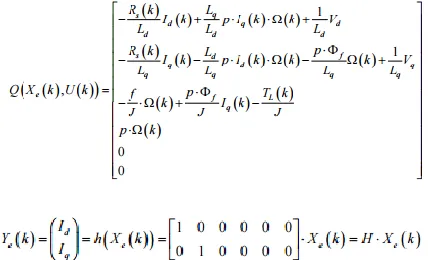
For parameter estimation using a full order EKF, the model structure (1) is discretized directly using Euler approximation (1st order) proposed in [15]. Furthermore, the state vector is extended to the stator resistance and load torque. Thus, choosing the currents (Id, Iq), speed (Ω), rotor position (θ), load torque (TL) and stator resistance (Rs) as state variables, the voltages (Vd, Vq) as inputs, the new discrete-time and Stochastic sixth-order nonlinear dynamic model for the PMSM is described by Equation (5):
Figure 1. Proposed currents control scheme.
The resulting output vector Ye (k) consists of the estimated motor current in a rotor reference frame being compared to the measured current. The difference is used to correct the state vector of the system model
The state vector and output, respectively at the k-th sampling instant, i.e. e t kT = ⋅ with Te the adequate sampling period chosen without failing the stability and the accuracy of the discrete-time model.
The random disturbance input, represented by, is the sum of modeling uncertainty, the discretization errors and the system noise. The measurement noise is represented by. Both n k( ) and r k( ) , are assumed to be white Gaussian noise with zero mean and covariance matrix Q and R respectively. Consider that:
Available online: https://edupediapublications.org/journals/index.php/IJR/ P a g e | 621
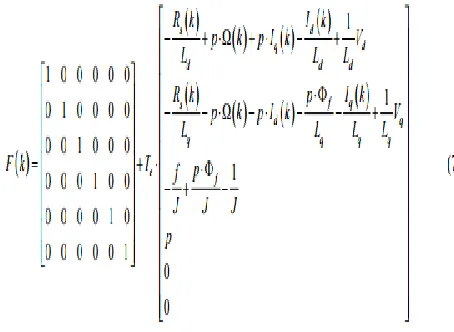
The EKF algorithm consists of repeated use of step (1-8) for each measurement is the Jacobian matrix of partial derivatives of f (•) with respect to. From Equation (5), we obtain:
4. Simulation Results and Discussion
The proposed robust nonlinear feedback control combined with a EKF strategy has been investigated with simulation tests carried out for a 1.6 kW PMSM by means of SIMULINK in order to illustrate its effectiveness against load, measurement noise and parameter variation (Figure 2). The nominal parameters of the PMSM, determined by means of the least-squares identification techniques proposed by the references [16] [17], are shown in the Table 1.
In order to evaluate its robustness and effectiveness, the comparisons between the estimated state variables and the simulated ones have been realized for several operating conditions with the presence of about 15% white noise on the measured currents and with additional load torque. Thus the simulations are obtained at first in the nominal case with the parameters of the PMSM (Table 1) and then in the second case, with 50% variation of the nominal stator resistance (Rs = 1.5 Rsn) in order to verify the behavior of the proposed EFK algorithm estimator with respect to stator resistance and load torque variation.
Figure 2. Simulation scheme.
Table 1. Nominal parameters of the PMSM.
Available online: https://edupediapublications.org/journals/index.php/IJR/ P a g e | 622
The important and difficult part in the design of the full order EKF is choosing the proper values for the covariance matrices Q and R. The change of values of covariance matrices affects both the dynamic and steady-state. In order to have a good performance, to insure better stability, convergence time and considerable rapidity of the EKF, the chosen values for the covariance matrices Q, R and P can be initialized and adjusted as follows:
the real qi must be tuned adequately small:
Available online: https://edupediapublications.org/journals/index.php/IJR/ P a g e | 623
Figure 3. Nominal case (Rr = Rrn): Comparison between estimated and simulated values for TL = 1.5 N∙m in the presence of measurement noises.
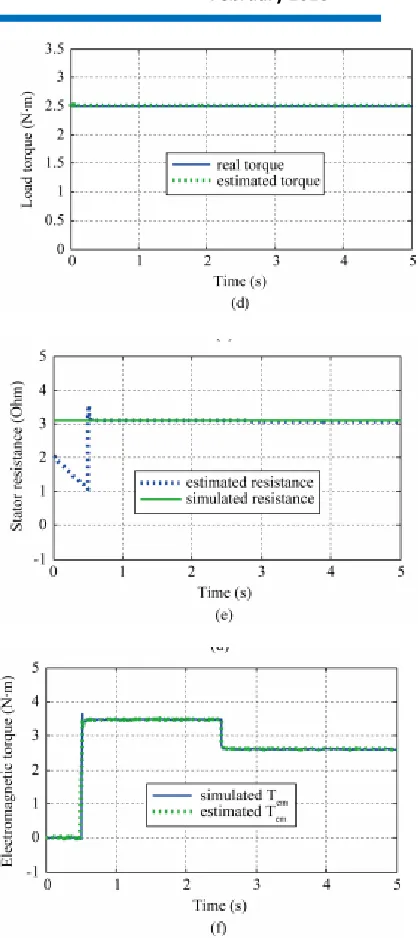
Figure 4. Non nominal case (Rr = 1.5*Rrn): Comparison between estimated and simulated values for TL = 2.5 N∙m in the presence of measurement noises.
Available online: https://edupediapublications.org/journals/index.php/IJR/ P a g e | 624
(Figure 3(b), Figure 4(b)), in the presence of parameter uncertainty and measurement noises, indicate the good regulation and convergence of the currents (with a decoupled system) due to a favorable stator resistance (Figure 3(e), Figure 4(e)) and load torque estimation (Figure 3(d), Figure 4(d)). These good waveforms illustrate the fast convergence and high performance of the robust decoupling control and EKF algorithm against modeling uncertainty, parametric variation and measurement noise.
5. Conclusions
We have appeared in this work a powerful nonlinear criticism control joined with an EKF approach have been acknowledged to allow a linearization, decoupling and direction of the PMSM states (streams) keeping in mind the end goal to guarantee a great dynamic execution of the worldwide framework and for taking care of scope of issues in sensorless (speed, rotorposition and load torque) control of PMSM drive without mechanical sensor. The intriguing reproduction comes about acquired on the PMSM demonstrate the viability, the joining and the dependability of the proposed control in nearness of stator protection variety, estimated clamor and load. Along these lines in the modern applications, due to the monetary focal points (particularly for low-controlled engines), one will acknowledge extremely well the trial actualize of this powerful EKF sensorless control calculation to substitute the PMSM mechanical sensor for the reconstitution of the speed, rotor position, stack torque and stator protection.
References
[1] Dehkordi, A., Gole, A.M. and Maguire, T.L. (2005) PM Synchronous Machine Model for Real-Time Simulation. International Conference on Power Systems Transients, Montreal, Paper No. IPST05-159.
[2] Pillay, P. and Krishnan, R. (1988) Modeling of Permanent Magnet Motor Drives. IEEE Transactions
on Industrial Electronics, 35, 537-541.
http://dx.doi.org/10.1109/41.9176
[3] Li, J. and Li, Y.Z. (2006) Speed Sensorless Nonlinear Control for PM Synchronous Motor Fed by Three-Level Inverter. IEEE International Conference on Industrial Technology, Mumbai,
15-17 December 2006, 446-451.
http://dx.doi.org/10.1109/ICIT.2006.372208
[4] Marino, R., Tomei, P. and Verrelli, C.M. (2006) Nonlinear Adaptive Output Feedback Control of Synchronous Motors with Damping Windings. 32nd Annual Conference on IEEE Industrial Electronics, Paris, 6-10 November 2006, 1131- 1136.
http://dx.doi.org/10.1109/IECON.2006.347363
[5] Deng, Z.H. and Nian, X.H. (2015) Robust Control of Permanent Magnet Synchronous Motors. IEEE/CAA Journal of Automatica Sinica, 2, 143-150.
[6] Bingyou, L. (2009) Research on H infinity Robust Tracking Controller for Permanent Magnet Synchronous Motor Servo System. International Conference on Information Engineering and Computer Science, ICIEC, 1-5
[7] Zulkifli, S.A. and Ahmad, M.Z. (2011) H∞ Speed Control for Permanent Magnet Synchronous Motor. 2011 International Conference on Electronic Devices, Systems and Applications (ICEDSA), Kuala Lumpur, 25-27 April 2011, 290- 293.
http://dx.doi.org/10.1109/ICEDSA.2011.5959059
[8] Kalman, R.E. (1960) A New Approach to Linear Filtering and Prediction Problems. Journal of Basic
Engineering, 82, 35-45.
http://dx.doi.org/10.1115/1.3662552
Available online: https://edupediapublications.org/journals/index.php/IJR/ P a g e | 625
Controller for PMSM Using Extended Kalman Filter.
Circuits and Systems, 4, 489-497.
http://dx.doi.org/10.4236/cs.2013.48064
[10] Taibi, D., Titaouine, A., Benchabane, F. and Bennis, O. (2015) Stability Analysis of the Extended Kalman Filter for Permanent Magnet Synchronous Motor. Journal of Applied Engineering Science & Technology (JAEST), 1, 51-60
[11] Aissa, A. and Mokhtari, B. (2012) Extended Kalman Filter for Speed Sensorless Direct Torque Control of a PMSM Drive Based Stator Resistance Estimator. Journal of Electrical and Control Engineering, 2, 33-39.
[12] Fateh, B., Titaouine, A., Bennis, O., Guettaf, A., Yahia, K., et al. (2011) Robust Position and Speed Estimation Algorithm for Permanent Magnet Synchronous Drives. European Journal of Scientific Research, 57, 6-14.
[13] Cheol, M., Hyun Nam, K., Jung, M., Chae, C. and Kwon, Y. (2012) Sensorless Speed Control of Permanent Magnet Synchronous Motor Using Unscented Kalman Filter. Proceedings of SICE Annual Conference (SICE), 2018-2023.
[14] Doyle, J.C., Francis, B.A. and Tannenbaum, A.R. (1992) Feedback Control Theory. Maxwell MacMillan International, New York, 240 p.
[15] Lewis, F. (1992) Applied Optimal Control Estimation-Digital Design and Implementation. Prentice Hall, New York, 448 p.
[16] De Fornel, B. and Louis, J.P. (2007) Identification and Observation of the Electric Actuators. Hermes, Paris, 250 p.
[17] Leite, V.T., Araujo, R.M. and Freitas, D.R. (2003) A New Online Identification Methodology for Flux and Parameters Estimation of Vector Controlled Induction Motors. IEEE International Electric
Machines and Drives Conference, IEMDC'03, 1, 449-455.
[18] Asseu, O., Yeo, Z., Koffi, M., Ori, T.R., Loum, G.L., Zoueu, T.J. and Tanoh, A. (2009) Reduced-Order Sliding Mode Flux Observer and Nonlinear Control of an Induction Motor. Trends in Applied
Sciences Research, 4, 14-24.