Secure Auditing For Shared Modified Cloud Data with Group User
Quieting
L.MOUNIKA Assistant Professor Department of CSE
ABSTRACT: In modern days the cloud data storage is present generations that promote the
secure remote data auditing. The existing system considers the problem secure and efficient
public integrity auditing for shared dynamic data storage. Cloud data assign stores data in the
cloud as well as distribute data number of users. We found the collusion attack in the exiting
model .An efficient public integrity auditing method with secure group user revocation based on
vector commitment plus verifier total revocation group signature. We find the proposed a new
public integrity auditing function to help of Message Authentication Code (MAC) generation and
symmetric cryptographic algorithm. The main aim of this paper is to improve privacy and an
efficient cloud data storage model to reduce the bandwidth and to improve the data security. This
work modify to number groups to access the data. We deplore scheme for group signature. The
cipher text support public checking and efficient user revocation in properties like confidently,
efficiency, count ability and traceability. Finally we compare our algorithm with old which
shows good result in security. The experimental results are analyzed and evaluated in terms of
computation time, block size, key size, number of rounds and cycles per block.
Index Terms: Data integrity; Public auditing; User revocation component, Cloud Computing,
Message Authentication Code (MAC), Message Digest (MD), Symmetric Key Cryptography,
Public Integrity Auditing, Security and Data Storag
1. INTRODUCTION
The improvements and enhancements in
cloud computing motivates enterprises and
also organizations to outsource data to third
party cloud service providers (CSP’s) which
will result in improvements in the data
storage limitation of resource constrain local
storage services are available like simple
storage service (S3) online data backup
services of Amazon and software like
Google Drive, Drop box, Mozy, Bitcasa and
Memopal built for cloud application. Cloud
computing is computing in which large
groups of remote servers are networked to
allow centralized data storage and online
access to computer services or resources.
Clouds can be classified as public, private or
hybrid.[1] The criticisms about it are mainly
focused on its social implications. This
happens when the owner of the remote
servers is a person or organization other than
the user, as their interests may point in
different directions, for example, the user
may wish that his or her information is kept
private, but the owner of the remote servers
may want to take advantage of it for their
own business.[4] We introduce publicly
verifiable scheme, it helps in various
aspects. That is data integrity can be
performed not only by data owners, but also
by one or more third party auditor.
Conversely, the dynamic schemes we
mentioned only focus on the gears where
there is a data owner and only the data
owner could change the data. In recent
times, the growth of cloud computing,
improves that some applications uses cloud
service, can use as a collaboration
platform.[2] Few of the software
development surroundings, one or more
users in a group may need to share some of
the source code, need to access, modify. At
some times they may need to compile and
run the shared source code at any time and
place. Cloud computing is a new paradigm
that is mainly used to provide an economic
resource utilization over the internet.[5] It is
a method of computing in which the users
can increase or decrease their computing
resources. Generally, the cloud contains
three models as shown Fig 1.
Figure 1: Types of cloud security data
The major contributions are as follows:
The secure and efficient shared data
ciphertext database with the help of
multi-user operation.[3]
Here, an efficient data auditing scheme is
proposed for providing data integrity by
incorporating the primitives of victor
commitment, asymmetric group key
agreement and group signature.[7]
2. RELATED WORK
A large amount of researchers have
committed significant concentration to the
troubles on how to securely outsource local
pile up to remote cloud server. The problem
of remote data integrity and availability
auditing attacks the attestation of many
researchers. Sagarika Dev Roy, et.al (2014)
proposed a methodology for secure
outsourcing of linear Computations into the
cloud environment. Outsourcing is a
common procedure engaged in the business
world when the customer chooses to farm
out a certain task to an agent for the benefit
of the firm in terms of time and cost.[6]
They proposed methodology to detecting a
malicious server, in an efficient result
verification method. YongjunRen, (2012)
proposed designated verifier provable data
possession. This plays a major role in public
clouds. Designated verifier provable data
possession is a matter of crucial importance
when the client cannot perform the remote
data possession checking. By using the
system security model and homomorphism
authenticator they designed a new scheme.
[8] The scheme removed luxurious bilinear
computing process. Furthermore in this
proposal, the cloud storage server is stateless
and independent of the verifier. This is an
important secure property of any other
schemes. In the course of security analysis
and performance analysis, their scheme is
secure and high efficiency.[10] The
asymptotic complexity in computations were
more in key generation methodologies.
Gentry and Halevi[12] discussed the
implementation of Fully Homomorphism
Encryption (FHE). The complete working of
any encryption methodologies required the
functionality called bootstrapping. They
provided the optimization in key generation
that reduced the complexity with
n-dimensional lattices. In a data storage
outsourcing services, the permission
assigned to the data owner to check whether
they stored data correctly or not. [9] In
previous work focused on TPA should be
storage without demanding the local copy of
data, and introduce no additional on-line
burden to the cloud user. This paper entirely
different compare with previous in the case
of privacy. Privacy preserving public
auditing for data storage security in cloud
computing [11] , ‖ by C. Wang, Q. Wang, K.
Ren, and W. Lou utilize and uniquely
combine the public key based
homomorphism authenticator with random
masking to achieve the privacy-preserving
public cloud data auditing system. In this
design, propose to uniquely integrate the
homomorphic authenticator with random
masking technique. In this protocol, the
linear combination of sampled blocks in the
server’s response is masked with
randomness generated by a pseudo random
function (PRF). By using random
masking,[13] The TPA no longer has all the
necessary information to build up a correct
group of linear equations and therefore
cannot derive the user’s data content, and no
matter how many linear combinations of the
same set of file blocks can be collected. A
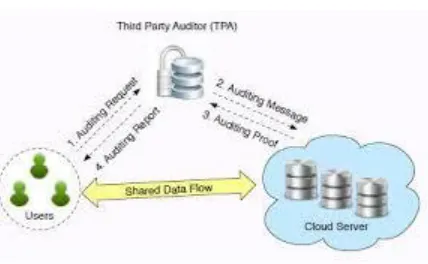
public verifier, such as a third party auditor
providing expert data auditing services or a
data user outside the group intending to
utilize shared data, is able to publicly verify
the integrity of shared data stored in the
cloud server. When a public verifier wishes
to check the integrity of shared data, it first
sends an auditing challenge to the cloud
server. After receiving the auditing
challenge, the cloud server responds to the
public verifier with an auditing proof of the
possession of shared data. Then, this public
verifier checks the correctness of the entire
data by verifying the correctness of the
auditing proof. Essentially, the process of
public auditing is a challenge and- response
protocol between a public verifier and the
cloud server.[15].
Fig 2 System Flow
3. PROPOSED WORK
Data outsourcing hoist security and privacy
worry. We need to trust third-party
confidentiality, integrity checking, and
access control mechanisms. The
conventional encryptions have need of
particular users to encrypt their data, with
the own keys of the user. Therefore, the
same data copies of different users will lead
to dissimilar cipher texts. It creates integrity
checking process is an impossible task. [5]
The present system use standard encryption
scheme for identifying duplicate blocks, the
blocks are stored in cloud. In Cloud Storage,
standard encryption of identical files
generates same key and same cipher text. As
a result Data de duplication is impossible in
encrypted data. When user lost the key,
there was impossible to restore the original
content of the file. Message digest algorithm
provides a viable option to enforce data
confidentiality while realizing duplication. It
encrypts or decrypts a data copy with the
help of a convergent key. By computing
cryptographic hash value of the content of
the data copy we can obtain the key. After
key generation process and data encryption
process, users can hang on to the keys. Then
the user sends the cipher text to the cloud
environment. Ever since encryption is
deterministic, the same data copies will
generate similar convergent key and the
identical cipher text. This permits the cloud
to perform de duplication over the cipher
texts. Cipher texts are able to decrypt by the
corresponding users’ with their convergent
keys. Convergent encryption practical is to
efficiently and reliably manage a huge
number of convergent keys. [9] The unique
Data block will be selected and those blocks
are placed in the cloud service provider’s
space. We are using crypto graphic
algorithm for integrity checking. Message
authentication code is the scheme of
producing Message digest for input file. The
integrity checking should be done by Third
party auditor by checking this message
digest code.Before Uploading file; data
owner must send the hash key to the third
party auditor. Third Party Auditor receives
the key and verify with cloud service
provider to check whether this file is already
uploaded or not. In this module, user
revokes the content by getting secret key of
data owner. Data owner must share the
secret key for group users. User downloads
the file from the cloud service provider
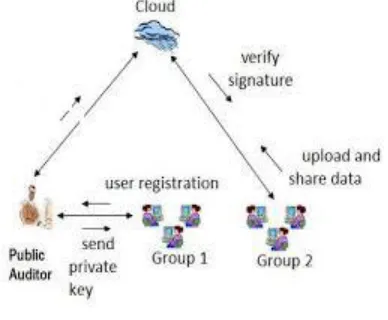
Fig. 3. Architecture of a proposed system
The proposed cloud storage model the
problem of designing public integrity
auditing based shared dynamic data with
group user revocation is analyzed. The main
contributions of this paper are listed as
follows:[6]
An efficient and secure public integrity
auditing scheme is proposed for cipher-text
base with the help of multi-user operation.
The primitives of victor commitment,
group signature and asymmetric group key
agreement are integrated.
The new features like, traceability and
countability are provided at the time of
auditing.
It is identified that the upload file is
duplicated. Otherwise, it will divided into
various blocks, after that the availability of
the blocks is also verified. If the block is not
exists, it will be given to the Cloud Service
Provider (CSP). Hence, the file is
downloaded from the server and to access
that file, the hash key and data blocks are
need to be decrypted. [15] In this work, the
two different algorithms such as, Message
Digest Code. Message Authentication Code
(MAC) algorithm is used for code
generation. Then, the symmetric key
cryptography algorithm is used for
encryption and decryption processes.
Algorithm – MAC Algorithm
Input: Block of file B = (B1, B2, B3 …
BN}
Step 1: Generate the hash key;
Step 2: Encrypt the data block with the help
of hash key;
Step 3: Generate the tag and hash key from
the content of the file;
Output: Obtain the decrypted file with the
1. H(M) = K (Key Generation)
Where,
M= Input file
H(M)=Hash value of file
K= Hash Key
2. E(K, M)=C (Encryption)
Where.
M-File,
K-Hash Key,
E-Encryption
C-Cipher Text
3. Tag(M)=T (Tag Generation)
Where,
M-File
T-Tag from File M
4. CIPHER TEXT DATABASE
In cloud storage outsourcing environment,
the outsourced data is usually encrypted
database, which is usually implicitly
assumed in the exiting academic research.
Actually, our scheme could support the
auditing of database of both plaintext and
cipher text database.[5] it is not
straightforward to extend a scheme to
support encrypted database. In order to
achieve the confidentiality of the data record
mx, the client can use his/her secret key to
encrypt each mx using a encryption scheme.
When there is only one user in the group, the
user only needs to choose a random secret
key and encrypt the data using a secure
symmetric encryption scheme. when the
scheme needs to support multi- user data
modification, while at the same time
keeping the shared data encrypted, a shared
secret key among group users will result in
single point failure problem.[3] It means that
any group user leak the shared secret key
will break the confidentiality guarantee of
the data. To overcome the above problem,
we need to adopt a scheme, which could
support group users data modification.
Exponentiation (BDHE) assumption in the
standard model according to the ASGKA
protocol, we consider the case of encrypted
database (x, cx), where x is an index and cx
is the corresponding cipher value. We
provide the detailed changes upon our
scheme to support encrypted database.[16]
1) In the Setup phase, the scheme has to run
the key agreement of ASGKA for the group
users. Then the database DB = (i,mi) is
encrypted by the group key gpk of data
owner. Finally, the stored database is a
2) In the second step of the Update phase, a
group user firstly decrypts the record ci
using the ASGKA secret key gsk[∗ ] to get
plaintext database DB = (i,mi). Then, update
the data to m′i, and later encrypt the data
with the public key gpk of ASGKA scheme
to get the new encrypted database DB = (i, c′
i)
Fig. 4. Cipher Text Model
The system is based on proxy re-signature
concepts. Blaze et al first proposed the
concept of proxy re-signature in[12].Proxy
signature is a digital signature scheme where
original user delegates his signing capability
to a proxy signer, and then the proxy signer
performs message signing on behalf of the
original signer.[9] In simple word it allows
semi-trusted proxy to work as a converter of
signatures between two users belonging to
same group
5. RESULT
We have provided a scheme of auditing the
integrity of the shared and dynamic cloud
data along with group user revocation. The
auditing of the data integrity is secure and
reliable. In this paper, the concept of
authorized data duplication was proposed to
achieve the data security by including
differential privileges of users in the
duplicate check. The data and associated key
primitives consume the space in cloud
architecture refers block size. An algorithm
effectiveness decided by the low space
consumption. Fig 5 shows the variation of
block size for both the proposed and existing
AES method. The block size for AES is 128
bits and for proposed symmetric cipher
block is 65 bits. The optimal steps reduction
in proposed work offers 49. 21 % reduction
in block size. This section demonstrate the
implementation results and experimental
performance analysis is carried out on the
basis of revocation time and overall auditing
mechanism. Graphically presented analysis
is most feasible analysis of our mechanism
with the existing public auditor.
Fig No 5 graph
6. CONCLUSION
A new public integrity auditing scheme for
cloud data storage For this purpose
algorithms such as, Message Authentication
Code (MAC) generation and symmetric key
cryptographic techniques are used in this
work This paper proposed system to realize
efficient and secure data integrity auditing
for dynamic data. The proposed model
consists of the public data auditing. This
technique will provide better data
confidentiality compare to other
methodologies. The main objective of this
paper is to reduce the bandwidth and to
improve the content integrity in cloud data
storage. Our novel design allows efficient
user revocation operations to the cloud.
Because of keys generated for the data not a
user. In addition scheme allows aggregation
of integrity auditing operations for multiple
tasks (files) through our batch integrity
auditing technique. When compared to other
algorithm key size is very small, it is not
able to hack easily. It is used for efficient
revocation without updating private keys of
remaining users. Cloud public verifier plays
an important role when dealing with security
aspects of cloud. In this paper, we have
proposed a new public auditing mechanism
for cloud for efficient user revocation while
maintaining shared data integrity which
allows cloud to re-sign blocks signed by
revoked user. In future, concentrate on key
management, how to revoke the private keys
from the group members
7. FUTURE WORK
Designing an efficient public auditing
mechanism with the capabilities of
preserving identity privacy and supporting
traceability is still open. Future work
includes improving performance of the
though there is greater performance and
efficiency in this mechanism, there is a
problem of traceability in this system which
is been considered to be continued in future
work. Since this mechanism is based on
aggregate signatures which are group
signatures with compressed storage, the
identity of the signer is protected. Proxy
re-signature can be carried out on two or more
cloud servers which reduces risk of
increased in data or users. It also helps in
improving security factors
8. REFERENCES
[1] Amazon. (2007) Amazon simple storage
service (amazon s3). Amazon.
[2] S Archana and Ananthi J,
“Privacy-Preservation and Public Auditing for Cloud
Data - A Survey”, International Journal of
Science and Research (IJSR), Vol. 3, No.
10, October 2014, pp-1989-1992.
[3] D. Boneh, C. Gentry, B. Lynn, and H.
Shacham, “Aggregate and Verifiably Encrypted Signatures from Bilinear Maps,”
Proc. 22nd Int’l Conf. Theory and
Applications of Cryptographic Techniques:
Advances in Cryptology
(EUROCRYPT’03), pp. 416-432, 2014
[4] C. Wang, Q. Wang, K. Ren, and W.
Lou, “PrivacyPreserving Public Auditing for Data Storage Security in Cloud Computing,”
Proc. IEEE INFOCOM, pp. 525-533, 2010
[5] B. Wang, B. Li, and H. Li, “Public
Auditing for Shared Data with Efficient
User Revocation in the Cloud,” Proc. IEEE
INFOCOM, pp. 2904-2912, 2013
[6]. B. Wang, B. Li, Member, IEEE, and H.
Li, “Panda: Public Auditing for Shared Data
with Efficient User Revocation in the
Cloud” in Proc. Of IEEE TRANSACTIONS
ON XXXXXX, VOL. X, NO. X, XXXX
201X
[7]. C. Wang, Q. Wang, K. Ren, and W.
Lou, “Privacy preserving public auditing for data storage security in cloud computing,” in
Proc. of IEEE INFOCOM 2010, CA, USA,
Mar. 2010, pp. 525– 533.
[8]. D. Catalano and D. Fiore, “Vector commitments and their applications,” in
Public-Key Cryptography - PKC 2013,
Nara, Japan, Mar. 2013, pp. 55–72.
[9] Dario Catalano, Dario Fiore,” Vector
Commitments and their Applications”, NSF
[10] Giuseppe Ateniese, Randal Burns, Reza
Curtmola, Joseph Herring,” Provable Data Possession at Untrusted Stores”, October
29–November 2, 2007, Alexandria, Virginia,
USA.Copyright 2007 ACM
978-1-59593-703-2/07/0011
[11] D. Catalano and D. Fiore, "Vector
commitments and their applications, " in
Public-Key Cryptography– PKC 2013, ed:
Springer, 2013, pp. 55-72.
[12] C. Gentry and S. Halevi,
"Implementing Gentry’s fully-homomorphic
encryption scheme,
[13] X. Jia and C. Ee-Chien, ―Towards
efficient proofs of retrievability,‖ in
Proceedings of the 7th ACM Symposium on
Information, Computer and
Communications Security, ser. ASIACCS
’12, Seoul, Korea, 2012.
[14] D. Chaum and E. van Heyst, “Group signatures,” in Proc. Of EUROCRYPT
1991, Brighton, UK, Apr. 1991, pp. 257–
265.
[15] Jachak K. B., Korde S. K., Ghorpade P.
P. and Gagare G. J.,―Homomorphic
Authentication with Random Masking
Technique Ensuring Privacy & Security in
Cloud Computing‖, Bioinfo Security
Informatics, vol. 2, no. 2, pp. 49-52, ISSN.
2249-9423, 12 April 2012
[16] H. Shacham and B. Waters, ―Compact Proofs of Retrievability,‖in the Proceedings
of ASIACRYPT 2008.