TO ALLELIC MAPPING AND COMPLEMENTATION1,*
THOMAS R. MANNEY3
Donner Laboratory, University of California, Berkeley
Received February 18, 1964
UPPRESSOR mutations restore a function lost as the result of a mutation at another locus. Although most suppressors studied have been specific for a single allele, HAWTHORNE and MORTIMER (1963) described a class of suppressors in Saccharomyces cereuisiae that suppressed the phenotypes of about 25 percent of all the nutritional mutants they tested. The suppressible mutants represented 11 different phenotypes, and yet at any given locus these super-suppressors acted only on certain alleles and not on others. They compared three independently isolated suppressors of this type, finding no specificity differences among them. Two of the three were shown to be allelic.
Similar multiple-action suppressors--on a somewhat smaller scale-have been reported in several Escherichia coli-bacteriophage systems. CAMPBELL ( 1961 ) found suppressors in certain strains derived from E. coli K-12 that suppress a
variety of mutations in the bacterial genome in addition to mutations in the bacteriophage A, when it is grown in the suppressor-bearing bacterial strain. Similar suppressors in E. coli suppress mutants of bacteriophage T4. These sup- pressors act on numerous ambivalent rZZ mutants ( BENZER and CHAMPE 1962), and also suppress certain mutants of the structural gene for alkaline phosphatase in the bacterium ( GAREN and SIDDIQI 1962).
To investigate the properties of super-suppressible mutants of Saccharomyces a suitable gene-enzyme system had to be developed. I n both E. coli and Neuro- spora, the tryptophan synthetase system has proved useful for studies of sup- pressor mechanisms (SUSKIND and KUREK 1959; BRODY and YANOFSKY 1963). The advantages offered by these systems, together with the availability of trypto- phan synthetase-defective mutants ( t r , locus) in yeast (HAWTHORNE and MORTI- MER 1960) made this system attractive for studying super-suppressors.
This paper reports results of genetic studies on 36 UV induced tr, mutants. These have been characterized with respect to allelic complementation, accumu- lation and utilization of indole, suppression by a super-suppressor, and their position on a n allele map has been determined by the use of X-ray-induced mitotic reversion (MANNEY and MORTIMER 1964).
'This work has been presented in partial satisfaction of requirements for the degree of Doctor of Philosophy. This investigation was supported in part by a Public Health Semice Fellowship, and by the United States Atomic
Present address: Biology Division, Oak Ridge National Laboratory, Oak Ridge, Tennessee. Energy Commission.
110 T . R . M A N N E Y
MA TE RI A LS A N D M E T H O D S
Yeast strains: Heterothallic strains of Saccharomyces cerevisiae were studied. All were ob- tained from R. K. MORTIMER. Tryptophan synthetase-deficient mutants were isolated by replica plating (LEDERBERG and LEDERBERG 1952), following irradiation with ultraviolet light (UV) (MORTIMER, LERNER and BARR 1957). All mutants except tr5.6 and trs.7 were derived from the standard-type haploid strain S288C, o r from closely related strains. Complete phenotypes of the strains used in these studies have been described (MANNEY 1964).
Media: The following culture media were used:
YEPD: Complex medium f o r routine culturing and assaying viability: Difco yeast extract, 1 percent; Difco Bacto-Peptone, 2 percent; dextrose, 2 percent; and agar, 2 percent (omitted for liquid media),
GNA: High-glucose medium, used for presporulation growth (MILLER, COLVIN and TRE- MAINE 1955): dextrose, 5 percent; Difco yeast extract, 1 percent; Difco Bacto-nutrient agar, 2.3 percent; and additional agar, 0.5 percent.
RA: Sporulation medium (FOWELL 1952) : raffinose, 0.022 percent; sodium acetate, 0.3 per- cent; agar, 2 percent.
MV: Synthetic minimal medium with vitamins: Difco Bacto-yeast nitrogen base, without amino acids (Difco Manual 1953), 0.67 percent; dextrose. 2 percent; and agar, 2 percent.
SC: Synthetic complete medium: MV supplemented with adenine, arginine. lysine, methio- nine, tryptophan, phenylalanine, tyrosine, and uracil, 20 mg/liter each; leucine, 30 mg/l;
histidine, 10 mg/l; threonine, 350 mg/l; and serine, 375 mg/l.
-X: Omission media: SC with one of the supplements omitted. These media are designated by the omitted nutrient, e.g., -Tr = SC without tryptophan.
PET: A medium containing glycerol as the carbon source, used to score respiratory defi- ciency (petites) : glycerol, 3 percent; dextrose, 0.025 percent; Difco yeast extract, 1 percent; Difco Bacto-Peptone, 2 percent; and agar, 2 percent.
Genetic methods: Allelism and allelic complementation were scored by a test employing replica plating. Overnight streak cultures were mixed on YEPD, incubated overnight to allow mating and growth of the diploid clones, and replica plated onto -Tr and SC. When allelic complementation was being scored the mixed cultures on YEPD were examined f o r zygotes under the microscope after 3 to 6 hours to ascertain that mating had occurred.
To establish diploid hybrid strains, haploids were mass mated on YEPD. Three hours later individual zygotes were isolated by micromanipulation, and allowed to form colonies (HAW-
THORNE and MORTIMER 1960).
Super-suppressor action was determined by tetrad analysis. Hybrid strains, precultured two days on GNA slants, sporulated in RA. Asci were dissected by the method of JOHNSTON and MORTIMER (1959). Spore cultures were streaked on YEPD plates and their phenotypes scored by replica plating on appropriate media. Mating was scored, also with the aid of replica plating, on the basis of prototroph formation with suitably marked tester strains.
The methods used for allelic mapping with X rays have been described (MANNEY and MORTIMER 1964).
Accumulation tests: Mutant strains were grown in liquid SC with limiting tryptophan
(4 mg/l). After incubation at 30°C for two days the medium was tested for indoleglycerol phosphate with ferric-chloride reagent (YANOFSKY 1956), and for indole with p-dimethylamino- benzaldehyde reagent (YANOFSKY 1955).
R E S U L T S
Allelic complementation: Thirty-five tr, alleles were tested for complementa- tion in diploids in all possible trans combinations, using the mutants and strains derived from them by dissection of hybrid asci. Most combinations were tested at least twice, and all positive tests were confirmed by retesting, in many cases by isolating zygotes and testing diploid clones. In all cases-positive and negative -formation of zygotes was confirmed by microscopic observation.
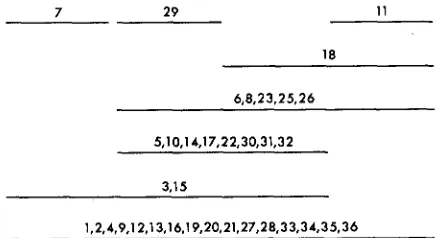
A complementation map, representing these results, is given in Figure 1. Each allele is represented by a line. If two alleles did not complement, their lines over- lap. If they did complement, their lines do not overlap. The bottom line represents the alleles that did not complement any others. Since every allele can be repre- sented by a continuous line, the map is linear.
Of the 35 alleles, 19 complement with at least one other while 16 do not. It is of interest to notice, however, that if merely three allele~-tr~-~, t ~ , - ~ ~ , and tr5--19
(or tr5-,s)-had been omitted, no complementation would have been found. Some of the 1 7 that gave only negative results in these tests may give positive results if tested with a sufficiently large number of alleles.
Allelic mapping: A method for allelic mapping in yeast using X-ray-induced mitotic reversion in heteroallelic diploids has been described ( MANNEY and MORTIMER 1964). For this method the X-ray sensitivity for induction of hetero- allelic reversion is assumed proportional to the distance between the two hetero- alleles. This assumption is supported by the observation that it leads to precisely additive values for the map intervals. The sequence of alleles can therefore be determined, unambiguously, from two-point tests; in some instances sequences have been verified by three-point tests.
Figure 2 is a map of 29 tr, alleles constructed by this method. The units of the map (prototrophs per I O 6 survivors per 200 roentgens) must be considered as relative units; they have not yet been related to conventional recombination units. The order of some of the alleles that are close together has not been deter- mined by the data. The uncertainty in the position of most of the alleles is about one unit, or about 1/25 of the length of the map, although in some cases it is much smaller. Four alleles near the left end of the map-~r,-~, tr5-4, tr5-al, and
7 29 11
18
5,10,14,17,22,30,31,32
3.15
1,2,4,9,12,13,16,19,20,21,27,28,33,34,35,36
FIGURE 1 .-Complementation map constructed from results of all possible complementation
tests with 35 tr, mutants in heteroallelic diploids. Overlapping lines represent combinations that
112 T. R. M A N N E Y
11 30
@
7 323125 26 23 18 6 22i
@ @
@
28@
@-.20@
27@
0
e9
@
35:,!?;
FIGURE 2.-Map of tr, mutants determined by X-ray method. Mutants numbered above the line are complementing, while those below are noncomplementing. The mutants circled are super-suppressible.
trs-p6-appear to be repeat mutations at the same site (MANNEY and MORTIMER
1964). With the exception of these four, the alleles are distributed along the map at random. There is no indication of clustering, nor are there any appreciable regions of the map that are insensitive to UV mutagenesis.
The alleles numbered above the line in Figure 2 are complementing ones, while those numbered below are noncomplementing. Both types are distributed along most of the length of the map. The alleles numbered in circles will be discussed later.
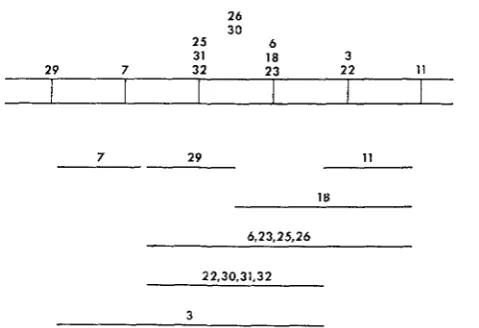
Comparison of X - r a y map with complementation map: Both the X-ray map and the complementation map assign sequences to the alleles. These are com- pared in Figure 3 . The top part of the figure is a sequence map derived from the X-ray sensitivity data used to construct Figure 2. In this map only the sequences determined unambiguously are represented. The alleles are grouped in clusters; the sequence of the clusters has been established, but the sequence of the alleles within each cluster has not. The distance shown between each cluster is arbitrary. The bottom part of the figure is a complementation map of the same alleles.
26 30
25 6
31 18 3
29 7 32 23 22 11
7 29 11
1R
6.23.25.26
2 2,30,31,32
3
For the most part, the sequences are colinear. There is one exception, however. The order of tr5--7 and tr5-zs relative to the rest of the alleles is different. This discrepancy will be seen to be of considerable theoretical importance with respect to a model for the action of super-suppressors.
Action of a super-suppressor: In their initial studies HAWTHORNE and MORTI-
MER (1963) investigated three super-suppressors which they designated S,, Sb, and S,. Although they found no differences in the spectra of mutants suppressed by them, the three suppressors represent at least two different loci. S, and S , are either very closely linked or are allelic, but show no linkage to Sb. A fourth super-suppressor, Sd, evidently represents an additional locus, because, unlike the first three, it is closely centromere linked. This suppressor, which suppresses many of the same alleles as the others, has been used to study the suppressibility of 32 tryptophan synthetase mutants.
The action of S d was tested by tetrad analysis of hybrids heterozygous for the allele being tested and for the super-suppressor, and homozygous for ad, (adenine requiring). The homozygous ad, alleles were employed to “mark” the suppressor. Unfortunately, however, two different alleles at the ad, locus were inadvertantly used and one of them is not suppressible. Consequently, in some crosses the sup- pressor could not be scored in every spore. Nonetheless, if the tr, allele being tested was suppressible, there should have been an excess of tryptophan-inde- pendent phenotypes, consistent with the segregation of the suppressor; no sup- pressor-bearing spore could have the mutant phenotype of a suppressible allele. Accordingly, the occurrence of the mutant phenotype coincident with the sup- pressor in a spore culture was conclusive evidence that the allele responsible for that phenotype was not suppressed.
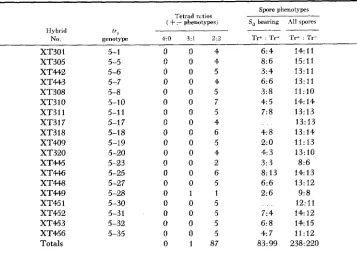
Thirty-two t r , alleles were tested for suppression by Sd. Thirteen were sup- pressed and 19 were not. The data for the 19 nonsuppressed ones are summarized in Table 1. Three types of evidence are tabulated: (1) segregation ratios of
Tr+: T r phenotypes among four-spored asci, (2) segregation ratios of Tr+: T r
phenotypes among suppressor-bearing spores, and ( 3 ) segregation ratios of
T r + : T r phenotypes among all spores examined. The tetrad ratios are based on data from complete asci. Those with inviable spores and those with irregular segregation of markers not suppressed by Sd were excluded. In each cross, several unsuppressed markers were included to detect “false tetrads” which occasionally arise from chance association of nonsister spores (JOHNSTON and MORTIMER
1959). Spores from incomplete and “false” asci were included in the spore ratioi shown in the last two columns. Therefore, these data do not merely duplicate the tetrad ratios. In all cases where the suppressor could be scored, the strongest evidence that these alleles are not suppressed is the occurrence of suppressor- bearing spores that require tryptophan. I n every case, at least two of the three criteria for nonsuppressibility are satisfied for these 19 alleles. In the two hybrids in which the suppressor could not be scored directly (XT317 and XT451), there is a significant absence of excess positive phenotypes.
114 T. R. MANNEY
TABLE 1
Segregation data establishing nonsuppressibility by S, for 19 tr5 mutants
~~~
Spore phenotypes -~ Tetrad rttios
(
+
:- phenotypes) S, bearing All spores4:O 3:l 2:O Tr+ : Tr- Tr+ : Tr-
____
--Hybrid “5
No. genotype
XT301 5-1 0 0 4 6:4
XT305 XT442 XT443 XT308 XT3 1 0 XT311 XT3 17 XT318 XT409 XT320 X T M XT446 X T M X T W XT45 1 XT452 XT453 XT456 Totals 5-5 5-6 5-7 5-8 5-10 5-1 1 5-1 7 5-18 5-19 5-20 5-23 5-25 5-27 5-28 5-30 5-3 1 5-32 5-35
0 0 4
0 0 5
0 0 4
0 0 5
0 0 7
0 0 5
0 0 4
0 0 6
0 0 5
0 0 4
0 0 2
0 0 6
0 0 5
0 1 1
0 0 5
0 0 5
0 0 5
0 0 5
0 1 87
8:6 3:4 6: 6 3:8 4: 5 7:8 4: 8 2: 0 4: 3 3:3 8: 13 6:6 2: 6
7:4 6:8
4: 7
83: 99 14:11 15:11 13:11 13:11 11:10 14: 14 13:13 13: 13 13:14 11:13 13:10 8:6 14:13 13: 12 9: 8
12:11 14: 12 14: 15 11:12 238: 220
TABLE 2
Segregation data establishing suppressibility by S, for I 3 tr5 mutants
Backcross Tetrad ratios Spore phenotypes
( + :- phenotypesj S , bearing All spores Spore phenotylv.5
fr5 - IIyhrid
Hybrid N o . genotype 4:O 3:l 2 : 3 Tr+ : Tr- Tr+ : Tr- N o . TT+ : Tr-
XT302 5-2 2 2 2 1O:l 18:6 XT473 18:5
XT405 5-3 1 4 2 7:O 21:4 XT474 20:4
XT304 5-4 2 2 2 13:O 21:6 XT475 17:4
XT309 5-9 2 3 2 9:0 21:7 XT476 21:7
XT312 5-12 3 1 1 13:O 20:5 XT495 18:6
XT313 5-1 3 1 2 1 11:0 19:5 XT478 20:3
XT408 5-16 3 1 2 4:O 21:5
XT321 5-21 2 0 1 6:O 18:6 XT481 21:6
XT458 5-24 2 0 2 13:O 21:5 XT482 19:4
XT450 5-29 3 2 1 14:O 23:5 XT483 24:3
XT454 5-33 3 3 0 l2:O 25:7 XT497 17:7
XT455 5-34 3 0 1 13:O 2 4 ~ 2 XT485 16:7
XT%7 5-36 2 2 1 15:O 24:5 XT486 20:5
the genotype tr5-c Sd with a strain bearing several suppressible alleles at other loci. The phenotypic spore-ratios from the backcrosses are included in Table 2. Segregation of tryptophan-requiring spores from these hybrids confirms the presumed genotype of the spores that were backcrossed, and proves that they are suppressible. The backcross was not performed with tr5--16, but the conclusion of suppressibility for this allele was confirmed by another method. A hybrid was made from a presumed Sd spore strain and an unsuppressed tr5-16 strain. The diploid required tryptophan. Therefore, it must have been homozygous for
tr5-16, and Sd must be a recessive suppressor of this allele.
The evidence for these 13 alleles clearly supports the conclusion that they are suppressible by Sa. The single suppressor-bearing, tryptophan-requiring spore in XT302 must be considered an error in light of the consistency of the other data for that allele.
The effect of Sd on tr5-19: Although tr5--19 is not suppressible as judged by the
tests described, it is affected by the super-suppressor. It appears to be “suppressed” to a different type of mutant, one that can utilize indole slowly. The spore cul- tures in many of the tests described above were scored on -Tr supplemented with indole (10 mg/l) in addition to unsupplemented -Tr. On the indole- supplemented medium segregation of tryptophan dependence in the hybrid bearing this allele (XT409) was characteristic of suppressibility. There were one 4:0, four 3: 1, and one 2:2 asci. The ratio of positive to negative phenotypes among all spores was 18: 6, and among spores known to bear the suppressor 2:O. A backcross of the suppressor-bearing, tr5-19 spore gave a ratio of positive to nega- tive phenotypes on indole-supplemented -Tr of 18: 2.
After a suggestion by B.
D.
MALING (personal communication) a n attempt was made to isolate a super-suppressor that would suppress to prototrophy. Not only was the attempt unsuccessful, but this allele could not be made to revert at all. Even after UV irradiation (to about 20 percent survival) no prototrophs were recovered from more than lo9 cells. However, when the cells were plated on indole-supplemented -Tr, and given the same UV dose, about five colonies were formed per lo6 cells plated. When these indole-utilizing mutants were cultured and plated on -Tr, prototrophs were obtained.It appears that tr5-19 reverts only by a two-step event. There are two tenable explanations. It could actually be a double tr, mutant, one alteration being sup- pressible and the other capable of utilizing indole. It could also be a small re- arrangement, such as a n inversion, that requires two base-changes for reversion. Experiments, employing Sd, designed to distinguish between these two possi- bilities are in progress.
The distribution of suppressible alleles on the X-ray allele map: The alleles
116 T. R . MANNEY
sites are randomly distributed along the map, and that at least one is significantly more sensitive to UV mutation induction than others. If it is assumed that there are no repeat mutations at other sites, then the 32 mutants tested for suppressi- bility are distributed among 29 sites. Of these, ten (or 35 percent) are suppres- sible. HAWTHORNE and MORTIMER (1963) tested 50 alleles at different loci and found 14 (or 28 percent) suppressible. Since their mutants were at many differ- ent loci, they could not have been repeats, and it is therefore appropriate to compare the number of mutation sites, rather than mutants. On this basis, the frequency of suppressible alleles among tr, mutation sites appears to he about the same as among nutritional mutation sites in general. This is consistent with the hypothesis that suppressible mutations can occur at every locus.
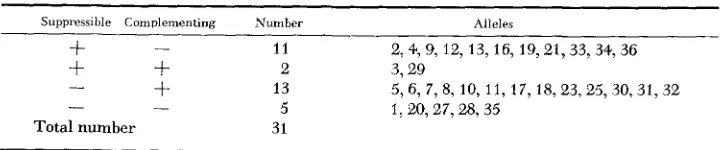
The distribution of suppressible alleles on the complementation map: In con- trast to their nearly uniform distribution along the allelic map, super-suppressible mutants are almost completely restricted to one group of the complementation map: the group of noncomplementing alleles. There are two important excep- tions: tr,+p and tr5-*+ The distribution of 31 alleles with respect to suppressibility and complementation is summarized in Table 3. Of the noncomplementing alleles 11 of 16 are suppressible, whereas of the complementing ones, only two of 15 are. Only five of these 31 mutants fail to function either by complementation or hy suppression.
The lower frequency of Suppressibility among complementing mutants, com- pared with noncomplementing mutants is highly significant. The two exceptional alleles, however, cannot be ignored. An acceptable model must explain these mutants as well as the almost complete exclusion between complementation and
suppressibility
.
DISCUSSION
The characteristic properties of the class of mutants that are suppressed by St may be summarized as follows: (1 ) They are distributed along the entire length of the mapped portion of the tr, locus, and apparently throughout the entire genome of Saccharomyces as well, perhaps at every locus. (2) Some of the sites at which these mutations occur have differing sensitivities to UV mutation induc- tion (prototrophy to auxotrophy), as evidenced by the occurrence of four sup- pressible mutations at the same site. (3) Most of these super-suppressible mutants are noncomplementing, but there are exceptions.
TABLE 3
Summary of results of complementation and super-suppressibility tests f o r 31 tr, mutants
Suppressible Complementmg Number Alleles
+
- 11 2, 4, 9, 12, 13, 16, 19,21,33, 34, 36+
+
2 3,29-
+
13 5, 6, 7, 8, 10, 11, 17, 18,23,25, 30,31, 32- 5 1,20,27,28,35
-
Comparison with suppressible mutants in other organisms: These character- istics are similar to those of mutants in E. coli and bacteriophages that are sup- pressed by suppressors with multiple action. The ambivalent r l l mutants of bac- teriophage
T4
are distributed among several sites in the r l l A cistron (BENZERand CHAMPE 1962). The 15 suppressible alkaline phosphatase mutants studied by GAREN and SIDDIQI (1962) are distributed among at least seven sites. Further, they are noncomplementing. The suppressor-sensitive mutants of bacteriophage ,istudied by CAMPBELL (1961) are similarly found at many sites, most of which he was able to group into nonoverlapping complementation groups. Complemen- tation was not found within each group,
WITKIN (1963) has presented evidence that suggests that the frequency of this type of suppressible mutant among randomly selected UV-induced auxo- trophs of E. coli is about the same as the frequency found by
HAWTHORNE
andMORTIMER (1963) for Saccharomyces. She studied a class of auxotrophs with particular reversion characteristics-a class comprising about one third of all auxotrophs. About half of all double-auxotrophic mutants (which she obtained by serial selection) from this class would revert to prototrophy by a single-step event. She proposed that multiple-acting suppressors account for these reversions. Her results indicate that about 20 percent of the randomly-selected UV-induced auxotrophs of E. coli (B/r and K-12) are “super-suppressible.”
The similarities between these systems and Saccharomyces are striking. They motivate the working hypothesis that the mechanism of super-suppression in all of them is basically the same. The demonstration of these similarities is one of the significant results of these yeast studies. On the one hand, it demonstrates that this mechanism of gene action, whatever it is, is not merely a curiosity, unique to a single genetic system, for, genetically, yeast and the E. coli-bacterio- phage systems are conspicuously dissimilar. On the other hand, if this working hypothesis is valid, the various systems-because of their diff erences-together provide a unique assemblage of genetic and biochemical approaches to the study of the mechanism of suppressor-gene action.
Models for super-suppressors: CAMPBELL (1 961 ) proposed that suppressor- sensitive mutants of bacteriophage ,iproduce abnormally sensitive protein that is either stabilized or freed of inhibition, by the action of the suppressor. I n sup- port of this he had found that some of the suppressible mutants were also sensi- tive to pH or temperature extremes. BENZER and CHAMPE (1962) found evidence to support quite a different interpretation of the ambivalent-mutant suppressors. The ambivalent r l l mutants behave as nonsense mutants: they appear unable to transcribe a complete protein. In agreement with this, GAREN and SIDDIQI
( 1962) found that the suppressible alkaline phosphatase mutants were noncom- plementing and failed to produce detectable CRM (immunologically cross-react- ing material) to the wild-type enzyme. BENZER and CHAMPE (1962) proposed that the suppressor changed the genetic code by altering either a n amino-acid activating enzyme or a n sRNA adaptor so that the nonsense sequence could be translated and a complete protein synthesized.
118 T. R. MANNEY
KUREK (1959) demonstrated for suppression of the Neurospora mutant t r 2 $ .
Mutation may alter an enzyme making it sensitive to inhibition by something normally present in the cell. The suppressor could then act by removing or lower- ing the concentration of the inhibitor. In the case of super-suppressors the inhibi- tor could be a small organic molecule, and the suppressor loci control different steps in its biosynthesis. This would explain several different loci having the same suppressor action.
Still another possibility is that the super-suppressors are involved in regulation of the number of enzyme molecules produced by the cell, rather than in their structure. Since so little is known about the regulation of these enzymes in yeast, it will be difficult to rule out such possibilities until the properties of the enzyme produced by suppressed strains are compared with those of the wild-type enzyme.
ConcZusions from present experiments: The experiments with tr5 mutants reported in this paper do not conclusively eliminate any of these models from consideration. They do, however, make some appear less likely than others. The observed partial exclusion between complementation and suppressibility is a more likely property of nonsense mutants than of mutants that form enzymes sensitive to external conditions or to cytoplasmic inhibitors. This is not conclusive, of course. One could postulate a mechanism whereby protein hybrid formation, necessary for complementation, was inhibited, and such a mechanism would be difficult to distinguish from the nonsense model on the basis of present evidence. The occurrence of the super-suppressible mutations along the entire length of the t r , locus would argue against them being primarily involved in regulating the amount of tryptophan synthetase formed. Further, trj-,s produces a n altered form of the enzyme, and if it is not a double mutant, may provide direct evidence that the suppressor alters the structure of the enzyme. Further studies on this mutant are in progress.
The nonsense model, formulated by BENZER and CHAMPE (1962), states that these mutants synthesize only part of the normal enzyme. SARABHAI, STRETTON,
BRENNER and BOLLE (1 964) have recently provided direct experimental support for this model. They demonstrated that a class of suppressible amber mutants that affect the head protein of bacteriophage T4D produce fragments of the polypeptide chain. The fragments all appear to have a common origin, and their terminal ends correspond with the positions of the appropriate mutants on an allelic map.
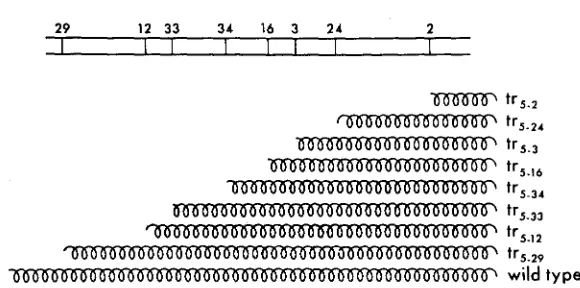
The protein fragments that this model predicts for the super-suppressible t r j
29 12 33 34 16 3 24 2
I I I I I I I 1
tr5.2 tr5.24
-
t r 5 . ,-
t r 5 . w-
t r 5 34tr5.33 tr5-12 tr5-29
2 wild type
FIGURE 4.Cchematic representation of the proteins formed by super-suppressible mutants, predicted by the nonsense model.
(2) if, at any given locus, a suppressible mutant complements with a mutant, say to its right on the allele map, then neither that suppressible mutant nor any other suppressible mutant at that locus can complement with one to its left. If
the model is correct, then, complementation involving super-suppressible mutants defines the direction of protein translation relative to the allelic map. These con- ditions provide a genetic test of the nonsense model. From knowledge of the fre- quency of complementing mutants in various regions of the locus one could calculate the expected frequency of mutants that complement mutants to both their right and to their left. It is then a matter of examining a sufficient number of mutants to either find a case incompatible with the model, or to demonstrate that such cases do not occur at the frequency expected if there were no such restriction.
and 215-29) are quite compatible with this model. They complement only with mutants that map to their right in Figure 2. Further, among all the mutants on the map, they are the only ones that complement only with mutants to their right; all others comple- ment either to their left or to both right and left. This is strong circumstantial evidence favoring the nonsense model. The occurrence of noncomplementing suppressible mutants between tr5+$ and on the map is an apparent incon- sistency that remains to be explained by the model.
The predictions of this model shown schematically in Figure 4 also suggest some biochemical tests. A particularly attractive approach is by the use of anti- sera against wild-type tryptophan synthetase to study the mutationally altered proteins (SUSKIND,
YANOFSKY
and BONNER 1955; SUSKIND 1957; MOHLER andSUSKIND 1960). The nonsense model applied to this system leads to the prediction that tra-z9 should produce a cross-reacting material (CRM), whereas the four mutants near the left end-tr5+2, tr5-4, tr5-21, and t r 5 - - 9 6 - ~ ~ ~ l d not. It would be of further interest to examine the pattern of cross-reaction among the various intermediately situated mutants.
120 T. R. M A N N E Y
the protein produced by suppressible and suppressed mutants. The feasibility of using this protein for such studies, however, has not been assessed.
I t is a pleasure to express my appreciation to DR. ROBERT K. MORTIMEII, whose advice and encouragement have been invaluable, and whose ideas have enriched the significance of these results. I am also grateful to DRS. PATRICIA ST. LAWRENCE and BARBARA MALINC for many help- ful suggestions. I t is also a pleasure to thank MRS. RUTH LERNER for her excellent technical assistance.
S U M M A R Y
The tryptophan synthetase system of Saccharomyces cereuisiae has been investigated and used to study the action of a super-suppressor.
Thirty-six allelic t r , mutants were characterized. All accumulated indole- glycerol phosphate when grown on tryptophan-limited medium. Three also accumulated indole. One was able to utilize indole in place of tryptophan.
Of 35 mutants tested in all possible combinations in diploids, 19 complemented with at least one other. A linear complementation map was constructed from these results. A map of 29 mutants was constructed by the X-ray method. The mutants are randomly distributed along the length of this map with the exception of four that are repeats at the same site. This map is colinear with the comple- mentation map with one exception.
Thirteen of 32 mutants tested were suppressed by the super-suppressor Sd. Of these, only two are of the complementing type. One mutant is altered by Sd to an indole-utilizing phenotype. This mutant has unusual reversion properties. The two mutants that are both suppressible and complementing are unique in that they complement only with alleles that are to their right on the X-ray map. The results are consistent with the model of super-suppressible mutants being non- sense mutants.
LITERATURE CITED
BENZER, S., and S. P. CHAMPE, 1962
BRODY, S., and C. YANOFSKY, 1963
CAMPBELL A., 1961
Difco Manual 1953
FINCHAM, J. R. S., and A. CODDINGTON, 1963
A change from nonsense to sense in the genetic code.
Suppressor gene alteration of protein primary structure. Proc. Natl. Acad. Sci. U S . 48: 1114-1121.
Proc. Natl. Acad. Sci. U.S. 54J: 9-16.
Sensitive mutants of bacteriophage A . Virology 14: 22-32.
Difco Laboratories, Detroit, Michigan.
Complementation at the a m locus of Neurospora crassa a reaction between different mutant forms of glutamic dehydrogenase. J. Mol. Biol.
6: 361-373.
FOWELL, R. R., 1952 Sodium acetate agar as a sporulation medium for yeast. Nature 170: 578. GAREN, A., and 0. SIDDIQI, 1962 Suppression of mutations in the alkaline phosphatase struc-
tural cistron of E. coli. Proc. Natl. Acad. Sci. U.S. 48: 1121-1 127.
HAWTHORNE, D. C., and R. K. MORTIMER, 1960 Chromosome mapping in Saccharomyces: centromere-linked genes. Genetics 45: 1085-1 1 IO. __ 3 963 Super-suppressors in yeast. Genetics 48: 61 7-620.
Use of snail digestive juice in isolation of yeast spore tetrads. J. Bacteriol. 7 8 : 292.
LEDERBERG, J., and E. M. LEDERBERG, 1952 mutants. J. Bacteriol. 63: 3 9 9 4 6 .
LOPER, J. C., 1961
MANNEY, T . R., 1964
Replica plating and indirect selection of bacterial
Enzyme complementation in mixed extracts of mutants from the Salmonella histidine B locus. Proc. Natl. Acad. Sci. U S . 47: IWO-1450.
Tryptophan synthetase mutants of yeast: Action of a super-suppressor in relation to allelic mapping and complementation. Ph.D. Thesis, University of California. Lawrence Radiation Laboratory Report UCRL 11191 (unpublished).
Allelic mapping in yeast using X-ray-induced mitotic reversion. Science 143: 581-582.
A study of certain factors influencing sporulation of Saccharomyces cerevisiae. Can. J. Microbiol. 1 : 560-573.
The similar properties of tryptophan synthetase and a mutationally altered enzyme in Neurospora crassa. Biochim. Biophys. Acta 43 : 288-299.
Ultraviolet-induced biochemical mutants of Saccharomyces cerevisiae. University of California Radiation Laboratory Report UCRL
3746 (unpublished).
Co-linearity of the gene with the polypeptide chain. Nature 201 : 13-17.
Hybrid protein formation of E. coli alkaline phos- phatase leading to in vitro complementation. J. Mol. Biol. 7: 7-12.
Properties of a protein antigenically related to trytophan synthetase i n
Neurospora crassa. J. Bacteriol. 74: 308-318.
On a mechanism of suppressor gene regulation of tryptophan synthetase activity in Neurospora crassa. Proc. Natl. Acad. Sci. U S . 45:
MANNEY, T. R., and R. K. MORTIMER, 1964
MILLER, J. J., J. COLVIN, and J. H. TREMAINE, 1955
MOHLER, W. C., and S. R. SUSKIND, 1960
MORTIMER, R. K., R. S. LERNER. and J. K. BARR, 1957
SARABHAI, A. S., A. 0. W . STRETTON, S. BRENNER, and A. BOLLE, 1964
SCHLESINGER, M., and C. LEVINTHAL, 1963
SUSKIND, S. R., 1957
SUSKIND, S. R., and L. I. KUREK, 1959
193-196.
SUSKIND, S. R., C. YANOFSKY, and D. M. BONNER, 1955 Allelic strains of Neurospora lacking tryptophan synthetase: a preliminary immunochemical characterization. Proc. Natl. Acad. Sci. U.S. 41 : 577-582.
In vitro complementation in the tryptophan synthetase system of Neuro- spora. Biochem. Biophys. Res. Comm. 10: 144-149.
One-step reversion to prototrophy in a selected group of multiauxotrophic substrains of Escherichia coli (Abstr.) Genetics 4.8: 916.
Enzyme complementation in vitro between adenylosuccinaseless mu- tants of Neurospora crassa. Proc. Natl. Acad. Sci. U.S. 45 : 848-850.
Tryptophan synthetase from Neurospora. Methods in Enzymology 2 : 233- 238. Edited by S. P. COLWICK. and N. 0. KAPLAN. Academic Press, New York. 1956 The enzymatic conversion of anthranilic acid to indole. J. Biol. Chem. 223: 171-184. SUYAMA, Y., 1963
WITKIN, E. M., 1963
WOODWARD, D. O., 1959
YANOFSKY, C., 1955