Copyright 0 1985 by the Genetics Society of America
TRANSPOSITION
OF
PLASMID-BORNE T N ~ O
ELEMENTS
DOES N O T EXHIBIT SIMPLE LENGTH-DEPENDENCE
J. C. WAY’ A N D N. KLECKNEK
Department of Biochemistry and Molecular Biology, Haruard University, Cambridge, Massachusetts 02138
Manuscript received April 1 , 1985 Revised copy accepted August 2 , 1985
ABSTRACT
T h e transposition frequencies of T n 1 0 elements from the bacterial chro- mosome to an F epitome decrease 40% for every kilobase increase in trans- poson length. T h e basis for this relationship is not known. We have now examined complemented transposition of defective T n l U elements off small multicopy plasmids. We find that length dependence in this situation is either reduced or absent, depending on the specific class of transposition events in- volved. These observations can he interpreted as evidence against the model that chromosomal length dependence occurs because of decay of a transposi- tion-associated replicative complex. This interpretation is consistent with un- related experiments suggesting that T n l O transposition is normally nonrepli- cative. Alternative explanations of length dependence phenomena are dis- cussed.
RANSPOSITION rates for chromosomal insertions of TnlU- and Tn9- like elements decrease exponentially as the length of the element in- creases (MORISATO et al. 1983; CHANDLER, CLERGET and GALAS 1982). TnlO transposition decreases by approximately 40% per kilobase increase in length; for T n 9 the rate of decrease is 50% per kilobase. CHANDLER, CLERGET and
GALAS (1 982) proposed two explanations for the exponential relationship be- tween transposition rate and transposon length. First, transposon DNA might behave as a three-dimensional random coil whose two ends, with or without transposase protein attached, find one another by collision. Second, some fea- ture of transposition might be processive, beginning at one end of the trans- poson and proceeding to the other with a constant probability of decay per unit length of DNA. CHANDLER, CLERGET and GALAS (1982) originally sug- gested that this feature might be transposition-associated DNA replication, with the fork aborting at a constant probability per unit length. In fact, this feature might be any process, replicative or nonreplicative, in which transposase, bound to one transposon end, moves along the DNA to the second transposon terminus with a constant probability per unit distance that the complex will
Ple5ent .iddiecc Depdrtmeiit of Biologlcdl Sciences, C,olumbld University, New York, New York 10027
706 J. C. WAY AND N . KLECKNER
fall off the intervening DNA or become irreversibly bound to it (CHANDLER, CLERCET and GALAS 1982; THOMPSON, CAMIEN and WARNER 1976).
We have now examined the length dependence of transposition by comple- mented function-defective TnlO elements off of small multicopy plasmids, and w e find results that differ from those obtained with self-driven transposition of chromosomal TnlO elements. We suggest that the differences can be most easily explained if length dependence arises by mechanisms other than decay of transposition-linked replication.
MATERIALS AND METHODS
Mating-out transposition assay: The mating-out assay is described in more detail by FOSTER et al. ( 1 98 1). Briefly, single colonies of F’ donor strains containing transposon plasmids and function donors (see figure legends) were grown into saturated cultures; were subcultured; were regrown briefly with minimal agitation into exponentially growing, conjugation-proficient cultures; were mated for 90 min with a late-log culture of the recipient strain and the mating mixture was plated on selective plates to determine the titer of bacteria carrying both recipient and transposon mark- ers. Several transformants of each plasmid-containing donor strain were tested in each experiment, and the data from the several cultures were averaged. In these experiments, mating efficiencies are highly reproducible from one donor culture to another. Thus, relative average titers of the desired exconjugant types are assumed to reflect directly the relative transposition rates of the corresponding transposons in the donor.
Plasmid constructions: Standard recombinant DNA techniques were used, essentially as described in MANIATIS, FRITSCH and SAMBROOK (1982). All enzymes were purchased from New England Biolabs. BAL31 digestions were performed as described by WAY and KLECKNER (1984).
RESULTS
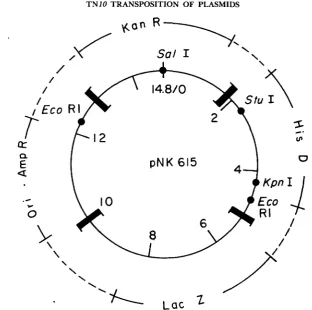
Effects of deletions and insertions on transposition of plasmid elements: T n l O transposition from a plasmid into the pOX38 conjugative episome was exam- ined using derivatives of a multicopy donor plasmid containing four TnlO ends (pNK615, Figure 1). T h e four ends are oriented as two pairs of inverted repeats, with a KanR marker present between one pair and a LacZ marker present between the other. T h e segments that separate the two pairs on either side are also marked, with AmpR and HisD respectively. Each of the four marked segments is roughly 3-4 kb in length. When transposition functions are provided in trans from a X prophage containing an IS10 transposase over- producer construction, the absolute and relative rates of transposition of dif- ferent segments can be determined by selection and screening for appropriate markers (see below). In several cases the structures of genetically identified transposition products have been confirmed by restriction analysis of the pOX38::Tn derivatives (not shown).
TNlO TRANSPOSITION OF PLASMIDS 707
/
i/
'
a
I
a ~
E
a
.c
w
0
\
pNK
615
a
4-
\
\
FIGURE I.-Structure of the 14.8 kb plasmid pNK615. Each of the four TnJO termini consists of the outermost 70 bp of IS10 (right). The two pairs of termini bracket 4.0 kb KanR and 5.0 kb LacZ segments, respectively. T h e HisD and AmpR-Ori segments are each 2.9 kb. pNK615 was constructed by insertion of the EcoRI fragment from pNK289 (FOSTER et al. 1981) into the unique EcoRI site of pNK419 (WAY and KLECKNER 1984).
tion (WAY and KLECKNER 1984; M. A . DAVIS, R. W. SIMONS and N. KLECKNER, unpublished results). Length dependence, therefore, was examined by con- struction and analysis of derivatives of pNK6 15 in which the length of one of the four marked segments was altered by deletion or by insertion of random E. coli fragments. Transposition of segments in the altered derivatives was compared with transposition of the corresponding segments in the parental plasmid.
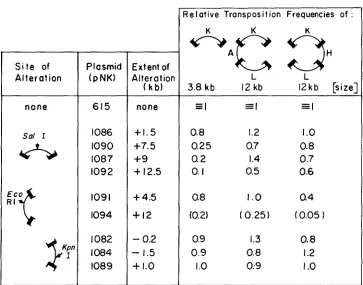
T h e structures and transposition properties of altered plasmids are shown in Figure
2.
(Numbers in parentheses are probably artificially low; the corre- sponding plasmid insert makes its host grow poorly.) T h e general finding from these experiments is that insertion or deletion of DNA at the SaEI, EcoRI or KpnI sites does not reduce or increase transposition of segments containing the inserted fragment in the way predicted from length-dependence experi- ments with chromosomal insertions. In particular:708 J. C. WAY AND N. KLECKNER
S i t e of AI t e r a t ion
n o n e
Sol I
cllcs,
P l a s m i d
( p NK)
615
I086 1090 1087 1092
109 I
1094 I082 1084 1089 Extent of Alteration
( k b )
n o n e
+1.5 +7.5 +9
+
12.5+
4.5+
12-
0.2-
1.5+
1.0~ ~~ ~~
qelative Transposition Frequencies of
K K K
L
L
3.8 k b 12 kb 12kb [size]
El =I
0.8 1.2 0.25 0.7 0.2 I .4 0. I 0.5
0.8 1.0
(0.2) ( 0.25
0.9 I .3
0.9 0.8 1.0 0;9
I
.o
0.8 0.7 0.60 4
( 0.05 1
0.8 I .2 I
.o
FIGURE 2.-Structures and properties of pNK615 derivatives. pNK6I 5 was altered by deletion of DNA from the unique KpnI site using BAL31 (pNK1082), by deletion of DNA between the
KpnI and Stul sites (pNK1084) and by insertion of random SalI-, K p n l - and EcoRI-generated restriction fragments of E. coli K12 into pNK615's unique Sal1 site (pNKs 1086, 1087, 1090 and 1092), unique Kpnl site (pNK1089), and EcoRI site near the AmpR gene (pNK1082) respectively. Transposition of different DNA segments from pNK615 and derivatives into the pOX38 conju- gative episome (GUYER et al. 1981) was measured and a mating-out assay was carried out as described in MATERIALS A N D METHODS and by WAY and KI-ECKNER (1984) and FOSTER et al.' (1981).
Plasmids were introduced into donor strain NK6660 (recA- pOX38) that carries a h prophage and a transposase overproducer construction, A1046 (MORISATO, et al. 1983; WAY and KLECKNER
1984). T h e recipient was NK6641 (AlacproXIll recA- strA hR mal-; MORISATO et al. 1983; FOSTER et al. 1981). T h e recipient also carried a multicopy CamR plasmid, pNK259, that is incompatible with pNK615 and others. Presence of this plasmid prevented overreplication of pOX38::Tn ex- conjugants containing the pNK6 15 origin on the transposed segment. Kanamycin-resistant excon- jugants were selected in the presence of chloramphenicol and were scored for LacZ and AmpR phenotypes. Relative frequencies of exconjugants carrying transposon markers are given. In the particular experiment shown, 0.01 ml of the parental pNK615 mating mix gave about 200 trans- positions of the small KanR segment, and 20 transpositions each of the large KanR-AmpR-LacZ (KHL) and KanR-HisD-LacZ (KDL) segments (average of five transformants, see MATERIALS AND METHODS).
TNlO TRANSPOSITION OF PLASMIDS 709 1.0 Z W 3 0 W U LL 0.5 0 I- v) v)
z
l- w>
I- -1 w CI:-
-
B
a
0.2-
a
0.1 \ \\
\ \ \ \\
1\
\ \ \I \ I I I I
2 4 6 8 IO 12 14
SIZE
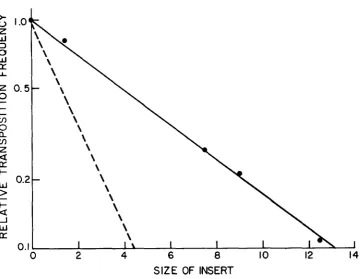
OF INSERTFIGURE 3.-Transposition of KanR segment as a function of length. Transposition frequencies of KdnR segments from plasmid carrying DNA inserts at the Sal1 site (pNK1086, 1090, 10087 and 1092) relative to that of pNK615 are plotted on a logarithmic scale against the size of the insert on a linear scale. Data are from Figure 2. Solid line corresponds to a decrease of 16% per kilobase increase in transposon length; dashed line corresponds to a decrease of 40% per kilobase increase as found for chromosomal TnlO insertions (MORISATO et al. 1983).
2.
Insertions of 4.5 and 12 kb into the EcoRI site have little or no effect on transposition of segments carrying the insertions. Even more paradoxically, both insertions decrease transposition of the large segment that does not con- tain the insert. Transposition of the KHL segment from pNKlO9 1 is decreased by twofold, which is a reproducible and significant effect. Transposition of the same segment from pNK1094 is decreased at least four-fold relative to that of other segments, assuming that transposition of all segments is nonspecifically depressed four or fivefold due to a deleterious effect of the inserted fragment. 3. Small insertions and deletions into the KpnI site have no detectable effect on transposition frequencies, where differences of up to 70% would have been expected among the derivatives tested from the chromosomal length depend- ence relationship.710 J. C. WAY AND N . KLECKNER
A
P N K
1085
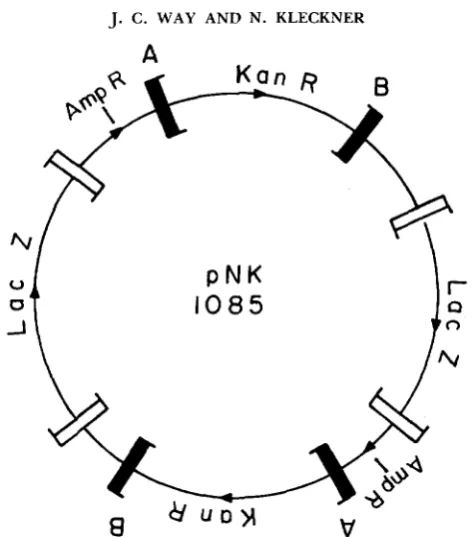
FIGURE 4.-pNK1085 is a dimeric form of pNK1084 (Figure 2) obtained and purified in a recA
-
host.and transposition of what amounts to the same segment containing an insert of pNK1084. These two segments should not differ in the intrinsic properties of their termini but only in the length and nature of the material between them. Consider the termini marked A and B flanking the KanR segment in Figure 4. An A and a B terminus can promote transposition of the KanR segment alone (segment X) or of a larger unit containing two KanR segments and a LacZ segment (segment Y ) . Among transpositions involving termini A
and B , about 80% (1 10 of 138) were transpositions of the small KanR segment alone (X); while 20% (28 of 138) were transpositions of two KanR segments plus the intervening material
(U).
Once again, the results are contrary to those expected from chromosomal length dependence assays. Since element Y is about 13.5 kb longer than element X , length dependence of the type observed for chromosomal TnlU elements would have predicted a several hundred-fold drop in transposition frequency.DISCUSSION
TNlO TRANSPOSITION OF PLASMIDS
71
1likely to reflect a difference between complemented and self-driven transposi- tion, because transposition of chromosomal elements is length-dependent even when driven by transposition functions provided in trans from a transposase overproducer plasmid (MORISATO et al. 1983).
One interpretation of these results is that TnlO transposition of a multicopy plasmid is mechanistically fundamentally different from transposition off of the chromosome-for example, that chromosomal transposition is replicative while most or all plasmid transposition is not-or that the replication process differs significantly in the two cases. This does not seem very likely, primarily because there has been no other indication that chromosomal and plasmid transposition differ significantly. T h e frequency of TnlO transposition per donor genome is the same for chromosomal and plasmid elements, as judged by comparing transposition of a particular hisG::TnlO insertion from a chromosomally inte- grated X hisG::TnlO prophage with transposition of the identical insertion off of a multicopy hisG::TnZO plasmid (N. KLECKNER, unpublished results). More importantly, the relative frequencies of different TnlO- and ISlO-promoted DNA rearrangements, which differ from one another by several orders of magnitude, are virtually identical for both chromosomal and plasmid-borne TnlO elements (WEINERT et al. 1984; M. SHEN, E. A. RALEIGYand N. KLECK- NER, unpublished results.
We would like to propose, instead, that neither chromosomal length de- pendence nor the less dramatic length dependence observed for one plasmid segment is due to decay of a passing replication fork, and that both effects reflect the process by which a complex is formed between transposase protein and two transposon ends. According to this interpretation, the difference be- tween chromosomal and plasmid transposition results from differences in the nature of the two donor molecules.
Chromosomal length dependence could reflect the probability of collision between the two terminus-bearing segments on a randomly coiled bacterial chromosome (MORISATO et al. 1983). If so, reduction or disruption of length dependence on a small plasmid could result from more compact coiling of the small circular molecule. Alternatively, length dependence could reflect decay of a transposase/terminus complex searching in one dimension for a second terminus. In this case, searching on a small circular plasmid might be different from searching on the long, linear bacterial chromosome. For example, search- ing might continue around and around the plasmid until an effective site is found. Alternatively, smooth one-dimensional movement might alternate with intramolecular jumps between one segment of the plasmid and another. Evi- dence is already available that IS10 transposase can search a target and select stronger termini over weaker ones; and intramolecular ‘Ijumps” have been proposed to account for the behavior of Int and Resolvase proteins (MORISATO
712 J. C. WAY A N D N . KLECKNER
ing DNA outside the transposing segment, although this effect might also be due to nonspecific inhibition of adjacent terminus activity by promoters on the inserted sequences.
Consistent with the notion that length dependence is not related to a repli- cative process is independent genetic evidence that TnlO transposition does not involve DNA replication. (KLECKNER et al. 1984; J. BENDER and N. KLECK- NER, unpublished results) have shown that artificially constructed heteroduplex TnlO elements present on appropriate X phages give rise to mixed colonies when they transpose into hosts lacking mismatch correction enzymes. T h e simplest interpretation of these results is that TnIO DNA is excised from the donor molecule and is inserted more-or-less intact into the target chromosome. In the case of bacteriophage M u , there is direct evidence that transposition length dependence does not result from abortive DNA replication but from a prior step. FAELEN et al. (1 985) have recently demonstrated that transposition by Mu, which is known to involve replication of the Mu genome, exhibits an exponential decay with increasing genome length similar to, although slightly less severe than, that observed with T n 9 and TnlO elements. However, meas- urements of phage replication following prophage induction revealed that in- creasing Mu genome length results in a decrease in the absolute amount of
Mu-specific DNA synthesis to levels of less than one or two copies per genome, even after 60 min, suggesting that the length-sensitive step is formation of a complex between the two termini or some other prereplicative event.
This work was supported by grants to N. K. from the National Institutes of Health (GM25326) and the National Science Foundation (83-034 15). We gratefully acknowledge critical reading of this manuscript by M. SYVANEN, H. NASH and K. MIZUUCHI and help in manuscript preparation by A . FERRI.
LITERATURE CITED
BERG, 0. G . , R. B. WINTER and P. H . VON HIPPEI., 1982 How d o genome-regulatory proteins locate their DNA target sites? Trends Biochem Sci. 7: 52-55.
CHANDLER, M . , M. CLERCET and D. J. GALAS, 1982 T h e transposition frequency of ISI-flanked transposons is a function of their size. J. Mol. Biol. 154: 229-243.
FAELEN, M . , A . TOUSSAINT, B. WAGGONER, L. DESMET and M. PATO, 1985 Transposition and replication o f Maxi-Mu derivatives o f bacteriophage Mu. Virology. In press.
FOSTER, 1’. J., M . A. DAVIS, D. E. ROBERTS, K. ‘TAKESHITA and N. KLECKNER, 1981 Genetic organization of transposon TnlO. Cell 23: 201-21 3.
GUYER, M. S . , R. R . REED, J. A . STEITZ and K. B. LOW, 1981 Identification of a sex-factor- affinity site in 6. coli as ganima-delta. Cold Spring Harbor Symp. Quant. Biol. 45: 135-140.
KLECKNER, N . , D. MoRIsn.ro, D. ROBERTS and J. BENDER, 1984 Mechanism and regulation of
T n 10 transposition. Cold Spring Harbor Symp. Quant. Biol. 49: 235-244.
KRASNOW, M. A . , M. M. MATZUK and N. R. COZZARELLI, 1983 Dynamics of site-specific recom- bination by the T n 3 resolvase. 12th Annu. UCLA Synip. J . Cell. Biochem. 7 B (Suppl.) 86.
TNlO TRANSPOSITION OF PLASMIDS 713
MORIsAro, D. and N. KLECKNER, 1984 Transposase promotes double strand breaks and single
TnZU transposase acts preferentially Kinetics of branch migration in
Essential sites at TnlU termini. Proc. Natl. Acad. Sci. USA strand joints at T n l O termini in vivo. Cell 3 9 181-190.
MORISATO, D., J. C. WAY, H.-J. KIM and N. KLECKNER, 1983
on nearby transposon ends in vivo. Cell 32: 799-807. THOMPSON, B. J., M. N. CAMIEN and R. C. WARNER, 1976
double-stranded DNA. Proc. Natl. Acad. Sci. USA 73: 2299-2303. W A Y , J. C. and N. KLECKNER, 1984
WEINERT, T. A., K. M . DERBYSHIRE, F. M. HUGHSON and N. D. E. GRINDLEY, 1984 81: 3452-3456.
Replicative and conservative transpositional recombination of insertion sequences. Cold Spring Harbor Symp. Quant. Biol. 49: 251-260.