Secure Stochastic Multi-party Computation for
Combinatorial Problems and A Privacy Concept
that Explicitely Factors out Knowledge about the
Protocol
∗
Marius C. Silaghi
†and Gerhard Friedrich
‡ †Florida Institute of Technology, USA
‡
University Klagenfurt, Austria
January 28, 2006
Abstract
High levels of security often imply that the computation time should be inde-pendent of the value of involved secrets. When the expected answer of the solver is either a solution orunsatisfiable, then the previous assumption leads to algo-rithms that take always the computation time of the worst case. This is particularly disturbing for NP-hard combinatorial problems.
In this work we start from the observation that sometimes (specially for hard problems) users find it acceptable to receive as answer either a solution, the answer
unsatisfiableor a failure with meaningdon’t know. More exactly users accept
incompletesolvers. As argued in [Sil05b], for certain problems privacy reasons lead users to prefer having an answer meaningdon’t knoweven when the secure multi-party computation could have provenunsatisfiable(to avoid revealing that all alternatives are infeasible). While the solution proposed in [Sil05b] is slower than complete algorithms, here we show secure stochastic solutions that are faster than complete solvers, allowing to address larger problem instances. Two new refined concepts of privacy are introduced, namely requested t-privacy that factors out treatment of knowledge of the protocol int-privacy, and a slightly weaker version callednon-uniform requested t-privacy. In the last section we discuss arithmetic circuits for complete and stochastic solutions to constraint optimization problems.
∗The update on Jan 28, 2006 introduced the comments about how the constant round primitive
first-in-array can replace certain computations. The last section, on Optimization Problems, was added during a September 2005 update, and contains material from [SPF05]. A subsequent more complete description of that section appears in [SFP06]. The section on the new privacy concept from [Sil05a], is further extended on Dec 31, 2006.
1 Introduction
Typical examples of combinatorial problems are meeting scheduling, resource alloca-tion, time-tabling, auctions with several possible winners. Such a problem is typically defined by a set of variables and constraints on the satisfiable assignments to these variables. The set of all (satisfiable and unsatisfiable) simultaneous assignments of val-ues to all variables defines thesearch spaceof the problem. An element of the search space is also referred to as an alternative to be considered as a solution to the problem, or simplyalternative.
A complete solver is one that reports a solution whenever a solution exists. The answer of such a technique is either a solution orunsatisfiable. Combinatorial problems can be very hard and therefore we no not have efficient complete secure multi-party computation solvers. Several complete secure solvers were proposed in the past for such problems, and high levels of security always require a computation time that is given by the worst possible case (over all possible values of the secrets).
It was shown that for problems that are solved only once, minimization of privacy loss often requires that the solution be picked randomly, preferably with a uniform distribution among the existing solutions [SR04]. Such a random selection can be achieved if the problem is shuffled prior to solving [Sil03, Sil04]. Two families of techniques were proposed for shuffling a shared description of a combinatorial prob-lem,one based on mix-nets and one based on arithmetic circuits [Sil05c].
Sometimes, the security requirements themselves require an incomplete solver (when the proof of unsatisfiability of the problem leads to unacceptable privacy loss, by revealing that all alternatives are infeasible) [Sil05b]. The answer of such a solver is either a solution orunsatisfiable. However, the solution proposed in [Sil05b] is actu-ally slower than complete solutions. It first computes a solution with a complete secure solver and then it hides the solution with some small probability.
In this work we show how the shuffling performed on problem descriptions prior to solving allows to build an incomplete secure stochastic multi-party solver where a high level of privacy is offered. The answers of the solver consists in either a solution or in
don’t know, and nothing is revealed about the set of alternatives that were not explored (except for its size). Notably, these algorithms are strictly faster than the corresponding complete versions and are parametrized with the percentage of the search space to be explored (the search space is the set of all alternatives that may or may not satisfy the combinatorial problem).
2 Privacy Concept that Explicitely Factors out
Knowl-edge about the Protocol
We refine a concept of privacy that allows to formally identify losses of privacy due to certain multi-party computation protocols. Namely, previous privacy concepts suggest that a protocol is secure if everythingleaked by its executioncan also be inferred from
prior knowledge and obtained result. However, in this article we stress the need to classify the information leaked due to the knowledge of which protocol is employed as beingleaked by its executionrather than solely byprior knowledge and obtained result. This distinction is non-trivial, as proven by the fact that several recent articles present algorithms designed according to the aforementioned privacy concept and still failing our test of security.
The implications of the two ways of accounting privacy loss becomes easily clear for problems where several solutions are possible (optimal). For such problems, the knowledge of the algorithm used to select the solution may leak information about where the other (optimal) solutions may or may not be located. While these implica-tions were underlined in our previous work, the new concept of privacy shown here offers a formal way to evaluate solutions proposed in the past for this problem. This allows to motivate protocols leaking less information for applications such as auctions. Different privacy concepts and levels of privacy were identified for multi-party computations [BOGW88, FMW01], and they are relevant for different computational models and assumptions. The t-privacy concept introduced in [BOGW88] is very well known and is applicable to many types of assumptions:
Definition 1 A multi-party computation is t-private if an attacker controlling any at mosttparticipants cannot learn anything from the computation, except for what can
be inferred from its outputs and prior knowledge.
Security of a t-private scheme can be computational (if breaking it is computation-ally intractable for the attacker) or information theoretical (if even infinite computation power cannot infer anything about secrets since no information about it is contained in the data obtained by the attacker).
Given secret inputsσ, the prior knowledgeΓof thetcolluders and a multi-party computation processΠwith answerα, the technique is t-private if the probability distri-bution of the secrets is conditionally independent onΠgiven answerαand knowledge
Γ.
P(σ|α,Γ,Π) =P(σ|α,Γ) (1)
However, many algorithms provide answersαthat contain more information than
what is actually needed. We typically decomposeαin a desired dataα∗ and an
al-gorithmic dependent unrequested data α. For example1 the desired data can be an
assignment of some variables satisfying secret constraints, and the unrequested data is what can be obtained from peculiarities of the used algorithmA(e.g., the solution is
the first/last in some known order on alternatives).
Definition 2 We say that an algorithmAachievesrequested t-privacyif the probability
distribution of the secrets is conditionally independent onΠ,Aandαgiven requested
dataα∗and prior knowledgeΓ.
P(σ|α,Γ,Π,A) =P(σ|α∗,Γ) (2)
Examples of algorithms designed to be secure, according to Equa-tion 1 [BOGW88], but insecure according to the definiEqua-tion introduced in EquaEqua-tion 2 are proposed in [YSH02a, Sil03, YS04, NZ05].
For problems with several solutions,requested t-privacytypically implies the re-turn of uniformly random selected solutions whenever the problem may have more than one solution. Examples of techniques secure according to the introduced concept are [Sil04, Sil05a]. Sometimes uniform randomness in selecting the solution requires very expensive computations. Non-uniform randomness in selecting the solution, while shown to be often clearly better then deterministic approaches and often achievable with significantly reduced computation effort, is less secure [Sil04]. The level of pri-vacy achieved in that case is nevertheless interesting and worth its own definition. We propose to call itnon-uniform requested t-privacy, and can be describes by the prop-erty:
Definition 3 We say that an algorithmAachievesnon-uniform requested t-privacyif
for any secretσ∈σthat is not deterministically revealed given requested dataα∗and
prior knowledgeΓ, it is also not deterministically relealed givenΠ,Aandα.
∀σ∈σP(σ|α∗,Γ)<1⇒P(σ|α,Γ,Π,A)<1 (3)
3 Background
Combinatorial problems have been often discussed in Computer Science and many ex-amples are known to be very hard. For example SAT was the first proven NP-complete problem and Constraint Satisfaction Problems are largely addressed with stochastic and incomplete solvers.
A Constraint Satisfaction Problem (X,D,C) is defined by a set of variablesX =
{x1, ..., xm}, a set of domains D = {D1, ..., Dm} where Di is the domain forxi,
and a set of constraintsC={φ1, ..., φc}. Each constraintφj specifies the acceptable
combinations of assignments of values to a subsetXj of the variables. A tuple is a
vector of assignments of values to distinct variables. A solution of the CSP is a tuple of assignments of values to all the variables and that satisfies all the constraints. The search space of the CSP is defined by the Cartesian productD1×...×Dm. An element
of the search space is called analternative. Theithalternative is denoted by i.
A distributed CSP is a CSP(X, D, C)where a set of participantsA={A1, ..., An}
3.1 Shuffling an array of shared secrets
Secure multi-party computations can simulate any arithmetic circuit [BOGW88] or boolean circuit [Kil88, Gol04] evaluation. An arithmetic circuit can be intuitively imagined as a directed graph without cycles where each node is described either by an addition/subtraction or by a multiplication operator. Each leaf is a constant.
The secure multi-party simulation of arithmetic circuit evaluation proposed in [BOGW88] exploits Shamir’s secret sharing [Sha79]. This sharing is based on the fact that a polynomialf(x)of degree t−1with unknown parameters can be
recon-structed given the evaluation off in at leastt distinct values of x, using Lagrange interpolation. Absolutely no information is given about the value off(0)by reveal-ing the valuation off in any at mostt−1non-zero values ofx. Therefore, in order to share a secret numberstonparticipantsA1, ..., An, one first selectst−1random
numbersa1, ..., at−1that will define the polynomialf(x) =s+Pti−=11(aixi). A
dis-tinct non-zero numberτi is assigned to each participant Ai. The value of the pair
(τi, f(τi))is sent over a secure channel (e.g. encrypted) to each participantAi. This
is called a(t, n)-threshold scheme. We will assume that all computations are
per-formed in a fieldZqfor some prime numberq. Once secret numbers are shared with a
(t, n)-threshold scheme, evaluation of an arbitrary arithmetic circuit can be performed
over the shared secrets, in such a way that all results remain shared secrets with the same security properties (the number of supported colluders,t−1) [BOGW88, Yao82].
For [Sha79]’s technique, one knows to perform additions and multiplications when
t≤(n−1)/2. Since anybn/2cparticipants cannot find anything secret by colluding, such a technique is calledbn/2c-private [BOGW88]. It is also known how to evaluate with computational securely any arithmetic circuit on additively shared secrets.
Shuffling with mix-nets In [Sil03, Sil04, Sil05c] it is shown how a mix-net can shuffle a vector of shared secrets and can unshuffle a vector of the same size using the inverse permutations. Each participant encrypts his share of each secret using a
(+ modq, X)public encryption scheme for which it holds the secret key, and sends
a vector holding each encrypted share toA1. The vectors with the encrypted shares
are passed along each participant inA, each of the applying the same secret
permu-tation on all vectors. A shared 0 is also added to each sharing of a secret using the homomorphism of the encryption. Each participant will provide the others with a zero-knowledge proof for the correctness of his shuffling (respectively unshuffling).
Shuffling with arithmetic circuits Assume that we have composable multi-party computations [Kil05, DFNT05] for computing:
• δK(x, y): Kronecker’s delta returning a shared 1 whenx=yand 0 otherwise
• cmp(x, y)returns 1 whenx < yand 0 otherwise
• RS(m, M): random secret generator, generating a shared secret in the interval
m, M.
• ∨`
k=1xi: computes a shared secret equal to the result of applying logic∨on the
3.2 First in Array
The primitivef irst([a[1..m]]F, m)can be applied on a vector of m shared secrets
[a[1..m]]F = [a[1]]F,...,[a[m]]F, in{0,1}, and replaces all its elements with 0, except for the first occurence of a 1. A version of the implementation in [DFNT05], requiring a constant number of rounds, namely 17, and 20m multiplications, is described in the following. Implementations with less multiplications but linear or logarithmic round are straight-forward and are shown in [Sil03, Sil04].
Letλ=d√me. First the elements ofaare wrapped in aλ×λmatrixb[i, j], such that:
[b[i, j]]F=
[a[iλ+j]]F if(i−1)λ+j≤m
0 otherwise
Then compute[x[i]]F = ∨λ
j=1[b[i, j]]F and[y[i]]F = ∨ik=1[x[k]]F fori ∈ [1..λ], and
compute the row selector:
[row[i]]F=
[y[i]]F ifi= 1 [y[i]]F−[y[i−1]]F ifi∈[2..λ]
Next one computes the selected row[r[j]]F=Pλi=1[row[i]]F∗[b[i, j]]Fand the column
selector with[z[i]]F=∨i
k=1[r[k]]Ffori∈[1..λ], and
[col[j]]F=
[z[j]]F ifj= 1 [z[j]]F−[z[j−1]]F ifj∈[2..λ]
Finally, the changes in the input vector are performed with: [b[i, j]]F = [row[i]]F ∗ [col[j]]F andbis returned as result. Operations can be optimized to disregard the 0
elements added tobat the beginning.
3.3 Shuffling
It is possible to design an arithmetic circuit for shuffling secrets, using the Algorithm 3. This algorithm uses Algorithm 1 for a permutation of two elements on secret positions in a vector. The random permutation is defined by a random vector computed with Algorithm 2. Unshuffling can be done with the Algorithm 4.
functionPerm (s,i,r,m,M,k
si=PMj=m(δK(r, j)∗sj); forj∈(i, k]do
sj =sj+ (si−sj)∗δK(r, j);
Algorithm 1: Permuting elementsiwithsrfor a secret valuer∈[m, M]in vectors
withkshared secrets
This permutation was shown in [Sil05c] to lead to a random shuffling (taken from a uniform distribution). Note that the random vector defining the permutation could have been built allowing each element to belong to any value between1andk. This
would be computationally more expensive as it would require each call to the procedure
functionRandomVector(k)
forj= 1tok−1do
r[j] =RS(j, k); returnr;
Algorithm 2: Shuffling a vectorswithkshared secrets
functionShuffle(s,k,r)
forj= 1tok−1do
Perm(s,j,r[j],j,k,k);
Algorithm 3: Shuffling a vectorswithkshared secrets, and a random vectorrobtained
with Algorithm 2
functionShuffle(s,k,r)
forj=k−1to1do
Perm(s,j,r[j],j,k,k);
Algorithm 4: Un-shuffling a vectorswithk shared secrets, when the shuffling was defined by random secret vectorr.
functionShuffle(s,k,r)
forj= 1tokdo
Perm(s,j,r[j],1,k,k);
3.4 MPC-DisCSP4
In [Sil05b] we have proposed a multi-party computation technique, called MPC-DisCSP4, that extracts a random solution of a distributed CSP. MPC-DisCSP4 uses general multi-party computation building blocks. General multi-party computation techniques can solve securely certain functions, one of the most general classes of solved problems being the arithmetic circuits. A distributed CSP is not a function. A DisCSP can have several solutions for an input problem, or can even have no solution. Two of the three reformulations of DisCSPs as a function (see [SR04]) are relevant for MPC-DisCSP4:
i A function DisCSP1() returning the first solution in lexicographic order,
respec-tively an invalid valuationτwhen there is no solution.
ii A probabilistic function DisCSP() which picks randomly a solution if it exists, respectively returnsτwhen there is no solution.
For privacy purposes only the 2ndalternative is satisfactory. DisCSP() only reveals
what we usually expect to get from a DisCSP, namelysomesolution. DisCSP1()
in-trinsically reveals more [SR04]. MPC-DisCSP4 implements DisCSP() in five phases:
1. Share the secret parameters of the input DisCSP using Shamir’s secret sharing. The value of each publicly possible assignment (allocation) is securely evaluated.
2. The shared DisCSP problem is shuffled in a cooperative way, reordering val-ues (and eventually variables), with a permutation that is not known to any-body [Sil05c].
3. A version of DisCSP1() where the operations performed by agents are
indepen-dent of the input secrets (to avoid leaking the secrets), is executed by simulating arithmetic circuits evaluation with the technique in [BOGW88].
4. The solution returned by DisCSP1() at Step 3 is translated into the initial
problem formulation using a transformation that is inverse of the shuffling at Step 2 [Sil05c].
5. Construct the solution from its secret shares.
It is also possible and very simple to find all solutions [HCN+01]. However, when
only a single solution is needed, this leaks a lot of information. At Step 3, MPC-DisCSP4 requires a version of the DisCSP1() function whose cost is independent of the
input, since otherwise the users can learn things like:The returned solution is the only one, being found after unsuccessfully checking all other tuples, all other tuples being infeasible.Since the used DisCSP1() has to be independent of the problem details, its
cost is exponential (at least as long as nobody proves P=NP).
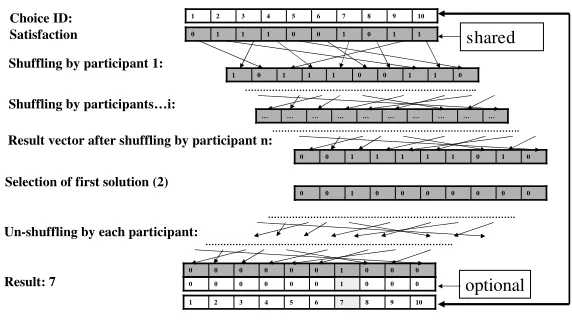
10 9 8 7 6 5 4 3 2 1 0 1 1 0 0 1 1 1 0 1 1 1 0 1 0 0 1 1 1 0 0 0 0 1 0 0 0 0 0 0 0 0 0 0 0 0 0 1 0 0 0 1 0 1 1 1 1 1 0 0 Choice ID: Satisfaction
Shuffling by participant 1:
Shuffling by participants…i:
… … … … … … … … … … ……….. ……….
Result vector after shuffling by participant n:
Selection of first solution (2)
10 9 8 7 6 5 4 3 2 1 ……….
Un-shuffling by each participant:
……….
Result: 7 0 0 0 0 0 0 1 0 0 0
shared
optional
Figure 1: MPC-DisCSP4 using mix-nets
3.5 Hiding existence of solution
When no solution is found, all the participants learn that each alternative is infeasible. For certain problems this leak of secrets may be considered unacceptable and adon’t knowanswer is prefered to learning the infeasibility. But thedon’t knowanswer is believable only if the algorithm may indeed miss some solutions. An algorithm for missing the solution with some predefined probabilitypis described in [Sil05b]. It
consists of computing a solution using a MPC-DisCSPx algorithm and then setting the assignments in the result to the invalid value 0 with a probabilityp.
3.6 Stochastic algorithms
In the CSP world it is known that complete algorithms are ineffective for hard problem instances. For large problems, most applications apply stochastic search procedures. With stochastic search, only a subset of the search space is analyzed. Typical examples of stochastic search are based on some type of hill climbing. With hill-climbing the solver starts with a random alternative and searches the neighbouring search space for solutions.
4 Simulated Annealing for Secure Optimization
Once the secret constraints of a distributed CSP are shared and shuffled with the tech-nique of MPC-DisCSP1 [Sil03, Sil05c], one can try to search a feasible solution of the shuffled problem using some hill-climbing. The same considerations and procedures apply if the problem is shuffled with a mixnet obtained from the one in [YSH02b] by replacing the encryption scheme with a(+,×)-homomorphic version (E.g., Paillier
with shared secret key, or the version of ElGamal of the formEa,y,g,p(m, r) = hgr
The quality of an alternative will normally be evaluated securely (since we do not tipically want to reveal individual constraints even if they were shuffled - as it would lead to an important privacy loss). The total weight (or number of conflicting con-straints) for an alternativeis computed withq(, P) =Pc∈Cc(). The revelation of
the quality will be relatively expensive for both versions (based on either secret shar-ing or homomorphic encryption). Therefore, this suggests to use stochastic algorithms that are lazy in evaluating the qualities of new tuples. Such a technique is Simulated Annealing (Algorithm 6).
procedureSSAdo
Shuffle DisCSP using secret sharing or additive encryption homomorphism; Select random alternative (tuple)t;
fordecreasing ’temperature’ Tdo
change randoly the value of one variable obtainingt0;
compute securely and then reveal∆ =q(t0)−q(t);
/*alternatively reveal q(t’) to detect termination when the optimum is known*/;
/*or securely compute and reveal onlycmp(q(t0), q(t)), if it returns 1*/;
if∆<0then
t=t’
else
t=t’ with probabilitye−∆
T
Unshuffle the results;
Algorithm 6: Secure Simulated Annealing (minimization)
Similar to the technique in [Sil02, YSH02b], the Secure Simulated Annealing al-gorithm may reveal undesired statistical information about some secrets via the knowl-edge of the shuffle search space. However, specific exact information about a secret may only be inadvertently revealed only for problems with very special patterns. In the following we concentrate on algorithms guaranteed not to reveal anything else besides the solution.
5 Secure Stochastic Search
Let us finally detail our proposed techniques for tractable secure stochastic search, allowing to address hard problems. The idea is that only a subset ofT alternatives
5.1 Secure Stochastic Search with Mix-nets
Each MPC-DisCSPx solving algorithm using mixnets can be modified into a corre-sponding secure stochastic search protocol that will be called Stochastic Multi-Party Computation for Distributed CSPs (SMPC-DisCSPx). Each SMPC-DisCSPx differs from the corresponding MPC-DisCSPx by the fact that only the firstT tuples of the
shuffled search space are used to compute the shuffled solution. Each stochastic solver is parametrized by the numberT of alternatives to be explored (T beeing smaller or
equal to the size of the search space). To be noted that a stochastic solver can be seen as a generalization of the corresponding complete solver, which is obtained whenT
equals the size of the search space.
SMPC-DisCSP4 For example, SMPC-DisCSP4 is shown in Algorithm 7. A version that explicits how to exploit an efficient “first in array” primitive is given in Algo-rithm 8.
functionSMPC-DisCSP4(T,(X,D,C))
fori=1 to kdo
S[i]=Qφ∈Cφ(i);
SHUFFLE(S) //using the mixnet; h[1]=1;
fori=2 to Tdo
h[i]=h[i-1]*(1-S[i-1]); S[i]=S[i]*h[i];
7.1 /* S[i]=S[i]*cmp(RS(0,q-1),p*q)// fine tuning*/; 7.2 /* S[T]=S[T]*cmp(RS(0,q-1),p*q)// fine tuning*/;
UNSHUFFLE(S);
7.3 set solution S to 0 with probability p; //optional;
return S // the solution can be extracted from S as in [Sil05b];
Algorithm 7: SMPC-DisCSP4 for solving a CSP(X, D, C)withkalternatives allowed
by the public constraints, and exploringT alternatives.
functionSMPC-DisCSP4(t,(X,D,C))
fori=1 to kdo
S[i]=Qφ∈Cφ(i);
Shuffle(S) //using the mixnet;
f irst(S, t); // call “first in array” primitive; Un-Shuffle(S);
// the solution can be extracted from S as in [Sil05b]; return S;
Algorithm 8: SMPC-DisCSP4 for solving a CSP(X, D, C)withkalternatives allowed
SMPC-DisCSP4 requires k(c−1) multiplications of secrets to build the vector
S and2T multiplications of secrets to select the solution. Also, the shuffling and
unshuffling require eachO(kn2) expensive operations,O(kn) for each participant.
While SMPC-DisCSP4 leads to a reduction with up to2kmultiplications of secrets,
the complexity remains the same, dictated by the shuffling.
One can allow agents to avoid revealing if that there existT alternatives that are
not solutions, by enabling the optional cancelation of the solution with probabilitypat
Line 7.1. This cancelation of solution can be done with the technique in [Sil05b]). It can be noted that the probability that a solution is lost can be fine tuned (e.g. for the application in [Sil05b]) by discarding the alternatives with probabilityp. This can be done by uncommenting either Line 7.1 or Line 7.2 in the Algorithm 7. In Al-gorithm 8 this can be done more efficient by multiplying each element[x[i]]F in the algorithm “first in array” withcmp(RS(0, q−1), p∗q) in one round andλ multipli-cations.
SMPC-DisCSP1 The stochastic algorithm obtained from MPC-DisCSP1 is more successful, and is sketched in Algorithm 9.
functionSMPC-DisCSP1(T,(X,D,C))
SHUFFLE(X,D,C) //using the mixnet;
fori=1 to Tdo
S[i]=Qφ∈Cφ(i);
F=DisCSP1(T,(X,D,C),S);
UNSHUFFLE(F); // Unshuffle each vector in F separately; set solution F to 0 with probability p; //optional;
return F;
Algorithm 9: SMPC-DisCSP1 for solving a CSP(X, D, C)withk alternatives and
exploringT alternatives.
DisCSP1 (Figure 2) is the arithmetic circuit proposed in [Sil03], with the only modification that functionsatisfiable()only integrates the firstT tuples (rather
than the whole search space). The resultF returned by DisCSP1 is a set of vectors,
one for each variable. A vector contains shared 0s on all positions, except for a 1 on the position corresponding the the value of the corresponding variable in the found solution. If there is no solution, then all elements of the vectors are 0.
The cost of SMPC-DisCSP1 is onlyO(T(md+c))multiplications of secrets. Of these,T(c−1)are used to computeS. DisCSP1 computessatisfiablemdtimes, each of them requiring at mostO(T)multiplications. The cost of shuffling in SMPC-DisCSP1 can be small even for large and hard problems, if the maximum constraint arity (number of involved variables) is small.
p(, P) = Y
c∈C
c()
satisfiable(P) = cmp(0, X
i∈[1...T]
p(i, P))
gi,j(P) = satisfiable(P∪ {xi=j} ∪k<i(xk =fk(P)))
fj(P) =
|Dj|
X
i=1
i∗(gj,i(P)∗δK(0, X
k<i
gj,k(P)))
Figure 2: Arithmetic circuit DisCSP1 for a CSPP = (X, D, C). The result is the vector of vectors{{δK(fi, j)}j∈[1..|Di|]}i∈[1..m]. Versions with other primitives appear
in [Sil03, Sil04]
needs to make sure that the same subset of the search space is explored by each instance of the optimization algorithms. Remember that in GVA one computes the Clarke taxes using the value of the best allocation for several different settings (excluding each bid-der in the computation of his tax).
Remark 1 Therefore the same shuffling has to be used for all these instances of opti-mization. Also the same parameterT has to be used for each instance optimization (at
each given total weight of the solution).
At each optimization instance that excludes a bidder one only needs the weight of the optimal solution, and onlysatisfiable(P)is computed there for each given total weight.
5.2 Constant round primitives in SMPC-DisCSP1
Constant round primitives can improve SMPC-DisCSP1. Namelysymmetric functions
can be used for reducing the number of rounds for the functionsatisfiable,first in arraycan be used to get rid if thetiteration, and unbounded fan-in multiplications can be used to compute S (needed inp()) in constant rounds. The obtained changes are depicted in Figures 3,10
proceduresatisfiable(t,P)do
return∨t
k=1[p(k, P)]F
Algorithm 10: Functionsatisfiable: returns0or1function on whether at least
one of the firstttuples in the search space ofP is a solution toP, wherek is thekth
Fj[k] =f irst([gj,1(P)..gj,|Dj|(P)],|Dj|)
p(, P) =Qφ∈Pφ()
gi,j(P) =satisfiable(P∪Λjik<i∪ Λ∗k,P, t)
Λji()
def
=
1 ifxi=vjiin valuation
0 ifxi6=vjiin valuation
Λ∗k,P()
def
= Fk[|xk] =
(
1 ifxk =vkfk(P)in valuation
0 ifxk 6=vkfk(P)in valuation
Figure 3: DisCSP1(t, P): arithmetic circuit for MPC-DisCSP1. It returns the set of
vectorsFj,∀j∈[1..m].|xkstands for the value ofxkin.
5.3 Secure Stochastic Search with arithmetic circuits
The secure stochastic algorithms based on mix-nets suffer from the fact that the cost of shuffling remains the same as for the non-stochastic complete approaches. This was particularly negative in the case of SMPC-DisCSP1 where the cost of the shuffling is the main cost.
This problem is reduced in algorithms with shuffling based on arithmetic circuits. Namely, with shuffling based on arithmetic circuits one does not need to compute the whole shuffling. With SMPC-DisCSP4, it is possible to only compute the firstT ele-ments of the shuffled problem (see Algorithms 11, 12), and 13).
functionShuffle(s,k,r,T)
forj= 1toT do
Perm(s,j,r[j],j,k,k);
Algorithm 11: Shuffling a vectorswithkshared secrets, and a random vectorr
ob-tained with Algorithm 2
functionShuffle(s,k,r,T)
forj=Tto1do
Perm(s,j,r[j],j,k,k);
Algorithm 12: Un-shuffling a vectorswithkshared secrets, when the shuffling was
defined by random secret vectorr.
It can be noted that in secure stochastic algorithms based on arithmetic circuits we succeed to reduce the cost of shuffling and unshuffling fromO(k2)toO(kT)
mul-tiplications of secrets. With this improvement the complexity of SMPC-DisCSP4ac decreases, but remains high sincekis large for hard problems (can be exponential in
functionSMPC-DisCSP4ac(T,(X,D,C))
fori=1 to kdo
S[i]=Qφ∈Cφ(i);
R=RandomVector(T);
SHUFFLE(S,k,R,T) //using the mixnet;
f irst(S, t); // “first in array” algorithm;
fori=T+1 to kdo
S[i]=0;
UNSHUFFLE(S,k,R,T);
set solution S to 0 with probability p; //optional;
return S// the solution can be extracted from S as in [Sil05b];
Algorithm 13: SMPC-DisCSP4ac, solving a CSP(X, D, C)withk alternatives
al-lowed by the public constraints, and exploringT alternatives.
In conclusion the most appropriate algorithm for Stochastic Search is SMPC-DisCSP1 which has polynomial space requirements and whose computational (time) complexity can be bounded to low values being linear inT and in the problem size.
SMPC-DisCSP4ac (with arithmetic circuits) has a time complexity significantly smaller than MPC-DisCSP4 (O(k(T +c))versusO(k2)). This implies that the size
of the problems solvable with SMPC-DisCSP4’ is larger than the size solvable with MPC-DisCSP4, which had the best complexity among complete algorithms.
Remark 2 (SMPC-DisCSP1ac) Arithmetic circuit shuffling for SMPC-DisCSP1 works by separately permuting each domain (with a separate random vector for each of them). The improvement that can be brought is to only compute the permuted con-straint elements that are part of the firstTtuples.
The shuffling for SMPC-DisCSP1 is not expensive. Therefore possible improve-ments in versions based on arithmetic circuit shuffling are less significant, not changing the time complexity.
6 Optimization Problems
It is known that, in general, Constraint Optimization Problems (COP) are NP-hard. Existing arithmetic circuits for secure protocols solving such problems are exponential in the number of variables,n. Using variable elimitation techniques [Dec90] COPs
can be solved with computation that is exponential only in the induced-width of the Depth First Search tree (DFS) of the constraint graph [PF05b], i.e. smaller thann. We
show how to construct an arithmetic circuit with this property and solving any COP. For forest constraint graphs, this leads to a linear cost secure solver.
weighted constraintsC ={φ0, ..., φm}, each such constraintφispecifying a distinct
cost associated with each assignment of values to a subsetXiofX.
An assignment is a pairhxi, viwherev ∈ Di. A solution of the COP is a tuple
of assignmentswith values for each variable inX such that the sum of the weights
associated by the constraints inC tois maximized (minimized). Without loss of
generality we assume that by optimal solution we understand the solution with maximal weight. If we denote the projection of a tupleon a set of variablesXiby|Xi, then
the solution is:
argmax
X
φi∈C
φ(|Xi)
A distributed COP (DCOP) arises when some constraints are functions of secrets own by some agents from a setA = {A1, ..., An}. Without loss of generality we
assume thatφ0 is the only public constraint and thatXm, the set of variables inφm,
contains besidesxmonly variablesxiwithi < m. Note that such a formulation can be
obtained from any DCOP by building a Depth First Search (DFS) tree, introduced later and combining the constraints such that there remains a single constraint per variable (with his ancestors in the tree).
Our work employs the following secure multi-party computation techniques:
• polynomial secret sharing [Sha79]: Each participantkout ofnparticipants
re-ceiveshsit k =s+
Pt
i=1aiki, whereaiis a secret random number. The secret can
be reconstructed with the collaboration oft+1participants usings=Ptk+1=1lk,t,
wherelk,tare the corresponding Lagrange coefficients.
• addition of shared secrets [BOGW88]:hs1+s2itk=hs1itk+hs2itk
• resharing shared secrets: To reshare a secrethsitwith another thresholdt0, each
sharehsit
kis shared with (t0+ 1, n)-polynomial sharing scheme.
• multiplication of shared secrets [BOGW88]:hs1∗s2i2kt =hs1itk∗ hs2itk
• arithmetic circuit evaluation with additive secret sharing [Gol04]: Each partic-ipantk, k > 1 out ofnparticipants receives[s]k = ai where ai is a random
number. Participant 1 gets [s]1 = s−Pni=2ai. The secret could be
recon-structed with s = Pnk=1[s]k. Addition of additively shared secrets is done
with[s1+s2]k = [s1]k + [s2]k. Multiplication is done using oblivious
trans-fers [Gol04].
• secure test [DFNT05]:δ(x)returns 1 ifx= 0and 0 otherwise.
• secure Kronnecker’sδ[Kil05]: δK(x, y) = δ(x−y)returns 1 ifx =yand 0
otherwise.
• secure comparison [DFNT05]:cmp(x, y)returns 0 ifx < yand 1 otherwise.
6.1 Optimization Background
DCOPs have been addressed with various techniques that differ both in efficiency and in their privacy guarantees. The former techniques seeking the strongest privacy guar-antees are based on secure multiparty computation and scan several times the whole search space, i.e. Cartesian product of domains in D, once for each possible total
weight [SM04]. An optimization protocol specialized on generalized Vickrey auc-tions and based on dynamic programming is proposed in [YS04] and is significantly more efficient, but does not randomize the selection of the solution, needed for reach-ing the highest level of privacy [SR04]. DPOP, a dynamic programmreach-ing algorithm for solving (D)COPs was proposed in [PF05b] and consists of a Viterbi-like combina-tion of a maximizacombina-tion and decoding [Vit67]. The algorithm in [PF05b] can also be seen as a clever heuristique for variable elimination [Dec90], or as a parallelization of ADOPT [MTSY03], and is based on a different concept of privacy [SF02].
6.1.1 Variable Elimination
Variable Elimination is a principled technique for complexity reduction in COPs. It consists of replacing all the constraints (objective functions) linked to a variable chosen for elimination by the projection of their composition on the remaining variables. A heuristique for selecting the variables to be eliminated next is provided by the DFS tree [PF05b].
6.1.2 DFS tree
The primal graph of a COP is the graph having the variables as nodes and having an arc for each pair of variables linked by a constraint [Dec03]. A Depth First Search (DFS) tree associated to a COP is a spanning tree generated by the arcs used for visiting once each node during some depth first traversal of its primal graph. DFS trees were first successfuly used for Distributed Constraint problems in [CDK00]. The property exploited there is that separate branches of the DFS-tree are completely independent once the assignments of common ancestors are decided.
Definition 4 (neighbor nodes) The nodes directly connected to a node in a primal graph are said to be itsneighbors.
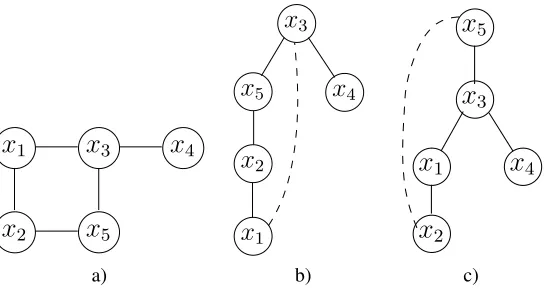
In Figure 4.a, the neighbors ofx3are{x1, x5, x4}.
Definition 5 (ancestor nodes) Theancestorsof a node are the nodes on the path be-tween it and the root of the DFS tree, inclusively.
In Figure 4.b, the ancestors ofx2are{x5, x3}, whilex3has no ancestors.
Definition 6 (descendants nodes) The descendantsof a node are its children in the DFS tree, as well as the children of any other of its descendants.
x
1x
2x
3x
4x
5x
3x
1x
2x
5x
4x
5x
3x
1x
2x
4a) b) c)
Figure 4: For a COP with primal graph depicted in (a), two possible DFS trees are (b) with induced width with 2 and (c) with induced width 2.
Aneighboring ancestorof a node is any node that is both a neighbor in the primal graph and an ancestor in the used DFS tree. The induced width of a DFS tree is given by the the number of ancestors that are neighboring him or some of its descendants Two examples of DFS trees for a COP primal graph are shown in Figure 4. It can be noted that trees with different induced widths can be obtained. Several heuristiques had been used in the past for building DFS trees with reduced width, a prefered optimal technique consisting of a branch & bound procedure.
The ancestors ofxi are all the nodes of the path between root of the tree andxi,
inclusively the root. The descendants ofxiare all the nodes for whichxiis an ancestor.
We use the following notation. Let:
• Fxbe the parent ofx(in Figure 4.bFx5 =x3) • Sxbe the children ofx(in Figure 4.cSx3 ={x1, x4})
• Pxbe the neighbor ancestors ofx(in Figure 4.cPx2 ={x1, x5})
• Gxbe the induced parents ofx, i.e., ancestors that are neighbors forxor for
some descendant ofx(in Figure 4.cGx1 ={x3, x5}, sincex5is the neighboring
ancestor of the descendantx2)
In this work we do not address heuristiques for building DFS trees, but consider that such a tree is provided.
6.1.3 DFS-based Variable Elimination
the problem (and therefore the complexity of the algorithm) is bounded by the distance between two neighbors in the DFS tree. This is bounded by the depth of the tree and potentially much smaller thann. The advantage of this heuristique is that the quality
of an elimination order can be easily evaluated.
6.1.4 Secure Optimization
A secure optimization algorithm for DCOP is proposed in [SM04]. It chooses ran-domly one of the values with the optimal value and reveals the total weight of the solution and the corresponding assignments only if desired and only to agreed partic-ipants. To ensure random selection of the solution, shuffling of values is done prior to solving. The result of the computation will be unshuffled. In [Sil04] it is shown how to make the selection with a uniform random distribution. However, the complete versions of these techniques are always exponential in the size of the search space (as defined by the public constraints).
Remark 3 The fact that a mix-net leads to a random solution only hold for an agent (or a set of agents) if the ’other’ agents shuffle all variables.
If at least one agent does not shuffle a variable, this do not hold for the sub-group that shuffle, and the benefit of the shuffling is completely lost
Theorem 1 All agents must be involved in shuffling each variable’s domain of a prob-lem.
Proof. If some agentAi does not shuffle a variablexj, then all the other agents can make
a coalition, find the order onxj with which the problem was solved, and learn a set of
val-ues ofxj for which there is no optimal solution. Eliminating xjfor those values leads to a
projection of constraint on the remaining variables,X0, from which they can infer bounds on
Ai’s costs on those remaining variablesX0 (lower bounds at minimization respectively upper
bounds at maximization). The techniques in [Sil05c] achieve the required type of shuffling/unshuffling.
In the following we show how to formulate arithmetic circuits for securely comput-ing an optimal solution of a DCOP uscomput-ing DFS-based Variable Elimination. As in the non-secure version, the algorithm has two parts, un (upward) dynamic programming step, and a (downward) decoding step.
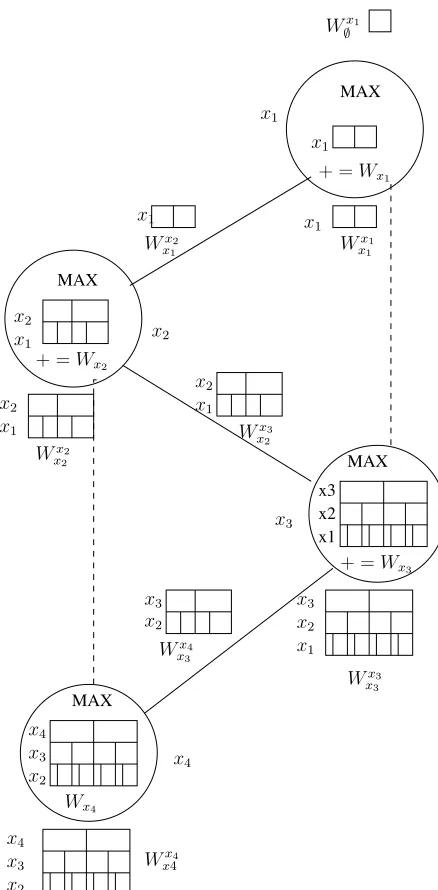
6.2 Arithmetic Circuits
The data structure we employ as well as their usage is depicted graphically in Figure 5. For each nodexi there is a separate set of data structures WFxii, W
xi
xi, Wxi. These
data structures are accessed by indexing with partial assignment of variables (and are implementable as multi-dimensional matrices).
• Wxi
xi holds φi, namely a local costs associated to each assignment of xi and
x3 x2 x1
MAX
MAX
MAX
MAX x4
x3 x2
x1
x4
x3 x2
x3 x2
x4
x3
x2
x3 x2 x1
x2
x1 x2
x1
x1 x
1
x1
x2 x1
Wx4
+ =Wx3 + =Wx1
Wx2
x1 W
x1
x1
Wx3
x3
Wx4
x4
Wx2
x2
Wx4
x3
Wx3
x2
Wx1
∅
+ =Wx2
Figure 5: Data structures in the Upward computation.
• Wxi holds the cummulated cost associated byφiand the projection of the
con-straints of all its children to each assignment ofxi and induced parents of xi,
• Wxi
Fi holds the cummulated cost associated byφiand the projection of the
con-straints of all its children to each assignment of induced parents ofxi,Gxi.
On the upward path in the DFS tree, for each nodexione computes for each assignment
Sof the induced parentsGx:
Wxi
Fi[S] = maxv∈D i
(Wxi
xi[hxi, vi ∪S|Pxi] +
X
y∈Sxi
(Wxyi[(S∪ {hxi, vi})|Gy])
The valueWr
∅, whereris the index of the root node, is the weight of the optimal
solution. The steps of computation are detailed in the Algorithm 14.
procedureUpward(xi)do foreach(y∈Sxi)do
Upward(y);
foreachtupleforGxi∪ {xi}do
Wxi[] =W
xi
xi[|{xi}∪Pxi]+
P
y∈Sxi(Wxyi[|Gy];
foreachtupleforGxi do
Wxi
Fi[] = maxv∈D i
(Wxi[∪ hxi, vi]);
Algorithm 14: Arithmetic circuit for the upward (dynamic programming) step. At the first call, the parameterxiis the root,r, of the DFS tree.
6.2.1 Unsecure decoding of solution
If we also want to reaveal the assignment with the optimal value, it can be done with the following arithmetic circuit, for the downward path (e.g., level-order traversal from root).
The value of the whole tree,Vr, is the shared secretW∅r computed at the upward
step. At variable xi with subtree value Vxi, for each tuple with value W’ in the
structureWxiat assignments equal to the ones selected at previous levels, compute and revealδK(W, W0). If the result is 1, the corresponding assignment ofxi is selected,
and the corresponding valuesVyinWxyifor each child variabley∈Sxiis selected as value of the subtree with rooty.
The problems with this approach, of revealing the solution, is that the algorithm cannot be used in cases where the solution of the COP is only an intermediary compu-tation, e.g. [Sil05a]. We fix this in the following algorithm.
6.2.2 Secure decoding of solution
The data structures proposed for the secure downward computation (decoding) are again similar for each node. At nodexiwe store:
• dxiis a shared secret vector of|Di|boolean values, each indicating the selection
of the corresponding value ofDi. Only one value can be set to true.
• Vxiis the shared secret weight associated to the selected optimal solution by the
subtree with rootxi.
After performing the upward computation of dynamic programming, we can de-code the solution securely during a preorder or level-order traversal of the tree. On visiting each nodexi, a procedure is run to compute securely the shared secret
assign-ment ofxiusing the shared secret assignments of the induced parents,dp, forp∈Gxi,
and the shared secret selected weight of this variable,Vxi. The procedure also
com-putes the inputs for the next recursive procedure calls, at the descendents ofxi, namely
the shared secret selected weightVy of each childy ∈ Sxi. The following sums are
over all tuplesof assignments forGxi∪ {xi}.
Vy= X
( Y
p∈Gxi
dp[|p])δK(Vxi, Wxi[])W
y xi[|Gy]
dxi[v] =
X
|{xi}=v
( Y
p∈Gxi
dp[|p])δK(Vxi, Wxi[])
procedureDownward(CSP)do
whilexi←get InOrder Next(DFS(CSP))do foreachv∈Dido
dxi[v] =
P
|{xi}=v( Q
p∈Gxidp[|p])δK(Vxi, Wxi[]);
foreachy∈Sxi do
Vy=P( Q
p∈Gxidp[|p])δK(Vxi, Wxi[])W
y xi[|Gy];
Algorithm 15: Arithmetic circuit for the downward step.
The computation steps required by the downward phase are detailed in Algo-rithm 15.
At the end of this computation, the vectorsdxi hold a shared unary constraint
al-lowing a single value for xi, namely the one in the optimal solution. These unary
constraints can then be unshuffled [Sil05c].
6.3 Complexity Analysis
TheUpwardstep is called once for each variablexiand the number of operations for
each variable is linear in the number of elements ofWxi, i.e., exponential in|Gxi|+ 1.
The total cost for the upward step isO(ndg+1), wheredis the maximum size of a
domain of a variable, andgis the maximum value for|Gxi|, i.e. the induced width of
In theDownwardstep there exists awhileloop for each variablexiand each such
cycle has two summations for each element inWxi, each term having|Gxi|+ 1
multi-plications. The total cost for the downward step isO(ngdg+1).
Therefore, the total complexity of the secure version isO(ngdg+1). If the
down-ward version with immediate revelation of assignments in solutions is used, then the complexity is onlyO(ndg+1). If shuffling of constraints and unshuffling of solution
vectorsdx are used to randomize the selection of the solution, then the cost of the
shuffling is also added [Sil05c].
6.4 Extensions and Applications
A version of Secure Stochastic Optimization can be obtained by trimming the inter-mediary data structures at each node on theUpward phase. Something similar was proposed for non-cryptographic techniques in [PF05a].
Remark 4 Note that sorting the set of weigths before trimming (in a beam-search like approach) is possible, but only for some applications. E.g., in auctions one has to ensure that the same tuples survive the prunning at each different optimization sub-problem appearing in the Clarke tax computations [Sil05a].
An immediate application for secure DCOPs is in performing the intermediary op-timizations steps for Clarke tax in generalized Vickrey auctions, and related auction clearance mechanisms. If a secure stochastic version is used, then one has to use the same prunning (with the same surviving tuples) for each different optimization task on a given problem, as explained in [Sil05a].
7 Conclusions
In this work we have proposed a new family of secure solvers for distributed Constraint Satisfaction Problems (disCSPs). While most existing techniques were complete and inapplicable to large instances, the new techniques can be used to address large prob-lems.
We have proposed stochastic versions for each of the complete secure multi-party algorithms MPC-DisCSP1 and MPC-DisCSP4, based on shuffling with mixnets or with arithmetic circuit. MPC-DisCSP1 is remarkable for its polynomial space requirements while MPC-DisCSP4 for its low time complexity and for the uniform distribution in selecting solutions.
The new versions only explore a subset of the search space of the problem, subset whose size is specified as a parameter. We have thus analyzed in detail three newly obtained versions: SMPC-DisCSP1, SMPC-DisCSP4, and SMPC-DisCSP4ac.
the ones based on MPC-DisCSP1 (SMPC-DisCSP1 and SMPC-DisCSP1ac), and their time complexity is linear in the problem size and in a parameter deciding the size of the explored search space.
References
[BOGW88] M. Ben-Or, S. Goldwasser, and A. Widgerson. Completeness theorems for non-cryptographic fault-tolerant distributed computating. In STOC, pages 1–10, 1988.
[CDK00] Z. Collin, R. Dechter, and S. Katz. Self-stabilizing distributed constraint satisfaction.Chicago Journal of Theoretical Computer Science, 2000. [Dec90] R. Dechter. Enhancement schemes for constraint processing:
Backjump-ing, learnBackjump-ing, and cutset decomposition.AI’90, 1990.
[Dec03] Rina Dechter.Constraint Programming. Morgan Kaufman, 2003. [DFNT05] I. Damg˚ard, M. Fitzi, J. B. Nielsen, and T. Toft. How to split a shared
number into bits in constant round and unconditionally secure. Cryptol-ogy ePrint Archive, Report 2005/140, 2005.http://eprint.iacr. org.
[FMW01] E.C. Freuder, M. Minca, and R.J. Wallace. Privacy/efficiency tradeoffs in distributed meeting scheduling by constraint-based agents. InProc. IJCAI DCR, pages 63–72, 2001.
[Gol04] O. Goldreich.Foundations of Cryptography, volume 2. Cambridge, 2004. [HCN+01] T. Herlea, J. Claessens, G. Neven, F. Piessens, B. Preneel, and B. Decker.
On securely scheduling a meeting. InProc. of IFIP SEC, pages 183–198, 2001.
[Kil88] J. Kilian. Founding cryptography on oblivious transfer. InProc. of ACM Symposium on Theory of Computing, pages 20–31, 1988.
[Kil05] E. Kiltz. Unconditionally secure constant round multi-party computa-tion for equality, comparison, bits and exponentiacomputa-tion. Cryptology ePrint Archive, Report 2005/066, 2005.http://eprint.iacr.org. [MTSY03] P.J. Modi, M. Tambe, W.-M. Shen, and M. Yokoo. An asynchronous
complete method for distributed constraint optimization. InAAMAS, Mel-bourne, 2003.
[NZ05] K. Nissim and R. Zivan. Secure discsp protocols - from centralized to-wards distributed solutions. InDCR05 Workshop, 2005.
[PF05b] Adrian Petcu and Boi Faltings. A scalable method for multiagent con-straint optimization. InIJCAI, 2005.
[SF02] M.-C. Silaghi and B. Faltings. A comparison of DisCSP algorithms with respect to privacy. InAAMAS-DCR, 2002.
[SFP06] M.-C. Silaghi, B. Faltings, and A. Petcu. Secure combinatorial optimiza-tion using dfs-based variable eliminaoptimiza-tion. InSymposium on AI and Maths, January 2006.
[Sha79] A. Shamir. How to share a secret.Comm. of the ACM, 22:612–613, 1979.
[Sil02] M.-C. Silaghi. Asynchronously Solving Distributed Problems with
Privacy Requirements. PhD Thesis 2601, (EPFL), June 27, 2002.
http://www.cs.fit.edu/˜msilaghi/teza.
[Sil03] M.-C. Silaghi. Solving a distributed CSP with cryptographic multi-party computations, without revealing constraints and without involving trusted servers. InIJCAI-DCR, 2003.
[Sil04] M.-C. Silaghi. Meeting scheduling system guaranteeing n/2-privacy and resistant to statistical analysis (applicable to any DisCSP). In3rd IC on Web Intelligence, pages 711–715, 2004.
[Sil05a] M. Silaghi. Using secure discsp solvers for generalized vickrey auctions, complete and stochastic secure techniques. InIJCAI05 DCR Workshop, 2005.
[Sil05b] M.-C. Silaghi. Hiding absence of solution for a discsp. InFLAIRS’05, 2005.
[Sil05c] M.-C. Silaghi. Zero-knowledge proofs for mix-nets of secret shares and a version of ElGamal with modular homomorphism. Cryptology ePrint Archive, Report 2005/079, 2005.http://eprint.iacr.org.
[SM04] M.-C. Silaghi and D. Mitra. Distributed constraint satisfaction and opti-mization with privacy enforcement. In3rd IC on Intelligent Agent Tech-nology, pages 531–535, 2004.
[SPF05] M.C. Silaghi, A. Petcu, and B. Faltings. Secure combinatorial optimiza-tion using dfs-based variable eliminaoptimiza-tions. Technical Report CS-2005-15, FIT, 2005.
[SR04] M.-C. Silaghi and V. Rajeshirke. The effect of policies for selecting the solution of a DisCSP on privacy loss. InAAMAS, pages 1396–1397, 2004.
[Yao82] A. Yao. Protocols for secure computations. InFOCS, pages 160–164, 1982.
[YS04] M. Yokoo and K. Suzuki. Generalized Vickrey Auctions without Third-Party Servers. InFC04, 2004.
[YSH02a] M. Yokoo, K. Suzuki, and K. Hirayama. Secure distributed constraint satisfaction: Reaching agreement without revealing private information. InCP, 2002.
![Figure 2: Arithmetic circuit DisCSP1 for a CSP Pvector of vectors = (X, D, C). The result is the {{δK(fi, j)}j∈[1..|Di|]}i∈[1..m]](https://thumb-us.123doks.com/thumbv2/123dok_us/1847274.1239663/13.612.132.480.127.256/figure-arithmetic-circuit-discsp-csp-pvector-vectors-result.webp)
![Figure 3: DisCSP1(t, P): arithmetic circuit for MPC-DisCSP1. It returns the set ofvectors Fj, ∀j ∈ [1..m]](https://thumb-us.123doks.com/thumbv2/123dok_us/1847274.1239663/14.612.158.422.126.238/figure-discsp-arithmetic-circuit-mpc-discsp-returns-ofvectors.webp)