Double-Base Chains
Chang’an Zhao, Fangguo Zhang and Jiwu Huang 1 Department of Electronics and Communication Engineering,
Sun Yat-Sen University, Guangzhou 510275, P.R.China 2 Guangdong Key Laboratory of Information Security Technology,
Guangzhou 510275, P.R.China [email protected] [email protected]
Abstract. Pairing-based cryptosystems have been developing very fast in the last few years. The efficiencies of the cryptosystems are determined by the computation of the Tate pairing. In this paper a new efficient algorithm based on double-base chain for computing the Tate pairing is proposed for odd characteristicp >3. The inherent sparseness of double-base number system reduces the computational cost for computing the Tate pairing evidently. It is 9% faster than the previous fastest method for MOV degree k=6.
Keywords: Tate pairing, Elliptic curves, Double-base chains.
1
Introduction
The bilinear pairings, namely the Weil pairing and the Tate pairing of algebraic curves, are important tools for research on algebraic geometry. The early appli-cations of the bilinear pairings in cryptography were used to evaluate the discrete logarithm problem. For example, the MOV attack [22] (using Weil pairing) and FR attack [15] (using Tate pairing) reduce the discrete logarithm problem on some elliptic curves or hyperelliptic curves to the discrete logarithm problem in a finite field. However, the bilinear pairings have been found various applications in cryptography since the publication of the works of Joux [20] and Sakai [26]. For example, there have been many papers on identity based encryption [9, 28, 6], short signatures [10, 29, 7], group signatures [8], and many more. Pairing-based cryptosystems are currently one of the most active areas of research in elliptic curve cryptography. More details about research on pairings can be found at Paulo Barreto’s pairing-based crypto lounge [3].
The computation of the Tate pairing can be performed using an algorithm first presented by Miller [23]. There are many improvements based in some man-ner on Miller’s algorithm proposed. Geman-nerally the following factors would affect the efficiency of computing the pairings: the base in Miller’s algorithm, the coeffi-cients of the elliptic curves, the Hamming weight of the subgroup orders and the relation of two input points. From different angles, many techniques have been exploited to dramatically improve the performance of the algorithm. The work in [2, 17, 13] mainly focus on reducing the large unit operations such as to remove the cost of denominator computation and denominator squaring. Eisentr¨aer, et al. [14] combine an improved point multiplication with a parabola substitution, enables them to get an improvement to Miller’s algorithm for general elliptic curves. The authors in [5] find that the times of Tate double-and-add opera-tion in the algorithm could be reduced. Izu and Takagi [19] apply the iterated double Tate pairing and the polynomial expansion trick to the computation of Tate pairing. Recently, Kobayashi et al. introduce a pseudo-arithmetic method to computing the Tate pairing in [21]. Some special pairings for efficient fast computations are introduced, such as eta pairing [4] and ate pairing [18].
In our paper, we propose a new modified Miller’s algorithm based on a rep-resentation of the multiplier as a sum of mixed powers of 2 and 3, called the double-base number system(DBNS). The sparseness of this representation leads to fewer multiplicative operations than some general modifications of Miller’s algorithm. The new algorithm for computing the pairing can be applied into supersingular and ordinary elliptic curves. Here the prime order of the elliptic curve subgroup is selected randomly since a prime modulus pof low Hamming weight leads to the possible lowering of discrete-logarithm security [25], whileP
andQin the pairingel(P, Q) are chosen randomly and have no special relations
in our algorithm since they can be implemented widely in many cryptographic protocols for security considerations.
This paper is organized as follows. Section 2 introduces basic mathematical concepts of the Tate pairing, Miller’s algorithm and DBNS. Section 3 describes the modified Miller’s algorithm based on double-base chain. Section 4 discusses the efficiency of the new algorithm. In Section 5 we summarize our work.
2
Mathematical Preliminaries
2.1 The Tate Pairing
Letq=pm, wherep >3 is a prime number andmis a positive integer.F q is a
finite field with qelements. pis the characteristic ofFq, andmis its extension
degree.
LetE be an elliptic curve defined over a finite field Fq.
E:y2=x3+ax+b
Let l be a prime integer which is coprime to q. l is the order of a point
P ∈ E(Fq). Let l†(q−1) , and k be the smallest positive integer satisfying
l|(qk−1).kis also called the embedding degree or MOV degree. We denote the
l-torsion points on the elliptic curve as E[l].
A divisor is a formal sum of points on the elliptic curve E(Fqk)(see [27]).
The degree of a divisor D = PPaP(P) is the sum deg(D) = PPaP. Let f
be a function on the elliptic curve and let DR = PRaR(R) which satisfies
deg(DR) = 0. Then we definef(DR) =QRf(R)aR.
Let P ∈ E(Fq)[l] and Q ∈ E(Fqk)[l]. DP and DQ are the divisors of E,
satisfying DP ∼ (P)−(O) and DQ ∼ (Q)−(O), respectively. Let fP be a
function on the elliptic curve whose divisor isdiv(fP) =lDP.
The reduced Tate pairingel is a mapping
el:E(Fq)∩E[l]×E(Fqk)∩E[l]→Fq∗k
defined as
el(P, Q) = (fP(DQ))(q
k
−1)/l.
By Theorem 1 in [2], one can define the reduced Tate pairing as
el(P, Q) =fP(Q)(q
k
−1)/l.
The Tate pairing satisfies the following properties:
1. Well-defined el(O, Q) = 1 for all Q ∈ E(Fqk) and el(P, Q) = 1 for all
P∈E(Fq)∩E[l],Q∈lE(Fqk).
2. Bilinearity For anyP ∈E(Fq)[l],Q∈E(Fqk) and any integern,
el(nP, Q) =el(P, nQ) =el(P, Q)n.
3. Non-degeneracy Ifel(P, Q) = 1 for allQ∈E(Fqk), thenP =O.
2.2 Miller’s Algorithm
The main part of the computation of the Tate pairing is calculating fP(Q).
Miller [23] first proposed an efficient algorithm for computing the Tate pairing. The main idea of Miller’s algorithm is to combine the ‘double-add’ algorithm for elliptic curve point multiplication with an evaluation of the straight lines passing the related points used in the addition process. Now we describe Miller’s original algorithm simply.
For P, Q ∈ E(Fqk), we define lP,Q to be the equation of the line through
pointsP andQ(ifP =Q, thenlP,Qis the tangent to the curve atP orQ, and
if one ofP orQis the point at infinityO, then thelP,Qis a vertical line at the
other point). We definevP to be the equation of the line between P andO ifP
is not equal toO.
LetP be a point inE(Fq)[l] andfj be a function on the elliptic curve with
its divisor (fj) =j(P)−(jP)−(j−1)O,j∈Z. Then fori, j∈Z, we have
Note that (f0) = (f1) = 0, so thatf0(Q) =f1(Q) = 1. A second useful remark is thatfi =−(f−i)−(viP) fori <0. Thus we havefi(Q) = 1/(f−i(Q)viP(Q)).
Particularly, we havef−1(Q) = 1/(xQ−xP) forP= (xP, yP) andQ= (xQ, yQ).
Miller’s original algorithm is described as follows.
Miller’s original algorithm
Input An prime integerl =Pni=0li2i, whereli ∈ {0,1}.P ∈E(Fq)[l] and
Q∈E(Fqk)[l]
Output el(P, Q)
1. T ←P,f1←1
2. fori=n−1, n−2, ...,1,0 do 2.1 f1←f12·
lT ,T(Q)
v2T(Q),T ←2T
2.2 ifli= 1 then
2.3 f1←f1· vlTT ,P+P((QQ)),T ←T+P 3. returnf(qk−1)/l
1
2.3 Double-base Number System
The double-base number system (DBNS) [12] is a representation for integers. It can reduce plus or minus signs for representing an positive integer highly. Every positive integerncan be represented as the sum of{2, 3}-integers (i.e., numbers of the form 2b3t) as
k=
m
X
i=1
si2bi3ti
wheresi ∈ {−1,1}, bi, ti≥0.
The work of [12] gives an efficient greedy algorithm for representingksparsely using double-base chain. Letbmax andtmaxbe the highest power of 2 and 3 in
double-base chain, respectively. We cite Table 7 in [12] generated by using 10000 randomly chosen 160-bit integers.
Table 1.Average number of terms and different largest binary and ternary exponents
bmax tmaxm bmax tmaxm 57 65 45 95 41 37 76 53 38 103 36 39
3
Miller’s Algorithm Using Double-base Chain
employed in our algorithm. We will borrow the point tripling [11] and the point quadrupling [1] in affine coordinates for computing the Tate pairing efficiently.
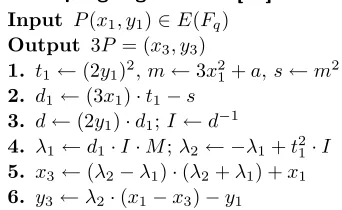
Point tripling algorithm [11] and quadrupling algorithm [1] in affine coordi-nates are described respectively as follows.
Point Tripling Algorithm in [11]
Input P(x1, y1)∈E(Fq)
Output 3P= (x3, y3)
1. t1←(2y1)2,m←3x21+a,s←m2 2. d1←(3x1)·t1−s
3. d←(2y1)·d1;I←d−1
4. λ1←d1·I·M;λ2← −λ1+t21·I 5. x3←(λ2−λ1)·(λ2+λ1) +x1 6. y3←λ2·(x1−x3)−y1
It is easily checked that the cost of point tripling algorithm is 1I+7M+4S.
Point Quadrupling Algorithm in [1]
Input P(x1, y1)∈E(Fq)
Output 2P= (x2, y2),4P= (x4, y4)∈E(Fq)
1. m←3x2
1+a,s←x1·(2y1)2,t←(2y1)4 2. e←2m·(3s−m2)−t,E←(2y1)·e, 3. I←E−1, (2y1)−1←e·I, (2y2)−1←t·I
4. λ1←m·(2y1)−1,
5. x2←λ21−2x1,y2←λ1·(x1−x2)−y1 6. λ2←(3x22+a)·(2y2)−1
7. x4←λ22−2x2,y4←λ2·(x2−x4)−y2
It is easily checked that the cost of point quadrupling algorithm is 1I+9M+7S. We denote the computational cost of point addition, doubling, tripling and quadrupling in affine coordinates on the elliptic curve as ECADD, ECDBL, ECTRL and ECQDL respectively. Table 2 summarizes these simple operations onE(Fq).
Table 2.Cost of simple operations onE(Fq)
operation cost ECADD 1I+ 2M+ 1S
ECDBL 1I+ 2M+ 2S
ECTRL [11] 1I+ 7M+ 4S
3.1 Miller’s Algorithm Using Double-base Chain
Let l be a positive integer represented in double-base chain. Let P ∈ E(Fq)[l]
and Q∈ E(Fqk)[l]. Miller’s algorithm based on double-base chain is described
as follows.
Miller’s Algorithm using Double-Base Chain
Input An integerl =Pmi=1si2bi3ti, withsi∈ {−1,1}, and such thatb1≥
b2 ≥ ... ≥bm ≥ 0, and t1 ≥ t2 ≥ ... ≥ tm ≥0; and P = (xP, yP) ∈
E(Fq)[l] andQ= (xQ, yQ)∈E(Fqk)[l]
Output el(P, Q)
1. T ←P,f−1= 1/(xQ−xP); ifs1= 1, then f1←1; elsef1←f−1
2. fori= 1, ..., m−1 do
2.1 u←bi−bi+1, v←ti−ti+1 2.2 ifu= 0 then
2.2.1 forj= 1, ..., v do 2.2.2 f1←f13·
lT ,T(Q)lT ,2T(Q)
v2T(Q)v3T(Q) ,T ←3T
2.3 else
2.3.1 ifv= 0 then 2.3.2 forj= 1, ..., udo 2.3.3 f1←f12·
lT ,T(Q)
v2T(Q),T ←2T
2.3.4 else
2.3.5 forj= 1, ..., udo 2.3.6 f1←f12·
lT ,T(Q)
v2T(Q),T ←2T
2.3.7 forj= 1, ..., v do 2.3.8 f1←f13·
lT ,T(Q)lT ,2T(Q)
v2T(Q)v3T(Q) , T ←3T
2.4 ifsi+1= 1, thenf1←f1·vlTT ,P+P((QQ)),T ←T+P 2.5 elsef1←f1·f−1
lT ,−P(Q)
vT−P(Q),T ←T−P
3. returnf(qk−1)/l
1
It seems that our new algorithm would be fast because of the sparseness of an integer represented in double-base chain. In the following section we will analyze the complexity of the addition, subtraction, doubling and tripling part of computing the Tate pairing. In Section 5 We will show that our modified Miller’s algorithm is more efficient than the previous fastest method indeed.
4
The Complexity of Computing the Tate Pairing
We neglect the cost of field additions and subtractions, as well as the cost of multiplication by small constants. The computational cost of a multiplication, a squaring, an inversion in F∗
q can be denoted the same as above. The
com-putational cost of a multiplication, a squaring, and an inversion in F∗
qk can be
represented by Mk, Sk and Ik. A multiplication between elements in Fq∗k and
F∗
q is denoted asMb. We will takeMk =k1.6M andMb=kM in the efficiency
The computational cost of the addition, subtraction, doubling and tripling part of the computation of the Tate pairing is represented by TADD, TSUB, TDBL and TTRL, respectively. We consider their computational cost in detail in this section. Some useful remarks are given as below.
For an elementg∈Fqk, the conjugates ofg is denoted byg. Notice that we
can replace (xQ−x1)−1 byxQ−x1 sincex1 =x1 ∈Fq∗ in the computation of
the Tate pairing generally. This replacement is similar to the pseudo-inversion method in [21] and leads to the reducibility of inversive operations in Miller’s algorithm. In the sequel, we analyze the complexity of TADD, TSUB, TDBL, TTRL, and iterated TDBL respectively.
4.1 The Computational Cost of TADD
LetT(x1, y1), P(xP, yP)∈E(Fq). TADD algorithm is described as below. TADD Algorithm
Input f ∈F∗
pk, T(x1, y1), P(xP, yP)∈E(Fq),Q(xQ, yQ)∈E(Fqk)
Output the updatedf
1. T5(x5, y5)←ECADD(T, P) 2. l1←(yQ−yP)−λ(xQ−xP)
3. l2←xQ−x5 4. f ←f·l1l2 5. returnf
If we take advantage of the polynomial expansion method [21, 19] and the fact that x5=x5, we have
l1l2= ((yQ−yP)−λ(xQ−xP))(xQ−x5)
= (yQ−yP)xQ−λ(xQ−xP)xQ−x5(yQ−yP) +λ x5(xQ−xP).
Notice that (yQ −yP)xQ and (xQ −xP)xQ can be precomputed. Calculating
λx5 requires 1M and calculating three scalar multiplications,λ·(xQ−xP)xQ,
x5·(yQ −yP), λx5·(xQ−xP) requires 3Mb. In addition, computing f ·l1l2 requires 1Mk. Therefore the total cost of TADD is Mk+ 3Mb+M + ECADD
as discussed in [21]. If the pseudo-multiplication [21] method is applied, it can be reduced to Mk+ 2.5Mb+M + ECADD withk≥3. The precomputed cost
of TADD is 2Mk+ 7Mk/2+Ik/2.
4.2 The Computational Cost of TSUB
LetT(x1, y1), P = (xP, yP)∈E(Fq). Since
f−1l1(Q) =
(yQ+yP)−λ(xQ−xP)
xQ−xP
= yQ+yP
xQ−xP
−λ,
we can substitutef−1l1(Q) with
yQ+yP
xQ−xP −λin the subtraction part of the
com-putation of the Tate pairing. Notice that yQ+yP
xQ−xP can be precomputed. TSUB
TSUB Algorithm
Input f ∈F∗
pk,T(x1, y1), P(xP, yP)∈E(Fq),Q(xQ, yQ)∈E(Fqk)
Output the updatedf
1. T6(x6, y6)←ECADD(T,−P) 2. f−1l1← xyQQ−+yxPP −λ
3. l2←xQ−x6 4. f ←f·(f−1l1)l2
5. returnf
It is easily checked that the total cost of TSUB isMk+ (2k+ 1)M+ ECADD if
the polynomial expansion method [21, 19] is applied. The precomputed cost of TSUB is 2Mk+Ik.
4.3 The Computational Cost of TDBL
LetT(x1, y1), T2= 2T= (x2, y2)∈E(Fq). TDBL algorithm is described in the
following.
TDBL Algorithm
Input T = (x1, y1)∈E(Fq),Q= (xQ, yQ)∈E(Fqk), andf ∈F∗
qk
Output the updatedf
1. T2= (x2, y2)←ECDBL(T) 2. l1←(yQ−y1)−λ(xQ−x1)
3. l2←xQ−x2 4. f ←f2·(l
1l2) 5. returnf
The total cost of TDBL is Mk+Sk + 4Mb+ 2M + ECDBL by using the
polynomial expansion method [19, 21]. If the pseudo-multiplication [21] method is applied, it can be reduced toMk+Sk+3.5Mb+2M+ECDBL. The precomputed
cost of TDBL is 2Mk.
4.4 The Computational Cost of TTRL
In this part we study the computational of TTRL. TTRL algorithm is described as follows.
TTRL Algorithm
Input T = (x1, y1)∈E(Fq),Q= (xQ, yQ)∈E(Fqk), andf ∈Fq∗k
Output the updatedf
1. T3= (x3, y3)←ECTRL(T) 2. l1← lT ,T(v2QT)l(T ,Q2)T(Q)
3. l2←xQ−x3 4. f ←f3·(l
Let T = (x1, y1), T3 = 3T = (x3, y3) ∈ E(Fq). Let T2 = 2T = (x2, y2), wherex2=λ21−2x1as an intermediate. We apply the parabola method [14] to computing TTRL. Notice that lT,T passes throughT and−2T, whose slope is
λ1, andlT,2T passes throughT and 2T, whose slope isλ2. We obtain
lT,T(Q)lT,2T(Q)
v2T(Q)
=((yQ+y2)−λ1(xQ−x2))((yQ−y2)−λ2(xQ−x2))
xQ−x2
=y 2
Q−y22
xQ−x2
+λ1λ2(xQ−x2)−λ1(yQ−y2)−λ2(yQ+y2)
=x2Q+x2xQ+x22+a+λ1λ2(xQ−x2)−λ1(yQ−y2)−λ2(yQ+y2)
=x2Q+(x2+λ1λ2)xQ−(λ1+λ2)yQ+x22+a−λ1λ2x2+(λ1−λ2)y2 =(xQ−x1)(xQ+x1+x2+λ1λ2)−(λ1+λ2)(yQ−y1)+x21+x1x2
+λ1λ2x1−(λ1+λ2)y1+x22+a−λ1λ2x2+ (λ1−λ2)y2 =(xQ−x1)(xQ+x1+x2+λ1λ2)−(λ1+λ2)(yQ−y1)
+y 2 1−y22
x1−x2
+λ1λ2(x1−x2) + (λ1−λ2)y2−(λ1+λ2)y1 =(xQ−x1)(xQ+x1+x2+λ1λ2)−(λ1+λ2)(yQ−y1)
+ (λ1−λ2)((y2+y1)−λ1(x1−x2))
=(xQ−x1)(xQ+x1+x2+λ1λ2)−(λ1+λ2)(yQ−y1)
by usingy2=λ1(x1−x2)−y1.
We can expand the above polynomial in powers ofxQ . The expansive
poly-nomial is
l1=x2Q+ (x2+λ1λ2)xQ−(λ1+λ2)(yQ−y1)−x1(x1+x2+λ1λ2)
=x2Q+ ((λ1(λ1+λ2)−2x1)xQ−(λ1+λ2)(yQ−y1)−(λ1(λ1+λ2)−x1)x1.
Computingλ1·(λ1+λ2) and (λ1(λ1+λ2)−x1)·x1requires 2M, and computing ((λ1(λ1+λ2)−2x1)·xQ and (λ1+λ2)·(yQ−y1) requires 2Mb. Therefore we
need 2Mb+ 2M for computingl1. Notice thatx2Q can be precomputed.
We require 1Sk + 3Mk for computing f ·f2·l1·l2. Thus the total cost of TTRL is 3Mk+Sk+ 2Mb+ 2M + ECTRL. The precomputed cost is 1Sk.
4.5 The Computational Cost of Iterated TDBL
The iterated TDBL algorithm was first proposed in the work [19] of Izu. The work of [21] gave an improved iterated TDBL algorithm. We give a modified iterated TDBL algorithm by using point quadrupling in affine coordinates.
Iterated TDBL Algorithm
Input f ∈Fqk,T = (x1, y1)∈E(Fq), and Q= (xQ, yQ)∈Fqk
Output the updatedf
2. l1←yQ−y1−λ1(xQ−x1)
3. l2←xQ−x2 4. f′ ←f2·l
1·l2 5. l′
1←yQ−y2−λ2(xQ−x2)
6. l′2←xQ−x4
7. f ←f′2·l′
1·l
′
2
Now we study the computation off in iterated TDBL. Since
the updatedf =f′2·l1′ ·l
′
2= f4·l21·l22·l
′
1·l
′
2= (f2·l1)2·l
′
1·l22l
′
2
We can apply the polynomial expansion method inl2 2l
′
2. Then
l22l
′
2= (xQ−x2)2(xQ−x4) =x3Q−(x4+ 2x2)x2Q+ (2x2x4+x22)xQ−x22x4 Sincex2
2is computed in ECQDL(T1),x2·x4andx22·x4require 2M. (x4+2x2)·x2Q
and (2x2x4+x22)·xQ require 2Mb. Therefore, the total cost of iterated TDBL is
3Mk+ 2Sk+ 4Mb+ 2M + ECQDL.
It is obviously more efficient than the iterated TDBL in [21] if the cost of 1EC-QDL is lower than the cost of 2ECDBL.
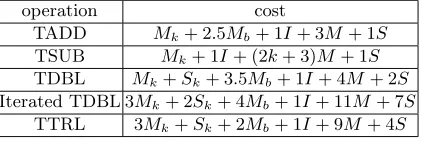
We summarize these results in the following table.
Table 3.Cost of elementary operations for computing the Tate pairing
operation cost
TADD Mk+ 2.5Mb+ 1I+ 3M+ 1S TSUB Mk+ 1I+ (2k+ 3)M+ 1S TDBL Mk+Sk+ 3.5Mb+ 1I+ 4M+ 2S Iterated TDBL 3Mk+ 2Sk+ 4Mb+ 1I+ 11M+ 7S
TTRL 3Mk+Sk+ 2Mb+ 1I+ 9M+ 4S
5
Efficiency Consideration
In this section we put our emphasis on studying the efficiency of new proposed algorithm and comparing it with the previous methods in [21] and [19]. Since it is necessary that the orderl of elliptic curve subgroup have at least 160 bits andqk have at least 1000 bits for security and efficiency in many cryptographic
5.1 Efficiency of Our Proposed Algorithm
The total precomputed cost of new proposed algorithm is
Tpre=6Mk+Sk+Ik+ 7Mk/2+Ik/2.
We assume that plus signs and minus signs appear on average ifl is repre-sented in double-base chain. The total cost of our algorithm is
bmaxTDBL +tmaxTTRL +
m
2(TADD + TSUB) +Tpre =((bmax+ 3tmax+m+ 6)Mk+ ((bmax+tmax+ 1)Sk
+ (7
2bmax+ 2tmax+ 5
4m)Mb+ (bmax+tmax+m)I
+(4bmax+9tmax+(k+ 3)m)M+(2bmax+4tmax+m)S+Ik+7Mk/2+Ik/2.
Here we takeM4= 9M,M6= 18M,M8= 27M,S = 0.8M,I= 10M,Mb=
kM,Ik =I+k2M. We estimate the cost of new proposed algorithm by Table
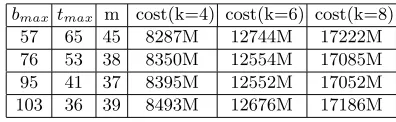
1 since the 160 bit length of l is enough for security in many cryptographical protocols. Notice that we do not use the iterated TDBL technique [19, 21] for simplicity.
Table 4.Cost of new proposed algorithm by Table 1
bmax tmax m cost(k=4) cost(k=6) cost(k=8) 57 65 45 8287M 12744M 17222M 76 53 38 8350M 12554M 17085M 95 41 37 8395M 12552M 17052M 103 36 39 8493M 12676M 17186M
5.2 Comparisons
In this part, we compare our algorithm with the previous methods in [19] and [21] mainly.
If we assume thatkis a randomly chosenn-bit integer, it is well known that the double-and-add algorithm requiresndoubling andn/2 additions on average. Using the signed digit representation, the average density of non-zero digits is reduced to 1/3. Therefore the computational cost of Miller’s original algorithm on average is the sum ofnTDBL and n2TADD. The computational cost of signed Miller’s algorithm is
nTDBL +n 3(
1
2TADD + 1
The computational cost of Miller’s algorithm described in [19] is
(n−1)(2Mk+ 2Sk+ (3k+ 7)M+ 6S) +n
2(2Mk+ (3k+ 10)M+ 3S) =(3n−2)Mk+ (2n−2)Sk+ (9n−6
2 k+ 12n−7)M +
15n−12
2 S.
The computational cost of signed Miller’s algorithm described in [21] is
(n−1)TDBL + n
6(TADD + TADD) +Tpre =(4
3n+ 5)Mk+ (n−1)Sk+Ik+ 7Mk/2+ 1Ik/2 + (17n−14
4 k+ (5n−4))M + ( 7
3n−2)S+ ( 4
3n−1)I.
Now we compare our algorithm with the proposed methods in [21] and [19]. The assumptions ofMk, I andnare the same as above. The computational cost
of these algorithms is shown in the following Table.
Table 5.Cost comparison of proposed algorithms
Algorithm cost(k=4) cost(k=6) cost(k=8) new proposed algorithm 8350M 12554M 17085M signed Miller’s algorithm in [21] 9196M 13685M 18121M Miller’s algorithm in [19] 12328M 20353M 28379M
Table 5 implies that our proposed algorithm is 9% faster and 62% faster than the previous proposed algorithms in [21] and [19] for k = 6, respectively. the sparseness of DBNS leads to fewer multiplications than the previous methods in [21, 19]. We also point out that our proposed algorithm can be applied fork= 2.
6
Conclusion
In this paper, A new algorithm based on the double-base chain is proposed for computing the Tate pairing. The proposed algorithm can be applied to supersin-gular and ordinary elliptic curves. It is more efficient than the previous proposed algorithms in [21] and [19].
References
2. P.S.L.M. Barreto, H.Y. Kim, B. Lynn, and M. Scott, Efficient algorithms for pairing-based cryptosystems. Advances in Cryptology-Crypto’2002, LNCS 2442, pp. 354-368. Springer-Verlag, 2002.
3. Paulo Barreto’s pairing-based crypto lounge,
http://paginas.terra.com.br/informatica/paulobarreto/pblounge.html
4. P.S.L.M. Barreto, S. Galbraith, C. ´Oh´Eigeartaigh, and Michael Scott, Efficient pairing computation on supersingular abelian varieties. Cryptology ePrint Archive, Report 2004/375.
5. I. Blake, K. Murty and G. Xu, Refinements of Miller’s algorithm for computing Weil/Tate pairing, Cryptology ePrint Archive, Report 2004/065.
6. D. Boneh, X. Boyen, Secure identity based encryption without random oracles, Advances in Cryptology-Crypto’2004, LNCS 3152, pp.443-459. Springer-Verlag, 2004.
7. D. Boneh and X. Boyen, Short signatures without random oracles, Advances in Cryptology-Eurocrypt 2004, LNCS 3027, pp.56-73, Springer-Verlag, 2004. 8. D. Boneh, X. Boyen, H. Shacham,Short group signatures. Advances in
Cryptology-Crypto’2004, LNCS 3152, pp.41-55. Springer-Verlag, 2004.
9. D. Boneh and M. Franklin, Identity-based encryption from the Weil pairing. Ad-vances in Cryptology-Crypto’2001, LNCS 2139, pp. 213-229. Springer-Verlag, 2001. 10. D. Boneh, B. Lynn, and H. Shacham, Short signatures from the Weil pairing, Advances in Cryptology-Asiacrypt 2001, LNCS 2248, pp.514-532, Springer-Verlag, 2001.
11. M. Ciet, M. Joye, K. Lauter, and P. L. Montgomery, Trading inversions for mul-tiplications in elliptic curve cryptography, Designs, Codes and Cryptography. Vol 39, No 2, pp.189-206, May 2006.
12. V.S. Dimitrov, L. Imbert, and P.K. Mishra,Efficient and secure elliptic curve point multiplication using double-base chains. Advances in Cryptology-Asiacrypt’2005, LNCS 3788, pp.59-78. Springer-Verlag, 2005.
13. I. Dutta, and H.-S. Lee, Tate pairing implementation for hyperelliptic curves
y2 = xp
−x+d. Advances in Cryptology-Asiacrypt’2003, LNCS 2894, pp.111-123. Springer-Verlag, 2003.
14. K. Eisentr¨aer, K. Lauter, and P.L. Montgomery, Fast elliptic curve arithmetic and improved Weil pairing evaluation. CT-RSA 2003, LNCS 2612, pp.343-354. Springer-Verlag, 2003.
15. G. Frey and H. R¨uck,A remark concerningm-divisibility and the discrete logarithm in the divisor class group of curves. Math. Comp., 52, pp.865-874, 1994.
16. S.D. Galbraith,Pairings - Advances in elliptic curve cryptography. Cambridge Uni-versity Press, 2005.
17. S.D. Galbraith, K. Harrison, and D. Soldera.Implementing the Tate pairing. Algo-rithm Number Theory Symposium - ANTS V, LNCS 2369, pp. 324-337. Springer-Verlag, 2002.
18. F. Hess and N.P. Smart and F. Vercauteren,The Eta Pairing revisited, Cryptology ePrint Archive, Report 2006/110.
19. T. Izu and T. Takagi,Efficient computations of the Tate pairing for the large MOV degrees, ICISC’02, LNCS 2587, pp.283-297. Springer-Verlag, 2003.
20. A. Joux, A one round protocol for tripartite Diffie-Hellman, Algorithm Number Theory Symposium - ANTS IV, LNCS 1838, pp.385-394. Springer-Verlag, 2000. 21. T. Kobayashi, K. Aoki, H. Imai,Efficient algorithms for Tate pairing, IEICE Trans.
22. A. Menezes, T. Okamoto, and S. Vanstone. Reducing elliptic curve logarithms to logarithms in a finite field. IEEE Transaction on Information Theory, 39: 1639-1646, 1993.
23. V.S. Miller.Short programs for functions on curves. unpublished manuscript, 1986. 24. P.L. Montgomery.Speeding the Pollard and elliptic curve methods of factorization.
Math. Comp., vol.48, pp.243-264,1987.
25. J.A. Muir, D.R. Stinson,On the low hamming weight discrete logarithm problem for nonadjacent representations, Applicable Algebra in Engineering, Communication and Computing, vol 16, pp.461-472, Jan 2006.
26. R. Sakai, K. Ohgishi, M. Kasahara,Cryptosystems based on pairing, SCIC 2000-C20, Jan. 2000. Okinawa, Japan.
27. J.H. Silverman,The arithmetic of elliptic curves. Springer-Verlag, New York, 1986. 28. B. Waters,Efficient identity-based encryption without random oracles, In Advances
in Cryptology Eurocrpt 2005, LNCS 3494, pp. 114-127, Springer-Verlag, 2005. 29. F. Zhang, R. Safavi-Naini and W. Susilo,An efficient signature scheme from