A TWO-SEX POLYGENIC MODEL FOR THE EVOLUTION
O F
PREMATING ISOLATION. 11. COMPUTER SIMULATION OF EXPERIMENTAL SELECTION PROCEDURES
J. A. W E D
School of Biological Sciences A12, Sydney University, N.S.W. 2006, Australia]
A N D
Institute of Ecology and Genetics, Uniuersity of Aarhus, Denmark
Manuscript received July 21, 1980 Revised copy received December 12, 1980
ABSTRACT
A Monte-Carlo simulation program is described for a polygenic mating model introduced i n the first paper in this series (SVED 1981). The program is used to simulate the situation in laboratory experiments in which two strains are allowed to mass-mate, hybrids are artificially eliminated and the estab- lishment of mating isolation is studied. I t is shown that, if mating choice is sufficiently precise, a combination of chance fluctuation and selection can lead to divergence in mating behavior. However, f o r small population sizzs, the variability would usually be considerably reduced by the time some divergence is established, leading to low eventual levels of isolation. For larger population sizes, on the other hand, it may take many generations for any divergence to be established.-A dissection of the selective forces involved in the diver- gence shows that the major force potentially responsible for initial selective response is the tendency for divergent females and males to reject mates from the wrong strain. However, this is nullified in mixed-strain matings by the tendency of such individuals equally to reject mates from the correct strain. To overcome this problem, it is suggested that the usual mixed strain mating procedure be replaced by procedures specifically designed to select for rejec- tion of interstrain matings. Two procedures are suggested for this, and com- puter simulation shows that one or other of the procedures will work under the assumptions of the mating model. Other possible outcomes of selection, including asymmetrical divergence, are discussed for cases in which the as- sumptions of the mating model are invalid.
T H E first paper in the series (SVED 1981) introduced a model in which mating is controlled by two different sets of genes that determine male and female mating behavior, respectively. The model was applied to the situation in which two strains of an organism have diverged to produce sterile hybrids, and it was shown that premating isolation would evolve only if there were some initial di- vergence of mating behavior between the two strains. Such initial divergence could arise by chance in a small population, although no analysis of this pos- sibility was attempted.
1 Permanent address.
21 8 J. A. SVED
The purpose of the present paper is partly to quantify, by computer simula- tion, the magnitude of stochastic effects needed to initiate divergence. However, the formulation of a stochastic model requires a specific model of population structure, and it is impossible to design any model that is appropriate for natural populations in general. It is therefore convenient to simulate, instead, the ex- perimental situation in which mating divergence is selected artificially (usually in Drosophila) by elimination of the progeny of interstrain matings.
The simplest experimental design consists of setting up a mating chamber containing equal numbers of males and females of each of the two genetically marked strains, This design will be designated as mixed-strain mating. Inter- strain matings are then eliminated, either by physical removal (c.f.
KESSLER
1966) or equivalently by rejecting the hybrid offspring when these occur (e.g.,
KNIGHT, ROBERTSON and WADDINGTON 19%). The procedure is then repeated over a number of generations. The size of the experiment is usually limited by the necessity for collecting virgin progeny in each generation.
Numerous variations of the mating scheme are possible. Small or large num- bers of flies may be used. Mating may be allowed to go to completion, or only a fraction of individuals may be allowed to mate. Partial combinations of the two strains and sexes may be used. Between-group selection may be employed. The computer simulation can be extended to cover any variation of mating schemes, and the likelihood of divergence can be evaluated. These simulations are, of course, dependent on the validity of the mating model, and an attempt has been made to evaluate, in general terms, the robustness of the assumptions.
THE COMPUTER MODEL
S u m m a r y of the assumptions of the mating model: (1) Male and female mat- ing scores are determined by additive gene contributions from a fixed number of di-allelic loci (no dominance). (2) The same number of loci affect male and female mating behavior. The theory of SVED (1981) assumes that this number is "large". (3) Mating occurs with probability
(1) where m is the male score, f the female s a x e and
W
a measure of the imprecision of the mating choice. T h i s is obtained from equation ( 3 ) of SVED (1981). (4) For a simulation beginning with no divergence, all loci are started with equal fre- quency of each of the two alleles. This implies no initial divergence between strains in either sex. It also implies that the variances of mating scores are ini- tially the same for both sexes in both strains.Details of the computer program: The program was written in FORTRAN to perform a Monte-Carlo simulation, each gene being represented as a separate entity and no theory being used directly. A lightly documented listing of the program is available from the author on request.
The simulation is a complex one, since each gene must be specified by a mini- mum of six coordinates:
SELECTION FOR P R E M A T I N G ISOLATION 219
(1 ) whether belonging to strain
A
or strain B, (2) whether contained in a male or female,( 3 ) the number of the individual containing the gene,
(4) whether a female- or male-derived gene (diploidy must be simulated),
( 5 )
whether affecting male o r female mating, and (6) the number of the locus.Any more complicated population structure, such as required to simulate be- tween population selection, adds an extra co-ordinate. Fortunately, it is possible to simplify the simulation by using individual bits, rather than whole words, to represent loci. Each word of the CDC computer contains 60 bits, which suffices for simulating genes at 30 loci determining female mating and 30 determining male mating. All loci could thus be represented as if on a single chromosome. However, most runs with the program were made assuming independence of all loci, through the use of randomly generated masks.
The core of the program involves the simulation of a mating pool of females and males of the two strains (mixed-strain mating). Encounters between fe- males and males occur at random and are accepted as matings with probability given by equation (1 ), or, alternatively, rejected. Matings are then classified as intrastrain and assigned to the appropriate pool of parents for the next genera- tion, or interstrain, in which case no action is taken on the mating. Both females and males can be returned to the mating pool, if required. Individuals for the next generation’s mating pool are then made up using the usual multinomial sampling process in which two individuals are sampled with replacement from the pool of parents, followed by gamete formation and production of a new zy- gote.
Provision has been made for several different mating structures, all of which use the same basic mating pool. I n each generation, the program evaluates the overall fraction of intrastrain mating. I n the case where equal numbers of males and females of the two strains are used and mating is taken to completion, the number of intrastrain matings must be the same in the two strains. In general, these numbers may be different, but it is convenient to use a single number to measure divergence. The parameter Z = 2 p
-
1, where p is the frequency ofintrastrain mating, is a suitable isolation index for this case (see PARSONS 1973,
p. 2 3 ) . This parameter ranges from zero, or nonsignificantly negative for no mating preference, to unity for complete divergence. The program also prints out the mean mating scores of
both sexes of both strains, thereby providing
arevealing picture of the underlying reason for particular divergence values. The mean heterozygosity is also calculated and printed out.
MIXED-STRAIN M A T I N G RESULTS
220 J. A. SVED
no a priori information on what are realistic relative values for these parameters. The initial simulations given therefore test the effect of variation in W .
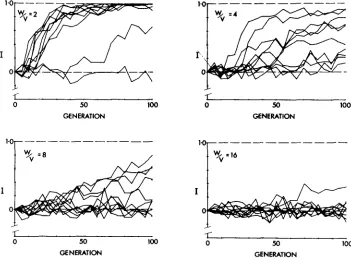
The graphs given in Figure 1 are individual runs made with V = V’ in all cases, and with various values of W / V . All runs were made with 20 pairs from each strain, and the results have been averaged over five-generation intervals to reduce the size of chance fluctuations. Ten replicate runs are shown for each parameter value, thereby giving a rough idea of the mean and variation in each case.
It is clear that the range of values presented ( W / V varying from 2 to 16) spans the scale of potentially realistic values. At the upper end of the scale, with
W / V = 2, despite the inefficiency of the initial stages of the selective process (SVED 1981), a sufficiently precise choice of mates enables the process to be car- ried to completion in most cases within a comparatively short time. Based on the results of experiments (e.g.,
KNIGHT,
ROBERTSON andWADDINGTON
1956; KITAGAWA 1978), these graphs show a rate of divergence that is unrealistically high. It is nevertheless of interest that in one case the process was significantly slower than usual and in another case no divergence resulted at all. Also in most cases it took IO to 15 generations for significant divergence to be produced.At the opposite end of the scale of mating imprecision, W / V = 16, there was
-i
0 50 100
GENERATION
r
0 50 100
GENERATION
1 I
-l 7-
0 50 100 0 50 100
GENERATION GENERATION
SELECTION FOR P R E M A T I N G ISOLATION 221
almost no response to selection. Since the variability at the end of 100 genera- tions is reduced to less than 10% of its original value, no divergence would re- sult even if the runs were extended further. Based on experimental results, the response is unrealistically low in this case. The results for W/V = 4 or 8 seem closer to those observed in experiments: so that, on the grounds of erring on the conservative side, the value W/V = 8 has been used in many of the later simu- lations.
One interesting point revealed by the simulations is that the stochastic process follows quite different kinetics from that predicted from a simple extension of deterministic theory (SVED 1981). The important parameter in the deterministic argument is the heritability of mating attraction, V / ( V
+
V’+
W ).
The rate of change of female mating score is directly proportional to the heritability. The rate of divergence, as measured by the parameterI,
is a complex function of the divergence of both female and male scores. It can nevertheless be shown that the time taken for a particular value ofI
to be reached is inversely proportional to the heritability. For the values shown in Figure 1, with W/V ranging from 2 to 16, the parameter V / ( V4-
V’
+
W ) ranges from 1/4 to 1/18. Thus, determinis- tic theory would predict that divergence should occur only four to five times as fast in the former case as in the latter. I n fact, the simulations show that the difference is much greater. It is scarcely surprising that the very complex two- stage process does not lead to an inverse linear relationship connecting diver- gence time and heritability. There is clearly a point on the heritability scale be- low which chance fluctuations almost never become sufficiently large for the process to be initiated.Population size and structure: Simulations were carried out using various sizes and structures, with the primary aim of seeing whether divergence could be expedited in comparison to the results of Figure 1. All of these simulations used a standard mixed-strain mating scheme, in which equal numbers of males and females of the two sexes compete for mating. These simulations are reported rather briefly, in view of their failure to enhance the mating divergence process significantly.
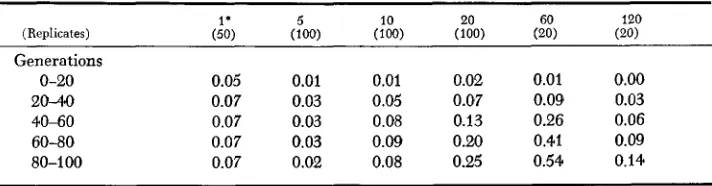
The results from simulations with a range of population sizes are shown in Table 1, which presents values of
I
averaged over 20-generation intervals. All simulations used the parameter value W / V = 8. The values given in Table 1 are mean values aT-eraged over many replicates; thus, they are only partially in- formative owing to the considerable variation between replicate simulations(Figure 1 )
.
222 J. A. SVED
TABLE 1
Values of the Isolation Index ( I ) produced by simulation with W / V = 8 and with various population s i z s
Generations
0-20 0.05 0.01 0.01 0.02 0.01 0.00
2040 0.07 0.03 0.05 0.07 0.09 0.03
40-60 0.07 0.03 0.08 0.13 0.26 0.06
60-80 0.07 0.03 0.09 0.20 0.41 0.09
80-100 0.07 0.02 0.08 0.25 0.54 0.14
The number of replicates at each population size is given in parentheses.
* The values for th2 population size N t= 1 are not comparable with the other results (see text).
tial chance fluctuations are expected to be smaller, but this is compensated by the smaller loss of variability.
The results indicate that the initial divergence is not strongly dependent on population size. The larger fluctuations given by the smaller population sizes may be cancelled out by the reduced accuracy in measuring divergence in the smaller mating pool. On the other hand, the loss of variability in early genera- tions is crucial for the smaller population sizes. Thus, the greatest amount of divergence occurred in comparatively large populations, although it took a very long time for this divergence to be produced. It is, in fact, possible that the largest population size used, N = 120, might ultimately produce greater levels of diver- gence if the simulations had been carried beyond 100 generations.
The results with
N
=1
are not strictly comparable with the other values of population size in the table. I n this case the procedure of AYALA andTOFTNER
(1978) was adopted, using between-population selection to select between popu- lations each of which was initiated by a single pair mating. The size of the mat- ing pool was 20 pairs per strain in this simulation. The mean initial divergence produced by this procedure was considerably greater than that given by mass selection. However, in absolute terms this divergence was not great. Only three m s out of fifty produced values of I of 0.5 or more. The simulations in this case were not taken beyond 20 generations, since all variability was exhausted by this stage. I n practice, inbreeding effects (not simulated by the program) would reduce the value of this procedure.
Attempts were made to combine the advantages of small population size in early generations and larger population sizes later. The best 20% of populations produced by the between-population selection method of AYALA and TOFTNER were chosen. Intercrossing to the base population was then simulated to intro- duce new variability, followed by mass selection at N = 20. However, due to the loss of selective gain at the stage of intercrossing to the base population, the method produced only minor increases in efficiency compared to straight mass selection.
SELECTION FOR PREMATING ISOLATION 223
tions were started with zero initial divergence and with
N
= 20. In all cases mating was taken to completion, although, of course, with multiple mating, this does not mean that all males necessarily mate. As shown in the theory, and as is intuitively clear, multiple mating should result in a reduced selection for di- vergence, since males chosen by females of the wrong strain will suffer no im- pairment of fitness. Yet, under the rather complex conditions of the simulation, multiple mating of males resulted in only a rather small reduction in the rate of divergence.VARIATIONS F R O M MIXED-STRAIN MATING
The situation in a mixed-strain mating pool is very complicated. Part of this complication can be traced to the fact that two kinds of mating are going on at the same time, i.e., intrastrain (A
x
A andB
x
B),
and interstrain (A XB
and B x A ) . This makes it difficult to analyze the reasons for the advantages or dis- advantage of any particular genotype. For example, in order to know the prob- ability that a particular genotype will eventually engage in intrastrain mating, it is necessary to know how likely the genotype is both to accept intrastrain matings and to reject interstrain matings. The facilitation mating model imposes a particular interdependence between these two processes and allows a simple solution to be obtained for the overall selection intensity [SVED 1981, equation (13) ; see equation (2) below]. At the same time, this approach obscures the un- derlying components responsible for particular selective values. As seen below, considerable insight into these components may be obtained by simplifying the mating structure to consider the consequences of just one type of mating at a time.The formulation will be simplified, as in
SVED
( 1981), by considering initially the selective pressures affecting just one sex of one strain, conveniently taken to be strainA
females. Once again, the calculation is also simplified by assuming that mating probabilities are unaltered between encounters, thereby implying that males are capable of multiple mating. This is an assumption whose im- portance needs to be tested again by computer simulation, and, in one case be- low, the assumption is shown to be critical.Summarizing first the results obtained previously, the change of mean score produced by one generation of mating with a mixture of strain A and
B
males isA F A = a. (MA-MB) * V/(V+V'+W)
,
( 2 )where
M A
and M B are the male mating scores of the two strains, and a is a posi- tive factor ranging between 0 and depending on the distance of the strain A female score from the mean of the male score. This formulation assumes that all females mate, and that males are capable of multiple mating. If, instead of all females mating, each female is involved in only one mating encounter, the relevant formula is1 2
224 J. A . SVED
Fntrastrain selection and inter-strain selection: Selection in mixed-strain mat- ing tends to maximize the proportion of intrastrain mating. This can obviously be done either by increasing the tendency for intrastrain mating or by decreasing the tendency for interstrain mating. Thus, two components of selection may be recognized: (1) Selection for acceptance of intrastrain mating, and (2) selection for rejection of interstrain mating.
It is convenient to adopt the shorthand designations “intrastrain selection” and “interstrain selection” for these two, with the understanding that the first will be a positive selection, i.e., selection towards a particular mean and the second, negative,
i.e.
away from a particular mean.It is important to clarify the differences between the two related sets of terms: “facilitation” and “avoidance” models on the one hand (SVED 1981), and “in- trastrain” and “interstrain” selection on the other. The outcomes of the two types of selection will clearly be dependent on which type of mating model is assumed, but either selective outcome is possible under either model. Under a facilitation model, as will be considered below, selection for acceptance of intra- strain mating occurs by an increase in facilitation of mating; whereas selection for rejection of interstrain mating occurs simply by a decrease in facilitation. Under an avoidance model, as will be discussed later, selection for acceptance of intrastrain mating must be assumed to occur by the selective removal of the causes of rejection; whereas, selection for rejection of interstrain matings would occur directly.
Calculation of selection diflerentials: We shall calculate the expected change in the mean score of strain A females produced by (1) mating the strain A fe- males with strain A males and (2) mating the strain A females with strain
B
males. The problem in both of these cases is that it is no longer possible, as in the mixed-strain mating example, to assume that mating continues until all females have mated. It is necessary, instead, to designate a particular degree of mating and to assume that in case
(1)
the maters produce progeny, and in (2) the non- maters. We choose for simplicity the situation in which each female is exposed to just one encounter with a male.Calculation of the strength of intrastrain selection is straightforward. The re- sult is, in fact, given by equation ( 3 ) . This equation was derived under the assumption of a fixed probability of intra- or interstrain mating; with only one mating encounter per individual, the contribution from interstrain mating be- comes irrelevant. Equation ( 3 ) shows that any deviation from equality of FA and MA will be diminished by intrastrain selection.
Considering now the interstrain case, the probability that a female from a population with mean FA will accept a mating with a strain B male from a popu- lation with mean M R is, by arguments analogous to those of SVED (1981),
S E L E C T I O N FOR P R E M A T I N G ISOLATION 225
by considering the relative fitness of females with mean mating scores FlA and F'A, differing by a single gene substitution. Following the arguments given previ- ously, the change in mean female score brought about by selection can then be shown to be
( 5 )
AFA == /3
.
(FA-MB).
V /
(V+V'+W),
where /3 = 2PB/( l-PB), PB being defined as in
(4).
The first term in equation ( 5 ) is a positive quantity, which is dependent on the frequency of successful encounters and maximized for a high probability of mating. The third term is the usual heritability coefficient, as in (2) and ( 3 ) . The crucial second term determines the direction of selection. It shows that any deviation from equality of FA and M B will be magnified by selection.
The combined eflects of intra- and interstrain selection: Intuitively, it seems that the selection produced by mixed-strain mating should be a sum of the com- ponents due to intra- and interstrain mating. However, as indicated previously, it is not possible to find solutions for the individual components when each in- dividual can have an unlimited number of encounters. Nevertheless it is of in- terest to note that the solutions obtained from considering a single encounter per individual, are, in one sense, of the expected form. Intrastrain selection results in an effect proportional to
( M A
-
F A ) . Interstrain selection produces an effect proportional to ( F A - M B ).
Mixed-strain mating produces an effect which is proportional to the sum of these two quantities, i.e., ( M A -M n )
.
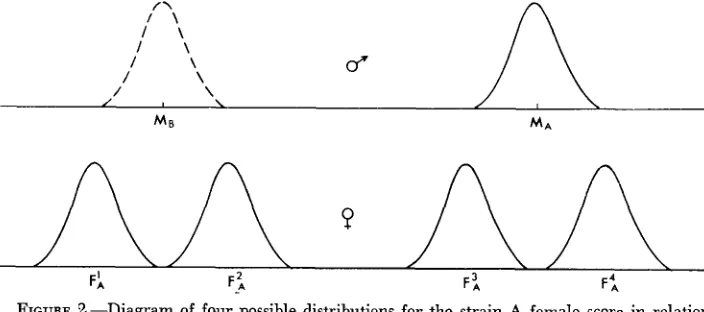
Further insight into the joint action of intra- and interstrain selection is given by considering Figure 2. This shows four possible distributions for the strain A female scores, in relation to the two male score distributions. The contribution of intrastrain selection may be isolated first by comparing the two female popu- lations whose means are denoted as FIA and F2,. These possess the property of being equidistant from the opposite male mean ( M B ) and, therefore, of being equivalent with respect to interstrain selection. However, equation (2) shows that the F2A population must be at an advantage to the FIA population, an ad-
..
-
\
MB MA
226 J. A. SVED
vantage that must be attributed to intrasti-ain selection. Similarly, the advantage of F 4 ~ over F3, must be attributed solely to interstrain selection.
Interestingly, equation (2) predicts that in the case of the F1, population, selection will favor a movement of the population towards males of the incorrect strain; i.e., in this case intrastrain selection overrides interstrain selection. The opposite is true for F4, females, for which interstrain selection overrides intra- strain selection. I n both cases, the dominant selective force is exerted by the re- mote population. This result must be accepted with some caution, as it appears to be attributable simply to the choice of the normal function to describe mating attraction. It can readily be seen that the selection intensity is determined by the relative slope of the mating function, and the fact that this increases with distance from the mean in the normal distribution has no necessary biological significance.
Another, and perhaps the most important, facet of the joint action of intra- and interstrain selection is illustrated in Figure 3. In this case there is no sepa- ration between the strain A and
B
males, and we consider the relative fitnesses of the FIA and F2A populations. Equation (2) predicts that if MA andM B
are equal, there will be no selection affecting the female population. Thus, in this case interstrain selection favoring the FZa population must exactly cancel out intrastrain selection favoring the FlA population.The use of interstrain selection in enhancing divergence: The reason that intra- and interstrain selection exactly cancel out in Figure 3 must be attributed to the equality of MA and MB. However, there is also the underlying assumption
that intra- and interstrain matings contribute equally to the selective process.
It
seems clear that divergence, at least of strain A females and strain B males, would be enhanced if interstrain mating played a more important role than in- trastrain mating. This seems an unlikely proposition for natural populations, but it can, at least in theory, be achieved experimentally. For example, if strain
FIGURE 3.-Two possible distributions for strain A females for the case in which strain A
SELECTION FOR P R E M A T I N G ISOLATION 227
A females were exposed to strain
B
males for a period of time that allowed some but not all to mate, and if all remaining unmated females were then allowed to mate with strain A males, there would be no contribution from intrastrain se- lection. Thus, even with equality of male means as in Figure 3, there would be a net selective effect tending to increase divergence. A mating scheme of this kind was used by KESSLER (1966) to increase divergenceD.
pseudoobscura andD.
persimilis. I t appears not to have been wed to produce divergence de novo.KESSLER’S
mating scheme will be considered further in the DISCUSSION.It must be noted that interstrain selection is not, by itself, able to overcome the zero-divergence in which all four means, FA,
F,,
MA and MB, are equal.Equation
( 5 )
shows that this state constitutes an equilibrium state under inter- strain selection, just as it does with mixed-strain mating (equation 2). Xowever, the important difference between (2) and( 5 )
is that under interstrain selection, any chance deviation between FA and M E will immediately be inagnified by se- lection (equation5 ) .
This is not the case with equation (2). Thus, the high inertia of the equilibrium situation under mixed-strain mating may be circum- vented by an initial period of interstrain mating.I t must be noted that interstrain selection, by itself, is unlikely to lead to overall mating divergence. Thus, in Figure 3, at the same time that interstrain selection is increasing the divergence between strain A females and strain
B
males, it is having the undesirable effect of increasing the divergence between strain A females and males.
If,
however, at the same time, strain A males could be selected for facilitation of mating with strain A females, this problem would be overcome. Clearly, the use of suitable combinations of inter-, intra- and mixed- strain matings can be made to lead to an enhanced rate of divergence. The ef- ficiency of such procedures can best be evaluated through computer simulation.Simulation of alternative mating procedures: The principal purpose of the computer simulation was to test the effect of enforced interstrain mating on over- coming the inertia of a zero-divergence state. The procedure adopted for inter- strain mating was to allow mating to continue until 50% of a given sex-strain had mated. For ease of considering all possible combinations, each sex of each strain was considered separately. Thus, the mating of 40 strain A females and 20 strain
B
males was simulated, and the 20 unmated females were used for sub- sequent matings. Similarly, 40 different strainB
males were placed with 20 different strainA
females, the remaining 20 strainB
males being used subse- quently. The combination of these procedures would presumably be similar to an incomplete mating procedure involving 40 strain A females and 40 strain B males, the 20 unmated of each sex being used for subsequent mating.J. A. SVED
+INTRA -STRAIN
I
4
+INTRA -STRAIN
I
4
0 50 100 0 50 100
GENERATION GENERATION
0 50 100 0 50 100
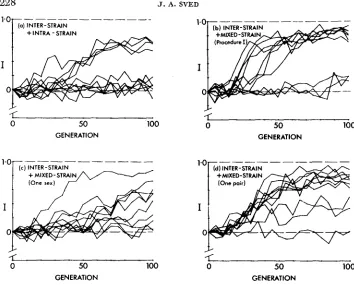
FIGURE 4.-Simulation results from four different procedures employing various combina- GENERATION GENERATION
tions of inter-, intra- and mixed-strain selection (see text for details).
The results from ten such simulations are shown in Figure 4a. The simula- tions used a value of W/V = 8, so that the results should be compared with those shown in Figure IC. Although there was a significant amount of divergence in some cases, this was not appreciably higher than in Figure IC. Inspection of the underlying mating scores in this case showed that interstrain selection was, in almost
all
cases, successful in leading to divergence between opposite sexes of opposite strains. However, as expected, the mating scores of females and males within strains were rarely close to each other. so that intrastrain mating was impeded to almost the same extent as interstrain mating. Considerable difficulty was encountered in the simulation of this procedure, since in many cases the di- vergence between female and male scores increased to such an extent that mat- ing occurred only after an inordinately large number of encounters.SELECTION FOR P R E M A T I N G ISOLATION 229
response. Perhaps even more strikingly it proved possible to induce divergence in the case of the lowest heritability level, W / V = 16, where almost no response occurred with mixed-strain mating (Figure Id). Nine of 20 simulation runs reached an isolation index of 0.5 or higher.
Two procedures involving partial interstrain mating are also included. Figure 4c represents the case where there is a preliminary interstrain mating affecting only one of the two sexes (the female), followed by niixed-strain mating. Figure 4d presents results in which the initial interstrain mating is carried out for only one of the two possible pairs, e.g. strain A females with strain B males, but not strain B females with strain A males. I n both cases, the partial interstrain mating procedure led to enhanced levels of divergence compared with just mixed-strain matings (Figure I C ) , although in neither case was the response as high as with interstrain mating involving both sexes and strains.
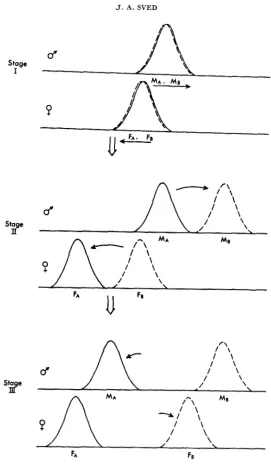
Initial sex diflerences: The results of Figure 4 apply to the case where there is no intial divergence in either strain, and the female and male scores are also syn- chronized. No difficulty should be anticipated in the case of initial differences between strains; e.g., if different species are used whose mating behavior has al- ready diverged to some extent. However, in the case where the male and female scores in the two strains are different, as pictured in the first stage of Figure
5,
the procedure of interstrain followed by mixed-strain mating may lead to diffi- culty. The situation of initial sex differences is a potentially important one, since it models what can be expected if there is a preferred directionof evolution, i.e., if interstrain selection tends to produce exactly the same type of divergence in different trials.
The effect of interstrain selection on the populations of Figure
5
would cause both pairs of opposite sexes to diverge in a n identical manner, males in a positive direction and females in a negative direction, as indicated by the arrows. The facilitation component of mixed-strain mating may be expected to oppose this tendency to some extent, but possibly not sufficiently to overcome the initial divergence.These expectations are confirmed by the computer simulation results given in Figure 6a. The procedure used to produce these results, which will be referred to below as Procedure I, is precisely the same as used to produce the high levels of di- vergence of Figure 4b. The initial difference between populations was 0.1 units on the mating scale from 0 to 1, where the standard deviation of each population is approximately 0.0065. Thus, there was considerable overlap in the initial popula- tions. However, in nine of 10 cases, this overlap was not sufficient to enable the two sets of strains to diverge in opposite directions.
230 J. A. SVED
Stage II
Stage
m
FA FE
FIGURE 5.-Diagram showing a suggested method for producing mating divergence, which should be especially effective when the male and female scores are not initially aligned.
convenience, shown as though the two selective forces acted in sequence, although in practice they would be combined in each generation.
The initial attempt to produce divergence as outlined in Figure 5 used inter- strain selection on just strain A females and strain B males, followed by mixed- strain mating. This attempt failed to produce significant divergence (Figure 6b). The situation in this case is comparable to that shown with population No. 1 in
SELECTION FOR P R E M A T I N G ISOLATION 23 1
f
0 50 1 0 0
GENERATION
-r
0 50 100
GENERATION
pair)- -
-
- -+
MIXED-STRAINI
I
0 50 100
GENERATION
----
7-
0 50 100
GENERATION
FIGURE 6.-Simulation results from different procedures, starting with nonaligned male and females scores (a), (b) and (c), and aligned scores (d).
populations at the start of the process (Stage 11, Figure
5 ) .
Although the mixed- strain mating theory (equation 2) predicts that the iemale score should move past the opposite male score, this theory is based on the supposition that males are capable of multiple mating. The simulation was carried out assuming single mating of males, and this difference apparently becomes important in this particu- lar situation. The wisdom of relying on the mixed-strain theory in this instance has, at any rate, been previously questioned.A more specific procedure for introducing intrastrain selection was then tried. Interstrain mating was carried out as described previously for strain A females and strain B males. The 20 strain A females remaining unmated were then mated with 40 strain A males. Thus, strain A males were selected purely on the basis of their ability in intrastrain mating. Similarly, the 20 strain B males unmated after interstrain mating were used with 40 strain B females. This mating procedure, which will be described as Procedure 11, produces pure interstrain selection for strain A females and strain B males, and intrastrain selection for strain A males and strain B females, as required for Figure 5.
Ten simulation runs using Procedure I1 are shown in Figure 6c. The pro- cedure was clearly successful in exploiting the initial sex difference to produce rapid divergence. With one exception, the response was much more consistent than that found previously.
232 J. A. SVED
gence. The results of Figure 6d show that even without initial sex differences, chance fluctuations will quite rapidly lead to such a deviation. The response was more uniform with this procedure than with Procedure I (Figure 4b), although when divergence did occur with the double interstrain selection of Procedure I, it was usually more rapid.
Experimental procedures: By artificial manipulation of mating pairs, it is possi- able to duplicate exactly the procedures simulated on the computer, with the pro- viso that mating will usually be incomplete. Such manipulative methods were used by KESSLER (1966) to study mating in
D.
pseudoobscura andD.
persimilis;they are perhaps less easily adapted to
D.
melanogaster. It would seem desirable if, as with mixed-strain mating, it were possible to devise procedures to eliminate the manipulation of individual pairs.By the use of suitable timing of matings, procedures closely analogous to those considered above can be realized. For Procedure I, two mating chambers could be set up with just the interstrain matings. After an interval sufficient to allow, say, 50% of matings to take place, the two sets of flies could be combined and mating allowed to continue for a further period of time. This procedure should ensure interstrain selection in females. Whether it would do the same in males in ques- tionable, although involvement in one mating might decrease the chance of in- volvement in a second over a reasonably short period of time. At any rate, as shown in Figure 4c, even if only females are selected in this way, some enhance- ment of mating divergence should result.
The procedure as outlined above suffers from the disadvantage that the overall fraction of progeny from intrastrain matings might initially be quite low, espe- cially if there are problems of inviability (see, e.g., KNIGHT, ROBERTSON and
WADDINGTON
1956). It would be advantageous to conduct, in some generations at least, parallel trials of simple mixed-strain mating, to provde a reliable measure of the strength of divergence.Procedure I1 would be more difficult to achieve. Anaesthesia could be used in this case to separate the females and males from interstrain mating, in order to set up separate intrastrain matings. However, this would have the disadvantage of almost certainly eliminating the male component. An alternative approach would be as follows: Two sets of matings of strain A females and strain B males could be set up. T o one of these, after a period of time, excess males of strain A could be added, and to the second, excess females of strain B. From the first of these mating groups, intrastrain matings would need to be recognized at the progeny stage. This would not be necessary from the second, provided females were sorted after mating. The effect of interstrain selection in males of strain
B
would again be questionable.
DISCUSSION
SELECTION FOR P R E M A T I N G ISOLATION 233
that have been given so far. At the same time, this discussion leads to a closer examination of the form in which experimental questions might best be posed. Procedure I1 suggested above lends itself to this discussion. The procedure uses, first, selection for rejection of mating between females of one strain (A) and males of the other (B)
.
If the variability of mating behavior is as defined in the model, such selection will presumably be successful in leading to rejection of mating. However, the same result could be achieved simply by a nonspecific decline in mating ability of either or both of the two genotypes, a possibility that is not taken into account in the model.There seems to be no way of predicting which outcome of selection is more likely and no way of avoiding the possibility of the latter outcome. KESSLER
(1966), who selected for rejection in exactly the manner advocated above, at- tempted to overcome this problem by selecting for individuals that rejected mates of the incorrect type. but that then quickly accepted mates of the correct type. The problem with this approach is that, at least under the assumptions of the models of this paper, these two aims of selection are antagonistic. For if there are no differences initially between males of the two strains, then any variation of female behavior causing rejection of one type of male must also cause rejection of the other type.
Whether rejection of interstrain mating occurs because of a generalized de- crease of mating ability or involves a specific rejection of some aspect of mating behavior, the net result will be a reduction in the facility of A female X B male matings. The second stage of Procedure I1 consists of selection f o r acceptance of intrastrain mating in the opposite sexes and strains. This is necessary simply to counteract the negative effects of interstrain se1ecti.m on intrastrain mating. At this stage, the differences between the possible outcomes of interstrain selection should become clear. Under the hypothesis of a generalized decrease of mating ability, it would presumably not be possible to increase the facility of intrastrain mating back to its original level simply by selection in the opposite sex. Under the mating model proposed in this paper, however, intrastrain selection should be capable of restoring any decrease in mating facility by a comparable shift in mating behavior in the opposite sex.
The final aspect of interest in Procedure I1 concerns the mating success of the interstrain combination B females and A males. No selection has been applied directly against this mating combination; yet, the mating model makes the rather remarkable prediction (see Figure 5 ) that the end result of the procedure will be a rejection of strain A males by strain B females. The reasoning for this is related to the argument given previously that the model is a facilitation model, and mating rejection occurs by default as a result of “insufficient facility.” The oppo- site type of model, that of avoidance of particular mating behavior, would not
predict a lowering of the frequency of B female x A male mating. Note that this type of model is, however, capable of explaining the increase in acceptability of intrastrain mating given by the second stage of Procedure 11, by assuming that whatever aspect of mating behavior is specifically being rejected is selected against in the intrastrain mating.
234 J. A. SVED
followed by testing of the behavior of interstrain pairs not specifically selected against each other. Such an experiment would be comparable to, although con- ceptually simpler than, that of KITAGAWA (1978). This author selected for di- vergence in replicated mixed-strain selection experiments. Comparatively small divergence values were realized over long periods of selection, but no mating preference was found in tests involving individuals from different replicate lines. This result would tend to suggest that there is not a single preferred direction of divergence (see Figure
5 )
and, therefore, that Procedure I might be successful in producing divergence.Although no experiment comparable to Procedure I1 has been carried out, it is of interest to examine the findings of WATANABE and KAWANISHI (1979) on extant species. These authors have shown that mating divergence often occurs asymmetrically, depending on which is the ancestral species and which the de- rived species. For example, if
B
is the ancestral, and therefore presumably initially more common, species and A is a newly derived species (strain), then A females are more strongly selected than B females. In the terms of the present paper, A females are selected for the ability to reject interstrain matings, whileB
females are selected simply for acceptance of intrastrain matings. Presumably, the fact that multiple mating is possible in males will result in a reduced selection for the corresponding changes in male behavior. However, there must still be some mating difference between theB
and A strain males in order for different modes of female behavior to arise.A specific prediction made by the facilitation model is that, in the presence of variability for male behavior, the change in female behavior of strain A should be accompanied by an equivalent change in strain
A
males to compensate for a re- duction in the facility of intrastrain mating. This should, at the same time, result in a reduced level of acceptability of strain A males by strainB
females, as in Figure5.
In general, a prediction of the facilitation model is that there should be approximate equality of the two types of interstrain mating. The findings of WATANABE andKAWANISHI
are therefore more easily explained in terms of an avoidance than a facilitation model.Finally, it may be worth considering whether it would advance our knowledge of natural populations if it proved possible to enhance mating divergence by the use of interstrain selection. It is difficult to envisage circumstances under which the interstrain selection component could be greater than the intrastrain com- ponent in natural populations. Nevertheless, the results of experiments using interstrain selection might provide an answer to the question of whether suitable genetical variability in mating behavior exists at all. WRIGHT (1921) first showed that assortative mating tends, if anything, to reduce variability, a conclusion also argued more recently by
PATERSON
(1978) and MOORE (1979). A similar predic- tion possibly also holds for the facilitation model of the present papers.SELECTION FOR P R E M A T I N G ISOLATION 235
divergence already exists. Thus, the relatively rapid manner in which divergence can be selectively altered in such cases (KOOPMAN 1950; KESSLER 1966) argues more strongly than does the difficulty of producing divergence de nouo (e.g.,
KITA-
GAWA 1978). This conclusion would be considerably strengthened if variability
could be uncovered by interstrain selection in single Fpecies experiments.
LITERATURE CITED
AYALA, F. J. and E. C. TOFT”, 1978
KFSSLER, S., 1966
KITAGAWA, O., 1978
KNIGHT, G. R., A. ROBERTSON and C. H. WADDINGTON, 1956
KDOPMAN, K. F., 1950
MOORE, W. S., 1979
PARSONS, P. A., 1973
PATERSON, H. E. H., 1978
SVED, J. A., 1981
terministic theory for natural populations. Genetics 97: 197-215. WATANABE, T. K. and M. KAWANISHI, 1979
in Drosophila. Science 205: 906-907. WRIGHT, S., 1921
Genetics 6: 16161.
Selection for reproductive isolation in Drosophila. Pro-
Selection for and against ethological isolation between Drosophila pseudo-
The origin of sexual isolation in Drosophila melanogaster. Proceedings
Selection for sexual isolation
Natural selection for reproductive isolation between Drosophila pseudo-
A single locus masaction model of assortative mating, with comments on
Behauioral and Eco1og:cal Genetics. Clarendon Press, Oxford. ceedings XIV Int. Cong. Genet. Abstracts 1 : 446.
obscura and Drosophila persimilis. Evolution 20 : 634646.
XIV Int. Cong. Genet. Abstracts 1 : 463.
within a species. Evolution 10: 1422.
obscura and Drosophila persimilis. Evolution 4: 135-148.
the process of speciation. Heredity 42: 173-186.
More evidence against speciation by reinforcement. So. Afr. J. Sci.
A two-sex polygenic model for the evolution of premating isolation. I. De-
Mating preference and the direction of evolution
Systems of mating. 111. Assortative mating based on phenotypic resemblance.
Corresponding editor: W. J. EWENS