Computational Strategy in Catalyst Design
Thesis by
Robert J. Nielsen
In Partial Fulfillment of the Requirements
for the Degree of
Doctor of Philosophy
California Institute of Technology
Pasadena, California
2005
c
2005
Robert J. Nielsen
Acknowledgements
I thank Bill Goddard for teaching me his way of thinking about metals and his optimistic support.
I thank Jason Keith, with whom I collaborated while resolving the mechanism of alcohol oxidation
by ((–)-sparteine)PdX2(section 2.3), and who is now investigating the interaction of O2and reduced
palladium species.
I thank Professor Brian Stoltz and his students Raissa Trend and Eric Ferreira for sharing their
insights into palladium-catalyzed oxidations, and especially Jeff Bagdanoff for investing effort in
synthesizing new ligands (section 3.3) developed in the course of the theoretical investigations.
The computational facilities at the Materials and Process Simulation Center were funded by
grants from ARO-DURIP, ONR-DURIP, IBM-SUR, and the Beckman Institute. I have graciously
been supported by grants from the NSF and Chevron-Texaco Energy Research and Technology
Abstract
The strategy and efficacy of applying computational tools to the development of new catalytic cycles
is discussed using the enantioselective palladium-catalyzed aerobic oxidation of secondary alcohols
as a model case. The key interactions responsible for the unique reactivity of ((–)-sparteine)PdX2
complexes (X = chloride, acetate) in kinetic resolutions of secondary alcohols are elucidated
us-ing density functional theory with the Poisson-Boltzmann polarizable continuum solvent model.
Enantioselectivities in these reactions are found to follow directly from calculated energies of
di-astereomeric beta-hydride elimination transition states incorporating (R) and (S) substrates. This relationship reveals an important role of the anion, namely to communicate the steric interaction of
the ligand on one side of the PdII square plane and the substrate on the other side. When no anion
is included, no enantioselectivity is predicted. Locating these transition states in different solvents
shows that higher dielectrics stabilize the charge separation between the anion and metal and draw
the anion farther into solution. Thus the solvent influences the barrier height (rate) and selectivity
of the oxidation.
Based on this understanding, computational assays for selectivity, reaction rate and stability are
developed and used to screen possible mimics of the natural product (–)-sparteine which could be
synthesized in both antipodes. Derivatives of the bispidine and bispidinone structures are predicted
to have high selectivity but poor stability on palladium. Experimental results verify that catalytically
active (bispidine)PdX2complexes do not form.
Mechanisms by which palladium diacetate complexes of N-heterocyclic carbenes may oxidize
al-cohols (a reaction known to occur with no enantioselectivity) are examined computationally. The
palla-dium catalysts. No traditional beta-hydride elimination is predicted to be capable of generating the
high deuterium kinetic isotope effect measured using this catalyst. Instead, the low-energy pathway
consistent with previous experimental observations (KIE, activation parameters, kinetics) is a
“re-ductive” beta-hydride elimination, in which the beta-hydrogen of the alcohol is transferred directly
to a bound acetate ligand. Assuming that relative energies of transition states of this type will
determine enantioselectivity, new, chiral carbene ligands are hypothesized and screened. Careful
placement of stereocenters and steric bulk has led to ligands with high predicted enantioselectivity
and stability.
Recurring factors in the induction of selectivity by asymmetric ligands are observed. Strengths
and weaknesses of quantum chemistry as applied to catalytic cycles are discussed, along with the
synergy of theory and experiment. Common pitfalls and areas in need of improvement are
Contents
Acknowledgements iii
Abstract iv
List of Figures viii
List of Tables x
1 Introduction and Methods 1
1.1 Background . . . 1
1.1.1 Roadmap . . . 5
1.2 Methods . . . 5
1.2.1 Wavefunctions and Hamiltonians . . . 7
1.2.2 Building Up Chemical Information . . . 10
2 Enantioselective Oxidation of Secondary Alcohols by ((–)-Sparteine)PdX2 15 2.1 Introduction . . . 15
2.2 Methods . . . 17
2.3 Mechanism . . . 18
2.3.1 General . . . 18
2.3.2 Chloride vs. Acetate . . . 22
2.4 Selectivity . . . 25
2.4.1 General . . . 25
2.4.3 Substrates and Anions . . . 30
2.4.4 Thermodynamics . . . 31
2.4.5 Other Approaches . . . 32
2.5 Conclusions . . . 32
3 New Ligands for Enantioselective Oxidations: Sparteine Mimics 34 3.1 Search Strategy . . . 36
3.1.1 Computational Assays . . . 36
3.1.2 Candidates . . . 38
3.2 Theoretical Results . . . 41
3.3 Experimental Results . . . 45
3.4 2nd Generation (–)-Sparteine Mimics . . . 46
4 New Ligands for Enantioselective Oxidations: N-Heterocyclic Carbenes 51 4.1 Unselective Ligand Systems for Pd-catalyzed Alcohol Oxidations . . . 51
4.2 N-Heterocyclic Carbenes . . . 54
4.2.1 Mechanism . . . 54
4.2.2 Asymmetric Carbenes . . . 70
4.3 On Asymmetric Ligands . . . 78
5 Discussion 81 5.1 Modeling Technique . . . 81
5.1.1 On What Projects is Theory Likely to Have an Impact? . . . 81
5.1.2 What to Do and Not to Do . . . 83
5.2 Future Work . . . 90
5.3 Introduction Redux . . . 97
List of Figures
1.1 Progress in modeling studies of catalysis . . . 4
1.2 The polarizable continuum solvation method . . . 12
2.1 ((–)-sparteine)PdCl2 and unlikely intermediates . . . 18
2.2 Mechanism: ((–)-sparteine)PdCl2 + (R)-1-phenylethanol . . . 20
2.3 Keyβ-hydride elimination transition state . . . 21
2.4 Mechanism: Reoxidation of palladium-hydride intermediate . . . 22
2.5 Mechanism: ((–)-sparteine)Pd(OAc)2+ (R)-1-phenylethanol . . . 23
2.6 β-hydride elimination transition states incorporating different anions . . . 24
2.7 Calculated and experimental enantioselectivities . . . 26
3.1 Ligands from the screens that identified (–)-sparteine . . . 35
3.2 Interpretation of chelating and monodentate ligands’ reactivity. . . 36
3.3 Asymmetric tethered amines. . . 39
3.4 Characterization of (–)-cytisine derivatives . . . 40
3.5 Bispidinones and bispidines . . . 41
3.6 Stability andβHE activation energies of bispidine and bispidinone ligands . . . 42
3.7 Rotational isomers of bispidines and bispidinones . . . 43
3.8 The effect of ligand structure on beta-hydride elimination transition state geometries . 45 3.9 Ligands synthesized. . . 46
3.10 1H NMR spectra of ligandk and products of attempted metallation . . . 47
3.12 Variations on the bispidine framework. . . 48
3.13 C1-symmetric bispidines and mixed phosphine-amine complexes. . . 49
4.1 Some known chiral N-heterocyclic carbenes . . . 54
4.2 Summary of the reactivity of (NHC)Pd(OAc)2(H2O) . . . 56
4.3 C–Hβ bond scission transition states of (NHC)Pd(OAc)2 complexes . . . 58
4.4 Possible mechanisms for the oxidation of 1-phenylethanol by (A)Pd(OAc)2 . . . 59
4.5 Possible mechanisms for the oxidation of 1-phenylethanol by (A)Pd(OAc)2 . . . 61
4.6 Potential energy surface describing two C–Hβ bond scission paths . . . 62
4.7 Possible intermediates in the oxidation of benzyl alcohol . . . 64
4.8 Possible mechanism of racemization . . . 70
4.9 Dependence of energy on coplanarity of imidazole and palladium square plane . . . . 73
4.10 C2-symmetric NHC ligands . . . 74
4.11 C1-symmetric NHC ligands . . . 75
4.12 Carbene ligands with chirally modified N-aryl substituents. . . 75
4.13 Carbene ligands with chiral N-alkyl substituents. . . 76
4.14 Carbene ligands with fluorene substituents. . . 77
4.15 The effect of solvation on electrostatically-derived selectivity. . . 79
5.1 Deactivation pathways of biimidazolylidene and biimidazole-based platinum catalysts 86 5.2 Sulfur-sulfur bonding in transition metal disulfides . . . 88
5.3 Possible thermodynamic cycles incorporating information from molecular dynamics . 94 5.4 Low-frequency vibrational modes . . . 95
5.5 Progress in modeling studies of catalysis . . . 98
List of Tables
1.1 Sample thermodynamics calculations . . . 13
2.1 Energetic and structural data of diastereomericβ-hydride elimination transition states 28 3.1 Computational evaluation of new bispidinone and bispidine ligands . . . 44
4.1 Ligand systems for Pd-catalyzed alcohol oxidations . . . 52
4.2 Summary of kinetic isotope effect predictions . . . 67
4.3 Dependence of thermodynamic properties on carboxylate pKa . . . 69
5.1 Thermodynamics of sulfur reductions predicted with several basis sets . . . 84
5.2 Observed disulfide crystal structures . . . 87
5.3 Relative energies of relaxed disulfide structures . . . 88
Chapter 1
Introduction and Methods
1.1
Background
Chemistry continues to resist our attempts to reduce it from an empirical science, where progress
comes through chance and wisely directed effort, to an engineering excercise, where new structures
for performing desired functions are regularly derived from a set of proven principles. Certainly
goals are reached, and the theoretical framework describing chemical structure and reactivity and the
experimental techniques to measure them that have developed over the last century allow researchers
to direct their investigations along the most promising avenues. But the path to success is often
circuitous with unexpected discoveries or setbacks along the way. Other plausible goals, like the
efficient conversion of photons to electric or chemical potential or the selective functionalization of
alkanes, are still unmet. Sophisticated apparatuses have developed to isolate reactants and control
their rates of reaction, crystallography has allowed us to “see” species in a 3-dimensional format easily
accessible to our minds, the mathematics of quantum mechanics describes the behavior of simple
models, numerous spectroscopies provide information about fleeting chemical intermediates in all
phases of matter, and the electronic library supplies an organized history of chemical observations.
Despite this, meeting the next technological demand in a chemical, materials science, or biochemical
industry is still not a predictable matter of handing the task to a research department or contracting
the work to the lowest bidder.
catalysis” to be solved to identify the composition of a solid surface or structure of a ligand system (or
the method of preparation) required for a new reaction. Here I relate my attempt to fill that gap by
using computational chemistry to bridge known catalytic cycles to new cycles we would find useful.
The intended role of simulations is to replace iterations through synthesis→evaluation→variation
with a more direct link from desired function to required structure.
Though the end goal is to use computers to design catalysts which behave in the real world as they
were predicted to behave virtually, computation is intended to complement, not replace, experimental
studies. The end of any successful campaign is the demonstration of a working catalyst whose
synthesis is not prohibitively complicated. At the beginning of a theoretical study, it behooves us to
let experimental observations of known reactions related to the new goal supply us with promising
motifs for further analysis. Until modeling can accurately predict the selectivities between all the
diverging reaction paths available to substrate, catalyst, and supposed spectators, observed products
may tell us which step of a cycle needs more attention. And agreement between measurements and
theoretical predictions serves to validate models so that the physical insights they provide can be
trusted.
What computational modeling can provide is a means of resolving the atomic-scale workings of
observed reactions and predicting the behavior of hypothesized systems. In this way we can explain
why the electronic or geometric structure of one catalyst is effective while alternatives are not.
Computation provides a cheaper and often faster route to structural and thermodynamic information
about proposed intermediates than many spectroscopic techniques (though it is up to the researcher
to determine the relevance of the proposed models.) Since the contents and thermodynamic state of
a chemical model can be controlled (either explicitly or statistically by Monte Carlo), all the states of
a system may be equally amenable to simulation. This allows modelling to compliment investigations
of real surfaces which are often restricted to idealized conditions. Varying the chemical composition
of a model allows derivatives of reactivity with respect to structure to be measured without investing
effort in synthesis. Most importantly, computational chemistry enables the study of molecules which
A first-principles understanding of physics, especially when aided by modern computing, has
made other technological fields predictable to a practical degree. The complex behavior of solids
under stress and new materials notwithstanding, much of our infrastructure has been successfully
designed to perform to predifined specifications. The command of Newton’s laws and solid mechanics
allows the construction of daring new buildings with unique functions, with degrees of freedom left to
spare on aesthetics. The construction of new bridges cannot proceed iteratively, yet they would not
be permitted without a confidence in their performance that goes beyond knowing related structures
have performed satisfactorily in the past. In chemistry today, we cannot have the same confidence
in a new molecule’s performance until it has been verified empirically.
More recently the aerospace industry has benefitted from digitalization of its design and
as-sembly efforts. Creators of the Boeing 777 established a new benchmark in efficiency by using
a 3-dimensional computer-aided drawing environment to virtually pre-assemble the aircraft,
sav-ing costly redesign and reconstruction [1]. More impressive than simulatsav-ing the spatial extent of
components is the progress in computational fluid dynamics. The Navier-Stokes equations with
ac-companying turbulence models can be solved to rapidly assess the lift and drag characteristics of an
airfoil silhouette or an entire aircraft. While applying this ability iteratively allows today’s engineer
to choose values for parameters which best meet his needs, methods for the direct optimization of 3-dimensional structures are under development.
Catalysis has not experienced the same kind of digital revolution. A primary reason for this is that
we have not yet found a combination of ab initio physics and mathematical approximations which
affords useful accuracy (kcal/mol) when treating realistically-sized chemical models (100 atoms)
in an acceptable time (hours). It is one thing to pay graduate students to pioneer the current
possibilities, but making a profit will require better than two out of these three. Also, as the field
is still developing, there are no established algorithms for using the tools that do exist to generate
the understanding we seek. Such algorithms are one goal of this work.
Any approach to catalysis (rational or combinatorial, experimental or theoretical) must overcome
contradictory properties. An active site, while avoiding poisoning by spectators, must bind reactants
and products just strongly enough that both adsorption and desorption events occur on a similar
time scale. Recall “volcano” plots revealing a maximum in reaction rate as the constituents of
a catalyst traverse the periodic table. In cycles involving redox chemistry, the catalyst at one
point in the reaction must be a strong enough oxidant to take electrons from a substrate, yet mild
enough to then pass them off to a terminal oxidant to complete the cycle. In general, the overall
thermodynamics of the net reaction place bounds on the elementary steps: each step must have a
low enough barrier to occur frequently, but not be so exothermic that a thermodynamic sink appears
in the middle of the cycle. To avoid deleterious side reactions, cocatalysts, reactants and products
must only enter the reaction when expected. To satisfy all these constraints (along with stability
and synthesizability), geometric, electronic and solubility properties must all be manipulated within
a single molecule or surface.
Goal set New understanding gained
New design suggested
New design synthesized
Design functions as planned
old designs studied
computational screening
synthesis
attempted designtested
Figure 1.1: Progress in modeling studies of catalysis.
Computational investigations in catalysis, including this work, roughly proceed through the
scheme outlined in Figure 1.1. While direct or automated optimization is conceivable in the cases
of airfoil design or process engineering, an analytical approach is not even on the distant horizon of
computational catalysis. Independent variables in catalytic cycles (the elements, chiefly, but also the
sequence of steps and the choice of oxidant, for example) are not continuous. Also, the properties of
a cycle we wish to optimize (rates or activation energies, selectivity, atom efficiency) do not depend
in a simple way on the given catalyst formulation. While computers are employed to quatitatively
describe reaction intermediates, they cannot by themselves tell what steps determine the reaction
rate or are likely to lead to undesired reactions. So, progress here has come by understanding known
1.1.1
Roadmap
The body of this thesis describes the application of computational chemistry to the
palladium-catalyzed kinetic resolution of racemic mixtures of secondary alcohols. The natural product
(–)-sparteine was identified by the Stoltz and Sigman groups as an effective ligand on palladium
for promoting the aerobic oxidation of (R) alcohols to the corresponding ketones at rates 20 to 30 times faster than their (S) antipodes. Chapter 2 describes the elucidation of the previously un-known interactions responsible for enantioselectivity. A new, tunable ligand which could be easily
synthesized in both (+) and (–) enantiomers would increase the substrate scope and permissible reaction conditions of the existing (–)-sparteine protocols. Chapters 3 and 4 therefore describe two
approaches to designing a replacement for (–)-sparteine.
Chapter 5 contains a general discussion of insights into the process of extracting useful chemical
information from molecular models and habits to follow and avoid. Chapters 2 through 4 are implied
as examples here, but illustrations are also drawn from other pursuits. The remainder of this chapter
introduces the methods commonly employed in theoretical investigations into catalytic reactions.
1.2
Methods
The computational machinery employed here does not extend beyond tools a researcher could find
for sale, in freely distributed software, or perhaps from their friendly neighborhood theorist. The
scope of problems which are approachable with the most established techniques is of course smaller
than what is being treated by specialists developing methods for specific new phenomena. Even these
core computational methods will bear more fruit in experienced hands. But the fraction of questions
regularly posed by chemists which we can expect to consistently benefit from the computational
component of our arsenal grows as new tools (e.g., for the generation of spectroscopic responses, for
incorporating dynamics, for treating realistically sized models, etc.) are proved.
To make progress, a practical approach is taken to the addage that “everything” is available from
than 10 or 20 atoms, we immediately substitute the electron density for the wavefunction, from
which the total energy and highest occupied molecular orbital energy are theoretically available,
and much more if we are willing to concede some rigor for the necessary improvement in speed.
Since in studying catalysis an accurate description of the making and breaking of covalent bonds
is necessary, we begin with ab initio1 models, for which the only input is nuclear coordinates and charges, the total number of electrons, and (in the case of DFT) an ad hoc Hamiltonian to be used
in the time-independent Schr¨odinger equation.
Conceptually more elaborate methods are being developed to describe the inherently
quantum-mechanical process of bond breaking in the presence of scores of neighboring atoms whose influence
needs to be represented. Reactive forcefields are a self-consistent solution to this problem in which
all the atoms in a model are governed by an unchanging list of rules which prescribe the total energy
of the system as a function of the atoms’ coordinates [2, 3, 4, 5, 6]. Since the mathematical
descrip-tion of each element’s bonding characteristics is crafted to reproduce ab initio bond dissociation energy profiles, these forcefields succeed in describing reactivity where their non-reactive ancestors
failed. While functional forms have been indentified to represent a growing list of interactions (not
just spring-like covalent bonds, but delocalization, ferroelectrics [7, 8], etc.), the multivalency of
metals has not yet been captured. Also, since the training of the forcefield requires the generation of
considerable amounts ofab initio data, one might prefer to use that computational effort to directly address the application at hand. An advantage of the forcefield is that it allows a dynamic de-scription of a large number of atoms, which may evolve through unexpected mechanisms. Thus one
useful strategy is the identification of reaction mechanisms using classical dynamics on an accurate
if imperfect potential energy surface, followed by their quantification and understanding through
quantum mechanical methods.
Hybrid methods (so-called QM/MM) are also being developed in which a small number of atoms
most crucial to an active site are modeled quantum mechanically while surrounding groups which
may affect the site sterically or electrostatically are modeled with a forcefield [9, 10, 11]. The
surroundings communicate with the quantum region through non-covalent interactions (like those
found in a traditional forcefield simulation) and a boundary condition which forces the bonds along
the periphery of the quantum region to be colinear with the corresponding bonds in the classical
model. Some may find this coupling procedure questionable, and a more seamless approach to
including the effects of surrounding atoms is to represent large moieties around the active site by
effective potentials which are passed into the Hamiltonian of a quantum mechanical calculation. For
instance in biological applications, distant peptides in proteins have been reduced to such a potential,
which can be added to the traditional nuclear and electronic potential energy terms [12, 13].
DFT models are used to answer the questions posed in the following chapters. From these static
and microscopic pictures, a layering of other disciplines allows chemically relevant information to be
constructed. The art of manipulating ensembles of virtual atoms to model real molecules is discussed
in Chapter 5, while here some useful quantities afforded by such methods are introduced.
1.2.1
Wavefunctions and Hamiltonians
Ab initioquantum chemical methods seek a many-electron wavefunction which minimizes the energy prescribed by the exact2 HamiltonionH
H =
A=B
ZAZB
RAB −
A,i
ZA
rAi −
i
1 2∇
2+
i=j
1 rij
(where the sums run over nuclei A and electrons i). Increasingly accurate solutions are found by
employing more sophisticated and flexible representations of the target wavefunction. The simplest
form for an antisymmetric wavefunction (the sign of the wavefunction must change when all the
coordinates of two electrons are exchanged) is a Slater determinant of spin orbitals. The single
2Here “exact” refers to the time-independent, non-relativistic Hamiltonian under the Born-Oppenheimer
approxi-mation, but in which the r1
determinant with the lowest energy is the Hartree-Fock solution to the many-body problem:
ΨHF(x1,x2, . . . ,xN) =
1 √
N!
φ1(x1) φ2(x1) . . . φN(x1)
φ1(x2) φ2(x2) φN(x2) ..
. . .. ...
φ1(xN) φ2(xN) · · · φN(xN)
=∀[φ1(x1)φ2(x2). . . φN(xN)]
Even if the spin orbitals in such a determinant are constructed from a complete set of basis functions,
the energy (and associated geometry) obtained from this procedure is unreliable. The correlation of
electrons’ positions is not represented in this scheme, save that antisymmetrization guarantees that
like-spin electrons will not occupy the same point in space simultaneously.
Electron correlation can be incorporated into the wavefunction by mixing the Hartree-Fock
de-terminant with additional dede-terminants (configurations) in which one or more electrons have been
“excited” to molecular orbitals unoccupied in the Hartree-Fock ground state:
ΨCI = c0ΨHF +
i,x
cx iΨxi +
i=j,x=y
cxy ijΨ
xy ij + . . .
where Ψxy12 = ∀[φx(x1)φy(x2)φ3(x3). . .] and sums run over spin orbitals occupied in the
Hartree-Fock ground state (φi) and excited states φx. Interference between the different configurations
decreases the probability of finding two electrons in the same region of space. Thus the Hartree-Fock
determinant describes a pair of electrons occupying (for example) a bonding orbital as oblivious of
each other, while including a perturbative amount of antibonding character allows the configuration
interaction wavefunction to describe the same pair of electrons in more detail: the electrons share
the same orbital, but when one electron is near the left nucleus, the other is more likely to be near
the right nucleus. Including an infinite number of excited configurations allows a perfectly correlated
wavefunction to be written.3
An accounting of at least the majority of the correlation energy (the difference between the lowest
Hartree-Fock and configuration interaction energies) is necessary in thermochemical investigations.
The correlation energy in modest H2is over 20 kcal/mol, and one can expect to incur O(10 kcal/mol)
errors per bond by neglecting correlation during reactions. Unfortunately the computational expense
of including a sufficient number of excited configurations leaves most molecules outside the reach of
accurate treatment.
An alternative to ab initio methods are density functional methods, which seek accurate total energies by applying increasingly sophisticated operators to a simple representation of the electronic
density. In theory a functional exists which extracts the exact total energy from a given 3-dimensional
electronic density, but this functional remains unknown. Instead, a 3N-dimensional density (again a
single Slater determinant ofN electrons) is often used so that known operators like those for kinetic
and exchange energy can be employed and the more elusive contributions to the total energy limited
to contrived functionals. In practice, such functionals (of the density and its spatial gradient) are
constructed to satisfy analytical constraints or reproduce observed phenomena.4
In this work the collection of gradient-corrected density functionals known as B3LYP is used
to evaluate the contributions of exchange and correlation to the total energy. Motivated by the
deficiencies of semiempirical exchange functionals in describing bond strengths, Becke [17] showed
that an optimally weighted combination of exact exchange with LSDA (linear spin density
approxi-mation) and gradient-corrected exchange functionals was able to reproduce the atomization energies
of small molecules to within a few kcal/mol. The resulting “B3” exchange functional has been
combined with Lee, Yang, and Parr’s correlation functional [18], a recasting of Colle and Salvetti’s
[19] formula for correlation energy in terms of the electronic density. The earlier authors wrote a
corellated wavefunction as the product of a Hartree-Fock determinant and factors which decrease
the amplitude as two electrons approach one another:
ΨC−S(x1,x2, . . .) = ΨHF(x1,x2, . . .)
i=j
(1−e−β2(ri−rj)2Φ(r i,rj))
After mathematical simplifications and assigning values to a few parameters using an accurate
treatment of the He atom only, a formula for the correlation energy of this general wavefunction in
terms of the density and Hartree-Fock second-order density matrix was obtained.
As expected from its calibration, the B3LYP functional’s dominant strength is its description of
thermochemistry across the periodic table. Geometries are also of high quality compared to those
of other density functionals and most wavefunction-based techniques [16]. Weakly bound van der
Waals complexes are not well described [20].5 Since dispersion forces do not dominate in catalysis,
this is an acceptable shortcoming.
1.2.2
Building Up Chemical Information
The quantum mechanical energy (“E” throughout) is the natural product of solving the eigenvalue
problem associated with the chosen Hamiltonian and includes the nuclear repulsion, electron-nuclear
attraction, electron kinetic energy, Hartree electron-electron repulsion, and electronic exchange and
correlation energy (to whatever extent exchange and correlation are represented). This energy and
the temperature-dependent thermodynamic functions are the first guide to determining the
proba-bility of finding a system in one state relative to another during the course of a reaction (but not
the probabililty that either state represents reality.) Energies allow the prediction of observables
(activation barriers, ratios of rates and concentrations) which are important for validating proposed
models when experimental data exists and predicting the behavior of hypothesized structures. The
electron distribution is also available at this point, represented commonly as an electrostatic
po-tential, atomic Mulliken charges [21], or explicit orbital amplitudes. This information underpins a
“frontier orbital” sense of reactivity, describes the location of lone-pair or unpaired electrons, and
allows us to understand whether a reaction is, for example, allowed or forbidden by symmetry, or
oxidative or reductive in character.
First derivatives of the energy with respect to nuclear coordinates allow the determination of
minimum-energy structures. These illustrate, often for fleeting intermediates, which chemical groups
are competing for the same space and what structural modifications should enhance or relieve such
strain. Also, differences in predicted structural parameters can serve as indicators of electronic
structure, as do structures from x-ray data. Second derivatives of the energy aid in the location
of transition states (saddle-points on the potential energy surface) and can be parsed to give the
vibrational spectrum of a structure. Transition state structures, combined with their energies and
electron distributions, can provide rich explanations for how changes in reactants affect rates or
selectivities among a series of analogous reactions.
When modeling reactions performed in solution, a representation of the solvent must be included
if one desires more than qualitative insight. In cases where the solvent does not participate as a
reactant, and since in a static model its role as a thermal bath is irrelevant, the leading role of the
solvent is that of a dielectric medium which allows the electronic and geometric structure of a solute
to relax from itsin vacuo form. Therefore a useful model of the solvent is a polarizable continuum, with the experimentally determined dielectric constant, surrounding the explicit solute at a distance
determined by the van der Waals radii of the solute and solvent. After the gas-phase wavefunction for
the solute has been obtained, the Poisson equation can be solved to determine the charge distribution
which would form at the solute-solvent interface in response to the solute’s electrostatic potential.
These charges can be added to the solute Hamiltonian and a new, polarized wavefunction generated.
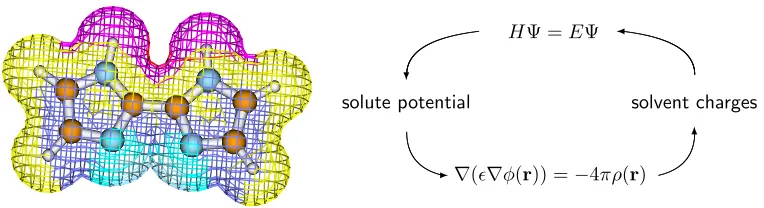
These two steps are repeated until wavefunction and charges are self-consistent (Figure 1.2). This
process ofelectronicrelaxation often (in low-dielectric media) accounts for the solvation energy of a model. However, derivatives of the new Hamiltonian include the forces on atoms due to the solvent,
so solvent-optimized structures can be determined. Since many intermediates a chemist might be interested in are not stable in the gas phase (i.e., ionic or zwitter-ionic compounds), the solvent
model’s ability to stablize charge separation is crucial for finding realistic geometries of species in
solution. Also, the effects of different solvents on the description of a reaction can be followed by
applying the appropriate dielectric constants and effective solvent radii.
Formulas of statistical mechanics are used to translate quantum mechanically derived quantities
(energy and vibrational frequencies) into thermodynamic functions and measurable chemical
prop-erties. Accurate vibrational, rotational and translational partition functions for ideal gases follow
HΨ =EΨ
∇(∇φ(r)) =−4πρ(r)
solute potential solvent charges
?
-6
Figure 1.2: The electrostatic potential around 2,2’-biimidazole and the iterative routine for including solvation in a quantum mechanical simulation using the polarizable continuum method.
Liquid phase thermodynamics, particularly entropy, are less accessible from a treatment of an
iso-lated molecule which has no representation of the “cage” potential provided by the surrounding
fluid. Fortunately, this potential is much softer than that governing intramolecular modes6, so the
contributions of the external degrees of freedom (hindered translation and rotation) to enthalpy are
expected to saturate to their classical limit of 12kT. The low-frequency limit of vibrational entropy,
however, is not so well behaved. Estimates of liquid phase entropies can be made by analogy to
tabulated experimental values or calculated from molecular dynamics simulations.
In cases where relative free energies of intermediates and transition states can be calculated,
transition state theory is used to estimate reaction rates. Rate constants of elementary steps are
based on the free energy change between a transition state and the preceeding stable intermediate
which contains all of the same atoms. Calculation of observed reaction rates and activation
parame-ters requires the correct rate expression for the catalytic cycle and knowledge of which intermediates
dominate the population. This information must be assembled from the relative free energies of the
various intermediates and any reaction orders observed for reactants. Ratios of calculated rates are
useful for comparison to selectivity or kinetic isotope effect data, and are likely to benefit from a
cancellation of error in frequency factors or activation entropies.
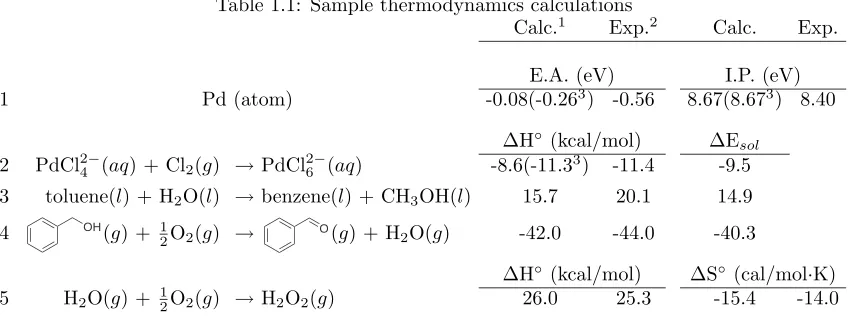
Table 1.1 provides sample thermodynamic calculations of the type found within using species
Table 1.1: Sample thermodynamics calculations
Calc.1 Exp.2 Calc. Exp.
E.A. (eV) I.P. (eV)
1 Pd (atom) -0.08(-0.263) -0.56 8.67(8.673) 8.40
∆H◦(kcal/mol) ∆Esol
2 PdCl24−(aq) + Cl2(g) →PdCl26−(aq) -8.6(-11.33) -11.4 -9.5 3 toluene(l) + H2O(l) →benzene(l) + CH3OH(l) 15.7 20.1 14.9
4 OH
(g) + 1
2O2(g) →
O(g) + H
2O(g) -42.0 -44.0 -40.3
∆H◦(kcal/mol) ∆S◦ (cal/mol·K)
5 H2O(g) + 12O2(g) →H2O2(g) 26.0 25.3 -15.4 -14.0
1B3LYP using double-ζbasis sets of Pople [22, 23, 24] with diffuse functions on O and Cl atoms and the Los
Alamos pseudopotential for palladium [25] with valence functions contracted to double-ζ 2Thermodynamic properties are taken from [26] and [27]3Calculated with the valence functions of palladium contracted to triple-ζ
whose thermodynamic properties have been tabulated. The enthalpy of a species is calculated as:
H = Eelec+ Gsolv+
ν
1 2hν+
n 2kT +
ν
hν
ehν/kT−1 (1.1)
including the total energy from the electronic structure calculation, the solvation energy7 based on
the solution of Poisson’s Equation around liquid-phase species, the zero-point energy, contributions
of 1
2kT for each rotational and translational degree of freedom and one kT for the PV contribution
to the enthalpy of gas-phase species, and finally the enthalpy of the vibrational modes. In some
instances a solvated energy, Esol = Eelec + Gsolv, will be discussed. This quantity contains the
components of enthalpy which do not require the time consuming calculation of second derivatives
and vibrational frequencies and provides a quick estimate of enthalpy.
Entries 1 and 2 show that finite basis sets commonly used are by no means converged (compare
the results from the double- and triple-ζcontractions of palladium’s valence functions). Additional
precision is gained by employing larger bases, particularly on species whose electron density changes
greatly during a reaction. The polarizable continuum solvation model has proven effective for high
and low dielectric media, although for the sake of calculating enthalpy changes reaction 2 was
7Calculated solvation energies based on an empirical dielectric constant arefree energies. The difference between
purposely chosen to maintain the number of ionic species. High dielectric media are not considered
in the body of this thesis, but the shortcomings of treating ionic species in high dielectric media are
Chapter 2
Enantioselective Oxidation of
Secondary Alcohols by
((–)-Sparteine)PdX
2
2.1
Introduction
1Recent examples of alcohol oxidations by PdII complexes and molecular oxygen, in the absence of
copper co-catalysts, demonstrate increasing efficiency and selectivity. Generally, the metal (ligated
to sp2 [28, 29, 30] or sp3 [31, 32] nitrogen, DMSO [33, 34] or a carbene [35], and common anions)
and a catalytic amount of base enable the dehydrogenation of an organic substrate by O2, producing
water or hydrogen peroxide2.
XH LnPdIIXH LnPdIIX2
R1 R2 O
R1 R2 H HO
O2 H2O2
A subset of these reactions is the enantioselective oxidation of secondary alcohols to ketones by a
((–)-sparteine)PdX2 catalyst (X = Cl, OAc), generating primarily H2O2. Sparteine, an asymmetric
natural product able to coordinate to Pd by two sp3-nitrogen lone pairs, has engendered relative
rates between (R) and (S) enantiomers of model aryl substrates of up to 47:1 [31, 32]. The aim of 1Reproduced with permission fromJ. Am. Chem. Soc. 2004,126, 7967. Copyright 2004 American Chemical
Society.
this chapter is to trace the observed characteristics of this catalyst, and less effective ones, to their
microscopic causes.
Pd(II) source, O2, base
(-)-sparteine
s = kR/kS
R1 = Aryl, Allyl R2 = Alkyl
O
R2 R1
OH
R2 R1 OH
R2 R1
OH
R2 R1
Organic chemists often seek the simplest synthetic route to large, biologically active molecules
whose stereochemistry is critical. Beginning a synthesis from a widely available, enantio-pure source
is not always possible. If the shortest synthesis starts from a racemic mixture (or if a stereocenter
is generated unselectively along the way), then at some point the unwanted enantiomer must be
removed. A kinetic resolution, in which an optically active catalyst promotes the destruction of one
antipode much faster than the other, allows the separation of enantiomers with identical physical
properties. Enantioselective oxidations of alcohol groups by ((–)-sparteine)PdX2have already proved
useful in the synthesis of Prozac, Singulair, etc. [36, 37].
Screens by the Stoltz [31] and Sigman [32] groups showed that an array of natural and synthetic
ligands exhibit a wide range of reaction rate and enantioselectivity in kinetic resolutions. Only
(–)-sparteine exhibited useful enantioselectivity factors (hereafter simply selectivity3,s= k
r/ks). As the
protocol has been refined, systematic variations in the reactivity of (–)-sparteine-PdX2 complexes
as a function of substrate have been mapped [38]. Basic additives such as Cs2CO3 have been found
to accelerate turnover [39], presumably by aiding the deprotonation of the alcohol. A recent solvent
screen [40] has shown chloroform offers rates and selectivites exceeding those previously measured in
toluene. We used the specific kinetic data to guide our investigations, which in turn have revealed the
atomistic factors that must be present to allow a ligand’s potential selectivity to evidence itself. Using
1-phenylethanol as a representative substrate, we examine the mechanism by which
(–)-sparteine-PdCl2 functions. Enantioselectivity is then considered, followed by the consequences of changing
anions and solvents.
3Pd-catalyzed oxidations have been known to overoxidize primary alcohols to carboxylic acids [29], but we will not
2.2
Methods
Reported solution phase energies (Esol, page 13) are the sum of gas phase electronic energies and
solvation energies computed with the Poisson-Boltzmann reactive field method. The gas phase
energy is evaluated with the B3LYP [17, 18] collection of gradient-corrected density functionals
using a 6-31G** [22, 23, 24] basis set for light atoms (with diffuse functions added to Cl atoms and
O atoms in acetate groups), the LACVP [25] relativistic effective core potential for Pd (which treats
the 4s, 4p, 4d, 5s and 5p electrons explicitly4), and the LAV3P [41] relativistic effective core potential
for I (5s and 5p explicit) augmented with a d-polarization shell5 as optimized by H¨ollwarth et al
[42]. The solvation energy is the difference between solvated and unsolvated calculations performed
with the described basis set sans diffuse functions. Solvents were represented with the following
parameters: toluene, = 2.379, probe radius (rp) = 2.762 ˚A; chloroform, = 4.806, rp = 2.514 ˚A;
1,2-dichloroethane, = 10.65, rp = 2.513 ˚A. Generally the gas phase structures were used in the
solvation calculations. In some cases (the relative energies in Table 2.1), the forces on the atoms
from the reaction field of the solvent were used to optimize the structure of the solvated complex,
allowing us to follow more precisely the effects of the dielectric. In such cases the relative energies
are simply energy differences between solvent-optimized structures.
Stable intermediates are completely relaxed, while transition states are characterized by no
in-teratomic forces and the presence of exactly one imaginary vibrational frequency. When a transition
state structure included a displaced anion, we often were not able to eliminate an imaginary
fre-quency corresponding to the relative motion of the unbound fragments (in addition to the imaginary
frequency of the reaction coordinate). This probably results from numerical approximations in the
methods which make it difficult to completely relax the very soft modes associated with such a
loosely bound complex. However, such modes lead to very low force constants and cause only a
negligible deviation in the transition state energy.
All calculations were performed with Jaguar 4.0 and 5.0 [43]
4Basis functions for the valence electrons were contracted to double-ζ. The energies of key species were also
evalu-ated with f-polarization functions on Pd. Since these functions served to change relative energies among intermediates by less than 0.2 kcal/mol, they were not employed.
2.3
Mechanism
2.3.1
General
Discussions of mechanisms for alcohol oxidations by palladium usually invoke aβ-hydride elimination
from a Pd-alkoxide formed by substrate coordination and deprotonation. Rather than study an
assumed sequence of intermediates, the mechanism for the reaction of interest was determined by
hypothesizing and testing many routes, using the predicted energetics to eliminate unlikely steps.
1-phenylethanol, free sparteine, and (sparteine)PdCl2in toluene were taken as reactants (the reference
state for energies).
Paths involving oxidative addition to form PdIV species were found to be quite unfavorable. The
products of O-H (2) and C-H (3) addition lie 58 kcal/mol above the reactants or are altogether
unstable (Figure 2.1).
Pd Cl O Cl H N N N Ru H H C O Ph Me O H C6H6 Pd N N Cl Cl Pd N N Cl Cl Pd Cl Cl H N N HO N Ru H H C O Ph Me O H C6H6
1(front and bottom views)
0.0 kcal/mol 57.52
3
unstable 0.04a 5
‡
<10a
Figure 2.1: ((–)-sparteine)PdCl2 and intermediates unlikely to participate in the oxidation mecha-nism. Energies (kcal/mol) for1-3are relative to1and include PB solvation by toluene (= 2.379).
aFrom reference [44].
A slightly more feasible route comes by analogy to the ruthenium catalyst of Noyori et al.
[45], generated from RuCl2(η6-benzene),β-amino alcohols orN-tosyl-1,2-diamines, and strong base. That complex (represented by4) performs the same net transformation,sec-alcohol to ketone, in one pericyclic step,5‡. Yamakawa’s calculations [44] suggest a barrier of less than 10 kcal/mol must be
overcome when reacting methanol with the coordinatively unsaturated compound4. There are two
striking differences, however, between the RuIIand PdIIcomplexes: the unsaturation of the Ru atom
without significant geometric rearrangement. No analogous transition state was found involving the
PdII compound, regardless of which base accepted the alcoholic proton: Cl−dissociating from Pd, a
nitrogen of sparteine dissociating from Pd, or exogenous amine. The structures sampled during the
search for a concerted mechanism lie more than 30 kcal/mol above the reactants, suggesting that
the reaction on Pd consists of some combination of elementary steps.
Many possible paths involving coordination of alcohol, deprotonation, and C-H activation by
β-hydride elimination are imaginable if one allows both Cl and sparteine to be displaced from the
metal during the reaction. The lowest-energy route through these steps is plotted in Figure 2.2,
along with some energetically competitive alternatives6. The alcohol enters the coordination sphere
by associative substitution for a Cl− ion (1, 6‡, 7). The predicted barrier for this displacement
(∆E‡sol= 3.8 kcal/mol) is lowered by the Cl−· · ·H–OR hydrogen bond which forms as the substrate
approaches. The free Cl− ion in 7is not basic enough to deprotonate the bound alcohol alone, but
the combination of Cl− and an exogenous sparteine molecule is. Deprotonation of the coordinated
alcohol by free sparteine has not been simulated (due to the large number of atoms and soft degrees
of freedom associated with a second, unbound ligand) but the energetic barrier of this step is believed
to be much smaller than that of the subsequentβ-hydride elimination. (Such is the case for benzyl
alcohol [38].) The products of deprotonation in the models are the bound alkoxide8and a separate
sparteine-H+Cl− ion pair, which is predicted to be more stable than separate HCl and sparteine
by ∆Esol = 25.2 kcal/mol. The relevance of structure 8 as an intermediate is supported by the
recent x-ray characterization of an analogous species (in which the methyl group of the substrate is
fluorinated) with the same structure [46].
The alkoxide8is found to undergoβ-hydride elimination through a 4-coordinate transition state
9‡, in which the remaining Cl atom is displaced to an axial, outer-sphere position 3.00 ˚A from
Pd (Figure 2.3). The ketone produced (in 10) is assumed to be easily replaced by the Cl atom,
generating the more stable Pd-hydride complex 11. A 5-coordinate transition state was sought in
which the Cl atom remains bound and theβ-hydrogen approaches Pd from out of the square plane 6Substitution of the alcohol for the other Cl, rotation around the alcohol’s O-C bond, and use of (S)-1-phenylethanol
-10 -5 0 5 10 15 20 25 30 ∆ Esol r b r r b r r b r r b 0.0 1 Pd N N Cl Cl 3.8 6‡ Pd N N O Cl Cl H -2.6 7 Pd N N Cl Cl O H -1.3 8 Pd N N H Cl O 17.5 9‡ Pd N N Cl O H 4.1 10 Pd N N Cl O H -6.2 11 Pd N N Cl H 21.9 15‡ Pd H Cl O Cl N N H 15.6 12 Pd Cl O Cl H N N 13.4 13 Pd Cl O Cl H N N 22.5 14‡ PdO H Cl N N
+ N N
H+ Cl -Pd N N Cl Cl
N Pd N
O Cl H H Cl N H O H Cl Pd N
Cl Pd N
NH
Cl
O N Pd NH
Cl
O Pd N
N
H
Cl
O N Pd N
H Cl
Figure 2.2: Mechanism for the oxidation of (R)-1-phenylethanol by ((–)-sparteine)PdCl2. Energies (kcal/mol) are relative to1and include PB solvation by toluene (= 2.379). Images are projections of the 3D structures, with corresponding bottom views aligned below.
to replace the Pd-O bond. That such a structure could not be found is consistent with the fact
that palladium’s d-orbitals are correctly organized to allow a “2+2” metathesis reaction in the
4-coordinate geometry 9‡, but not in a 5-coordinate geometry [47]. Attempts to find a 5-coordinate
transition state relaxed to the 4-coordinate structure by displacing the Cl atom from the metal.
It is most intuitive to assume that the sparteine ligand imparts chirality to the metal center
by remaining bidentate throughout the reaction and breaking the symmetry of the coordination
sphere. Nonetheless we also considered the dissociation of one or both N atoms of sparteine. A
general result of the calculations is that the proximity of the nitrogen lone pairs and the bulk and
rigidity of the ligand render it possible but unfavorable for sparteine to be bound to palladium by
only one nitrogen. This is borne out by the peripheral structures in Figure 2.2. 12-14‡ belong to a
mechanism featuring monodentate sparteine, and a low-energyβ-hydride elimination transition state
15‡ was found in which both Cl atoms remain bound to Pd while protonated sparteine is present
as a counter-ion. Besides being energetically less favorable than9‡, a mechanism including14‡ or
8(bottom)
9‡(bottom) 9‡(front)
C-H: 1.56 Pd-H: 1.63
O-C: 1.30 Pd-O: 2.09 Pd-Cl: 3.00 ˚A
Figure 2.3: Pd-alkoxide8andβ-hydride elimination transition state9‡. Sparteine carbon atoms in light grey, chlorine in green.
sparteine possesses unusual kinetic stability; in addition to its chelation, its bulk hinders associative
substitution mechanisms and its rigidity hinders stepwise breaking of the N-Pd bonds. Finally,
these alternate paths are not predicted to yield the enantioselectivities observed experimentally
(vida infra).
The reoxidation of L2PdXH species to L2PdX2 by O2, a reaction general to many catalytic
cy-cles besides the present one, warrants separate attention. This step is apparently not rate-limiting
in oxidations featuring nitrogen-bound ligands under an oxygen atmosphere, and presently we find
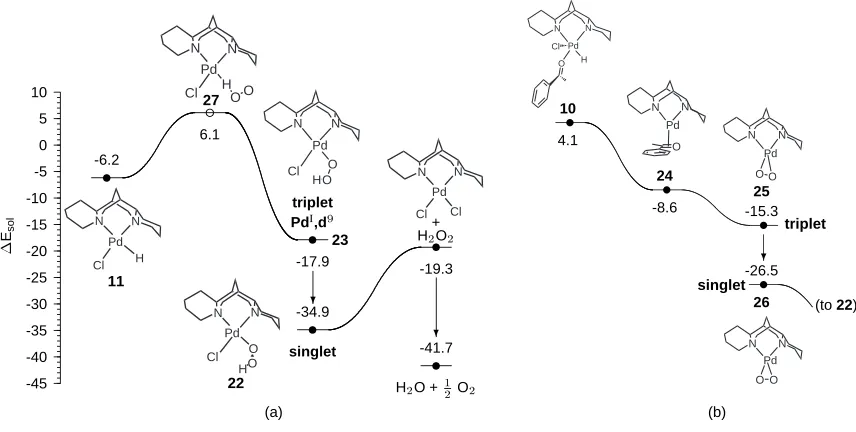
either of two suggestions plausible. O2may add across the Pd-H bond in11to produce a
hydroper-oxide complex, as proposed previously [28, 48]. Keith et al. [49] found a specific mechanism for
this transformation with a low (12 kcal/mol) activation enthalpy (Figure 2.4 (a)). The oxidizing
power of O2 drives the abstraction of the hydrogen atom from 11 yielding a PdI-OOH diradical
(23), which can cross over to the singlet surface through a thermal perturbation of the Pd-O-O-H
dihedral angle. The hydroperoxide complex22 is expected to readily join the178equilibrium
after protonation by a new alcohol or sparteine-H+Cl−and liberation of H
2O2. Alternatively, Stahl
[50] has demonstrated that (bc)Pd0(η2-olefin) (bc = bathocuproine) yields (bc)PdIIX
2 and H2O2
(via a stable (bc)PdII(η2-peroxo) intermediate) upon attack by molecular oxygen and an acid, HX.
An analogous reduced species such as24might be attained by deprotonation of 10and
be regenerated as demonstrated experimentally and theoretically [51]. (a) (b) -45 -40 -35 -30 -25 -20 -15 -10 -5 0 5 10 Esol -6.2 Pd N N Cl H 6.1 Pd N N H OO Cl -17.9 triplet PdI,d Pd N N Cl O O H -34.9 singlet Pd N N O H Cl O -19.3 Pd N N Cl Cl + HO
-41.7
HO + O s s s s 4.1 10 Pd N N Cl O H -8.6 24 Pd N N O -15.3 25 Pd N N O O -26.5 26 Pd N N O O ? (to 22) 27 22 11 23 singlet triplet
Figure 2.4: Reoxidation of the palladium-hydride intermediate through (a) PdI and (b) Pd0 inter-mediates. Energies (kcal/mol) are relative to1and include PB solvation by toluene (= 2.379.)
The result of our studies is a mechanism that involves the same sequence of steps proposed by
Mueller et al. [52], whose observations of the same model reaction strongly support rate limitation
by either deprotonation (at low sparteine loading) orβ-hydride elimination (at high sparteine
load-ing). Mueller found no reaction when no excess ligand was present, but as sparteine was added the
rate approached an asymptote at high loading. Also, when theβ-hydrogen of 1-phenylethanol was
replaced with deuterium, Mueller observed a kinetic isotope effect only under sparteine-saturated
conditions. In light of these observations, we focus on the deprotonation (DP) andβ-hydride
elim-ination (βHE) elementary steps, their dependence on the catalyst’s composition, and their control
of the observed selectivity.
2.3.2
Chloride vs. Acetate
The thermodynamics in Figure 2.2 suggest that deprotonation of 7is driven by the concentration
of reactants, not by an energetic force. As mentioned, excess sparteine (or other base) is required for
the calculations predict that the−OAc group displaced by the substrate deprotonates the alcohol
directly, without the aid of an exogenous base (Figure 2.5). No stable analogue of structure 7
containing−OAc was found; instead the proton hops from the alcohol to the acetate ion during the
energy minimization. We find that the alkoxide17is more stable (∆Esol = -1.9 kcal/mol) than the
sparteine-Pd(OAc)2 starting material 16. (Again we consider that the acetic acid generated forms
a hydrogen-bound complex with free sparteine, predicted to be only 10.2 kcal/mol more stable than
separate acetic acid and sparteine.) Consequently we expect the alkoxide to play a larger role in
the1617equilibrium when−OAc replaces Cl−, leaving the overall reaction rate to be determined
by theβ-hydride elimination step at a lower concentration of base. This effect of acetate’s greater
basicity is confirmed by the observation of modest reactivity when employing (sparteine)-Pd(OAc)2
with no added base [38].
-5 0 5 10 15 20 25 ∆ Esol s s c s c 0.0 16 Pd N N O O O O -1.9 17 Pd N N O O O H 24.1 18‡ Pd N N O -H O O 11.1 19 Pd N N O H O O -24.1 20‡ Pd N N O O H O PdN N O O O O
NPdN
O H O O PdN N O H O
-O NPdN
O H
O
-O
Figure 2.5: Abbreviated mechanism for the oxidation of (R)-1-phenylethanol by ((–)-sparteine)Pd(OAc)2. Energies (kcal/mol) include PB solvation by toluene ( = 2.379.) Bottom views are aligned below.
βHE transition state structures and energies were found for 1-phenylethanol incorporating both
Cl− and −OAc as the anion. They reveal the important role of X-groups in determining the
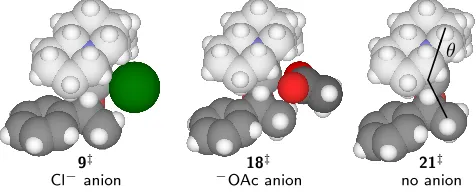
selec-tivity and rate of elimination-limited reactions. The sample structures in Figure 2.6 illustrate that
there is little direct interaction between the substrate and ligand. Instead, the temporarily displaced
group. We believe that the role of the anion at this point in the mechanism is to communicate
steric interactions between ligand and substrate, while not covalently bound but held in place by
electrostatic forces. The Csparteine-Pd-Cmethylangleθshown in Figure 2.6 increases from 135◦in21‡
to 139◦in18‡ to 146◦in9‡to accomodate the counterions. By filling the space between the methyl
group and ligand differently, the two anions present the same substrate with slightly different
envi-ronments. The asymmetry of sparteine ensures thatR and S alcohols face different combinations of steric interference as they pass through this transition state, hence the selectivity.
9‡
Cl−anion 21
‡ no anion
18‡ −OAc anion
A
A θ
Figure 2.6: β-hydride elimination transition states incorporating chloride (9‡), acetate (18‡), and no anion (21‡), optimized in toluene. The anion nestles between the ligand and substrate, increasing the Csparteine-Pd-Cmethylangleθ.
To validate the role of these diastereomeric transition state structures their energies were used
to predict enantioselectivities (scalc) of reactions limited byβ-hydride elimination using the method
of the following section. A selectivity factor of scalc = 17.7 is calculated for 1-phenylethanol in
toluene at 60◦C when X = Cl−, and scalc = 7.4 at 80◦C in toluene and scalc = 14.9 at 60◦C
in 1,2-dichloroethane when X = −OAc. Bagdanoff et al. [39] report sexp = 20.0 at 60◦C using
(norbornadiene)PdCl2 as a palladium source. (This datum is interpreted here as representing the
β-hydride elimination-controlled regime because of the excess base, Cs2CO3, present.) Starting with
Pd(OAc)2, Ferreira and Stoltz [31] reportsexp= 8.8 at 80◦C in toluene and Jensen et al. [32] report
sexp = 13.0 at 60◦C in dichloroethane.
To further emphasize the anion’s role in the β-hydride elimination step, transition states were
found for (R)- and (S)-1-phenylethanol with no anion present. The separation of charge implied by removing the anion from the resulting cationic complex (e.g. 21‡ in Figure 2.6) is energetically
kcal/mol relative to reactants) are predicted when Cl− is solvated separately than when Cl− is
allowed to remain close to the reaction center. More striking is that practically no discrimination
between enantiomers is predicted (scalc = 1.5), suggesting no selectivity would be observed if the
anion were not present between the ligand and substrate to amplify it.
2.4
Selectivity
2.4.1
General
The enantioselectivity displayed by a catalyst/substrate pair is a convolution of the relative rates of
the coordination (e.g. 1→7), deprotonation (7→8) and β-hydride elimination (8→10) events. An
algebraic expression for selectivity in terms of these rates (kCoord, kDP, kβHE) and their associated
equilibrium constants depends on one’s choice of rate law and the conditions employed in the reaction
and cannot be written down a priori. We find that selectivities observed in kinetic resolutions of racemic mixtures under base-rich conditions are accurately described by
scalc= rateR
rateS
=
RAoexp(−
∆E‡sol RT )
SAoexp(− ∆E‡sol
RT )
(2.1)
when ∆E‡sol is the calculated energy of aβHE transition state relative to the reactants (Figure 2.7).
Since the asymmetry of sparteine makes the two sites occupied by Cl atoms in the resting state
incongruent, twoβHE transition states exist for each enantiomer. Distinguished by which Cl atom
is initially displaced by the alcohol, we consider these two structures (e.g. R1 and R2 or S1 and
S2 in Table 2.1) to belong to separate reaction pathways. (Four additional isomers, analogues of
R1-S2, can be generated by swapping the methyl and aryl groups of the substrate so that the anion
resides adjacent the aryl group instead of the methyl group. For 1-phenylethanol, the unfavorable
interaction of the anion with the π-electrons of the aryl group causes the energies of these isomers
to lie 212 to 4 kcal/mol above their analogues R1-S2, and these isomers were subsequently ignored.)
By the same reasoning, experimental and calculated selectivities can be transformed into effective
∆∆G‡’s (a measure of the degree to which a catalyst distinguishes between enantiomers) for a
substrate/anion/solvent combination according to ∆∆G‡eff = RTln(s). Using only sparteine as a
ligand, Jensen et al. found that the selectivity between (R) and (S)-1-phenylethanol ranged from 2.6 to 17.5 depending on their palladium source and reaction conditions [32]. Though the models
only contain information regarding the substrate, X-group, solvent and temperature, they are able
to consistently reproduce the selectivities observed in elimination-limited reactions.
0.0 8.0 16.0 24.0 32.0 40.0 s (observed)
0.0 8.0 16.0 24.0 32.0 40.0
s (calculated)
Chloroform Toluene
1,2-Dichloroethane
1
2
3 4
5
9 10
a
b
Figure 2.7: Calculated and experimental enantioselectivities. Labels denote corresponding entry in Table 2.1; a and b correspond to 1-(p-FC6H4)-ethanol and 1-(2-napthyl)-ethanol, respectively, in chloroform at 23◦C, X = Cl−.
Equation 2.1 is consistent with an expression such as
s= KCoord,RKDP,RkβHE,R KCoord,SKDP,SkβHE,S
in which all steps prior to βHE reach pre-equilibrium. Expressions derived from more complex
mechanisms cannot, however, be excluded. The selectivity observed in the DP-limited regime
KCoord,RkDP,R/KCoord,SkDP,S. We focus on selectivity in the βHE-limited regime for two reasons.
Barring a change in mechanism, new catalysts will achieve their highest rates under these
condi-tions. Also, theβHE step may be more amenable to tuning with new ligands than deprotonation.
An experimental combinatorial study [53] found that Pd complexes of both chiral and achiral
lig-ands yielded functioning catalysts in the presence of sparteine (acting only as a chiral deprotonating
agent). Unfortunately, selectivities resulting from these asymmetric deprotonations were not
im-proved over sparteine-Pd complexes operating in theβHE-limited regime.
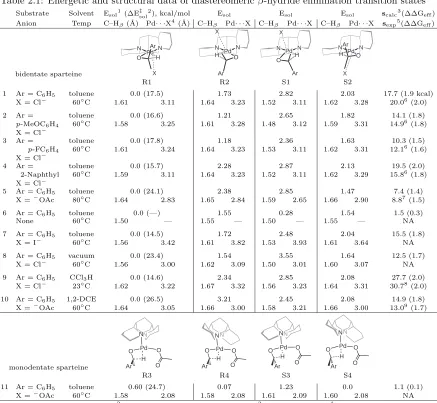
Four βHE transition states were located for a sampling of substrates (1-substituted ethanols),
solvents and X-groups. The energetic and structural data collected in Table 2.1 show that
configura-tions R1 and S2 provide the lowest-energy routes to the (R) and (S) substrates, respectively, though none of the four paths is negligible. We find the relative energies of the isomers are determined by
three factors. First, transition state energies are lower if the anion is displaced to the open face of
the ligand (below Pd in Table 1) than if it moves to the occluded face (above Pd). The rightmost
piperidine ring of sparteine (as drawn) disrupts the coordination sphere of Pd by interfering with
both the adjacent equitorial site (e.g. the adjacent chlorine in 1 is bent out of the square plane)
and upper axial site (e.g. the anion in structure S1). Whether the oxygen of the substrate bonds to
the left or right site on Pd is another factor. In the favorable site (R1, S1), oxygen abuts the less
obtrusive, leftmost piperidine ring. This effect is most clearly seen in entry 6, in which no anion is
present to otherwise affect the relative energies. Third, as mentioned, displacing the anion toward
the aryl group of the substrate requires more energy than displacing it toward the methyl group.
By combining the favorable aspects of each of these factors, structure R1 provides (R) substrates with the fastest oxidation pathway.
Selectivity predictions based on the combination ofgas phaseoptimized transition state energies and single-point solvation energies only qualitatively matched the experimental observations. In
particular, this approach failed to capture the high selectivities observed when chloroform is used
as solvent. This suggested that solvent-induced geometric relaxation plays a significant role in
Table 2.1: Energetic and structural data of diastereomericβ-hydride elimination transition states Substrate Solvent Esol1(∆E‡sol2), kcal/mol Esol Esol Esol scalc3(∆∆Geff) Anion Temp C–Hβ(˚A) Pd· · ·X4(˚A) C–Hβ Pd· · ·X C–Hβ Pd· · ·X C–Hβ Pd· · ·X sexp5(∆∆Geff)
bidentate sparteine Pd N N H X O Ar Pd N N H X O Ar Pd N N H X O Ar Pd N N H X O Ar
R1 R2 S1 S2
1 Ar = C6H5 toluene 0.0 (17.5) 1.73 2.82 2.03 17.7 (1.9 kcal)
X = Cl− 60◦C 1.61 3.11 1.64 3.23 1.52 3.11 1.62 3.28 20.06(2.0)
2 Ar = toluene 0.0 (16.6) 1.21 2.65 1.82 14.1 (1.8)
p-MeOC6H4 60◦C 1.58 3.25 1.61 3.28 1.48 3.12 1.59 3.31 14.96(1.8) X = Cl−
3 Ar = toluene 0.0 (17.8) 1.18 2.36 1.63 10.3 (1.5)
p-FC6H4 60◦C 1.61 3.24 1.64 3.23 1.53 3.11 1.62 3.31 12.16(1.6) X = Cl−
4 Ar = toluene 0.0 (15.7) 2.28 2.87 2.13 19.5 (2.0)
2-Naphthyl 60◦C 1.59 3.11 1.64 3.23 1.52 3.11 1.62 3.29 15.86(1.8) X = Cl−
5 Ar = C6H5 toluene 0.0 (24.1) 2.38 2.85 1.47 7.4 (1.4)
X =−OAc 80◦C 1.64 2.83 1.65 2.84 1.59 2.65 1.66 2.90 8.87(1.5)
6 Ar = C6H5 toluene 0.0 (—) 1.55 0.28 1.54 1.5 (0.3)
None 60◦C 1.50 — 1.55 — 1.50 — 1.55 — NA
7 Ar = C6H5 toluene 0.0 (14.5) 1.72 2.48 2.04 15.5 (1.8)
X = I− 60◦C 1.56 3.42 1.61 3.82 1.53 3.93 1.61 3.64 NA
8 Ar = C6H5 vacuum 0.0 (23.4) 1.54 3.55 1.64 12.5 (1.7)
X = Cl− 60◦C 1.56 3.00 1.62 3.09 1.50 3.01 1.60 3.07 NA
9 Ar = C6H5 CCl3H 0.0 (14.6) 2.34 2.85 2.08 27.7 (2.0)
X = Cl− 23◦C 1.62 3.22 1.67 3.32 1.56 3.23 1.64 3.31 30.78(2.0)
10 Ar = C6H5 1,2-DCE 0.0 (26.5) 3.21 2.45 2.08 14.9 (1.8)
X =−OAc 60◦C 1.64 3.05 1.66 3.00 1.58 3.21 1.66 3.00 13.09(1.7)
monodentate sparteine Pd Ar O O H O
NN N
Pd N H O Ar O O Pd NN H O Ar O O N N Pd H O Ar O O
R3 R4 S3 S4