Nudging the Envelope of Direct Transfer Methods
for Multilingual Named Entity Recognition
Oscar T¨ackstr¨om
SICS / Uppsala University Sweden
Abstract
In this paper, we study direct transfer meth-ods for multilingual named entity recognition. Specifically, we extend the method recently proposed by T¨ackstr¨om et al. (2012), which is based on cross-lingual word cluster features. First, we show that by using multiple source languages, combined with self-training for tar-get language adaptation, we can achieve sig-nificant improvements compared to using only single source direct transfer. Second, we in-vestigate how the direct transfer system fares against a supervised target language system and conclude that between 8,000 and 16,000 word tokens need to be annotated in each tar-get language to match the best direct transfer system. Finally, we show that we can signif-icantly improve target language performance, even after annotating up to 64,000 tokens in the target language, by simply concatenating source and target language annotations.
1 Introduction
Recognition of named entities in natural language text is an important subtask of information extrac-tion and thus bears importance for modern text min-ing and information retrieval applications. The need to identify named entities such as persons, loca-tions, organizations and places, arises both in ap-plications where the entities are first class objects of interest, such as inWikificationof documents (Rati-nov et al., 2011), and in applications where knowl-edge of named entities is helpful in boosting perfor-mance, e.g., machine translation (Babych and Hart-ley, 2003) and question answering (Leidner et al., 2003). The advent of massive machine readable fac-tual databases, such as Freebase1and the proposed
1http://www.freebase.com
Wikidata2, will likely push the need for automatic extraction tools further. While these databases store information about entitytypesand the relationships between those types, the named entity recognition (NER) task concerns finding occurrences of named entitiesin context. This view originated with the Mes-sage Understanding Conferences (MUC) (Grishman and Sundheim, 1996).
As with the majority of tasks in contemporary nat-ural language processing, most approaches to NER have been based on supervised machine learning. However, although resources for a handful of lan-guages have been created, through initiatives such as MUC, the Multilingual Entity Task (Merchant et al., 1996) and the CoNLL shared tasks (Tjong Kim Sang, 2002; Tjong Kim Sang and De Meul-der, 2003), coverage is still very limited in terms of both domains and languages. With fine-grained en-tity taxonomies such as that proposed by Sekine and Nobata (2004), who define over two hundred cate-gories, we can expect an increase in the amount of annotated data required for acceptable performance, as well as an increased annotation cost for each entity occurrence. Although semi-supervised approaches have been shown to reduce the need for manual an-notation (Freitag, 2004; Miller et al., 2004; Ando and Zhang, 2005; Suzuki and Isozaki, 2008; Lin and Wu, 2009; Turian et al., 2010; Dhillon et al., 2011; T¨ackstr¨om et al., 2012), these methods still require a substantial amount of manual annotation for each tar-get language. Manually creating a sufficient amount of annotated resources for all entity types in all lan-guages thus seems like an Herculean task.
In this study, we turn to direct transfer methods (McDonald et al., 2011; T¨ackstr¨om et al., 2012) as
2http://meta.wikimedia.org/wiki/Wikidata
a way to combat the need for annotated resources in all languages. These methods allow one to train a system for a target language, using only annota-tions in some source language, as long as all source language features also have support in the target lan-guages. Specifically, we extend the direct transfer method proposed by T¨ackstr¨om et al. (2012) in two ways. First, in§3, we use multiple source languages
for training. We then propose a self-training algo-rithm, which allows for the inclusion of additional target language specific features, in §4. By
com-bining these extensions, we achieve significant error reductions on all tested languages. Finally, in§5,
we assess the viability of the different direct transfer systems compared to a supervised system trained on target language annotations, and conclude that direct transfer methods may be useful even in this scenario.
2 Direct Transfer for Cross-lingual NER
Rather than starting from scratch when creating sys-tems that predict linguistic structure in one language, we should be able to take advantage of any cor-responding annotations that are available in other languages. This idea is at the heart of both direct transfer methods (McDonald et al., 2011; T¨ackstr¨om et al., 2012) and of annotation projection methods (Yarowsky et al., 2001; Diab and Resnik, 2002; Hwa et al., 2005). While the aim of the latter is to transfer annotations across languages, direct transfer meth-ods instead aim to transfer systems, trained on some source language, directly to other languages. In this paper, we focus on direct transfer methods, however, we briefly discuss the relationship between these ap-proaches in§6.
Considering the substantial differences between languages at the grammatical and lexical level, the prospect of directly applying a system trained on one language to another language may seem bleak. However, McDonald et al. (2011) showed that a lan-guage independent dependency parser can indeed be created by training on a delexicalized treebank and by only incorporating features defined on universal part-of-speech tags (Das and Petrov, 2011).
Recently, T¨ackstr¨om et al. (2012) developed an al-gorithm for inducing cross-lingual word clusters and proposed to use these clusters to enrich the feature space of direct transfer systems. The richer set of
cross-lingual features was shown to substantially im-prove on direct transfer of both dependency parsing and NER from English to other languages.
Cross-lingual word clusters are clusterings of words in two (or more) languages, such that the clus-ters are adequate in each language and at the same time consistent across languages. For cross-lingual word clusters to be useful in direct transfer of lin-guistic structure, the clusters should capture cross-lingual properties on both the semantic and syntac-tic level. T¨ackstr¨om et al. (2012) showed that this is, at least to some degree, achievable by coupling monolingual class-based language models, via word alignments. The basic building block is the follow-ing simple monolfollow-ingual class-based language model (Saul and Pereira, 1997; Uszkoreit and Brants, 2008):
L(w;C) =
m
Y
i=1
p(wi|C(wi))p(C(wi)|wi−1),
where L(w;C) is the likelihood of a sequence of words,w, andCis a (hard) clustering function, which
maps words to cluster identities. These monolingual models are coupled through word alignments, which constrains the clusterings to be consistent across lan-guages, and optimized by approximately maximizing the joint likelihood across languages. Just as monolin-gual word clusters are broadly applicable as features in monolingual models for linguistic structure predic-tion (Turian et al., 2010), the resulting cross-lingual word clusters can be used as features in various cross-lingual direct transfer models. We believe that the extensions that we propose are likely to be useful for other tasks as well, e.g., direct transfer dependency parsing, in this paper, we focus solely on discrimina-tive direct transfer models for NER.
3 Multi-source Direct Transfer
Source DE ES NL
EN 39.7 62.0 63.7 EN+DE – 61.8 65.5 EN+ES 39.3 – 65.6 EN+NL 41.0 62.5 – ALL 41.0 63.6 66.4
↑DEVELOPMENT SET↓TEST SET
[image:3.612.115.256.60.212.2]EN 37.8 59.1 57.2 EN+DE – 59.4 57.9 EN+ES 35.9 – 59.1 EN+NL 38.1 59.7 – ALL 36.4 61.9 59.9
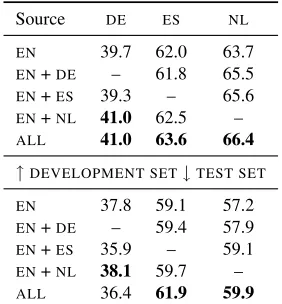
Table 1: Results of multi-source direct transfer, measured withF1-score on the CoNLL 2002/2003 development and test sets. ALL: all languages except the target language are used as source languages.
256 cross-lingual word clusters and the same feature templates as T¨ackstr¨om et al. (2012), with the ex-ception that the transition factors are not conditioned on the input.3The features used are similar to those used by Turian et al. (2010), but include cross-lingual rather than monolingual word clusters. We remove the capitalization features when transferring to man, but keep them in all other cases, even when Ger-man is included in the set of source languages. We use the training, development and test data sets pro-vided by the CoNLL 2002/2003 shared tasks (Tjong Kim Sang, 2002; Tjong Kim Sang and De Meul-der, 2003). The multi-source training sets are cre-ated by concatenating each of the source languages’ training sets. In order to have equivalent label sets across languages, we use theIO(inside/outside) en-coding, rather than theBIO(begin/inside/outside) en-coding, since the latter is available only for Spanish and Dutch. The models are trained using CRFSuite 0.12 (Okazaki, 2007), by running stochastic gradient descent for a maximum of 100 iterations.
Table 1 shows the result of using different source languages for different target languages. We see that multi-source transfer is somewhat helpful in general, but that the results are sensitive to the combination of source and target languages. On average, using all source languages only give a relative error reduction of about 3% on the test set. However, results for
3This is due to limitations in the sequence labeling software
used and gives slightly lower results, across the board, than those reported by T¨ackstr¨om et al. (2012).
DE ES NL AVG
NATIVE CLUSTERS 71.2 80.7 82.5 78.1 X-LING CLUSTERS 68.9 78.8 80.9 76.2 NATIVE&X-LING CLUST. 72.5 81.2 83.6 79.1
↑DEVELOPMENT SET↓TEST SET
NATIVE CLUSTERS 72.2 81.0 83.0 78.7 X-LING CLUSTERS 71.0 80.2 80.7 77.3 NATIVE&X-LING CLUST. 73.5 81.8 83.7 79.7
Table 2: The impact of different word clusters in the supervised monolingual setting. Results are measured with F1-score on the CoNLL 2002/2003 development and test sets. NATIVE/X-LING CLUSTERS: The cross-lingual/monolingual clusters from T¨ackstr¨om et al. (2012).
Spanish and Dutch are more promising, with relative reductions of 7% and 6%, respectively, when using all source languages. Using all available source lan-guages gives the best results for both Spanish and Dutch, but slightly worse results for German. When transferring to Dutch, using more source languages consistently help, while Spanish and German are more sensitive to the choice of source languages. Based on the characteristics of these languages, this is not too surprising: while Dutch and German has the most similar vocabularies, Dutch uses similar cap-italization rules to English and Spanish. Dutch should thus benefit from all the other languages, while Span-ish may not bring much to the table for German and vice versa, given their lexical differences. Knowl-edge of such relationships between the languages, could potentially be used to give different weights to different source languages in the training objective, as was shown effective by Cohen et al. (2011) in the context of direct transfer of generative dependency parsing models. Although better results could be achieved by cherry-picking language combinations, since we do not have any general principled way of choosing/weighting source languages in discrimina-tive models, we include all source languages with equal weight in all subsequent experiments where multiple source languages are used.
4 Domain Adaptation via Self-Training
[image:3.612.315.538.60.172.2]Algorithm 1Self-Training for Domain Adaptation
Dl
s: Labeled source domain data Dl
t: Labeled target domain data (possibly empty) Du
t: Unlabeled target domain data
δ: Dominance threshold T: Number of iterations procedureSELFTRAIN(Dl
s,Dtl,Dtu, δ, T)
θ0 ←LEARN(Dl
s∪ Dlt) .Train supervised model
fori←1toTdo Pi←PREDICT(Du
t, θi−1) .Predict w/ curr. mod.
Fi←FILTER(Pi, δ) .Filterp
θi−1(y∗|x)≤δ
Si←SAMPLE(Fi) .Pick∼pθi−1(y|x). (†)
θi←LEARN(Dl
s∪ Dlt∪Si) .Retrain
end for
returnθT .Return adapted model end procedure
†If L
EARN(·)supports instance weighting, we could weight each instance(x,y∗) ∈ Fi bypθi−1(y∗|x) in the training objective, rather than performing sampling according to the same distribution.
supervised target language models trained with differ-ent cluster features,4these clusters are not optimally adapted to the target language, compared to the mono-lingualnativeclusters that are induced solely on the target language, without any cross-lingual constraints. This is to be expected, as the probabilistic model used to learn the cross-lingual clusters strikes a balance between two language specific models. On the other hand, this suggests an opportunity for adapting to tar-get language specific features through self-training. In fact, since the direct transfer models are trained using cross-lingual features, the target language can be viewed as simply representing a different domain from the source language.
Self-training has previously been shown to be a simple and effective way to perform domain adapta-tion for syntactic parsers and other tasks (McClosky et al., 2006; Chen et al., 2011). The idea of self-training for domain adaptation is to first train a su-pervised predictor on labeled instances from a source domain. This predictor is then used to label instances from some unlabeled target domain. Those instances for which the predictor is confident are added to the source training set, and the process is repeated until some stopping criterion is met. Recently, Daum´e et al. (2010) and Chen et al. (2011) proposed more
4For these experiments, the same settings were used as in the
multi-source transfer experiments in§3, with the difference that only target language training data was used.
complex domain adaptation techniques, based on co-training. In this work, however, we stick with the sim-ple single-view self-training approach just outlined. In the self-training for domain adaptation method, de-scribed by Chen et al. (2011), the top-kinstances for
which the predictor is most confident are added to the training set in each iteration. We instead propose to weight the target instances selected for self-training in each iteration proportional to the confidence of the classifier trained in the previous iteration.
In short, letx ∈ Du
t be an unlabeled target
lan-guage input sequence (in our case a sentence) and y∗ ∈ Yt(x) its top-ranked label sequence (in our case anIOsequence). In the first iteration, a predictor is trained on the labeled source language data,Dl
s. In
each subsequent iteration the sequences are scored according to the probabilities assigned by the pre-dictor trained in the previous iteration,pθi−1(y∗|x).
When constructing the training set for the next it-eration, we first filter out all instances for which the top-ranked label sequence is notδ-dominating.
That is, we filter out all instancesx∈ Dt
usuch that pθi−1(y∗|x) < δ, for some user-specifiedδ. In this
work, we setδ = 0.5, since this guarantees that the output associated with each instance that is kept is assigned the majority of the probability mass. This is important, as we only consider the most likely output y∗for each inputx, so that sampling low-confidence instances will result in a highly biased sample. After filtering, we sample from the remaining instances, i.e. from the set of instances x ∈ Dt
u such that pθi−1(y∗|x) ≥ δ, adding each instance (x,y∗) to
the training set with probabilitypθi−1(y∗|x). This
procedure is repeated for T iterations as outlined
in Algorithm 1. By using instance weighting rather than a top-klist, we remove the need to heuristically
set the number of instances to be selected for self-training in each iteration. Further, although we have not verified this empirically, we hypothesize that us-ing instance weightus-ing is more robust than pickus-ing only the most confident instances, as it maintains di-versity in the training set in the face of uncertainty. Note also that when we have access to target language test data during training, we can perform transduc-tive learning by including the test set in the pool of unlabeled data. This gives the model the opportunity to adapt to the characteristics of the test domain.
na-DE ES NL AVG
SINGLE 39.7 62.0 63.7 55.2 MULTI 41.0 63.6 66.4 57.0 SINGLE+SELF 42.6 65.7 64.0 57.4 SINGLE+SELF/NATIVE 44.5 66.5 65.9 59.0 MULTI+SELF 48.4 64.7 68.1 60.4 MULTI+SELF/NATIVE 49.5 66.5 69.7 61.9
↑DEVELOPMENT SET↓TEST SET
[image:5.612.78.295.60.235.2]SINGLE 37.8 59.1 57.2 51.4 MULTI 36.4 61.9 59.9 52.8 SINGLE+SELF 41.3 61.0 57.8 53.3 SINGLE+SELF/NATIVE 43.0 62.5 58.9 54.8 MULTI+SELF 45.3 62.3 61.9 56.5 MULTI+SELF/NATIVE 47.2 64.8 63.1 58.4
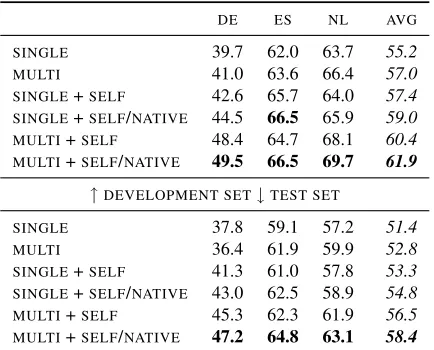
Table 3: Results of different extensions to direct trans-fer as measured withF1-score on the CoNLL 2002/2003 development and test sets. SINGLE: single-source trans-fer, MULTI: multi-source transfer, SELF: self-training with only cross-lingual word clusters,SELF/NATIVE: self-training with cross-lingual and native word clusters.
tive to the target language resembles the way McDon-ald et al. (2011) re-lexicalize a delexicalized direct transfer parser. Both methods allow the model to move weights from shared parameters to more pre-dictive target language specific parameters. However, rather than using the direct transfer parser’s own pre-dictions through self-training, these authors project head-modifier relations to the target language through loss-augmented learning (Hall et al., 2011). The boot-strapping methods for language independent NER of Cucerzan and Yarowsky (1999) have a similar effect. Our self-training approach is largely orthogonal to these approaches. We therefore believe that combin-ing these methods could be fruitful.
4.1 Experiments
In these experiments we combine direct transfer with self-training using unlabeled target data. This is the transductive setting, as we include the test data (with labels removed, of course) in the unlabeled target data. We investigate the effect of adding self-training (SELF) to the single-source and multi-source transfer settings of§3, where only cross-lingual features are
used (SINGLEandMULTI, respectively). We further study the effect of including native monolingual word cluster features in addition to the cross-lingual fea-tures (SELF/NATVE). The experimental settings and
datasets used are the same as those described in§3.
We performed self-training forT = 5iterations for all languages, as preliminary experiments indicated that the procedure converges to a stable solution af-ter this number of iaf-terations. CRFSuite was used to compute all the required probabilities for the filtering and sampling steps.
The results of these experiments are shown in Ta-ble 3. By itself, self-training without target specific features result in an average relative error reduction of less than 4%, compared to the baseline direct transfer system. This is only slightly better than the improvement achieved with multi-source transfer. However, when adding target specific features, self-training works better, with a 7% reduction. Combin-ing multi-source transfer with self-trainCombin-ing, without target specific features, performs even better with a 10% reduction. Finally, combining multi-source transfer and self-training with target specific features, gives the best result across all three languages, with an average relative error reduction of more than 14%.
The results for German are particularly interest-ing, in that they highlight a rather surprising general trend. The relative improvement achieved by com-bining multi-source transfer and self training with na-tive clusters is almost twice as large as that achieved when using only self-training with native clusters, despite the fact that multi-source transfer is not very effective on its own – in the case of German, multi-source transfer actually hurts results when used in isolation. One explanation for this behavior could be that the regularization imposed by the use of multi-ple source languages is beneficial to self-training, in that it generates better confidence estimates. Another, perhaps more speculative, explanation could be that each source language shares different characteristics with the target language. Even though the predictions on the target language are not much better on aver-age in this case, as long as a large enough subset of the confident predictions are better than with single-source transfer, these predictions can be exploited during self-training.
0 10 20 30 40 50 60 70 80
0 125 250 500 1k 2k 4k 8k 16k 32k 64k 128k F1
Number of annotated target tokens supervised
[image:6.612.314.528.66.190.2]single multi single + self/native multi + self/native
Figure 1: Learning curves for German.
0 10 20 30 40 50 60 70 80 90
0 125 250 500 1k 2k 4k 8k 16k 32k 64k 128k F1
Number of annotated target tokens supervised
[image:6.612.75.287.67.186.2]single multi single + self/native multi + self/native
Figure 2: Learning curves for Spanish.
cross-lingual direct transfer scenario. It thus seems likely that the significant improvements that we ob-serve are at least in part explained by the fact that the native features are distinct from the cross-lingual features and not mere duplicates.
5 Direct Transfer vs. Supervised Learning
Finally, we look at the relative performance of the dif-ferent direct transfer methods and a target language specific supervised system trained with native and cross-lingual word cluster features. For these experi-ments we use the same settings as for the experiexperi-ments in§3 and§4.1.
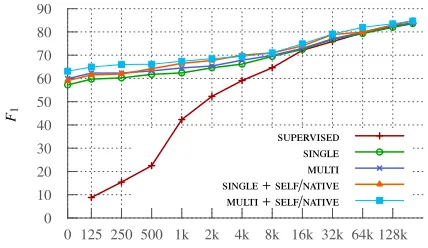
Figures 1–3 show the learning curves for the su-pervised system, as more and more target language annotations, selected by picking sentences at random from the full training set, are added to the training set, compared to the same system when combined with different direct transfer methods. From these curves, we can see that the purely supervised model
0 10 20 30 40 50 60 70 80 90
0 125 250 500 1k 2k 4k 8k 16k 32k 64k 128k F1
Number of annotated target tokens supervised
single multi single + self/native multi + self/native
Figure 3: Learning curves for Dutch.
requires between 8,000 and 16,000 annotated word tokens (roughly corresponding to between 430 and 860 sentences) in each target language to match the best direct transfer system. The learning curves also show that adding source language data improves per-formance with as many as 64,000 annotated target language tokens.
Although we believe that the results on combin-ing source and target data are interestcombin-ing, in practice the marginal cost of annotation is typically quite low compared to the initial cost. Therefore, the cost of going from 125 to 64,000 annotated tokens is likely not too high, so that the benefit of cross-lingual trans-fer is small on the margin in this scenario. However, we believe that direct transfer methods can reduce the initial cost as well, especially when a larger label set is used, since a larger label set implies a larger cognitive load throughout annotation, but especially in the initial phase of the annotation.
[image:6.612.74.287.236.375.2]6 Discussion
We have focused on direct transfer methods that ex-ploit cross-lingual word clusters, which are induced with the help of word alignments. A more com-mon use of word alignments for cross-lingual linguis-tic structure prediction is for projecting annotations across languages (Yarowsky et al., 2001; Diab and Resnik, 2002; Hwa et al., 2005).
Apart from the algorithmic differences between these approaches, there are more fundamental differ-ences in terms of the assumptions they make. An-notation projection relies on the construction of a mapping from structures in the source language to structures in the target language,Ys 7→ Yt0. Based
on thedirect correspondence assumption(Diab and Resnik, 2002; Hwa et al., 2005), word alignments are assumed to be a good basis for this mapping. When projecting annotations, no consideration is taken to the source language input space,Xs, nor to the target
language input space, Xt, except implicitly in the
construction of the word alignments. The learning al-gorithm is thus free to use any parameters when train-ing on instances fromXt× Y0
t, but can at the same
time not exploit any additional information that may be present inXs× YsaboutXt× Yt. Furthermore,
word alignments are noisy and often only provide partial information about the target side annotations.
Direct transfer, on the other hand, makes a stronger assumption, as it relies on a mapping from the joint space of source inputs and output structures to the target language, Xs × Ys 7→ Xt0 × Yt0. Actually,
the assumption is even stronger, since in order to achieve low error on the target language with a dis-criminative model, we must further assume that the conditional distributionP(Yt0|Xt0)does not diverge too much from P(Yt|Xt) in regions where P(Xt) is large. This suggests that direct transfer might be preferable when source and target languages are suffi-ciently similar so that a good mapping can be found. These differences suggest that it may be fruitful to combine direct transfer with annotation projec-tion. For example, direct transfer could be used to first map Xs × Ys 7→ X0
t × Yt0, while
annota-tion projecannota-tion could be used to derive constraints on the target output space by means of a mapping
Ys 7→ Y00
t. These constraints could perhaps be
ex-ploited in self-training, e.g., through posterior
reg-ularization (Ganchev et al., 2010), or be used for co-training (Blum and Mitchell, 1998).
7 Conclusions
We investigated several open questions regarding the use of cross-lingual word clusters for direct transfer named entity recognition. First, we looked at the sce-nario where no annotated resources are available in the target language. We showed that multi-source di-rect transfer and self-training with additional features, exclusive to the target language, both bring benefits in this setting, but that combining these methods provide an even larger advantage. We then exam-ined the rate with which a supervised system, traexam-ined with cross-lingual and native word cluster features, approaches the performance of the direct transfer system. We found that on average between 8,000 and 16,000 word tokens need to be annotated in each target language to match our best direct transfer sys-tem. We also found that combining native and cross-lingual word clusters leads to improved results across the board. Finally, we showed that direct transfer methods can aid even in the supervised target lan-guage scenario. By simply mixing annotated source language data with target language data, we can sig-nificantly reduce the annotation burden required to reach a given level of performance in the target lan-guage, even with up to 64,000 tokens annotated in the target language. We hypothesize that more elaborate domain adaptation techniques, such as that proposed by Chen et al. (2011), can lead to further improve-ments in these scenarios.
Our use of cross-lingual word clusters is orthog-onal to several other approaches discussed in this paper. We therefore suggest that such clusters could be of general use in multilingual learning of lin-guistic structure, in the same way that monolingual word clusters have been shown to be a robust way to bring improvements in many monolingual applica-tions (Turian et al., 2010; T¨ackstr¨om et al., 2012).
Acknowledgments
References
Rie Kubota Ando and Tong Zhang. 2005. A high-performance semi-supervised learning method for text chunking. InProceedings of ACL.
Bogdan Babych and Anthony Hartley. 2003. Improving machine translation quality with automatic named en-tity recognition. InProceedings of the EAMT workshop on Improving MT through other Language Technology Tools: Resources and Tools for Building MT.
Taylor Berg-Kirkpatrick and Dan Klein. 2010. Phyloge-netic grammar induction. InProceedings of ACL. Avrim Blum and Tom Mitchell. 1998. Combining labeled
and unlabeled data with co-training. InProceedings of
COLT, COLT’ 98, New York, NY, USA. ACM.
Minmin Chen, John Blitzer, and Kilian Q. Weinberger. 2011. Co-training for domain adaptation. In Proceed-ings of NIPS.
Shay B. Cohen, Dipanjan Das, and Noah A. Smith. 2011. Unsupervised structure prediction with non-parallel multilingual guidance. InProceedings of EMNLP. Silviu Cucerzan and David Yarowsky. 1999. Language
independent named entity recognition combining mor-phological and contextual evidence. InProceedings of EMNLP-Very Large Corpora.
Dipanjan Das and Slav Petrov. 2011. Unsupervised part-of-speech tagging with bilingual graph-based projec-tions. InProceedings of ACL-HLT.
Hal Daum´e, III, Abhishek Kumar, and Avishek Saha. 2010. Frustratingly easy semi-supervised domain adap-tation. InProceedings of the 2010 Workshop on Do-main Adaptation for Natural Language Processing. Hal Daum´e, III. 2007. Frustratingly easy domain
adapta-tion. InProceedings of ACL.
Paramveer Dhillon, Dean Foster, and Lyle Dean. 2011. Multi-view learning of word embeddings via cca. In
Proceedings of NIPS.
Mona Diab and Philip Resnik. 2002. An unsupervised method for word sense tagging using parallel corpora. InProceedings of ACL.
Dayne Freitag. 2004. Trained named entity recogni-tion using distriburecogni-tional clusters. In Proceedings of EMNLP.
Kuzman Ganchev, Jo˜ao Grac¸a, Jennifer Gillenwater, and Ben Taskar. 2010. Posterior regularization for struc-tured latent variable models. Journal of Machine Learn-ing Research.
Ralph Grishman and Beth Sundheim. 1996. Message understanding conference-6: a brief history. In Pro-ceedings of the 16th conference on Computational lin-guistics - Volume 1.
Keith Hall, Ryan McDonald, Jason Katz-Brown, and Michael Ringgaard. 2011. Training dependency
parsers by jointly optimizing multiple objectives. In
Proceedings of EMNLP.
Rebecca Hwa, Philip Resnik, Amy Weinberg, Clara Cabezas, and Okan Kolak. 2005. Bootstrapping parsers via syntactic projection across parallel texts.
Natural Language Engineering, 11(03):311–325. Jochen L. Leidner, Gail Sinclair, and Bonnie Webber.
2003. Grounding spatial named entities for information extraction and question answering. InProceedings of HLT-NAACL-GEOREF.
Dekang Lin and Xiaoyun Wu. 2009. Phrase clustering for discriminative learning. InProceedings of ACL-IJCNLP, pages 1030–1038.
David McClosky, Eugene Charniak, and Mark Johnson. 2006. Effective self-training for parsing. In Proceed-ings of NAACL-HLT.
Ryan McDonald, Slav Petrov, and Keith Hall. 2011. Multi-source transfer of delexicalized dependency parsers. InProceedings of EMNLP.
Roberta Merchant, Mary Ellen Okurowski, and Nancy Chinchor. 1996. The multilingual entity task (met) overview. InProceedings of a workshop on held at Vienna, Virginia: May 6-8, 1996.
Scott Miller, Jethran Guinness, and Alex Zamanian. 2004. Name tagging with word clusters and discriminative training. InProceedings of HLT-NAACL.
Joel Nothman, James R Curran, and Tara Murphy. 2008. Transforming wikipedia into named entity training data. InProceedings of the Australasian Language Technol-ogy Association Workshop 2008, pages 124–132, Ho-bart, Australia, December.
Naoaki Okazaki. 2007. Crfsuite: a fast implementation of conditional random fields (crfs).
Lev Ratinov, Dan Roth, Doug Downey, and Mike Ander-son. 2011. Local and global algorithms for disam-biguation to wikipedia. InProceedings of ACL-HLT. Lawrence Saul and Fernando Pereira. 1997. Aggregate
and mixed-order markov models for statistical language processing. InProceedings of EMNLP, pages 81–89. Satoshi Sekine and Chikashi Nobata. 2004. Definition,
dictionaries and tagger for extended named entity hier-archy. InProceedings of LREC.
Benjamin Snyder, Tahira Naseem, Jacob Eisenstein, and Regina Barzilay. 2009. Adding more languages im-proves unsupervised multilingual part-of-speech tag-ging: A bayesian non-parametric approach. In Pro-ceedings of NAACL.
Jun Suzuki and Hideki Isozaki. 2008. Semi-supervised sequential labeling and segmentation using giga-word scale unlabeled data. InProceedings of ACL-HLT. Oscar T¨ackstr¨om, Ryan McDonald, and Jakob Uszkoreit.
Erik F. Tjong Kim Sang and Fien De Meulder. 2003. Introduction to the conll-2003 shared task: Language-independent named entity recognition. InProceedings of CoNLL.
Erik F. Tjong Kim Sang. 2002. Introduction to the conll-2002 shared task: Language-independent named entity recognition. InProceedings of CoNLL.
Joseph Turian, Lev-Arie Ratinov, and Yoshua Bengio. 2010. Word representations: A simple and general method for semi-supervised learning. InProceedings of ACL.
Jakob Uszkoreit and Thorsten Brants. 2008. Distributed word clustering for large scale class-based language modeling in machine translation. In Proceedings of ACL-HLT.