Public Key Encryption with Equality Test
in the Standard Model
Hyung Tae Lee1, San Ling1, Jae Hong Seo2, Huaxiong Wang1, and Taek-Young Youn3
1 Division of Mathematical Sciences, School of Physical and Mathematical Sciences,
Nanyang Technological University, Singapore {hyungtaelee,lingsan,hxwxang}@ntu.edu.sg
2 Myongji University, Korea [email protected] 3
Electonics and Telecommunications Research Institute, Korea [email protected]
Abstract. Public key encryption with equality test (PKEET) is a cryp-tosystem that allows a tester who has trapdoors issued by one or more usersUito perform equality tests on ciphertexts encrypted using public key(s) of Ui. Since this feature has a lot of practical applications in-cluding search on encrypted data, several PKEET schemes have been proposed so far. However, to the best of our knowledge, all the existing proposals are proven secure only under the hardness of number-theoretic problems and the random oracle heuristics.
In this paper, we show that this primitive can be achieved not only generically from well-established other primitives but also even with-outrelying on the random oracle heuristics. More precisely, our generic construction for PKEET employs a two-level hierarchical identity-based encryption scheme, which is selectively secure against chosen plaintext attacks, a strongly unforgeable one-time signature scheme and a cryp-tographic hash function. Our generic approach toward PKEET has sev-eral advantages over all the previous works; it directly leads the first standard model construction and also directly implies the first lattice-based construction. Finally, we show how to extend our approach to the identity-based setting.
Keywords: Public key encryption with equality test, identity-based en-cryption with equality test, standard model
1
Introduction
between ciphertexts of users who issued the trapdoor to him.4This property is of use in various practical applications, such as keyword search on encrypted data, encrypted data partitioning for efficient encrypted data management, personal health record systems, and so on.
As a very similar primitive to PKEET, we may recall public key encryption with keyword search (PKEKS) due to Boneh et al. [6]. In PKEKS schemes, each user issues a token for a keyword to the tester using his/her private key, and henceforth the tester is able to perform an equality test between a message in a ciphertext of the user and the keyword in the issued token. Hence, it can be utilized to check the equality between ciphertexts of the same user. However, the most important feature of PKEET beyond PKEKS is to support equality tests on ciphertexts between different users.
Let us consider more concrete application scenario of PKEET to elaborate advantages of PKEET over PKEKS. In an email service, suppose each user stores his/her emails to the server as encrypted. To support keyword search over encrypted emails efficiently, encrypted keywords are appended to stored emails. The server needs to monitor stored emails to maintain the security of the system. To this end, the server may need to test equality among encrypted keywords. If the system exploits PKEKS for this functionality, the server can perform equality tests on encrypted keywords by using a token for a keyword, issued by the owner of ciphertexts. However, the server needs a different token for each user and each keyword and so it should interact with each user whenever it has a new keyword to be monitored. On the contrary, if the system exploits PKEET, the server can generate a ciphertext of a keyword by himself and perform equality tests.
To support equality tests on encrypted data required for the above scenario, one may consider to exploit other types of encryption schemes, such as deter-ministic encryption and fully homomorphic encryption, to name a few. However, they are faced with the obstacles that PKEKS has. We will discuss more about relations of PKEET to other primitives including PKEKS in Section 1.2. On the other hand, apart from the above scenario, PKEET can also be utilized as a building block to design advanced cryptographic constructions, e.g., group signatures with controllable linkability [19].
Due to its wide applicability, since Yang et al. proposed the first PKEET realization, various subsequent constructions [20, 22, 17, 16, 11, 15, 14, 12] have been proposed to improve performance or to support advanced functionality. We note that, however, all the existing proposals are proven secure only un-der the hardness of specific number-theoretic problems and the random oracle heuristics. There is a lot of literature discussing the limitations of the random oracle model (e.g., [8, 10, 13]) and thus, it is highly desirable to achieve each primitive (PKEET in our case) without relying on the random oracle heuristics from both theoretical and practical standpoints.
1.1 Our Contribution
In this paper, our main contribution is a proposal for PKEET schemes. The proposed construction has several advantages over all the previous PKEET con-structions. First, our construction does not rely on the random oracle heuristics. Second, our construction does not rely on underlying mathematical structures in the sense that we do not require any number-theoretic assumptions for the security of the proposed construction. More precisely, we employ a 2-level hi-erarchical identity-based encryption (HIBE) scheme, which is selectively secure against the chosen-plaintext attacks, a strongly unforgeable one-time signature scheme and a cryptographic hash function. Finally, our construction can be eas-ily extended to the identity-based setting since it already employs HIBE as a building block. As a result, we also obtain the first identity-based encryption with equality test (IBEET) in the standard model.
As direct applications of our generic construction, we can obtain PKEET constructions that are proven secure under various types of assumptions, such as pairing-based, lattice-based, and RSA-based ones. In particular, for example, we may obtain a PKEET construction from lattices by exploiting a strongly unforgeable lattice-based signature scheme (e.g., [18]) and a 2-level lattice-based HIBE scheme (e.g., [2, 3]), which satisfies the indistinguishability under selective identity, chosen plaintext attacks (IND-sID-CPA). To the best of our knowledge, it is the first PKEET scheme whose underlying assumptions are solely lattice-based.
There exists a very recent work by Lee et al. [12] that has a similar goal to ours. We clearly note that Lee et al.’s approach is not completely generic in the sense that it essentially uses the computation Diffie-Hellman (CDH) assumption. Furthermore, Lee et al. proved the security of their scheme only in the random oracle model.
Overview of Our Generic Construction.Let us explain a high level intuition for our generic PKEET construction. We begin with a trivial insecure construc-tion and then modify it subsequently. Suppose that each user has a 2-level HIBE schemeHIBE = (Setup,KeyExt,Enc,Dec). To generate a ciphertext of a mes-sageM, we design an encryption algorithm that performs the following steps. It first selects a random stringstrfrom a set{0,1}∗ as a second level identity and generates two ciphertexts
C0=Enc(mpk,[0.str], M) andC1=Enc(mpk,[1.str], H(M))
wherempkis a master public key ofHIBE,H is a hash function, and [ID1.ID2] denotes an identity whose i-th level identity is IDi for i = 1,2. This process
outputs (str, C0, C1) as a ciphertext of the messageM. The decryption algorithm is straightforward; it first generates the secret keys related to str, decrypts C0 and C1 by using generated secret keys, and outputsDec(C0) ifH(Dec(C0)) =
Dec(C1).
may perform an equality test by decrypting C1 parts of ciphertexts and then comparingH(M) values. On the other hand, the user who has the master secret key ofHIBEas his/her secret key, can generate a secret key of the identity [0.str] and obtain the correct message by using it to decrypt C0. However, the above construction does not satisfy the security against adaptive chosen ciphertext attacks (CCA2). Although C0 and C1 are linked by str and there is a process to check the link between C0 and C1 during the execution of the decryption algorithm, it is not enough to prevent chosen ciphertext attacks. In fact, the adversary can obtain the message in C0 by requesting a query on a modified ciphertext (str, C0,·) to the decryption oracle in the security game. To prevent such a chosen ciphertext attack, almost all previous PKEET constructions in the random oracle model (including the semi-generic one [12]) have embedded an instance of the CDH problem.
To achieve the CCA2 security in a generic way, we borrow an idea of the Canetti, Halevi, and Katz (CHK) transformation to obtain a CCA2 secure PKE scheme from an IND-sID-CPA secure identity-based encryption (IBE) scheme using a strongly unforgeable one-time signature scheme in the standard model. We first assign a signature scheme to each user. By adapting their technique, we modify our encryption algorithm so that it first generates a pair of a signing key and a verification key (sks,vks) and uses the verification key vks as the second level identity, instead of a random stringstr. After generating two ciphertexts,
C0=Enc(mpk,[0.vks], M) andC1=Enc(mpk,[1.vks], H(M)),
it additionally generates a signature σ on the ciphertexts C0 and C1 using a signing keysks. Thereafter, it outputs
(vks, C0, C1, σ) as a ciphertext.
Informally, we can regard that an adversary has to succeed in forging a signature on some message with respect to the verification key in the chal-lenge ciphertext, in order to receive the correct response from a decryption oracle query on a ciphertext obtained by modifying the challenge ciphertext. We show that our construction achieves one-wayness under adaptive chosen ci-phertext attacks (OW-CCA2) against Type-I adversaries, who have a trapdoor for equality tests, and the indistinguishability under adaptive chosen ciphertext attacks (IND-CCA2) against Type-II adversaries, who do not have a trapdoor, if the exploited HIBE scheme is IND-sID-CPA secure and the exploited signature scheme is strongly unforgeable in the standard model. As a result, we obtain the first PKEET construction in the standard model.
1.2 Related Works
In this subsection, we look at some primitives related to PKEET. We also intro-duce existing works related to the technique used in our construction.
PKE/IBE with Equality Test. Yang et al. [23] first introduced the concept of PKEET, which allows anyone to check whether two ciphertexts contain the same message or not, under different public keys as well as the same public key. Following their work, Tang [22] proposed a variant, so called all-or-nothing PKEET, which allows only testers authorized by two users to perform equality tests on all ciphertexts of those users. Subsequently, there have been proposed various PKEET constructions [20, 21, 17, 16, 11, 14, 12] to improve performance or to support advanced functionality.
In the identity-based setting, Ma [15] proposed a system model for IBEET, which is an identity-based version of Tang’s all-or-nothing PKEET model, and presented an instantiation of IBEET. Later, Lee et al. [12] showed that their semi-generic construction for PKEET can be extended to the identity-based setting and the derived outcome achieves better security than Ma’s scheme.
On the other hand, all existing PKEET/IBEET schemes are constructed in the random oracle model. Moreover, all previous proposals rely on specific number-theoretic assumptions.
PKE/IBE with Keyword Search.PKE with keyword search (PKEKS) is a PKE scheme that supports the functionality to perform an equality test between a keyword embedded in a tag and a message in a ciphertext [6]. It is quite similar to PKEET in the sense that both are able to check the equality on encrypted data. However, the main difference between the two schemes is that PKEKS allows tests on ciphertexts under only a fixed public key related to the issued tag, whereas PKEET allows equality tests on ciphertexts under different public keys as well as the same public key.
Abdalla et al. [1] considered an extension of PKEKS to the identity-based setting, which has similar features to those of IBEET. As similar with the relation between PKEKS and PKEET, IBE with keyword search (IBEKS) also allows to perform equality tests on ciphertexts under a fixed identity related to the issued tag, whereas IBEET allows equality tests on ciphertexts under different identities as well as the same identity.
Deterministic Encryption. The notion of deterministic encryption was first initiated by Bellare et al. [4]. For testers, PKEET has the very similar feature to deterministic encryption in the sense that it supports equality tests on cipher-texts, although PKEET is a probabilistic encryption. Hence, PKEET can be exploited to many applications of deterministic encryption. On the other hand, in the view of others who do not have a trapdoor, PKEET works just like tradi-tional PKE schemes and so it is expected that PKEET achieves better security than deterministic encryption. Further, as the same as PKEKS, deterministic encryption supports equality tests between ciphertexts of the same user only.
PKE scheme from an IND-sID-CPA secure IBE scheme with exploiting strongly unforgeable one-time signatures. We note that there is a generic transforma-tion to obtain a PKEKS scheme using an IBE scheme. In [1], Abdalla et al. provided a transformation of an anonymous IBE scheme to a secure PKEKS scheme. Further, as similar to ours, they also extended their transformation to the identity-based setting by replacing the underlying IBE scheme with an HIBE one. However, its design principle is quite different from ours: For example, while our construction uses a verification key of the underlying signature scheme as an identity and encrypts a message using it, their transformation generates a random message and encrypts it with a keyword in PKEKS as an identity.
1.3 Organization of the Paper
Section 2 presents basic definitions of several components exploited in our con-structions. In Section 3, we introduce syntax and the security model of PKEET. Section 4 provides our PKEET scheme and Section 5 analyzes its security. We discuss about extensions of our construction in Section 6 and give concluding remarks in Section 7. The details about formal definitions of IBEET and our IBEET construction are given in Appendices.
2
Preliminaries
In this section, we look at basic definitions of components that will be exploited to design our PKEET schemes.
Notation.Throughout the paper,λdenotes a security parameter. For an algo-rithmA,A→aandA6→adenote thatAoutputsaandAdoes not, respectively. A function ν :N→R is negligible in λif for all positive polynomials p(·) and
sufficiently large λ,ν(λ)≤ 1
p(λ).negl(λ) represents a negligible function inλ.
Hierarchical Identity-Based Encryption.We begin with presenting the def-inition of HIBE and its security notion, which will be utilized as a building block of our generic construction for PKEET schemes.
Definition 1 (Hierarchical Identity-Based Encryption). A hierarchical identity-based encryption (HIBE) scheme consists of the following four proba-bilistic polynomial-time (PPT) algorithms:
– Setup(λ): On input a security parameterλ, it outputs a pair of a master pub-lic key and a master secret key(mpk,msk). It is assumed thatmpkcontains the message spaceM and the identity spaceI.
– Enc(mpk,ID, M): It takes mpk, a recipient’s identity ID, and a message M ∈ Mas inputs and outputs a ciphertextct.
– Dec(skID,ct): It takes a secret keyskID of an identityIDand a ciphertextct as inputs and outputs a messageM0.
We say an HIBE scheme iscorrect if for any output (mpk,msk) ofSetup(λ), message M ∈ M, identity ID0 ∈ I, and outputskID0 ofKeyExt(skID,ID0) with any ID0’s ancestor ID, it holds
Pr[Dec(skID0,Enc(mpk,ID0, M))→M] = 1,
where the probability goes over all randomness values used in all corresponding algorithms. Furthermore, we require that for any identity ID, its delegated secret keys obtained from its any ancestor have the same distribution. We remark that an IBE scheme is an HIBE scheme where all identities are at level 1.
For our construction, we need a selective identity secure HIBE scheme against chosen plaintext attacks.
Definition 2 (IND-sID-CPA).An IBE or HIBE schemeE= (Setup,KeyExt,
Enc,Dec) is IND-sID-CPA secure if for any PPT adversary A, the advantage of the following game between the adversaryAand the challengerCis negligible in the security parameterλ:
1. Init:Aoutputs a target identity ID∗.
2. Setup:C runsSetup(λ)→(mpk,msk), forwards the master public keympk
toA, and keeps the master secret key mskprivate.
3. Phase 1: A may issue private key queries on IDi, which is neither ID∗
nor an ancestor ofID∗, polynomially many times. To respond to queries,C
runs the KeyExt algorithm to generate a secret key skIDi of the requested identityIDi and returns skIDi toA.
4. Challenge:Aoutputs two messagesM0, M1of the same length and forwards
C them. C selects a random bit b ∈ {0,1}, runs Enc(mpk,ID∗, Mb) →ct∗b,
and passesct∗b as the challenge ciphertext to A.
5. Phase 2:Amay issue private key queries onIDi, which is neitherID∗ nor
an ancestor ofID∗, polynomially many times.C responds as in Phase 1. 6. Guess:Aoutputs b0∈ {0,1}.
We sayAwins if b=b0 and the advantage ofAin the above game is defined to
AdvINDA,E-sID-CPA(λ) :=
Pr[b=b0]−1
2
.
We remark that in the above game, ifAsends a target identity ID∗together with two messages M0, M1 at the challenge step, not at the beginning of the game, then we say that a schemeE is IND-ID-CPA secure.
to convert IND-sID-CPA secure IBE schemes into CCA2 secure PKE schemes with employing a strongly unforgeable one-time signature scheme in the standard model. Here, we describe the formal definition of signature schemes and provide its security notion required for our construction.
Definition 3 (Digital Signature Scheme). A digital signature scheme con-sists of the following three PPT algorithms:
– G(λ) : It takes a security parameter λ as an input and outputs a pair of a verification key and a signing key(vks,sks).
– S(sks, M) : On input the singing key sks and a message M, it outputs a signatureσ.
– V(vks, M, σ) : It takes the verification key vks, a message M, and a signa-tureσ as inputs, and returns1 or0.
We say that a digital signature scheme iscorrect if for any output (vks,sks) ofG(λ) and any messageM, it holds
Pr[V(vks, M,S(sks, M))→1] = 1,
where the probability goes over all randomness values used in all corresponding algorithms. We also say that a digital signature isone-timeif for each verification key the signing algorithm runs only once; that is, in the following security model, we may assume that the adversary attacking a one-time signature scheme can issue a signing query only once.
Definition 4 (Strong Unforgeability). A signature scheme Sig = (G,S,V) is strongly unforgeable under an adaptive chosen message attack if for any PPT adversaryA, the probability that the adversary wins in the following game with the challengerC is negligible in the security parameterλ:
1. Setup: C runs G(λ)→ (vks,sks), passes the verification key vks to A, and keeps the signing keysks private.
2. Signature Queries:Aissues signing queries on messagesMi polynomially
many times. For eachMi,C runsS(sks, Mi)→σi and sendsσi toA. These
queries may be requested adaptively so that each query may depend on the replies to the previous queries.
3. Output:Aoutputs a pair(M, σ).
The adversary wins if V(vks, M, σ)→1 and(M, σ)is not generated during the signature query phase.
Properties of Hash Functions. To show the correctness and security of our construction, we will exploit the following properties of hash functions.
Definition 5 (One-way Functions).A functionH is one-way if the following two conditions hold:
2. For any PPT algorithmA, it holds that
Pr[A(λ, H, y)→xsuch that H(x) =y]≤negl(λ) wherey=H(x0)for a randomly chosen x0 from the domain.
Definition 6 (Collision Resistant Hash Functions).A family of hash func-tions{Hs} is collision resistant if the following three conditions hold:
1. There exists a PPT algorithmGen(λ)that outputs an indexs. 2. There exists a polynomial-time algorithm to computeHs.
3. For any PPT algorithmA, it holds that
Pr[Gen(λ)→s, A(s)→(x, x0)such that x6=x0 andHs(x) =Hs(x0)]≤negl(λ).
3
Syntax and Security Model
In this section, we review the concept of PKEET and its security model. There have been several types of definitions of PKEET with slight differences. Among them, our system model follows the concept of all-or-nothing PKEET scheme, proposed by Tang [22].
3.1 Syntax
System Model for Our PKEET.Our PKEET system consists of users (e.g., senders and receivers) and testers (e.g., the server): In the system, a sender encrypts a data using a receiver’s public key and sends a ciphertext to the re-ceiver. The receiver may decrypt his/her ciphertexts using his/her secret key and/or store ciphertexts at the server. Once the receiver wants to delegate the test capability for all of his/her ciphertexts, he/she issues a trapdoor for equality tests to a tester who can access to the server that stores encrypted data. Here-after, the tester is able to perform equality tests on ciphertexts under the public key of the receiver who delegated the test authority for his/her ciphertexts to the tester.
Definitions of PKEET. Before giving a definition of PKEET, we first note that PKEET is a multi-user setting and we assume that each user is assigned an index i for 1 ≤i ≤ N, where N is the number of users in the system. We useUi to denote the i-th user. Furthermore, for notational convenience, we use
a subscripted index to indicate keys and ciphertexts for each user, e.g.,pki is a public key for user Ui.
– Setup(λ): On input a security parameter λ, it outputs a system parame-terparams, which includes the message spaceM. It is assumed that all other algorithms takeparams as an input implicitly, though it is not stated.
– KeyGen(params): It takes params as an input and outputs a pair of user’s public and secret keys(pk,sk).
– Enc(pk, M): It takes pk and a message M ∈ M as inputs, and outputs a ciphertextct.
– Dec(sk,ct): It takes sk and a ciphertext ct as inputs, and outputs a mes-sageM0 or⊥.
– Td(ski): On input a secret keyski of a userUi, it outputs a trapdoortdi.
– Test(tdi,cti,tdj,ctj): It takes two ciphertextscti and ctj and two trapdoors
tdi andtdj as inputs, and outputs0 or1.
Correctness. Basically, PKEET is a PKE scheme, so that we require that for any Setup(λ)→params andKeyGen(params)→ (pki,ski) and for any message
M ∈ Mand indexi,Dec(ski,Enc(pki, M)) =M always holds. For the
function-ality ofTd andTestalgorithms, we require the following two additional condi-tions to be satisfied. For any Setup(λ)→params,KeyGen(params)→(pki,ski),
KeyGen(params)→(pkj,skj),Td(ski)→tdi,Td(skj)→tdj,Enc(pki, Mi)→cti,
andEnc(pkj, Mj)→ctj withMi, Mj ∈ M,
1. Pr
Test(tdi,cti,tdj,ctj)→1
= 1 if Mi =Mj, regardless of whetheri=j
ori6=j;
2. Pr[Test(tdi,cti,tdj,ctj)→1] is negligible in the security parameterλfor any
ciphertextsct0iand ct0j such thatDec(ski,ct0i)6=Dec(skj,ct0j).
3.2 Security Model
For the security of PKEET, we consider two different scenarios according to whether the adversary has a trapdoor for the target user or not. In case where the adversary has the trapdoor for the equality test, we cannot expect the indistinguishability-based security notion for PKEET, and, probably, the one-wayness is the best achievable security. Otherwise, we can define the indistin-guishability security notion for PKEET.
More precisely, we consider the following two types of adversaries for our PKEET system model.
– Type-I adversary: This type of adversaries has the trapdoor for the target user’s ciphertexts and so the adversary can perform an equality test with the challenge ciphertext. Hence, we consider that the aim of the adversary is to reveal the message contained in the challenge ciphertext.
We first provide the formal security definition for PKEET constructions against Type-I adversaries below.
Definition 8 (OW-CCA2 against Type-I Adversaries).A PKEET scheme is OW-CCA2 secure against Type-I adversaries if for any PPT adversaryA, the success probability ofAin the following game with the challengerC is negligible in the security parameterλ: Let Utbe the target user.
1. Setup:C runsSetup(λ)→params and sends the system parameter params
toA. Then,C runsKeyGen(params)→(pki,ski)for 1≤i≤N and passes
allpki’s toA.
2. Phase 1:Amay query the following oracles polynomially many times adap-tively and in any order. The constraint is that an indextcannot be queried to the key extraction oracleOsk.
– Osk:an oracle that on input an index i, returns theU
i’s secret keyski.
– ODec: an oracle that on input a pair of an indexi and a ciphertextct
i,
returns the output ofDec(ski,cti)using theUi’s secret keyski.
– OTd:an oracle that on input an indexi, returnstd
iby runningTd(ski)→
tdi with the Ui’s secret keyski.
3. Challenge: C chooses a random message M from the message space M, runsEnc(pkt, M)→ct∗t, and sendsct∗t toA.
4. Phase 2: For A’s queries, C responds as in Phase 1. The constraints for
A’s queries are that
(a) the indextcannot be queried to the key extraction oracleOsk;
(b) the pair of the index t and the ciphertext ct∗t cannot be queried to the decryption oracleODec.
5. Guess:Aoutputs M0.
The adversaryA wins in the above game ifM =M0 and the success probability of Ais defined to
AdvOWA,PKEET-CCA2(λ) := Pr[M =M0].
Remark 1. (Constraint on the message space) If the size of the message space is polynomial in the security parameter or the min-entropy of the message dis-tribution is much lower than the security parameter, a Type-I adversary who has a trapdoor for the challenge ciphertext, can reveal the message in the chal-lenge ciphertext in polynomial time or sufficiently small exponential time in the security parameter, by performing equality tests with the challenge ciphertext and other ciphertexts of all messages, generated by himself. To prevent these trivial attacks, it is assumed that the size of the message space is exponential in the security parameter and the min-entropy of the message distribution is sufficiently higher than the security parameter.
Definition 9 (IND-CCA2 against Type-II Adversaries).A PKEET scheme is IND-CCA2 secure against Type-II adversaries if for any PPT adversary A, the advantage of A in the following game with the challenger C is negligible in the security parameter λ: LetUt be the target user.
1. Setup: This step is the same as that of the OW-CCA2 security game in Definition 8.
2. Phase 1: This step is almost the same as that of the OW-CCA2 security game in Definition 8, except that the constraint is that an indext cannot be queried to the trapdoor extraction oracle OTd as well as the key extraction oracleOsk.
3. Challenge:A chooses two message M0, M1 ∈ M of the same length and passesC them. C selects a random bitb∈ {0,1}, runsEnc(pkt, Mb)→ct∗t,b,
and sendsct∗t,b toA.
4. Phase 2: For A’s queries, C responds as in Phase 1. The constraints for
A’s queries are that
(a) the index t cannot be queried to the key extraction oracle Osk and the trapdoor extraction oracleOTd;
(b) the pair of the index t and the ciphertext ct∗t,b cannot be queried to the decryption oracleODec.
5. Guess:Aoutputs b0.
The adversary A wins in the above game if b =b0 and the advantage of A is defined to
AdvINDA,PKEET-CCA2(λ) :=
Pr[b=b0]−1
2
.
3.3 Extension to Identity-Based Settings
One can easily extend the definition of PKEET to the identity-based setting. Let us briefly point out differences only. (Refer to Appendix A for formal definitions of IBEET.) The setup algorithmSetupoutputs a pair of a master public keympk
and a master secret key msk, instead of a system parameter params. The key generation algorithmKeyGentakesmpkand an identity ID, and outputs a secret key of the identity ID, skID. All other algorithms are almost the same as the public key setting, except a slight adjustment for an identity instead of a public key.
part in the security model remains almost unchanged, except a fine-tuning for an identity instead of a public key. We note that such a small difference between the numbers of manipulable users in systems should be carefully handled in the security proof. Hence, in the security proof for PKEET, one may assume that the simulator knows the target public key pkt in advance at the beginning of
the simulation, at the price of polynomial reduction loss. However, in the se-curity proof for IBEET, if one would like to make a construction that achieves the adaptive ID security, not the selective ID security, one may not be able to assume that the simulator knows the target identity at the very beginning of the simulation because there are exponentially many candidates. It causes a situa-tion that our IBEET construcsitua-tion should employ an IND-ID-CPA secure HIBE scheme, whereas our PKEET construction employs an IND-sID-CPA secure one.
4
Our PKEET Construction
In this section, we present our construction for PKEET by exploiting traditional 2-level HIBE schemes and signature schemes. Hereafter, [ID1.ID2] denotes an identity of a 2-level HIBE schemeHIBE = (Setup,KeyExt,Enc,Dec) where ID1 is the first level identity and ID2 is the second level identity. [M0kM1] denotes the concatenation of messagesM0 andM1.
Our Strategy.Our design strategy is based on the transformation from an IND-sID-CPA secure IBE scheme into an IND-CCA2 secure PKE scheme in the stan-dard model, proposed by Canetti, Halevi, and Katz (CHK) [9], which has a ci-phertext of the formct= (vks, C, σ), whereG(λ)→(vks,sks),Enc(mpk,vks, M)→ C, and S(sks, C) → σ for a signature scheme Sig = (G,S,V) and an IBE scheme IBE = (Setup,KeyExt,Enc,Dec). More precisely, in the encryption algorithm constructed by the CHK transformation, it performs as follows: 1) generate a pair of a signing key and a verification key (vks,sks), 2) encrypt a mes-sage M using the encryption algorithmEnc of the underlying IBE schemeIBE
with a verification key vks as an identity, and finally 3) sign the obtained IBE ciphertext C using the signing keysks. Then, the resulting scheme is an IND-CCA2 secure PKE scheme if the underlying signature scheme Sig is strongly unforgeable and the underlying IBE schemeIBE is IND-sID-CPA secure.
In our construction, to support an equality test, we apply the CHK transfor-mation to two ciphertexts of a message and its hash value at once using a 2-level HIBE scheme instead of an IBE scheme. For given a signature scheme Sig = (G,S,V) and a 2-level HIBE scheme HIBE = (Setup,KeyExt,Enc,Dec), the proposed encryption process for a messageM is as follows: 1)G(λ)→(vks,sks), 2)Enc(mpk,[0.vks], M)→C0, 3)Enc(mpk,[1.vks], H(M))→C1for a hash func-tionH, 4)S(sks,[C0kC1])→σ, and 5) output ct= (vks, C0, C1, σ).
using a decryption key for the identity [1.vks] and comparing with them of other ciphertexts.
Informally, when the underlying signature scheme is strongly unforgeable and the underlying HIBE scheme is IND-sID-CPA secure, if the adversary does not have a decryption key for the identity [1.vks∗] that is used in the challenge ciphertext, then the proposed scheme still remains to be IND-CCA2 secure as constructions obtained by the CHK transformation. Otherwise, all the situation is the same as the previous, except that the adversary additionally knows the hash value of the message, H(M). Therefore, it cannot achieve the indistin-guishability between messages, but we expect the one-wayness of the message information ifH is a one-way function.
Description.We provide a full description of our PKEET construction below.
– Setup(λ) : Given a security parameterλ, generate
1. a 2-level HIBE schemeHIBE = (Setup,KeyExt,Enc,Dec),
2. a hash function H : {0,1}∗ → Mfor the message space Mof HIBE, and
3. a digital signature schemeSig= (G,S,V).
It outputs a system parameterparams={H,HIBE,Sig}. We implicitly set the message space of our PKEET scheme to the message spaceMofHIBE.
– KeyGen(params) : On input params, it runs Setup(λ) → (mpk,msk) and outputs a public keypk=mpkand a secret keysk=msk.
– Enc(pk, M) : It takespkand a messageM ∈ Mas inputs and runs 1. G(λ)→(vks,sks),
2. Enc(pk,[0.vks], M)→C0,
3. Enc(pk,[1.vks], H(M))→C1, and 4. S(sks,[C0kC1])→σ.
It outputs a ciphertextct= (vks, C0, C1, σ).
– Dec(sk,ct) : On input ct, parse ct to (vks, C0, C1, σ). Then, it performs as follows:
1. RunKeyExt(sk,[i.vks])→sk[i.vks] fori= 0,1.
2. DecryptC0andC1by runningDec(sk[0.vks], C0)→M
0andDec(sk [1.vks],
C1)→h0.
3. Ifh0 =H(M0) andV(vks,[C0kC1], σ)→1, then outputM0. Otherwise, output⊥.
– Td(ski) : It takes a user Ui’s secret key ski as an input, runs KeyExt(ski,
– Test(tdi,cti,tdj,ctj): It takes trapdoors tdi,tdj and ciphertexts cti,ctj for
usersUi, Uj, respectively, as inputs. Fork=i, j,
1. parsectk to (vks,k, Ck,0, Ck,1, σk),
2. runKeyExt(tdk,[1.vks,k])→skk,[1.vks,k], and 3. runDec(skk,[1.vks,k], Ck,1)→h
0
k.
Ifh0
i=h0j, then output 1. Otherwise, output 0.
Correctness.The following theorem demonstrates the correctness of our PKEET construction.
Theorem 1. Our PKEET construction is correct if the underlying HIBE scheme
HIBE and signature schemeSigare correct, and the employed hash functionH is collision resistant.
Proof. Letct= (vks, C0, C1, σ) be a valid ciphertext of messageM obtained by runningEnc(pk, M) wherepkis a public key generated by runningKeyGen(params) and params is an outcome of the Setup algorithm. That is, G(λ) → (vks,sks),
Enc(pk,[0.vks], M) → C0, Enc(pk,[1.vks], H(M)) → C1, and S(sks,[C0kC1])
→σ. Because HIBE is correct,
Dec(sk[0.vks], C0) = Dec(sk[0.vks],Enc(pk,[0.vks], M)) →M0=M
and
Dec(sk[1.vks], C1) = Dec(sk[1.vks],Enc(pk,[1.vks], H(M))) →h0=H(M)
where sk[i.vks] is an outcome of KeyExt(sk,[i.vks]) for i= 0,1. So, it holds h
0= H(M0). In addition, becauseSigis correct,
V(vks,[C0kC1], σ) =V(vks,[C0kC1],S(sks,[C0kC1]))→1. Hence,Dec(sk,ct) always outputs the correct messageM.
Let ctk = (vks,k, Ck,0, Ck,1, σk) be a valid ciphertext of user Uk, obtained
by performing Enc(pkk, Mk) where pkk is a user Uk’s public key generated by
running KeyGen(params) and params is an outcome of the Setup algorithm for k=i, j. Then, becauseHIBE is correct,
Dec(skk,[1.vks,k], Ck,1)→h 0
k=H(Mk)
where skk,[1.vks,k] is an outcome of KeyExt(skk,[1.vks,k]) for k =i, j. Hence, if Mi =Mj, thenh0i =H(Mi) =H(Mj) =h0j and so the Testalgorithm always
outputs 1. On the other hand, if Dec(ski,cti) 6= Dec(skj,ctj), then Mi 6= Mj
and so h0i =H(Mi) =6 H(Mj) =h0j with overwhelming probability because H
is collision resistant. Hence, the Test algorithm outputs 0 with overwhelming probability.
5
Security Analysis
In this section, we look into the security of our PKEET construction against Type-I and Type-II adversaries. We first show that our scheme is IND-CCA2 secure against Type-II adversaries who do not have a trapdoor for equality tests on all target user’s ciphertexts.
Theorem 2 (IND-CCA2).IfHIBE is an IND-sID-CPA secure 2-level HIBE scheme and Sig is a strongly unforgeable one-time signature scheme, then the proposed PKEET scheme exploitingHIBE andSig is IND-CCA2 secure against Type-II adversaries in the standard model.
More precisely, if there is no PPT adversary that breaks the strong unforge-ability of one-time signature schemeSigwith at leastεSig success probability and there is no PPT adversary that breaks the IND-sID-CPA security ofHIBE with at least εHIBE advantage, then for any PPT adversary that breaks the IND-CCA2 security of the proposed PKEET construction, its advantage is bounded
above by2εHIBE+ 3εSig
2 .
Proof. We prove by using the standard hybrid argument. Let N be the num-ber of users in the system and t be the index of the target user. Let ct∗t =
(vks∗,t, Ct,∗0, Ct,∗1, σt∗) be the challenge ciphertext for the userUt.
We begin with defining the following three games and denote byGithe event
that the adversaryAwins inGamei.
Game0: This game is the same as the original IND-CCA2 security game in Definition 9.
Game1: This game is almost the same asGame0, except that ifAqueries the oracle ODec(t,·) on ct
t = (vks,t, Ct,0, Ct,1, σt) such that vks,t =vks∗,t, ctt 6=ct∗t,
and V(vks,t,[Ct,0kCt,1], σt)→1, then the challengerC stops an interaction and
setsA’s answer at random.
Game2: This game is almost the same as Game1, except for the challenger’s response in the challenge phase. Recall that the original challenge ciphertext
ctt∗ (in Game0 and Game1) has the form (vks∗,t, Ct,∗0, Ct,∗1, σt∗), where G(λ)→
(vks∗,t,sks∗,t), Enc(pkt,[0.vks∗,t], Mb) → Ct,∗0, Enc(pkt,[1.vks∗,t], H(Mb)) → Ct,∗1,
S(sks∗,t,[Ct,∗0kCt,∗1]) → σ∗t, and b is a random bit chosen by C. At the
begin-ning of the challenge phase,Aissues two messagesM0 and M1. Then,C tosses two unbiased coins a and b. If a= 0, C computes the challenge ciphertext by using Mb and H(M1−b), instead ofMb and H(Mb). Otherwise (a= 1), C uses
M1−b andH(Mb) for generatingC0 andC1, respectively.
Let the advantage ofAinGameibeεi fori= 0,1,2. That is,εi=
Pr[Gi]−
1 2
fori= 0,1,2. Then, we prove the theorem by using a sequence of lemmas.
Lemma 1. ε0−ε1< 3εSig
Proof. We begin with defining an eventE1. InGame1,Cshould stop and output a random guess for A’s output if A issues a decryption query on the target userUt’s ciphertextctt= (vks,t, Ct,0, Ct,1, σt) such thatvks,t =vks∗,t,ctt6=ct∗t,
andV(vks,t,[Ct,0kCt,1], σt)→1. Denote such the situation byE1.
From the definitions ofE1,ε0, andε1, we find a relation among Pr[E1], ε0, andε1 as follows.
ε1=
Pr[G1]−
1 2 =
Pr[G1|E1] Pr[E1] + Pr[G1|¬E1] Pr[¬E1]−
1 2 = 1
2Pr[E1] + Pr[G0∧ ¬E1]− 1 2 = 1
2Pr[E1] + Pr[G0]−Pr[G0∧E1]− 1 2 ≥
Pr[G0]−
1 2 − 1
2Pr[E1]−Pr[G0∧E1]
≥
Pr[G0]−
1 2 − 3 2Pr[E1] =ε0−
3
2Pr[E1].
The third equality holds since Pr[G1|E1] = 1
2 and Pr[G0∧ ¬E1] = Pr[G1∧ ¬E1]. Hence, we have
Pr[E1]≥ 2
3(ε0−ε1). (1)
Now, we are going to show that Pr[E1] < εSig, which leads an inequality among ε0, ε1, andεSig. In Game1, whatA causes the eventE1 is that A suc-ceeds in forging a signature on some message with respect to the verification keyvks∗,t. Here,vks∗,tappears only in the challenge ciphertext. So, one can easily
embed an instance of the strong unforgeability game for the underlying signa-ture scheme Siginto Game1; that is, one can construct another simulator SSig that breaks the strong unforgeability ofSig by usingAinGame1. One letsSSig behave normally as the challenger of Game1 for all situations, except for the challenge ciphertext generation. Once SSig generates the challenge ciphertext, it embeds the verification key of the strong unforgeability game forSig as vks∗,t
in the challenge ciphertext. It normally generates ciphertextsCt,∗0 andCt,∗1of a message Mb and its hash value H(Mb), respectively, by selecting b ∈ {0,1} at
random. It then requests a signature of the message [Ct,∗0kCt,∗1] to the signing oracle that is given to SSig in the strong unforgeability game. If the event E1 occurs, whatAreturns is exactly a forged signature on some message, which is different from [Ct,∗0kCt,∗1], with respect to the target verification keyvks∗,t. Hence,
stated in the lemma,
ε0−ε1<3
2εSig. (2)
u t
Lemma 2. ε1−ε2<2εHIBE.
Proof. We construct a simulatorSHIBEthat breaks the IND-sID-CPA security of
HIBE by usingA. Denote the challenger of the IND-sID-CPA security game for
HIBE byCHIBE. First, we describeSHIBE and then analyze its advantage later.
SHIBE generates a pair of a signing key and a verification key (sks∗,t,vks∗,t) by
running the key generation algorithmGof the signature schemeSig.SHIBEtosses a coin α∈ {0,1} and passes [α.vks∗,t] as the target (2-level) identity to CHIBE. Once receiving the master public key mpkof HIBE fromCHIBE, SHIBE sets a userUt’s public key pktto mpk, runs the key extraction algorithm Setup(λ)→
(pki,ski) for all 1 ≤ i 6= t ≤ N, and passes the system parameter params =
{H,HIBE,Sig}and allpki’s for 1≤i≤N toA.
As for the query responses,SHIBE utilizes her own oracles provided byCHIBE. If A issues a decryption query on a valid ciphertext using vks∗,t, then SHIBE stops the interaction with A and sets A’s output to be a random coin. For all the other decryption queries toODec, S
HIBE responds by accessing the key extraction oracle served byCHIBE. For all other queriesOsk(i) andOTd(i) with i6=t,SHIBE responds by usingski’s. We note thatAwill not issue a secret key
extraction query Osk(t) and a trapdoor query OTd(t) for the target userU
tin
the IND-CCA2 security game.
In the challenge phase,Achooses and sendsM0andM1toSHIBE. According toα, which is chosen bySHIBE at the beginning of the simulation, the challenge ciphertext for A is differently computed: If α = 0, then SHIBE sends M0 and M1toCHIBE, receivesCt,∗0,bthat is a ciphertext of the messageMbwith respect
to the target identity [0.vks∗], wherebis a random bit chosen by CHIBE. Then,
SHIBE selects a random bitβ ∈ {0,1}and sendsA
ct∗t = (vks∗,t, Ct,∗0,b, Ct,∗1,β =Enc(pkt,[1.vks∗,t], H(Mβ)), σt∗),
whereS(sks∗,t,[Ct,∗0,bkC
∗
t,1,β])→σ
∗
t. Similarly, ifα= 1, thenSHIBE sendsH(M0) andH(M1) toCHIBE, and receivesCt,∗1,bthat is a ciphertext of the messageH(Mb)
with respect to the target identity [1.vks∗,t], where b is a random bit chosen by
CHIBE. Then,SHIBE selects a random bitβ ∈ {0,1}and sendsA
ct∗t = (vks∗,t, C
∗
t,0,β=Enc(pkt,[0.vks∗,t], Mβ), Ct,∗1,b, σ
∗
t),
where S(sks∗,t,[Ct,∗0,βkCt,∗1,b]) → σt∗. After the challenge phase, SHIBE can re-spond to all decryption queries correctly as before the challenge phase. Finally,
SHIBE forwardsA’s outputb0 to CHIBE.
except the challenge ciphertext. As for the challenge ciphertext, if b = β, the challenge ciphertext has the same form as that of Game1. Otherwise (that is, b6=β), it is the challenge ciphertext ofGame2. Hence, the advantage ofSHIBE can be computed as follows.
εHIBE >AdvIND-sID-CPASHIBE,HIBE(λ) =
Pr[b
0=b]−1 2 = 1 2 Pr[b
0=b|b=β] + Pr[b0=b|b6=β]
−1 2 =1 2
Pr[G1] + Pr[G2]−1 =1 2
Pr[G1]−
1 2
+ Pr[G2]− 1 2 ≥1 2
Pr[G1]−
1 2 −
Pr[G2]−
1 2 =1
2(ε1−ε2).
u t
Lemma 3. ε2= 0.
Proof. In the challenge phase, C computes the challenge ciphertext differently according to the choice of a. If a= 0, C usesMb andH(M1−b) for generating
C0 and C1, respectively. Otherwise (a = 1), C uses M1−b and H(Mb). Even
when messages are known to A, A cannot find the valueb correctly since a is completely hidden from the viewpoint ofA. Hence,ε2= 0. ut
Overall, putting all the results of lemmas, we have ε0≤2εHIBE+
3εSig 2 .
u t
The following theorem shows that our PKEET construction is OW-CCA2 secure against Type-I adversaries who have a trapdoor for equality tests on all target user’s ciphertexts.
Theorem 3 (OW-CCA2).IfHIBE is an IND-sID-CPA secure 2-level HIBE scheme, H is a one-way hash function, and Sig is a strongly unforgeable one-time signature scheme, then the proposed PKEET scheme exploitingH,HIBE, andSig, is OW-CCA2 secure against Type-I adversaries in the standard model. More precisely, if there is no PPT adversary that breaks one of the strong unforgeability of Sig, the one-wayness of H, and the IND-sID-CPA security of
HIBE with at least εSig success probability, εH success probability, and εHIBE
Proof. Similarly to the IND-CCA2 security proof of Theorem 2, we use the standard hybrid argument and begin with defining two games. Let N be the number of users in the system and t be the index of the target user. Letct∗t =
(vks∗,t, Ct,∗0, Ct,∗1, σt∗) be the challenge ciphertext for the target user Ut. Denote
byGi the event that the adversaryAwins inGamei.
Game0: This game is the same as the original OW-CCA2 security game in Definition 8.
Game1: This game is almost the same as Game0, except that if A queries
ODec(t,·) on ct
t = (vks,t, Ct,0, Ct,1, σt) such that vks,t = vks∗,t, ctt 6= ct∗t, and
V(vks,t,[Ct,0kCt,1], σt)→1, then the challengerC stops an interaction and sets
A’s answer at random.
We show that the adversarial success probability gap between the above two games is less than εSig. InGame1, C should stop and output a random guess if A issues a decryption query on a ciphertext ctt = (vks,t, Ct,0, Ct,1, σt) such
that vks,t = vks∗,t, ctt 6= ct∗t, and V(vks,t,[Ct,0kCt,1], σt) →1. Denote such the
situation byE1. We assume that there exists an adversaryAsuch that its success probability in Gamei isεi fori= 0,1. That is, εi = Pr[Gi] for i= 0,1. Then,
we find a relation among Pr[E1], ε0, and ε1as follows: ε1= Pr[G1]
= Pr[G1|E1] Pr[E1] + Pr[G1|¬E1] Pr[¬E1]
= 1
|M|Pr[E1] + Pr[G0∧ ¬E1]
≥ 1
|M|Pr[E1] + Pr[G0]−Pr[E1] ≥ε0−Pr[E1].
Hence, we have
Pr[E1]≥ε0−ε1. (3)
We can show that Pr[E1] < εSig by using the same argument given in the proof of Theorem 2 and so we omit the details. Therefore, we finally have an inequality
ε0−ε1< εSig. (4)
cannot expect howAbehaves on this anomalous transcript, but we can find an upper bound of the probability thatAoutputsM10 by considering another game to break the one-wayness ofH usingA. The reduction is quite straightforward. One can just embed the instance of the one-wayness game into a message ofCt,0∗1, instead ofH(M10). SinceM10 is used only forCt,0∗1in the challenge ciphertext, the simulation for the other parts is straightforward. From this simulation, we have Pr[A →M10 in PS]< εH. (5)
Now, we are ready to construct a main simulator SHIBE that breaks the IND-sID-CPA security ofHIBE by usingA. Denote the challenger of the IND-sID-CPA security game for HIBE by CHIBE. First, SHIBE chooses a target verification keyvks∗,t by runningG(λ)→(vks,t∗,sks∗,t). Next,SHIBE sends [0.vks∗] as the target (2-level) identity to CHIBE. Once SHIBE receives the system pa-rameter mpk of HIBE, it sets pkt to mpk, runs the key extraction algorithm
Setup(λ) → (pki,ski) for all 1 ≤ i 6= t ≤ N, and passes the system
param-eter params = {H,HIBE,Sig} and all pki’s for 1 ≤ i ≤ N to A. SHIBE can respond to all decryption oracle queries, secret key extraction queries, and trap-door queries correctly as in the proof of Theorem 2. In particular, differently from the adversary in the proof of Theorem 2, it is allowed thatAissues a trap-door query on the index of the target userUtandSHIBE can answer by querying on the secret key for the identity 1 to the key extraction oracle of HIBE.
In the challenge phase,SHIBE chooses M0 andM1 at random, sends them to CHIBE, and then receivesCt,∗0,b that is a ciphertext of the message Mb with
respect to the target identity [0.vks∗], wherebis a random bit chosen byCHIBE.
SHIBE selects a random bitβ ∈ {0,1}and sendsA
ct∗t = (vks∗,t, C
∗
t,0,b, C
∗
t,1,β =Enc(pkt,[1.vks∗,t], H(Mβ)), σt∗),
where S(sks∗,t,[Ct,∗0,bkCt,∗1,β]) → σt∗. After the challenge phase, SHIBE can re-spond to all queries correctly as before the challenge phase. Finally, A may output either a message M0 or ⊥ toSHIBE. If M0 =Mβ, then SHIBE returns b0 =β to CHIBE. Otherwise, SHIBE sets a bit b0 at random and returns it to
CHIBE.
It is trivial to show that all the simulated transcripts are identical to the viewpoint of A in Game1, except the challenge ciphertext. If b =β, the sim-ulated transcripts are identical to the real transcripts including the challenge ciphertext. Otherwise, both are not identical and hence we cannot expect A’s behaviour exactly. However, we can obtain some probability about A’s output in this case from the result of the simulationPS. By using this, we compute the advantage ofSHIBE as follows.
Pr[b
0 =b]−1 2 = 1 2 Pr[b
0=b|b=β] + Pr[b0 =b|b6=β]
−1 2 = 1
2 Pr[A →Mb∨(A 6→Mb∧b
0 =b)|b=β] + Pr[b0=b|b6=β]
−1
2
=
1
2 Pr[A →Mb|b=β] + Pr[(A 6→Mb∧b
0 =b)|b=β] + Pr[b0 =b|b6=β]
−1 2 = 1
2 Pr[G1] + 1
2Pr[A 6→Mb|b=β] + Pr[b
0=b|b6=β]
−1 2 = 1
2 Pr[G1] + 1
2(1−Pr[G1]) + Pr[b
0=b|b6=β]
−1 2 = 1 2 1
2Pr[G1] + Pr[b
0 =b|b6=β]−1 2 = 1 2 1
2Pr[G1] + Pr[A 6→Mβ∧b
0=b|b6=β]−1 2 = 1 2 1
2Pr[G1] + 1
2Pr[A 6→Mβ|b6=β]− 1 2 = 1 2 1
2Pr[G1] + 1
2(1−Pr[A →Mβ|b6=β])− 1 2 = 1 4
Pr[G1]−Pr[A →Mβ|b6=β]
> 1
4(Pr[G1]−εH)
whereG1denotes the event thatAwins inGame1. The fourth and eighth equal-ities hold because b0 is independently and randomly chosen from the set{0,1}
if M0 6= Mβ for A’s output M0 at the last step and the last inequality holds
because of Equation (5).
Hence, we have 14(ε1 −εH) < εHIBE. Therefore, putting this with
Equa-tion (4), we obtain ε0<4εHIBE+εH+εSig. ut
6
Discussion
In this section, we provide an extension of our PKEET construction to the identity-based setting. We also present a comparison of ours with the previous results.
6.1 Extension to IBE with Equality Test
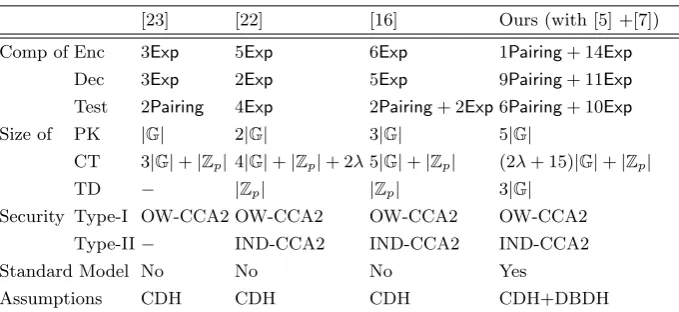
Table 1.Comparison of Our PKEET with Existing Schemes
[23] [22] [16] Ours (with [5] +[7]) Comp of Enc 3Exp 5Exp 6Exp 1Pairing+ 14Exp
Dec 3Exp 2Exp 5Exp 9Pairing+ 11Exp Test 2Pairing 4Exp 2Pairing+ 2Exp6Pairing+ 10Exp Size of PK |G| 2|G| 3|G| 5|G|
CT 3|G|+|Zp|4|G|+|Zp|+ 2λ5|G|+|Zp| (2λ+ 15)|G|+|Zp|
TD − |Zp| |Zp| 3|G|
Security Type-I OW-CCA2 OW-CCA2 OW-CCA2 OW-CCA2 Type-II− IND-CCA2 IND-CCA2 IND-CCA2
Standard Model No No No Yes
Assumptions CDH CDH CDH CDH+DBDH
Legends: Comp: computational complexity, Enc: encryption algorithm, Dec: decryp-tion algorithm, Test: test algorithm, PK: public key, CT: ciphertext, TD: trapdoor, Exp: cost for an exponentiation, Pairing: cost for a pairing computation, λ: secu-rity parameter, CDH: computational Diffie-Hellman assumption, DBDH: decisional Diffie-Hellman assumption
indistinguishability under adaptive identity and adaptive chosen ciphertext at-tacks (IND-ID-CCA2) against Type-II adversaries in the standard model. We provide the details of the description of our IBEET construction and its security proofs in Appendix B.
6.2 Comparison of Our PKEET Construction with Previous Works
We provide a comparison of our PKEET construction with previous schemes. For our scheme, we exploit Boneh and Boyen’s IND-sID-CPA HIBE (BB-HIBE) [5] and Boneh, Shen, and Waters’ strongly unforgeable signature (BSW-Sig) [7] as underlying HIBE and signature schemes, respectively. We note that for a level-` user, the BB-HIBE scheme requires (2`+ 1)Exp, 1Pairing+ (`+ 2)Exp, and (`+ 1)Pairingfor key generation, encryption, and decryption, respectively, where
Pairing and Exp denote costs for computing a pairing and an exponentiation, respectively. The sizes of a ciphertext and a private key for a level-`user are (2 + `)|G|and`|G|, respectively, where|G|denotes a bit size required for representing
an element in the underlying group G. The security of their scheme relies on
decisional bilinear Diffie-Hellman (DBDH) assumptions. On the other hand, the BSW-Sig scheme requires 1Exp, 6Exp, and 3Pairing+ 1Exp for key generation, signing, and verification, respectively. The bit sizes of a verification key and a signature are (n+ 5)|G|and 2|G|+|Zp|, respectively, wherenis the output size
of the utilized hash function and pis the order of the underlying groupG. Its
Table 1 presents a comparison of ours with previous works. The second, third, fourth, and last columns describe the features of Yang et al.’s original PKEET [23], Tang’s all-or-nothing PKEET [22], Ma et al.’s PKEET [16] by considering a Type-1 authorization only in their paper, and ours, respectively. We set the output size of the utilized hash functions to 2λ for the security parameterλ. The table shows that ours has the worst performance among them in terms of both computational complexity and parameter size. The performance of ours in the table heavily relies on that of the underlying signature and HIBE schemes. Thus, we believe that more efficient underlying schemes improve the performance of ours further. On the other hand, we remark that our PKEET construction is the first one in the standard model.
7
Conclusion
In this paper, we provided a generic construction of PKEET by exploiting a 2-level HIBE scheme, a traditional signature scheme, and a cryptographic hash function. Our proposed scheme is OW-CCA2 secure against Type-I adversaries who have a trapdoor for equality tests and is IND-CCA2 secure against Type-II adversaries who do not have if the exploited HIBE scheme is IND-sID-CPA secure, the exploited one-time signature scheme is strongly unforgeable, and the exploited hash function is one-way in the standard model. As a result, we obtain the first PKEET construction that is secure in the standard model. Finally, we discussed an extension of our PKEET construction into the identity-based setting.
While our construction has an advantage that is generic in the sense that it does not require any number-theoretic assumption explicitly, there may be room for improvement in terms of efficiency. Thus, it would be interesting to design efficient PKEET schemes in the standard model.
Acknowledgements
Hyung Tae Lee would like to thank Khoa Nguyen for his vaulable suggstions to improve the previous version of this paper. Hyung Tae Lee, San Ling, and Huax-iong Wang were supported by Research Grant TL-9014101684-01 and the Sin-gapore Ministry of Education under Research Grant MOE2013-T2-1-041. Huax-iong Wang was also supported by NTU under Tier 1 grant RG143/14. Jae Hong Seo was supported by Electronics and Telecommunications Research Institute (ETRI) grant funded by the Korean government [15ZS1500, Develpoment of storage and search technologies over encrypted database].
References
properties, relation to anonymous IBE, and extensions. J. Cryptology, 21(3):350– 391, 2008.
2. S. Agrawal, D. Boneh, and X. Boyen. Efficient lattice (H)IBE in the standard model. In H. Gilbert, editor,Advances in Cryptology - EUROCRYPT 2010, volume 6110 ofLNCS, pages 553–572. Springer, 2010.
3. S. Agrawal, D. Boneh, and X. Boyen. Lattice basis delegation in fixed dimen-sion and shorter-ciphertext hierarchical IBE. In T. Rabin, editor, Advances in Cryptology - CRYPTO 2010, volume 6223 ofLNCS, pages 98–115. Springer, 2010. 4. M. Bellare, A. Boldyreva, and A. O’Neill. Deterministic and efficiently search-able encryption. In A. Menezes, editor,Advances in Cryptology - CRYPTO 2007, volume 4622 ofLNCS, pages 535–552. Springer, 2007.
5. D. Boneh and X. Boyen. Efficient selective-ID secure identity-based encryption without random oracles. In C. Cachin and J. Camenisch, editors, Advances in Cryptology - EUROCRYPT 2004, volume 3027 ofLNCS, pages 223–238. Springer, 2004.
6. D. Boneh, G. D. Crescenzo, R. Ostrovsky, and G. Persiano. Public key encryp-tion with keyword search. In C. Cachin and J. Camenisch, editors, Advances in Cryptology - EUROCRYPT 2004, volume 3027 ofLNCS, pages 506–522. Springer, 2004.
7. D. Boneh, E. Shen, and B. Waters. Strongly unforgeable signatures based on computational Diffie-Hellman. In M. Yung, Y. Dodis, A. Kiayias, and T. Malkin, editors,Public Key Cryptography (PKC) 2006, volume 3958 ofLNCS, pages 229– 240. Springer, 2006.
8. R. Canetti, O. Goldreich, and S. Halevi. The random oracle methodology, revis-ited (preliminary version). In J. S. Vitter, editor,ACM STOC 1998, pages 209–218. ACM, 1998.
9. R. Canetti, S. Halevi, and J. Katz. Chosen-ciphertext security from identity-based encryption. In C. Cachin and J. Camenisch, editors, Advances in Cryptology -EUROCRYPT 2004, volume 3027 ofLNCS, pages 207–222. Springer, 2004. 10. Y. Dodis, R. Oliveira, and K. Pietrzak. On the generic insecurity of the full domain
hash. In V. Shoup, editor,Advances in Cryptology - CRYPTO 2005, volume 3621 ofLNCS, pages 449–466. Springer, 2005.
11. K. Huang, R. Tso, Y. Chen, S. M. M. Rahman, A. Almogren, and A. Alamri. PKE-AET: Public key encryption with authorized equality test. Comput. J., 58(10):2686–2697, 2015.
12. H. T. Lee, S. Ling, J. H. Seo, and H. Wang. Semi-generic construction of public key encryption and identity-based encryption with equality test.Inf. Sci., 373:419–440, 2016.
13. G. Leurent and P. Q. Nguyen. How risky is the random-oracle model? In S. Halevi, editor,Advances in Cryptology - CRYPTO 2009, volume 5677 ofLNCS, pages 445– 464. Springer, 2009.
14. X.-J. Lin, H. Qu, and X. Zhang. Public key encryption supporting equality test and flexible authorization without bilinear pairings. IACR Cryptology ePrint Archive, 2016:277, 2016.
15. S. Ma. Identity-based encryption with outsourced equality test in cloud computing. Inf. Sci., 328:389–402, 2016.
16. S. Ma, Q. Huang, M. Zhang, and B. Yang. Efficient public key encryption with equality test supporting flexible authorization.IEEE Transactions on Information Forensics and Security, 10(3):458–470, 2015.
18. M. R¨uckert. Strongly unforgeable signatures and hierarchical identity-based signa-tures from lattices without random oracles. In N. Sendrier, editor,Post-Quantum Cryptography (PQCrypt) 2010, volume 6061 of LNCS, pages 182–200. Springer, 2010.
19. D. Slamanig, R. Spreitzer, and T. Unterluggauer. Adding controllable linkability to pairing-based group signatures for free. In S. S. M. Chow, J. Camenisch, L. C. K. Hui, and S. Yiu, editors,Information Security Conference (ISC) 2014, volume 8783 ofLNCS, pages 388–400. Springer, 2014.
20. Q. Tang. Towards public key encryption scheme supporting equality test with fine-grained authorization. In U. Parampalli and P. Hawkes, editors,ACISP 2011, volume 6812 ofLNCS, pages 389–406. Springer, 2011.
21. Q. Tang. Public key encryption schemes supporting equality test with authorisation of different granularity. IJACT, 2(4):304–321, 2012.
22. Q. Tang. Public key encryption supporting plaintext equality test and user-specified authorization. Security and Communication Networks, 5(12):1351–1362, 2012.
23. G. Yang, C. H. Tan, Q. Huang, and D. S. Wong. Probabilistic public key encryption with equality test. In J. Pieprzyk, editor,Topics in Cryptology - CT-RSA 2010, volume 5985 ofLNCS, pages 119–131. Springer, 2010.
A
Syntax and System Model for IBEET
In this section, we provide basic definitions of IBEET, including a system model for IBEET, a definition of an IBEET scheme, and its security definitions.
System Model for Our IBEET. Our IBEET system consists of multiple users (e.g., senders and receivers), the key generation center (KGC), and tester(s) (e.g., the server): As traditional IBE schemes, once a user requests his/her secret key to the KGC by sending his/her identity, the KGC issues a user’s secret key according to the user’s identity to the user. The rest is almost the same as that of our PKEET system model. A sender encrypts a data using a receiver’s identity and sends a ciphertext to the receiver. The receiver may decrypt his/her cipher-texts using his/her secret key and/or store ciphercipher-texts at the server. When the receiver wants to delegate the test capability for all of his/her ciphertexts, he/she issues a trapdoor for equality tests to a tester who can access the server that stores his/her ciphertexts. From that moment, the tester can perform equality tests on ciphertexts under the identity of the receiver who delegated the test authority to the tester.
Definitions of IBEET. Below, we present the formal definition of IBEET schemes under our system model.
Definition 10 (Identity-Based Encryption with Equality Test).An identity-based encryption with equality test (IBEET) consists of the following six polynomial-time algorithms(Setup,Extract,Enc,Dec,Td,Test):
the message spaceMand it is assumed that all other algorithms take ppas an input implicitly, though it is not stated.
– Extract(pp, msk,ID): It takes pp, msk, and an identity ID∈ {0,1}∗ as in-puts, and outputs a userID’s secret key dID.
– Enc(pp,ID, M): It takespp, an identityID, and a messageM ∈ Mas inputs and outputs a ciphertextct.
– Dec(pp, dID,ct): It takes pp, a userID’s secret key dID and a ciphertext ct
as inputs and outputs a messageM0 or⊥.
– Td(dID): On input a user ID’s secret key dID, it outputs a trapdoor tdID.
– Test(tdIDi,ctIDi,tdIDj,ctIDj): It takes two ciphertexts ctIDi, ctIDj and two trapdoors tdIDi, tdIDj for identities IDi, IDj, respectively, as inputs, and outputs0 or1.
Correctness. Since IBEET is an IBE scheme, it should be guaranteed the correctness of the decryption algorithm: For any identity ID and messageM ∈ M,
Dec(pp, dID,Enc(pp,ID, M)) =M
should always hold whereSetup(λ)→(pp, msk) andExtract(pp, msk,ID)→dID. For the functionality ofTdand Testalgorithms, we also require the follow-ing two additional conditions to be satisfied: For any identities IDi,IDj and
messagesMi, Mj ∈ M,
1. Pr[Test(tdIDi,ctIDi,tdIDj,ctIDj)] = 1 if Dec(pp, dIDi,ctIDi) = Dec(pp, dIDj,
ctIDj)6=⊥,
2. Pr[Test(tdIDi,ctIDi,tdIDj,ctIDj)] is negligible in the security parameter if
Dec(pp, dIDi,ctIDi)=6 Dec(pp, dIDj,ctIDj),
where Setup(λ) → (pp, msk), Extract(pp, msk,IDi) → dIDi, Extract(pp, msk, IDj) → dIDj, Enc(pp,IDi, Mi) → ctIDi, Enc(pp,IDj, Mj) → ctIDj, Td(dIDi)
→tdIDi, andTd(dIDj)→tdIDj.
Security Definitions. As the same as the security definitions of our PKEET system model, we consider two types of adversaries for our IBEET system model, Type-I adversaries who have the trapdoor for the target identity and Type-II adversaries who do not have the trapdoor information. We first describe the formal security definition for IBEET constructions against Type-I adversaries.
Definition 11 (OW-ID-CCA2 against Type-I Adversaries). An IBEET scheme is OW-ID-CCA2 secure against Type-I adversaries if for any PPT ad-versaryA, the success probability ofAin the following game with the challengeC
1. Setup: C runsSetup(λ)→(pp, msk)and sends the public parameterppto
A.
2. Phase 1:A may query the following oracles polynomially many times and adaptively and in any order.
– OExt: an oracle that on input an identityID, returns a userID’s secret keydID.
– ODec: an oracle that on input an identity ID and a ciphertext ct, runs
Dec(pp, dID,ct)→M0 and outputsM0.
– OTd: an oracle that on input an identity ID, runs Td(dID)→td ID and outputs tdID.
3. Challenge:Asubmits a target identityID∗, which was never queried to the
OExt oracle in Phase 1. C chooses a random message M from the message spaceM, runs Enc(pp,ID∗, M)→ct∗ID∗, and sends ct∗ID∗ toA.
4. Phase 2: For A’s queries, C responds as in Phase 1. The constraints for
A’s queries are that
(a) the target identity ID∗ cannot be queried to the secret key extraction oracle OExt;
(b) the pair of the target identity ID∗ and the challenge ciphertext ct∗ID∗ cannot be queried to the decryption oracle ODec.
5. Guess:Aoutputs M0.
The adversaryA wins in the above game ifM =M0 and the success probability of Ais defined to
AdvOWA,IBEET-ID-CCA2(λ) := Pr[M =M0].
Now, we present the definition of the IND-ID-CCA2 security of IBEET schemes against Type-II adversaries.
Definition 12 (IND-ID-CCA2 against Type-II Adversaries).An IBEET scheme is IND-ID-CCA2 secure against Type-II adversaries if for any PPT ad-versary A, the advantage of A in the following game with the challenge C is negligible in the security parameterλ:
1. Setup:This step is the same as that of the OW-ID-CCA2 security game in Definition 11.
2. Phase 1:This step is the same as that of the OW-ID-CCA2 security game in Definition 11.
3. Challenge:Aselects a target identity ID∗, which was never queried to the
OExt and OTd oracles in Phase 1, and two messages M0, M1 of the same length and passesID∗,M0,M1 toC.C chooses a random bitb∈ {0,1}, runs
4. Phase 2:ForA’s query,C responds as in Phase 1. The constraints forA’s queries are that
(a) the target identity ID∗ cannot be queried to the secret key extraction oracle OExt and the trapdoor extraction oracleOTd;
(b) the pair of the target identity ID∗ and the challenge ciphertext ct∗ID∗ cannot be queried to the decryption oracle ODec.
5. Guess:Aoutputs b0∈ {0,1}.
The adversary A wins if b =b0 in the above game and the advantage of A is defined to
AdvINDA,IBEET-ID-CCA2(λ) :=
Pr[b=b
0]−1 2
.
B
Our IBEET Construction
In this section, we present a description of our IBEET construction using a 3-level HIBE scheme, a strongly unforgeable one-time signature scheme, and a cryptographic hash function. Then, we look into the security of the proposed IBEET scheme against Type-I and Type-II adversaries.
Throughout this section, [ID1.ID2.ID3] denotes a 3-level identity where IDi
is thei-th level identity fori= 1,2,3.
B.1 Our IBEET Scheme
Description.We describe our IBEET construction below.
– Setup(λ): It take a security parameterλas an input and performs as follows: 1. Generate
(a) a 3-level HIBE schemeHIBE= (Setup,KeyExt,Enc,Dec),
(b) a hash function H : {0,1}∗ → M for the message spaceM of the
HIBE scheme, and
(c) a digital signature schemeSig= (G,S,V). 2. RunSetup(λ)→(mpk,msk).
3. Output a public parameterpp= (HIBE, H,Sig,mpk) and keep a master secret keymsk=mskprivate.
– Extract(pp, msk,ID): On inputpp,msk, and an identity ID, it runsKeyExt(msk,ID)→
dID and outputs a user ID’s secret key dID.
– Enc(pp,ID, M): It takespp, ID, and a messageM as inputs and runs 1. G(λ)→(vks,sks),
3. Enc(mpk,[ID.1.vks], H(M))→C1, 4. S(sks,[C0kC1])→σ.
It outputs a ciphertextct= (vks, C0, C1, σ).
– Dec(pp, dID,ct): On input a ciphertextct, parse ctto (vks, C0, C1, σ). Then, it performs as follows:
1. RunKeyExt(dID,[ID.i.vks])→d[ID.i.vks] fori= 0,1.
2. DecryptC0andC1by runningDec(d[ID.0.vks], C0)→M
0andDec(d[ID
.1.vks],
C1)→h0.
3. Ifh0 =H(M0) andV(vk
s,[C0kC1], σ)→1, then outputM0. Otherwise, output⊥.
– Td(dID): It takes a user ID’s secret keydID as an input, runsKeyExt(dID, [ID.1])→d[ID.1], and returnstdID =d[ID.1].
– Test(tdIDi,ctIDi,tdIDj,ctIDj): It takes trapdoorstdIDi,tdIDj and ciphertextsctIDi,
ctIDj for users IDi, IDj, respectively, as inputs. Fork=i, j, 1. parsectIDk to (vks,IDk, CIDk,0, CIDk,1, σIDk),
2. runKeyExt(tdIDk,[IDk.1.vks,IDk])→d[IDk.1.vks,IDk], 3. runDec(d[IDk.1.vks,IDk], CIDk,1)→h
0
k.
Ifh0i=h0j, then output 1. Otherwise, output 0.
Correctness.The following theorem shows the correctness of our IBEET con-struction.
Theorem 4. Our IBEET construction is correct if the underlying HIBE scheme
HIBE and signature schemeSigare correct, and the employed hash functionH is collision resistant.
Proof. Letct= (vks, C0, C1, σ) be a valid ciphertext obtained by runningEnc(pp, ID, M) for any identity ID and a messageM, whereppis a public parameter ob-tained by runningSetup(λ). That is,G(λ)→(vks,sks),Enc(mpk,[ID.0.vks], M)→ C0,Enc(mpk,[ID.1.vks], H(M))→C1, and S(sks,[C0kC1])→σ. Since HIBE is correct,
Dec(d[ID.0.vks], C0) = Dec(d[ID.0.vks],Enc(mpk,[ID.0.vks], M)) →M0=M
and