Towards Isogeny-Based Password-Authenticated
Key Establishment
Oleg Taraskin1, Vladimir Soukharev, David Jao, and Jason T. LeGrow
1 Waves Platform. Moscow, Russian Federation.[email protected] 2
InfoSec Global. Toronto, Ontario, Canada.
3 Department of Combinatorics and Optimization, University of Waterloo. Waterloo,
Ontario, Canada.{djao,jlegrow}@uwaterloo.ca
Abstract. Password authenticated key establishment (PAKE) is a cryp-tographic primitive that allows two parties who share a low-entropy se-cret (a password) to securely establish cryptographic keys in the ab-sence of public key infrastructure. We propose the first quantum-resistant password-authenticated key exchange scheme based on supersingular el-liptic curve isogenies. The scheme is built upon supersingular isogeny Diffie-Hellman [15], and uses the password to generate permutations which obscure the auxiliary points. We include elements of a security proof, and discuss roadblocks to obtaining a proof in the BPR model [1]. We also include some performance results.
1
Introduction
Many current cryptographic schemes are based on mathematical problems that are considered difficult for classical computers, but can easily be solved using quantum algorithms. To prepare for the emergence of quantum computers, we aim to design cryptographic primitives which will resist quantum attacks. One family of such primitives, proposed by Jao and De Feo [15]—commonly referred to as SIDH—uses isogenies between supersingular elliptic curves to construct quantum-resistant cryptographic protocols for public key cryptography. Subse-quent work by Costache et al. [8] has shown that the security of SIDH reduces to the Supersingular Isogeny Graph problem originally proposed by Charles et al. [7].
prohobitively expensive (elliptic curve arithmetic) and do not require additional rounds of communication, and the messages are the same size as in SIDH.
In particular, in SIDH, parties exchange elliptic curves which are images of a fixed public curve under ephemeral secret isogenies; then, each party computes the image of their peer’s curve under a related isogeny. Parties also exchange certain points on their ephemeral curves to aid in the computation. In our PAKE protocol, these so-called “auxiliary points” are obfuscated by transforming them according to a certain group action, described in Section 2. The passive security of this protocol comes from the difficulty of finding the correct points (preventing offline dictionary attacks) or performing the computation without them, while the active security from the fact that the adversary needs to “commit,” in a sense, to a group element in order to actively attack the protocol (preventing all but the most basic online dictionary attacks).
2
Background
2.1 Password-Authenticated Key Establishment
The PAKE security model of Bellare, Pointcheval, and Rogaway (BPR) [1] is very similar to the Canetti-Krawczyk (CK) security model [5] for authenticated key establishment. The complete model specification appears in Appendix A; here we only point out the major differences between the two. While the CK security model includes public-key infrastructure (i.e.,each party registers a keypair, and the public keys are published), in the BPR model there are two kinds of parties— clients and servers—and clients choose passwords according to some distribution on a dictionary and share them with the servers. Of course, in the real world, passwords arelow-entropysecrets; this is typically modelled by having passwords be chosen by parties uniformly from a set called thepassword dictionarywhich is small enough that it can be enumerated efficiently. In particular, attacks which involve “checking all passwords” are feasible. The examples in the following section illustrate this concept.
Two Insecure PAKEs To illustrate the consequences of the low-entropy na-ture of passwords, we present two protocols which admit attacks that exploit it.
With overwhelming probability equality will hold for exactly one password
π∗, which is the party’s true password. Once the password is recovered, the adversary can successfully mount a man-in-the-middle attack.
2. Randomized-base Diffie-HellmanConsider a modified version of Diffie-Hellman in a groupG=hgiof orderN as follows. LetH be a hash function which maps the password dictionary into (Z/NZ)∗. Instead of using the fixed base g, parties use base gH(π) when constructing their messages, so that if the ephemeral secret is a, the message is m = gaH(π). The shared secret is constructed as in Diffie-Hellman: if the messages arem = gaH(π) andm0 =gbH(π), the shared secret is (m0)a =gabH(π)=mb. An adversary
can attack the protocol by intercepting a message m =gaH(π) from Alice and inserting their own message m00 = gc. Alice will compute a shared
secrets=gac, while the adversary can compute a “potential” shared secret
s0(π0) =mcH(π0)−1 for each passwordπ0. By issuing a password reveal query on Alice’s session, the adversary can determine Alice’s true password from
sand the list ofs0(π0).
2.2 Isogenies
We provide a brief review of the background information. For further details on the mathematical foundations of isogenies, we refer the reader to [15, 25]. Given two elliptic curvesE1andE2over some finite fieldFq of sizeq, anisogeny
φ : E1 → E2 is an algebraic morphism which is a group homomorphism. The degree of φ, denoted deg(φ), is its degree as an algebraic morphism. Two el-liptic curves are isogenous if there exists an isogeny between them. Given an isogenyφ:E1→E2 of degreen, there is another isogeny ˆφ:E2→E1(thedual isogeny) of degreensatisfyingφ◦φˆ= ˆφ◦φ= [n] (the multiplication-by-nmap). Thus “being isogenous” is an equivalence relation. For any n ∈ N, define the subgroup E[n] = {P ∈ E(¯Fq) : nP = ∞}. The group E[n] is isomorphic to
(Z/nZ)2whenever gcd(n, q) = 1 [25]. We define theendomorphism ring End(E) to be the set of all isogenies fromE to itself, defined over the algebraic closure ¯
Fq of Fq. The endomorphism ring is a ring under the operations of point-wise
addition and functional composition. If dimZ(End(E)) = 2, then we say that
2.3 Isogeny-Based Cryptography
The first cryptographic construction to use supersingular elliptic curve isogenies is the hash function construction of Charles et al. [7], based on the isogeny graph path-finding problem. Public key cryptography based on isogenies was first introduced by Couveignes [10] and Rostovtsev & Stolbunov [23] using ordinary elliptic curves. Jao and De Feo [15] proposed the first public-key cryptosystem based on supersingular elliptic curve isogenies, along with a new assumption which was subsequently shown [8] to reduce to the path-finding assumption originally proposed in [7]. We review here the operation of the Jao and De Feo key exchange protocol SIDH, which is the foundation for our PAKE.
Fix a primepof the form`eA
A `
eB
B f±1 where`A, `B are small primes,eA, eB ∈
N such that `eAA ≈ ` eB
B , and f ∈ N is a small cofactor. Fix a supersingular
curve E defined over GF(p2), and bases {PA, QA} and {PB, QB} of E[`eAA]
and E[`eB
B ] respectively. Alice chooses mA, nA ∈R Z/`eAAZ, not both divisible
by `A, and computes an isogeny φA: E → EA with kernel hmAPA+nAQAi.
Alice computes the auxiliary points {φA(PB), φA(QB)} ⊂EA, and sends these
points to Bob along withEA. Bob proceeds analogously. Upon receipt ofEBand
φB(PA), φB(QA) ∈ EB from Bob, Alice computes an isogenyφ0A:EB → EAB
with kernel hmAφB(PA) +nAφB(QA)i; Bob proceeds mutatis mutandis. Alice
and Bob can then form a shared secret key using use the commonj-invariant of
EAB=φ0B(φA(E)) =φ0A(φB(E)) =E/hmAPA+nAQA, mBPB+nBQBi.
With almost no loss in generality, private ephemeral keys withm= 1 can be used [9]. In this work we follow that convention.
2.4 The M¨obius Action and Auxiliary Point Obfuscation
For a prime`and an integere, we define
SL2(`, e) =
Ψ ∈(Z/`eZ)2×2 : detA≡1 (mod`e)
Υ2(`, e) ={Ψ ∈SL2(`, e) : Ais upper triangular modulo`}
to be the special linear and special reduced upper triangular groups modulo`e,
respectively. If p = `eA
A`
eB
B f ±1 is a prime and E is a supersingular elliptic
curve defined overGF(p2),Υ
2(`A, eA) acts onE[`eAA]
2 in a way analogous with
ordinary matrix-vector multiplication: ifΨ =hα βγ δithenΨ[X
Y ] =
h
αX+βY γX+δY
i
.We use this action to mask auxiliary points, since for any X, Y ∈E[`eA
A ] and any
Ψ, Ψ0∈Υ2(`A, eA), for
X0
Y0
=Ψ−1Ψ0[X
Y] we have e(X, Y) =e(X0, Y0), where e
is the Tate pairing [24, Exercise 10.24]; this prevents a kind of offline dictionary attack, which we elaborate on in Section 4.1.
In the context of isogeny computations, this (left) action ofΥ2(`A, eA) induces
a new (right) action (the M¨obius action) on Z/`eA
A Z in the following way: if
X0
Y0
=Ψ[X
Y ] whereΨ =
hα β
γ δ
i
, then for anym∈Z/`eAAZ
thus we define the right action mΨ := δm+β
γm+α. The two actions are related as
above: mapping the auxiliary basis by the action ofΨ onE[`eA
A ]
2is equivalent to mapping themwhich defines the isogeny’s kernel by the action ofΨ onZ/`eA
A Z.
This action relates to a sort of “related-key attack” on SIDH: in an unauthenti-cated setting, an active adversary can force an honest party to compute a shared key corresponding to an ephemeral key chosen by the adversary and the image of the honest party’s ephemeral key under the action of a known matrixΨ.
Note that givenEA withEA =EK/hPA+mAQAiand Ψ ∈Υ2(`A, eA) it is
easy to find (EB, XB, YB), EAB,Ψ satisfyingEAB,Ψ=EB/hXB+mΨAYBi; simply
setEB=EK/kerφfor some`eBB-isogenyφ, and set [XB, YB]T =Ψ−1[φ(PB), φ(QB)]T.
2.5 Computational Assumptions
For brevity, the standard assumptions of SIDH appear in Appendix B.
As noted in Section 2.3, to compute the shared secret in SIDH the parties must have the images of the public torsion bases under the secret isogenies. While previous works ignored these “auxiliary points” in favour of standard authentication methods, such as signature schemes [18] or generic transforms [14] to add authentication, here we focus on how we can disrupt man-in-the-middle attacks by obfuscating them. In this section we define a new computational assumption related to computing these auxiliary points. We use the notation of Section 2.3 for our global parameters, and define the security parameterλ= dlog2pe. WhenP is a computational problem with some global parameters (such as the primepand global curves and torsion points used in SIDH), we denote by InsP(γ) the set of all instances of problemP with global parameters γ. When
Ais an algorithm for a problemP andϑis an instance ofP, A(ϑ) denotes the (possibly randomized) output of A on input ϑ. Unif(X) denotes the uniform distribution on a setX.
The asymmetry of the isogeny computations requires us to consider two vari-ants of each of the computational problem: one for`eA
A -isogenies, and the other
for`eB
B -isogenies. For brevity we present the “Type A” problem, advantage, and
assumption here and omit the “Type B” variant, which is defined analogously.
Definition 1 (Auxillary Point Computation–A (SI-APCA)).LetφA:E→
EAbe an`eAA-isogeny with kernelhPA+nAQAifornA←Unif(Z/`eAAZ). The
su-persingular isogeny auxiliary point computation problem (type A) is to compute
φA(PB) andφA(QB)given(E, PA, QA, PB, QB, EA).
With the notation above, we define SI-APCA((E, PA, QA, PB, QB, EA)) =
(φA(PB), φA(QB)). For algorithms A which solve SI-APCA, we define the
ad-vantages
AdvSI-APCA
p (A) =P[ϑ←InsSI-APCA(p) : SI-APCA(ϑ)∈ A(ϑ)], and AdvSI-APCA
p (t) = max{Adv
SI-APCA
p (A) :Aruns in timet∀ϑ∈InsSI-APCA(p)}. The SI-APC assumption is that for t andn polynomial in λ, AdvSI-APCA
p (t, n)
and AdvSI-APCB
Of course, the MOV attack [20] attack using the Pohlig-Hellman algorithm [22] can be used to solve extended discrete logarithms in supersingular elliptic curves, and so the SI-APC problem is equivalent to asking the adversary to find the image ofany `eB
A - (or` eB
B -) torsion point—rather than the image of a
particular basis; this phrasing is arguably more natural. The SI-APC problem reduces to the supersingular isogeny problem [11, Problem 5.2] by noting that finding a generator of the kernel of an isogeny φ allows one to compute the isogeny on the whole domain curve, by V´elu’s formulas [26], whereas SI-APC require one to compute the isogeny on particular points (or equivalently, the restrictionφ|E[`eA
A ] orφ|E[` eB B ].)
The hardness of Problem 1 has not been thoroughly studied; however, we note that if the problem could be solved efficiently, the auxiliary points needed in SIDH [11] would not have to be sent, and thus the bandwidth of SIDH could be reduced by omitting them. So far, there are no proposals for how to do away with auxiliary points in SIDH, and no known solutions to the SI-APC problems. Notably, however, it is shown in [21] that, under some heuristics, SI-APC is equivalent to the corresponding isogeny problems for some non-standard variant SIDH parameter sets (e.g.,when`eA
A `
eB
B , or vice versa).
3
Our Protocol
The protocol builds on the SIDH scheme of Jao and De Feo [15]. Suppose a client A ∈ C and a server B ∈ S who share a common password πA wish to
establish a shared secret key. The setup is as follows: Fix a primepof the form
`eA
A `
eB
B ·f±1 where`Aand`B are small primes,eAandeBare positive integers,
andf is a (small) cofactor. Fix a supersingular curveEK defined overGF(p2),
and bases {PA, QA} and {PB, QB}. Let HA and HB be random oracles with
codomain(HA) =Υ2(`B, eB) and codomain(HB) =Υ2(`A, eA), and let KDF be
a key derivation function (modelled as a random oracle). Then:
1. Achooses an ephemeral key and a message toB. In particular,A: (a) Chooses nA∈Z`eAA uniformly and setsGA=PA+nAQA;
(b) DefinesEA=EK/hGAiandφA to be the isogeny with kernelhGAi;
(c) DefinesΨA=HA(j(EA)||πA) and sets
XA
YA
=ΨA·
hφ
A(PB)
φA(QB)
i
; and, (d) Sends (EA, XA, YA) toB.
2. Upon receiving (EA, XA, YA) fromA,B:
(a) Checks thateEA(XA, YA) =eEK(PB, QB)
`eAA —if not, abort;
(b) ComputesΨAB=HA(j(EA)||πA);
(c) ChoosesnB∈Z`eBB uniformly and setsGB=PB+nBQB;
(d) DefinesEB =EK/hGBiandφB to be the isogeny with kernelhGBi;
(e) Computes ΨB=HB(j(EB)||πA) and sets
XB
YB
=ΨB·
hφ
B(PA)
φB(QA)
i
; (f) Sends (EB, XB, YB) toA; and,
(g) Constructs the keyKB, which is given by
KDF((EA, XA, YA)||(EB, XB, YB)||j(EA/hXA+n Ψ−1
AB
3. Upon receiving (EB, XB, YB) fromB,A:
(a) Checks thateEB(XB, YB) =eEK(PA, QA)
`eBB —if not, abort;
(b) ComputesΨBA=HB(j(EB)||πA); and,
(c) Constructs the keyKA, given by
KDF((EA, XA, YA)||(EB, XB, YB)||j(EB/hXB+n ΨBA−1
B YBi)||ΨA||ΨBA)
From the definitions ofKA andKB, the correctness of the protocol follows
ifj(EA/hXA+n ΨAB−1
B YAi) =j(EB/hXB+n ΨBA−1
B YBi).We have
EA/hXA+n Ψ−1
AB
B YAi= (EK/kerφA)/hφA(PB) +nBφA(QB)i
∼
= (EK/kerφA)/φA(kerφB)
∼
=EK/hkerφA,kerφBi
∼
= (EK/kerφB)/φB(kerφA)
∼
= (EK/kerφB)/hφB(PA) +nAφB(QA)i
=EB/hXB+n ΨBA−1
A YBi
so thatj(EA/hXA+n ΨAB−1
B YAi) =j(EB/hXB+n ΨBA−1
B YBi) (since thej-invariant
is isomorphism-invariant [24, Proposition 1.4.(b)]), and the protocol is correct.
4
Progress Toward—and Roadblocks to—a Security
Theorem
Ideally, we would like a security theorem of the following form: for all adversaries A which run in time t and use nS, nE, nO queries to Send, Execute, and the
random oracles respectively, we have
AdvΓΠ(A)≤αnS
L + poly(nS, nE, nO, t)·negl(λ) (1)
+X
j
αjAdvPj(poly(t, nS, nE, nO))
where α≥ 1, the terms AdvPj(poly(t, n
S, nE, nO)) encode the success
proba-bility in solving the underlying computational problems. Intuitively, this says “the protocol is secure, up to terms related to an adversary’s ability to solve the underlying computational problems plus a negligible probability, and up to online dictionary attacks which allowαpassword guesses per online session on average.”
4.1 Successes
A birthday-type bound. The adversary can break the security of the protocol if, by chance, two sessions use the same ephemeral secret key. A straightforward birthday bound argument demonstrates that this occurs with probability at most
2(nS+nE)(nS+nE+nO+nK)
min{`eA
A , ` eB
B }
= poly(nS, nE, nO, t)·negl(λ).
Preventing offline dictionary attacks from SIDH public key validation. The aux-iliary points (φA(PB), φA(QB)) (respectively, (φB(PA), φB(QA))) used in SIDH
are determined by the ephemeral secret key, and hence are information-theoretically determined by the public ephemeral curveEA(respectively,EB). In [13], the
au-thors demonstrate an attack on static-ephemeral SIDH which uses maliciously-generated false auxiliary points to determine one party’s static public key; in response, auxiliary point verification procedures have been developed. The most robust known verification measure—present in [9]—ensures that the Tate pairing of the auxiliary points is correct; that is, one checks whether
eEA(XA, YA) =eEK(PB, QB)
`eAA .
This has the potential to yield an offline dictionary attack against protocols which obfuscate auxiliary points, as follows: upon receiving (EA, XA, YA) from
a client whose password isπ, the adversary constructs Ψ(π0) =HA(EA||π0) for
each passwordπ0in the dictionary, and then constructs each pair [RA(π0), SA(π0)]T =
Ψ(π0)−1[XA, YA] of points. Then, the adversary checks if
eEA(RA(π 0), S
A(π0)) =eEK(PB, QB)
`eAA (2)
for each passwordπ0. For anyπ0 for which Equation 2 doesnot hold, the adver-sary is certain that the client’s password is notπ0, since the true auxiliary points
RA(π) andSA(π) will satisfy it. This could allow the adversary to cut down the
set of “possible passwords,” without needing to launch an active attack. Our choice of auxiliary point obfuscation method is not susceptible to this attack since for allΨ0∈Υ2(`A, eA) we have
eEK Ψ 0−1[X
A, YA]T
=eEK(XA, YA) detΨ0−1
=eEK(XA, YA);
in particular, the pairing value is the same for each pair of pointsR0A(π), SA0 (π). The same argument applies to Bob’s messages, and so this particular offline dictionary attack is thwarted.
Enforcing knowledge of the auxiliary points. In SIDH, the shared secret isj(E/hGA, GBi),
whereGAandGBare the ephemeral secret kernel generators, and the (passive)
only to make the computation efficient. In contrast, in order for our protocol to be secure against offline dictionary attacks, it is necessary to assume that it is difficult to recover not only the SIDH shared secret from EA andEB, but also
the correct auxiliary points. The most natural idea is to make the SI-APC as-sumption as described in Section 2.5; unfortunately, if the session key depends only on the SIDH shared secret, we cannot extract a solution to an SI-APC instance from an adversary who wins the security game, and thus cannot relate the security of the protocol to the SI-APC assumption directly.
The solution: we must include auxiliary point information in the keying infor-mation. By includingΨAandΨB as arguments to KDF, we can extract auxiliary
points from the random oracle inputs of an adversary that wins the security game, and solve an instance of SI-APC. To solve an instance of SI-APCA we
can insert the instance into a client’s message, choosing the auxiliary points at random. With probability [SL2(`B, eB) : Υ2(`B, eB)]−1 = (`B + 1)−1 the
randomly-chosen points are “valid” (in the sense that there exists an element of
Υ2(`B, eB) that takes the true auxiliary points to the randomly-chosen points).
Any adversary who wins the game with non-negligible advantage must make a KDF query with the correct ΨA andΨB values, since KDF is a random oracle;
thus any such adversary must obtain the correctΨA andΨB either by
1. Querying HA andHB on the correct values, or;
2. Extracting them from the publicly-available, password-related information.
In the second case we can extract solutions to SI-APCA(respectively SI-APCB),
by using theΨA(respectively,ΨB) value from the adversary’s correct KDF query.
4.2 Roadblocks
Password information in messages. In classical PAKE protocols, the message distribution is typically independent of the users’ passwords; in contrast, in our protocol the password is information-theoretically determined by a given mes-sage, but extracting the information from the messages is assumed to be difficult. Nevertheless, the possibility of obtaining partial password information from the messages alone cannot easily be ruled out, and so it is very difficult to quantify the number of passwords that can be eliminated per actively-attacked session (the α in equation (1)). Notably, some other post-quantum PAKEs, such as RLWE-PAK and RLWE-PPK [12] also have message distributions which are not independent of the password.4
4
Password guesses. A typical PAKE security argument defines the notion of “password guess,” and then argues that at most α password guesses can be made per session, under some computational assumption. A password guess on password πis intuitively “a KDF query in which the messages are those mes-sages sent in a pair of matching sessions, the shared secret is the one that would be computed in the pair of matching sessions if the password were π, and the other inputs to KDF are consistent with the password and (if appropriate) have been the output of random oracle queries with passwordπ.”
A natural-seeming notion for password guess on a client is that, for values (E, X, Y),(E0, X0, Y0), j(E00), Ψ, Ψ0 the adversaryAqueries
– KDF((E, X, Y)||(E0, X0, Y0)||j(E00)||Ψ||Ψ0);
– Send(A, i,(Initiate, B)) with output (E, X, Y);
– Send(A, i,(E0, X0, Y0));
– HA(j(E)||π) =Ψ andHB(j(E0)||π) =Ψ0
whereE00∼=E0/hX0+nAΨ0−1Y0i, wherenA is the secret key which yieldsE. This
is somewhat consistent with our intuition of what a password guess should be: A executes the protocol with A (pretending to be B) and computes the key that Awould compute if her password wereπ. While this does model one form of password guess, the asymmetry of the protocol means that there is another form of password guess which is consistent with the messages of the protocol: by sending (E0, X0, Y0) where E0 = hPB+nBQBi, X0, Y0 are the images of
the true auxiliary points under the action of Ψ00 = HB(j(E0)||π00) and then
computing sk00 = KDF((E, X, Y)||(E0, X0, Y0)||E/hX+nΨ−1
B Yi||Ψ||Ψ00) (where
Ψ =HA(j(E)||π00)), the adversary can test whetherΨ00 isA’s true password by
revealingA’s session key sk and testing whether sk00= sk. This type of password guess creates two difficulties for a security proof:
1. It is undetectable without knowledge of the ephemeral key nB, and;
2. It is difficult to formulate a computational problem whose hardness can be used to bound the number of passwords that can be checked per session.
If the “natural” password guess were the only type, under the heuristic as-sumption that the messages reveal no password information, we can show that only one password can be guessed per session (and, furthermore, that the proto-col is secure in the model of [1], under further assumptions) under the assumption that the following computational problem (and itsB-type variant) is difficult:
Definition 2 (Computational Simultaneous Group Action Problem— (Type A) (C-SGAA)). Let φA : E → EA be an isogeny with kernel hPA+
mAQAiformA←Unif(Z/`eAAZ), and letΨ1, Ψ2←Unif(Υ2(`B, eB)). The
Com-putational Simultaneous Group Action Problem (Type A) (C-SGAA) is to find
values (EB, XB, YB), E1, E2 which satisfy E1 =EB/hXB +mAΨ1YBi andE2 =
5
Performance
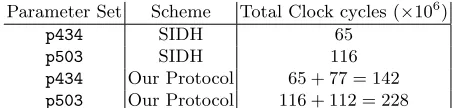
It is clear from the protocol description in Section 3 that the message sizes in our protocol are identical to those of SIDH [11] for the same parameter set; in particular, the are among the smallest post-quantum message sizes at equivalent security levels. We implemented the scheme for the two parameter setsp434and p503 from [14] to quantify the additional computational cost due to auxiliary point obfuscation/unobfuscation. Table 1 contains our performance results.
Parameter Set Scheme Total Clock cycles (×106)
p434 SIDH 65
p503 SIDH 116
p434 Our Protocol 65 + 77 = 142
p503 Our Protocol 116 + 112 = 228
Table 1.Quantitative results for our protocol compared with unauthenticated SIDH. Results measured on a machine running Ubuntu 18.04 LTS with a 1.6 GHz Intel Core i5-8250U processor.
6
Conclusion
We have presented a proposal for an isogeny-based password-authenticated key establishment protocol based on supersingular isogeny Diffie-Hellman. Of par-ticular interest is that our protocol explicitly makes use of the auxiliary points for security, rather thanefficiency. We hope that the partial results presented here can serve as a stepping stone on the path to provably-secure isogeny-based PAKE.
References
1. Mihir Bellare, David Pointcheval, and Phillip Rogaway. Authenticated key ex-change secure against dictionary attacks. In Bart Preneel, editor, Advances
in Cryptology — EUROCRYPT 2000, pages 139–155, Berlin, Heidelberg, 2000.
Springer Berlin Heidelberg.
2. Mihir Bellare and Phillip Rogaway. Entity authentication and key distribution. In Douglas R. Stinson, editor, Advances in Cryptology — CRYPTO ’93, pages 232–249, Berlin, Heidelberg, 1994. Springer Berlin Heidelberg.
3. Steven M. Bellovin and Michael Merritt. Encrypted key exchange: Password-based protocols secure against dictionary attacks. InIEEE Symposium On Research In
Security And Privacy, pages 72–84, 1992.
4. Reinier Br¨oker, Denis Charles, and Kristin Lauter. Evaluating large degree iso-genies and applications to pairing based cryptography. InProceedings of the 2nd
5. Ran Canetti and Hugo Krawczyk. Analysis of key-exchange protocols and their use for building secure channels. In Birgit Pfitzmann, editor, EUROCRYPT, volume 2045 ofLecture Notes in Computer Science, pages 453–474. Springer, 2001. 6. Ran Canetti and Hugo Krawczyk. Analysis of key-exchange protocols and their use
for building secure channels. In Birgit Pfitzmann, editor,Advances in Cryptology—
EUROCRYPT 2001, pages 453–474, Berlin, Heidelberg, 2001. Springer.
7. Denis Xavier Charles, Kristin E. Lauter, and Eyal Z. Goren. Cryptographic hash functions from expander graphs. Journal of Cryptology, 22:93–113, 2009.
8. Anamaria Costache, Brooke Feigon, Kristin Lauter, Maike Massierer, and Anna Puskas. Ramanujan graphs in cryptography. Research Directions in Num-ber Theory: Women in NumNum-bers IV, AWM Springer Series (to appear), 2019. https://eprint.iacr.org/2018/593.
9. Craig Costello, Patrick Longa, and Michael Naehrig. Efficient algorithms for super-singular isogeny diffie-hellman. In Matthew Robshaw and Jonathan Katz, editors,
Advances in Cryptology – CRYPTO 2016: 36th Annual International Cryptology
Conference, Santa Barbara, CA, USA, August 14-18, 2016, Proceedings, Part I,
pages 572–601, Berlin, Heidelberg, 2016. Springer Berlin Heidelberg.
10. Jean-Marc Couveignes. Hard homogeneous spaces, 2006. http://eprint.iacr.org/2006/291/.
11. Luca De Feo, David Jao, and J´erˆome Plˆut. Towards quantum-resistant cryptosys-tems from supersingular elliptic curve isogenies. J. Math. Cryptol., 8:209–247, 2014.
12. Jintai Ding, Saed Alsayigh, Jean Lancrenon, Saraswathy RV, and Michael Snook. Provably secure password authenticated key exchange based on rlwe for the post-quantum world. In Helena Handschuh, editor, Topics in Cryptology – CT-RSA 2017, pages 183–204, Cham, 2017. Springer.
13. Steven D. Galbraith, Christophe Petit, Barak Shani, and Yan Bo Ti. On the security of supersingular isogeny cryptosystems. In Jung Hee Cheon and Tsuyoshi Takagi, editors,Advances in Cryptology – ASIACRYPT 2016, pages 63–91, Berlin, Heidelberg, 2016. Springer Berlin Heidelberg.
14. David Jao, Reza Azarderakhsh, Matthew Campagna, Craig Costello, Luca De Feo, Basil Hess, Amir Jalali, Brian Koziel, Brian LaMacchia, Patrick Longa, Michael Naehrig, Geovandro Pereira, Joost Renes, Vladimir Soukharev, and David Ubanik. Supersingular isogeny key encapsulation. Technical report, NIST Post-Quantum Cryptography Standardization Process, 2019.
15. David Jao and Luca De Feo. Towards quantum-resistant cryptosystems from su-persingular elliptic curve isogenies. In Bo-Yin Yang, editor, PQCrypto, volume 7071 ofLecture Notes in Computer Science, pages 19–34. Springer, 2011.
16. David Jao and Vladimir Soukharev. A subexponential algorithm for evaluating large degree isogenies. InAlgorithmic number theory, volume 6197 ofLecture Notes
in Comput. Sci., pages 219–233. Springer, Berlin, 2010.
17. Brian LaMacchia, Kristin Lauter, and Anton Mityagin. Stronger security of au-thenticated key exchange. In Willy Susilo, Joseph K. Liu, and Yi Mu, editors,
Provable Security: First International Conference, pages 1–16, Berlin, Heidelberg,
2007. Springer Berlin Heidelberg.
18. Jason LeGrow. Post-quantum security of authenticated key establishment proto-cols. Master’s thesis, University of Waterloo, 2016.
19. Vadim Lyubashevsky, Chris Peikert, and Oded Regev. On ideal lattices and learn-ing with errors over rlearn-ings. In Henri Gilbert, editor, Advances in Cryptology –
EUROCRYPT 2010, pages 1–23, Berlin, Heidelberg, 2010. Springer Berlin
20. Alfred J. Menezes, Tatsuaki Okamoto, and Scott A. Vanstone. Reducing elliptic curve logarithms to logarithms in a finite field. IEEE Trans. Inform. Theory, 39(5):1639–1646, 1993.
21. Christophe Petit. Faster algorithms for isogeny problems using torsion point im-ages. In Tsuyoshi Takagi and Thomas Peyrin, editors, Advances in Cryptology –
ASIACRYPT 2017, pages 330–353, Cham, 2017. Springer International Publishing.
22. S. Pohlig and M. Hellman. An improved algorithm for computing logarithms over and its cryptographic significance (corresp.). IEEE Trans. Inf. Theor., 24(1):106– 110, September 2006.
23. Alexander Rostovtsev and Anton Stolbunov. Public-key cryptosystem based on isogenies, 2006. http://eprint.iacr.org/2006/145/.
24. Joseph H. Silverman. The Arithmetic of Elliptic Curves. Number 106 in Graduate Texts in Mathematics. Springer, New York, 1986.
25. Joseph H. Silverman. The arithmetic of elliptic curves, volume 106 of Graduate
Texts in Mathematics. Springer-Verlag, New York, 1992.
26. Jacques V´elu. Isog´enies entre courbes elliptiques.C. R. Acad. Sci. Paris S´er. A-B, 273:A238–A241, 1971.
27. Jiang Zhang and Yu Yu. Two-round pake from approximate sph and instantia-tions from lattices. In Tsuyoshi Takagi and Thomas Peyrin, editors,Advances in
Cryptology—ASIACRYPT 2017, pages 37–67, Cham, 2017. Springer.
Acknowledgements. This research was undertaken thanks in part to funding from the Canada First Research Excellence Fund, CryptoWorks21, NSERC, Public Works and Government Services Canada, and the Royal Bank of Canada.
A
The Security Model
PAKE security is commonly proved in the model of Bellare, Pointcheval, and Rogaway [1], which we briefly review here.
Protocols. Fundamentally, a protocolΠ is a probabilistic algorithm which maps strings (in this context, concatenations of passwords, randomness, and protocol-specific messages and parameters) to strings (keys).
Parties and Party Identifiers. Participants in protocols are calledparties. Parties are eitherclientsCorservers S. In this model, protocols are initiated by clients and responded to by servers. All clients are served by all servers. Each party
P ∈CtSis uniquely identified by a string a fixed length; ifP is a party, we will also useP to refer toP’s identifier string as needed.
Passwords. We work in thesymmetric password model: each clientA∈Chas a password πA, and each server has a collection{πA}A∈C.
Party Instances. Associated to each party U ∈ CtS is a collection of party instances {Ω(Un)}n∈N. When the adversary interacts with a party he may be
required to specify an instance. These instances model parties establishing keys at different times and with different partners, and these different key-establishing sessions may be attacked differently (or not at all) by the adversary.
Acceptance and Termination. A party instance “accepts” when they compute a session key, and “terminates” when it will send no more messages. In our proto-col, acceptance is always followed immediately by termination, but termination may occur without acceptance (e.g.,in the case of ill-formed incoming messages).
The Security Experiment. Informally, in the security experiment, a new entity (theadversary) attempts to break semantic security of the protocol after inter-acting with the parties and one additional “formal” party who “administrates” the game (thechallenger). The security experiment proceeds in three stages
1. Initialization: The adversary chooses disjoint sets C and S of client and server identifiers. Each client A ∈ C generates a password according to a probability distribution on their password-space: πA ← PA ∀A ∈C; then,
each serverB∈Sreceives all client passwords. Password-generation happens out-of-view of the adversary, though the adversary knows eachPA.
2. Information Gathering: The adversary performs computations and in-teracts with the parties and challenger. The computational power of the adversary is not fixed in the model, but his interactions are limited to: (a) Send(U, n,msg): MessageM is sent toΩU(n). As a result,ΩU(n)’s internal
state is updated according toΠ.
(b) Reveal(U, n): The instanceΩ(Un)reveals its session key sk(Un)(if it exists). (c) Execute(A, n, B, m): If A ∈ C, B ∈ S, and neither ΩA(n) norΩB(m) has been used, the challengerC instructsΩA(n)to executeΠ withΩB(n). The transcript of this execution is then provided toA.
(d) Corrupt(U): IfU ∈C, returnπU. IfU ∈S, return{πAU}A∈C.
(e) Test(U, n): The challengerC chooses b∈ {0,1}uniformly at random; if
b= 0, the challenger reveals sk(Un), while ifb= 1, the challenger chooses a string uniformly at random and reveals it.
Remark 1. Our definition of Corrupt in item (d) above is known as the weak corruption model [1, Remark 3]. In the strong corruption model, a
Corrupt(U) query also reveals the state of each oracle ΩU(n), n ∈ N; this
presents another way by which a secret session key can become known to the adversary, and the definition of freshness (Definition 4) would have to be modified. [1, Remark 7].
3. The Game:To begin, we must define what it means for an oracleΩU(n) to befresh, which itself requires that we define partnered sessions:
(a) A∈C andB∈S, orA∈SandB ∈C. (b) ΩA(n) andΩ(Bm)have both accepted.
(c) ΩA(n)’s peer isB, andΩB(m)’s peer is A(that is, A believes she is estab-lishing a key withB, and vice versa).
(d) ΩA(n) andΩ(Bm)have the same message transcript and session key. (e) No other oracle ΩU(k) accepts with the same message transcript.
Definition 4 (Fresh Oracle).An oracleΩ(Un)is called fresh(or, to empha-size that we are explicitly considering forward secrecy in the weak corruption model,weak forward secrecy fresh) if none of the following is true:
(a) Reveal(U, n)has been issued.
(b) Reveal(V, m)has been issued, where ΩV(m) is the partner toΩU(n). (c) Corrupt(V, i) was issued for some V ∈ CtS and Send(U, n, M) was
issued for someM ∈ M.
Now, at any point during the protocol,Amay make aTest(U, n) query. If
ΩU(n) is not fresh or this is not the first Test query of the game, A loses the game; otherwise, the challenger answers the query appropriately. The game continues, and eventuallyAmakes a guessb0at the value ofbthat the challenger chose in response to theTestquery; the adversary wins if b0 =b
and loses otherwise. We define the adversary’s advantage to be
AdvΠΓ(A) = 2P[Awins the gameΓ with protocolΠ]−1.
B
Computational Assumptions of SIDH
In this section we present the SIDH and SSI problems [11, Problems 5.1–5.4], whose presumed hardness underlies the security of SIDH (and, by extension, our protocol).
Definition 5 (Computational Supersingular Isogeny Diffie-Hellman Prob-lem (SIDH)).LetφA:E→EAbe an isogeny with kernelhPA+nAQAifornA←
Unif(Z/`eAAZ). Let φB:E → EB be an isogeny with kernel hPB +nBQBi for
nB ← Unif(Z/`eBBZ). The Computational Supersingular Diffie-Hellman
prob-lem (SIDH) is to find thej-invariant of EAB =E/hPA+nAQA, PB+nBQBi
given
(E, PA, QA, PB, QB),(EA, φA(PB), φA(QB)),(EB, φB(PA), φB(QA))
.
If ((E, PA, QA, PB, QB),(EA, φA(PB), φA(QB)),(EB, φB(PA), φB(QA)))
is a valid SIDH instance under the notation of Definition 5, we write EAB =
SIDH((E, PA, QA, PB, QB),(EA, φA(PB), φA(QB)),(EB, φB(PA), φB(QA))).
When the global parameters and auxiliary points are clear from context, we abbreviate this asEAB = SIDH(EA, EB). We also define variants of SIDH:
– ForEB=E/hPB+mBQBi, say SIDHB(E0, EB, X0, Y0) =E0/hX0+mBY0i
These arise in SIDH by considering messages which are not well-formed. For an algorithmA which, given a valid SIDH instance, produces a list of candidate solutions to the instance, define its advantage as
AdvSIDHp (A) =P[ϑ←Unif(InsSIDH(p)) :A(ϑ) = SIDH(ϑ)]
where InsSIDH(p) is the set of all valid SIDH instances defined over GF(p2). Also define
AdvSIDHp (t) = max{Adv
SIDH
p (A) :Aruns in timet for allϑ∈InsSIDH(p)}.
Intuitively, this quantity measures the maximum probability of solving a ran-domly chosen SIDH instance in timetif you are allowed to makenguesses. The SIDH assumption is that fort, n= poly(λ), AdvSIDHp (t, n) = negl(λ).
As in Section 2.5, the asymmetry the isogeny computations requires us to consider there are really two variants of each of the following computational problem: one for `eA
A -isogenies, and the other for ` eB
B -isogenies. For brevity we
present the “Type A” problem and advantage and omit the analogous “Type B” variant.
Definition 6 (Supersingular Isogeny Problem–A (SSIA)). Let φA:E →
EA be an isogeny with kernelhPA+nAQAifornA←Unif(Z/`eAAZ). The
super-singular isogeny problem (type A) (SSIA)is, givenE, EA,φA(PB), andφA(QB),
to find a generator of kerφA.
The SIDH problem reduces to both the Type A and type B variants of Problem 6 by noting that knowledge of kerφA, φB(PA) andφB(QA) allows one
to map EB to EAB, and the knowledge of kerφB, φA(PB) andφA(QB) allows
one to mapEAtoEAB similarly. Recent work due to Costacheet al.[8, Theorem