A Survey on QoS-Based Multipath Routing Protocol for Effective
Mobile Ad hoc Network
G.Karthik, R.Sasi Kiran Kumar Reddy, Mr.D.Madhu babu
P.G Student, Dept. of MCA, Narayana Engineering College, Nellore.
Asst.prof, Dept. of MCA, Narayana Engineering College, Nellore.
Abstract: A Mobile Ad hoc Network (MANET) is a wireless communication network with least physical foundation with differing communication applications. Versatility and Multi bouncing are the principle qualities of MANET. Multipath routing protocols set up various courses between hubs. The development of various courses ought to be finished with least overhead and bandwidth utilization. The reason for this article is to investigate the attributes and usefulness of different multipath routing protocols and to do the execution examination between these multipath routing protocols to pick the best among them to use in expansive networks.
Index Terms: MANET, route failure, load balancing, mobility, multihop, multipath, routing protocols
I. INTRODUCTION
A MANET is a gathering of mobile hubs by wireless connections shaping a dynamic topology without much physical network foundation, for example, routers, servers, get to focuses or links or concentrated administration. Every mobile hub is going about as a router and also a hub. The issues engaged with MANET [1,29] are: (I) erratic connection properties uncover bundle crash and flag spread, (ii) hub portability makes dynamic topology, (iii) constrained battery life of mobile gadgets, (iv) covered up and uncovered terminal issues happen when signs of two hubs are slamming into each other. (v) route support is exceptionally troublesome in light of changing
conduct of the communication medium, and (vi) weakness is the most vital issue of MANET.
Multipath routing protocols are expected to send communication from source to goal by having reinforcement routes. Amid end-to-end communication, if an essential route comes up short, the reinforcement routes are utilized for effective conveyance of messages at their goal. The ad hoc multipath routing protocols can be characterized into three noteworthy gatherings in view of the routing system as appeared in Fig.1
Whatever is left of this paper is sorted out as takes after: In area II, the qualities and usefulness of different proactive multipath routing protocols are investigated; in segment III the attributes and usefulness of different responsive multipath routing protocols are broke down; in segment IV the attributes and usefulness of different cross breed multipath routing protocols are examined lastly in segment V the conclusion is given.
Figure.1. Classification of Multipath Routing Protocols for Mobile Ad Hoc Networks
Classifications of Routing Protocols in MANET: The routing protocols in MANET are delegated takes after:
• Table-Driven Routing Protocols
• On-request Routing Protocols (Suganthi and Tamilarasi, 2012; Keming and Yang, 2010).
Issues identified with MANET routing: The issues identified with MANET routing are unusual of condition, lack of quality of wireless medium, asset obliged hubs and dynamic topology. These issues may bring about shortcomings, for example, transmission blunders, hub disappointments, interface disappointments, route breakages, congested hubs or connections (Khetwal and Sharma, 2012).
Route upkeep and recuperation in MANET: Route disclosure, route support and movement allotment are the three parts incorporates into the multipath routing. The initial two parts build up of numerous routes amongst source and goal hub. Also the multipath routing protocol tries finding disjoint hubs, disjoint connection and non-disjoint routes. After the route is set up, the mobile hub begins sending the information parcels to the goal. As a rule amid some circumstance, the route disappointment causes the sent parcels to be lost. Different circumstances make the bundles achieve the goal with some deferral. To handle this issue, route upkeep procedure is considered.
Route storing in MANET: The as of late found routes ought to be reserved for utilizing it again when the comparative route is requested. The two kinds of route storing procedure accessible for on-request routing protocol are source route reserving and transitional route reserving. The on-request routing protocols, for example, AODV and DSR licenses the middle of the road hub which has stored route to the goal react to the source with the reserved route. The route reserve is essential for
giving commanding recuperation in MANET. The benefits of utilizing route store incorporate the accessibility of the backup way to go amid interface disappointment and controlling overhead which is important to repair the route.
3. PROBLEM IDENTIFICATION
Traditional on-request routing protocols create a lot of routing control activity by indiscriminately flooding the whole network with RREQ bundles amid route revelation. The routing overhead connected with the dispersal of routing control bundles can be very tremendous, particularly when the network topology much of the time changes (Aminu et al., 2009).
Multipath routing protocols reserve numerous routes to a goal in a solitary route disclosure. Be that as it may, within the sight of portability, multipath protocols acquire additional parcel drops and postponement because of their reliance on conceivably stale routes from stores Protocols utilizing either constrained broadcast or nearby blunder recuperation have concentrated on decreasing bundle drops and not on using the bandwidth productively amid route recuperation.
We propose to build up a cross breed routing protocol including multipath revelation and nearby mistake recuperation. In this protocol, each source and goal combine sets up numerous ways in the single route revelation and they are reserved in their route stores. The reserved routes are arranged based on their bandwidth accessibility
go choice. A successful backup course of action is chosen from the route reserve which is more reliable and having more noteworthy accessible bandwidth. So our proposed half and half routing method has the accompanying advantages:
• Reduces parcel drops
• Reduces the recuperation time
• Reduces overhead
• Utilizes bandwidth productively
4. RELATED WORKS
Kang and Ko (2010) have proposed an area based cross breed routing protocol to enhance information bundle conveyance and to diminish control message overhead in mobile ad hoc networks. In mobile situations, where hubs move consistently at a rapid, it is for the most part hard to keep up and reestablish route ways. In this way, their investigation proposes another flooding instrument to control route ways. The quintessence of their proposed plot is its successful following of the goal's area in light of the signal messages on the principle route hubs.
Aminu et al. (2009) proposed another probabilistic route disclosure technique for routing in MANETs, alluded to as Probabilistic Counter-based Route revelation (PCBR), which join the highlights of counter-based and prattle based methodologies. The execution of PCBR is assessed utilizing AODV as the base routing protocol, which traditionally utilizes the visually impaired flooding. The impact of movement load, portability and topology estimate on the execution of the PCBR-AODV route disclosure isn't considered.
Dhirendra et al. (2010) have improved the execution of Split Multipath Routing protocols by utilizing route refresh system. Their proposition is
valuable in the route recuperation process. In MANET for sending the information parcels through interchange way takes additional time in correlation with stale route that was broken. In this way, they repair the broken route through a route refresh system process and diminish the postponement through the new refreshed way. In their proposition they are thinking about the high pick up reception apparatus terminal that adjusts transmission scope of every hub and take after another method for route refresh component. Along these lines, they give a heuristic way to deal with lessen the postpone metric and increment the execution of MANET.
Juanwei et al. (2009) have proposed another multipath protocol called the Multipath Routing Protocol for Networks Lifetime Maximization in AdHoc Networks (MRNLM) is proposed in light of AOMDV. The protocol sets the vitality limit to upgrade the sending component. In the meantime it constructs a vitality cost capacity and utilizations the capacity as the basis for numerous way choice. In transmission stage, they utilize an oddity strategy called "information transmission in different ways one by one" to adjust the vitality in various ways.
Sung-Won et al. (2010) proposed a solid and half and half multipath routing protocol which furnishes a proactive-like routing with less end-to-end defer and less control overhead. Likewise a quick mistake recuperation plan to adapt to the potential route disappointments caused by hub obliteration by the adversary is proposed. The disadvantage of this approach is that load adjusting and more productive route upkeep isn't considered.
unwavering quality by altering the route revelation and route upkeep forms in DSR. The different routes are maximally hub disjoint in this protocol. Their approach does not think about the nature of administration into represent information transmission.
5. SYSTEM DESIGN AND PROTOCOL OVERVIEW
We devise the model by considering a mobile ad hoc network in which every hub uses IEEE 802.11 DCF for medium access control (MAC). At the application layer, intra-stream impedance happens for a similar stream which is transmitted on various wireless connections. Be that as it may, it has been assumed as a solitary information stream.
We set forward a QOS based multipath routing protocol expected for mobile ad hoc networks. In this paper, we will utilize the office to decide numerous routes to a host and change between them to extend the meaning of AOMDV [6].
Empowering a QoS obliged route from source to goal is the goal of the routing protocol. The route picked by the protocol must send parcels with least bandwidth and end-to-end inertness, without confronting clog. The protocol ought to fulfill the above limitations and furthermore select the most hearty among all conceivable competitor routes.
A QoS-based routing metric for MANETs should join least accessible bandwidth and end-to-end idleness alongside blockage around a connection. Clog is identified with channel quality, which relies upon the MAC get to conflict and channel unwavering quality. So our calculation ought to depend on the accompanying measurements to distribute weights to singular connections.
• End-to-End Delay
• Channel Quality
• Link Quality
The individual connection weights are consolidated into a routing metric to approve the load adjusting and obstruction between joins utilizing a similar channel. Thus, the activity is adjusted and the network limit is enhanced as the weight esteem helps the routing protocol to evade routing movement through congested territory. In this manner, the choice of the extent of movement to be routed to each neighbor is made to perform routing with the end goal that the heaviness of the hub is a conceivable least.
6. HYBRID MULTIPATH ROUTING PROTOCOLS
The highlights of both proactive and receptive protocols are joined together to shape another age of protocols called Hybrid multipath routing protocols. These protocols are utilized to build versatility by enabling hubs with nearness to cooperate to frame a type of a spine to lessen the route revelation overheads. This can be accomplished by proactively keeping up routes to close-by hubs and deciding routes to far away hubs utilizing a route disclosure procedure. The vast majority of the cross breed protocols are zone-based, which implies that the network is parceled or seen as various zones by every hub. Others are bunch based, which implies the hubs are assembled into trees or groups. This area depicts the generally utilized half breed multipath routing protocol called Zone Routing Protocol (ZRP) and its execution examination [2] is represented in Table 3. Note that the execution measurements speak to the most dire outcome imaginable for each routing protocol.
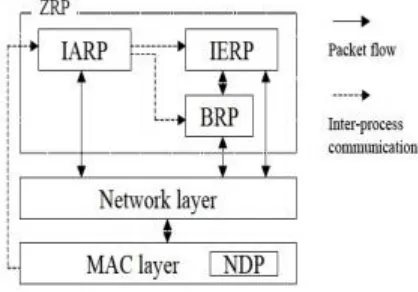
The ZRP [12, 13, 14] joins the advantages of proactive and receptive protocols in a mixture plot. It goes about as a proactive protocol in the area of a hub (IntrA-zone Routing Protocol, IARP) locally and a responsive protocol for routing between neighborhoods (IntEr-zone Routing Protocol, IERP) all inclusive. The nearby neighborhoods are called zones, which are diverse for every hub. Every hub might be inside numerous covering zones and each zone might be of an alternate size. The "size" of a zone isn't dictated by the topographical estimation however is controlled by a radius is the quantity of jumps to the
zone.
Figure. 2. Routing Zone of node A with2
Figure. 3. ZRP architecture
The hubs of a zone are separated into the hubs whose base separation to the focal hub is precisely
equivalent to the zone radius r called fringe hubs and the hubs whose base separation is not as much as r are inside hubs called inside hubs. In Fig. 2, the hubs A– F are inside hubs, the hubs G– J are fringe hubs and the hubs K and L are outside the routing zone. Note that the hub H can be come to by two ways, one with length 2 and one with length 3 jumps. The most brief way is not exactly or equivalent to the zone radius if the hub is inside the zone
From Fig. 3, the IARP gives the topology data as immediate inquiry demand to the fringe of the zone is called as outskirt throwing. The Border cast Resolution Protocol (BRP) gives the conveyance of fringe cast parcel. The route solicitations can be coordinated far from territories of the network which have been already secured through question control systems. In ZRP, a Neighbor Discovery Protocol (NDP) gave by the Medium Access Control (MAC) layer is utilized to distinguish new neighbor hubs and connection disappointments. The "Welcome" guides are transmitted by NDP at normal interims. The neighbor table is refreshed after getting a guide. The Neighbors which has not been gotten signal inside a predefined time, are expelled from the table. The usefulness of NDP must be given by IARP if the MAC layer does exclude a NDP.
as repetitive and they are disposed of. The properties [15] of ZRP are: (I) crossover protocol (consolidating the highlights of master dynamic and re-dynamic routing), (ii) no particular protocol yet system, (iii) could conceivably give numerous ways (ward of protocols utilized as IARP and IERP), (iv) neighbor disclosure through NDP, (v) locally star dynamic and Inter locally re-dynamic, and (vi) structure which provides food different protocols to work. B. Summary of hybrid multipath routing
The crossover multipath routing protocols are having higher versatility than the proactive or responsive multipath routing protocols since they endeavor to limit the quantity of rebroadcasting hubs by characterizing a structure. Other advantage of cross breed multipath routing protools is that they endeavor to dispense with each and every purpose of disappointment. The ZRP protocol is the best half and half multipath routing which expands the adaptability and gives more grounded network availability in MANET.
7. CONCLUSION
In this, we propose multipath routing protocol for viable nearby route recuperation in Mobile Ad Hoc Network (MANET). At the point when the source requires sending an information bundle to a goal, it surges the Route Request (RREQ) parcel to the whole network. The halfway hub on getting RREQ bundle refreshes its route stores and rebroadcast the parcel. The goal hub after getting all RREQ parcels joins the route code constituting accessible bandwidth data and input RREP bundles.The route recuperation administration system is dealt with to dodge the successive impact and degradation in the network execution. By reenactment comes about, we have demonstrated that the proposed approach enhances network execution.
REFERENCES:
[1]. Khazaei, M. and R. Berangi, 2009. A multi-path routing protocol with fault tolerance in mobile ad hoc networks. Proceedings of the 14th International CSI Computer Conference, Oct. 20-21, IEEE Xplore Press, Tehran, pp: 77-82. DOI: 10.1109/CSICC.2009.5349359.
[2] Mehran Abolhasan, Tadeusz Wysocki, and Eryk Dutkiewicz , “A review of routing protocols for mobile ad hoc networks”, Ad Hoc Networks, June 2003, pp.1-22.
[3]. Kang, B.S. and I.Y. Ko, 2010. Effective route maintenance and restoration schemes in mobile ad hoc networks. Sensors, 10: 808-821.
[4]. Aminu, M., M. Ould-Khaoua, L.M. Mackenzie, C. Perkins and J.D. Abdulai, 2009. Probabilistic counter-based route discovery for mobile ad hoc networks. Proceedings of the 2009 International Conference on Wireless Communications and Mobile Computing: Connecting the World Wirelessly, (WCMC’ 09) ACM New York, NY, USA, pp: 1335-1339. DOI: 10.1145/1582379.1582672
[5]. Dhirendra, K.S., S. Kumar and C. Kumar, 2010. Enhancement of split multipath routing protocol in MANET. Int. J. Comput. Sci. Eng., 02: 679-685.
[6] P. Jacquet and T. Clausen, "Optimized Link State Routing Protocol", IETF Internet Draft, draft-ietfmanet-olsr-11.txt, July 2003.
Piscataway, NJ, USA, pp: 2713-2716. DOI: 10.1109/WICOM.2009.5305828In
[8]. Sung-Won, L., J.Y. Choi, K.W. Lim, Y. Ko and B. Roh, 2010. A reliable and hybrid multi-path routing protocol for multi-interface tactical ad hoc networks. Proceedings of the Conference on Military Communication Unclassified Program Networking Protocols and Performance Track, (MCUPNPP’ 10), pp: 1531-1536.
[9]. Wu, Y.C. and C.C. Tuan, 2009. Power saving routing protocol with power sieving in wireless ad hoc networks. Proceeding of the International Conference on Networks Security, Wireless Communications and Trusted Computing, April 25-26, IEEE Xplore Press, Wuhan, Hubei, pp: 349- 352. DOI: 10.1109/NSWCT.2009.36
[10]. Juanwei, L., J. Chen and Y. Kuo, 2009. Multipath routing protocol for network lifetime maximization in ad-hoc networks. Proceedings of the 5th International Conference on Wireless Communications, Networking and Mobile Computing, (WCNMC’ 09), IEEE Xplore Press, Piscataway, NJ, USA, pp: 2713-2716. DOI: 10.1109/WICOM.2009.5305828In
[11]C. Toh, A novel distributed routing protocol to support ad-hoc mobile computing, in: IEEE 15th Annual International Phoenix Conf., 1996, pp. 480– 486.
[12]J. Schaumann, “Analysis of the Zone Routing Protocol”, December 2002.
[13]Z. Haas and M. Pearlman, "The zone routing protocol (ZRP) for Ad Hoc networks", IETF Internet Draft, draft-ietf-manet-zone-zrp-04.txt, July 2002.
[14]Z. Haas, “A New Routing Protocol for the Reconfigurable Wireless Networks”, Proceedings
of IEEE ICUPC’97, San Diego, CA, pp. 562-566, October 1997.
[15] “CACTUS Impulse Research project (Context-Aware Communication, Terminal and User)”, A TU-Delft and TNO research project proposal for the Freeband Impulse Research Program in Telecommunications, July 2002.
Ramireddy.Sasi kiran kumar reddy is currently pursuing his MCA in MCA Department, Narayana Engineering College, Nellore, AP. He received his Bachelor of Science from Loyola Degree College
Gurram.Karthik is currently pursuing his MCA in MCA Department, Narayana Engineering College, Nellore, AP. He received his Bachelor of Science from Rao’s Degree College