Reduced-Round Camellia-192/256
Ya Liu1, Dawu Gu1, Zhiqiang Liu1, Wei Li2, Ying Man1
1Department of Computer Science and Engineering, Shanghai Jiao Tong University, Shanghai 200240, P.R. China
{liuya0611,dwgu,ilu zq,manying1208}@sjtu.edu.cn 2School of Computer Science and Technology, Donghua University, Shanghai 201620, P.R.China
Abstract. As an international standard adopted by ISO/IEC, the block cipher Camellia has been used in various cryptographic applications. In this paper, we reevaluate the security of Camellia against im-possible differential cryptanalysis. Specifically, we propose several 7-round imim-possible differentials with theF L/F L−1 layers. Based on them, we mount impossible differential attacks on 11-round Camellia-192 and 12-round Camellia-256. The data complexities of our attacks on 11-round Camellia-Camellia-192 and 12-round Camellia-256 are about 2120chosen plaintexts and 2119.8 chosen plaintexts, respectively. The corresponding time complexities are approximately 2167.1 11-round encryptions and 2220.87 12-round encryptions. As far as we know, our attacks are 216.9
times and 219.13
times faster than the previously best known ones but have slightly more data.
Key words: Block Cipher, Camellia, Impossible Differential Cryptanalysis
1 Introduction
The block cipher Camellia was jointly proposed by NTT and Mitsubishi Electric Corporations [1]. It was then submitted to several standardization and evaluation projects such as the NESSIE Project and the Japanese CRYPTREC Evaluation. In 2002, Camellia was selected to be a CRYPTREC e-government recommended block cipher [4]. In 2003, it was also recommended in the NESSIE block cipher portfolio [19]. Finally, it was adopted as a new international standard by ISO/IEC in 2005 [7]. Camellia is a 128-bit block cipher. It supports variable key sizes and the number of rounds depends on the key size, i.e., 18 rounds for a 128-bit key size and 24 rounds for 192/256-bit key sizes. For simplicity, they are usually denoted by Camellia-128, Camellia-192 and Camellia-256. Camellia uses the basic Feistel structure with theF L/F L−1 layers inserted every 6 rounds. Those
transformationsF L/F L−1are related to the key value, which is expected to make the cryptanalysis
of Camellia much harder.
As one of the most widely used block ciphers, Camellia has drawn a great amount of attention from many researchers. Up to now, a lot of research work has been done to evaluate the security of Camellia by means of various cryptanalytic methods such as linear and differential cryptanalysis, truncated differential cryptanalysis, higher order differential cryptanalysis, collision attacks, square attacks, integral attacks and impossible differential cryptanalysis. Among them, most work [20, 9, 8, 22, 12, 18, 16] focused on the study of the security of a simple version of Camellia (i.e., Camellia withoutF L/F L−1or whitening layers), and only a few [11, 6, 3, 14] involved in the security analysis of Camellia with theF L/F L−1and whitening layers (Called Camellia for short). For instance, Duo
2210 10-round encryptions, Hatano et al. proposed a higher order differential attack on the last 11 rounds of Camellia-256 with 293 chosen ciphertexts and 2255.6 11-round encryptions, Chen et al.
constructed some 6-round impossible differentials which were used to mount impossible differential attacks on 10-round Camellia-192 with about 2121 chosen plaintexts and 2175.3 10-round encryp-tions and 11-round Camellia-256 with approximately 2121 chosen plaintexts and 2206.8 11-round
encryptions, Li et al gave some 7-round conditional impossible differentials (i.e., there is a 75% probability that each of them is impossible), which could be used to attack 10-round Camellia-128 with 2112.4 chosen plaintexts and 212010-round encryptions, 11-round Camellia-192 with 2113.7
cho-sen plaintexts and 2184 11-round encryptions as well as 12-round Camellia-256 with 2114.8 chosen plaintexts and 2240 12-round encryptions.
Impossible differential cryptanalysis, which is a variant of differential cryptanalysis, was in-dependently proposed by Knudsen [10] and Biham et al. [2]. Its main idea is to use impossible differentials that hold with probability zero to discard the wrong keys until only one key is left. Impossible differential cryptanalysis has received much attention and has been used to attack a variety of well-known block ciphers such as AES, ARIA, CLEFIA and MISTY1 [15, 17, 21, 5].
In this paper, we reappraise the security of Camellia against impossible differential attacks. Firstly, we exploit the properties of the functions F L/F L−1 and propose several 7-round
impos-sible differentials of Camellia. Based on them, we successfully mount an imposimpos-sible differential attack on 11-round Camellia-256. The data, time and memory complexities of our attack are ap-proximately 2120.06 chosen plaintexts, 2196.4 11-round encryptions and 2133.06 bytes, respectively.
Then, we further improve our results and present impossible differential attacks on 11 rounds of Camellia-192 and 12 rounds of Camellia-256. For 11 rounds of Camellia-192, our attack requires about 2120chosen plaintexts, 2167.1 11-round encryptions and 2149bytes of memory. For 12 rounds of Camellia-256, our attack needs approximately 2119.8 chosen plaintexts, 2220.8712-round encryptions
and 2156.8 bytes of memory. Compared with the previously latest results on 11-round Camellia-192 and 12-round Camellia-256, the time complexities of our attacks are reduced by 216.9 times and 219.13 times and the data and memory complexities are comparable. In table 1, we summarize our
results along with the former known ones on Camellia.
Table 1.Summary of the attacks on Camellia-192/256
Cipher Rounds Attack Type Data (Enc) Time (Bytes) Memory Source Camellia-192 10 Impossible DC 2121CP 2175.3 2155.2 [3]
10 Impossible DC 2118.7CP 2130.4 2135 [13]
11* Impossible DC 2119.5
CP 2138.54
2135.5
[14] 11 Impossible DC 2113.7CP 2184 2143.7 [14]
11 Impossible DC 2120CP 2167.1 2149 Section 5.2
Camellia-256 11 High Order DC 293CC 2255.6 298 [6]
11 Impossible DC 2121CP 2206.8 2166 [3]
11 Impossible DC 2119.6CP 2194.5 2135 [13]
11 Impossible DC 2120.06
CP 2196.4
2133.06
Section 4 12* Impossible DC 2119.7CP 2202.55 2143.7 [14]
12 Impossible DC 2114.8CP 2240 2151.8 [14]
12 Impossible DC 2119.8CP 2220.87 2156.8 Section 5.1
The remainder of this paper is organized as follows. Section 2 gives some notations, a brief description of Camellia and some results on impossible differential cryptanalysis of reduced-round Camellia. Section 3 proposes several 7-round impossible differentials of Camellia with theF L/F L−1 layers. Section 4 describes an impossible differential attack on 11-round Camellia-256. Section 5 presents impossible differential attacks on 11 rounds of Camellia-192 and 12 rounds of Camellia-256. Section 6 summarizes this paper.
2 Preliminaries
In this section, we first illustrate some notations. Then we briefly describe the encryption procedure and key schedule of Camellia. Finally, we list some results on impossible differential cryptanalysis of reduced-round Camellia.
2.1 Some Notations
– P, C: the 128-bit plaintext and the 128-bit ciphertext;
– ∆P, ∆C: the differences of a plaintext pair and a ciphertext pair;
– Lr−1, Rr−1: the left and right halves of the r-th round input;
– X |Y: the concatenation ofX andY;
– kw1 |kw2, kw3|kw4: the pre-whitening and post-whitening keys;
– kli(1 ≤i≤6): 64-bit key used in theF L/F L−1 layers; – kr: ther-th round subkey;
– ∆Lr−1: the difference ofLr−1 and L′r−1;
– ∆Rr−1: the difference ofRr−1 andR′r−1;
– Sr: the output of the S-boxes in the r-th round;
– ∆Sr: the output difference of the S-boxes in the r-th round; – X ≪j: left rotation ofX by j bits;
– XL(n
2), XR(
n
2): the left half and the right half of a n-bit word X;
– Xl,j, Xl,{i,j}, Xl,{i∼j}: thej-th byte, thei-th and j-th bytes and the i-th to thej-th bytes ofXl; – ⊕,∩,∪: bitwise exclusive-OR (XOR), AND, and OR operations;
2.2 Overview of Camellia
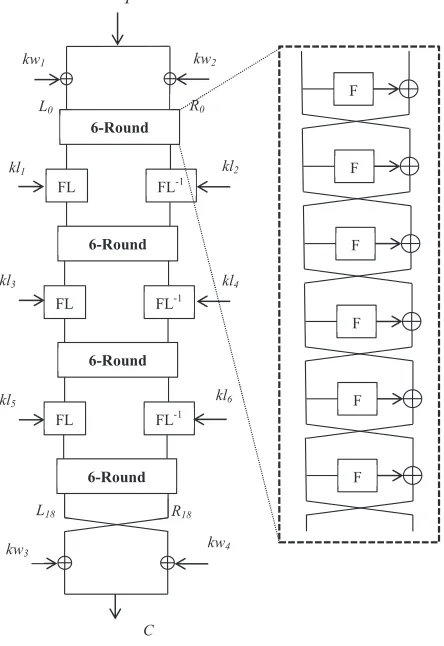
Camellia, which is a 128-bit block cipher, adopts a Feistel structure with two key-dependent func-tionsF L/F L−1 inserted every 6 rounds. It uses variable key sizes and the number of rounds depends on the key size, i.e., 18 rounds for a 128-bit key size and 24 rounds for 192/256-bit key sizes. Before the first round and after the last round, the pre-whitening and post-whitening layers are included. Using the notations above, the whole encryption algorithm of Camellia-192/256 can be expressed as below. The basic encryption structure can been seen in Figure 1.
First, a 128-bit plaintextP is XORed with the pre-whitening keykw1 |kw2 to obtain the input
of the first round L0 |R0, i.e., L0 |R0 =P ⊕(kw1 |kw2). Then, for r = 1,· · ·,24 andr 6= 6,12
and 18,
Lr =Rr−1⊕F(Lr−1, kr), Rr=Lr−1.
Forr = 6,12 and 18,
L′r=Rr−1⊕F(Lr−1, kr), R′r=Lr−1;
Here the round function F uses a SPN structure including the key-addition layer, the nonlinear transformation S and the linear diffusion layer P. The nonlinear transformation S uses four dif-ferent 8×8 S-boxes s1, s2, s3 and s4 twice, where three S-boxess2, s3 and s4 are generated by s1.
Their definitions can be found in [1]. The linear transformation P : ({0,1}8)8 → ({0,1}8)8 maps (y1, y2, y3, y4, y5, y6, y7, y8) to (z1, z2, z3, z4, z5, z6, z7, z8). This transformation and its inverse P−1
are defined as follows.
z1 =y1⊕y3⊕y4⊕y6⊕y7⊕y8; y1 =z2⊕z3⊕z4⊕z6⊕z7⊕z8;
z2 =y1⊕y2⊕y4⊕y5⊕y7⊕y8; y2 =z1⊕z3⊕z4⊕z5⊕z7⊕z8;
z3 =y1⊕y2⊕y3⊕y5⊕y6⊕y8; y3 =z1⊕z2⊕z4⊕z5⊕z6⊕z8;
z4 =y2⊕y3⊕y4⊕y5⊕y6⊕y7; y4 =z1⊕z2⊕z3⊕z5⊕z6⊕z7;
z5 =y1⊕y2⊕y6⊕y7⊕y8; y5 =z1⊕z2⊕z5⊕z7⊕z8;
z6 =y2⊕y3⊕y5⊕y7⊕y8; y6 =z2⊕z3⊕z5⊕z6⊕z8;
z7 =y3⊕y4⊕y5⊕y6⊕y8; y7 =z3⊕z4⊕z5⊕z6⊕z7;
z8 =y1⊕y4⊕y5⊕y6⊕y7; y8 =z1⊕z4⊕z6⊕z7⊕z8;
6-Round
FL FL-1
6-Round
FL FL-1
6-Round
FL FL-1
F
F
F
F
F
F
P
kw2 kw1
kl1
kl3
kl2
kl4
kl5 kl6
kw3
kw4
L0 R0
6-Round
C
L18 R18
Finally, the ciphertext C is obtained by the XOR of R24 | L24 and the post-whitening key
kw3|kw4, i.e., C = (R24|L24)⊕(kw3|kw4).
Key Schedule of Camellia-192/256 The key schedule of Camellia-192/256 applies a 6-round
Feistel structure to generate two 128-bit intermediate variables KA and KB. These two variables KA and KB can be generated from two 128-bit variables KL and KR defined by the main key K. For Camellia-192, the left 128 bits of the key K are used as KL, and the concatenation of
the right 64 bits of the key K and the complement of the right 64 bits of the key K are used as KR. For Camellia-256, the main key K is separated into two 128-bit variables KL and KR, i.e., K =KL|KR. One can refer to [1].
2.3 Results on Impossible Differential Cryptanalysis of Reduced-Round Camellia
In 2011, Chen et al.gave the first impossible differential cryptanalysis of Camellia [3]. They con-structed several 6-round impossible differentials with F L/F L−1 inserted in the middle. More con-cretely, the input and output differences are (0,0,0,0,0,0,0,0,0, a,0,0,0,0,0,0) and (0, a,0,0,0,0, 0,0,0,0,0,0,0,0,0,0), which lead to a contradiction in the key-dependent functions F L/F L−1.
Based on it, they put three additional rounds on the top and one additional round on the bottom of their 6-round impossible differential to attack 10-round Camellia-192 with 2121 chosen plain-texts and 2175.3 10-round encryptions. Moreover, they add one additional round on the bottom
of 10-round Camellia-192 to attack 11-round Camellia-256 with 2121 chosen plaintexts and 2206.8 11-round encryptions.
In Nov. 2011, another paper on the security of reduceround Camellia against impossible d-ifferential attack was posted in IACR cryptology eprint archive [14]. They gave several 7-round conditional impossible differentials of Camellia, i.e., the probability that each of them is impos-sible is 75%. Based on them, they attacked 10-round Camellia-128 with 2112.4 chosen plaintexts
and 2120 10-round encryptions, 11-round Camellia-192 with 2113.7 chosen plaintexts and 2184 10-round encryptions as well as 12-10-round Camellia-256 with 2114.8 chosen plaintexts and 224012-round encryptions.
3 7-Round Impossible Differentials of Camellia with the F L/F L−1 Layers
In this section, we first give the properties of the key-dependent transformations F L/F L−1. Then
we propose some 7-round impossible differentials of Camellia, one of which is elaborated through a proposition as follows.
Lemma 1. [3] Let ∆X and ∆Y the input and output differences of theF L function. Then
(1) ∆YR= ((∆XL∩klL)≪1)⊕∆XR, ∆YL=∆XL⊕∆YR⊕(∆YR∩klR);
(2) ∆XL=∆YL⊕∆YR⊕(∆YR∩klR), ∆XR= ((∆XL∩klL)≪1)⊕∆YR.
Lemma 2. If the output difference of the key-dependent function F L−1 is(0,0,0,0, a,0,0,0), then
its input difference has the form (y,0,0,0, a,0,0,0).
Proof. Let (∆YL, ∆YR) =F L(0,0,0,0, a,0,0,0). By Lemma 3.1, we calculate that∆YR= (((0,0,0,
0)∩klL)≪ 1)⊕(a,0,0,0) = (a,0,0,0) and ∆YL = (0,0,0,0)⊕(a,0,0,0)⊕((a,0,0,0)∩klR),
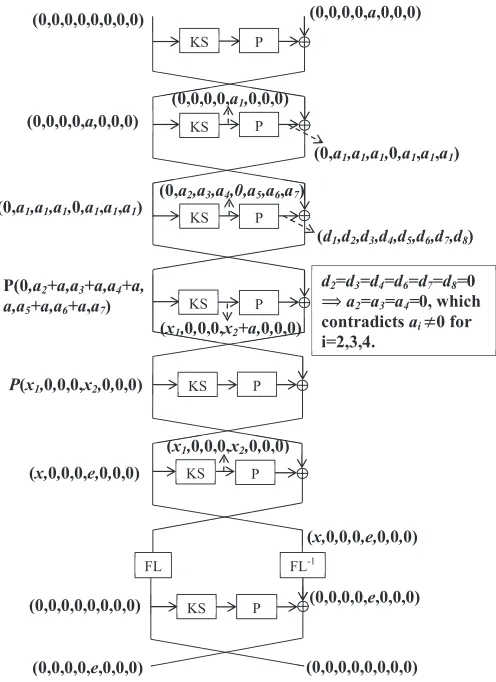
Proposition 1. If the input difference of the i-th round is (0,0,0,0,0,0,0,0, 0,0,0,0, a,0,0,0)
and the output difference of the (i+ 6)-th round is(0,0,0,0, e,0,0,0,0,0,0,0,0,0,0,0) with aand
e being non-zero bytes, then
(0,0,0,0,0,0,0,0,0,0,0,0, a,0,0,0) →7 (0,0,0,0, e,0,0,0,0,0,0,0,0,0,0,0)
is an impossible differential of Camellia with the F L/F L−1 layers. Here the key-dependent
trans-formations F L/F L−1 are inserted after the (i+ 5)-th round. The detailed structure can be seen in Figure 2.
KS P
KS P
KS P
KS P
KS P
KS P
FL FL-1
KS P
(0,0,0,0,0,0,0,0) (0,0,0,0,a,0,0,0)
(0,0,0,0,a,0,0,0)
(0,a1,a1,a1,0,a1,a1,a1)
(0,a1,a1,a1,0,a1,a1,a1)
(0,a2,a3,a4,0,a5,a6,a7)
P(0,a2+a,a3+a,a4+a,
a,a5+a,a6+a,a7)
(0,0,0,0,e,0,0,0) (0,0,0,0,0,0,0,0) (0,0,0,0,0,0,0,0) (0,0,0,0,e,0,0,0) (x,0,0,0,e,0,0,0) (x,0,0,0,e,0,0,0)
(x1,0,0,0,x2,0,0,0)
P(x1,0,0,0,x2,0,0,0)
(x1,0,0,0,x2+a,0,0,0)
d2=d3=d4=d6=d7=d8=0
ฺ a2=a3=a4=0, which
contradicts ai ്0 for
i=2,3,4.
(d1,d2,d3,d4,d5,d6,d7,d8)
(0,0,0,0,a1,0,0,0)
Fig. 2.A 7-Round Impossible Differential of Camellia
Proof. If the input difference of thei-th round is (0,0,0,0,0,0,0,0,0,0,0,0, a,0,0,0), then the left halves of the input differences in the (i+2)-th and (i+3)-th rounds are (0, a1, a1, a1,0, a1, a1, a1) and
(0,0,0,0, a,0,0,0)⊕P(0, a2, a3, a4,0, a5, a6, a7), respectively. Hereai(1≤i≤7) are non-zero bytes.
of P, we can obtain
z1 =a3⊕a4⊕a5⊕a6⊕a7; z2=a2⊕a4⊕a6⊕a7;
z3 =a2⊕a3⊕a5⊕a7; z4=a2⊕a3⊕a4⊕a5⊕a6;
z5 =a⊕a2⊕a5⊕a6⊕a7; z6 =a2⊕a3⊕a6⊕a7;
z7 =a3⊕a4⊕a5⊕a7; z8=a4⊕a5⊕a6;
On the other hand, if the output difference of the (i+6)-th round is (0,0,0,0, e,0,0,0,0,0,0,0,0, 0,0,0), then the output difference after one-round decryption is (0,0,0,0,0,0,0,0,0,0,0,0, e,0,0,0). By Lemma 3.2, the output difference of the (i+ 5)-th round is (0,0,0,0,0,0,0,0, x,0,0,0, e,0,0,0). Next decrypt (0,0,0,0,0,0,0,0, x,0,0,0, e,0,0, 0). We can obtain the left half of the output d-ifference in the (i+ 4)-th round is equal to P(x1,0,0,0, x2,0,0,0) with x2 being non-zero byte.
Therefore, the output difference of S-boxes in the (i+ 3)-th round is (x1,0,0,0, x2 ⊕a1,0,0,0).
Up to now, we have obtained that the input and output differences of the S-boxes in the (i+3)-th round are (z1, z2, z3, z4, z5, z6, z7, z8) and (x1,0,0,0, x2⊕a1,0,0,0), respectively. Then we can deduce
thatz2 =z3 =z4 =z6 =z7 =z8= 0. Soa2 =a3 =a4 = 0,which contradicts ai6= 0 for i= 2,3,4.
To summarize, (0,0,0,0,0,0,0,0,0,0,0,0, a,0,0,0) →7 (0,0,0,0, e,0,0,0,0,0,0,0,0,0,0,0) is a
7-round impossible differential of Camellia.
Similarly, we find some other 7-round impossible differentials of Camellia with the F L/F L−1
layers. For example,
(0,0,0,0,0,0,0,0, a,0,0,0,0,0,0,0) 97 (e,0,0,0,0,0,0,0,0,0,0,0,0,0,0,0),
(0,0,0,0,0,0,0,0,0, a,0,0,0,0,0,0) 97 (0, e,0,0,0,0,0,0,0,0,0,0,0,0,0,0),
where the transformations F L/F L−1 are inserted between the (i+ 5)-th round and the (i+ 6)-th
round. In addition, if the nonlinear layersF L/F L−1 are inserted after the i-th round, three differ-entials above are also impossible. We only demonstrate a part of all possible impossible differdiffer-entials. Others can be constructed in the same way.
4 Impossible Differential Cryptanalysis of 11-round Camellia-256
Based on the 7-round impossible differentials in section 3, we present an impossible differential attack on 11-round Camellia-256. In the following, we will elaborate the whole attacking procedure. We add four additional rounds after the 7-round impossible differential. In other words, we mount an impossible differential attack on 11-round Camellia-256 from rounds 1 to 11 by setting the 7-round impossible differential at rounds 1 to 7. The detailed structure can been seen in Figure 3. Before introducing our method, we list some notations used in this section. Let
ka=kw4⊕k11, kb=kw3⊕k10, kc =kw4⊕k9, kd =kw3⊕k8.
We use these equivalent subkeys ka, kb, kc,andkdinstead of the round subkeys k11, k10, k9,andk8
The Attacking Algorithm 1
1. Select a set of 28 plaintexts which has some fixed values in all bytes except for the fifth byte of
its right part. Call this special set a structure, which contains some plaintexts with the following form:
(x1, x2, x3, x4, x5, x6, x7, x8, y1, y2, y3, y4, α, y5, y6, y7),
where xi(1 ≤i≤8) andyj(1≤j ≤7) are fixed and α takes all possible values of F82. Clearly,
each structure forms about 215 plaintext pairs, all bytes of the differences of which are zero except for ∆R0,5. Take 2n structures. As a result, there are 2n+15 plaintext pairs satisfying the
input difference of our proposed 7-round impossible differential.
KS P
KS P
KS P
KS P
(0,0,0,0,0,0,0,0) (0,0,0,0,a,0,0,0)
(0,0,0,0,e,0,0,0) (0,0,0,0,0,0,0,0)
kw3 (0,0,0,0,e,0,0,0)+
P(0,g1,g2,g3,0,g4,g5,g6)
7-Round Impossible Differential with FL/FL-1
(0,0,0,0,g,0,0,0)
(0,g,g,g,0,g,g,g)
(0,g1,g2,g3,0,g4,g5,g6)
kw4
kw1 kw2
Fig. 3.Impossible Differential Cryptanalysis of 11-Round Camellia-256
2. Guesska,1. For each remaining ciphertext pairs, check whether∆S11,1 is equal to (P−1(∆CL))1.
If ∆S11,1 6= (P−1(∆CL))1 for some plaintext pair, then this pair is discarded. The probability
that a plaintext pair passes this step is 2−8. Therefore, we expect about 2n+15×2−8 = 2n+7 pairs to be kept. Next guess the other bytes of ka, i.e., ka,l for 2 ≤ l ≤8. For the remaining
pairs, compute the outputs of the 10-th round.
3. Guess all possible values ofkb,l for 1≤l ≤8 andl 6= 5. For each of the remaining pairs after
step 2, check whether the l-th byte of the S-Boxes output difference in the 10-th round∆S10,l is
equal to (P−1(∆L
10))l. Keep only the pairs satisfying ∆S10,l = (P−1(∆L10))l. The probability
and kb,{6∼8}. Finally, guess kb,5 and calculate the outputs of the 9-th round for the remaining
pairs.
4. We first guess the byte kc,8. Partially decrypt the remaining pairs and keep only the pairs
which satisfy ∆S9,8 = (P−1(∆L9))8. The probability of this event is 2−8. So the number of
the pairs remaining is about 2n−49×2−8 = 2n−57. Then guess the value of kc,l for 2 ≤ l ≤ 7
and l6= 5 and check whether the equation∆S9,l = (P−1(∆L9))l⊕(P−1(∆L9))5 holds for each
remaining pairs. If ∆S9,l 6= (P−1(∆L9))l⊕(P−1(∆L9))5 for some pair, then this pair will be
removed. The probability that all equations hold is 2−40. The expected number of the pairs
remaining is approximately 2n−57×2−40= 2n−97. Finally, guess the value ofkc,1 and compute
∆L7,5 =∆S9,1⊕∆S9,2⊕∆S9,6⊕∆S9,7⊕∆S9,8 for the remaining pairs.
5. Guess each possible value of kd,5. If ∆S8,5 = ∆L8,2 for some pair, then we remove this value
of kd,5 with the guessed (ka, kb, kc,{1∼4}, kc,{6∼8}). The probability of this event is 2−8. Anyway, the correct key will be kept.
6. The main key can be recovered from the remaining 192-bit joint subkey (ka, kb, kc,{1∼4}, kc,{6∼8} kd,5). According to the key schedule of Camellia-256, we can get the following equations:
ka=kw4⊕k11= (KB≪111)R⊕(KA≪45)L, (1)
kb =kw3⊕k10= (KB≪111)L⊕(KL≪45)R, (2) kc =kw4⊕k9 = (KB ≪111)R⊕(KL≪45)L, (3) kd=kw3⊕k8 = (KB ≪111)L⊕(KB≪30)R. (4)
Guess each possible value ofKB. By equation (4), we first discard some wrong candidates ofKB.
The probability for that to happen is 2−8. For each of the remaining keysKB, we calculate 64
bits ofKAby equation (1) and 120 bits ofKLby equations (2) and (3). Next, guess 64 remaining
unknown bits of KA. Based on KB and KA, we generate all bits of KR by the key schedule.
Finally, guessing eight remaining unknown bits of KL, we test whether (KL, KR, KA, KB) can
pass the key schedule of Camellia-256. The number of main keys remaining is approximately 2128×264×28×2−8×2−128= 264. These remaining keys are considered as the candidates for
the correct user key. With about 264 trail encryptions, we can recover the unique user key.
Complexity Letǫ be the expected number of the wrong subkeys remaining. Clearly,
ǫ= 2192×(1−2−8)n−97.
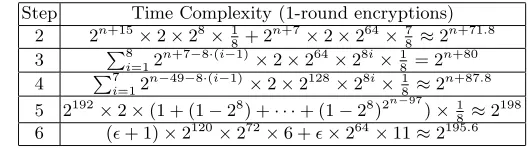
If we taken= 112.06, thenǫ≈1. At this time, about one wrong key is left. In table 2, we will list the time complexity of each step.
Table 2.Time Complexity of Impossible Differential Attacks on 11-Round Camellia-256 Step Time Complexity (1-round encryptions)
2 2n+15×2×28×1 8+ 2
n+7×2×264×7 8 ≈2
n+71.8
3 P8i=12
n+7−8·(i−1)×2×264×28i ×1
8 = 2
n+80 4 P7i=12
n−49−8·(i−1)×2×2128×28i ×1
8 ≈2
n+87.8 5 2192×2×(1 + (1−28) +· · ·+ (1−28)2n−97
)×1 8 ≈2
From Table 2, we know the dominant part of time complexity to recover the main key is steps 4 and 5. Therefore, the time complexity of our attack is about (2n+87.8+ 2198)× 1
11 ≈2196.4 11-round
Camellia-256 encryptions. The data and memory complexities of our attack are approximately 2120.06 chosen plaintexts and 2n+15×4 = 2129.06 128-bit blocks, respectively.
5 Impossible Differential Cryptanalysis of 11-Round Camellia-192 and
12-Round Camellia-256
On the basis of our 7-round impossible differentials, we further attack 11-round Camellia-192 and 12-round Camellia-256.
5.1 Impossible Differential Cryptanalysis of 12-Round Camellia-256
KS P
KS P
KS P
KS P
(0,0,0,0,a,0,0,0)
(0,0,0,0,e,0,0,0) (0,0,0,0,0,0,0,0)
kw3 (0,0,0,0,e,0,0,0)+
P(0,g1,g2,g3,0,g4,g5,g6)
7-Round Impossible Differential with FL/FL-1
(0,g,g,g,0,g,g,g)
(0,g1,g2,g3,0,g4,g5,g6)
kw4
FL FL-1
kw1 kw2
(y,0,0,0,a,0,0,0) (y,0,0,0,a,0,0,0)
(y1,0,0,0,y2,0,0,0)
P(y1,0,0,0,y2,0,0,0)
(0,0,0,0,0,0,0,0)
(0,0,0,0,g,0,0,0)
KS P
Fig. 4.Impossible Differential Cryptanalysis of 12-Round Camellia-256
6 to 17. In Figure 4, we illustrate the basic structure of our attack. Some equivalent subkeys need to be given. Let
ke=kw1⊕k6, kf =kw4⊕k17, kg =kw3⊕k16, kh=kw4⊕k15, ki =kw3⊕k14.
We remove the whitening layers and replace the round keys k6, k14, k15, k16 and k17 with the
corresponding subkeyske, ki, kh, kg andkf to generate a new cipher, which acts as the original one.
The precise attacking procedure can be shown as below.
The Attacking Algorithm 2
1. Data Collection: Choose 2n structures of plaintexts. Each of them has the following form:
(P(α1, x1, x2, x3, α2, x4, x5, x6), P(α3, x7, x8, x9, α4, x10, x11, x12))
where αi(1 ≤ i ≤ 4) takes all possible values and xj(1 ≤ j ≤ 12) is fixed in each structure.
It is obvious that every structure contains 232 plaintexts and generates 263 plaintext pairs.
In total, we collect 2n+63 plaintext pairs with the differences ∆L0 = P(y,0,0,0, a,0,0,0) and
∆R0 =P(y1,0,0,0, y2,0,0,0), wherey and yi(i= 1,2) are non-zero bytes. Encrypt these pairs
to obtain the corresponding ciphertexts.
2. Guess ke,1 andke,5. Check whether the equations ∆S6,l= (P−1(∆PR))l (l= 1,5) hold for each
of remaining pairs. Remove some plaintext pairs satisfying∆S6,l 6= (P−1(∆PR))l. The expected
number of the pairs remaining is about 2n+63×2−16= 2n+47.
3. Guess kl2,5 and keep some plaintext pairs which satisfy the relation ∆PL,1⊕∆PL,5⊕(∆PL,5∩
kl2,5) = 0. The probability of this condition is 2−8. So about 2n+47×2−8= 2n+39 pairs will be
left.
4. Guesskf,1 and test whether the equation∆S17,1= (P−1(∆CL))1 holds for the remaining pairs.
If ∆S17,1 is equal to (P−1(∆CL))1 for some pair, then this pair will be kept. The probability
of this event is about 2−8. Thus there are about 2n+39×2−8= 2n+31pairs remain. Next guess other bytes of kf, i.e., kf,{2∼8} and compute the outputs of the 16-th round.
5. Guess kg,l for 1≤l ≤8 and l6= 5. Check whether the equation ∆S16,l = (P−1(∆L16))l holds
for the remaining pairs. Remove some pairs which do not satisfy the equations above. The probability for that to happen is 2−56. Consequently, about 2n+31×2−56 = 2n−25 plaintext
pairs will be kept. Next guess kg,5 and decrypt the ciphertext pairs to get the outputs of the
15-th round.
6. Guess kh,8 and check whether ∆S15,8 is equal to (P−1(∆L15))8 for the remaining pairs. If
∆S15,8 = (P−1(∆L15))8 for some pair, then this pair will be left. The probability of this event
is 2−8. Thus there are about 2n−25 ×2−8 = 2n−33 pairs remain. Next guess each possible
value of kh,l for 2 ≤ l ≤ 7(l 6= 5). Keep only the pairs satisfying the equation ∆S15,l =
(P−1(∆L15))l⊕(P−1(∆L15))5. The total probability is about 2−40. The expected number of
remaining pairs is about 2n−33×2−40 = 2n−73. Finally, guess kh,1 and calculate the values of
R14,5 andR′14,5.
7. Guess each possible value of ki,5. If ∆S14,5 = ∆L14,2, then we remove this value of ki,5 with
8. The main key can be retrieved from the remaining joint subkeys (ke,{1,5}, kl2,5, kf, kg, kh,{1∼4}, kh,{6∼8}, ki,5). By the key schedule of Camellia-256, we can obtain:
ke =kw1⊕k6 = (KL≪0)L⊕(KA≪15)R (5)
kf =kw4⊕k17= (KB≪111)R⊕(KL≪77)L (6)
kl2 = (KR≪30)R (7)
kg =kw3⊕k16= (KB≪111)L⊕(KB ≪60)R (8)
kh =kw4⊕k15= (KB ≪111)R⊕(KB ≪60)L (9)
ki =kw3⊕k14= (KB≪111)L⊕(KR≪60)R (10)
We first compute the value KB by equations (8) and (9). There are about 28 values of KB
remain. Then we can calculate 64 bits of KLby the equation (6) and 8 bits ofKR by equation
(10). Equation (7) also provides 8 bits of information on KR. Guess 112 remaining bits ofKR.
By the key schedule, we can calculate all bits of KA. Guessing 64 other bits of KL, we can
discard some wrong values of KL and KA according to equation (5). The probability of this
event is 2−16. In total, about 2168(= 28×2112×264×2−16) keys (KL, KR, KA, KB) require to
be executed the test of the key schedule. Therefore, the expected number of the keys remaining is about 2168×2−128= 240 and the correct key can be obtained by trial encryptions.
Complexity After step 5, there are about 2n+23 plaintext pairs remain. Denote the expected
number of wrong 216-bit values (ke,{1,5}, kl2,5, kf, kg, kh{1∼4}, kh{6∼8}, ki,5) surviving after trying all
the pairs byε′. Clearly,
ǫ′ = 2216×(1−2−8)2n−73.
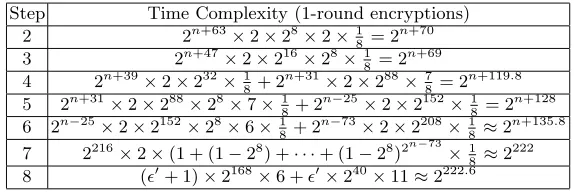
Take n= 87.8. Thenǫ′≈252. We list the time complexity of each step in table 3.
Table 3.Time Complexity of Impossible Differential Attacks on 12-Round Camellia-256
Step Time Complexity (1-round encryptions)
2 2n+63×2×28×2×1
8 = 2
n+70
3 2n+47×2×216×28×1
8 = 2
n+69 4 2n+39×2×232×1
8+ 2
n+31×2×288×7 8 = 2
n+119.8 5 2n+31×2×288×28×7×1
8+ 2
n−25×2×2152×1 8 = 2
n+128 6 2n−25×2×2152×28×6×1
8 + 2
n−73×2×2208×1 8 ≈2
n+135.8 7 2216×2×(1 + (1−28) +· · ·+ (1−28)2n−73
×1 8 ≈2
222 8 (ǫ′+ 1)×2168×6 +ǫ′×240×11≈2222.6
Clearly, the dominant part of time complexity is steps 6 to 8. Therefore, the total time com-plexity is about (2n+135.8 + 2222+ 2222.6)× 1
12 ≈ 2220.87 12-round Camellia-256 encryptions. The
5.2 Impossible Differential Cryptanalysis of 11-Round Camellia-192
On the basis of impossible differential attacks on 12-round Camellia-256 from rounds 6 to 17, we present impossible differential cryptanalysis of 11-round Camellia-192 by removing the 17-th round. Since this attack is similar to the impossible differential attack on 12-round Camellia-256, we only describe some differences between them in the following.
First, we collect the same plaintext pairs as we do in step 1 of section 5.1. In total, we select 2n+32 plaintexts, which generate 2n+63 pairs satisfying the input differences of the plaintext pairs. Second, we filter out some wrong plaintext pairs whose ciphertext differences don’t satisfy our requirements. Keep only the pairs with the following ciphertext differences:
P(0, g1⊕e, g2⊕e, g3⊕e, e, g4⊕e, g5⊕e, g6),
wheregi(1≤i≤6) are non-zero byte. After this step, we expect about 2n+63×2−8 = 2n+55 pairs
remain.
Third, we remove the wrong subkeys. We first give some new notations, i.e., kg′ = kw4 ⊕
k16, k′h = kw3 ⊕k15 and ki′ = kw4 ⊕k14. Then, we guess all possible values of ke,{1,5}, kl2,5, k′g
and k′
h,l(1 ≤ l ≤ 8, l 6= 5) in turn so as to keep some plaintext pairs satisfying our
require-ments. There are approximately 2n+55 ×2−16 ×2−8 ×2−56×2−48 = 2n−73 plaintext pairs re-main. Finally, guess ki,5. If ∆S14,5 = ∆L14,2, then we remove this value of ki,5 with the guessed
(ke,{1,5}, kl2,5, k′g, kh,′ {1∼4}, k′h,{6∼8}). The probability of this event is 2−8. Denote the number of the wrong subkeys remaining by ǫ′′. Clearly,
ǫ′′= 2152×(1−2−8)2n−73.
Take n= 88. Then ǫ′′≈2−32.7. Up to now, the dominant part of time complexity is the step that to guess the values of (k′
h,{1∼4}, kh,′ {6∼8}), i.e., about 2n−25×2×288×28×7×81 = 2n+71.8 = 2159.8
1-round encryptions. It is equivalent to approximately 2159.8× 1
11 ≈2156.34 11-round Camellia-192
encryptions.
Finally, we recover the main key from the remaining joint subkeys. According to the key schedule of Camellia-192, we obtain the equation:
k′g=kw4⊕k16= (KB≪111)R⊕(KB≪60)R (11)
kh′ =kw3⊕k15 = (KB≪111)L⊕(KB ≪60)L (12) k′i =kw4⊕k14= (KB≪111)R⊕(KR≪60)R (13)
Combining with equations (5) and (7), we retrieve the main key. First, we calculate 120 bits of KB by equations (11) and (12). Guessing eight other bits of KB, we can compute 8 bits of KR by
equation (13). In addition, we know 8 bits ofkRfrom equation (7). Next, guessing the 48 remaining
unknown bits ofKR, we obtain all bits of KA by the key schedule and 16 bits ofKL by equation
(5). Finally, guessing 112 remaining bits of KL, we test whether (KL, KR, KA, KB) can pass the
key schedule of Camellia-192. Consequently, about 28×2112×248×2−128= 240 keys are kept. The unique correct key can be sieved by trail encryptions. The time complexity of this step is about 2168 6-round encryptions, i.e., 2167.1 11-round encryptions.
In conclusion, the total time complexity of impossible differential attacks on 11-round Camellia-192 is about 2158.8 + 2167.1 ≈ 2167.1 11-round Camellia-192 encryptions. The data and memory
6 Conclusion
In this paper, we have presented new results on impossible differential cryptanalysis of Camellia-192 /256. We first exploit some properties of the transformationsF L/F L−1. On the basis of them, we construct several 7-round impossible differentials of Camellia with theF L/F L−1 layers. Then by adding four additional rounds after one 7-round impossible differential, we propose a new impossible differential attack on 11-round Camellia-256. Our attack requires 2120.06chosen plaintexts, 2196.4 11-round encryptions and 2133.06bytes of memory. Furthermore, we further improve these cryptanalytic results and derive efficient attacks on 11 rounds of Camellia-192 and 12 rounds of Camellia-256. The time complexities of our attacks on 11 rounds of Camellia-192 and 12 rounds of Camellia-256 are about 2167.1 11-round encryptions and 2220.87 12-round encryptions, which are 216.9 times and 219.13 times faster than previously best known results but have slightly more data and memory.
References
1. Aoki, K., Ichikawa, T., Kanda, M., Matsui, M., Moriai, S., Nakajima, J., Tokita, T.: Camellia: A 128-bit block cipher suitable for multiple platforms - design and analysis. In: Stinson, D.R., Tavares, S.E. (eds.) Selected Areas in Cryptography. Lecture Notes in Computer Science, vol. 2012, pp. 39–56. Springer (2000)
2. Biham, E., Biryukov, A., Shamir, A.: Cryptanalysis of Skipjack reduced to 31 rounds using impossible differentials. In: EUROCRYPT. pp. 12–23 (1999)
3. Chen, J., Jia, K., Yu, H., Wang, X.: New impossible differential attacks of reduced-round Camellia-192 and Camellia-256. In: Parampalli, U., Hawkes, P. (eds.) ACISP. Lecture Notes in Computer Science, vol. 6812, pp. 16–33. Springer (2011)
4. CRYPTREC-Cryptography Research and Evaluation Committees: report. Archive (2002),
http://www.ipa.go.jp/security/enc/CRYPTREC/index-e.html
5. Dunkelman, O., Keller, N.: An improved impossible differential attack on MISTY1. In: Pieprzyk, J. (ed.) ASI-ACRYPT. Lecture Notes in Computer Science, vol. 5350, pp. 441–454. Springer (2008)
6. Hatano, Y., Sekine, H., Kaneko, T.: Higher order differential attack of Camellia (II). In: Nyberg, K., Heys, H.M. (eds.) Selected Areas in Cryptography. Lecture Notes in Computer Science, vol. 2595, pp. 129–146. Springer (2002)
7. International Standardization of Organization (ISO): International standard - ISO/IEC 18033-3. Tech. rep., Information technology - Security techniques - Encryption algrithm - Part 3: Block Ciphers (July 2005) 8. Jie, G., Zhongya, Z.: Improved collision attack on reduced round Camellia. In: Pointcheval, D., Mu, Y., Chen,
K. (eds.) CANS. Lecture Notes in Computer Science, vol. 4301, pp. 182–190. Springer (2006)
9. Kawabata, T., Kaneko, T.: A study on higher order differential attack of Camellia. In: The 2nd open NESSIE workshop (2001)
10. Knudsen, L.R.: DEAL - a 128-bit block cipher. Tech. rep., Department of Informatics, University of Bergen, Norway (1998), technical report
11. Lei, D., Li, C., Feng, K.: New observation on Camellia. In: Preneel, B., Tavares, S.E. (eds.) Selected Areas in Cryptography. Lecture Notes in Computer Science, vol. 3897, pp. 51–64. Springer (2005)
12. Lei, D., Li, C., Feng, K.: Square like attack on Camellia. In: Qing, S., Imai, H., Wang, G. (eds.) ICICS. Lecture Notes in Computer Science, vol. 4861, pp. 269–283. Springer (2007)
13. Li, L., Chen, J., Jia, K.: New impossible differential cryptanalysis of reduced versions of Camellia block cipher. In: CANS (2011), to appear
14. Li, L., Chen, J., Wang, X.: Security of reduced-round Camellia against impossible differential attack. IACR Cryptology ePrint Archive 2011, 524 (2011)
15. Lu, J., Dunkelman, O., Keller, N., Kim, J.: New impossible differential attacks on AES. In: Chowdhury, D.R., Rijmen, V., Das, A. (eds.) INDOCRYPT. Lecture Notes in Computer Science, vol. 5365, pp. 279–293. Springer (2008)
17. Mala, H., Dakhilalian, M., Rijmen, V., Modarres-Hashemi, M.: Improved impossible differential cryptanalysis of 7-round AES-128. In: Gong, G., Gupta, K.C. (eds.) INDOCRYPT. Lecture Notes in Computer Science, vol. 6498, pp. 282–291. Springer (2010)
18. Mala, H., Shakiba, M., Dakhilalian, M., Bagherikaram, G.: New results on impossible differential cryptanalysis of reduced-round Camellia-128. In: Jr., M.J.J., Rijmen, V., Safavi-Naini, R. (eds.) Selected Areas in Cryptography. Lecture Notes in Computer Science, vol. 5867, pp. 281–294. Springer (2009)
19. NESSIE: New european schemes for signatures, integrity, and encryption, final report of eurpean project IST-1999-12324. Archive (1999), http://www.cosic.esat.kuleuven.be/nessie/Bookv015.pdf
20. Sugita, M., Kobara, K., Imai, H.: Security of reduced version of the block cipher camellia against truncated and impossible differential cryptanalysis. In: Boyd, C. (ed.) ASIACRYPT. Lecture Notes in Computer Science, vol. 2248, pp. 193–207. Springer (2001)
21. Tsunoo, Y., Tsujihara, E., Shigeri, M., Saito, T., Suzaki, T., Kubo, H.: Impossible differential cryptanalysis of CLEFIA. In: Nyberg, K. (ed.) FSE. Lecture Notes in Computer Science, vol. 5086, pp. 398–411. Springer (2008) 22. Wu, W., Zhang, W., Feng, D.: Impossible differential cryptanalysis of reduced-round aria and camellia. J. Comput.