Journal of
RANGE MANAGEMENT vozu~~tZLerf’%~fi;L9R;Ibel
5
Rangeland Environments and Man ___________________._______________.________ Gerald W. Thomas Range Management and Improvement in New Zealand _____.________ W. R. Chapline Supplementing Pine-Wiregrass Range with Improved Pasture in South Georgiaau Clifford E. Lewis and W. C. McCormick Recovery of Desert Plants in Various States of Vigor
C. Wayne Cook and R. Dennis Child Stocking Rangelands on the Rio Puerto in New Mexico
Earl F. Aldon and George Garcia Utilization of the Major Plant Communities in the Similkameen Valley, British Columbia ____________________-__.____--.._________- A. McLean, T. M. Lord, and A. J. Green Seedling Survival on Erosion Control Treatments in a Salt Desert Area
Ross W. Wein and Neil E. West Developmental Morphology of Switchgrass and Sideoats Grama
Phillip L. Sims, Lucas J. Ayuko, and D. N. Hyder Some Soil Age-Range Vegetation Relationships _____ ____. _ ____ _______ ____._ __________ E. M. White Effect of Site Class and Rainfall on Annual Range Response to Nitrogen and Phosphorus _______________ _____ __________________ R. E. Luebs, A. E. Laag, and M. J. Brown Phenology and Control of Common Broomweed on Texas Rangelands
C. J. Scifres, R. R. Hahn, and J. H. Brock Effects of Utah Juniper Removal on Herbage Yields from
Springerville Soils ____________________________---_______-_________________._.____-__._______ Warren P. Clary Responses of Eastern Red Cedar to Control Procedures
Normie Buehring, P. W. Santelmann, and Harry M. Elwell Grass Seedling Emergence and Survival after Treatment with Fungicides
A. C. Hull, Jr. and K. W. Kreitlow Morphologic Development of Subterranean Clover (Trifolium subterraneum L.) as Influenced by Seed Size ____.________.__ Charles A. Raguse and Francis K. Fianu Influence of Row Spacing on Crested Wheatgrass
Seed Production _______________________________________________.__________________ William J. McGinnies Comparison of Lysimeter and Neutron Scatter Techniques for Measuring
Evapotranspiration from Semiarid Rangelands ___________.______._______ J. Ross Wight Technical Notes
Moistening and Heating Improve Germination of
Two Legume Species ________________________-_._____--______--______--_.____--_._- C. A. Segelquist A Portable Small-Stage Photoelectric Planimeter for Leaf Area Measurements
Martyn M. Caldwell and Russell T. Moore Winterfat Seedlings Emerge Best from Shallow Seeding,
Moderately Dry Soil ___._________.______________.________________________.__---- H. W. Springfield Management Notes
Changes on a Sagebrush-Grass Range in Nevada Ungrazed
for 30 Years ____________________----_____---______--_._____-_._____--._____--.____---___ J. H. Robertson Viewpoints
Relevance of the Population Explosion to Management of Sparsely-Populated Lands ____________________-______---______--__.______ __.. ____ . ..__ ____ _.__ ____ ._.._ ___ ._.. ____ Dennis H. Knight
Book Reviews _______________________________________________.______________.________________.______..________-_______-____________-_-____ RE = Con Resumen en Espaiiol
326 329
334
339
344
346
352
357 360
366
370
373
378
383
385
387
390
393
394
395
397
400 402
cover Photo-End of the Trail,
Rangeland Environments and Maw
GERALD W. THOMAS
President, New Mexico State University, Las Cmces, New Mexico
Range managers, as a profes-
sional group, are not assuming an
active leadership role in the mod- ern political, social and economic scene. On the one hand, we are
relegating our responsibilities for
food and fiber production to politi- cal expediency. On the other hand, we, who have lived and worked with
land, vegetation, and water re-
sources and their interactions with all forms of animal life (which is, after all, the field of ecology), have not assumed a leadership role in the new developments and interest, in the environment and pollution control.
Range men have not been as
outspoken-or emotional-as the
ultraprotectionist types, or the
health fadists, or even the man on the street. We have allowed the term “ecology” to be misinterpreted and misrepresented to mean only a very restricted view of a small part
of the environmental complex.
When the headlines read “New Solution to the Ecology Problem,” we find the details of the story to refer only to a new technique to collect garbage, or to grind up glass or cans.
Or, even more seriously, when we make the headlines as range man- agers, or foresters, or ranchers, we are caught in a defensive, rather than an offensive position. We are the culprits who use pesticides, who provide access roads to remote areas, who allow the hunter to kill or livestock to graze. We are often classed as the “Polluters” and not the “Protectors” of range and forest lands.
Please don’t misunderstand me
on this point. I’m convinced that we need some pressure from the ex- tremists. The United States, as a
1 Keynote address presented to the 24th
Annual Meeting of the Society for Range Management, Reno, Nevada,
February 16, 1971.
nation, waited far too long to wake up to the consequences on the en- vironment of an exploding popula- tion coupled with rapid techno-
logical development. We needed
the environmental teachins and the concern on and off campus in pollu- tion. As a matter of fact, many members of the Society for Range Management were trying to alert us to these same problems many years ago.
And, while a new technique for garbage disposal is important, those of us who work with, and study, the
interactions between man, other
animals, plants, and the environ- ment, must realize that there is a larger and more significant picture- a broader concept of ecology-which
involves energy and nutrient
cycling in the ecosystem, vegetation change through time (succession and regression patterns), land use
and land requirements for food
and fiber production, water and the hydrologic cycle, and air and the C02/02 ratio.
Consequently, the first challenge to you and me, as ecologists by training and practice, is to make ourselves heard, and to move out in an offensive posture rather than to wait for a court hearing or a public
confrontation which invariably
places us on the defensive.
The second majo’r challenge to members of this Society is to lend expertise to other professions and to other problems of society such
as urban environmental analysis
and planning, analysis of cultivated
land ecosystems, recreation and
land-use planning for cities and communities, and international de- velopment.
Range men have more knowl- edge and ability than most profes- sions to help with environmental
problems. They can bring a dif-
ferent perspective to the scene-
326
that of “management” orientation. The Federal Government and many states are organizing environmental
“protection” agencies. “Pro tec-
tion” could mean “hands-off,” to “shield” or to “let nature take its course.” I much prefer the terms
environmental “improvement” or
“management.” Nearly everything
that man does-nearly all of man’s
activities-either directly or in-
directly, has some undesirable ef-
fects on the environment. There-
fore an environmental “protection” organization could be staffed with
“protectionist” oriented people,
and could lead to curtailment of many of man’s activities, including industrial development, food and
fiber production, recreation and
tourism development, and munici- pal expansion.
On the other hand, environ-
mental “improvement” and/or
“management” implies research, ed-
ucation, understanding, analysis,
and planning. “Improvement”
could lead to correction of the ex- isting problems of environmental deterioration as well as “planned” growth and development with man as the focal point. And, since we can’t pass a retroactive birth con- trol law, we have no choice but to be concerned about man’s needs for consumer goods and well-being.
Ecological understanding and
management orientation are essen- tial. For many centuries man has
been “influencing” the environ-
ment in which he lives and works. Part of his efforts have been toward
“intentional” management to im-
self and modified the biological organisms using the area. He has developed drought-resistance plants, bred up animals to withstand cli- matic extremes, and learned to co- operate with the climate. These all add up to man’s credit-based upon goals established early in our his- tory.
While man has thus been busy modifying the environment to serve his special needs, he has, for the
most part, unintentionally, created
problems of pollution and contam- ination. He has had too little con- cern and too little understanding of the quality of the “total envi- ronmen t.” We now have the tools and techniques to make a better
analysis of the environment-to pin-
point problem areas and problem
activities. We can now re-orient
our development goals with a view
toward environmental enhance-
ment. At the present time, how- ever, we are being influenced by
emotionalism, protectionism, and
over-reaction. I am not implying
that we do not have problems, be-
cause we do-and some are very
serious. But, our problems must be analyzed in the context of broad ecological principles.
If we, as range men, are to lend our expertise to the many environ- mental issues, we are going to have to convince a large sector of our society that we have this knowl- edge and ability. Many members of scientific and professional orga- nizations, as well as most of the gen- eral public, have a poor concept of
“Rangeland” and an even poorer
definition of “Range Managers” or “Range Scientists.”
I was pleased to receive a copy of Francis Colbert’s response to the Bureau of Labor Statistics draft of material for the new “Occupational Outlook Handbook.” Francis called attention to a statement made in the manuscript as follows:
“The scientific and technical duties once performed by range managers in- creasingly will be performed by natural scientists.”
Our able secretary’s response was:
“In regard to this, it is logical to ask
RANG-ELAND
ENVIRONMENT
327
what in heaven’s name is a range man- ager if he is not a natural scientist?”
Unfortunately, such misunderstand- ings are common.
7)
What kind of vegetation patternis best for livestock productivity, water yield, recreation and aes- thetic values and/or oxygen pro- duction?
The third challenge to members of the Range Society is one of self-
analysis and research. Since the
theme for this conference is “Range- land Environments and Man” I am assuming that we are concerned about the future as well as the prob- lems of today. Therefore we need to ask ourselves some very difficult
questions-looking toward the year
2000 and beyond.
With the world’s po,pulation ex- pected to exceed 6 billion people by the turn of the century, what kinds of pressures will be placed on the Range Resource? I’m con- vinced that we have not had suffi- cient knowledge until recently to, even ask the right questions. The IBP grassland, desert and forest
biome studies-probably the most
significant ecological research now
underway-will help provide the
tools to reformulate our questions and hopefully look for the big an- swers.
Based upon some new ecological concepts, we must examine the in- dividual consumer in olur society in relation to the basic resources re- quired to sustain this individual. In other words, we need to ask, and to answer, the following question:
Time will not permit an ade-
quate examination of these ques-
tions, but my preliminary analysis indicates that they have serious
implications for our Range Re-
sources. My studies of the “Ecology of Food Production” clearly indi- cate that we cannot sustain and probably should not promote, on a world-wide basis, the U. S. ap- proach to mechanized agriculture on cultivated lands. I say this be- cause, in studying cultivated land ecosystems in the United States, it appears that we are “spending” in the neighborhood of 10,000 calories of fossil fuel per person per day to produce 3,000 calories of food en- ergy from the sun-this energy cap- tured in crop production through the process of photosynthesis. The average U. S. citizen today is using over 2 1,000 calories of outside en- ergy per day for all purposes-and yet our food needs are only about 3,000 calories. Obviously this drain
on depletable resources-and the
accompanying problems of pollu-
tion-cannot be continued. Since
1900 we have replaced 22 million work horses and mules on U. S. farms with 5 million tractors and many other forms of mechanized power. In doing so, we have re-
leased
72
million acres of land thatwould have been required to feed these animals, for direct food pro- duction for humans. But, in so do- ing, we have significantly changed the energy cycling patterns with serious implications to the environ- ment.
1)
2)
3)
4)
5)
6)
How much land is required to sustain an individual-regardless of whether he lives in the city or in the country? What are our basic requirements for cultivated cropland and for range? How much water is required for food production and for man’s other needs?
How much energy from what source?
is required and
How much air is required person and what quality? Per How much elbow room, or open
space, is needed to maintain health and mental attitudes? our What are the requirements of each individual for depletable re- sources and what are the inter- actions between these “non- renewable” and our important “renewable” resources?
328 THOMAS
look more closely at the question of where man should bleed the energy cycle for most efficient food pro- duction with a minimum of dis- turbance to natural ecosystems.
I am equally concerned about man and his water resource require- ments. As our level of living in- creases so does our demand for water. For example, one study showed that the residents of Bev- erly Hills, California used 313 gal- lons of water per person per day while residents of Compton, with less than half the average per capita income used only 89 gallons per day. The average citizen in the U. S. now requires about 180 gallons per person per day for home use. Our total withdrawals amount to approximately 360 billion gallons of water per day for various pur- poses. Although agriculture uses
41 percent of the total, industry and municipalities are placing increas- ing pressure on this resource. Ac- cording to the U. S. Water Re- sources Council, before the year 2020 industrial, municipal, do’mes- tic, and power requirements for fresh water in this country are ex- pected to reach over 1,000 billioln gallons per day-three times the total withdrawn for all purposes today. This means that the agri- cultural sector will have to develop new arguments to justify contin- ued use. Pressure will continue for more “water harvesting” and other techniques to increase run-off with- out adequate data of the effects on total ecosystems.
Many attempts have been made to calculate minimum water re- quirements for our major needs. To grow a pound of wheat in the field will require about 1,500 pounds of water. If we follow this wheat on through the milling proc- esses, with average losses, and to the completed bread, we find that over one ton of water is used to produce
one pound of bread. To produce one pound of rice may require as much as 2 toIns of water.
As we introduce animal protein or o)ther essentials for balanced diet, the water requirements are in- creased correspondingly. For ex- ample, on some brush infested rangelands in the Southwest, over 100 tons of water are involved in the process of producing 1 pound of beef-measured at the supermar- ket level. In terms of water “ex- penditures” for beef production, it appears that efficiency can be in- creased at least 10 times by produc- ing animal feeds on irrigated lands and confining the animals to a dry- lot during the production period. But, keep in mind that much of the water falling on range lands is dis- sipated by undesirable weeds and brush or evaporates from the un- protected soil surface. Also, most of the water necessary to the process of photosynthesis in productive crops is transpired through the plant and returned to the atmos- phere.
It is significant to note that water used for crop and livestock produc- tion in both cultivated and un- cultivated land ecosystems can only be recycled in the long run as it passes through the complicated hy- drologic cycle. On the other hand, most of the water used by industry and municipalities can be recycled and cleared of pollution on a short term basis with only an economic and techno’logical input.
It seems obvious that before the year 2000 the range resofurce must be examined more carefully in terms of the total environment as we seek to supply man’s needs. Most range ecologists believe that it will be possible to double our livestock productivity on these areas with proper management. And while we are working on this o#bjec- tive we are also very well aware
that these lands have value to the individual and to society for more than one purpose. Though the primary income may be from live- stock and forest products, these lands are also important from the standpoint of wildlife, recreation and water yield. And, we must now add another dimension to our “mu1 tiple-use” approach to un- cultivated lands-that is, we must now consider carefully their value to environmental enhancement- particularly air and water quality, energy and nutrient cycling.
In summary, I have tried to pre- sent three challenges to members of the Society as we discuss rangeland environments and man. The first is that the range profession has a long and distinguished history deal- ing with ecological problems-but, we have not made ourselves heard in other than a defensive posture.
Secondly, we have the expertise and the responsibility to work with other professions and to help with a vast array of environmental prob- lems of concern to society-to pre- sent our concepts of ecosystem management-to help base decisions on the larger picture rather than on bits and pieces of information.
Thirdly, and probably of most importance-we must look inter- nally. Have we been asking our- selves the right questions as we face the very real probability of provid- ing consumer goods and a desirable living environment for an expected 6.2 billion people by the year ZOOO? This last challenge should influence today’s decisions relating to re- search, education, and action pro- grams.
CLYDE ROBIN
NATIVE SEEDSRange Management and Improvement
in New Zealand
W. R. CHAPLINE
Range Consultant, Washngton, D.C.
Highlight
Approximately one-third of New Zealand is in improved pasture and addi- tional areas are being developed each year. These are high producing, seeded mainly to turf forming grasses and legumes, fertilized periodically by air, and intensively managed for wool, lamb, mutton, and beef production. Range lands occur chiefly in the colder South Island, generally at elevations above 3000 feet. Wool production is paramount, although some lamb, mutton and beef are produced. As a result mainly of heavy rabbit infestation and burning to pro- vide fresh forage in past years, these ranges were seriously deteriorated followed by excessive runoff and erosion. Rabbits have been controlled, burning largely eliminated, and better range and livestock management is being applied.
The establishment and manage- ment of improved pastures in New Zealand has reached a high art or science. The improvement and management of range lands is in a much less advanced stage. There are, however, examples of well planned range operations which have brought about recovery from past deterioration and profitable sustained ecoaomic use for livestock production, together with desirable watershed management.
New Zealand is a nation consist- ing of two large and many small islands in the Southern Hemisphere, extending from near the 34th to the 47th parallels south. That is com- parable in the western United States from Los Angeles, California to the Columbia River in eastern Wash- ington. With average annual rain- fall in the North Island ranging from 20 to 100 inches, rather well distributed throughout the year, and a temperate climate, the North Island is generally favorable for improved pasture development, ex- cept limited rugged mountain areas. The South Island is colder, and its climate is influenced greatly by the high mountain chain (Southern Alps) which extends the entire length of the island near its west coast. While rainfall is high west
l Formerly Chief, Division of Range Research, Forest Service, U. S. Depart- ment of Agriculture, and Chief, Forest Conservation Section, Food and Agri- culture Organization, United Nations, Rome, Italy.
of the mountains, the slopes there are too steep for pasture develop- ment. Average annual rainfall east of the mountains ranges from about 12 to 15 inches in high central plains to about 25 to 40 inches fur- ther east, with somewhat higher amounts in the mountains. Plains, valleys, and hills below 3000 feet in elevation, with rainfall of 18 inches or more, in the South Island are generally suitable for improved pas- ture development. The rest that is grazable is largely range land.
Out of a total area of approxi- mately 66 million acres, about 44 million are occupied as “farms” or “runs” (ranches), of which 7 mil- lion acres are used in arable farm- ing, horticulture and other farming purposes. (Du Four et al., 1967). lmproved pastures have been devel- oped on approximately 21 million acres. About 22 million acres are native or naturalized pasture, na- tive or planted forest, or scrub, much of which is grazed. About 4 million acres of the farm area are primarily dairy farms. Some 33 mil- lion acres are reported to carry about 60 million sheep, while beef cattle are also grazed to some degree on these lands. Relatively large areas of scrub, native forest and de- pleted native pastures are being de- veloped as improved pasture each year.
Farming has evolved chiefly as an export industry with low prices for dairy products, especially, but also relatively low prices for wool, lamb,
329
mutton, and beef. This has necessi- tated low farm labor costs, and in the case of sheep and beef cattle production, relatively large proper- ties and large sheep numbers per owner operator.
The native pasture, or range, con- ditions are different from most of the range area of the world. The island climate, young geology and soils, and lack of grazing animals before white settlement, give a dif- ferent basis for growth and use of palatable native vegetation than is generally the case in other countries. With white settlement not only were domesticated animals intro- duced, but also? deer, rabbits, and other wild animals were imported. Without natural enemies and a lack of regular adequate harvesting, this population, especially deer and rab- bits, increased tremendously. The result was excessive overgrazing and destruction of the palatable vegeta- tion accompanied by loss of much topsoil. With naturally unstable soils on steep slopes, clearing and burning of forest and tussock grass growth from such slopes, in- creased runoff and terrific erosion both of slopes and stream channels occurred. In some areas there was failure for economic livestock pro- duction. The Government pro- vided for the establishment of Rab- bit Boards; financed by rates (a special type of taxes) assessed against land areas affected, and a campaign of rabbit control or ex- termination was instituted that has finally reduced the rabbit popula- tion to a reasonable number. Deer and other wild animal control, largely conducted by the Forest Ser- vice in forested mountain areas, is also effective.
Most of the tall tussock grasses and other coarse vegetation on re- maining range lands are of low palatability for domestic livestock.
330
Some areas, however, recovered and support a dense inter-tussock c”ver of palatable “i- reasonably palat- able native and naturalized intro- duced grasses and other herbs. Much “I the tllssock area, however, is of an intermediate condition.
Most of the farms and nuns arc what might be termed o’f single fam- ily economic sire, sufficient to give a reasonable income. This fits in with long established ~;“vernmental policy. The Land Settlement Pro- motion Act controls ag,gxgation of land by individuals and in general keeps farms to a “living area” sire. However, if land is owned by a company oi 10 or more members it is exempt from the Act. In s”me of the larger “runs,” especially in the South Island where there is chance for considerable further develop- ment of improved pastures, the value of farms may increase greatly through expenditure of otherwise taxable funds for that purpose.
Sheep are not herded, even in rugged mountains. They are grazed in paddocks (pastures) and are moved from pasture t” pasture or mustered for shearing or sale by the use of well trained dogs and the whistle, or call, of the owner. Shear- ing is handled by migrant crews.
Improved Pastures Improved pasture development and management throughout New Zealand is very good, being almost entirely a combination of turf form- ing introduced grasses and clovers with suitable fertilixr treatment both for establishment and main- tenance, and grating procedures well adapted to each major situn- tion. Research relating t” the prob- lem has been outstanding, covering both fundamental and practical as- pects, both by the Department of Scientific and Industrial Research x~l by Agriculture. (Cockayne, 195G; Corkill, 1966; Cullen, 19G6; Levy, 195G; O’Connor, 1966; Suck-
ling, 1966). Progressive farmers follow the research closely and ap- ply procedures unusually promptly.
Suitable grasses and clovers, es- pecially varieties derived from pe- rennial ryegrass, orchard grass, and
CHAPL.lNE
white clover, adaptable to the many climatic, soil, and topographic con- ditions, have been developed through introduction, selection, and breedmg. Where cultivation is practicable, economic procedures have been evolved for soil prepara- tion, seeding XKI fertilizing. In hill country, fire is ordinarily utilized to *em”ve the unwanted native veg- elation and airplane seeding and fertilization are applied. Super- phosphate is required almost throughout, but the amount needed varies greatly. Nitrogen may be ;~pplicd initially. Sulpbur is needed in many areas, sometimes 20 to 30 pounds per acre per annum. Lime is needed on s”me soils, sometimes t” offset aluminum toxicity. Vari- ous minor elements, such as molyb- denum, magnesium, cobalt, copper, and selenium, are also required in various parts of the pasture area.
Once paswres are established, management is important. In gen- eral, grazing needs to be rather heavy, “mob~stocking,” intermit- tent, and with suitable rest periods
(Fig. 1). This requires a rotational system of grazing of reasonable sized pastures so that the forage can be utilized in a few days, or weeks at rn”&, and then allowed t” pro-
duce a new crop. This type of grw- ing results in a cycling of nitrogen for high production-up to 14,000 pounds of dry matter per acre. The use of the graring animal in proper utilization of the forage and even unwanted vegetation plays a great part in elficient maintenance of high productivity in the pastures.
After weaning al lambs, they are ordinarily given the chance t” have abundant forage on fresh pasture. The dry ewes may be utilized to tidy up pastures through closer util- ilation, and cattle are graxd along with sheep to utilize s”me of the coarser vegetation that would other- wise compete with effective.growth or the forage most needed In wool and lamb production.
Periodically, pastures need reno- vating and the necessary procedures are well developed. In the hill country of the North Island this usually includes rather close graz- ing for a short period, called “bare,” but a good sod remains. Then the pasture is topdressed by airplane with suitable fertilizer and some-
every three years. In some areas annual topdressing is required.
In the South Island, especially, provision for winter and spring is extremely important. The warm- laced slopes are accordingly given an itutumn rest so that suitable growth is available for the winter and spring periods. The dark~faced slopes and higher elevations are utilixd primarily in summer.
Alfalfa is grown on many flats and low ridges, eslxcially in the Soutll Island, but also in the North, for hay, silage and lor grazing. In grazing it, a rotation system is es- xntial. In the semi-arid Central Ot:!go, alfalfa is grown without irri- gauon on suitable soils and topog- raphy with only 12 inches average rainfall. Under such conditions it is not as thick a stand as on most cultivated lands with rainfall of 20 inches or more, but it makes one or more crops of hay and can be grazed after cutting, in autumn and early winter.
In most parts of the South Island, sup~lementarv feed in the Sorm of ha;‘and/or turnips is usual. This period extends from three to five months of winter. Sometimes oats are also grown for autumn and winter grazing.
The New Zealand Romney is the most widely used sheep on farms. It is based primarily on the English Romney with some English Lei- tester and Lincoln blood, and once established as a breed in years past, carried forward as such. It is well adapted to the improwd pastures
widely available. In many flocks especially on level and rolling pas- tures, part of the ewes are bred to Southdown rams to’ produce fat lambs for sale. In some, Border L&ester rams are utilized to dc- velop crossbred ewes which are re- ported to have greater fertility and also produce good lambs. The Cor- riedale, another important New Zealand breed, is prominent on the Canterbury Plains of the South Island. The Perendale is still an- other, developed from a cross of the New Zealand Romney with Chev- iot. It is said to be a better mother and also well adapted to grazing
RANGE IN NEW ZEALAND 331
hill farms and gives a greater lamb uop.
Polled Angus and Herefords are the two principal beef breeds. On some farms Frieaian steers are being fattened on pasture, and in others Friesian bulls are being used with Angus and Hereford cows, and on still others Friesian cows are being bred to Angus and Hereford bulls for beef production.
“High Country” Grazing The term “High Country” relates to those runs in the South Island which have a considerable part of their holdings located at elevations above 3000 feet. These include some Slats, considerable hills and moun- tains which may run up to 5000 or 6000 feet in elevation. They cover a considerable area, primarily range lands, and produce a great deal of fine wool, some lambs, mutton and beef. Most of the country above 3000 feet is grarcd by sheep, mainly Merinos, which do well in that cooler climate (Fig. 2). Steep slopes in the mountains are commonly graxd by Merino weathers for wool production alone. Much of the hill and flat country below 3000 feet in elevation with annual rainfall of 18 inches or more, is gradually
being converted to improved pas- ture or for winter feed crops which supplement the range lands and assure better sustained year round nutrition of animals.
In the past when there were con- siderable numbers of rabbits and burning was a common practice in an effort to keep the range open Sor grazing and provide young green forage, the vegetation was thinned drastically, and much of the topsoil was washed away through erosion. Large areas were reduced to’ scree or gravel, and the remaining vegeta- tion was insufficient to prevent con- siderable soil and rock creep. (The Tussock Grassland Research Com- mittee, 1954). Riney and Dunbar
(195G) described criteria for deter- ming status and trend of High Country grazing lands and mini- mum requirements for conserve- rion, which imply the maintenance of a soil-vegetation balance and the prevention of increase in depletio,n of existing soil and vegetation. Now that rabbits are controlled, the veg- etation is making a slow recovery, unless there are more domestic ani- mals on the range than the palat- able vegetation can support effi- ciently.
332 CHAPLINE
,“.‘.,~ ._.
elevations above 3,000 feet and semi- arid range below that elevation which has an average annual rain- fall of only 12 to 16 inches, is to de- termine suitable degrees of grazing and proper seasonal use, as well as other features of management which will aid recovery of vegeta-
tion and rebuild soil under grazing use by sheep or cattle or both. Such management is apt to be very dif- ferent from that applicable to the improved pastures in New Zealand. On such range lands there are sev- era1 instances where lower stock numbers have produced an equal amount or in some cases a higher amount of wool than from the orig- inal larger flock numbers.
Watershed Management and Soil Conservation
The serious erosion situations on pasture and range lands and their adverse effect on stream flow and channels appear to be well recog- nired, at least by the New Zealand government. The soil conservation work of the Catchment Boards in- dicates that it has real potential for reducing erosion and at the same time facilitating increased income from many areas treated. In gen- eral, when a farmer or rancher agrees to the development of a plan
for his farm or run, soil conservators formulate a plan which they believe will reduce, or even overcome the erosion which is occurring. This is worked out jointly with him. Such plans now provide for removal of grazing from steep mountain areas classified as Class VIII and those in Class VII which are eroding badly
(Fig. 3). These plans normally pro- vide some subsidy for carrying out necessary features of the plan. About 1000 conservation farm plans are operating.
All farms and runs of course, do not require such plans. However, there are many local land slips which do not vegetate quickly, and other critically erodable soils which do need prompt and effective action to check the erosion. On such areas necessary treatments are vital. There are also limited erosive situa- tions on farms, many of which can be corrected by tree planting and other minor erosion control pro- cedures. Soil conservators can give advice in connection with such sit- uations without the necessity of for- mulating plans for the entire farm operation.
The Lands and Survey Depart- ment has three “Blocks” in the South Island with steep slopes to 6,000 feet where erosion was severe.
Progress on these has demonstrated that economic livestock production can go hand in hand on such areas with soil conservation. This in- volved goal land and stock manage- ment, including judicious stocking, fencing for graring control, top dressing and oversowing with suit- able seed mixtures on lower eleva- tion areas where that proves effec- tive, and improvement in both the livestock and the property.
Land Development
The Department of Lands and Survey is taking large areas of low value land and making them far more productive through land de- velopment operations. Much of this area at one time was considered wasteland incapable of effective utilization. Development of prop- erties has made possible settlement of many family-size farms which could not otherwise have been pos- sible.
RANGE IN NEW ZEALAND 333
a” accumulated profit of more than $500,000. It does not pay income taxes but all profit goes to the Government. Approximately 2,300 cattle were sold in 1969 for about $200,000. The striking features are the moderate or conservative gral- ing being practised on flats and on seeded and unseeded slopes, and the healing of erosion. Seasonal use is also applied to different parts so that weaned calves and fattening steers, as well as co’ws, have abun- dant forage throughout the year. This is a” unusually tine demon- stration 01 good range management.
Literature Cited
COCKAYNE, A. H. 1956. Grasslands of New Zealand. A. Grassland philos~
ophy. Proceedings, Seventh Interna- tional Grassland Congress. p. 585- 595.
CORKILL, L. 1966. Breeding for qualm ity in herbage plants. Proceedings, IX International Grassland Congress 1:205-209.
CULLEN, N. A. 1966. Pasture estab~ liahment on unploughable hill count try in New Zealand. Proceedings, X International Grassland Congress. p. 851m855.
Du FOUR, RALPH, KENNETH Rmvoo~, A~CD JEAN Brcwooo. 1967. New Zea- land farming in color. A. H. and A. W. Reed, Wellington. 112 p. LEVY, E. BRUCE. 1956. Grasslands of
New Zealand. R. Grassland ecology. Proceedings, VII International Grass- land Congress. p. 595-608.
O’CONICOR, K. F. 1966. The improve- ment and utilization of tussock grasslands: A scientist’s viewpoint. Cycling nitrogen for production. Proceedings, 28th Conference, New Zealand Grassland Axociation 1966: 59-78.
RINEY, T. A., /\ND D”m,\n, G. A. ,956. Criteria ior determining status and trend of bigh country grazing lands in the South Island of New Zealand. Soil Conservation and River Control Council. 33 p.
SUCKLING, F. E. T. 1966. Hill pasture
improvement. A guide to better “se of the Hills. Newton King Group of Companies and N.Z.D.S.I.R. 58 p. THE Tussoca GRASSLAND REsEARcII
CO~MITTEP. 1954. The high-altitude snow-tussock grassland in South 1s~ land, New Zealand. NZ Joum. Sci- ence and Technology Section A, 36 (4):335-364. Dec.
Each year throughout the country settlements are being made avail- able for purchase. All applicants must have certain qualifications which are passed upon by a com- mittee. Then the successful pur- chasers are drawn by lot. Most developed farms with their live- stock, at the present time about 1,400 ewes, cost approximately $50,000 to $60,000. The buyers must put up 15 percent of this amount. Long term loans are pro- vided for the balance, usually with initial payments for reduction of the total coming after about 5 years. The Marginal Lands Board can also facilitate such operations by loans. It is expected that these units will not only furnish a satisfactory fam- ily income but will pay out in the time provided in the loan provi- sions. Good farmers can do better.
Molesworth, a 458,000.acre unit, is made up of what was four moun- tain runs in the north of the South Island. Summers are dry and warm. Winters are cold with snow eve” at low levels. Rainfall varies from 27 inches in the east to 60 inches in the west, and comes mainly in early spring and late autumn. Tempera- tures vary from zero to SO degrees. The Government had to take these over because, with overgrazing by
rabbits, private owners were not able to operate them economically. The Department of Lands and Sur- vey took over in 1938. For several years killing of rabbits proceeded, to overcome their overgrazing. In 1940, 723 cattle were put on the range, and killing of rabbits, deer, goats, and pigs continued. At that time most of the slopes were prac- tically bare scree. The number of cattle grazing increased gradually. In 1953 seeding of slopes by air- plane began. Usually strips on tht lower part of slopes were seeded first with orchard grass and red and white clover. As these took hold, higher strips have been seeded Elevations vary from 2,000 to 6,000 feet. There are extensive flats at about 3,200 feet. These have re- vegetated naturally. At the present time Molesworth is carrying 9,000 cattle (Fig. 4). It is really remark- able to see the stand of orchard grass and clovers on the poor slope “soils” and to note the spread of them and native and naturalized
forage species on unseeded range
Supplementing Pine-Wiregrass
Range withImproved Pasture in South Georgia1
CLIFFORD E. LEWIS AND W. C. MCCORMICK
Associate Range Scientist, Southeastern Forest Experiment Station, Forest Service, U. S. Department of Agriculture; and Head, Animal Science
Department, Coastal Plain Experiment Station, Tifton, Georgia
Highlight
Native forage on pine-wiregrass ranges is low in quality and poor in palata- bility most of the year. Management techniques to overcome these problems and to utilize this resource are needed. Acceptable beef production can be achieved with proper combination of burned-unburned range during spring and summer when accompanied by adequate feed during fall and winter. Combining use of improved pasture at the rate of 0.6 acre per cow with native range during the spring-summer grazing period or during only the summer boosts calf weights and maintains cow weights from year to year over weights of cattle grazing range-only during spring and summk.
La Suplementacion en Pastizales de Bosques de Pino en el Estado de
Georgia, E.U.A. Resumen2
El forraje que proporcionan 10s pas- &ales nativos en bosques de pino es bajo de calidad y palatabilidad durante la mayor parte de1 afio. La producci6n de bovino de came es aceptable con una combinacibn de pastas quemados y sin quemar durante la primavera y el verano si 10s animales son suplemen- tados durante el otofio y el invierno. Sin embargo, si se pastorea pastizal na- tivo y 0.6 acres por vaca diario dallis- grass (Paspalum dilatatum) y zacate Bahia (P. notatum) durante la dpoca de pastoreo de primavera, verano o un verano solamente, si aumenta el peso de las vacas y el de 10s becerros al destete.
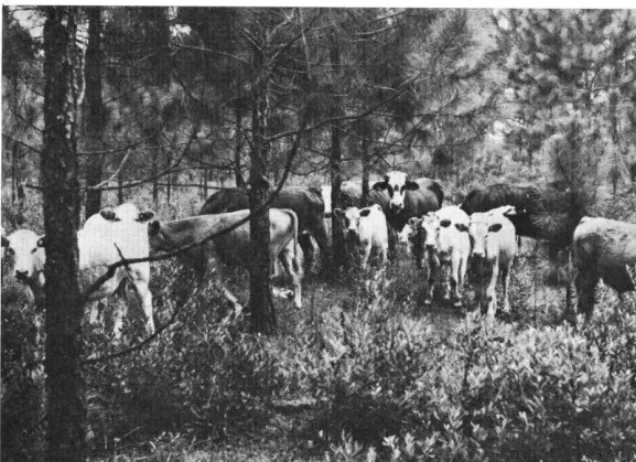
Several million acres of pine for- est in south Georgia produce forage useful to beef cattle even though the area is generally well sto,cked with timber. Cattle have grazed these forests since colonial days, l Cooperative investigations conducted by the University of Georgia College of Agriculture Experiment Station, Coastal Plain Experiment Station, and the Forest Service, U. S. Department of Agriculture. Coastal Plain Exper- iment Station Journal Series Paper No. 554. Received September 14,
1970; accepted for publication Decem- ber 7, 1970.
2 Por Dr. Donald L. Huss, Organization de las Naciones Unidas para la Agri- cultura y la Alimentacion (FAO), Dep. de Zootecnia, ITESM, Monte- rrey, N.L., Wlexico.
but low quality of forage has con- tributed to limited beef production. Minerals, protein, and other nu- trients are deficient much of the year (Biswell et al., 1943; Halls et al., 1957; Hale et al., 1962). Native cattle of mixed breeding that for- merly subsisted year-round on this kind of range were small, produced low calf crops with light weaning weights, and suffered high death losses (Farley and Greene, 192 1; Biswell et al., 1942; Shepherd et al., 1953).
A series of range grazing studies has shown how to increase produc- tivity of beef herds while utilizing this natural forage. Recognizing the dormant winter season as the most critical period, the earliest studies tested supplemental protein at this season in addition to varied stocking rates and burning treat- ments at other seasons (Shepherd et al., 1953). These practices failed to increase calving percentage, and indicated need for a higher level of yearlong nutrition. Accordingly, supplementation of range folrage with cottonseed meal and with lim- ited improved pasture in spring and summer was tested along with fall and winter feeding of supplemental cottonseed meal (Southwell and Halls, 1955). Beef production in- creased, and improved pasture was found to be more econolmical than protein concentrates for supple- menting native forage in summer.
334
Practices representing several levels of summer nutrition were then tested in combination with two levels of supplementation in fall and winter, the latter on hayfield aftermath and coastal bermudagrass hay with no reliance on winter range (Southwell and Hughes, 1965). Most of the spring-summer g-razing practices produced high calving percentages and satisfactory weaning weights when ample hay was fed in fall and winter. Overall, these past results suggested that sup- plementation of native range in spring and summer paid off in in- creased beef production, but that forage quality in winter was too low for practical use at that season. Sup- plementing range with improved pasture during spring and summer, grazing hayfields and field glean- ings in the fall, and feeding quality hay in winter evolved as a practical scheme for yearlong maintenance of a breeding herd.
Because native forage on burned range is fairly nutritious during the spring but is inadequate during the summer, we investigated summer-only supplementation of range with improved pasture and compared it to supplementation during both spring and summer
(season-long) and to no supplemen- tation (range-only).
Methods
SUPPLEMENTING PINE-WIREGRASS RANGE 335
panicum grasses (Panicurn sp.), toothachegrass (Ctenium aromati- cum (Walt.) Wood), and carpet- grass (Axono+s alfinis Chase). Predominant shrubs are gallberry
(Zler glabra (L.) A. Gray) and saw- palmetto (Serenoa re@zs (Bartr.) Small).
Supplemental improved pastures were mixtures of da&grass (Pas- p&m dilatatum Poir.), Pensacola bahiagrass (P. notntum Flugge), and carpetgrass. These pastures an- nually received 400 lb. /acre of O&12- 12 fertilizer in the spring and split applications of 100 lb. N/acre, one- half in the spring and one-half in the summer.
Mature cows, raised on the Ala- paha range, were divided into three comparable herds with respect to :,!ge, previous treatment, sex, and we of calf. Each herd was assigned to one of three range units and to one al three treatments involving access to improved pasture supple- mental to native range or no aup- pIemental pasture (Table 1). For the 3 years of study, a 12.cow herd was assigned to the summer-only treatment, a herd of 14 was assigned to season-long supplementation, and a 13~~0~ herd was assigned to range~only grazing.
Initially all cows were nursing calves sired by Angus bulls; the second and third calf crops were sired by Charolais bulls. Calves were born during January toMarch, went on range April 1, and were weaned at the close of the range- grazing season on September 15. After calves were weaned, all cows were maintained as a single herd on coastal bermudagrass hayfields until late December and were then fed coastal bermudagrass hay, free- choice, through March. A mineral mixture was provided year-round. COWS and calves were weighed every 28 days during the grazing period, and weight changes pro- vided the best measure of treatment effects. Analysis of variance, con- sidering years as replications, was used to aid interpretation. Results discussed were statistically signifi- cant at the 5y0 level.
Two-fifths of each range unit was burned annually in the winter. Herbage yield and utilization were determined every year by the stationary-cage method described by Grelen (1967). A cluster of four quadrats for each 8 acres of burned range was randomly located on fresh burns. one quadrat per cluster was protected Crorn grazing throughout the growing season by a cage; the other three were open to grazing. In September all quadrats were clipped 1 inch above the ground and samples were over,- dried at 70 C for 4X hours.
Cattle diet and grazing habits were determined in 1965 and 19GG by closely observing gentle cattle from sunrise to sunset 2 days per month to record and collect samples of the kind, portion, and relative amounts of plants eaten (Halls, 1954). Proximate chemical analyses were performed on these samples. Observers also recorded the time a herd spent grazing, resting, and traveling.
Results and Discussion Cattle Response
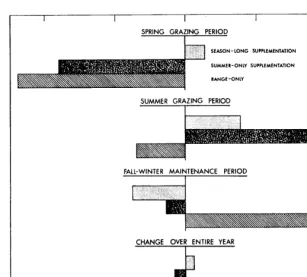
Lactating cows consistently lost weight while grazing native range alone (Fig. 2). Cows in the range- only treatment lost about 100 lb. during the April-June period and continued to lose slightly through the remainder of the range~graring period. They were able to regain most of this loss during the fall and winter mnintenance period on field aftermath and hay, but they suf- tered a net loss of about 34 lb. an- nually. While grazing only native range during the spring, cows in the summer-only supplementation treatment also lost weight in a man- ner similar to the range-only treat-
Table 1. Assignment of native range and supplemental imlwoved pasture (acres per cow) during the range grazing period.
NO”C 0.6 8 12
n.fi 0.6 8 12
336 LEWIS AND MCCORMICK
SUMMER GRAZING PERIOD I
FALL-WINTER MAINTENANCE PERIOD I
CHANGE OVER ENTIRE YEAR I
I I I I I
-100 -50 0 +50 +100
AVERAGE CHANGE IN WEIGHT (POUNDS)
FIG 2. Average weight changes of cows with and without supplemental improved pasture (0.6 acre/cow) season-long or summer-only.
ment. These herds apparently had weights when cows were provided 9
insufficient forage available during acres of burned range in the spring
the spring period. and 26 acres during the summer.
The amount of burned native In our study, supplying 8 burned
range or combination of burned and 12 unburned acres for a 6-
and unburned range required to month season fell short of the opti-
support a lactating cow adequately mum, since the degree of forage
has received considerable attention
utilization on burns tended to ex- ceed levels recommended by Halls et al. (1956). Increasing the burned area to at least 10 acres per cow may have been preferable when supple- mental pasture was not available- either in spring or season-long.
Supplemental improved pasture, either season-long or summer-only, permitted the cows to gain weight during the range grazing period and to maintain their weight from year to year (Fig. 2). With summer- only supplementation, weight losses in spring were fully regained during the summer grazing season. Both supplemen ted herds lost weight during the fall-winter period about equal to gains made during the range grazing period and, thereby, generally maintained their weight from year to year.
Use of improved pasture to sup- plement native range at various ra- tios of pasture to combinations of burned and unburned range were
tested by Southwell and Halls
(1955) and Southwell and Hughes (1965). Figuring that 0.6 acre of improved pasture would supply from % to % the required forage per cow, Southwell and Hughes (1967) added this amount of pas- ture season-long to 10 burned and 10 unburned acres of native range.
in past research. The first study (Shepherd et al., 1953) indicated that stocking should be based pri- marily on burned range and that at least 6 acres per co~w was re- quired. Later, 7 acres of burned range were found to be inadequate, and the amount was increased to
10 acres (Southwell and Halls,
300
;;;
s 250
8 L 200
1955). In a comprehensive study
of grazing capacity, maximum
weight gains were obtained from the equivalent of 9 acres of burned open range per 500~lb. steer for a
IO-month season (Halls et al., 1956). They concluded that mature cows would require 15 acres for the pe- riod mid-March to mid-January and that this acreage should be in- creased about l%% for each 1% of tree and shrub cover. Subse-
3 (3 150
:
$ 100
50
0
SPRING SUMMER BOTH
GRAZING GRAZING GRAZING
SEASON SEASON SEASONS
WEANING WEIGHT
500
650 ;;; B 8 P 400 k 2 s
350
300
quently, Southwell and Hughes
SUPPLEMENTING
PINE-WIREGRASS
RANGE
337
Table 2. Activities of cattle (hours per day) with and without access to im- proved pasture (0.6 acre/cow) season-long or in summer-only.1
Grazing
Swamp
Treatment lklonth Range” Pasture border Swamp Resting Travel
Season-long April 2.7 5.0 .l .I 4.8 .4
June 3.8 .5 .4 1.9 .2
Sept. 2.9
;4
.4 .l 3.3 .4
Summer-only April 7.8 -3 .4 .2 4.4 .l
June 9.0 - .4 .2 3.6 .l
Sept. 2.7 5.1 .5 .I 3.6 .2
Range-only April 7.2 -4 .3 .l 5.2 .l
June 9.6 - .4 .l 2.9 .2
Sept. 7.9 - .5 .4 3.5 .O
1 Cattle activities were measured from sunrise to sunset on two successive days near the middle of the month.
2 Includes both burned and unburned range. 3 Improved pasture made available on July 1.
4 No improved pasture during the spring-summer grazing period.
They obtained excellent cow re- sponse and calves that weaned at 470 lb. Also, they found that sup- plementing 15 to 20 acres of un- burned range with 0.6 acre of pas- ture gave excellent cow response and calf weaning weights of more than 420 lb. These results, along with those in our study, indicate that 0.6 acre/cow of improved pas- ture is about the right amount to supplement this kind of range.
Percentage calf crop could not be determined precisely with the small number of cows involved, and dif- ferences were not statistically sig- nificant. Calf crops averaged 90% in the season-long, 92yo in the
summer-only, and 82% in the
range-only treatments. These per-
centages are based on actual calving in 1966 and 1967 and on palpation in the fall of 1967. Death losses
were relatively low-one calf in
each herd during the 3 years.
Seasonal gains and weaning
weights of calves reflected the bene-
ficial effects of supplemental im-
proved pasture (Fig. 3). Weaning weights of calves in the supple- mental treatments were about 100 lb. greater than calves on range-
only treatments. These increased
gains probably resulted from in-
creased milk production by the
cows, particularly in the spring, as
well as from better forage for the calves in summer when a large part of their diet came from grazing. Similar trends were reported by
Southwell and Halls (1955) for
slightly different management
schemes.
It should be emphasized that these results were obtained with a relatively high level of winter feed- ing. Several methods and levels of supplementing native range during spring and summer failed to give satisfactory calf crops’ with limited levels of winter feeding in early
studies. Southwell and Hughes
(1965) concluded that “ample feed during the fall and winter is essen- tial for a good range cattle repro-
duction program. Most of the
spring-summer range treatments
and cattle practices gave satisfactory
calving percentages and weaned
weights when winter feeding was adequate.”
Cattle Activities
Cattle spent about 60y0 of their grazing time on the limited im- proved pasture when it was avail- able, but this did not appreciably influence total time spent in graz- ing (Table 2). There was no ap- parent seasonal trends in time spent grazing range or pasture. Al- most all range grazing was on burns, with little use of unburned range, swamp, or swamp border. These observations agree with those reported by Southwell and Hughes
(1967).
Cattle on range only grazed and rested about the same amount of time as those on both range and pasture, but the latter spent a little extra time traveling from pasture to burned range. Thus, providing supplemental pasture had little in- fluence on cattle activities other than reducing grazing time on range.
Cattle Diet
Supplementing native range with improved pasture had little effect on the relative use of the various na- tive species (Table 3). Pineland threeawn and Curtiss dropseed con- tributed heavily to the diet in early spring when they were the primary species available. Curtiss dropseed appeared to maintain palatability longer than pineland threeawn be- cause its use declined more slowly.
Table 3. Species composition (%) of the diet of cattle grazing native range with access to a limited amount of supplemental improved pasture.
Season-long Summer-only1 Range-only
Species April June Sept. April June Sept. April June Sept.
Pineland threeawn 3 1 3 0 32 7 1 31 5 2
Curt& dropseed 39 16 0 39 17 2 38 9 2
Bluestem grasses I1 28 61 11 35 40 11 38 37
Other grasses 12 34 27 10 23 46 12 38 46
Grasslike species 1 2 2 2 3 3 2 1 3
Forbs 2 6 4 2 6 4 2 4 6
Browse 4 11 6 4 9 4 4 6 4
338 LEWIS AND MCCORMICK
Table 4. Protein, calcium, and phosphorus diet of cattle grazing native range.
content
(%9 dry
weight) of theApril 9.9 0.13 0.13
June 7.8 0.15 0.11
Sept. 7.1 0.22 0.10
1 Diet samples were collected for two consecutive days about the middle of the month while estimating species composition of the diet shown in Table 2.
After these species became un- palatable in late spring, bluestems and other grasses were the major source of native feed. Grasslike spe- cies, forbs, and browse apparently
contributed very little to cattle
The nutrient content of the diet obtained from range was similar for diets. The moist abundant shrub,
all treatments, but varied with sea- son (Table 4). As is common in
gallberry, is unpalatable and was
wiregrass forage, crude protein and phosphorus decreased in cattle diets by early summer following winter taken only occasionally and in small
burning, but calcium levels rose amounts.
through the grazing season. The cattle’s diet of native forage never met the minimum standards for
calcium (0.240/,) or phosphorus
(0.18%) (NAS-NRC, 1963). It
would appear to have met the rec- ommended level of crude protein
(7 to 8%) for beef cows nursing calves. However, limited digesti- bility no doubt kept the range diet from being fully adequate, as re- flected by lower weight gains of cows and calves on range only (Figs. 2 and 3). Past studies of this kind of wiregrass forage found di- gestion coefficients for crude pro- tein between 24 and 40%, and total digestible nutrients of 43 to 48%, during the period April through September (Halls ee al., 1957; Hale et al., 1962).
Forage Yield and Use
Herbage yields, though sampled with limited precision, indicated that lack of forage was not the cause for the poor response of cattle graz- ing range-only since productivity
was highest in this treatment
(Table 5). This can be attributed to an open stand of young pines with limited crown cover; the other range units supported heavier cano- pies of more mature timber, and
Utilization percentages of indi-
herbage yields were lower. Yields of
vidual species and of total herbage apparently were influenced both by range productivity and by pasture individual species or groups of spe-
supplementation, but the relation-
cies reflected a preponderance of
ships were not precise at the level
of sampling employed.
pineland threeawn, Curtiss drop-
Supple- mental improved pasture was fully seed, and bluestem grasses.
utilized when available and tended to decrease the intensity of use of native range. This was most ap- parent for pineland threeawn and Curtiss dropseed, the main sources of early spring forage on range. Utilization of these was heavy where supplement was withheld until sum- mer and yield was 101~. Utilization was relatively light with season-long supplementation, and intermediate without supplementation but with high yield (Table 5).
Summary and Conclusions
Forage from native pine-wiregrass ranges in south Georgia is nutri- tionally marginal much of the year; in winter, forage quality is too low
for practical utilization. Breeding
herds can maintain themselves on native forage for up to 6 months during the spring and summer if adequate feed is supplied the re- mainder of the year. Supplement- ing range with quality feed or for- age will increase calf gains and beef production while utilizing the na- tive forage resource. About 0.6 acre per cow of well-maintained pasture
effectively supplements both
burned and unburned range. In our study the use of summer- only supplemental pasture was com- pared to season-long supplementa-
tion. Both increased calf gains
about 100 lb. over those from non- supplemented range, but calf gains in spring tended to favor season-
long supplementation. Cows with
access to improved pasture main- tained their weights from year to year; tho#se grazing only native range lost weight over the 3-year period of study.
Eight acres of burned range per cow was adequate while being sup- plemented with 0.6 acre of pasture, but this allowance was minimal under a moderate stand of timber. About 10 burned acres per cow, if
unsupplemented in spring, seems
preferable to insure adequate for- age by keeping utilization of native herbage below SOY& Utilization of unburned range was negligible.
Table 5. Average annual yields (lb./acre, oven dry) of herbage and utilization (%) of burned range grazed April through September in conjuction with sup- plemental pasture.
Species
Season-long Yield Use
Summer-only
Yield Use
Range-only
Yield Use
Pineland threeawn 370 (101)l 25 420 (116) 75 670 (151) 45
Curtiss dropseed 550 (123) 25 280 ( 75) 60 850 (160) 35
Bluestem grasses 190 ( 56) 45 200 ( 48) 35 180 ( 38) 25
Other grasses 180 ( 68) 35 170(48) 30 200 ( 70) 25 Other herbage 350 ( 82) 35 330 ( 61) 50 420 ( 70) 50
Total 1640 (205) 30 1400 (192) 55 2320 (228) 40