J. Phys.: Condens. Matter15(2003) L447–L451 PII: S0953-8984(03)64964-7
LETTER TO THE EDITOR
Optically driven silicon-based quantum gates with
potential for high-temperature operation
A M Stoneham, A J Fisher and P T Greenland
Department of Physics and Astronomy, University College London, Gower Street, London WC1E 6BT, UK
E-mail: [email protected]
Received 19 June 2003 Published 27 June 2003
Online at stacks.iop.org/JPhysCM/15/L447
Abstract
We propose a new approach to constructing gates for quantum information processing, exploiting the properties of impurities in silicon. Quantum information, embodied in electron spins bound to deep donors, is coupled via optically induced electronic excitation. Gates are manipulated by magnetic fields and optical light pulses; individual gates are addressed by exploiting spatial and spectroscopic selectivity. Such quantum gates do not rely on small energy scales for operation, so might function at or near room temperature. We show the scheme can produce the classes of gates necessary to construct a universal quantum computer.
1. Introduction
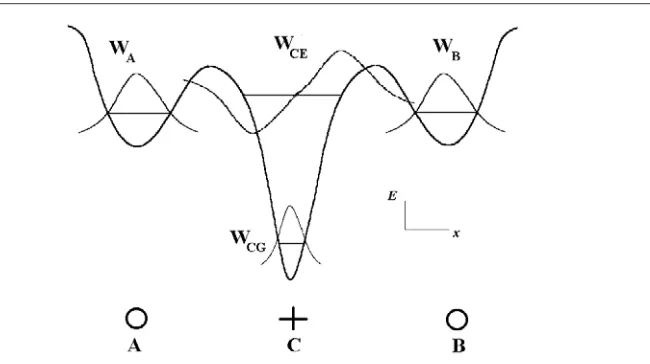
Localized spins in solids have properties suitable for representing quantum information. Quantum gates require mutual coherent evolution of such states, necessitating interactions between them. Previous schemes to control interactions [1] required gate electrodes positioned near to specific highly polarizable defects which would be readily ionized except at low temperatures. The formidable fabrication requirements [2] may introduce further significant sources of decoherence. Our novel control scheme avoids electrodes. Interactions are controlled by electronic excitation [3]. One implementation embodies quantum bits (qubits) in electron spins of deep donors (A, B), not ionized at working temperatures. Typical A, B spacings should be large enough for ground-state interactions between donor spins to be small, perhaps 7–l0 nm for a deep donor like Si:Bi. Controlled optical excitation of a charge-transfer transition [4, 5] from a nearby control impurity C, possibly Er, promotes a ‘control’ electron from C into a molecular state of A and B, analogous to the hydrogen molecular ion H−2. In this excited state, there is an effective exchange interaction between the qubit spins. Qubit–qubit interactions are switched on by optical excitation and off by stimulated de-excitation of the control electron (see figure 1).
Figure 1.A schematic diagram of the quantum gate. The qubit spins are on deep donors A and B (
◦
) with wavefunctionsWAandWB. The control atom, C (+), is the source of a control electron. In the ground state, the control electron is in stateWCG, whose wavefunction and potential well are shown schematically. In the excited state, the control electron is in a charge-transfer, molecular-like, state,WCE, which overlaps both qubit electrons. Neither the qubits nor the control electron interact significantly in the ground state, but interact causing entanglement in the excited state.The approach has two key features. Clearly, the spins encoding the quantum information must have an acceptable lifetime. Further, there must be an electronic excited state in which the entanglement is changed significantly; we discuss here only one of a number of possibilities. Our scheme has two major advantages. First, ground-state quantum information storage is largely separated from excited-state information control. Second, no small energy scale is involved in the gate operation: it might operate at liquid nitrogen temperatures or even near room temperature.
2. Feasibility checklist
Could this solid-state implementation satisfy DiVincenzo’s [6] checklist for quantum information processing?
(i) Is there a well defined Hilbert space to represent the quantum information? The spin states (S=1/2) of electrons on donors A and B provide a well defined Hilbert space. For
deep donors, carrier excitation into the conduction band, and therefore out of this Hilbert space, has low probability∼exp(−Ed/kT), whereEd is the energy of the donor level. Entanglement with the control electron is discussed below.
(ii) Initializing qubit states. Direct initialization ‘all-0’ state qubits (all 1 in spin language) is impractical at room temperature for accessible magnetic fields. Feasible alternatives include magnetic (spintronic) initialization by injection of spin-polarized electrons into the material [7, 8], and polarization-selective optical pumping to drive qubits into an all-0 initial state.
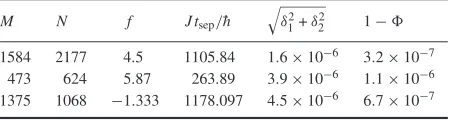
Table 1. Some parameter sets which produce CNOT gates and corresponding errors. is a measure of the gate fidelity, and 1−
δ2
1+δ 2
2 a measure of how well these integers reproduce a
CNOT gate. f is defined in equation (2).
M N f J tsep/¯h
δ2
1+δ22 1−
1584 2177 4.5 1105.84 1.6×10⁻⁶ 3.2×10⁻⁷
473 624 5.87 263.89 3.9×10⁻⁶ 1.1×10⁻⁶
1375 1068 −1.333 1178.097 4.5×10⁻⁶ 6.7×10⁻⁷
electron wavefunction overlaps the qubit states of dopants A and B. For clarity we assume that the dominant interaction is exchange between control and qubit electrons, represented by effective Heisenberg (σ·σ) interactions of strengthsJAandJBrespectively [12]. This
can be generalized at the expense of complexity. The model Hamiltonian we consider is thus
H= |g{µABσAz+µBBσBz+µ0CBσCz}g|
+|e{JAσA·σC+JBσB·σC+µABσAz+µBBσBz+µCBσCz+}e| +|eV(t)cos(ωt+φ)g|+|gV(t)cos(ωt+φ)e|. (1) Quantization is along the magnetic fieldB;µAandµBare magnetic moments for qubit
spins A and B;µ0Cis the ground-state magnetic moment of control particle C andµCits
excited state magnetic moment. Ground (|g) and excited (|e) states are coupled by the interactionV(t)cos(ωt +φ)appropriate for pulsed-laser excitation of particle C in the semiclassical approximation. In (1), the first term describes the ground state, the second term the excited state and the last term the coupling between them. In the absence of laser coupling (V =0), ground and excited states ofHare separated by a large excitation energy (∼1 eV). The three electrons have eight possible spin states so that the ground and excited states are further split into octets, so that the full spectrum has 16 states: |pqrgfor the
ground state and|pqrefor the excited state, where the tripletp,q,r= {0,1}represents
the spin states of qubit 1, qubit 2 and the control atom. The ground state has spin splitting due to magnetic fieldB; the excited states are more complex because of magnetic field and exchange interactions (JA,JB). A pulsed laser tuned to the excitation energy(¯hω=),
with pulse lengthτ corresponding to a transform width much larger than the splittings, excites an eight-component wavepacket in the upper state. This wavepacket propagates until another laser pulse returns the system to the ground state, decoupling control and qubit electrons. The qubits are frozen into a state determined by the time intervaltsepbetween laser pulses. We show elsewhere [13] that if the Zeeman and exchange interactions and magnetic field are related byJA= JB= J,µAB =µBB =µB andµB−µCB = f J
with
f = −M 2+N2
M2−N2 ±
M2+N2 M2−N2
2
−9 (2)
whereM and N are arbitrary integers then there will be no entanglement between the control and qubits after the atoms have been returned to their ground states providedtsep
is chosen so that
tsep/¯h =Mπ/(µB−µCB−J)2+ 8J2=Nπ/
(−µB+µCB−J)2+ 8J2. (3)
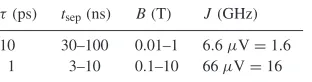
Table 2. Typical values for the laser parameters. τis the laser pulse duration,tsepthe inter-pulse period (which is approximately the gate operating time) andBthe magnetic field. Case 1 can be implemented with standard lasers; case 2 requires some laser development. Jis typical of the values we expect in a device.
τ(ps) tsep(ns) B(T) J(GHz) 10 30–100 0.01–1 6.6µV=1.6
1 3–10 0.1–10 66µV=16
accuracy. This class of conditions is not unique, and there appear to be other, more general, classes of parameters that are acceptable.
(iv) Avoid decoherence for long enough to compute. Decoherence arises from spin–lattice relaxation, spontaneous optical emission and thermal ionization of the excited state. There are few recent measurements of spin–lattice relaxation times for deep donors in silicon at appropriate concentrations. Older data [14] imply excitation energies should be greater than the maximum phonon energy for long lifetimes, so deeper donors than Si:Bi [15] are desirable for higher-temperature operation. Even so, Si:Bi would have adequate spin– lattice relaxation times and thermal ionization rates at low temperatures, say less than 10 K. If we consider other hosts like diamond, deep donor lifetimes can be as long as milliseconds at room temperature. We shall discuss elsewhere other materials and dopants, probably better than Si:Bi, for which the same basic ideas apply. Table 2 shows how gate times depend on the laser parameters.
(v) Readout of the quantum information.In our scheme, a further advantage is that the control atom can be used for optical readout. Suppose the computation uses qubits 0 ton, and we can access one extra qubit labelled−1. Letci jbe the control atom connecting qubitsqi andqj. After computation, all control atoms are in state|0. We arrange thatq−1(which
takes no part in the computation) is also in state|0. Now tune thec−10laser to be resonant
between the|000gground state of the full systemq−1−c−10−q0and the excited|000e
state, and operate it continuously. Rabi oscillations will occur between these two states ifq0is in the state|0, and scattered photons will be observed (one may need to suppress background Rayleigh scatter). If photons are observed,q0is in|0; if not,q0is in|1. If
q0is in|0, then usec01to readq1in exactly the same way. If, however,q0is read to be in|1, then use a single qubit operation onc01to flip its spin (so it is in|1), tune the laser forc01 to the|111g to|111etransition and look for scattered photons. Their detection
shows thatq1is in state|1, non-detection thatq1is in|0. Continue until all theqnare read. The point is that the states|000g,|000e,|111gand|111eare the same in the fully
interacting basis, and the computational basis (the basis used to read the qubits), and the laser transitions cannot produce spin-flips. Thus, at the expense of introducing one extra qubit, we can use the control atoms for readout.
of energies can be enhanced by several means, if needs be [3]. We then use spectroscopic resolution in combination with spatial resolution to control a particular pair. For reasonable architectures and energy resolutions (which we shall discuss elsewhere) it appears to be feasible to create linked groups of a few tens of qubits such that individual qubits and individual two-qubit gates can be optically controlled. Possible structures might use an ultrathin layer of silicon on a silica substrate, such as an optical fibre. Such a system permits some optimization of the excited state character by exploiting the band offset between Si and the oxide. Most of the processes to construct such a quantum information processor are available with current silicon technologies; some involve electronic excitation methods [5]. There is scope to create architectures with convenient values of design parameters likeJA
andJB, thus optimizing the ease of resolving and manipulating particular qubits or qubit
pairs.
3. Summary
In conclusion, we propose a quantum information processor based on electron spins of spatially disordered deep centres in silicon or silicon-compatible hosts. All key quantum information processing is done optically. The critical energies mean that operation at useful temperatures, perhaps room temperature, is possible. Most construction steps, whilst challenging, have been demonstrated by others. Processors following our approach might he made in near-future semiconductor fabrication plants.
We are grateful to Ms Roby Rodriquez, Professors G Aeppli, P Bayvel and I Boyd and Drs A H Harker and C Renner for valuable discussions. This work was done under EPSRC grants GR/S23506 and GR/M67865EP69
References
[1] Kane B E 1999Nature393305
[2] Oberbeck Let al2002Appl. Phys. Lett.813197
[3] Stoneham A M, Fisher A J and Greenland P T 2002 A gate for quantum information processingBritish Patent ApplicationNo 02050011.0 (filed 4 March 2002)
[4] Stoneham A M 1975Theory of Defects in Solids(Oxford: Oxford University Press)
[5] Itoh N and Stoneham A M 2001Materials Modification by Electronic Excitation(Cambridge: Cambridge University Press)
[6] DiVincenzo D P 1998Superlatt. Microstruct.23419
[7] Malajovich I, Kikkawa J M, Awschalom D D, Berry J J and Samarth N 2000Phys. Rev. Lett.841015 [8] Malajovich I, Berry J J, Samarth N and Awschalom D D 2001Nature411770
[9] DiVincenzo D P 1995Phys. Rev.A511015 [10] Jelezko Fet al2002Appl. Phys. Lett.812160
[11] Charnock F T and Kennedy T A 2001Phys. Rev.B64041201 [12] Herring C and Flicker M 1964Phys. Rev.134 (2A)A362
[13] Rodriquez R, Fisher A J, Greenland P T and Stoneham A M 2003PreprintUniversity College London [14] Castner T G 1962Phys. Rev.13058