R E S E A R C H
Open Access
An adaptive transmission protocol for
exploiting diversity and multiplexing gains in
wireless relaying networks
Mohammed Taha O El Astal
1*, Ammar M Abu-Hudrouss
2, Brian P Salmon
1and Jan Corné Olivier
1Abstract
Wireless relaying networks with distributed space-time block codes have been shown to provide high link reliability. This is because of the space diversity gain from multiple transmitting relays, which improves by adding more relays. The drawback of this approach is the overall reduction in throughput of the network. In this paper, we propose a method to construct a distributed space-time block code that is combined with spatial modulation to find a flexible trade-off between reliability and throughput. This proposed method is not restricted to a specific number of relays and can be constructed as necessary. The constructed code also uses a novel adaptive transmission protocol to achieve higher space diversity, even with relays equipped with a single antenna. This protocol assumes use of coherent detection, meaning that a perfect channel estimation is available at the destination. Lastly, a new decoder is proposed that offers significant reduction in complexity to maintain high data throughput. All claims in this work are supported with theoretical analysis and backed up with empirical results.
Keywords: Spatial modulation; Spatial diversity; Wireless relaying networks; Space-time block coding
1 Introduction
In recent years, the spatial diversity of wireless relay-ing networks (WRNs) has been used to improve signal quality in wireless transmission [1-5]. A WRN constructs a virtual multiple-input multiple-output (MIMO) system using multiple neighbouring client apparatuses as relaying nodes. It has been suggested that distributed space-time block codes (D-STBC) be used in WRNs to allow simul-taneous transmission among relaying nodes to increase the spectral efficiency of the network [6-9]. It is known that the diversity is further improved when the number of relays in the WRN is increased. Unfortunately, this has the drawback of reducing the overall throughput of the network as the number of relays increase [10]. The throughput can be retained by increasing the code rate of the D-STBC at the cost of decoding complexity [11]. It has been shown that an orthogonal design of full-rate codes is
*Correspondence: [email protected]
1School of Engineering and ICT, University of Tasmania, Private Bag 65, Hobart, Tasmania 7001, Australia
Full list of author information is available at the end of the article
possible only with two relays [12]. The orthogonal designs lead to a low decoding complexity at the destination[11].
To summarise, the major challenge in WRNs is to coor-dinate an arbitrary number of relay transmissions with high rate while maintaining both full diversity and low decoding complexity.
1.1 Prior work
The overall interest in this field of research lies in the construction of a high-rate D-STBC that has the ability to utilise any arbitrary number of relays [13,14]. It would appear that research has had limited success in design-ing high-rate codes while maintaindesign-ing a sdesign-ingle-symbol decodability at the destination. In [15], the authors pro-posed systematic construction steps of a row-monomial D-STBC with a code rate bounded by 2/(2+N), where
N denotes the number of relays. In [16], a new code class called semi-orthogonal precoded distributed single-symbol decodable STBC (Semi-PD-SSD-STBCs) was pro-posed. It has the advantage of performing precoding on the information symbols, which in turn doubles the achieved code rate. Although these codes were designed
for an arbitrary number of relays, they may be prefer-able to be used only in WRNs with a few number of relays. This is because the code rate decreases dramati-cally as the number of relays increases. In [17], a coding scheme, with a code rate of 14, was proposed to operate in WRNs of high number of relays. However, this scheme has a high decoding delay. This is as the required trans-mission time increases exponentially with the number of relays. In [18], an adjustable full-rate STBC matrix was designed, but it requires a feedback channel to adjust the code. This creates additional network overhead that inher-ently reduces the achieved diversity gain. In [19-21], the generalised ABBA code (GABBA) of [22] was adapted for amplify-and-forward (AF) WRNs to offer a full-rate while maintaining single-symbol decodability. However, the resulting D-GABBA scheme has some constraints: (1) the number of symbols per block (T) should be express-ible as a power of two, and (2) the number of available relays (N) should be smaller or equal toT(N≤T). These constraints were resolved by utilising global knowledge of channel state information (CSI) of the entire WRN at the relays [10].
Spatial modulation (SM) was developed to improve the throughput of MIMO systems and was initially extended for WRNs in [23-25]. The intention was to add the spa-tial dimension to the modulated signal constellation; this allowed information to be transmitted not only using amplitude/phase modulation (APM) but also using the relay index. This offers higher throughput due to data multiplexing via different relays [24,26]. However, the overall achieved diversity gain was limited to the num-ber of receive antennas, as only one relay was active for any given transmission. This was partially solved when employing SM specifically at the source node and leaving the full diversity gain to be achieved in the link between the relays and the destination [25,27,28]. The effective use of SM was still bounded by the number of antennas avail-able at the source node. Due to size, cost and hardware limitations, the availability of multiple antenna may not be feasible in many systems [29]. In [30,31], transmit diversity gain can be achieved at the expense of orthogonal channel resources.
In conclusion, the current WRN uses its relays either to offer high throughput only (using SM) or to achieve transmit diversity gain (using D-STBC).
1.2 Our contribution
As mentioned, a major challenge in a WRN is to coor-dinate an arbitrary number of relay transmissions while maintaining full diversity gain and offering high rates with low decoding complexity at the destination. Using a combination of STBC and SM, it is expected that high throughput and high transmit diversity gain is possible. In general, such combinations are achieved using MIMO
systems. This allows the construction of a fixed STBC-SM code as the number of antennas at the transmitter is fixed [32-36]. These designs are also bounded by a transmit diversity gain of 2. To the best of the authors’ knowledge, there is no existing research addressing distributed STBC-SM (D-STBC-STBC-SM). With respect to the current literature, this paper presents:
• An adaptive transmission protocol to accommodate N relays in decode-and-forward (DF) WRNs, where N∈N+. Unlike [32-36], this protocol offers a transmit diversity gain ofN0(N≤N0≤1) because the possibility of activatingN0number of relays simultaneously during transmission. Given some control information, the protocol can be adapted to transmit through any given number of relays (N0). This means the network can work with a varying number ofN0, which is a desirable feature for networks that experience imperfect time synchronisation [37,38].
• An algorithm to construct D-STBC-SM codes. Unlike [15,16,19-21], this algorithm offers a rate that increases with the number of relays. The rate for this code isr0log2M2+ T12log2cbpcu instead ofr0log2M2
bpcu, wherec=
N N0
2p
is the number of
possible relay combinations,r0is the code rate of the used STBC,M2is the order of modulation used by the relays and.represents the floor integer operator. The increase in throughput uses the same total average transmitting energy. This is as onlyN0 of theN available participating relays are active at any given time. The proposed algorithm uses multi-level optimisation processes, and hence the constructed code outperforms the few existing STBC-SM codes. • An optimal and suboptimal reduced-complexity
decoder to work for the proposed protocol. The orthogonal property of the STBC allows a decoding complexity to reduce fromOcMns
2
toO(cnsM2), wherensis the number of symbols per information block of transmission. Using the sub-optimal decoder, this decoding complexity can be further reduced to
O(c+nsM2)with some performance penalty. This makes it suitable to acquire higher throughput. • Theoretical analysis of diversity gain, coding gain and
required decoding complexity of the proposed protocol. Also, these claims are backed up by numerical simulations.
of performance and complexity. Last, empirical results to back up the claims are presented.
1.3 Notations
Hereafter, small letters, bold small letters and bold capital letters will designate scalars, vectors and matrices, respec-tively. IfAis a matrix, thenAH,A∗ andAT denote the hermitian, conjugate and the transpose ofA, respectively.
2 Network model
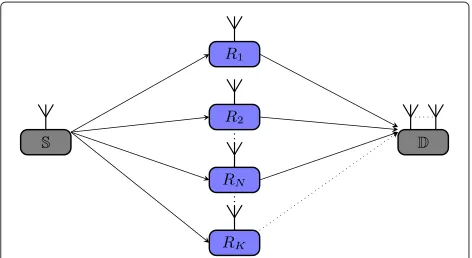
A dual-hop WRN comprised a source S, Nˆ number of half-duplex (HD) relays R1,. . .,RNˆ and a destinationD is considered (depicted in Figure 1). Let the source and relays be equipped with a single antenna and the desti-nation hasNr antennas,Nr ∈ N+. This configuration is denoted by
ˆ
N,Nr . The transmission through the net-work is conducted in two phases. In the first phase, the information is broadcast from the source to the relays. In the second phase, each relay decodes its received sym-bols which are then only encoded and transmitted to the destination if received correctly. The total transmission power for the entire network is denoted byPand is evenly divided between both phases. The channel through the network is assumed to be a quasi-static Rayleigh fading channel. The source is assumed to be completely blind, while perfect CSI is assumed only at the decoding nodes.
3 The proposed transmission protocol
In this section, an adaptive protocol that uses an effi-cient combination of D-STBC and SM is proposed to obtain better cooperative diversity gain and higher over-all throughput. This will be supported by a mathematical evaluation and an empirical comparison to existing proto-cols on bit error rate (BER) graphs.
3.1 Protocol description For a network configuration of
ˆ
N,Nr , the transmission through the network is conducted in two phases:
Figure 1Wireless relaying network model.A graph model of a WRN, given thatNout ofNˆrelays are active in the relaying phase. It is assumed that both source and each relay are equipped with a single antenna while the destination hasNrantennas.
Broadcasting phase:
The source transmits M1-ary PSK/QAM modulated symbols denoted byy(i) = y(i, 1),. . .,y(i,J)T, wherei
denotes the information block index andJis the number of symbols in the broadcasting phase. To maximise the number of participating relays, the source (S) uses an error control code (ECC) to mitigate all errors. This is as relays are only allowed to transmit if no error is present (see IEEE 802.16j standard of [39]). Thus, the received vector atRnis
rn(i)
Multiplexing and relaying phase:
To match the proposed modifications, this phase’s name is changed to ‘multiplexing and relaying phase’ rather than ‘relaying phase’. As stated previously, a relay will not partake in this phase if it detects an error. To limit the discussion, it is assumed that a fixed number N out of
ˆ
N relays will always have no errors. The participatingN
relays will each conduct the following on itsK =Jlog2M1 received bits (illustrated in Figure 2):
1. TheK decoded bits are divided into two groups. The first group containsK1bits, and it is multiplexed to determine the relays that will be used to transmit the second group ofK2bits. TheseK2bits are modulated and then encoded with the D-STBC. IfK=K1+K2, the excess bits must be buffered. The values ofK1 andK2are chosen according to Section 3.2.2. 2. The binary sequence of the first group is converted
to a decimal value. This value is used to determine if the relay is allowed to transmit and what it should transmit. The second group ofK2bits is modulated to a symbol vectory2(i)=y2(1,i),. . .,y2(ns,i)
T
using a two-tier starM2-ary QAM modulator (see Section 3.2.2).
Figure 2Multiplexing and relaying phase for a given relay node.An illustration of the steps that each relay is conducting for each block of transmission.
are characterized by the D-STBC matrix and are used to construct the code in a distributive manner (see Appendix 1) [11,29]. It is worth noting that many existing D-STBC matrix can be used, given the number of relays and the extent of the diversity gain required (N0). This will be discussed in detail in Section 3.2.2.
4. The vectortn(i)is then phase-rotated to ensure maximum diversity and coding gain. If the rotation is not used, then rank deficiency occurs due to
interfering codewords and the achieved diversity gain is reduced. This results in the transmitted vector given astθn(i)=exp(jθi)tn(i), whereθi,θi∈[0,π]are provided by the code-mapping table.
Accordingly, the received symbol matrix at destination
Dis given by
is the channel coefficient vector from the relay Rn to the destination with entries hn,j ∼CN(0, 1). The matrixηis the noise at the destina-tion with entriesηij∼CN
The received signal matrix of (3) can be rewritten using (2) as
z(i)=Hy2(i)+η(i), (4)
whereHis the equivalent channel matrix that encapsu-lates both the rotation employed and the channel coeffi-cients of the relay setused for transmission.
3.2 D-STBC-SM system design and optimisation 3.2.1 Review of conventional STBC-SM
Recently, the design of STBC-SM codes has drawn atten-tion because of the promising improvements shown [32-36]. In this section, background and some required
definitions of STBC-SM that are needed to work for D-STBC-SM are shown.
Definition 1. The STBC scheme is represented by a matrix expressed as
where the columns represent the encoded L time-slot sequences that should be transmitted by theN transmit-ting antennas of the source. Ifnsdenotes the number of encoded symbols, then the code raterof the used STBC is defined asr= ns
L.
Definition 2. LetXdenote the STBC matrix (see Def-inition 1) and the STBC-SM code word denoted by Xi,j [32]. An STBC-SM codebook Xd is defined as a set of nXSTBC-SM codewords. The STBC-SM codeX is, here, formally defined as a set ofnX codebooks.
Definition 3.Let X be an STBC-SM code with nX codebooks, and each has nX codewords. The minimum coding gain distance (CGD) is defined by
α(X)=min
i,j γmin(Xi,Xj), (6)
where i,j = 1. . .nX andγmin(Xi,Xj) is the minimum CGD between two codebooks given by
γmin(Xi,Xj)=min
monic mean of the non-zero eigenvalues ofA
number of antennas at the transmitter. The number of antennas at the transmitter is fixed. This allows the con-struction only of a fixed STBC-SM code. For example, codewords of an STBC-SM code (X) proposed in [32] is based on Alamouti’s STBC for a 4×1 MIMO system which are expressed as
X1= {X11,X12} =
y(1) y(2) 0 0
−y∗(2) y∗(1) 0 0
,
0 0 y(1) y(2) 0 0 −y∗(2) y∗(1)
(8)
X2= {X21,X22} =
0 y(1) y(2) 0 0−y∗(2) y∗(1) 0
,
y(2) 0 0 y(1)
y∗(1) 0 0 −y∗(2)
ejθ.
(9)
In this STBC-SM design, the first 2 bits are used to decide on the codewordXij. These bits define the set of antennas to transmit the remaining encoded bits (y(1) andy(2)). It should be noted that each codewordXijuses a unique antenna mapping pattern. The phase rotation θi is set to avoid rank deficiency among codebooks to mitigate diversity gain loss. The designs of a more com-plex STBC-SM in a MIMO system have shown promising improvements and recently have started to attract atten-tion [32-36].
3.2.2 D-STBC-SM code construction
In a conventional MIMO system, the number of antennas at both the destination and source is fixed. In contrast, the number of transmitting antennas is determined by the number of available relays in WRNs. The number of relays can differ for each initiated transmission, a variation that equates to the need for a D-STBC-SM code to operate over a varying distributed network. In this section, an algo-rithm is defined to construct D-STBC-SM codes to work in WRNs. Two examples of constructing a D-STBC-SM code for given WRNs are also provided.
The construction of an optimal D-STBC-SM code relies on the proper selection of a relay index pattern that maximises the CGD. To reduce the search space for the optimised codebooks, the inner and mutual CGDs are formally defined:
Definition 4.For a givenX, the inner CGD (ϕmin(X)) and the mutual CGD (δmin(X)) are given by
ϕmin(X)=min
i γmin(Xi,Xi) (10)
and
δmin(X)=min
i,j γmin(Xi,Xj)∀i=j, (11) respectively.
Another two important metrics in the construction of the code are how the relay patterns are chosen, namely the indexing distance and the Hamming distance. Both are used in the shown algorithm and are formally defined as
Definition 5.Let{Ri}and{Rj},iandj∈ N, denote two sets of relays. Then,ρ : N → |({Ri} ∩ {Rj})|defines the indexing distance. This computes the size of the intersec-tion between these two sets.
Definition 6.Let{Ri}and{Rj},iandj∈ N, denote two sets of relays with similar cardinality. Then,dmin : N → ({Ri},{Rj}) defines the Hamming distance between the two sets of relays.
To maximise the BER performance, the proposed algo-rithm is designed to construct codewords with minimal indexing distance ρ and maximum Hamming distance
dmin. This design can operate on the common mod-ulation schemes, but an additional improvement was observed using star QAM. The star QAM relies on two parameters that are also optimised in the algorithm as an additional step and, for completeness, are defined in Definition 7.
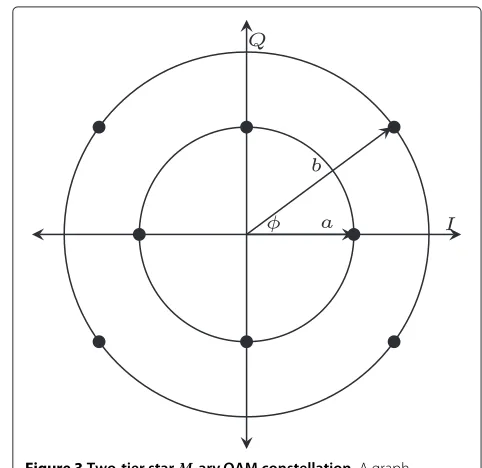
Definition 7.A two-tier starM-ary QAM modulation has its constellation points distributed over two amplitude levelsaandb. There are M2 constellation points on each amplitude level with a phase differenceφ[40], as depicted in Figure 3.
Bothaandφ should be optimised to maximise code-word differences.b = √2−a2should hold to ensure a unity average transmitted power.
Now with the necessary definitions, the proposed algo-rithm can be described in detail in Algoalgo-rithm 1. Two examples are provided to illustrate how the algorithm operates. The codes shown below follow step by step in its construction phase. The algorithm shown have a code rate of
r=r0log2M2+log2c, (12)
where r and r0 are the code rate of the constructed D-STBC-SM and the STBC used, respectively.
Algorithm 1 D-STBC-SM code design procedures 1. In a WRN, a network protocol uses several metrics to
determine which relays can participate in the communication to the destination. LetN denote the number of relays available to the WRN, and letN0 denote the number of relays assigned by the network protocol to transmit simultaneously (N0<N). The numberN0is determined when the transmission flow is initiated by the higher layer functions within the WRN. Based on network constraints (desired code rate, latency, etc.), an existingL×N0MIMO STBC code (X) is chosen, e.g. several are suggested in [11,29]. 2. DetermineK1=log2(c), wherec=
N N0
2p
denotes the number of possible relay combinations for the transmission of the STBC codeword andp∈N. 3. Generate a list of all possible combinations of relays while avoiding inner and outer repetition [41-43]. 4. Pick uniquec combinations while
• maximisingdmin,
• minimisingρ, • and minimisingnX.
5. Create a code-mapping table by reordering and labelling thec combinations to minimise the number ofnX, e.g. see Tables 2 and 3. Each row in the mapping table represents one codeword of the new D-STBC-SM code.
6. As an optional step, the parameters{a,b}, andφfor a M2-ary star-QAM modulation can be optimised, if this modulation is used, by
[a,φ]= argmax ri∈(0,2),φ∈[0,π4]
ϕmin, (13)
whereϕminis defined in (10) andb=√2−a2. 7. Assumingθ1=0, optimise the set of phase rotation
angles{θi}ii==n2X that maximiseδmin(X)expressed as
θ2. . . θnX=argmaxθi∈[0,π]δmin.
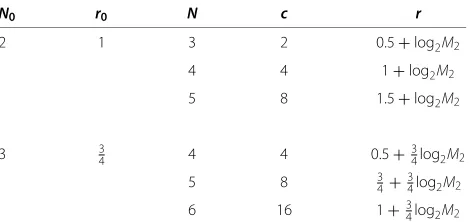
The overall rate increases as the number of relays increases. This is seen in (12) for a number of participating relays (examples are shown in Table 1).
Example 1. LetN0 = 2 and N = 4, then the num-ber of possible combinations is c = 4. A D-STBC-SM is constructed based on the proposed algorithm while using Alamouti’s STBC shown in Appendix 1. For illus-tration purposes, the optimisation process results are shown in Appendix 2. The STBC-SM proposed in [32] that was originally designed for a conventional MIMO system can be used on this WRN, but Section 5 shows an improvement when using the proposed algorithm. The final constructed code-mapping table is given in Table 2.
Example 2. LetN0 = 3 andN = 6, then the number of possible combinations is c = 8. A D-STBC-SM is constructed using the STBC (with code rate 34) of Appendix 1. The constructed code-mapping table is given in Table 3. To avoid repetition, the illustration of optimization pro-cess for this code is omitted.
3.3 Decoding methods
The growing demand for more complex WRN transmis-sions requires more complex decoders at the receiving node. In this section, an optimal maximum likelihood (ML) decoder for the transmission protocol is described, followed by a proposal of a reduced-complexity decoder.
3.3.1 Optimal ML decoder
The ML decoder considers an exhaustive search trying to estimate the transmitted data. This is expressed as
ˆ
,yˆ2
= argmin
∈{0,...c−1},y2∈S2ns
||z−Hy2||2, (14)
whereS2is theM2-ary star-QAM modulation used by the relays.
This equates to searching over allcMns
2 permutations. Assuming an orthogonal STBC (OSTBC) is used, the received matrix can be decomposed into
Table 1 The code rate for a different number of relays
N0 r0 N c r
2 1 3 2 0.5+log2M2
4 4 1+log2M2
5 8 1.5+log2M2
3 34 4 4 0.5+34log2M2
5 8 34+34log2M2
Table 2 The code-mapping table for Example 1
R1 R2 R3 R4 θ
X1 0 (00) 1 2 0 0 0
1 (01) 0 0 1 2
X2 2 (10) 0 1 2 0 0.96
3 (11) 2 0 0 1
Star-QAM parameters:a=0.8245 andφ=0.7854.
ˆ
y2(m)=argmin y2∈S2
||u(m)−βy2||2,∀m=1,. . .,nS, (15)
and
ˆ
=argmin
ns
m=1
min y2∈S2||
u(m)−βy2||2
, (16)
where u = [u(1),u(2),. . .,u(nS)]T = HHyd and HH
H=βIns.
This simplification based on the orthogonality prop-erty reduces the complexity of the decoder fromcMnS
2 to nscM2.
3.3.2 Proposed reduced-complexity decoder
A further reduction in decoding complexity can be made using two sequential steps, with an accepted loss in BER performance. The first step determines the set of relays used in the relaying phase. This is accom-plished by using a projection matrix P with the con-dition that PH = 0. This projection matrix maps the received vectoryd to an orthogonal subspaceHˆ =
H1. . . H−1 H+1 . . .Hc
. The projection matrix is computed as
P=I−HˆHˆHHˆ −1HˆH. (17)
This matrix projects the received vectorydto the space ofH, which results in a product of zero for the correct
Table 3 The code-mapping table for Example 2
R1 R2 R3 R4 R5 R6 θ
X1 0 (000) 1 0 0 0 3 2 0
1 (001) 0 3 2 1 0 0
X2 2 (010) 0 1 0 0 2 3 0.6
3 (011) 3 0 1 2 0 0
X3 4 (100) 0 2 3 0 1 0 0.35
5 (101) 2 0 0 3 0 1
X4 6 (110) 0 2 1 0 3 0 1.1
7 (111) 1 0 0 2 0 3
Star-QAM parameters:a=0.75 andφ=0.393.
set of relays ifNr ≥ N0and has no channel impairments. However, in the presence of channel impairments, the projection of the received vector z is altered and the decoder decides on the set of relays by
ˆ
=argmin
||Pz||
2. (18)
It should be noted that there are numerous reduced-complexity (RC) detectors that appeared in the literature and that can be adapted for the first step of this sequential detector [44-46]. They differ in the offered performance complexity trade-off. The second step of this decoder is conducted using a traditional OSTBC decoder which computes [11]
ˆ
y2(m)=argmin y∈S21×1
||u(m)−βy||2, (19)
whereu = HHˆ
z, andHHˆH = βIns andIns isns×ns identity matrix.
Thus, it can be observed that the number of all possi-ble combinations for an ML search reduces fromcnsM2to (c+nsM2).
4 Performance analysis
In this section, the proposed transmission protocol is eval-uated theoretically in terms of diversity gain, coding gain and the decoding complexity.
4.1 Diversity analysis
The diversity gain of a DF WRN is determined by the broadcasting or relaying phase that offers the lowest diver-sity gain individually. The scope of this work is focused on the diversity gain in the relaying phase. This section shows analysis of the diversity gain in the case of the optimal ML decoder and then in the case of the RC decoder.
4.1.1 ML decoder diversity analysis
Lemma 1.If the diversity gain of an STBC code is N0× Nr, then constructing the D-STBC-SM based on Algorithm 1 using this STBC will also have a diversity gain of N0×Nr, if the ML decoder of Section 3.3.1 is used at the destination.
Proof.It is known that a wireless communication sys-tem achieves a space diversity gain ofdif the average error probabilityPis upper bounded in the high SNR range by
Assuming that a codewordXis transmitted through the relays, then (4) is equivalently written for a single-antenna destination as
z=Xh+η, (20)
wherehis the relays-destination channel vector.
Thus, the conditional pairwise error probability (PEP) of the WRN (see Section 2) can be computed as [47]
P(X→ ˆX|h)=Q
Equation (21) can be expanded as
P(X→ ˆX|h)=Q noting that there is no rank deficiency indue to using of the phase rotation (see Appendix 3).
Equation (22) can be simplified and bounded as
P(X→ ˆX) = Eh
Given that the former code construction steps are fol-lowed, the rank ofN0is preserved (see Appendix 3). Thus, according to Lemma 1 of [48], the unconditional PEP is determined by
which can be approximated for high SNR values as
P(X→ ˆX)
This concludes that a transmit diversity gain of N0 is achieved. As the equivalent channel matrix is a concate-nation of the equivalent channel matrices of each receive
antenna, it suffices to check the diversity gain for only one receiving antenna. This results in a diversity gain ofN0× Nrfor a code employed with anNr-antenna destination.
4.1.2 Diversity analysis of RC decoder
It was shown that the designed D-STBC-SM code achieves the full diversity gain if the ML decoder is used. However, the RC decoder of Section 3.3.2 has limited diversity gain encapsulated in (18). It is limited by the relay combination detection step, which has an error probabilityPcof
Pc|H = 1−P(ν νˆ1,. . .,ννˆc−1|,H) bits are independent and equiprobable.
By applying the Chernoff bound to (26), we can rewrite as
Averaging overH, the relay combination detection error can be determined as
Pc ≤
Table 4 CGD values of the proposed code and [32]
STBC-SM of [32] Proposed
dmin(X) δmin(X) dmin(X) δmin(X)
# of participating relays
4 6 8 10
Normalized complexity
order
0.0 0.2 0.4 0.6 0.8
1.0 4-ary,ML
16-ary,ML 4-ary,Proposed 16-ary,Proposed
({3,5}) ({3.5,5.5}) ({4,6}) ({4.5,6.5})
Figure 4Normalised complexity order versus the number of relays.Also, the offered bpcu is given in parentheses; the first value corresponds to an 8-ary case while the second value corresponds to a 16-ary case.
From (28), it can be concluded that the two-step decoder can achieve only the full-receive diversity gainNr. Therefore, the complexity reduction is at the expense of transmit diversity gain.
4.2 Coding gain analysis
The coding gain of the proposed D-STBC-SM code is improved by maximising the CGD. The inner and mutual CGD of the code designed in Example 1 is compared with the code of [32] under the assumption of using an 8-ary modulation.
Thus, it can be observed that the proposed STBC-SM has a larger inner and mutual CGD than the code proposed in [32], and hence, better performance can be achieved (Table 4).
4.3 Complexity analysis
The complexity order is defined here as the number of iterations needed to find the optimal estimate for (4). The complexity order of the optimal ML decoder isOcMns
2
, where ns is the number of symbols per codeword and M2 is the order of the modulation used. This order is
SNR
4 6 8 10 12 14 16 18 20 22
BER
1e-6 1e-5 1e-4 1e-3 1e-2 1e-1 1e+0
Alamouti-16QAM 3/4-OSTBC-32QAM ABBA-16QAM SM-4QAM Proposed -8*QAM code of [26]-8QAM Reference=2*N_r Reference=4*N_r
Figure 6BER performance result of Example 2 network.The simulation results, in terms of BER, for the network configuration shown in Example 2.
reduced to O(cM2ns) when orthogonality of the STBC used is preserved. This is as orthogonality allows linear decomposition of the symbols. In contrast, the complex-ity order of the proposed RC decoder is further reduced toO(c+ M2ns). This is because the set of transmitting relays is firstly identified. A comparison of the complex-ity order is shown in Figure 4 in terms of the number of relays, for the configuration used in Example 1. The offered bits per channel use (bpcu) is also shown; this is determined by the number of relays and the modulation scheme. From Figure 4, it is observed that the complexity of the RC decoder increases marginally with the number of relays when compared to the complexity of the opti-mal ML decoder. The advantage of using the RC decoder is that the throughput can be increased from 3 to 4.5 bpcu for a 4-ary modulation scheme without complexity increasing at a cost of minor loss in performance.
5 Simulation results
Numerical simulations are shown here in terms of BER to back up the theoretical claims of the proposed protocol.
Table 5 Simulation parameters used in Figure 5
Code Network Broadcast phase Relaying phase
Alamouti’s STBC [48,49] (22, 4) J=2 (16-QAM) n
S=2 (16-QAM) 3
4-OSTBC [11] (4
4, 4) J=3 (32-QAM) n
S=4 (32-QAM)
ABBA code [21] (44, 4) J=4 (16-QAM) n
S=4 (16-QAM)
SM of [23,50] (41, 4) J=1 (16-QAM) n
S=1 (4-QAM)
D-STBC-SM (Example 1) (42, 4) J=2 (16-QAM) n
S=2 (8-*QAM)
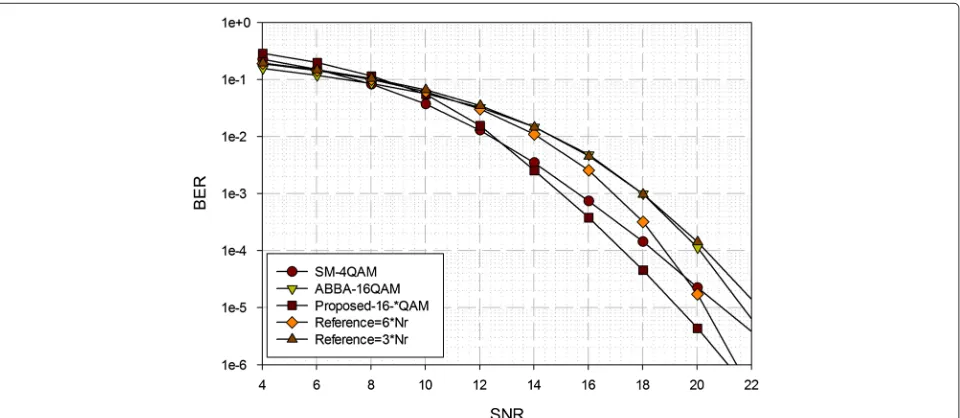
First, Example 1 and 2 networks are simulated and com-pared with a number of existing systems in Figures 5 and 6, respectively. This is to show how the proposed protocol and the constructed codes outperform the exist-ing systems. Tables 5 and 6 summarise the simulation parameters used for the existing systems. This section shows also a comparison of using the optimal ML decoder and the RC decoder for different network configurations (shown in Figure 7). All simulations were conducted on a Rayleigh faded channel, and it was assumed that the total transmission power is evenly distributed between the transmission phases. For comparison purposes, the shown figures include two slope diversity gain reference curves for cases of(N×Nr)and(N0×Nr).
In Figure 5, the proposed transmission protocol (using the code in Example 1 on a(42, 4)network) is compared to Alamouti’s STBC, the 34-OSTBC, the ABBA code and the traditional SM. Alamouti’s STBC is limited to only two relays and can achieve a transmit diversity gain of 2 (N0 = 2), while both the 34-OSTBC and the ABBA code constantly utilise all four relays and achieve a transmit diversity gain of N0 = N = 4. However, they lose the throughput that can be offered by SM. The traditional SM offers better throughput at the cost of not using an STBC,
Table 6 Simulation parameters used in Figure 6
Code Network Broadcast phase Relaying phase
SM of [23,50] (61, 4) J=1 (16-QAM) nS=1 (4-QAM)
ABBA code [21] (66, 4) J=6 (16-QAM) nS=6 (16-QAM)
SNR
0 2 4 6 8 10 12 14 16
BER
1e-6 1e-5 1e-4 1e-3 1e-2 1e-1 1e+0
Optimal Det.-N=3 RC. Det.-N=3 Optimal Det.-N=5 RC. Det.-N=5 Optimal Det.-N=8 RC. Det. -N=8 Reference=2*Nr Reference=Nr
Figure 7BER of(3, 5, 8)×4D-STBC-SM when the optimal ML and RC decoder is used.The simulation results, in terms of BER, for the network configuration of(3, 5, 8)×4 D-STBC-SM. The results of using either the optimal ML decoder or the RC detector.
which results in a loss of transmit diversity gain and cod-ing gain. For a fair comparison in this experiment, no con-straint was imposed on the modulation order used and the resulting system was required to provide a bpcu of 2. With reference to Figure 5, it is observed that the proposed protocol reports an improved BER performance. Specifi-cally, it results in performance gains of 1.3, 2.3 and 3.6 dB over networks employing Alamouti’s STBC, 34-OSTBC and ABBA code, respectively. In addition, a gain of 1 dB
was achieved over the STBC-SM of [32] because of the unique selection of the c codewords and the use of optimised star-QAM modulation. It should be noted that this STBC-SM code of [32] was originally designed for a conventional MIMO system and was extended here to operate on the WRN for the purpose of this comparison.
The proposed protocol was simulated in Figure 6 for another network configuration of(63, 4)to investigate the
0.2 0.3
0.4 0.5
0.6 0.7
0.8 0.9
1 0 0.2
0.4 0.6 0.8 1
1.2 1.4 1.6 0
0.1 0.2 0.3 0.4 0.5 0.6 0.7 0.8
φ (rad)
X: 0.65 Y: 0.78 Z: 0.7043
a
dmin
0 0.2 0.4 0.6 0.8 1 1.2 1.4 1.6 0
0.1 0.2 0.3 0.4 0.5 0.6 0.7
θ (rad)
δmin
Figure 9The optimisation ofθvalues for the Example 1 network.An illustration of the optimisation process for determining the optimal values of the phase-rotation among the codebooks. It optimises the value ofθfor the Example 1 network.
ability to achieve higher diversity gain and to offer higher throughput. It was compared to an ABBA system which offers a transmit diversity gain ofN0 = N = 6 by using all the available relays but without throughput improve-ment. A simulation of the traditional SM was included again to illustrate how the throughput can be maximised. It was observed that the proposed protocol had the low-est BER in this experiment with a diversity gain of(N0 = 3) × (Nr = 4). It provides an SNR gain of 1.2 and 2.8 dB over networks employing the ABBA code and SM, respectively.
In the next experiment, the loss in performance in the case of using the RC decoder was investigated in Figure 7. It was compared to the optimal ML decoder in WRNs of (32, 4),(52, 4)and(82, 4). It should be noted that a reduc-tion in complexity is ideal in certain applicareduc-tions when higher throughput is needed. In this experiment, it was observed that the optimal ML decoder achieved a diver-sity gain of (2×Nr = 8), while the RC decoder had a reduced diversity gain ofNr =4.
6 Conclusions
Motivated by the developments in spatial modulation, an adaptive transmission protocol was proposed for WRNs to exploit the potential space diversity gain while obtaining higher spectral efficiency. Unlike the existing literature, this protocol can accommodate an arbitrary number of relays while improving the overall through-put and maintaining the same achieved space diversity gain. In addition, an algorithm to generate D-STBC-SM
codes to be used by this protocol was shown. The achieved performance of the resulting codes is better than that of many existing codes because the criteria are designed to choose the codewords and to employ a multi-level optimization process. Also, a further reduced-complexity decoder is proposed. All of these claims are accompanied by numerical and theoretical evaluations.
Appendices
Appendix 1: Example STBC encoding matrices
For the sake of convenience the encoding matrix of each STBC used in the two examples are listed here. For Exam-ple 1, the full-rate Alamouti’s STBC code is used given as
X = +
s(1,i) s(2,i) −s∗(2,i) s(1,i)∗
,
, (29)
with encoding matrices:A1 =I2,B1= 02,A2 = 02, and
B2= +
0 −1 1 0
,
.
In Example 2, a34-rate OSTBC code is used given as
X = ⎡ ⎢ ⎢ ⎣
s(1,i) s(2,i) s(3,i) −s∗(2,i) s(1,i)∗ 0
−s∗(3,i) 0 s(1,i)∗
0 s∗(3,i) −s(2,i)∗ ⎤ ⎥ ⎥
⎦, (30)
A1=
Appendix 2: Optimising a code-mapping table
The resulting figures of the optimization process of Example 1 code are shown here for illustration purposes. First, the parameters set{a,φ}for aM2-ary star-QAM modulation is chosen to maximise the inner CGD for the given code. In Figure 8, the inner CGD is shown over search ranges ofaandφ. The values for the example wasa=0.65 andφ=0.78 which provided a maximum inner CGD of 0.70.
Another optimization which is crucial is to determine the correct phase rotationθi for each codebook. This is to avoid rank deficiency among codebooks to mitigate diversity gain loss. This is accomplished by choosing the set{θi}to maximise the mutual CGD. In Figure 9, the mutual CGD is shown for Example 1 for the search range ofθ.
Appendix 3: Rank of the constructed code
Following the steps of Algorithm 1, the constructed D-STBC-SM code based an STBC (X),X is with rank ofN0, has the same rank ofX.
Proof.Let{X}denote the set of codewords for a codebookXi. The rank of the constructed code in Example 1, com-puted fromA(X,Xˆ)of (), is investigated to show that the maximum rate is preserved. There are two cases to consider: (1) when two codewords belong to the same codebook and (2) for the case of two different codebooks. In the first case, two codewords are present in the same codebook that used identical relays in its transmission. This results in
A(X,Xˆ)=
It can be noticed thatA(X,Xˆ)of the constructed D-STBC-SM is equal to the original STBC used in the construction of the code. Therefore, it has a rank ofN0if the used STBC has this rank.
In the second case, where two codewords belong to two different codebooks, the phase rotation between codebooks is used to mitigate rank deficiency among codebooks. The rank ofN0is preserved even under the worst case among codeword combination possibilities. Without loss of generality, this concept is shown for Example 1 as
A(X,Xˆ)=
It should be noted that if the phaseθ is set to zero, then the code is rank deficient over several symbols, e.g. when
Competing interests
The authors declare that they have no competing interests.
Author details
1School of Engineering and ICT, University of Tasmania, Private Bag 65, Hobart, Tasmania 7001, Australia.2Electrical Engineering Department, IUG University, Gaza, Palestine.
Received: 22 September 2014 Accepted: 21 January 2015
References
1. JNab Laneman, DNCc Tse, GWa Wornell, Cooperative diversity in wireless networks: efficient protocols and outage behavior. IEEE Trans. Inf. Theory.
50(12), 3062–3080 (2004)
2. SS Ikki, MH Ahmed, inIEEE Vehicular Technology Conference. Performance analysis of generalized selection combining for decode-and-forward cooperative-diversity networks (Ottawa, ON, 6–9 Sept. 2010)
3. Q Deng, A Klein, Relay selection in cooperative networks with frequency selective fading. EURASIP J. Wireless Commun. Networking.2011(1), 171 (2011). doi:10.1186/1687-1499-2011-171
4. GK Karagiannidis, C Tellambura, S Mukherjee, AO Fapojuwo, Multiuser cooperative diversity for wireless networks. EURASIP J. Wireless Commun. Networking.2006(1), 017202 (2006). doi:10.1155/WCN/2006/17202 5. Y Izi, A Falahati, Amplify-forward relaying for multiple-antenna multiple
relay networks under individual power constraint at each relay. EURASIP J Wireless Commun. Networking.2012(1), 50 (2012).
doi:10.1186/1687-1499-2012-50
6. J Laneman, G Wornell, Distributed space-time-coded protocols for exploiting cooperative diversity in wireless networks. IEEE Trans. Inf. Theory.49(10), 2415–2425 (2003)
7. M Dohler, M Hussain, A Desai, H Aghvami, inIEEE Vehicular Technology Conference. Performance of distributed space-time block codes, vol. 59 (Milan, Italy, 17–19 May 2004), pp. 742–746. Chap. 2
8. G Menghwar, A Jalbani, M Memon, Hyder1, M., C Mecklenbrauker, Cooperative space-time codes with network coding. EURASIP Journal on Wireless Communications and Networking.2012(1), 205 (2012). doi:10.1186/1687-1499-2012-205
9. Y Jing, B Hassibi, Diversity analysis of distributed space-time codes in relay networks with multiple transmit/receive antennas. Eurasip J. Adv. Signal Process, 254573 (2008)
10. M-T El Astal, B Salmon, JC Olivier, Full-space diversity and full-rate distributed space-time block codes for amplify-and-forward relaying networks. IET, J. Eng.1, 0 (2009)
11. Y Jing, H Jafarkhani, Using orthogonal and quasi-orthogonal designs in wireless relay networks. IEEE Transactions on Information Theory.53(11), 4106–4118 (2007)
12. X Liang, X Xia, On the nonexistence of rate-one generalized complex orthogonal designs. IEEE Trans. Inf. Theory.49(11), 2984–2989 (2003). Cited By (since 1996):63
13. Y Jing, B Hassibi, Distributed space-time coding in wireless relay networks. IEEE Trans. Wireless Commun.5(12), 3524–3536 (2006)
14. GS Rajan, BS Rajan, Multigroup ML decodable collocated and distributed space-time block codes. IEEE Trans. Inf Theory.56(7), 3221–3247 (2010) 15. Z Yi, I Kim, Single-symbol ML decodable distributed STBCS for
cooperative networks. IEEE Trans. Inf. Theory.53(8), 2977–2985 (2007) 16. Sreedhar, A. D. Chockalingam, B Rajan, Single-symbol ML decodable
distributed STBCS for partially-coherent cooperative networks. IEEE Trans. Wireless Commun.8(5), 2672–2681 (2009)
17. K Pavan Srinath, B Sundar Rajan, inIEEE Inf. Theory Workshop 2010, ITW 2010. Single real-symbol decodable, high-rate, distributed space-time block codes (Cairo, Egypt, 6–8 Jan. 2010)
18. T Peng, R.C., de Lamare, A Schmeink, Adaptive distributed space-time coding based on adjustable code matrices for cooperative MIMO relaying systems. IEEE Trans. Commun, 2692–2703 (2013)
19. B Maham, A Hjørungnes, inProceedings of the 2007 IEEE Information Theory Workshop on Information Theory for Wireless Networks, ITW. Distributed GABBA space-time codes in amplify-and-forward cooperation (Solstrand, 1–6 July 2007), pp. 189–193
20. B Maham, A Hjørungnes, G Abreu, inSAM 2008 - 5th IEEE Sensor Array and Multichannel Signal Processing Workshop. Distributed GABBA space-time
codes with complex signal constellations (Darmstadt, Germany, 21–23 July 2008), pp. 118–121
21. B Maham, A Hjørungnes, G Abreu, Distributed GABBA space-time codes in amplify-and-forward relay networks. IEEE Trans. Wireless Commun.8(4), 2036–2045 (2009)
22. T Giuseppe, D Freitas, Generalized ABBA space-time block codes. CoRR.
abs/cs/0510003(2005)
23. RY Mesleh, H Haas, S Sinanovic, CW Ahn, S Yun, Spatial modulation. IEEE Trans. Vehicular Technol.57(4), 2228–2241 (2008).
doi:10.1109/TVT.2007.912136
24. P Yang, B Zhang, Y Xiao, B Dong, S Li, M El-Hajjar, L Hanzo,
Detect-and-forward relaying aided cooperative spatial modulation for wireless networks. IEEE Trans. Commun.61(11), 4500–4511 (2013) 25. R Mesleh, S Ikki, M Alwakeel, Performance analysis of space shift keying
with amplify and forward relaying. IEEE Commun. Lett.15(12), 1350–1352 (2011)
26. S Sugiura, S Chen, H Haas, PM Grant, L Hanzo, Coherent versus non-coherent decode-and-forward relaying aided cooperative space-time shift keying. IEEE Trans. Commun.59(6), 1707–1719 (2011) 27. R Mesleh, S Ikki, E-H Aggoune, A Mansour, Performance analysis of space
shift keying (SSK) modulation with multiple cooperative relays. EURASIP J. Adv. Signal Process.2012(1), 201 (2012). doi:10.1186/1687-6180-2012-201 28. R Mesleh, SS Ikki, Performance analysis of spatial modulation with
multiple decode and forward relays. IEEE Wireless Communications Letters.2(4), 423–426 (2013)
29. JNab Laneman, DNCc Tse, GWa Wornell, Cooperative diversity in wireless networks: efficient protocols and outage behavior. IEEE Trans. Inf. Theory.
50(12), 3062–3080 (2004)
30. Y Yang, S Aïssa, Information-guided transmission in decode-and-forward relaying systems: spatial exploitation and throughput enhancement. IEEE Trans. Wireless Commun.10(7), 2341–2351 (2011)
31. D Yang, C Xu, L Yang, L Hanzo, Transmit-diversity-assisted space-shift keying for colocated and distributed/cooperative MIMO elements. IEEE Trans. Vehicular Technol.60(6), 2864–2869 (2011)
32. E Basar, U Aygolu, E Panayirci, HV Poor, Space-time block coded spatial modulation. IEEE Trans. Commun.59(3), 823–832 (2011).
doi:10.1109/TCOMM.2011.121410.100149
33. L Wang, Z Chen, X Wang, A space-time block coded spatial modulation from (n,k) error correcting code. IEEE Wireless Commun. Lett.3(1), 54–57 (2014)
34. X Li, L Wang, High rate space-time block coded spatial modulation with cyclic structure. IEEE Commun. Lett.18(4), 532–535 (2014)
35. H Mai, T Dinh, X Tran, M Le, V Ngo, in2012 IEEE International Symposium on Signal Processing and Information Technology, ISSPIT 2012. A novel spatially-modulated orthogonal space-time block code for 4 transmit antennas (Ho Chi Minh City, 12–15 Dec. 2012), pp. 119–123
36. M Le, V Ngo, H Mai, XN Tran, M Di Renzo, Spatially modulated orthogonal space-time block codes with non-vanishing determinants. IEEE Trans. Commun.62(1), 85–99 (2014)
37. M-TO El Astal, AM Abu-Hudrouss, Sic detector for 4 relay distributed space-time block coding under quasi-synchronization. IEEE Commun. Lett.15(10), 1056–1058 (2011)
38. F Zheng, AG Burr, S Olafsson, Signal detection for distributed space-time block coding: 4 relay nodes under quasi-synchronisation. IEEE Trans. Commun.57(5), 1250–1255 (2009)
39. V Genc, S Murphy, Y Yu, J Murphy, IEEE 802.16j relay-based wireless access networks: an overview. Wireless Commun., IEEE.15(5), 56–63 (2008). doi:10.1109/MWC.2008.4653133
40. L Hanzo, S Ng, T Keller, W Webb,Star QAM Schemes for Rayleigh Fading Channels. Quadrature Amplitude Modulation: From Basics to Adaptive Trellis-Coded, Turbo-Equalised and Space-Time Coded OFDM, CDMA and MC-CDMA Systems. (Wiley-IEEE Press, 2004), pp. 307–335
41. S Kitaev,Patterns in Permutations and Words. (Springer, London, 2011) 42. C Savage, A survey of combinatorial gray codes. SIAM Rev.39(4), 605–629
(1997)
43. T Hough, F Ruskey, An efficient implementation of the Eades, Hickey, Read adjacent interchange combination generation algorithm. J. Comb. Math. Comb. Comp.4, 79–86 (1988)
45. Y Chen, S Ten Brink, inIEEE International Symposium on Personal, Indoor and Mobile Radio Communications, PIMRC. Near-capacity MIMO subspace detection (Toronto, ON, 11–14 Sept. 2011), pp. 1733–1737
46. RC De Lamare, Adaptive and iterative multi-branch MMSE decision feedback detection algorithms for multi-antenna systems. IEEE Trans. Wireless Commun.12(10), 5294–5308 (2013)
47. MK Simon, M-S Alouini,Digital Communication over Fading Channels, 2nd edn. (Wiley-IEEE Press, USA, 2004)
48. MC Ju, H Song, I Kim, Exact BER analysis of distributed Alamouti’s code for cooperative diversity networks. IEEE Trans. Commun.57(8), 2380–2390 (2009)
49. A-T Hanan, B Imad, Performance analysis of relay selection in cooperative networks over Rayleigh flat fading channels. EURASIP J. Wireless Commun. Networking.2012(10), 224 (2012). doi:10.1186/1687-1499-2012-224 50. S Narayanan, M Di Renzo, F Graziosi, H Haas, inIEEE Vehicular Technol.
Conference. Distributed spatial modulation for relay networks (Las Vegas, NV, 2–5 Sept. 2013)
Submit your manuscript to a
journal and benefi t from:
7Convenient online submission
7Rigorous peer review
7Immediate publication on acceptance
7Open access: articles freely available online
7High visibility within the fi eld
7Retaining the copyright to your article


![Table 4 CGD values of the proposed code and [32]](https://thumb-us.123doks.com/thumbv2/123dok_us/951736.1116312/8.595.66.278.429.533/table-cgd-values-proposed-code.webp)