R E S E A R C H
Open Access
Energy and spectral efficient Doppler diversity
transmissions in high-mobility systems with
imperfect channel estimation
Weixi Zhou
1*, Jingxian Wu
2and Pingzhi Fan
1Abstract
This paper studies energy and spectral efficient Doppler diversity transmissions in the presence of imperfect channel state information (CSI). Fast time-varying fading in high-mobility communication systems introduces Doppler diversity that can benefit system performance. On the other hand, it is more difficult to estimate and track fast time-varying channel; thus, channel estimation errors might seriously degrade system performance in high-mobility systems. The trade-offs between channel estimation errors and Doppler diversity are studied by using two precoding schemes, a simple repetition code, and a rate 1 Doppler domain multiplexing (DDM) scheme. The repetition code can achieve the maximum Doppler diversity at the cost of a lower spectral efficiency, and the DDM scheme can achieve the energy and spectral efficient Doppler diversity transmissions. Unlike many other Doppler diversity systems that assume perfect CSI, we explicitly consider the impacts of imperfect CSI on the design and performance of both precoding schemes. Optimum and suboptimum receivers for both schemes are developed by studying the statistical properties of channel estimation errors. The analytical error probabilities of the receivers are expressed as functions of a number of system parameters, such as the maximum Doppler spread, the percentage of pilot symbols for channel estimation, the energy allocation between the pilot and data symbols, etc. The analytical and simulation results indicate that both precoding schemes can achieve the maximum Doppler diversity order through the optimization of the various parameters, even in the presence of imperfect CSI.
Keywords: Doppler diversity; Channel estimation error; High-mobility communications
1 Introduction
With the increasing demands of high-speed railways and aircraft communications, wireless communications in high-mobility environment have attracted considerable attentions during the past few years. Signals in high-mobility systems could experience large Doppler shifts in the order of kilohertz, while most conventional wireless communication systems are designed for Doppler shifts up to a few hundred hertz. The large Doppler shifts result in fast time-varying fading, which is one of the main chal-lenges for the design of reliable high-mobility systems. On the other hand, fast time-varying fading caused by large Doppler shifts in high-mobility systems provides
*Correspondence: [email protected]
1Institute of Mobile Communications, Southwest Jiaotong University, Chengdu, China
Full list of author information is available at the end of the article
Doppler diversity, which can be used to benefit system performance.
Several methods are proposed to exploit the Doppler diversity gain inherent in fast time-varying fading [1–3], and they provide efficient countermeasures against fad-ing. Most existing works on Doppler diversity assume that perfect channel state information (CSI) can be obtained at the receiver. However, in high-mobility systems, it is a non-trivial task to estimate and track the fast time-varying fading with high precision and credibility. Channel esti-mation errors are usually inevitable and might have signif-icant impacts on system performance when the Doppler frequency is high. The performance of precoded orthogo-nal frequency division multiplexing (OFDM) systems with channel estimation error is studied in [4]. It is shown in [5] that for a single-input multiple-output (SIMO) sys-tem with identically and independently distributed (i.i.d.) fading, the conventional maximal ratio combining (MRC)
receiver is no longer optimum with imperfect CSI. The results of [4] and [5] cannot be applied to high-mobility systems because they both assume the systems experi-ence quasi-static fading channels. The optimum designs of high-mobility systems in the presence of imperfect CSI are studied in [6, 7] and [8] in terms of different design metrics, such as the bit error rate (BER), symbol error rate (SER), or spectral efficiency. However, Doppler diversity is not considered in these works.
In this paper, we study the energy and spectral effi-cient designs of Doppler diversity transmissions in high-mobility systems with imperfect CSI. The design aims at achieving a balanced trade-off between Doppler diver-sity gain and channel estimation errors by considering a large number of system parameters, such as the per-centage of pilot symbols among the total transmitted symbols, the energy allocation between pilot and data symbols, and the maximum Doppler shifts. Two precod-ing schemes are employed to achieve Doppler diversity: a simple repetition code, and a rate 1 Doppler domain multiplexing (DDM) code [3]. The repetition precoder can achieve the full Doppler diversity at the cost of a lower spectral efficiency, and the rate 1 DDM precoder can achieve energy and spectral efficient Doppler diver-sity transmissions. By analyzing the statistical properties of channel estimation errors, we develop the optimum and sub-optimum receivers for both precoding schemes. The main contributions of this paper are summarized as follows.
• The Doppler diversity transceivers in this paper are developed by explicitly utilizing the properties of imperfect CSI, whereas most existing works on Doppler diversity assume perfect CSI. For example, the DDM scheme is originally proposed in [3] for systems with perfect CSI, and its performance degrades significantly with imperfect CSI, given the fact that conventional receivers are no longer optimum with imperfect CSI. We address this problem by developing new transceiver structures that explicitly consider the impact of channel estimation errors.
• The impacts of imperfect CSI on system performance are identified by developing the theoretical error probabilities of the new transceivers. The new analytical results are expressed as functions of the second-order statistics of the channel estimation errors, and they reveal the trade-off between Doppler diversity and channel estimation errors.
• The new transceiver structure along with the theoretical error probabilities can be used to guide the development of practical Doppler diversity systems. With the analytical and simulation results, the various system parameters that yield the
optimum trade-off between channel estimation errors and Doppler diversity are identified.
The rest of this paper is organized as follows. Section 2 introduces the system model and the two precoding schemes. Section 3 shows the channel estimation. The trade-off between Doppler diversity and channel estima-tion errors is studied in Secestima-tion 4 with the repetiestima-tion code. Section 5 presents the receiver design and performance analysis of the rate 1 DDM scheme. Numerical and sim-ulation results are presented in Section 6, and Section 7 concludes the paper.
2 System model
The system model is presented in this section. At the transmitter, the modulated data symbols are precoded to achieve Doppler diversity transmissions. Pilot symbols are inserted among the precoded data systems to track and estimate the fast time-varying fading channel.
2.1 Precoding
The data symbols to be transmitted are divided into slots. Denote the modulated data symbols in one slot ass =
[s1,· · ·,sNs]T∈SNs, whereSis the modulation alphabet
set,AT is the matrix transpose operation, andNs is the
number of data symbols in one slot. To achieve the max-imum Doppler diversity, precoding is employed to spread out the data symbols in the time domain before trans-mission. The precoded data vector can be represented by
c=s, (1)
where ∈ CNc×Ns is a precoding matrix with C being
the set of complex numbers, andNc ≥ Ns is the length
of the codeword. Define the k-th precoded data symbol of c =[c1,· · ·,cNc]T as ck, where k = 1,· · ·,Nc. The
coding rate isρ = Ns
Nc and the precoding matrix satisfies
traceH = Ns, withAH being the matrix Hermitian
operation. Two precoding schemes are considered in this paper.
The first precoding scheme is a simple rate N1
c
repeti-tion code withNs = 1 and = √1N
c1Nc, where1Ncis a
length-Ncall-one vector. Since the repetition code spreads
one data symbol over the entire slot, it is guaranteed to achieve the maximum Doppler diversity at the cost of a low spectral efficiency. The repetition code provides the best possible performance in terms of Doppler diversity gain, and its performance can serve as a lower bound for practical precoding schemes [9].
data streams. The precoding matrix is = FHNc, where Nc = Ns andFNc ∈ CNc×Nc is the normalized discrete
Fourier transform (DFT) matrix with the(n,k)-th element being √1
Nce
−j2π(n−1)(k−1)/Nc. With DDM, the codeword
can be alternatively expressed as
c=
Nc
n=1
θnsn, (2)
whereθn is then-th column of . With such a
precod-ing scheme, then-th data symbol is spread out over the entire slot asθnsn, such that the maximum Doppler
diver-sity can be achieved. However, the orthogonality between the columns of the precoding matrix will be destroyed by the fast time-varying fading channel. Therefore, there will be mutual interferences among the data symbols at the receiver. The interference can be partly removed by means of Doppler domain equalization. It should be noted that perfect CSI at the receiver is assumed by [3], and this assumption is usually not true for high-mobility systems.
2.2 Pilot-assisted transmission
After precoding, Np equally-spaced pilot symbols are
inserted in each slot to assist channel estimation at the receiver. The number of precoded data symbols Nc and
pilot symbolsNpare chosen asNc=Np(K−1), such that
there areK−1 precoded data symbols between a pair of adjacent pilot symbols. Thek-th pilot symbol is denoted asxik = pk, whereik = kKis the index of thek-th pilot
symbol, fork = 1,. . .,Np. Similarly, thek-th data
sym-bol is denoted asxnk =ck, wherenk =k+
k−1 K−1is the
index of thek-th coded data symbol, fork = 1,· · ·,Nc,
whereais the largest integer not larger thana. Define
xp =[xi1,· · ·,xiNp]T and xd =[xn1,· · ·,xnNc]T as the
pilot and coded data vectors, respectively. Pilot and data symbols can be from different modulation alphabet sets. Without loss of generality, pilot symbols are assumed to be constant amplitude symbols, i.e.,|pk|2 = 1, which is
not necessarily the case for data symbols. With such a slot structure, the pilot percentage can be defined asδ= Np
N =
1
K, withN =Np+Nc.
Due to the different roles of channel estimation and data transmission, different amounts of energy are allo-cated to the pilot and coded data symbols. Denote the energy for each pilot and coded data symbol asEp and
Ec, respectively. The total energy in one slot is thusE0 = EpNp+EcNc. The energy per uncoded information bit can
be calculated asEb = EpNNsp+logEcNc
2M , whereM = |S|is the cardinality of the modulation constellation set. Define an energy allocation factorη= EpNp
E0 ∈(0, 1)as the fraction
of the total energy per slot allocated to pilot symbols,Ep
andEccan be expressed by
Ep = η
E0 Np =η
1
δ −1
ρEblog2M, (3)
Ec = (
1−η)E0 Nc =(
1−η)ρEblog2M, (4)
whereρ is the precoding code rate. Under a fixedEb,η,
andρ, increasing the pilot percentageδwill decrease the energy for each pilot symbol; however, it will not affect the energy per coded data symbol.
The pilot and coded data symbols are transmitted over the time-varying fading channel. The pilot symbols observed at the receiver can be represented by
yp=
EpXphp+zp, (5)
whereyp=[y(i1),· · ·,y(iNp)]T∈CNp×1andzp=[z(i1),· · ·,
z(iNp)]T∈CNp×1are the received pilot vector and additive
white Gaussian noise (AWGN) vector, respectively, and
Xp = diag(xp)is a diagonal matrix with the main
diago-nal beingxp, andhp =[h(i1),. . .,h(iNp)]T∈CNp×1is the
discrete-time channel fading vector. The AWGN vector is a zero-mean symmetric complex Gaussian random vector (CGRV) with covariance matrixN0INp, whereIN is a size Nidentity matrix.
Similarly, the data symbols observed at the receiver can be denoted as,
yd =
EcXdhd+zd, (6)
whereyd=[y(n1),· · ·,y(nNc)]T∈CNc×1andzd=[z(n1),· · ·,
z(nNc)]T∈ CNc×1 are received coded data symbols and
AWGN, respectively,Xd = diag(xd)is a diagonal matrix
with the precoded data vectorxdon its main diagonal, and
hd =[h(n1),. . .,h(nNc)]T∈CNc×1.
3 Channel estimation
The channel is assumed to experience wide-sense sta-tionary uncorrelated scattering, andh(n)is a zero-mean symmetric complex Gaussian random process with the covariance function
φ(m−n)=E[h(m)h∗(n)]=J0(2πfD|m−n|Ts), (7)
wherea∗denotes complex conjugate,fD is the maximum Doppler spread of the fading channel, Ts is the symbol
period, andJ0(x)is the zero-order Bessel function of the first kind.
In fast time-varying fading, the channel coefficients vary from symbol to symbol by following the time correlation in (7). As a result, the channel coefficients of the pilot sym-bols,hp, are different from the channel coefficients of the
In order to track the fast time variation of the fading coefficients, the channel estimation can be performed in two steps. In the first step, the receiver obtains an estimate of the channel coefficients at pilot locations as
ˆ
hp=WHpyp, (8)
whereWp∈CNp×Npis the minimum mean squared error
(MMSE) matrix designed to minimize the mean squared error (MSE) N1
pE ˆhp−hp
2. In the second step, the
channel coefficients at data locations can be estimated by performing time domain interpolation overhˆpas
ˆ
It is shown in [10] and [11] that the above two-step MMSE is equivalent to a single-step MMSE as
ˆ
hd=WHdhˆp=WdHWHpyp=WHyp, (10)
where W = WpWd ∈ CNc×Np is the MMSE matrix
that can minimizeN1
cE ˆhd−hd
2. In (10), the received
pilot symbols are used to estimate the channel coefficients of data symbols through time interpolation; thus, the fast time-variation of the fading coefficients can be accurately tracked. 0, the MMSE estimation matrix can be solved as
WH =
EpRdpXHp EpXpRppXHp +σz2INp
−1
, (11)
where A−1 is the matrix inverse operation, Rdp =
EhdhHp
their elements defined in (7).
Define the error vectored = hd− ˆhd. The correlation
z is the signal-to-noise ratio (SNR) of the
pilot symbols,Rdd = E
INpis used in the derivation of the above equation.
For the design and analysis of the diversity receiver in the presence of imperfect CSI, it is necessary to obtain the statistical properties ofhˆd by considering the effects
of channel estimation errors because the receiver per-forms detection based on the knowledge of the estimated channel coefficientshˆd.
Given the pilot symbols, the vector yp is zero-mean Gaussian distributed with covariance matrix E[ypyHp]= EpXpRppXpH + σz2INp. From (10), the estimated
chan-nel coefficient vector is a linear transformation of a zero-mean Gaussian vector. Therefore, hˆd is zero-mean
Gaussian distributed with the covariance matrix
Rdˆdˆ =Rdp
To gain further insights, define the estimation MSE as σe2,N
4 Trade-off between channel estimation errors and Doppler diversity
The trade-off between channel estimation errors and the maximum Doppler diversity gain is studied in this section with the help of the simple repetition code.
4.1 Optimum diversity receiver with imperfect CSI With the repetition precoder, the received data vector in (6) can be simplified to
yd=
Ec
Nc
hds+zd. (15)
It should be noted that the total energy of the Nc
repeated data symbols is normalized toEcto ensure fair
comparison with other precoding schemes and uncoded systems.
The receiver performs detection based on the received data vector yd and the knowledge of the estimated CSI vector hˆd. Since both hd and hˆd are zero-mean
Gaussian distributed, the error vector ed = hd −
ˆ
hd is zero-mean Gaussian distributed. Conditioned on
ˆ
Therefore, conditioned on the transmitted data symbol smand the estimated CSI vectorhˆd, the received data
CN uy|ˆhd,s
m,Ryy|ˆhd,sm
. The conditional mean and condi-tional covariance matrix are given as follows
uy|ˆhd,s
For system with equiprobable symbols, the maximum likelihood (ML) detection rule can minimize the detec-tion error probability. From (16), maximizing the likeli-hood function,p(yd|ˆhd,sm), is equivalent to minimize the
It can be easily shown that
argmin
where denotes the real part operator, and α is the decision variable defined as
α=
Therefore, the optimum decision rule in the presence of imperfect CSI can be written as
ˆ
The error performance for systems withM-ary phase shift keying (MPSK) modulation and operating with imperfect CSI and the optimum decision rule is derived based on the statistical properties of the estimated CSIhˆd.
From [5], the conditional error probability (CEP) for systems with MPSK modulation is
P E|ˆhk
The above CEP depends on the estimated CSI through the quantityβ = ˆhHkQhˆk. Since the estimated CSI
vec-torhˆk is zero-mean Gaussian distributed with covariance
matrixRdˆdˆ given in (13),β is a quadratic form of a
com-plex Gaussian random vector with the moment generating function (MGF) [13]
β(t)=Eetβ=detIN−t·RdˆdˆQ−1, (22)
wheretis a dumb variable.
The MGF in (22) depends on the matricesRddandRee.
Perform eigenvalue decomposition ofReeas
Ree=VVH, (23)
whereV∈CNs×Nscontains the orthonormal eigenvectors
ofRee, and= diag[ϕ1,· · ·,ϕNc] is the diagonal matrix
containing the corresponding eigenvalues.
Based on the Sylvester’s determinant identity, the MGF in (22) can be rewritten as
β(t)=
Perform eigenvalue decomposition on the Hermitian matrixϒ = −12VHRˆ
ddˆV
−1
2 = UDUH, where U ∈
CNc×Nc contains the orthonormal eigenvectors ofϒ, and D = diag{[d1,· · ·,dNc]}is the diagonal matrix
contain-ing the correspondcontain-ing eigenvalues. Then the MGF in (24) can be simplified to
β(t)=
which can be easily evaluated by numerical calculation. In case of perfect CSI, we have the assumptionRee =0
so that the decision variable in (19) simplifies to α =
1
dyd. Thus, the optimum decision rule in
Propo-sition (20) degrades to the conventional maximal ratio combining (MRC) receiver. From (26), the unconditional SER simplifies to
wheregnis the eigenvalue ofRdd, and it is directly related
to the Doppler diversity gain.
chan-nel estimation error affects the decision process, and the new optimum decision rule has to take into consideration the statistical properties of the channel estimation error quantified in the matrixRee.
The SER expressions in (26) reveal the trade-off between Doppler diversity and channel estimation errors, and they provide a lower bound on the performance of systems with practical precoders.
5 Doppler domain multiplexing in the presence of imperfect CSI
The design and performance of a practical rate 1 DDM precoding scheme is studied in this section. A sub-optimum receiver is developed by studying the statistical properties of the estimated channel coefficients, and the corresponding analytical error performance is derived.
5.1 Doppler domain equalization with imperfect CSI From (2) and (6), the received coded data samples can be expressed as
onal matrices with hˆd and ed on their main diagonals,
respectively.
The system can be considered as an equivalent MIMO system with the equivalent channel matrix being Hˆd,
which introduces interference among the symbols in the frequency domain. In addition, interference is introduced by the channel estimation error.
We propose to detect the transmitted symbols by using an iterative soft-input soft-output (SISO) block deci-sion feedback equalizer (BDFE) [14]. Unlike conventional BDFE that assume perfect CSI at the receiver, the BDFE in this paper is developed by considering the statistical properties of the estimated channel coefficients and the channel estimation errors.
The input to the SISO-BDFE equalizer is the a priori log-likelihood ratio (LLR) of the information bits, and the output of the SISO-BDFE equalizer is the a posteriori LLR of the information bits. The a priori LLR at thei-th iter-ation is the a posteriori LLR at the (i− 1)-th iteration. Based on the a priori LLR of the bits, the a priori mean, ¯
sn, and variance,σn2, of the symbolsncan be calculated as
described in [14].
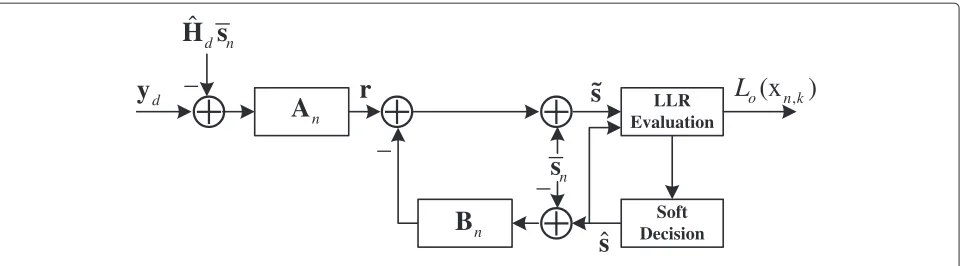
The structure of the SISO-BDFE in one iteration is shown in Fig. 1. The BDFE contains two filters, a feed-forward filter An and a feedback filter Bn, both will be
calculated by using the properties ofHˆdandEd.
The output of the feedforward filter is r=An
yd− ˆHds¯n
, where¯sn=[¯s1,. . .,¯sn−1, 0,¯sn+1,. . .,¯sNc]T∈
CNc×1is the a priori mean vector. Then-th element ofs¯ n
is set to 0 during the detection ofsn to avoid instability
caused by positive feedback. The output of the feedfor-ward filter is then used to subtract the output of the feedback filter,Bn(sˆ− ¯sn), whereBnis a strict upper
trian-gular matrix with the main diagonal being 0,sˆis the hard decision at the output of the BDFE, and the soft output of the BDFE filter,s˜n, can then be represented by
˜
sn=An(yd− ˆHd¯sn)−Bn(ˆs− ¯sn)+ ¯sn, (28)
where the soft output˜snis used for the detection ofsn.
SinceBnis strictly upper triangular, the detection is
per-formed in a reverse order, that is,sn+1is detected before snand the hard decision ofsn+1is fed back to facilitate the
detection ofskfork<n+1.
Based on the common assumption of correct past deci-sions, the error vector n = ˜sn − s can be written as
n=An(yd− ˆHds¯n)−(Bn+INc)(s− ¯sn). (29)
With the orthogonality principle, EnyHd
= 0, the feedforward matrixAncan be derived as
An=(Bn+INc)RsyR−1yy =(Bn+INc)Gmmse, (30)
is them-th element of the channel estimation error vec-tore, and¯vmnis the(m,n)-th element of the matrixV =
is the element-wise multiplication between two matrices. Combining (29) and (30) yieldsn=(Bn+INc)ξn, where
ξn=RsyR−1yy(yd− ˆHds¯n)−(s− ¯sn)is the error vector of a
linear MMSE equalizer. Based on the orthogonal principle
E(ξnyHd)=0, we haveξξ =E
ξnξnH
=Rnss−RsyR−1yyRHsy.
d
Fig. 1The soft-input soft-output block decision feedback equalizer
The covariance matrix of the BDFE error vectorncan
then be calculated as = (Bn+INc)ξξ(Bn+INc)H.
We need to identify the feedback matrix Bn such that
trace(ξξ) is minimized under the constraint that Bn
is strictly upper diagonal. The problem can be solved through the Cholesky decomposition of−1ξξ as [15]
−1ξξ =LHL=UHξDξUξ, (33)
whereUξ ∈CNc×Ncis an upper triangular matrix with unit
diagonal elements,Dξ ∈RNc×Ncis a diagonal matrix, and L=DξUξ. With the Cholesky decomposition described in (33), the feedback matrixBncan be calculated asBn=
Uξ−INc. Consequently, the error covariance matrix of the
BDFE equalizer is =D−1ξ .
5.2 Error performance analysis
The pairwise error probability (PEP) and a BER lower bound of the rate 1 DDM system with imperfect CSI is developed in this subsection.
Based on the estimated channel coefficients, (6) can be rewritten as
yd =
EcXdhˆd+wd, (34)
wherewd = √EcXded+zdis the equivalent noise
com-ponent associated with the estimation error and AWGN. If we treatwdas noise, then the maximum likelihood rule
for deciding between two possible codewords for MPSK modulated systems,cαandcβ, is
Based on the ML decision rule in (35), the PEP of deciding in favor ofXβ when Xα is transmitted can be calculated as
z1andz2are complex Gaussian distributed. ThenQzcan
be expressed in a quadratic form of a complex Gaussian random vector as
The characteristic function (CHF) ofQzis given by [13]
Qz(t)=
Performing eigenvalue decomposition ofRzyieldsRz=
UzDzUHz. The CHF in (37) can be alternatively
repre-whereλi is thei-th non-zero eigenvalue of the rank-Nw
matrixD
When the values ofλi are all unique, which is usually
the case for practical systems, we can rewrite the CHF through partial fraction expansion as
The PDF ofQzcan be derived from the CHF asfQz(x)=
1 2π
∞
−∞Qz(t)e−jxtdt, and the result is
fQz(x)= Nw
i=1
μi·
1 |λi|
exp
−λx
i
u(sgn(λi)x), (43)
where u(x)is the unit step function, and sgn(x) = 1 if x≥0 and−1 otherwise.
Without loss of generality, assume the eigenvalues are ordered in an ascending order, and there areNw−negative eigenvalues, the PEP can be written as
P(Xα →Xβ)=
0
−∞fQz(x)dx=
Nw−
n=1
Nw
i=1,i=n
λn
λn−λi
,
whereλnforn=1,. . .,Nw−are the negative eigenvalues.
For a pair of information vectors,sα andsβ, their Ham-ming distance are defined as DH(sα,sβ) = sα −sβ0,
wherea0is thel0norm operator that returns the
num-ber of non-zero elements in the vectora. Intuitively, the BER can be reduced by assigning codeword pairs with smaller PEP to information vector pairs with larger Ham-ming distance, such that the probability of error events with a large number of bit errors is small. Equivalently, whenDH(sα,sβ)is small, a good precoding scheme should
yield a relatively large PEPP(Xα → Xβ), whereXα and
Xβare the codewords ofsαandsβ, respectively.
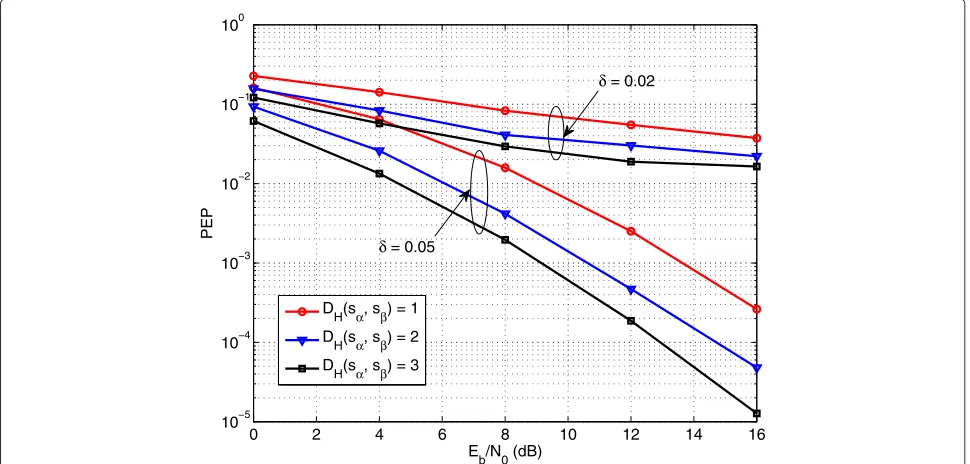
Figure 2 shows the PEP of the DDM-precoded sys-tem with BPSK modulation and different Hamming
dis-tances between information vector pairs. The normalized Doppler frequency isfDTs=0.01 and block length is 100.
For a given Hamming distanceDH, we randomly generate
an information vectorsα, then randomly changeDH bits
insα to getsβ. The PEP for a given Hamming distance is obtained by averaging over 105 such information vector pairs. It can be seen that the PEP decreases asDH(sα,sβ)
increases, and the system performance is dominated by error events with 1 bit information error.
Since the system performance is dominated by error events with 1 bit information error, we can get a BER lower bound of a BPSK modulated system by considering only error events with 1 bit error
Pb≤
1 2Nc
2Nc
α=1
β: DH(sα,sβ )=1
1 Nc
P(Xα →Xβ). (44)
In the equation above, the outer summation with respect toα is used to average over all 2Nc possible
val-ues of sα. When Nc is large, the averaging operation is
time-consuming. However, it can be evaluated by using a large number of randomly generatedsα instead. It should
be noted that our analysis can be easily extended to any MPSK modulated system by considering the dominant error events.
6 Simulation results
Analytical and simulation results are presented in this section to study the trade-off between Doppler diversity
0 2 4 6 8 10 12 14 16
10−5 10−4 10−3 10−2 10−1 100
E
b/N0 (dB)
PEP
DH(sα, sβ) = 1 D
H(sα, sβ) = 2
D
H(sα, sβ) = 3
δ = 0.02
δ = 0.05
and channel estimation errors and to validate the perfor-mance of the two precoding schemes in the presence of imperfect CSI. All systems employ a symbol rate of 0.1 Msym/s and operating at 1.9 GHz. The block length is N=100. When the movement speed is between 56.8 and 568.4 km/hr, the corresponding range of Doppler spread is between 100 Hz (fDTs=10−3) to 1 KHz (fDTs=10−2). Figure 3 compares the performance between the two precoding schemes with both analytical and simulation results. For the rate N1
c repetition coded system, the
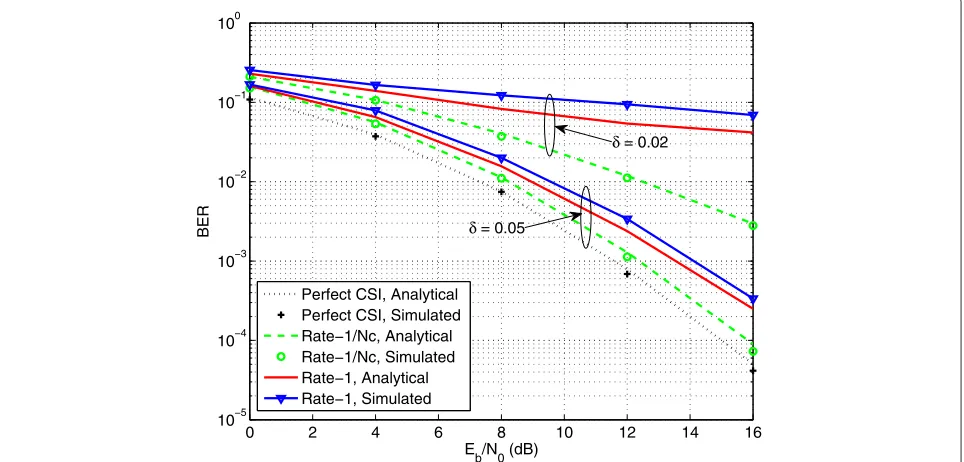
ana-lytical BER described in (26) serves as the lower bound for Doppler diversity system in the presence of chan-nel estimation error, while the simulated BER is obtained by utilizing the optimum receiver described in (20). The rate 1 DDM system employs the suboptimum SISO-BDFE receiver and the analytical results are obtained by using (44). The value offDTsis 0.01, and the energy allocation
factor is selected asη = 0.1. The analytical BER of the rate 1 system matches very well with the corresponding simulation results. The analytical BER lower bound of the DDM-precoded system can reasonably predict the perfor-mance of the system with the sub-optimum SISO-BDFE receivers. For both systems, the pilot percentage has sig-nificant impacts on the BER performance. Whenδ=0.02, the BER performance is dominated by channel estimation errors, such that the Doppler diversity gain is very small. Whenδ = 0.05, the repetition coded system can achieve the maximum Doppler diversity order as the system with perfect CSI. The BER of the DDM precoded system is 1.9 dB worse than the repetition coded system at 10−3 and
δ = 0.05, mainly due to the interference introduced by
the rate 1 precoder. Similar performance is observed for high-level modulations.
Similar results are given in Fig. 4 with higher modulation order. For the rate N1
c repetition code, the analytical BER
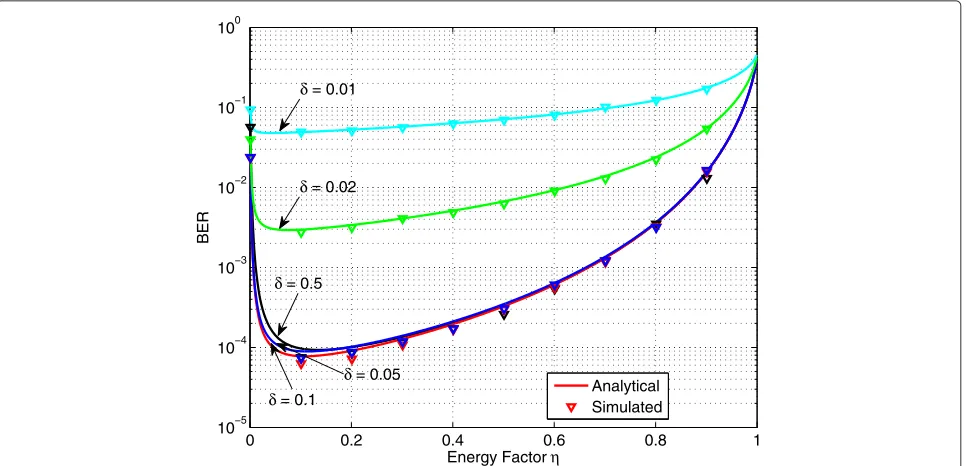
is approximated by dividing the SER over log2(M), and a perfect match is observed between the analytical and sim-ulation SER. For the rate 1 DDM scheme, the analytical results serve as the lower bound for the simulation results. Figure 5 shows the analytical and simulated BER as a function of the energy allocation factor η for system with the repetition precoding scheme. The normalized Doppler spread isfDTs=0.01 andEb/N0=16 dB.
Simu-lation and analytical results match very well. For all system configurations, the BER is convex inη. The optimum η increases as δ increases. The optimum η is 0.06, 0.09, 0.1, 0.1 and 0.1 for systems withδ = 0.01, 0.02, 0.05, 0.1, and 0.5, respectively. A larger δ means more pilot sym-bols per slot; thus, more energy needs to be allocated to the Np pilot symbols in order to achieve a good
chan-nel estimation quality. Similar results are also observed for systems with DDM precoders. We will use the energy allocation factor 0.1 for all subsequent examples, and it provides a robust and good performance for all system configurations.
Figure 6 shows the analytical BER lower bound as a function of pilot percentage, under various values offDTs.
The energy allocation factor isη = 0.1 andEb/N0 = 16
dB. When δ is small, e.g., δ < 0.05 for fDTs = 0.01,
increasingδslightly yields significant performance gains because the performance is dominated by channel estima-tion errors. Onceδreaches a threshold, e.g.,δ ≥ 0.1 for
0 2 4 6 8 10 12 14 16
10−5 10−4 10−3 10−2 10−1 100
Eb/N0 (dB)
BER
Perfect CSI, Analytical Perfect CSI, Simulated Rate−1/Nc, Analytical Rate−1/Nc, Simulated Rate−1, Analytical Rate−1, Simulated
δ = 0.02
δ = 0.05
Fig. 3The analytical and simulation results for both rateN1
0 2 4 6 8 10 12 14 16 10−5
10−4 10−3 10−2 10−1 100
E
b/N0 (dB)
BER
Rate−1/Nc, Analytical Rate−1/Nc, Simulated Rate−1, Analytical Rate−1, Simulated QPSK
8PSK
Fig. 4The analytical and simulation results for both rateN1
cand rate 1 diversity systems with QPSK/8PSK and imperfect channel state information
fDTs = 0.01, increasingδ further has very small impact
on system performance, due to the fact that the impacts of channel estimation error is small onceδbecomes large. It is interesting to note that increasing δ from 0.1 to 0.5 might degrade system performance because Ep is a
decreasing function in δ. More importantly, when δ is small (e.g. δ < 0.02), a higher fDTs might result in a
worse BER due to channel estimation errors. On the other
hand, whenδis large enough such that the channel esti-mation quality is good enough, the BER performance increases with fDTs due to the higher Doppler diversity
gains collected by the proposed systems.
To illustrate the impact of Doppler shift on error perfor-mance, the BER of system with repetition code is shown as a function of fDTs in Fig. 7, under various values of
pilot percentage. The Eb/N0 is fixed at 16 dB. For all
0 0.2 0.4 0.6 0.8 1
10−5 10−4 10−3 10−2 10−1 100
Energy Factor η
BER
Analytical Simulated
δ = 0.1
δ = 0.05
δ = 0.5
δ = 0.01
δ = 0.02
Fig. 5The BER as a function ofηfor rateN1
0 0.1 0.2 0.3 0.4 0.5 10−5
10−4 10−3 10−2 10−1 100
Pilot Percentage δ
BER
rate−1/N
c
rate−1
f
DTs = 0.005
f
DTs = 0.01
f
DTs = 0.001
Fig. 6The BER as a function ofδfor rateN1
csystems with BPSK modulation and imperfect channel state information
systems, the BER is a quasi-convex function offDTs. The
performance first improves asfDTs increases due to the
Doppler diversity and then degrades due to the channel estimation errors. For systems with δ = 0.02, 0.05, and 0.1, the minimum BER is achieved atfDTs= 0.004, 0.015,
and 0.045, respectively. A higher pilot percentage may not always yield a better performance, and the performance improvement is not significant when the channel estima-tion is good enough.
7 Conclusions
The maximum Doppler diversity transmissions for high-mobility systems in the presence of channel estimation errors have been studied in this paper. The trade-off between Doppler diversity and channel estimation errors has been studied by using a repetition code and a rate 1 Doppler domain multiplexing scheme. The analytical performance of both systems have been obtained by ana-lyzing the statistical properties of the channel estimation
0 0.01 0.02 0.03 0.04 0.05 10−8
10−7 10−6 10−5 10−4 10−3 10−2 10−1
f
DTs
BER
δ = 0.5
δ = 0.1
δ = 0.05
δ = 0.02
errors, and they quantitatively identify the impacts and interactions of a number of system parameters, such as the pilot percentage, the maximum Doppler spread, and the energy allocation factor between pilot and data symbols, etc. It has been shown that the error probability is quasi-convex in Doppler spread and monotonically decreasing in the pilot percentage. The performance of systems with a sufficiently high pilot percentage can approach that of a system with perfect CSI. On the other hand, if the pilot percentage is too low, the benefits of Doppler diver-sity are offset by channel estimation error such that a system with a lower Doppler spread could get a better performance.
Competing interests
The authors declare that they have no competing interests.
Acknowledgements
The work of Weixi Zhou and Pingzhi Fan was supported by the Chinese 973 Program (No. 2012CB316100), the NSFC project (No. 61471302), the 111 Project (No. 111-2-14), the MoE Key Grant Project (No. 311031100), and the Young Innovative Research Team of Sichuan Province (No. 2011JTD0007). The work of Jingxian Wu was supported in part by the U.S. National Science Foundation (NSF) under Grants ECCS-1202075 and ECCS-1405403.
Author details
1Institute of Mobile Communications, Southwest Jiaotong University,
Chengdu, China.2Department of Electrical Engineering, University of Arkansas, AR 72701 Fayetteville, USA.
Received: 7 December 2014 Accepted: 29 April 2015
References
1. AM Sayeed, B Aazhang, Joint multipath-Doppler diversity in mobile wireless communications. IEEE Trans. Commun.47(1), 123–132 (1999). doi:10.1109/26.747819
2. X Ma, GB Giannakis, Maximum-diversity transmissions over doubly selective wireless channels. IEEE Trans. Inform. Theory.49(7), 1832–1840 (2003). doi:10.1109/TIT.2003.813485
3. J Wu, inProc. IEEE GLOBECOM. Exploring maximum Doppler diversity by Doppler domain multiplexing (San Fransico, USA, 2006), pp. 1–5. doi:10.1109/GLOCOM.2006.897
4. KI Ahmed, C Tepedelenlioglu, A Spanias, Performance of precoded OFDM with channel estimation error. IEEE Trans. Signal Process.
54(3), 1165–1171 (2006). doi:10.1109/TSP.2005.862898
5. J Wu, C Xiao, Optimal diversity combining based on linear estimation of Rician fading channels. IEEE Trans. Commun.56(10), 1612–1615 (2008). doi:10.1109/TCOMM.2008.060598
6. S Savazzi, U Spagnolini, On the pilot spacing constraints for continuous time-varying fading channels. IEEE Trans. Commun.57(11), 3209–3213 (2009). doi:10.1109/TCOMM.2009.11.080024
7. N Sun, J Wu, Maximizing spectral efficiency for high mobility systems with imperfect channel state information. IEEE Trans. Wireless Commun. 13(3), 1462–1470 (2013). doi:10.1109/TWC.2014.012314.130772 8. N Sun, J Wu, inProc. IEEE GLOBECOM. Maximizing spectral efficiency with
imperfect channel information in high mobility systems (Atlanta, USA, 2013). doi:10.1109/GLOCOM.2013.6831591
9. W Zhou, J Wu, P Fan, inProc. IEEE ICC. Maximizing Doppler diversity transmisssions for high mobility systems with imperfect channel state information (Sydney, Australia, 2014). doi:10.1109/ICC.2014.6884267 10. J Wu, N Sun, Optimum sensor density in distortion tolerant wireless
sensor networks. IEEE Trans. Wireless Commun.11, 2056–2064 (2012). doi:10.1109/TWC.2012.041612.110127
11. N Sun, J Wu, Optimum sampling in spatial-temporally correlated wireless sensor networks,. EURASIP J. Wireless Commun. Networking.
2013, 5 (2013). doi:10.1186/1687-1499-2013-5
12. N Sun, J Wu, inProc. IEEE MILCOM. Minimum error transmissions with imperfect channel information in high mobility systems (San Diego, USA, 2013). doi:10.1109/MILCOM.2013.160
13. S Siwamogsatham, MP Fitz, JH Grimm, A new view of performance analysis of transmit diversity schemes in correlated Rayleigh fading. IEEE Trans. Inform. Theory.48(4), 950–956 (2002). doi:10.1109/18.992794 14. J Wu, YR Zheng, Low complexity soft-input soft-output block decision
feedback equalization. IEEE J. Sel. Areas Commun.26(2), 281–289 (2008). doi:10.1109/JSAC.2008.080205
15. A Stamoulis, GB Giannakis, A Scaglione, Block FIR decision-feedback equalizers for filterbank precoded transmissions with blind channel estimation capabilities. IEEE Trans. Commun.49(1), 69–83 (2001). doi:10.1109/26.898252
Submit your manuscript to a
journal and benefi t from:
7 Convenient online submission
7 Rigorous peer review
7 Immediate publication on acceptance
7 Open access: articles freely available online
7 High visibility within the fi eld
7 Retaining the copyright to your article