USING A GAME-LIKE PROCEDURE
AS A NEW TEST OF PROBLEM
SOLVING AND CONCEPT
FORMATION IN CHILDREN.
Annie Pavitt
A thesis submitted in partial fulfilment of the requirements of the University of East London for the degree of
ABSTRACT
Concept formation is a complex cognitive process which allowsus to identify, categorise, and determine rules from sets of experiences alongside developing cognitive representations for complex thoughts, behaviours, and events. Concept formation abilities are highly important for children’s performances in school, socially, and therefore throughout their lives. Yet, most of the tests that are used to measure concept formation in children were developed for use with adults; very few have been specifically designed for children.
This study is the first phase of test development. It addressed whether a new game of concept formation, theAlien Game, could capture executive functions in a group of 18 typically developing children. The game was based on the 20-Questions task and a game-like structure was adopted in order to engage participants. Codes were generated from a two-phase content analysis carried out using previous research and the children’s responses within this study. The task was also interpreted using an Abstraction Score, a Learning Slope, an Initial Abstraction Score, a Weighted Achievement Score, and a Time to First Question measure.
The content analysis indicated that similar patterns were found among the children’s responses, with the children using a majority of ‘Constraint seeking’ questions. The Abstraction Score, Initial Abstraction Score, and Weighted Achievement Score addressed separate aspects of the questions asked, and were each designed to assess the quality of questions asked.
ACKNOWLEDGEMENTS
I would firstly like to thank my participants for giving up their time to participate in my study and for your enthusiasm. I learnt a lot from you and the different ways you approached this task. I would also like to say a big thank you to my teacher friends for arranging for me to come into their schools and to recruit some of their class into my study. This included sending out information sheets to their pupil’s parents and answering their questions – I am hugely grateful for all of your time and effort spent! I would also like to thank the Head Teachers and SENCOs at these schools for allowing me to recruit children into the study.
I would next like to thank Dr Matthew Jones-Chesters for all of his guidance, wisdom, and support throughout both the development of my study and in the write up of my thesis. I have learnt a lot from his useful insights and am very grateful for all of his encouragement and responsiveness throughout this process. A special thank you goes both to my dad and to Lawrence. Thank you both for being there and offering an abundance of support, both emotional and practical. Your relentless belief in me has encouraged me to keep on going at times when it felt difficult. I would also like to thank the rest of my family: my mum, siblings and their partners, Yvonne, and granny. I am not sure how to put into words how grateful I am to have such a supportive, caring, and fun family around me. Finally, a huge thank you goes to the rest of my friends for sticking by me and being so understanding and supportive during the doctorate course which
TABLE OF CONTENTS
ABSTRACT ... i
ACKNOWLEDGEMENTS ... ii
LIST OF TABLES AND FIGURES ... vi
1. INTRODUCTION ... 1
1.1. Executive Function... 2
1.2. Concept Formation ... 3
1.3. Literature Review ... 4
1.3.1. Methods of Literature Review ... 4
1.3.2. Inclusion and Exclusion Criteria ... 4
1.3.3. Search Results ... 4
1.4. Review of Literature ... 5
1.4.1. Concept Formation in Children ... 6
1.4.2. Assessment of Concept Formation ... 16
1.4.3. Aetiology of Difficulties ... 23
1.4.4. Impact of Deficits ... 26
1.5. Summary of Literature Review ... 29
1.6. Present Study ... 30
1.6.1. Aims and Rationale ... 30
1.6.2. A Game-Like Procedure ... 31
1.7. Research Questions ... 32
2. EPISTEMOLOGY & METHODOLOGY... 33
2.1. Epistemological Approaches ... 33
2.2. Adopting a Critical Realist Approach ... 34
2.3. Inclusion & Exclusion Criteria ... 35
2.4. Design ... 35
2.5. Materials ... 36
2.6.1. Confidentiality ... 39
2.7. Procedure ... 39
2.8. Data Collection and Analysis ... 40
2.8.1. Content Analysis ... 40
2.8.2. Analysis of the Coding Data ... 43
2.8.3. Additional Tests ... 43
2.8.4. Acceptability ... 44
2.9. Participants ... 45
2.9.1. Demographic Data ... 45
3. RESULTS ... 49
3.1. Methods of Analysis... 49
3.2. Content Analysis ... 50
3.2.1. Quantitative Analysis ... 54
3.2.2. Inter-Rater Reliability ... 54
3.2.3. Exploratory Content Analysis ... 56
3.3. Other Measures ... 58
3.3.1. Abstraction Score ... 59
3.3.2. Learning Slope ... 60
3.3.3. Initial Abstraction Score ... 61
3.3.4. Weighted Achievement Score ... 62
3.3.5. Comparison with Other Measures ... 63
3.3.6. Time to First Question ... 65
3.3.7. Acceptability ... 66
4. DISCUSSION ... 67
4.1. Revisiting the Research Questions ... 67
4.1.1. Research Question 1 ... 67
4.1.2. Research Question 2 ... 69
4.1.3. Research Question 3 ... 73
4.2. Summary of Findings... 73
4.3. Evaluating the Present Study in Relation to Previous Research ... 74
4.4. Critical Evaluation ... 79
4.4.1. Strengths of the Current Study ... 79
4.4.2. Limitations of the Current Study ... 81
4.5. Conclusions ... 86
4.6. Clinical Implications ... 87
4.7. Future Research Directions ... 88
4.7.1. Reliability ... 89
4.7.2. Validity ... 90
4.8. Concluding Summary ... 91
REFERENCES ... 92
APPENDICIES: ... 108
APPENDIX A: Pictures Used in the Alien Game. ... 109
APPENDIX B: Consent Form – Child. ... 109
APPENDIX C: Information Sheet ... 109
APPENDIX D: Opt Out Form for Parents/Guardians. ... 109
APPENDIX E: Consent Form – Parents/Guardians. ... 109
APPENDIX F: Head Teacher’s Loco Parentis Form. ... 109
APPENDIX G: Standardised Instructions for Child. ... 109
APPENDIX H: Measure of Task Acceptability Using Likert/Visual Analogue Scale ... 109
APPENDIX I: Coding Sheet ... 109
APPENDIX J: Coding Scheme Explained... 109
APPENDIX K: Scoring for Code 7 and Code 8 ... 109
APPENDIX L: Ethical Approval ... 109
LIST OF TABLES AND FIGURES
TABLE 1. Developmental Trajectory of Concept Formation………...11
TABLE 2. Codes From Previous Tests of Concept Formation………...42
TABLE 3. Non-Parametric Correlations Between and Within National Curriculum Levels for Reading, Writing, and Maths….……….46
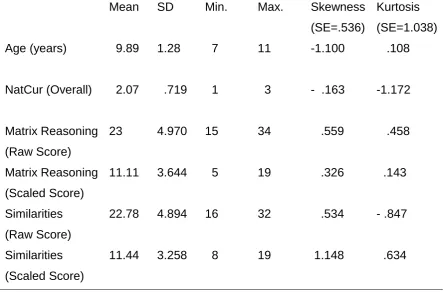
TABLE 4. Descriptive Statistics for Age and Key Cognitive Tests………...47
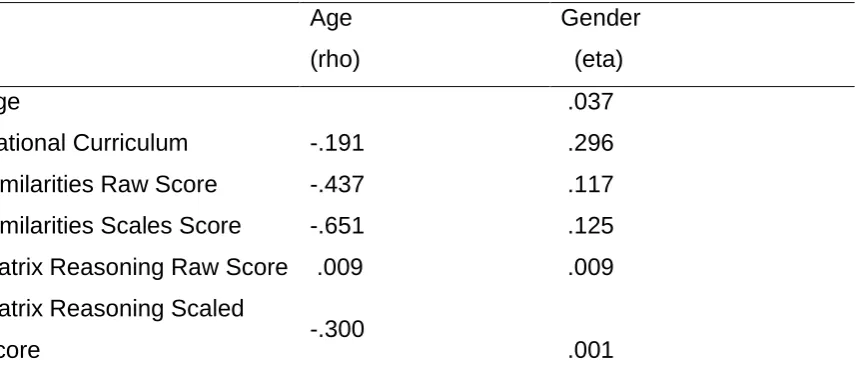
TABLE 5. Measures of Association Between the Demographic and Cognitive Scores……….48
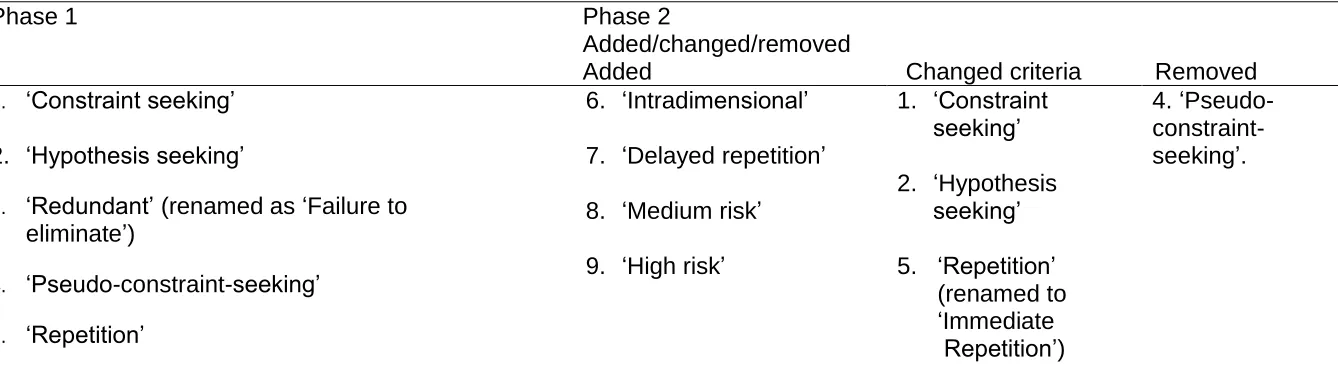
TABLE 6. Two Phase Content Analysis……….51
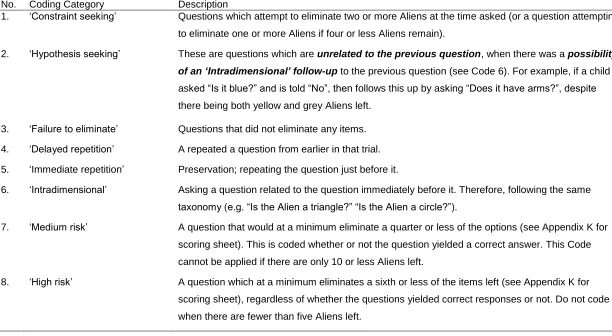
TABLE 7. Coding Scheme………....53
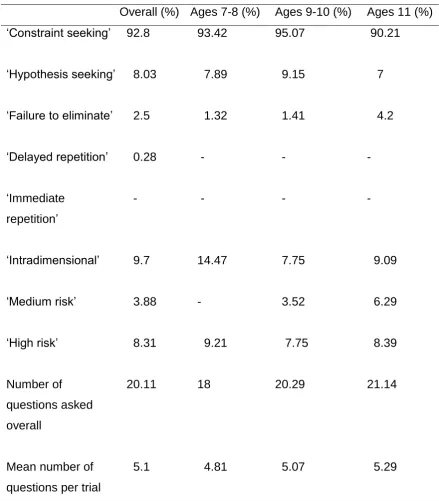
TABLE 8.Percentage of Codes Used and Number of Questions Asked Overall………..55
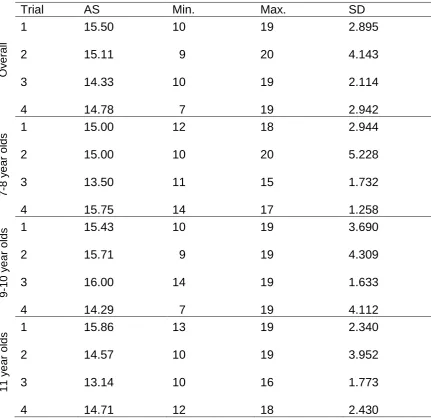
TABLE 9. Mean Abstraction Scores………...59
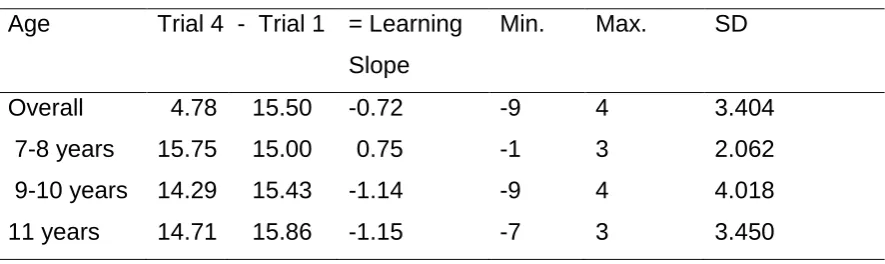
TABLE 10. Mean Learning Slope Scores………..60
TABLE 11. Initial Abstraction Score………...61
TABLE 12. Weighted Achievement Scoring System………...62
TABLE 13. Weighted Achievement Score………...63
TABLE 14. Spearman’s Rank Correlation Comparing Abstraction Score with Similarities and Matrix Reasoning………...64
TABLE 15. Friedman’s Two-Way Analysis By Ranks………...66
TABLE 16. Coding Scheme Explained………....119
TABLE 17. Scoring for Code 7 and Code 8………....121
TABLE 18. Scoring for Code 7 and Code 8 – Continued……….122
TABLE 19. Mean Learning Slope Total and in Different Age Groups………….126
FIGURE 1. PRISMA (2009) Flow Diagram of Article Selection Process………..5
FIGURE 2. Related-Samples Friedman’s Two-Way Analysis of Variance by Ranks………..66
FIGURE 3. Pictures of Aliens Created For the Alien Game………...109
1. INTRODUCTION
This research is situated within the field of assessment of concept formation in children. Gelman (1999) reported that there had been over 7,000 research
articles written about children's concepts over the past thirty years; a number that will have since risen. Researchers are attracted to this area for the opportunity to explore fundamental issues such as how early childhood thinking is
characterised, alongside practical concerns about how children form concepts which are directly pertinent to their abilities and performance at school and throughout their lives (Gelman, 1999). Yet despite the interest in and importance of this topic, there have been relatively few standardised neuropsychological tests designed to specifically test concept formation in children (Channon & Crawford, 1999). The aim of this present study is to examine the utility of using a game-like procedure in order to test children’s concept formation and problem solving abilities.
This section will introduce the reader to the research topic. It will firstly position concept formation within the wider topic of executive functioning. It will then
introduce the literature on concept formation in children, including a discussion on how concepts are acquired and the developmental trajectory of these abilities. This section will also discuss current and past neuropsychological tests used to assess concept formation in both children and adults. Throughout this section, a critical review of the literature is provided. The aetiology of difficulties with
1.1. Executive Function
Executive function is a term used to describe a set of cognitive capacities intimately associated with the frontal lobes, specifically the prefrontal cortex (Morris, Ahmed, Syed, & Toone, 1993) and connections to other brain areas. There is currently no consensually agreed definition of executive function, however, it can be broadly defined as the capacity to engage in “independent, purposive, self-serving behavior” (Lezak, Howieson, & Loring, 2004, p. 42). Executive functions play a central role in helping people perform in new, non-routine, or complex situations that require integrating knowledge and experience (Welsh, 2002). It isa set of interrelated abilities responsible for enabling a person to manage, regulate, plan, and execute meaningful aim-oriented behaviour
(Gligorović & Buha, 2013). Carlson, Zelazo, and Faja (2013) note that these skills may be observed in children when they pause and reflect before acting. Children with difficulties in executive functioning may find problem solving difficult as they may find it hard to plan, anticipate consequences, form concepts, and initiate activity towards goal-directed behaviour (Darby & Walsh, 2005). These children may also be slow to master reading skills (Lorsbach, Wilson, & Reimer, 1996).
1.2. Concept Formation
Although explanatory theories and specific definitions of concept formation differ somewhat, generally it is regarded as a complex and multifaceted cognitive process which allows people to derive concepts based on relational, functional, and perceptual aspects (Hills, Maouene, Maouene, Sheya, & Smith, 2009). This enables someone to categorize objects or experiences by sorting them under more general rules or classes (Hunt, 1962), for example, recognizing a chair without having seen that particular chair before. It enables us to identify, determine, and categorize rules from sets of patterns (McGrew, 2009) and develop cognitive representations for complex thoughts, behaviours, and events (Medin & Smith, 1984). Thus, concept formation is a key component of a
person’s information processing which forms the basis for many higher-order linguistic and cognitive processes including: abstraction, reasoning, controlled attention, and the ability to compare (Vygotsky, 1986).
The ability to generate and flexibly change concepts are crucial abilities in the development of academic and adaptive skills (Gligorović & Buha, 2013).
1.3. Literature Review
1.3.1. Methods of Literature Review
An exhaustive search of literature on concept formation in children was carried out using PsycINFO, CINAHL Plus, and PubMed databases. The reference lists from retrieved papers were also manually searched for relevant articles and publications.
1.3.2. Inclusion and Exclusion Criteria
The search was limited to empirical papers published in English in peer-reviewed journals within an unrestricted timeframe. Studies were included if they
investigated concept formation in children. Only studies in which concept formation was directly measured or observed and reported were included. All study types were included in the review, including: empirical studies, clinical cases, longitudinal studies, and systematic reviews. The search included studies of the developmental trajectory of concept formation in typically developing children. Additionally, it included research which explored concept formation difficulties in children in order to explore the psycho-social effects of such deficits.
The search strategy aimed to identify all research in which concept formation in children was investigated alongside neuropsychological testing or the symptoms related to difficulties. The search terms were ‘Concept Formation’ along with Child*,Psych*, Neuropsych*, and Test* (where * denotes truncated terms) which were used in various combinations.
1.3.3. Search Results
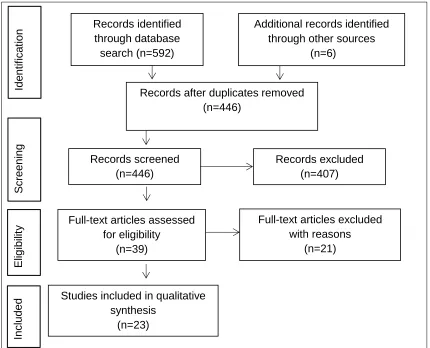
Figure 1. PRISMA (2009) Flow Diagram of Article Selection Process1
The next part of the report is derived from the qualitative synthesis of information obtained from the 23 papers remaining after this process.
1.4. Review of Literature
In this section, I will start by reviewing contemporary literature on concept formation in children in order to define what concept formation is, and how and when typically developing children acquire these abilities. I shall also explore similarities and differences in how children and adults form concepts. I shall do
1
From: Moher D, Liberati A, Tetzlaff J, Altman DG, The PRISMA Group (2009). Preferred
Reporting Items for Systematic Reviews and Meta-Analyses: The PRISMA Statement. PLoS Med 6(7): e1000097. doi:10.1371/journal.pmed1000097
Ide nti fi ca ti on Records identified through database search (n=592)
Records after duplicates removed (n=446)
Records screened (n=446)
Records excluded (n=407)
Full-text articles excluded with reasons
(n=21) Full-text articles assessed
for eligibility (n=39)
Studies included in qualitative synthesis (n=23) S cree ni ng E lig ibi lit y Incl ud ed
Additional records identified through other sources
this before reviewing how this literature has given rise to associated cognitive tests of concept formation which are currently available with a particular view to reviewing the strengths and weaknesses of these, alongside the supporting evidence and usefulness with children. The gaps in, and limitations of, these tests will also be discussed. I will then review literature on the aetiology of problems that children with concept formation difficulties may face in order to explore how difficulties in concept formation can manifest and thus why it is important to be able to test these abilities in children. After reviewing the literature, I will lead onto describing how this present study fits within gaps and recommendations from the contemporary literature reviewed in this sub-section with a view to creating a cognitive test that can best capture children’s concept formation abilities as derived from the literature review.
1.4.1. Concept Formation in Children
In order to assess the need for, and design of, a test of concept formation in children, this section will explore how and when children form concepts and whether children form concepts differently to adults.
1.4.1.1. Definitions - a key part of defining ‘concept formation’ is defining what is
meant by the term ‘concept’. There have been many different definitions which led Medin and Smith (1984) to describe the term as a ‘loaded one’, serving numerous explanatory functions within both psychology and related disciplines. This report will, however, adopt Mandler’s (2008) definition of ‘concepts’ as knowledge about objects and events that are accessible to conscious thought.
Rey (1983) viewed concept formation as comprising four functions:
1. Simple categorisation – deciding if something can be categorised as part
of a simple class (e.g. whether or not a particular object or being is an occurrence of the concept girl).
2. Complex categorisation – deciding if an object or being is an example of a
complex class (e.g. concluding that an object is an example of the concept
3. Linguistic meaning – explaining relations of semantic, synonymy,
implication, and antinomy (e.g. the meaning of lass is somewhat synonymous to girl and indicates being young and female)
4. Components of cognitive states – including beliefs and preferences. In this function, concepts give a cognitive explanation for complexities of
behaviour and thought (e.g. concepts rich, girl, and spoiled are played out in the resulting belief that rich girls are spoilt).
The categorisation process is fundamental to efficient information processing (Rosch, 1978). Simple categorisations provide the basis of more complex categories and have been a major focus throughout literature concerning itself with concepts (Smith, Jones, & Landau 1996). As this is the initial phase of test development, this study took an exploratory approach to assess which concept formation strategies the children appeared to adopt while problem solving.
1.4.1.2. Approaches to concept acquisition - one way children acquire new concepts is through the ability to detect new rules. There has been a long history of research in this area, including both visual and verbal concept acquisition. In Fantz’s (1964) experiments of visual habituation, two stimuli were provided to infants; one was novel, the other stayed the same. He found that infants
progressively looked towards the novel stimulus, indicating they had habituated to the familiar stimulus. These studies demonstrate infant’s ability to acquire visual concepts. Other research focused on verbal concept acquisition. For example, McShane (1980) told children in his study that they were using an animal name incorrectly, and supplied them with the ‘correct’ name. He then found these children incorporated the new name into their vocabulary (e.g. “Thus Brian, told that what he called ducks were turkeys, called the toys turkey ducks …”, McShane, 1980, p. 112).
The ability to form concepts in novel situations starts early in a child’s learning process, at a time when relatively few exemplars have been encountered
Brewer, & Mooney, 1992) are able to accurately generalise a concept once exposed to a single instance. As the number of category examples increases, representations of categories are increasingly likely to incorporate both novel features and prior knowledge (Heit, 1994; Wisniewski & Medin, 1994). The ability to form categories based on prior knowledge of conceptual or perceptual
differences and similarities allows novel stimuli to be organised in a manageable way (Alderson-Day & McGonigle-Chalmers, 2011). Therefore, exposure to new instances and novel features is an important part of concept formation which can refine and change previous knowledge or beliefs about categories.
Even young children do not just derive concepts solely on the basis of novel perceptual or sensory information (Keil, 1986; Mervis, 1987). Much research has suggested that from a very young age, children also interpret information with reference to existing domain knowledge and theories they hold about the world (e.g. Carey, 1985; Gelman & Markman, 1986; Keil, 1989). Krascum and Andrews (1998) found that when 4-5 year olds were able to use their pre-existing
knowledge of animals this helped in their learning of new animal categories. Similarly, Carmichael and Hayes (2001) showed 4-10 year olds pictures of fictitious animals which were either consistent or inconsistent with the child’s pre-existing knowledge and found that prior knowledge influenced their categorisation in all experiments. Barrett, Abdi, Murphy, and Gallagher (1993) also found that 5-10 year old children link specific features associated with individual concepts to form theories. Their experiments indicated that theory-based correlations were prominent in decisions regarding category membership and children's theories determined which attributes were considered most central to the concept. Furthermore, Farrar, Raney, and Boyer (1992) found younger children made more inductive inferences about novel categories when they contained familiar properties. However, these studies may only reflect how a child reacts within the experimental setting, and thus lack external validity. When met with an object in ‘real life’ which has a feature correlation which is inconsistent with their current theories, the child may choose to either ignore the contradicting feature
In the above experiments, the term ‘prior knowledge’ is used to encompass children’s expectations or beliefs about concepts. A question arising from these experiments is the origin of the children’s prior beliefs and knowledge of
categories (Carmichael & Hayes, 2001). One theory is that children acquire conceptual knowledge through generating ‘naïve theories’. What constitutes a ‘naïve theory’ has been debated, but this term is often used to describe common sense theories which incorporate concepts (Murphy, 1993). Naïve theories provide organised and fairly coherent sets of knowledge about something which enables a child to provide causal descriptions for phenomena and, from these, form logical predictions about unfamiliar objects or events (Keil, Smith, Simons, & Levin, 1998). In other words, concepts are acquired and refined through
reference to a child’s existing concepts.
However, while much research has focused on how children self-generate concepts, much of their knowledge is also derived from the input of others (Gelman, 2009). This includes learning through teachers and parents, (Callanan & Oakes, 1989).
It is not always possible to pinpoint exactly where knowledge was acquired. McShane and Dockrell (1983) state that it may be “virtually impossible to know in what contexts a child will have acquired a word and therefore it will be impossible to predict patterns of results in advance of a comprehension test…” (p. 65). Despite this, the research in this sub-section demonstrates that both prior knowledge and novel stimuli are central to category acquisition and refinement. These abilities are observed in children from a young age; however, some debate exists around the developmental shift in a child’s dependence on these different sources of information. Farrar et al. (1992) propose that learning new concepts becomes more theory-driven as children accumulate knowledge about a
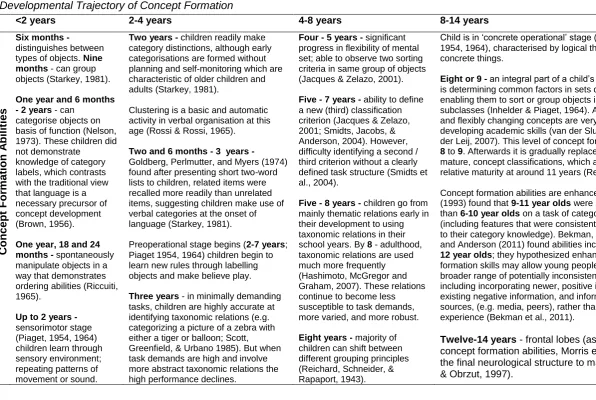
1.4.1.3. When do concept formation abilities manifest? - research into when concept formation abilities develop is an area of some debate; however, there is much research that attests to young children having concept formation abilities. One conventional approach to gaining a deeper understanding of when these concept formation abilities develop in children is through looking at research on the developmental trajectory in ‘typically developing’ children (see Table 1).
According to classical empiricism, concept formation begins in infancy as knowledge derives from our senses (Charlesworth & Lind, 2010). When infants explore their environment they gain a sense of shape, weight, and size. Shapes of objects are learned from the experiences of touching. Concepts can therefore be viewed as direct representations of a child’s sensory and perceptual
experience, or combinations of both (Gelman, 2009). Many researchers find the empiricist approach to learning appealing as it provides the potential to view mental processes and knowledge as being built up from simple building blocks (Gelman, 1996). Similarly, Smith et al. (1996) proposed that one’s higher-level cognitions result from lower-level associations; building up sensory cues
gradually and throughout many lived examples. Mandler (2008) studied how our earliest, unstructured concepts are sensory and formed as infants. This fits with the sensorimotor stage within Piaget’s Theory of Cognitive Development (1954, 1964; see Table 1).
Nativist approaches to concept acquisition offer an alternative view. This
approach describes how any concept acquisition involves some innate capacity, even within empiricist approaches (Wanner & Gleitman, 1983). However, the questions that arise from this approach are: how rich and detailed concept formation based on our innate capacities can be, the degree to which someone can incorporate variable concepts from different contexts, and how much these concepts are then modified by their environment (Murphy, 1993). Nativist theories range from children having different attentional biases due to their innate
<2 years 2-4 years 4-8 years 8-14 years
Six months
-distinguishes between types of objects. Nine months - can group objects (Starkey, 1981).
One year and 6 months - 2 years - can
categorise objects on basis of function (Nelson, 1973). These children did not demonstrate
knowledge of category labels, which contrasts with the traditional view that language is a necessary precursor of concept development (Brown, 1956).
One year, 18 and 24 months - spontaneously manipulate objects in a way that demonstrates ordering abilities (Riccuiti, 1965).
Up to 2 years - sensorimotor stage (Piaget, 1954, 1964) children learn through sensory environment; repeating patterns of movement or sound.
Two years - children readily make category distinctions, although early categorisations are formed without planning and self-monitoring which are characteristic of older children and adults (Starkey, 1981).
Clustering is a basic and automatic activity in verbal organisation at this age (Rossi & Rossi, 1965).
Two and 6 months - 3 years
-Goldberg, Perlmutter, and Myers (1974) found after presenting short two-word lists to children, related items were recalled more readily than unrelated items, suggesting children make use of verbal categories at the onset of language (Starkey, 1981).
Preoperational stage begins (2-7 years; Piaget 1954, 1964) children begin to learn new rules through labelling objects and make believe play.
Three years - in minimally demanding tasks, children are highly accurate at identifying taxonomic relations (e.g. categorizing a picture of a zebra with either a tiger or balloon; Scott, Greenfield, & Urbano 1985). But when task demands are high and involve more abstract taxonomic relations the high performance declines.
Four - 5 years - significant progress in flexibility of mental set; able to observe two sorting criteria in same group of objects (Jacques & Zelazo, 2001).
Five - 7 years - ability to define a new (third) classification criterion (Jacques & Zelazo, 2001; Smidts, Jacobs, & Anderson, 2004). However, difficulty identifying a second / third criterion without a clearly defined task structure (Smidts et al., 2004).
Five - 8 years - children go from mainly thematic relations early in their development to using taxonomic relations in their school years. By 8 - adulthood, taxonomic relations are used much more frequently (Hashimoto, McGregor and Graham, 2007). These relations continue to become less susceptible to task demands, more varied, and more robust.
Eight years - majority of children can shift between different grouping principles (Reichard, Schneider, & Rapaport, 1943).
Child is in ‘concrete operational’ stage (7-12 years; Piaget, 1954, 1964), characterised by logical thinking about concrete things.
Eight or 9 - an integral part of a child’s cognitive potential is determining common factors in sets of different objects enabling them to sort or group objects into classes and subclasses (Inhelder & Piaget, 1964). Abilities in forming and flexibly changing concepts are very important in developing academic skills (van der Sluis, de Jong, & van der Leij, 2007). This level of concept formation peaks aged 8 to 9. Afterwards it is gradually replaced by other, more mature, concept classifications, which appear to reach relative maturity at around 11 years (Reichard et al., 1943).
Concept formation abilities are enhanced: e.g. Barrett et al. (1993) found that 9-11 year olds were significantly better than 6-10 year olds on a task of category membership (including features that were consistent with or contrasting to their category knowledge). Bekman, Goldman, Worley, and Anderson (2011) found abilities increased between 8-12 year olds; they hypothesized enhanced concept formation skills may allow young people to integrate a broader range of potentially inconsistent information, including incorporating newer, positive information with existing negative information, and information from distal sources, (e.g. media, peers), rather than just personal experience (Bekman et al., 2011).
Twelve-14 years - frontal lobes (associated with concept formation abilities, Morris et al., 1993) are the final neurological structure to mature (Lord-Maes & Obrzut, 1997).
[image:18.842.101.698.116.516.2]C on ce pt Fo rmat ion A bil it ies Table 1.
senses (Harris & Koenig, 2006) or innate abilities; Gelman (2002) proposed that it gets elaborated with a person’s experiences and development.
As a child develops they tend to structure concepts around either themes or taxonomies. Thematic relationships group together objects that are found
together, for example paper and pen may both be part of a classroom theme, as are desk, computer, pupil, and teacher. Lin and Murphy (2001) propose that thematic relationships may be: functional (e.g. pen and paper), causal (e.g. pen and teacher), or spatial (e.g. paper and desk).
Taxonomical concepts can be described by features which share an essence; Rosch (1978) described how basic concepts within our environment can be described through co-occurring features that cluster together (‘feature
correlations’), such as ‘beak’ and ‘feathers’ occur together in a bird. Malt and Smith (1984) stated that using a correlational structure of ‘features’, or the essence of characteristics, is one way of linking together knowledge about an object which forms the basis of basic level concepts.
Inhelder and Piaget (1964) observed that pre-schoolers arranged categories of objects in accordance to their spatial (thematic) relationship rather than their perceptual similarity (taxonomic). Pre-schoolers also demonstrated a tendency to use thematic relations during tasks involving forced choice matching (Smiley & Brown, 1979) and naming tasks (Scott et al., 1985). However, Smiley and Brown (1979) suggested that while 6-7 year olds may prefer to thematically sort objects (e.g. grouping a spider and a web), they are able to categorise pictures
taxonomically (e.g. grouping a spider and an ant).
level reasoning to understand higher, taxonomical ‘levels’ of concepts and related taxonomic principles, including ordinate, superordinate, and subordinate
classifications (e.g. a Labrador is a dog, a dog is an animal, and a cat is also an animal). A number of studies have since criticised Piaget’s work for
underestimating children’s abilities in relation to their age. For example, Wood, Smith, and Grossniklaus (2001) stated Piaget used overly complicated tasks, with unclear instructions, and that children could correctly complete simpler forms of such tasks which require the same concept formation and problem solving abilities. Therefore, it would be a mistake to assume that because a young child could not perform advanced or complex cognitive tasks requiring what Piaget (1964) called ‘formal operations’ that they are not actively engaged in making category distinctions (Starkey, 1979). This suggests that young children do have concept formation abilities, but for these to be tested, tasks must have clear instructions and use a structure which is suited to the developmental level of the child.
1.4.1.4. Dichotomous divide between adults and children? - other key questions in designing a test specifically for children are whether and how children’s and adults’ concept formation abilities differ. In several traditional explanations, concept formation is said to undertake qualitative, fundamental shifts throughout development.
Children and adults are frequently viewed as occupying opposite ends of several developmental dichotomies, including: concrete to abstract (Piaget, 1951),
perceptual to conceptual (Bruner, Olver, & Greenfield, 1966), or similarity to theories (Quine, 1977). Dichotomies such as these are appealing, particularly as children can appear to reason in strikingly dissimilar ways to adults. For example, children's and adults’ concepts may differ in the number or salience of
from a wide glass into a tall, narrow glass, children below six or seven years old appeared to mainly attend to one salient but deceptive element (e.g. height) and perceive that the transformation led to an increase in quantity. However, there are many critiques of this task, such as Rose and Blank (1974) who found many six year olds answered correctly in their version of this study. Additionally, the children may have assumed that the adult deliberately changing the appearance of the water was important and thus give an answer which was impacted by experimenter demand. Therefore, McGarrigle and Donaldson (1974) devised a task where the alteration was ‘accidental’ in their ‘naughty teddy tasks’, which involved two identical rows of sweets being lined up, and a naughty teddy ‘accidentally messing up’ one line. In these tasks, more than half of the children aged 4-6 years were able to identify that there were still the same number of items in each group, demonstrating that children are able to conserve at an earlier stage than Piaget claimed. This again demonstrates the need for careful design of any test of concept formation for young children.
Various studies argue that developmental dichotomies such as the shift from ‘perceptual-to-conceptual’ give an incomplete view of children’s capabilities (Gelman, 1978; Markman & Hutchinson, 1984; Nelson, 1977). Furthermore, traditional assumptions such as viewing children’s concepts as uniformly concrete and perceptual while viewing adult’s concepts as conceptual, logical, and abstract (Gelman & Au, 1996) do not adequately capture a child’s concept formation abilities. For example, while Inhelder and Piaget’s (1964) hierarchical classifications (the ability to simultaneously classify objects into specific and more general groups) required a child to be at the ‘concrete operational’ stage (7-11 years), other studies have found that using hierarchical structures in
categorisation can be detected in the first few years of life (e.g. Nelson, 1973). The development of more sensitive versions of Piaget’s tests led to children being able to succeed on such tasks, and thus led to these assumptions about children’s concept formation abilities being questioned (Gelman & Baillargeon, 1983). Therefore children are also capable of arranging categories into
concepts enables them to think beyond exterior features in their categorisations and can also help to decide which components can be applied to other members of that category.
In summary, there is a complex relationship between a child's developing
concepts and the way that adults develop and use concepts. While children can form categories and concepts in some similar ways to adults, these abilities develop over time. The age at which a child is viewed to develop concept formation abilities may depend largely on which of the many methodological approaches is taken. Part of the problem appears to rest with whether the methodology of the tests is appropriately accessible to, and developed for, the age of the examinee. However, what is clear is that many studies demonstrate that children have concept formation abilities from as young as infancy which develop and change with age (e.g. Albert, Opwis, Regard, 2010).
As the ability to generate and flexibly change concepts are crucial abilities in academic and adaptive skills (Gligorović & Buha, 2013), it is important to develop an appropriately sensitive test aimed at a child’s developmental level which is able to identify whether there are constraints or deficits in a child’s concept formation abilities. Deficits in concept formation abilities in simple contexts are predictive of how someone plans and approaches problems in other, more
complex situations (Gligorović & Buha, 2013). Therefore, by identifying difficulties early, this means that clinicians and teachers can implement appropriate
interventions to help towards a child’s ability in effectively navigating the world in day-to-day life, education, and future work (Gligorović & Buha, 2013).
1.4.2. Assessment of Concept Formation
In order to situate this present study within the broader subject matter, an overview of current and previous neuropsychological assessment methods of concept formation is given in this sub-section.
One key distinction within means of assessing concept formation is between tests that use a single trial versus a multi-trial format. In the single trial format,
everything you need to solve the task and derive the concept is provided in the trial. Multi-trial formats in contrast require participants to develop answers through multiple trials within the same task.
1.4.2.1. Single trial tests - single trial tests may be either visual or verbal in nature.
1.4.2.1.1. Visual single trial tests -the classic example is the Cattell Culture-Fair Intelligence Test (Cattell & Cattell, 1973) which was originally conceived in the 1920s (Sweetland & Keyser, 1991) but is still one of the most frequently used tests of non-verbal intelligence (Urbina, 2011). This test is used for children aged four through to adults, and was designed to be an unbiased, culturally fair test of reasoning using pictures rather than words. It consists of four reasoning tasks, including ‘matrices’. The most popular test of this kind is currently Raven's Progressive Matrices (Raven, 1936; Raven, Raven, & Court, 1998), where a person is shown a series of patterns and is required to identify the missing pattern. There have been many parallels of this task, including those used in the 11+ exams (for grammar school entry) and in the Civil Service Entrance Exam. Versions of this are also used in tests such as the Leiter International
1.4.2.1.2. Verbal single trial tests- the Similarities task (in the WISC and WAIS batteries) is classically used as a test of concept formation (Rapaport, 1946). This task requires the examinee to identify the qualitative relationship between two objects or ideas. Other examples include the Analogies task (e.g. Wide Range Intelligence Test; Glutting, Adam, & Sheslow, 2000) or Proverbs task, which was originally by Gorham (1956) with newer versions including the Delis-Kaplan Executive Function System™ version (D-KEFS; Delis, Kaplan, & Kramer, 2001). In the Analogies task, a participant is read an analogy that they have to complete (e.g. “wheels are round and boxes are…”). The Proverbs task requires a
participant to describe the meaning of a proverb. When using the Proverbs task, the examiner should keep in mind that familiar proverbs feature more in older generation’s conversations than in younger, and thus at least a few proverbs that are not commonly used should be added (Albert & Knoefel, 2011; Van Lancker, 1990). However, the Proverbs and Analogies tasks are not widely used due to being confounded with vocabulary or general knowledge as it is difficult to score highly without a person having a good grasp of vocabulary.
1.4.2.2. Multi-trial tests- there are widely available multi-trial tests of concept formation within test batteries such as D-KEFS and Woodcock-Johnson (WJ-III-Cog; Woodcock, McGrew, & Mather, 2001). These include visual and verbal trials.
1.4.2.2.1. Visual multi-trial tests - one type of visual multi-trial task are sorting tasks. The D-KEFS Sorting Task, modelled after the California Card Sorting Task (Greve, Farrell, Besson, & Crouch, 1995), involves free sort and recognition
conditions. The free sort condition involves participants sorting six cards into two groups based on similar visual-spatial or verbal-semantic characteristics as many times as possible and to describe their sorting criteria. The recognition condition involves the examiner sorting the cards and asking the examinee to explain the sorting criteria (Delis, Kramer, Kaplan, & Holdnack, 2004).
infants to elderly people. The Color-Form Sorting test consists of 12 cardboard pieces of four colours and three shapes. The participant is first asked to group those that belong together. After their first sorting group, the participant is asked to sort them a different way (Reichard et al., 1943). Participants are then required to explain their groupings. Success on this task is measured through a
participant’s ability to shift between different categories; failure is measured by a repetition of the first category, or by mixed or incorrect groupings. This test is not used frequently and little research has been carried out using this test, which is perhaps due to this test not being scaled and thus it does not allow for
quantitative comparison or evaluation of test performance (Weiss, 1964). However, it does yield rich observational data on a participant’s performance during the task.
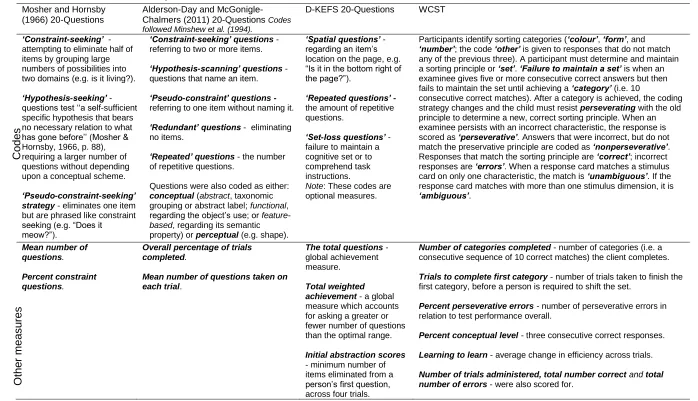
The Wisconsin Card Sorting Test (WCST; Heaton, Chelune, Talley, Kay, & Curtiss, 1993) is a commonly used neuropsychological test of concept formation (Maddox, Filoteo, Glass, & Markman, 2010) for people aged 7-89. Participants are asked to match cards in line with one of three classifying criteria (colour, shape, number of features), but are not told how to match them and the sorting rule changes without warning after 10 successive correct pairings. Participants have to reach a conclusion based on the examiner’s reaction to their previous response. Success on this task mainly depends on: the ability to detect and shift to an abstract sorting principle, conceptualisation, inhibition of irrelevant
responses, cognitive flexibility, and working memory (Gligorović & Buha, 2013).
In using the WCST with children, some research has indicated that at 10 years, children’s abilities in switching contexts and inhibition of irrelevant responses reaches that typically observed in adults (Huizinga & van der Molen, 2007; Welsh, Pennington, & Groisser, 1991); with both typically developing (Chelune & Baer, 1986) and clinic-referred paediatric children (Chelune & Thompson, 1987). However, the ability to ‘maintain a set’, for which working memory is largely responsible, appears to continue to develop after the age of 10 (Huizinga & van der Molen, 2007). The WCST test is seen as being good at capturing
researchers have questioned its construct validity. For example, Barceló (2001) reports that some of the WCST scores do not inform on the nature of cognitive impairment, a critique which underlies some other criticisms about the WCST lacking reliability and validity in pinpointing damage within the prefrontal cortex (Bowden et al., 1998). That said, the WCST scores are still good at identifying a person’s general executive system abilities including a person’s attention (Lezak, 1995).
The Brixton Spatial Anticipation Test (Burgess & Shallice 1997) has similarities with the WCST, as examinees have to work out the rules and rule changes based on the examiner’s response to their last selection, except this task uses a grid within which placement of a blue dot changes. However, while the WCST can be used with children as well as adults, the Brixton task has not been normed with children. An additional disadvantage of this task, is that the scoring system used involves ‘Sten scores’ as a metric (meaning that scores correspond to a 0.5 of a standard deviation). Thus there is potential for meaningful differences between raw scores to be obscured.
The Concept Formation subtest of the WJ-III-Cog is normed for people aged 2-95 years. It involves visual puzzles consisting of squares and circles outside and inside a box. Examinees are required to ask questions in order to identify and then verbalise underlying concepts and rules for being included in the box (e.g. colour). This subtest includes items for single comparison (one box with only one sorting criterion), multiple comparisons with a single rule (multiple boxes with one sorting criterion), and multiple comparisons, with multiple rules (multiple boxes and rules, alongside either an “and” or an “or” relational concept, e.g. “Yellow and two”). A strength of this test is the large sample across a wide age range was used to standardize this measure (Edwards & Oakland, 2006). However, the WJ-III-Cog has been reported to have low construct validity and low subtest reliability for some of its subtests (Campbell, Brown, Cavanagh, Vess, & Segall, 2008).
guess the meaning of the pseudo-word after each clue. Floyd et al. (2006)
demonstrated this subtest had a reliable convergent validity with WJ-III-Cog tests in a large sample of adults and children.
The 20-Questions task originated from a game whereby a person asks yes/no questions in order to guess the name of a famous person (Baldo et al., 2004). In neuropsychological testing, this has been adapted to assess executive functions such as abilities in planning, seeking, and organising stimuli while monitoring feedback (Anderson, 1998). This task uses a paper containing pictures which can be categorised into multiple groups (e.g. plants, vehicles), and participants have to try to find a target picture through asking “yes/no” questions. Mosher and Hornsby (1966) were the first to adapt a 20-Questions task into a neurocognitive test (Remine, Care & Brown, 2008) to investigate the types of questions
examinees asked, and how examinees utilised feedback to generate strategies. Mosher and Hornsby classified the questions asked as either ‘constraint seeking’ (i.e. attempting to eliminate half of the items), ‘hypothesis seeking’ (involving “a series of questions, each of which tests a self-sufficient specific hypothesis that bears no necessary relation to what has gone before’’, Mosher & Hornsby, 1966, p. 88) or ‘pseudo-constraint-seeking’ strategies (i.e. questions that eliminate only one object at a time, but are phrased similarly to ‘constraint seeking’ questions, e.g. “Does it meow?”). Alongside concept formation, this task tests a person’s working memory as they are faced with an unchanging array of pictures and have to remember which items their questions have eliminated. Also, cognitive
flexibility is needed as participants are required to adapt their questioning according to a changing information set (Alderson-Day & McGonigle-Chalmers, 2011). This concept formation task differs from other tests by providing a larger amount of items within a hierarchical structure, which provides a wider
assessment of the examinee’s categorisation skills (Baldo et al., 2004).
More recently, the D-KEFS 20-Questions task (Delis et al., 2001) was developed for people aged 8-89 years. Similarly to Mosher and Hornsby’s (1966) test, this task assesses concept formation from examinees’ verbal responses during a task involving pictures of items organised in such a way to provide structured
animals). Examinees must identify categories in order to subdivide the items and eliminate irrelevant items through asking as few yes/no questions (maximum of 20) as possible to guess the correct answer (e.g. ‘‘Is it an animal?’’, Siegler, 1977) while keeping track of their previous responses and modifying answers based on examiners’ feedback.
A limitation of such tasks is that they rely on a participant’s language abilities, and require a participant to use their working memory to keep track of their previous questions, and which corresponding items have already been eliminated
(Alderson-Day & McGonigle-Chalmers, 2011), thus the scores on this task do not just reflect a person’s concept formation abilities. These critiques have led some researchers to make adaptions to this task. Alderson-Day and
McGonigle-Chalmers (2011) proposed a 20-Questions task with novel robot characters and allowed participants to physically eliminate irrelevant items to reduce working memory demands. They developed this novel task to test it against a standard 20-Questions task with both children with ASD and typically developing children to assess whether the adapted test was more suitable for children with ASD. Despite some limitations to this task (see section 1.4.3.2.), this adapted version of the 20-Questions task was developed in such a way to be accessible to children and thus it was one of the tests that inspired the creation of the test created in this study (see section 1.6.2.).
Despite some critiques, 20-Questions tasks are popular among tests of concept formation due to being an enjoyable and engaging task. Baldo et al. (2004) found the 20-Questions task is tolerated and well enjoyed by both control participants and those with focal prefrontal lesions, unlike some tests of concept formation which can cause frustration or refusal from the latter group of participants. This task being enjoyable is particularly pertinent to children, as using a task that is more ‘game-like’ can increase engagement (Gioia, 2015).
1.4.2.3. Considerations - The standard process in neuropsychological tests of concept formation differs from most other neuropsychological tests. For example, within the 20-Questions tasks, the examiner does not measure whether
the quality or process of the questions asked (Lezak et al., 2004). However, this follows an assumption that a person’s concept formation abilities can be tested through the examiner’s qualitative judgments of whether the examinee’s answers were: simple or complex, abstract or concrete, apt or irrelevant (Lezak et al., 2004). Additionally, Albert and Knoefel (2011) report that the process of an examiner scoring participants’ responses in tests of concept formation can be problematic, as scores may reflect their own experiences, cultural background, and biases, alongside their choice of test. However, this assessment process appears to be in line with current research on concept formation, as it provides a means for examinees to demonstrate their ability to alter their approach based on feedback and problem solve when faced with a range of options.
1.4.2.4. Principles of good cognitive tests for children – most of the tests that are widely used to test children’s concept formation abilities were originally
developed for use with adults. As creating a test of concept formation specifically for children is a new area of research, there are currently no principles to guide how to create such a test. However, some researchers have identified general principles of how to conduct a good cognitive assessment with children. Yeates and Taylor (2001) propose four principles of child neuropsychological
assessment based on models of neuropsychological assessment (including Bernstein, 2000; Taylor & Fletcher, 1990; Yeates & Taylor, 1998): adaptation; brain and behaviour; context; and development.
Adaption describes the child’s interactions between themselves and their
environments. Failing to adapt can result in a child struggling with school work or socially. Neuropsychological assessments should thus help to explain why a child is failing to adapt in order to facilitate outcomes in future at school, home and later life.
making the test more suitable for the child’s age in order to enhance
engagement. Gioia (2015) found that using a game-like procedure can increase engagement in children, yet to the researcher of the present study’s knowledge, there are no widely used game-like tests of concept formation that have been designed specifically for children. Other considerations include the test not being too long in order to not exhaust a child’s attention span, and making the test fit for the child’s size (e.g. making children’s blocks not too big).
During an assessment, the examiner must also explore the child’s context to rule out any other potential causes for adaptation difficulties. Thus while measuring a child’s cognitive skills; the examiner must also determine how children apply these to meet the demands of their own environments in order to make more specific and informed recommendations (Bernstein, 2000).
Behavioural and cognitive development results from an interplay between biology and a child’s environment, and involves new skills emerging, such as language, and we lose earlier abilities such as more primitive reflexes (Dennis, 1998). Thus the tests must be appropriate to a child’s developmental level. The test
instructions should be written using accessible language that the children understand, and they should be suited to the developmental level of the child (e.g. McGarrigle and Donaldson, 1974).
1.4.3. Aetiology of Difficulties
There are several potential causes of executive dysfunction in children which can be separated into two main sources: brain damage (Elliott, 2003) and congenital disorders (Friedman et al., 2008). Below is a discussion of brain injury and
pervasive developmental disorders which are two areas which cover some of the more common reasons for deficits in concept formation in children.
(Headway, 2017). They are also especially vulnerable to Traumatic Brain Injury (TBI), due to their large size and location at the front of the brain. Even a knock to the back of the head can lead to frontal lobe injury due to the brain moving within the skull as a result of the impact (Headway, 2017). Fairly common sequelae in children with TBI includes inattention and impairments in problem solving (Donders & Kuldanek, 1998). Other researchers have indicated that conceptual functions tend to be impacted after a brain injury regardless of the site of the injury (Luria, 1966; Mesulam, 2000).
These deficits have been demonstrated in research using neurocognitive testing. Burgess and Shallice (1997) found a highly significant difference between the performance of adults with frontal lesions and controls on the Brixton Spatial Anticipation Test. Baldo et al. (2004) found in their study using the D-KEFS 20- Questions task, that people with pre-frontal lesions asked significantly more questions than the control group and sometimes exceeded the 20 questions limit. These participants tended to use less effective category selection (e.g. asking a question relating to only one item), and were more likely to use repetitive
questions (3%) compared to controls (1%). This study only used a relatively small number of brain injured participants (n=12) due to a strict inclusion criterion
(including normal language abilities, focal frontal lesion). This was deemed necessary to provide consistency within their population to test for difficulties in concept formation in the absence of other factors such as language dysfunction or memory deficits.
Kizilbash and Donders (1999) tested the performance of 9-16 year old children who had a TBI diagnosis on the WCST. They found an association between younger age and longer duration of coma with poorer performance. However, not every child with a TBI performed badly on the WCST; a third of the children completed the test.
categories (Frith, 2003) such as train timetables. These interests traditionally fall within the ‘restricted interests and repetitive behaviours’ third of the autistic ‘triad of impairments’ (Wing, 1996). The categorisation process is fundamental in
efficient information processing (Rosch, 1978), and therefore difficulties in dealing with departure from familiarity or fixations on particular categories could perhaps reflect abnormal or deficient categorisation processes. Many studies document that individuals with ASD have difficulties with tasks testing concept formation, such as reduced completion of category sorting on the WCST (Lopez, Lincoln, Ozonoff, & Lai, 2005; Shu, Lung, Tien, & Chen, 2001). It has been suggested that the typically observed restricted and repetitive characteristics in people with ASD could be due to difficulties with category generation, or biases in forming and using categories (Klinger & Dawson 2001). Ropar and Peebles (2007) found individuals with ASD had sorting preferences for concrete over abstract
categories. Much research has indicated that people with ASD complete
significantly less trials than controls in the 20-Questions task and tended to use questions that eliminated single items rather than identifying and eliminating categories (Minshew, Siegel, Goldstein, & Weldy, 1994).
These findings suggest that there may be a fundamental problem in concept formation in people with ASD (Minshew, Meyer, & Goldstein, 2002). Although people with ASD seem to recognise and learn category groupings similarly to those without ASD, they may have difficulties generating categories as an information processing strategy (Alderson-Day & McGonigle-Chalmers, 2011). Interpreting reasons for impaired performance on 20-Questions tasks can,
however, be problematic as these tests pose various complex demands, such as use of working memory. As working memory deficits have been widely reported in people with ASD (e.g. Williams, Goldstein, & Minshew, 2006), this could contribute to problems on this task.
Alderson-Day and McGonigle-Chalmers (2011) compared results from a standard Questions task (based on Mosher & Hornsby’s 1966 and D-KEFS
questions during the novel task, when they could physically eliminate items, than the standard 20-Questions task. Overall participants with ASD asked ‘lower quality’ questions than controls on both tasks (i.e. using category groupings which eliminated fewer items). They also found ASD participants performed worse than controls in completing a standard version of the 20-Questions task. They were unable to assess overall performance on their novel task due to ceiling effects. Further limitations include a small sample size (n=14 in each group) and the children in each group were not matched on their verbal ability. These limitations mean it is unclear the extent to which conclusions can be generalised from this study (Alderson-Day & McGonigle-Chalmers, 2011). However, this study still provided useful information regarding how people with ASD problem solve and use concepts compared with controls. The findings also indicate that allowing physical elimination of items appeared to usefully reduce the working memory demands on the participants.
1.4.4. Impact of Deficits
The impact of having concept formation deficits is multifactorial, from impacting a child at school, to their psycho-social development. This next sub-section will explore these impacts in more detail.
1.4.4.1. Academic difficulties –concept formation is necessary for the
development of various academic and adaptive skills (Gligorović & Buha, 2013) including reading, writing, and mathematics. Some research studies have indicated a strong association between children’s conceptual skills and their performance on tests of vocabulary knowledge (Langer, 1967) and reading comprehension (Braun, 1963). While reading, conceptual thought underlies formation of complex relationships between characters and understanding of the story’s plot (Guthrie et al., 2004), alongside giving an overall gestalt of the
purposes for the reading material. Expressing ideas through writing also involves conceptual organisation of ideas, in order to write in a coherent way while
Concept formation and problem solving abilities are also used in a range of mathematical processes including operations, such as subtraction, and in understanding what these operations and the applications of these represent.
Research in this area has indicated that a child’s conceptual mathematical skills when they start school are highly predictive of their later academic success (Duncan et al., 2007). Additionally, both a child’s literacy and mathematical conceptual abilities in early life have been shown to be correlated with long-term influences on their quality of life, such as future employment and salaries
(Bynner, 1997; Rivera-Batiz, 1992). In fact, concept formation, i.e. the realisation of what objects belong together, seems to be a key part of every intellectual function (Reichard et al., 1943). Therefore, it is not surprising that many
intelligence tests include testing a person’s concept formation abilities (Wechsler et al., 2004).
The importance of concept formation in academic abilities was demonstrated in a case study by Levi (1965). Levi described the yearlong treatment of an 11-year-old boy, Stephen, who was referred for reasons including long-term ‘poor
schoolwork’. Stephen’s intervention focused on developing his concept formation abilities through three phases: learning to generalise, learning about relations between concepts, and being able to notice conceptual relations. Afterwards, Stephen’s WISC scores increased, most notably his ‘Similarities’ score (from a scaled score of 7 to 14), which is a test considered to be a measure of concept formation (Rapaport, 1946). Stephen’s school grades also increased to being within the average range for his age, and a 6 months follow-up showed his school performance had continued at this level. It is unclear how generalizable the
From their study with children with mild intellectual difficulties (MID), Gligorović and Buha (2013) concluded that poor WCST results may result from children with MID having difficulties in generating a new pattern of concepts, task
conceptualisation or shifting between mental sets. They concluded that progress in conceptual abilities is achieved when a child develops their abilities in mental set flexibility. Thus, they recommended that interventions should offer activities that are specifically designed to vary in their actions, attentional demand, conceptual patterns, and content. These findings can only be generalised to children aged 10-13 years old, as this was the sample used in this study. However, this study provided an important suggestion that in order to test concept formation abilities, a test should be able to capture a child’s ability to flexibly switch between sets, such as a task which requires children to adapt their answers based on examiner feedback.
1.4.4.2. Psycho-social difficulties - a child’s concept formation abilities are also
important for information processing outside of the academic domain. Conceptual thinking is crucial in social interactions in order to comprehend and relate to others’ points of view (Castellanos et al., 2015). Verbal communication relies upon concepts being transmitted through language. Thus, concept formation abilities play an integral role in a child developing adequate verbal
communication skills. Whether in a playground, or presenting to classmates in a class room, these skills are guided by general concepts which involve the
organisation of materials, ideas, and planning, which are key foundational components within executive functioning (Gioia, Isquith, Guy, & Kenworthy, 2000).
Gioia et al. (2000) posit that concept formation is a core foundational cognitive function in everyday functioning which underlies abilities in forming, applying, and manipulating concepts. Due to concept formation being an integral part of
WJ-III-Cog test than normally hearing participants. However, as a cross-sectional, correlational design was used and relatively few deaf children with cochlear implants were recruited, it is not clear the extent to which the findings can be generalised.
This sub-section has described the importance of concept formation abilities in a child’s everyday life. It has also discussed some research demonstrating that concept formation difficulties can be helped and improved. Thus if we were able to identify and provide appropriate interventions early this could help children improve their day-to-day functioning and long term quality of life.
1.5. Summary of Literature Review
From the literature discussed in the above sub-section, it can be seen that the main, current tests of concept formation used with children (usually aged 7 years and above) were developed for adults. However, crucial developments of concept formation abilities begin very early in a child’s life (see section 1.4.1.3.).
Additionally, neurological development is thought to continue throughout childhood, with the frontal lobes (associated with concept formation abilities, Morris et al., 1993) being the final neurological structure to mature at
approximately 12-14 years (Lord-Maes & Obrzut, 1997). Therefore, it is important to also be able to capture concept formation abilities as they are developing. Some research has suggested that children and adults reason in different ways, with children’s concept formation abilities being underdeveloped in children (e.g. Piaget, 1964; Starkey, 1979). However, this has been questioned by the
development of more sensitive tasks (Gelman & Baillargeon, 1983), including those using accessible language, instructions suited to the developmental level of the child, and a more sensitive research design (e.g. McGarrigle and Donaldson, 1974) in order to more accurately assess a child’s concept formation abilities (Wood et al., 2001).
example; with adults, the face validity of the task (Nevo, 1985) is important for engagement (i.e. the test should look valid, as well as being valid). However, for children, using a game-like procedure can increase engagement (Gioia, 2015). Channon and Crawford stated in 1999 that there were very few cognitive tests that had been designed specifically for concept formation in children; having reviewed the literature, this is still the case. While some tests of concept
formation have been adapted for children, there are no game-like tests of concept formation being widely used, which is a weakness given that children are
reportedly more engaged more by this type of task (Gioia, 2015). Therefore, based on previous literature, in order to create a test of children’s concept formation abilities in a way that will give the best indication of a child’s potential, this study must create a test that is specifically designed for children by using a game-like task with instructions that are easily accessible to the child’s
developmental level.
1.6. Present Study
1.6.1. Aims and Rationale
This current, exploratory study is the first phase in the development of a new neuropsychological test of concept formation; the Alien Game. The Alien Game was created with an aim of being an enjoyable and engaging psychometric tool for children, with clear instructions, through using a game-like procedure. A benefit to this design is that children (particularly those with difficulties in
which could be used to assess and identify deficits in concept formation in children earlier, providing an opportunity for earlier clinical intervention.
1.6.2. A Game-Like Procedure
Games such as ‘Guess Who?’ are conceptually similar to the 20-Questions task and WCST in that they involve a participant abstracting a category, keeping track of their questions and responses, and modifying their questions based on
feedback (Baldo et al., 2004). In the original version of ‘Guess Who?’ two participants select a character and ask yes/no questions in turn to try to guess their opponent’s character, and therefore win the game.
Ideas for the Alien Game were developed from Mosher and Hornsby (1966) and Alderson-Day and McGonigle-Chalmers (2011) 20-Questions tasks, and ‘Guess Who?’. Alderson-Day and McGonigle-Chalmers (2011) created a version of the 20-Questions task that used pictures of 24 robots on a hinged board. This made the task more similar to games such as ‘Guess Who?’ and thus the researcher felt that this made the task more accessible and enjoyable for children. An original version of ‘Guess Who?’ was not used for a number of reasons. Firstly, as some children may be familiar with the ‘Guess Who?’ game, the pictures in this task were changed to custom-drawn 'Aliens' (Appendix A) thus reducing the chance of ‘practice effects’ (e.g. participants familiar with ‘Guess Who?’ may have a strategy and be less anxious about the task than someone who has not played ‘Guess Who?’ before). ‘Aliens’ were chosen to appeal to younger children. The pictures of Aliens, with made up names, were also chosen to make the test more culturally fair, as the pictures were novel to all participants. Additionally, whereas traditional 20-Questions tasks allow items to be categorised in line with conceptual criteria (e.g. animals, vehicles, tools, etc.), which can be culturally laden, this task only required perceptual categories to be utilised. The perceptual characteristics (e.g. colours and shapes) were organised in such a way to provide structured, category groupings.
memory demands of this test (Alderson-Day & McGonigle-Chalmers, 2011). Unlike ‘Guess Who?’, the ‘Alien Game’ was only played one way (with the participant asking questions), to make it similar to the 20-Questions tasks, while ruling out the possibility that the examinee’s questions may be affected by the examiner’s questions.
Finally, as the task is highly verbal in nature, there is a chance that a deficit in language abilities could impact upon a person’s score (Alderson-Day &
McGonigle-Chalmers, 2011). As language demands of this task could not be minimised easily by modifying the current procedure, an examinee’s verbal abilities were measured by administering the Similarities task (WISC-IV) to test whether any participants had any verbal deficits.
Similarly, the Matrix Reasoning task was administered to test whether any children had any visuo-spatial difficulties. The Similarities and Matrix Reasoning tasks were selected as they are both tests of concept formation, but as they use a different format to the Alien Game (a single trial format rather than a multi-trial) they would not lead to the child’s scores being affected by practice effects.
1.7. Research Questions
The present research study aimed to answer the following questions:
1) Do children from a non-clinical sample adopt similar strategies when completing the Alien Game?
2) Can we establish normative performance characteristics (including scores and typical patterns of responding) from the results that capture normal variation of concept formation?