178 | P a g e
STANDARDIZATION OF CLASH DETECTION IN
BIM
Mrs. Ashwini R.Patil
Asst. Prof D.Y. Patil College of Engineering, Akurdi, Pune (India)
ABSTRACT
This document gives a brief introduction to the utilization of Building Information Modelling (BIM) coordination in Architecture Engineering and Construction (AEC) industry. It also focuses on the process of simplifying and standardizing the process of Clash Detection using Navisworks.
Keywords: AEC, BIM, Coordination, Clash Detection, Standardization, Cost optimization,
Methodology, Scope.
I INTRODUCTION
1.1 BIM:
Building Information Modelling (BIM) is process that supports virtual design and construction methodologies putting all team members together throughout the entire design and construction process and beyond to the operations in maintenance of the building, during its working life. Typically, BIM is one holistic process using real-time, intellectual modelling software effectively working in 3D, 4D (3D + time), and 5D (4D + cost) to improve productivity, to save money and time in the design and construction phases, and to reduce operating costs after construction.
Necessity of BIM:
It is also important to highlight the increasing necessity of BIM, and its overall cost-effectiveness. When it comes to the decision-making process, no tool outperforms BIM in clarity of purpose and scope. Each week in the owners’ meeting, we observed a communication process that was primarily dependent on oral exchange among meeting participants supported by 2D text and graphics. When the digital drawings are brought out though, a decision is often made in only minutes. As projects become increasingly complex, BIM becomes more and more necessary for all participants to understand what is taking place. It could also be argued that the financial savings of efficient decision-making and fewer project changes will cover the cost of maintaining an accurate model. It is likely that complete BIM services will pay for itself over the life of a project. It is for these reasons that this major qualifying project recommends a gradual investment in BIM technology for all applications in Construction Project Management.
179 | P a g e
A clash occurs when elements of different models occupy the same space. A clash may be geometric (for example, pipes passing through walls), schedule based (when different aspects of work that are supposed to be sequential are scheduled to occur together or in reverse), or changes/updates not made to drawings.
There are 3 main types of clashes that clash detection seeks out:
1. Hard Clash: when two objects pass through each other. Most BIM modelling software eliminate the likelihood for this using clash detection rules based on embedded object data (like the image above) 2. Soft Clash: work to detect clashes which occur when objects encroach into geometric tolerances for other objects (for example, a building being modelled too close to a high tension wire).
3. 4D/Workflow Clash: clash resolves scheduling clashes and abnormalities as well as delivery clashes (for example, work crews arriving when there is no equipment on site)
Features of Clash Detection:
1. Clash detection helps in effective identification, inspection and reporting of interferences in a project model.
2. It is used for checking completed/ongoing work and reduces the risk of human error during model inspections.
3. Clash detection is necessary because several models (structural, MEP, etc) are integrated into one main BIM model.
4. With clash detection, mistakes which normally would have been discovered on the site (with high cost and schedule implications when corrected at that stage) can now be seen in the office even before anyone sets foot on the site.
5. BIM even makes clash detection possible for objects within objects (a steel rod completely immersed inside a concrete wall)
BIM Software Available for Clash Detection:
1. BIM modelling design software:
Clash detection within this is limited as it can only work on models created by the software (proprietary models.) For example, when you try to place a slab on a set of walls that do not make contact with each other in Revit, the software notifies you of a clash.
2. BIM Integration tools that perform clash detection:
180 | P a g e
II METHODOLOGY
Clash detection with Navisworks software:
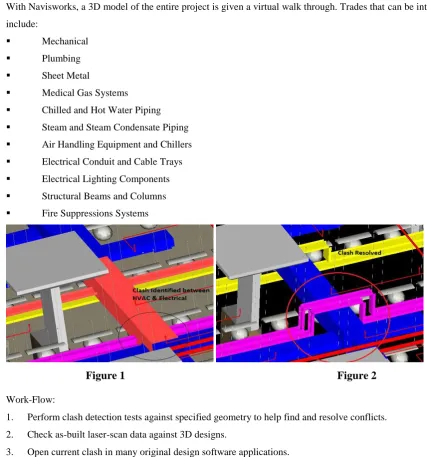
Navisworks provides a platform for integrating all of the trades, even those with different 3D programs, into one system in order to build a comprehensive and interactive, three dimensional model of each project we perform. Navisworks predicts clashes by combining all of the trades in the virtual world, allowing us to revise plans and schedules to resolve conflicts before construction begins. This saves thousands of man hours that would be spent working through these issues in the field. Doing it right the first time, with a comprehensive 3D representation of the project, preserves valuable resources of time and money.
With Navisworks, a 3D model of the entire project is given a virtual walk through. Trades that can be integrated include:
Mechanical
Plumbing
Sheet Metal
Medical Gas Systems
Chilled and Hot Water Piping
Steam and Steam Condensate Piping
Air Handling Equipment and Chillers
Electrical Conduit and Cable Trays
Electrical Lighting Components
Structural Beams and Columns
Fire Suppressions Systems
Figure 1
Figure 2
Work-Flow:
1. Perform clash detection tests against specified geometry to help find and resolve conflicts. 2. Check as-built laser-scan data against 3D designs.
3. Open current clash in many original design software applications.
181 | P a g e
7. Create Hard, Clearance, and Duplicate clash tests to support multiple coordination scenarios. 8. Analyze space and time by linking clash tests to 4D simulations and object animations.
Clash detection with BIM 360 Glue:
1. Find Clashes.
Select the models to compare for the clash analysis. 2. View Clash Results.
Identify problem areas by grouping the results associated with specific models. 3. Add a Clash Mark-up
Annotate clash results with text or linear mark-ups. 4. Send Clash Notifications.
For each individual clash or group of clashes, you can send notifications to inform project members so that the conflicts are addressed.
5. Resolve Clashes.
182 | P a g e
IV SCOPE OF WORK
1. To build a BIM Architectural, structural and services model, coordinate between all the services, model the interiors and coordinate that with the other disciplines
2. The Architectural, structural and services models were imported into Navisworks software to identify the clashes among various disciplines. The clashes were identified, resolved and the 3D BIM model was updated to incorporate these resolved clashes.
3. Carry out clash detection in BIM 360 Glue. 4. To study the clash reports.
5.
To provide the simplified and standardized solutionfor clash detection process.
V RESULTS
1.
Cost optimization in project scheduling and Execution.
2.
Quality management reports.
3.
Calculating the efficiency of clash detection software such as Naisworks and BIM 360 glue.
4.
Implementation for Indian conditions.
VI CONCLUSION
1. The first thing that should be done by Navisworks users before they go ahead with conducting a clash test is to effectively set up the elements or items that they would like to compare during clash detection in the Batch tab.
2. This can be done by accessing clash detective tool from where Batch tab can be accessed by Navisworks users.
3. Elements of a model are compared with the elements of another model so that if they are clashing with each other it can be identified in the clash detection process.
4. One of the most important tasks of Navisworks users is to effectively recognize the clashes and then group them according to their similarity.
5. When clashes are grouped together according to their potential to create obstacles for AEC professionals in construction, it becomes easy for them to understand the nature of the clashes.
REFERENCES
1. Clash Detection - A New Tool in Project Management: Pranav Bhagwat, Rahul Shinde, 2016 IJSRSET | Volume 2 | Issue 4 | Print ISSN: 2395-1990
2. Root causes of clashes in building information models: Iris D. Tommeleinand Sepide Gholami
183 | P a g e
4. IFC-based clash detection for the open-source BIM server: P. van den Helm, M Böhms & L van Berlo TNO Built Environment and Geosciences, NL
5. A Review of Building Information Modeling (BIM) for Construction Industry: N. S. Chougule, Prof. B. A. Konnur, International Journal of Innovative Research in Advanced Engineering (IJIRAE) Issue 4, Volume 2 (April 2015).
6. Implementing building information modelling (BIM) at AEC firms in India: Aarti Nanajkar, A Paper Submitted to the Graduate Faculty of the North Dakota State University.
7. Scope of Building Information Modelling (BIM) in India: J. Vinoth Kumar and Mahua Mukherjee, Department of Architecture and Planning, Indian Institute of Technology, Roorkee, India. Journal of Engineering Science and Technology Review 2 (1) (2009) 165-169.