27 | P a g e
An Efficient Protocol with Bidirectional Verification for
Storage Security in Cloud Computing
1
Ch. Rachana,
2A.Mahesh
1
Pursuing M.Tech (CSE),
2Working as an Assistant Professor, Department of CSE,
Visvesvaraya College of Engineering & Technology, Affiliated to Jntuh, Telangana, (India)
ABSTRACT
In distributed computing, information proprietors have their information on cloud servers, and clients can get to
the information from the cloud servers. This new worldview of information facilitating administration
additionally presents new security challenges that require an autonomous reviewing administration to check the
uprightness of the information in the cloud. Some current strategies for checking the trustworthiness of the
information can't deal with this issue effectively and they can't manage the mistake condition. Consequently, a
safe and effective dynamic evaluating convention should dismiss demands that are made with uncalled for
confirmation. Also, a phenomenal remote information confirmation strategy ought to have the capacity to
gather data for measurable examination, for example, approval comes about. In this paper, we outline an
evaluating structure for distributed storage frameworks and propose a proficient and privacypreserving
reviewing convention.
At that point, we stretch out our evaluating convention to help dynamic information operations, which is
productive and has been ended up being secure in the arbitrary prophet show. We stretched out our evaluating
convention further to help bidirectional verification and factual investigation. What's more, we utilize a superior
load conveyance technique, which enormously decreases the computational overhead of the customer. Last, we
give a blunder reaction conspire, and our tests demonstrate that our answer has great mistake taking care of
capacity and offers bring down overhead costs for calculation and correspondence than different
methodologies.
I . INTRODUCTION
28 | P a g e
the cloud. As a result of comfort and effectiveness, the fame of cloud capacity has expanded quickly. Normal clients and additionally numerous
Substantial firms have a tendency to outsource their information to spare their own storage room. Some little organizations store their information in the cloud in light of the high cost of devoted stockpiling offices.
Tragically, this new worldview of information facilitating benefit likewise has presented new security challenges. In expansion, how to recover the encoded document is likewise an essential issue. The Data Owner(s) would stress that the information could be altered (or erased) in the cloud. They have this worry since they realize that information can be lost in any foundation, independent of the degree of dependable measures to keep this from happening. Moreover, here and there cloud benefit suppliers might be exploitative. The server may dispose of some document hinders that have not been gotten to or seldom got to spare storage room and claim that the majority of the documents are as yet in place. Continuously, the security of documents has turned into a major issue in the field of distributed storage. Clients are starting to stress over the security of their documents. The organizations that give cloud processing administrations know about this, and they get it that their organizations will fall without dependable security. There are numerous cases that demonstrate this can be a genuine issue, e.g., Amazons S3 breakdown, Gmail’s mass erasure of messages, the Sidekick cloud debacle,
and Amazons EC2 administrations blackout. Accordingly, the Data Owners must have an instrument to affirm whether their documents are in great condition on the server
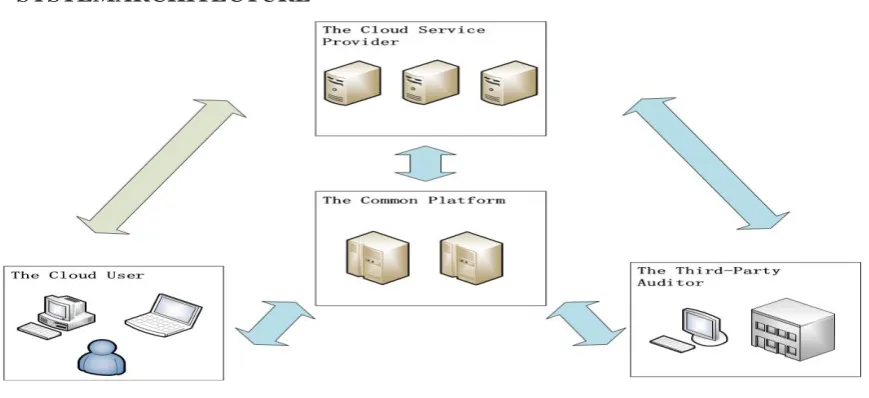
II SYSTEMARCHITECTURE
Fig :System Model
III RELATED WORK
29 | P a g e
with a specific likelihood by approaching confirmation for a consistent measure of obstructs that are autonomous of the add up to number of document pieces. Also, this conclusion gives the probabilistic evidence strategy a hypothetical premise. Be that as it may, their plans did not consider dynamic updates.E raw yet al. proposed a test reaction convention to settle this issue. Afterward, numerous different creators in this field likewise proposed their own particular arrangements .Moderately, arrangements have been talked about in past papers, however was not appropriate for huge information and cluster preparing on the grounds that the calculations of those plans were too expansive. Some new label count techniques have been proposed keeping in mind the end goal to decrease the measure of calculation. Notwithstanding these issues, Yan et al. talked about the issue of multi-distributed storage in their paper. Quickly, multicloud capacity is when distinctive parts of a record are put away on various servers. They partitioned the framework into three layers, i.e. the capacity layer, benefit layer, and express layer. All administration suppliers are viewed as a collection through the threelayer mapping. Afterward, many creators tackled this issue in a comparable way. Maybe roused by the multi-cloud, a few people started to focus on the issue of various proprietors. Wang et al. utilized a bilinear total mark plot to take care of this issue. It can total a few unique.
IV. OBJECTIVE
Character Based Encryption with Outsourced Revocation really manages the Advanced Encryption Standard(AES) Algorithm, where enter era comes into contact. Here there is an era of two specific keys 1. Private Key Generation (PKG)
2.Out Sourced Key (OST)
Where first key is created by the Private Key generator and second key is produced by Cloud Service Provider(CSP). The principle goal of this undertaking is to give the seeking choice in two courses i.e.; by question looking and substance seeking.
V. MOTIVATION
In many Cloud sites there are numerous who look for records pictures and numerous different things which are identified with their routine and work .Where we are losing the personality of the records. To dispose of the sort of issue the Identity Based encryption with outsourced repudiation comes in point and takes out the issue of looking through the content based documents or pictures or anything. Where client can look through his/her related content.
VI. EXISTING SYSTEM
30 | P a g e
for customers to sporadically restore their private keys without teaming up with PKG. Regardless, the doubt required in their work is that each customer needs a modify safe gear device. Another course of action is center individual bolstered repudiation: In this setting there is a one of a kind semi-trusted outcast called a go between who encourages customers to interpret each figure content. If an identity is denied then the go between is advised to stop helping the customer. Plainly, it is unfeasible since all customers can't translate in solitude and they need to relate with center individual for each unscrambling. Starting late, Lin et AL proposed a space viable revocable IBE part from non-monotonic Quality Based Encryption (ABE), however their advancement requires times bilinear mixing operations for a lone unraveling where is the amount of denied customers. To the degree we know, the revocable IBE design displayed by Bold Riva et al. remains the best course of action as of now. Liberty and Vergnaud improved Bold Riva’s advancement to achieve flexible ID security. Their work focused on security enhanced, yet obtains the similar downside as Bold Riva’s one of a kind improvement. As we indicated some time as of late, they are short away for both private key at customer and combined tree structure at PKG.
VII. EXISTING DISADVANTAGES
From the above experimental data, we can find that thechange of detection probability is very small. This indicatedthat our scheme was feasible. Next, we used an experiment tojustify the efficiency of our scheme. Let’s address the securitylevel first.
For CSP, there are two situations, i.e.,
1) to allowCSP to know the location of important blocks and 2) notto allow CSP to know the location of the important blocks.
.
VIII. PROPOSED SOLUTION
In this paper, we bring outsourcing calculation into IBE disavowal, and formalize the security meaning of outsourced revocable IBE interestingly to the best of our insight. We propose a plan to offload all the key era related operations amid key-issuing and key refresh, leaving just a steady number of basic operations for PKG and qualified clients to perform locally. In our plan, as with the proposal, we understand disavowal through refreshing the private keys of the unrevoked clients. In any case, not at all like that work which inconsequentially links day and age with personality for key era/refresh and requires to re-issue the entire private key for unrevoked clients, we propose a novel conspiracy safe key issuing method: we utilize a cross breed private key for every client, in which an AND door is included to interface and bound two sub-parts, to be specific the character segment and the time segment.
31 | P a g e
need to re-issue the entire private keys, however simply need to refresh a lightweight segment of it at a particular element KU-CSP. We likewise determine that
1) with the guide of KU-CSP, client needs not to contact with PKG in key-refresh, at the end of the day, PKG is permitted to be disconnected in the wake of sending the denial rundown to KU-CSP.
2) No protected channel or client confirmation is required amid key-refresh amongst client and KU-CSP.
IX. ADVANTAGES
In this proposed System there is a generation of the key. Such as Private key is generated by the private key
generator and outsourced key is generated by the Cloud Service Provider
Where these keys come in to work when the user want to view the content of the file and when user want to download the file. The actual purpose of the key’s are preserving the security by the users,
X.CONCLUSION
In this paper, focusing on the essential issue of character renouncement, we bring outsourcing estimation into IBE and propose a revocable arrangement in which the disavowal operations are allotted to PKG. With the guide of KU-PKG, the proposed plot is full-featured: 1) It achieves reliable capability for the two estimations at PKG and private key size at customer; 2) Client needs not to contact with PKG in the midst of key-upgrade, toward the day's end, USER is allowed to be logged off in the wake of sending the foreswearing once-over to KU-CSP; 3) No ensured channel or customer affirmation is required in the midst of key-update amidst customer and KU-CSP. Additionally, we consider torecognize revocable IBE under a more grounded foe demonstrate. We present a pushed advancement what's more , exhibit to it is secure under RDOC show, in which no short of what one of the KU-CSPs is believed to be totally straightforward. Appropriately, paying little mind to the likelihood that a precluded customer and both from claiming the KU-CSPs plot, it can't enable such customer re-to get his/her unscramble capacity. Finally, we give wide test results re-to show the profitability of our proposed improvement.
XI. FEATURE ENHANCEMENT
This undertaking is completely in view of creating the key and looking through the changed records. In view of these offices we can build up the new strategy for key era. For example, we can utilize OTP like key era method and which is send to the portable by message application. Presently a day we are utilizing messaging framework to send the private key and outsourced key to client. This informing office is a propelled strategy for past framework and in addition current working framework.
32 | P a g e
REFERENCES
[1] M. Armbrust, A. Fox, R. Griffith et al., ”A view of cloud computing,”Communications of the ACM, vol.53,
no.4, pp. 50-58,2010.
[2] M. Whaiduzzaman, M. Sookhak, A. Gani, and R. Buyya, ”A survey onvehicular cloud computing,” Journal of Network and Computer Applications,vol.40, pp. 325-344,2014.
[3] Mell, Peter M., and T. Grance. ”SP 800-145”. The NIST Definition ofCloud Computing.” Communications
of the ACM 53.6(2011):50-50.
[4] Guangjie Han, AihuaQian, Jinfang Jiang, Ning Sun, Li Liu, ”A Grid-Based Joint Routing and Charging Algorithm for Industrial WirelessRechargeable Sensor Networks”, Computer Networks, Vol.101, No.6,
pp:19-28, 2016
[5] Tie Qiu,DiansongLuo, Feng Xia, NakemaDeonauth, Weisheng Si, AmrTolba. ”A Greedy Model with Small
World for Improving the Robustness of Heterogeneous Internet of Things”, Computer Networks, 2016, vol.101, no. 6, pp. 127-143
[6] Ali, Masher, S. U. Khan, and A. V. Vasilakos. ”Security in cloud computing:Opportunities and challenges.” Information Sciences 305(2015):357-383.
[7] MLA Velte , Toby, A. Velte, and R. Elsenpeter. ”Cloud Computing, APractical Approach.” Spatial Science 60.1(2015):197-198.
[8] Zhihua Xia, Xinhui Wang, Xingming Sun, and Qian Wang, ”A Secure andDynamic Multi-keyword Ranked
Search Scheme over Encrypted CloudData,” IEEE Transactions on Parallel and Distributed Systems,vol. 27,no. 2, pp. 340-352, 2015
[9] Zhangjie Fu, KuiRen, JiangangShu, Xingming Sun, and FengxiaoHuang, ”Enabling Personalized Search over Encrypted Outsourced Datawith Efficiency Improvement,” IEEE Transactions on Parallel and DistributedSystems, DOI: 10.1109/TPDS.2015.2506573, 2015
[10] Zhangjie Fu, Xingming Sun, Qi Liu, Lu Zhou, and JiangangShu,”Achieving Efficient Cloud Search
Services: Multi-keyword RankedSearch over Encrypted Cloud Data Supporting Parallel Computing,”IEICE Transactions on Communications, vol. E98-B, no. 1, pp.190-200.
AUTHOR DETAILS
CH Rachana Pursuing M.Tech (CSE),( 15BT1D5810) from Visvesvaraya
College of Engineering & Technology, M.P. Patelguda, Ibrahimpatnam,
Hyderabad. Telangana , Affiliated to JNTUH, India.
Mr. Mahesh Akuthota : Working as Asst. Professor (CSE) in Visvesvaraya
College of Engineering and Technology, M.P Patelguda, Ibrahimpatnam (M),