
Charmonia in moving frames
S. Prelovsek1,2,3,, G. Bali1, S. Collins1, D. Mohler4, M. Padmanath1, S. Piemonte1, and S. Weishaeupl1
1Institute für Theoretische Physik, Universität Regensburg, D-93040, Germany 2Faculty of Mathematics and Physics, University of Ljubljana, 1000 Ljubljana, Slovenia 3Jozef Stefan Institute, 1000 Ljubljana, Slovenia
4Helmholtz-Institut Mainz, 55099 Mainz, Germany
5Johannes Gutenberg Universität Mainz, 55099 Mainz, Germany
Abstract.Lattice simulation of charmonium resonances with non-zero momentum pro-vides additional information on the two-meson scattering matrices. However, the reduced rotational symmetry in a moving frame renders a number of states with differentJPin the same lattice irreducible representation. The identification ofJPfor these states is particu-larly important, since quarkonium spectra contain a number of states with differentJPin a relatively narrow energy region. Preliminary results concerning spin-identification are presented in relation to our study of charmonium resonances in flight on theNf =2+1 CLS ensembles.
1 Introduction
Experiments discovered a number of interesting and exotic hadrons in the charmonium sector. Most of those appear near or above open flavor threshold. They have to be inferred from the two-hadron scattering matrices. So far, only one lattice simulation considered the charmonium resonances above open charm threshold, performing an exploratory extraction of their masses as well as decay widths [1]. This study considered only the total momentum zero, which provides only a rather limited infor-mation on the scattering matrix. Simulation of the system with non-zero total momentum (i.e. moving frames) provides additional information on the relevant two-meson scattering matrices. This presents the main motivation to consider charmonium(like) states in the moving frames.
On the other hand, simulations in the moving frames pose additional challenges compared to the rest frame. This holds particularly for the charmonium sector, since there are a number of states with differentJP in a narrow energy region. The main focus of this paper is to address part of those
challenges.
Here we consider the single-hadron approach and employ only quark-antiquark operatorsO=cc¯ .
The motivation is to identifyJP of “single-hadron” eigenstates. This will be helpful to spin-identify the narrow states once this study is extended to two-hadron scattering; such a study is pursued in parallel on the same CLS ensembles. The intermediate results at zero momentum were described at this conference in [2].
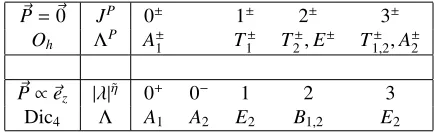
P=0 JP 0± 1± 2± 3±
Oh ΛP A±1 T1± T2±,E± T1±,2,A±2
P∝ez |λ|η˜ 0+ 0− 1 2 3
Dic4 Λ A1 A2 E2 B1,2 E2
Table 1.Upper part lists irrepsΛPof the octaheral group (P=0) and corresponding continuum quantum numbersJPof states that they contain. Lower part concerns momentumP∝ezwith the symmetry group Dic4:
it lists irrepsΛand corresponding values of helicity|λ|and ˜η=P(−1)Jfor the states that they contain (withPin ˜
ηreferring to the rest frame).
2 The challenge in moving frames
The charmonium spectrum is dense, as shown for example in Figure 3 of [3], which is obtained with the single-hadron approach andO=cc¯ . There is a number of states with differentJPC in a narrow
energy region, for example in the interesting region around 4 GeV. The purpose is to identifyJP of observed eigenstates in the moving frames.
The reduced rotational symmetry in the moving frame renders a number of states with different JPin the same irreducible representation, as detailed in the next Section. Parity is not a good quantum number in moving frames,since inversion transforms a system with momentumPto a system with
momentum −P. Helicity λ = J·P/|P| is a good quantum number instead. Fortunately, charge
conjugation is also a good quantum number in moving frames, which can be used as an important handle to distinguish states of bothC-parities.
The strategy that was often used for identifyingJPof eigenstates in the past was based on the near-degeneracy of energies from different irreducible representations. Let us provide a familiar example
concerningP =0 with symmetry groupOh: the irreducible representationΛ = T−
1 contains JP = 1− as well as 3− states as shown in Table1; the JPC = 3−− state was commonly identified as an
eigenstate that has nearly equal energy in irreducible representationsT−
1 andT2−. This procedure to identify 3−− state is not very reliable for the dense charmonium spectrum, since the 3−− state has
almost degenerate mass as 1−− state ψ(3770) (see Figure 3 of [3]). This problem becomes even
more severe for moving frames, where even more states with different JP fall into the same irrep.
Therefore, the near-degeneracy of eigen-energies between different irreps is not a reliable criteria for
spin-identificaton in general.
The framework for reliable identification of JP for eigenstates at zero momentum was proposed by Hadron Spectrum Collaboration in [4] and was extended to the systems in flight in [5]. To identify
JPof charmonium eigenstates in flight we therefore follow [5]. There it was employed in the study of light iso-vector mesons.
3 Helicity states and irreducible representations for
P
∝
e
zLet’s consider a system with good quantum numbersJPin its rest frame, but boosted to a momentum
P. The good quantum number is helicityλ = J·P/|P| that gives the projection of the spin Jto
the direction of momentum. For given J it can have the valuesλ = −J,−J+1, ..,J. The other
quantum number ˜η is related to the reflection ˆΠin the plane containing the momentum direction
ˆ
P=0 JP 0± 1± 2± 3±
Oh ΛP A±1 T1± T2±,E± T1±,2,A±2
P∝ez |λ|η˜ 0+ 0− 1 2 3
Dic4 Λ A1 A2 E2 B1,2 E2
Table 1.Upper part lists irrepsΛPof the octaheral group (P=0) and corresponding continuum quantum numbersJPof states that they contain. Lower part concerns momentumP∝ezwith the symmetry group Dic4:
it lists irrepsΛand corresponding values of helicity|λ|and ˜η=P(−1)Jfor the states that they contain (withPin ˜
ηreferring to the rest frame).
2 The challenge in moving frames
The charmonium spectrum is dense, as shown for example in Figure 3 of [3], which is obtained with the single-hadron approach andO=cc¯ . There is a number of states with different JPC in a narrow
energy region, for example in the interesting region around 4 GeV. The purpose is to identifyJP of observed eigenstates in the moving frames.
The reduced rotational symmetry in the moving frame renders a number of states with different JPin the same irreducible representation, as detailed in the next Section. Parity is not a good quantum number in moving frames,since inversion transforms a system with momentumPto a system with
momentum −P. Helicity λ = J·P/|P| is a good quantum number instead. Fortunately, charge
conjugation is also a good quantum number in moving frames, which can be used as an important handle to distinguish states of bothC-parities.
The strategy that was often used for identifyingJPof eigenstates in the past was based on the near-degeneracy of energies from different irreducible representations. Let us provide a familiar example
concerningP =0 with symmetry groupOh: the irreducible representationΛ = T−
1 contains JP = 1− as well as 3− states as shown in Table1; the JPC = 3−− state was commonly identified as an
eigenstate that has nearly equal energy in irreducible representationsT−
1 andT2−. This procedure to identify 3−− state is not very reliable for the dense charmonium spectrum, since the 3−− state has
almost degenerate mass as 1−− state ψ(3770) (see Figure 3 of [3]). This problem becomes even
more severe for moving frames, where even more states with different JP fall into the same irrep.
Therefore, the near-degeneracy of eigen-energies between different irreps is not a reliable criteria for
spin-identificaton in general.
The framework for reliable identification of JP for eigenstates at zero momentum was proposed by Hadron Spectrum Collaboration in [4] and was extended to the systems in flight in [5]. To identify
JPof charmonium eigenstates in flight we therefore follow [5]. There it was employed in the study of light iso-vector mesons.
3 Helicity states and irreducible representations for
P
∝
e
zLet’s consider a system with good quantum numbersJPin its rest frame, but boosted to a momentum
P. The good quantum number is helicity λ = J·P/|P|that gives the projection of the spin Jto
the direction of momentum. For given J it can have the valuesλ = −J,−J+1, ..,J. The other
quantum number ˜η is related to the reflection ˆΠin the plane containing the momentum direction
ˆ
Π|pz;JP, λ=η˜|pz;JP,−λ. It is a good quantum number only for the states with helicityλ=0 since
this transformation inverts helicity; in this case the eigenvalue is ˜η =P(−1)JwherePandJrefer to
the rest frame [5].
Table1lists irreducible representationsΛof the symmetry group Dic4 relevant forP ∝ez and corresponding values of helicity|λ|and ˜η = P(−1)J for the states that this irrep contains [5]. This
Table andλ=−J, ..,Jindicate whichJPappear in a given irrep (Pagain referring to rest frame): • B1andB2contain|λ|=2: thereforeJ=0,1 can not contribute, whileJP =2±, 3±contribute
• E2contain|λ|=1: J=0 can not contribute, but all states withJP =1±, 2±, 3±contribute; this is
an example where particularly manyJPstates clutter a single irrep and is therefore challenging
• A1contains|λ|=0 and ˜η=P(−1)J=1: therefore states withJP =0+,1−,2+,3−contribute
• A2contains|λ|=0 and ˜η=P(−1)J=−1: therefore states withJP=0−,1+,2−,3+contribute This implies that many states with differentJPappear in a given irrep. The eigenstates of light mesons
with|P| = N2π
L indeed appear according to this pattern in Figure 8 of [5]. Charmonium spectrum is
denser than the light meson spectrum, which implies an even denser spectrum of eigenenergies for each irrep in the charmonium case.
TheC-parity is a good quantum number also in a moving frame and is a very useful handle to discriminate at least the states withC= +1 andC=−1. Consider, for example, the scalarJPC =0++ and vectorJPC =1−−states, that are of significant phenomenological interest: both appear inA1, but
since they have differentC-parity, the scalar appears inΛC =AC=+1 1and the vector appears in a distinct
representationAC=−1
1 . Note thatAC=+1 1is the only representation that allows to study the scalars with
P∝ez. The challenge is that theJPC =0++state is inevitably accompanied byJPC =2++, 1−+and 3−+states in this representation.
4 Operators for spin-identification in moving frames
We identifyJPof the eigenstates by employing the operatorsO[J,P,|λ|]
Λ,µ (P) that are subduced from the
continuum operators OJ,P,|λ|(P) to the irreducible representationΛ and row µ, as proposed in [5]. Such operators were found to carry the memory of the continuum spin-parityJP; they were found to have larger overlapO|nto the eigenstates|nwith thatJPthan to other eigenstates [5]. Comparing magnitudes of variousO[J,P,|λ|]
Λ,µ |ntherefore helps with identifyingJPof given eigenstates|n.
The operators, that are particularly useful for spin-identification, are build in three steps [5]. The first step is buildingOJ,P,M(P = 0) that have goodJP and M at rest and adapting it to the general momentumP
OJ,P,M D (P)=
m1,m2
CG(1,m1; 1,m2|J,M)
x
eiPxc¯(x,t)Γ
m1←→Dm2c(x,t),
OJ,P,M DD (P)=
m1,m2,m3,mD
CG(1,m3;JD,mD|J,M)CG(1,m1; 1,m2|JD,mD)
x
eiPx
¯
c(x,t)Γm3 ←→D
m1 ←→D
m2c(x,t),
where we show the operators with one and two derivatives, which are constructed to also have the desiredC-parity. The operators with good helicityλare obtained by the rotation (R) ofeztoP/|P| using the Wigner-matricesD
OJ,P,λ(P)=
M
D(MJ),λ∗(R)O
J,P,M(P), OJ,P,λ(P =e
1.3 1.4 1.5 1.6 1.7 1.8
E n
a
O1,4 & O8,9,12 [J=0]
O1,4 [J=2] [J=0]
O8,9,12[J=2]
Figure 1. Eigen-energiesEn=1,..for the total momentumP= N2πLezin the irreducible representationAC=+1 1. Left
pane: eigen-energies resulting from the basis which includesO[J=0]
A1 andO[A1J=2]operators. Middle pane: energies resulting fromO[J=0]
A1 only. Right pane: energies resulting fromO[A1J=2]only. The number of employed operators is given above each pane. Black and red symbols indicate the eigenstates identified asJP =0+andJP =2+, respectively, via the employed spin-identification method. The black dashed lines show [m2
χc0+(2π/NL)
2]1/2,
wheremχc0correspond to two lowest energies obtained fromΛP=A+1withP=0. The red dashed lines indicate
[m2
χc2+(2π/NL)2]1
/2, wherem
χc2correspond to two lowest energies obtained fromΛP=T2+withP=0.
which is a trivial step for the momentumP ∝ezemployed below. The last step is subducing these
operators to the irreducible representationΛand rowµ
O[J,P,|λ|]
Λ,µ =
ˆ
λ=±|λ| Sη,˜λˆ
Λ,µO
J,P,λˆ(P), O[J,P=+1,|λ|]
A1 (P ∝ez)=O
J,P=+1,λ=M=0(P∝e
z) forJ=0,2. (2)
using the subduction matrices S in Table II of [5] (we have verified those S for the symmetry groups Dic4 and Dic2). Below we show the results for the subduction from JP = 0+, 2+ to the one-dimensional representationA1, whereS =1 is trivial.
5 Lattice simulation
In this preliminary study we employ 130 configurations of CLS ensemble (U101) withNf =2+1,
V = 243×128, a 0.0854 fm andmπ 280 MeV. The action includes non-perturbatively
O(a)-improved Wilson fermions with tree-level Symanzik O(a)-improved gauge action. Fermions and gluons have periodic boundary conditions in space and open boundary conditions in time. The correlators are evaluated using the full distillation method [6] with 90 Laplacian eigenvectors. The charm quarks are based onκc=0.12522, the gauge links are not smeared and a single source time-slice is used in this study.
6 Spectrum and overlaps for
P
=
2πL
e
z, irrep
A
1and
C
= +
1
As an example, we show the results forP=2π
Lez, irreducible representationA1and positiveC−parity. States withJPC=0++,2++,1−+and 3−+can appear as eigenstates in this irrep, as explained in Section
1.3 1.4 1.5 1.6 1.7 1.8 E n a
O1,4 & O8,9,12 [J=0]
O1,4 [J=2] [J=0]
O8,9,12[J=2]
Figure 1. Eigen-energiesEn=1,..for the total momentumP= N2πLezin the irreducible representationAC=+1 1. Left
pane: eigen-energies resulting from the basis which includesO[J=0]
A1 andO[A1J=2]operators. Middle pane: energies resulting fromO[J=0]
A1 only. Right pane: energies resulting fromO[A1J=2]only. The number of employed operators is given above each pane. Black and red symbols indicate the eigenstates identified asJP =0+andJP =2+, respectively, via the employed spin-identification method. The black dashed lines show [m2
χc0+(2π/NL)
2]1/2,
wheremχc0correspond to two lowest energies obtained fromΛP=A+1 withP=0. The red dashed lines indicate
[m2
χc2+(2π/NL)2]1
/2, wherem
χc2correspond to two lowest energies obtained fromΛP=T2+withP=0.
which is a trivial step for the momentumP ∝ezemployed below. The last step is subducing these
operators to the irreducible representationΛand rowµ
O[J,P,|λ|]
Λ,µ =
ˆ
λ=±|λ| Sη,˜λˆ
Λ,µO
J,P,λˆ(P), O[J,P=+1,|λ|]
A1 (P ∝ez)=O
J,P=+1,λ=M=0(P∝e
z) forJ=0,2. (2)
using the subduction matrices S in Table II of [5] (we have verified those S for the symmetry groups Dic4 and Dic2). Below we show the results for the subduction from JP = 0+, 2+ to the one-dimensional representationA1, whereS =1 is trivial.
5 Lattice simulation
In this preliminary study we employ 130 configurations of CLS ensemble (U101) withNf =2+1,
V = 243 ×128, a 0.0854 fm andmπ 280 MeV. The action includes non-perturbatively
O(a)-improved Wilson fermions with tree-level Symanzik O(a)-improved gauge action. Fermions and gluons have periodic boundary conditions in space and open boundary conditions in time. The correlators are evaluated using the full distillation method [6] with 90 Laplacian eigenvectors. The charm quarks are based onκc=0.12522, the gauge links are not smeared and a single source time-slice is used in this study.
6 Spectrum and overlaps for
P
=
2πL
e
z, irrep
A
1and
C
= +
1
As an example, we show the results forP= 2π
Lez, irreducible representationA1and positiveC−parity. States withJPC =0++,2++,1−+and 3−+can appear as eigenstates in this irrep, as explained in Section
3. We focus on the states with masses below 4 GeV. The charmonia withJPC=1−+,3−+are expected to have masses above 4.2 GeV (see Figure 3 of [3]), so these quntum numbers are not considered.
2 4 6 8 10 12
i
0.001 0.01 0.1 1 10Z
i nOi=1[J=0]
Oi=4[J=0]
Oi=8[J=2]
Oi=9[J=2]
Oi=12[J=2]
n=1
2 4 6 8 10 12
i
0.001 0.01 0.1 1 10 n=22 4 6 8 10 12
i
0.01 0.1 1
Z
in
/ max
m
(Z
i
m
)
n=1
2 4 6 8 10 12
i
0.01 0.1 1
n=2
Figure 2. The overlap factorsZn
i = Oi|nfor lowest two eigenstatesn = 1,2 in the left pane of Figure 1resulting from the 5×5 correlation matrix based on operatorsO[J=0]
1,4 &O[8J=,9,2]12. The lower figure shows the
normalized overlapsZn
i/maxmZmi , which are independent of normalization, and are by construction equal to 1 for the eigenstate (m) to which they overlap best.
The eigenstates|nwithJPC =0++and 2++both appear in the same representationΛC =AC=+1 1 and our purpose is to distinguish them based on overlapsO[AJ=10]|nandO[AJ=12]|n. We employ seven operatorsO[i=J=1,..,0]7 ≡ O[J=0,P=+,λ
=0]
A1 subduced from continuumJ = 0 and five operators O
[J=2] i=8,..,12 ≡
O[J=2,P=+,λ=0]
A1 subduced from continuumJ=2.
The left pane of Figure1shows eigen-energies obtained from the GEVP where bothO[AJ=10]and
O[AJ=12]are used to compute 5×5 correlation matrix1: four eigenstates are found and at this point it
is not clear which areJ = 0 states and which areJ = 2. The identification ofJ is done based on
the overlapsZn
i =Oi|nin Figure2. It shows that a given operatorO[iJ=0]has larger overlapZinwith the staten =1 than withn =2 (2), so eigenstaten =1 is identified asχc0 withJ =0. Any given operatorO[iJ=2]has larger overlapZn
i with the staten=2 than withn=1, son=2 state is identified asχc2withJ=2. Similarly,n=3 and 4 states are identified as excitedJ=0 andJ=2 charmonia, respectively, although the statistical errors on energies and overlaps are rather large for the current preliminary results.
This identification of four eigenstates is consistent also with the expectation based onE =[m2χ+
(2π/NL)2]1/2, which is shown by dashed lines. Here, the masses ofχc0andχc2are extracted from two lowestP =0 states inΛP=A+
1 andT2+, respectively.
1Five operators are chosen out of twelve, which lead to reasonable plateaus for the lowest four eigenstates. 2This statement is independent of the overall normalization for operatorOias it comparesZn
For completeness, Figure1shows also eigenstates obtained employing onlyO[AJ=10]operators (mid-dle pane) and onlyO[AJ=12]operators (right pane). Given the current statistics and the employed basis, it seems thatO[AJ=10]renders only lowest twoχc0states, whileO[AJ=12]renders reliably only the ground
stateχc2. However, we point out that the middle and right panes do not present a reliable method for identification ofJ. Namely, states with all allowed Jcan appear in a given irrepΛ, although only
operatorsO[ΛJ]for specificJare used.
7 Conclusions
The purpose was to identify JP of the observed charmonium eigenstates in moving frames. The single-hadron approach was followed and only interpolatorsO = cc¯ were used. We employed the
spin-identification method proposed in [4, 5]. It successfully identified the spin-parities JP = 0+ andJP = 2+of the nearby charmonium states in the irreducible representation A
1 for momentum
P= 2Nπ
Lez. It also worked well for other examples we considered. This will be helpful to spin-identify
the narrow states when this study is extended to two-hadron scattering, which is in progress on the same ensembles [2].
Acknowledgements
The Regensburg group was supported by the Deutsche Forschungs- gemeinschaft Grant No. SFB/TRR 55. S. P. was supported by Slovenian Research Agency ARRS (research core funding No.
P1- 0035). M. P. acknowledges support from EU under grant no. MSCA-IF-EF-ST-744659 (XQCD-Baryons). We thank our colleagues in CLS for the joint effort in the generation of the gauge field
ensembles which form a basis for the here described computation. The simulations were performed on the Regensburg iDataCool cluster and the SFB/TRR 55 QPACE2 [7] and QPACE3 machines. Part
of the simulations were preformed at the local cluster at the Departument of Teoretical physics at Jozef Stefan Institute.
References
[1] C.B. Lang, L. Leskovec, D. Mohler, S. Prelovsek, JHEP09, 089 (2015),1503.05363
[2] S. Piemonte, S. Weishaeupl, G. Bali, S. Collins, D. Mohler, M. Padmanath, S. Prelovsek, Char-monium resonances on the lattice, inProceedings,35th International Symposium on Lattice Field Theory (Lattice2017): Granada, Spain, indico IDs 138 and 183, to appear in EPJ Web Conf. [3] G.K.C. Cheung, C. O’Hara, G. Moir, M. Peardon, S.M. Ryan, C.E. Thomas, D. Tims (Hadron
Spectrum), JHEP12, 089 (2016),1610.01073
[4] J.J. Dudek, R.G. Edwards, M.J. Peardon, D.G. Richards, C.E. Thomas, Phys. Rev. Lett.103, 262001 (2009),0909.0200
[5] C.E. Thomas, R.G. Edwards, J.J. Dudek, Phys. Rev.D85, 014507 (2012),1107.1930
[6] M. Peardon, J. Bulava, J. Foley, C. Morningstar, J. Dudek, R.G. Edwards, B. Joo, H.W. Lin, D.G. Richards, K.J. Juge (Hadron Spectrum), Phys. Rev.D80, 054506 (2009),0905.2160

![Figure 2.The overlap factors Zni = ⟨Oi|n⟩ for lowest two eigenstates n = 1, 2 in the left pane of Figure1 resulting from the 5 × 5 correlation matrix based on operators O[J=0]1,4 &O[J=2]8,9,12](https://thumb-us.123doks.com/thumbv2/123dok_us/8058205.1342933/5.482.136.389.79.317/figure-overlap-factors-eigenstates-figure-resulting-correlation-operators.webp)
