• No results found

Performance Analysis of Routing Protocol Using Swarm Optimization Technique

N/A
N/A
Protected

Academic year: 2020

Share "Performance Analysis of Routing Protocol Using Swarm Optimization Technique"

Copied!
8
0
0

Loading.... (view fulltext now)

Full text

(1)

1503 | P a g e

Performance Analysis of Routing Protocol Using Swarm

Optimization Technique

Vikram Singh

1

, Varsha

2

, Ashish Kumar Luhach

1

Research Scholar, CTIEMT Shahpur Jalandhar, Punjab, (India)

2

Assistant Professor , CTIEMT Shahpur, Jalandhar, Punjab, (India)

2

Associate Professor , CTIEMT Shahpur, Jalandhar, Punjab, (India)

ABSTRACT

The LEACH combined with the idea of Rendezvous nodes (RZ) and mobile sink, helps in improving energy

efficiency to a great level. In this paper the swarm intelligence optimization technique called particle swarm

optimization is used for selecting the best optimal path. By using the PSO technique the results are better in

terms of energy and network lifetime. By comparing the performance of RZ LEACH with the proposed system,

results shows that the proposed technique increase the energy efficiency, thus prolongs network lifetime.

Keywords: LEACH, Rendezvous nodes, swarm intelligence , PSO, Network lifetime.

I.INTRODUCTION

In Wireless Sensor Networks [1,2,7] (WSNs), sensors are distributed randomly for monitoring a certain events.

In a wireless sensor network, sensors deployed have been used in numerous applications like medical and

military applications. WSNs is consist of low powered devices which is called sensor nodes and each sensor

node has limited battery life, that cannot be recharged because of the several constraints like energy saving,

minimizing computational complexity and storage space. The nodes of wireless sensor networks are used to

measure the surroundings with the help of temperature, humidity, position, volume, vibration etc. Such types of

nodes are used in the real time application to perform the tasks such as smart detection, monitoring, controlling,

synchronization, localization of nodes and efficient routing between sink and nodes. The sensor node is made up

of four components such as the sensing unit, power unit, communication unit and processing unit.

II. CLUSTERING

In order to enhance life time of network, clustering approach is adopted. Network is divided in to

various clusters (group) containing various sensor nodes as cluster members and a cluster head. Cluster

head transmit aggregated data[8,11] to the data sink. Clustering sensor nodes is an efficient technique to

improve scalability and life time of a wireless sensor network (WSN).

In WSN network is divided into clusters, the communication between nodes can be intra cluster or inter-cluster.

Intra-cluster communication comprises the message exchanges between the participating nodes and the CH.

Inter-cluster communications includes the transmission of messages between the CHs or between the CH and

the BS. Clustering schemes have advantages as follows:

(2)

1504 | P a g e

b) Less Overheads

c) Easy Maintenance

d) More Robustness

e) Load Balancing

f) Less Energy Consumption

III. LEACH ROUTING PROTOCOL

Low Energy Adaptive Clustering Hierarchy (LEACH): LEACH [3,5] protocol is a dynamic, hierarchal, probabilistic and distributed clustering protocol proposed by Chandrakasan, Heinzelman and Balakrishnan in

MIT for WSNs. It assumes all nodes to be homogeneous (means nodes are having similar hardware

configuration and processing capabilities). In it clusters are formed. Each cluster has a head called Cluster Head

(CH). The member nodes transmit their data to CH. CH aggregates all the data collected from member nodes

and transmits that data to the BS. This clustering protocol is designed with the aim to enhance lifetime of

network and to decrease consumption of energy by uniformly distributing the energy among all the nodes and

by data aggregation.

LEACH algorithm consists of Set-up Phase and Steady State Phase, which are as follows:

Setup Phase: The setup phase consists of 3 stages i.e. Task Ordination (TO), Cluster Setup, and Scheduling. In Task Ordination, each node is assumed to be a Normal Node (NN). A node decides tobecome a CH is based on

existing CHs percentage (which ranges from 5% to 10%), count of nodes previously selected as CH and its

energy level. Only those nodes will participate in CH selection whose energy value is either equal to or greater

than the average energy of all nodes. The sensor nodes that do not fulfil the required condition will have a delay

of 1/pr (where pr is the desired CH %) in rounds. The node then generates a random number between 0 and 1. If

this number is less than Th(nd), the node will become CH and CH label is attached to it.

(3.1)

Here „pr‟ signifies CH percentage e.g. pr=5%, „rou‟ signifies current round and „Gr‟ denotes subset of nodes

that are not selected as CHs for the last 1/pr rounds.

In Cluster Setup phase, an advertisement message is broadcasted to Normal Nodes (NNs) after CHs selection.

The receivers of NNs must be kept „ON‟ during this phase to listen the advertisement message broadcasted by

CHs. The Carrier Sense Multiple Access (CSMA) technique is used for broadcasting the message. Each node

senses the signal strength and attaches them to the nearest CH depending upon signal strength.

Steady Phase: Data Transmission (DT) stage starts after clusters formation and establishment of schedule. In this phase, NN transmit packets to CH only during their allotted time slot.

IV. MOBILE SINK

In WSN, with the help of mobile sink we can reduce the energy consumption because due to sink mobility the

(3)

1505 | P a g e

controlled and uncontrolled. Controlled means the Mobile sink trajectory is fixed or predefined. Whereas in

uncontrolled it is not specified. Rotating sink closes to the normal nodes decrease the transmission distance. To

increase the lifetime of wireless sensor network , the mobile sink is introduced. To count the total tour distances

and the maximum distance between two consecutive movements , the mobile sink is introduced in the wireless

sensor network.

V. RENDEZVOUS NODE

The concept of MS introduced above has a drawback that it cannot be closed to collecting data from all the

nodes. So, a new method called Rendezvous Node (RNs) or Rendezvous Point (RPs) has been developed. RN is

defined as a point closer to the area of MS. RNs collects data from CHs and transmits this data to MS as it

comes closer to it. MS notify RNs of its arrival by sending a signal called beacons. The advantage of RZ node is

that it helps in reducing consumption of energy.

To determine RZ node we need to find the distance of nodes from the trajectory of MS, which is as given below:

yw/2 (1+Rx) <= yy <= yw/2 (1-Rx) (5.1)

Where yw is the sampling region width, yy be the node location in y-direction and Rx = constant related to the

width of region <1.

VI. PSO ROUTING

Particle swarm optimization [9,10] is an optimization technique developed by Eberhart and Kennedy in 1995

inspired by the behavior of birds flocking and fish schooling. Many variants of PSO exist and it may also grow

very rapidly. Two types of variant exists basic variant and modification variant of PSO. In basic variants of

PSO, we have velocity clamping, weight, constriction coefficient and synchronous Vs Asynchronous and in the

modification of PSO, we have single solution of PSO, nitching with PSO, Discrete PSO.

In PSO, Every single solution is bird which may also called particles. Each particle has their fitness value which

can be obtained by fitness function and have velocities which flying with the particles. In each iteration, each

particle is updated by two best values called global best and local best. First of all, the best solution is achieved

and fitness value is stored and this particular value is called the pbest. The value obtained so far by any of

particle in the whole population is called global best gbest. When any particle takes part in their population, the

best value obtained so far become the local best also called the lbest.

After finding these two values, the particle has to be update their velocity and position with the following

equation.

vel[] = vel[] + c1 * ran() * (pbest[] - present[]) + c2 * ran() * (gbest[] -present[]) (6.1)

pre[] = per[] + vel[] (6.2)

vel[] represents velocity of particle, per[] represents current particle, ran () represents random number ranges

(4)

1506 | P a g e

Pseudo code for PSO

Generate Initial Particle randomly

Repeat

For every particle i to the maximum iteration

Compute best fitness function

Upgrade velocity

Upgrade best position

Upgrade global position

Upgrade Position

End for

Until the final criterion is met

VII. SIMULATION RESULT

In this simulation environment, the 100 sensor nodes are deployed in the area of (100,100). The MATLAB

simulator is used for the given experiment. The parameters are listed below in the given table. The metrics used

for the simulation are:-

 Number of dead nodes

 Number of alive nodes

 Number of packets send to base station

 Remaining Energy

Table1:- Simulation Parameters

Parameters Value

Area(x,y) 100,100

Base Station(x,y) Moving

Number of nodes 100

Probability 0.1

(5)

1507 | P a g e

Transmitter Energy 50 nJ/bit

Receiver Energy 50nJ/bit

Free space

Energy(amplifier)

1.0nJ/bit/m^2

Multipath Energy 0.0013nJ/bit/m^2

Number of rounds 10,000

Message Size 4000bits

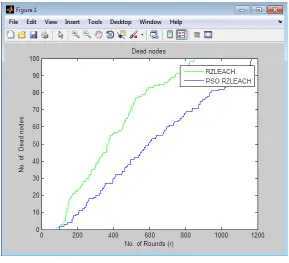
Dead Nodes:- This is the graph of dead nodes in RZLEACH and PSORZLEACH protocol.The network lifetime can be evaluated by using the number of dead nodes. It has been found that the number of nodes die earlier in

RZLEACH protocol. Here, we can see from the graph that all the nodes are die at the round of 850 in case of

RZLEACH and 1150 in case of PSORZLEACH.

Fig 7.1 Dead nodes Vs Rounds

Alive Nodes:- This is the graph of alive nodes in RZLEACH and PSORZLEACH protocol. It has been found that the number of nodes alive much more in PSORZLEACH protocol. Here, we can see from the graph that

(6)

1508 | P a g e

Fig 7.2 Alive nodes Vs Rounds

Packets Send to base station:-

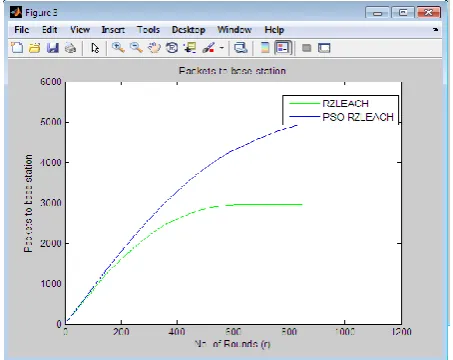
This is the graph of Packet send to base station after simulation. This graph shows the total number of packets

send to the base station by the sensor nodes. At the round of 810, the total number of packets send to base

station is 3000 in the case of RZLEACH protocol and in case of PSORZLEACH ,the packets send to base

station is 5000.

Fig 7.3 packet send to BS Vs Rounds

Remaining Energy:-

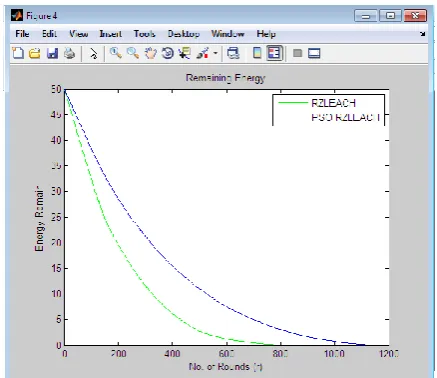
This is the graph of remaining energy, how much energy is left with the rounds. From the graph, we can see the

remaining energy with RZLEACH goes to 800 rounds, whereas in the case of PSORZLEACH the remaining

(7)

1509 | P a g e

Fig 7.4 Remaining Energy Vs Rounds

VIII. CONCLUSION AND FUTURE SCOPE

In this paper, we have proposed the PSORZLEACH which is an efficient technique. This protocol adopts the

selection of path criteria using the PSO technique which outperforms RZLEACH. The proposed protocol shows

the better improvement over existing protocol. But this work has not taken into account the utilization of 3D

WSNs, which are becoming major area of research in these days. Therefore in near future work we will extend

the planned technique for 3D WSNs environment.

REFERENCES

[1]. I.F.Akyildiz,W.Su,Y.Sankarasubramaniam,E.Cayirci,“Wireless Sensor Networks:A Survey,”

Computer Networks, vol. 38, pp. 393-422, 2002.

[2] S. Rani et al.” Energy efficient protocol for densely deployed homogeneous network”, in: Issues and

Challenges in Intelligent Computing Techniques (ICICT), International Conference on. IEEE, February

2014, pp.292–298.

[3] Bakr, B.A. and Lilien, L. (2011), “LEACH-SM: A protocol for extending wireless sensor network lifetime

by management of spare nodes”, In Modeling and Optimization in Mobile, Ad Hoc and Wireless Networks

(WiOpt), 2011 International Symposium on pp. 375-375.

[4] Basagni, S., Carosi, A., Melachrinoudis, E., Petrioli, C. and Wang, Z.M. (2008), “Controlled sink mobility

for prolonging wireless sensor networks lifetime”, Wireless Networks, vol. 14 (6), pp. 831-858.

[5] Beiranvand, Z., Patooghy, A. and Fazeli, M. (2013), “I-LEACH: An efficient routing algorithm to improve

performance & to reduce energy consumption in Wireless Sensor Networks”, In Information and

Knowledge Technology (IKT), 2013 5th Conference on pp. 13-18. [6]Khan, M.I., Gansterer, W.N. and

Haring, G. (2013), “Static vs. mobile sink: The influence of basic parameters on energy efficiency in wireless sensor networks”, Computer communications, vol. 36, pp. 965-978.[7]JaspinderKaur, Varsha “A

New Approach for Energy Efficient Linear Cluster Handling Protocol In WSN "International journal of

(8)

1510 | P a g e

[8] Harshdeep, Varsha. “Tabu Search and Tree Based Energy Efficient Protocols for Wireless Sensor Networks”. International Journal of Advanced Research in Computer Science and Software Engineering

(IJARCSSE) ISSN: 2277-128X, Impact Factor: 2.5, Vol-5, Issue-9, Page no 923-933, September2015.

[9] V.Raghavendran, Naga Satish, P. Suresh Varma, “Intelligent routing techniques for mobile ad hoc networks

using swarm intelligence”, I.J Intelligence systems and applications, 2013, Vol. 01, pp 81-89.

[10] K.Sayed.AliFathima, T.Sumitha, “To Enhance the Lifetime of WSN Network using PSO”, International

Journal of Innovative Resarch in Computer and Engineering, Vol.2, Special Issue 1,March2014.

[11] Varsha Sahni, Manju Bala et al “TABU Search Based Cluster Head Selection in Stable Election Protocol”

International Journal on Recent Trends in Computing and Communication, Volume: 4, Issue: 8, pp: 90-94.

[12] Isha, Varsha, "Study on Co-operative Communication for Energy Efficient Routing in Wireless Sensor

Network", International Journal of Science and Research (IJSR),

Figure

Fig 7.1  Dead nodes Vs Rounds
Fig 7.2  Alive nodes Vs Rounds
Fig 7.4  Remaining Energy Vs Rounds

References

Related documents

APT: Atopy patch test; AD: Atopic dermatitis; HDM: House dust mites; SPT: Skin prick test; WQ: Written questionnaire; ISAAC: International Study on Asthma and Allergy in

the epilepsy can likewise be found inside the recurrence scope of 1-3Hz, delta wave alone is separated.

diabetic neuropathy in control.Our Cortex-feet foot analyzer and blood flow stimulator will be having.. hand-held unit which can be integrated to a wrist watch and a foot-unit which

In this paper we do not provide a full process evaluation, but rather use the BCW wheel to structure the analysis to de- scribe the different ‘ policies ’ (outer layer) that

Out of con­ sideration® of convenience* the boundaries of this area are confined in this study to the region enclosed by Slengarry and Ouellette Avenues on the east and west and

768 bromide and potassium iodide in the studied solvent systems are more positive than A- coefficients, thereby suggesting the presence of strong ion–solvent interactions, and these