Article
A QUBO model for the Traveling Salesman Problem
with Time Windows for execution on the D-Wave
Christos Papalitsas* , Theodore Andronikos*, Konstantinos Giannakis* , Georgia Theocharopoulou, and Sofia Fanarioti
1
2
3
4
5
6
7
DepartmentofInformatics,IonianUniversity,TsirigotiSquare7,Corfu,49100,Greece; {kgiann,c14papa,zeta.theo,sofiafanar,andronikos}@ionio.gr
* Correspondence:[email protected](Ch.P.);[email protected](Th.A.);[email protected](K.G.); ‡ Theseauthorscontributedequallytothiswork.
Abstract: ThisworkfocusesonexpressingtheTSPwithTimeWindows(TSPTWfor short)asa quadraticunconstrainedbinaryoptimization(QUBO)problem. Thetimewindowsimposetime constraintsthatafeasiblesolutionmustsatisfy.Thesetaketheformofinequalityconstraints,which areknowntobeparticularlydifficulttoarticulatewithintheQUBOframework.Thisis,webelieve, thefirsttimethismajorobstacleisovercomeandtheTSPTWiscastintheQUBOformulation.We haveeveryreasontoanticipatethatthisdevelopmentwillleadtotheactualexecutionofsmallscale TSPTWinstancesontheD-Waveplatform.
Keywords:TSP;TSPTW;Metaheuristics;QuantumAnnealing;IshingModel;QUBO;D-Wave 8
1. Introduction 9
Quantum computing promotes the exploit of quantum-mechanical principles for computation 10
purposes. Richard Feynman in 1982 suggested that computation could be done more efficiently by 11
taking advantage of the power of quantum “parallelism” [1]. Since then quantum computing has 12
gained a lot of momentum and today appears to be one of the most prominent candidates to partially 13
replace classical, silicon-based systems. There exist a number of quantum algorithms that run more 14
efficiently than the best known classical algorithm; arguably, the most famous ones are Shor’s [2] and 15
Grover’s [3] algorithms. For an in-depth study of quantum computing and quantum information, the 16
reader is referred to [4]. 17
When solving large scale optimization problems, one of the most effective classical strategies is to 18
search among the nearest neighbors and search for paths between the initial and final configurations 19
to improve upon an initial guessyt. This search takes place locally among neighboring configurations 20
similar toyt. By finding the best solution within the local neighborhood ofyt, the next candidate 21
solutionyt+1appears. Then a new local search starts withyt+1as the starting point in the neighborhood. 22
Unfortunately, greedy local improvement, in case of hard problems, may be deceptively leading the 23
solution into a local minima whose energy may be much higher than the globally minimum value. 24
Adiabatic quantum computation was proposed by Farhi et al. [5,6] in the early 2000s [7] and is 25
based on an important theorem of quantum mechanics, the adiabatic theorem [8,9]. This theorem 26
dictates that if a quantum system is driven by a slowly changing (in time) Hamiltonian that evolves 27
fromHinittoHf in, then if the systems starts in the ground state ofHinit, the system will end up in the 28
ground state ofHf in. Farhi et al. also showed that adiabatic quantum computation can be efficiently 29
simulated by a quantum computer based on the gate model, meaning that the two computational 30
models have the same expressive power [5,6]. 31
Quantum annealing is based on the quantum adiabatic computation paradigm. Quantum 32
annealing was initially proposed by Kadowaki and Nishimori [10,11] and has since then been used 33
for tackling combinatorial optimization problems. The way that a quantum annealer tries to solve 34
problems, is very similar to the way optimization problem are solved using (classical) simulated 35
annealing [12]. An energy landscape is constructed, via a multivariate function, such that the ground 36
state’s coordinates (i.e., the lowest value) correspond to the solution of the problem. The quantum 37
annealing process is iterated to the point that an optimal solution, with a sufficient high probability, is 38
found. The “quantum” in “quantum annealer” refers to the use of multi qubit tunneling [10,11]. The 39
high degree of parallelism is the advantage of quantum annealing over classical code execution. A 40
quantum annealer explores all possible inputs in parallel to find the optimal solution to a problem, 41
which might prove crucial when it comes to solving NP-complete problems. We caution the reader 42
however that, at present, these techniques should be considered more as an automatic heuristic-finding 43
program than as a formal solver [13]. 44
The preceding facts explain why optimization problems have been associated with quantum 45
computing principles [14–18]. In this approach, which can be considered as an “analog” method to 46
tackle optimization problems, the ground state of a Hamiltonian represents an optimal solution of the 47
optimization problem at hand. Typically, the quantum annealing process starts with the system being 48
in an equal superposition of all states. Then, an appropriate Hamiltonian is applied and the system 49
evolves in a time-dependent manner according to the Schrödinger equation. The state of the system 50
keeps changing according to strength of the local transverse field, which varies with respect to time. 51
Finally, the transverse field is smoothly turned off and the system finds itself in the ground state of a 52
properly chosen Hamiltonian that encodes an optimal solution of the optimization problem. 53
After the first commercial launch of an actual system whose functionality is based upon quantum 54
annealing, the D-Wave platform, it has been demonstrated that these particular quantum machines 55
are capable of solving certain quadratic unconstrained (mainly binary) optimization problems. The 56
core of D-Wave’s machine that applies the quantum annealing principles for complex combinatorial 57
optimization problems is the quantum processing unit (QPU). In the D-Wave computer the quantum 58
bits (which we shall refer to as qubits from now on) are the lowest energy states of superconducting 59
loops [7,19,20]. In these states there is a circulating current and a corresponding magnetic field. Since a 60
qubit is a quantum object, its state can be a superposition of the 0 state and the 1 state at the same time. 61
However, upon measurement a qubit collapses to the state 0 or 1 and behaves like a classical bit. The 62
quantum annealing process in effect guides the qubits from a superposition of states to their collapse 63
into either the 0 or 1 state. In the end, the net effect is that the system is in a classical state, which must 64
encode an (optimal) solution of the problem. 65
The current generation of D-Wave computers employs the Chimera topology. In the Chimera 66
topology, qubits are sets of connected unit cells, that are connected to four vertical qubits via 67
couplers [20–22]. The unit cells are oriented vertically and horizontally with adjacent qubits connected, 68
creating a network of sparsely connected qubits. A Chimera graph consists of anN×Ngrid of unit 69
cells. The D-Wave 2000Q QPU has up to 2048 qubits which are mapped to a C16 Chimera graph, that is 70
they are logically mapped into a 16×16 matrix of unit cells, each consisting of 8 qubits. In the D-Wave 71
nomenclature the percentage of working qubits and couplers is known as the working graph, which is 72
typically a subgraph of the total number of interconnected qubits, which are physically present in the 73
QPU. 74
A major category of optimization problems, particularly amenable to D-Wave’s quantum 75
annealing, are those that can be expressed as quadratic unconstrained binary optimization (QUBO) 76
problems. QUBO refers to a pattern matching technique, that, among other applications, can be 77
used in machine learning and optimization, and which involves minimizing a quadratic polynomial 78
over binary variables [20,23–29]. We emphasize that QUBO is NP-hard [29]. Some of the most 79
famous combinatorial optimization problems that can be solved as QUBO problems are the Maximum 80
and related results (that are beyond the scope of this paper) can be found in the survey paper of 82
Kochenberger [25]. QUBO is equivalent to the Ising model, a well-known and extensively studied 83
model in physics, that was introduced in the mid 1920s by Ernst Ising and Wilhelm Lenz in the field 84
of ferromagnetism [31,32]. The underlying logical architecture of this model is that variables are 85
represented as qubits and interactions among qubits stand for the costs associated with each pair of 86
qubits. In particular, this architecture can be depicted as an undirected graph with qubits as vertices 87
and couplers as edges among them. The open-source software qbsolv that D-Wave introduced in 88
2017 is aimed at tackling QUBO problems of higher scale than previous attempts, by utilizing a more 89
complex graph structure with higher connectivity among QPUs, by partitioning the input into parts 90
that are then independently solved. This process is repeated using a Tabu-based search until no further 91
improvement is found [19,33]. 92
The literature contains several works that are dedicated to solving the standard TSP or some 93
relative problem in a quantum setting. One of the first, was the work by Marto ˇnák et al. in [34] 94
that introduced a different quantum annealing scheme based on path-integral Monte Carlo processes 95
to address the symmetric version of the Traveling Salesman Problem (sTSP). In [35,36] the D-Wave 96
platform was used as a test bed for evaluating the efficiency of quantum annealing in solving the 97
standard TSP compared to classical methods. In [37,38] the well-known variation of the TSP, the 98
(Capacitated) Vehicle Routing Problem is studied using, again, the D-Wave computer. However, no 99
work is known to us that tackles the TSP with Time Windows within the QUBO framework, using the 100
D-Wave platform, or even quantum annealing in general. 101
Contribution. In this paper we give the first, to the best of our knowledge, QUBO formulation for 102
the TSP with Time Windows (TSPTW). The existence of an Ising or QUBO formulation for a problem 103
is the essential precondition for its solution on the current generation of D-Wave computers. For the 104
vanilla TSP there exists such a formulation, as presented in an elegant and comprehensive manner 105
in [32], which has enabled the actual solution of TSP instances on the D-Wave platform (see [35–37]). 106
In contrast, prior to this work, the TSPTW had not been cast in the QUBO framework. This can be 107
attributed to the extra difficulty of expressing the time window constraints of TSPTW. We hope and 108
expect that the formulation presented here will lead to the experimental execution of small-scale 109
TSPTW instances. 110
This paper is organized as follows. The most relevant to our study work is presented in Section2. 111
Section3is devoted to the standard definitions and notation of the conventional Traveling Salesman 112
Problem with Time Windows. Section4, the most extensive section of this article, contains the main 113
contribution of our paper. It includes an in-depth presentation of all the required rigorous mathematical 114
definitions and the proposed modeling that allows us to map the TSPTW into the QUBO framework. 115
Finally, conclusions and ideas for future work are given in Section5. 116
2. Related work 117
Quantum annealing [5,11] has been shown to provide solutions to a broad range of combinatorial 118
optimization problems, not only in computer science [6,16,26,30,39–41], but also in other fields, such as 119
quantum chemistry [42], protein folding [14], vehicle routing [33,38,43,44], etc. This kind of problems 120
aim at minimizing a cost function, which can be interpreted as finding the ground state of a typical 121
Ising Hamiltonian [32]. Nevertheless, it is a laborious task to compute a global minimum in problems 122
where multiple local minima exist [45–47], a fact that shares a lot of similarities to classical spin glasses 123
[45,46]. 124
The possible superiority of quantum computation could be translated into either providing a 125
better solution (i.e., closest to the optimal one) or arriving at a solution faster or producing a diverse 126
set of solutions (for the multiobjective case). Some known cases where such methods work well 127
are spin glasses [48], graph coloring [49], job-shop scheduling [50], machine learning [16,51], graph 128
partitioning [30], 3-SAT [52], vehicle routing and scheduling [33,38,43,44], neural networks [53], image 129
Battaglia et al. showed that quantum annealing techniques could outperform their classical 131
counterparts on a known NP-complete problem, the 3-SAT, under special circumstances, whereas 132
in the general case, the quantum versions did not offer any actual advantage [52]. In a recent work, 133
Pagano et al. built a mechanism that implements a shallow-depth quantum approximate optimization 134
algorithm (QAOA) by estimating the ground state energy of the Ising model using an analogue 135
quantum simulator [54]. Farhi and Harrow tried to show the advantages of quantum approximate 136
optimization algorithms compared to classical approaches, providing useful theoretical results and 137
bounds, with the emphasis on the idea of “quantum supremacy” than can be established through such 138
solutions [55]. Constrained polynomial optimization problems using adiabatic quantum computation 139
methods were recently discussed by Rebentrost in [18]. In [56], Venegas-Andraca et al. introduced 140
basic algorithms for some well-known problems in combinatorial optimization, like the 3-SAT [52] and 141
the max-cut [57] problems. An overview of approaches of the quantum annealing systems used by 142
D-Wave Systems [19] is, also, presented. 143
Recently, in [58], Hadfield et al. worked upon the quantum annealing algorithm of Farhi et al. [6], 144
extending it by employing the quantum alternating operator ansatz, which yields a broader set of 145
operators that can be used by the user. Particularly, this operator allows the representation of a larger 146
set of states compared to the original algorithm, aiming to tackle problems with tighter constraints. 147
Another work on how to apply constraints in QUBO schemes was presented by Vyskocil and Djidjev 148
in [59]. In particular, to avoid the use of large coefficients (hence, more qubits) that result from the use 149
of quadratic penalties, they proposed a novel combinatorial design and solving of mixed-integer linear 150
programming problems to accommodate the application of the desired constraints. 151
Choi in [7], one of the first studies regarding the commercial D-Wave machine, showed that 152
quadratic unconstrained binary optimization (QUBO) problems can be solved using an adiabatic 153
quantum computer that employs an Ising spin-1/2 Hamiltonian. This was achieved by the reduction, 154
through minor-embedding, of the underlying graph to the quantum hardware graph. The Chimera 155
graph is the underlying annealing architecture of the current generation D-Wave platform. Due to 156
physical limitations and noise levels, some qubits and couplers cannot be exploited, and are, thus, 157
disabled. Therefore, the underlying graph is marginally incomplete [21,22]. 158
In a recent technical report, D-Wave systems describe in detail their next generation architecture 159
graph, named Pegasus [20]. As claimed by D-Wave itself, Pegasus will offer more flexibility and 160
expressiveness over previous topologies, like more efficient embeddings of cliques, penalties, improved 161
run times, boosted energy scales, better handling of errors, etc [20]. Similarly, Dattani and Chancellor 162
discussed some differences between the two latest quantum annealing architectures from D-Wave 163
systems, namely the Chimera and Pegasus graphs [22]. They further proposed a methodology to 164
minor embed the required subgraphs on the Chimera and Pegasus graphs. 165
The D-Wave Two, 2X, and 2000Q all used the Chimera graph (see Table1), which consisted of 166
processing unit ofK4,4subgraphs. Each generation of this graph has evolved by exploiting more and 167
more qubits (or vertices). On the other hand, Pegasus, the latest graph, totally changed the setting 168
by adding more complex connectivity (each qubit or vertex is coupled with 15 other ones) [21]. This 169
enhanced connectivity allows for better utilization of the existing qubits, thus fewer vertices are capable 170
of broader calculations. 171
Table 1.Evolution of Chimera graphs throughout previous D-Wave versions (from [21]).
Size of quantum processing unit Total number of qubits
D-Wave One 4×4 128
D-Wave Two 8×8 512
D-Wave 2X 12×12 1152
Lucas in [32] discussed Ising formulations for a variety of NP-complete and NP-hard optimization 172
problems (including the TSP problem), with emphasis on using as few as possible qubits. Marto ˇnák 173
et al. in [34] introduced a different quantum annealing scheme based on path-integral Monte Carlo 174
processes to address the symmetric version of the Traveling Salesman Problem (sTSP). Their approach 175
is built upon a rather constrained Ising-like representation and is compared against the standard 176
simulated annealing heuristic on various benchmark tests, demonstrating its superiority. 177
Boros et al. presented a set of local search heuristics for Quadratic Unconstrained Binary 178
Optimization (QUBO) problems, providing indicative simulation results on various benchmark tests 179
[29]. Adiabatic quantum annealing techniques are also used to address multiobjective optimization 180
problems. In particular, Barán and Villagra proved their algorithm is capable of finding Pareto-optimal 181
solutions in finite-time for a particular class of problems [60]. 182
Another work on quantum annealing and TSP was presented by Warren in [36]. Warren studied 183
small-scale instances of traveling salesman problems, showcasing how a D-Wave machine using 184
quantum annealing would operate to solve these instance. The motivation for this work was to offer 185
a tutorial-like approach, since the limitations on the number of TSP nodes are quite restrictive for 186
real-world applications. The mapping of the CMO protein problem to a QUBO formulation was 187
studied by Oliveira et al. in [61]. Simulation results showed that the proposed approach outperformed 188
classical techniques. 189
On the other hand, Ushijima-Mwesigwa demonstrated the graph partitioning mechanism of 190
D-Wave computers utilizing the quantum annealing tools on the D-Wave 2X [30]. The reduction of 191
the large matrix size in QUBO was the main topic in [24] by Lewis and Glover. This was vital in 192
order to have a quick solution for large-scale problems with numerous variables that require equally 193
many qubits. Glover et al. showed in a step by step procedure how one can translate a problem with 194
particular characteristics into a QUBO instance, using the appropriate tools [28]. Another iterative 195
version of the quantum annealing heuristic for QUBO problems based on tabu search was presented by 196
Rosenberg et al. in [62]. Regarding the technical details of that work, their approach tries to partition 197
the problem into subproblems, while keeping the rest of variables fixed. Moreover, they consider the 198
effect of the time to reach the best solution on the problems size. 199
Many researchers have studied the classical Traveling Salesman Problem with Time Windows 200
(TSPTW). The literature can provide exact algorithms for solving the TSPTW. Langevin et al. [63] 201
introduced a flow formulation of two elements, which can be extended to the classic “makespan” 202
problem. Dumas et al. [64] used a dynamic programming approach reducing trials, which improved 203
the performance and scaled down the search space, in advance and during its execution as well. The 204
TSPTW is an NP-hard problem, since it is a special case of the famous TSP. So, in practice, a heuristic, 205
which is able to solve effectively realistic cases within a reasonable time, is necessary. Gendreau et 206
al. [65] proposed an insertion heuristic, which gradually builds the path to the construction phase and 207
improves a refinement phase. Urrutia et al. [66] proposed a two-stage heuristic, based on VNS. In 208
the first step, a feasible solution is manufactured using the VNS, wherein the mixed linear, integer, 209
objective function is represented as an infeasibility measurement. In the second stage, the heuristic 210
improves the feasible solution with a general version of VNS (General VNS - GVNS). 211
A hybrid genetic algorithm for finding guaranteed and reliable solutions of global optimization 212
problems using the branch-and-bound technique was proposed by Sotiropoulos et al. [67]. A 213
branch-and-bound approach was, also, used in the work of Pardalos et al. in [68], where dynamic 214
preprocessing techniques and heuristics are used to calculate good initial configurations. For an 215
in-depth insight on quantum genetic algorithms, the reader is referred to the work of Lahoz-Beltra 216
in [69]). 217
Papalitsas et al. in [70] developed a metaheuristic based on conventional principles for finding 218
within a short period of time feasible solutions for the TSPTW. Subsequently, a novel quantum-inspired 219
unconventional metaheuristic method, based on the original General Variable Neighborhood Search 220
was applied to the solution of the garbage collection problem modeled as a TSP instance [17]. Recently, 222
Papalitsas et al. [72] applied this quantum-inspired metaheuristic to the practical real-life problem 223
of garbage collection with time windows. For the majority of the benchmark instances used to 224
evaluate the proposed metaheuristic, the experimental results were particularly promising. Towards 225
the ultimate goal of running the TSPTW using pure quantum optimization methods, we focus here on 226
its QUBO formulation. This present article is an attempt in that direction. 227
3. The classical formulation of the TSPTW 228
In this section we give the formal definition of the classical TSPTW. Our presentation follows [73], 229
which is pretty much standard in the relative literature. 230
Definition 1. Let G= (N,A)be a directed graph, where N={0, 1, . . . ,n}is the finite set of nodes or, more 231
commonly referred to in this context ascustomers, and A=N×N is the set of arcs connecting the customers. 232
For every pair(u,v)of customers there exists an arc in A. Atouris defined by the order in which the customers 233
are visited. 234
A couple of assumptions facilitate the formulation of the TSPTW. 235
Definition 2. Let customer 0 denote the depot and assume that every tourbeginsandendsat the depot. 236
Each of the remaining n customers appears exactly once in the tour. We denote a tour as an ordered list 237
P = (p0,p1, . . . ,pn,pn+1), where piis the index of the customer in the ithposition of the tour. According to 238
our previous assumption p0= pn+1=0. 239
Definition 3. For every pair(u,v)of customers u,v ∈ N, there is a cost cu,v, for traversing the arc(u,v). 240
This cost of traversing the arc from u to v generally consists of anyservice timeat customer U plus thetravel 241
timefrom customer u to customer v. 242
Definition 4. To each customer v∈N there is an associatedtime window[ev,lv], during which the customer 243
v must be visited. We assume that waiting is permitted; a vehicle is allowed to reach customer v before the 244
beginning of its time window, ev, but the vehicle cannot depart from customer v before ev. 245
A tour isfeasibleif it satisfies the time window of each customer. 246
In the literature two primary TSPTW objective functions are usually considered 247
• minimize the sum of the arc traversal costs along the tour, and 248
• minimize the time to return to the depot. 249
In a way, the difficulty of the TSPTW stems from the fact that it is two problems in one; a traveling 250
salesman problem and a scheduling problem. The TSP alone is one of the most famous NP-hard 251
optimization problems, while the scheduling part, with release and due dates, adds considerably to 252
the already existing difficulty. To verify that the tour is feasible, i.e., it satisfies the time windows, it is 253
expedient to introduce thearrival timeat theithcustomer and the time at whichservicestarts at the 254
ithcustomer, which are denoted byApi andDpi, respectively. At this point we make the important 255
observation thatDpi is thedeparture timefrom theithcustomer in the case ofzero service time. The 256
assumption of zero service time is widely used in the literature in order to simplify the problem, and, 257
so, we too shall follow this assumption in our presentation. 258
The classical formulation of the TSPTW can be summarized by the next relations (see also [73]). 259
min
n+1
∑
i=1cpi−1,pi (1)
In the above expression (1), we assume that(p0,p1, . . . ,pn,pn+1)is a feasible tour. This means 260
Dp0 =0 . (2)
Api =Dpi−1+cpi−1,pi (1≤i≤n+1). (3)
Dpi =max{Api,epi} (1≤i≤n). (4)
3.1. An illustrated example for the TSPTW 262
At this subsection we shall describe and explain a template reference problem with 4 nodes plus 263
the starting point (5 nodes in total). Although this example is quite simple, we hope that it will help 264
the reader to easily understand the TSPTW. Specifically, to better comprehend the modeling of this 265
benchmark, as well as the attempt to find a feasible solution at first, and consequently the optimal one. 266
The next Figure1is the graphical depiction of the 5 customers and all arcs that connect them. 267
0 1
2
3
4
Figure 1.The above graph depicts an example of a tour consisting of 4 nodes plus the depot (node 0).
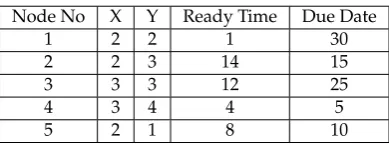
Table2includes all the relevant data of the above example. In particular, we see the coordinates X 268
and Y of every node, as well as the Ready Time and the Due Date. 269
Table 2.The input data for our example.
Node No X Y Ready Time Due Date
1 2 2 1 30
2 2 3 14 15
3 3 3 12 25
4 3 4 4 5
5 2 1 8 10
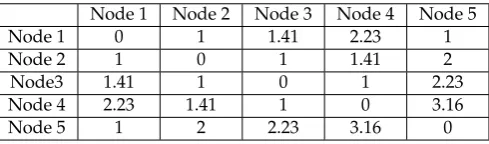
Table3is actually the distance matrix for our example. Let us clarify here that we calculated 270
the costs between the nodes using the Euclidean distance, which is given by the well-know formula: 271
Table 3.The distance matrix.
Node 1 Node 2 Node 3 Node 4 Node 5
Node 1 0 1 1.41 2.23 1
Node 2 1 0 1 1.41 2
Node3 1.41 1 0 1 2.23
Node 4 2.23 1.41 1 0 3.16
Node 5 1 2 2.23 3.16 0
A feasible solution for this particular TSPTW consisting of 5 nodes is given in Table4. One can 273
see that if all time windows are respected in every step of the tour going from from one customer to 274
the next, a feasible solution can be constructed. Although, this is a small scale example, we expect that 275
it will enhance one’s understanding of what is a feasible solution for the TSPTW. 276
Table 4.A feasible solution of our illustrated example.
Ordering Node 1 Node 4 Node 5 Node 3 Node 2
cost 0<1 2.23 <4 7.16 <8 10 <12 12<14
feasibility yes yes yes yes yes
In the next section we introduce our novel approach for mapping the TSPTW over the quadratic 277
unconstrained binary optimization (QUBO) model. 278
4. A QUBO formulation for the TSPTW 279
In the literature, the typical QUBO formulation of the standard TSP involves the use of a set of 280
binaryvariables (see [32]). They are characterized as binary in the sense that they can take only the 0 or 281
1 value. Typically, they are denoted byxv,i, and their meaning is the following: 282
xv,i = (
1, customervis at positioniin the tour
0, otherwise . (5)
In the case of the TSPTW, we have discovered to be more advantageous to use binary variables 283
parameterized by three integers: u,vandi. A similar suggestion for the Vehicle Routing Problem can 284
be found in [38]. Hence, in the rest of our analysis, we shall use the binary variablesxiu,vdefined next: 285
xiu,v= (
1, customersuandvare at consecutive positionsi−1 andiin the tour
0, otherwise . (6)
As we explained in the previous section, a feasible tour has the form{p0,p1, . . . ,pn,pn+1}. In 286
this enumeration,piis the customer in theithposition of the tour. We always take for granted that 287
p0= pn+1=0 and each other customer appears exactly once. We recall the assumption ofzero service 288
timeat each customer, and without loss of generality, we adopt another assumption that greatly reduces 289
the final clutter of our QUBO expressions: for each customerv, where 0≤v≤n+1,ev=0. With this 290
understanding, we see that the parametersuandvrange from 0 tonand the parameteriranges from 291
1 ton+1. 292
Therefore, we can assert that: 293
• For eachi, 1≤i≤n+1, exactly one of the binary variablesxui,vis 1, whereuandvrange freely 294
from 0 ton, with the proviso thatu 6=v. As a matter of fact wheni=1 andi=n+1 we can 295
be more precise. In the former case, exactly one of the binary variablesx1
0,vis 1, wherevranges 296
from 1 ton, and, in the latter case, exactly one of the binary variablesxnv,0+1is 1, wherevranges 297
• In addition to the above constraints, for eachu, 1≤u≤n, exactly one of the binary variables 299
xiu,vis 1, whereiranges from 2 tonandvranges from 1 ton. 300
• Symmetrically, we also have the constraint that for everyv, 1≤v≤n, exactly one of the binary 301
variablesxui,vis 1, whereiranges from 2 tonanduranges from 1 ton. 302
These constraints are encoded in the HamiltonianHc. 303
Hc=B n+1
∑
i=1
1−
n
∑
u=0n
∑
v=0 v6=uxiu,v
2
+B 1− n
∑
v=1x0,1v
!2
+B 1− n
∑
v=1xnv+,01
!2
+B n
∑
u=11− n
∑
i=2n
∑
v=1xiu,v
!2
(7)
+B n
∑
v=11− n
∑
i=2n
∑
u=1xiu,v
!2
Using thexiu,vbinary variables, the requirement that the tour be minimal can be encoded by the 304
following HamiltonianHm. 305
Hm=C n+1
∑
i=1n
∑
u=0n
∑
v=0 v6=uxiu,vcu,v. (8)
In the above Hamiltonians,BandCare positive constants, which must be appropriately chosen, 306
i.e.,C<B, so as to ensure that the constraints ofHcare respected (see also [32]). Obviously,cu,vis the 307
cost for traversing the arc(u,v). 308
The above Hamiltonians are certainly not the end of the story in the case of the TSPTW, as, in their 309
essence, they just encode the minimal cost of the Hamiltonian circuit. There are a lot more difficult 310
time constraints to tackle in order to satisfy the time window of every customer. To this end, besides 311
the binary variablesxi
u,v, it will be necessary to use a second type of binary variables, denoted bytn,i, 312
in order to express thetime marginof every customer. 313
Definition 5. Given afeasibletour p0,p1, . . . ,pn,pn+1, suppose that the customer at position i, where 314
1≤ i ≤ n, is v with time window[ev,lv]. We say that thetime marginof the customer at position i to be 315
lv−Api. 316
Clearly, for a feasible tour, the time margin for every position of the tour is non negative. We can 317
now define the binary variablestk,ias follows: 318
tk,i= (
1, the time margin of the customer at positioniin the tour isk
0, otherwise . (9)
We recall that in the formulation of the TSPTW, the arrival time at the customer in theithposition 319
of the tour, denotedApi, plays an important role (see [73]). Thus, we begin our analysis by showing 320
how to expressApi. Obviously,Ap0 =0, so it is only necessary to give the formula forApi, 1≤i≤n. 321
We first observe that the customer at position 0 is always the depot (customer 0), which results in the 322
following, relatively simple formula, forAp1. 323
Ap1 = n
∑
v=1x10,vc0,v. (10)
Api = i
∑
d=1n
∑
u=1n
∑
v=1 v6=uxdu,vcu,v (2≤i≤n). (11)
Example 1. To explain how Equations (10) and (11) can be used in practice, we continue with our test case 325
example. 326
Equation (10) becomes 327
Ap1 =x10,1c0,1+x10,2c0,2+x10,3c0,3+x10,4c0,4 (12) Equation (11) gives the following series of equations.
328
Ap2 =
x10,1c0,1+x10,2c0,2+x10,3c0,3+x10,4c0,4
| {z }
Ap1
+x21,2c1,2+x1,32 c1,3+x1,42 c1,4+x22,1c2,1+x22,3c2,3+x22,4c2,4 (13) +x23,1c3,1+x3,22 c3,2+x3,42 c3,4+x24,1c4,1+x4,22 c4,2+x24,3c4,3
Ap3 =
x0,11 c0,1+x10,2c0,2+x10,3c0,3+x10,4c0,4
+x21,2c1,2+x1,32 c1,3+x21,4c1,4+x2,12 c2,1+x2,32 c2,3+x22,4c2,4 +x23,1c3,1+x3,22 c3,2+x23,4c3,4+x4,12 c4,1+x4,22 c4,2+x24,3c4,3
(14)
+x31,2c1,2+x1,33 c1,3+x31,4c1,4+x2,13 c2,1+x2,33 c2,3+x32,4c2,4 +x33,1c3,1+x3,23 c3,2+x33,4c3,4+x4,13 c4,1+x4,23 c4,2+x34,3c4,3
Ap4 =x10,1c0,1+x10,2c0,2+x0,31 c0,3+x10,4c0,4
+x21,2c1,2+x1,32 c1,3+x1,42 c1,4+x22,1c2,1+x2,32 c2,3+x22,4c2,4 +x23,1c3,1+x3,22 c3,2+x3,42 c3,4+x24,1c4,1+x4,22 c4,2+x24,3c4,3
+x31,2c1,2+x1,33 c1,3+x1,43 c1,4+x32,1c2,1+x32,3c2,3+x32,4c2,4 (15) +x33,1c3,1+x3,23 c3,2+x3,43 c3,4+x34,1c4,1+x4,23 c4,2+x34,3c4,3
+x41,2c1,2+x1,34 c1,3+x1,44 c1,4+x42,1c2,1+x2,34 c2,3+x42,4c2,4 +x43,1c3,1+x3,24 c3,2+x3,44 c3,4+x44,1c4,1+x4,24 c4,2+x44,3c4,3
The above equations demonstrate that in every case, Apican be expressed as a sum of terms, where each 329
term is the product of an input variable cu,vandexactly onebinary decision variable xui,v. 330
The simplifying assumption of zero service time enables us to express the constraints imposed by 331
the time windows of every customer as follows: 332
Ap1 ≤ n
∑
v=1for the special case wherei=1, and
Api ≤ n
∑
u=1n
∑
v=1 v6=uxiu,vlv (2≤i≤n), (17)
for the general case where 2≤i≤n. 333
The above expression may seem a little complicated, but, unfortunately, whileApi tells us the 334
arrival time at the customer in theithposition of the tour, it does not tell uswhich isthis particular 335
customer. We have to resort to the binary variablesxiu,vto indirectly obtain this information. 336
Inequality constraints such as these in (16) and (17) are notoriously difficult to express within the 337
QUBO framework. For an extensive analysis we refer the interested reader to [28,59,74]. The approach 338
which is most commonly used in the literature is to employ auxiliary binary variables, like the binary 339
variablestk,ipreviously defined, to convert the inequality into an equality, and then proceed, as usual, 340
by squaring the equality constraint. 341
In our case, the first step is to express the inequalities (16) and (17) as 342
Ap1+ K
∑
k=1ktk,1= n
∑
v=1x10,vlv, (18)
and as
Api+ K
∑
k=1ktk,i = n
∑
u=1n
∑
v=1 v6=uxiu,vlv (2≤i≤n), (19)
respectively. 343
In the above equalitiesKis a positive constant appropriately chosen taking into consideration 344
the specific time windows. A valid possible choice could beK=max1≤v≤n{lv}. Such a choice, while 345
valid, would be unnecessarily big in most practical cases. 346
Equality constraints like (18) and (19) are typically treated in QUBO by converting them into 347
squared expressions. Hence, (18) gives rise to the first time window constraint, denoted byW1and 348
given by 349
W1= Ap1+ K
∑
k=1ktk,i− n
∑
v=1x10,vlv
!2
, (20)
while Equation (19) gives rise to theithtime window constraint, denoted byW
iand given by:
Wi =
Api+
K
∑
k=1ktk,i− n
∑
u=1n
∑
v=1 v6=uxiu,vlv
2
(2≤i≤n). (21)
If we replaceAp1and Api in the above equations by the formulas in (10) and (11), we derive the 350
expanded forms ofW1andWi, 2≤i≤n, respectively. 351
W1= n
∑
v=1x10,vc0,v+ K
∑
k=1ktk,i− n
∑
v=1x10,vlv
!2
Wi=
i
∑
d=1n
∑
u=1n
∑
v=1 v6=uxdu,vcu,v+ K
∑
k=1ktk,i− n
∑
u=1n
∑
v=1 v6=uxiu,vlv
2
(2≤i≤n). (23)
At this point it is important to pause and confirm that the constraints in Equations (22) and (23) 352
conform to the QUBO formulation requirements, in the sense that, after the expansion of the square, 353
we get a sum of terms, where each term is the product of input data likecu,vorlv andat most two 354
binary decision variables. 355
The last time constraint concerns the binary variablestk,i. For eachi, 1≤i≤n, exactly one of 356
the binary variablestk,iis 1, wherekranges from 1 toK. The meaning of this constraint is obvious: in 357
every position of a feasible tour the time margin should be unique. Expressing this constraint is also 358
straightforward: 359
Mi= 1− K
∑
k=1tk,i
!2
(1≤i≤n). (24)
Putting all the time constraints together results in the HamiltonianHt: 360
Ht=T(W1) +T n
∑
i=2TWCi+T n
∑
i=1Mi. (25)
Therefore, to solve the TSPTW in the QUBO framework we must use the HamiltonianHgiven 361
below: 362
H= Hc+Hm+Ht. (26)
As noted earlier, the constantsB,CandTappearing in the Hamiltonians are positive constants, 363
which must be chosen according to our requirements. For instance, by settingC < B, so as to 364
ensure that the constraints ofHcare respected; similarly, settingT<Bprioritizes the time windows 365
constraints over the minimality of the tour. 366
Example 2. To show the form of the time windows constraints when the square is expanded, we apply 367
constraint (22) to our test case example. 368
First we point out that for binary variables the following hold: 369
(xiu,v)2=xiu,v and (tk,i)2=tk,i. (27) We also recall the identity:(a+b−c)2=a2+b2+c2+2ab−2ac−2bc. We shall use this identity to 370
expand (22), setting a =∑nv=1x10,vc0,v, b=∑Kk=1ktk,1, and c=∑nv=1x10,vlv. In our example n=4and, in 371
order to simplify somewhat the calculations we take K=2. With this understanding we use Equation (12) to 372
derive the formulas given below. Note that to improve the readability of the equations in this example, we have 373
written in green color those terms that involveexactly onebinary variable and in blue color those terms that 374
A2p1 =
x10,1c0,1+x10,2c0,2+x10,3c0,3+x0,41 c0,4
2
= (x10,1)2c20,1+ (x10,2)2c20,2+ (x10,3)2c20,3+ (x0,41 )2c20,4+2x10,1c0,1x0,21 c0,2+2x10,1c0,1x10,3c0,3 +2x10,1c0,1x0,41 c0,4+2x10,2c0,2x10,3c0,3+2x10,2c0,2x10,4c0,4+2x10,3c0,3x0,41 c0,4 (28) =x10,1c20,1+x10,2c0,22 +x10,3c20,3+x10,4c20,4+2x10,1c0,1x0,21 c0,2+2x10,1c0,1x10,3c0,3
+2x10,1c0,1x0,41 c0,4+2x10,2c0,2x10,3c0,3+2x10,2c0,2x10,4c0,4+2x10,3c0,3x0,41 c0,4
Similarly, we see that: 376
2
∑
k=1ktk,1
!2
= (1t1,1+2t2,1)2=t21,1+4t22,1+4t1,1t2,1=t1,1+4t2,1+4t1,1t2,1 (29)
4
∑
v=1x10,vlv
!2
= x10,1l1+x10,2l2+x10,3l3+x10,4l4
2
= (x10,1)2l12+ (x10,2)2l22+ (x10,3)2l32+ (x0,41 )2l42+2x10,1l1x0,21 l2+2x10,1l1x10,3l3 +2x10,1l1x10,4l4+2x10,2l2x10,3l3+2x0,21 l2x0,41 l4+2x10,3l3x10,4l4 (30) =x10,1l12+x10,2l22+x10,3l23+x10,4l42+2x10,1l1x0,21 l2+2x10,1l1x10,3l3
+2x10,1l1x10,4l4+2x10,2l2x10,3l3+2x0,21 l2x0,41 l4+2x10,3l3x10,4l4
2Ap1 2
∑
k=1ktk,1=2
x10,1c0,1+x10,2c0,2+x10,3c0,3+x10,4c0,4
(1t1,1+2t2,1)
=2x10,1c0,1t1,1+2x10,1c0,1t2,1+2x10,2c0,2t1,1+2x10,2c0,2t2,1 (31)
+2x10,3c0,3t1,1+2x10,3c0,3t2,1+2x10,4c0,4t1,1+2x10,4c0,4t2,1
2Ap1 4
∑
v=1x10,vlv=2x10,1c0,1+x10,2c0,2+x10,3c0,3+x10,4c0,4 x10,1l1+x10,2l2+x10,3l3+x10,4l4
=2(x0,11 )2c0,1l1+2x0,11 c0,1x10,2l2+2x10,1c0,1x10,3l3+2x10,1c0,1x10,4l4 +2x10,2c0,2x10,1l1+2(x10,2)2c0,2l2+2x10,2c0,2x10,3l3+2x10,2c0,2x10,4l4 +2x10,3c0,3x10,1l1+2x10,3c0,3x10,2l2+2(x10,3)2c0,3l3+2x10,3c0,3x10,4l4 +2x10,4c0,4x10,1l1+2x10,4c0,4x10,2l2+2x10,4c0,4x10,3l3+2(x10,4)2c0,4l4
=2x10,1c0,1l1+2x10,2c0,2l2+2x10,3c0,3l3+2x10,4c0,4l4 (32)
+2x10,1c0,1x10,2l2+2x0,11 c0,1x10,3l3+2x10,1c0,1x10,4l4
+2x10,2c0,2x10,1l1+2x0,21 c0,2x10,3l3+2x10,2c0,2x10,4l4
+2x10,3c0,3x10,1l1+2x0,31 c0,3x10,2l2+2x10,3c0,3x10,4l4
2
2
∑
k=1ktk,1 4
∑
v=1x10,vlv=2(1t1,1+2t2,1)
x10,1l1+x10,2l2+x10,3l3+x10,4l4
=2t1,1x10,1l1+2t1,1x10,2l2+2t1,1x10,3l3+2t1,1x10,4l4 (33)
+4t2,1x10,1l1+4t2,1x10,2l2+4t2,1x10,3l3+4t2,1x10,4l4
We can now substitute Equations (28)–(33) in (22) to finally arrive at the expanded form of the constraint, 377
given by the following equation. 378
W1=x10,1c20,1+x0,21 c20,2+x10,3c20,3+x10,4c20,4+2x10,1c0,1x0,21 c0,2+2x10,1c0,1x10,3c0,3 +2x10,1c0,1x10,4c0,4+2x10,2c0,2x10,3c0,3+2x0,21 c0,2x10,4c0,4+2x10,3c0,3x10,4c0,4
+t1,1+4t2,1+4t1,1t2,1
+x10,1l12+x0,21 l22+x10,3l23+x10,4l42+2x10,1l1x0,21 l2+2x10,1l1x10,3l3
+2x10,1l1x10,4l4+2x10,2l2x10,3l3+2x0,21 l2x10,4l4+2x10,3l3x10,4l4
−2x10,1c0,1t1,1−2x10,1c0,1t2,1−2x10,2c0,2t1,1−2x10,2c0,2t2,1 −2x10,3c0,3t1,1−2x10,3c0,3t2,1−2x10,4c0,4t1,1−2x10,4c0,4t2,1
−2x10,1c0,1l1−2x10,2c0,2l2−2x10,3c0,3l3−2x0,41 c0,4l4 (34)
−2x10,1c0,1x10,2l2−2x0,11 c0,1x10,3l3−2x0,11 c0,1x10,4l4
−2x10,2c0,2x0,11 l1−2x10,2c0,2x0,31 l3−2x0,21 c0,2x10,4l4 −2x10,3c0,3x10,1l1−2x0,31 c0,3x10,2l2−2x0,31 c0,3x10,4l4
−2x10,4c0,4x10,1l1−2x0,41 c0,4x10,2l2−2x0,41 c0,4x10,3l3
−2t1,1x0,11 l1−2t1,1x0,21 l2−2t1,1x0,31 l3−2t1,1x0,41 l4
−4t2,1x0,11 l1−4t2,1x0,21 l2−4t2,1x0,31 l3−4t2,1x0,41 l4
Similar calculations, albeit too lengthy to include here, confirm that all time window constraints have 379
similar patterns, that is they constitute legitimate expressions within the QUBO framework. 380
5. Conclusions and future work 381
In this work, we have considered the TSPTW. Although many combinatorial optimization 382
problems have been expressed in the QUBO (or, equivalently, the Ising) formulation, this particular 383
problem was not one of them. Presumably, the reason is the TSPTW imposes many additional (time) 384
constraints because the customers’ time windows must be satisfied. These are actually inequality 385
constraints that are very difficult to tackle within the QUBO framework. We remind the reader that 386
valid QUBO expressions must have the form: xTQx, wherexis a column vector of binary decision 387
variables,xTits transpose andQa square matrix of constants. So, to the best of our knowledge, this is 388
the first time the TSPTW is cast in QUBO form. 389
This step is a necessary precondition in order to be able to run TSPTW instances on the current 390
generation of D-Wave computers. Hence, the future direction of this work will the mapping of TSPTW 391
benchmarks to the Chimera or the upcoming Pegasus architecture, so as to obtain experimental results. 392
This will enable the comparison of the current state of the art classical, or conventional, if you prefer, 393
metaheuristics with the purely quantum approach. This comparison is expected to shed some light on 394
the pressing question of whether quantum annealing is more efficient than classical methods, and, if 395
so, to what degree. 396
Author Contributions: Conceptualization, Christos Papalitsas and Theodore Andronikos; Formal
397
analysis,Christos Papalitsas and Theodore Andronikos; Methodology, Christos Papalitsas and Theodore
Andronikos; Supervision, Theodore Andronikos; Validation, Christos Papalitsas and Sofia Fanarioti; Writing
-399
original draft, Konstantinos Giannakis and Georgia Theocharopoulou; Writing - review & editing, Konstantinos
400
Giannakis, Georgia Theocharopoulou, Christos Papalitsas, Sofia Fanarioti and Theodore Andronikos.
401
Funding:This research is funded in the context of the project “Investigating alternative computational methods
402
and their use in computational problems related to optimization and game theory,” (MIS 5007500) under the
403
call for proposals “Supporting researchers with an emphasis on young researchers” (EDULL34). The project is
404
co-financed by Greece and the European Union (European Social Fund - ESF) by the Operational Programme
405
Human Resources Development, Education and Lifelong Learning 2014-2020.
406
Conflicts of Interest:The authors declare no conflicts of interest.
407
Abbreviations 408
The following abbreviations are used in this manuscript:
409 410
QPU Quantum Processing Unit
QUBO Quadratic Unconstrained Binary Optimization
TSP Traveling Salesman Problem
TSPTW Traveling Salesman Problem with Time Windows
411
412
1. Feynman, R.P. Simulating physics with computers. International Journal of Theoretical Physics Int J Theor 413
Phys1982,21, 467–488.
414
2. Shor, P.W. Polynomial-time algorithms for prime factorization and discrete logarithms on a quantum
415
computer. SIAM review1999,41, 303–332.
416
3. Grover, L. A fast quantum mechanical algorithm for database search. Proc. of the Twenty-Eighth Annual
417
ACM Symposium on the Theory of Computing, 1996, 1996.
418
4. Nielsen, M.A.; Chuang, I.L.Quantum computation and quantum information; Cambridge university press,
419
2010.
420
5. Farhi, E.; Goldstone, J.; Gutmann, S.; Sipser, M. Quantum computation by adiabatic evolution. arXiv 421
preprint quant-ph/00011062000.
422
6. Farhi, E.; Goldstone, J.; Gutmann, S.; Lapan, J.; Lundgren, A.; Preda, D. A quantum adiabatic evolution
423
algorithm applied to random instances of an NP-complete problem.Science2001,292, 472–475.
424
7. Choi, V. Minor-embedding in adiabatic quantum computation: I. The parameter setting problem.Quantum 425
Information Processing2008,7, 193–209.
426
8. Messiah, A. Quantum mechanics, 1961.
427
9. Amin, M. Consistency of the adiabatic theorem.Physical review letters2009,102, 220401.
428
10. Kadowaki, T. Study of optimization problems by quantum annealing. arXiv preprint quant-ph/0205020 429
2002.
430
11. Kadowaki, T.; Nishimori, H. Quantum annealing in the transverse Ising model. Physical Review E1998,
431
58, 5355.
432
12. Kirkpatrick, S.; Gelatt, C.D.; Vecchi, M.P. Optimization by simulated annealing.science1983,220, 671–680.
433
13. Pakin, S. Performing fully parallel constraint logic programming on a quantum annealer. Theory and 434
Practice of Logic Programming2018,18, 928–949.
435
14. Perdomo-Ortiz, A.; Dickson, N.; Drew-Brook, M.; Rose, G.; Aspuru-Guzik, A. Finding low-energy
436
conformations of lattice protein models by quantum annealing. Scientific reports2012,2, 571.
437
15. Sarkar, A. Quantum Algorithms: for pattern-matching in genomic sequences2018.
438
16. Biamonte, J.; Wittek, P.; Pancotti, N.; Rebentrost, P.; Wiebe, N.; Lloyd, S. Quantum machine learning.
439
Nature2017,549, 195.
440
17. Papalitsas, C.; Karakostas, P.; Andronikos, T.; Sioutas, S.; Giannakis, K. Combinatorial GVNS (General
441
Variable Neighborhood Search) Optimization for Dynamic Garbage Collection.Algorithms2018,11, 38.
442
18. Rebentrost, P.; Schuld, M.; Wossnig, L.; Petruccione, F.; Lloyd, S. Quantum gradient descent and Newton’s
443
method for constrained polynomial optimization.New Journal of Physics2019.
444
19. D-Wave, S. Getting Started with the D-Wave System. Technical report, D-Wave Systems, 2019.
20. Boothby, K.; Bunyk, P.; Raymond, J.; Roy, A. Next-generation topology of D-Wave quantum processors.
446
Technical report, D-Wave Systems, 2019.
447
21. Dattani, N.; Szalay, S.; Chancellor, N. Pegasus: The second connectivity graph for large-scale quantum
448
annealing hardware.arXiv preprint arXiv:1901.076362019.
449
22. Dattani, N.; Chancellor, N. Embedding quadratization gadgets on Chimera and Pegasus graphs. arXiv 450
preprint arXiv:1901.076762019.
451
23. Boros, E.; Crama, Y.; Hammer, P.L. Upper-bounds for quadratic 0–1 maximization. Operations Research 452
Letters1990,9, 73–79.
453
24. Lewis, M.; Glover, F. Quadratic unconstrained binary optimization problem preprocessing: Theory and
454
empirical analysis. Networks2017,70, 79–97.
455
25. Kochenberger, G.; Hao, J.K.; Glover, F.; Lewis, M.; Lü, Z.; Wang, H.; Wang, Y. The unconstrained binary
456
quadratic programming problem: a survey.Journal of Combinatorial Optimization2014,28, 58–81.
457
26. Lloyd, S.; Mohseni, M.; Rebentrost, P. Quantum algorithms for supervised and unsupervised machine
458
learning.arXiv preprint arXiv:1307.04112013.
459
27. Hauke, P.; Katzgraber, H.G.; Lechner, W.; Nishimori, H.; Oliver, W.D. Perspectives of quantum annealing:
460
Methods and implementations. arXiv preprint arXiv:1903.065592019.
461
28. Glover, F.; Kochenberger, G. A Tutorial on Formulating QUBO Models. arXiv preprint arXiv:1811.11538 462
2018.
463
29. Boros, E.; Hammer, P.L.; Tavares, G. Local search heuristics for quadratic unconstrained binary optimization
464
(QUBO).Journal of Heuristics2007,13, 99–132.
465
30. Ushijima-Mwesigwa, H.; Negre, C.F.; Mniszewski, S.M. Graph partitioning using quantum annealing
466
on the D-Wave system. Proceedings of the Second International Workshop on Post Moores Era
467
Supercomputing. ACM, 2017, pp. 22–29.
468
31. Newell, G.F.; Montroll, E.W. On the theory of the Ising model of ferromagnetism.Reviews of Modern Physics 469
1953,25, 353.
470
32. Lucas, A. Ising formulations of many NP problems.Frontiers in Physics2014,2, 5.
471
33. Neukart, F.; Compostella, G.; Seidel, C.; Von Dollen, D.; Yarkoni, S.; Parney, B. Traffic flow optimization
472
using a quantum annealer. Frontiers in ICT2017,4, 29.
473
34. Marto ˇnák, R.; Santoro, G.E.; Tosatti, E. Quantum annealing of the traveling-salesman problem. Physical 474
Review E2004,70, 057701.
475
35. Warren, R.H. Adapting the traveling salesman problem to an adiabatic quantum computer. Quantum 476
information processing2013,12, 1781–1785.
477
36. Warren, R.H. Small traveling salesman problems. Journal of Advances in Applied Mathematics2017,2.
478
37. Feld, S.; Roch, C.; Gabor, T.; Seidel, C.; Neukart, F.; Galter, I.; Mauerer, W.; Linnhoff-Popien, C. A hybrid
479
solution method for the capacitated vehicle routing problem using a quantum annealer. arXiv preprint 480
arXiv:1811.074032018.
481
38. Irie, H.; Wongpaisarnsin, G.; Terabe, M.; Miki, A.; Taguchi, S. Quantum annealing of vehicle routing
482
problem with time, state and capacity. International Workshop on Quantum Technology and Optimization
483
Problems. Springer, 2019, pp. 145–156.
484
39. Neven, H.; Denchev, V.S.; Rose, G.; Macready, W.G. Training a large scale classifier with the quantum
485
adiabatic algorithm.arXiv preprint arXiv:0912.07792009.
486
40. Garnerone, S.; Zanardi, P.; Lidar, D.A. Adiabatic quantum algorithm for search engine ranking. Physical 487
review letters2012,108, 230506.
488
41. Cruz-Santos, W.; Venegas-Andraca, S.; Lanzagorta, M. A QUBO Formulation of the Stereo Matching
489
Problem for D-Wave Quantum Annealers. Entropy2018,20, 786.
490
42. Babbush, R.; Love, P.J.; Aspuru-Guzik, A. Adiabatic quantum simulation of quantum chemistry.Scientific 491
reports2014,4, 6603.
492
43. Crispin, A.; Syrichas, A. Quantum annealing algorithm for vehicle scheduling. 2013 IEEE International
493
Conference on Systems, Man, and Cybernetics. IEEE, 2013, pp. 3523–3528.
494
44. Cai, B.B.; Zhang, X.H. Hybrid Quantum Genetic Algorithm and Its Application in VRP [J]. Computer 495
Simulation2010,7.
496
45. Binder, K.; Young, A.; Fischer, K.; Hertz, J. Rev. Mod. Phys., 1986.
497
46. Young, A.P.Spin glasses and random fields; Vol. 12, World Scientific, 1998.
47. Nishimori, H. Statistical physics of spin glasses and information processing: an introduction; Number 111,
499
Clarendon Press, 2001.
500
48. Venturelli, D.; Mandra, S.; Knysh, S.; O’Gorman, B.; Biswas, R.; Smelyanskiy, V. Quantum optimization of
501
fully connected spin glasses. Physical Review X2015,5, 031040.
502
49. Titiloye, O.; Crispin, A. Quantum annealing of the graph coloring problem. Discrete Optimization2011,
503
8, 376–384.
504
50. Venturelli, D.; Marchand, D.J.; Rojo, G. Quantum annealing implementation of job-shop scheduling.arXiv 505
preprint arXiv:1506.084792015.
506
51. Benedetti, M.; Realpe-Gómez, J.; Biswas, R.; Perdomo-Ortiz, A. Quantum-assisted learning of
507
hardware-embedded probabilistic graphical models.Physical Review X2017,7, 041052.
508
52. Battaglia, D.A.; Santoro, G.E.; Tosatti, E. Optimization by quantum annealing: Lessons from hard
509
satisfiability problems. Physical Review E2005,71, 066707.
510
53. Alom, M.Z.; Van Essen, B.; Moody, A.T.; Widemann, D.P.; Taha, T.M. Quadratic Unconstrained Binary
511
Optimization (QUBO) on neuromorphic computing system. 2017 International Joint Conference on Neural
512
Networks (IJCNN). IEEE, 2017, pp. 3922–3929.
513
54. Pagano, G.; Bapat, A.; Becker, P.; Collins, K.; De, A.; Hess, P.; Kaplan, H.; Kyprianidis, A.; Tan, W.; Baldwin,
514
C.; others. Quantum Approximate Optimization with a Trapped-Ion Quantum Simulator.arXiv preprint 515
arXiv:1906.027002019.
516
55. Farhi, E.; Harrow, A.W. Quantum supremacy through the quantum approximate optimization algorithm.
517
arXiv preprint arXiv:1602.076742016.
518
56. Venegas-Andraca, S.E.; Cruz-Santos, W.; McGeoch, C.; Lanzagorta, M. A cross-disciplinary introduction to
519
quantum annealing-based algorithms.Contemporary Physics2018,59, 174–197.
520
57. Farhi, E.; Goldstone, J.; Gutmann, S. A quantum approximate optimization algorithm. arXiv preprint 521
arXiv:1411.40282014.
522
58. Hadfield, S.; Wang, Z.; O’Gorman, B.; Rieffel, E.G.; Venturelli, D.; Biswas, R. From the quantum
523
approximate optimization algorithm to a quantum alternating operator ansatz. Algorithms2019,12, 34.
524
59. Vyskocil, T.; Djidjev, H. Embedding Equality Constraints of Optimization Problems into a Quantum
525
Annealer.Algorithms2019,12. doi:10.3390/a12040077.
526
60. Barán, B.; Villagra, M. A Quantum Adiabatic Algorithm for Multiobjective Combinatorial Optimization.
527
Axioms2019,8, 32.
528
61. Oliveira, N.M.D.; Silva, R.M.D.A.; Oliveira, W.R.D. QUBO formulation for the contact map overlap
529
problem.International Journal of Quantum Information2018,16, 1840007.
530
62. Rosenberg, G.; Vazifeh, M.; Woods, B.; Haber, E. Building an iterative heuristic solver for a quantum
531
annealer.Computational Optimization and Applications2016,65, 845–869.
532
63. Langevin, A.; Desrochers, M.; Desrosiers, J.; Gélinas, S.; Soumis, F. A two-commodity flow formulation for
533
the traveling salesman and the makespan problems with time windows. Networks1993,23, 631–640.
534
64. Dumas, Y.; Desrosiers, J.; Gelinas, E.; Solomon, M.M. An optimal algorithm for the traveling salesman
535
problem with time windows.Operations research1995,43, 367–371.
536
65. Gendreau, M.; Hertz, A.; Laporte, G.; Stan, M. A generalized insertion heuristic for the traveling salesman
537
problem with time windows.Operations Research1998,46, 330–335.
538
66. Da Silva, R.F.; Urrutia, S. A General VNS heuristic for the traveling salesman problem with time windows.
539
Discrete Optimization2010,7, 203–211.
540
67. Sotiropoulos, D.; Stavropoulos, E.; Vrahatis, M. A new hybrid genetic algorithm for global optimization.
541
Nonlinear Analysis: Theory, Methods & Applications1997,30, 4529–4538.
542
68. Pardalos, P.M.; Rodgers, G.P. Computational aspects of a branch and bound algorithm for quadratic
543
zero-one programming. Computing1990,45, 131–144.
544
69. Lahoz-Beltra, R. Quantum genetic algorithms for computer scientists.Computers2016,5, 24.
545
70. Papalitsas, Ch.; Giannakis, K.; Andronikos, Th.; Theotokis, D.; Sifaleras, A. Initialization methods for
546
the TSP with Time Windows using Variable Neighborhood Search. IEEE Proc. of the 6th International
547
Conference on Information, Intelligence, Systems and Applications (IISA 2015), 6-8 July, Corfu, Greece,
548
2015.
549
71. Papalitsas, C.; Karakostas, P.; Kastampolidou, K. A Quantum Inspired GVNS: Some Preliminary Results.
550
GeNeDis 2016; Vlamos, P., Ed.; Springer International Publishing: Cham, 2017; pp. 281–289.
72. Papalitsas, C.; Andronikos, T. Unconventional GVNS for Solving the Garbage Collection Problem with
552
Time Windows. Technologies2019,7. doi:10.3390/technologies7030061.
553
73. Ohlmann, J.W.; Thomas, B.W. A compressed-annealing heuristic for the traveling salesman problem with
554
time windows.INFORMS Journal on Computing2007,19, 80–90.
555
74. Vyskoˇcil, T.; Pakin, S.; Djidjev, H.N. Embedding Inequality Constraints for Quantum Annealing
556
Optimization. Quantum Technology and Optimization Problems; Feld, S.; Linnhoff-Popien, C., Eds.;
557
Springer International Publishing: Cham, 2019; pp. 11–22.
![Table 1. Evolution of Chimera graphs throughout previous D-Wave versions (from [21]).](https://thumb-us.123doks.com/thumbv2/123dok_us/8018782.1333510/4.595.78.518.671.753/table-evolution-chimera-graphs-previous-d-wave-versions.webp)