University of South Carolina
Scholar Commons
Theses and Dissertations
2017
A Machine Learning Approach For Enhancing
Security And Quality Of Service Of Optical Burst
Switching Networks
Adel Dabash A. Rajab University of South Carolina
Follow this and additional works at:https://scholarcommons.sc.edu/etd
Part of theComputer Engineering Commons, and theComputer Sciences Commons
This Open Access Dissertation is brought to you by Scholar Commons. It has been accepted for inclusion in Theses and Dissertations by an authorized administrator of Scholar Commons. For more information, please [email protected].
Recommended Citation
Rajab, A. A.(2017).A Machine Learning Approach For Enhancing Security And Quality Of Service Of Optical Burst Switching Networks.
A
M
ACHINEL
EARNINGA
PPROACH FORE
NHANCINGS
ECURITY ANDQ
UALITY OFS
ERVICE OFO
PTICALB
URSTS
WITCHINGN
ETWORKSby
Adel Dabash A. Rajab
Bachelor of Science
University of South Carolina, 2005
Master of Engineering University of South Carolina, 2007
Submitted in Partial Fulfillment of the Requirements
For the Degree of Doctor of Philosophy in
Computer Science and Engineering
College of Engineering and Computing
University of South Carolina
2017
Accepted by:
Chin-Tser Huang, Major Professor
Manton M. Matthews, Committee Member
Csilla Farkas, Committee Member
Marco Valtorta, Committee Member
Mohammed Al-Shargabi, Committee Member
ii
iii
ACKNOWLEDGEMENTS
First, I would like to express my deepest appreciation to my super-advisor
Dr. Chin-Tser Huang for his patient, kindness, friendly, and unfailing support
over the past few years. Without his invaluable directions, enlightenment,
advices and constant supports, this work could never have been completed. Also
I would like to thank Dr. Manton M. Matthews, Dr. Csilla Farkas, Dr. Marco
Valtorta and Dr. Mohammed Al-Shargabi for their guidance, their valuable time
to serve on my proposal/dissertation committee and for their valuable comments
and advice to help improve my dissertation. Finally, I would like to express my
utmost appreciation to my parents, my brother Dr. Khairan D. Rajab, my wife,
Wafa M. Alyami and my kids for their love and constant support which inspired
iv
A
BSTRACTThe Optical Bust Switching (OBS) network has become one of the most
promising switching technologies for building the next-generation of internet
backbone infrastructure. However, OBS networks still face a number of security
and Quality of Service (QoS) challenges, particularly from Burst Header Packet
(BHP) flooding attacks. In OBS, a core switch handles requests, reserving one of
the unoccupied channels for incoming data bursts (DB) through BHP. An
attacker can exploit this fact and send malicious BHP without the corresponding
DB. If unresolved, threats such as BHP flooding attacks can result in low
bandwidth utilization, limited network performance, high burst loss rate, and
eventually, denial of service (DoS). In this dissertation, we focus our
investigations on the network security and QoS in the presence of BHP flooding
attacks. First, we proposed and developed a new security model that can be
embedded into OBS core switch architecture to prevent BHP flooding attacks.
The countermeasure security model allows the OBS core switch to classify the
ingress nodes based on their behavior and the amount of reserved resources not
being utilized. A malicious node causing a BHP flooding attack will be blocked
v
itself. Using our security model, we can effectively and preemptively prevent a
BHP flooding attack regardless of the strength of the attacker. In the second part
of this dissertation, we investigated the potential use of machine learning (ML) in
countering the risk of the BHP flood attack problem. In particular, we proposed
and developed a new series of rules, using the decision tree method to prevent
the risk of a BHP flooding attack. The proposed classification rule models were
evaluated using different metrics to measure the overall performance of this
approach. The experiments showed that using rules derived from the decision
trees did indeed counter BHP flooding attacks, and enabled the automatic
classification of edge nodes at an early stage. In the third part of this dissertation,
we performed a comparative study, evaluating a number of ML techniques in
classifying edge nodes, to determine the most suitable ML method to prevent
this type of attack. The experimental results from a preprocessed dataset related
to BHP flooding attacks showed that rule-based classifiers, in particular decision
trees (C4.5), Bagging, and RIDOR, consistently derive classifiers that are more
predictive, compared to alternate ML algorithms, including AdaBoost, Logistic
Regression, Naïve Bayes, SVM-SMO and ANN-MultilayerPerceptron. Moreover,
the harmonic mean, recall and precision results of the rule-based and tree
classifiers were more competitive than those of the remaining ML algorithms.
vi
more predictive, but are also more efficient than other algorithms. Thus, our
findings show that decision tree identifier is the most appropriate technique for
vii
T
ABLE OFC
ONTENTSACKNOWLEDGEMENTS ... iii
ABSTRACT ... iv
LIST OF TABLES ... ix
LIST OF FIGURES ... x
CHAPTER 1INTRODUCTION ...1
1.1MOTIVATION ...1
1.2PROBLEM OVERVIEW ...3
1.3OVERVIEW OF DISSERTATION ...6
CHAPTER 2COUNTERING BURST HEADER PACKET FLOODING ATTACK IN OPTICAL BURST SWITCHING NETWORKS ... …9
2.1BACKGROUND ... 9
2.2DESIGN OF THE PROPOSED SECURITY MODEL ... 13
2.3IMPLEMENTATION ... 15
2.4 EVALUATION AND ANALYSIS ... 22
2.5RELATED STUDIES ... 27
2.6SUMMARY ... 32
viii
3.1BACKGROUND ... 33
3.2BHPFLOODING ATTACK AS CLASSIFICATION PROBLEM ... 38
3.3THE PROPOSED RULE-BASED MODEL FOR ANTI-BHP-FLOOD ATTACK ... 41
3.4EXPERIMENTATION AND RESULT ANALYSIS ... 59
3.5RELATED STUDIES ... 75
3.6SUMMARY ... 78
CHAPTER 4DETECTING BHP-FLOODING ATTACK IN OBSNETWORKS:AMACHINE LEARNING PROSPECTIVE ... 81
4.1BACKGROUND ... 81
4.2THE CONSIDERED MACHINE LEARNING TECHNIQUES ... 85
4.3EXPERIMENTAL SETTINGS AND DATA ... 95
4.4RESULTS ANALYSIS ... 100
4.5STUDIES RELATED TO APPLICATION OF MACHINE LEARNING IN DETECTING AND CLASSIFICATION TASKS ... 107
4.6SUMMARY ... 111
ix
L
IST OFT
ABLESTable 2.1 NCTUns Network Simulator parameter of the OBS Network
configuration in evaluation ...23
Table 3.1 Sample four iteration of two edge nodes ...44
Table 3.2 CHI feature selection score generated from the binary-class dataset. ....48
Table 3.3 Sample four iterations of the processed training dataset ...49
Table 3.4 CHI feature selection score generated from the multi-class dataset ...50
Table 3.5 Sample of five iterations of the processed multi-class dataset ...51
Table 3.6 Confusion matrix for classification task in ML ...72
x
L
IST OFF
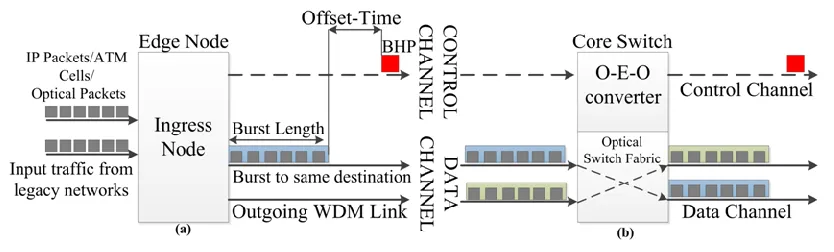
IGURESFigure 2.1 (a) Assembling of packets at an ingress node; (b) BHP (O-E-O)
conversion at a core switch to allocate the resources for the incoming data burst
in OBS networks ...10
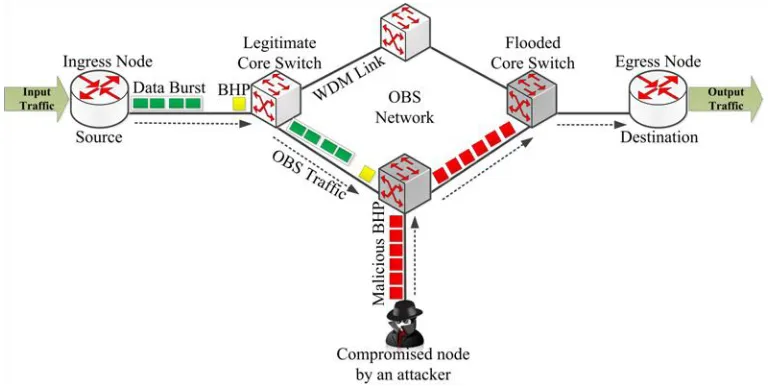
Figure 2.2 BHP Flooding attack on core switches in an OBS networks ...12
Figure 2.3 The classification process of the proposed model ...14
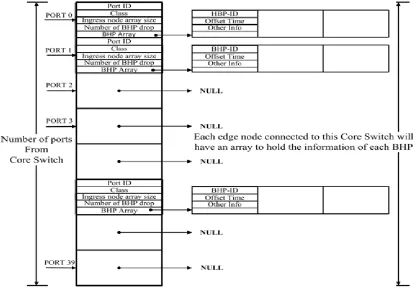
Figure 2.4 The proposed data structure component of the proposed security model ...17
Figure 2.5 (a) Number of dropped DBs in each slot or cycle; (b) number of dropped DBs for one second; 0 indicates no DBs has been dropped ...19
Figure 2.6 The algorithm process of classifying nodes ...21
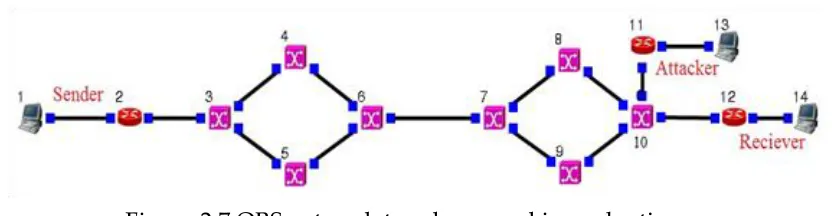
Figure 2.7 OBS network topology used in evaluation ...22
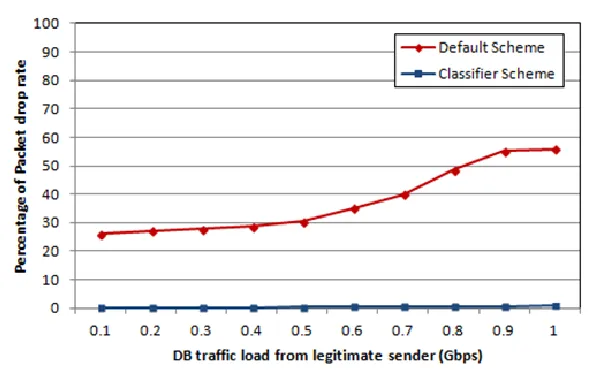
Figure 2.8 Comparison of percentage of lost packets number in the presence of 0.2 Gbps load of malicious BHPs ...24
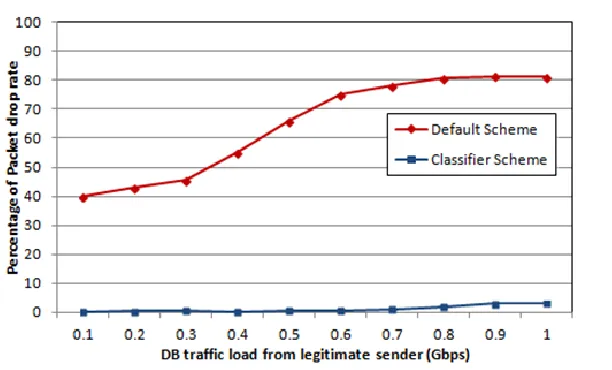
Figure 2.9 Comparison of percentage of lost packets number in the presence of 0.5 Gbps load of malicious BHPs ...26
Figure 2.10 Comparison of percentage of lost packets number in the presence of 1.0 Gbps load of malicious BHPs ...27
Figure 3.1 The proposed rule based classification architecture for BHP flood Attack ...42
Figure 3.2 Build_Tree algorithm for constructing a classification model ...53
Figure 3.3 Decision tree model example ...57
xi
Figure 3.5 The multi-class classification model with pruning ...71
Figure 3.6 The confusion matrix of the decision tree model derived from the multi-class dataset ...73
Figure 4.1 Steps of ML classification technique ...87
Figure 4.2 Classification accuracies in % derived by the ML algorithms ...101
Figure 4.3 The classifiers’ sizes of RIDOR, Bagging and C4.5 algorithms ...102
Figure 4.4 (a) TPs; (b) FPs; (c) TNs and (d) FNs of the ML algorithms ...103
Figure 4.5 The Precision, Recall and F1 scores of the ML algorithms ...106
1
C
HAPTER1
I
NTRODUCTION1.1 Motivation
The Optical Burst Switching (OBS) network is a promising switching
technology for building the next generation of Internet infrastructure. It typically
represents a trade-off between two switching technologies: optical circuit
switching (OCS) and optical packet switching (OPS). Even with all the OBS's
network merits, such as resiliency, bandwidth/resources efficiency, and overall
economic advantages, OBS networks still suffer from several quality of service
(QoS) and security issues, such as burst loss due to bursts contention, bursts
scheduling, and most importantly, Denial of Service (DoS) due to Burst Header
Packet (BHP) flooding attacks.
A BHP flooding attack can subjugate the core switches by sending a large
number of BHPs into the network. Normally, when a core switch receives a BHP,
it reserves a WDM channel for it and changes the status of the reserved channel
from unoccupied to occupied. Attackers use this to flood the network with
2
will blindly reserve a new WDM channel for each incoming malicious BHP
without checking if the corresponding data arrives. When a legitimate request
comes to the compromised core switch, there will be no unoccupied WDM
channels available. This leads to preventing legitimate nodes from reserving the
required network resources at the intermediate core switch [2], eventually
causing a DoS attack.
The main motivation for this research is to examine the behavior of edge
nodes to counter the risks associated with BHP flood attacks in OBS
networks. This can develop efficient security techniques that can manage the
problem, as well as providing contributions to enhance the QoS in OBS network.
Furthermore, we aim to examine the applicability of machine learning (ML) to
the problem of BHP flooding attacks in OBS networks. This is to develop a more
efficient detection system enabling the core switches to classify ingress nodes in
an automated manner, and identify misbehaving ones as early as possible. To
achieve this, we extensively investigated various ML techniques that adopt
different learning approaches to the research problem considered. We seek to
identify the most relevant ML technique(s) to solve the issue of BHP flooding
3 1.2 Problem Overview
1.2.1 Countering Burst Header Packet Flooding Attacks in Optical Burst
Switching Networks
The study of detection techniques of BHP flooding attack is very limited
for OBS networks. This type of attack, which relies on the flooding approach, has
been studied in traditional DoS against the TCP protocol [9, 10]. For instance, the
SYN flooding attack intends to exhaust the resources of the TCP/IP stack (e.g. the
backlog) of the victim host by generating enormous numbers of SYN requests
towards it without completing a connection setup. The victim host will be unable
to accept legitimate connection requests if its backlog is fully occupied by all the
fake half-opened connections [11]. However, in the context of UDP protocol over
an OBS network, there is no such study on preventing or even limiting BHP
flooding attacks that we are aware of. Therefore, it is important to be able to
monitor or study the behavior of edge nodes in an OBS network in the likelihood
of dealing with such threats.
In this part of the study, we propose and develop a new security
system that can be added to OBS core node architecture to prevent BHP flood
attacks. The countermeasure security system allows the OBS core node to classify
the ingress nodes, based on both their behavior, and the amount of reserved
4
will be blocked by the system until the threat is resolved. The system is
implemented, tested and verified using a modified NCTUNS simulator. The
analysis shows that this is highly effective in preventing BHP flooding attacks, as
well as in providing the network resources for the legitimate nodes.
1.2.2. Decision Tree Rule Learning Approach to Counter Burst Header Packet
Flooding Attacks in Optical Burst Switching Networks
Machine Learning (ML) is a widely adopted and powerful data analysis
technique which has displayed a highly predictive performance in multiple
application domains, due to its ability to discover useful hidden knowledge that
can be beneficial for decision making. However, a key challenge in adopting ML
to counter BHP flood attacks is the unavailability of the training datasets.
Therefore, this study is two-fold. Firstly,itdeterminesanddevelopsadatasetfrom
thousands of simulation runs that can be converted into a classification task.
Secondly, it investigates the use of a predictive model using ML to counter the
risk of BHP flooding attack dilemmas experienced in OBS networks, proposing a
tree-based decision architecture as an appropriate solution.
Few related studies have used ML techniques within OBS networks [40,
50]. These studies centred on data traffic identification, whereas our study is
concerned with an entirely different issue – BHP flooding attacks. To the best of
5
decision-tree method of classification to solve the issue of BHP flooding attacks
in OBS networks. Since previous studies have not used ML as a way of blocking
misbehaving edge nodes which send DBs in OBS networks, we believe a solution
is needed in order to address this critical issue in the initial phases of BHP
flooding attacks.
1.2.3 Detecting BHP-Flooding Attacks in OBS Networks: A Machine Learning
Prospective
A powerful and promising approach in identifying misbehaving edge
nodes causing BHP flooding attacks is Machine Learning (ML), and in particular,
classification techniques. A classification technique learns models by applying
them to a large historical dataset derived from an edge node’s performance
during a simulation run. The dataset contains behavior traces from a number of
edge nodes, with respect to input data characteristics, sensitivity, efficiency
performance, predictive performance, and model content. The learned model can
then be utilized to single out (classify) misbehaving edge nodes based on their
future performance as accurately as possible, hence disciplining them. Therefore,
this part of the study investigates the BHP problem by evaluating a number of
ML techniques in classifying edge nodes, and determines the most suitable
6
This study evaluates Decision Tree (C4.5), Bagging, Boosting (AdaBosst),
Probabilistic (Naïve Bayes), Rule Induction (RIpple DOwn Rule Learner-RIDOR),
Neural Network (NN-MultilayerPerceptron), Logistic Regression, and Support
Vector Machine-Sequential Minimal Optimization (SVM-SMO) on a real dataset
to identify the most appropriate method(s) to combat the BHP flood attack
problem in OBS networks.
1.3 Overview of Dissertation
We will address some of the problems facing OBS networks. The
organization of this dissertation is as follows:
Chapter 2 provides a background on BHP flooding attacks, and proposes
a new security model, the node classifier, to counter BHP flooding attacks. We
implemented a sophisticated data structure comprised of two layers, with the
use of an adaptive sliding range window to classify ingress nodes into three
varieties. This classification is based on the number of lost bursts from each
ingress node during the time frame, to measure the performance of nodes and
detect BHP flooding attacks at preliminary classes. The simulation results show
that our proposed classifier is effective in preventing BHP flooding attacks.
Chapter 3 investigates the applicability of the predictive model, using ML
7
proposing a decision-tree based architecture as an appropriate solution. This
architecture contains a learning algorithm that extracts novel rules from tree
models using data processed from several simulation runs. Our simulation
results show that the rules derived from our learning algorithm are able to
accurately classify 93% of the BHP flooding attacks into either Behaving (B) or
Misbehaving (M) classes. Moreover, the rules can further categorize the
Misbehaving edge nodes into four sub-class labels of Misbehaving-Block (Block),
Behaving-No Block (No Block), Misbehaving-No Block (M-No Block), and
Misbehaving-Wait (M-Wait) with 87% accuracy. The results clearly show that
our proposed decision-tree model is a viable solution in comparison to decisions
undertaken by expert domains or human network administrators.
Chapter 4 builds on our previous work from Chapter 3. One method
to prevent a BHP flood attack is to detect the misbehaving edge nodes
overloading the network with malicious BHPs, and take the proper action to
secure and sustain the QoS performance in an OBS network using ML. This
chapter investigates the BHP flood attack problem by evaluating a number of
ML techniques in classifying edge nodes, and determines the most suitable
method to prevent this type of attack. To be precise, we evaluate Decision Tree
(C4.5), Bagging, Boosting (AdaBosst), Probabilistic (Naïve Bayes), Rule
(NN-8
MultilayerPerceptron), Logistic Regression, and Support Vector
Machine-
Sequential Minimal Optimization (SVM-SMO) on a real dataset to identify
the most effective method(s) to combat the BHP flood attack problem in
9
C
HAPTER2
C
OUNTERING BURST HEADER PACKET FLOODING ATTACK IN OPTICAL BURST SWITCHING NETWORKS2.1 Background
Optical network is a modern network technology for transmitting
information from one place to another by sending light through an optical fiber.
The light forms an electromagnetic carrier wave that is modulated to carry
information [1]. These features of optical networks provide high speed and huge
bandwidth, which make optical networks a viable choice of the Internet
backbone infrastructure [1]. The popularity of optical networks has led to the
replacement of traditional copper wires by optical network fibers, and has also
motivated many enterprises to invest in optical burst switching (OBS) network in
particular within the past few years.
OBS network is a promising switching technology for building the
next-generation Internet infrastructure [2, 3, 4]. It represents a trade-off between two
switching technologies: optical circuit switching [2] and optical packet switching
10
the burst header packet (BHP) is sent in a separate channel from the data burst
(DB) channel. OBS is designed for a better utilization of wavelengths in order to
minimize the latency (setup delay) and avoid the use of the optical buffers [4].
OBS transmission technique keeps the data in the optical domain and
allows for sophisticated electronic processing of control header information at
another domain. As illustrated in Figure 2.1 (a), the transmission works by
assembling the incoming data traffic from clients at the edge node (called ingress)
of the OBS network into what is called data burst (DB). Then a BHP, which
contains the information about the DB packets, including the burst length, arrival
time, offset time, etc., is transmitted ahead over a devoted Wavelength Division
Multiplexing (WDM) channel (out-of-band). The BHP precedes the DB by a time
known as offset time in order to reserve the required resources and to set up the
path configuration for the DBs in the core switches [5]. The BHP goes through Figure 2.1 (a) Assembling of packets at an ingress node; (b) BHP (O-E-O) conversion at a core switch to allocate the resources for the incoming data burst
11
the Optical-Electronic-Optical (O-E-O) conversion at each intermediate node and
is processed electronically to allocate the resources for the incoming data burst
into the optical domain [6, 7] as shown in Figure 2.1 (b). OBS data bursts may
have different lengths, and encompass many types of traffic (IP packets, ATM
cells, optical packets, etc.). The ingress sends the data in the form of bursts which
will be disassembled at the destination edge router (called egress).
Even with all its merits, OBS networks like any other communication
networks can suffer from several threats. Some of the known threats are orphan
bursts, redirection of data bursts, replay, BHP flooding attack, fake burst header
attack and denial of service attack [8].
In this work, we are interested in the denial of service (DoS) that can be
caused by BHP flooding attack, and aim to prevent a legitimate BHP from
reserving the required network resources at the intermediate core switch. This
type of attack relies on the flooding approach that has been studied in traditional
DoS against the TCP protocol [9, 10]. For instance, the SYN flooding attack
intends to exhaust the resources of the TCP/IP stack (e.g. the backlog) of the
victim host by generating enormous numbers of SYN requests toward the victim
host without completing connection setup. The victim host will be unable to
accept legitimate connection requests if its backlog is fully occupied by all the
12
In a similar way, the BHP flooding attack can subjugate the core switches
when a malicious node sends large numbers of BHPs into the network without
transmitting the actual DBs. When a core switch reserves WDM channels for the
incoming BHPs, it changes the status of the reserved channels from unoccupied
to occupied. Figure 2.2 demonstrates that when the target node (a core switch)
receives malicious BHPs, the target node starts reserving new WDM channel for
each malicious BHP. This prevents a legitimate BHP from reserving the required
network resources at the intermediate core switch [2]. When a legitimate DB
arrives and there are no unoccupied WDM channels available, the arrived DB
will be dropped by the core switch and the reserved channels will be waiting for
unidentified bursts which may never arrive [12].
13
This paper proposes a new security model, called the node classifier, which
is designed to counter BHP flooding attacks. The proposed model has an
adaptive sliding range window to classify ingress nodes into three classes. This
classification will be based on the number of lost burst from each ingress node
during time window to measure the performance of nodes and detect BHP
flooding attack at preliminary classes.
2.2 Design of the Proposed Security Model
In this section, we present our proposed security model designed for BHP
flooding countermeasure, and it is illustrated in Figure 2.3. In order to combat
BHP flooding attacks, we study and analyze the behavior of each node to
discover the point when the node is misbehaving. This can be considered an alert
to prevent the malicious BHPs from reserving the network resources. The
proposed security model has several merits summarized as follows:
It only requires software modification and implementation, and does not
require additional hardware.
It is easy to be integrated with existing core switches architecture.
It is not necessary to modify all the core switches at once for the model to
effectively work. Incremental deployment of the model can still enhance the
14
The model works by classifying all the ingress nodes into three possible
classes, namely Trusted, Suspicious, and Blocked. Initially, the model classifies all
the nodes into the Trusted class. As time goes on, the classifier changes the class
assignment of each ingress node based on its observed performance such as
packet arrival rate and packet dropping rate using a sliding range window. For
example, if a node is acting normally by sending the BHP with its corresponding
DB on the expected time (BHP arrival time + offset time), the node will be
assigned to the Trusted class. However, when the ingress node at some point
does not send a predefined number of corresponding DBs within the expected
time, the classifier assigns Suspicious class to the node. In cases when the
transmitted data do not arrive at all and the packet dropping rate keeps
increasing, the ingress node will then be assigned to the Blocked class, hence
subsequent BHPs from this node will no longer be accepted and none of the
15
flooding attack, the classifier will eventually add the compromised node to the
blocked list.
An ingress node can redeem itself from the Blocked and Suspicious classes
back to Trusted by improving its throughput and lowering the packet dropping
rate, i.e. stopping the BHP flooding attacks. In typical BHP attack, the attacking
ingress node keeps sending the bogus BHPs. In this case, the core switches that
place this attacking node in the Blocked class will not be able to forward its BHPs
and will not allow the node to be allocated network resources. However, when
the blocked node stops sending bogus BHPs and starts sending legitimate DBs,
the arrived DBs will be used to redeem the node from the Blocked class.
2.3 Implementation
In this section, we discuss the implementation of our classification model
in detail, and introduce its three main components (data structure, sliding range
window, and classifier).
2.3.1 Data Structure
The model’s data structure is composed of two layers. The first layer
allows a core switch to store and maintain information about each connected
port (representing an ingress node) including the following fields:
16
2) Class: The class currently assigned to this ingress node (i.e. Trusted,
Suspicious, Blocked)
3) Ingress node array size: The size of the array for each ingress node. The size
will be incremented by each received BHP and decremented by each
dropped BHP from the array.
4) The number of dropped BHPs: This parameter keeps account of how many
BHPs from each ingress node have been dropped based on the sliding
range window.
5) BHP Array: A pointer to the array of the BHPs. The array will be created
dynamically for memory management purpose.
The second layer of the model’s data structure is used to store information
about the BHPs received from each incoming node (ingress node or core switch),
including the following fields:
1) BHP_ID: This item is used to check which BHP does and does not have
corresponding data burst received.
2) Offset Time: This is the time after which a BHP is considered part of a
17
The primary reason of using this data structure is to efficiently manage
and store the data regarding each connected node. Figure 2.4 depicts a bird’s eye
view of this data structure management process.
2.3.2 Sliding Range Window
The proposed classification model utilizes a sliding range window scheme
that is implemented as a circular queue. The window enables the classifier to
monitor the behavior of each connected node over short and long periods to
assign the appropriate and accurate class to each node.
The size of the window and the number of slots within the window need
to be considered and configured carefully. Since most network performance Figure 2.4 The proposed data structure component of the proposed security
18
metrics such as throughput or dropping rate are usually calculated in the unit of
seconds, e.g. transmitted bytes per second, a natural choice of the window size is
one second. However, a congestion or unexpected high dropping in data traffic
may happen wherein the number of dropped DB may fluctuate in each slot. For
example, consider the following worst case scenario in which only one BHP is
transmitted in one second and the corresponding DB has not arrived, the result is
100% dropped packet rate in this period. Our classifier will block the node since
the expected DB did not arrive. For this reason, we have to monitor the behavior
of the edge nodes over short and long periods of time by computing packet
dropping rate in each time slot using a sliding range window.
Moreover, the time range threshold cannot be set too long such that the
attacker can flood the network within a short period of time and then
discontinue doing so without being detected. Further, the time range cannot be
set too short either, otherwise we cannot accurately determine the behavior of the
node. Hence, in the case of Trusted class, we divide the window (one second)
into 10 slots (one tenth of a second for each slot) during experimentations,
whereas in the cases of Suspicious and Blocked classes, we double the number of
time slots to 20 to closely monitor the node behavior.
Within the sliding range window, there are multiple counters for
19
WE as the start and end of the sliding range window, respectively. The sliding
range window method often finds the total number of dropped and arrived DB
packets per slot using transmitted BHPs per slot, and it calculates the dropped
packets rate per slot or over the entire window. Our model considers each time
slot and the entire window range W (one second) to monitor the behavior of the
ingress nodes. Subsequently, each ingress node will be assigned a class based on
its packet dropping rate.
Figure 2.5(a) shows an example of counting the number of harmful BHPs
that its corresponding DB have not been received for a short period (i.e. per slot),
such as ((0 = slot 1), (6 = slot 2), (5 = slot 3)). Figure 2.5(b) also illustrates the
number of harmful BHPs for a long period (i.e. per second), such as (S1 through
S10).
20 2.3.3 Classifier
The basic idea of the classification model is to detect harmful ingress node
at preliminary classes. However, what is the appropriate criterion for judging
whether a node is under a BHP flooding attack? Based on previous research
studies, i.e. [32, 33], a consistent high utilization of the network resources
normally greater than 40% is an indication of network’s performance
deterioration. Moreover, link utilization ratio (the link’s bandwidth being
currently utilized by the network traffic) is another indicator of possible threats
to the node. The node utilization can be calculated according to [33] using
equation (1)
Utilization % = (data bits x 100) / (bandwidth x interval) (1)
The above two observations are typically used as indicators when a node
is under a possible threat. In our model, we use 40% BHPs that do not have
corresponding DB packets received as a threshold for blocking attacks. This is
since 40% of the resources are reserved by malicious BHPs and are unused. This
is a condition where we can be confident that the network is under BHP flooding
attack. Note that this condition is distinguishable from network congestion, since
in a congested network not only DB packets will be dropped, but BHPs as well.
When using the 40% utilization as the single boundary of judging whether BHP
21
network congestion. Therefore, we split the 40% threshold into two ranges, in
which the first 20% is considered trustworthy, and the second 20% is considered
suspicious but allowing the node a chance to redeem itself as trustworthy again
once the abnormality disappears. We define the class assignment value of the
node using the following rules:
Trusted if: 80% ArrivedRate 100%.
Suspicious if: 60% ArrivedRate < 80%. Blocked if: ArrivedRate < 60%.
Algorithm: Assign Node Class
Input: Edge Router Number
Output : Node Class
Preprocessing: Data Structure and Sliding Window are populated with
edge router information
STEP 1 Check Class
IF (Edge Router has NO Class) THEN RETURN TRUSTED
STEP 2 Calculate from each slot in the sliding window
Total number of dropped packets (DP) Total number of arrived packets (AP)
STEP 3 Calculate percentage of packet drop rate
PDR ← (DP / DP+AP) * 100
STEP 4 Assign node class by checking
IF (PDR 20) THEN Class ← TRUSTED
ELSE IF (PDR 40) THEN Class ← SUSPICIOUS
ELSE Class ← BLOCKED
STEP 5 RETURN Class
22
Figure 2.6 shows the algorithm process of classifying nodes. The
procedure uses the sliding range window explained earlier and the classifier to
assign each node its appropriate value.
2.4 Evaluation and Analysis
In this section, we explain the simulation setup and experimental results
of our model. The simulation is conducted on a modified version of NCTUns
network simulator to evaluate the performance of the proposed classifier [32].
The topology used in the simulation is shown in Figure 2.7, which contains eight
core switches (3, 4, 5, 6, 7, 8, 9, 10) to simulate an OBS network, two ingress edge
routers (2, 11), one egress edge router (12), one legitimate sender (1), one receiver
(14) and one attacker (13). It is worth to note that the attacker node can be located
in different places of the topology, but we choose to place it near the destination
in order to emphasize its effect and because the probability of remaining
23
ingress nodes and any number of attackers, in our experiments we use only one
legitimate ingress node and one attacker. This is because we are interested in
testing our classifier against the BHP flooding attack rather than testing the
possible congestion in this topology.
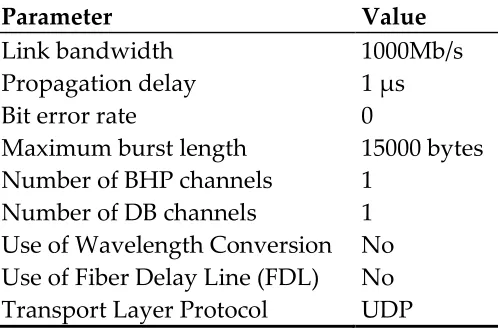
Table 2.1 shows the simulation parameters for the OBS network
configuration. As for the traffic files, we created ten trace files with incremental
traffic load rate (0.1 Gbps, 0.2 Gbps, 0.3 Gbps, …, 1 Gbps respectively, where 1
Gbps is the maximum rate allowed by the simulator for each node) which
represent the traffic transmitted by the legitimate sender.
We conducted experiments based on a BHP flooding attacker of varied
strengths to evaluate and compare our classifier with the default scheme which
has no security measures. The objectives of these experiments are twofold: Table 2.1
NCTUns Network Simulator parameter of the OBS Network configuration in evaluation
Parameter Value
Link bandwidth 1000Mb/s
Propagation delay 1 μs
Bit error rate 0
Maximum burst length 15000 bytes
Number of BHP channels 1
Number of DB channels 1
Use of Wavelength Conversion No
Use of Fiber Delay Line (FDL) No
24
1. Firstly, we want to observe the impact of BHP flooding attack on
legitimate traffic when no security measure is employed;
2. Secondly, we want to evaluate the effectiveness of our classifier in
preventing the BHP flooding attack.
We start with a lightweight attacker with 0.2 Gbps load. By attacker’s load
we refer to the network resources collectively requested by the harmful BHPs
sent by the attacker. Lightweight is relative to the traffic loads of other trace files
used in our experiments. To increase the difficulty of detection, we make the
attacker randomly flood the intermediate core switch with a random load of
malicious BHPs with different interval time, and let the average attacker load
reaches 0.2 Gbps. We test this lightweight attacker against all 10 trace files, with
each trace file run three times and calculate the average. The results in terms of
25
packet dropping rate are shown in Figure 2.8. From this figure we can see that at
the beginning when the legitimate traffic load is not very high, the packet
dropping rate for the default scheme is not high. This is because the attacker load
is relatively low which still leaves much bandwidth available for the legitimate
traffic. The dropping rate of legitimate traffic starts at 26% and stabilizes to
around 55% as the legitimate traffic load increases to 1 Gbps. This is expected
since the legitimate traffic load becomes gradually higher than the attacker load
and will request more bandwidth, which, however, has been falsely reserved by
the attacker.
The packet dropping rate of our classifier remains low, only around 1%.
This is because our classifier detects the misbehaving node and assigns it to the
Blocked class. Once the system blocks the attacking node, all the resources
requested by the legitimate ingress node are granted and hence the packet
dropping rate becomes low even for high traffic loads. The 1% of dropped
packets is due to the period when the attacker was not yet classified into the
Blocked class at the beginning of the simulation and was granted the resources
requested by the bad BHPs, which leads to the slight dropping of legitimate
packets at the initial phase.
We continue testing with a medium-strength attacker with a load of 0.5
26
allowed by the simulator for each node. The results for these two cases are
shown in Figures 2.9 and 2.10 respectively. For the default scheme, the packet
dropping rate demonstrates similar trend as in Figure 2.8, except that the stable
packet dropping rate is around 80% for the medium-strength attacker, and
around 90% for the powerful attacker. These results are reasonable since higher
attacker load gives the attacker a better chance to reserve the DB channel for
longer time and may result in higher packet dropping rate for the legitimate
traffic. By contrast, both Figures 2.9 and 2.10 show that for our classifier, the
packet dropping rate remains as low as between 1% and 5%, which clearly
demonstrates the effectiveness of our classifier in stopping the BHP flooding
attack.
27
Overall, the experimental results lead us to reach the following two
conclusions. Firstly, if the BHP flooding attacker is more powerful to transmit its
bad BHPs to request network resources at a higher rate, it can cause more
legitimate DB packets to be dropped. Secondly, our classifier can effectively
prevent the BHP flooding attack regardless of the strength of the attacker.
Furthermore, the model relies on detecting/preventing the BHP flooding attack
in time which makes our classifier model perform better.
2.5 Related Studies
In OBS network, there are several potential threats including traffic
analysis, eavesdropping, spoofing, data burst redirection attack, burst
duplication attack, replay attack, burstification attack, land attack and BHP
flooding attack [8]. In this section, the focus will be on discussing security issues Figure 2.10 Comparison of percentage of lost packets number in the presence of
28
related to OBS network and present common threats particularly DoS flooding
attacks based on the protocol level.
In traffic analysis or eavesdropping attack, the attacker attempts to gain or
access some unauthorized information about the target node by passively
listening to the communication. The attacker in OBS can scan for an open
vulnerability, and then intercepts active BHPs in order to compromise the
corresponding data burst. When BHP gets compromised, the attacker will be able
to analyze and monitor the transmitted information from the compromised BHPs
which may expose him to the transparent DBs that contain the critical
information. Passive attackers are hard to detect and can be seen a true troubling
threat in OBS networks. In [13, 14, 15], the authors propose prevention
techniques to overcome this type of attacks.
In data burst redirection attack, the attacker injects a malicious BHP into
the OBS network, causing the corresponding DB to be redirected to unauthorized
destination. In OBS network, a DB is configured to follow the optical routing
path set up by its associated BHP, but it is not able to authenticate the routing
path of the BHP. If a malicious BHP is injected into the OBS network at a time
such as offset time, any active DB can be misdirected to an unauthorized
destination. The authors of [2], [12], [16] developed solutions to fight data burst
29
In burstification attack, the attacker can compromise the ingress node by
changing the DB size value that was originally recorded in the BHP. Then the
actual DB could be mishandled as a different DB value according to the modified
BHP, in which the receiving node will have to inquire for retransmission of the
burst. This attack can happen at both edge (including ingress and egress) and
core switches. The attacker will compromise the ingress node and modifies the
burst size value to a larger size, such that the burst reservation time will increase,
resulting in longer propagation delay and increased burst setup latency. In [17],
the authors thoroughly discussed the burstification besides other threats that
may occur on optical nodes.
In land attack, the attacker compromises a node by making a copy of the
BHP, modifying its destination address to the source address, and injecting the
modified BHP into the OBS network. The result is that the corresponding data
burst will reach the intended destination and the source itself. Due to this attack,
some network resources will be wasted in sending the data burst back to the
source, which in turn will cause some restriction on the sending resource in the
best possible behavior. In [18], the authors discussed in details this type of attack.
Research works more relevant to ours include [9, 10], [19], whose authors
also addressed the problem of preventing BHP flooding attacks that may cause
30
that operates at the optical layer to filter out flooding attacks at early stages. The
filtering process is performed based on comparing the offset time included in the
BHP and the actual delay between this BHP and the associated DB. However,
due to the high traffic rates in optical networks, the proposed flow filtering
mechanisms cannot be effectively applied.
In [10], the authors study the denial of service attack resulting from BHP
flooding attack in the resources reservation protocols. The proposed
countermeasure module uses the concept of optical codewords to optically filter
the fake BHP and identify the compromised source node in the network. This
module can work at the edge node but it cannot optically filter the fake BHP at
the core switch. Moreover, the module does not perform any system validation
at the core switch to evaluate the performance of each connected node in the
network based on packet arrival rate/packet dropping rate and
allowing/blocking security rules.
In [19], the authors proposed a prevention mechanism to detect BHP
flooding attack in TCP over OBS network. This mechanism is limited based on
the statistical data collected from packets, and the threshold is not well defined
to justify whether the behavior of the node is normal or under an attack.
Moreover, the solution proposed by the authors increases the end-to-end delay
31
associated Quality of service (QoS) variables. [19]’s prevention mechanism only
reduces the trust value of the node until it reaches a value below the threshold.
However, there is no real or immediate action to stop the attacks before they
occur.
It is worthy to note that flooding is a very common way to launch
distributed denial of service (DDoS) attacks, in which the distributed attacking
sources simultaneously transmit an overwhelming amount of malicious
unwanted traffic toward the victim machine to congest the victim’s network and
drain the victim’s communication and computation resources. Many approaches
have been proposed to address DDoS flooding attacks, such as rate-limiting
schemes [20,21,22,23,24,25] and IP traceback schemes [26,27,28,29,30,31].
However, the main purposes of these schemes are to identify the attacking
sources and restrain them from sending excessive traffic. By contrast, the
problem with BHP flooding attacks is that the attacking sources, whose identities
are already known to the core switches, do not send out the corresponding data
burst traffic after sending BHPs to reserve network bandwidth. This major
difference deems the rate-limiting and IP traceback schemes unfit for addressing
32
2.6 Summary
In this work, we proposed a new security classification model for
countering BHP flooding attack with an adaptive sliding range window to detect
nodes based on their behavior. The classifier enables core switches to measure
the performance of incoming nodes and detect BHP flooding attack. The
simulation results show that our proposed classifier is effective in preventing
BHP flooding attack. They show that the overall packet dropping rate when the
classifier is used is less than 5% in all traffic load cases under BHP flooding
attack. This is a remarkable improvement over the default scheme that employs
no security measures, which results in up to 90% packet dropping rate. The
proposed classifier has been studied with various scenarios with different cases
to demonstrate its capability of securing the OBS network from BHP flooding
attack, such as critical links in the network. We note during experimentations
that our classifier not only can secure the core switches in the OBS network, but
also has the potential to improve the QoS performance of the OBS network. In
the near future, we will extend the solution to increase the performance of our
current model and add QoS improvement features for OBS networks based on
33
C
HAPTER3
D
ECISIONT
REER
ULEL
EARNINGA
PPROACH TOC
OUNTERB
URSTH
EADERP
ACKETF
LOODINGA
TTACK INO
PTICALB
URSTS
WITCHINGN
ETWORKS3.1 Background
An Optical Network (ON) is a common network for transmitting data
from source to destination via an optical fibre medium using light [1]. Featuring
efficient quality performance indicators such as bandwidth and speed in contrast
to traditional networks, ON is the preferable option for Internet infrastructure
[2]. In order to make use of the huge bandwidth of ON, Optical Burst Switching
(OBS) was proposed in [3] as the next generation of optical switching technology.
Once it has obtained the User Datagram Protocol (UDP) packets, OBS network
will assemble the packets from the clients at the edge nodes (ingress node) into a
data burst (DB) and a burst header packet (BHP) will be transmitted in advance
in order to preserve the network resources required before the DB is actually
sent. However, an attacker can exploit this fact and can make an ingress node
(source node) overloads (flood) the network with BHPs that reserve the
34
ensure that prevention of BHP flooding attacks is set as a high priority in OBS, as
it could severely reduce the performance of the entire network and eventually
cause a Denial of Service (DoS) [5]. Despite the many advantages of the OBS
network such as resiliency, bandwidth efficiency as well as its economic benefits,
QoS and security can become issues for these networks, with consequences
including burst loss as a result of BHP flood attacks [35, 10]. Attacks of this type
are reliant on the flooding approach which has been examined in traditional DoS
against the TCP protocol [11].
A limited number of studies exist in relation to dealing with and
preventing issues caused by BHP flood attacks within OBS networks (such as, in
[9, 10, 35, 36]). For example, [9] proposed a flow filtering architecture operating
at the optical layer to filter out BHP flood attacks at an early stage. The filtering
process is performed through a comparison between the offset time included in
the BHP and the actual delay between this BHP and the associated DB. In [10],
the authors examined the issue of DoS within the resources’ reservation
protocols. This countermeasure adopts the method of using optical code words
which filter out fake BHP in order to identify the compromised source node
within the network. In [35] meanwhile, the authors proposed a prevention
method which was built by gathering statistical data from packets used to detect
35
and developed a new security model which could be integrated within an OBS
core switch architecture to prevent BHP flooding attacks. Using a
countermeasure security model enables the core switch of the OBS to classify the
ingress nodes according to their behaviour in addition to the amount of reserved
resources not being used. A malicious node which causes a BHP flooding attack
can be blocked using this model until the risk is disappeared. The issues with
these methods however is that they do not use the machine learning (ML)
techniques which are available to identify edge node behaviour in order to
counter the risk of BHP flooding attacks. These methods also contain their own
faults and can be limited in their execution and therefore need further
authentication.
This study will examine the problems of DoS resulting from BHP flooding
attacks in which legitimate BHPs are prevented from preserving network
resources for legitimate DBs. The ML architecture we have developed features
sets of beneficial learnings gathered from past simulations carried out using a
reduced number of features including the bandwidth used, the average packet
drop rate as well as the average delay time per second and other factors (further
details are presented in Section 3.3). One of the most encouraging data analysis
methods used by researchers for prediction is ML [37]. It features intelligent
36
knowledge building or isolating patterns which are concealed [38]. Little
research exists around the classification of edge nodes in preventing BHP
flooding attacks within OBS networks. A large proportion of this research related
to classifying traffic of computer networks through the use of ML, for example
[39, 35, 40, 41], are not solely focused on the classification of BHP flood attack
within OBS networks. Through our study, we find that ML can have a vital
function in preventing BHP flood attacks, resulting in improved QoS. These
results from the prediction decision used in ML techniques rely on automated
knowledge learnt, which can impact the predisposed decisions made by users,
leading to improved predictive accuracy.
Classification is one of the most frequent ML tasks which require the
prediction of a target attribute [42]. Classification related to building a model (the
classifier) using a recorded set of data along with a number of variables using
data processing, and then using the classifier in order to predict precise attributes
(the class) within the hidden dataset [43]. In relation to the issue of BHP flooding
attacks, the edge nodes can be classified into pre-defined classes, e. g. Behaving
or Misbehaving, meaning that this issue can be classified within predictive tasks,
and of course, classification. The key objective therefore will be to forecast the
type of edge nodes involved in order to prevent the risks associated with
37
Of the different classification approaches used within various domains,
the rule extraction from decision tree models is one of the most effective [44].
Decision tree models are a type of classification method which is cleverly built
using an information theory approach [45]. For example, [46] used Entropy and
Information Gain methods to build decision trees within an algorithm labelled
C4.5. Using the training dataset to form the tree, every individual path stemming
from the root node to the leaf represents a corresponding If-Then rule.
In this Chapter, we have investigated the potential of machine learning in
countering the risk of BHP flood attack problem. In particular, we have proposed
and developed a new series of rules using the decision tree method as a way to
prevent the risks of the BHP flood attack problem. Firstly, the decision tree
method proposed will build a binary classification model which can classify the
edge nodes into two classes (Behaving and Misbehaving). Hundreds of
simulation runs were used in order to collect the data to build the binary models,
gathering the various attributes associated with how the edge nodes perform. It
worth to note that the use of only two types of classes (binary) is intended for the
researchers and developers who are interested in security of OBS networks and
want only to identify suspicion nodes (Misbehaving). Next, the classification
models were improved through splitting the Misbehaving class into further
38
from the edge nodes (further details provided in Section 3.4). The proposed
classification rule models were evaluated using different metrics to measure the
overall performance of this approach. The experiments showed that using rules
derived from the decision trees did indeed counter the BHP flooding attack
problem and enabled the automatic classification of edge nodes at an early stage.
3.2 BHP Flood Attack as Classification Problem
In the field of artificial intelligence, ML is regarded as one of the most
popular areas of research, and used for data analysis in various applications [42].
In recent years, researchers in the field of artificial intelligence and ML have
developed several analytical methods which are directly concerned with the
classification of datasets generated within various business areas. Some of the
ML methods include Decision Trees [46], Greedy Induction [47], Associative
Classification [43], Neural Network [47], Probabilistic [48], and Support Vector
Machines [49]. Common ML methods tend to separate classification into three
different sub-tasks, which are:
Learning: Learning involves the tasks of executing data processing on the
dataset entered. One example is the associative classification method, in
which class association rules, if they exist, are identified using an
39
different input variable using Entropy (see Equation 4) in addition to a
support vector machine method tries which will recognize a clear line
within a hyper plane to identify the possible characteristics of the target
class.
Model Building: This task is related to the building of a predictive model
using the results of the previous task. The ML method will sometimes
change the results of the learning task through retaining key elements to
build the predictive model. For example, decision trees will prune
pointless branches to cut down overfitting.
Class Forecasting: This task will use the ML method to measure the built
model’s success rate in predicting the test data’s class values. The results
of this step are used to serve as the model’s error rate or establish the
negatives, model efficiency, classification accuracy and other factors.
When a core switch within an OBS network reserves the wavelength
division multiplexing (WDM) channels for the incoming BHPs, it will alter the
status of these channels from unoccupied to occupied. If a core switch becomes
the target of a BHP flooding attack and receives malicious BHPs, it will begin to
reserve new WDM channels in correspondence with each received malicious
BHP. This will prevent a legitimate BHP from reserving the essential network
40
and no WDM channels are available, the core switch will drop the arrived DB,
while the reserved channels will be waiting for unidentified bursts which may
never arrive [50]. This research will focus on the BHP flooding attacks in terms of
a classification issue as it is concerned with classifying edge nodes into a single
type out of a limited number of possible class values such as Behaving or
Misbehaving. Misbehaving nodes are defined as those send BHPs at a
substantially higher rate without sending the corresponding DB.
The definition of the classification problem is based on [51]. The training
dataset is labelled as , where represents the combination of variables
within the training dataset aside from the class variable, and represents the
class variable. A vector can be assigned one of two disjoint point sets C1
or C2 within an m-dimensional feature space. is the ith training data row
and represents the ith class value. The aim is to derive a function, F,
that maximizes the chance that for each test data. Two-class problem
(binary classification) is the simplest form of the classification; ci can be either -1
(Misbehaving) or 1 (Behaving). This means Function is:
(1)
In relation to an OBS network, BHP flooding attacks can be prevented if
41
nodes being identified. More specifically, if the determination of the edge nodes
that reserve network resources without proper use can occur in an early phase,
then these nodes can be blocked. The blocking of the edge nodes means that the
other ‘behaving’ edge nodes will be able to effectively reserve network resources,
improving the resource management and QoS of the network. To deal with this
issue, it is possible to build a model created from the edge nodes’ previous
behavior displayed during the simulations. This enables the model to be used to
automatically place the edge nodes into the right classifications in future
simulations.
3.3 The Proposed Rule-based Model for Anti-BHP-Flood Attack
In this section, we will present the proposed classification architecture and
its different phases. The various phases which must be included to promote
classification rules necessary to counter BHP flooding attacks can be seen in
Figure 3.1. In the initial phase, simulations were carried out to gather data
relevant to the edge nodes performance indicators, which was then catalogued as
the training dataset. Next, the training data set was pre-processed to remove
noise or statistical biases. Once the data is cleaned, a filtering process takes place
to detect the features which are the most influential, as well as reduce the
42
algorithm will process the dataset to build a classification model that will then be
transformed into rule sets. Any unnecessary rules are then be pruned to
eliminate any redundant rules. The rule sets are finally applied to classify the
edge nodes into a number of pre-defined classes against new test cases that had
the same performance indicators. The following subsequent sections will explain
the proposed classification architecture in further detail.
3.3.1 Understanding the Dataset
When using ML to prevent BHP flood attacks, establishing the right
training dataset from various nodes through the simulations remains a
significant challenge. The domain expert will typically identify many variables
that will directly and indirectly affect the OBS network which are also relevant to
the sending performance of the nodes. The first challenge faced is creating the
training dataset and determining the needed variables that ensure the ML Figure 3.1 The proposed rule based classification architecture for BHP flood
43
method can be used in order to construct a predictive model. Identifying the
necessary mechanism for converting the training dataset to the task of
classification is another challenge. The initial challenge can be addressed by
recording as many variables linked to the sending nodes as possible while the
simulator is working. On the other hand, the second challenge can be addressed
by establishing a new variable, the ‘class’ within the training dataset. Values of
classes can be assigned using a knowledge base to the variable which is entered
by domain experts, which will reduce biased data cases and make the building of
the training dataset more legitimate. A comparison will be made between this
class and the proposed ML’s predicted class to establish the effectiveness of the
model in terms of accurate classification
3.3.2 Training Dataset Preparation
The right training dataset is very crucial step in order for ML algorithms
to work as indented. To prepare the training dataset for the purpose of
identifying misbehaving nodes that are causing BHP flooding attack, numbers of
simulations were carried out in order to collect the different variables related to
the OBS network performance. Significant variables recorded include the
sending node number, allocated bandwidth, bandwidth used, bandwidth lost,
packet transmitted, packet dropping rate, packet received, transmitted byte,
44
flooding attack. For illustration purposes, Table 3.1 lists just four iterations for
two of the edge nodes.
Variables’ Descriptions Itr: The iteration number.
Node: The edge node label.
FB: Initial Bandwidth assigned (given) to each node, the user (usr) in the experiments assign these values.
UB: This is what each node could reserve from the assigned Bandwidth from FB column. The drops here are due to congestions.
LB: The amount of lost Bandwidth by each node from the assigned Bandwidth at column FB.
PSBy: Packets size in Byte assigned specifically for each node to transmit. Note: 60 Byte will be added to the 1440 for the IP Header and the UDP Header ((Data size 1440 Byte) + (IP Header 40 Byte) + (UDP Header 20 Byte)) =1500 Byte.
PT: Total transmitted packets (per second) for each node based on the assigned Bandwidth.
PR: Total received packets (per second) for each node based on the reserved Bandwidth.
PL: Total lost packets (per second) for each node, which based on the lost Bandwidth.
ByT: Total transmitted Byte (per second) for each node.
ByR: Total received Byte (per second) for each node based on the reserved Bandwidth.
ADTpS: Average Delay Time (per second) for each node. This is (End-to
End Delay).
Table 3.1