An Improved Reliability On Wireless Sensor
Network For Energy Irregularity Models Using
Fuzzy Deep Learning Protocol: Fdlp
Y. S. Thakur D. K. Sakravdia
Abstract: Electronic devices are widely used in many engineering and medical fields, such as aviation, power, communications, military and robotic, etc. Usually, the reduced the precision of the device, the more components the system includes. However, part failures are usually conditional. The safety model for conditional electronic circuit failure (WSN) is built in this paper and the impacts of decentralized strength and d ecentralized strain are discussed. Thanks to a wide range of applications, the Wireless Sensor Networks (WSN) has become the primary technology for u niversal life and remains an efficient research. The development of a secure and energy-efficient WSN remains to pose a major study task. Merger clustering methods have frequently been used to decrease energy consumption and extend the life of the network. This article presents a deep lea rning algorithm centered on fusion-level clustering logic, WSN-oriented routing, cross-protocol to eliminate secure, energy-based issues and stretch the life of the network. The simulation findings indicate that the proposed method operates very efficiently than the current strategy in aspects of power , energy consumption, charge interaction, network life, network reliability and client relationship. The suggested approach is intensively tested and contrasted to the curre nt processes, namely LEACH, TEEN and DEEC, and suggested.
Keywords: Wireless Sensor Networks, Fuzzy logic deep learning, Fusion level clustering, network reliability.
————————————————————
I.
INTRODUCTION
Since the last century, wireless network security has attracted more and more exposure to WSN. Reliability is usually defined as the probability within the specified operating environment of a device performing its intended function for a specified period of time. This concept of precision as a probability, generally quantified by assessing the median test duration (MTTF), implies the inevitability of domain mistakes. Dedication to consumer safety is required in today's extremely lucrative electronic devices such as WSN. Reliability is a complicated problem which is of interest to many scholars [1-7]. WSN's most recent reliable increase in energy efficiency, wireless interaction, reduced quantity, and computing methods is anticipated to be implemented in a stressful manufacturing environment where efficient surveillance and critical transmission of parameters play a important role. Industrial applications, mainly for control and maintenance reasons, involve atmospheric surveillance and equipment. Finally, the proposed FDLP protocol used the Opposition Deep Learning Algorithm to conduct multi-hop inter-cluster communication from CHs to the master station. The application of the FDLP protocol is divided primarily into three stages, namely the Network-Association stage, the nearest stage of detection of the node and, eventually, the precise stage. The findings of standard clustering protocols such as LEACH, TEEN and DEEC are used to compare the efficiency of the suggested FDLP protocol.
The simulation results proved the efficiency of the proposed FDLP protocol in the evaluation of metrics such as network life, energy utilization, efficiency and scalability of other clustering protocols. Localization is one of the most important problems faced by mobile device networks (WSNs), especially in the lack of global positioning facilities such as GPS. However, equipping WSNs with GPS devices entails extra hardware logic expenses and enhanced power consumption, which reduces the life of the sensor, which is usually run on a non-rechargeable battery. Range-free localization systems have shown potential as desired and cost-effective alternatives relative with range-based methods. The primary advantage of typical range-free localization schemes is: comfort. However, their precision requires to be improved, especially in the context of variable node density, reliability-related monitoring conditions and topology. This study therefore investigates the probable inclusion of three software teaching techniques, namely Fuzzy Logic (FL) and deep learning and fusion phase clustering, with the objective of improving energy irregularity design effectiveness on the wireless sensor network while bringing into consideration the above factors. In strong contrast to FDLP, FL methods generate high accuracy under tiny node density and limited bandwidth conditions. In fact, additional measures to offset for the impacts of uneven geometry (i.e., loud noise thickness owing to barriers) are incorporated as a hybrid system. During the blurred countries, noise and weight are normalized while the FDLP utilizes a deep learning idea to improve the representation of the image, including enhancing the spring force mistake assessment. The efficiency of our suggested system is assessed through experiments that show the efficiency of the system in terms of reliability-based range-free localization systems relative to other machine learning protocol for energy saving. An important and hard job is to assess the effectiveness of the wsn system. In fact, the failure of the CH node to merge WSN interrupts network communication,but also with the adjacent CH nodes. In order to maintain network contacts and improve network lives, clustering algorithms must
_____________________
Department of Electronics and Communication Engineering,
therefore be considered a fault-tolerant and network reliability issue.
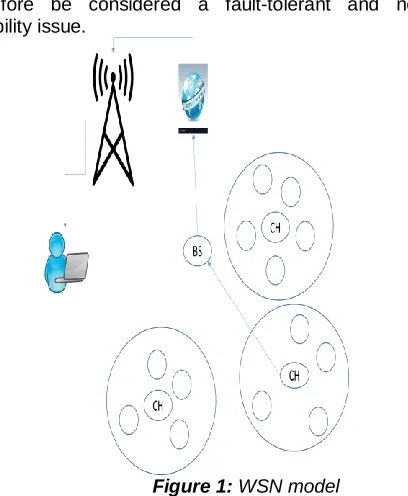
Figure 1: WSN model
The contributions of this work are the following:
A smart computer centered on profound studying blurred logic is suggested. This computer allows the MN sensor to smartly decide whether or not to initiate the handoff operation and execute the handoff to a current place.
The suggested FDLP strategy is, to the finest of our understanding, the first method to assess the finest route through information exchange on gathered network parameters and new node top procedure.
In order to enhance effectiveness and reliability, we have implemented a FDLP approach to select a suitable route for forwarding information transmissions.
The suggested FDLP approach will assess the network parameters and perform information integration on them in order to make an efficient cluster top choice choice, a new fuzzy-based cluster head choice method has been suggested.
We analyse and assess the efficiency of the suggested FDLP approach with different hierarchical, place and plain tracking procedures along Leach Cluster Head Selection Strategy. The simulation was carried out using different random networks and actual Internet topologies The following is the organization of this study article: Sect. 2 Recent associated suggestions, in specific those applying fuzzy logic and profound teaching, are shortly examined. In Sect. 3. A short debate of our motive is given on the basis of the constraints of the exit strategy leading to our suggested technique (FDLP). Section 4 offers a comprehensive overview of the suggested technique that integrates Fuzzy Centroid with Spring Force Vector Standardization and FDLP. FDLP's efficiency is demonstrated and discussed in Sect as opposed to other
standard deep learning apps, including the traditional current protocols namely LEACH, TEEN, and DEEC. 5. Lastly, Sect. 6 Concludes and addresses feasible potential work.
II.
RELATED WORK
resource-restricted WSN. Kaur, T. et al[8] This article provides a systematic review of the QoS systems used by routing protocols and shows each mechanism's efficiency problems as well. The study subsequently provides a relative assessment of QoS-aware routing protocols centered on computational intelligence with their weaknesses and constraints. Finally, this study describes different possible paths for future studies in the area of network layer QoS provisioning
Table 1: Comparative Analysis
Author Protocol /Algorithm Methodology
Molay Z, et al[11]
This approach based on the leach
Control the energy in the central level
Ran G et al[12]
Leach based algorithm applying for selection the CH and control the centralized
Compute the node density and central controller used on for energy saving
Singh M, et al[13]
Leach based algorithm used and applying the fuzzy logic
That used for maximizing life time with the help of proactive approach
Bagci H et al[14]
Fuzzy logic based Proactive approach
Fuzzy logic based approach used for energy saving distribute the load different number of node.
Mao S, et al[15]
Fuzzy logic based approach used for energy saving distribute the load different number of node. And applying the ACO
Fuzzy logic based approach and used ACO
III.
PROPOSED METHODOLOGY
The choice of the node tops nodes is focused on six descriptors; remaining power, thickness and BS range, weakness coefficient, centrality and CH range. There are several conceptual algorithms relying on fuzzy logic. But it is realized that to ensure optimal selection of the CHs, in the event of reasonable allocation and handling of the general energy consumption, the suggested algorithm works faster. The outcome also indicates a lower energy variance for the suggested algorithm that also validates its sensible energy consumption. We introduce a blurred profound training procedure: FDLP method where, in terms of quality and power effectiveness, it integrates the concept of press availability and energy-efficient cluster-based scheduling to increase network longevity. We enforce a method of artificial knowledge (i.e. blurred reasoning, deep learning, clustering) for efficient cluster top choice to minimize the issue by implementing non-similar clustering system. This system divides the nodes into groups of lower dimensions, which are mainly nearer to the base station.
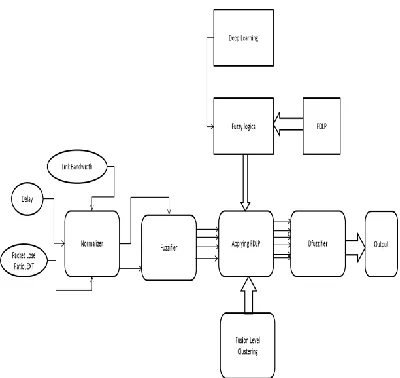
Figure 1: fuzzy deep learning protocol: FDLP
Oppositional blurred profound training protocol derived: FDLP algorithm for fusion cluster multihop transmission from CHs to master store, safe information transition to the MS. The simulation outcomes of the suggested protocol are contrasted with other existing protocols and their supremacy is shown. Fuzzy-based fusion cluster top choice in WSN A novel cluster top choice protocol oriented on the dictionary profound training method: FDLP was suggested in this document. The purpose of the suggested protocol is to boost network members ' lifespan by selecting a suitable node top. In this way, in the prolonged lifetime, the nodes can transmit the sensed or forwarding data. As a blurred deep learning protocol, we designated the suggested procedure: FDLP. The suggested system uses the calculation of the classification function when selecting the cluster top node. In this respect, for calculating the status (yield matrix) of each node top (CH) certain parameters are chosen. The output parameters selected are remaining energy, density of nodes, effectiveness of aggregation, historical throughput and range to BS. Reliability of residual electricity: This is drawn into account as greater energy nodes should be offered more opportunity to be chosen as CH. Thus, the network's lifespan can be improved. Reliability of node size: Because the nodes consume the energy, it is encircled by the amount of neighbours. This parameter is therefore drawn into account. Efficiency in aggregation reliability: It linked to the word of aggregation from the downward sensor nodes of incoming felt information. If the performance aggregation effectiveness is big, it will result in fewer transfers to the BS. Historical performance reliability: the performance is defined as the bits transmitted per second of duration. If the metric is large, it will contribute to excellent results of the entire IoT-oriented WSN network. Distance to BS reliability: A tightly situated CH to BS should be less competitive in order to be able to waste a significant quantity of energy transferring data from remote CH to BS. With a first-class radio energy model. There is also a difference between energy consumption, residual power, BS transmission and network life. our main contributors are listed below:
Fuzzy-cluster scheduling depending on deep training
Fusion information communication (threshold-based and regular information delivery with secure larger periods)
A new planning strategy that requires benefit of every possible path.
The service phase of the cross-level pile.
To perform the simulation and evaluate the existing algorithm.
The algorithm of the proposed FDLP protocol is shown by Algorithm as follows:
Algorithm: Working of proposed protocol Algorithm: Working of proposed protocol
CH (Checked the probability for come to be a CH for each node)
If (the CH node is empty set) Initialize the condition is true or false
Selected the variable as a random R define the value range 0 to 1
If R< CH (Checked the probability)
Applying the fuzzy login based on neural network concept compute the each chosen nodes
Performing the training operation And applying the testing condition Selected node reliable or not Compute the reliable node
If (position of CH is reliable or correct then compute the correct position)
Else if
If(Select correct CH= = true ) then Send the reliable path
Exit End if Else
Applying join operation
Finding the closest cluster head
Sending the closest message in for closest cluster head Set the cluster head <- assign the cluster member Exit
Compute the input node Layer 1 and x is a input variable layer 1 input give as a input in layer 2 , layer 2 output give as the input in layer 3 as well compute the wait value layer 3 output give as the input layer 4 w is represent as the wait value final output generated by the layer 5
Figure 2: Deep Learning Processing model
Simulation and evaluation
Simulations are conducted to confirm the effectiveness of the suggested algorithm. The simulation setting consists of
two distinct situations, 60 homogeneous SNs distributed uniformly over 120 9 120 and 60 9 60 m2 networks. Each SN has an original energy value of 0.1 J. energy specified as Eelec= 50 nJ / bit, efs= 10 pJ / bit / m2 and emp= 0,0013 pJ / bit / m4 and the information aggregation energy is measured as EDA= 5 nJ / bit / signal. The suggested algorithm was likened to LEACH[4], TEEN [5] and DEEC [6] for network life, energy dissipation and energy variance.
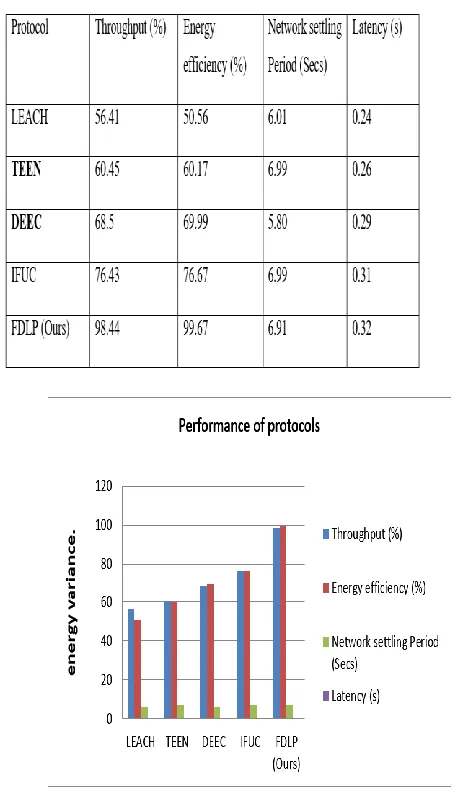
Table 2: Performance of protocols
Figure 3: Performance of protocols
the FDLP protocol chooses the relay node bringing into consideration precipitate energy and queue duration. . As a result, the signal is relayed to the MS on the multi-hop route and the energy is spread evenly perform the evaluation in different protocol as' LEACH[4], TEEN [5] and DEEC [6], the allocation percentage of the FDLP protocol is higher outstanding to the request of the fuzzy-based CH ranking technique. the data latency in the proposed FDLP protocol is slightly higher. The number of live nodes for each scenario was given in Figs for the operation of the network. It's 14 and 15. With respect to the time of death of the first node, it is well recognized that the suggested algorithm operates much quicker in both cases. Although the network size is 120 9 120 m2, the FDLP algorithm achieves a slightly higher yield than the suggested and other last node mortality algorithms. The WSN remaining energy was evaluated in each round to check the energy efficiency of the suggested algorithm. 16 and 17 distinguish the energy dissipation protocol. Taking these numbers into consideration, it has been discovered that in both cases the curve of the suggested algorithm is smoother than the remainder of the protocols, which confirms its enhanced efficiency in the case of reasonable allocation and general energy equilibrium. Another technique for validating the rational energy consumption of WSN is to investigate the variance in the job of the complete energy network. Reasonable energy consumption is stated by a lower energy variance left. the energy difference between the two circumstances. In both cases, the suggested algorithm appears to have a reduced energy variance. Another technique for validating the rational energy consumption of WSNs is to investigate the variance of complete energy in the job of the network. Having less energy variance left indicates a reasonable energy consumption. the energy variance between the two circumstances. In both cases, the suggested algorithm appears to have a reduced energy variance.
IV.
CONCLUSION
This article recommends a blurred Fusion Level Clustering (FLC) oriented deep learning protocol centered on routing, fusion protocol for WSN to eliminate reliability issues and improve the lifespan of the network. In relation to regular data transmission, the suggested technique uses threshold concept for data transmission. We have also implemented a fresh fusion-cluster scheduling approach for power load distribution by transferring the limit information for energy storage in the shortest paths and regular information in expired routes. In addition, the servicing stage of the unit helps all CHs produce an equivalent quantity of energy and considerably extends the life of the network. The comprehensive testing shows that the technique suggested generates stronger efficiency in different situations than current algorithms. This technique is well suited for apps for collecting information. The suggested technique with portable nodes and various exits can be expanded to the network. We would also concentrate on designing machine learning approach with reliability of connections, distribution and associated parameters. We will create a real-time application for the issue in using the suggested work.
REFERENCE
[1]. Guruprakash, B., Balasubramanian, C., & Sukumar, R. (2019). An approach by adopting multi-objective clustering and data collection along with node sleep scheduling for energy efficient and delay aware WSN. Peer-to-Peer Networking and Applications. doi:10.1007/s12083-019-00779-3. [2]. Kalaikumar, K., & Baburaj, E. (2018). Fuzzy
enabled congestion control by cross layer protocol utilizing OABC in WSN: combining MAC, routing, non-similar clustering and efficient data delivery. Wireless Networks. doi:10.1007/s11276-018-1848-3.
[3]. Jayasri, T., & Hemalatha, M. (2016). Link Quality Estimation for Adaptive Data Streaming in WSN. Wireless Personal Communications, 94(3), 1543– 1562. doi:10.1007/s11277-016-3697-7.
[4]. Qin, F., Dai, X., & Mitchell, J. E. (2013). Effective_SNR estimation for wireless sensor network using kalman filter. Ad Hoc Networks, 11, 944–958.
[5]. Baccour, N., Koubaa, A., Youssef, H., Jamaa, M. B., do Rosario, D., Alves, M., & Becker, L. B. (2010). F_LQE: A fuzzy link quality estimator for wireless sensor networks. In Wireless sensor networks, 7th European conference, EWSN 2010, Coimbra, Portugal, February 17–19, 2010 (pp. 240–255).
[6]. Baccour, N., Kouba, A., Jema, M. B., do Rosario, D., Youssef, H., Alves, M., et al. (2011). RadiaLE: A framework for designing and assessing link quality estimators in wireless sensor networks. Ad Hoc Networks, 9, 1165–1185.
[7]. Chen, Y., & Terzis, A. (2009). Calibrating RSSI measurements for 802.15.4 radios. HINRG technical Report, 2009-10-29.
[8]. Kaur, T., & Kumar, D. (2019). A survey on QoS mechanisms in WSN for computational intelligence based routing protocols. Wireless Networks. doi:10.1007/s11276-019-01978-9
[9]. Mittal, N., Singh, U., Salgotra, R., & Sohi, B. S. (2019). An energy efficient stable clustering approach using fuzzy extended grey wolf optimization algorithm for WSNs. Wireless Networks. doi:10.1007/s11276-019-02123-2 [10]. Arjunan, S., & Sujatha, P. (2017). Lifetime
maximization of wireless sensor network using fuzzy based unequal clustering and ACO based routing hybrid protocol. Applied Intelligence, 48(8), 2229–2246. doi:10.1007/s10489-017-1077-y. [11]. 30. Molay Z, Akbari R, Shokouhifar M,
Safaei F (2016) Swarm intelligence based fuzzy routing protocol for clustered wireless sensor networks. Expert Syst Appl 55:313–328. https://doi.org/10.1016/ jeswa201602016 31. [12]. Ran G et al (2010) Improving on LEACH
protocol of wireless sensor networks using fuzzy logic. J Inf Comput Sci 7:767–775 32.
[14]. Bagci H, Yazici A (2010) An energy aware fuzzy unequal clustering algorithm for wireless sensor networks. In: 2010 IEEE international conference on fuzzy system (FUZZ), 18-23 July 2010, pp 1–8 34.
[15]. Mao S, Zhao C, Zhou Z, Ye Y (2012) An improved fuzzy unequal clustering algorithm for wireless sensor Network. Mob Networks Appl:206– 214. https://doi.org/10.1007/s11036-012-0356-4 [16]. Tamandani, Y. K., Bokhari, M. U., &
Shallal, Q. M. (2016). Two-step fuzzy logic system to achieve energy efficiency and prolonging the lifetime of WSNs. Wireless Networks, 23(6), 1889– 1899. doi:10.1007/s11276-016-1266-3.
[17]. Gochoo, M., Tan, T.-H., Huang, S.-C., Batjargal, T., Hsieh, J.-W., Alnajjar, F. S., & Chen, Y.-F. (2019). Novel IoT-Based Privacy-Preserving Yoga Posture Recognition System Using Low-Resolution Infrared Sensors and Deep Learning. IEEE Internet of Things Journal, 1–1. doi:10.1109/jiot.2019.2915095.
[18]. Sun, Z., Zhou, L., & Wang, W. (2017). Learning Time-frequency Analysis in Wireless Sensor Networks. IEEE Internet of Things Journal, 1–1. doi:10.1109/jiot.2017.2771514.
[19]. Zhao, L., Huang, H., Li, X., Ding, S., Zhao, H., & Han, Z. (2019). An Accurate and Robust Approach of Device-Free Localization with Convolutional Autoencoder. IEEE Internet of
Things Journal, 1–1.
doi:10.1109/jiot.2019.2907580.
[20]. Bangotra, D. K., Singh, Y., & Selwal, A. (2018). Machine Learning in Wireless Sensor Networks: Challenges and Opportunities. 2018 Fifth International Conference on Parallel, Distributed and Grid Computing (PDGC). doi:10.1109/pdgc.2018.8745845.
[21]. Ahn, J., Park, J., Park, D., Paek, J., & Ko, J. (2018). Convolutional neural network-based classification system design with compressed wireless sensor network images. PLOS ONE,
13(5), e0196251.