13
International Journal in Management and Social Science http://ijmr.net.in, Email: [email protected]A Study of Consumer perception regarding digital payment
system in India
Himani
Research Scholar, KCL Institute of Management & Technology, G.T Road, Jalandhar
ABSTRACT
In today word mobile users can nowadays use their smartphones to make money transaction or
payment by using applications installed in the phones. The last decade has seen tremendous
growth in use of internet and mobile phones in India. Electronic consumer transaction made at
point of sale (POS) for services and products through internet banking or mobile banking using
smartphones or card payments are called as digital payment. This paper provides us a glimpse
of the user‟s behavior about the use of digital payment, their satisfaction level and impact of age on their use, factors that can affect a consumer‟s decision to adopt digital payment. The
structured questionnaire will used as a research tool for study the consumer perception of digital
payment. Primary data will collected from 100 respondents. The respondents will categorized
on the basis of demographics such as age, income level, occupation and gender. This research
used quantitative method ANOVA in order to get the statistical result from respondents.
14
International Journal in Management and Social Science http://ijmr.net.in, Email: [email protected]INTRODUCTION
It has been said that the announcement of demonetization by Prime Minister Mr. Narender
Modi is decisive move to root out corruption from the society. The move will not only have
transforming effect on the economy but will also pave the way for a more honest, digital
&modern India. Demonetization created huge growth opportunity for Digital payment in India
and digital wallet companies garbed the opportunities to expand their market shares.
Indian government and private sector companies such as paytm, freecharge, Vodafone‟s
m-Pesa, Airtel‟s Airtel Money and Mobikwik has been aggressively pushing several digital
payment applications, including Aadhaar Payment app and the national Payments corporation
of India (NPCI) developed the Bharat Interface for Money (BHIM) app.
Growth & Trend of Digital Payment in India
As a result of the government‟s unrelenting „Digital India‟ push, digital transactions in the
country reached a record high of 1.11 Bn in January 2018, up by 4.73%from the 1.06 Bn mark
touched in December last year.According to data released recently by the Reserve Bank of
India (RBI), the total transaction value surged to $2 Tn (INR 131.95 Tn) in January, making it
the second highest reported in a single month over the last one year. Compared to that,
December 2017 clocked transactions worth around $1.9 Tn (INR 125.51 Tn).The adoption of
prepaid payment instruments (PPIs) like digital wallets has also been speeding up as more and
more customers are coming under the umbrella of digital inclusion. In January this year, PPIs
records a total transaction volume of 113.6 Mn, up significantly from 99.1 Mn in December
2017.Payments via National Electronic Funds Transfer (NEFT) and Real Time Gross
Settlement (RTGS) also reportedly 1% and 2.4% jumps, respectively.Poised to reach $500 Bn
by 2020 according to a report by Google and Boston Consulting Group, the digital payments segment has transformed into a behemoth in the last few years. As per the report, cashless
transactions in the consumer payments segment is expected to double to 40% in the next three
15
International Journal in Management and Social Science http://ijmr.net.in, Email: [email protected] Amazon, PayPal and Uber have already made their foray into the Indian digital payments space,with WhatsApp slated to join the bandwagon in the next few weeks.
Figure 1 shows the data about total Internet Population in India from 2009 to 2018.
The above figure 1 depicts that there is massive increase in Internet users over this period of time.
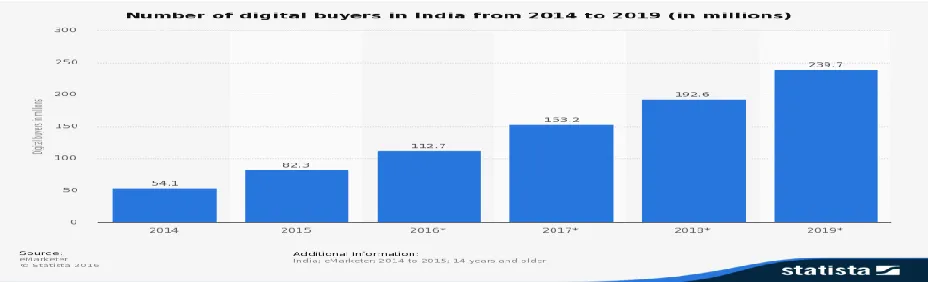
Figure 1.1 shows the data regarding Number of digital buyers in India from 2014 to the year 2019.
The above figure 1.1 depicts that there has been massive increase in digital buyers over a period
16
International Journal in Management and Social Science http://ijmr.net.in, Email: [email protected]Features of Digital wallets in India.
Paytm: Transferring money instantly to the bank from Patym account safe to store
Customer’s CVV number. Paytm has launched an app password features for Patym wallet in order to ensure the money is safe even if the customer lose or misplace his/her phone.
Mobikwik Wallet: It is user friendly mobile application and use for easy storing and transaction of money. We can instantly recharge without sign-up.
Vodafone’s m-Pesa: This wallet is also growing digital platform in India. It is efficient to make safe and hassle-free transactions through mobile phone. It also allow to transfer money to other
instantly.
Airtel’s Airtel Money: This can be used for recharges and money transfers, and are available in some offline destinations too.
Digital payment modes in India
There are several mode of digital payment available in India. These are:
Prepaid credit cards:Credit Card is a plastic card issued by bank to the customer. Customers can make purchases using funds available on the card and not on borrowed credit from the
bank. Can be recharged like a mobile phone recharge, up to a prescribed limit.
Debit/Rupay cards: These cards are issuing by bank will not authorize the transaction unless the PIN is entered correctly.These are linked to an individual‟s bank account. Can be used at
Shops, ATM, online wallets micro-ATMs and for e-commerce purchases.
Online or mobile wallets: They are used via the internet and through smartphone applications. Money can be stored on the app via recharge by debit or credit cards or net-banking.
AEPS: The Aadhaar Enabled Payment System uses the 12-digit unique Aadhaar identification number to allow bank-to-bank transaction at PoS. AEPS services include balance enquiry, cash
17
International Journal in Management and Social Science http://ijmr.net.in, Email: [email protected]Literature Review
Jashim Khan, Auckland University of Technology (AUT), “Cashless” transactions:
This paper presents a brief over view of issues regarding payment affected perceptions of
money and purchase behavior. Studies shows that money perceptions and use vary across
different social and cultural contexts.
Deepak Mathur said in his paper that Digital payment is secure, there should be no threat to the
user credit card number, smart card or other personal detail, payment can be carried out without
involment of third party. The study reveals that the people are not so aware about the security
concerns while making digital payments. There is a need to have awareness programs by the
various agencies in this regard.
TRAI (Telephones Regulatory Authority of India) and DOT (Dept. of Telecommunications)
need to enforce strong SOP (Standard Operation Procedures) for issues of duplicate SIM card.
Special cyber fraud codes are needed. Civil court judged to be trained in handling cyber fraud,
convenience vs security and cyber fraud issues. ATM CCTV camera to be functional in all
ATMs 24X7.
Major Challenges to Digitalization – Jan 11, 2017, “STEP” Test. This approach is highly
useful, both for the leadership to gauge readiness and refine and enhance it. The acronym STEP
stands for „S‟-security First. „T‟ Transformation preparedness, „E‟-Enterprise Architecture. „P‟
Productivity as the key foundation.
The Economic Times discuss the issue of “India leads the world in Digital Transformation”–
NOV 10, 2016. The government has been promoting digital transactions since Nov 8 when it
announced demonetization. Government is going to create digital transaction Index. It will be
based on three parameters-(1) total transactions in a state (proportion of cash and digital
transactions), (2) the extent of penetration and (3) usage of different modes of digital payments.
Rathore HS said in his paper that major factor in adoption of digital payment is convenience in
18
International Journal in Management and Social Science http://ijmr.net.in, Email: [email protected] There has been many studies conducted in past on mobile payment application to find consumerinterest and they found consumer has positive inclination for the same.
Journal of Internet Banking and Commerce, Shamsher Singh and Ravish Rana studied in their
paper that demographic factor except education does not have much impact on the adoption of
digital payment. It indicated that adoption of digital payment influenced by the education level
of the customer.
OBJECTIVES
To study the customer perception on adoption of digital mode of payment.
To understand the impact of demographic factors on adoption of digital mode of
payment.
HYPOTHESIS
H01: There is no significant difference perceived by respondents for various attributes of digital payment on the basis of gender of respondents.
H02: There is no significant difference perceived by respondents for various attributes of digital
payment on the basis of age of respondents.
H03: There is no significant difference perceived by respondents for various attributes of digital
payment on the basis of education of the respondents.
H04: There is no significant difference perceived by respondents for various attributes of digital
payment on the basis of profession of the respondents.
H05: There is no significant difference perceived by respondents for various attributes of digital
payment on the basis of annual income of the respondents.
19
International Journal in Management and Social Science http://ijmr.net.in, Email: [email protected]RESEARCH METHODOLOGY
The aim of this research paper is to find the various factors that affect customers in adopting
Digital mode of payment and to understand the impact of demographic factors on adoption of
Digital mode of payment.
SAMPLING PROCEDURE
In order to reach the aim a descriptive survey research method was used for this study. Data
was collected using structured questionnaire method. Questionnaire was sent to 100 smart
phone users. The respondents were categorized on the basis of gender, age, education, annual
income and profession.
RESEARCH AND STATISTICAL TOOLS EMPLOYED
The research and statistical tools employed in this study are ANOVA in order to get the
statistical result from the respondents. SPSS 19 was used to perform statistical analysis.
ANOVA was carried out to find the variance in the responses and to test the hypothesis.
ANALYSIS & INTERPRETATION OF THE DATA
Analysis and findings drawn from the data are presented in the below tables:
Table 1. Shows the result of data analysis between mode of digital payment and gender.
Test N F Sig
Gender and Digital Payment
100 3.22 0.04
20
International Journal in Management and Social Science http://ijmr.net.in, Email: [email protected]Table 2. Shows the result of data analysis between mode of digital payment and various age groups.
Test N F Sig
Age and Digital
Payment
100 2.95 0.05
With respect to variable-digital payment, the significance level is 0.05 (p = .05), which is equal
to 0.05 and therefore, there is a statistically significant difference between age groups and
mode of digital payment.
Table 3. Show the result of data analysis between mode of digital payment and education of the respondents.
Test N F Sig
Education and Digital Payment
100 0.96 0.32
With respect to variable-digital payment, the significance level is 0.32 (p = .32) which is above
0.05 and therefore, there is a no statistically significant difference between education of the
respondents and mode of digital payment.
Table 4. Show the result of data analysis between mode of digital payment and profession of the respondents.
With respect to variable-digital payment, the significance level is 0.02 (p = .02) which is below
0.05 and therefore, there is a statistically significant difference between profession of the
respondents and mode of digital payment.
Test N F Sig
Profession and Digital Payment
21
International Journal in Management and Social Science http://ijmr.net.in, Email: [email protected]Table 5. Show the result of data analysis between mode of digital payment and annual income of the respondents.
Test N F Sig
Annual Income and Digital Payment
100 3.94 0.023
With respect to variable-digital payment, the significance level is 0.023 (p = .023) which is
below 0.05 and therefore, there is a statistically significant difference between annual income of
the respondents and mode of digital payment.
Advantages of making Digital payment:
Save time: Digital payment hold the amount in the electronic form so as to ease the payment process.
Ease of Use: It allows user to link digital wallet to accounts and pay right away so that the consumers face no issues to enter the details every time a transaction happen.
Convenient and information stored under one roof: Better management is possible as there is synchronization of data from multiple platforms like bank accounts, credit and debit cards,
mobile accounts and billing portals.
Attractive discount: Cash back and discounts are being offered by most of the players along with providing offline wallets balance top up known as „Cash Pickup „service. This services is
being offered by Mobikwik that will facilitate cash to be directly added to Mobikwik wallet
22
International Journal in Management and Social Science http://ijmr.net.in, Email: [email protected]Findings of the Study
The study was conducted on various digital payment users: male and female, from different age
groups, education, annual income and profession. It was found in the study that there is no
significant difference between education of the respondents and mode of digital payment.
The other major findings of the research are as follow:
Security and safety of the funds is the most challenging issue for the users.
Dependency on internet connection to make payment is one of the major reasons for less
adoption of digital payment or digital wallet.
Users of digital wallet or digital payment are satisfied with the services provided to
them.
RECOMMENDATION
Discount offers and reward points on making digital payment can increase its popularity
and adoption as well.
Marketing and promotion programs should be conducted to create awareness among
non-users.
CONCLUSION
In term of the information Act 2000, reasonable security practices need to strengthen and it is a
continuous exercise. Specifically in the context of growing digital payments cyber police
personnel has to be trained fully because customers are not adopting the mode of digital
payment due to problem of security and for that TRAI (Telephone Regulatory Authority of
India) and DOT (Dept. of Telecommunications) need to be enforce strong SOP (Standard
Operation Procedures) for issue of duplicate SIM card. A big awareness is needed for rural
23
International Journal in Management and Social Science http://ijmr.net.in, Email: [email protected]Bibliography
1. The Economic Times- various issues from NOV 2016 to 2017
2. “Major Challenges to Digitalisation”-Jan 11, 2017
3. Journal of Internet Banking and Commerce, Dec 2017, Vol 22.
4. Deepak Mathur, A survey of awareness about security in E- payment system.