CSEIT1725182 | Received : 11 Oct 2017 | Accepted : 23 Oct 2017 | September-October-2017 [(2)5: 842-847]
International Journal of Scientific Research in Computer Science, Engineering and Information Technology © 2017 IJSRCSEIT | Volume 2 | Issue 5 | ISSN : 2456-3307
842
A Virtual Force Vibration Concept for four Resonances
Autonomous Mobile Robot Navigation
Akwara Uchenna C
Weafri Well Services Company Limited, C & I Data Engineer, Portharcourt - Rivers State, Nigeria
ABSTRACT
In this paper, the research on virtual force vibration concept for four resonance autonomous mobile robots navigation is welcome. This concept is adopted and applied to solve and address; the behaviour of four autonomous mobile robots without initial force of vibration, the amplitude frequency of the vibrating medium, the effect of inapplicable resonance, the wavelength of vibration and the vibrating amplitude length of the four mobile robots. Robot 1is set into motion at an amplitude frequency of its own mass, then forcefully vibrating Robot 2 with the same amplitude frequency of another mass. Robot 3 is set into force vibration by Robot 2 and Robot 4 is set into force vibration by Robot 3 and finally, Robot 1 takes the same force vibration of similar amplitude frequency of Robot 4 into resonance effect with different wavelength and different mass in a square workspace of cell (i,j) with respect to virtual force vibration. The technique was simulated using MOBOT SIM software, MATLAB software, Hewlett-Packard Laptop with Microsoft window 10 operating system.
Keywords : Four mobile robots, Resonance, Virtual force vibration, Frequency, Motion, Amplitude, Wavelength
I.
INTRODUCTION
Within this context, force is external pull acting on the robot at a particular inclined angle and mass. Vibration is the behavioural outcome acting physically no the external force created by the robot. Virtual force vibration is the virtual external force acting on the robot due to an external vibration inclined at a particular area, the mass occupied by the robot and the virtual workspace involved. Robot resonance is the effects that occur when a force vibrating robot set another robot into vibration with an amplitude frequency and vibrating characteristics existing between the force vibrating robot and another virtual force vibrating robot and both share the same amplitude frequency of vibration. There are Literature updates to this effect which are;
Tsetserukou et al. [1], in their paper, they reported that vibrations in heavily loaded joints have risen due to compliances introduced into each joint of robot arm by means of torque sensors. Nuriev et al. [2], they established that mechanical system simulates a vibration-driven robot, i.e. a mobile device capable to move in a resistive medium without external moving
parts. Chernous’ko F.L. [3] propounded that displacement of the system in a while occurs due to periodic motion of the internal mass respect to the container.
Yegorov A.G. and Zakharova O.S. [4], they established that motion of the system as a whole occurs by longitudinal periodic motion of one body (the internal mass) relative to the other body (the shell). Zhang et al. [5], in their paper, they developed legged locomotion (e.g. running) as adaptive vibration which is capable of adapting to change in internal parameters and in the external environment. Haitao et al. [6], they reported that rigid-flexible coupling vibration system of a spot-welding robot solve the natural frequency and modal shapes of the system and finally calculate the frequency response under certain forced vibration.
II.
PROBLEM IDENTIFICATION
This section highlighted the problems associated with four robots without initial force vibration and without resonance effect when robot 1 established a motion and come in contact with the other three robots with respect to the workspace of cell (i,j).
Figure 1: Four robots in a neutral state without force vibration and resonance effect.
The questions asked on Virtual force vibration concept are as follows;
(1). What suitable environment is applicable to four mobile robots motion?
(2). Can there be any virtual force vibration acting on the four mobile robots?
(3). Can the four mobile robots vibrate at the same amplitude frequency?
(4). What kind of Algorithm procedure is applicable for such virtual force vibration principle?
(5). Can there be any resonance effect acting on the four mobile robots?
III.
SOLUTION PROPOSED
This section explained the applicable solution to solve the lingering problems identified in section 2.
3.1 Nature of Environment
The nature of environment applied to this research paper is called Partially Unknown Environment (PUE). The four mobile robots are partially unaware of the environment in which the virtual force vibration and resonance is about to take place with respect to the workspace of cell (i,j) in x and y coordinates.
3.2. Virtual Force Vibration Algorithm (VFV) Procedure
This section explained the algorithm procedural technique applied for the experiment. The virtual force vibration for the four resonance mobile robots were mapped out on the workspace of cell (i,j) and the region of application is a square form where the four mobile robots are adapted to force vibration and resonance as shown below
Figure 2. Four resonance mobile robots in a virtual force vibration to the workspace of cell (i,j). Assuming,
x = 9m (x coordinate) y = 4.54m (y coordinate)
Where, α1, α2, α3 and α4 are the inclined angle of cell (i,j) while R1, R2, R3and R4 are the force vibrating mobile robots in a square fo form workspace of cell(i,j) for resonance effect to occur.
Such that,
Tanα = y/x (1) Taking each inclined angle into consideration Tanα1 = y/x α1 = Tan-1(y/x) α1 = Tan -1(4.54/9) = Tan-1(0.504) α
1 = 30o since α1= α2= α3= α4, then, α1= 30o, α2 = 30o, α3= 30o, α4= 30o Taking the force vibration acting on R1R2 into consideration.
Then, F(R1R2) = M(R1R2) x g(R1R2) x sin(α1α2) (2) Where, F(R1R2) = Force vibration acting on R1R2 to the cell (i,j). M(R1R2) = Mass of Robot 1 and Robot 2 to the cell (i,j).
Adapting periodic vibration of simple motion into the force vibration of the robots, then,
g = Amplitude acceleration of the robot to cell (i,j). Vt(R1R2) = 2∏ [√L (R1R2) /g (R1R2)] (4)
Then, Vt(R1R2) = Vt(R2R3) = Vt(R3R4) = Vt(R4R1)
V2
t(R1R2) =4∏2 [L (R1R2) /g (R1R2)] (5) Also,
g(R1R2) =4∏2 [L (R1R2) /V2t (R1R2)] (6) But,
Vt = 1/F (7)
Substituting equation (7) into equation (6) g(R1R2) =4∏2 [F21 x L (R1R2) ] (8)
Where F= Amplitude frequency of vibration to cell (i,j). Also,
L (R1R2) = λ(R1R2) / 2 (9)
Substituting equation (9) into equation (8) Then,
g(R1R2) =4∏2 [F21 x λ (R1R2) ] / 2 (10) g(R1R2) =2∏2 [F21 x λ
(R1R2) ] (11)
But the four robots have different masses and different wavelengths. Then,
g(R1R2) ≠ g(R2R3) ≠ g(R3R4) ≠ g(R4R1) M(R1R2) ≠ M(R2R3) ≠ M(R3R4) ≠ M(R4R1) λ(R1R2) ≠ λ(R2R3) ≠ λ(R3R4) ≠ λ(R4R1)
Substituting equation (11) into equation (2) Then,
F(R1R2 )= M(R1R2) x 2∏2F21λ (R1R2) x sin(α1α2)(12) F(R1R2) = 2∏2 [F21 M(R1R2) x λ (R1R2)] sin(α1α2)(13) F(R2R3) = 2∏2 [F22 M(R2R3) x λ (R2R3)] sin(α2α3)(14) F(R3R4)= 2∏2 [F23 M(R3R4) x λ (R3R4)] sin(α3α4)(15) F(R4R1)= 2∏2 [F24 M(R4R1) x λ (R4R1)] sin(α4α1)(16)
But the amplitude frequency of virtual force vibration are the same and in the same directional resonance with different partition. Since, F2
1= F22= F23= F24 (17) Taking the sum of virtual force vibration for the four resonance mobile robot to the cell (i,j).Then, ΣFs = F(R1R2 ) + F(R2R3 ) + F(R3R4 ) + F(R4R1 ) (18) Where, ΣFs is the Sum of virtual force vibration of the four resonance mobile robots to cell (i,j).
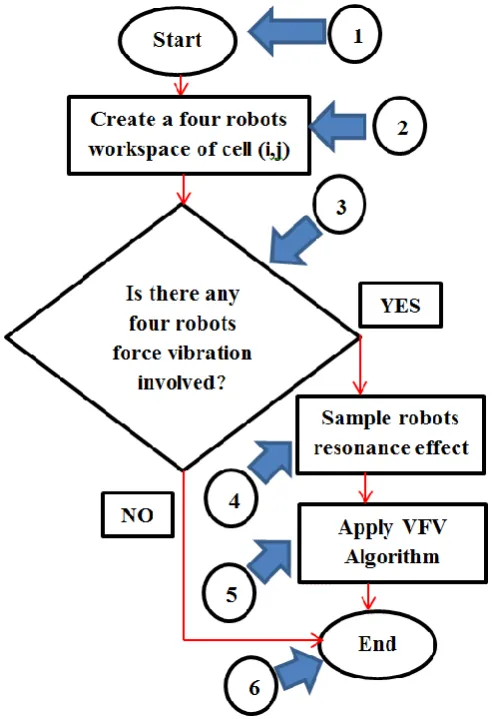
3.3. Virtual Force VibrationAlgorithm Flow Chart
This section explained the flow chart procedure of the virtual force vibration algorithm being applied on the four resonance mobile robots.
Figure 3: Shows the Flow chart of Virtual force vibration Algorithm concept.
IV.
RESULT AND DISCUSSION
This section highlighted the experimental research results obtained from the simulation of the algorithm and the overall discussions of the obtained results both figures, tables, raw data and chart has been applied in the experimental details and analysis.
The following parameters were applied during the research;
M(R1R2) = 80kg, M(R2R3) = 120kg, M(R3R4) = 50kg, M(R4R1) = 100kg, F1=F2=F3= F4=5Hz,
∏= 3.142, L(R1R2)= 2cm, L(R2R3)= 5cm,
L(R3R4)= 3cm, L(R4R1)= 4.5cm, α1= α2= α3= α4= 30o Then,
L(R1R2)= λ (R1R2) / 2 λ (R2R3)= 2 L(R2R3)
λ (R1R2)= 2 L(R1R2) = 2 x 5 = 2 x 2 = 10cm
= 4cm
= 6cm = 9cm
g(R1R2) = 2∏2 [F21 x λ (R1R2) ] = 2 x (3.142)2 x (5)2 x 4 = 1974.43 cm/s2
= 19.744m/s2
g(R2R3) = 2∏2 [F22 x λ (R2R3) ] = 2 x (3.142)2 x (5)2 x 10 = 4936.08cm/s2
= 49.361m/s2
g(R3R4) = 2∏2 [F23 x λ (R3R4) ] = 2 x (3.142)2 x (5)2 x 6 = 2961.65cm/s2
= 29.617m/s2 g
(R4R1) = 2∏2 [F24 x λ (R4R1) ] = 2 x (3.142)2 x (5)2 x 9
= 4442.47cm/s2 = 44.425m/s2 V2
t(R1R2) = 4∏2 [L (R1R2) /g (R1R2)] = 4 x (3.142)2 x 0.02/19.744 = 0.04s2 V2
t(R1R2) = V2t(R2R3) = V2
t(R3R4) = V2t(R4R1) = 0.04s2
Table 1: Shows the VFV simulation table for four resonance mobile robots
F(R1R2) = 2∏2 [F21 M(R1R2) x λ (R1R2)] sin(α1α2) =2 x (3.142)2[(5)2 x 80 x 0.04]sin 30o = 7.898N F(R2R3) = 2∏2 [F22 M(R2R3) x λ (R2R3)] sin(α2α3) =2 x (3.142)2[(5)2 x 120 x 0.1]sin 30o = 29.617N
F(R3R4) = 2∏2 [F23 M(R3R4) x λ (R3R4)] sin(α3α4) =2 x (3.142)2[(5)2 x 50 x 0.06]sin 30o = 7.404N
F(R4R1) = 2∏2 [F24 M(R4R1) x λ (R4R1)] sin(α4α1) =2 x (3.142)2[(5)2 x 100 x 0.09]sin 30o = 22.212N
ΣFs = F(R1R2 ) + F(R2R3 ) + F(R3R4 ) + F(R4R1 ) = 7.898+29.617+7.404+ 22.212
= 67.131N
Figure 4: VFV simulation graph of masses against amplitude wavelengths of four resonance mobile
robots
Figure 5 : VFV simulation graph of amplitude Length against amplitude acceleration of four resonance
mobile robots.
y = 0.0007x + 0.0128 R² = 0.5473
0 0.02 0.04 0.06 0.08 0.1 0.12
0 50 100 150
λ(m
)
M(kg)
Simulation graph of M(kg) against λ(m)
y = 987.23x - 0.0003 R² = 1
0 10 20 30 40 50 60
0 0.02 0.04 0.06
g(m
/s
2)
L(m)
Simulation graph of L(m) against g(m/s2)
S/N M(kg) L(m) λ(m) g(m/s2)
R1R2 80.00 0.020 0.04 19.744
R2R3 120.00 0.050 0.10 49.361
R3R4 50.00 0.030 0.06 29.617
R4R1 100.00 0.045 0.09 44.425
S/N Vt(s) V2t (s2) F(N) ΣFS(N)
R1R2 0.20 0.04 7.898 67.131
R2R3 0.20 0.04 29.617 67.131
R3R4 0.20 0.04 7.404 67.131
Figure 6: VFV simulation graph of amplitude period against amplitude acceleration of four resonance mobile
robots.
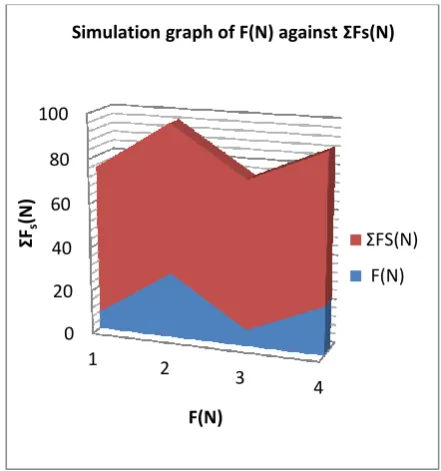
Figure 7: VFV simulation graph of virtual force against Sum of virtual force vibration of four resonance mobile
robots
Figure 8: 3D simulation of sum of virtual force vibration of the four resonance mobile robots.
In figure 1, representing four robots in a neutral state without force vibration and resonance effect. Robot 1 is blue, Robot 2 is orange, and Robot 3 is brown while Robot 4 is green in colour. In figure 2, representing four resonance mobile robots in a virtual force vibration to the workspace of cell (i,j). From the graph, the algorithm region where the mobile robots force vibration were mapped out on the workspace of cell (i,j) and the region of application is a square form where the four mobile robots are adapted to force vibration and resonance.
Figure 3, represents the Flow chart of Virtual force vibration algorithm application. From the graph, the algorithm procedural concept is analysed on a flow chart that would explain the overall technique applied and methodology while figure 4, represents the VFV simulation graph of masses against amplitude wavelengths of four resonance mobile robots. From the graph, the blue coloured object symbolised the simulation result of resonance mobile robots on virtual force vibration with y= 0.0007x + 0.0128 being the equation of longitudinal wave on a straight line and R2= 0.5473 being linear amplitude wavelength gradient.
In figure 5, representing the VFV simulation graph of amplitude Length against amplitude acceleration of four resonance mobile robots. From the graph, the simulation result of resonance mobile robots on virtual force vibration with y= 987.23x - 0.0003 being equation of longitudinal length on a straight line and R2= 1 being linear amplitude acceleration gradient while figure 6,
0 10 20 30 40 50 60
0 0.01 0.02 0.03 0.04 0.05
g(m
/s
2)
V2
t(s2)
Simulation graph of v2
t(s2) against g(m/s2)
0 10 20 30 40 50 60 70 80
0 10 20 30 40
ΣF
s(
N
)
F(N)
Simulation graph F(N) against ΣFs(N)
0 20 40 60 80 100
1 2
3 4
ΣFs
(N
)
F(N)
Simulation graph of F(N) against ΣFs(N)
ΣFS(N)
represents the VFV simulation graph of amplitude period against amplitude acceleration of four resonance mobile robots. From the graph, the blue mobile robots are cascaded and overlapping each other with respect to the resonance effect created by the virtual force vibration when considering the amplitude period and amplitude acceleration.
Figure 7, represents the VFV simulation graph of virtual force and Sum of virtual force vibration of four resonance mobile robots. From the graph, Robot 1 superimpose on Robot 2 while Robot 4 cascaded and overlapped on Robot 3 and finally, figure 8 represents the 3D simulation of sum of virtual force vibration of four resonance mobile robots. From the graph, the brown colour is the sum of virtual force vibration occupied area and the light blue colour is the virtual force occupied area acting along the virtual external force in a wave form region.
V.
CONCLUSION
The virtual force vibration concept applied for four resonance mobile robots navigation has scientifically proven to be robust, 100% technical, efficient and effective. The mathematical algorithm and simulation of the algorithm have made the end results to be accurate for the virtual force vibration. The figures applied, the simulation table, the flow chart analysis and the raw data’s used in the research are true raw data’s adopted from the simulation which gave 100% results oriented and virtual force vibration for the four resonance mobile robots. More research work expected in the future includes; thermal diffusivity concept for autonomous mobile robot and hybrid virtual force vibration model for two autonomous mobile robots.
VI.
REFERENCES
[1]. Tsetserukou et al. Vibration damping control of robot Arm intended for service application in human environment, 8th IEEE-RAS international conference on humanoid robots, pp. 441-446, December 1-3, 2008.
[2]. Nuriev et al. The study of the wedge-shaped vibration-driven robot motion in a viscous fluid forced by different oscillation Laws of the internal mass, IOP conference series: Materials science and Engineering, Vol. 158, issue 1, 2017. [3]. Chernous’ko F.L. The optimal periodic motions of a two-mass system in a resistant medium,
Journal of applied mathematics and mechanics, Vol. 72, issue 2, pp. 116-125, August 2008. [4]. Yegorov A.G., Zakharova O.S. The
energy-optimal motion of a vibration-driven robot in a resistive medium, Journal of applied mathematics and mechanics, Vol. 74, issue 4, pp. 443-451, 2010.
[5]. Zhang et al. Adaptive running of a quadruped robot using forced vibration and synchronization, Journal of vibration and control, Vol. 12, issue 12, pp. 1361-1383, December 2006.
[6]. Haitao et al. Vibration characteristic analysis of spot-welding robot based on ADAMS/Vibration, IEEE international conference on EMEIT, 2011. [7]. Futami et al. Vibration absorption control of
industrial robots by acceleration feedback, IEEE transactions on industrial electronics, Vol. 1E-30, issue 3, pp. 299-305, August 1983.
[8]. Goinaraghi et al. Resonance in a high-spedd flexible-arm robot, Dynamics and stability of systems, Vol. 4, issue 3and 4, pp. 170-188, 1989. [9]. Park et al. Position and vibration control of a
flexible robot manipulator using hybrid controller, Robotics and Autonomous system, Vol. 28, issue 1, pp. 31-41, July 1999.
[10]. Abduljabar et al. Active vibration control of a flexible rotor, Computers and structures, Vol. 58, issue 3, pp. 499-511, 1996.
[11]. Chan et al. Force vibration analysis for damped periodic systems with one Non-linear disorder, Journal of applied mechanics, Vol. 67, issue 1, pp. 140-147, December 1998.
[12]. Lee E.W. Non-linear forced vibration of a structured string, British journal of applied physics, Vol.8, issue 10, pp. 411, 1957
[13]. Savita et al. Frequency response curve for forced vibration under different damping for steel beam, International journal of innovative research in science, Engineering and Technolgy,Vol.3, issue 4, pp. 37-42, 2014