
A simple real-word error detection and correction using local word
bigram and trigram
Pratip Samanta
Computer Vision and Pattern Recognition Unit Indian Statistical Institute, Kolkata
Bidyut B. Chaudhuri
Computer Vision and Pattern Recognition Unit Indian Statistical Institute, Kolkata
Abstract
Spelling error is broadly classified in two categories namely non word error and real word error. In this paper a localized real word error detection and correction method is proposed where the scores of bigrams generated by immediate left and right neighbour of the candidate word and the trigram of these three words are combined. A single character position error model is assumed so that if a word W is erroneous then the correct word belongs to the set of real words S generated by single character edit operation on W. The above combined score is calculated also on all members of S. These words are ranked in the decreasing order of the score. By observing the rank and using a rule based approach, the error decision and correction candidates are simultaneously selected. The approach gives comparable accuracy with other existing approaches but is computationally attractive. Since only left and right neighbor are involved, multiple errors in a sentence can also be detected ( if the error occurs in every alternate words ).
Keywords: Real word error, Local context.
1. Introduction
Word error is a major hindrance to the real world applications of Natural Language Processing. In textual documents, word-error can be of two types. One is non-word error which has no meaning and other is real word error which is meaningful but not the intended word in the context of the sentence. Of these, non-word has been widely studied and algorithms to detect and suggest correction word for the error have been proposed. These algorithms are generally termed as spell-checker, which are integrated in various word-processing software like Microsoft Word1, LibreOffice Writer2, Ispell3, Aspell4 etc. For error
occurring at two positions of a word, the commercial spell checkers work fairly well. Some studies on spell checking approaches are found in [1-5], that include English and non-English language like Bangla.
However, the problem of real-word error is a more complex one. Usually, such error disturbs the syntax and semantics of the whole sentence, which requires human-being to detect it. However, an automatic syntactic/semantic analysis of a 'correct' sentence itself is a difficult
1 Microsoft Word is a word processor developed by Microsoft. 2 LibreOffice Writer a free open-source word processor. 3 Ispell is spell-checker for Unix.
task and the analysis of an 'erroneous' sentence is almost impossible in most cases. Any word-error can be represented in terms of insertion, deletion or substitution of one or more character. If we consider 'space' as one character, the problem can become more complex. For example, the word 'within' can become 'with' and 'in' if a 'space' is inserted wrongly after 'h'. Conversely, 'with' and 'in' can be merged to 'within' if a 'space' is unintentionally missed. This can be regarded as 'Split error' or 'Prune-on error'. Exploring further, 'these' can be split into 'the' and 'se'. This is an example of mixed case where the first part is real-word error and the second part is non word error, making them more difficult to correct. Real-word errors are also found in dyslexic text written by person having Dyslexia. Moreover, not only human-beings, these errors can occur due to 'Auto Correction' feature of some word processing software [6]. Sometimes by man and machine together, when user chooses a wrong word from list of suggestion against a flagged error by word processing software [7] .
To the best of our knowledge, the problem of real-word error is still at the research and development stage where instead of going at the full sentence level, anomaly is searched at the word bigram or trigram level. The first work in this direction was due to Mays et al. [8] who considered word trigram i.e. Second order Markov process for language modelling. If a word (W) in the sentence is unintended ( i.e. erroneous) , then the correct word is assumed to come from the members of confusion set of real word C(W) of W generated by single edit operation. In this model, the observed word W is assumed to be correct with probability or degree of belief α. Hence any member of C(W) is equally likely to be a correction candidate with constant probability (1- α) / n where n is the cardinality of C(W). The member for which the sentence probability is maximum is the correction word.
In this paper we present a simpler method to deal with the real word errors based on bigram and trigram model. The method tries to detect an error by noting bigrams and trigram constituted by immediate left and right neighbour of candidate word and then generate some suggestions according to ranks/score calculated for the correction set of words. Here we use BYU5 corpus of bigram and trigram corpus while test our method on text from Project
Gutenberg6.
This paper is organized as follows. Section 2 covers overview of related work. In section 3 we present our method. Section 4 highlights evaluation and experimental results. Concluding remarks are given in section 5.
2. Related Work
Apart from Mays et al. [8], several other methods have been proposed to handle real word spelling error problem. They are mainly based on either semantic information or machine learning and statistical method.
Among them, Golding and Schabes [9] introduced a hybrid approach called 'Tribayes' combining Trigram and Bayes' method. Trigram method uses part-of-speech trigrams to encode the context whereas Bayes' is a feature-based method. They use two types of features : context word and collocations. Their method worked better than MS-Word on a predefined confusion set. Later Golding with Roth [10] proposed a Winnow-based method for real word detection and correction. They modified the previous method [9] by applying a winnow multiplicative algorithm combining variants of winnow and weighted majority voting and achieved better accuracy. However , they used a small data set in their experiment. Word-net was considered as first lexical resources for real word error by Hirst and St-Onge
5 Details of Brigham Young University corpus can be found at http://corpus.byu.edu/.
6 Project Gutenberg is a collection of free electronic books, or ebooks. Details is available at
apriori belief that the observed test word is not a real word error. In their experiment Mays et al. obtained optimum value of this belief as 0.99 [8] which is used in our case as well. In other words, we believe that the test word can be a real word error in 1% cases. This value is used in normalizing the score in the real-word error detection algorithm described below. LetWi be a test word in the sentence. IfWi has a suffix part it can be stemmed into a root word sayWis . But if Wi is a root word, it cannot be stemmed. Thus, Wis may or may not exist, depending on the nature ofWi . Now, depending on the scores we make the decisions described in pseudo-code as follows.
Begin
if Score
(
Wi)
=0ifWis exists
ifScore
(
Wsi)
=0declare Wi as real-word error else
Wi is correct end if
else
declareWi as real-word error end if
else
ifWis exists
ifScore
(
Wsi)
< 0.01 * Score of Top-ranked element of confusion setdeclareWi as real-word error else
Wi is correct end if
else
Wi is correct end if
end if End
The above rules are now illustrated by an example. In a stream of text “... new lodger made
his appearance ink my modest bachelor quarters, but I was not ...” , the word 'ink' is actually
a real-word error.
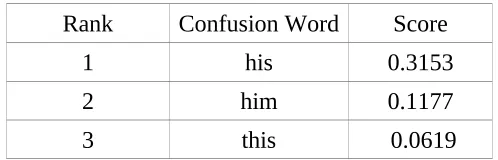
In our approach, the system starts processing one word after another. While processing the word 'his', we have the confusion set { his, him, this, is, has }. For each of these words we calculate the score the score and arrange it in decreasing order of magnitude, as shown in Table 1.
Rank Confusion Word Score
1 his 0.3153
2 him 0.1177
4 is 0.0044
5 has 4.9629E-4
Table 1: Confusion set for word “his” with score
Since 'his' is on top of the list, the system infers that it is a correct word.
In case of the word 'appearance', we get the following results and it is also declared as a correct word.
Rank Confusion Word Score
1 appearance 0.2256
2 appearances 0.0243
Table 2: Confusion set for word “appearance” with scores
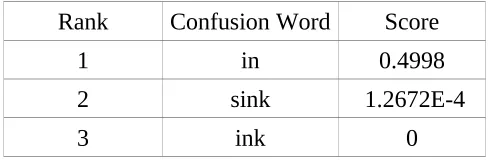
Now, for the word 'ink' we get the confusion set { in, sink, ink }
Rank Confusion Word Score
1 in 0.4998
2 sink 1.2672E-4
3 ink 0
Table 3: Confusion set for word “ink” with score
However, there is no count of the bigrams 'appearance ink' and 'ink my' as well as no count of the trigram 'appearance ink my' in the BYU corpus. So, the score of 'ink' is 0 and hence it is declared as real-word error. Since 'in' tops the score, the system considers it as the correct suggestion.
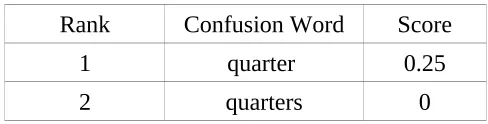
But score zero may not always mean that the word is an error. Sometimes a bigram/trigram score may be zero because it is absent in the particular corpus. For example, consider the word 'quarters'. From BYU corpus we get
Count(bachelor quarters) =0 Count(quarters but) =0 Count(bachelor quarters but) =0
Rank Confusion Word Score
1 quarter 0.25
2 quarters 0
Table 4: Confusion set for word “quarter” with score
Some of the frequent elements we consider for stemming are given below :
{d, n, r, s, y, ed, es, ly, ies}
Now we have a word
(
Wi)
decided as real-word error or not along with scores of the members of its confusion set. If decided as real-word error, we rank the members of the confusion set in descending order as suggestions for correction.4. Experimental results and discussion
In order to evaluate our approach we collected test data from Project Gutenberg. We chose Project Gutenberg because it contains simple text files only, especially with no pictures i.e. only stream of text. Our data consists of around 100 files ( approximately 25000 words ) with headings removed.
We simulated real-word error synthetically and subject this erroneous document to our error detection and correction system. To make such a corrupted document, one in every 20 words is chosen. Suppose this current word is W. Then W is converted into a set of strings by one edit operation ( insertion, deletion, substitution) at one character position. If W contains n characters then n substitutions, n deletions and n+1 additions will create 3n+1 strings. From all the generated strings we find those which are valid words. One of these valid words is chosen at random and W is replaced by this word. In this way we introduce 100/20 = 5% real-word error in the corpus. Here we have considered real-word error generated by single operation like substitution, deletion or insertion.
While typing people make single position character mistake in between 60%-80% of the erroneous cases [2]. A small portion of that becomes real-word error. Out of the rest 20%-40% two or more position mistakes, the chance of getting real-word error is even smaller. So, single portion mistyping based model can take care of a very high percentage of real-word errors. We give this qualitative statement because we did not find any robust statistics of the real-word errors presented in the published literature.
The performance of our approach can be evaluated from three aspects. The first one is to compute Precision and Recall of real-word error detection. Letn1be the number of total errors,n2 be the be number of total detection andn3be the number of correct detection. Then,
Precision= n3
n2
Recall= n3
n1
(n2−n3). However, n2 can theoretically be equal to the total number of words in the test corpus ( say N ). So, we may normalize(n2−n3)with respect to N and represent it in percent as
Percent of erroneous detection=
(
n2−n3)
N ∗100 %
Table 5 shows Precision, Recall and percentage of erroneous detection. It is significantly better than [6] though test database is different.
Detected Real-word Error Erroneous Detection
Precision Recall
71%-79% 81%-88% 1%-2%
Table 5: Evaluation results of Detection by our approach
If words in the sentence are real-word error which have been detected by the system, then the relative ranks of correct suggestion generated by the system is shown in chart 1.
Chart 1 : Evaluation results of ranks of suggestions
It is noted that top-ranked suggestion is correct in 85% cases. Also, the correct suggestion lie in the top two ranks in 85+8 = 93 % cases. This shows that our proposed method can work very well by substitutions from our ranked list.
5. Conclusion
A simple but effective real-word error detection and correction approach is proposed here that employs only two bigrams and one trigram around the test word in a sentence. Since it works in a small neighbourhood around the test word, possibility of detecting and correcting more than one real-word error exist. The overall performance of the system on a moderate test set is quite satisfactory and comparable with those of state art correction systems. Evaluation of this method on global databases like Wall Street Journal corpus is a future scope of the work. The n-gram database used here is not huge, hence many valid bigrams and trigrams are not found in it, thus making the system less accurate. We tried to reduce such error by employing the stemming based method. This system may be further strengthened by using Word-net, which is our plan for future work. Test of this approach for Indian language text is another scope of future study.
85%
8% 7%
6. Acknowledgement
Authors would like to thank Supriya Das and Purnendu Banerjee for useful discussion.
7. References
[1] F. J. Damerau. A technique for computer detection and correction of spelling errors, communication of ACM, 7(3), 171-176, 1964.
[2] Karen Kukich. Techniques for automatically correcting words in text, ACM Computing Surveys, 24 (4), page 377 - 439, 1992.
[3] B. B. Chaudhuri. Reversed word dictionary and phonetically similar word grouping based spell-checker to Bangla text, Proc. LESAL Workshop, Mumbai, 2001.
[4] Joseph J. Pollock and Antonio Zamora. Automatic spelling correction in scientific and scholarly text, Communication ACM, 27(4):358–368, 1984.
[5] Peterson James. Computer Programs for Detecting and Correcting Spelling Errors, Computing Practices, Communications of the ACM, 1980.
[6] G. Hirst and A. Budanitsky. Correcting real-word spelling errors by restoring lexical cohesion. Natural Language Engineering, 11(1):87–111, March 2005.
[7] L. A. Wilcox-O’Hearn, G. Hirst, and A. Budanitsky. Real-word spelling correction with trigrams: A reconsideration of the mays, damerau, and mercer model. In Proceedings of CICLing-2008 (LNCS 4919, Springer-Verlag), pages 605–616, Haifa, February 2008.
[8] E. Mays, F. J. Damerau and R. L. Mercer. Context based spelling correction. Information Processing and Management, 27(5):517–522, 1991 .
[9] A. R. Golding and Y. Schabes. Combining Trigram-based and Feature-based Methods for Context sensitive Spelling Correction. Proceedings of the 34th Annual Meeting of the Association for Computational Linguistics,71-78, 1996.
[10] A. R. Golding and D. Roth. A winnow-based approach to context-sensitive spelling correction. Machine Learning, 34(1-3):107–130, 1999.
[11] G. Hirst and D. St-Onge. WordNet: An electronic lexical database, chapter Lexical chains as representations of context for the detection and correction of malapropisms. Pages 305–332, The MIT Press, Cambridge, MA, 1998.
[12] J. Pedler. Using semantic associations for the detection of real-word spelling errors. In Proceedings from The Corpus Linguistics Conference Series,vol. 1,no. 1,Corpus Linguistics, 2005.
[13] J. Pedler. Computer Correction of Real-word Spelling Errors in Dyslexic Text. PhD. Thesis, Birkbeck, London University , 2007.
![Table 5 shows Precision, Recall and percentage of erroneous detection. It is significantly better than [6] though test database is different](https://thumb-us.123doks.com/thumbv2/123dok_us/1092821.1138027/9.595.233.421.359.440/precision-recall-percentage-erroneous-detection-significantly-database-different.webp)
