In the same boat
and other idiomatic seafaring expressions
Rita Marinelli*, Laura Cignoni*
*Istituto di Linguistica Computazionale, C.N.R. Area della Ricerca Via Moruzzi 1, 56124 Pisa, Italy e-mail: [email protected], [email protected]
Abstract
This paper reports on a research carried out at the Institute for Computational Linguistics (ILC) on a set of idiomatic nautical expressions in Italian and English. A total of 200 Italian expressions were firstselected and examined, using both monolingual and bilingual dictionaries, as well as specific lexicographical works dealing with the subject of idiomaticity, especially of the maritime type, and a similar undertaking was then conducted for theEnglish expressions. We discuss the possibility of including both the Italian and English idiomatic expressions in the semantic database Mariterm, which contains terms belonging to the maritime domain. We describe the terminological database and the way in which the idiomatic expressions can be organised within the system, so that, similarly to the other synsets, they are connected to other concepts represented in the database, but at the same time continue to belong to a group of particular linguistic expressions. Furthermore, we study similarities and differences in meaning and usage of some idiomatic expressions in the two languages.
Keywords: Terminology, Semantic databases, Idiomatic expressions
1.
Introduction
Italy and England have a rich maritime history and therefore it comes as no surprise that there are so many maritime words and expressions which originated on the sea, deriving from the customs and traditions of seamen who spent more time on ship than on land, and therefore carrying with them a large amount of cultural information.
Nowadays, in the global economy, the port is a focal point of the network which involves not only the commercial, but also industrial, economic, financial, and logistic activities. The activities of the port have been extended beyond its geographical limits, interconnected as they are with the surrounding territory. In this respect, an ever increasing number of individuals are involved in the field of work (brokers and shipping agencies, freight forwarders, export-import companies, etc.), of school and didactics (nautical institutes, professional training, etc.), of maritime law (maritime and insurance contracts, averages and damages, passenger rights, etc.).
Wewere asked by specialized professional users working in the field of maritime navigation and transport to implement a terminological resource acting as a support for the definition and translation (Italian - English) of the terms belonging to this domain (Marinelli et al., 2003).
Firstly, a large set of terms was codified containing semantic information about the knowledge field of navigation; secondly, a set of specialized concepts belonging to maritime transport terminology were also inserted in the database.
Changes caused by the globalization of trade, business and travel, together with the development of technology for communication, translation and dissemination of terms within the maritime activity and its related terminology were also taken into account.
The “world” of shipping and maritime transport, comprising
both passengers and goods, is to be considered a center of interest connected to other fields such as tourism or intercultural communication. Therefore, we decided to include in the database, mostly rich in technical terms, the idiomatic expressions and sayings originating from this domain, which is a cultural environment affecting - also from a lexical point of view - our everyday life. In this way, the lexical coverage of the database Mariterm has been increased with concepts connected to navigation and belonging to a cultural linguistic heritage shared by and in which so many countries identify themselves.
2. The Terminological Database
Mariterm is a database organized in semantic relations, following the EuroWordNet (EWN)/ItalWordNet (IWN)
model, and according to the Princeton WordNet (WN)
philosophy (Vossen, 1999; Miller et al., 1990). The model used to structure this terminological lexicon is based on the concept of synset, a set of synonymous words, and on the vision of a synset defined by semantic relations which connect it to other synsets and reflect the user’s mental lexicon (Miller and Fellbaum, 2007).
The database contains semantic information for an approximate 3,500 lemmas belonging to the maritime knowledge field, and clustered into approximately 2,500 synsets, e.g.: timone, governale (helm); naufragare, colare a picco, affondare (to sink) (Marinelli and Roventini, 2006). The lexical semantic relations provided by the model can be described as: 1) relations linking the terms with other terms within the database (or ‘internal relations’); 2) relations connecting the terms to the synsets of the generic English WordNet (WN) (or ‘equivalence relations’).
2.1 Internal Relations
entire conceptual network in which that term is not only included but also plays a central role. The link is constituted by a specific ad hoc relation connecting the idiomatic expressions to the relativethematic word(s), e.g.: perdere la bussola (Æbussola), tirare i remi in barca (Æremo, Æ barca). In the examples reported here we have decided to link the idiomatic expressions to the terms which are the actual root-words, the words related to the specific maritime language. Furthermore, these words remain fixed within the expression, and are considered together with the variants of the expression proper. In the example tirare i remi in barca
(lit.: pull the oars in the boat) and its variants appoggiare (to rest), mettere (to place) i remi (the oars) in barca (in the boat), in other words to ship the oars, it is the concept, the mental representation of the oars in the boat that we assimilate to the staticity of the oars that we are pursuing; whether we are resting, pulling or placing them is irrelevant. partially enclosed by land)
S: (n)ocean, sea (anything apparently limitless in quantity or volume).
In these and other similar cases, instead of treating mare1
and mare2 as different meanings of the same word-form, we decided to highlight the second sense of mare (sea) as an ‘extended’ sense of the former, using a particular relation which encodes the synset extensions.
A semantic relation was created and included in the set of database relations so as to codify the sense extension phenomenon in the case of metaphorical or metonymic uses of a term, namely the relation has extension and its reverse
is extension of, already exploited to represent particular ‘extended’ senses of Proper Names (Cignoni and Coffey, 2003; Marinelli, 2010):
mare1 (grande massa di acqua salata) has hyperonym acqua (water)
mare2 (abbondanza, grande quantità) has hyperonym quantità
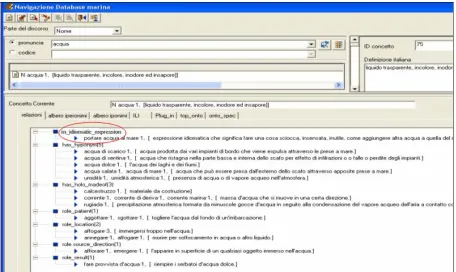
(quantity) All these kinds of data, information and semantic relations are managed by a tool which allows visualization and updating of the database. Each idiomatic expression is included in a set of items appropriately predisposed and managed by the tool, so that the idiomatic expressions form a repository of idioms that can be retrieved and listed on demand. Like the other synsets in the database, each expression is provided with a brief definition and is connected to its thematic term through a particular relation; if the term, for example mare (sea), appears in an idiomatic expression, the new relation in idiomatic expression and its reverse idiomatic expression from are used:
mare1 has extension mare2 mare2 is extension of mare1
The inclusion of idiomatic expressions should occur in an organized manner so that, similarly to the other synsets, they can be connected to other concepts represented in the database, but at the same time continue to belong to a group of particular linguistic expressions.
Each idiomatic expression of the database is linked to a ‘thematic’ term, namely a keyword representing a central relevant concept in the specialized lexicon and occurring in associated idiomatic expressions. The semantic field (‘node of information’ connected to the given keyword) is supplied with new information which contributes to enriching the
mare1 in idiomatic expression portare acqua al mare (fare una cosa inutile)
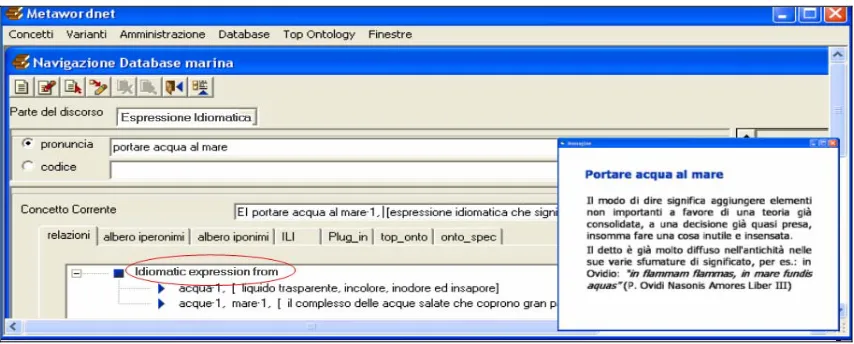
portare acqua al mare idiomatic expression from mare1
Fig. 2 “Portare acqua al mare”
In some cases, the tool displays a slot containing historical information concerning the idiomatic expression sought for, as in figures1 and 2 above.
4. English Translation
The idiomatic expressions included in the database also have the English translation, as provided by the conceptual model of the database.
When compared with nautical English phrases, many similarities were found to exist in the two languages, but sometimes a nautical expression was idiomatic in one language but not in the other (Cignoni et al., 1999).
As far as the English translation is concerned, different situations may occur:
a) The idiomatic Italian expression has an English translation which expresses the same concept, and uses terms belonging to the same maritime lexicon. Some expressions have a literal translation as well as an idiomatic sense which are identical, i.e. un pesce fuor d’acqua (a fish out of water), the same in the two languages, indicating unease and discomfort, or parlare come uno scaricatore di porto which is similar to “to talk like a dockworker”, or
buttato ai quattro venti, which is identical to “scattered to the four winds”: if something is scattered to the four winds, it moves in all directions.
b) The idiomatic expression has an English translation expressing the same concept, but using terms that do not belong to the same (maritime) ‘world’ i.e. essere un porto di mare, finding oneself in a very popular and crowded place (to be like Piccadilly Circus), un mare di guai (a heap of trouble), goccia nel mare (drop in the bucket), the last expression meaning that a certain amount of something is insufficient.
c) There are some English idiomatic expressions belonging to the maritime ‘world’, with an equivalent expression in Italian; in other words they have the same meaning, but do not belong to the maritime ‘world’, i.e. bruciare i ponti, (lit.: to burn the bridges) which is equivalent to the English “to
burn one’s boats”, in the sense of leaving oneself with no means of escape; buttarsi a terra, - where the Italian uses the very generic “throw yourself to the ground”-, while the English uses “hit the deck”, the part of the ship, with the intention or meaning of protecting oneself. Another example, “sail close to the wind” has the same meaning of
camminare sul filo del rasoio (to walk on a razor(’s) edge): if you sail close to the wind, you take the risk of doing something, of going close to the limit of what is allowed or acceptable.
5. Conclusion
This paper has discussed the importance of Italian and English seafaring phraseology and the integration of idiomatic expressions in the terminological database Mariterm organized in semantic relations.
We related on i) the methodology designed to enhance the database with this set of expressions, in keeping with the conceptual model of the database; ii) the enrichment of the lexical resource with explanations of the origins of the most common expressions; iii) the similarities and differences in meaning and usage of some idiomatic expressions in the two languages, also using Italian and English corpora and databases as references.
We are planning to add data on the frequency in the corpus CLIC of a subset of idiomatic expressions. In this respect, it would be useful to create a link allowing visualization of a number of examples, together with an annotation regarding the use (either literal or extended) of the idiomatic expression considered in that particular context.
Corpora can help determine or at least suggest the canonical form of the idiomatic expression, on the basis of the frequency of the variants and analysis of the co-occurrencies.