On-line Summarization of Time-series Documents using
a Graph-based Algorithm
Satoko Suzuki
Graduate School of Humanities and Sciences, Ochanomizu University 2-1-1 Otsuka Bunkyo-ku Tokyo,Japan [email protected]
Ichiro Kobayashi
Graduate School of Humanities and Sciences, Ochanomizu University 2-1-1 Otsuka Bunkyo-ku Tokyo,Japan
Abstract
As enormous amount of electronic documents on the Web have been increasing, the ne-cessity of automatic summarization has also been increasing to help people grasp the essen-tial points of the documents. Many summa-rization techniques dealing with single doc-ument and multi-docdoc-uments have been stud-ied. However, due to the increase of the documents which report the change of top-ics along a timeline, called time-series docu-ments, in recent years, a summarization tech-nique which generates a summary of time-series documents, called timeline summariza-tion, has been actively studied as an area of automatic summarization. There are different difficulties in summarizing time-series doc-uments from other type of automatic sum-marization. The basic approach for timeline summarization is to extract sentences which describe major events in object documents in chronological order to generate a timeline summary.
However, unlike the prior studies of timeline summarization, we particularly focus on on-line summarization of time-series documents and propose an on-line graph-based timeline summarization method. With our proposed method, a summary of time-series documents can be generated at any point of time when it is required. We conduct experiments to investi-gate the ability of our proposed method, evalu-ate the results with ROUGE metrics, and show our proposed method produces a better mary compared to other representative sum-marization methods.
1 Introduction
The automatic summarization techniques have been required due to increasing the amount of electronic documents. The object documents handled by au-tomatic summarization are diverse from newspa-per and academic articles to the documents used in social network services such as Weblog, Twit-ter, etc. Depending on object documents, an appro-priate summarization technique is applied. Due to the increase of electronic documents updated day by day, in recent years, new techniques which rize time-series documents, called timeline summa-rization, have been actively studied. There are dif-ferent difficulties in summarizing time-series docu-ments from other type of automatic summarization, because as for timeline summarization we have to summarize current information taking account of the information from the past. Besides, we have to de-cide the important information which should be in-cluded in a summary, tracking the change of topics. The basic approach for timeline summarization is to extract sentences which describe major events in ob-ject documents in chronological order to generate a timeline summary.
re-lation and apply graph-based algorithm to extract important information from the graph — here, the graph is evolved along a timeline by combining the current and past information, and then it represents object information to be summarized. In our pro-posed method, a summary can be generated at any point of time by request.
The structure of this paper is as follows. Related studies are summarizsed in section 2. In section 3, we show our proposed method. In section 4, we ex-plain the experiments based on our proposed method and discuss the results. Finally, we conclude this study in section 5.
2 Related Studies
As an application of automatic summarization, sum-marization of series document, called time-line summarization, has recently been actively stud-ied. At an early stage of the development of the technique, Allan et al. (2001) have proposed sev-eral summarization methods for time-series docu-ments and built evaluation corpus for the method. Chieu et al. (2004) have proposed a framework for making a timeline of events occurrence. They ex-tract events, which correspond to important sen-tences, relevant to a query from documents and place such events along a timeline. Yan et al. (2011a) have also proposed a method to extract important sentences to make a timeline summary expanding the graph-based sentence ranking algorithm used for multi-document summarization, and proposed a summarization method, called Evolutionary Trans-Temporal Summarization (ETTS), which extracts sentences from different points of time in a particu-lar period, and they have also proposed a method to optimize the function for the combination of impor-tant factors such as relevance, coverage, coherence and variety of words in a generated summary (Yan et al., 2011b). Tran et al. (2013a) have employed support vector machine based ranking algorithm to rank sentences with 28 features and selected sen-tences with high ranking score for a timeline sum-mary. They have reported that their method outper-forms other representative timeline summarization methods, e.g., (Yan et al., 2011a) and the reason for that is because they leverage some latent factors un-der supervision of human timelines.
As the studies using graph representation for the relation among sentences, Erkan et al. (2004) have introduced the PageRank algorithm to rank sen-tences in the order of high centrality and then ex-tracted the sentences with high ranking score as im-portant sentences which are expected to be included in a summary. Yan et al. (2012) have introduced hi-erarchical graph structure to represent both textual and semantic relation among sentences. Moreover, Li et al. (2013) have proposed a method called Evo-lutionary Hierarchical Dirichlet Process(EHDP) to consider the development of topics along a time-line. In their method, they have introduced a non-parametric Bayesian topic model to represent latent information among sentences — in their method, coverage and coherence are mainly considered for extracting sentences for a summary.
As the studies to focus on the topic development along a timeline, Zhao et al. (2013) have focused on the attention attracted to topics of interest – they call it social attention – to make a timeline sum-mary which reflects user’s interest. Hu et al. (2014) have explored the interactions of storylines in a news topic. They have especially focused on the coher-ence between news articles and discovered storyline interactions for timeline summarization.
Unlike the prior studies mentioned above, we fo-cus on on-line summarization for time-series docu-ments. The information reported in time-series doc-uments such as news paper articles is updated day by day, and we often need a summary for the infor-mation which has so far been reported. Therefore, in this study we aim to propose an on-line summariza-tion of time-series documents with a graph-based al-gorithm. By our method, a summary can be gener-ated at any point of time when it is required.
3 On-line graph-based timeline summarization
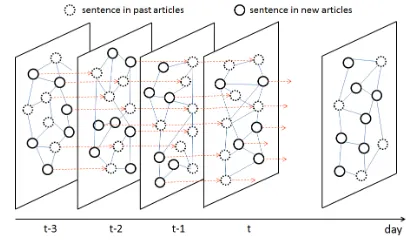
Figure 1 illustrates an overview of our proposed method.
Figure 1: Overview of our proposed method
LexRank algorithm (Erkan et al., 2004) is applied to the graph to rank the sentences, which correspond to the nodes in the graph, based on the the centrality of the sentences in the graph. Based on the ranking score, a particular number of top sentences are se-lected and recompiled as a new object documents to be summarized, and then a summary is gener-ated with the constraint on summary length. The summary candidate sentences are passed over to the next day as the sentences from past articles, and then a new graph consisting of both sentences from past and that day is reconstructed and the same procedure is applied to the updated graph. Like this, a series of the procedures is repeatedly applied to the summary candidate sentences in each day, and a summary of time-series documents is generated at any point of time when it is required.
The algorithm of our proposed method is shown in Algorithm 1.
Algorithm 1ranking algorithm
1: Input:Dt ϵ l
2: S ={ }
3: ϵ←threshold
4: fort= 0 toT do 5: S′←S +Dt
6: rankingS′with LexRank
7: iflength ofS′ >ϵthen 8: S←topϵsentences ofS′ 9: else
10: S←S′ 11: end if 12: end for
13: return toplsentences ofS
In Algorithm 1, Dt, ϵ, andl are provided as
in-put values. Here,Dtis a set of documents provided
at timet={0,. . . ,T},ϵis the threshold of graph size, andlis the number of sentences included in a sum-mary. S is a set of sentence candidates which are expected to be included in a generated summary. As mentioned above, as for the ranking algorithm for sentences, we employ LexRank algorithm pro-posed in (Erkan et al., 2004) – the detail procedure is shown in Algorithm 2.
Here, the similarity between two sentence vectors is defined as in equation (1).
idf-modified-cosine(x, y)
=
!
w∈x,ytfw,xtfw,y(idfw)2
"!
xi∈x(tfxi,xidfxi)2×
"!
yi∈y(tfyi,yidfyi)2 (1)
In the above equation,tfw,sindicates the frequency
of wordwin sentences. xandyindicate sentences andxiandyiindicate words inxandy, respectively.
idfiis defined equation (2).
idfi= logNd
ni
(2)
Nd is the total number of the documents inS′, and
ni is the number of documents in which wordi
oc-curs.
The score of nodeuis calculated based on equa-tion (3).
p(u) = d
N + (1−d)
#
v∈adj[u] p(v)
deg(v) (3)
Here, N indicates the number of nodes in a graph,
Algorithm 2LexRank
1: Input: An array S ofnsentences, cosine threshold toutput: An array L of LexRank scores 2: Array CosineMatrix[n][n];
3: Array Degree[n]; 4: Array L[n]; 5: fori←1 to ndo
6: forj←1 to ndo
7: CosineMatrix[i][j] = idf-modified-cosine(S[i],S[j]); 8: ifCosineMatrix[i][j]>tthen
9: CosineMatrix[i][j] = 1;
10: Degree[i]++;
11: end
12: else
13: CosineMatrix[i][j] = 0;
14: end
15: end
16: end
17: fori←1 to ndo
18: forj←1 to ndo
19: CosineMatrix[i][j] = CosineMatrix[i][j]/Degree[i];
20: end
21: end
22: L = PowerMthod(CosineMatrix,n,ϵ); 23: returnL;
equation (3) which is used for calculating the socre of a node is enhanced as shown in equation (4).
p(u) = d
N + (1−d)
× !
v∈adj[u]
idf-modified-cosine(u, v)
"
z∈adj[v]idf-modified-cosine(z, v) p(v)
(4)
In our proposed method, we limit the size of a graph. If the size of a graph, i.e., the number of sentences, exceeds the predefined threshold, it will be reduced to the size of the threshold. Then the sentences represented in the graph are ranked by LexRank algorithm and are extracted according to the raking score for a summary. In generating a summary, we use MMR-MD (Maximal Marginal Relevance-Multi Documents) proposed in (Gold-stein et al., 2000) to avoid redundancy in a sum-mary. This index works to avoid extracting similar sentences in a summary by providing penalty corre-sponding to the similarity between a newly extracted
sentence and the already extracted sentences. It is often used for query-based summarization. In our method, it is required to extract the sentences which have high ranking score and are not similar to the already extracted sentences as a part of a summary. Therefore, we modify MMR-MD as shown in equa-tion (5). We call our modified MMR-MD MMR’ hereafter.
MMR’≡arg max si∈S\S′
#
λscore(si) −(1−λ) max
sj∈S′sim(si, sj)×η
$
(5)
S : A set of summary candidate sentences
S′ : A set of already extracted sentences as summaryS
si : A sentence inS\S′ λ : Weighting parameter
η : Adjustment coefficient
Table 2: H1N1 Guardian
Methods R1-R R1-P R1-F R2-R R2-P R2-F RL-R RL-P RL-F random 0.386 0.389 0.415 0.067 0.069 0.072 0.360 0.367 0.388 LexRank 0.602 0.389 0.472 0.187 0.121 0.147 0.566 0.365 0.444 our method 0.593 0.403 0.476 0.172 0.116 0.138 0.562 0.383 0.451
R1: ROUGE-1, R2:ROUGE-2, RL: ROUGE-L, -R: Recall, -P: Precision, -F: F-score
Table 3: H1N1 Guardian without stop words
Methods R1-R R1-P R1-F R2-R R2-P R2-F RL-R RL-P RL-F random 0.197 0.223 0.212 0.022 0.024 0.023 0.197 0.218 0.207 LexRank 0.465 0.305 0.368 0.127 0.083 0.101 0.446 0.292 0.353 our method 0.453 0.311 0.369 0.130 0.089 0.106 0.441 0.303 0.359
Table 4: H1N1 Reuters
Methods R1-R R1-P R1-F R2-R R2-P R2-F RL-R RL-P RL-F random 0.415 0.253 0.317 0.030 0.020 0.024 0.394 0.237 0.297 LexRank 0.609 0.245 0.349 0.150 0.060 0.086 0.576 0.232 0.330 our method 0.641 0.255 0.358 0.147 0.063 0.088 0.603 0.241 0.34
Table 5: H1N1 Reuters without stop words
Methods R1-R R1-P R1-F R2-R R2-P R2-F RL-R RL-P RL-F random 0.175 0.120 0.142 0.005 0.004 0.005 0.170 0.116 0.138 LexRank 0.454 0.196 0.273 0.083 0.036 0.050 0.443 0.191 0.267 our method 0.495 0.205 0.284 0.078 0.036 0.049 0.474 0.200 0.274
scores than LexRank. As for the results shown in Ta-ble 3, i.e., H1N1 Guardian without stop words, the proposed method gets higher scores than LexRank at most evaluation metrics. However, as for the re-sults shown in Table 4, i.e., H1N1 Reuters, the pro-posed method gets higher scores at many metrics than LexRank when evaluating the result with stop words. However, both methods produce similar re-sults.
Introducing MMR’
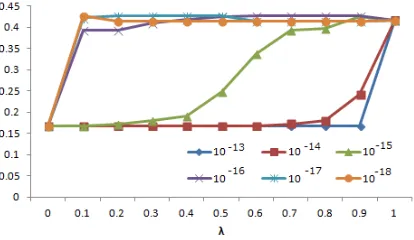
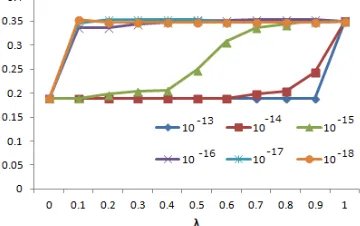
We conducted an experiment to investigate the in-fluence on the accuracy of summarization results by introducing MMR’. We used the articles of H1N1 of Guardian and set the graph size as 2000. For evalu-ation, we employed ROUGE-1 whose result is con-sidered as being close to the sense of humans (Lin et al., 2004). The results of the experiment obtained by changing the value of an adjustment coefficientη are shown from Figure 2 to 4.
The figures show the results in the case of
with-Figure 2: ROUGE-1/Recall(without stop words)
Figure 3: ROUGE-1/Precision(without stop words)
Figure 4: ROUGE-1/F-score(without stopword)
the result, and ifηis smaller, the ranking score in-fluences the result. As a result, even though we can find some parts where the accuracy is higher if we put weight on the penalty term rather than the rank-ing score term, the difference is a little. So, we have not been able to confirm that MMR’ works to raise the accuracy in this experiment.
4.4 Supplementary experiment
Each sentence is represented as a sentence vector constructed with the words included in itself and the frequency of those words. When making a sentence or document vector, we usually remove stop words from the vector because the stop word do not rep-resent the contents of the documents. As well as this, the word which do not appear in documents are hardly to represent the contents of the documents. Based on this, we have conducted experiments on removing such words from the object documents to be summarized and investigated the summarization result. As object documents, we used the articles about H1N1 of Guardian from which low frequency words are removed, and we set the graph size 2000
as experimental settings. Figures 5 and 6 show the results, that is, ROUGE-1 values of recall, precision and F-score in the cases of with and without stop words, respectively.
Figure 5: ROUGE without low frequency words (with stop words)
Figure 6: ROUGE without low frequency words (without stop words)
In the figures, the horizontal axis indicates the fre-quency for the words which are removed from the
object documents — for example, 3 indicates the
the accuracy is better than the case without any pprocessing. Compared with other methods, the re-sult is summarized in Table 6. Here, the case of removing the words whose frequency is less than twice is shown in the table. The best score is ex-pressed in bold fonts.
Table 6: Comparison with other methods (ROUGE-1)
Methods with without
R1-R R1-P R1-F R1-R R1-P R1-F
random 0.386 0.389 0.415 0.197 0.223 0.212
LexRank 0.602 0.389 0.472 0.465 0.305 0.368
our method 0.593 0.403 0.476 0.453 0.311 0.369
cut2 0.629 0.415 0.500 0.475 0.319 0.382
Making a comparison among all methods, the re-sult indicates that the best summary is generated by our proposed method with recompiled documents removing the words appearing less than twice from the original documents. From this result, remov-ing low frequency words from the objective docu-ments to be summarized can be regarded as useful pprocessing to make sentence vectors which re-flect the contents of the document.
5 Conclusions
In this study, we have proposed a graph-based on-line automatic summarization for time-series docu-ments. The algorithm of our proposed method can deal with the renewal of the object documents to be summarized over time, and generate a summary of the documents at any time when it is required. Fur-thermore, by providing the limit on the size of a graph, it is not necessary to take account of irrele-vant sentences for a summary. To evaluate the pro-posed method, we conduct an experiment to com-pare the proposed method with the other two meth-ods, i.e., the method of randomly extracting sen-tences to make a summary and LexRank. We em-ploy ROUGE as evaluation metrics. As a result, the proposed method gets close or higher accuracy than LexRank. Moreover, we have introduced an index to avoid redundancy in a summary by mod-ifying MMR-MD — with the modified index, we provide a penalty for selecting a similar sentence to the already extracted sentences. As the result of the
experiments using MMR’, we have confirmed that MMR’ works to raise the accuracy in some cases, however, have not yet confirmed its usefulness as a whole. Furthermore, we assume that the low fre-quency words are not regarded as important to rep-resent the contents of documents as well as stop words, therefore, we conducted a supplementary ex-periment on considering word frequency in object documents to be summarized. As the result of the experiment, we have confirmed that the acuuracy gets better than any other methods if we remove the words which do not appear less than twice in object documents and generate a summary. By this fact, we can say that removing low frequency words leads to making sentence vectors which reflect the contents of documents, and it works well as a pre-processing for generating a summary.
As future work, as the first issue, we like to con-sider how to decide the initial value for the impor-tance of a sentence in a graph — it is expected to be decided based on the ranking score at the previous time so as it will be useful for generating a sum-mary at the current time. As the second issue, we will investigate more about the possibility of intro-ducing MMR’. In this paper, we have not yet con-firmed that the usefulness of MMR’. However, we think that providing a penalty for similarity of sen-tences should work to generate a summary, so we like to propose a better metrics which works well in the proposed algorithm. As the third issue, we could not use enough data in the experiments in this study, so, we will use more data to confirm the proposed method is useful. Finally, we will compare the pro-posed method with the other timeline summarization methods.
Acknowledgements: This work is partly supported by Kayamori Foundation of Information Science Advancement.
References
James Allan, Rahul Gupta, and Vikas Khandelwal. 2001.
Hai Leong Chieu and Yoong Keok Lee. 2004. Query Based Event Extraction along a Timeline. In Proceed-ings of the 27th annual international ACM SIGIR con-ference on Research and development in information retrieval, pp. 425-432.
Gunes Erkan and Dragomir R. Radev. 2004. LexRank: Graph-based Lexical Centrality as Salience in Text Summarization. Journal of Artificial Intelligence Re-search, Vol. 22, No. 1, pp. 457-479.
Jade Goldstein, Vibhu Mittal, Jaime Carbonell, and Mark Kantrowitzt. 2000. Multi-Document Summarization By Sentence Extraction. In Proceedings of the 2000 NAACL-ANLP Workshop on Automatic Summariza-tion, Vol. 4, pp. 40-48.
Po Hu, Min-Lie Huang, and Xiao-Yan Zhu. 2014. Ex-ploring the Interactions of Storyline from Informative News Events. Journal of Computer Science and Tech-nology, Vol. 29, No. 3, pp.502-518.
Hongyan Jing. 2000. Sentence Reduction for Automatic Text Summarization. In Proceedings of the Sixth Con-ference on Applied Natural Language Processing, pp. 310–315, Association for Computational Linguistics. Kevin Knight and Daniel Marcu. 2002.
Summariza-tion Beyond Sentence ExtracSummariza-tion: A Probabilistic Ap-proach to Sentence Compression, Journal of Artificial Intelligence, Vol. 139, No.1, pp. 91-107, Elsevier Sci-ence Publishers Ltd.
Jiwai Li and Sujian Li. 2013. Evolutionary Hierarchi-cal Dirichlet Process for Timeline Summarization. In Proceedings of the 51st Annual Meeting of the Associ-ation for ComputAssoci-ational Linguistics, Vou. 2, pp. 556-560.
Chin-Yew. Lin. 2004. ROUGE: a Package for Auto-matic Evaluation of Summaries. In Proceedings of the Workshop on Text Summarization Branches Out, pp. 74-81.
Ryan McDonald. 2007.A study of global inference algo-rithms in multi-document summarization. In Proceed-ings of the 29th European conference on IR research, pp. 557-564.
Rada Mihalcea and Paul Tarau. 2004. TextRank: Bring-ing order into texts. In ProceedBring-ings of EMNLP-03 and the 2004 Conference on Empirical Methods in Natural Language Proceeding.
M.F. Porter. 1980. An algorithm for suffix Stripping. Program, Vol. 14 No.3,pp.130-137.
Dragomir R. Radev, Hongyan Jing, Malgorzata Stys, and Daniel Tam. 2004. Centroid-based summarization of multiple documents. Information Processing and Man-agement: an International Journal, Vol.40, No 6, pp. 919-938.
Giang Binh Tran, Tuan A. Tran, Nam-Khanh Tran, Mo-hammad Alrifai, and Nattiya Kanhabua. 2013.
Lever-aging Learning To Rank in an Optimization Frame-work for Timeline Summarization. SIGIR 2013 Work-shop on Time-aware Information Access.
Giang Binh Tran, Mohammad Alrifai, and Dat Quoc Nguyen. 2013. Predicting Relevant News Events for Timeline Summaries. In Proceedings of the 22nd inter-national conference on World Wide Web Companion, pp. 91-92.International World Wide Web Conferences Steering Committee.
Dingding Wang, Li Zeng, Tao Li, and Yi Deng. 2009. Evolutionary Document Summarization for Disaster ManagementIn Proceedings of the 32nd international ACM SIGIR conference on Research and development in information retrieval, pp. 680-681.
Rui Yan, Liang Kong, Congrui Huang, Xiaojun Wan, Xiaoming Li, and Yan Zhang. 2011a. Evolution-ary Timeline Summarization: a Balanced Optimiza-tion Framework via Iterative SubstituOptimiza-tion. In Pro-ceedings of the 34th international ACM SIGIR con-ference on Research and development in Information Retrieval, pp. 745-754.
Rui Yan, Congrui Huang, Xiaojun Wan, Jahna Otter-bacher, Xiaoming Li, and Yan Zhang. 2011b. Time-line Generation Evolutionary Trans-Temporal Sum-marization. In Proceedings of the Conference on Em-pirical Method in Natural Language Processing, pp. 433-443.
Rui Yan, Xiaojun Wan, Yan Zhang, and Xiaoming Li. 2012. Hierarchical Graph Summarization: Lever-aging Hybrid Information through Visible and Invis-ible Linkage. 16th Pacific-Asia Conference, PAKDD 2012, pp. 97-108.