V o o r w o o r d
Dit document bevat het onderzoeksartikel dat ik geschreven heb in het kader van mijn afstuderen aan de opleiding Communications Studies van de Universiteit Twente. Deze studie heb ik naast mijn werk als docent aan de Informatica Communicatie Academie (ICA) van de Hogeschool van Arnhem en Nijmegen gevolgd.
Ik heb onderzoek gedaan naar de acceptatie van Ambient Intelligence door ouderen. Ambient Intelligence gaat een steeds voornamere rol spelen in de ouderenzorg, maar er is nog niet veel onderzoek gedaan naar hoe ouderen dit beleven. Met dit onderzoek hoop ik daaraan bij te dragen.
Voor het onderzoek heb ik kunnen aansluiten bij een project van Stichting Thuiszorg Noord-Limburg naar een ‘intelligent’ zorgsysteem dat er voor moet zorgen dat ouderen langer zelfstandig thuis kunnen wonen.
Ik wil daarom John Rietman en vooral Ank Kleuskens van de thuiszorg bedanken voor hun bereidwilligheid en medewerking tijdens het onderzoek Door hen heb ik veel van de deelnemers of dagbestedingcentra kunnen benaderen en daardoor mijn voornaamste data kunnen verzamelen.
Verder wil ik Daan Dohmen van Focus Cura en Charles Willems van Vilans bedanken voor hun bijdrage aan het vinden van een passende onderzoeksetting en hun feedback op de beschrijving van het systeem zoals ik het bij mijn onderzoek heb gebruikt. Els van der Pool wil ik bedanken voor haar feedback op de deelversies en voor haar behulpzame tips. Ik wil vooral Somaya ben Allouch en Philip Brey bedanken voor de inhoudelijke en procesmatige tips en kritische noten. Zij hebben me door hun begeleiding laten ervaren wat zelfstandig onderzoek doen inhoudt.
Uiteraard mag ik Floor Felet niet vergeten. Dankzij haar steun, begrip en hulp heb ik niet alleen deze afstudeeropdracht kunnen afronden, maar tevens de twee studiejaren ervoor goed kunnen doorlopen naast mijn samenleven met haar en mijn werkzaamheden bij de ICA. Hiermee kom ik tot de laatste personen die ik wil bedanken. De directie van ICA, Deny Smeets en Ella Hueting, heeft mij de mogelijkheid geboden om dit leerzame, interessante en vooral leuke traject te volgen en zo mij de kans geboden om mezelf verder te ontwikkelen.
Op de volgende twee pagina’s vindt u eerst een Nederlandstalige samenvatting van het artikel. Vervolgens het resultaat van mijn afstudeerwerk.
Het artikel is geaccepteerd voor het Ambient Intelligence congres (AmI-08) in Nürnberg. De versie die in dit document is opgenomen, is hetzelfde als daar is aangeboden. Vandaar dat de opmaakeisen van de Lecture Notes in Computer Science zijn opgevolgd. Philip Brey is op zijn verzoek niet opgenomen als medeauteur. Veel leesplezier,
De Invloed van Controle op de Acceptatie van Ambient Intelligence door Ouderen, een Verkennend Onderzoek
Door: Lambert Zaad Nederlandstalige samenvatting
Dit artikel beschrijft het onderzoek dat is gericht op de acceptatie van Ambient Intelligence (AmI) door ouderen als zij erdoor langer zelfstandig kunnen blijven wonen. De gebruikers, van een systeem dat hen via bewegingssensoren ondersteunt, zijn gevraagd naar hun belevingen en ervaringen. Er is gebruik gemaakt van een bestaand systeem dat autonoom functioneert en voor het onderzoek is een ook aangepaste versie gefingeerd. Deze aanpassing bestaat uit een touch screen dat de gebruikers informeert
over de informatie die sensoren hebben waargenomen en door kunnen spelen aan de zorgverleners. Dit wordt, via een gesloten vraag, ter controle aan de gebruikers voorgelegd. Door op een knop op het touch screen te drukken
kunnen de gebruikers antwoorden. Hierdoor hebben de gebruikers meer zicht op de informatie die het systeem over hen doorgeeft aan de zorgverleners en over hun eigen welzijn.
De onderzoeksvraag die hiervan is afgeleid, luidt:
Hoe beïnvloedt de mate van controle de gebruiksintentie van Ambient Intelligence technologie door ouderen?
Om te onderzoeken of er verschil is in de beleving van deze twee versies van het systeem is het Ubiquitous Computing Acceptance Model (UCAM) van
Spiekermann (2007) gebruikt. Dit model geeft de variabele weer die de acceptatie van Ubiquitous Computing bepalen. Aangezien AmI en Ubiquitous Computing erg verwant zijn, is dit model gebruikt. Het model bestaat uit de variabelen usefulness, cognitive attitude, affective attitude,privacy, control en risk. De focus van dit onderzoek is vooral de invloed van Controle op acceptatie, maar de rol van de andere variabelen zijn ook onderzocht. De participanten zijn via een vragenlijst en met een focusgroep gevraagd naar hun ervaringen en belevingen.
The Influence of Control on the Acceptance of Ambient
Intelligence by Elderly People: an Explorative Study
Lambert Zaad1, 2
1 University of Twente, Drienerlolaan 5, 7522 NB Enschede, The Netherlands 2 HAN University of Applied Sciences, Information Technology, Media and Communication,
Ruitenberglaan 26, 6826 CC Arnhem, The Netherlands
Abstract. This paper presents the results of a study on how elderly people
perceive an intelligent system, embedded in their home, which should enable them to live independently longer. Users of a motion sensor system were interviewed about their experiences. A sensor system that autonomously works as well as a manipulated version was studied. The manipulation contained a touch screen that informed the users if the gathered information was correct before sending it to caregivers, so more control over personal information was provided. To test the use intention of the motion sensor system Spiekermann’s Ubiquitous Computing Acceptance Model of was used. This study shows that people, who perceive more control over their wellbeing, show more use intention. And that the subjective norm influences their acceptance. This study shows that acceptance models for Ambient Intelligence application in care situations need to be developed.
Key words: ambient intelligence, user experiences, elderly, telecare
1. Introduction
The vision of Ambient Intelligence (AmI) proclaims a future life filled with small computers embedded in environments of everyday life. The aim of AmI is that people in a particular environment will be assisted by the ubiquitous distribution of small computers in this environment [1]. Due to the context awareness of AmI, the environment should adapt itself to its present users and their needs. The users should interact with their environment in a natural way [1, 2]. The smart environment so provides more comfort and saves time and money, empowering the user and providing more entertainment [3]. The Institute for Prospective Technological Studies (IPTS) describes it as: “...'human centred computing’ where the emphasis is on user-friendliness, efficient and distributed service support, user-empowerment, and support for human interactions [2]. Thus, AmI should strengthen humans in their own environments.
Together with these positive sides, some major concerns are frequently voiced as well. Loss of privacy, autonomy and control are often cited as downsides of the vision of AmI [2, 3, 4, 5].
presented yet. This study investigates whether the level of control influences the use intention of AmI.
As the IST Advisory Group (ISTAG) forecasted, many intelligent systems will surround humans in their daily lives and activities in 2010 [6]. These forecasts have been criticized on their sense of reality and optimistic vision [7], but this does not mean that the realization of the vision has been compromised. At present many major research centres focus on the development of AmI, such as Philips, Microsoft and MIT. Also the European Commission and the Dutch government see many possibilities of AmI, for society and economy. Their policy focuses strongly on investing in ICT as an important part of, for example, health care and transport.
Despite the ongoing development of AmI, user centeredness and use intention have not been researched much. At the Ubicomp 2007 conference, only five of the twenty-nine surveys focus partly on user experiences and expectations in their studies [8]. This is understandable, as the technology to realize the vision has not yet been fully developed. There are not many applications or settings that contain all the five key features of AmI [9]. To develop and test a technology that contains embedded network devices and is context aware, personalized,adaptive and anticipates towards the users’ needs, is, at this moment, practically impossible. To be user centred, you must test how people perceive intelligent and assistive technology. Especially the equilibrium between personalized and assistive possibilities versus perceived invasion of privacy and threat to autonomy needs more attention and research.
The first AmI-like environments are gradually appearing in daily life. Intelligent vehicles and home equipment trickle through to the consumer market. One example is the safety features to assist the driver in automobiles. Examples of intelligence at home are sensor technology to automatically adjust light or energy use, robot vacuum cleaners and remote controls for managing lighting. Especially the care for elderly people makes use of information and communication technology to help the elderly live more independently. The technology should improve their way of live.
In spite of these technological improvements, the question remains how people react to this integration of ‘smart’ technology in their daily life. How do they cope with the possible threats and new opportunities elicited by AmI? This study tries to gain insight in the attitude of elderly people who could live in an ‘assistive’ environment and how this influences their intention to use and accept such an environment. The goal of this study is to investigate whether the level of perceived control over well-being influences the use intention of such an intelligent environment. A sub goal of the study is to look for indications of differences in use intention between Potential Users (PU), the ones that participated in the study, and Actual Users (AU).
The next section highlights some of the methods of user studies within the field of AmI or Ubiquitous Computing1 (Ubicomp), followed by the introduction of the Ubiquitous Computing Services Acceptance Model (UC AM), introduced by Spiekermann [10].
2. Previous research on AmI and related technologies
The user studies in the field of AmI are mainly executed by using films or scenarios of a future with smart devices [11, 12] or by the use of single prototypes of systems that could be used in an AmI environment [13, 14]. These studies mainly focused on
1The two concepts are closely related [1, 2] and for the readability of the text only the term AmI
perceived effects of ‘smart’ devices on humans; in particular perceived control and perceived privacy were measured. They also show effects of the experiences people have with suggested scenarios or used prototypes. However, none of these studies used technology that is actually deployed in real life or that fits two or more key features of AmI as stated by Aarts [1]. This could mean that the perception of the participants will not correspond with the perception of actual users of AmI-like technology. The perception of privacy and the level of control can be perceived differently by actual users than by potential users. Another way to study the perceptions of users in AmI-like settings is by the use of a living laboratory or a Smart Home. Such laboratory studies create real-time interaction with AmI technology and can provide in results of actual use experiences.
The next paragraphs describe the research methods and results of other user studies of AmI-like technologies.
Spiekermann [11] used a film showing the future of shopping, in which Radio Frequency Identification (RFID) is used to provide personalized services. RFID is considered one of the important building blocks of Ubicomp [7], and therefore also of AmI. The results showed that people prefer to destroy the RFID tag, despite the perceived value of after sales services which it could provide. It seems that people put the protection of their privacy above the possible benefits of the use of RFID technology. There was also an indication that people did not prefer to manually activate the RFID tag (User scheme) over automatically determine the privacy settings of the user through a “watchdog” (Agent scheme). There was no difference in perceived control between the two settings, so an autonomous system was not seen as less preferable than the system with more user control. However, the results suggested that the level of information control provided by the User scheme does influence its appreciation. Perceived control appeared to influence the appreciation of automated personalized services.
Another study by Niemelä, et al [12] used three scenarios of AmI environments to test the attitude of elderly people towards AmI applications that support the elderly in living independently. One scenario introduced a smart pillbox. A second scenario drew a sleep quality logger to check for sleep apnoea. The third scenario described a home equipped with several interlinked ambient sensors. Overall some privacy concerns arose, as did questions about usability: The first two scenarios transferred personal data to someone else, which led to some worries. In two scenarios, it was required to interact with the system by using a mobile phone. Several participants considered this to be difficult and preferred an easier interface. But mainly the participants did accept services and applications that improved their living and facilitated a more independent way of living.
A study that also surveyed perceived privacy and presence was conducted by Brown et al [13]. They used a Whereabouts Clock (WAC) to investigate the experiences of using a family locating system. The clock could, coarse-grained, track the whereabouts of relatives. The researchers investigated whether the WAC was perceived as a helpful smart tool to enhance family values. This study showed that the technology can also help families to “be a family”: it can enhance social cohesion. The participants perceived the WAC as supporting their reassurance, connectedness, expression of identity and social touch.
Besides user studies that used scenarios or single service prototypes, there are also studies that used a simulated environment like the Philips HomeLab [15] or the Aware Home [16]. The aim of these smart homes is to discover the subtle characteristics of human behaviour and experiences when interacting with technology in a home situation. The use of technology in a home setting is different than in a working environment [16]. Creating realistic prototypes in a controlled but realistic environment [15] could gain insight into how people interact with and perceive a smart environment.
The papers cited above contain good ways to study user behaviour in AmI, but despite the high fidelity of the settings, they are still laboratory situations. To gain more insight into the role of smart technology, more field study is necessary [15] because “both the impact of the environment and the impact of time on the behaviour of the users of these applications must be considered.” [17]. Due to the laboratory setting of these methods the social environment of the user is mainly left out, and as the Unified Theory of Acceptance and Use of Technology [18] states: social environment does influence the intention of technology use.
The user studies of AmI technologies described above showed that privacy does indeed somehow concern the users, especially the control over personal information and over who receives this information. Automatic situations were preferred in one situation, but not in others. Perceptual presence reassured people. Stimuli were used to invoke user perceptions. Live laboratory studies used actual stimuli, but lacked the social environment of the users. However, these studies did not apply to natural settings. This study tries to avoid this pitfall with the use of a real time system that meets most AmI characteristics.
3. Home automation
As the previoussection shows, using scenarios, films, single prototypes or laboratory settings are helpful ways to gain insight in the perception and experience of users of AmI-like environments. But all these methods use unreal settings, so actual experiences that form real intentions are not revealed. To avoid this, this study uses an environment that is actually deployed with technology strongly related to AmI: home automation.
Home automation can be seen as a precursor of AmI. The aim of home automation is the same as the aim of AmI: both should strengthen the users in their own environment. The Rathenau Institute describes the comparison between AmI and home automation as follows: home automation is the integration of technology and services within the home, emphasizing the improvement of the quality of life by enhancing safety, comfort and better communication. With home automation as well as with AmI, the technology ought to be ‘intelligent’ and disappear into the background [24]. The system used in this study consists of motion detecting sensors. This motion sensor system (MSS) approaches the five key elements of AmI. It is embedded in the environment, it is adjusted to the settings of the user, the monitoring makes it possible to detect differences in the context, and it informs care givers and relatives when differences are observed. Only the pro-active element is not yet deployed in the MSS.
elderly. The use of ICT is seen as one way to meet the rising demand for elderly care [16, 24]. This study used one of the latest forms of home automation. This consisted of monitoring devices that unobtrusively keep an eye on the behaviour of the elderly by using motion sensors. The MMS was installed in the home of the user. These sensors registered daily habits, such as the pattern of taking medicine, eating, the sleep/wake pattern and the room temperature. By means of these patterns of behaviour a personalized care program could be facilitated. After about two weeks a lifestyle pattern could be determined. When the MSS detected differences in this lifestyle pattern a signal was automatically given to a central care giving organization and to designated relatives. Detected differences in lifestyle patterns might indicate that the person’s abilities have started to degenerate or that some problem has occurred. The MSS used informed the care giving centre whether differences in sleeping pattern, kitchen use or room temperature had taken place. The MSS could generate an immediate alert when a serious problem would take place, such as a fall in the bathroom. This MSS worked automatically and did not inform the elderly user whether an alert was transferred.
In December 2007 a home care organization in the Netherlands started a field study to determine whether the MSS would be suitable for their clients. This created the opportunity to investigate the difference in use intention if the MSS would be less autonomous and to ask the user whether registered differences in lifestyle patterns are correct or not. As the previous studies [11, 12] indicated, control over information flow influenced the appreciation of a smart system.
The model and the method used to measure the experiences in this setting are described in the following sections.
4. Measuring use intention and acceptance
To avoid the pitfall mentioned in section two, this research aims to study the influence of the level of control on use intention of an actually deployed home automation system. In this way the real experiences of living in an assistive environment can be measured. These results can be compared with the expected experiences of potential users of the same system. The setting was described in the previous section.
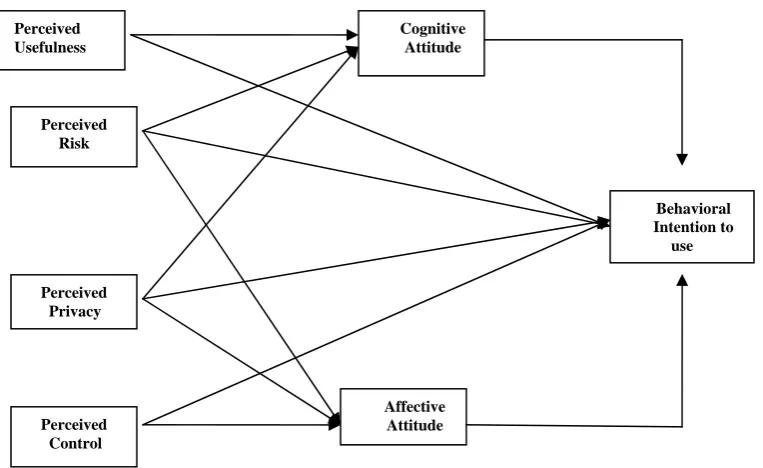
To measure the experiences with this technology, we used a new model: the Ubiquitous Computing services Acceptance Model (UCAM) of Spiekermann [10]. Spiekermann developed a model that predicts the acceptance and use intention of Ubicomp applications. As stated before, AmI is closely related to Ubicomp. Ben Allouch [19] described the differences and similarities between the two in her dissertation. Spiekermann’s model could therefore be used for investigating the experience and acceptance of AmI.
Perceived Usefulness
Cognitive Attitude
Behavioral Intention to
use
Affective Attitude Perceived
Risk
Perceived Privacy
Perceived Control
Figure 1: Ubiquitous Computing-service Acceptance Model, Spiekermann (2007)
The UCAM is based on the Technology Acceptance Model (TAM) [20]. The TAM was developed to test the adoption of information systems in organizations. It was not designed for measuring the adoption of Ambient Intelligence. The variable usefulness is one of two used in the TAM. Spiekermann follows the TAM by treating it as a variable that influences the acceptance of UC, even though it is not in a professional environment. She leaves the second variable, ease of use, out of the model, because the vision of Ubicomp, and of AmI as well, describes an intuitive interaction with the system. This makes ease of use part of the system. Usefulness influences the cognitive attitude as well as the affective attitude. These attitudes are the centre of the acceptance model of UC. Spiekermann here follows Yang and Yoo [21], who have expanded the TAM with cognitive attitude and affective attitude. The cognitive attitude describes the expected performance of the system and the affective attitude is closely related to the appeal and usability of the system. Both attitudes have their own effect on the use intention of the technology.
the intention to use the te
were a
this use intention for an AmI application. This led the following research question.
of control influence the use intention of Ambient Intelligence technology by elderly?
5. Methodology
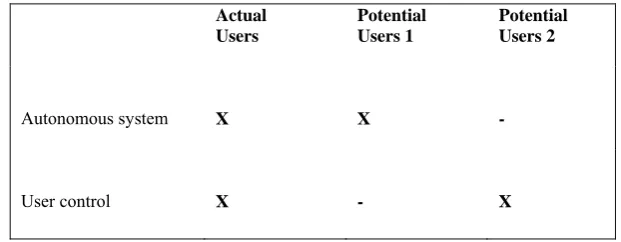
explained furt r below table 1, which shows the design of the research experiment.
Table 1: Research design
specialists and a Dutch language specialist for accuracy and n
Users
l
Users 1 sers 2
affective attitude and the intention to use intelligent technology. The last variable of the model is perceived risk. Spiekermann has chosen to measure an overall perceived risk (risk). She follows Featherman and Pavlou [22] who state that several types of risk, as identified by Kaplan, Szybillo and Jacoby [23], share a common core. That is why a unified risk perception is measured by the risk variable. Perceived risk influences the attitudes towards the technology and
chnology, as well as the cognitive and affective attitude.
The main focus of this study was on the intention of elderly people to use a ‘smart’ environment. In this study we mean by ‘use intention’ the same as the variable intention to use in Spiekermann’s UCAM. The other variables of the UCAM
lso taken into account to find out how they stand out in the care for the elderly. We wanted to study the use intentions of elderly people for a smart device and whether the level of control influences
to
RQ: How does the level
To study the use intention of the MSS, three groups were formed. One group consisted of Actual Users (AU) of the MSS. These were participants in the field study of the home automation experiment. The two other groups both consisted of Potential Users (PU), and were named PU1 and PU2. The PU1 group received a description of an existing system, which works autonomously. The PU2 group received a description of an adjusted system, which means that it had a touch screen that could ask the participant a question about the registration. This adjustment is
he
Actual Potentia Potential
U
For this study a description of the MSS was used. The description was reviewed by two home automation
eutral tone of voice.
Autonomous system X X -
e question “the <name> gives sufficient control o
ar with the system and had actual use e
helps th
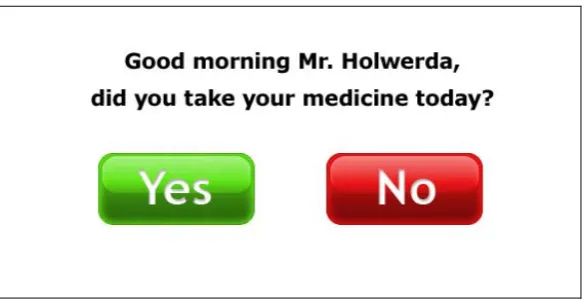
tor, mounted on the home central. For example if the system detected an irregularity in medicine use, it asked the user whether this detection was correct. See figure 2.
A description of an existing home automation system was presented to the participants. It described the features of the system neutrally. The participants received a questionnaire with questions about perceived privacy concerns, perceived control, perceived usefulness, perceived risk and attitude towards such a system. This questionnaire was based on Spiekermann [6] and the text was translated into Dutch and adjusted to the home automation system used. The context of the question changed from a smart refrigerator and smart car to living safely and independently. The questions to measure the variables of the model could be taken over from the questionnaire. Only the question to measure the variable perceived control was changed from “I think that <with the system> I can decide any time on <the task> myself” and “this system leaves me sufficient control over my <task>” to “with the <name> I can do my daily tasks more safely” and “with the <name> I can do my daily tasks more independent”. And th
ver my wellbeing” was added in this study to test the difference between the actual used system and the adjusted version.
The readability and comprehensibility of the questionnaire was tested by a test group (n=12, mean age=68.8). Only small textual adjustments had to be made.
For the AU group the description of the system and text of the questionnaire were adjusted to the fact that they were famili
xperience. For both PU groups the description as well as the questionnaire was formulated with the focus on potential use.
The AU (n=18) were approached by people of the home care organization which conducted the field test with the system used. This test lasted five months. Fifteen persons agreed to participate. The participants of the PU groups (n=208) were over sixty and lived independently, but could move to a supported environment in the near future. All the participants were visitors of a Day Activity Centre (DAC) that
em to be socially active. They all have an indication, which means that a low level of care is necessary and that the health insurance pays for the cost of the DAC.
These PU were split into two equal groups. The PU1 group received the description of the MMS as it was deployed. The PU2 received an adjusted version of the description. This adjustment consisted of a user control function. If the system registered an irregularity in the patterns, it asked a question by means of a little touch screen moni
Earlier work has indicated that autonomous systems were preferred above manual systems [12, 13, 14], but that the transfer of personal data led to privacy concerns [8, 14]. That is why this extra level of control for the user was inserted in the scenario.
After the results of the questionnaire were collected and analyzed, a focus group meeting was organized. The goal of the focus group meeting was to elaborate on the results of the questionnaire. The groups consisted of five to seven people who had participated in the study. This was smaller than suggested [25], but followed the recommendations of Zajicek [26] to minimize the number of participants in focus groups if they consist of elderly people. By using smaller groups, the participants could contribute more easily and focus more on the discussion.
6. Results
The results of this study are divided into two sections. First we will present the results of the questionnaires, followed by the qualitative results of the focus group meetings.
6.1 Quantitative results
This section presents the results of the questionnaires. First the variables used will be explained briefly, followed by the results of the study.
Usefulness measured the perceived benefits of the system. The variable control checked the perceived control over well-being. The variable risk measured the perceived risks of using such a system. The variable privacy measured perceived privacy concerns. The variables cognitive attitude and affective attitude measured the personal attitudes towards the presented or used system. The variable use intention measured the level of willingness to use or reject the system.
The three research groups consisted of 15 (AU), 43 (PU1) and 40 (PU2) persons. To test the results of the questionnaire, a reliability check was done for variables of UCAM. Cronbach’s alpha (α) was used as an indication of how well a set of items measures a latent construct. A scale is regarded as reliable when Cronbach’s alpha is at least between .60 and .70. Therefore all variables with α < 0.60 were not taken into further analysis.
The variables that were usable for further processing were: usefulness (α = 0.76), affective attitude (α = 0.88), cognitive attitude (α = 0.95) and privacy (α = 0.87). For the Touch Screen setting, the variable privacy (α = 0.81) was the only reliable one. The variable use intention was formed by three questions, but these had a low alpha. That is why only one question was used to represent the variable use intention. The question I would naturally adopt the system, without any advice of others was used because its high face validity for measuring use intention.
Variable Cronbach’s alpha (α) PU1
Cronbach’s alpha (α) PU2
Usefulness 0.82 0.74
Affective Attitude 0.77 0.64
Cognitive Attitude 0.86 0.74
Control 0.87 0.87
Risk 0.76 0.78
Privacy 0.73 0.69
Table 2: Cronbach’s Alpha in groups PU1 and PU2
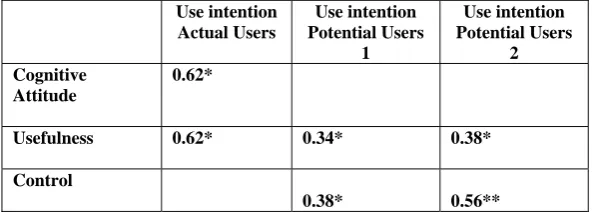
To test the correlation between use intention and the other variables of the UCAM, we used Spearman´s Rho. The results are shown in table 3 below. Only the significant correlations between the variables of the model are shown in the table.
The results for the AU group show a positive association between cognitive attitude and use intention (ρ = 0.62; p < 0.05). The association between usefulness and use intention was also positive (ρ = 0.62; p < 0.05).
For the potential users who were offered a description of the actual, non-control, version of the system (PU1), the following results appeared after the Spearman’s Rho test. Only two variables of the UCAM had a significant association with use intention. Usefulness had a positive association with use intention (ρ = 0.34; p < 0.052) and control had a positive association with use intention (ρ = 0.38; p < 0.05).
The results of the Potential Users who received a description of the system, containing an extra control function, the Touch Screen (PU2), showed three significant associations between use intention and other variables of the UCAM. Usefulness had a positive association with use intention (ρ = 0.38; p < 0.05). Also risk had a positive association with use intention (ρ = 0.36; p < 0.05). But the most interesting result was the positive association between control and use intention (ρ = 0.54; p < 0.01).
The results show that the association between control and use intention in the situation with the user control function was stronger than the association between control and use intention in the existing system. In table 3 below, all significant results of the correlations between the variables and use intention are presented. These results also clearly show that many relations, as predicted by the UCAM, were not found in this study.
Table 3: Correlations between the variables of the UCAM
* p < 0.05, ** p < .0.01
intention (ρ = 0.64; p < 0.05), cognitive attitude (ρ = 0.55; p < 0.05) affective attitude (ρ = 0.58; p < 0.05) and usefulness (ρ = 0.65; p < 0.05).
For the PU1 group also four positive associations were found between the subjective norm and variables of the model. These were cognitive attitude (ρ = 0.53; p < 0.01), usefulness (ρ = 0.33; p < 0.05), privacy (ρ = -0.32; p < 0.05) and control (ρ = 0.63; p < 0.01). The negative correlation between subjective norm and privacy indicates that people who have low concerns about their privacy rate high on the subjective norm.
For the PU2 group five positive associations occurred between subjective norm and variables of the model. These were use intention (ρ = 0.60; p < 0.01), cognitive attitude (ρ = 0.57; p < 0.01), usefulness (ρ = 0.58; p < 0.01), risk (ρ = 0.57; p < 0.01), and control (ρ = 0.83; p < 0.01).
This shows that people in the social environment of the elderly influence their perception, attitude and use intention towards such a system. Fulk et al [27] already postulated that the social environment influences the attitude towards communication technology.
The Mann-Whitney U was used to test whether the differences between the control setting by the added touch screen and the system as it was actually deployed were significant. For the AU group this test could not be performed. Due to the low reliability of the variables they could not be compared.
For the PU groups the results show that there were significant differences in usefulness and control between both groups. There was a significant difference for perceived usefulness (U = 618.000; p < 0.05) between PU1 (mean rank = 36.21) and PU2 (mean rank = 47.05). The potential users with touch screen system (mean rank = 47.08) also differed significantly (U = 621.000; p < 0.05) with regard to the perceived control of the system from the potential users who did not have the touch screen system (mean rank = 36.44). These results indicate that the potential user group with the adjusted system perceived the system as more useful and that they perceived having more control over their well-being than the potential user group that had experienced the autonomously working system.
6.2 Qualitative results
To get more insight into the results of the questionnaires, three focus group meetings were scheduled with the user groups. Since the actual users lived dispersed and lack the mobility to come to a central place for a focus group meeting. That is why open interviews were conducted with them. For both PU groups a focus group meeting was held.
First we will describe the results of the open interviews with the AU, followed by the results of the focus group meetings of PU1 en PU2.
All the interviewed persons said that they relied more on their personal alarm than they did on the sensor system. The tested system was seen as secondary by the interviewed participants.
These results correspond with the results of the questionnaires of the PU groups; the more control people perceived over their well-being, the more useful the system seemed to them. A higher level of personal control, for instance the possibility to contact a caregiver directly, increased their perception of the usefulness of the system. Communication via a screen or an alarm button could fill this need.
The results of a focus group meeting with 5 participants of the PU1 group show that they perceived the presented system as useful. The system gave them the feeling of being less lonely and of being looked after. Three of them stated that the system is better than the personal alarm trigger that has to be worn around your neck. “People forget to wear those”, was their comment.
Privacy was considered important by the elderly, but they stated that when you need help it becomes less important. The home care organization was trusted to deal carefully and discretely with the collected data. The participants stated that good agreements between the user and the organization are necessary. The cost of such a system was an important variable for them. If they live alone and if they can afford it, they would like to use and buy such a system. Relatives or other closely related persons were another main variable. If those people would say that the system is useful, they would use it. So the subjective norm of family and others seemed to have a positive and strong effect on the intention of the elderly to use the system.
The target group of the system would be elderly people who live alone, according to most of them. Three persons also stated that it would be preferable if the system would also work outside their house. Control over their well-being provided by their social environment was preferred by most of the participants. But the system could also support their children in combining their own lives with taking care of their parents. Two persons saw this as a positive aspect of the system. If the care givers would visit them in case of a false alarm, it would not be a problem. It was important, though, that the care giver should be a person known to the care receiver.
During the focus group meeting of 7 participants of the PU2 group the following results could be derived. The adjusted system was especially useful for people who live alone. It provided a secure feeling for the elderly. However, 5 participants stated that they preferred to be watched over by their social environment instead of being watched by ‘technical surveillance’. The fact that the system was able to check on medicine intake, mainly as a reminder, was appreciated by three persons. As someone said “everybody forgets something sometimes”. Two persons preferred the data being sent to the care giver automatically, without a control check.
According to the elderly, the cost of such a system was an important variable in deciding whether they were going to use it or not. However, one person stated that security was more important than cost. Furthermore, privacy was also a concern for two persons in this group, but the care giver or volunteer aids were allowed to know ‘everything’ in case of health situations. The other persons did not care much about their privacy. As someone said: “What does privacy matters at our age”.
All of the participants were clear with respect to the fact that if a relative or closely related person would think that the system would be useful for them, they all would use the system. Within this group the subjective norm was also a strong variable for use intention. The system would be more useful if it were expanded with more alarm functions, as was the case in the bathroom, or with a personal alarm trigger. The elderly thought that this would increase their level of control over their well-being in case of an emergency.
important and the elderly’s social environment strongly influenced their intention to use the system. This corresponds with the findings of the questionnaires for PU1 and PU2, in which more control was preferred. The qualitative results also show that privacy for the elderly in a care situation was considered to be not very important. The results were similar with regard to the subjective norm: The results of the questionnaires and the interviews and focus groups show that the subjective norm played an important role for the elderly in their intention to use such systems. Summarized, elderly people perceived the subjective norm of family and other closely related persons and the perceived control over their well-being as important variables for their intention to use intelligent systems in a care setting. Privacy seemed to play a less important role for the elderly. The results of the questionnaires already indicated this. However, the relevance of these results became clearer in the interviews and focus group meetings.
In the next section we will present the overall conclusions, which will then be discussed further.
7. Conclusions and Discussion
The aim of this study was to investigate how the level of control influences the use intention of an intelligent system for elderly people who might need it to live independently. The main conclusion of this study is that the more control someone perceives, the greater the use intention is. Another important result is that the subjective norm also has a strong influence on use intention. These results appeared in the questionnaire as well as in the focus group meetings. The next paragraph elaborates on the overall conclusions of this study.
The subjective norm is found to play an important role in the use intention of the system by the elderly. This is shown by the results of the questionnaires and this was also clearly reflected by the elderly in the interviews. Based on these findings, it is clear that the attitude of closely related people and contact with care givers influence the use intention of the elderly with regard to an intelligent care system. To increase the acceptance of AmI in the care setting by elderly people, it is very important to involve the social environment of the elderly in the acceptance process.
This study shows that the acceptance of ambient intelligence in a care setting is not completely comparable with the acceptance process of intelligent devices that are not meant directly for care settings. In the explorative interviews the Actual Users stated that if the system would integrate an alarm trigger, such as they were all using at the time, it would be more useful. The participants missed the direct control over their well-being. This indicates that actual users, as well as potential users, prefer more control over when to call for help or to contact care givers. This finding does not correspond with some earlier work [13, 14] in which ‘intelligent’ applications that worked automatically was preferred over a manual working system. This could be caused by the target group of this study and the goals of the used system. Maybe elderly people prefer more control because their well-being is at stake. For example, in the work of Janse et al [14] families participate in the study, and not elderly people.
seen as the lack of control over personal information. In this study, privacy is not regarded as very important for elderly people in a setting in which they depend on care. By definition, when you come to depend on the care of someone else, you lose a bit of control over your well-being and also some privacy. Apparently, privacy seems less important for the use intention of AmI-like systems by the elderly, if they need it for living independently. In the study of the after sale services provided by RFID [11], manual control was preferred over autonomous services. The study of Niemelä et al [12] also showed that automatically transferred personal information led to privacy concerns. However, the studies of the whereabouts clock [14] and the presence detecting lamp [14] show that an automatic system is preferred over a manual one. These differences between the results of different studies towards perception of control and privacy in different settings need more attention. Especially because AmI wants to empower people in their own environment, control and privacy can play a vital role in that process.
An explanation for the contradictory findings with regard to control in the different studies could be that the user in a care setting is not the care taker, but the care giver. So the actual user of the system is not always clear on first sight. Besides this, in a care setting you do not always want a user to have control over a system that should support them. If a person lacks the insight that he or she needs care, or just ignores it, then they could overrule the system. So it could be that AmI in elderly care could be a part of some kind of compassionate interference,
This creates a thin dividing line between user in control and user centeredness. Especially in care for the elderly, more attention should be given to this issue.
One of the limitations of this study is that the small group of actual users who participated in this study all used a personal alarm trigger beside the sensor system. They did not completely have to rely on the system. This could influence their perception of the system. Future research should try to include more elderly persons, although their inclusion in research projects can prove to be very difficult.
This study showed that financial risks also seem to influence the use intention of an intelligent system but this variable was only significant within the PU2 group. The interviews showed that costs are an important issue for the users, but the other types of risks, as identified by Kaplan, et al [23] were not frequently mentioned by the participants of all the groups.
9. References
1. Aarts, E.: Ambient intelligence: A multimedia perspective. IEEE Trans. Multimedia 11(1), 12-19 (2004)
2. Punie Y. (eds) Institute for Prospective Technological Studies: A social and technological view of Ambient Intelligence in Everyday Life. What bends the trend? (2003)
3. Brey, P.: Freedom and privacy in Ambient Intelligence. Ethics and Information Technology 7 (3), 157-166 (2005)
4. Bohn, J., Coroama, V., Langheinrich, M., Mattern, M. and Rohs, M.: Social, economic, and ethical implications of ambient intelligence and ubiquitous computing. In: E. Aarts, W. Weber and J. Rabaey, (eds) Ambient Intelligence. Springer-Verlag, 2004.
5. Spiekerman, S.: Perceived control: Scales for privacy in ubiquitous computing environments. In: Proceedings of the 10th International Conference on User Modeling, Edinburgh (2005).
6. ISTAG,: Scenarios for ambient intelligence in 2010, Institute for Prospective Technological Studies (IPTS), Seville (2001)
7. Friedewald, M., Gutwirth, S., Punie, Y., Wright, D., Vildjiounaite, E.: Safeguards in a World of Ambient Intelligence. In: Security in Pervasive Computing Springer, Berlin-Heidelberg, (2007)
8. UbiComp 2007: Proceedings Ubiquitous Computing 9th International Conference (2007)
9. Ben Allouch, S., Van Dijk, J. A. G. M., & Peters, O. (2006). Our future home: A content analysis of ambient intelligence promotional material. Paper presented at the annual meeting of the International Communication Association, Dresden, Germany. 10. Spiekermann, S.: User Control in Ubiquitous Computing: Design Alternatives and
User Acceptance (2007)
11. Spiekermann, S.: Privacy Enhancing Technologies for RFID in Retail- An Empirical Investigation. In: In: Proceedings Ubiquitous Computing 9th International Conference, UbiComp 2007, (2007)
12. Niemelä, M., Fuentetaja, R.G., Kaasinen, E. and Gallardo, J.L.: Supporting Independent Living of the Elderly with Mobile-Centric Ambient Intelligence: User Evaluation of Three Scenarios. In: Proceedings European Conference, AmI 2007 (2007).
13. Brown, B., Taylor, A.S., Izadi, S., Sellen, A., Kaye. A.A. and Eardley, R.: Locating Family Values: A Field Trial of the Whereabouts Clock. In: Proceedings Ubiquitous Computing 9th International Conference, UbiComp 2007, (2007)
14. Janse, M., Vink, P., Soute, I. and Boland H.: Perceived Privacy in Ambient Intelligent Environments.In: Proceedings of Context Awareness and Trust 2007 (CAT07), First International Workshop on Combining Context with Trust, Security and Privacy, New Brunswick (2007)
15. B. de Ruyter, E. Aarts, P. Markopoulos and W. Ijsselsteijn. Ambient Intelligence Research in HomeLab: Engineering the User Experience Ambient Intelligence. In: Weber, W., Rabbaey, J., and Aarts, E. (eds): Ambient Intelligence, Springer Verlag, Berlin, (2005)
16. C. Kidd, G. Abowd, C. Atkeson, I. Essa, B. MacIntyre, E. Mynatt and T. Starner, The Aware Home: A living laboratory for ubiquitous computing research. In: Proceedings of the Second International Workshop on Cooperative Buildings CoBuild'99 (1999) 17. S.S. Intille, E. Munguia Tapia, J. Rondoni, J. Beaudin, C. Kukla, S. Agarwal, L. Bao,
18. Venkatesh, V., Morris, M., Davis, G., Davis, F.: User acceptance of information technology: toward a unified view. MIS Quarterly, 27 (3), 425-478 (2003)
19. Ben Allouch, S. The design and anticipated adoption of ambient intelligence in the home. Dissertation (2008).
20. Davis, F.: Perceived usefulness, perceived ease of use, and user acceptance of information technology. MIS Quarterly 13 (3), 319–340 (1989)
21. Yang, H. and Yoo Y.: It's all about attitude: revisiting the technology acceptance model. Decision Support Systems 38(1), 19-31(2004)
22. Featherman M.S. and P.A. Pavlou, P.A.: Predicting e-service adoption: a perceived risk facets perspective. In: Proceedings of the Eighth Americas Conference on Information Systems, (2002)
23. Kaplan LB, Syzbillo GJ, Jacoby J.: Components of perceived risk in product purchase: A cross-validation. Journal of Applied Psychology 59 287–91(1974) 24. Het Rathenau Instituut (eds): Ambient intelligence: toekomst van de zorg, of zorg van
de toekomst? (2007)
25. Patton, M.Q.: Qualitative Research and Evaluation Methods. Thousand Oaks, CA: Sage (2002).
26. Zajicek, M.: Successful and available: interface design exemplars for older users. Interacting with Computers 16(3), 411–430 (2004)