Devices using ARM TrustZone
(Full Version)
?Bo Yang1, Kang Yang1, Yu Qin1, Zhenfeng Zhang1, and Dengguo Feng1,2 1
Trusted Computing and Information Assurance Laboratory Institute of Software, Chinese Academy of Sciences, Beijing, China
2
State Key Laboratory of Computer Science, Institute of Software Chinese Academy of Sciences, Beijing, China
{yangbo,yangkang,qin_yu,zfzhang,feng}@tca.iscas.ac.cn
Abstract. Direct Anonymous Attestation (DAA) has been studied for applying to mobile devices based on ARM TrustZone. However, current solutions bring in extra performance overheads and security risks when adapting existing DAA schemes originally designed for PC platform. In this paper, we propose a complete and efficient DAA scheme (DAA-TZ) specifically designed for mobile devices using TrustZone. By considering the application scenarios, DAA-TZ extends the interactive model of orig-inal DAA and provides anonymity for a device and its user against remote service providers. The proposed scheme requires only one-time switch of TrustZone for signing phase and elaborately takes pre-computation into account. Consequently, the frequent on-line signing just needs at most three exponentiations on elliptic curve. Moreover, we present the archi-tecture for trusted mobile devices. The issues about key derivation and sensitive data management relying on a root of trust from SRAM Physi-cal Unclonable Function (PUF) are discussed. We implement a prototype system and execute DAA-TZ using MNT and BN curves with different security levels. The comparison result and performance evaluation indi-cate that our scheme meets the demanding requirement of mobile users in respects of both security and efficiency.
Keywords: DAA, Privacy, Mobile Devices, ARM TrustZone, PUF.
1
Introduction
With the development of wireless communication network as well as modern mobile devices, a variety of mobile applications have been realized to provide users convenient and comprehensive services. Depending on these achievements, online interactive applications such as mobile payment, mobile ticketing, mobile shopping and mobile voting, are benefiting people’s daily lives. However, with the widespread use of mobile services, users are faced with the risk of privacy
?
disclosure. Generally, authenticating the users’ legitimate identity is regarded as one prerequisite for access to those remote application services. This authenti-cation is associated with an individual mobile device, a SIM card or a service account. As a result, when a user logins to enjoy services, his personal informa-tion, perhaps involving his real identity, locations, bank accounts or records of network behaviors etc., is potentially linked to each other and leaked to service providers [33]. And what is worse, the personal information could be further shared with some third parties, for example, to send consumers behaviorally targeted advertisements [12]. Thus, the issue of information leakage is seriously threatening mobile users’ personal privacy and information security.
On PC platform, the analogous problem can be effectively solved by DAA [3], which is standardized by the Trusted Computing Group (TCG). DAA allows an embedded processor on a motherboard, called Trusted Platform Module (TPM), to anonymously attest the certain statements about the configuration of the host machine as well as its legitimate status to remote third parties [2]. The key requirement behind DAA is that this attestation is done in a way that maintains the privacy of the machine (i.e., the user). On the other hand, DAA is an anonymous credential system designed specifically to encapsulate security-critical operations within TPM, and the sensitive data including secret signing key and parameters are well protected by TPM. An adversary hardly shares a legitimate user’s credential by just stealing related data on the host to gain unauthorized access to remote services. The DAA [3] is originally proposed based on strong RSA assumption. For better computing efficiency and shorter signature length, researches constructs several DAA schemes based on elliptic curves and bilinear maps [4,11,5,10], which we call ECC-DAA. Moreover, Chen [8] designs a DAA scheme requiring less TPM resources. Bernhard et al. [2] give a new security model and a generic construction of DAA protocol on it. Xi et al. [32] first add the property of forward anonymity. To date, DAA has gained lots of favor with industry and standard bodies [9,27,28], which renders it better prospects for practical applications than other anonymous credential systems [34].
For mobile platform, DAA is still attractive as an alternative anonymous authentication solution. Unfortunately, previous DAA schemes are exclusively designed for the model of TPM inside a host. The prevalent mobile devices are rarely equipped with special-purpose chip like TPM, so that the direct use of DAA on mobile platform would cause trouble. Opaak [17] is a simplified DAA scheme for mobile devices, but its executable codes and sensitive data are easily compromised or stolen by malwares.
many mobile manufacturers. Leveraging TrustZone, some solutions are proposed to construct software-based ECC-DAA with security-critical codes running with-in TEE, and treat REE as the role of “host”. Wachsmann et al. [30] put forward an authentication scheme based on DAA and TLS but without user-controlled linkability. Yang et al. [33] present LAMS for anonymous mobile shopping, which is compatible with four unmodified ECC-DAA schemes. Given by Zhang et al. [34], Mdaak provides a general and flexible DAA framework for mobile devices. Nevertheless, these solutions neither implement pre-computation for anonymous signing nor consider comprehensive protection for DAA sensitive data. Further-more, in these solutions, implementing unmodified or simply modified DAA in TrustZone brings much extra meaningless overhead and security issues. First, DAA does not concern the number of interactions between TPM chip and the host, while it is a problem for mobile devices using TrustZone. Each switching the context between TEE and REE carries both performance overhead and pow-er consumption. In practice, these cannot be neglected, especially if the system or software is complicated, or the switch action needs to be triggered frequent-ly [21]. When many switch actions occur, data transmission and protection for DAA procedure are also cumbersome, memory-consuming and time-consuming. Second, extra operations are demanded in original DAA for the sake of the lim-ited bandwidth of TPM, which seems superfluous for TrustZone. Last but not least, TPM itself is hardware-based root of trust with inside root key for sensi-tive data management, while TrustZone does not definitely provide this root. To the best of our knowledge, there is no DAA scheme specially designed to adapt for mobile devices using TrustZone.
Our Contributions. In this paper, based on elliptic curves and bilinear map-s, we propose an efficient DAA scheme (DAA-TZ) for mobile devices who are resource-constrained as compared with PC platform. DAA-TZ enables remote service providers to authenticate mobile users’ trusted status or legitimate in-formation without disclosing users’ identity. DAA-TZ makes full use of ARM TrustZone and modifies the traditional interactive model as well as procedure of original DAA. The main signing efficiency for users is improved without the expense of security. Our work is summarized as follows.
– This is the first complete work that designs an efficient DAA scheme deeply integrated with TrustZone and expressly for mobile devices. In order to re-duce the time delay and space overhead, the scheme minimizes the switch times of TrustZone for the frequent signing phase.
– According to the ecosystem of mobile devices, DAA-TZ supports manufac-turers to acquire a batch of credentials through cooperative and trusted channels, and then embed them into devices before they leave factory. Users could immediately execute anonymous signing after getting devices. – The pre-computation is carefully added into DAA-TZ, so that the on-line
– DAA-TZ utilizes the on-chip SRAM PUF to reproduce a root key seed and further create keys serving different purposes. The mechanism for sensitive data management using related keys is presented in detail.
– We implement a prototype system with full functions of DAA-TZ. The e-valuation on it with two types of curves is performed. Both theoretical com-parison and testing results show the high efficiency of our scheme.
Paper Outline.We provide the preliminary information in Section 2. Section 3 describes the system model and assumptions. Section 4 details the design for DAA-TZ, which is comprised of the architecture using TrustZone, the sensi-tive data management and the scheme procedure. Section 5 analyses the secu-rity properties that DAA-TZ satisfies. Our implementation and evaluation are showed in Section 6. Finally, Section 7 concludes the whole paper.
2
Preliminaries
2.1 Notation
Throughout this paper,λdenotes the security parameter. We usea←S to de-note samplingafrom a setSuniformly at random. We also use 1Gto denote the identity element of a groupG. For any groupG,G∗ denotesG\{1G}.MACk(m)
denotes the message authentication code for a message m computed with the secret keyk, andEnck(m) denotes a ciphertext of a message mproduced with
the symmetric keyk.
2.2 Bilinear Groups
Bilinear groups consist of three (multiplicatively written) groupsG1,G2andGT
of prime orderpequipped with a bilinear mape:G1×G2→GT. Letg1andg2
be generators ofG1 andG2 respectively. We defineΛ= (p,G1,G2,GT, e, g1, g2) to be a description of bilinear groups parameters.
The mape:G1×G2→GT must satisfy the following properties:
1. Bilinear.for anyu∈G1,v∈G2and any a, b∈Z,e(ua, vb) =e(u, v)ab. 2. Non-degenerate.e(g1, g2)6= 1GT.
3. Computable.the mapeis efficiently computable.
In this paper, we only consider the Type-3 pairings [13], thusG1 6=G2 and there is no known efficiently computable isomorphism betweenG1 andG2.
2.3 Cryptographic Assumptions
The security of DAA-TZ is based on the Decisional Diffie-Hellman assumption in G1 (DDHG1) and the blind 4-LRSW (B-4-LRSW) assumption [2] which is a
variant of the original LRSW assumption [16]. The DDHG1 assumption and the
Assumption 1 (DDHG1).Given (g1, ga
1, gb1) fora, b←Zp, it is hard to
distin-guishg1abfrom a random element ofG1.
Assumption 2 (B-4-LRSW).Given the bilinear group parametersΛ, (gx2, g2y) forx, y←Zpand an oracle that on input ofg1m∈G1outputs (A, A
y, Ax+mxy, Amy)
for A ← G∗1, it is hard to output (m∗, A∗, B∗, C∗, D∗) such that m∗ ∈ Z∗p,
A∗ ∈ G∗
1, B∗ = (A∗)y, C∗ = (A∗)x+m
∗xy
and D∗ = (A∗)m∗y where gm∗
1 was never queried to the oracle.
2.4 ARM TrustZone
ARM TrustZone [20] is a hardware-based security extension technology incor-porated into ARM processors. It enables a single physical processor to execute codes in one of two possible operating worlds: the normal world and the secure world. Accordingly, the system is separated into two domains and each domain has banked registers and memory to run the domain-dedicated OS and software. The isolation mechanisms of TrustZone are well defined. Access permissions are strictly under the control of the secure world that normal world components can-not access the secure world resources. As the processor only runs in one world at a time, to run in the other world requires context switch. A secure monitor mode exists in the secure world to control the switch and migration between the two worlds. To date, TrustZone has been popularized and applied by many mainstream mobile manufacturers to achieving secure applications [33].
2.5 Physical Unclonable Functions
Physical Unclonable Functions (PUFs) [23] are functions where the relationship between input (or challenge) and output (or response) is decided by a physical system. Randomness and unclonability are two significant properties of PUFs. The unclonability originates from random variations in a device’s manufacturing process. With the help of a fuzzy extractor that eliminates the noise from the response, PUFs are able to implicitly “store” a piece of secret data. PUFs pro-vide much higher physical security by extracting the secret data from complex physical systems rather than directly reading them from non-volatile memory. Additionally, PUFs are cost-effective, since they take the advantage of the results from a preexisting manufacturing process[34].
3
System Model and Assumptions
3.1 System Model
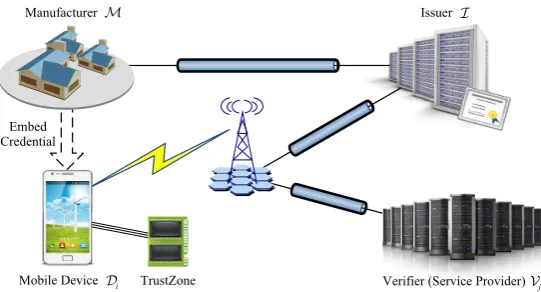
The system model of DAA-TZ is composed of four kinds of entities: mobile de-vice D, manufacturer M, issuer I and verifier V. In practice, there could be a number of D and V, thus we use Di and Vj to represent an individual unite respectively. Di is directly accessed by a user and equipped with ARM pro-cessor having TrustZone extension technology. M, who produces Di, performs embedding some credentials to each Di in advance before it leaves factory. I
is responsible for issuing credentials to legitimate (or trusted) Di. I could be an independent trusted authority or a part of mobile network provider. The procedure of issuing could be executed with either M or Di respectively. Ser-vice providers play the role of V in this interactive model.Vj outsources some verification strategies toI for confirming the legitimacy of Di. The verification strategies may involves Di’s configuration, user’s membership status or the ac-counting and billing (e.g., Vj’s subscription fees accounted with user’s mobile phone bill). With these strategies, Vj authorizesI to distribute service-related credentials toDi. When requestingVjfor a service, the user generates an
anony-mous signature based on the corresponding credential to attests his legitimacy with other necessary information, such as the integrity measurement values of executing applications on Di, the amounts of e-cash or the content of e-ticket. The specific information structure and content are particularly defined by the service protocol. Vj authenticates the user’s request by verifying his signature without revealing his identity. In some scenarios,I and V could be one entity. Fig.1 illustrates the system model for our proposed scheme.
TrustZone Mobile Device
Embed Credential
Manufacturer Issuer
i
Verifier (Service Provider)j
3.2 Assumptions and Threat Model
In the system model, there is a dedicated channel between M and I, which could be either physical connection or other forms of out-of-band communica-tion, for I issuing credentials via M. To simplify our design, we assume that data communications betweenMandI, and betweenDi andVj build on secure transport protocols, like TLS/SSL, which can provide confidentiality, authentic-ity and integrauthentic-ity protection. Note that the secure channel betweenDiandVj is only verifier-authentication (i.e., unilateral authentication) in caseDi’s identity is revealed. Additionally, Public Key Infrastructure (PKI) is also assumed to realize authenticating I. As a consequence, M, Vj and Di can accurately ob-tain public keys, public parameters and revocation list fromI who displays the public information with certificate for being downloaded.
Actually, the establishment of the whole system requires some premised trust relationships. First, the cooperation is assumed to be credible between I and each Mwho ensures not to embed credentials to illegal Di or the Di without
available TrustZone. Second,Vj trusts that, before issuing credentials,I always checksDi’s legitimacy by using verification strategies provided byVj. As a result,
Vj would believe that the right credentials are in the right users’ hands. Another accepted fact is that the user trusts M not to deliberately damage his Di’s security. Constrained by the market supervision and the force of law, the above-mentioned trust relationships are easily established and maintained.
Based on the assumptions, DAA-TZ protects against the following adversary: – The adversary can attack the scheme itself by attempting to pretend entities,
manipulate data transmission between entities and forge data.
– The adversary can perform any software-based attacks which compromise the mobile Rich OS or existing applications running in REE. DAA-TZ in-terfaces in REE are also available for the adversary.
– The adversary can physically access the mobile device. He can reboot the device and gain access to data residing on persistent storage.
However, we ignore the malicious behaviors of tampering with the TrustZone hardware or mounting side-channel attacks on PUF [19]. Moreover, pointed out by [30], since in general it is not possible to prevent simple relay attacks, we do not consider that an adversary just forwards a DAA signature fromDi toVj.
4
DAA-TZ Scheme for Mobile Device
In this section, we give the specific design for the architecture of trusted mobile device, and then present the key derivation and sensitive data management. Depending on these, DAA-TZ scheme are detailed afterwards.
4.1 The Architecture of Trusted Mobile Device
Secure World (SW)
TrustZone Is
olation
Boundary
User M
ode
Ke
rn
el
M
od
e
Hardwares with ARM TrustZone Extension
SW-Driver Monitor NW-Driver
DAA-TZ Service
Crypto Library
API Functions Logic Engine
Data Handler
Key Manager
SRAM PUF
DAA-TZ Proxy
Software Stack Crypto Library
Command Caller Preprocessing Engine
Mobile OS Kernel TEE OS Kernel
App1 App2 Appn
Normal World (NW) . . . App1Service . . . AppnService
Fig. 2.Architecture of Trusted Mobile Device for DAA-TZ.
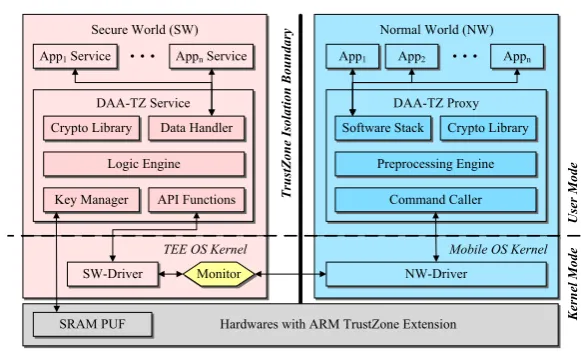
DAA-TZ functionality on existing hardwares targets at economy, flexibility and extensibility. Meanwhile, our architecture is designed to be compatible with the conventional running model of secure applications using TrustZone. Fig. 2 shows the detailed architecture with the way components interact with each other.
DAA-TZ functionality in the architecture contains two components: untrust-ed DAA-TZ Proxy innormal world(NW) and security-sensitive DAA-TZ Service
in secure world (SW). In reality, SW instantiates TEE, while NW implements
REE. DAA-TZ Service is isolated via TrustZone from all other codes running in NW. The components are formally described as follows.
DAA-TZ Proxy. It is the component visible for mobile applications in NW. Waiting for their DAA-TZ service requests, the proxy handles the parameters and preprocesses them. According to the request type, the proxy would call DAA-TZ Service for substantive computations of the scheme and finally return the results. DAA-TZ Proxy consists of the following four subcomponents:
– Software Stack: provides top DAA-TZ interfaces for mobile applications. It parses the service requests and gives back service response results. – Crypto Library: offers cryptographic algorithm support for Preprocessing
Engine. In NW, this library only supports exponentiations on elliptic curves. – Preprocessing Engine: executes pre-computation for DAA-TZ when one of two conditions is satisfied: a new credential is generated successfully, or a pre-computed result is consumed correctly.
– Command Caller: formats calling command and interacts with DAA-TZ Service. It sends the command through the GP TEE Client API [22], requests to switch NW to SW via NW-Driver and waits for the returned values.
well protection of TrustZone isolation mechanism. Five following subcomponents constitute DAA-TZ Service component:
– API Functions: receives a service request from DAA-TZ Proxy and parses the command. The functions transmit instructions to Logic Engine and waits for results that would be forwarded back to DAA-TZ Proxy.
– Key Manager: creates cryptographic keys using the unique root key seed extracted from SRAM PUF and provides keys to Data Handler.
– Data Handler: receives message to be signed from application service and seals or unseals sensitive data. To prevent adversary from forging message, Data Handler only receives message produced by application service in SW. Besides, using keys from Key Manager, Data Handler seals sensitive data to store them in the insecure persistent storage space of mobile device. – Crypto Library: offers cryptographic algorithm support for Logic Engine
and Data Handler. In SW, it supports bilinear maps, computations on elliptic curves, and other cryptographic operations.
– Logic Engine: executes the computations of security-sensitive parts of DAA-TZ scheme. Logic Engine reads necessary parameters and data to run operations relying on scheme specification.
Application and Application Service.The corresponding application should be launched if the user wants to enjoy a remote service from Vj. The secure application released by Vj consists of two parts: App for NW and App Service for SW. App provides the GUI and basic functions. When App has the need to execute DAA-TZ procedures for remote service authenticating user’s legitimacy with the message as service input, it calls DAA-TZ Proxy using its Software Stack. App could notify App Service in SW to prepare message to be signed through inter-domain communication mechanism supported by TrustZone [15]. App Service is trusted for processing security-sensitive data. It is sometimes non-existent if the remote service does not require secure computation or signed message as input.
Components in Kernels. SW-Driver in TEE OS Kernel and NW-Driver in Mobile OS Kernel handle the communication requests and responses with respect to switching the worlds. Implemented as Secure Monitor defined by TrustZone, the Monitor controls hardwares to fulfill the switching action.
Components in Hardwares. The hardware of mobile device support ARM TrustZone extension technology. Protected by TrustZone mechanism, SRAM PUF component is only accessible for SW.
4.2 Key Derivation and Sensitive Data Management
byM who “stores” it inDi through the physical features of one SRAM inside
Di. From SRAM PUF component,sis only reproduced and securely cached by Key Manager when Di starts up every time in normal use. The confidentiality ofsis rigidly guaranteed by TrustZone.
Key Derivation. Key Manager has the deterministic key derivation function
KDF : S ×e D →e Ke, where Se is the key seed space, De is a set of strings for
statement of purposes with possible variables, and Ke is the derived key space.
Using theKDF, the device key pair which is analogous to the endorsement key pair in [27,28] and the storage root key for generating specific storage keys can be derived as (dsk, dpk)←KDFs(‘identity’) andsrk←KDFs(‘storage root’)
respectively, where s is the root key seed. Whereafter, we also use the storage keys derived fromKDFwith the storage root keysrkto preserve sensitive data. The hierarchical structure of storage keys enhances the security for key usage. Note that all the derived keys are never stored permanently. Instead, they are regained viaKDFwithsat the same way when needed.
Sensitive Data Management. We can utilize the storage keys derived from the storage root keysrkto seal the DAA-TZ’s public parametersparams, some mobile deviceDi’s credentialcred and a pair (f, T), wheref isDi’s secret key and T = g1f for some fixed basis g1. The sealed results of these data can be stored in the insecure positions of NW.
– Protect integrity for params: mkparams ← KDFsrk(‘storage key’,‘MAC’,
params,0) and blobparams←Data Seal(‘MAC’, mkparams, params), where
blobparams:=params||MACmkparams(params).
– Protect integrity forcred:mkcred←KDFsrk(‘storage key’,‘MAC’, T, cred,1)
andblobcred←Data Seal(‘MAC’, mkcred, cred), where
blobcred:=cred||MACmkcred(cred).
– Protect confidentiality and integrity for (f, T): generate two kinds of keys by (skf, mkf)←KDFsrk(‘storage key’,‘Enc+MAC’, T,2), and thenblobf ←
Data Seal(‘Enc+MAC’, skf, mkf, f, T), where
blobf :=Encskf(f)||T||MACmkf(Encskf(f)||T).
Data Handler can useData Unseal() to recover and verify the sensitive data from blobs with the related keys regained by Key Manager.
4.3 The Details of DAA-TZ Scheme
Some preliminary work needs to be done as premise to start the normal proce-dures of the scheme. Specifically, whenMinitializesDiin the factory,Mguides
For Di-centered design, DAA-TZ scheme consists of seven phases: Setup,
KeyGen,Embed,Sign,Verify,RevokeandRejoin. First of all,Setupis executed
to create the public parameters. After that, the issuer I can execute KeyGen to generate its public/private key pair according to the public parameters. In addition, KeyGenandEmbed are compelled to execute sequentially before Di
leaves the factory. Then, other phases are able to execute correctly according to application requirements. We adopt the techniques in [2,10,32] to build DAA-TZ scheme. The phases of DAA-TZ scheme are presented in detail as follows.
Setup. Given a security parameter λ, picks the suitable bilinear groups
pa-rameters Λ = (p,G1,G2,GT, e, g1, g2) described in Section 2.2 such that the
bit-length ofpis 2λ. In addition, chooses three independent collision-resistant hash functions:
H1:{0,1}∗→Zp, H2:{0,1}∗→G1, H3:{0,1}∗→Zp.
Finally, publish (p,G1,G2,GT, e, g1, g2,H1,H2,H3) as the public parameter-s params. For each mobile device Di, M imports params to Di and calls
Data Seal() to seal theparams. The resulting blobblobparams is stored inDi.
KeyGen. This phase initializes the public/private key pair for the issuerI and
generates a mobile deviceDi’s key.
– Key Generation for Issuer. Given params as input, I picks x, y ← Z∗p,
and computes X := gx2 and Y := g
y
2. I sets (x, y) as the private key skI and publishes (X, Y) as the public key pkI. We assume that some mobile
deviceDi and verifierVj could get the correctpkI fromI via verifying the
certificate3 forpk
I. Besides,I initializes a revocation listRLas empty.
– Key Generation for Mobile Device. In SW of a mobile device Di, Logic
Engine callsDAATZ SW Create() to generate key blobblobf that seals the Di’s secret keyf and public informationT. It runs as:
blobf←DAATZ SW Create(blobparams),
where the API mainly has the following four operations:
1) Unseal the blobblobparams to getparamsby callingData Unseal().
2) Pickf ←Z∗p and computeT:=g f
1.
3) CallData Seal() to seal the pair (f, T) to obtain the key blobblobf.
4) Outputblobf.
Di switches back to NW and storesblobf in its non-volatile memory.
Embed. In this phase, a credentialcred for each mobile deviceDi is produced
and embedded into the device beforeDi leaves the factory as follows.
1. MobtainsT from the key blobblobfand sendsT toIthrough the
dedicat-ed channel. Because of the cooperative relationship, I trustsMis asking for producing credential to embed into aDiwith legitimate configurations. 3 Utilizing PKI solution, a Certificate Authority (CA) issues a public key certificate
Thus,I does not check the validity ofDi any more. But in this phase, only the credentials that do not require other more strict verification strategies fromVj are permitted to issue.
2. On input of a group element T,I runs the following signature algorithm to generate a credentialcredforT.
(A, B, C, D, cI, sI)←SIG Cred(params, skI, T)
The signature algorithm has the following four steps: 1) Choosea ← Z∗p and compute A := ga1, B := g
a·y
1 , C := g1a·x·Ta·x·y, D:=Ta·y andt:=a·y.
2) ChooserI←Zpand computeRI1:=g1rI,RI2:=TrI. 3) ComputecI:=H1(B||D||g1||T||RI1||RI2).
4) ComputesI :=rI+cI·t(mod p).
Then,I sends (A, B, C, D, cI, sI) toM.
3. Mimports the tuple (A, B, C, D, cI, sI) into SW ofDi. Logic Engine calls
the API DAATZ SW Join() to check the elements from I and generate a credential blobblobcredto store:
blobcred←DAATZ SW Join(blobparams, pkI, T, A, B, C, D, cI, sI),
where the API executes the following operations:
1) CallData Unseal() to unseal the blobblobparams to obtainparams.
2) ComputeR0I1:=gsI
1 ·B−cI andR0I2:=TsI·D−cI. 3) Computec0I:=H1(B||D||g1||T||R0I1||R0I2).
4) Check whether the relationsA 6= 1G1, e(A, Y) = e(B, g2), e(C, g2) = e(A·D, X) andcI =c0I hold.
5) If all the relations hold, setcred:= (A, B, C, D).
6) CallData Seal() to sealcred, and output the resulting blobblobcred.
Note that M could send simultaneously a set of{Ti}n
i=1 to I by a single interaction, and obtain the corresponding credential set{credi}n
i=1. 4. After a credentialcred is successfully obtained by Di, TrustZone switches
to NW and DAA-TZ Proxy executes pre-computation in the background to prepare for user’s fast anonymous signing operation in the following Signphase. Preprocessing Engine callsDAATZ NW PreCmpt() to generate a blinded credential:
(l, S, U, V, W)←DAATZ NW PreCmpt(blobparams, blobcred),
where the algorithm consists of the following steps.
1) Get the prime pand credential cred by directly reading the plaintext part of blobparams andblobcredrespectively.
2) Parsecredas (A, B, C, D).
3) Choosel←Z∗p and compute (S, U, V, W) := (A
l, Bl, Cl, Dl).
4) Output (l, S, U, V, W).
Sign. This phase enables a user to anonymously attest the legitimacy of both his status and his mobile device.
1. App of a mobile deviceDiconnects a remote verifierVj. Then,Vjnegotiates
with Di to decide a basenamebsn ∈ {0,1}∗. If bsn is empty (i.e., bsn =
⊥), it means that the signatures created by Di are unlinkable. If bsn is a non-empty basename (i.e., bsn 6= ⊥), the signatures produced by Di are pseudonymous, i.e., signatures under the same basename could be linked and signatures under different basenames are unlinkable. In addition, Vj
chooses a noncenVj ← {0,1}
2λ
and sends it to Di.
2. In NW, it is optional for App to notify App Service to prepare authentica-tion informaauthentica-tion as messagem to be signed. The notification is combined with the command for DAA-TZ Proxy to request generating signature. 3. On account of the request, the environment is switched into SW. App
Ser-vice may need its user to securely input some information, such as password, to generatem. Then, Logic Engine callsDAATZ SW Sign() to create a DAA signatureσusing the related pre-computation result as:
σ←DAATZ SW Sign(blobparams, blobf, blobcred, bsn, nVj, m, l, S, U, V, W),
where the detailed process is presented as follows:
1) Unseal the blobs to getparams,f,T andcredby callingData Unseal(). 2) Ifbsn6=⊥, computeJ :=H2(bsn) andK:=Jf, else setJ, K := 1
G1.
3) ChooserDi ←Zp and computeRDi1:=J
rDi andR
Di2:=B l·rDi.
4) ComputecDi :=H3(J||K||S||U||V||W||RDi1||RDi2||bsn||nVj||m).
5) ComputesDi :=rDi+cDi·f (modp).
6) Output a signatureσ:= (K, S, U, V, W, cDi, sDi).
Afterσis generated successfully, the environment is switched back to NW with the returned outputsmand σthat are eventually sent toVj.
4. Through the above step, a pre-computation result (l, S, U, V, W) is con-sumed. Preprocessing Engine deletes the previous pre-computation result, then callsDAATZ NW PreCmpt() again to get a new pre-computation tuple (l0, S0, U0, V0, W0) for the next use. This pre-computation process is execut-ed parallelly in the background of NW without causing obvious time delays felt by the user.
Verify. In this phase, a verifier Vj checks whether or not a signature σ on a
messagemis valid.
1. Vj verifies (m, σ) by the means of calling verification algorithmVerify() as: res←Verify(params, pkI, bsn, nVj, m, σ),
where the algorithm runs in detail as follows: 1) Parseσas (K, S, U, V, W, cDi, sDi).
2) For eachfrvk∈RL, ifW =Ufrvk, then setres:=f alseand abort.
3) Ifbsn6=⊥, computeJ0:=H2(bsn), else setJ0:= 1G1. 4) ComputeR0Di1:=J0sDi
·K−cDi andR0
Di2:=U
sDi·W−cDi.
6) Check whether the relations S 6= 1G1, e(S, Y) = e(U, g2), e(V, g2) = e(S·W, X) andcDi=c
0 Di hold.
7) If all the relations hold, thenres:=true, else res:=f alse.
According to the verification result res, Vj decides whether to accept the message/signature pair (m, σ) and provide service for the owner ofDi.
Revoke. In this phase, if a secrete keyf has been revealed, it could be revoked.
1. I has the duty to censor the Internet. By collecting and analyzing daily logs, I tries to find the clue indicating the leakage of f and its declared valid credential cred. If the pair (f, cred) is found,I checks whether cred is a valid credential on thef withparamsandpkI. For valid one,I adds
f intoRL, i.e.,RL:=RL∪ {f}.
2. Vj maintains locally a revocation listRL which is regularly updated from the revocation list published byI.
Rejoin. This phase enablesDito recreate a new secret keyf0and obtain a
relat-ed new crrelat-edentialcred0, when an old keyf ofDi has already been revoked, or
Diintends to apply for a membership credential under a new public key created by either a new or an existing issuer4. We choose an IND-CCA secure public key encryption scheme (ENC,DEC) for the following usage with the device key pair (dpk, dsk). In particular, C ←ENCdpk(M) andM ←DECdsk(C) denote
that encrypting the messageM with the public keydpkto obtain a ciphertext C, and decrypting the ciphertextCwith the secret keydskto recover a message M respectively. This phase is executed as follows.
1. DAA-TZ Proxy sendsDi’sdpkand its certificatecerttoI.
2. I checks whether dpkis valid withcertfor confirmingDi’s configurations. Utilizing the verification policy from Vj, I checks other properties of Di
and its owner. If all the checks are passed, I randomly chooses a key k for MAC operation, and a nonce nI ← {0,1}2λ. I then adds nI into a
nonce list NL which is initially empty, i.e., NL := NL∪ {nI}. Next, I
generates a commitment request by encrypting k and nI with dpk, i.e.,
commreq←ENCdpk(k||nI). Finally,I sendscommreq toDi.
3. DAA-TZ Proxy invokes DAA-TZ Service with inputtingcommreq. In SW,
DAATZ SW Commit() is called to generate a commitment response: commres←DAATZ SW Commit(commreq),
where the process is executed as follows:
1) Recover the device private key dsk using the root key seed s, i.e., (dsk, dpk)←KDFs(‘identity’).
2) Use the secret keydskto decryptcommreq:k||nI←DECdsk(commreq).
3) Call DAATZ SW Create() to generate a blob blobf0 associated with a
new secret key f0 and the correspondingT0 =gf10. 4) Computeτ ←MACk(T0||nI) andcommres:= (τ, nI, T0).
4 If the public key of an existing issuer has expired, it should refresh its public key by
Finally,Di switches back to NW and sends commres toI.
4. I first verifies whethercommres is valid by computingτ0←MACk(T0||nI)
and checking if the relations nI ∈NL and τ =τ0 hold. If hold, as in the
Embedphase,I runs theSIG Cred() algorithm with the public parameters
params, its secret keysk0I and the T0 contained incommres as the input
to obtain a tuplecommcred:= (A0, B0, C0, D0, c0I, s0I), i.e.,
(A0, B0, C0, D0, c0I, s0I)←SIG Cred(params, sk0I, T0). Finally,I sends the above tuplecommcred toDi.
5. As in the Embed phase, DAA-TZ Service in SW calls DAATZ SW Join() with the tuplecommcred to generate a credential blobblob0cred, i.e.,
blob0cred←DAATZ SW Join(blobparams, pk0I, T0, A0, B0, C0, D0, c0I, s0I),
wherepk0I is the public key ofI.
6. Back to NW, Preprocessing Engine invokesDAATZ NW PreCmpt() to ob-tain a pre-computation tuple, i.e.,
(l0, S0, U0, V0, W0)←DAATZ NW PreCmpt(blobparams, blob0cred).
5
Security Analysis
In this section, we first review the desired security properties of DAA schemes for mobile devices, then analyze DAA-TZ satisfying these properties.
Security Properties. Informally, a DAA scheme for mobile devices should satisfy the following properties:
Anonymity. The anonymity property requires that anyone including the issuer
cannot identify the signer of a DAA signature. In particular, we consider two types of anonymity as follows.
• Forward Anonymity:Given a DAA signature for bsn = ⊥, anyone cannot
decide whether the signature was produced previously by some mobile device even though it compromises the NW of the device later.
• Pseudonymity: Given two DAA signatures for different non-empty
base-names, anyone cannot determine whether they are created by the same mo-bile device. Note that in this case, if the SW of a momo-bile device remains honest, its NW could not be corrupted by an adversary.
Traceability. No adversary can create a DAA signature which cannot be traced to a secret key originated from an execution of the EmbedorRejoinphase.
assume that the authenticated channel between the SW of a mobile device and an issuer, which is established by the “Encrypt-then-MAC” method with the device key pair (dpk, dsk), is secure. Actually, the method was adopted in the DAA schemes [3,10]. Besides, for simplicity, the nonce nVj from the verifierVj
is considered as a part of the messagem. Because it is beyond the scope of this paper to provide a formal security proof, we here only give an informal security analysis to demonstrate that the proposed DAA-TZ scheme satisfies the above security properties. Nevertheless, according to the security proof of the forward anonymity property in [32], one can analogously prove that the DAA-TZ scheme is forward anonymous under the DDHG1 assumption. Furthermore, according to the security proof in [2], one can analogously prove the DAA-TZ scheme to be pseudonymous under the DDHG1 assumption, traceable under the B-4-LRSW assumption, and non-frameable under the discrete logarithm (DL) assumption. Now, we argue why the DAA-TZ scheme satisfies the above security properties.
Forward Anonymity. Given a DAA signature σ = (K, S, U, V, W, c, s) for a
pair (bsn = ⊥, m) and a target mobile device Di, an adversary A
attempt-s to determine whether σ was signed previously by Di. First of all, recall-ing K = 1G1, (c, s) is perfectly zero-knowledge in the random oracle model [1]. Thus, the tuple (S, U, V, W) is the only information that could be used by A to decide if Di is the signer of σ. When A corrupts the NW of Di, it could have access to the API DAATZ SW Sign() and obtain the group ele-ment T, the Di’s credential cred = (A, B, C, D) and the pcomputation re-sult (l0, S0, U0, V0, W0) for next signing operation. Note that the group elemen-t B being input to DAATZ SW Sign() is fixed as the integrity of the creden-tial (A, B, C, D) is protected by the MAC scheme. Since the pre-computation result being input to DAATZ SW Sign() is controlled by A, the pseudonyms
{Ki =H2(bsni)f}ni=1 included in the outputting signatures are only useful in-formation forA, wherenis the number of theDAATZ SW Sign() requested by
A,bsniis picked byAfor eachi∈ {1, . . . , n}, andf is the secret key ofDi.
Fur-thermore,Acould also obtain some previous signatures fromDi and signatures
from other mobile devices. Under the DDHG1 assumption, A cannot link the tuple (S, U, V, W) to any information obtained via the above manners. Thereby, the forward anonymity property of DAA-TZ is guaranteed.
Pseudonymity. Given two DAA signatures σ0 = (K0, S0, U0, V0, W0, c0, s0) for (bsn0 6= ⊥, m0) and σ1 = (K1, S1, U1, V1, W1, c1, s1) for (bsn1 6= ⊥, m1) such thatbsn06=bsn1, an adversaryAattempts to decide whether the two signatures were created by the same mobile device. According to the above security analysis, under the DDHG1 assumption, (S0, U0, V0, W0, c0, s0) and (S1, U1, V1, W1, c1, s1) do not reveal any information that may be used byAto linkσ0andσ1. Thus,K0 andK1 are the only data that might helpAlink the above two signatures. For its purpose,Acould obtain some DAA signatures from some mobile devices, and some group elements{Ti}n
i=1as well as the corresponding credentials{credi}
not help it to link K0 and K1. Thus, the pseudonymity property of DAA-TZ scheme is guaranteed.
Traceability.An adversaryAagainst the traceability property attempts to forge a DAA signatureσ= (K, S, U, V, W, c, s) on a basename/message pair (bsn, m), where the secret key f associated with σ cannot generate any group element T from an execution of the Embed phase or the Rejoin phase. Since the non-interactive zero-knowledge proof (c, s) is sound, it implies thatAholds a valid credentialcred= (A, B, C, D) under the issuerI’s public keypkI and its secret
key f which is different from all the secret keys from the Embed phase or the Rejoinphase. In addition, since the non-interactive proof (c0I, s0I) created byIin an execution of theRejoinphase is perfectly zero-knowledge, the proof (c0I, s0I) does not reveal any information aboutI’s secret keyskI. Thus, if the B-4-LRSW
assumption holds, it is impossible forAto hold the valid credential credof the new secret keyf. Hence, the traceability property of DAA-TZ is guaranteed.
Non-frameability. An adversary A against the non-frameability property
at-tempts to forge a DAA signatureσ= (K, S, U, V, W, c, s) on a basename/message pair (bsn, m), which is associated with an honest mobile deviceDi’s secret key
f. IfAcorrupts the NW ofDi, it is able to have access to theDAATZ SW Sign()
API and obtain T =g1f, the credentialcred = (A, B, C, D) on the f and the pre-computation result (l0, S0, U0, V0, W0). For the i-th DAATZ SW Sign() re-quest issued byA, it could get a signature (Ki, Si, Ui, Vi, Wi, ci, si) on a message
mi where (Si, Ui, Vi, Wi) is picked by A and Ki =H2(bsni)f ifbsni 6=⊥
cho-sen by Aor Ki = 1G1 otherwise. Under the DL assumption, Acannot obtain
the secret key f from T, cred and H2(bsni)f. Besides, (ci, si) is a signature of
knowledge [7]
SPK{(f) :Wi=Uif∧Ki=H2(bsni)fifbsni6=⊥}(bsni, mi)
5
Thus, providing the DL assumption is true, it is infeasible to forge a signature of knowledge (c, s) on a new (bsn, m) under the secret keyf. Therefore,Acannot forge a DAA signature σ = (K, S, U, V, W, c, s) on (bsn, m). Consequently, the non-frameability property of DAA-TZ scheme is guaranteed.
Remark.For any pair (bsn, m) and its signatureσ= (K, S, U, V, W, c, s) on which theVerify() algorithm outputstrue, the discrete logarithmf = logWU is the same as the secret key involved inV (i.e.,V =Sx+f xy) as the bilinear property of the
pairinge. Thus, no adversary could utilize a secret key in the revocation listRL
to produce a DAA signature which is accepted by a verifierVj.
5
Following the notation [6],SPK{(f) :Wi=Uif∧Ki=H2(bsni)fifbsn
6
Implementation and Evaluation
In this section, we first present the prototype system of DAA-TZ from both aspects of hardware and software. Afterwards, we show the comparison of the proposed scheme to other four solutions. Finally, we give the performance eval-uation and analysis based on our prototype system.
6.1 Implementation
Hardware Platform.To simulate real environment, we implement the role of manufacturer on one PC platform. Issuer and verifier are together implemented on another PC platform. For simulating mobile device, we leverage a develop-ment board Zynq-7000 AP Soc Evaluation Kit [29] to impledevelop-ment functions of DAA-TZ. It is TrustZone-enabled and equipped with ARM Cortex-A9 MPCore, 1GB DDR3 memory and On-Chip Memory (OCM) module including 256 K-B SRAM. However, this SRAM is initialized by K-BootROM once the board is powered on, which prevents us from reading its initial data. Then we utilize an SRAM chip that is the type IS61LV6416-10TL [23] to act as our SRAM PUF. SRAM initial data is transferred to the Zynq development board by an FP-GA implementation of Universal Asynchronous Receiver/Transmitter (UART) in Verilog hardware description language. A UART receiver in the Zynq board receives and stores the SRAM data in a RAM cache. Then the processor can fetch the SRAM data in the RAM cache via the bus.
Software Implementation.The software implementation on the development board for mobile device is divided into two parts. In secure world, we use Open Virtualization SierraTEE as the basic TEE OS which is compliant with GP’s TEE Specifications [22]. For Key Manager of DAA-TZ Service, the fuzzy extrac-tor of PUF is constructed on an open source BCH code [18]. For Crypto Library, we use OpenSSL-0.9.8y for general cryptographic algorithms, and Pairing-Based Cryptography (PBC) 0.5.14 library for computations of elliptic curves and pair-ings. We choose SHA256 forH2(), 1280-bit RSA key pair for the device key and 128-bit AES encryption with HMAC-SHA256 for sealing and unsealing opera-tions. 2315 lines of code (LOC) in C language totally make up our components and auxiliary functions in secure world. In normal world, we run a Linux as REE OS with kernel 3.8.6. The SieraTEE project provides the Linux with NW-Driver and GP TEE Client API. , DAA-TZ Proxy totally comprises 1651 LOC. Besides we program one test application that could request executing DAA-TZ scheme. It contains 1068 LOC running in NW. In addition, there are several tens of thousands of LOC for implementing manufacturer, issuer and verifier.
6.2 Comparison
Table 1.Comparison of DAA-TZ to other related solutions
Computation Amount
of On-line Signing Switch Times of Signing
Pre-Compute
Controllable Pseudonym
Forward Anonymity
Data Management
bsn=⊥ bsn6=⊥
ISC10 4EG1 / >1 8 8 8 8
BCL08 (LAMS)
3EG1+4EGT
+3P / 2 8 8 8 8
BL10
(Mdaak) 4EG1+E 2
G1+EGT+P 2 8 4 8 4
CPS10
(Mdaak) 7EG1 1 8 4 8 4
DAA-TZ EG1 3EG1 1 4 4 4 4
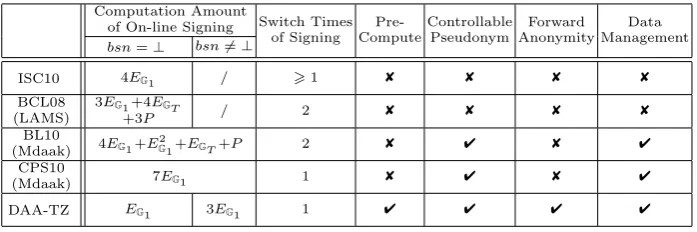
BL10 and CPS10 in Mdaak [34]. Likewise building on ECC-DAA and TrustZone technology, these solutions are all designed for mobile platform. The comparison focuses on the items related to mobile device, involving the most time-consuming computation amount of on-line anonymous signing (that leads user to wait for its instant result) depending on whetherbsn is null, the switch times between SW and NW when executing signing, and other properties including realized pre-computation, user-controlled pseudonym, forward anonymity and sensitive data management using a root of trust. The notations used in the table are as follows: when we write EG1 or EGT, we mean the exponentiation is in group G1 or GT; EG21 denotes 2 simultaneous exponentiations on G1, i.e. computing
ab1
1 ·a
b2
2 ; P is short for pairing computation; the check mark (4) denotes the solution considers or has this property while the X mark (8) denotes not; the slash (/) indicates it does not support pseudonym.
From the table, it is clear that the proposed scheme not only has the least on-line computation amount and switch times for mobile devices in signing phase, but also provides all other listed properties. The signing phase is the most fre-quent execution and deeply influences the whole scheme’s efficiency. Overall, the combination of these advantages endows DAA-TZ with a good user experience as well as high security.
6.3 Performance Evaluation
20 B. Yang et al.
Sign 433 507
Rejion 1186 1534
Verify (PC) 157 182
MNT160 MNT224 BN160 BN192 BN224 BN256 Sign 433 765 507 633 733 815 0 200 400 600 800 1000 1200 1400 1600
Pre-Compute Sign Rejion Verify (PC)
Time Overhead (ms) MNT160 BN160 0 100 200 300 400 500 600 700 800 900
MNT160 MNT224 BN160 BN192 BN224 BN256
Time Overhead
(ms)
MNT160 BN160
Fig. 3.Time overheads of the critical processes with 80-bit security level.
Sign 433 507
Rejion 1186 1534
Verify (PC) 157 182
MNT160 MNT224 BN160 BN192 BN224 BN256 Sign 433 765 507 633 733 815 0 200 400 600 800 1000 1200 1400 1600
Pre-Compute Sign Rejion Verify (PC)
Time Overhead (ms) MNT160 BN160 0 100 200 300 400 500 600 700 800 900
MNT160 MNT224 BN160 BN192 BN224 BN256
Time Overhead
(ms)
MNT160 BN160
Fig. 4. On-line time overheads of Sign phase with different security levels.
covering instantiated protocol, TrustZone switch and sensitive data management. Each average experimental result is taken over 20 test-runs.
On MNT and BN curves with 80-bit security level, Fig.3 illustrates the av-erage time overheads of critical processes including the computations of pre-compute, Sign (excluding pre-computation) and Rejoin on mobile device and
Verify on PC for verifier. The results indicate that using both curves the
fre-quent computations about either pre-compute or Signonly take less than 500 milliseconds (ms), while infrequent and time-consumingRejoinspends less than 1550 ms. Even if the computation amount of Verify is quite large, the time overhead is indeed low on PC platform.
Fig.4 shows the average on-line time overheads of singleSignphase (excluding pre-computation) on mobile device using two curves with different security levels. From the figure, we can see that as the security levels increase, the time overheads of Signphase have evident growth. The growth rate of overhead using MNT is higher than that using BN. Encouragingly, all the resulting overheads spend less than 820ms, which is completely acceptable for a mobile user.
Actually, a direct performance comparison of our competitive scheme to oth-ers is difficult because of four inevitable differences: the hardware platforms, the algorithm libraries, the selections of elliptic curves, and the completeness degrees of programming. Anyhow, according to our comparison and experimental result-s, DAA-TZ can be considered as a reasonably efficient scheme for mobile device. In regard to adopting modern mobile devices that are much more powerful than our development board and a more optimal library to implement elliptic curves and parings, the time overhead of our scheme could be further decreased.
7
Conclusion
trust provided by SRAM PUF, key derivation and sensitive data management collectively enhance the security of our scheme. The implementation and evalu-ation convince that DAA-TZ is quite practical for mobile users. Our next step is to design the concrete secure applications based on DAA-TZ.
Acknowledgment. We thank Shijun Zhao and the anonymous reviewers for their valuable comments. This work was supported in part by grants from the National Natural Science Foundation of China (No.91118006, No.61202414 and No.61402455) and the National 973 Program of China (No.2013CB338003).
References
1. Bellare, M., Rogaway, P.: Random oracles are practical: A paradigm for designing efficient protocols. In: Proceedings of the 1st ACM Conference on Computer and Communications Security – CCS’93. pp. 62–73. ACM Press (1993)
2. Bernhard, D., Fuchsbauer, G., Ghadafi, E., Smart, N.P., Warinschi, B.: Anonymous attestation with user-controlled linkability. International Journal of Information Security 12(3), 219–249 (2013)
3. Brickell, E., Camenisch, J., Chen, L.: Direct anonymous attestation. In: Proceed-ings of the 11th ACM conference on Computer and communications security. pp. 132–145. ACM (2004)
4. Brickell, E., Chen, L., Li, J.: A new direct anonymous attestation scheme from bilinear maps. In: Trusted Computing-Challenges and Applications, pp. 166–178. Springer (2008)
5. Brickell, E., Li, J.: A pairing-based daa scheme further reducing tpm resources. In: Trust and Trustworthy Computing, pp. 181–195. Springer (2010)
6. Camenisch, J., Stadler, M.: Efficient group signature schemes for large groups. In: Kaliski, B. (ed.) Advances in Cryptology – CRYPTO’97. LNCS, vol. 1296, p. 410C424. Springer-Verlag (1997)
7. Chase, M., Lysyanskaya, A.: On signatures of knowledge. In: Dwork, C. (ed.) Ad-vances in Cryptology – CRYPTO’06. LNCS, vol. 4117, p. 78C96. Springer-Verlag (2006)
8. Chen, L.: A daa scheme requiring less tpm resources. In: Information Security and Cryptology. pp. 350–365. Springer (2010)
9. Chen, L., Li, J.: Flexible and scalable digital signatures in tpm 2.0. In: Proceedings of the 2013 ACM SIGSAC conference on Computer & communications security. pp. 37–48. ACM (2013)
10. Chen, L., Page, D., Smart, N.P.: On the design and implementation of an efficient daa scheme. In: Smart Card Research and Advanced Application, pp. 223–237. Springer (2010)
11. Chen, X., Feng, D.: Direct anonymous attestation for next generation tpm. Journal of Computers 3(12), 43–50 (2008)
12. Commission, F.T., et al.: Mobile privacy disclosures: Building trust through trans-parency. Federal Trade Commission Staff Report (2013)
13. Galbraith, S., Paterson, K., Smart, N.: Pairings for cryptographers. Discrete Ap-plied Mathematics 156(16), 3113–3121 (2008)
15. Jang, J., Kong, S., Kim, M., Kim, D., Kang, B.B.: Secret: Secure channel between rich execution environment and trusted execution environment. NDSS 2015 (2015) 16. Lysyanskaya, A., Rivest, R.L., Sahai, A., Wolf, S.: Pseudonym systems. In: Selected
Areas in Cryptography. pp. 184–199. Springer (2000)
17. Maganis, G., Shi, E., Chen, H., Song, D.: Opaak: using mobile phones to limit anonymous identities online. In: Proceedings of the 10th international conference on Mobile systems, applications, and services. pp. 295–308. ACM (2012)
18. Morelos-Zaragoza, R.: Encoder/decoder for binary bch codes in c (version 3.1) 19. Oren, Y., Sadeghi, A.R., Wachsmann, C.: On the effectiveness of the remanence
decay side-channel to clone memory-based pufs. In: Cryptographic Hardware and Embedded Systems-CHES 2013, pp. 107–125. Springer (2013)
20. ARM: Trustzone. http://www.arm.com/products/processors/technologies/ trustzone, (last accessed May 5, 2015)
21. GENODE: An exploration of arm trustzone technology. http://genode.org/ documentation/articles/trustzone, (last accessed May 1, 2015)
22. GlobalPlatform: Tee client api specification version 1.0 (2010)
23. Integrated Silicon Solution Inc: IS61LV6416-10TL. http://www.alldatasheet. com/datasheet-pdf/pdf/505020/ISSI/IS61LV6416-10TL.html
24. ISO/IEC: 15946-5: 2009 information technology-security techniques: Cryptograph-ic techniques based on elliptCryptograph-ic curves: Part 5: ElliptCryptograph-ic curve generation (2009) 25. Proxama:http://www.proxama.com/platform/(2015)
26. Sansa Security: Discretix. https://www.sansasecurity.com/blog/
discretix-becomes-sansa-security/(2014), (last accessed June 22, 2014) 27. Trusted Computing Group:TPMmain specification version1.2, revision 116.http:
//www.trustedcomputinggroup.org(2011), (last accessed October 25, 2014) 28. Trusted Computing Group: Trusted platform module library, family 2.0. http:
//www.trustedcomputinggroup.org(2013), (last accessed March 10, 2015) 29. Xilinx: Zynq-7000 all programmable soc zc702 evaluation kit.http://www.xilinx.
com/products/boards-and-kits/EK-Z7-ZC702-G.htm
30. Wachsmann, C., Chen, L., Dietrich, K., L¨ohr, H., Sadeghi, A.R., Winter, J.: Lightweight anonymous authentication with tls and daa for embedded mobile de-vices. In: Information Security, pp. 84–98. Springer (2011)
31. Wilson, P., Frey, A., Mihm, T., Kershaw, D., Alves, T.: Implementing embedded security on dual-virtual-cpu systems. IEEE Design & Test 24(6), 582–591 (2007) 32. Xi, L., Yang, K., Zhang, Z., Feng, D.: Daa-related apis in tpm 2.0 revisited. In:
Trust and Trustworthy Computing, pp. 1–18. Springer (2014)
33. Yang, B., Feng, D., Qin, Y.: A lightweight anonymous mobile shopping scheme based on daa for trusted mobile platform. In: TrustCom, 2014 IEEE 13th Interna-tional Conference on. pp. 9–17. IEEE (2014)
34. Zhang, Q., Zhao, S., Xi, L., Feng, W., Feng, D.: Mdaak: A flexible and efficient framework for direct anonymous attestation on mobile devices. In: Information and Communications Security. Springer (2014)