Modelling and Simulation of a PV generator
and MPPT using P&O Method and Fuzzy
Logic Controller
Rajinder Singh
1, Prasenjit Basak
2Research scholar, ME (Power System), Department of Electrical and Instrumentation Engineering, Thapar University,
Patiala, Punjab, India1
Assistant Professor, ME (Power System), Department of Electrical and Instrumentation Engineering, Thapar
University, Patiala, Punjab, India2
ABSTRACT: This paper presents themodelling and design of the photovoltaic generator using Simscape
MATLAB/Simulink and also design the performance of present stand-alone solar photovoltaic energy system with perturbation and observation (P and O) and artificial intelligence like fuzzy logic based maximum power point tracking (MPPT) algorithm. The system is intended for solar PV panels of 400 cells. Perturb and Observe and fuzzy logic method is used for tracking of Maximum power point (MPPT) which increases efficiency of the PV generator. In this paper the I-V and P-V characteristics of the PV generator are show and also show the scope result with respect to time. According to the P and O method or the fuzzy logic method, the array terminal voltage is always adjusted according to the MPP voltage and the duty cycle is adjusted directly in the algorithm. The system as good dynamic response and good tracking accuracy and increases the efficiency of the PV generator. The different results are presented in the form of the characteristic of the PV generator.
KEYWORDS: DC-DC converter, Fuzzy logic algorithm, PV array, P&O algorithm, Maximum power point tracking
(MPPT) controller, Photovoltaic (PV), Simscape MATLAB/Simulink.
I. INTRODUCTION
The study in solar energy has become a gradually important matter in recent centuries due to its vast and environmentally friendly energy. In the word the demand of the electricity widely increases due to the non-availability and the shortage of the fossil fuels. To overcome this limitation the renewable resources are used. The most renewable energy resources are the solar energy. The solar energy mainly depends on the sun and the energy is free of cost and non-polluted, and environment friendly. The most common way of harvesting the solar energy through photovoltaic panels or array is very popular and effective to receive photon energy from sun. This energy intern, converted to electrical energy. The solar energy depends on the phenomena of “Photovoltaic effect” which converts the sunlight to the electric energy by semiconductor device means photovoltaic cells [1]. The photovoltaic (PV) power systems are achieving reputation more than other renewable sources because of their ease of installation, less maintenance and in isolated mode of power generation these are proven to be effective solution for feeding energy demand of rural areas.. The efficiency of the solar array depends on the temperature, insolation, dirt, shadow and so on. In the cloudy weather the insolation change due fast climate change and increase the ambient temperature can reduce the Photovoltaic array output power [1]. Therefore a technique will be use known as MPPT which implemented the DC-DC converter to attain the maximum efficiency [2]. The PV is now broadly used as a distributed energy resource in standalone modes due to environmentally friendly and cost-effective benefits.
II. DESCRIPTION OF PV GENERATOR MODEL IN SIMSCAPE MATLAB ENVIRONMENTAL
negative terminal and third is the insolation or irradiance terminal. The open circuit voltage Vocof this cell is 0.6 volt
and the short circuit current Isc is 7 amps .The block diagram of the solar cell is given in figure1
.
Figure 1. Block diagram of solar cell
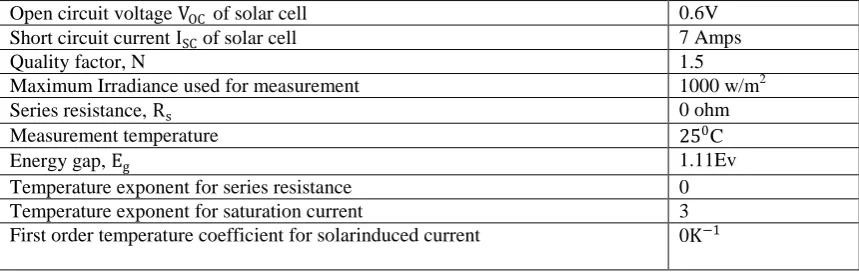
Specification of the solar cell The table 1 shows the complete specification of the solar cell.
Open circuit voltage VOC of solar cell 0.6V
Short circuit current ISC of solar cell 7 Amps
Quality factor, N 1.5
Maximum Irradiance used for measurement 1000 w/m2
Series resistance, Rs 0 ohm
Measurement temperature 250C
Energy gap, Eg 1.11Ev
Temperature exponent for series resistance 0
Temperature exponent for saturation current 3
First order temperature coefficient for solarinduced current 0K−1
Table 1. Specification table of solar cell
Solar Sub-module
The output voltage of the single cell is very small about 0.6 volts which does not meet the load demand. To increase the output of the system the solar cells are connected in series or parallel combination and all of them are subjected to the same irradiation level. This is shown in figure 2.
Solar Cell 2 Solar Cell 3 Solar Cell 4 Solar Cell 20
0.6 V 0.6 V 0.6 V 0.6 V 0.6 V Solar Cell 1
Figure 2. Schematic diagram of solar sub-module
In the sub-module there are total 20 number of solar cell which is connected in a series, each having the open circuit
voltage Voc of 0.6 volt. The irradiation level of the solar sub-module is same around 1000 w/m2. This irradiation level
increasing or decreasing according to the radiation of the sun. The open circuit voltage of the solar sub – module = (Open circuit voltage
of each solar cell) * (total number of cell connected in series) = (0.6*20) Volts = 12 Volts and the short circuit current is 7 Amp.
Solar Module - There is a combination of the two solar sub – module which are connected in parallel to create the on
solar module. The open circuit voltage Vocof the solar module is 12 Volt because the cell is connected in parallel. The
short circuit current Isc of solar module = (short circuit current of each sub module) * (Number of solar sub- module
connected in parallel) = (7 * 2) = 14 A [2].
Solar Array (PV Array) - it is the combination system of the solar module which is used to develop the more output
voltage. In the solar array there is a combination of 20 numbers of solar modules which are connected in series to build up the desired output voltage to meet the load demand. Each solar module having voltage is 12 Volt .The schematic
voltage of each solar module) * (Total numbers of solar modules are connected in series) = (12 *20) = 240 Volt and the
short circuit current Isc of the PV generator or PV array is 7 A.
Figure 3. Schematic diagram of PV Array or PV generator model
III. DESCRIPTION OF PV GENERATOR CONNECTED WITH DC/DC CONVERTER AND MAXIMUM POWER POINT (MPPT) CONTROLLER
In this section the representation complete model of the PV generator which are connected with DC/DC converter, Perturbation and Observation block, Fuzzy logic block, Battery system and then connected with the DC load. The block diagram of this complete system is shown in figure 4.
PV Array Or PV generator
DC / DC Converter
Connected DC Load Battery system
P and O MPPT Controller with duty cycle
modification Fuzzy Logic System MPPT
Controller
Product
Ppv
Ipv Vpv
D D
Vpv
Ipv Vpv
DC
Inductor
Diode
Capacitor Resistance
Voltage source Switch
Figure 4. Block diagram of PV generator Figure 5. Circuit diagram of the DC-to-DC converter
IV. MODELLING AND SIMULATION OF PV GENERATOR TO OBTAIN I-V AND P-V CHARACTERISTIC
In the modelling part a PV generator is connected to the fixed or variable resistive load. The voltage sensor or the current sensor device is used to obtain the open circuit output voltage and the short circuit current of the PV generator. The X-Y graph block is connected to the voltage sensor or current sensor to draw the I-V and P-V characteristics of the PV generator. The PS constant blocks givesthe irradiation to the PV generator.Due change the irradiation level the output of the PV generator will be changes, increasing the irradiation level the output voltage of the PV generator increases and vice –versa.The modelling diagram or the PV generator is shown in figure 6.
Figure 6. Modelling diagram of PV generator
The f(x) is the solver configuration block which is used to solve the mathematically equations of the PV generator. The ramp block generates constantly increasing or decreasing signal that starts at a specific time and value and change by specific rate. There is a Simulink -PS converter which converts the unitless Simulink input to physical signal and PS-Simulink converter which converts the physical input signal to unitless PS-Simulink signal [4].
V. CHARACTERISTIC OF THE PV GENERATOR
Current Versus Voltage (I-V) characteristic of PV generator
The typically current versus Voltage (I-V) characteristics of the PV generator is shown in figure 7. In the I-V characteristics the current and voltages changes because a variable resistance is connected with the PV generator
.
Figure 7. I-V characteristic of PV generator Figure 8. P-V characteristic of PV generator
At the initial point when voltage is zero and the current is maximum around 7A.This changes is due to the variable resistance. The voltage is zero because of the short circuit. Due to changes the resistance from zero to maximum then the current versus voltage graph will change and this change is shown in graph with the blue line.
Power versus Voltage (P-V) characteristics of the PV generator
The power is the product of voltage and the current according to the ohms law P =V*I. Due to the voltage change the power will change because both are directly proportional with each other. The typically Power versus Voltage (P-V)
0 50 100 150 200 250
0 200 400 600 800 1000 1200 1400
Voltage (V)
Po
w
er
(W
)
0 50 100 150 200 250
0 1 2 3 4 5 6 7 8
Voltage (V)
Cu
rren
t
(A
graph as shown in figure 8.When the voltage is zero then the power is zero. Increasing the voltage of the PV generator then the power is increases gradually.
The simulation scope results of PV generator
The figure 9 shows the Voltage versus Time graph. The graph shows how the open circuit voltage is changes with time
when the variable resistance is connected to the PV generator with a fixed 1000 w/m2 irradiation level
.
The figure 10shows the Current versus Time graph. This graph shows that how the short circuit current changes with time when a
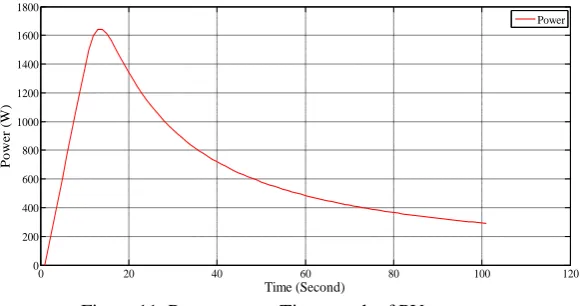
variable resistance is connected to the PV generator with a fixed 1000 w/m2 irradiation level.The figure 11 shows the
Power versus Time graph. In this graph the power is the product of voltage and current P=V*I. This graph shows that how the power change with respect to time with the changes of voltage and current connected to the variable resistance
with constant 1000 w/m2 irradiation level [1].
Figure 9 Voltage versus Time graph of PV generator Figure 10. Current versus Time graph of PV generator
The figure 10 shows the Current versus Time graph. This graph shows that how the short circuit current changes with
time when a variable resistance is connected to the PV generator with a fixed 1000 w/m2 irradiation level.
The figure 11 shows the Power versus Time graph. In this graph the power is the product of voltage and current P=V*I. This graph shows that how the power change with respect to time with the changes of voltage and current connected to
the variable resistance with constant 1000 w/m2 irradiation level [1].
Figure 11. Power versus Time graph of PV generator
I - V and P - V characteristic of PV generator with different insolation level
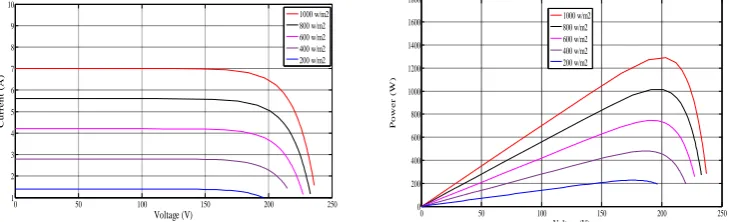
The figure 12 and figure 13 shows the I-V and P-V characteristics with the different irradiation level. The irradiation
level increased from 200 w/m2 to 1000 w/m2.When the irradiation level increase the characteristic of the graph changes
which are indicated with different solar as shown in figure.
0 20 40 60 80 100 120
0 50 100 150 200 250
Time (Second)
V
o
l
at
g
e
(V
)
Voltage
0 20 40 60 80 100 120
1 2 3 4 5 6 7 8
Time (Second)
Cu
rren
t
(A
)
Current
0 20 40 60 80 100 120
0 200 400 600 800 1000 1200 1400 1600 1800
Time (Second)
Po
w
er
(W
)
Figure 12. I-V characteristic with different insolation level Figure 13. P-V characteristic with different insolation level
Maximum Power Point Tracking (MPPT) of PV generator
The principle of Maximum Power Point Tracking (MPPT) controller of PV generator are mainly depend upon the load characteristic (figure 7 and 8) to which it is connected. With the variable load resistance the optimal variation occurs only at one specific operating point known as Maximum Power Point (MPP). When there is a direct connection between the PV generators and load the output of the PV generator is maximum but not optimal. To overcome this problem it is necessary an additional device, MPPT controller connected with a DC-to-DC converter between the source and the variable load resistance. The MPPT controller is also track a new modify curve whenever the irradiation and the temperature variation occurs. The main purpose of the MPPT controller is to increase the efficiency of the PV generator and track the Maximum Power from the PV generator [6]. There is different method to track the Maximum Power Point of the PV generator. In the previous year the voltage control feedback method, current control feedback method and the power based method is used. In the voltage feedback method the operating voltage of the PV generator is compared with the reference voltage in order to generate the control signal to DC-to-DC converter. At present time the most commonly method used to track the Maximum Power point of the PV generator is Perturbation and Observation (P and O)method, Incremental conductance method and Artificial intelligence based Fuzzy logic method, which is used to make the PV generator more efficient. Here only two methods are discussed is in detail which is mostly used and easy to install. There are different method to find the maximum power point of the PV generator namely as
[1] Perturbation and Observation method or (P and O method) [2] Fuzzy logic method.
Perturbation and Observation controller method (P and O method)
In the modern time due to the simplicity and generic nature the Perturbation and Observation method are mostly used. The principle of this controller is to aggravate perturbation by performing (increasing and decreasing) on the duty cycle and observe the effect of output of the PV generator power. This method is based on the fact that the derivative of the power in role of the voltage is zero at MPP. The algorithm of the P and O method in given below in figure14. At the
operating point on the P-V curve if the derivative of power dP> 0 then the Perturbation (increase) move the PV
generator operating point toward the MPP and done through Vref(t2) = Vref(t2) +C and if the derivative of power dP<
0 then the Perturbation (decrease) and move the PV generator operating point away from the MPP and done through
Vref(t2) = Vref t2 -C. If the dP = 0 then the operation point is a Maximum Power Point (MPP) in the P-V curve. The
output taken from the Perturbation and Observation is in the form of Duty cycle. The duty cycles is given to the switch of the DC/DC converter and check the output power of the converter with the help of scope. The range of the duty cycle in between 0 and 1.The representation of the duty cycle (D) is shown in figure 21.
0 50 100 150 200 250
1 2 3 4 5 6 7 8 9 10
Voltage (V)
Cu
rren
t
(A
)
1000 w/m2 800 w/m2 600 w/m2 400 w/m2 200 w/m2
0 50 100 150 200 250
0 200 400 600 800 1000 1200 1400 1600 1800
Voltage (V)
Po
w
er
(W
)
START
Vref(t2) = Vref(t2) - C
Ppv(t1) = Vpv(t1)*Ipv(t1)
Measure: Vpv(t2),Ipv(t2) Vref = Vpv(t2) Measure: Vpv(t1),Ipv(t1)
Vref = Vpv(t1)
Vref(t2) = Vref(t2) +
C Ppv(t2) = Vpv(t2)*Ipv(t2)
NO YES ΔPpv(t2)>0
Figure 14. Flow chart or algorithm of P and O method
Fuzzy Logic method
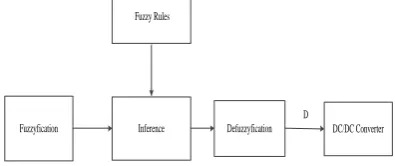
The artificial intelligence based fuzzy logic method is a best technique to find the maximum power point tracking (MPPT) of the PV generator. The block diagram of the fuzzy logic system is given in figure 15.
Fuzzyfication Inference Defuzzyfication DC/DC Converter D
Fuzzy Rules
Figure 15 Block diagram of fuzzy logic system
Figure 16. Input variable Power (P) of fuzzy system Figure 17. Input variable ΔV of fuzzy system
The output membership function is duty cycle which is represented by (D) and shown in above figure 18. The values of the input member is select according to the model requirement. In this model the output voltage is 240 volt and the current is 7 amp then the total output power will be 1.6 kw. In the fuzzy logic system the range of the derivative of voltage ΔV (-10 to 10) and the range of the power is (0 to 1800) and the range of the duty cycle is (0 to 1). In the inference a mamdani block is show where the rules will be created according to the two input and one output membership function. There are total 25 rules in the mamdani block. The output of the fuzzy system in the form of duty cycle, this duty cycle is given to switch of the DC/DC conversion device. The surface view of the fuzzy logic based MPPT controller is shown in figure 19 [6].
Figure 19. Surface view fuzzy logic MPPT controller
Simulation results of the MPPT controller
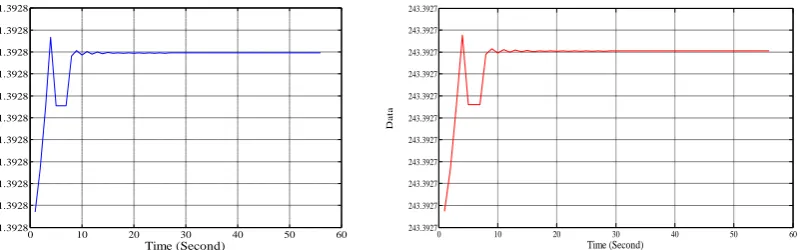
Figure 21 Duty cycle versus Time graph Figure 22 Output voltage without MPPT controller
Output voltage with and without MPPT controller
Figure 23 Output voltages with P and O controller Figure 24 Output voltages with fuzzy logic controller
0 20 40 60 80 100 120
0 2 4 6 8 10 12 14 16 18
Time (Second)
D
ut
y
Cy
cl
e(D
)
Duty Cycle
0 10 20 30 40 50 60
0 50 100 150 200 250
Time (Second)
D
at
a
0 10 20 30 40 50 60
241.3928 241.3928 241.3928 241.3928 241.3928 241.3928 241.3928 241.3928 241.3928 241.3928 241.3928
Time (Second)
D
at
a
0 10 20 30 40 50 60
243.3927 243.3927 243.3927 243.3927 243.3927 243.3927 243.3927 243.3927 243.3927 243.3927 243.3927
Time (Second)
D
at
VI. CONCLUSION
This paper is mainly about the Simscape based modeling of the PV generator by using the MATLAB- Simulink. In this I-V and P-V characteristic are drawn and shows the maximum power point tracking (MPPT). The P and O method and the fuzzy logic method are used to find the MPPT and output voltage will be shown without MPPT or with MPPT controller.
REFERENCES
[1] Varshney, Gunjan, D. S. Chauhan, and M. P. Dave. Simscape Based Modelling & Simulation of MPPT Controller for PV Systems. PP
41-46,(Nov – Dec. 2014).
[2] Basak, Prasenjit, Shuvro Chowdhury, and S. P. Chowdhury. "Simscape based modeling and simulation of a PV generator in microgrid
scenario." (2013): 0997-0997.
[3] Raju, Dr P. Sangameswar, and Mr G. Venkateswarlu. Simscape Model of Photovoltaic cell." International Journal of Advanced Research in
Electrical, Electronics and Instrumentation Engineering 2.5 (2013).
[4] Srivastava, Manish, Sunil Agarwal, and Ekta Sharma. Design and Simulation of Perturb and Observe MPPT Algorithm for 72 Cell Solar PV
System.
[5] Kondawar, Sangita S., and U. B. Vaidya. A comparison of two MPPT techniques for pv system in Matlab simulink. International Journal of
Engineering Research and Development 2.7 (2012): 73-79.
[6] Cheng, Po-Chen, et al. "Optimization of a Fuzzy-Logic-Control-Based MPPT Algorithm Using the Particle Swarm Optimization
Technique." Energies 8.6 (2015): 5338-5360.
BIOGRAPHY
Rajinder Singh is a student of Masters of Engineering in Electrical and Instrumentation Engineering Department of Thapar University, Punjab, India. His research interest is in the area of renewable energy resources, microgrid (analysis and simulation).
Prasenjit Basak received BEE and PhD degree in the year 1999 and 2012 respectively from