Fast and Universally-Composable Oblivious Transfer
and Commitment Scheme with Adaptive Security
Megha Byali, Arpita Patra, Divya Ravi and Pratik Sarkar Indian Institute of Science, India
{megha,arpita,divyar,pratiks}@iisc.ac.in
Abstract. Adaptive security embodies one of the strongest notions of security that allows an adversary to corrupt parties at any point during protocol execution and gain access to its internal state. Since it models real-life situations such as “hacking”, efficient adaptively-secure multiparty computation (MPC) protocols are desirable. Such protocols demand primitives such as oblivious transfer (OT) and commitment schemes that are adaptively-secure as building blocks. Efficient realizations of these primitives have been found to be challenging, especially in the no erasure model. We make progress in this direction and provide efficient constructions that are Universally-Composable in the random oracle model. Oblivious Transfer.We present the firstround optimalframework for building adaptively-secure OT in the programmable random oracle (PRO) model, relying upon the framework ofPeikertet al. (Crypto 2008). When instantiated with Deci-sional Diffie Hellman assumption, it incurs a minimal communication overhead of oneκbit string and computational overhead of 5 random oracle queries over its static counterpart, whereκis the security parameter. This computation overhead translates to 0.02% and 1% in the LAN and WAN setting. Additionally, we ob-tain a construction of adaptively-secure 1-out-of-NOT by extending the result of Naoret al. (Journal of Cryptology 2005) that transformslogNcopies of 1-out-of-2 OTs to one 1-out-of-NOT in the PRO model. We complete the picture of efficient OT constructions by presenting the first adaptively secure OT Extension, extending the protocol of Asharov et al. (Eurocrypt 2015) for the adaptive setting using PRO. Our OT extension enables us to obtain adaptive OTs at an amortized cost of3symmetric key operations and communication of 3κbit strings. It incurs a runtime overhead of 2%and 11.95%, in the LAN and WAN setting and almost no communication overhead over the static OT extension protocol. In concrete terms, the cost is 2µs and 115µs for each OT in LAN and WAN.
1
Introduction
Secure multiparty computation (MPC) [Yao82,GMW87] is an area of cryptography that deals with multiple parties who wish to compute a joint function of their private inputs such that the goals of MPC i.e. correctness and privacy of inputs remain intact. Various security notions of MPC are defined in accordance with different types of ad-versaries. The area of MPC achieving security against a malicious adversary causing static corruptions has been the center of attention in the recent past. Here, static corrup-tion refers to the model in which the adversary corrupts the subset of parties at the outset of the protocol. Most widely known protocols of [Lin13,HKK+14,MR17], consider malicious security against static corruptions. Although static security is of interest, it is desirable to achieve security against adaptive adversary. Adaptive security is a stronger corruption model that allows the adversary to choose which parties to corrupt during the protocol execution and models real-life situations in a more comprehensive way. For in-stance, it captures the event of “hacking”, where a hacker can illegally capitalize on the system and corrupt any workstation while protocols are in execution. Adaptive security is further classified based on secure erasures of the memory. An adaptively-secure pro-tocol assuming erasure allows secure erasure of a workstation’s internal memory once it is corrupted by a hacker. [Can01] argued that security relying on erasures often leads to problems and is impractical, especially for real-life systems. It requires an inherent trust assumption on the part of a workstation that it will erase its memory upon being corrupted. Hence, adaptive security without erasures (referred to simply as adaptive-securitythroughout the paper) is preferable as it precisely models real world “hacking” attacks. However, the current literature of MPC dealing with adaptive adversaries is less explored compared to static security since it turns out to be considerably more challenging. In this paper, we explore the less traveled path of dealing with adaptive ad-versaries in the Universal Composability (UC) model of [Can01]. We aim at obtaining efficient, adaptively-secure primitives which are instrumental in construction of prac-tical adaptively-secure MPC protocols. We focus on two such primitives in particular: Oblivious Transfer (OT) and Commitment schemes.
In the literature, OT has been regarded as the fundamental primitive [Rab81,BCR86,
present the first round optimal OT protocol which is secure against adaptive adversaries without erasures.
Another interesting direction to consider for OTs is to reduce the number of public key operations. The impossibility result by [IR89] states that its highly unlikely that OTs can be constructed without public key operations. In order to circumvent this limi-tation, the concept of OT Extension [Bea96,IKNP03,ALSZ13,ALSZ15,KOS15] was introduced and explored. It allows the parties to execute a small number of OTs, called seed OTs, and then extend them to obtain large number of OTs using cheap symmetric key operations. The amortized cost of generating one single OT reduces to a constant number of symmetric key operations. However, there is no known OT extension proto-col in the adaptive setting. An effort towards obtaining adaptively secure OT Extension would be of quite interest as it would open the gates towards constructing large number of efficient adaptively secure OTs using small number of seed OTs. Our paper presents one such result for adaptively-secure OT extension.
Commitment Scheme is another fundamental primitive in the MPC literature that draws attention. Informally, we describe a commitment scheme as follows: The sender Scommits to a message min a commitment c and sendsc to the receiver Rin the commit phase. In the decommit phase,Rlearns the messagem, along with some de-commitment information, such thatRis convinced that indeedm was committed in the commit phase. Besides its involvement in MPC protocols, commitment schemes in the UC model also have implications in key exchange [DG03] and are non-malleable [CF01] in nature. In this work, we explore UC secure commitment protocols which are secure against adaptive adversaries.
1.1 Related Work
The extensive use of fundamental building blocks of MPC has led to substantial work towards attaining efficient primitives. Since our work primarily focuses on universally composable OT and commitment schemes, we outline only the relevant literature below.
In the setting of adaptive security, the literature can be divided based on the era-sure model. The works of [ABB+13, CKWZ13,BCG17,BC16, BC15] rely on se-cure erasures of the memory, whereas [GWZ09,CDMW09a,CDMW09b,BDD+17] consider the stronger model of no erasures. [CKWZ13] presented a framework for adaptively-secure OT in the globalcrsmodel. They provide instantiations under vari-ous assumptions- DLIN, Symmetric External Diffie Hellman (SXDH), DDH and DCR. However, their protocols are not round optimal and achieve adaptive security at the cost of significant overhead in communication and computation compared to the PVW protocol. [CKWZ13] also provided two constructions (Appendix A of [CKWZ13]) of [GWZ09] framework under Decisional Linear (DLIN) assumptions. These instan-tiations are adaptively-secure with erasures, with computational overhead reduced to constant number of exponentiations. There has been a separate line of work [BCG17,
BC16,BC15,ABB+13] based on password-authenticated key exchange (PAKE) and smooth projective hash functions. They require atleast 3 rounds of communication, as-suming erasures for adaptivity. On the other hand, achieving adaptivity with no era-sures is a challenging task. [GWZ09] followed the compiler approach to transform the [PVW08] framework into an adaptively-secure OT using adaptively secure commit-ments. It was further improved by a recent work of [ABP17]. Both protocols incur an overhead ofO(n)exponentiations, wherenis the size of sender’s input messages. The works of [CDMW09a,CDMW09b] proposed constructions which are of theoretical interest. [CDMW09a] presented an OT construction using non-committing encryption (NCE). On the other hand, [CDMW09b] compiled protocols that are secure against a semi-honest adaptive adversary into one that is secure against a malicious adaptive adversary.
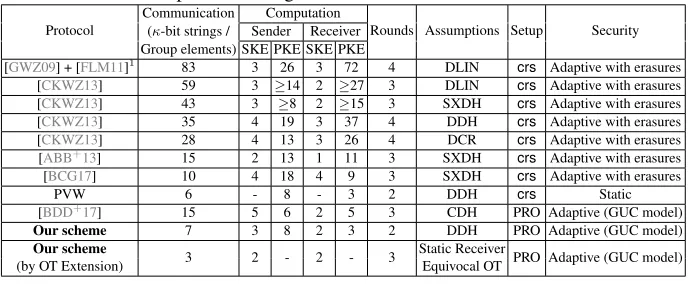
The work of [CO15], the “simplest OT” protocol explored 3-round OT constructions in the PRO model. Although the paper claimed adaptive security, several bugs have been identified [GIR17,BDD+17,HL17] recently in their static security proof thereby ren-dering the protocol of [CO15] insecure in the UC model. Recently two more works ([HL17],[BDD+17]1) have claimed to achieve adaptive security in the same model. However, in Section3, we give a justification that these protocols are not UC-secure. We note that the authors of [BDD+17] have updated their protocol and their new version presents a 3 round OT framework which can be instantiated under Learning from Parity with Noise, McEliece cryptosystem, QC-MDPC, LWE and Computational Diffie Hell-man (CDH) in the PRO model. Their most efficient instantiation (under CDH) incurs twice the amount of communication, while maintaining the same computation cost as ours. Consequently, the problem of attaining anround-optimal, efficient and adaptively-secure OT continued to remain open, which we try to address through our work. Table1 summarizes the literature on adaptively-secure OT protocols and our result. We do not compare with [GWZ09,CDMW09a,CDMW09b,ABP17] in the table since they re-quire atleastO(n)exponentiations, where sender’s input message is ofnbits, whereas the other protocols in the table require constant number of exponentiations. Among the PAKE-based schemes we compare with the most efficient works of [ABB+13,BCG17]. Another interesting factor to consider is the model of security that these protocols satisfy. All of the above protocols (except [BDD+17]) are secure in the plain
model [Can01] which allows privatecrs. There is a stronger model of security, i.e. the Generalized UC model (GUC) [CDPW07], which guarantees stronger compositional guarantees than the plain UC model. In the GUC model, the parties are not allowed to possess privatecrsand the random oracle is a public object, shared between arbi-trary protocols. This prevents the simulator from manipulating thecrsduring simula-tion, rendering the simulation procedure more difficult. Interestingly, the recent work of [CDG+18] has shown that the random oracle in the GUC model can satisfy the property of programmability. Such a random oracle is formally known as Global Random Oracle (GRO). Utilizing the programmability feature of the GRO, our protocol and the proto-col of [BDD+17] achieve adaptive security. Whereas, the other protocols require a local crs, which is private to one instance of the protocol, thereby hampering composition in the GUC model.
Oblivious Transfer Extension. Next, we consider the problem of OT Extension, which was introduced by the work of [Bea96], followed by the seminal work of [IKNP03]. The paper of [IKNP03] presented an efficient 1-out-of-2 semi-honest OT Extension protocol which was secure against static adversaries. An optimized version of this pro-tocol appeared in [ALSZ13]. The paper of [ALSZ15,KOS15] presented the actively secure versions. The paper of [KK13] gave constructions for 1-out-of-Ncase, which were made actively secure by [PSS17,OOS17]. However all of these protocols are in the static setting and it was not knownwhether adaptively-secure OT Extension pro-tocol is possible. Our work answers it in an affirmative way by proving that existing static OT extension [ALSZ13,ALSZ15] schemes satisfy adaptive security under the PRO assumption.
Table 1: Comparison among UC secure Oblivious Transfer Protocols
Protocol
Communication Computation
Rounds Assumptions Setup Security (κ-bit strings / Sender Receiver
Group elements) SKE PKE SKE PKE [GWZ09] + [FLM11]1
83 3 26 3 72 4 DLIN crs Adaptive with erasures [CKWZ13] 59 3 ≥14 2 ≥27 3 DLIN crs Adaptive with erasures [CKWZ13] 43 3 ≥8 2 ≥15 3 SXDH crs Adaptive with erasures
[CKWZ13] 35 4 19 3 37 4 DDH crs Adaptive with erasures
[CKWZ13] 28 4 13 3 26 4 DCR crs Adaptive with erasures
[ABB+
13] 15 2 13 1 11 3 SXDH crs Adaptive with erasures
[BCG17] 10 4 18 4 9 3 SXDH crs Adaptive with erasures
PVW 6 - 8 - 3 2 DDH crs Static
[BDD+
17] 15 5 6 2 5 3 CDH PRO Adaptive (GUC model)
Our scheme 7 3 8 2 3 2 DDH PRO Adaptive (GUC model)
Our scheme
3 2 - 2 - 3 Static Receiver PRO Adaptive (GUC model)
(by OT Extension) Equivocal OT
Notations:
SKE - symmetric key encryptions, PKE - exponentiations, GUC - Generalized UC ,
DDH - Decisional Diffie Hellman, DLIN - Decisional Linear, SXDH - symmetric external Diffie Hellman,
CDH - Computational Diffie Hellman, DCR - Decisional Composite Residuosity, PRO - programmable random oracle
Commitment Scheme. The study of UC secure commitment schemes was initiated by the seminal work of [CF01]. It was followed by the works of [CLOS02,DG03,HM04,
Lin11,Fuj16,ABP17] and many more. We highlight some of the notable works in the relevant literature classified based on their round complexity, the security they achieve and the security model they are proven to be secure in.
The contributions of [DG03, Lin11, GIKW14, Fuj16, FLM11, CJS14, ABP17] based on hardness assumptions such as DDH, DLIN and Discrete Log (DLP) are inter-active (involve either an interinter-active commit or decommit phase) in nature. In contrast, the contributions of [CLOS02,CF01,HM04,FLM11,NFT09,ABP17] present non-interactive commitment (NICOM) schemes where both - commit and decommit phases are non-interactive. The offline-online paradigm also forms an interesting flavour of NICOM schemes. These schemes [CDD+15,DDGN14] consist of an input indepen-dent setup phase, which is run in the offline phase, while the NICOM is efficiently used in the online phase. The cost of the setup phase can be substantial but it gets amortized over multiple commitments. Our scheme also follows this particular model.
Similar to OT literature, the literature regarding commitment schemes is concen-trated mainly around static security [Lin11, BCPV13, CJS14, GIKW14, DDGN14,
CDD+15,Fuj16, CDD+16]. Building commitment schemes against adaptive adver-saries has been a challenging task, since it involves equivocation of the internal states of the parties in case corruption occurs. There have been few contributions in the past addressing adaptive security. Adaptively-secure schemes can be broadly classified into two categories based on their ability to erase the internal state of the party when corrup-tion occurs. [NFT09,FLM11,BCPV13,Fuj16] proposed adaptively-secure protocols which rely on secure erasure of the party’s internal state whereas the constructions of [CF01,CLOS02,HM04,ABB+13,HV15,ABP17,HPV17] achieved the same level of security without erasures. We skim through the protocols in the non-erasure model and compare all the above mentioned works with our protocol in Tab.2.
[HV15] presented a theoretical construction of an interactive adaptive commitment scheme based on the minimal assumption of trapdoor simulatable public-key encryp-tion. Since our focus is on adaptively-secure NICOM schemes, we elaborate the relevant NICOM results. [CF01,CLOS02,ABB+13,ABP17] provided schemes for bit com-mitments, communicating at leastO(κ2)bits for committing to aκbit string. [HM04] provided the first efficient NICOM for an arbitrary length message in the RO model and involves communication of constant number of bits for commitment. Programmability of RO is used to attain the property of equivocation in [HM04].
prop-erty of the GRO. [HPV17] presents a theoretical construction of an adaptively secure commitment scheme relying on one way function. They achieve GUC security in the tamper-proof hardware model. From the literature we can observe that, adaptive com-mitments in the GUC model either asks for programmability from the RO or it incurs a blowup in terms of efficiency. Hence, we can ask the following question:
“Can we obtain an efficient, interactive commitment scheme based on the non-programmable random oracle which is adaptively secure in the GUC model?”
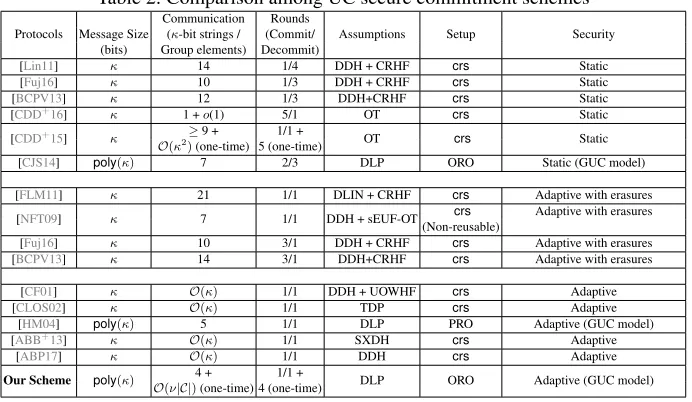
Our paper answers it in affirmative by presenting an adaptively-secure NICOM in the offline-online model, relying solely on the observable property of the RO. Table2 consolidates the comparison of various UC secure commitment schemes alongside our protocol.
Table 2: Comparison among UC secure commitment schemes Protocols Message Size
Communication Rounds
Assumptions Setup Security (κ-bit strings / (Commit/
(bits) Group elements) Decommit)
[Lin11] κ 14 1/4 DDH + CRHF crs Static
[Fuj16] κ 10 1/3 DDH + CRHF crs Static
[BCPV13] κ 12 1/3 DDH+CRHF crs Static
[CDD+16] κ 1 +o(1) 5/1 OT crs Static
[CDD+15] κ ≥9 + 1/1 + OT crs Static O(κ2)(one-time) 5 (one-time)
[CJS14] poly(κ) 7 2/3 DLP ORO Static (GUC model)
[FLM11] κ 21 1/1 DLIN + CRHF crs Adaptive with erasures
[NFT09] κ 7 1/1 DDH + sEUF-OT crs Adaptive with erasures
(Non-reusable)
[Fuj16] κ 10 3/1 DDH + CRHF crs Adaptive with erasures
[BCPV13] κ 14 3/1 DDH+CRHF crs Adaptive with erasures
[CF01] κ O(κ) 1/1 DDH + UOWHF crs Adaptive
[CLOS02] κ O(κ) 1/1 TDP crs Adaptive
[HM04] poly(κ) 5 1/1 DLP PRO Adaptive (GUC model) [ABB+13] κ O(κ) 1/1 SXDH crs Adaptive
[ABP17] κ O(κ) 1/1 DDH crs Adaptive
Our Scheme poly(κ) O 4 + 1/1 + DLP ORO Adaptive (GUC model)
(ν|C|)(one-time) 4 (one-time)
Notations:
DDH - Decisional Diffie Hellman, CRHF - collision resistant hash function, DLP - Discrete Log Problem, DLIN - Decisional Linear, sEUF-OT - strongly unforgeable one-times signature, TDP - trapdoor permutations, UOWHF - universal one-way hash functions, OWF - one-way functions, ORO - observable random oracle, PRO - programmable random oracle, GUC - Generalized UC model ORO - observable random oracle, circuitCcomputesgx
Note :The protocol of [CJS14] and [HM04] requires a non-interactive trapdoor commitment scheme. It has been instantiated with Pedersen commitment since to the best of our knowledge such a commitment scheme does not exist based on OWF.
1.2 Our Results
exponen-tiations toO(logN). Finally, we conclude with detailed implementation results of our primitives. Our contributions are stated below.
Adaptively Secure 1-out-of-2 Oblivious Transfer. We construct the first OT framework that is round-optimal, GUC composable and adaptively-secure assuming no erasures. Our construction is motivated by the vital observation of [CO15] that thecrsin OT can be replaced with the PRO. We apply the same observation on the static OT framework of [PVW08]. At the heart of their framework lies the Dual Mode Encryption Scheme (DME) which requires acrsfor its functioning. We generate thecrsof the Dual Mode Encryption (DME) scheme using the PRO. During simulation thecrscan be suitably modified, to equivocateR’s view, by programming the PRO. However, for our scheme it should be possible to generate the crsof the DME using an RO. Hence, we cus-tomize the definition of DME, based on our requirements, to obtain a stronger version, called Samplable DME. Once thecrshas been generated it can be suitably modified, to extract/equivocateR’s view, by programming the PRO. On the other hand,S’s mes-sages are encrypted using another PRO, such that it enables equivocation ofS’s view when required. Thus, we replace thecrs in the round-optimal [PVW08] framework with PRO to achieve adaptive security. A similar observation was made by the work of [CJS14] where they tried to generate thecrsusing the observability property of the GRO. However, their goal was to obtain one-sided simulatable static OT in the GUC model. Whereas, we aim for adaptive security in the GUC model relying on the pro-grammability feature. In our framework, the DME scheme can be instantiated under the DDH and LWE assumptions. Additionally, when instantiated with DDH assumption, our protocol incurs a computation overhead of 5 random oracle queries and a minimal communication overhead of oneκ-bit string over the static protocol of PVW (the DDH-based instantiation of [PVW08]).Tab.1and Tab.3compare our scheme with various other schemes. Empirically our protocol requires 1.676s and 4.3s in LAN and WAN set-ting, incurring a nominal overhead of 0.02%and 1%, in the same settings, over PVW. The protocol of [BDD+17] requires at least the same runtime as ours, since the number of symmetric key operations in [BDD+17] is more than us, although the number of public key operations in both the protocols are same.
Table 3: Table indicating implementation results for Oblivious Transfer protocol in LAN setting, forn= 128andκ= 128.
Scheme Communication Total Runtime Rounds Assumptions Security
(bits) (s)
PVW 768 2.645 2 DDH Static
[BDD+17] 1920 >2.647 3 CDH Adaptive
Our Scheme 896 2.647 2 DDH Adaptive
Our Scheme
716.7 20.954×10⁻⁷ 3 DDH Adaptive
(from OT extension) Our Scheme
702 1.043×10⁻⁷ 5 DDH Adaptive
Adaptively Secure 1-out-of-N Oblivious Transfer. The work of [NP05] established thatlogNcopies of 1-out-of-2 OTs can be transformed to obtain one 1-out-of-NOT, which is statically-secure against active adversaries. This transformation implies exis-tence of statically-secure 1-out-of-NOT at the expanse ofO(logN)exponentiations. We extend their result to provide a formal proof that the transformation satisfies adap-tive security under PRO assumption. At present, one adapadap-tive 1-out-of-NOT protocol [ABB+13,BC15,BC16,BCG17] incurs atleastO(N)exponentiations. Our adaptive transformation brings down the number of exponentiations toO(logN); thereby match-ing the efficiency of statically-secure 1-out-of-NOT. Interestingly, it can be shown that for the semi-honest setting the seed OTs can be statically secure, if we consider the simulation of the 1-out-of-2 OTs in a non-blackbox manner. For the active setting, we can show that if the 1-out-of-2 OTs support equivocation of receiver’s view irrespective of equivocation of sender’s view then it is possible to generate adaptively-secure 1-out-of-NOT from our transformation, if the simulation of the 1-out-of-2 OTs is performed in a non-blackbox manner. This implies that we can plug-in statically-secure 1-out-of-2 OTs which satisfy the property of receiver equivocability [GKPS18].
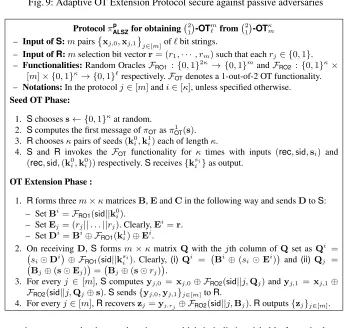
Oblivious Transfer Extension. We provide the first adaptively-secure protocols for OT Extension solely relying on the PRO assumption. In this regard we present two results, one corresponding to semi-honest setting and the other for the active setting. Our first result proves that the semi-honest protocol of [ALSZ13] can be made adaptively-secure. Interestingly, we show that the seed OTs can be statically secure, if we invoke them in a non-blackbox way. We know that for adaptive security, blackbox-usage of the seed OTs is not possible in our construction since it would violate the results of [LZ13,IR89]. [LZ13] proves that the existence of OT extension protocol, secure against semi-honest adaptive adversaries, imply OT protocol secure against static semi-honest adversaries. In that case, blackbox usage of seed OTs establishes that PRO would imply static semi-honest OT, contradicting the result of [IR89] which states that public key operations are necessary for static OT. Our second result proves that the actively secure proto-col of [ALSZ15] can be made adaptively-secure against active adversaries. The paper of [ALSZ15] gave two constructions - a 3 round and a 5 round OT extension in their paper. The 3 round OT extension consists of pair-wise consistency check for all the columns. Whereas, in the 5 round protocol, the parties performed a coin-tossing sub-protocol and based on the outcome of the subsub-protocol, they performed a consistency check on the columns. The 5 round protocol is more efficient than the 3 round one due to reduced number of checks. Similarly, we consider a 3 round and a 5 round vari-ant of our OT extension protocol. Interestingly, we demonstrate that the seed OTs in our case can be replaced with receiver equivocal static OTs which are secure against active adversaries. Our OT Extension protocols preserve the efficiency of the original static protocols, yielding adaptive 1-out-of-2 OTs at an amortized cost of 3 symmet-ric key operations and 3κbits communication per OT. Moreover, if we combine the OT Extension protocol with our 1-out-of-NTransformation, then we obtain 1-out-of-N adaptive OTs at an amortized cost ofN+ 3 logN+ 1symmetric key operations per OT. The other adaptive protocols [ABB+13,BC15,BC16,BCG17,BDD+17] require
the 3 round one due to reduced number of checks. Empirically, the 3 round protocol has a rough multiplicative overhead of 20 over the 5 round protocol for LAN runtime, while generating223 OTs together. The overhead will decrease for larger number of extended OTs, as the number of checks remain constant, while the number of extended OTs increase. Throughout the paper our implementation results for the OT extension protocol, correspond to the 5 round protocol unless specified otherwise. Empirically our OT extension protocol has an overhead of 2%and 11.95%over [ALSZ15] in the LAN and WAN setting respectively. The amortized (over1.25∗105) cost of generating one adaptive 1-out-of-2 drastically reduces to 2.02µs and 115.5µs in LAN and WAN setting for OT output lengthn=16 bits. We also generate 1-out-of-16 OTs from 4 copies of 1-out-of-2 OTs using our transformation. The amortized cost for each 1-out-of-16 OT is 21.3µs and 145.5µs in LAN and WAN setting respectively. In Tab.3we compare our OT protocols with PVW and [BDD+17]. Our extended adaptive OTs are useful in practical MPC applications where the MPC protocols require a large number of OTs. In such a situation it can be observed that if we are given 3 rounds, then we can run our 3 round OT extension protocol to obtain adaptive OTs at a minimal cost of 2.1µs (amor-tized over106OTs), whereas other 3 round protocols (like [BDD+17]) would require 2.647s, which is106times slower than our extended OTs. The cost of each extended OT reduces drastically with amortization, i.e. the total number of extended OTs. Given 5 rounds, our OT extension protocol generates adaptive OTs at a cost of 0.1043µs (amor-tized over106OTs). The protocol of [BDD+17] would be12×105times slower than our extended OTs. If we consider our 5 round OT extension protocol then the overhead factor increases to25×106.
Commitment Scheme. We construct a NICOM, in the offline-online model, that is se-cure against an adaptive adversary without erasures. First, we generate acrsfor Peder-sen commitment using an ORO in the setup phase. Thecrsis of the form(g, h), where h=gxforg, h∈
same hash function. Table2compares our commitment schemes with the recent liter-ature. In terms of empirical costs, our scheme takes approx. 0.18 ms and 0.20 ms to obtain commitment of 128 bits and 2048 bits respectively. In comparison, the scheme of [HM04] takes approx 0.42 ms and 0.49 ms for commitment of 128 and 2048 bits respectively. The protocol of [HM04] requires a non-interactive trapdoor commitment scheme which has been instantiated with Pedersen commitment since to the best of our knowledge such a commitment scheme does not exist based on OWF. The comparison can be viewed in Table4. Based on the results, we conclude that our scheme is approx-imately 2 times faster than [HM04] even though we rely on a weaker assumption from the RO.
Table 4: Table indicating implementation results for our Commitment SchemeπCOM
and [HM04] in the LAN setting. Message Size
Scheme Runtime Runtime Commitment Size
(bits) ofS(ms) ofR(ms) (bits)
128 Our Scheme 0.184 0.185 128 + 512
[HM04] 0.423 0.418 128 + 640
256 Our Scheme 0.189 0.187 256 + 512
[HM04] 0.435 0.432 256 + 640
1024 Our Scheme 0.192 0.191 1024 + 512
[HM04] 0.455 0.469 1024 + 640
2048 Our Scheme 0.198 0.202 2048 + 512
[HM04] 0.487 0.490 2048 + 640
Note: Commitment Size = message size + (commitment&decommitment size)
1.3 Roadmap
2
Preliminaries
In this section, we describe the notations used in our protocols and give a high-level overview of the primitives that are used in the paper.
Notations. For the OT and NICOM protocol, we denote the sender bySand receiver by R. We denote bya←RDthe random sampling ofafrom a distributionDand the set of elements{1, . . . , n}is represented by[n]. Let PRF denote a secure pseudorandom function. A functionneg(·)is said to be negligible, if for every polynomialp(·), there exists a constantc, such that for alln > c, it holds thatneg(n) < p(1n). We denote a probabilistic polynomial time algorithm as PPT. We denote the statistical security parameter by ν and the computational security parameter by κ. We use≈c and≈s to denote computational and statistical indistinguishability, respectively. Let Zp denote the field of orderp, wherepis a prime. LetGbe the multiplicative group corresponding toZ∗pwith generatorg. For a bitb∈ {0,1}, we denote1−bbyb.
Garbled Circuits. The term ‘garbled circuit’ (GC) was coined by Beaver [BMR90] and used extensively only as a technique in secure protocols until they were formalized as a primitive by Bellare et al. [BHR12]. We use notations consistent with [BHR12] (described in Appendix B) for the garbling primitive used to generate CRS for our commitment scheme. LetGCk denote the kth garbled circuit instantiating circuitC. We assume that the randomness used for generating circuit kis derived from aκ-bit random stringseedk using a PRF. We assume that the fan-in of each gate is 2. We can assume that each AND gate in the circuit has 2 ciphertexts and XOR gates have 0 ciphertexts, using the Half-Gate construction [ZRE15] as the garbling scheme.
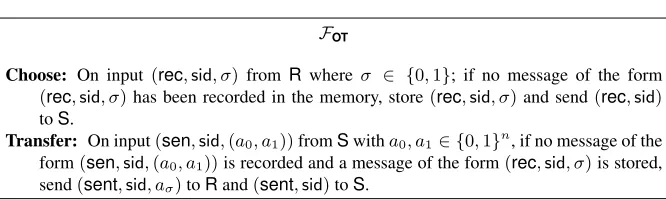
Oblivious Transfer. Oblivious transfer (OT) is a protocol between a sender (S) and a receiver (R). In a1-out-of-2OT, the sender holds two inputsa0, a1 ∈ {0,1}n and the receiver holds a choice bitσ. At the end of the protocol, the receiver obtainsaσ. The sender learns nothing about the choice bit, and the receiver learns nothing about the sender’s other inputaσ. The ideal OT functionalityFOTis recalled below in Figure1.
Similarly a 1-out-of-NOT can be defined asFN-OTfunctionality in Figure2.
Fig. 1: The ideal functionalityFOT for oblivious transfer
FOT
Choose: On input (rec,sid, σ) from Rwhere σ ∈ {0,1}; if no message of the form (rec,sid, σ)has been recorded in the memory, store(rec,sid, σ)and send(rec,sid) toS.
Transfer: On input(sen,sid,(a0, a1))fromSwitha0, a1∈ {0,1}n, if no message of the
form(sen,sid,(a0, a1))is recorded and a message of the form(rec,sid, σ)is stored,
Fig. 2: The ideal functionalityFN-OT for oblivious transfer
FN-OT
Choose: On input(rec,sid, σ)fromRwhereσ ∈ {0,1}logN; if no message of the form (rec,sid, σ)is present in memory, store(rec,sid, σ)and send(rec,sid)toS. Transfer: On input(sen,sid,{aj}jN=1)fromSwithaj ∈ {0,1}n, if no message of the
form(sen,sid,{aj}Nj=1)is present in memory and a message of the form(rec,sid, σ)
is stored, send(sent,sid, aσ)toRand(sent,sid)toS.
Commitment Schemes. Commitment schemes allow a partySto commit to a message m using randomnessr. It keeps the message hidden, while allowingS to reveal the committed message later. We denote an UC secure commitment to message mwith randomnessras COM(m;r). The ideal commitment functionalityFCOMhas been
de-picted in Fig.3.
Fig. 3: FunctionalityFCOM
FCOM FCOMinteracts with senderSand receiverR:
1. On receiving input(COMMIT, sid, m) fromS, ifsid has been recorded, ignore the input. Else record the tuple(sid,S,R, m)and send(RECEIPT, sid,S,R)toR. 2. On receiving input (DECOMMIT, sid) from S, if there is a record of the form
(sid,S,R, m0)return(DECOMMIT, sid, m0)toR. Otherwise, ignore the input.
Random Oracle Model. A random oracle functionality is parametrized by a domain and a range and it is asFROin Fig.4. A random oracle query on messagemis denoted
byFRO(m). The random oracle functionality can be broadly classified [CDG+18] into
three categories based on its features- plain RO, observable RO and programmable RO. A plain RO returns a random string, from its range, upon being queried on a message m, from its domain. An observable RO inherits the properties of the plain RO but in addition it grants the simulator to observe the queries made, toFRO, by the adversary.
A programmable RO allows the simulator to programFRO(m)to return any string from
the range, upon being queried onmfor the first time.
3
Attack in Concurrent Works on UC-secure Adaptive OT
Fig. 4: FunctionalityFRO
FRO
FRO is parameterized by a domainDand rangeRand it proceeds as follows, running on security parameter k:
– FROmaintains a listL(which is initially empty) of pairs of values( ˆm,h)ˆ , s.t.mˆ ∈D andˆh∈R.
– Upon receiving a value(sid, m)(wherem ∈ D) perform the following: If there is a pair(m,ˆh), for someˆh∈R, in the listL, seth:= ˆh. If there is no such pair, sample h←RRand store the pair(m, h)inL. Oncehis set, reply to the activating machine with(sid, h).
as well as the ‘simplest OT’ construction of [CO15] are prone to a bug when we con-sider UC-security even against a statically corrupt receiverR∗. The attack stems from the late input extraction of a statically-corruptRas detailed below. The simulator for the case of static corruption ofR, playing the role of honestS, can only extractR∗’s input by observingR∗’s query to RO, made in an attempt to decrypt its chosen message on receiving the last OT message from the sender. This implies that a corruptR∗can indefinitely delay the input extraction causing composition-related issues.
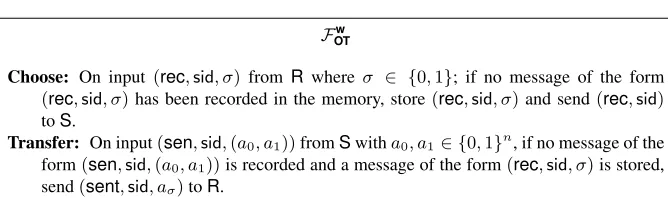
The delayed input extraction allows us to demonstrate that their constructions do not realise the OT functionalityFOTpresented in Fig.1whereSobtains a notification from
the functionality, denoting the end of ideal world execution. Rather, they realise only a weaker version of OT functionalityFw
OT as depicted in Fig.5. In the weaker variant
Fw
OT,Sdoes not obtain any notification from the functionality. Instead its role is limited
to sending(sid, a0, a1)toFw
OT, after whichShalts. However,FOTw is not composable
and cannot be used in a bigger protocol to implement the oblivious transfer functional-ity. Our observation aligns with the work of [LM16], which states (in page 2, last para of Section 1) that the naive OT functionality (Fig. 1 in their paper), same asFw
OT, is not
composable whereas the modified/revised OT functionality (Fig. 3 of their paper), same as ourFOT, can be proven to be composable. The late input extraction problem is re-ferred to as “timing bug” in their paper (page 3, first paragraph). They explain the issue of composability due to timing bug in the naive OT functionality with an example of OT Extension protocol in Section 3. In Section 4, they address the issue by plugging in the revised OT functionality (FOT in our case). Interestingly, all the currently known
UC-secure OT protocols, barring the protocols of [CO15,HL17], implement bothFOTand
Fw
OTfunctionalities and hence they are composable. In what follows, we first show that
the protocols of [CO15,HL17] do not realiseFOT functionality, but realise onlyFOTw.
Next, we demonstrate the compositional issue of usingFw
OTin (yet another example) of
2PC protocol based on garbled circuit (GC) approach.
Fig. 5: The ideal functionalityFw
OTfor weaker OT
Fw OT
Choose: On input (rec,sid, σ) from Rwhere σ ∈ {0,1}; if no message of the form (rec,sid, σ)has been recorded in the memory, store(rec,sid, σ)and send(rec,sid) toS.
Transfer: On input(sen,sid,(a0, a1))fromSwitha0, a1∈ {0,1}n, if no message of the
form(sen,sid,(a0, a1))is recorded and a message of the form(rec,sid, σ)is stored,
send(sent,sid, aσ)toR.
world keep waiting for notification from theFOT functionality in order to terminate.
Therefore, while honest Sdoes not haltin the ideal world, it halts in the real world immediately after sending its last message. This difference in the behavior of honestS can be used to distinguish between the two worlds by an environment. WithFw
OT
func-tionality, in the scenario mentioned above, an honestSwould halt in both the worlds, preserving indistinguishability.
We now illustrate the compositional issue resulted from usingFw
OT by means of a
GC based 2PC protocol in the OT-hybrid model, where the evaluatorEfirst involves with the constructor in a set of OT functionalities to choose the circuits that will be used for evaluation and respectively for checking and on completion of OTs, the constructor sends the GCs to the evaluator. WhenFOTwas used, a simulator against a corrupt
eval-uatorE∗, extracts the inputs ofE∗from the OT and either constructs a fake/simulated GC or a real GC based on the extracted input ofE∗. However inFw
OT-hybrid model, the
simulator for a corrupt evaluatorE∗(playing the role ofR∗) cannot exact theE∗’s in-put bits to OT and hence cannot substitute certain (evaluation to be specific) GCs with simulated ones (without getting caught with high probability). This difference would enable the environmentZto distinguish between both worlds based onE∗’s view.
4
Samplable Dual-Mode Encryption
The seminal paper of [PVW08] introduced the primitive ofdual mode encryption(DME). It works like a regular public key encryption scheme, alongside a notion of encryption branches. The key generation algorithm, takes a branchσ∈ {0,1}as an input, along-side thecrs, to generate the public and secret key pair(pk,sk). Messages encrypted usingpk, on branchσ, can be decrypted usingsk, whereas the messages encrypted on the other branch remains hidden under certain conditions, described next. The encryp-tion scheme can be further initialized in either of the two modes -messyordecryption
mode, based on the setup phase. The setup phase is invoked with the mode and it returns
– (crs, t)←SetupMessy(1κ): It is a randomized algorithm that takes as input the security parameterκand outputs thecrs and the trapdoor informationt, for the messy mode. It enables the invocation ofFindMessyalgorithm.
(crs, t) ← SetupDec(1κ): It is a randomized algorithm that takes as input the security parameterκand outputs thecrs and the trapdoor informationt, for the decryption mode. It enables the invocation ofDecKeyGenalgorithm.
– (pk,sk)← KeyGen(crs, σ): It is a randomized algorithm that takes as input the crsand the branchσand returns the public/encryption and secret/decryption key pair(pk,sk)for branchσ.
– (y, r)← Enc(pk, σ, m): It is a randomized algorithms that takes as inputpk, the branchσand the messagem ∈ {0,1}κ. It returns the ciphertexty, encrypted on branchσand the randomnessr, used for the encryption.
– m←Dec(sk, y): It is a deterministic algorithm that takes in inputskandyand it returnsmonly ifskandycorrespond to the same branch.
– b ← FindMessy(pk, t): It returns the branch valueb ∈ {0,1}givenpkand the trapdoort, when the mode is set to messy. The message encrypted on this branch is statistically hidden.
– (pk,sk0,sk1) ← DecKeyGen(t): It is a randomized algorithm that generates a key pair (pk,sk0,sk1) when it is invoked with the trapdoor t as input and the mode is set to decryption. The secret keyskb,b ∈ {0,1}, enables decryption of ciphertexts on branchb.
The above defined scheme satisfies correctness and four security properties, as men-tioned in the [PVW08] paper. In addition, the dual mode encryption scheme must sat-isfy another property for our OT protocol. It must be possible to generate acrsfor the messy mode from a random oracle query with overwhelming probability. We outline the correctness and security properties as follows:
– Correctness: For every mode, for all(crs, t)←SetupMessy(1κ)/SetupDec(1κ), for eachσ∈ {0,1}, for each(pk,sk)←KeyGen(crs, σ), and for allm∈ {0,1}κ, the following holdsDec(sk,Enc(pk, σ, m)) =m.
– Property 1(Indistinguishability of modes): The crs generated from either modes are indistinguishable, i.e. for all(crs, t)←SetupMessy(1κ)and for all(crs0, t0)←
SetupDec(1κ), the following holdscrs≈c crs0.
– Property 2(Indistinguishability of Branches in Messy mode): In messy mode, the public key does not leak the branch value to a computational adversary i.e., for all crsgenerated bySetupMessy, the following condition holds true-KeyGen(crs,0)≈c
KeyGen(crs,1).
– Property 3(Messy Branch Identification): For eachcrsgenerated bySetupMessy and for eachpkreturned byKeyGen(crs, σ),FindMessy(pk, t)returns the messy branchb, s.t.b= 1−σ. Moreover, any message encrypted on branchbis statistically hidden, i.e. for everym0, m1∈ {0,1}κ,Enc(pk, b, m0)≈s Enc(pk, b, m1). – Property 4(Dual Decryptable Branches in decryption mode): For each(crs, t)←
i. (pk,sk0)≈s KeyGen(crs,0),(pk,sk1) ≈s KeyGen(crs,1)and(pk,sk0)≈s
(pk,sk1).
ii. Dec(skb,Enc(pk, b, m)) =mfor allb∈ {0,1}. iii. Enc(pk, b, m0)≈c Enc(pk, b, m1), for allb∈ {0,1}.
– Property 5 (Samplable crs in Messy mode): for all c ∈ {0,1}κ, (crs, t) ← SetupMessy(1κ), the random oracle queryF
RO(c) is identically distributed to
thecrsof messy mode except with negligible probability i.e.,FRO(c)
s
≈crs.
The above DME scheme can be instantiated under the DDH and the LWE as-sumption, which has been provided in Appendices C andDrespectively. The paper of [PVW08] provides proof for correctness and Properties 1-4 of DME instantiations under the two respective assumptions. We further demonstrate, in AppendicesCandD, that they satisfy Property 5 too, thereby yielding a samplable DME.
5
Framework for Adaptive Oblivious Transfer
In this section, we present our round-optimal framework for adaptive OT given a DME scheme, random oraclesFRO1andFRO2. We first present a brief overview of our
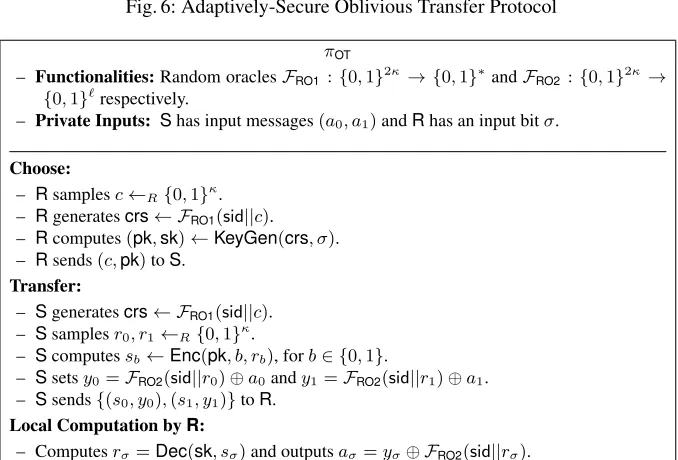
pro-tocol and then we present our proof.Rgenerates thecrsby sampling a random string cand invoking the random oracle onc.Robtains a validcrs, in messy mode, except with negligible probability. He invokes theKeyGenwith thecrsand his choice bitσto obtain a key pair(pk,sk)which would allow decryption on branchσusingsk.Rsends candpktoS. Property 2 ensures thatpkdoes not leak aboutσ.Sgenerates thecrs us-ingcand encrypts two random pads on both branches usingpk. Finally,Sencrypts his messages using RO queries on the pads.Rcan decrypt the pad corresponding to branch σ, due to correctness of the DME scheme, and thus obtain the message corresponding to choice bitσ. The framework has been presented as protocolπOTin Fig.6.
5.1 Static Security
To make the proof of adaptive security more comprehensible, we first prove thatπOT
realizes the ideal functionalityFOT (Fig.1) in presence of static adversaries. This is
extended to adaptive security in Section5.2.
In order to prove static security, we describe a simulatorSimwho behaves as the ideal world adversary and generates a view ofZwhich is indistinguishable from the view generated by the real world adversaryAdvin the real world. It does so by invoking
FOT, on behalf of the adversary in ideal world, and running a copy ofAdvinternally,
in the head. We denote this internal adversary asAdvInt.Simsimulates the role of the
honest parties and the environment toAdvIntin the internal execution. WheneverAdv
corrupts a party in the real world,AdvIntalso corrupts that party in the internal execution
andSimcorrupts that party in the ideal world. At the end of the protocolAdvIntforwards
its view toSimwho forwards it toZas its ideal world view. We refer to AppendixA for clarity ofAdvInt notation and details of static security in the UC model [Can01].
Fig. 6: Adaptively-Secure Oblivious Transfer Protocol πOT
– Functionalities:Random oraclesFRO1 :{0,1}2κ→ {0,1}∗andFRO2 :{0,1}2κ→ {0,1}`
respectively.
– Private Inputs: Shas input messages(a0, a1)andRhas an input bitσ.
Choose:
– Rsamplesc←R{0,1}κ. – Rgeneratescrs← FRO1(sid||c). – Rcomputes(pk,sk)←KeyGen(crs, σ). – Rsends(c,pk)toS.
Transfer:
– Sgeneratescrs← FRO1(sid||c). – Ssamplesr0, r1←R{0,1}κ.
– Scomputessb←Enc(pk, b, rb), forb∈ {0,1}.
– Ssetsy0=FRO2(sid||r0)⊕a0andy1=FRO2(sid||r1)⊕a1.
– Ssends{(s0, y0),(s1, y1)}toR.
Local Computation byR:
– Computesrσ=Dec(sk, sσ)and outputsaσ=yσ⊕ FRO2(sid||rσ).
honest whileR∗ is corrupt (4) BothS∗andR∗are corrupt. In each of the above cases we describe a simulatorSimand show that the real world view ofZis indistinguishable from its ideal world view.
We first give a brief intuition of the security proof. Revisiting the proof of security for a static adversary [PVW08], note thatSimsets thecrsin accordance with which party is corrupt, to enable input extraction ofAdvInt in the internal execution. More
specifically, whilecrsof the internal execution is set to messy mode whenRis cor-rupted, it is set to decryption mode when S is corrupted. Simcan perform this by invokingSetupMessy(orSetupDec) to obtain(crs, t)and then program the random oracle to return the samecrs. In the former case,FindMessycan be suitably invoked to extractσ. In the latter case,Simcan invokeDecKeyGento obtain secret keys on both branches and unlock both messages using the secret keys. The simulation of our protocol for static security is similar to that of PVW.
We are ready to present the formal proof of Theorem.1. We design an ideal world adversarySim who creates an ideal world viewIDEALF,Sim,Z(1κ, z) of Z which is
indistinguishable from the real world viewREALF,Adv,Z(1κ, z)ofZ.
Theorem 1. If DME is a samplable dual mode encryption scheme then protocolπOT se-curely realizes theFOTfunctionality against static active adversaries in(FRO1,FRO2 )-hybrid model.
The Simulator: We describe the simulatorSimfor each possible case of corruption.
Case 1.SandRare honest: In this caseSimacts on behalf of both parties in the internal execution. At the end,AdvIntgenerates his view without corrupting any party
(i) Simulating thecrs and R’s message: Sim obtains (crs, t) ← SetupDec.Sim samples c ←R {0,1}κ and programs FRO1(sid||c) to return crs. Siminvokes
DecKeyGen(t)to obtain(pk,sk0,sk1)and sends(c,pk)as the first OT message toSon behalf ofRin the internal execution.
(ii) SimulatingS’s message:Simsets(s0, s1)as per the protocol and(y0, y1)are set randomly.Simsends the simulated message on behalf ofS.
(iii) SimulatingR’s computation:Simcompletes the simulation on behalf ofRin the internal world.
Case 2.S∗is corrupted andRis honest: In this case,Simacts on behalf ofRin the internal execution. At the end,AdvIntgenerates the view ofS∗and sends it toSimwho
forwards it toZ.
(i) Simulating thecrsandR’s message:Same as Case 1.
(ii) AdvIntplays the role ofS∗and computes the sender message in the internal world.
AdvIntsends the second OT message toRin the internal world.
(iii) SimulatingR’s computation:Sim decryptsr0 andr1 using secret keyssk0 and sk1 and obtainsa0 anda1 from y0 andy1.Sim invokesFOT with(a0, a1)and
completes the simulation on behalf ofRin the internal world.
Case 3.Sis honest andR∗is corrupted: In this case,Simacts on behalf ofSin the internal execution. At the end,AdvIntgenerates the view ofR∗and sends it toSimwho
forwards it toZ.
(i) Simulating thecrs: AdvInt plays the role ofR∗ and computes the receiver
mes-sage in the internal world. Whenever AdvInt queries FRO1(sid||c), Siminvokes
SetupMessyto obtain(crs, t)and programsFRO1(sid||c)to returncrs.Simstores
the tuple in a listQas(sid, c,crs, t). If a query is repeated thenSimreturns thecrs corresponding to the entry inQindexed by thesidandcvalues.AdvIntsends the
first OT message toSin the internal world.
(ii) SimulatingS’s message:Simextracts the the choice bit, i.e.σ, ofR∗by invoking FindMessy(pk, t).SimsendsσtoFOTon behalf ofRin the ideal world, obtains
aσand constructs(sσ, yσ)honestly. On the other hand,sσis set honestly andyσis set randomly. Finally,Simcomputes the sender’s message and sends it toR∗in the internal world.
(iii) AdvIntcomputes on behalf ofR∗and completes the protocol in the internal world.
Case 4. BothS∗andR∗are corrupted: This is a trivial case of corruption.Sim in-vokesAdvInt, who simulates messages of both parties and generates the view internally.
At the end of execution,AdvIntsends the generated view toSimwho forwards it toZ.
Indistinguishability: Here we show that the ideal world viewIDEALF,Sim,Z(1κ, z)of
Case 1.SandRare honest: We prove thatHYBRand the ideal world view i.eHYBI.1 is indistinguishable through a series of intermediate hybrids.
– HYB1 : We consider a hybridHYB1 which is same asHYBR except that here, thecrsis generated usingSetupDec. Indistinguishability follows from Property 1 of DME, i.e. indistinguishability of the two modes, and random sampling ofc. A distinguisher for the hybrids can be used to break Property 1 or guess the exact value ofc, both of which happen with negligible probability.
- HYB2:We consider a hybridHYB2which is same asHYB1except thatSim gener-atespkusingDecKeyGen. Indistinguishability follows statistically from Property 4i of DME, i.e. the branch remains statistically hidden when the DME is set to decryption mode.
– HYB3 :We consider a hybridHYB3 similar toHYB2 except that inHYB3 Sim constructss0 ands1 usingr0andr1 whereasy0 andy1 are formed using differ-ent random pads,r00 andr10. Indistinguishability between the hybrids follows from Property 4iii of DME, i.e. indistinguishability of ciphertexts in decryption mode. – HYBI.1:We consider the ideal world hybridHYBI.1similar toHYB3except that
inHYBI.1,Simsetsy0 andy1randomly.AdvIntcan distinguish between the
hy-brids only if the valuesr00orr01are guessed precisely and queried to the random oracle. This event occurs with negligible probability in the random oracle model and as a result indistinguishabilty between the hybrids follows.
Case 2.S∗is corrupted andRis honest: We prove thatHYBRand the ideal world view i.eHYBI.2is indistinguishable through an intermediate hybrid.
– HYB1 :We consider hybridHYB1which is same asHYB1 in previous case. In-distinguishability betweenHYBRandHYB1follows (similar to the previous case) from Property 1 of DME.
– HYBI.2 :We consider a hybridHYBI.2similar to HYB1except that in HYBI.2 Simdecryptsr0 andr1 and obtainsa0 anda1respectively using secret keys on both branches. Indistinguishability follows from Property 4ii of DME, which en-sures thatSimcan decrypt messages on both branches using the secret keys in the decryption mode.
Case 3.Sis honest andR∗is corrupted: We prove thatHYBRand the ideal world view i.eHYBI.3is indistinguishable through a series of intermediate hybrids.
– HYB1:We consider a hybridHYB1which is same asHYBRexcept here thecrs is generated usingSetupMessy. Indistinguishability follows from Property 5 and 1, i.e. the crsin the messy mode can be sampled using the random oracle and thecrsin the messy mode is indistinguishable from thecrsin decryption mode. Another possible way of distinguishing is if the distinguisher can guess the value of thecrswithout queryingcto the random oracle, but that happens with negligible probability, due to the random oracle assumption.
– HYB3 :We consider a hybridHYB3similar toHYB2except that inHYB3,Sim constructssσusingrσ, whereasyσ is formed using different random pad,rσ0. In-distinguishability between the hybrids follows from the fact thatrσ0 remains statis-tically hidden, due to Property 3, in the messy mode.
– HYBI.3:Finally we consider our ideal world hybridHYBI.3whereyσis set ran-domly. Indistinguishability follows from the random oracle assumption since the distinguisher has to guessr0
σto distinguish between the two hybrids and this hap-pens with negligible probability.
Case 4. BothS∗andR∗are corrupted: In this caseHYBRandHYBI.4are generated byAdvandAdvIntafter being in control of both honest parties in the real world and
internal world respectively. As a result, the two views are identical.
5.2 Adaptive Security
Building upon the proof of static security in the previous section, we now prove thatπOT securely implementsFOTin the presence of adaptive adversaries. We refer to Appendix Afor details about the security model. We give a brief overview of the proof and then we present it formally. Following the lines of the static proof,Simprograms thecrs of the internal execution to be in messy mode, when the receiver is corrupt in the first round, or in the decryption mode otherwise, to enable extraction of R’s input or S’s input respectively.
In addition,Simhas to equivocate the view ofR(resp.S), in the internal execution, whenR(resp.S) gets corrupted adaptively byAdvInt. The proof demands equivocation
only whenRgets corrupted after sending the first OT message and/orSgets corrupted after sending the second OT message. This is done to ensure that the ideal world views (messages and internal state) of the simulated honest parties (in the internal execution) are consistent with the real world views (messages and internal state) of the actual hon-est parties elseZcan distinguish between the two views. In the first scenario, whenRis corrupted after the first OT message is sent, the mode is set to decryption, andSimcan extract secrets keys for both branches, corresponding topk, by invokingDecKeyGen. WhenRgets corrupted andSimobtainsσ asR’s input,Simcan provideskσ as its secret key on branchσ. Equivocation is successful due to Property 4ii of DME. In the second case whenSis corrupted after the second OT message is sent, the random val-ues sent corresponding to (y0, y1)by Simhave to be made consistent with sender’s actual input(a0, a1). For this,Simexploits the programmability ofFRO2 to enforce
that(y0, y1)decrypts to(a0, a1). We are ready to present the proof of Theorem2.
Theorem 2. If DME is a samplable dual mode encryption scheme then protocolπOT se-curely realizesFOTfunctionality against adaptive active adversaries in(FRO1,FRO2 )-hybrid model.
The Simulator: The simulatorSimthat generates the ideal world view, is initialized with input values fromZbased on which party is corrupted to facilitate simulation.
Outset of the Protocol: WheneverAdvInt queriesFRO1(sid||c),Siminvokes the
SetupMessyalgorithm to obtain(crs, t)and programsFRO1(sid||c)to returncrs.Sim stores the tuple in a listQas(sid, c,crs, t). If a query is repeated thenSimreturns the crscorresponding to the entry inQindexed by thesidandcvalues.
Ris honest in the first round: SimcomputesR’s message similar to case 1(i) (R’s message for (S,R) case) of the static proof. Thecrsis set in the decryption mode by programmingFRO1(sid||c).SiminvokesDecKeyGento obtain(pk,sk0,sk1)and he
sendscandpkas the first OT message toAdvInton behalf ofRin the internal execution.
– Sis honest in the second round:Simacts on behalf ofSin the internal execution. Simsimulates according to Case 1(ii) (S’s message for (S,R) case) of static proof. - Case 1(A).Ris honest in the first round,Sis honest in the second round,
R∗is corrupted after second OT message:Simobtainsσandaσin the ideal world.Simequivocatespkby settingskσ as the secret key on branchσ. Ad-ditionally,Simequivocatesyσ s.t.aσ can be obtained from it. For this,Sim programsFRO2(sid||rσ) =aσ⊕yσ. At the end of the protocol,AdvIntoutputs
⊥and sends its internal state toSimwho forwards it toZ.
Post Execution.In case of post execution corruption ofS∗,Simobtains(a0, a1)
and needs to provide the internal randomness ofS∗s.t.y0andy1open toa0 anda1. We note that yσ was previously equivocated. Equivocation of yσ is performed by programmingFRO2(sid||rσ) =aσ⊕yσ.Simsends the internal state ofS∗toZwho halts with an output.
- Case 1(B).Ris honest in the first round,Sis honest in the second round,
Ris honest after second OT message: In this case,Sim acts on behalf of both parties throughout the protocol in the internal execution. At the end of the protocol,AdvIntoutputs his random tape as its internal state to Simwho
forwards it toZ.
Post Execution. In case of post execution corruption ofR∗andS∗,Simobtains
(σ, aσ)and(a0, a1), and has to provide the internal randomness ofR∗andS
∗
toZ. Equivocation of both views is similar to the previous case (Case 1(A) of adaptive simulation) where the view ofR∗is equivocated first and then the view ofS∗is equivocated.Simsends the equivocated views ofR∗andS∗to
Z, who halts with an output.
– Case 2.Ris honest in the first round,S∗ is corrupted in the second round: Simreceives the second message on behalf ofRfromS∗in the internal execution. Simulation is performed as in Case 2(iii) (R’s computation for (S∗,R) case) of static proof.AdvIntoutputs⊥at the end of the protocol and sends its internal state
toSimwho forwards it toZ.
Post Execution. In case of post execution corruption ofR∗,Simobtainsσandaσ and he proceeds like the simulator for case 1(A) of adaptive simulation.
R∗is corrupted in the first round: WheneverAdvIntqueriesFRO1(sid||c),Sim
crs.Simstores the tuple in a listQas(sid, c,crs, t). If a query is repeated thenSim returns the thecrscorresponding to entry inQindexed by thesidandcvalues.AdvInt
generates the first OT message which is sent toS in the internal execution. This is similar to Case 3(i) (R’s message for (S,R∗) case) in static proof.
– Case 3.R∗is corrupted in the first round,Sis honest in the second round:Sim receives the first OT message, on behalf ofS, fromAdvInt controllingR∗ in the
internal execution.Simcontinues simulation as in Case 3(ii) (S’s message for (S, R∗) case) of static proof.
Post Execution. In case of post execution corruption ofS∗,Simobtains(a0, a1)
and needs to equivocateyσsuch that it opens toaσ.Simperforms this by program-mingFRO2(sid||rσ) =yσ⊕aσ. The internal state ofS∗is revealed toZwho halts with an output.
– Case 4.R∗is corrupted in the first round,S∗is corrupted in the second round: This is a trivial case since both parties are corrupted by the adversary. The parties are controlled byAdv/Sim/AdvIntin the real/ideal/internal world.AdvIntgenerates
the second OT message similar to Case 4 ((S∗,R∗) case) of static proof. At the end of execution,AdvIntoutputs a special symbol⊥on behalf of the corrupted parties
and hands over the internal state toSimwho in turn forwards it toZ.
Post Execution. There is no post execution corruption since both parties are cor-rupted andZhalts with an output computed from the internal state ofAdvInt.
Indistinguishability : Here we show that the ideal world viewIDEALF,Sim,Z(1κ, z)of
Z is indistinguishable from the real world viewREALF,Adv,Z(1κ, z)ofZ. We denote REALF,Adv,Z(1κ, z)as hybridHYBRand show that in each simulation caseHYBRis indistinguishable from the ideal world by relying on the static indistinguishability proof.
Case 1(A).Ris honest in the first round,Sis honest in the second round,R∗ is corrupted after second OT message: Simulation of both OT messages follows along the same direction as Case 1 of static proof. WhenR∗gets corrupted after second OT messageSimobtainsσand he can provideskσas the secret key for branchσ. Equivo-cation is successful due to Property 4ii of DME, i.e.σis statistically hidden inpkwhen thecrsis generated in decryption mode. In case of post execution corruption,Sim suc-cessfully equivocates yσ, s.t. it unlocksaσ by programmingFRO2(sid||rσ).Advcan queryrσ toFRO2 only with negligible probability and hence equivocation is
success-ful. This follows from Property 4iii of DME, i.e. indistinguishability of ciphertexts in the decryption mode.
Case 1(B). Ris honest in the first round, Sis honest in the second round, Ris honest after second OT message: In this case we can consider that the post execution corruption occurs in two phases - first R∗ gets corrupted and only after that S∗ gets corrupted. Then it becomes identical to the previous case (case 1(A) of adaptive proof) and indistinguishability follows from the previous argument.
Case 2(i) of static proof. The rest of the simulation proceeds as Case 2 of static proof. Indistinguishability follows from the indistinguishability ofHYBI.2fromHYBRin the static proof. In case of post execution corruption, equivocation ofR’s view is possible since thecrsis in decryption mode andSimhas secret keys for both branches.skσcan be provided as the secret key for branchσ. Indistinguishability follows from Property 4ii of DME.
Case 3.R∗is corrupted in the first round,Sis honest in the second round: Indis-tinguishability follows from the indisIndis-tinguishability ofHYBI.3fromHYBRin the static proof. In case of post execution corruption equivocation can fail if during the simulation AdvIntunlocksrσfromsσand queries it toFRO2. However, this occurs with
negligi-ble probability due to Property 3 of DME, i.e. ciphertext indistinguishability in messy mode, and the random oracle assumption.
Case 4.R∗ is corrupted in the first round,S∗ is corrupted in the second round: This is identical to case 4 (both(S∗,R∗)are corrupted) in static proof. Hence, indis-tinguishability of simulation for this case follows from indisindis-tinguishability ofHYBI.4 fromHYBRin the static proof.
5.3 Concrete Instantiations and Optimized Protocol based on DDH
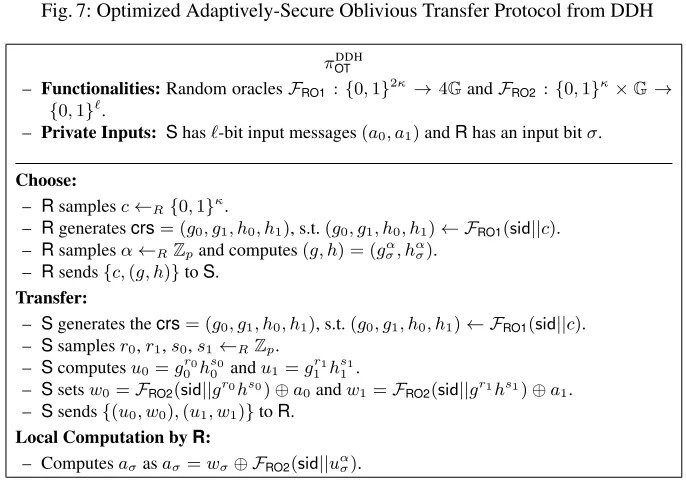
We provide concrete instantiations of our protocol by instantiating the DME scheme under the DDH and LWE assumptions in AppendixCandDrespectively. Furthermore, we can optimize our protocol, while considering the DDH-based instantiation of the DME. In Figure.7we present our optimized adaptive OT protocolπDDHOT based on the DDH assumption. It differs from the original framework since protocolπOTDDHdoes not send separate messages(s0, s1)for encrypting the random pads. Rather, the random pads and the messages are encrypted in the same ciphertext (w0, w1). This protocol incurs a computation cost of 11 exponentiations and 5 random oracle queries and it has an optimal round complexity of 2. It requires sending aκbit string -c, two`bit strings -(w0, w1); and 4 group elements–(u0, u1)and(g, h). Interestingly, it is the first round-optimal adaptively-secure OT protocol and it has an overhead of 5 random oracle queries andκ-bit string communication overhead over the static protocol of [PVW08]. The security of our protocol follows from the security of the OT framework and the DME instantiation presented in AppendixC. Hence we avoid presenting it and summa-rize it in Theorem.3.
Theorem 3. If the Decisional Diffie Hellman problem is hard in groupGthen protocol
πDDH
OT securely realizes the FOT functionality against adaptive active adversaries in (FRO1,FRO2)- hybrid model.
5.4 Static Version of our Protocol
Fig. 7: Optimized Adaptively-Secure Oblivious Transfer Protocol from DDH
πDDH
OT
– Functionalities:Random oraclesFRO1 :{0,1}2κ→4GandFRO2:{0,1}κ×G→ {0,1}`.
– Private Inputs: Shas`-bit input messages(a0, a1)andRhas an input bitσ.
Choose:
– Rsamplesc←R{0,1}κ.
– Rgeneratescrs= (g0, g1, h0, h1), s.t.(g0, g1, h0, h1)← FRO1(sid||c). – Rsamplesα←RZpand computes(g, h) = (gασ, hασ).
– Rsends{c,(g, h)}toS. Transfer:
– Sgenerates thecrs= (g0, g1, h0, h1), s.t.(g0, g1, h0, h1)← FRO1(sid||c). – Ssamplesr0,r1,s0,s1←RZp.
– Scomputesu0=g0r0h
s0
0 andu1 =gr11h
s1 1 .
– Ssetsw0=FRO2(sid||gr0hs0)⊕a0andw1=FRO2(sid||gr1hs1)⊕a1.
– Ssends{(u0, w0),(u1, w1)}toR.
Local Computation byR:
– Computesaσasaσ=wσ⊕ FRO2(sid||uασ).
using a PRO. We can obtainπOT0 fromπOTby removing the random oracle invocation
FRO2.FRO2 is not required since static corruption does not demand equivocation, of
sender’s message, by theSim. The security of our protocol is summarized in Theorem 4and the proof is similar to the static security proof ofπOT.
Theorem 4. If DME is a samplable dual mode encryption scheme then protocol πOT
securely realizes theFOTfunctionality against static active adversaries inFRO1- hybrid model.
Interestingly,π0
OT satisfies the property of receiver equivocality, which states that
the view of the receiver can be equivocated if the receiver gets adaptively corrupted during/after the protocol execution. We analyze this property as two exhaustive sub-cases as follows : (1)Rgets corrupted before the first OT message is sent (2)Rgets corrupted after the first OT message is sent. For the first case, the simulator has not sent any message on behalf ofRand hence equivocation is not required. In this case thecrs is set to messy mode. For the second case, the simulator sets thecrsin the decryption mode which enables him to equivocateR’s view on obtainingσ, afterRgets corrupted.
6
Adaptively Secure 1-out-of-
N
Oblivious Transfer.
The work of [NP05] implements FN-OT, against static adversaries in theFOT-hybrid model by relying on pseudorandom functions.ShasNstrings(a1, a2, . . . , aN)as input
andRhas alogNbit input choice stringσ.Ssamples2 logNrandom padspi 0, pi1 ←
{0,1}κfori∈ [logN]. The two parties invokelogNcopies ofF
OT withS’s input as (pi
the pad corresponding to hisσichoice bit. Finally,Sencryptsajaswj using the pads corresponding to the bit representation ofj,j ∈[N]. The messageajis encrypted as follows :
wj=aj⊕ logN
M
i=1 PRFpi
c(j),
wherec =ji, i.e. theith bit of stringj.Robtains(w0, w1, . . . , wN)and decrypts
wσfor which he possesses all thelogNpads. For otherwvalues,Rlacks at least one random pad and security follows by applying PRF on that secret random pad. The transformation communicatesNciphertexts, and requireslogNinvocations ofFOTand
NlogNevaluations of a PRF. It guarantees security against a statically corrupted active adversary.
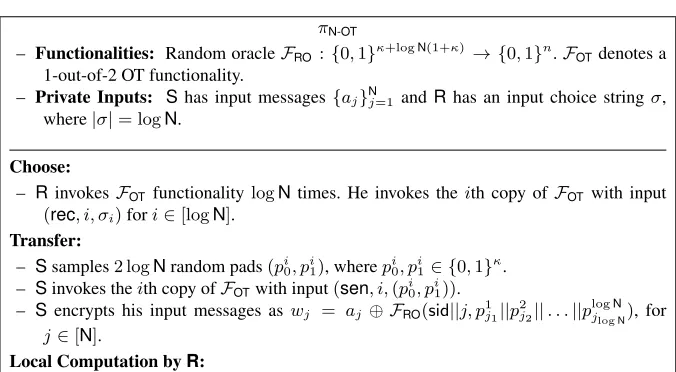
We show in Fig.8 that the same transformation can be made adaptively-secure (by protocolπN-OT) by implementing the underlyingFOT functionality in an adaptive
secure manner. In addition, we replace PRF with a programmable random oracleFRO
and modify the formation ofwjas follows, wherejidenotes theith bit ofj.
wj=aj⊕ FRO(sid||j, p1j1||p
2
j2||. . .||p
logN
jlogN) =aj⊕ FRO(sid||j, vj),
wherevj= (p1j1||p
2
j2||. . .||p
logN
jlogN). This reduces theNlogNPRF evaluations toN ran-dom oracle queries. Later, in this section we further demonstrate that the underlying
FOT need not be full adaptively secure. Static OTs with security against adaptive
re-ceivers, i.e. receiver equivocal OTs, suffice for the transformation. Hence, we obtain adaptively-secure 1-out-of-NfromlogN1-out-of-2 receiver equivocal OTs.
6.1 Security
The security of the protocol is proven by constructing a simulatorSimforπN-OT. We first present the static proof and then discuss the adaptive proof. For a statically cor-rupted S∗,Simcan extract the pads by invoking the simulator for FOT. Simforms
{vj}j∈[N]and decrypts{wj}j∈[N]to unlock all the input messages ofS
∗
, i.e.{aj}j∈[N], and completes the simulation by invoking FN-OT with the input messages.
Indistin-guishability follows from theFOThybrid model. For a statically corruptedR∗,Simcan
extract the choice bitσiby invoking the simulator forith copy ofFOT.Simreconstructs
σand invokesFN-OTwithσto obtainaσ.Simconcludes the simulation by settingwσ correctly while{wj}j∈[N]/σare set as random strings.R∗obtains all the random pads (corresponding toσ) fromlogNinvocations of FOT and constructs vσ to unlockaσ. The other{aj}j∈[N]/σ values remain hidden sinceR∗ lacks at least one random pad for{vj}j∈[N]/σ, and henceFRO(j, vj)will be indistinguishable from a random string, except with negligible probability, due to the random oracle assumption.
TheFOTmessages can be trivially equivocated by invoking the adaptive simulator for
FOT. The simulated ciphertexts can be equivocated by programmingFRO(sid||j, vj) = wj⊕aj, forj∈[N]/σ. Adversary can queryFRO(sid||j, vj)with negligible probability since he lacks atleast one pad invj and hence simulator can program FRO(sid||j, vj) successfully to equivocate correctly. The proof of indistinguishability is similar to the one for statically corruptedR∗.
Fig. 8: Adaptively-Secure 1-out-of-NOblivious Transfer Protocol
πN-OT
– Functionalities: Random oracleFRO :{0,1}κ+logN(1+κ) → {0,1}n.FOTdenotes a 1-out-of-2 OT functionality.
– Private Inputs: Shas input messages{aj}Nj=1and Rhas an input choice string σ,
where|σ|= logN. Choose:
– RinvokesFOT functionalitylogNtimes. He invokes theith copy ofFOT with input (rec, i, σi)fori∈[logN].
Transfer:
– Ssamples2 logNrandom pads(pi
0, pi1), wherepi0, pi1∈ {0,1}κ.
– Sinvokes theith copy ofFOTwith input(sen, i,(pi0, pi1)).
– Sencrypts his input messages aswj = aj⊕ FRO(sid||j, p1j1||p 2
j2||. . .||p logN jlogN), for
j∈[N].
Local Computation byR:
– Computesaσasaσ=wσ⊕ FRO(sid||σ, p1σ1||p 2
σ2||. . .||p logN σlogN).
6.2 Efficiency
Our protocol invokesFOT functionality logNtimes and queriesFRO forNtimes. It
incurs communication oflogNcopies ofFOTandNciphertexts of sizenbits.
6.3 InstantiatingFOTusing Static Receiver Equivocal OT
![Table 4: Table indicating implementation results for our Commitment Scheme πand [COMHM04] in the LAN setting.](https://thumb-us.123doks.com/thumbv2/123dok_us/7957290.1320209/11.612.160.455.297.409/table-table-indicating-implementation-results-commitment-scheme-setting.webp)