A Salad of Block Ciphers
The State of the Art in Block Ciphers and their Analysis
and the TikZ graphics package.
The text has been mostly set to the TeX Gyre font family, in particular TeX Gyre Pagella, TeX Gyre Heros, and TeX Gyre Cursor, with the exception of Cyrillic text, which has been set to Linux Libertine, and Japanese text, which has been set to Utsukushi Mincho.
Mathematical formulas are set to TeX Gyre Pagella Math, with the mathematical calligraphic symbols from XITS Math, and a few more individual symbols taken from thenewpxmathand the AMS Math fonts.
© 2013-2017 Roberto Avanzi
Some rights reserved:
This work is licensed under the following Creative Commons license
Attribution-NonCommercial-NoDerivatives 4.0 International
http://creativecommons.org/licenses/by-nc-nd/4.0/
Foreword
1This book is a survey on the state of the art in block cipher design and analysis. It is work in 2
progress, and it has been for the good part of the last three years – sadly, for various reasons 3
no significant changes habe been made for about one year and a half, and only recently I have 4
started updating some parts again. 5
However, it is also in a self-contained, useable, andrelativelypolished state, and for this reason 6
I have decided to release thissnapshotonto the public as a service to the cryptographic com-7
munity, both in order to obtain feedback, and also as a means to give something back to the 8
community from which I have learned much. 9
At some point I will produce a final version – whatever being a “final version” means in the 10
constantly evolving field of block cipher design – and I will publish it. In the meantime I hope 11
the material contained here will be useful to other people. 12
Roberto Avanzi 13
Introduction
1Einstein, the most creative physicist since Newton, is one of my heroes. I wrote a book on
2
relativity to teach myself the theory.
3
Martin Gardner 4
Thetopicof this book is the state of the art in block ciphers. These are, together with the closely 5
related permutations, arguably the best understood primitives in the field of symmetric cryp-6
tography: Over the course of more than four decades, solid theoretical foundations have been 7
developed and as a result several established design principles are now available to the cryptog-8
rapher to construct block ciphers resistant against all known attacks. At the same time, many 9
challenges are still as interesting as ever, if not more: for instance to as compact as possible or 10
to minimise latency, while at the same time taking no compromises in regard to security; to 11
develop new and better attacks to break existing ciphers; and to invent new designs or design 12
methodologies. 13
Thepurposeof this book to get a comprehensive overview of the research done so far in this huge 14
and complex field. Only cryptographic methods whose details have been publicly disclosed 15
are reported here, and all information contained herein comes from openly available sources, 16
except for the occasional explanation obtained by private communication from the authors of 17
a design or an attack. 18
The focusof this book is on ciphers whose design criteria have been carefully analysed by the 19
cryptographic community, as well as on historically relevant ciphers whose design criteria have 20
proven influential, recent developments, and off-the-beaten-path designs. 21
The main design types of block ciphers are discussed, as well as the cryptanalytic techniques 22
used to assess their security. This information has been put into its proper historical context 23
as well, for instance the rationale for new designs, and the way a cipher influenced successive 24
cryptographic algorithms. 25
It is very difficult to talk about design without talking about cryptanalysis, and one cannot 26
discuss cryptanalysis without referring to at least some specific design techniques. In fact, one 27
cannot talk about one without discussing the other, since the best way to learn how to design 28
block ciphers is by breaking them. Block cipher analysis is driven by the concrete instances 29
of the designs themselves, and therefore it is advisable to consider concrete examples when 30
studying cryptanalytic techniques. For an intrinsically linear document such as a book this 31
is quite an annoying circular reference situation. Still, a separation of the subjects of design 32
and cryptanalysis, even if at times somewhat arbitrary, is necessary, especially in a work of 33
reference. A constant intermixing of design principles, ciphers, and analysis would only make 34
the exposition confusing. Therefore, we treat these subjects separately: The first two chapters 35
will be on design (Chapter 1 on page 21) and on cryptanalysis (Chapter2 on page 73), and 36
only after this we shall move to a discussion of several concrete ciphers that have marked the 37
history of the last three decades of block cipher design (Chapter3 on page 127). However, some 38
cryptanalytic concepts are mentioned already in the design chapter to provide context. 39
This is not a self-contained treatise on the subject matter. We do not define complexity classes. 40
this stuff. It is assumed that the reader will either know or learn the necessary mathematical 2
background as necessary. 3
This document is nota textbook nor an encyclopaedia on block ciphers. It is not meant as a 4
replacement for Lars Knudsen and Matt Robshaw’s excellent book The Block Cipher
Compan-5
ion[KR11]. In fact, it is advisable to have The Block Cipher Companion on the desk beside the 6
present one to properly understand the designs documented here. 7
It also is part of the learning process of its author, so a particular balance in exposition is not 8
necessarily to be expected, even though we attempt to present the information in a uniform 9
way. In fact, the document originates from my own (LaTeX-ed) notes while I was learning 10
block cipher design and cryptanalysis, as part of my work at Qualcomm after Greg Rose left 11
the company. 12
More than 80 block ciphers are described – to variable level of detail – from the DES to al-13
gorithms disclosed in early 2014. The advantages and disadvantages of these ciphers, their 14
weaknesses, the types of attacks, and their performance have been compared whenever there 15
was publicly available information about them. Performance comparisons are mostly in HW 16
and in SW on micro-controllers, but also general purpose CPUs are briefly considered for a few 17
ciphers. Full references are given for all information collected here. 18
Even though in some cases I aimed at completeness, there are areas where completeness is 19
difficult or impossible to achieve. In particular, this applies to intellectual property. I have tried 20
to determine the intellectual property situation for all the ciphers that I have described, but in 21
some case it was not possible to determine whether aspects of a given cipher were patented 22
or not. In some cases the information is just not easy to find. In no case there is warranty 23
(explicit or implied) about the correctness of information regarding intellectual property, or in 24
fact any information contained here. Readers that needs conclusive evidence should talk to a 25
legal counsel and have a patent search performed on their behalf. 26
I also want to thank Sergey Agievich, Billy Bob Brumley, Cameron McDonald, Greg Rose, 27
Markku-Juhani Olavi Saarinen and Benoît Viguier for reporting typos, providing precious ma-28
terial and many valuable suggestions. Any error is my fault only, nobody else is responsible. 29
Since one should never stop learning, this document is by necessity also a work in progress. As 30
such, I am always looking to improve this document, and any polite suggestion is encouraged. 31
Please use the following email address to inform the author about errors and inaccuracies, and 32
send suggestions for improvements and updates:[email protected]. All con-33
tributions will be acknowledged. 34
Roberto Avanzi 35
Table of Contents
Foreword . . . 1
Introduction . . . 3
Table of Contents . . . 5
List of Figures . . . 11
List of Tables . . . 14
Notation . . . 16
1 Design . . . 21
1.1 Fundamental Definitions and Design Principles . . . 22
1.2 Substitution-Permutation Networks . . . 25
1.3 Feistel Networks (Luby–Rackoff Ciphers) . . . 28
A Taxonomy of Feistel Networks . . . 30
1.4 The Wide Trail Design Strategy . . . 34
1.5 The Lai-Massey Design . . . 37
1.6 The Even-Mansour Schemes and the FX Construction . . . 38
1.7 The Key Schedule . . . 40
The Role of the Key Schedule . . . 40
Construction of the Key Schedule . . . 41
1.8 Diffusion . . . 42
Bit Permutations . . . 43
Shuffles . . . 44
Diffusion Layers Based on Linear Algebra . . . 46
Multipermutations and MDS Matrices . . . 47
Type of MDS Matrices . . . 49
Constructing Efficient MDS Matrices . . . 51
More on the Diffusion in Feistel Networks . . . 54
1.9 Confusion . . . 56
Algebraic Degree . . . 58
Algebraic Immunity . . . 58
Nonlinearity . . . 59
Differential Uniformity . . . 61
Strict Avalanche Criterion and Propagation Criterion . . . 62
Other Criteria . . . 63
1.10 Less Beaten Paths . . . 63
Taking Inspiration From Stream Ciphers . . . 63
Hybrid Designs . . . 64
Decorrelation Theory . . . 64
1.11 Relations to Other Symmetric Constructions . . . 67
Block Ciphers and Stream Ciphers . . . 67
Block Ciphers and Hash Functions . . . 68
BEAR, LION, LIONESS, and AARDVARK . . . 69
2 Cryptanalysis . . . 73
2.1 Differential Cryptanalysis . . . 73
Fundamentals of Differential Cryptanalysis . . . 73
Markov Ciphers and the Wrong-Key Randomisation Hypothesis . . . 78
Remarks on the Wrong-Key Randomisation Hypothesis . . . 80
Multiple Differentials . . . 81
Truncated Differentials . . . 82
Higher-order Differential Cryptanalysis . . . 83
Integral Cryptanalysis (Saturation Attacks, Multiset attacks) . . . 84
AIDA/Cube Attack . . . 84
Boomerang Attacks . . . 85
Impossible Differentials . . . 87
Improbable Differentials . . . 87
Unitary Approaches to Differential Cryptanalysis . . . 88
2.2 Linear Cryptanalysis . . . 91
Chosen-Plaintext Linear Cryptanalysis . . . 93
Multiple Linear Approximations . . . 93
Multidimensional Linear Cryptanalysis . . . 93
Zero Correlation Linear Cryptanalysis . . . 94
2.3 Differential-Linear Cryptanalysis . . . 95
2.4 Meet-in-the-middle Attacks and Bicliques . . . 97
Meet-in-the-middle Attacks . . . 97
Space-Memory Tradeoffs . . . 98
Partial Matching (Match- and Sieve-in-the-Middle) . . . 100
Splice-and-Cut: The Merkle-Hellman Attack . . . 102
Bicliques . . . 104
The Parallel-Cut MITM Attack . . . 106
2.5 Weak or Equivalent Keys . . . 107
2.6 Related Key and Key Related Attacks . . . 108
Biham’s Sliding Related Key Attack . . . 108
Slide Attacks . . . 110
Advanced Slide Attacks . . . 112
Complementation Slide Attack . . . 112
Slide Attack with a Twist . . . 113
Saarinen’s Chosen Key Recovery of Secret GOST S-boxes . . . 114
Even-Mansour Schemes . . . 116
Sliding with a Twist on Even-Mansour Schemes . . . 116
The SlideX Attack . . . 118
Further Analysis of Even-Mansour Constructions . . . 118
2.7 Statistical Analysis . . . 121
The Davies-Murphy Attack . . . 121
2.8 Algebraic Methods . . . 123
Interpolation Attacks . . . 123
Algebraic Attacks . . . 123
Gröbner Basis Attacks . . . 124
2.9 A Remark on The Rebound Attack . . . 125
3 Block Ciphers . . . 127
3.1 Lucifer . . . 128
3.2 DES . . . 129
The Bit-Slicing Implementation Technique . . . 133
Triple-DES . . . 134
DES-X . . . 134
DES and DESXL . . . 135
3.3 Some Early Post-DES Developments . . . 135
Madryga . . . 135
NewDES . . . 136
KeeLoq . . . 138
FEAL . . . 139
3.4 The GOST Block Cipher . . . 140
3.5 RC2 . . . 142
3.6 IDEA . . . 144
The MESH Family . . . 147
3.7 The CAST Family . . . 148
CAST-128 . . . 148
CAST-256 . . . 149
3.8 The SAFER Family of Ciphers . . . 150
SAFER (S)K-64 and (S)K-128 . . . 150
SAFER+ and SAFER++ . . . 152
3.9 Blowfish . . . 157
3.10 RC5 . . . 158
3.11 SQUARE . . . 160
3.12 The TEA Family of Block Ciphers . . . 161
TEA, the Tiny Encryption Algorithm . . . 161
XTEA and Block TEA . . . 162
XXTEA . . . 164
XETA . . . 164
3.13 Twofish . . . 164
3.14 Skipjack . . . 166
3.15 RC6 . . . 168
3.16 MARS . . . 169
3.17 Serpent . . . 170
3.18 Camellia . . . 172
E2 . . . 175
MISTY-1, MISTY-2 and KASUMI . . . 176
3.19 The AES Contest . . . 177
DFC . . . 179
FROG . . . 180
Hasty Pudding . . . 180
LOKI97 . . . 181
MAGENTA . . . 181
3.20 AES (Rijndael) . . . 182
3.21 The NESSIE Block Cipher Selection . . . 188
SHACAL . . . 189
Khazad (and Shark) . . . 190
Anubis . . . 192
NOEKEON . . . 193
3.22 The CRYPTREC Block Ciphers Recommendations . . . 194
CIPHERUNICORN-E . . . 194
SC2000 . . . 195
3.23 IDEA NXT (FOX) . . . 195
3.24 ICEBERG . . . 197
3.25 mCrypton (and Crypton) . . . 198
3.26 SEA, the Scalable Encryption Algorithm . . . 199
3.27 HIGHT . . . 202
3.28 CLEFIA . . . 203
3.29 PRESENT . . . 206
3.30 Threefish . . . 207
3.31 The KATAN/KTANTAN Family . . . 209
3.32 PRINTcipher . . . 211
3.33 BelT . . . 214
3.34 TWINE . . . 215
LBlock . . . 217
3.35 PRINCE . . . 217
3.36 SIMON and SPECK . . . 222
SIMON . . . 223
SPECK . . . 224
3.37 A Miscellanea of Recent Lightweight Designs . . . 226
KLEIN . . . 226
MIBS . . . 229
LED . . . 229
3.38 Ciphers that are Efficient when Masked . . . 230
PICARO . . . 230
ZORRO . . . 231
Robin and Fantomas . . . 232
4 Comparisons . . . 235
4.1 Hardware Performance . . . 235
4.2 Software Performance: 8 and 16 bit Microcontrollers . . . 240
4.3 Software Performance: Desktop CPUs . . . 243
List of Figures
1.1 A Product Block Cipher . . . 24
1.2 Simple Substitution-Permutation Networks . . . 26
1.3 Schema of a Feistel Cipher . . . 29
1.4 A (Partial) Taxonomy of (Generalised) Feistel Networks . . . 31
1.5 A Wide Trail SPN . . . 35
1.6 The Lai-Massey Scheme (one Round) . . . 38
1.7 Complete Tree-Structure SPNs Following the Kam-Davida Construction . . . 44
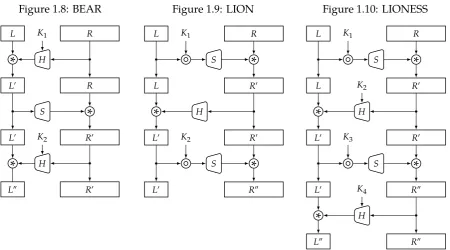
1.8 BEAR . . . 70
1.9 LION . . . 70
1.10 LIONESS . . . 70
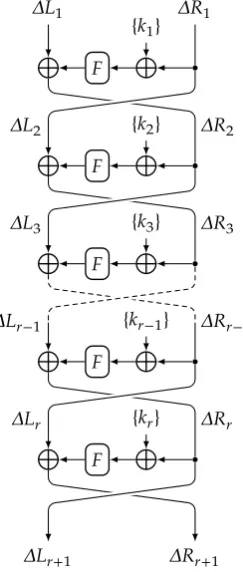
2.1 Notation for the 0R Differential Cryptanalysis of a Simplified Feistel Cipher . 74 2.2 Construction of a Boomerang . . . 86
2.3 Biham’s “Sliding” Related Key Attack . . . 109
2.4 A Slid Pair . . . 110
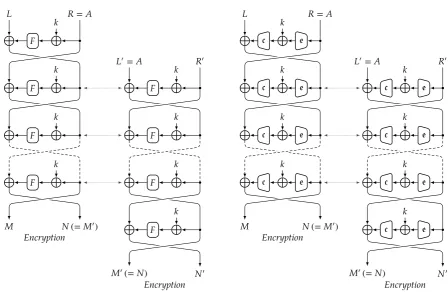
2.5 Slide Attack on a Feistel Cipher with a Single Round Key . . . 111
2.6 Slide Attack on a DES-like Cipher with a Single Round Key . . . 111
2.7 Complementation Slide Attack on a Two Keys Feistel Cipher . . . 113
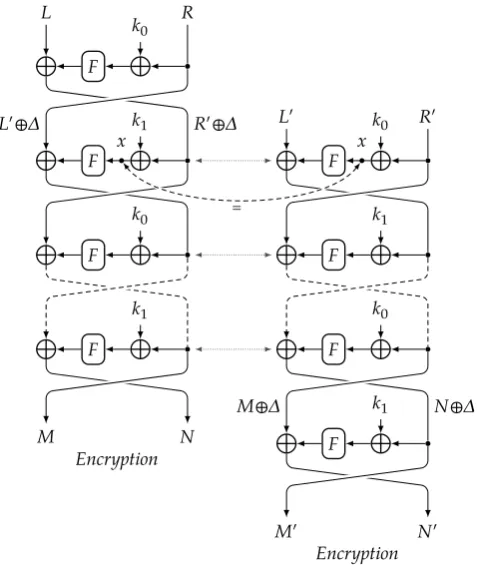
2.8 Slide Attack with a Twist on a Two Keys Feistel Cipher . . . 114
2.9 Complementation Slide With a Twist Attack on a Four Keys Feistel Cipher . . 115
2.10 General Even-Mansour Scheme . . . 116
2.11 Slide With a Twist Attack on an Even-Mansour Scheme . . . 117
2.12 Slide With a Twist Attack on an Even-Mansour Scheme, Refactored . . . 118
2.13 The SlideX Attack on an Even-Mansour Scheme . . . 118
2.14 Single Round Even-Mansour Scheme With One Key . . . 119
2.15 Two Rounds Even-Mansour Scheme With One Key . . . 119
2.16 Relation Between Adjacent S-boxes of the DES . . . 122
3.1 The Lucifer Basic Building Block . . . 129
3.2 The Data Encryption Standard . . . 130
3.3 The DES Round Function . . . 131
3.5 The FEAL F-function . . . 140
3.6 The FEAL FK-Function . . . 140
3.7 The GOST Round Function . . . 141
3.8 The RC2 MIX Function . . . 143
3.9 A Round of IDEA . . . 145
3.10 IDEA’s Final Half-Round . . . 145
3.11 A Round of MESH-64 . . . 147
3.12 A Round of MESH-96 . . . 147
3.13 The CAST F-function . . . 149
3.14 A Round of SAFER . . . 151
3.15 A Round of SAFER++ . . . 154
3.16 The Structure of Blowfish . . . 157
3.17 The Blowfish F-function . . . 157
3.18 A Round of RC5 . . . 159
3.19 A Cycle – Two Rounds – of TEA, XTEA and XETA . . . 163
3.20 A Round of Twofish . . . 165
3.21 The two Types of Rounds in Skipjack . . . 166
3.22 A Round of RC6 . . . 169
3.23 The Serpent Linear Mixing Stage . . . 171
3.24 The Camellia F-function . . . 173
3.25 The Camellia FL and FL−1Functions . . . 174
3.26 The AES Key Schedule for 128-bit Keys . . . 184
3.27 The Khazad/Anubis Composite S-box . . . 191
3.28 Rounds of IDEA NXT-64 and NXT-128 . . . 196
3.29 Data Encryption and Key Schedule Rounds of SEA . . . 200
3.30 A Round of HIGHT . . . 202
3.31 CLEFIA’s Feistel Structure . . . 204
3.32 CLEFIA’s F-function F0 . . . 204
3.33 CLEFIA’s First S-box𝑆0 . . . 204
3.34 The PRESENT pLayer . . . 206
3.35 The Threefish MIX Function . . . 208
3.36 Four Rounds of Threefish-512 . . . 208
3.37 The Structure of KATAN/KTANTAN . . . 210
3.39 A Round of BelT . . . 215
3.40 A Round of TWINE . . . 216
3.41 The Structure of PRINCEcore . . . 218
3.42 A Round of SIMON . . . 223
3.43 The SIMON Key Schedule for𝑚 = 2 . . . 223
3.44 The SIMON Key Schedule for𝑚 = 3 . . . 223
3.45 The SIMON Key Schedule for𝑚 = 4 . . . 223
3.46 A Round of SPECK . . . 226
3.47 The SPECK Key Schedule . . . 226
List of Tables
3.1 Cryptanalysis of the SAFER Cipher Family – Published Results . . . 156
3.2 Single Key Cryptanalysis of AES-128 – Selected Published Results . . . 186
3.3 Single Key Cryptanalysis of AES-192 – Selected Published Results . . . 186
3.4 Single Key Cryptanalysis of AES-256 – Selected Published Results . . . 187
3.5 Related Key Cryptanalysis of AES – Selected Published Results . . . 187
3.6 Low Data Cryptanalysis of AES (all variants) – Selected Published Results . . 188
3.7 Differences between Khazad and Shark . . . 191
3.8 Differences between Anubis and Rijndael . . . 193
3.9 Security Parameters of the Clefia S-boxes . . . 204
3.10 Cryptanalysis of PRESENT – Published Results . . . 207
3.11 Cryptanalysis of PRINCE – Selected Published Results . . . 221
3.12 Some Parameters for SIMON and SPECK . . . 222
3.13 Cryptanalysis of SIMON – Published Results . . . 225
3.14 Cryptanalysis of SPECK – Published Results . . . 227
3.15 Cryptanalysis of KLEIN – Published Results . . . 228
3.16 Performance Comparisons of AES and PICARO . . . 231
3.17 Performance Comparisons of AES, Noekeon, PICARO, Zorro, Robin, and Fan-tomas in Masked Implementations . . . 232
4.1 Performance of Block Ciphers in HW . . . 237
4.2 Performance of Block Ciphers in SW on a 8-bit ATMEL ATtiny45 . . . 240
4.3 Performance of Block Ciphers on a 8-bit ATMEL ATmega128 . . . 241
4.4 Performance of Block Ciphers on a 16-bit TI MSP 430 . . . 242
4.5 Device/server use cases for lightweight encryption . . . 243
Notation
1We attempt to maintain a consistent notation throughout the document. The following nota-2
tions hold except when explicitly stated otherwise. Accordingly, in several cases our descrip-3
tions of ciphers and attacks have been modified with respect to the reference papers. Another 4
convention is in the numbering of rounds: we usually start with round0, and the descriptions 5
of some ciphers have been modified not only to adhere to the notation set below, but also to 6
our round numbering. 7
𝒜,ℐ,𝒦,𝐾[ℐ]and⟨𝐴,ℐ⟩: The symbols𝒜,ℐ, and𝒦 denote set of key bits, usually to extract 8
a partial key from a key, for instance as in𝑘1= 𝐾[ℐ]. 9
Key bit sets are identified with vectors whose entries are equal to one for the included bits 10
and zero otherwise. Hence, for a vector𝐴of lengthℓover𝔽2and a subsetℐ of[0..ℓ − 1], 11
the notation⟨𝐴,ℐ⟩ shall denote the sum (parity) of the bits in𝐴 at the fixed positions 12
indexed by the numbers inℐ, i.e. the parity bit of the corresponding choice of bits. 13
𝒜𝒾: Algebraic immunity of a Boolean function. 14
𝑏: Where different from the key size𝑛,𝑏is used to denote the block size. 15
ℬ: The branch number of a linear mapping. 16
𝐶: A ciphertext (also in derived forms such as𝐶𝑖,𝐶′, etc.).
17
𝔠,𝔢: In the F-Function of a DES-like cipher, the compression and expansion blocks, that follow 18
and precede the key mixing, respectively. 19
𝐷,𝐸: 𝐸is normally used to denote an encryption function, in which case the letter𝐷represents 20
the corresponding decryption function. 21
This applies also to indexed or accented variants, i.e. the inverse of𝐸𝑖, resp.𝐸(1),𝐸, and̂ 22
𝐸′is denoted by𝐷𝑖, resp.𝐷(1),𝐷, and̂ 𝐷′, etc. 23
For all other letters the inverse of a function𝑓 is denoted by𝑓−1. 24
𝐷,𝑆,𝑇: When analysing space-time tradeoffs, these are shorthands for (collected)data, run-25
timespace(orstorage) and runningtime, usually in conjunction with𝑁 = 2𝑛for the state 26
(and key space) cardinality. 27
𝛥,∇: Used to denote input, output, state, or key differences / (higher order) differentials. 28
𝛿𝑖: 𝛿𝑖is often used as a shorthand for𝛥𝑃𝑖. 29
𝛿𝐹: The differential immunity of a function𝐹. 30
𝑓,𝐹: 𝑓 can be a generic function, often a Boolean function. In the context of the latter case,𝐹 31
𝐹: The F-Function of Feistel ciphers or generic random permutations in Even-Mansour con-1
structions. 2
𝔽: A finite field.𝔽𝑎denotes the finite field with𝑎elements, as in𝔽2.𝔽28,𝔽17etc.
3
𝛾,𝜆,𝜋,𝜓,𝜌,𝜎,𝜃: In the wide trails design strategy, these greek letters denote respectively: a 4
non-linear transformation, a linear transformation, a word permutation, the key schedule, 5
the round function, a key addition, and a layer of S-boxes. 6
𝐾,𝑘,𝑟𝑘,𝑤𝑘: The letter𝐾denotes (master) keys, such as𝐾, 𝐾𝑖, 𝐾′etc.
7
The lower case 𝑘denotes subkeys and round keys𝑘𝑖, which are usually derived from a 8
master key𝐾. It is sometimes used also in composite symbols, such as𝑟𝑘for a round key, 9
𝑤𝑘for a whitening key, etc. 10
𝐿,𝑅: In the context of Feistel ciphers the left and right halves of a state, respectively. 11
ℓ: Use to denote the length of the key or of the keys used in a cipher, when different from the 12
block size𝑛. 13
ℳ,𝒩 : Sets. 14
ℳ𝑑: Set of all sequences which consist of𝑑elements of a setℳ. 15
𝑛: When studying block ciphers,𝑛is used to denote the block length of the cipher; when study-16
ing S-boxes𝑛often denotes the S-box size. In cryptographic schemes which explicitly use 17
more than one key𝐾1,𝐾2, etc. that by design are not considered as a sub keys of a larger 18
key,𝑛usually denotes the size of each of these keys. In these cases𝑁 = 2𝑛. 19
𝑛: In a few cases𝑛denotes the length of a vector, especially when the state of a cipher is rep-20
resented as a vector of𝑛elements over a given algebraic structure. Used when studying 21
diffusion layers and wide-trail designs. 22
𝑛𝑙: The nonlinearity of a (vectorial) Boolean function. 23
𝒪: Encryption or decryption oracle. 24
𝑃: Usually a plaintext (including derived forms like𝑃𝑖,𝑃′, etc.), or a permutation (P-box). 25
𝒫 : Probability. 26
𝑃𝑓(𝛼, 𝛽): is defined as 27
• 𝒫[𝑓(𝛼)= 𝛽]in the case of linear cryptanalysis; 28
• 𝒫[𝑓(𝑥)+ 𝑓(𝑥 + 𝛼)= 𝛽]in the context of differential cryptanalysis; and 29
• 𝒫[𝛥(𝛼𝑖)𝑓(𝑥)= 𝛽]where𝛼 =(𝛼1, … , 𝛼𝑖), for higher order differential cryptanalysis.
30
𝑟: The number of rounds of an iterative cipher. 31
𝑆: Commonly used to denote S-boxes in the description of ciphers. 1
wt(𝑎): The Hamming weight of the number, finite field element, or vector𝑎, i.e. the number of 2
non-zero bits, or elements, of its argument. 3
𝓌: For a function 𝑓, its Walsh transform/spectrum is denoted by 𝑓𝓌. 4
ℤ: The ring of the integers. The notationℤ/𝑛ℤis used for the ring of integers modulo𝑛. 5
̄: For a bit string𝑎,𝑎̄denotes the bitwise complement of𝑎. 6
⊕: Bitwise exclusive or, or XOR. 7
∧andT: Logical (bitwise) AND.Tis used in diagrams. 8
∨andU: Logical (bitwise) OR.Uis used in diagrams. 9
⊞and⊟: Modular addition and subtraction, respectively (especially in diagrams). 10
∘: Functional composition where by the notation𝑔 ∘ 𝑓 it is understood that𝑔 follows 𝑓, i.e. 11
(𝑔 ∘ 𝑓)(𝑥)= 𝑔(𝑓(𝑥)). 12
∗,⊛,⊚and⊙: Various compositions of values. 13
‖: Concatenation of bit strings. Often used for states of Feistel constructions. For matrices𝑀1 14
and𝑀2with equal number of rows,𝑀1‖𝑀2denotes the matrix obtained by juxtaposition 15
(also written as(𝑀1|𝑀2)). 16
≪ 𝛼,≪𝛼: Left shift by𝛼bits (zero-filled). 17
≫ 𝛼,≫𝛼: Right shift by𝛼bits (zero-filled). 18
⋘ 𝛼,⋘𝛼: Left rotate by𝛼bits. 19
⋙ 𝛼,⋙𝛼: Right rotate by𝛼bits. 20
∪,∩,∖: Set theoretic union, intersection, and subtraction. 21
# : The cardinality of a set. 22
∅: The empty set. 23
Chapter 1
Design
2Lots of people working in cryptography have no deep concern with real application issues.
3
They are trying to discover things clever enough to write papers about.
4
Whitfield Diffie 5
In 1883 Auguste Kerckhoffs published two papers inLa Cryptographie Militaire[Ker83a,Ker83b] 6
in which he stated six axioms of cryptography. In modern words, these axioms can be sum-7
marised as: can be summarised as: 8
1: The system must be mathematically and physically indecipherable; 9
2: It must not rely on on secret algorithms or parameters; 10
3: It must be easy/efficient to transmit the key and change it; 11
4: It must be applicable to telecommunications; 12
5: It must allow lightweight implementations; and 13
6: It must be user friendly and its use must not require technical prowess. 14
We want to focus our attention on the second axiom, now known asKerckhoffs’ Principle. The 15
original text is 16
Il faut qu’il n’exige pas le secret, et qu’il puisse sans inconvénient tomber entre les mains de
17
l’ennemi.
18
which, in English, translates as: 19
It [the method] must not be required to be secret, and it must be able to fall into the enemy’s
20
hands without inconvenience.
21
This principle implies that the security shall rely only on the secrecy of the key. It is also known 22
asShannon’s Maximafter Claude Shannon who formulated it as “the enemy knows the system.” 23
This is in fact the most important design principle for anycipher, not only block ciphers, but 24
also stream ciphers, or even public key cryptosystems: avoid secret designs or design principles. 25
We strongly believe that obscurity does not bring security: Not only does peer scrutiny lead to 26
better ciphers, but obscurity often gives a false sense of security, leading to design mistakes. 27
Bruce Schneier argues in a CRYPTO-GRAM newsletter [Sch02]1 that Kerckhoffs’ papers are
28
probably the earliest papers that support the non-secrecy of cryptographic algorithms. 29
Kerckhoffs’ Principle does not only apply to the “blueprints” of a cryptographic algorithm, but 1
also to the methods used to determine any constants used in the system. When the US National 2
Bureau of Standards (NBS) introduced the Data Encryption Standard, it was known that the 3
US National Security Agency (NSA) had changed some of the hardwired constants. At the time 4
there was suspicion that this was done to insert a mathematical backdoor into the system – and 5
if the NSA had it, somebody else could also find it. 6
It was later disclosed that this was not the case – in fact it was later disclosed that these modifica-7
tions strengthened the cipher against differential cryptanalysis, an attack that was not publicly 8
disclosed at the time – but this was sufficient to cast doubts on the cipher. For this reason 9
several recent cryptographic methods containnothing up my sleeve numbers, i.e. values ob-10
tained in a way that is “above suspicions,” for instance from the binary expansions of important 11
mathematical constants such as𝜋,𝑒,𝜑, etc. 12
Even though we do not endorse it, secrecycanhave a value for security agencies, since they 13
would keep their algorithms and machinery secret in order to not teach their adversaries by 14
exposing their own their cutting-edge technology. In this case, extensive analysis is performed 15
in-house, and in the case of the NSA it can be argued to be at the highest level. This still made 16
perfect sense, even in light of Kerckhoffs, when the the NSA’s technology was cutting edge, 17
for instance, when the S-boxes of the DES were constructed, or when Skipjack (Section3.14 on 18
page 166) was developed. This has changed recently, as public knowledge seems to have caught 19
or surpassed that of the security agencies, and acknowledged by the public release of ciphers 20
such as Simon and Speck. 21
In the following sections we will formalise concrete design principles and methodologies which 22
are specific to block ciphers. The material is roughly organised in four parts: 23
1: In Section1.1 we introduce fundamental concepts, such as the definitions of block cipher, 24
product and iterated block ciphers, rounds, key schedule, avalanche, confusion, diffusion 25
and the security reduction principle. 26
2: Sections1.2 to 1.7 describe the main design topologies and components of block ciphers, 27
namely substitution-permutation networks, Feistel ciphers, Lai-Massey designs, etc. 28
3: Sections1.8and1.9deal with the main building blocks of block ciphers, that is the functions 29
that provide diffusion and confusion. 30
4: Finally, the last section serves as a sort of appendix to this chapter, collecting information 31
about less common design types and building blocks. 32
1.1 Fundamental Definitions and Design Principles
33
A block cipher is an algorithm that applies a permutation, selected by a key, to the set of 34
allblocks(bit strings) of a fixed length. Usually the application of the permutation is called 35
encryptionand converts aplaintextinto aciphertext, while the inverse permutation is called 36
decryptionand converts a ciphertext into the original plaintext. Computing the algorithm and 37
its inverse usually have identical or similar costs. 38
A classical definition of security for a cipher is that it considered secure when it is not feasible 39
A more modern security notion is based on the concept of (computational)indistinguishability. 1
Informally, two systems 𝒮 and𝒯 are said to be indistinguishable if no (efficient) algorithm 2
𝒟 (⋅) – called a distinguisher – that can be connected either to𝒮 or𝒯, is able to decide with 3
which of the two systems it is interacting. Then, a block cipher 𝐸(𝐾, ⋅) is secure if it and and 4
its inverse 𝐷(𝐾, ⋅) for a uniformly random key𝐾 are indistinguishable from a truly random 5
permutation𝜋 and its inverse𝜋−1 Indistinguishability is also for reductions: it two systems 6
are indistinguishable, then one is secure when the other one is secure as well. 7
Recently, the standard definition seem to have settled on the stronger concept of
indifferentiabil-8
ity[MRH04,CDMP05]. Here we shall not make use of the technical original definition, but an 9
equivalent and more informal one is the following: Two systems𝒮 and𝒯 are indifferentiable 10
if and only if the security of any cryptosystem using𝒯 as a component is not affected when𝒯
11
is substituted by𝒮. In particular, a block cipher is secure if it is indifferentiable from an ideal 12
one. It is clear that this concept of security implies that no key recovery is possible. 13
Ideally, the best attacks against a block cipher should not run considerably faster than brute 14
force on the key space. For instance, it is necessary that a block cipher, unlike, say, Caesar’s 15
cipher, does not show any kind of linearity. Caesar’s cipher can be interpreted as modular 16
addition of a secret key. Whereas brute force search requires on average 13attempts before 17
guessing the correct key, a known plaintext attack determines the secret key with just one en-18
cryption operation and a modular subtraction. Linearity also exposes biases in the distribution 19
of the characters in the plaintext through the ciphertext: Taking again Caesar’s cipher as an 20
example, if we know that the plaintext is in English and the most common character in the 21
ciphertext is “g”, then we can guess it to be the encryption of the letter “e” and thus the secret 22
key is probably 2. 23
In fact, a block cipher should not be approximable by any easily computable function of the 24
input with a nonnegligible bias. This includes linear or affine functions as a special case, and 25
there are countless ways to represent the states of a cipher: the most common way is to see 26
them as vectors over𝔽2, but we can also view the bytes of the states as integers modulo256, or 27
elements of the Galois field𝔽28.
28
Apart from non linearity, another desirable property is theavalanche effect, which means that 29
a small change in either the key or the plaintext should induce a drastic change in the ciphertext. 30
This was formalised by A. F. Webster and Stafford Tavares as theStrict Avalanche Criterion 31
(SAC)[WT85]:Complementing a single bit in the input or in the key should change any bit in the output
32
with probability1/2, for any input or key bit and for any output bit.
33
In order to achieve these goals we could take a table of random permutations: For block and 34
key lengths of𝑛andℓ bits, we just pick at random2ℓ permutations of the elements of the 𝑛-35
dimensional vector space over𝔽2. But such a table would be huge for any acceptable security 36
level – and we are not yet taking into account the difficulty to obtain a good randomness source. 37
Hence, a block cipher is constructed by chaining simpler operations, which are individually 38
weak, but combined form a much stronger function. Such a cipher is called aproduct cipher. 39
Claude Shannon first formalized this approach in [Sha49]. The encryption algorithm of a prod-40
uct block cipher is a sequence ofrounds, where the input to the first round is the plaintext, the 41
output of each round is passed to the following round as its input, and the output of the last 42
Figure 1.1: A Product Block Cipher Key
Plaintext Round Round Round Round Ciphertext
Key Schedule
round key
round
key round key
round
k
ey
Data obfuscation path
also a key, called theround key, which is derived from the encryption key. 1
Hence, a block cipher can also be defined as atriple(instead of a pair) of algorithms, namely, 2
encryption, decryption andkey schedule, also calledkey expansion. The latter is the process 3
ofexpandingthe given secret key into a set of values used in different places of the encryption 4
and decryption algorithms. If the key schedule is considered as a separate algorithm, then en-5
cryption (resp. decryption) is redefined as an algorithm that takes as inputs the plaintext (resp. 6
ciphertext) and the outputs of the key schedule and outputs the ciphertext (resp. plaintext). The 7
encryption part of the cipher is sometimes called thedata (obfuscation) path, as depicted in 8
Figure1.1. These definitions are also useful when the key schedule process is computationally 9
expensive and it thus it makes sense to separate it from encryption and decryption when the 10
same key is used repeatedly. 11
In order to simplify the construction of concrete proposals, Shannon also suggested to build 12
a product cipher by repeating the same steps over and over until the desired robustness is 13
achieved. Intuitively, increasing the number of rounds improves the security of a cipher at the 14
expense of speed and, conversely, reducing the number of rounds can improve performance at 15
the expense of security. 16
The resulting cipher is called an iterated (product) cipher. The internalstateof the cipher is 17
initially the plaintext. Each iteration of the round updates the state, i.e. it replaces the state with 18
its output. The ciphertext is then just the final state. 19
The operations that are used to build the rounds should provideconfusionanddiffusion. To 20
quote Shannon [Sha49]: 21
Two methods (other than recourse to ideal systems) suggest themselves for frustrating a
sta-22
tistical analysis. These we may call the methods of diffusion and confusion.
23
Diffusion means that the statistical structure of the plaintext is dissipated in the long range 24
statistics of the ciphertext. That is, each part of the ciphertext should depend on as much of the 25
plaintext as possible. Inside a plaintext block, diffusion is attained by means of state permuta-26
tion operations. 27
Confusion means that the key is used in such a way that even when an attacker knows the 28
statistics of the plaintext, or has many plaintext/ciphertext pairs, it is still difficult to deduce the 29
key as possible. This can be attained when the mathematical dependence of the ciphertext from 1
plaintext and key is very complex, for instance by repeatedly using non-linear functions to mix 2
the state with the round keys. One way to improve the mixing of plaintext and key, especially 3
in the presence of keys larger than the plaintext block, is to use a complex key schedule. 4
At this point it is noteworthy to remark a fundamental difference between block ciphers, on 5
one side, and stream ciphers, the One Time Pad (invented by Frank Miller in 1882 [Mil82] as 6
shown by Steven M. Bellovin in [Bel11]), and the Vernam Cipher [Ver26] on the other side: Block 7
ciphers build their security on both confusion and diffusion, whereas the other types of ciphers 8
rely exclusively on confusion to achieve security. 9
Shannon introduced two further design principles: 10
1. The first is calledreduction: make the security of the system reducible to some known dif-11
ficult problem. This principle has been used widely in public-key cryptography, much less 12
so in secret-key cryptography. 13
2. Shannon’s second principle is very pragmatic:make the system secure against all known attacks.
14
For secret-key ciphers this is still the best known design principle. Indeed, in the words of 15
Bruce Schneier [Sch98b]: “The only way to become a good algorithm designer is to be a good
crypt-16
analyst: to break algorithms. [...] Only after a student has demonstrated his ability to cryptanalyze
17
the algorithms of others will his own designs be taken seriously.” Humility is also necessary in 18
this endeavour, since, again in the words of Bruce Schneier [Sch98a]: “Anyone, from the most
19
clueless amateur to the best cryptographer, can create an algorithm that he himself can’t break.” 20
We shall put the second principle into practice in an exemplary way after we have discussed 21
Substitution-Permutation Networks(SPNs), a large family of block ciphers. This will allow us to 22
understand how some common attack strategies work, and also how a cryptographer hedges 23
her designs against these attacks. The latter will directly translate to concrete requirements of 24
the building blocks used in the construction of such a cipher. Since SPNs comprise almost all 25
block cipher types encountered in practice, this will be general enough to set the ground for 26
later, more in-depth treatments. 27
1.2 Substitution-Permutation Networks
28
Shannon suggested the use of two logically separated types of functions to achieve confusion 29
and diffusion in a product cipher. Asubstitution functionorsubstitution layerprovides con-30
fusion, whereas adiffusion layerprovides diffusion. This functional separation of the devices 31
that provide confusion and diffusion allows to construct the rounds from simpler operations 32
that can be analysed mathematically on their own terms. This principle also leads to a certain 33
minimalism in the design approach and in its analysis, which has proven to be beneficial for se-34
curity: Indeed, most designs that have better withstood cryptanalysis are very regular designs 35
built from simple blocks, whereas many an apparently clever design that mixed different types 36
of complex and obscure operations has been broken in a surprisingly short time. 37
The substitution function (also: confusion function,confusion layer) can be represented as a 38
table mapping state values to other values, but the actual implementation can be different, for 39
instance a simple circuit or a short program using non-linear operations. This function is some-40
Figure 1.2: Simple Substitution-Permutation Networks
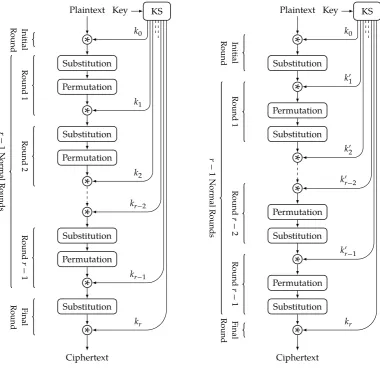
A simple SPN with a KSP round and without final representation is depicted to the left. The SPN to the right is equivalent, provided that the permutation layer is⊛-linear, in which
case round key𝑘𝑖′is the inverse image of𝑘𝑖under the𝑖thpermutation function.
Plaintext KS
∗
Substitution Permutation∗
Substitution Permutation∗
∗
Substitution Permutation∗
Substitution∗
Ciphertext Initial R ound R ound 1 R ound 2 R ound 𝑟 − 1 𝑟 − 1 N or mal R ounds F inal R ound Key 𝑘0 𝑘1 𝑘2 𝑘𝑟−2 𝑘𝑟−1 𝑘𝑟 Plaintext KS∗
Substitution∗
Permutation Substitution∗
∗
Permutation Substitution∗
Permutation Substitution∗
Ciphertext Initial R ound R ound 1 R ound 𝑟 − 2 R ound 𝑟 − 1 𝑟 − 1 N or mal R ounds F inal R ound Key 𝑘0𝑘′1
𝑘′ 2 𝑘′ 𝑟−2 𝑘′ 𝑟−1 𝑘𝑟
that modifies just a part of the state, and the full substitution layer consists of piecewise, parallel 1
applications of several S-boxes (not necessarily distinct from each other) to its input. Means to 2
achieve confusion will be discussed in Section1.9 on page 56. 3
The permutation layer ordiffusion layeris sometimes called aP-box. The permutation layer 4
can be realised by a simple fixed permutation of the bits of the state, or more general invertible 5
linear transformation of the state as a vector over some ring. (There is nothing in principle that 6
prevents non-linear diffusion layers.) Diffusion will be discussed in Section1.8 on page 42. 7
A combination of these two operation types together with mixing of key derived material con-8
stitutes a round of aSubstitution-Permutation Network(alsoSP NetworkorSPN). 9
Simple functions cannot be expected to bring much confusion and diffusion, but if sufficiently 10
many such functions are suitably chained, the resulting iterated cipher can achieve very high 11
Two variants of the modern generic scheme of a SPN are depicted in Figure1.2 on the preced-1
ing page, where the reader can immediately note how the general idea of product cipher (as 2
presented in Figure1.1 on page 24) is implemented. 3
Several variants are possible, for instance there can be more substitution and permutation layers 4
in each round. If S denotes a substitution layer, P a permutation layer, and K a key mixing layer, 5
them the rounds in Figure1.2are of type SPK, with the final round being just SK. Key mixing 6
usually follows the substitution and permutation layers, but there are ciphers where the key 7
mixing is defined as being at the beginning of a round, in which case it is the final round that 8
consists of just key mixing. In some ciphers key material is mixed more than once per round, 9
such as the KSKP round type used in the SAFER family (Section3.8 on page 150). Other ciphers 10
other can have very complex rounds built out of several simple layers: for instance ICEBERG’s 11
round structure (Section3.24 on page 197) is SPSPS-PKP. 12
An important remark is that placing substitution and permutation layers at the very beginning 13
or end of a cipher (even though it may facilitate implementation) does not increase security, 14
because they are fixed modifications of the plaintext or ciphertext. Therefore it is a sensible 15
design decision to ensure that key mixing instead occurs at the very beginning and very end of 16
the cipher. (This is related to theFX construction, cf. Section1.6 on page 38.) 17
Returning to Figure1.2(left), the initial key mixing is called theinitial round2. Several addi-18
tional rounds composed of substitution and permutation layers and key mixing follow. Only 19
thefinal roundmay sometimes omit the permutation layer, since it is often simply a linear op-20
eration, and omitting it is equivalent to mixing a different, linearly transformed round key, at 21
the end of the round. Again, for ease of implementation or for design reasons the permutation 22
layer may be present in the last round in a simplified form (such as in SQUARE, cf. Section3.11 23
on page 160, and its successors, including the AES, cf. Section3.20 on page 182). 24
For this type of ciphers, if the permutation layer is linear (that is𝑃(𝑥 ⊛ 𝑦)= 𝑃(𝑥)⊛ 𝑃(𝑦)), then de-25
cryption can be implemented with a similar control structure as the encryption, i.e. the inverse 26
of the circuit to therightis used to invert the circuit to theleft: It will still be necessary to reverse 27
the order of the round keys and to linearly transform some of them, and possibly add control 28
logic to choose whether to use the inverse substitution and permutation layers for decryption, 29
but resources can be saved. A further development of this intuition is part of the Wide Trail 30
design strategy (Section1.4 on page 34) and in particular of involutory ciphers such as Khazad 31
and Shark (Subsection3.21.2 on page 190) and Anubis (Subsection3.21.3 on page 192). 32
Key mixing is usually a simple operation, and in most cases it performed by a XOR. The second 33
most popular operation is modular addition, as in GOST (Section3.4 on page 140), RC2 (Sec-34
tion3.5 on page 142), RC5 (Section3.10 on page 158), TEA (Section3.12 on page 161), Twofish 35
(Section 3.13 on page 164), RC6 (Section3.15 on page 168), SEA (Section 3.26 on page 199), 36
Threefish (Section 3.30 on page 207), and BelT (Section3.33 on page 214) – to name just a few 37
examples. In software, modular addition is often as expensive as XOR, so it is an inexpensive 38
way to improve diffusion and confusion. This is not always true as in some ciphers there may 39
be optimisations relying on the use of XOR that would not be possible if a different operation is 40
used. Also, in hardware addition is always more expensive than XOR, as the increased latency 41
of addition is not hidden by the pipeline of the CPU. Some ciphers use more than one operation 42
2Sometimes the initial and final key additions are derived from additional key material, in which case we have
to mix the subkeys with the state. For instance, in IDEA (Section3.6 on page 144) and MESH 1
(Subsection3.6.6 on page 147) addition modulo216and multiplication modulo216+ 1are used, 2
and in the CAST (Section3.7 on page 148) and SAFER (Section3.8 on page 150) families both 3
XOR and modular addition/subtraction are used. SHARK (Subsection3.21.2 on page 190) takes 4
an even more interesting approach, as key mixing is done both by simple XORs and an affine 5
transform, i.e. the multiplication by a matrix that is derived from key material. 6
Most of the block cipher designs ever proposed and nearly all those that are in use today are 7
SPNs. Some of the designs that are often presented as belonging to a different family, such 8
as Feistel networks (Section1.3) or Lai-Massey designs (Section1.5 on page 37), are in fact just 9
particular types of SPNs: Indeed, in the early history of block ciphers the term SPN was used 10
in works describing Feistel designs, such as [Ada90,AT93], and until recently it was not uncom-11
mon to state that a cipher “uses the Feistel structure [...] to implement the SPN” [Ada97]. Today 12
Feistel Networks and SPNs are treated as separate design families: when a cipher is clearly a 13
Feistel or Lai-Massey design, it is denoted only as such and rarely referred to as an instance 14
of a SPN, whereas SPN usually denotes a narrower class of ciphers such as bricklayer designs 15
following the Wide Trail strategy (Section1.4 on page 34). More examples of “classic” SPNs 16
are given by SQUARE (Section3.11 on page 160), Serpent (Section3.17 on page 170), Rijndael 17
(Section3.20 on page 182), mCrypton (Section3.25 on page 198) and PRESENT (Section3.29 on 18
page 206). 19
1.3 Feistel Networks (Luby–Rackoff Ciphers)
20
A SPN as described in Section 1.2 on page 25 often needs two different circuits or routines 21
to perform both encryption and decryption. Even if they can be optimised somewhat (as we 22
saw when comparing the two example designs of Figure 1.2 on page 26), the issue can still 23
adversely impact performance tradeoffs in resource constrained environments. An elegant so-24
lution to this problem was presented in the late 60s by IBM cryptographer Horst Feistel. During 25
the development of the Lucifer family of block ciphers he invented a structure that allows iter-26
ated ciphers to be built in a way such that encryption and decryption are essentially the same 27
operation. 28
Feistel’s idea, in its simplest form, constructs a round as follows: The state is split into two 29
halves, calledbranches; a function, called theF-function, is computed on the first half, called 30
thesourcebranch; the result of this operation is composed with the other half of the state, called 31
thetarget, in a reversible way – the source branch remains unchanged until now; finally, the 32
two branches are swapped. 33
For the composition of the transform of the source to the target, usually the XOR is used because 34
the effect of XORing with some value is reversed by XORing again with the same value, but, as 35
we mentioned in the previous section, other composition operations may be used. 36
Let the state be written as𝐿‖𝑅, as the concatenation of the two branches. The plaintext is the 37
initial state𝐿1‖𝑅1. A round computes state𝐿𝑖+1‖𝑅𝑖+1from𝐿𝑖‖𝑅𝑖as follows: 38
{
𝑅𝑖+1= 𝐿𝑖⊛ 𝐹(𝑅𝑖, 𝑘𝑖)
𝐿𝑖+𝑖 = 𝑅𝑖
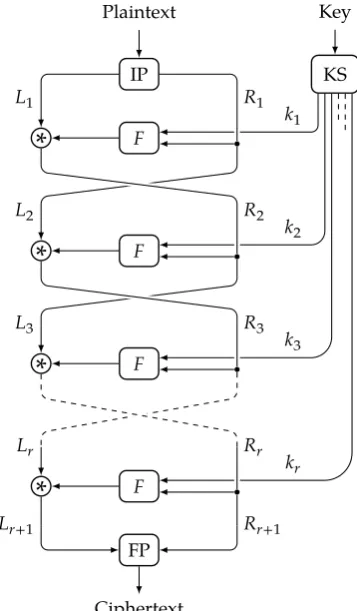
Figure 1.3: Schema of a Feistel Cipher
Plaintext Key
IP
𝐿1 𝑅1
∗
𝐹𝐿2 𝑅2
∗
𝐹𝐿3 𝑅3
∗
𝐹𝐿𝑟 𝑅𝑟
∗
𝐹𝐿𝑟+1 𝑅𝑟+1
FP
Ciphertext
KS
𝑘1
𝑘2
𝑘3
𝑘𝑟
the key though a key schedule. A graphical depiction of the cipher is given in Figure1.3that 1
includes an initial and final permutation (which have no influence on security) like the DES 2
(Section3.2 on page 129), and treats the key schedule as a black box. 3
Feistel networks are just a special case of SPNs: only half of the state is modified at each round, 4
but in fact the state is a function of the whole previous state, and the permutation function is 5
very simple. This also means that confusion and diffusion must be in fact applied to the source 6
branch. Since confusion and diffusion are applied only to part of the state, so a higher number 7
of rounds is necessary, in fact roughly twice as much – but these rounds are also potentially 8
less expensive (roughly a half) since they have to operate only on half of the state. Moreover, 9
the steps are easy to revert in the case the composition is the XOR, since only the round keys 10
have to be fed in the opposite order to decrypt. 11
Finally, the F-function can be a simple SPN itself, so all the theory developed for SPNs is recy-12
cled – this is very well exemplified by the development of the Lucifer family of block ciphers 13
(Section3.1 on page 128) whose first instances were SPNs, and then the experience of the de-14
sign of these SPNs was exploited to design the round function of the “final” Lucifer described 15
in [Sor84]. 16
In fact, the F-function itself can be an existing cipher, and therefore this construction can be 17
seen as a simple way to double the block size of a cipher: the original cipher is used as the F-18
to generate different round keys for the various instances of the original cipher. Ladder-DES 1
and DEAL (Subsection3.19.1 on page 179) are two ciphers that use DES as the round function 2
in this way, and MAGENTA (Subsection3.19.6 on page 181) uses a quite complex 12-layer SPN 3
as its F-function. 4
In general both confusion and diffusion are slower in a Feistel network than in a SPN, assuming 5
they are equally well designed. This is general due to the fact that confusion and diffusion 6
operations usually work only on a part of the state at each round, and will be discussed further 7
in Subsection1.8.4 on page 54. Hence, a Feistel network usually needs more rounds than a SPN 8
to achieve comparable levels of security at the same block and key sizes. This often balances 9
with the fact that the Feistel rounds are also lighter than in SPNs. 10
But there is more: the power of this construction comes from the fact that the F-function needs 11
not be bijective, with serious positive implications for performance, flexibility of design, and 12
also for cryptographic theory. Michael Luby and Charles Rackoff analyzed the Feistel cipher 13
construction [LR86], and proved that if the round function is a cryptographically secure pseu-14
dorandom function (where the round key is interpreted as the seed) then three rounds are suf-15
ficient to make the block cipher a pseudorandom permutation, while four rounds are sufficient 16
to make it a “strong” pseudorandom permutation (which means that it remains pseudorandom 17
even to an adversary who gets oracle access to its inverse permutation). Because of this very 18
important result, Feistel ciphers are also called Luby-Rackoff ciphers. 19
Finally, David Goldenberg et al. [GHL+07a,GHL+07b] show that the Luby-Rackoff construction 20
makes it particularly easy to construct tweakable block ciphers from conventional block ciphers: 21
In the method we have mentioned to double the size of a block cipher, tweaking keys are added 22
before the F-function and after the mix to the target branch. 23
1.3.1 A Taxonomy of Feistel Networks
24
There are many types of Feistel networks and generalisations, with the treatment going back to 25
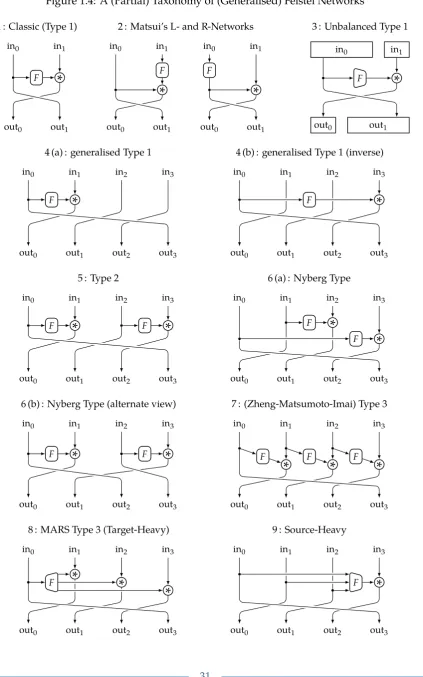
at least [ZMI89]. In Figure1.4 on the facing pagewe show some of the most important types, 26
where just one round is visualised for each variant. In place of the symbol⊕for the XOR we 27
have used a “wildcard” composition symbol⊛in the figure because different operations can 28
be used to mix the output of the F-function with the target branch. In particular, Hoang and 29
Rogaway define anarithmetic Feistel networkto be a Feistel network in which the composition 30
with the target is a modular addition. 31
The represented types are: 32
1: Classic Feistel network, also called a balanced Type 1 Feistel network, wherebalancedmeans 33
that the two branches have the same size. 34
This is the topology of several notable ciphers such as DES (Section3.2 on page 129), GOST 35
(Section3.4 on page 140), Blowfish (Section3.9 on page 157), TEA and XTEA (Section3.12 on 36
page 161) CAST-128 (Section3.7 on page 148), Twofish (Section3.13 on page 164), Camellia 37
(Section3.18 on page 172), Simon (Subsection3.36.1 on page 223) and many others. 38
2: Mitsuru Matsui’s variation as used in various components of the ciphers 1, MISTY-39
2 and KASUMI (see Subsection 3.18.8 on page 176), is here given as the “L-network,” i.e. 40
the version where the F-function is on the target branch. There is also another version, the 41
Figure 1.4: A (Partial) Taxonomy of (Generalised) Feistel Networks 1 : Classic (Type 1)
in0 in1
∗
out0 out1 𝐹
2 : Matsui’s L- and R-Networks
in0 in1
𝐹
∗
out0 out1
in0 in1
𝐹
∗
out0 out1
3 : Unbalanced Type 1
𝐹
∗
in0 in1
out0 out1
4 (a) : generalised Type 1
in0 in1 in2 in3
∗
out0 out1 out2 out3
𝐹
4 (b) : generalised Type 1 (inverse)
in0 in1 in2 in3
∗
out0 out1 out2 out3
𝐹
5 : Type 2
in0 in1 in2 in3
∗
∗
out0 out1 out2 out3
𝐹 𝐹
6 (a) : Nyberg Type
in0 in1 in2 in3
∗
∗
out0 out1 out2 out3
𝐹
𝐹
6 (b) : Nyberg Type (alternate view)
in0 in1 in2 in3
∗
∗
out0 out1 out2 out3
𝐹 𝐹
7 : (Zheng-Matsumoto-Imai) Type 3
in0 in1 in2 in3
∗
∗
∗
out0 out1 out2 out3
𝐹 𝐹 𝐹
8 : MARS Type 3 (Target-Heavy)
in0 in1 in2 in3
∗
∗
∗
out0 out1 out2 out3 𝐹
9 : Source-Heavy
in0 in1 in2 in3
∗
out0 out1 out2 out3
Kouichi Sakurai in [KSS97] and Henri Gilbert and Marine Minier in [GM01], where the F-1
function is on the source branch. 2
Note that in these constructions the F-function must be invertible. 3
3: Unbalanced Feistel network. The bit length of in1and out0is different from the bit length of 4
in0and out1. The output of a round can then be repartitioned before being input to the next 5
round, but there are variants where there is no repartitioning, two different F-functions are 6
used, with one “expanding” its input to be applied to the smaller branch and the other one 7
“compressing” the input to apply the output to the larger branch, such as BEAR, LION and 8
LIONESS (cf. Subsection1.11.3 on page 69). 9
The most extreme example of repartitioning unbalanced Feistel network is the Thorp shuffle, 10
where the𝑛bit state is divided into a1bit part and a𝑛−1bit part [MRS09] (see also [NR99] for 11
an earlier realization of the usefulness of the Thorp shuffle in cryptography). The function 12
𝐹takes the𝑛 − 1bit part and outputs a single bit that is xored to the1bit part. 13
NLFSR-based ciphers such as Keeloq (Subsection3.3.3 on page 138) and KATAN (Section3.31 14
on page 209) can be described in terms of unbalanced Feistel networks. 15
Most unbalanced Feistel networks fall into the types that follow. 16
4: Generalised Feistel Network (GFN) Type 1. It is one of the many ways to describe unbalanced 17
networks: instead of having two branches of different width, we split the state into more 18
than two branches (which, in the examples that follow, always have equal widths, but can 19
of course still be unbalanced as well). The particular generalised Type 1 network depicted 20
here has four branches, but there can be more than four branches. 21
CAST-256 (Section3.7 on page 148) is a classic example of this design. 22
Note that in the subfigure maked 4 (a) there are two branches that are nor source nor target, 23
and that the target gets permuted onto the source branch. Other variants are possible, for 24
instance where the output of the F-function is combined to the in3 branch. In this case 25
the source branch gets permuted onto the target, as represented in the subfigure maked 26
4 (b), and this variant is actually theinverseof the previous design, up to numbering of the 27
branches. 28
The reader may now ask what happens if (in a four-branch Type 1 Feistel with branch permu-29
tation(0 1 2 3) (3 0 1 2)) the source and target branches are the first and third, respectively. 30
It is easy to see, in this case, that the cipher splits into two non-intermixed ciphers, of two 31
branches each, and therefore this case is not interesting. 32
The Skipjack (Section3.14 on page 166) rounds combine ideas from the Type 4 and Matsui 33
networks. 34
5: Type 2, notable examples being RC6 (Section3.15 on page 168), CLEFIA encryption and key 35
schedule (Section 3.28 on page 203), and HIGHT (Section3.27 on page 202). Note that it 36
may seem at first sight that, if the branches are rotated in the opposite direction, we obtain 37
a different topology, but in fact the two variants are equivalent. 38
6: The topology studied by Kaisa Nyberg in [Nyb96]. It is a variation of Type 2 with a different 39
permutation of the branches. The subfigure marked 6 (a) follows Kaisa Nyberg’s original 40
depiction, whereas the subfigure marked 6 (b) shows how the permutation is different from 41
The significative difference between Type 2 and Nyberg Type is that in the former source and 1
target branches are always swapped, whereas in the latter some source and target branches 2
are permuted to branches of the same type. 3
7: Type 3, according to the definition given in [ZMI89]. To distinguish it from the next type, we 4
call it also Zheng-Matsumoto-Imai Type 3 (see also Hoang and Rogaway [HR10a,HR10b]). 5
8: MARS Type 3, also called target-heavy, which is used in MARS (Section3.16 on page 169). 6
9: Source-heavy, as used in RC2 (Section3.5 on page 142), MacGuffin [BS94], SPEED [Zhe97], 7
and in the LOKI97 key schedule (Subsection3.19.5 on page 181). 8
This is a dual of the target-heavy topology. 9
The F-functions can be explicitly keyed, but for clarity we omitted arrows from the pool of round 10
keys to the F-functions. The F-functions can be unkeyed internally by still be implicitly keyed 11
by other transformations. Let us consider the classic Feistel network as an example. The cipher 12
designer may want to add a round key to in0before the value is fed to the F-function. This value 13
can be kept as the “new” in0(which then goes to become out1) or be used only as an input to 14
the F-function. Despite these different design choices, all these variants can be considered a 15
classic Feistel network design. 16
The outputs of the F-functions can also be used to “tweak” other inputs (this should not be 17
confused with the concept of tweakable block ciphers). For instance, let us consider RC6 (Sec-18
tion3.15 on page 168). It has essentially a Type 2 topology. Referring to the graphics of Fig-19
ure 1.4 on page 31, the output of the F-functions applied to inputs in0, resp. in2, is not only 20
XORed to in1, resp. in3, but it also determines the amount of a further rotation of the already 21
XORed values of in3, resp. in1. 22
Henri Gilbert and Marine Minier in [GM01] develop for L- and R-networks analogue results 23
to the work of Michael Luby and Charles Rackoff about Feistel networks. They prove that if 24
the round function is a cryptographically secure pseudorandom function, then: a L-network 25
is not pseudorandom with three rounds but four, and it is strong pseudorandom with five 26
rounds (but not four); a R-network is already pseudorandom with three rounds but, similarly 27
to the L-network, it is strong pseudorandom only with five rounds. Makoto Sugita [Sug96] 28
and Kouichi Sakurai [SZ97] already proved independently that four rounds are not sufficient 29
to make L-networks strong pseudorandom. 30
Another set of variations on the Feistel design was discussed by Yasuyoshi Kaneko, Fumihiko 31
Sano and Kouichi Sakurai at SAC 1997 [KSS97]. They consider all possible variants of two-32
branch Type 1 and Matsui L- and R-network rounds with keyed functions (or permutations) at 33
three possible places: at the bottom, i.e. on the connection from split to composition (such as 34
classic Feistel networks); on the target branch before the composition (such as in Matsui’s L-35
network); or on the source branch before the split (as in the R-network). The bottom placement 36
is denoted by the letter B. Since there are two possibilities for each of the three places (i.e. there 37
is a keyed function or there it none), and one case is trivial, they study seven combinations: B, 38
L, R, LB, RB, LR and LRB. There are of course countless ways to combine these variants with 39
the network topologies of Figure1.4 on page 31. 40
There of course more variations on the original Feistel design, and some of the above design 41