American
Society of Range Management
The American Society of Range Management was created allied technologists, and to encourage professional improvement in 1947 to foster advancement in the science and art of grazing of its members.
land management, to promote progress in the conservation and Persons shall be eligible for membership who are interested greatest sustained use of forage and soil resources, to stimu- in or engaged in practicing range or pasture management or late discussion and understanding of scientific and practical animal husbandry; administering grazing lands ; or teaching, range and pasture problems, to provide a medium for the or conducting research, or engaged in extension activities in exchange of ideas and facts among society members and with range or pasture management or related subjects.
T
he JOURNAL OF RANGE MAN-AGEMENT. published bi-monthly, is the official organ of the American Society of Range Management. The Society, however. assumes no responsibility for the statements and opinions expressed by authors and contributors.
Off ice, Executive Secretary. Address all inquiries and correspondence including memberships, renewals, replacements of JOURNALS, etc., to Executive Secretary, American Society of Range Management, P.O. Box 5041, Portland 13, Oregon. Dues. Membership dues should be sent to the Executive Secretary. The dues are $8.00 per year including a subscrip- tion to the JOURNAL OF RANGE MAN- AGEMENT. Dues for student members are $4.00 per year, including the JOURNAL. All subscriptions mailed outside the North American continent and insular possessions of the U. S. are $8.50 per year. Subscrip- tions must be paid in advance. Remit by draft or check on U. S. banks in U. S. funds. Reprinting. The reprinting of articles or parts of articles published in the JOURNAL OF RANGE MANAGEMENT is author- ized on the express condition that full credit be given the JOURNAL and the author. The date of original publication must be shown with the credit line.
Post Office Enfry. Second-class post- age paid at Portland, Oregon, and at ad- ditional offices.
Change of Address. Notices of change of address should be received by the Execu- tive Secretary one month before the date of issue on which the change is to take effect. Both the new and old addresses should be sent to the Executive Secretary, American Society of Range Management, P.O. Box 5041, Portland 13, Oregon.
Prinfers. The Nebraska Farmer Company, 1420 P Street, Lincoln, Nebraska.
Copyright 1961 by the American Society of Range Management.
, JOURNAL OF RANGE MANAGEMENT
EDITOR E. J. WOOLFOLK
Pacific Southwest Forest & Range Exp. Sta. Berkeley 1, California
EDITORIAL BOARD 1959-61
GEORGE E. GLENDENIR’G U.S. Forest Service ARNOLD HEERWAGEN
Tempe, Arizona
W. J. MCGINNIES Soil Conservation Service
321 New Customs Building
Agricultural Res. Service Fort Collins, Colorado Denver 2, Colorado
1960-62 F. A. BRANSON U.S. Geological Survey
Federal Center Denver, Colorado
L. T. BURCHAM LYNN RADER
California Division of Forestry Sacramento, California
University of California Berkeley, California 1961-63
ALEX JOHNSTON Canada Agric. Res. Sta.
Lethbridge, Alberta
HAROLD A. PAULSEN DOXALD F. BLJRZLAFF U.S. Forest Service Fort Robinson Res. Sta. Fort Collins, Colorado Crawford, Nebraska
OFFICERS OF THE SOCIETY President:
V. A. YOUNG 733 West 2nd St.
Mesa, Arizona President Elect:
E. WM. ANDERSON
Executive Secretary: JOHN G. CLOUSTOY
215 N.W. 10th P. 0. Box 5041
Pendleton, Oregon Portland 13, Oregon BOARD OF DIRECTORS
1959-61
JOHN CHOHLIS C. H. MCKINNON
Western Livestock Journal 4511 Produce Plaza
LK Ranches, Ltd. Los Angeles, Calif.
Calgary, Alberta 1960-62
KARL G. PARKER GERALD W. THOX~S
Montana State College Bozeman, Montana
Texas Technological College Lubbock, Texas 1961-63
AVON DENHAM OTTO J. WOLFF
Box 4137 912 St. Patrick St.
Portland 8, Oregon Rapid City, S.D. Past President:
FRED H. KENNEDY U. S. Forest Service Albuquerque, N. Mex.
IN THIS
ISSUE
Ediforial-The Fufure of fhe American Society of Range Managemenf
F. G. Renner 119 Ediforial-Ranchers in fhe Range Sociefy... ____ _________ ____ _____ ____.______.. Bill Anderson 122
Where fhe Prairie Meefs fhe Plains... _____ _ ___________ _.___ _____ . ..CZarence E. Bunch 123
Effect of Herbicidal Confrol of Saw Palmeffo on Associaied Nafive Forage Planfs in Peninsular Florida
J. E. McCaleb, E. M. Hodges and C. L. Dan&man 126
Estimating Soil Moisfure for Field Sfudies of Planf Growth
Robert S. Campbell and Roger W. Rich 130
Seeding Response and Soil Characferisfics on Adjacenf Sagebrush
and Deserf Molly Soils_..._._._.__...~.__.___._.~___C. Wayne Cook 134
Economic Pofenfials from Blue Grama Seed Producfion under Irrigation
in Norfhwesf Oklahoma...William R. Kneebone and Robert W. Greve 138
Relation of Selected Measurements fo Weighf of Cresfed Wheafgrass
Planfs... ____ _______ ._._ ___. __________________.._______ ._.___ -Wayne C. Hickey, Jr. 143
Ground Cover and Plan& Presenf on Grazed Annual Range as Affecied by Nitrogen Ferfilizafion
M. B. Jones, W. E. Martin, L. J. Berry and V. Osterli 146
Effecfs of Macro- and Micronufrienis on fhe Yield oif Cresfed Wheafgrass
Richard E. Eckert, Jr., A. T. Bleak, and Jos. H. Robertson 149
Response of Nafive and Infroduced Grasses Following Aerial Spraying of Velvef Mesquife in Southern Arizona
Dwight R. Cable and Fred H. Tschirley 155
Technical Notes:
Porfable Feeders for Range Grazing Sfudies
Don A. Duncan and Stanley L. Anderson 159 Pellef Seeding on Sagebrush Range...Gordon E. Gatherum 160
Small Velvet Mesquite Seedlings Survive Burning...Dwight R. Cable 160 The nomenclafure of fhe cresfed wheafgrass complex...A. A. Beetle 162
Book Reviews: The Meaning of Wilderness fo Science (Brower): My Sixty Years on fhe Plains (Hamilton): Food for America’s Fufure
(Ethyl Corp.): Manual of Phofograpic Inferprefafion (Colwell)... 163
Currenf Liferafure _____________ ____ ________________________________________. .____________________________________~..._.._.__._. 165
Cover Photo-A
Sign of Spring
SUMMER MEETING IN ALBERTA, JULY 6 & 7
DIRECTORS’ MEETING, JULY
5
Make your reservations now with Eion Chisholm,
Livestock Exchange Building, Calgary, Alberta
A SPECIAL WORD FOR ASRM DIRECTORS
Journd of
Volume 14, Number 3 May 1961RANGE MANAGEMENT
---- ~___-
-__-
EDITORIAL
The Future of the American Society of Range
Management’
Fourteen years from now, I
visualize the American Society
of Range Management as the
leader among scientific conser-
vation organizations in North
America. I see ten thousand or
m o r e enthusiastic, dedicated,
members in every section of the
United Stat es, Canada, and
Mexico, with three-fourths of
these members from the ranks
of ranchers and other landown-
ers. I visualize an organization
that, over the years, has taken a
deep interest in all matters
affecting the conservation and
use of rangelands, one whose
advice and council is sought by
public and private interest alike,
and one ready to express its
views on affairs that affect
either of these interests. In short,
an organization that has not only
continued to proclaim the objet-.
tives printed on its masthead,
but one that has done every-
thing possible to live up to them.
These objectives have already
stood the test of 14 years and I
see no reason to change them.
’ Presented at Homecoming Meet- ing, American Society of Range Management, January 31 -Febru- ary 3, 1961, Newhouse Hotel, Salt Lake City, Utah.
There are, however, many things
that we as an organization can
do to bring them alive so that
they will in fact give direction to
our actions.
Let’s start with the first pur-
pose for which we were organ-
ized-“ to foster advancement in
the science and art of grazing
land management.” Perhaps the
greatest barrier to progress in
any field, whether it is in the
biological sciences or human
r e 1 a t i o n s
,is simple lack of
knowledge and understanding.
How much does the general pub-
lic know about rangelands, their
importance to the national wel-
fare, or what is being done or
should be done to improve them?
For that matter, how well in-
formed is the average school
teacher on this subject, or State
and county officials, legislators,
and many others in positions of
influence? Here is a vast oppor-
tunity for an important service
to the public.
Many of the local Sections
have recognized this opportunity
and have made a good start in
helping others learn something
about the Nation’s rangelands.
They have done this through the
organization of youth c a m p
s ,range judging contests, in the
preparation of printed materials
119
for various uses, and in a number
of other ways. These activities
have usually been carried out in
cooperation with other groups
and individuals so that many
people have learned about them.
Much more remains to be done,
however, if we are to arouse the
interest of all the people whose
help we need “to foster advance-
ment in the science and art of
grazing land management.”
I believe, too, the time has
come when the Society should
take the leadership in openly
discussing some of the contro-
versial issues involved with the
conservation and use of range-
lands. We have announced to
the world that one of our pur-
poses is “to stimulate discussion
and understanding of scientific
and practical range and pasture
problems” but we haven’t done
very much about this as far as
broad public questions are con-
cerned. On the contrary, we have
been pretty careful to refrain
from public discussion of many
important matters on which we
know there are differences of
opinion.
120
EDITORIAL
nor can it be achieved by dictum.
We will have lasting conserva-
tion in this country only when
the people who own and operate
the land believe in it, under-
stand what needs to be done, and
practice it voluntarily.
At almost the same time an-
other official of that department
was pleading before a scientific
congress for a “wider application
of both cash payments for con-
servation and technical assist-
ance in conservation from public
sources.”
There are many such questions
that involve both rangelands and
the public interest. A list would
include consideration of whether
some rangeland might not be
more profitably used for dude-
ranching or wildlife production;
whether public ownership of
rangelands should be increased
or reduced; differences in poli-
cies affecting the use of public
lands administered by different
agencies; w h e t h e r extremely
low - producing publicly - owned
rangelands should continue to be
used for grazing or reserved for
watershed protection purposes,
and many others.
While I am not suggesting that
the American Society of Range
Management take an immediate
stand on one side or the other of
such questions, I might point out
that neutral organizations, like
neutral Nations, are r a r e 1 y
looked to as leaders. I think you
will agree that no other organ-
ization understands these prob-
lems as well, has more first-hand
knowledge about them, or is in a
better position to analyze the ad-
vantages,
disadvantages, an d
costs of alternative courses of
action. Presenting these facts to
the public is clearly the obliga-
tion of a professional society, one
I suggest that we must assume if
we are to attain the position of
influence in National affairs that
I indicated earlier.
Another objective of the Soci-
ety is “to encourage professional
improvement of its members.”
Clearly, the Society has an ob-
ligation to make sure that young
men planning a professional
career in range work receive the
basic scientific training they
need. A start was made on this
matter some years ago with the
appointment of a committee to
draw up a set of recommenda-
tions for the kind of comprehen-
sive training needed by range
men. That committee did its job
and its recommendations were
printed in the Society’s Journal.
The record is not clear, however,
whether these proposals repre-
sent the position of the Society
itself, or are merely the recom-
mendations of a Society commit-
tee. In the light of our additional
decade of experience, I am sure
considerable improvement can
be made in these proposals. A
good way to start might be to
have the Range Education Coun-
cil re-examine, and if it appeared
desirable, revise and upgrade the
proposals of our earlier commit-
tee. We need to remember, too,
that officials of agencies who
employ range conservationists
have a real concern with this
matter and they, as well as the
membership generally, should be
given the opportunity to review
and comment on recommenda-
tions of this kind. After such
consideration, the final proposals
should be formally approved by
our Board of Directors and pub-
lished so that we may all say,
“Here is what the American
Society of Range Management
stands for in the way of mini-
mum scientific training for pro-
fessional range conservationists.”
Another closely allied problem
is concerned with the qualifica-
tion standards used by the Fed-
eral government for the employ-
ment of range conservationists.
Most of you probably know that
in 1959 the U. S. Civil Service
Commission proposed a set of
education requirements so broad
that men could have qualified
for such positions with no train-
ing in range management, soil
science, plant taxonomy, plant
physiology, or any branch of ani-
mal husbandry. This proposal
was officially endorsed by two of
the agencies who employ range
conservationists, as well as by
the Director of Personnel of
their Department.
This was an astonishing situa-
tion in the light of long-stand-
ing recommendations that the
F e d e r a 1 gorvernment raise,
rather than lower, its standards
for the employment of scientific
personnel.
EDITORIAL
121
sure that these requirements are
made a part of Civil Service pro-
cedures.
We also have the avowed pur-
pose of “providing a medium for
the exchange of ideas and facts
among society members and
with allied technologists.” Here,
I think there are some things
that need to be said about the
services our members have a
right to expect, as well as the
kind of people we hope will be
members 14 years from now.
When we met in Salt Lake
City thirteen years ago, the de-
cision was made that we didn’t
want “just another technical
society,” with membership re-
stricted to technicians and col-
lege professors. Time has proven
the wisdom of that decision. The
membership of ranchers and
their participation in our meet-
ings, on our programs, and as
officers of our organization has
given the Society a vitality it
would not have had otherwise.
Of more importance, this rela-
tionship has probably speeded up
the practice of conservation on
our Nation’s rangelands.
This brings us to a considera-
tion of whether or not we are
providing the kind of informa-
tion through our Journal of
Range Management that our
rancher members
need and
want. This becomes increasingly
important when we remember
that, to a large extent, the
growth of the Society depends
on them. If we are to grow as
we must to meet the challenging
opportunities of the future, that
i n c r e a s e d membership must
come 1 a r ge ly from ranchers,
rather than from professional
people.
Here I am going to talk
straight from the shoulder. We
are all proud of the Journal of
Range Management and we owe
a “well-done” to every man who
has served as Editor, or on the
Editorial Board. The Journal of
Range Management has now
reached the point where no tech-
nician can afford to be without
it. I am equally certain that only
a very small proportion of our
rancher-members look upon it in
the same fashion.
To make sure this was not
merely my opinion, this past fall
I sought and obtained the views
of a cross-section of nearly 100
rancher-members in 15 States.
Their statements were revealing.
The vast majority of them felt
that many Journal articles were
written in a manner that made
them difficult to understand.
Some of them reported that they
had quit, or almost quit, trying
to read the Journal for this rea-
son.
A large number of them ob-
jected to what they considered
the undue amount of space de-
voted to research techniques and
methodology. They were inter-
ested in the studies some of our
Journal authors had under way
and they were even more inter-
ested in the results and possible
application of some of these
studies to their own operations.
They objected, however, having
to wade through a description of
the detailed procedures by which
the results were obtained.
Others pointed out that the
stereotyped
organization
of
many articles, while p e r h a p s
suitable for formal research re-
ports, made dull reading when
constantly repeated in the Jour-
nal.
Finally, and this was probably
the most important suggestion of
all, there was a widespread plea
for more articles-as
they ex-
pressed it-“on how ranchers are
doing things”, articles on the
successful application of conser-
vation measures in practical
ranch operations.
I think, too, the membership
generally has a right to expect
better coverage of important de-
velopments affecting rangelands
and the people concerned with
them. How many of you know,
for example, that 39 United
States Senators and Congress-
man recently petitioned the Sec-
retaries of Agriculture and In-
terior to launch a nation-wide
study of “America’s
Grazing
Lands” as a basis for a national
program to foster range develop-
ment, or what their response was
to this proposal? Some means
should be found for keeping the
membership informed on de-
velopments as important as this;
perhaps the restoration of the
Editorial page as a regular fea-
ture of the Journal would help.
All of this leaves me with a
pretty blunt conclusion. This is
that unless we find ways to
broaden its appeal and increase
its usefulness to all of our mem-
bers, the Journal itself will prove
a barrier to any greatly in-
creased growth of the Society.
I pay tribute to the men of
vision who founded the Ameri-
can Society of Range Manage-
ment and to all those who, over
the years, have worked so hard
in its interests. We have an or-
ganization of which we can all
be proud. We also have un-
limited opportunities. Meeting
the challenges of the next 14
years will take positive and
aggressive action from all of us.
We will need the help of many
thousands of people and to get
that help we must have their
understanding. We must do more
than we have done in the past to
let them know about the im-
portance of the Nation’s range-
lands and what is being done,
and should be done, to improve
them.
Where there are differences of
opinion about what should be
done, the Society itself, as the
one organization that knows the
most about such problems, must
meet its responsibilities in help-
ing to guide public opinion. Fur-
thermore, if it is to attain a posi-
tion of leadership, it must take a
positive position on matters in-
volving the public interest.
122 EDITORIAL
those in public service in this field are properly qualified.
The Journal of Range Manage- ment has two primary functions. As the one publication of its kind in the world, we should be able to look to it as the principal source of the technical informa- tion we need in our work, with
equal emphasis on the “art” as well as the “science” of range management. As our official publication, it should continually reflect the purposes for which we were organized, express the opinions of our leaders, and pub- licize our accomplishments to help create the image of the
Society in the public mind that we want to establish.
Clearly, there is work to be done if we are to build on the foundations of the past and meet the challenges of the future.- F. G. Renner, Head Range Con- servationist, Soil Conservation Service, Washington, D. C.
Editaka~
Ranchers
in the Range Society
Practically every range live- stock operator has a big stake in the American Society of Range Management. Show me a rancher who isn’t interested in the train- ing his children receive, the ed- ucation of youth in ranching and in the future of the range live- stock industry and you will have picked the exception to that statement.
Just consider for a moment what A.S.R.M. is contributing toward youth education in ranch- ing and livestock production:
1. Five Sections in the West annually sponsor and help con- duct one or more range camps, range or grass judging contests or similar organized range edu- cational sessions for youth. These are held out of doors on the range. They vary from 15 to over 60 participants per session. Texas and Oklahoma were among the first to start this activity and it has been going on for several years. If an average of 30 par- ticipants per session in each of the 5 sections for 6 consecutive years represents the scope of this activity, the Range Society al- ready has helped bring the prin- ciples and practices of good range management into the per- sonal experiences of about 1,000 youngsters in ranching commu- nities. This is a very conserva- tive estimate. And we’ve just begun! The movement is grow- ing in size and expanding to other Sections.
U J
Consider, too, what this activ- ity represents in terms of do- nated time, money and facilities. A large proportion of the plan- ning, instruction, supervision and management of these camps has been DONATED by dedicated A.S.R.M. members, including ranchers.
Generally, the facilities for these camps and the time and travel of persons helping instruct and conduct the camps is DO- NATED by agencies, groups and individuals. The cash it takes for each participant has been DO- NATED by rancher groups, Granges, banks, Elks lodges, Ro- tary, Farm Bureau units, Ki- wanis, soil conservation districts and many other fraternal, civic and farm organizations. Think of the stupendous amount of per- sonal efforts and contributions involved in this program!
Won’t most livestock ranchers agree that this activity is bene- ficial to the future of the whole range livestock industry and should be continued at an ex- panding rate?
2. Throughout the range states much has been done to develop 4-H and FFA youth activities in range management. Manuals for effectively teaching range prin- ciples and practices to youth have been developed. Many A.S.R.M. members have pitched in and continue to help our ex- tension range specialists plan and put this project into action.
To help expand the scope of this activity and put range man- agement projects on a par with crop and livestock projects, the Range Society is furnishing at- tractive awards for state and na- tional range project winners.
Won’t most range livestock ranchers agree that range pro- jects and range instruction in 4-H and FFA are important and should be on a par with crop and livestock projects?
3. Not all of A.S.R.M.‘s youth activities are confined to pre- college youngsters. Throughout the colleges and universities that teach range management, the Range Society is strongly influ- encial in getting improved cur- ricula in range management. Modern concepts, broader train- ing, pertinent subject matter- all designed to turn out better qualified range managers and technicians.
Range educators in A.S.R.M. recently formed a Range Educa- tion Council in order to pool their capabilities in resolving problems associated with im- proving our academic range training.
The Society’s committee on Professional Standards and Civil Service has been influential broadly in shoring up the quali- fications under which range per- sonnel are hired by various agen- cies.
122 EDITORIAL
those in public service in this field are properly qualified.
The Journal of Range Manage- ment has two primary functions. As the one publication of its kind in the world, we should be able to look to it as the principal source of the technical informa- tion we need in our work, with
equal emphasis on the “art” as well as the “science” of range management. As our official publication, it should continually reflect the purposes for which we were organized, express the opinions of our leaders, and pub- licize our accomplishments to help create the image of the
Society in the public mind that we want to establish.
Clearly, there is work to be done if we are to build on the foundations of the past and meet the challenges of the future.- F. G. Renner, Head Range Con- servationist, Soil Conservation Service, Washington, D. C.
Editaka~
Ranchers
in the Range Society
Practically every range live- stock operator has a big stake in the American Society of Range Management. Show me a rancher who isn’t interested in the train- ing his children receive, the ed- ucation of youth in ranching and in the future of the range live- stock industry and you will have picked the exception to that statement.
Just consider for a moment what A.S.R.M. is contributing toward youth education in ranch- ing and livestock production:
1. Five Sections in the West annually sponsor and help con- duct one or more range camps, range or grass judging contests or similar organized range edu- cational sessions for youth. These are held out of doors on the range. They vary from 15 to over 60 participants per session. Texas and Oklahoma were among the first to start this activity and it has been going on for several years. If an average of 30 par- ticipants per session in each of the 5 sections for 6 consecutive years represents the scope of this activity, the Range Society al- ready has helped bring the prin- ciples and practices of good range management into the per- sonal experiences of about 1,000 youngsters in ranching commu- nities. This is a very conserva- tive estimate. And we’ve just begun! The movement is grow- ing in size and expanding to other Sections.
U J
Consider, too, what this activ- ity represents in terms of do- nated time, money and facilities. A large proportion of the plan- ning, instruction, supervision and management of these camps has been DONATED by dedicated A.S.R.M. members, including ranchers.
Generally, the facilities for these camps and the time and travel of persons helping instruct and conduct the camps is DO- NATED by agencies, groups and individuals. The cash it takes for each participant has been DO- NATED by rancher groups, Granges, banks, Elks lodges, Ro- tary, Farm Bureau units, Ki- wanis, soil conservation districts and many other fraternal, civic and farm organizations. Think of the stupendous amount of per- sonal efforts and contributions involved in this program!
Won’t most livestock ranchers agree that this activity is bene- ficial to the future of the whole range livestock industry and should be continued at an ex- panding rate?
2. Throughout the range states much has been done to develop 4-H and FFA youth activities in range management. Manuals for effectively teaching range prin- ciples and practices to youth have been developed. Many A.S.R.M. members have pitched in and continue to help our ex- tension range specialists plan and put this project into action.
To help expand the scope of this activity and put range man- agement projects on a par with crop and livestock projects, the Range Society is furnishing at- tractive awards for state and na- tional range project winners.
Won’t most range livestock ranchers agree that range pro- jects and range instruction in 4-H and FFA are important and should be on a par with crop and livestock projects?
3. Not all of A.S.R.M.‘s youth activities are confined to pre- college youngsters. Throughout the colleges and universities that teach range management, the Range Society is strongly influ- encial in getting improved cur- ricula in range management. Modern concepts, broader train- ing, pertinent subject matter- all designed to turn out better qualified range managers and technicians.
Range educators in A.S.R.M. recently formed a Range Educa- tion Council in order to pool their capabilities in resolving problems associated with im- proving our academic range training.
The Society’s committee on Professional Standards and Civil Service has been influential broadly in shoring up the quali- fications under which range per- sonnel are hired by various agen- cies.
ante and grazing land manage- ment.
Not all A.S.R.M. efforts to benefit livestock ranchers are confined to the youth in ranch- ing areas. Consider all the good that has come from our field tours planned and conducted annually, and oftener, by all the Sections. Exchanging ideas, dis- cussing our respective problems as well as our mutual ones, see- ing accomplishments right out on the land, and just plain rub- bing elbows on these tours has brought about a remarkable and very apparent improvement in rancher-technician relations. Good for the industry? You bet! Good for the technicians, too.
Most r a n c h e r s enjoy these tours and benefit from them. They appreciate what the Range Society is trying to accomplish by getting our present-day ranching folks, technicians, edu-
EDITORIAL
caters and researchers together on the land. Many ranchers will want to help in whatever way they can to improve and step up this good work.
Intangible as the benefits just related may seem to some peo- ple, they are very real and have magnitude. Add to them those that are more commonly recog- nized such as the personal ex- periences gained during a range tour, the good reports on im- portant range research in the Range Journal and the view- points and discussions presented during annual winter meetings. Together, they present an effec- tive explanation of why almost every range livestock rancher has a big stake in the American Society of Range Management. R a n c h e r s throughout the United States, in Canada and in Mexico have increased their op- portunities to benefit individual-
Where the Prairie Meets the Plains
CLARENCE E. BUNCH
Extension Range State University,
Management Specialist, Oklahoma Stillwater, Oklahoma
Members and visitors at the forthcoming meeting of the Kan- sas-Oklahoma Section of the American Society of Range Man- agement will have an opportun- ity to see range management at its best.
The meeting is scheduled for early June, 1961 on the 100,000 acre Berryman ranch with spe- cial attention to the 20,000 acres operated by Francis and Gus Davison.
The Berryman spread, the largest in Oklahoma acreage- wise, is located in Ellis County. This ranch is in an area having an average annual rainfall of approximatelytwenty-two
inches with the heaviest precipi- tation occurring in May. Some eighty percent of the total rain- fall comes during the six-month growing season, April through
October. The dominant range site is referred to by the Davisons as “sand hills.” Some
123
ly by becoming members of the Range Society. In addition, and equally important, they are con- tributing significantly to ad- vancement of the science and art of grazing land management, which is the Range Society’s stated objective. Ranchers make up about 22 percent of our mem- bership.
Each member of A.S.R.M., rancher or technician, really is obligated to explain the, Range Society’s o b j e c t i v e s and ac- tivities to ranchers with whom we work. Give them the oppor- tunity to learn how they, too, can profit by becoming a member, how they can contribute to a movement that is important to the future of their industry.
DO THIS NOW! GO GET
THAT RANCHER MEMBER! Best regards and good luck to you all.-Bill Anderson, Chair- man Membership Committee
ante and grazing land manage- ment.
Not all A.S.R.M. efforts to benefit livestock ranchers are confined to the youth in ranch- ing areas. Consider all the good that has come from our field tours planned and conducted annually, and oftener, by all the Sections. Exchanging ideas, dis- cussing our respective problems as well as our mutual ones, see- ing accomplishments right out on the land, and just plain rub- bing elbows on these tours has brought about a remarkable and very apparent improvement in rancher-technician relations. Good for the industry? You bet! Good for the technicians, too.
Most r an c h e r s enjoy these tours and benefit from them. They appreciate what the Range Society is trying to accomplish by getting our present-day ranching folks, technicians, edu-
EDITORIAL
cators and researchers together on the land. Many ranchers will want to help in whatever way they can to improve and step up this good work.
Intangible as the benefits just related may .seem to some peo- ple, they are very real and have magnitude. Add to them those that are more commonly recog- nized such as the personal ex- periences gained during a range tour, the good reports on im- portant range research in the Range Journal and the view- points and discussions presented during annual winter meetings. Together, they present an effec- tive explanation of why almost every range livestock rancher has a big stake in the American Society of Range Management. R a n c h e i- s throughout the United States, in Canada and in Mexico have increased their op- portunities to benefit individual-
Where the Prairie Meets the Plains
CLARENCE B. BUNCH
Extension Range Management Specialist, Oklahoma State University, Stillwater, Oklahoma
Members and visitors at the forthcoming meeting of the Kan- sas-Oklahoma Section of the American Society of Range Man- agement will have an opportun- ity to see range management at its best.
October. The dominant range site is referred to by the Davisons as “sand hills.” Some
The meeting is scheduled for early June, 1961 on the 100,000 acre Berryman ranch with spe- cial attention to the 20,000 acres operated by Francis and Gus Davison.
The Berryman spread, the largest in Oklahoma acreage- wise, is located in Ellis County. This ranch is in an area having an average annual rainfall of approximatelytwenty-two
inches with the heaviest precipi- tation occurring in May. Some eighty percent of the total rain- fall comes during the six-month growing season, April through
123
ly by becoming members of the Range Society. In addition, and equally important, they are con- tributing significantly to ad- vancement of the science and art of grazing land management, which is the Range Society’s stated objective. Ranchers make up about 22 percent of our mem- bership.
Each member of A.S.R.M., rancher or technician, really is obligated to explain the Range Society’s o b j e c t iv e s and ac- tivities to ranchers with whom we work. Give them the oppor- tunity to learn how they, too, can profit by becoming a member, how they can contribute to a movement that is important to the future of their industry.
DO THIS NOW! GO GET
THAT RANCHER MEMBER! Best regards and good luck to you all.-Bill Anderson, Chair- man Membership Committee
124
ment is to favor the grasses and keep the shinnery oak in check.
This persistent oak, while pro- viding some forage and livestock shelter (Figure 1) along with protection to high dunes, if allowed to increase, soon smothers out the lush summer grasses. Thus, where shimmy has taken over, the rancher is confronted with the problem of managing very low-producing range and is hard put to stay in business.
A smaller portion of the ranch, referred to as “red hills” is rela- tively free of brush. These shallow, loamy prairie soils are characteristic of the Woodward- Quinlan permian redbed soils of western Oklahoma. They support a mixture of tall and short grasses.
Fifty years of range manage- ment has gone into the ranch and practically every phase of man- agement is practiced by the Davisons. The luxurious growth of the range is an indication of the efficiency of their planning and carrying out range conserva- tion practices on the ranch where, as they term it, “the prairie meets the plains.”
The Davisons do not depend on their thinking alone in plan- ning range management. They are close cooperators with all available agencies and experi- ment stations dealing with range conservation.
The area was virgin prairie when opened to white settlement in 1894. Within ten years it was occupied by farmers and ranchers, mostly on 160~acre homesteads. During this period, approximately twenty-five per- cent of the land was broken to the plow which proved to be a mistake due to wind and water erosion on the light soils in the arid climate.
In 1910, the Davison brothers’ father, G. E. Davison, began buy- ing up these tracts and by 1920 had accumulated a spread of 100,000 acres lying in a horseshoe bend of the South Canadian
BUNCH
River. He utilized the land for 2,000 registered Herefords of Hazlett breeding whose descend- ants form the high-quality com- mercial H e r e f o r d herd now owned by Francis and Gus.
“The first twenty years of this century were marked by unsuc- cessful farming and range de- pletion. The next forty years saw the reclamation of this range to a point almost as good as when the white man took over,” Gus said. This reclamation was made possible through application of principles in range management advocated by the United States Soil Conservation Service through the Ellis County Soil Conservation District, the Exten- sion Service of Oklahoma State University, and the Agricultural Stabilization and Conservation programs. More recently, the SCS Great Plains program and the Southern Great Plains Field Station at Woodward have given technical assistance.
The Davisons describe the grasses on the ranch as prairie and short grasses. Little blue- stem (Andropogon scoparius) is listed as the predominant grass with others in order of their im- portance in the “sand hill” sec- tion being purple 1 o v e g r as s (Eragrostis spectabilis), s an d paspalum (Paspalum stramine-
urn),
sand lovegrass (E. tri- &odes), sand bluest em (A. halli), and sand dropseed (Sporobolus cryptandrus). There is also a scattering of sideoats (Bouteloua curtipendula) an d hairy grama (B. hirsuta), Indian-grass (Sorghastrum sp.) , silver
bluestem (A. sac&amides), and red lovegrass (E. secundiflora).
In the red hill range country, grasses in the order of impor- tance include sideoats, blue (B. gracilis) and hairy grama, little and sand bluestem, buffalo grass (Buchloe dactyloides), vine mes- quite (Panicum obtusum), In- diangrass, cmnm~n witch grass (Panicurn capillare), wildrye (Elymus sp.), western wheat- grass (Agropyron smithii), little barley (Hordeum pusillum), and rescue grass (Bromus catharti- cm).
This range furnishes year around pasture for the Davison’s beef cattle production program. “We would like to emphasize that on this range cafeteria, our cattle utilize and enjoy, in addi- tion to the grasses, a number of native legumes, forbs, brush, so called weeds and even tree leaves in their forage diet,” said Francis. He added, “cattle do not live on grass alone. The other plants add variety and make pas- ture better and more succulent and nutritious throughout the year.” Cattle are on the range twelve months of the year and depend on the range for forage during all of this time.
The brothers calendarize their grazing as follows, the rescue grass, wildrye, little barley, and western wheatgrass lead off the succulent plant grazing season in early spring. By June 1 or earlier, these plants have lost their succulence and cattle turn to the late spring, summer, and fall and winter plants as the sea- sons progress. The 1959-60 winter was one of the most severe in many years in the area but no hay was required for the Davison cattle. Ordinarily, they feed ap- proxmiately two pounds of cottonseed meal per animal daily during the winter.
The D&sons own no farm machinery-there is not an acre of cultivated land on the lOO,OOO- acre Berryman ranch. Stocking rate is moderate, ordinarily 20 to 30 acres per animal unit. The brothers agree that this stocking rate will protect the choice range plants.
One range management prac- tice which they believe will give ma x i m u m utilization of the range, is a trend toward year around grazing in each pasture. This enables cattle to utilize each kind of plant in season at the best stage of growth. This means putting proper numbers of cattle in each pasture and leaving them throughout the year.
Another management practice is better distribution of grazing
PRAIRIE MEETS PLAINS 125
through cross fencing and more watering places. Sixty wind- mills on the range are being supplemented by n u m e r o us stock ponds. They use two types of ponds, dams across canyons and excavations to trap hillside water runoff (Figure 2). They added more than twenty water- ing places to the range last year. Rodent control through pro- tection of red-tailed and marsh hawks, the great horned owl, the golden eagle, coyotes, bobcats, badgers, and all benefical types of snakes is also a part of range management. These creatures help to control kangaroo rats, albon rats, cotton rats, deer mice, ground squirrels and, above all, cottontail and jack rabbits, which the brothers believe to be the most important animals in the area. During 1958 and 1959, when there was a widespread rat problem, the problem did not exist on the Berryman ranch. “We figure each coyote worth $25 per year in increased beef production and we are of the opinion that the bobcat is even more valuable,” Francis said. During the past forty years but few calves have been lost to coy- otes, but dogs have killed sev- eral.
Range management the
Davison way, includes insect
control through the protection of wildlife. Species protected in- clude all birds especially the Mississippi kite, the lesser prairie chicken, bob white quail, crow, road runner, sparrow hawk, bur, rowing owl, skunk (which is a beetle eater), and ornate box turtle. Mechanical insect con- trol, which they term expensive and use only in times of extreme insurgent insect infestation, is done by spraying two ounces of aldrin per acre by airplane. The brothers estimate that rodents and insects consume as much forage as cattle on many ranges. Other insects including the horse fly, horn fly, heel fly, gnat, mos- quito, louse, and tick that attack the cattle directly are held in check by spraying. The cattle are sprayed annually with organic phosphate systemic and other sprays as needed. Control of par- asites tends to disperse cattle and distribute grazing.
Brush control is a very im- portant range management prac- tice. The D&sons remember that their father used two meth- ods, moderate grazing and peri- odic supervised burning. To these practices the sons have added airplane application of chemical spray materials such as 2,4-D, 2,4,5-T and silvex.
126
effective. The Southern Great Plains Experiment Station is providing technical information in the spray program. They sprayed over 3,000 acres of shin oak infested rangeland in 1960 at their own expense. This ap- plication also controlled other brush and forb species such as sand sage, smooth sumac, prick- lypear, skunk brush, and so called weeds. The brothers recognized that an inescapable price of this spray program was the damage to some n a t i v e legumes and other desirable plants.
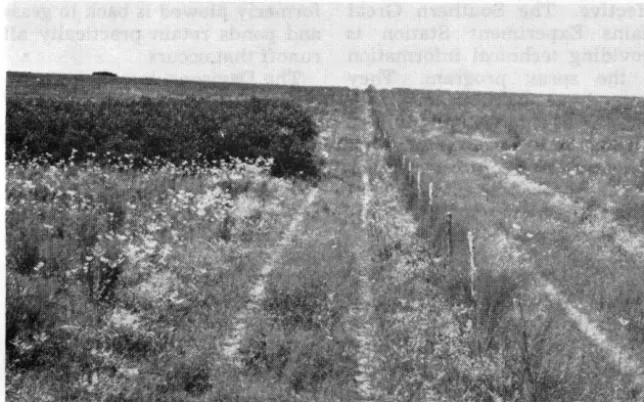
Brush control has several ad- vantages, Figure 3. It is, as they term it, the equivalent of irriga- tion and fertilization. It con- serves soil moisture by reducing competition, and also the rotting roots of plants release plant nu- trients. It also provides an op- portunity for sunlight to reach desirable plants and removes a mechanical barrier to cattle searching for grass.
The management goal is total water conservation on the range and it is being approached. Light to moderate grazing has resulted in increased insoak. All land
BUNCH
formerly plowed is back to grass and ponds retain practically all runoff that occurs.
The Davisons’ livestock opera- tion is a combination cow-calf and yearling program using reg- istered bulls on high quality purebred commercial cows. The fall calves weigh around 500 pounds at nine month weaning age without creep feeding. The spring calves are held over and sold as long yearling feeders at around 18 months. Heifers aver- age 725 pounds and steers 800 pounds.
These ranchers are modern as tomorrow in their operations. They have two-way radios con- necting homes and pickup trucks to maintain contact at all times. Four houses and four pickup trucks are linked together in this system.
Protein supplement, usually 41 percent protein c o t t o n s e e d pellets, is delivered in bulk quan- tities, not sacked. It is stored in upright tanks, augered into pick- ups equipped with mechanical unloaders and reaches the cattle untouched by human hands.
Fencing is a never-ending chore on the ranch. They build
good, four-wire barbed fence for both line and cross fences. There is more than enough fence wire on the ranch to build one wire fence from the ranch to Chicago and beyond.
A beef cattle performance test- ing program has just been started and one set of calves has been weighed. Top-producing cows are kept in an “A Herd” to produce replacement heifers. Gus and Francis feel that they have just barely scratched the possibilities of beef per acre on the ranch and that present pro- duction will continue to improve from year to year.
Of all resources, the Davisons particularly value the help of their employees, neighbors, and others interested in range con- servation. They have some of the finest people in the world to work with.
As we said in the beginning, visitors to the Berryman ranch during the forthcoming Kansas- Oklahoma section meeting will see practical and economical range conservation as practiced by the Davison brothers, two men who live the conservation rules day by day.
Effect of Herbicidal Control of Saw Palmetto
On Associated Native Forage Plants
In Peninsular Florida
J. E. McCALEB, E. M. HODGES AND C. L. DANTZMAN
Assistant A@-onomist, Agronomist and Assistant Soils
Chemist, Range Cattle Experiment Station, Ona, Florida
Native plants have been the basic livestock food since the in- troduction of beef cattle into Florida by Ponce de Leon in 1521 and Hernando de Soto in 1539. Approximately 10.2 mil- lion acres are used as native rangeland in peninsular Florida. Another million acres in this region have been improved by partial or total destruction of native vegetation and planted with more productive and nu-
tritious grasses and legumes. Livestock producers in south- central Florida flatwoods are be- coming more concerned about methods of controlling saw pal- metto and associated shrubby plants. This is the result of ris- ing value of grazeable land coupled with the increasing need for higher quality cattle feed.
Trials were started at the Range Cattle Experiment Sta- tion in August 1955 to deter-
mine: (1) response of saw pal- metto to treatment with herbi- cides; (2) changes in species composition and density of na- tive plants in treated areas and (3) comparison of carrying ca- pacity per acre and productivity of beef cattle in areas with and without herbicidal control of saw palmetto and associated shrubby plants. Only the second objective will be discussed in this manuscript.
Review of Literature
126
effective. The Southern Great Plains Experiment Station is providing technical information in the spray program. They sprayed over 3,000 acres of shin oak infested rangeland in 1960 at their own expense. This ap- plication also controlled other brush and forb species such as sand sage, smooth sumac, prick- lypear, skunk brush, and so called weeds. The brothers recognized that an inescapable price of this spray program was the damage to some n a t i v e legumes and other desirable plants.
Brush control has several ad- vantages, Figure 3. It is, as they term it, the equivalent of irriga- tion and fertilization. It con- serves soil moisture by reducing competition, and also the rotting roots of plants release plant nu- trients. It also provides an op- portunity for sunlight to reach desirable plants and removes a mechanical barrier to cattle searching for grass.
The management goal is total water conservation on the range and it is being approached. Light to moderate grazing has resulted in increased insoak. All land
BUNCH
formerly plowed is back to grass and ponds retain practically all runoff that occurs.
The Davisons’ livestock opera- tion is a combination cow-calf and yearling program using reg- istered bulls on high quality purebred commercial cows. The fall calves weigh around 500 pounds at nine month weaning age without creep feeding. The spring calves are held over and sold as long yearling feeders at around 18 months. Heifers aver- age 725 pounds and steers 800 pounds.
These ranchers are modern as tomorrow in their operations. They have two-way radios con- necting homes and pickup trucks to maintain contact at all times. Four houses and four pickup trucks are linked together in this system.
Protein supplement, usually 41 percent protein c o t t o n s e e d pellets, is delivered in bulk quan- tities, not sacked. It is stored in upright tanks, augered into pick- ups equipped with mechanical unloaders and reaches the cattle untouched by human hands.
Fencing is a never-ending chore on the ranch. They build
good, four-wire barbed fence for both line and cross fences. There is more than enough fence wire on the ranch to build one wire fence from the ranch to Chicago and beyond.
A beef cattle performance test- ing program has just been started and one set of calves has been weighed. Top-producing cows are kept in an “A Herd” to produce replacement heifers. Gus and Francis feel that they have just barely scratched the possibilities of beef per acre on the ranch and that present pro- duction will continue to improve from year to year.
Of all resources, the Davisons particularly value the help of their employees, neighbors, and others interested in range con- servation. They have some of the finest people in the world to work with.
As we said in the beginning, visitors to the Berryman ranch during the forthcoming Kansas- Oklahoma section meeting will see practical and economical range conservation as practiced by the Davison brothers, two men who live the conservation rules day by day.
Effect of Herbicidal Control of Saw Palmetto
On Associated Native Forage Plants
In Peninsular Florida
J. E. McCALEB, E. M. HODGES AND C. L. DANTZMAN
Assistant A@-onomist, Agronomist and Assistant Soils
Chemist, Range Cattle Experiment Station, Ona, Florida
Native plants have been the basic livestock food since the in- troduction of beef cattle into Florida by Ponce de Leon in 1521 and Hernando de Soto in 1539. Approximately 10.2 mil- lion acres are used as native rangeland in peninsular Florida. Another million acres in this region have been improved by partial or total destruction of native vegetation and planted with more productive and nu-
tritious grasses and legumes. Livestock producers in south- central Florida flatwoods are be- coming more concerned about methods of controlling saw pal- metto and associated shrubby plants. This is the result of ris- ing value of grazeable land coupled with the increasing need for higher quality cattle feed.
Trials were started at the Range Cattle Experiment Sta- tion in August 1955 to deter-
mine: (1) response of saw pal- metto to treatment with herbi- cides; (2) changes in species composition and density of na- tive plants in treated areas and (3) comparison of carrying ca- pacity per acre and productivity of beef cattle in areas with and without herbicidal control of saw palmetto and associated shrubby plants. Only the second objective will be discussed in this manuscript.
Review of Literature
mock, and oak-scrub sites. The pine flatwoods cover ap- proximately six million acres in central and south peninsular Florida. The soils of the region are poorly drained, inherently low in plant nutrients with a pH of 4.5 or below. Rainfall ranged from 36.6 to 78.74 inches and av- eraged 55.27 inches for the 18- year period, 1942 through 1959. For the same period 60.7 per- cent of the total precipitation fell in four months, June through September. Average temperatures for this same pe- riod ranged from a low of 49.1”F. in January to a high of 91.5”F. in June. Relatively high humidity prevails throughout much of the year. Dominating plants in this range type are saw palmetto
(Serenoa repens), gallberry (Ilex glabra) , staggerbush (Ly-
onia spp.) , huckelberry (Vuccin- ium spp.) , papaw (Asiminu spp.)
grass genera such as Aristidu, Andropogon, Punicum, Puspu- lum, Axonopus, Sorghustrum, and other grasses and grasslike plants.
Rummell (1957) found that a highly complex vegetation ex- ists in Charlotte County, Flor- ida. During the summer of 1954 he listed a total of 354 plants that showed evidence of being grazed by cattle, including 147 grass and 77 grasslike species. Existing forbs and shrubs have little grazing value compared with grasses and grasslike plants.
Saw palmetto (Small, 1933 and Baker, 1955) grows through- out the pine flatwoods region in Florida and occurs on many different sites from Louisiana to South Carolina. Plants vary in size with the stems normally creeping and copiously rooted along the underside. In more fertile areas single plants or col- onies may have oblique to erect stems rooted only at the base. Contrary to the growth habit of most palms, the stems are fre- quently much branched. The leaves, cordate at the base and
CONTROL OF SAW PALMETTO 127
TABLE 1. Plant Kill and Canopy Area Reduction of Saw Palmetto by
Check anld Treafmeni Plots.
Saw Palmetto Water: Oil Reduction Treatment’ Carrier Killed Canopy Cover
--- (Percent) - - -
Check 00.0 00.0
dalapon 100-O 38.8 65.0
20 lbs.’ 50-50 83.0 75.0
2, 4, 5-T 100-O 74.9 66.6
4 lbs’ 50-50 52.5 73.1
O-100 44.2 48.3
2,4,5-TP 100-O 69.3 74.3
4 lbs.” 50-50 66.5 78.7
O-100 49.8 68.4
2,4-D 100-O 21.8 17.9
6 lbs.’ 50-50 63.7 59.5
O-100 63.7 60.9
erbon 100-O 86.0 91.0
120 lbs.’ 50-50 80.4 73.0
O-100 66.5 68.5
1 Dalapon=2,2-dichloropropionic acid; 2,4,5-T=2,4,5-trichlorophenoxyacetic acid butoxy ethanol ester; 2,4,5-TP=2- (2,4,5-thrichlorophenoxy) propionic
acid; 2,4-D=2,4-dichlorophenoxy acetic acid butyl ester; erbon=2- (2,4,5- trichlorophenoxyl) ethyl 2,2-dichloropropionate.
“Pounds active ingredients per acre.
ranging from green to glaucous in color, have petioles with sharp recurving spines. This plant is unpalatable and is not eaten by cattle except in periods of critical forage supply or when there is a lack of bulk in the ration. The thicker clumps, how- ever, provide some protection against cold wind and/or rain, and small undisturbed areas are desirable for this purpose. Erad- ication of 70 to 80 percent of this species is within the de- sired control range. The remain- ing stands will provide adequate shelter to livestock and wildlife.
Method of Procedure Five herbicides selected from preliminary trials involving 25 chemical materials and f ormu- lations, as reported by McCaleb et al (1960)) were applied with a boom-type ground sprayer to replicated plots 12 x 60 feet in September and October 1957. The herbicides used were dalapon, 2,4,5-T, 2,4,5-TP, 2,4-D and erbon (Table 1) in cut-over pineland without tree canopy at the Range
Cattle Experiment Station.
Treatments were completed be- fore mid-day to provide maxi- mum light and temperature. Diesel fuel was mixed with wa- ter to provide three carriers con- taining 0.0, 50.0 and 100.0 per- cent oil. Equal amounts of an emulsifying agent (Dyna-wet) were used with all mixtures. Spray equipment was calibrated to deliver 60 gallons of liquid per acre. Immokalee fine sand soils prevailed throughout the plot areas.
128 McCALEB, HODGES AND DANTZMAN
uring the distance along the line intercepted by fronds and buds. Checks were left between each treatment area and the average measurements in six adjoining untreated plots were computed for comparison with the en- closed sprayed areas. Counts for all categories were averaged and shown as percent for each her- bicidal treatment.
For purposes of further evalu- ation of effects of different her- bicidal treatments, plants were grouped in the following major categories and sub-divisions.
Grasses
A Decreasers: Primarily peren- nial species of Aristida, Stipa, Andropogon, Sorghastrum genera and some Panicum and Paspalum species which decrease rapidly when heav- ily grazed and which disap- pear if subjected to continued heavy grazing. These are the most desirable native plants from the stand-point of both quality and quantity of for- age produced.
B.
C.
Increasers: Grass species of intermediate grazing value which first increase under heavy grazing and then de- crease with continued mis- use. Representative increas- ers in flatwoods pinelands include numerous species of Panicum and Paspalum. Invaders: Grasses of low for- age production and usually sod-forming if perennial. Representatives of this group are Axonopus, Cynodon, Ere- mochloa and most annual Panicum and Paspalum spe- cies. Muhlenbergia and Era- grostis also supply some feed but are relatively unimpor- tant.
Grasslike Plants
This group is composed of a large number of annual, biennial and perennial spe- cies of Cyperus and Juncus. Some provide grazing through- out the year. These plants
increase under heavy utiliza- tion and are serious invaders of improved pastures.
Forbs
This division contains all the non-toxic broad-leaved plants. Species composition within this group changes rapidly and frequently through-out the year. Forbs usually comprise less than two percent of the native up- land vegetation.
Woody Shrubs
These plants are undesirable because they compete directly with grass, grasslike plants and forbs for light, moisture and nu- trients. However, they do fur- ish shelter and seasonal feed for quail and other wildlife.
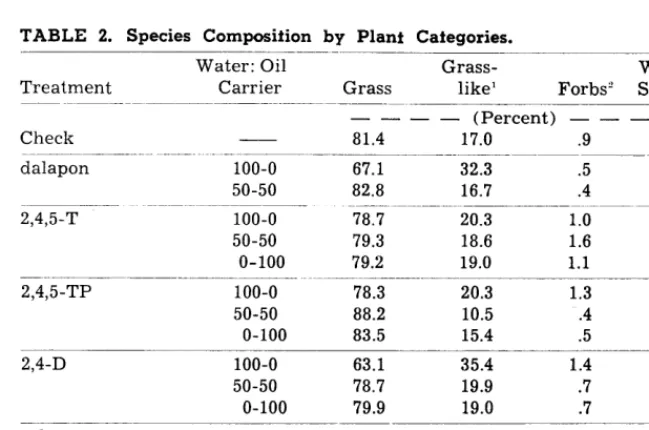
Results and Discussion The May 1959 counts of native vegetation on plots treated in September and October 1957 with five herbicides and three water to oil carriers are shown in Tables 1,2,3 and 4.
Table 1 gives the percent plant kill and canopy area reduction of saw palmetto by herbicidal agent and percent water to oil in the carrier. Plant height ranged
TABLE 2. Species Composition by -___
Water: Oil
from 12 to 48 inches at time of chemical application. Check plots for the two dates of treat- ment averaged 21.8 plants per 100 feet of intercept line and 45.7 percent canopy cover. The high- est percentage plant kill or con- trol, 86.0 percent, was obtained with erbon, a soil sterilant at the rate used. When the general area was burned in December 1959, the erbon plots did not have suf- ficient vegetation to burn sat- isfactorily. Of the translocated herbicides, 2,4,5-T in water gave the best control. It is interesting to note that percent plant kill de- creased as the amount of oil in the carrier was increased from 0 to 50 to 100 percent with 2,4,5-T, 2,4,5-TP and erbon. The low percent of plant kill with 2,4-D without oil in the carrier indicates the ineffectiveness of the herbicide and that a large share of the control was con- tributed by oil. Apparently, a synergistic action occurs when 2,4-D and oil are combined and applied to palmetto. Diesel fuel without herbicides in the solu- tion was applied to a series of plots at rates of 30 and 60 gal- lons per acre without damage to saw palmetto other than moder- ate leaf burn at the higher vol-
Plant Categories. Grass- Grass like’
Woody Forbs’ Shrubs Treatment Carrier
Check
---_ (Percent) - - - - 81.4 17.0 .9 .8
dalapon 100-O 67.1 32.3 .5 .l
50-50 82.8 16.7 .4 .l 2,4,5-T
_-____ 2,4,5-TP
100-O 50-50
O-100 100-O 50-50
O-100
78.7 20.3 1.0 .O
79.3 18.6 1.6 .5
79.2 19.0 1.1 .7
78.3 20.3 1.3 .2
88.2 10.5 .4 .9
83.5 15.4 .5 .7
2,4-D 100-O 63.1 35.4 1.4 .2
50-50 78.7 19.9 .7 .7 O-100 79.9 19.0 .7 .4
erbon 100-O 78.0 18.9 3.0 .l
50-50 68.7 28.3 2.8 .2 O-100 66.7 30.1 2.9 .3 ICarex and Juncus spp.