Setting of k
≤
N<2k-1 using Secret Sharing Scheme
Keiichi Iwamura1 and Ahmad Akmal Aminuddin Mohd Kamal2 1 Tokyo University of Science, 6-3-1 Niijuku, Katsushika-ku, Tokyo 125-8585 JAPAN
2 Tokyo University of Science, 6-3-1 Niijuku, Katsushika-ku, Tokyo 125-8585 JAPAN [email protected]
Abstract. In this paper, we describe two new protocols for secure secrecy com-putation with information theoretical security against the semi-honest adversary and the dishonest majority. Typically, unconditionally secure secrecy computa-tion using the secret sharing scheme is considered impossible under the setting of 𝒏 < 𝟐𝒌 − 𝟏. Therefore, in our previous work, we first took the approach of finding conditions required for secure secrecy computation under the setting of
𝒏 < 𝟐𝒌 − 𝟏 and realized a new technique of conditionally secure secrecy com-putation. We showed that secrecy computation using a secret sharing scheme can be realized with a semi-honest adversary with the following three preconditions: (1) the value of a secret and a random number used in secrecy multiplication does not include 0; (2) there is a set of shares on 1 that is constructed from random numbers that are unknown to the adversary; and (3) in secrecy computation in-volving consecutive computation, the position of shares in a set of shares that are handled by each server is fixed. In this paper, we differentiate the relationship between the parameter 𝒏 of (𝒌, 𝒏)-threshold secret sharing scheme and 𝑵 of the number of servers/parties, and realize secrecy computation of multiplication un-der the setting of𝒌 ≤ 𝑵 < 𝟐𝒌 − 𝟏. In addition, we improve the processing speed of our protocol by dividing the computation process into a Preprocessing Phase
and a Computation Phase and shifting the cost for communication to the Prepro-cessing Phase. This technique allows for information that does not depend on any of the private values, to be generated in advance and significantly reduce the cost of communication in the Computation Phase. For example, for secrecy com-putation without repetition, the cost for communication can be totally removed in the Computation Phase. As a result, we realize the method for secrecy compu-tation that is faster compared to conventional methods. In addition, our protocols provided solutions for the aforementioned three preconditions and realize secure secrecy computation without any limitation in terms of usability.
1
Introduction
1.1 Background
In recent years, with the improvement of big data and the internet of things (IoT), there is high anticipation regarding technology that could make use of an individual’s infor-mation. However, there is still concern among individuals about the privacy, security, and confidentiality of their information. Therefore, as a measure to solve this problem, there is a need for technology that allows for their information to be used without re-vealing anything about their privacy. One of the available technologies that could per-mit this is called secrecy computation or multiparty computation. In the setting of se-cure secrecy computation, a set of parties with private inputs wish to compute a joint function of their inputs, without revealing anything but the output. Protocols for secure secrecy computation guarantee privacy (meaning that the protocol reveals nothing but the output), correctness (meaning that the correct function is computed), and more. These security guarantees are provided in the presence of two types of adversary mod-els: semi-honest (where the adversary follows the protocol specification but may try to learn more than allowed from the protocol) and malicious (where the adversary can run any arbitrary polynomial-time attack strategy). In the information theoretic model, se-curity is obtained even in the presence of computationally unbounded adversaries. In contrast, in the computational model, security is obtained in the presence of polyno-mial-time adversaries and relies on cryptographic hardness assumptions.
There are three main approaches for constructing secure secrecy computation proto-cols:
─ Secret sharing approach [1, 5, 9, 11, 12, 16, 19, 20, 22] ─ Homomorphic encryption approach [4, 7, 8, 13, 14, 21] ─ Garbled circuit approach [3, 24].
However, homomorphic encryption is known to be costly in term of computational cost. Therefore, approaches with lower computational cost are preferable to homomorphic encryption when considering utilization in a cloud system. On one hand, the garbled circuit approach yields protocols with a constant number of rounds, therefore, outper-forming secret sharing based protocols, which have a number of rounds that is linear in the depth of the circuit being computed in high-latency networks. On the other hand, protocols based on secret sharing typically have low bandwidth, and given that band-width is often a bottleneck, it follows that protocols with low communication have the potential to achieve much higher throughput. Note that the secret sharing approach typ-ically relies on simple operations making them fast. However, as far as we know, no protocols achieve low communication while realizing information theoretical security under the setting of 𝑛 < 2𝑘 − 1. From now on, 𝑛 < 2𝑘 − 1 means 𝑘 ≤ 𝑛 < 2𝑘 − 1.
1.2 Our Results
cryptography for data encryption, in which a single data is divided into multiple shares, which are then distributed to multiple users. A known example of a secret sharing scheme is Shamir’s (𝑘, 𝑛) threshold secret sharing scheme [17]. In this scheme, a secret 𝑠 is divided into 𝑛 number of shares. The original secret 𝑠 could only be reconstructed or retrieved from a threshold 𝑘 number of shares. That is, any 𝑘 − 1 or smaller number of shares reveals nothing about the original secret. However, there are a few major challenges. Secure computation using a secret sharing scheme can perform secrecy ad-dition and subtraction easily. However, this is not so in the case of secrecy multiplica-tion, where the degree of a polynomial changes from 𝑘 − 1 to 2𝑘 − 2 for each multi-plication of polynomials. To restore the multimulti-plication result, the number of shares re-quired increases from 𝑘 to 2𝑘 − 1. This problem was solved by Shingu et al. through the TUS1 method [19], where the secret is first encrypted with a random number. When performing secrecy multiplication, the encrypted secret is momentarily restored as a scalar value and multiplication is realized using the (𝑠𝑐𝑎𝑙𝑎𝑟 𝑣𝑎𝑙𝑢𝑒 × 𝑝𝑜𝑙𝑦𝑛𝑜𝑚𝑖𝑎𝑙) ap-proach to prevent an increase in the polynomial degree. However, the TUS1 method introduced another problem: when computation involving a combination of operations, such as that of 𝑎𝑏 + 𝑐, is performed, if the adversary has information about one of the inputs and outputs, he/she can specify the value of the remaining two inputs. This prob-lem was solved by Mohd Kamal et al. through the TUS2 method [16], by introducing the concept of conditionally secure secrecy computation. Typically, unconditionally secure secrecy computation is considered impossible under the setting of 𝑛 < 2𝑘 − 1. In contrast, this means that secure secrecy computation using a secret sharing scheme is possible with certain conditions. Therefore, Mohd Kamal et al. proposed three con-ditions as shown below, and realized a new method to solve the problem of the TUS1 method. Note that both methods share a common point where the secret information is first encrypted with a random number and is then used in the actual secrecy computa-tion.
─ Condition 1: The value of a secret and a random number used in secrecy multiplica-tion does not include 0.
─ Condition 2: There is a set of shares on 1 that is constructed from random numbers that are unknown to the adversary.
─ Condition 3: In secrecy computation involving consecutive computation, the posi-tion of shares in a set of shares that are handled by each server is fixed.
However, introduction of the aforementioned conditions limits the usability of the TUS2 method. In addition, the TUS2 method requires a large computational cost, thus making it slow.
Therefore, in this paper, we propose protocols to solve these three conditions and realize secure secrecy computation without any limitation in terms of usability. Fur-thermore, our protocol significantly reduces the communication cost compared to con-ventional methods and realizes a faster secrecy computation.
New protocols
New Protocol 1:
In the conventional method of secrecy computation using a secret sharing scheme, to restore the multiplication result, the number of shares required increases from 𝑘 to 2𝑘 − 1. Therefore, the number of servers/parties (parameter 𝑛) needs to be more than 2𝑘 − 1. Due to this, unconditionally secure secrecy computation is considered impos-sible under the setting of 𝑛 < 2𝑘 − 1.In our new protocol 1, we differentiate the re-lationship between the parameter 𝑛 required in the (𝑘, 𝑛)-threshold secret sharing scheme and parameter 𝑁, which is defined as the number of servers/parties participat-ing in the computation, realizparticipat-ing a secrecy computation usparticipat-ing a secret sharparticipat-ing scheme with the parameters of 𝑘 ≤ 𝑁 < 2𝑘 − 1, 𝑛 ≥ 2𝑘 − 1. In other words, the number of servers/parties remained at 𝑘 ≤ 𝑁 < 2𝑘 − 1, but secrecy computation is realized under 𝑛 ≥ 2𝑘 − 1. By using this technique, we were able to produce the set of shares on 1, proposed in Condition 2 of the TUS2 method. Therefore, our protocol realizes a secure secrecy computation of multiplication using a secret sharing scheme while maintaining the number of servers/parties at less than 2𝑘 − 1. From now on, 𝑁 < 2𝑘 − 1 also means 𝑘 ≤ 𝑁 < 2𝑘 − 1.
New Protocol 2:
In order to prevent the degree of a polynomial changing from 𝑘 − 1 to 2𝑘 − 2 for each multiplication between polynomials, secrecy computation proposed thus far re-quired extra cost for both communication and computation. In our new protocol 2, we divide the computation process into a Preprocessing Phase and a Computation Phase. The new techniques used here allow us to shift parts of the communication cost to the Preprocessing Phase, where raw material that does not depend on any of the private values can be generated at convenience. As we shall see later, this can be used to sig-nificantly reduce the communication cost in the Computation Phase, and significantly speed up the Computation Phase. For example, when performing computation with repetition, communication between the servers/parties are required to reconstruct the result before being used as input for the consecutive multiplication. In contrast, when performing computation without repetition, because no reconstruction of result is re-quired, the Computation Phase could be computed with zero communication cost. Security
We show that our protocols are secure in the presence of semi-honest adversaries with at most 𝑘 − 1 corrupted servers, under the standard information entropy-based definitions. The basis of our protocol is information theoretic. In addition to the above, our proposed model of secrecy computation is based on a client/server model where any number of clients send shares of their inputs to 𝑛 servers that carry out the compu-tation for the clients and return the results to them, without learning anything. This model is widely used nowadays and is the business model used in Sharemind [18]. Our protocols are designed to be flexible with a dishonest majority, any number of 𝑛 parties and, at most, 𝑘 − 1 corrupted parties. This is unlike Araki et al.’s method [1] that works for only a fixed number of 3 parties, with at most one corrupted party.
in Chapter 5, we present our second new protocol and solution for Condition 1 of the TUS2 method. In addition, in Chapter 6, we discuss the solution for Condition 3 and the features of our protocol. Finally, in Chapter 7, we compare our protocol with con-ventional works and show that our protocol can achieve a faster computation speed, especially when performing computation without repetition.
2
Related Works
Most of the work on concretely efficient secure secrecy computation has focused on the dishonest majority case. For example, the SPDZ 2 protocol [13] introduced a com-putationally secure multiparty computation with dishonest majority through implemen-tation of homomorphic encryption. In the setting of an honest majority, to the best of our knowledge, the method by Araki et al. [1] is the only highly efficient protocol with security for semi-honest adversaries. We will present a detailed comparison of our pro-tocol in Section 7.
2.1 SPDZ 2 Method by Damgård et al. [13]
Damgård et al. proposed a secure multiparty computation called SPDZ 2 that utilizes a somewhat homomorphic encryption (SHE) and is secure against a dishonest majority under the setting 𝑛 = 𝑘. In SPDZ 2, the owner of the secret is one of 𝑛 players involved in the multiparty computation. Moreover, in SPDZ 2, even when 𝑛 − 1 players form a coalition, provided that the owner keeps his/her share of the secret secure, the original secret cannot be reconstructed from 𝑛 − 1 shares.
SPDZ 2 consists of a preprocessing and an online phase. It ensures the confidenti-ality of inputted secrets by using an additive secret sharing scheme. Through the SPDZ 2 method, secrecy addition is easily achievable. Secrecy multiplication in SPDZ 2 is based on Beaver’s circuit randomization [2]. To perform secrecy multiplication, shares of random numbers 〈𝑎〉, 〈𝑏〉, 〈𝑐〉 , called a multiplicative triple, which satisfy 𝑎 ∙ 𝑏 = 𝑐, are used.
In SPDZ 2, for example, the process where the secret information of 𝑥 is recon-structed from its shares 〈𝑥〉 is denoted as 𝑥 = 𝑜𝑝𝑒𝑛(〈𝑥〉). The protocol for multiplica-tion of 𝑥 ∙ 𝑦 proposed by SPDZ 2 is shown below. However, the construcmultiplica-tion of a mul-tiplication triple requires fully homomorphic encryption (FHE) [14], where the compu-tation cost is expensive, thus increasing the overall process time significantly. 1. Prepare the multiplication triple 〈𝑎〉, 〈𝑏〉, 〈𝑐〉 (Offline Phase).
2. Compute shares 〈𝑥〉, 〈𝑦〉 on secret 𝑥, 𝑦 (Distribution Phase).
2.2 Araki et al.’s Method [1]
Typically, in a secure secrecy computation, the cost for communication between servers could affect the overall processing speed more than the actual cost of computation. Therefore, Araki et al. proposed a very fast method of secrecy computation under the parameters 𝑛 = 3, 𝑘 = 2, that require only 1 times of communication per multiplica-tion. The detail protocol is shown below. Note that it is usually not considered a prob-lem, even if communications are required in the Preprocessing Phase. In addition, se-crecy computation of addition is performed locally, where the shares are added to-gether.
Preprocessing Phase: Generation of correlated randomness
1.Players 𝑃 , 𝑃 , 𝑃 generate and hold 𝛽 , 𝛽 , 𝛽 ∈ 𝑍 , where 𝛽 + 𝛽 + 𝛽 = 0.
Computation Phase: Distribution
1. Dealer D chooses a random number 𝑥 , 𝑥 , 𝑥 ∈ 𝑍 , where 𝑥 + 𝑥 + 𝑥 = 0. 2. Dealer D sends a share (𝑥 , 𝑎 ) of the secret 𝑣 to players 𝑃. 𝑎 is computed as 𝑎 =
𝑥 − 𝑣 (𝑖 = 1,2,3).
3. Dealer D performs the same process on secret 𝑣 , producing share (𝑦 , 𝑏 ) for play-ers 𝑃. Note that 𝑏 = 𝑦 − 𝑣 , 𝑦 + 𝑦 + 𝑦 = 0.
Multiplication
1. Players 𝑃 compute 𝑟 = (𝑎 𝑏 − 𝑥 𝑦 + 𝛽 ) 3⁄ and send to players 𝑃 .
2. Players 𝑃 compute 𝑧 = 𝑟 − 𝑟 , 𝑐 = −2𝑟 − 𝑟 and hold (𝑧 , 𝑐 ) as a share on the result of multiplication of 𝑣 𝑣 .
Reconstruction
1. From information 𝑧 , 𝑐 , 𝑧 , 𝑐 of Player 𝑃 and Player 𝑃, the result of multiplication 𝑣 𝑣 can be computed using the equation shown below. Note that 𝑐 = −2𝑟 − 𝑟 = 𝑧 − 𝑣 𝑣 .
𝑧𝑗− 𝑐𝑖 = 𝑣1𝑣2
3
Building Blocks and Sub-Protocols
3.1 (𝒌, 𝒏) threshold secret-sharing scheme
A secret sharing scheme that satisfies both the conditions stated below is known as the (𝑘, 𝑛) threshold secret-sharing scheme.
Any 𝑘 and above number of shares will allow for the reconstruction of the original secret information 𝑠.
The classic methods of the (𝑘, 𝑛) threshold secret sharing scheme are Shamir’s (𝑘, 𝑛) threshold secret sharing scheme [17](Shamir’s method) and the XOR-based method for sharing and reconstruction of secret information proposed by Kurihara et al. [15] (XOR method). In our protocol, unless stated otherwise, Shamir’s method is used, and all computations are performed in modulus 𝑝. In addition, shares of secret information, 𝑠, are represented by [𝑠]
3.2 Ben-Or’s Method [5]
Multiplication of the 𝑘-degree polynomial 𝑓(𝑥), 𝑔(𝑥) will result in ℎ(𝑥) = 𝑓(𝑥) × 𝑔(𝑥) with a degree of 2𝑘. Therefore, at least 2𝑘 + 1 number of shares are required for reconstructing ℎ(𝑥). Here, Ben-Or proposed a method of reducing the degree of the polynomial of ℎ(𝑥) from 2𝑘 to 𝑘, where each coefficient of ℎ(𝑥) is randomized.
However, this method does not change the limitation where the required number of shares 𝑛 for reconstruction must be 𝑛 ≥ 2𝑘 + 1. In this method, by using matrix 𝐴 shown below, 𝑅 = 𝑊・𝐴 is computed in regard to a vector of shares 𝑊 = (𝑊 , 𝑊 , … , 𝑊 ) with a degree of 2𝑘, producing a vector of shares 𝑅 = (𝑅 , 𝑅 , … , 𝑅 ) with a degree of 𝑘.
𝐴 =
𝑎 , ⋯ 𝑎 ,
⋮ ⋱ ⋮
𝑎 , ⋯ 𝑎 ,
(1)
3.3 The TUS Methods
First, Shingu et al. proposed a 2-inputs-1-output computation named the TUS1 method [19], where the secret is first encrypted with a random number. When performing se-crecy multiplication, the encrypted secret is momentarily restored as a scalar value and multiplication is realized using the (𝑠𝑐𝑎𝑙𝑎𝑟 𝑣𝑎𝑙𝑢𝑒 × 𝑝𝑜𝑙𝑦𝑛𝑜𝑚𝑖𝑎𝑙) approach to pre-vent an increase in the polynomial degree. However, the TUS1 method introduced an-other problem: when computation involving a combination of operations, such as that of 𝑎𝑏 + 𝑐, is performed, if the adversary has information about one of the inputs and outputs, he/she can specify the value of the remaining two inputs. Therefore, condition where computation involving a combination of addition/subtraction and multiplica-tion/division is not performed is needed, in addition to the existing condition where the input of the secret does not include the value 0. Therefore, the TUS1 method could realize a very effective specific computation such as a computation of RSA encryption. However, it is not capable of coping with computation that requires a combination of addition/subtraction and multiplication/division.
is secure against computation that involves a combination of product-sum operation. Therefore, this method could realize any arithmetic computation under the setting of 𝑛 < 2𝑘 − 1. However, the TUS 2 method requires much more computational cost com-pared to the conventional method in 𝑛 ≥ 2𝑘 − 1, so it is not the most efficient method.
Because of this, Tokita et al. proposed an improved version of the TUS 2 method, known as the TUS 3 method, where XOR based secret sharing [15] is introduced and realizes a more efficient method of secrecy computation [20]. Out of the aforemen-tioned three conditions, the TUS 3 method proposed a way to ease one of the conditions (known as the TUS3’ method); however, the three conditions still remain. Note that all TUS methods share a common point where the secret information is first encrypted with a random number, and is then used in the secrecy computation using a secret shar-ing scheme.
4
Proposed Method 1
4.1 Secrecy Multiplication for 𝑵 < 𝟐𝒌 − 𝟏 and Solution for Condition 2
In the TUS method, it is proposed that in Condition 2 there is a set of shares on 1 that is constructed from random numbers that are unknown to the adversary, as defined be-low.
[𝜀] = [𝜀] , [𝜀 ] , … , [𝜀 ] (2)
Here, 𝜀 = ∏ 𝜀 is defined as a random number unknown to the adversary. However, in order to produce a set of shares on 1, shown above, multiplication 𝜀 = ∏ 𝜀 of random numbers 𝜀 (𝑗 = 0, 1, … , 𝑘 − 1) is required. However, it is known that uncon-ditionally secure multiparty computation is considered impossible under the setting of 𝑛 < 2𝑘 − 1. Therefore, our protocol introduces the approach of differentiating the re-lationship between parameter 𝑁, which is the number of servers/players that is actually needed, and parameter 𝑛 of secret sharing scheme, and realizing computation under the parameter setting of 𝑁 < 2𝑘 − 1, 𝑛 ≥ 2𝑘 − 1. Because of this, we could extend the work of Ben-Or where 𝑁 = 𝑛 ≥ 2𝑘 − 1 is assumed, into a protocol that can be realized even when 𝑁 < 2𝑘 − 1, 𝑛 ≥ 2𝑘 − 1.
In this section, for ease of understanding, [𝑎]( ) is defined as shares of 𝑎 where the number of shares required for reconstructing 𝑎 is 𝑘. Below, 𝑎, are elements of matrix A of Ben-Or’s method (we include the computation of Matrix A for 𝑘 = 3 in Appendix 3), and 0, 0′ are used in order to differentiate between the shares of 0 that had been distributed by different polynomials. In the protocol below, random numbers are chosen from uniformly distributed random numbers and do not include the value of 0. In addi-tion, all values are chosen from finite field 𝐺𝐹(𝑝), and all computations including the secret sharing are performed in modulus 𝑝. We also presume there exists a secure com-munication between the players and servers.
For ease of understanding, we include the computation for 𝑁 = 𝑘 = 3 from Step 4 to Step 8 in Appendix 1.
Protocol 4.1: Secrecy multiplication for 𝑵 < 𝟐𝒌 − 𝟏
1. Player 𝑃 generates random numbers 𝛼 , … , 𝛼 , computes 𝛼 = ∏ 𝛼 and dis-tributes secret information 𝜆 using (𝑘, 2𝑘) Shamir’s method. Then, computes [𝛼𝜆 ]( )= 𝛼 × [𝜆 ]( ), [𝛼𝜆 ]( ) = 𝛼 × [𝜆 ]( )(𝑖 = 0, … , 𝑘 − 1) and sends [𝛼𝜆 ]( ), [𝛼𝜆 ]( ), 𝛼 to servers 𝑆.
2. Player 𝑃 generates random numbers 𝛽 , … , 𝛽 , computes 𝛽 = ∏ 𝛽 and dis-tributes secret information 𝜆 using (𝑘, 2𝑘) Shamir’s method. Then, computes [𝛽𝜆 ]( )= 𝛽 × [𝜆 ]( ), [𝛽𝜆 ]( ) = 𝛽 × [𝜆 ]( )(𝑖 = 0, … , 𝑘 − 1) and sends [𝛽𝜆 ]( ), [𝛽𝜆 ]( ), 𝛽 to servers 𝑆.
3. Player 𝑃 generates random numbers 𝛾 , … , 𝛾 , computes 𝛾 = ∏ 𝛾 and 𝛾𝜆 using secret information 𝜆 , sends 𝛾𝜆 to all servers and 𝛾 to servers 𝑆.
4. Servers 𝑆 compute 𝛼 𝛽 𝛾, distribute 0 using (2𝑘, 2𝑘) Shamir’s method, compute the following and send [𝛼 𝛽 𝛾 𝜆 𝜆 𝜆 ]′( ), [𝛼 𝛽 𝛾 𝜆 𝜆 𝜆 ]′( ) and shares of 0 (except for [0 ]( ), [0 ]( )) to server 𝑆 ( ). However, 𝛼 that does not in-clude 𝛼 is denoted as 𝛼 .
[𝛼𝛽𝛾𝜆 𝜆 𝛾𝜆 ]( )= [𝛼𝜆 ]( )× [𝛽𝜆 ]( )× 𝛾𝜆
[𝛼𝛽𝛾𝜆 𝜆 𝛾𝜆 ]( )= [𝛼𝜆 ]( ) × [𝛽𝜆 ]( ) × 𝛾𝜆
[𝛼 𝛽 𝛾 𝜆 𝜆 𝜆 ]′( ) =[𝛼𝛽𝛾𝜆 𝜆 𝛾𝜆 ]
( )
𝛼 𝛽 𝛾 + [0 ] ( )
[𝛼 𝛽 𝛾 𝜆 𝜆 𝜆 ]′( ) =[𝛼𝛽𝛾𝜆 𝜆 𝛾𝜆 ]
( )
𝛼 𝛽 𝛾 + [0 ] ( )
𝛼 ( ,…, )𝛽 ( ,…, )𝛾 ( ,…, )𝜆 𝜆 𝜆 ′ ( )
= 𝛼 ( ,…, )𝛽 ( ,…, )𝛾 ( ,…, )𝜆 𝜆 𝜆 ′ ( )
𝛼 𝛽 𝛾 + [0′ ]
( )
𝛼 ( ,…, )𝛽 ( ,…, )𝛾 ( ,…, )𝜆 𝜆 𝜆 ′ ( )
= 𝛼 ( ,…, )𝛽 ( ,…, )𝛾 ( ,…, )𝜆 𝜆 𝜆 ′ ( )
𝛼 𝛽 𝛾 + [0′ ]
( )
[0 …] ( )
=[0 … ] ( )
𝛼 𝛽 𝛾 + [0′ ] ( )
6. After the (𝑘 − 1)-th round, servers 𝑆 collect 0…
( ) , 0…
( ) (𝑗 = 0, … , 𝑘 − 1) that correspond to its own [𝜆 𝜆 𝜆 ]′( ), [𝜆 𝜆 𝜆 ]′( ) , add them to-gether and produce [𝜆 𝜆 𝜆 ]"( ),[𝜆 𝜆 𝜆 ]"( ) .
7. Servers 𝑆 distribute 0" using (𝑘, 𝑁) Shamir’s method, compute the following for 𝑗 = 0, … , 𝑁 − 1, and send 𝑅, to servers 𝑆.
𝑅, = 𝑎, × [𝜆 𝜆 𝜆 ]" ( )
+ 𝑎, × [𝜆 𝜆 𝜆 ]" ( )
+ [0" ]( )
8. Servers 𝑆 compute [𝜆]( )= ∑ 𝑅,, and obtain [𝜆] ( )
. However, note that 𝜆 = 𝜆 𝜆 𝜆 .
When performing reconstruction of the multiplication result, the player only needs to collect 𝑘 numbers of [𝜆]( ) and reconstruct the result of 𝜆. In addition, if 𝑘 number of players distribute 𝜆 , … , 𝜆 as random numbers 𝜀 , … , 𝜀 in Steps 1 and 2, using the (𝑘, 𝑁) XOR method, servers 𝑆 can obtain set of shares on 1 as shown above.
In addition, in Step 7 of the above protocol, if 𝑁 ≥ 𝑘 and computation is performed until 𝑅, is computed and sent to 𝑁 number of servers, the above protocol can also accommodate the case of 𝑁 ≥ 𝑘.
4.2 Security Analysis on Secrecy Multiplication for 𝒌 ≤ 𝑵 < 𝟐𝒌 − 𝟏
We assumed that there were 𝑢 number of players. In this case, 𝜆 , … , 𝜆 is secret in-formation, and ∏ 𝜆 is the result of secrecy multiplication. Here, we assumed that the adversary had information from 𝑘 − 1 number of servers. First, we defined 𝑢 − 2 number of players and the player who reconstructed the result as Adversary 1 and the adversary attempting to learn about the secret information of the remaining players. Next, we defined 𝑢 − 1 number of players as Adversary 2 and the adversary attempting to learn about the secret information of the remaining players and the result of the se-crecy computation.
We suppose that Players 𝑃 , … , 𝑃 and the player who reconstructed the result are Adversary 1. In addition, Adversary 1 has information from servers 𝑆 , … , 𝑆 . In this case, if Adversary 1 managed to learn about secret information 𝜆 , 𝜆 of the re-maining players 𝑃 , 𝑃 , the attack would be considered as successful.
From Step 3, Adversary 1 learns from players 𝑃 , 𝑃 about encrypted infor-mation 𝜔𝜆 , 𝜁𝜆 and random numbers 𝜔 , … , 𝜔 , 𝜁 , … , 𝜁 which were used to construct random numbers 𝜔, 𝜁. Therefore, Adversary 1 also learns about random numbers 𝜔 𝜆 and 𝜁 𝜆 . However, because secret information 𝜆 , 𝜆 does not consist of value 0, and Adversary 1 has no information on 𝜔 , 𝜁 , the adversary will not be able to identify information of 𝜆 , 𝜆 . In addition, in Step 4,
Adversary 1 learns about [0 ]( ), [0 ]( )(𝑖 = 0, … , 𝑘 − 2) from server 𝑆 .
Be-cause the constant for these are the value 0, it can be solved if 2𝑘 − 1 number of shares are collected; however, because Adversary 1 only knows 2𝑘 − 2 number of shares, it cannot be solved. From Step 5 and onwards, because shares of value 0 is added to all information that is being sent, even if the original value is known it cannot be solved. In addition, because Adversary 1 has 𝑘 numbers of [𝜆]( ) in the reconstruction process, from the computation result of 𝜆 and information of 𝜆 , … , 𝜆 from 𝑢 − 2 number of players, the adversary will be able to learn about 𝜆 𝜆 . However, it cannot be de-composed into 𝜆 , 𝜆 . Therefore, Adversary 1 cannot learn about each individual information of 𝜆 , 𝜆 . The same can be said even if Adversary 1 learns about other combinations of 𝑘 − 1 number of servers. In addition, it is also obvious that the same can be said even if the combination of players is changed. Therefore, we can state that the algorithm shown above is secure.
Proof of Security against Adversary 2
Suppose that the players 𝑃 ,…,𝑃 make up Adversary 2 and the adversary also has information from servers 𝑆 , … , 𝑆 . In this case, the attack will be considered suc-cessful if Adversary 2 learns about input 𝜆 or the result of computation ∏ 𝜆. From Step 3, Adversary 2 learns from player 𝑃 about encrypted information 𝜁𝜆 and random numbers 𝜁 , … , 𝜁 used to construct random number 𝜁. Therefore,
Ad-versary 2 also learns about 𝜁 𝜆 . However, because secret information 𝜆 does
𝐻(𝜆 ) = 𝐻(𝜆 |𝑖𝑛𝑓𝑜𝑟𝑚𝑎𝑡𝑖𝑜𝑛 𝑜𝑓 𝑢
− 2 𝑛𝑢𝑚𝑏𝑒𝑟 𝑜𝑓 𝑝𝑙𝑎𝑦𝑒𝑟𝑠 𝑡ℎ𝑎𝑡 ℎ𝑎𝑣𝑒 𝑛𝑜 𝑖𝑛𝑓𝑜𝑟𝑚𝑎𝑡𝑖𝑜𝑛 𝑜𝑛 𝜆 + 𝑖𝑛𝑓𝑜𝑟𝑚𝑎𝑡𝑖𝑜𝑛 𝑜𝑓 𝑝𝑙𝑎𝑦𝑒𝑟 𝑤ℎ𝑜 𝑟𝑒𝑐𝑜𝑛𝑠𝑡𝑟𝑢𝑐𝑡𝑒𝑑 𝑡ℎ𝑒 𝑟𝑒𝑠𝑢𝑙𝑡 + 𝑖𝑛𝑓𝑜𝑟𝑚𝑎𝑡𝑖𝑜𝑛 𝑓𝑟𝑜𝑚 𝑘 − 1 𝑛𝑢𝑚𝑏𝑒𝑟 𝑜𝑓 𝑠𝑒𝑟𝑣𝑒𝑟𝑠)
𝐻(𝜆 ) = 𝐻(𝜆 |𝑖𝑛𝑓𝑜𝑟𝑚𝑎𝑡𝑖𝑜𝑛 𝑜𝑓 𝑎𝑙𝑙 𝑝𝑙𝑎𝑦𝑒𝑟𝑠 𝑡ℎ𝑎𝑡 ℎ𝑎𝑣𝑒 𝑛𝑜 𝑖𝑛𝑓𝑜𝑟𝑚𝑎𝑡𝑖𝑜𝑛 𝑜𝑛 𝜆 + 𝑖𝑛𝑓𝑜𝑟𝑚𝑎𝑡𝑖𝑜𝑛 𝑓𝑟𝑜𝑚 𝑘 − 1 𝑛𝑢𝑚𝑏𝑒𝑟 𝑜𝑓 𝑠𝑒𝑟𝑣𝑒𝑟𝑠)
𝐻(𝜆 𝜆 𝜆 ) = 𝐻(𝜆 𝜆 𝜆 |𝑖𝑛𝑓𝑜𝑟𝑚𝑎𝑡𝑖𝑜𝑛 𝑜𝑓 𝑢 − 1 𝑛𝑢𝑚𝑏𝑒𝑟 𝑜𝑓 𝑝𝑙𝑎𝑦𝑒𝑟𝑠 + 𝑖𝑛𝑓𝑜𝑟𝑚𝑎𝑡𝑖𝑜𝑛 𝑓𝑟𝑜𝑚 𝑘 − 1 𝑛𝑢𝑚𝑏𝑒𝑟 𝑜𝑓 𝑠𝑒𝑟𝑣𝑒𝑟𝑠)
In regard to the set of shares on secret 1, 𝑘 number of players are required to distribute 𝜀 , … , 𝜀 using (𝑘, 𝑁) XOR instead of 𝜆 , … , 𝜆 in Steps 1, 2. This is considered to be independent of the secrecy multiplication, thus it is clear that even by adding this process it will still be secure.
4.3 Verification of the Result of Secrecy Multiplication
If any of the players or servers perform different processes other than as shown in Sec-tion 4.1, result [𝜆] will be computed but it will not be a correct result of multiplication. Here, we need to think about the verification of the result of secrecy multiplication generated by 𝑘 number of servers from Section 4.1. In order to do that, we first assumed that each server held another different result of secrecy multiplication, namely ([𝜇 ] , 𝜇 ,). Here, ([𝜇 ] , 𝜇 ,) is also generated from the protocol shown in Section 4.1.
From above, the verification of ([𝜆] , 𝜆) produced in Section 4.1 can be performed as follows:
Protocol 4.3: Verification of the Result of Secrecy Multiplication
1. Servers 𝑆 or Player 𝑃 compute 𝜆 /𝜇 , and broadcast it. 2. Servers 𝑆 compute the following and broadcast [0′].
[𝜆′] = 𝜆 𝜇 ,
× … × 𝜆 𝜇 ,
× [𝜇 ] (3)
[0′] = [𝜆′] − [𝜆] (4)
3. Servers 𝑆 reconstruct [0′] and verify whether it it is equal to 0. If the reconstructed result is equal to 0, the result of secrecy multiplication ([𝜆] , 𝜆) is correct; if the reconstructed result is not equal to 0, the result of secrecy multiplication has been corrupted
Case 1: We suppose a situation where one of the results of secrecy computation ([𝜇 ] , 𝜇 ,), ([𝜆] , 𝜆 ) is incorrect, without adversary.
However, because one of these is correct, for example, if 𝜇 is assumed to be 𝜇 = 𝜌 (∏ 𝜇 ,), from equation (3), [𝜆′] will become [𝜆′] = 𝜌 ∏ 𝜆 × [1]. Thus, it will not be a matched with [𝜆] and the reconstruction result of [0′] will not equal to 0, resulting in multiplication deemed as incorrect. However, in this case ([𝜆] , 𝜆 ) is assumed to be correct. We can also think about the opposite situation of judging the incorrect result by giving priority to safety.
Case 2: We suppose a situation where both results of the secrecy computation ([𝜇 ] , 𝜇 ,) and ([𝜆] , 𝜆 ) are incorrect, without adversary.
If we assumed that 𝜇 = 𝜌 ∏ 𝜇 , ,𝜆 = 𝜌 (∏ 𝜆 ), equation (3) will become [𝜆′] = 𝜌 ∏ 𝜆 × [1] , and equation (4) will become (𝜌 − 𝜌 ) × ∏ 𝜆 × [1]. Therefore, only when both 𝜌 and 𝜌 coincidently match, reconstruction of [0′] will produce a value of 0, causing an error in the verification process. If the verification process is repeated by changing ([𝜇 ] , 𝜇,) to ([𝜇 ] , 𝜇 ,)(ℎ = 2,3 …), the percentage for errors to occur in verification of ([𝜆] , 𝜆 ) can be arbitrarily reduced.
Case 3: We suppose a situation where the adversary makes use of servers that it had taken over and tried to output false result of multiplication and at the same time tried to establish equations (3) and (4).
From the proof of security against Adversary 2 in Section 4.2, even if players and serv-ers are dishonest, no one can learn about the result of the secrecy multiplication. In other words, because the adversary has no information on [𝜆 𝜆 𝜆 ]"( ), [𝜆 𝜆 𝜆 ]"( ) held by an honest server, the adversary cannot learn about the result of the secrecy multiplication. Therefore, because the adversary has no information on 𝜆 and 𝜇 , the adversary will not be able to learn about 𝜌 , 𝜌 , which are required to estab-lish equations (3) and (4). The detail of the proof is shown in Appendix 2.
Case 4: We suppose a situation where the adversary performs protocol in Section 4.1 correctly and obtains the correct result of multiplication. However, the adversary tries to establish equations (3) and (4) by outputting false values.
(3) and (4) only guarantee the correctness of the result of secrecy multiplication but not the correctness of the reconstructed value 𝜆. In other words, the problem whether cor-rect shares of multiplication (including the reconstruction of 𝜆) are used for the consec-utive secrecy computation will depend on the verification process of that particular se-crecy computation
From above, in regard to multiple [𝜇 ] , 𝜇 , , if equations (3) and (4) are estab-lished, we can conclude that the multiplication protocol shown in Section 4.1 had been performed correctly.
4.4 Implementation into generation of Multiplication Triple
In the offline phase (preprocessing phase) of the SPDZ method, “Multiplication Triple” is generated by using homomorphic encryption. Even when using the SPDZ 2 method, if the number of servers/parties is at 𝑁 = 𝑘 no substantial problem will occur, even without the use of homomorphic encryption. Therefore, we will show the method of generating multiplication triple using our proposed method. Below, we show the algo-rithm for 𝑢 number of players. By this, SPDZ 2 can also be improved with faster pro-cessing speed and realization of information-theoretical security.
Protocol 4.4: Generation of multiplication triple for 𝑵 = 𝒌
1. 𝑢 number of players 𝑃 each generates random numbers 𝜆 , and 𝜆 ,, and computes 𝜆 = 𝜆 ,𝜆,.
2. In regard to 𝜆 , 𝑢 number of players perform secrecy multiplication as shown in Sec-tion 4.1 and obtain [𝜆]( ). Note that 𝜆 = 𝜆 … 𝜆 .
3. In regard to 𝜆 ,, 𝑢 number of players perform secrecy multiplication as shown in Section 4.1 and obtain [𝜆 ]( ). Note that 𝜆 = 𝜆 , … 𝜆 , .
4. In regard to 𝜆,, 𝑢 number of players perform secrecy multiplication as shown in Section 4.1 and obtain [𝜆 ]( ). Note that 𝜆 = 𝜆 , … 𝜆 ,
Suppose that when 𝜆 = 𝑎, 𝜆 = 𝑏, 𝜆 = 𝑎𝑏, “Multiplication Triple” can be obtained. In addition, it is obvious that the security for this algorithm can be proven the same way as shown in Sections 4.2. and 4.3.
4.5 Generation of Set of Shares on 1 When the Same Participant Participates in the Secrecy Computation of the TUS methods
required. In order to omit Condition 3, Player 𝑃 in Section 4.1 must be replaced with servers 𝑆. In this case, the adversary will be able to learn information from at most 𝑘 − 1 number of servers; however, this is the same as Adversary 2 shown in 4.2, where 𝑢 − 1 = 𝑘 − 1 number of players (who provide inputs) are attacked. Because our proposed method is secure against this, it is not a problem. Therefore, in the case where the player who provided input in Section 4.1 is the participant for the secrecy computation, if servers 𝑆 generate random numbers 𝜆 and store them to be used in the Computation Phase, even if 𝑘 − 1 numbers of 𝜀 are leaked, random number 𝜀, which is the result of multiplication, is not known.
In addition, because random number 𝜆, which is the input for Multiplication Triple and the set of shares on 1, does not need to include the value of 0, leakage of the result will not occur.
5
Proposed Method 2
By dividing the computation process into a Preprocessing Phase and a Computation Phase, it allows us to shift parts of the computation that require communication to the Preprocessing Phase, where information that does not depend on any of the private values can be generated in advance. This can be used to significantly reduce the cost for communication in the Computation Phase and speed up the whole process. When computation is performed without repetition, the Computation Phase can be performed without any communication cost. However, when computation is performed with rep-etition, communication between servers is required during reconstruction. Here, com-putation with repetition means that the result of comcom-putation is reconstructed tempo-rarily and is then used as an input for the consecutive secrecy computation of multipli-cation. In this case, communication between servers is required only for the reconstruc-tion process. On the other hand, in the case where repetireconstruc-tion is not required, the cost for communication can be totally eliminated from the Computation Phase, realizing a very effective method of secure computation. Below, we show two types of protocols that can accommodate computation without repetition (TUS 5’ Method) and computation with repetition (TUS 5 Method).
5.1 TUS 5’ Method: Protocol for Computation without Repetition
In computation without repetition, even if the result of computation is equal to 0, be-cause the result is not reconstructed midway we only need to respond when the input is zero (which means that we can use the same approach as the TUS3’ method proposed by Tokita et al. [20]). However, the input needs to be within modulus 𝑝 and be a number under 𝑝 − 2. For ease of understanding, we show our protocol for computation of the product-sum operation of 𝑎𝑏 + 𝑐 in the setting of 𝑁 = 𝑘. However, extension of our protocol into computation such as ∑ (𝑎 𝑏 … 𝑧 ) is also possible. In addition, we as-sume that communication between the dealer, players and servers is secure.
1. Servers 𝑆 (𝑖 = 0, … , 𝑘 − 1) that participate in the computation produce 4 random numbers 𝜀,(𝑗 = 1, … 4), and by using the method shown in Chapter 4, multiply them together and compute 4 shares on 𝜀 , and store 𝜀 and 𝜀,.
2. Dealer D generates 𝑘 number of random numbers 𝛼 , , 𝛼 , , … , 𝛼 , , computes 𝛼 = ∏ 𝛼 , and sends 𝛼 , to Servers 𝑆.
3.Dealer D performs the same process as Step 2 on random numbers 𝛽, and 𝛾, .
4. 𝑘 number of Servers 𝑆𝑗
(
𝑗 = 0, … , 𝑘 − 1)
generate random numbers 𝛿0,𝑗, compute the following, and send to one of the servers (Here, we assume the server to be Server 𝑆0).𝛿0,𝑗 𝛼0,𝑗𝛽0,𝑗𝜀1,𝑗
, 𝛿0,𝑗
𝛼0,𝑗𝜀2,𝑗 , 𝛿0,𝑗
𝛽0,𝑗𝜀3,𝑗
, 𝛿0,𝑗
𝛾0,𝑗𝜀4,𝑗
5. By using the received information, Server 𝑆 computes the following and sends 𝛿 𝛼 𝛽 𝜀⁄ , 𝛿 𝛼 𝜀⁄ , 𝛿 𝛽 𝜀⁄ , 𝛿 𝛾 𝜀⁄ to all servers.
𝛿 𝛼 𝛽 𝜀 =
𝛿 , 𝛼 , 𝛽, 𝜀 ,
𝛿 𝛼 𝜀 =
𝛿 , 𝛼 , 𝜀 ,
𝛿 𝛽 𝜀 =
𝛿 , 𝛽 , 𝜀,
𝛿0
𝛾0𝜀4
= 𝛿0,𝑗 𝛾0,𝑗𝜀4,𝑗 𝑘−1
𝑗=0
6.All servers 𝑆𝑖 compute and hold the following information: 𝛿
𝛼 𝛽 = 𝛿
𝛼 𝛽 𝜀 × [𝜀 ]
𝛿
𝛼 =
𝛿
𝛼 𝜀 × [𝜀 ]
𝛿 𝛽 =
𝛿
𝛽 𝜀 × [𝜀 ]
𝛿 𝛾 =
𝛿
7. Dealer D sends 𝛼 to Player A, 𝛽 to Player B, and 𝛾 to Player C. Encryption Phase
1. Player A computes 𝛼 (𝑎 + 1) = 𝛼 × (𝑎 + 1) for secret information 𝑎 and sends to all servers.
2. Player B computes 𝛽 (𝑏 + 1) = 𝛽 × (𝑏 + 1) for secret information 𝑏 and sends to all servers.
3. Player C computes 𝛾 (𝑐 + 1) = 𝛾 × (𝑐 + 1) for secret information 𝑐 and sends to all servers.
Computation Phase (Product-Sum Operation)
1. All servers 𝑆 compute [𝛿 (𝑎𝑏 + 𝑐)] as shown below
[𝛿 (𝑎𝑏 + 𝑐)] = 𝛼 (𝑎 + 1) × 𝛽 (𝑏 + 1) × 𝛿
𝛼 𝛽 − 𝛼 (𝑎 + 1) × 𝛿 𝛼
− 𝛽 (𝑏 + 1) × 𝛿
𝛽 + 𝛾 (𝑐 + 1) × 𝛿 𝛾
Reconstruction Phase
1. Player who wishes to reconstruct the result collects [𝛿 (𝑎𝑏 + 𝑐)] and 𝛿 , from 𝑘 number of servers, reconstructs 𝛿 (𝑎𝑏 + 𝑐), 𝛿, and computes the result of 𝑎𝑏 + 𝑐 as follows:
𝛿 (𝑎𝑏 + 𝑐)
𝛿 = 𝑎𝑏 + 𝑐
5.2 Security Analysis and Discussion of the TUS 5’ Method
In a 3-input-1-output computation, regardless of the security level of the method used, if two out of three inputs and the output are leaked to the adversary, the remaining one input can also be leaked. Similarly, when all three of the inputs are known to the adver-sary, the output can also be leaked to the adversary. Therefore, we consider these two types of adversaries. We can state that our proposed secrecy computation method is secure if it is secure against Adversaries 1 and 2 defined below. However, if each ad-versary can learn information that he/she wanted to learn, the attack will be considered to be successful.
Adversary 1:
Adversary 2:
In the product-sum operation, two of the players who inputted secrets constitute the adversary. Adversary 2 has information on two of the secrets (and the random numbers used to encrypt them). In addition, the adversary also has knowledge of information from 𝑘 − 1 servers. According to this information, the adversary attempts to learn the remaining one input or the output of the computation.
The security proof for the TUS5’ method is shown below. Proof of security of the Preprocessing Phase
First, in Step 1, as proven in Section 4, the process of generating a set of shares on 1 is secure. In addition, because our proposed method assumed a semi-honest adversary, we assumed that the Dealer performed Step 2, Step 3, and Step 7 securely and correctly, and sent to each server. In Step 4. 𝑘 number of servers 𝑆 (𝑗 = 0, … , 𝑘 − 1) compute 𝛿 , ⁄𝛼 , 𝛽 ,𝜀 , , 𝛿 , ⁄𝛼 , 𝜀 , , 𝛿 , ⁄𝛽, 𝜀 , , 𝛿 , ⁄𝛾 , 𝜀, and send to server 𝑆 . How-ever, Adversary 1 and Adversary 2 cannot decompose each random number from the above information. Therefore, Adversary 1 and Adversary 2 cannot learn about random numbers 𝛿 , 𝛼 , 𝛽 ,, 𝛾 , 𝜀 , … , 𝜀 . In Step 5, Server 𝑆 computes and broadcasts 𝛿 𝛼 𝛽 𝜀⁄ , 𝛿 𝛼 𝜀⁄ , 𝛿 𝛽 𝜀⁄ , 𝛿 𝛾 𝜀⁄ ; however, Adversary 1 and Adversary 2 can-not decompose this information into random numbers. Shares in Step 6 are generated by using shares on 1. Because Adversary 1 and Adversary 2 have no information on random numbers, or random number 𝜀 in shares on 1, we can say that the shares for each server can be generated securely.
Therefore, the following statement is true and the evaluation above remains valid for the rest of the shares.
𝐻 𝛿
𝛼 𝛽 = 𝐻 𝛿 𝛼 𝛽
𝛿 𝛼 𝛽 𝜀
Proof of security of the Encryption Phase
Because the secret information is smaller than 𝑝 − 2, even if 1 is added to the secret information it will not become 0. In addition, a random number generated by the dealer is secure. Therefore, the following statement is true, and remains true for the rest of the secret information 𝑏 and 𝑐.
𝐻(𝑎) = 𝐻 𝑎 𝛼 (𝑎 + 1)
Proof of security of the Computation Phase
Security against Adversary 1
1 has information about 𝛿 (𝑎𝑏 + 𝑐), 𝛿 and 𝑎𝑏 + 𝑐. By using this information, we as-sume that Adversary 1 tries to learn about secret information 𝑎, 𝑐. However, if less than 𝑘 number of shares about random numbers are collected, information regarding the random numbers and secret information will not be leaked.
First, in order to simplify the problem, we redefined the parameter above to avoid any duplication of a parameter. As a result, Adversary 1 has information about 𝐵 = {𝑏, 𝛽 , 𝛼 (𝑎 + 1), 𝛾 (𝑐 + 1), 1 𝛼 𝜀⁄ , 1 𝛼 𝜀⁄ , 1 𝜀⁄ , 1 𝛾 𝜀⁄ , 𝛿 , 𝑎𝑏 + 𝑐}.
One of the methods to learn about secret information 𝑎, is to first learn about random number 𝛼 . However, Adversary 1 has no information on random numbers 𝜀 ~𝜀 , therefore, he/she is not able to learn about 𝛼 from B. Similarly, because Adversary 1 has no information on 𝛾 , he/she is not able to learn about 𝑐. Even if Adversary 1 tries to learn about 𝑎, 𝑐 from 𝑎𝑏 + 𝑐, he/she cannot decompose secret 𝑎, 𝑐 from 𝑎𝑏 + 𝑐. Therefore, the following statements are true.
𝐻(𝑎) = 𝐻(𝑎|𝐵)
𝐻(𝑐) = 𝐻(𝑐|𝐵)
In addition, the evaluation above remains valid even if the adversary is the player who inputted secret 𝑎 or 𝑐. Therefore, the TUS5’ method is information-theoretically secure against Adversary 1.
Security against Adversary 2
Assume that the player who inputted secrets 𝑏, 𝑐 and random numbers 𝛽 , 𝛾 is the adversary. He/she also has information from 𝑘 − 1 servers. Therefore, in the Prepro-cessing Phase, Adversary 2 has information about 𝛿 𝛼 𝛽 𝜀⁄ , 𝛿 𝛼 𝜀⁄ , 𝛿 𝛽 𝜀⁄ , 𝛿 𝛾 𝜀⁄ . In the Distribution Phase, Adversary 2 has information about 𝛼 (𝑎 + 1). By using this information, the adversary tries to learn about the remaining input 𝑎 or output 𝑎𝑏 + 𝑐. However, if less than 𝑘 number of shares about random numbers are collected, information regarding the random numbers and secret information will not be leaked.
In order to simplify the problem, we redefined the parameters above to avoid any their duplication. As a result, we know that Adversary 2 has information about 𝐵𝐶 = {𝑏, 𝑐, 𝛽 , 𝛾 , 𝛼 (𝑎 + 1), 𝛿 𝛼 𝜀⁄ , 𝛿 𝛼 𝜀⁄ , 𝛿 𝜀⁄ , 𝛿 𝜀⁄ , 𝛿 (𝑎𝑏 + 𝑐)}.
One of the methods to learn about secret information 𝑎, is to first learn about random number 𝛼 . However, Adversary 2 has no information on random numbers 𝜀 ~𝜀 , therefore, he/she is not able to learn about 𝛼 from BC. In addition, even if Adversary 2 tries to learn about output 𝑎𝑏 + 𝑐 from 𝛿 (𝑎𝑏 + 𝑐), because Adversary 2 has no in-formation on 𝛿 , the output will not be leaked. The same can also be said for other combinations. Therefore, the following statements are true.
𝐻(𝑎) = 𝐻(𝑎|𝐵𝐶)
𝐻(𝑎𝑏 + 𝑐) = 𝐻(𝑎𝑏 + 𝑐|𝐵𝐶)
of the pieces of information that is known to the adversary and the adversary tries to learn about the remaining one input or output) .
Proof of security of the Reconstruction Phase
Even if 𝑎𝑏 + 𝑐 is equal to 0, because nothing is leaked from 𝑘 or less number of shares on [𝛿 (𝑎𝑏 + 𝑐)] and 𝛿 , , we can say that Adversary 2 is not able to learn about the result of the computation.
Because the Preprocessing Phase only processes information that does not depend on any of the secret information, it can be performed in advance before inputting the secret information. Secret information is introduced in the Encryption Phase and the result is sent to all servers. Both these phases are equal to the process of distribution/set-ting of the secret sharing scheme. Therefore, the actual computation is performed by the Computation Phase using values set in advance, so no communication between servers is needed. Finally, in the Reconstruction Phase, a player collects [𝛿 (𝑎𝑏 + 𝑐)] and 𝛿 , from 𝑘 number of servers 𝑆 and obtains 𝑎𝑏 + 𝑐. From this, we learn that com-munication only occurs in the Preprocessing Phase, Encryption Phase and Recon-struction Phase.
5.3 TUS 5 Method: Protocol for Computation with Repetition
Because no repetition of computation is assumed in the TUS5’ method, reconstruction is only performed by the player who wishes to know about the results of computation. However, when computation with repetition is assumed, encrypted results are recon-structed temporarily by one of the servers and are then used as input for the consecutive computation. Here, if the reconstructed result of that particular computation is equal to 0, the information that the result of that particular computation is equal to 0 will be leaked. Even if a value of 1 is added to the result before being reconstructed, if the reconstructed result is still equal to 0, the information that the resulting value is equal to -1 in modulus 𝑝 will be leaked. Therefore, the protocol shown below will introduce the measure to accommodate secrecy computation with repetition.
Preprocessing Phase
1.Servers 𝑆 (𝑖 = 0, … , 𝑘 − 1) that participate in the computation generate random numbers 𝜀,(𝑗 = 1, … 𝑟𝑒𝑞𝑢𝑖𝑟𝑒𝑑 𝑛𝑢𝑚𝑏𝑒𝑟) and by using the method in Section 4, multiply them together and compute enough number of shares 𝜀 on 1, and store
𝜀 and 𝜀,.
2.Dealer D generates 2 sets of 𝑘 numbers of random numbers 𝛼0,0, 𝛼0,1, … , 𝛼0,𝑘−1 and 𝛼2,0, 𝛼2,1, … , 𝛼2,𝑘−1, computes the following and sends 𝛼0,𝑗, 𝛼2,𝑗 to Servers 𝑆𝑗.
𝛼2 = 𝛼2,𝑗 𝑘−1
𝑗=0
3.Dealer D performs the same process as Step 2 on random numbers 𝛽0,𝑗, 𝛽2,𝑗 and 𝛾0.𝑗, 𝛾2,𝑗.
4. Servers 𝑆𝑗
(
𝑗 = 0, … , 𝑘 − 1)
compute the following and send to Server 𝑆0. 𝛿 ,𝛼 , 𝛽, 𝜀,
, 𝛿 , 𝛼 , 𝛽 , 𝜀,
, 𝛿, 𝛼 ,𝛽 , 𝜀 ,
𝛿 , 𝛾 , 𝜀,
, 𝛿, 𝛼 , 𝛽, 𝜀 ,
, 𝛿 , 𝛾, 𝜀 ,
5. Server 𝑆 computes 𝛿 𝛼 𝛽 𝜀⁄ , 𝛿 𝛼 𝛽 𝜀⁄ , 𝛿 𝛼 𝛽 𝜀⁄ , 𝛿 𝛾 𝜀⁄ , 𝛿 𝛼 𝛽 𝜀⁄ , 𝛿 𝛾 𝜀⁄ as shown below, and sends to all servers.
𝛿 𝛼 𝛽 𝜀 =
𝛿 , 𝛼 , 𝛽, 𝜀 ,
𝛿 𝛼 𝛽 𝜀 =
𝛿 , 𝛼 , 𝛽, 𝜀 ,
𝛿 𝛼 𝛽 𝜀 =
𝛿 , 𝛼 , 𝛽, 𝜀 ,
𝛿 𝛾 𝜀 =
𝛿, 𝛾 , 𝜀 ,
𝛿 𝛼 𝛽 𝜀 =
𝛿 , 𝛼 , 𝛽, 𝜀 ,
𝛿 𝛾 𝜀 =
𝛿, 𝛾 , 𝜀 ,
6. All servers 𝑆 compute and hold the following. 𝛿
𝛼 𝛽 = 𝛿
𝛼 𝛽 𝜀 × [𝜀 ]
𝛿 𝛼 𝛽 =
𝛿
𝛿 𝛼 𝛽 =
𝛿
𝛼 𝛽 𝜀 × [𝜀 ]
𝛿 𝛾 =
𝛿
𝛾 𝜀 × [𝜀 ]
𝛿 𝛼 𝛽 =
𝛿
𝛼 𝛽 𝜀 × [𝜀 ]
𝛿 𝛾 =
𝛿
𝛾 𝜀 × [𝜀 ]
7. Dealer D sends 𝛼 , 𝛼 to Player A, 𝛽 , 𝛽 to Player B, and 𝛾 , 𝛾 to Player C. Encryption Phase
1. Player A generates random number 𝛼 , such that 𝑎 + 𝛼 ≠ 0 for secret information 𝑎, computes 𝛼 (𝑎 + 𝛼 ), 𝛼 𝛼 , and sends to all servers.
2. Player B generates random number 𝛽 , such that 𝑏 + 𝛽 ≠ 0 for secret information 𝑏, computes 𝛽 (𝑏 + 𝛽 ), 𝛽 𝛽, and sends to all servers.
3. Player C generates random number 𝛾, such that 𝑐 + 𝛾 ≠ 0 for secret information 𝑐, computes 𝛾 (𝑐 + 𝛾 ), 𝛾 𝛾 , and sends to all servers.
Computation Phase
1. All servers 𝑆 compute [𝛿 (𝑎 + 𝛼′ )] , [𝛿 𝛼′ ] as follows. Note that 𝑎 = 𝑎𝑏 + 𝑐, 𝛼′ = 𝛾 − 𝛼 𝛽.
[𝛿 (𝑎 + 𝛼′ )] = 𝛼 (𝑎 + 𝛼 ) × 𝛽 (𝑏 + 𝛽 ) × 𝛿 𝛼 𝛽
− 𝛼 (𝑎 + 𝛼 ) × 𝛽 𝛽 × 𝛿
𝛼 𝛽 − 𝛽 (𝑏 + 𝛽 ) × 𝛼 𝛼 × 𝛿 𝛼 𝛽
+ 𝛾 (𝑐 + 𝛾 ) × 𝛿 𝛾
[𝛿 𝛼′ ] = 𝛾 𝛾 × 𝛿
𝛾 − 𝛼 𝛼 × 𝛽 𝛽 × 𝛿 𝛼 𝛽
2. Server 𝑆 collects [𝛿 𝛼′ ] from 𝑘 number of servers 𝑆, and reconstructs 𝛿 𝛼′ . 3. If 𝛿 𝛼′ = 0 or 𝛿 (𝑎 + 𝛼′ ) = 0 , skip to Correction Phase, and obtain
𝛿 𝛼" , 𝛿 (𝑎 + 𝛼" ), such that 𝛿 𝛼" ≠ 0, 𝛿 (𝑎 + 𝛼" ) ≠ 0.
Correction Phase
2. Server 𝑆0 computes the multiplication of 𝜌𝜆 = Π𝜌 𝜆, and broadcasts the result to all servers.
3. Servers 𝑆 compute the following and send to Server 𝑆 . However, a set of shares on 1 used in the Correction Phase, such as 𝜀 , 𝜀 are also generated through Step 1 of the Preprocessing Phase.
𝛿 , 𝜌 𝜀 ,
, 𝛿 , 𝜌 𝜀 ,
4.Server 𝑆0 computes the following and sends to all servers.
𝛿 𝜌𝜀 =
𝛿 , 𝜌 𝜀 ,
𝛿 𝜌𝜀 =
𝛿 , 𝜌 𝜀 ,
5.All servers 𝑆𝑖 compute the following.
[𝛿 𝜆] = 𝜌𝜆 × 𝛿
𝜌𝜀 × [𝜀 ]
[𝛿 𝜆] = 𝜌𝜆 × 𝛿
𝜌𝜀 × [𝜀 ]
6. All servers 𝑆 compute the following. Note that 𝛼" = 𝛼′ + 𝜆. [𝛿 𝛼" ] = [𝛿 𝛼′ ] + [𝛿 𝜆]
[𝛿 (𝑎 + 𝑎" )] = [𝛿 (𝑎 + 𝛼′ )] + [𝛿 𝜆]
7. Server 𝑆 first collects [𝛿 𝛼" ] from 𝑘 numbers of Servers 𝑆 and reconstructs 𝛿 𝛼" . If 𝛿 𝛼" = 0, Step 1 is repeated with different random numbers. If 𝛿 𝛼" is not equal to 0, Server 𝑆 collects [𝛿 (𝑎 + 𝛼" )] from 𝑘 numbers of Servers 𝑆 and reconstructs 𝛿 (𝑎 + 𝛼" ). If 𝛿 (𝑎 + 𝛼" ) = 0, returns to Step 1, and repeats the process by changing the random numbers. This process is repeated until both 𝛿 (𝑎 + 𝛼" ), 𝛿 𝛼" are not equal to 0.
Reconstruction Phase
1. The player collects 𝛿 , , 𝛿, from 𝑘 numbers of servers 𝑆 who participated in the last computation, and by using 𝛿 (𝑎 + 𝛼" ), 𝛿 𝛼" and the reconstructed 𝛿 , 𝛿 , computes result 𝑎′ by using the equation below.
𝛿 (𝑎 + 𝛼" )
𝛿 −
5.4 Security Analysis of the TUS5 Method
The number of random numbers produced in the Preprocessing Phase increased com-pared to the Preprocessing Phase of the TUS5’ method; however, the security remains the same as in the TUS5’ method. In the Encryption Phase, because random number 𝛼 is added to produce 𝑎 + 𝛼 ≠ 0, even if secret information 𝑎 = 0, 𝛼 (𝑎 + 𝛼 ) ≠ 0, secret information 𝑎 will not be leaked. In the Computation Phase, the number of ran-dom numbers known to Adversary 1 and Adversary 2 increases. However, the security of the Computation Phase in the TUS5 method can still be proven to be the same as in the TUS5’ method. In addition, the security of the Reconstruction Phase is also the same as in the TUS5’ method. However, because of the limit on the number of pages, we have omitted the detailed proof. Below, we show the security analysis for the newly added Correction Phase.
Proof of security of the Correction Phase
In the Correction Phase, if either one of the reconstructed results is equal to 0, a new random number 𝜆 is added for 𝛼′ to be renewed as 𝛼" . Only 𝛿 (𝑎 + 𝛼" ), 𝛿 𝛼" that are not equal to 0 become the new 𝛼 (𝑎 + 𝛼 ), 𝛼 𝛼 . This allows for the repetition of computation of secrecy product-sum computation. Note that, in the Correction Phase, 𝛿 𝛼" and 𝛿 (𝑎 + 𝛼" ) are not reconstructed together. If either one of the recon-structed results 𝛿 𝛼" = 0, 𝛿 (𝑎 + 𝛼" ) = 0, information about either 𝛼" = 0 or (𝑎 + 𝛼" ) = 0 will be leaked. However, because 𝛼" consists of only random num-bers, information regarding the secret information will not be leaked. In addition, if (𝑎 + 𝛼" ) = 0, information that 𝑎 = −𝛼" will be leaked. However, because 𝛼" is not equal to 0 and is encrypted by 𝛿 𝛼" , information regarding secret information will not be leaked. Therefore, Adversaries 1 and 2 cannot learn about the secret information.
In addition, even if the Correction Phase is repeated, because different random num-bers (except for 𝛿 , 𝛿 ) are used each time, 𝛿 , 𝛿 , 𝜆 will not be leaked from [𝛿 𝜆] , [𝛿 𝜆]. Therefore, Adversaries 1 and 2 cannot learn about the secret information and random numbers used.
6
Discussion and Consideration
6.1 Merits of Secrecy Computation for 𝑵 < 𝟐𝒌 − 𝟏
We proposed secrecy computation using a secret sharing scheme under the setting of 𝑛 < 2𝑘 − 1. There are two merits of this approach.
down, the secrecy computation will no longer be possible, thus losing the loss resistance of servers.
The second merit is that because parameters 𝑛 and 𝑘 can be set such that 𝑛 = 𝑘, if the owner of the secret information participates in the computation and he/she manages his share securely, even if all players except for the owner collude, the information regarding the secret information will not be leaked. In contrast, in the case when 𝑛 ≥ 2𝑘 − 1, even if the owner manages the share securely, if more than 𝑘 players except for the owner colluded, all information regarding the secret information will be leaked.
We can strictly say that our proposal realizes 𝑁 < 2𝑘 − 1, but it can also realize the above merits.
6.2 Security Comparison with SPDZ 2 Method
In the SPDZ 2 method [13], the owner of the secret information is one of the players and it is assumed that even if all players except for the owner (𝑛 − 1 number of players) is attacked, the secret information will not be leaked. However, in some cases such as when the reconstructed result is shared with all players, the above statement will not be true. For example, in the computation of 𝑓 shown below, suppose that 𝑎 is the secret information of the owner.
𝑎 = 𝑓(𝑎 , 𝑎 , … , 𝑎 )
Here, if the result of computation 𝑎 is known to (𝑛 − 1) number of players, by using the computation shown below, secret information 𝑎 of the owner will be leaked. How-ever, 𝑔 is a function of 𝑓 where 𝑎 had been transformed to 𝑎 = and 𝑓 is a function that realizes arithmetic computation.
𝑎1= 𝑔(𝑎, 𝑎2, … , 𝑎𝑛)
Therefore, the security definition of the SPDZ 2 method only ensures security during the secrecy computation phase, where secret information of the owner will not be leaked even if 𝑛 − 1 players (excluding the owner) colluded.
The same can be said for the TUS method, where when performing a secrecy com-putation it can also be resistant to attack by (𝑛 − 1) number of players (excluding the owner). For example, in the Computation Phase of the product-sum operation, shown in Section 5.1, the reconstructed result is not known. Therefore, from the security anal-ysis against Adversary 2, we learn that out of 𝑡 number of players, even if 𝑡 − 1 number of players colluded, the rest of the secret information will not be leaked.
6.3 About Condition 3
computation are not sent directly to all participating servers, but instead are distributed by using the XOR method. By this, even if one of the servers is no longer functional, if the substitute server could reconstruct the random numbers used by that particular server, the process of secrecy computation can be continued. In this case, Condition 3 is needed. In other words, the newly added server and the previous server are deemed as the same server and it must only handle the same random numbers as the previous server. However, by doing this, in the case of 𝑛 > 𝑘, the server loss-resistant charac-teristic of the secret sharing scheme could also be maintained. In addition, even if the old server is honest and the new server is not honest, we assumed only up to 𝑘 − 1 servers were not honest out of the original 𝑛 number of servers. Therefore, it will not cause any problem.
7
Performance Evaluation
7.1 Function used for Evaluating Performance
There are many cases where Advanced Encryption Standard (AES) is used for evaluat-ing the performance of a secrecy computation method. However, regardevaluat-ing AES, where the process is considerably light, it is hard to imagine a situation where the process of encryption is outsourced. In a case such as Public Key Encryption where the process is considerably heavy, it is beneficial to outsource the process of encryption. However, this is not equivalent to secrecy computation by multiple players, but instead simplifies the process of outsourcing the encryption process by one player. Therefore, we make use of the inner-product sum operation by multiple players as the function for evaluat-ing the performance of multiparty computation, as shown below. Operations such as an inner-product sum are often used in statistical calculation such as distribution, sum of squared deviation etc., meaning that it can be applied to areas such as searching of gene sequence and much more. Therefore, the range of possible application of our protocols is very wide.
The detailed algorithm is shown below for an inner-product sum computation be-tween the secret information (𝑎 , … , 𝑎 ) of Player A and the secret information (𝑏 , … , 𝑏 ) of Player B. The security for this algorithm can be proven the same way as in the TUS5’ method.
Preprocessing Phase
1. Servers 𝑆 (𝑖 = 0, … , 𝑘 − 1) that participate in the computation generate random numbers 𝜀,(𝑗 = 1, … 𝑑𝑒𝑠𝑖𝑟𝑒𝑑 𝑛𝑢𝑚𝑏𝑒𝑟 ), and by using the method shown in Chap-ter 4, multiply them together and compute the desired number of shares 𝜀 on 1. Servers 𝑆 each hold information 𝜀 and 𝜀,.
3. Player B decides random numbers (𝛽 , … , 𝛽 ) correspond to secret information (𝑏 , … , 𝑏 ), and sends random numbers 𝛽 , , such that 𝛽 = ∏ 𝛽 , (𝑙 = 1, … , 𝑚) to servers 𝑆.
4. Servers 𝑆 (𝑗 = 0, … , 𝑘 − 1) generate random numbers 𝛿 , , compute the following and send to Server 𝑆 .
𝛿 , 𝛼 , 𝛽 , 𝜀 ,
, 𝛿 , 𝛼 , 𝜀 ,
, 𝛿 , 𝛽 , 𝜀 ,
,𝛿, 𝜀 ,
(𝑙 = 1, … , 𝑚)
5. Server 𝑆 computes the following using the received information and sends to all servers.
𝛿0 𝛼0𝑙𝛽0𝑙𝜀1𝑙=
𝛿 , 𝛼 , 𝛽 , 𝜀 ,
𝛿0 𝛼0𝑙𝜀2𝑙 =
𝛿 , 𝛼 , 𝜀 ,
𝛿0 𝛽0𝑙𝜀3𝑙=
𝛿 , 𝛽 , 𝜀 ,
𝛿0 𝜀4𝑙 =
𝛿 , 𝜀 ,
6. Servers 𝑆 compute the following: 𝛿 𝛼 𝛽 =
𝛿
𝛼 𝛽 𝜀 × 𝜀 ,
𝛿0 𝛼0𝑙 =
𝛿0
𝛼0𝑙𝜀2𝑙× 𝜀 ,
𝛿0 𝛽0𝑙 =
𝛿0
𝛽0𝑙𝜀3𝑙× 𝜀 ,
[𝛿0] =𝛿0
𝜀4𝑙× 𝜀 ,
Encryption Phase
1. In regard to secret information 𝑎, Player A computes 𝛼 (𝑎 + 1)(𝑙 = 1, … , 𝑚) and broadcasts it.
Computation Phase
1. All servers 𝑆 compute the following:
𝛿0(𝑎𝑙𝑏𝑙) 𝑚
𝑙=1 𝑖= {𝛼0𝑙
(𝑎𝑙+ 1)× 𝛽0𝑙(𝑏𝑙+ 1)× 𝛿0
𝛼0𝑙𝛽0𝑙 𝑖− 𝛼0𝑙
(𝑎𝑙+ 1)×
𝛿 𝛼 𝑖
𝑚
𝑙=1
− 𝛽0𝑙(𝑏𝑙+ 1)×
𝛿
𝛽 𝑖+[𝛿0]𝑖}
Reconstruction Phase
1. The player collects [∑ 𝛿 (𝑎 𝑏 )] , 𝛿 , from 𝑘 number of servers, reconstructs ∑ 𝛿 (𝑎 𝑏 ) , 𝛿 and computes the following :
(𝑎𝑙𝑏𝑙) 𝑚
𝑙=1 =
𝛿0(𝑎𝑙𝑏𝑙) 𝛿0 𝑚
𝑙=1
The above computation of the inner-product sum operation does not require any com-munication. In addition, without the use of a junction process such as “if”, and if all the computations for the second process onwards had been decided and computed in ad-vance in the Preprocessing Phase, along with all the combinations of random numbers required, we only need to perform communication when the process of reconstruction is required for computation with repetition. For example, suppose that after the compu-tation of the inner-product sum operation, the result is going to be used for other secrecy computations. By performing the above algorithm using the TUS5 method, one of the servers first reconstruct [∑ 𝛿 (𝑎 𝑏 − 𝛼 𝛽 )] and use it as the encrypted input ∑ 𝛿 (𝑎 𝑏 − 𝛼 𝛽 ) = 𝛿 ∑ (𝑎 𝑏 − 𝛼 𝛽 ) for the consecutive computation. By this, the secrecy computation can be continued (a more detail explanation will be dis-cussed later). In addition, if the result of the computation is not equal to 0, even if there are 𝑚 number of multiplications of 𝑎 𝑏 , the reconstruction process required in the Computation Phase is only 1. If the result of the computation is equal to 0, the number of reconstructions required for the Correction Phase will increase; however, this will only happen several times at most.
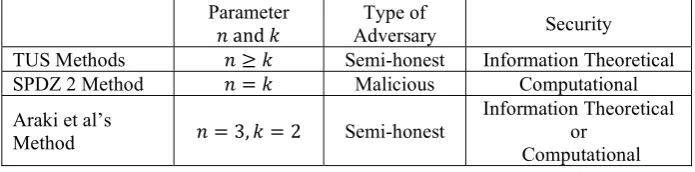
7.2 Qualitative Comparison
show the qualitative comparison between our proposed methods and conventional methods.
Table 1. Qualitative comparison of our proposed method with conventional methods
Parameter 𝑛 and 𝑘
Type of
Adversary Security
TUS Methods 𝑛 ≥ 𝑘 Semi-honest Information Theoretical
SPDZ 2 Method 𝑛 = 𝑘 Malicious Computational
Araki et al’s
Method 𝑛 = 3, 𝑘 = 2 Semi-honest
Information Theoretical or
Computational
7.3 Quantitative Comparison
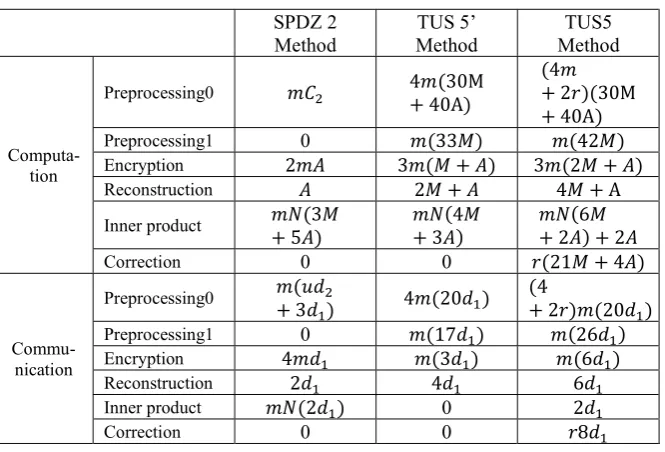
By using the computation of 𝑚 number of inner-product sum operations, in Table 2 we show the communication and computation costs for the SPDZ 2,TUS5’,and TUS5 methods when 𝑛 = 𝑘 = 2. In the case of 𝑛 = 𝑘, because the TUS method could make use of additive secret sharing, computation of shares and reconstruction of secret infor-mation can be done by one process of addition.
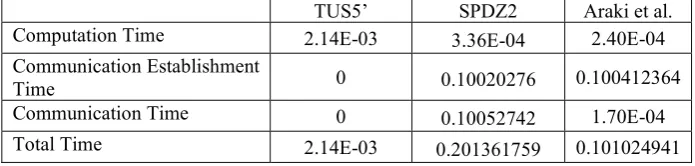
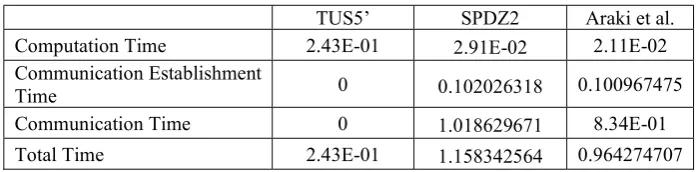
In Table 3 we show the computation and communication costs of the Araki,TUS5’, and TUS5 methods when 𝑛 = 3, 𝑘 = 2. Araki et al’s method does not possess the loss resistance of the server; however, the TUS method still holds the loss resistance of the server.
In addition, in the inner-product sum computation, no repetition of computation is required. We assume a situation where the reconstructed result in the TUS5 method might be equal to 0, thus we include the process of performing 𝑟-times of Correction Phase. We define the parameters used in the comparison as follows.
Definition of Parameters
─ 𝑑 : Size of share from Shamir’s secret sharing or XOR-based secret sharing
─ 𝑑 : Size of share from SHE
─ 𝐶: Computational cost of Shamir’s secret sharing
─ 𝐶 : Computational cost for generating a set of Multiplication Triple using SHE ─ 𝐶 : Computational cost of XOR-based secret sharing
─ 𝐴: Computational cost of a single addition/subtraction
─ 𝑀: Computational cost of a single multiplication/division
addition/subtraction or multiplication/division, and 𝐶 , 𝐶 , 𝐶 ≫ 𝐴, 𝑀. Process costs re-garding the generation of random numbers and secret information is not included. Com-munication to all servers is assumed as a one-time comCom-munication of broadcast, and 𝑢 represents the number of players.
In Tables 2 and 3 the process of generating a share on 1, as shown in Section 4, is labelled as Preprocessing0, and the rest of the preprocessing process is labelled as Pre-processing1. The Correction Phase is also separated and is evaluated as Correction.
The secrecy computation of the TUS5 method is assumed to be as follows:
𝛿0(𝑎𝑙𝑏𝑙− 𝛼1𝑙𝛽1𝑙) 𝑚
𝑙=1 𝑖
= {𝛼0𝑙(𝑎𝑙+ 𝛼1𝑙)× 𝛽0𝑙 𝑏𝑙+ 𝛽1𝑙 × 𝛿0 𝛼0𝑙𝛽0𝑙 𝑖 𝑚
𝑙=1
− 𝛼0𝑙(𝑎𝑙+ 𝛼1𝑙)× 𝛽2𝑙𝛽1𝑙× 𝛿0 𝛼0𝑙𝛽2𝑙 𝑖
− 𝛽0𝑙 𝑏𝑙+ 𝛽1𝑙 × 𝛼2𝑙𝛼1𝑙 𝛿0 𝛼2𝑙𝛽0𝑙 𝑖
}
𝛿2(−𝛼1𝑙𝛽1𝑙) 𝑚
𝑙=1 𝑖
= − {𝛼2𝑙𝛼1𝑙× 𝛽2𝑙𝛽1𝑙× 𝛿2 𝛼2𝑙𝛽2𝑙 𝑖
} 𝑚
𝑙=1
Therefore, even in the TUS5 method, the number of shares on 1 required in order to perform secrecy computation is 4𝑚. However, considering 𝑟-times of the Correction Phase, we assumed that it needed (4𝑚 + 2𝑟) number of shares on 1.
If all preprocessing processes and the encryption process are also considered as pre-processing processes, from Table 2, the communication cost for the SPDZ 2 method includes the computation 𝐶 , which requires expensive computation using Somewhat Homomorphic Encryption (SHE). Therefore, the computation cost for the SPDZ 2 method is the most expensive. In addition, communication costs depend a great deal on the relationship between 𝑑 , 𝑑 , but the TUS methods typically perform more small communication. However, the processes up to this point are performed by the Prepro-cessing Phase. In the secrecy computation of the inner-product sum operation, in order to see the detailed breakdown of the operation, we show the computation and commu-nication cost for one server and it is then multiplied by 𝑁 for the total cost. In the SPDZ 2 method, the computation and communication costs per server are 𝑚(3𝑀 + 5𝐴) and 𝑚(2𝑑 ), respectively. In contrast, in the TUS5’ method, only the computation cost of 𝑚(4𝑀 + 3𝐴) is required per server and no communication cost is required. Therefore, in the case where the communication process requires a lot of time, we can state that the TUS5’ method is faster than the SPDZ 2 method.