Clinical Interventions in Aging
Dove
press
O R I G I N A L R E S E A R C H open access to scientific and medical research
Open Access Full Text Article
A single blind randomized control trial
on support groups for Chinese persons
with mild dementia
Daniel KW Young1
Timothy CY Kwok2
Petrus YN Ng1
1Department of Social Work,
Hong Kong Baptist University, Kowloon Tong, Hong Kong;
2Department of Medicine and
Therapeutics, The Chinese University of Hong Kong, Shatin, Hong Kong
Purpose: Persons with mild dementia experience multiple losses and manifest depressive symptoms. This research study aimed to evaluate the effectiveness of a support group led by a social worker for Chinese persons with mild dementia.
Research methods: Participants were randomly assigned to either a ten-session support group
or a control group. Standardized assessment tools were used for data collection at pretreatment and post-treatment periods by a research assistant who was kept blind to the group assignment of the participants. Upon completion of the study, 20 treatment group participants and 16 control group participants completed all assessments.
Results: At baseline, the treatment and control groups did not show any significant difference on all demographic variables, as well as on all baseline measures; over one-half (59%) of all the participants reported having depression, as assessed by a Chinese Geriatric Depression Scale score 8. After completing the support group, the depressive mood of the treatment group participants reduced from 8.83 (standard deviation =2.48) to 7.35 (standard deviation =2.18), which was significant (Wilcoxon signed-rank test; P=0.017, P0.05), while the control group’s participants did not show any significant change.
Conclusion: This present study supports the efficacy and effectiveness of the support group for persons with mild dementia in Chinese society. In particular, this present study shows that a support group can reduce depressive symptoms for participants.
Keywords: support group, mild dementia, Chinese, depression
Introduction
In Hong Kong, ~8.9% persons aged 70 years or older suffer from dementia.1 There were
~70,000 persons with dementia in Hong Kong in 2006, and the number is expected to escalate to 330,000 by the year 2050.2 Among persons with dementia in Hong Kong,
about 85% suffer from mild dementia.1 At present, the pharmacological treatments for
mild dementia are found to have small benefits on cognitive decline.3 Mild dementia
has an adverse impact on the lives of sufferers, including progressive loss of memory, increasingly impaired cognitive impairments, and an increasing inability to conduct daily living activities.4
Depression is common in dementia, and the prevalence of depression in persons with dementia is higher than in those persons without dementia.5 One research study
has reported that up to one-half of persons with mild dementia manifested depressive symptoms.6 Depression has negative impacts for persons with mild dementia and their
caregivers, including negative impacts on quality of life,7 functional impairment,8
increased risk of early institutionalization,9 and an increased stress level of caregivers.10
Correspondence: Daniel KW Young AAB1015, Department of Social Work, Hong Kong Baptist University, Kowloon Tong, Hong Kong
Tel +852 341 177 72 Fax +852 341 171 45
Email [email protected]
Journal name: Clinical Interventions in Aging Article Designation: ORIGINAL RESEARCH Year: 2014
Volume: 9
Running head verso: Young et al
Running head recto: Support groups for mild dementia DOI: http://dx.doi.org/10.2147/CIA.S68687
Clinical Interventions in Aging downloaded from https://www.dovepress.com/ by 118.70.13.36 on 20-Aug-2020
For personal use only.
This article was published in the following Dove Press journal: Clinical Interventions in Aging
3 December 2014
Dovepress Young et al
The risk and predictive factors for depression in persons with dementia are different from that for depression in persons without dementia.11 It has been suggested that depression is
a psychological reaction to cognitive decline.12
While retaining an awareness of their problems, persons with mild dementia experience multiple losses, including the loss of social roles, self-esteem, self-confidence, and they have negative feelings about their illness.13 Under such
stressful situations, many persons with mild dementia mani-fest depressive symptoms.14
Pharmacological interventions, as well as nonpharma-cological interventions, are available for treating depression in dementia.15 It is recommended that nonpharmacological
interventions be adopted first in treating depression among persons with mild dementia.15 Nevertheless, depression in
dementia is underdiagnosed and undertreated.15,16
Recently, a support group, as one kind of nonpharma-cological intervention, has been developed in the Western countries (such as in the United States, the United Kingdom, Canada, the Netherlands, and Australia) to help persons with mild dementia cope with the illness and reduce depression.4,17
A support group is generally defined as emphasizing a sup-portive and nurturing relationship among group participants and leaders.4,18 Many support groups are topical in nature.
Group formats vary. Some allow for time with the caregiver, or a family member may be present,19 while others are
intended solely for the person with dementia.20 Some groups
are structured, time limited, and last for about ten sessions,21
while others are long-term open groups.22 Support groups are
often led by health professionals with working experiences with persons with dementia.
Research evidence has indicated that structured and time-limited support groups for persons with mild dementia can be beneficial; the benefits include a decrease in feelings of isolation, better coping skills, an increase in self-efficacy, and a reduction in depression.18–21,23,24 However, the generalization
of these research results is limited by the nonrandomized research design, as well as by cultural differences. Only one randomized control study on the support group, which was conducted in the US, supported the efficacy of the support group; it reported that the treatment group, but not the control group, showed significant improvement in terms of quality of life, self-efficacy, and depression for persons with mild dementia.17 More research studies are needed in this area,
especially with respect to studies that test the efficacy of the support group in different societies and cultures.
Due to a cultural difference, Chinese persons with mild dementia in Hong Kong have somewhat different concerns
regarding their cognitive decline.25 As shown in a local
study, Chinese persons with mild dementia in Hong Kong expressed fear with respect to being labeled as mentally ill, losing their status within the family, feeling guilty about becoming dependent, being a family burden, and feelings of helplessness.25 These kinds of fears are due to the
stigmatiza-tion of dementia and mental illness by tradistigmatiza-tional Chinese cultural values, especially Confucianism.26
Under traditional Chinese values, after experiencing cog-nitive decline, persons with dementia fail to perform duties that lead to a loss of face and status within the family and their social systems. After losing face, persons with dementia become devalued within the family and community, which affects their social status and relationships with family mem-bers and others. Thus, Chinese persons with mild dementia experience multiple losses, including a loss of face and social status, which leads them to experience depressive symptoms. Thus, it is important for the support group to address these needs of Chinese persons with dementia.
In Hong Kong, local studies on the effectiveness of a support group for persons with mild dementia are lacking. This present study thus aims to evaluate the positive effects of a support group for Chinese persons with mild dementia in the Hong Kong context.
Research methods
A randomized controlled study research design was adopted in the present study. Participants were recruited from three centers for elderly individuals run by nongovernment organi-zations. Participants who gave their consent to participate in this research project were randomly assigned to a treatment group or a control group. Standardized assessment tools were used for data collection at pretreatment and post-treatment periods by a research assistant who was kept blind to the group assignment of the participants.
Treatment and control group
The support group involved in this study was structured, time limited, and allowed participants to share on different topics. The support group lasted for ten sessions, with one session a week. Each session lasted, on average, 90 min-utes. The group was small in nature, with group sizes that ranged from six to eight elderly individuals. Finally, three support groups were held at three local elderly centers so that participants could access it easily. Each support group was led by a social worker who had working experiences with persons with dementia. Promoting the understanding and acceptance of the illness, handling role adjustment,
Clinical Interventions in Aging downloaded from https://www.dovepress.com/ by 118.70.13.36 on 20-Aug-2020
Dovepress Support groups for mild dementia
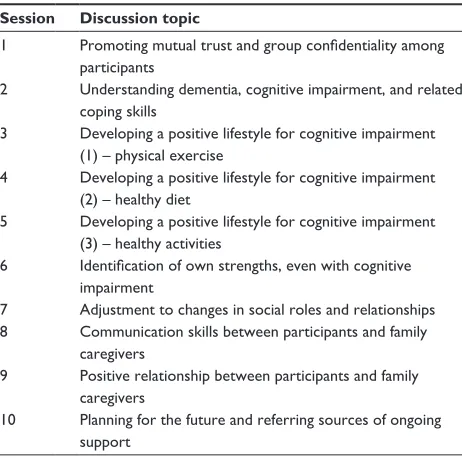
providing coping skills for memory decline, letting go of responsibilities without having guilty feelings, fostering communication skills with family caregivers, and offering emotional support for participants were important elements of this support group. Also, family caregivers were encour-aged to join in for two sessions on communication skills and establishing positive relationships between participants and family caregivers. Please refer to Table 1 for the content outline of the structured support group.
On the other hand, participants who were assigned to the control group received standardized educational written material on dementia that provided basic information on dementia.
Subject inclusion criteria
In this study, the inclusion criteria for this study included: 1) aged 60 years or above; 2) having a diagnosis of dementia; 3) having a Mini-Mental State Examination (MMSE) score of 18 or above; 4) aware of their memory loss and had a memory complaint; and 5) were able to participate independently in a group setting. Those participants who did not receive any diagnosis of dementia were assessed by a screening tool (ie, the Hong Kong List Learning Test [HKLLT]27) as
hav-ing probable dementia. The HKLLT can reliably identify elderly people who are suffering from mild dementia with satisfactory reliability and validity, and it is one of the most commonly used memory assessment tools at local major public hospitals.27 On the other hand, the cognitive ability
of participants was assessed by the MMSE (Cantonese ver-sion), which had been tested with satisfactory reliability and validity.28
The ethical issues of this study were approved by the Research Committee of Hong Kong Baptist University. Data collection began and was completed in 2013.
Assessment tools
Chinese Geriatric Depression Scale (GDS)
The GDS provides an assessment of the mood changes of participants.29 The reliability and validity of the Chinese
version of the GDS have been tested to be satisfactory.29
Although there have been reservations on using the GDS to assess depressive symptoms among persons with moderate to severe dementia, the GDS has been validated for assess-ing depressive symptoms for persons with mild dementia.30
A recent research study also provides evidence to support the use of GDS to assess the depressive symptoms of persons with mild dementia,31,32 including Chinese persons with mild
dementia.33 In this study, the GDS-15, which consists of
15 items, was used to measure depressive symptoms among participants. A cut-off point of 5 is indicative of significant depressive symptoms in the original form,34 while a cut-off
point of 8 has been adopted for the Chinese version of the GDS in the Hong Kong context.29 In this study, a cut-off point
of 8 was adopted as being indicative of significant clinical depression for the Chinese participants.
Rosenberg Self-Esteem Scale (RSES) (Chinese version)
The RSES has been widely used in many countries and has been translated into many languages, including Chinese.35
It consists of ten items. Each item is rated with a score on a 4-point scale ranging from strongly agree to strongly dis-agree. The reliability and validity of the Chinese version of the RSES have been tested to be satisfactory.35
General Self-Efficacy scale (GSE) (Chinese version)
The GSE was used to measure the self-efficacy of the studied subjects.36 The scale has been translated into various languages,
and its Chinese version has been tested with satisfactory valid-ity and reliabilvalid-ity.36 Each item is rated by the studied subjects
on a 4-point scale. Scores are summed over the items such that higher scores indicate a higher level of self-efficacy.
Index for Managing Memory Loss (IMMEL)
The IMMEL is a checklist of coping skills designed to assess the coping skills of people with dementia.37 The IMMEL
Table 1 Session outline of the 10-week support group for
persons with mild dementia
Session Discussion topic
1 Promoting mutual trust and group confidentiality among participants
2 Understanding dementia, cognitive impairment, and related coping skills
3 Developing a positive lifestyle for cognitive impairment (1) – physical exercise
4 Developing a positive lifestyle for cognitive impairment (2) – healthy diet
5 Developing a positive lifestyle for cognitive impairment (3) – healthy activities
6 Identification of own strengths, even with cognitive impairment
7 Adjustment to changes in social roles and relationships 8 Communication skills between participants and family
caregivers
9 Positive relationship between participants and family caregivers
10 Planning for the future and referring sources of ongoing support
Clinical Interventions in Aging downloaded from https://www.dovepress.com/ by 118.70.13.36 on 20-Aug-2020
Dovepress Young et al
consists of six items: “I laugh about my memory problems”; “I use lists to help me remember”; “I think my memory problems are a normal part of growing older”; “I talk about my memory problems to someone that I trust”; “I get angry about my memory problems”; and “I bottle my feelings about my memory problems up”. It has a 3-point scale: 1, “never use”; 2, “occasionally use”; and 3, “often use”.
Data analyses
Descriptive statistics including frequency distribution (N) and mean scores (M) were used to report the baseline demographic and clinical characteristics of the participants. Group mean value (M) and standard deviation (SD) or count (N) and per-centage (%) were used to report the GDS and other outcome assessment scores. The baseline demographic and clinical characteristics between the treatment and control group were compared using chi-squared (χ 2) tests for categorical
variables, and nonparametric Mann–Whitney U-tests were used for ordinal or interval scale variables due to the small sample size involved in this study. When analyzing the significant change of repeated measures of GDS and other outcome assessment scores for both the treatment and control groups, the nonparametric Wilcoxon signed-rank tests were performed. For all analyses, two-tailed P-values of 0.05 indicated statistical significance. All data were analyzed using SPSS version 21.0 (IBM Corporation, Armonk, NY, USA).
Results
A total of 46 participants were recruited; however, seven of them did not meet the inclusion criteria and were excluded. Thirty-nine subjects were randomly assigned to a treatment group or a control group. Among them, 20 subjects entered the treatment group, while 19 subjects entered the control group. Figure 1 illustrates the recruitment procedure. After
39 subjects meeting the inclusion criteria entered the study were randomly allocated into intervention or control group
7 subjects not meeting inclusion criteria were excluded
20 subjects entered
treatment group 19 subjects enteredcontrol group
20 subjects completed the treatment group and all pre- and post-assessment
0 subject drop out
16 subjects completed all pre- and post-assessment
3 subjects refused to do post-assessment 46 subjects, who were
referred by NGOs, gave consent to this study
Figure 1 Recruitment procedure.
Abbreviation: NGO, nongovernmental organization.
Clinical Interventions in Aging downloaded from https://www.dovepress.com/ by 118.70.13.36 on 20-Aug-2020
Dovepress Support groups for mild dementia
the study was completed, 36 subjects (92.3%) remained and finished all the assessments.
Characteristics of the research sample
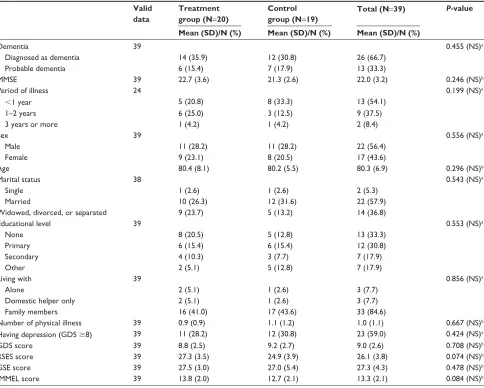
Table 2 details the demographic data and baseline measures of all participants. The mean age of the participants was 80.3 years. Just over one-half of them (56.4%; number [n]=22) were male. One-third (33.3%; n=13) did not receive any education, about one-third (30.8%; n=12) reached primary school, while 17.9% (n=7) reached the secondary school level. Over one-half of them were married (57.9%; n=22); about one-third (36.8%; n=14) were widowed, separated, or divorced; while 5.3% (n=2) were single. The majority of them (84.6%; n=33) lived with their family members; 7.7% (n=3) lived with a domestic helper, and another 7.7% (n=3) lived alone. Two-thirds of them (66.7%; n=26) received a diagnosis
of dementia, while one-third (33.3%; n=13) were diagnosed as having probable dementia, as assessed by the HKLLT. Their mean MMSE score was 22.0 (SD =3.2). Over one-half (54.1%; n=13) of the participants suffered from dementia
1 year, about one-third (37.5%; n=9) suffered for 1–2 years, while the rest (8.4%; n=2) suffered for 3 years or more.
Depressive symptoms
At baseline, just over one-half (59.0%; n=23) of the partici-pants manifested depressive symptoms as assessed by the Chinese GDS (ie, GDS 8). The respondents regarded their self-esteem as average, with a mean RSES score of 26.13 (SD =3.85, ranging from 16.00–37.50). The treatment and control groups did not show any significance on any of the demographic variables or on the baseline measures. Please refer to Table 2 for the data analysis.
Table 2 Baseline characteristics of research subjects
Valid data
Treatment group (N=20)
Control
group (N=19) Total (N=39)
P-value
Mean (SD)/N (%) Mean (SD)/N (%) Mean (SD)/N (%)
Dementia 39 0.455 (NS)a
Diagnosed as dementia 14 (35.9) 12 (30.8) 26 (66.7)
Probable dementia 6 (15.4) 7 (17.9) 13 (33.3)
MMSE 39 22.7 (3.6) 21.3 (2.6) 22.0 (3.2) 0.246 (NS)b
Period of illness 24 0.199 (NS)a
1 year 5 (20.8) 8 (33.3) 13 (54.1)
1–2 years 6 (25.0) 3 (12.5) 9 (37.5)
3 years or more 1 (4.2) 1 (4.2) 2 (8.4)
Sex 39 0.556 (NS)a
Male 11 (28.2) 11 (28.2) 22 (56.4)
Female 9 (23.1) 8 (20.5) 17 (43.6)
Age 80.4 (8.1) 80.2 (5.5) 80.3 (6.9) 0.296 (NS)b
Marital status 38 0.543 (NS)a
Single 1 (2.6) 1 (2.6) 2 (5.3)
Married 10 (26.3) 12 (31.6) 22 (57.9)
Widowed, divorced, or separated 9 (23.7) 5 (13.2) 14 (36.8)
Educational level 39 0.553 (NS)a
None 8 (20.5) 5 (12.8) 13 (33.3)
Primary 6 (15.4) 6 (15.4) 12 (30.8)
Secondary 4 (10.3) 3 (7.7) 7 (17.9)
Other 2 (5.1) 5 (12.8) 7 (17.9)
Living with 39 0.856 (NS)a
Alone 2 (5.1) 1 (2.6) 3 (7.7)
Domestic helper only 2 (5.1) 1 (2.6) 3 (7.7)
Family members 16 (41.0) 17 (43.6) 33 (84.6)
Number of physical illness 39 0.9 (0.9) 1.1 (1.2) 1.0 (1.1) 0.667 (NS)b
Having depression (GDS 8) 39 11 (28.2) 12 (30.8) 23 (59.0) 0.424 (NS)a
GDS score 39 8.8 (2.5) 9.2 (2.7) 9.0 (2.6) 0.708 (NS)b
RSES score 39 27.3 (3.5) 24.9 (3.9) 26.1 (3.8) 0.074 (NS)b
GSE score 39 27.5 (3.0) 27.0 (5.4) 27.3 (4.3) 0.478 (NS)b
IMMEL score 39 13.8 (2.0) 12.7 (2.1) 13.3 (2.1) 0.084 (NS)b
Notes: aPearson’s chi-squared test; bMann–Whitney U-tests.
Abbreviations: N, number; SD, standard deviation; NS, not significant; MMSE, Mini-Mental State Examination; GDS, Geriatric Depression Scale; RSES, Rosenberg
Self-Esteem Scale; GSE, General Self-Efficacy scale; IMMEL, Index for Managing Memory Loss.
Clinical Interventions in Aging downloaded from https://www.dovepress.com/ by 118.70.13.36 on 20-Aug-2020
Dovepress Young et al
Treatment outcomes
Table 3 summarizes the outcome measures of the partici-pants. The results showed that support group participants exhibited a significant reduction in their depressive mood, as the mean GDS score reduced from 8.83 (SD =2.48) to 7.35 (SD =2.18) (Wilcoxon signed-rank test; P=0.017, P0.05). However, the treatment group did not show any significant change in self-esteem, self-efficacy, and coping skills. On the other hand, the control group did not show any significant changes in the GDS score or on the other outcome assess-ment scores.
Discussion
This present single blind, randomized controlled study provides evidence to support the efficacy and effectiveness of a structured and time-limited support group for Chinese persons with mild dementia. Also, this present study shows that the support group is effective in reducing participants’ depressive mood.
Several established models of support groups for persons with mild dementia have been developed in Western coun-tries. An early support group model for persons with mild dementia and their caregivers has been developed in the US.18,19 This support group model is structured with eight
sessions focusing on coping with memory problems, daily living, self-esteem, relationships, as well as health, legal, and financial concerns. The Memory Club is another support group model for a person with mild dementia and their care partners that was developed in the US.20,21 This support group
is structured with ten sessions and is aimed at empowering participants to problem solve and plan for the future. Circle of Care, based in Toronto, ON, Canada, is an eight-session support group for persons with mild dementia without the participation of family caregivers.23 It is structured and allows
participants to share in different topics including: causation
of dementia; coping with memory problems; loss; grief; and daily living skills. Unlike previous support group models, the Alzheimer’s Café in the Netherlands has been carried out to provide a relaxed café-like environment for persons with mild dementia and their family caregivers, so as to facilitate social interactions and sharing among participants.22 Participation is
open-ended, allowing for ongoing participation. In fact, all of these support group models have been found to be effective in recent research studies for participants.19,21,24
All of these previously named support group models developed in Western countries share common group ele-ments of enhancing the participants’ coping skills with memory problems, daily living skills, problem-solving skills, and better planning for the future. However, as discussed earlier, Chinese persons with mild dementia in Hong Kong have somewhat different concerns regarding their cognitive decline.25 Chinese persons with mild dementia expressed
fears with being labeled as mentally ill, losing face and status within the family, experiencing guilty feelings of becoming dependent and being a family burden, and having feelings of helplessness. Thus, it is important for the support group to help participants to promote the acceptance of illness, handle role adjustment, develop a positive lifestyle, let go of responsibilities without feeling guilty, and improve their relationship with family caregivers. Moreover, Chinese elderly individuals were afraid of sharing their difficulties with family members, as family members tended to limit the activities that participants could continue to perform, and they valued the opportunity to share with others facing similar problems.25 Thus, it is important for the support group to allow
participants to share in different topics without the presence of family caregivers. Also, it is important for the support group to facilitate emotional support among the participants who share similar difficulties that are encountered in daily living. By receiving emotional support from others, participants can
Table 3 Outcome measures of the research subjects
Treatment group (N=20) P-value Control group (N=16) P-value Pretest Post-test Difference Pretest Post-test Difference
Mean (SD) Mean (SD) Mean (SD) Mean (SD) Mean (SD) Mean (SD)
GDS 8.83 (2.48) 7.35 (2.18) −1.48 (2.59) 0.017*,a 9.12 (2.88) 7.19 (1.60) −1.9 (3.5) 0.055a
GSE 27.54 (2.98) 26.30 (3.89) −1.24 (4.06) 0.232a 27.64 (4.87) 26.50 (4.10) −1.1 (4.6) 0.245a
RSES 27.32 (3.53) 27.95 (3.23) 0.63 (2.81) 0.263a 25.50 (3.14) 26.75 (3.64) 1.2 (3.0) 0.195a
IMMEL 13.81 (1.96) 14.09 (2.50) 0.28 (2.02) 0.514a 12.93 (2.21) 14.19 (1.64) 1.3 (2.5) 0.073a
N (%) N (%) N (%) N (%) N (%) N (%)
Having depression 11 (55.0) 9 (45.0) −2 (10.0) – 9 (56.3) 7 (43.8) −2 (12.5) –
Notes: *P0.05; aWilcoxon signed-rank test.
Abbreviations: N, number; SD, standard deviation; GDS, Geriatric Depression Scale; GSE, General Self-Efficacy scale; RSES, Rosenberg Self-Esteem Scale; IMMEL, Index
for Managing Memory Loss.
Clinical Interventions in Aging downloaded from https://www.dovepress.com/ by 118.70.13.36 on 20-Aug-2020
Dovepress Support groups for mild dementia
reduce their loneliness, helplessness, and hopelessness, which are typical symptoms of depression. These previously named elements may contribute to the support group’s benefit in reducing participants’ depressive mood.
In this study, the Chinese GDS was used to assess the depressive symptoms of participants; a cut-off point 8 was indicative of clinical depression for Chinese participants.29
In fact, this cut-off point (GDS 8) has been widely used in local large-scale prevalence studies of depression among older people in Hong Kong.38,39 However, different cut-off
points for the Chinese GDS have been suggested in the literature, including GDS 4,40 GDS 5,41 GDS 8,38,39
and GDS 10.33 Most of these studies included a sample
without a diagnosis of dementia. Only one study33 has been
performed to validate the use of the GDS for screening depression among Chinese persons with dementia living in Singapore. A cut-off point of a GDS score 10 has been suggested,33 which is close to the cut-off point adopted in
the present study. Interestingly, a higher GDS cut-off point has also been suggested for Chinese persons with moderate to severe dementia.33 Thus, more research studies are needed
to establish an optimal cut-off point for the Chinese GDS for a Chinese person with mild dementia. Nevertheless, the research results of this present study (ie, the significant reduc-tion of the GDS score among support group participants) remain unchanged, even when adopting a different cut-off point for the Chinese GDS.
Conclusion
In a recent review on various nonpharmacological interven-tions for persons with mild dementia, support groups have been recommended as an effective intervention by experts.4
This present randomized controlled study provides evidence to support the efficacy and effectiveness of the structured and time-limited support group for Chinese persons with mild dementia. In particular, the present study shows that support groups can reduce depressive symptoms among participants.
Several methodological limitations of this randomized control study require attention. First, the generalizability of the research results are limited by the small sample size. In the future, it would be better to conduct a larger scale random-ized controlled study to further validate the effectiveness and benefits of the support group model for Chinese persons with mild dementia. Second, promoting an acceptance of illness, handling role adjustment, developing a positive lifestyle, let-ting go of responsibilities without feeling guilty, improving relationship with family caregivers, and facilitating emotional
support among participants are thought to be essential elements of this support group. However, no standardized tools have been adopted to assess these elements in this study. So, it is better to conduct further research studies to identify the essential elements of a support group for Chinese persons with mild dementia.
Acknowledgment
This study was generously sponsored by the Social Science Faculty of Hong Kong Baptist University.
Disclosure
The authors report no conflicts of interest in this work.
References
1. Lam LC, Tam CW, Lui VW, et al. Prevalence of very mild and mild dementia in community-dwelling older Chinese people in Hong Kong.
Int Psychogeriatr. 2008;20(1):135–148.
2. The Hong Kong Council of Social Service. Elderly Service in
Hong Kong. Hong Kong: The Hong Kong Council of Social Service;
2007.
3. Hogan DB, Bailey P, Black S, et al. Diagnosis and treatment of dementia: 5. Nonpharmacologic and pharmacologic therapy for mild to moderate dementia. CMAJ. 2008;179(10):1019–1026.
4. Burgener S, Beattie E, Bossen A, Buckwalter K, Buettner L, Fick D, et al.
Consensus Report: Review of Scientific Evidence Addressing Prevalence, Documented Needs, and Interdisciplinary Research: Persons in Mild Alzheimer’s Dementia. Chicago, IL: Alzheimer’s Association; 2007.
5. Li Y, Meyer JS, Thornby J. Depressive symptoms among cognitively normal versus cognitively impaired elderly subjects. Int J Geriatr
Psychiatry. 2001;16(5):455–461.
6. Fritze F, Ehrt U, Sønnesyn H, et al. Depression in mild dementia: associations with diagnosis, APOE genotype and clinical features. Int
J Geriatr Psychiatry. 2011;26(10):1054–1061.
7. Hurt C, Bhattacharyya S, Burns A, et al. Patient and caregiver perspec-tives of quality of life in dementia. An investigation of the relationship to behavioural and psychological symptoms in dementia. Dement Geriatr
Cogn Disord. 2008;26(2):138–146.
8. Starkstein SE, Jorge R, Mizrahi R, Robinson RG. The construct of minor and major depression in Alzheimer’s disease. Am J Psychiatry. 2005;162(11):2086–2093.
9. Dorenlot P, Harboun M, Bige V, Henrard JC, Ankri J. Major depression as a risk factor for early institutionalization of dementia patients living in the community. Int J Geriatr Psychiatry. 2005;20(5):471–478. 10. Rosness TA, Ulstein I, Engedal K. Stress affects carers before
patient’s first visit to a memory clinic. Int J Geriatr Psychiatry. 2009;24(10):1143–1150.
11. Bergdahl E, Allard P, Gustafson Y. Depression among the very old with dementia. Int Psychogeriatr. 2011;23(5):756–763.
12. Lee HB, Lyketsos CG. Depression in Alzheimer’s disease: heterogeneity and related issues. Biol Psychiatry. 2003;54(3):353–362.
13. Phinney A. Toward understanding subjective experiences of demen-tia. In: Downs M, Bowers B, editors. Excellence in Dementia Care:
Research Into Practice., Berkshire, UK: McGraw-Hill Education, Open
University Press; 2008:35–51.
14. Waite A, Bebbington P, Skelton-Robinson M, Orrell M. Life events, depression and social support in dementia. Br J Clin Psychol. 2004; 43(Pt 3):313–324.
15. Lyketsos CG, Lee HB. Diagnosis and treatment of depression in Alzheimer’s disease. A practical update for the clinician. Dement
Geriatr Cogn Disord. 2004;17(1–2):55–64.
Clinical Interventions in Aging downloaded from https://www.dovepress.com/ by 118.70.13.36 on 20-Aug-2020
Clinical Interventions in Aging
Publish your work in this journal
Submit your manuscript here: http://www.dovepress.com/clinical-interventions-in-aging-journal Clinical Interventions in Aging is an international, peer-reviewed journal focusing on evidence-based reports on the value or lack thereof of treatments intended to prevent or delay the onset of maladaptive correlates of aging in human beings. This journal is indexed on PubMed Central, MedLine,
CAS, Scopus and the Elsevier Bibliographic databases. The manuscript management system is completely online and includes a very quick and fair peer-review system, which is all easy to use. Visit http://www.dovepress. com/testimonials.php to read real quotes from published authors.
Dovepress
Dove
press
Young et al
16. Rosness TA, Barca ML, Engedal K. Occurrence of depression and its correlates in early onset dementia patients. Int J Geriatr Psychiatry. 2010;25(7):704–711.
17. Logsdon RG, Pike KC, McCurry SM, et al. Early stage memory loss support groups: outcomes from a randomized controlled clinical trial.
J Gerontol B Psychol Sci Soc Sci. 2010;65(6):691–697.
18. Yale R. Developing Support Groups for Individuals with Early-Stage
Alzheimer’s Disease: Planning, Implementation, and Evaluation.
Baltimore, MD: Health Professions Press; 1995.
19. Snyder L, Bower D, Arneson S, Shepherd S, Quayhagen M. Coping
with Alzheimer’s Disease and Related Disorders: An Educational Sup-port Group for Mild Individuals and Their Families. San Diego, CA:
UCSD Alzheimer’s Disease Research Center; 1994.
20. Gaugler JE, Gallagher-Winker K, Kehrberg K, et al. The Memory Club: Providing support to persons with early-stage dementia and their care partners. Am J Alzheimers Dis Other Demen. 2011;26(3):218–226. 21. Zarit SH, Femia EE, Watson J, Rice-Oeschger L, Kakos B. Memory
Club: a group intervention for people with early-stage dementia and their care partners. Gerontologist. 2004;44(2):262–269.
22. Morrissey MV. Rethinking the benefits of an adapted version of ‘Alzheimer Café’ for individuals with Alzheimer’s and their partners.
Int J Psychiatr Nurs Res. 2006;12(1):1393–1401.
23. Goldsilver PM, Gruneir MR. Early stage dementia group: an innovative model of support for individuals in the early stages of dementia. Am J
Alzheimers Dis Other Demen. 2001;16(2):109–114.
24. Snyder L, Jenkins C, Joosten L. Effectiveness of support groups for people with mild to moderate Alzheimer’s disease: an evaluative survey.
Am J Alzheimers Dis Other Demen. 2007;22(1):14–19.
25. Mok E, Lai CK, Wong FL, Wan P. Living with early-stage dementia: the perspective of older Chinese people. J Adv Nurs. 2007;59(6):591–600.
26. Lam CS, Tsang HWH, Corrigan PW, et al. Chinese lay theory and mental illness stigma: implications for research and practices. J Rehabil. 2010;76(1):35–40.
27. Chan A, Kwok I. Hong Kong List Learning Test (HKLLT): Manual and
Preliminary Norms. Hong Kong: Chinese University of Hong Kong;
1999.
28. Chiu HF, Lee HC, Chung WS, Kwong PK. Reliability and valid-ity of the Cantonese version of mini-mental state examination – a preliminary study. Journal of Hong Kong College of Psychiatry. 1994;4(2):25–28.
29. Chiu HF, Lee HC, Wing YK, Kwong PK, Leung CM, Chung DW. Reliability, validity and structure of the Chinese Geriatric Depression Scale in a Hong Kong context: a preliminary report. Singapore Med J. 1994;35(5):477–480.
30. Sheehan B. Assessment scales in dementia. Ther Adv Neurol Disord. 2012;5(6):349–358.
31. Lach HW, Chang YP, Edwards D. Can older adults with dementia accu-rately report depression using brief forms? Reliability and validity of the Geriatric Depression Scale. J Gerontol Nurs. 2010;36(5):30–37. 32. Lucas-Carrasco R. Spanish version of the Geriatric Depression Scale:
reliability and validity in persons with mild-moderate dementia. Int
Psychogeriatr. 2012;24(8):1284–1290.
33. Lam CK, Lim PP, Low BL, Ng LL, Chiam PC, Sahadevan S. Depression in dementia: a comparative and validation study of four brief scales in the elderly Chinese. Int J Geriatr Psychiatry. 2004;19(5):422–428. 34. Sheikh JI, Yesavage JA. 1986. Geriatric Depression Scale (GDS):
Recent evidence and development of a shorter version. Clin Gerontol. 1986;5(1–2):165–173.
35. Leung SO, Wong PM. Validity and reliability of Chinese Rosenberg Self-Esteem Scale. New Horizons in Education. 2008;56(1):62–69. 36. Schwarzer R, Bäßler J, Kwiatek P, Schröder K, Zhang JX. The
assess-ment of optimistic self-beliefs: comparison of the German, Spanish, and Chinese versions of the General Self-Efficacy Scale. Applied
Psychology: An International Review. 1997;46(1):69–88.
37. Keady J, Nolan M. IMMEL: assessing coping responses in the early stage of dementia. Br J Nurs. 1995;4(6):309–314.
38. Woo J, Ho SC, Lau J, et al. The prevalence of depressive symptoms and predisposing factors in an elderly Chinese population. Acta Psychiatr
Scand. 1994;89(1):8–13.
39. Chi I, Yip PS, Chiu HF, et al. Prevalence of depression and its cor-relates in Hong Kong’s Chinese older adults. Am J Geriatr Psychiatry. 2005;13(5):409–416.
40. Lim PP, Ng LL, Chiam PC, Ong PS, Ngui FT, Sahadevan S. Validation and comparison of three brief depression scales in an elderly Chinese population. Int J Geriatr Psychiatry. 2000;15(9):824–830.
41. Lai DW, Fung TS, Yuen CT. The factor structure of a Chinese version of the Geriatric Depression Scale. Int J Psychiatry Med. 2005;35(2):137–148.
Clinical Interventions in Aging downloaded from https://www.dovepress.com/ by 118.70.13.36 on 20-Aug-2020