Journal of
Volume 9, Number 1 January, 1956RANGE
MANAGEMENT
Editorial
Objectives and Opportunities
The founders of the American
Society of Range Management
placed among its objectives, as a part of its constitution, the follow- ing reasons for organizing: “To stimulate discussion and under- standing of scientific and practical range and pasture problems” and “to provide a medium for exchange of ideas and facts among Society members and with allied technolo- gists. . . .” These objectives are in close harmony with the functions of Local Sections. Among other functions, Local Sections are “to study local range and pasture con- servation and management prob- lems, to cooperate . . . with other local organizations in matters of common interest, and to br.ing about closer personal acquaintance and a spirit of cooperation. . . .”
Clearly, the founders of our So- ciety intended that certain definite activities be undertaken, but wise- ly left it ‘to local groups to work out methods best suited to time and place. Membership in this So- ciety, therefore, carries responsi- bilit,ies and also provides opportu- nities for group action in matters of range management.
Under our system of range man- agement on public lands, many of the recommendations for manage- ment practices are made by advi- sory boards. The board members are necessarily interested in both the science and the art of range management, as users and as ad- visors. These people belong in the American Society of Range Man- agement because they can contrib- ute toward a balanced member- ship.
The Sections, in turn, are
uniquely fitted to be of service to
advisory boards. The Society,
drawing together as it does all facets of interest, training, and ex- perience, on common ground, is collectively the broadest, most pro- ficient, and least biased organiza- tion in its field at present. The Local Sections are one in philoso- phy with the Society.
Livestock advisory boards are sometimes vexed with problems of proper grazing. Are certain allot- ments stocked with the proper numbers, or at the best season? Is the kind of stock grazed the best suited to the allotment? Is an al- lotment improving, deteriorating or holding its own? What is the production of certain base prop- erty? The board needs informa- tion upon which to base its recom- mendation.
When a user considers that a
JOSEPH H. ROBERTSON
ruling, with or without a recom- mendation from a board, is unfair, poorly based or prejudicial, he protests. Should his protest be re- jected, he may appeal according to established legal procedure.
The protest is the point at which advisory boards might occasionally use the kind of help that Local Sections are, by nature, equipped to give. Local Sections might well take the first step. They should inform advisory boards of their willingness to designate balanced committees from their membership to meet on the land in question, with a representative of the Board, the user of the land, and the tech- nician in charge. The whole group would then work together, exam- ining and interpreting the range. This approach could be most fruit- ful only if all who were concerned had a sincere desire to apply the best technical information avail- able to the problem and come to whatever agreement the evidence supported.
To take a simple but plausible example, let us assume that a rul- ing on livestock numbers because of alleged range depletion was be- ing protested on the grounds that no range depletion exists on the allotment in question. The advi- sory board has invited the Local Section, to which the board mem- bers belong, to appoint a commit- tee to help study the evidence in the field. The Local Section execu- tive committee has appointed two members of its own section and one man from the adjacent neigh- boring section has accepted an in- vitation to help. One of the three has been appointed leader. They have assembled at an appointed time and driven to the range.
2
sible in the light of the evidence spread out at their feet. Progress should be from one point of agree- ment to the next. All points agreed upon by the committee and the en- tire group should be recorded be:. fore moving to the next question. A serious effort should be made to obtain complete agreement. Inter- pretations of the evidence should be reconciled. Where agreement seems unlikely, the question should be held for further evidence as the group moves over the range. Walk- ing or riding may be necessary, and committees should be selected with this in mind. Key areas may be selected by those most familiar with the allotment.
Pertinent questions to be consid- ered would include : (1) Is this definitely the allotment in ques- tion ? (2) What are its boundaries?
(3) What is the season of use? (4) Has there been any change in man- agement of the allotment recently?
(5) How has precipitation com- pared with normal during the past year and the last ten years? (6) Which recent years have been much wetter or drier than normal, and by how much (from nearest Weather Bureau cooperator). (7) Which of the species present are the most desirable? (8) Which of the species present are the least desirable ? (9) Which of the spe- cies present are represented by the most size classes? (10) Which spe- cies have fewest juveniles? (11) Are there relict or lightly used areas nearby for comparison ? If so, do they contain desirable spe-
JOSEPH H. ROBERTSON
ties that are absent from much of the allotment? Are litter, rill marks, pedestalled grasses more or less than on the allotment? Are seed stalks abundant on the pro- tected area this season7 Are the grasses taller than ungrazed plants on the allotment? Are there more culms per bunch?
Answers to these and many other questions can be agreed upon by direct observation. Correct in- terpretations in most cases will be reached through thought and dis- cussion. Unreasonable interpreta- tions or dogmatic statements will not be supported by sufficient evi- dence.
Finally, all points on which agreement was reached by (a) the whole group, (b) the committee only, and (c) neither, should be listed for future consideration and use by any who may desire to use it.
No one is naive enough to sup- pose that this approach will be quickly adopted or sure-fire in its operation. It does seem to the writer to be a technique that should be given a fair trial. It is hoped that it will head off some of the hearings in which chances of agreement are less than by the “on-the-ground” method proposed here.
Other opportunities for service by Local Sections might be opened up through active efforts to estab- lish permanent lines of communi- cation with other organizations having related interests. Among these, in addition to Grazing Ad-
visory Boards, may be numbered the state livestock associations, the farm organizations, and the asso- ciations of Soil Conservation Dis- trict Supervisors. These contacts may be effected in many ways. One suggestion is that local sections in- vite these organizations to send an official representative to the an- nual meeting of the Local Section. Possibly a reciprocal relationship of this kind could be arranged in order ‘(to cooperate . . . with other local organizations in matters of common interest, and to bring about a closer personal acquaint- ance and a spirit of coopera- tion. . . .”
Local Sections can project their influence for range conservation into the next generation by coop- erating with agencies which are
working primarily with farm
y o u t h. Agricultural Extension Agents and vocational agriculture teachers are of ten at a loss for help in developing range management projects in the 4-H and F.F.A. programs. The Local Sections can fill a need here if they will provide local leaders for these range man- agement projects. One or more sections have already taken this step. It will be very interesting to learn of their success. Regardless of slow progress and possible re- buffs, it would. be well for all of us to keep the objectives of our So- ciety clearly in mind, and their ac- complishment as our goal.--Joseph
H. Robertson, Associate Professor, Range Management, University of Nevada, Reno.
RANGE SOCIETY OFFICERS ELECTED FOR 1956
Officers of the American Society of Range Management, elected for the year 1956 are : President: John D. Freeman, Soil Conservation Service, Prescott, Arizona
Vice President:
E. W. Tisdale, College of Forestry, University of Idaho, Moscow, IdahoBoard of Directors:
1956-58 :
JOHN M. CROSS, rancher, Nanton, Alberta
Where Are Our Future Ranchers?
CHARLES K. SKINNER, JR.
Livestock Loan Dept., Colorado ANatiowal Bank, Denver, Colorado
A serious epidemic has engulfed the western United States and
threatens to cause widespread
damage to our overall livestock picture if remedial steps are not soon employed. The problem was dramatically brought to my atten- tion the other day when a long-time customer of the bank, who normally exhibits little emotion even during the toughest sledding, appeared visibly shaken. When the business at hand had been fully discussed he volunteered to relate his prob- lem. Apparently his only son, who was born and raised on his father’s sizable cattle ranch, had decided to seek employment in town. The boy had just been discharged from the service and appeared ready to become a serious understudy and eventual heir to his father. Evi- dently, no advance notice of the boy’s decision had been forthcom- ing. Therefore it was only natural that our sympathy was directed toward the father. If the boy left him at this time there would be little hope of finding an adequate successor to replace the father when he retired, and, in turn? an operation and physical plant worth many thousands of dollars would presumably be split up and sold to outsiders of unknown ranching and managerial abilities.
Just as it is a banker’s responsi- bility to foster range production and development through proper lines of credit, it should also be his job to prevent potential ranch managers from deserting such a specialized field where their serv- ices are at a premium. What per- plexed the father in the above- mentioned example has been taking place ever since 1910 and only now are the consequences being prop- erly scrutinized.
Some interesting observations on farm employment and production on a per-man-hour basis are given
in the April 1955 issue of Morzthly Review, published by the Federal Reserve Bank of Kansas City. In 1910 farm population was approxi- mately 35 percent of the total U. S. population, while by 1950 it ac- counted for only about 17 percent of the total population. There are three reasons that explain the tre- mendous decrease in farm popula- tion.
1. High wages and standards of living in the city.
2. Decreased demand for farm labor resulting from increased labor productivity.
3. More rapid increase in non- farm labor demand than could be satisfied by the natural increase in the urban labor force.
Despite the nationwide decrease in farm labor requirements, farm output has increased substantially since 1910. The rate of increase in crop productivity has been greater than for livestock production pri- marily because of the difficulty of adapting mechanization to live- stock production.
A look into the future produces a pessimistic note. There is little evidence to substantiate the fact that this trend will subside to any great degree if a dormant attitude continues to plague us. The prob- lem does not concern those who have already left the farms and ranches but only pertains to those who will give such a move serious
consideration sometime in the
future. Granted that with our depressed cattle market over the past few years coupled with un- certain governmental p 0 1 i c i e s, drouth, and rising land values, the
situation appears anything but
rosy at present. These factors tend to limit the entry of newcomers to the livestock industry unless they are persons of financially independ- ent means. That is why we can-
3
not afford to lose those youngsters already situated on our ranches.
A makeshift solution would at- tempt to alleviate the problem by inducing the next generation to remain on ranches by means of modern, attractive and romantic
surroundings. However, upon
closer observation, it will be noted that the majority of ranch homes have running water, indoor toilets, gas and electrical appliances. When it comes to the attractive feature, it’s quite a chore to expound upon
it when some localities have
breathed, swallowed and bathed in dirt and dust for the past four or five years. As for the romantic aspect of ranching, it is almost a thing of the past. Trucks and jeeps are essential equipment and the boy who thinks he can sit in a saddle all day without. digging a posthole is the type of person who is better off in town to begin with. In short, a practical, realistic atti- tude should be developed at an early age among those who plan to make ranching a career. It is essential to separate the men from the boys.
There is no single solution to the problem of rural-urban migration. Educational policies and organiza- tions play a profound role in mold- ing future leaders for the livestock industry. Such projects as provided by 4-H and F.F.A. groups are certainly a step in the right direc- tion. Available access to a. county agent is essential. Our agricultural colleges are becoming a more popu- lar faucet of range management education. The need for college graduates to fill responsible posi- tions of leadership in agriculture cannot be overemphasized. Perhaps if these institutions of higher learn- ing could indoctrinate a program that combined more of the actual experience with the technical side of learning, a greater insight of the problems that lay ahead might be digested by the student.
4 CHARLES K. SKINNER, JR.
time we assumed more of a respon- sibility in generating enthusiasm among our customers and their children. We must emphasize the fact that credit and sound manage- ment go hand in hand, and that the term mortgage is not a word to be feared, but simply one that .
often accompanies adequate loan arrangements. It is a sound idea to allow the younger members of a borrowing family to familiarize themselves with the basic require-
ments that formulate a successful loan. Such terms as principal, in- terest, etc. should become part of their working vocabulary. If possi- ble, marginal operators should be discouraged from borrowing, espe- cially in lean years. A number o’f these operators have not shown a profit for the past few years and this is certainly a detrimental in- fluence on those who are consider- ing ranching or farming as a career. After all, farm income
Problems of Climatic Changes1
RICHARD B. MILLIN
Box 30, Downieville Sta,r Route, Nevada City, Califomia
An urgent need exists for more vary from year to year or by groups of years and the variations may trend in one direction or an- other over longer periods of time. Studies of such variation in forage supply by Clawson ( 1947) pointed out the need for methods of adjust- ing carrying capacities to fluctua- tions of forage caused by periods of drought or plentiful precipita- tion. Clawson’s work showed that, in some parts of the country, fluc- tuations tended to be from year to year while in other areas they oc- curred by groups of years. research on the problem of climatic
changes as well as the effect of pre- cipitation on forage production. Research men very naturally tend to follow the fields in which there
is the most interest or those on which some influence can be ex- erted. Both range administrators and research men have failed to give these basic factors the atten- tion they deserve. This has prob- ably been due to the feeling that weather is relatively stable and nothing can be done about it any- how. It is time we all realize that the climate is changing and, if we can not control it, we can plan better for it if we have a better understanding of present trends. For this we need more research on these problems. Our research men will gladly respond if we admin- istrators and stockmen clearly out- line our needs and support their efforts.
Our range management plans are based on expectations. These
center around expected forage
production. This production may
1. Paper presented at the 1954 annual meeting of the Nevada Section at Winne- mucca. The author was formerly with the ‘17. S. Bureau of Indian Affairs at Stewart, Nevada.
Many Nevada range administra- tors have basically a difficult prob- lcm in operating on lands that in the past have been marginal and in recent years have been submargi- nal. Vegetation on the desert may be hardy in its resistance to drought but may be easily ruined by improper grazing, particularly during the growing season. Those who manage desert lands have more difficult problems to face than those managing lands with higher precipitation. Conversely they stand in greater need for sci- entific information on forage pro- duction, and particularly on the effect of precipitation on forage production and how to solve the resulting problems.
Tn an article entitled “What is
determines the farmers’ ability to pay wages, and numerous talk about various men going bankrupt is not conducive to an optimistic future.
Actually, our primary responsi- bility, whether we are engaged in producing, feeding, financing, or teaching, is to see that stable and proper management is not only practiced but perpetuated. Now is the time to initiate such a pro gram.
Happening to the Weather ?” in the January 1953 issue of Harper’s Magazine, the climatologist C. E. I’. Brooks stated that the earth’s temperature had fluctuated over extended periods in recorded his- tory though not greatly. He stated
“It is not unlikely that an initial fall by five degrees below the pres- ent sufficed to account for the Great Ice Age, all the rest of the freezing up bein, 0 due to the ice il self .”
“As regards America, John H. Conover of the Blue Hills Meteor- ological Observatory recently com- piled an index of the severity of
winters in New England. When
4 CHARLES K. SKINNER, JR.
time we assumed more of a respon- sibility in generating enthusiasm among our customers and their children. We must emphasize the fact that credit and sound manage- ment go hand in hand, and that the term mortgage is not a word to be feared, but simply one that .
often accompanies adequate loan arrangements. It is a sound idea to allow the younger members of a borrowing family to familiarize themselves with the basic require-
ments that formulate a successful loan. Such terms as principal, in- terest, etc. should become part of their working vocabulary. If possi- ble, marginal operators should be discouraged from borrowing, espe- cially in lean years. A number o’f these operators have not shown a profit for the past few years and this is certainly a detrimental in- fluence on those who are consider- ing ranching or farming as a career. After all, farm income
Problems of Climatic Changes1
RICHARD B. MILLIN
Box 30, Downieville Sta,r Route, Nevada City, Califomia
An urgent need exists for more vary from year to year or by groups of years and the variations may trend in one direction or an- other over longer periods of time. Studies of such variation in forage supply by Clawson ( 1947) pointed out the need for methods of adjust- ing carrying capacities to fluctua- tions of forage caused by periods of drought or plentiful precipita- tion. Clawson’s work showed that, in some parts of the country, fluc- tuations tended to be from year to year while in other areas they oc- curred by groups of years. research on the problem of climatic
changes as well as the effect of pre- cipitation on forage production. Research men very naturally tend to follow the fields in which there
is the most interest or those on which some influence can be ex- erted. Both range administrators and research men have failed to give these basic factors the atten- tion they deserve. This has prob- ably been due to the feeling that weather is relatively stable and nothing can be done about it any- how. It is time we all realize that the climate is changing and, if we can not control it, we can plan better for it if we have a better understanding of present trends. For this we need more research on these problems. Our research men will gladly respond if we admin- istrators and stockmen clearly out- line our needs and support their efforts.
Our range management plans are based on expectations. These
center around expected forage
production. This production may
1. Paper presented at the 1954 annual meeting of the Nevada Section at Winne- mucca. The author was formerly with the ‘17. S. Bureau of Indian Affairs at Stewart, Nevada.
Many Nevada range administra- tors have basically a difficult prob- lcm in operating on lands that in the past have been marginal and in recent years have been submargi- nal. Vegetation on the desert may be hardy in its resistance to drought but may be easily ruined by improper grazing, particularly during the growing season. Those who manage desert lands have more difficult problems to face than those managing lands with higher precipitation. Conversely they stand in greater need for sci- entific information on forage pro- duction, and particularly on the effect of precipitation on forage production and how to solve the resulting problems.
Tn an article entitled “What is
determines the farmers’ ability to pay wages, and numerous talk about various men going bankrupt is not conducive to an optimistic future.
Actually, our primary responsi- bility, whether we are engaged in producing, feeding, financing, or teaching, is to see that stable and proper management is not only practiced but perpetuated. Now is the time to initiate such a pro gram.
Happening to the Weather ?” in the January 1953 issue of Harper’s Magazine, the climatologist C. E. I’. Brooks stated that the earth’s temperature had fluctuated over extended periods in recorded his- tory though not greatly. He stated
“It is not unlikely that an initial fall by five degrees below the pres- ent sufficed to account for the Great Ice Age, all the rest of the freezing up bein, 0 due to the ice il self .”
“As regards America, John H. Conover of the Blue Hills Meteor- ological Observatory recently com- piled an index of the severity of
winters in New England. When
PROBLEMS OF CLIMATIC CHANGES 5
ln closing, Brooks stated “To sum up, the temperate and polar regions have been getting warmer for many years. The process may continue or it may be reversed; the one certain thing is that it will not stand still. If it continues, the northern lands will become more habitable and productive, though probably at the expense of the drier agricultural regions further south . . .” There is consider- able evidence that Nevada lies in the southern region that he men- tions.
From studies of tree rings, Hard- man and Reil (1936) point out a wet period in Nevada climate from 1870 to 1915 that was unequalled in the last 600 years. This was the period in which Nevada’s ranching economy was being established. Following this period the climate returned to “normal” for some years, and more recently appears to be in a period of subnormal pre- cipitation and forage production.
In attempting to study these problems we are handicapped by a total lack of forage production records and short, or relatively short, precipitation records ; and data that for the most part con- sists of precipitation only. From this data we must try to recon- struct the history of our forage production if we are able to study past and present forage produc- tion and apply that information to range management.
A Precipitation-Forage Index
In its 1952 Annual Report, the Intermountain Forest and Range
Experiment Station presented a
formula for converting precipita- tion to forage production based on data obtained at the Desert Ex- perimental Range at Milford, Utah. In this formula, monthly prec,ipi- tation totals for October, Novem- ber and December are multiplied by two; those of January, Febru- ary and March by 11/z ; and the remainder of the year by one and the totals added. The resulting sum is multiplied by 31.44 and from that result 76.18 is sub- tracted. Under Milford, Utah con- ditions the answer in pounds of
forage per acre has a probable er- ror of plus or minus 21.33 pounds of forage or about 7 percent.
Most of Nevada’s winter range forage is produced under precipi- tation conditions similar to those of Milford, Utah. Though the pro- duction per acre may vary it is be- lieved that the formula provides the best estimate of potential for- age and its fluctuation of any method now available. When used with existing data on precipitation, numerous comparisons m a y be made for analysis. One example is mentioned here although others may be of equal or even greater interest in determining individual range plans.
When the Milford formula is ap- plied to the precipitation record of McGill, Nevada, estimated pro- duction for recent years, calcu- lated as percentages of the 1913-52 average are as follows:
Year
Est. Production
1948 39%
1949 63
1950 38
1951 57
1952 113
1953 37
These recent years include the longest and most intense drought period in the 42-year weather rec- ord at this station. It contains three of the four years of lowest
production. Next to 1934, the
years 1953, 1950 and 19’48 rank as the poorest in production in that order.
Nevada range conditions are gen- erally less favorable for production than those of the Desert Experi- mental Range at Milford, Utah. Some of the years of low produc- tion probably resulted in practical f a i 1 u r e s of forage production rather than the 35 to 40 percent of the average as calculated.
McGill, situated at the base of the Shell Range in eastern Nevada, does not fully portray the drought farther west as demonstrated by
records and observations at
Schurz, Nevada. Application of the Milford formula to the precipi- tation record at Schurz provides the following data on estimated
production based on a 32-year av- erage :
Year
Est. Production
1946 39%
1947 32
1948 2
1949 20
1950 0
1951 “5
1952 :3
1953 14
The actual production from 1947 to 1952 was practically nil on the sand grass range of the Walker River Reservation, but due to fa- vorable May rains there was a very small crop of sand grass in 1953.
These eight consecutive years of intense drought are believed to be more representative of conditions in most of Nevada than the data from McGill. In either case they give support to many other indica- tions that Mr. Brooks’ theories are actually in operation in Nevada.
Summary
We
are faced with basic prob- lems which are recognized by far too few men. They are the prob- lems which are determining the direction and extent of our range management plans and programs. Presently far too little understand- ing and discussion are given to the relationship between climatic changes and range management. Research should provide more facts for the use of range administrators to use in their plans. Likewise, administrators should recognize the situation and support the re- search efforts needed to provide a clear understanding of the situa- tion confronting us.In the past we have had many range management plans ruined by these unrecognized forces. Let us now recognize them and pre- pare our plans to meet a situation that can be fully recognized if not accurately forecast.
ILITERATUREs CITED
CLAWSON, MARION. 1947. Sequence in variation of annual precipitation in the Western United States. Jour. Land & Publ. Utility Economics 23: 271-287. HARDMAN, G. AND 0. E. REIL. 1936. The relationship between tree growth and stream run-off in the Truckee River Basin, California-Nevada. Nev. Agr.
Brush Invasion- 1500 B.C. and 1950
AD.
YAAQOV OREV Soil Conservation Tel-Aviv, Israel
It is said that “History repeats itself .” The Bible gives evidence of brush invading the Biblical lands as early as 1500 B.C. Before my eyes, 3,450 years later, I was amazed at the brush invasion in the southwestern United States.
As I traveled through Texas, New Mexico, Utah, Arizona and California, I saw millions of acres where brush was now dominant, but which once were vast areas of rich grasslands. The invasion was so complete in places, such as in south Texas, that woody species formed almost impenetrable thick- ets. Early American pioneers once described the same area as a “sea of grass.”
The invasion has occurred so re- cently that there are still people alive that remember the open grassy plains.
Records and writings give fairly accurate accounts of the change. What has happened and is hap- pening in the Southwest is exactly what could have, and probably did happen in the Biblical lands. The Old Testament gives only hints, or scraps of information, but the story, pieced together, is there.
Abraham was a stockman. He left his home in the irrigated valley of the Tigris and Euphrates, and went westward looking for greener pastures.
The country of Canaan looked good-not yet thickly populated, only two sizable towns-Sichem and Hebron, and the rest must have been grass-otherwise why settle there% Grass was what he was seeking.
The tillers of the soil who lived in those towns were friendly to- wards the stockman. After all, they had not much use for all the grass around. But trouble soon started. With Abraham was his nephew, Lot. He, too, had flocks, and it soon became apparent that there was not
Division, Ministry of Agriculture,
enough feed for both of them (Gen. 23). This must be the first historical record of overgrazing.
So Lot chose to leave the high country near Hebron and went to graze in the rich, watered valley of the Jordan River. But he was a late arrival there-the valley was already densely populated, with
contradiction, until we notice that there is an abrupt change in style1 at the end of the story which, the Bible scholars tell us, belongs to a much later age. Does that mean that grass was dominant when the beginning of the story was written, and brush when the second part
was put down? Perhaps. (Gen.
32.) Certain it is that nature at- tempts to cover its wounds and, when man’s livestock graze off the grass, weeds, which may be woody plants, invade.
Livestock operators in early Bib- lical times must have had large herds. For example we have some
FIGURE 1. A South Texas brush-invaded range cleared of brush by root-plowing during the previous year is inspected by the author, Yaaqov Orev, while on assign-
ment in the U. S.
many towns-and Lot became in- indications of the size of Jacob’s volved in a fight and was taken operation. He offered to Esau, as prisoner. Abraham came to his res- a token of conciliation, the follow- cue with his armed herders-318 in ing :
all (Gen. 24). Quite an outfit! Goats 20 Camels 30
At that time the mountains and Bucks 20 cows 40
slopes were treeless. Evidence of Ewes 200 Bulls 10
this lies in the fact that when Abra- Rams 20 Asses 20
ham went to obey God’s command Donkey Colts 10
to sacrifice his only son on a moun- Allowing that the animals then tain, he took the necessary firewood were smaller than now, it would with him-he knew he would not amount to approximately 150 AU. find it on the spot. But when the It is logical to assume that it was whole affair ended happily with 1. The change consists of the use of the
God’s angel stopping him and oblig- word “Jehovah,” which is late, for the
ingly providing a stag entangled in ending of the story, opposed to “Elohim,”
BRUSH INVASION-1500 B.C. AND 1950 A.D. 7
one-tenth of what he had. There- fore, if he started with 1,500---150 ~1,350 AU, we can safely assume a crop of 50 percent and 20 percent annual increase in size of flocks. That would mean that in 10 years his flocks and herds would number approximately 6,000 AU. And he was neither the first nor the only operator in that area of 3,000 square miles.
About 300 years after Abraham came to the land of Canaan, Jacob and his tribe were stricken by a
prolonged drought. Their herds
must have denuded the grazing lands. They had to seek refuge in Egypt. After 400 years of slavery, their descendants returned to Ca- naan. It was already densely pop- ulated, and brush was abundant- scrub oaks and pistacias. Tillers of the soil did not bother much about it-after all, they needed firewood and fiber. But it had its disad- vantages-wild beasts lurked in the brush. Samson (ca. 1200 B.C.) had to fight a lion (which would point to a Savannah type) and out- laws like Iftah and David found it easy to hide.
Sometimes, though, it profited the established authority-as when Absalom’s hair got caught by a pistacia, where Jacob found and killed him (cu. 250 B.C.) (Saun. II, Chap. 17).
Even the drier parts of the coun- try became wooded. Ezekiel (ca. 550 B.C.) speaks about the “forest of the Negev” (Chap. 21). In real- ity it was an Acacia scrub, and scattered Acacias are still found in that area which has 8 to 10 inches of winter rainfall.
All memory of the country once having had a grass cover was lost ; today all authorities assume that the climax vegetation was oak-pis- tacia or Aleppo pine forest, as it appeared about 1000 B.C.
The same story was repeated all
around the Mediterranean. We
know of repeated incursions and in- vasions of nomad horsemen into Mediterranean countries. The horse- men needed grass. It is hard to imagine that they would have been attracted by thick, impenetrable
“Maquis.” A stockman’s psychol- ogy changes little.
The first written documents we have, and the earliest literature, speak of Greece and Italy as being forested, and grazed mainly with sheep and goats ; their decline being attributed to soil erosion caused by destruction of forest cover.
But the earliest written records date from approximately 1000 B.C. What about all the grazing in the Bronze Age ? Can even the lightest grazing be discounted? And know- ing what we know now, we may be sure that any grazing on natural range in the past was overgra&g.
Can the vegetation of the Medi- terranean littoral at about 1000 B.C. be accepted as climax? Was the forest a result of grazing? Or was the so-called “forest” only scrubby woody species that invaded denuded grassland ?
When I compare these two areas of the world, so distant and dif- ferent’ yet apparently so similar in their cause-effect relationship, sev- eral thoughts emerge.
Nature’s laws do not change. There is no “unique” brush in- vasion in the Southwest. Similar
invasions have occurred or are happening all over the world.
What happened is exactly what happens when Nature’s balance is disturbed. A piece of virgin sod is broken out for cultivation, or the thick cover of grass is destroyed by grazing and drought. Almost miraculously, weeds appear.
Where did the weeds come from? In most cases, the weedy species occurred as a minor and insig- nificant part of the climax, or orig- inal vegetation. Perhaps they were found around animal or insect bur- rows’ or other such disturbed spots. Seldom was the seed actually intro- duced from distant areas, true “in- vaders.”
Certain of these minor plants, particularly those not grazed, found the disturbed soil to their liking. They multiplied manyfold, and spread. In some cases, culti- vated fields had to be abandoned. Likewise, poisonous invaders have
made rangeland almost useless, and woody species made grasslands un- productive of palatable forage.
One Texan was heard to say, while looking at a vast expanse of “chaparral,” or thorny brush, “My grandfather must have been a hot- headed fool to have fought the Mexicans for this!” Yet his grand- father was fighting for, and won, rich grasslands.
These worthless plants, mesquite, juniper, burroweed, etc., aren’t the real “invaders.” They were there, even though in minor quantities. It is economic man that is the real invader. He disturbed the balance’ with his plow and his herds of live- stock, the balance that Nature had built up for millions of years.
Research workers are looking for “the” factor responsible for brush invasion - overgrazing, drought, fire prevention, etc. It seems to me they are searching in vain. AU the factors which contribute to eco- nomic use, taking something out and not returning anything, are responsible.
It may help to learn that the problem is not unique, and that it, was inevitable. The early settlers grazed off the grass, and took no heed of the “weeds” as they ap- peared. Suddenly, the ranchers were confronted with the fact that the grass was gone; the weeds were there. Woody species are the most apparent weeds, though non- palatable, often poisonous herb spe- cies are also abundant. It did not take the Southwest long to realize the immensity of the problem. The realization was possible because the change occurred so rapidly.
It may be much more expensive to fight the weeds now, than it would have been to control them when they started.
There is no more Western fron- tier to be settled-the ranchers can’t move on and leave the abused,
weed-infested rangeland. The
Greater Returns from Cow-yearling
Operations on Southwest Ranges
THOMAS M. STUBBLEFIELD
Assistant Agricultural Economist, Unniversity of Arizona,
Tucson, Arizona
Next to “death and taxes”
drought is about the most certain thing in the Southwest. Ranchers there do not know when to expect one, but if they have been in busi- ness long enough they will have experienced a drought.
The Southwest rancher’s biggest headache is unstable range condi- tions. If a rancher has a cow-calf operation, he must try to adjust the size of his breeding herd to fit the forage production of the ranch. With a great variation in seasonal and annual rainfall he finds this a difficult feat.
If he needs to increase his breed- ing herd, he finds that his neigh- bors are doing the same. If he has to reduce it, he discovers the bot- tom has dropped out of the cow market.
Drought has probably forced
more ranchers into bankruptcy than anything else. Normally, ranchers stock their ranges to typ- ical carrying capacity. If a rancher does this, he expects to overgraze his range in dry years and to un- dergraze in wet years. In dry years he feeds supplement.
He has also discovered that se- vere overgrazing, continued year after year, depletes his range resource-his capital investment. Even when he does not do perma- nent injury by overgrazing, he will delay range recovery to normal (typical carrying capacity) at the start of a wet cycle.
Cow-yearling Opwations Offer Flexibility
Ranchers who have survived one or more droughts have found that
FLEXIBILITY is the answer to
drought. And the way it is done is for the rancher to reduce his
breeding herd to the size that can be carried on his range during the dry years. When rainfall is normal or above normal, the surplus feed and grazing capacity can be grazed by yearlings.
Two big questions to be answered in changing over to a cow-yearling operation are : How will this af- fect the total pounds of beef pro- duced on the range? And, more important, what effect will the change have on gross and net in- come? Fixed costs would be the same. However, there would be a little additional cost in a cow-year- ling operation when weaner calves are wintered with supplement.
Knox (1947) found that more beef could be produced per acre
by grazing yearling steers than by producing and selling weaners-32 percent more.
Reynolds (1%4) reports that
about 50 percent more income from 1939-1953 could have been realized by leasees on the Santa Rita Ex-
perimental Range if they had
stocked their leases at a flexible rate rather than at a constant one.
McIlvain, et al. (1954) report that at the U. S. Southern Great Plains Field Station, Woodward, Oklahoma, only about 60 percent as much beef may be expected to be produced per unit of land on year- long grazing of breeding cows as
was produced from continuous
year-long grazing of steers. Heavy grazing of ranges was more detri- mental to cows and calves than the same degree of grazing with steers.
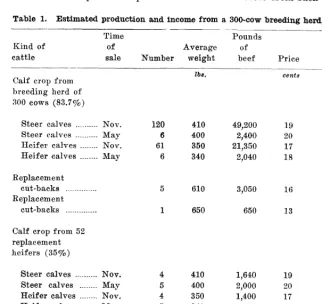
Comparison of Cow-calf and Cow-yearling Operations This paper is based on a 300-cow breeding herd and the assumption that the range is not overstocked. Table 1 shows the expected produc- tion and income from such a herd.
Table 1. Estimated production and income from a 300~~0~ breeding herd, 1954-55
Kind of cattle
Time Pounds of Average of sale Number weight beef Calf crop from
breeding herd of 300 cows (83.79%)
Steer calves __ _.______ Nov. 120 410 49,200 19 9,348.OO
Steer calves __._______ May 6 400 2,400 20 480.00
Heifer calves ________ Nov. 61 350 21,350 17 3,629.50
Heifer calves _ ______ _ Ma,y 6 340 2,040 18 367.20
Replacement
cut-backs ___.._____ ___ Replacement
cut-backs ____ __________ Calf crop from 52 replacement heifers (359’0)
Steer calves __________ Nov. Steer calves ________ May Heifer calves ______ __ Nov. Heifer calves ___...__ May
Total ______________ 85,430 15,652.80
5 610
1 650
lbs. cent8 d 011W8
3,050 650
16 488.00
13 84.50
410 1,640 19 311.60 400 2,000 20 400.00 350 1,400 17 238.00 340 1,700 18 306.00
Price Income
GREATER RETURNS FROIM COW-YEARLING OPERATIONS 9
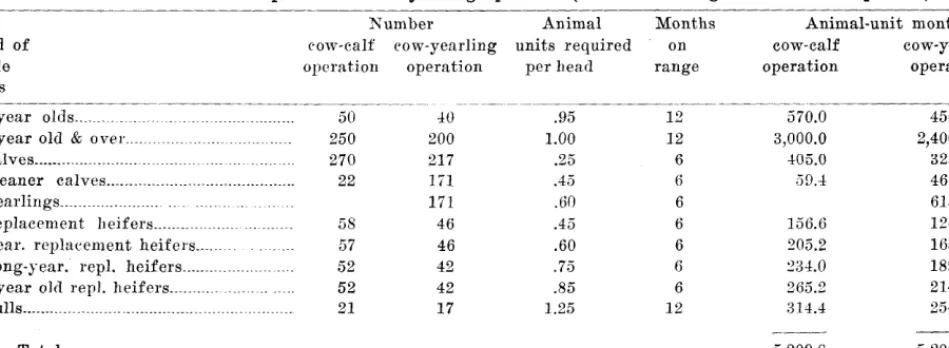
2. The number of animal-unit months required for a co w-calf operation of a breeding herd of 300 cows, and ber of animal-unit months required for a cow-yearling operation (30~cow breeding herd reduced 20 percat)
the num-
--
Number Animal Months Animal-unit months Kind of
cattle
cows
cow-calf cow-yearling units required on operation
3-year o~as... _.._.____ . _.___.._._.._. . .._._____ 4-year old & over ._.. ._.. .__ _....
Calves_.____ __.___ _ __._..____ _. _.._ _.. _. ._.. ._
Weaner calves._.._ ___._.. _ _._._.._..___.___ ___ _.._._ _.
Yearlings ._._._...__._.__.___ _.
Replacement heifers... __._.._. .._._. ._ .._ .__ Year. replacement heifers...
Long-year. repl. heifers ____ _ ._.._...._..
2-year old rep]. heifers. _.__.___.. .._. ._ _. __
Bulls._... ___._..._._._ _ _..._._ ______.__ _._.._...___.. . . . .._._ 50
250 270
22
55 57 52 52 21
operation per head
40 .95
200 1.00
217 .ia 9’
171 .45
171 .60
46 .45
46 .60
42 .75
42 .S5
17 1.25
range
cow-calf operation
cow-yearling operation
13 570.0
12 3,000.0
6 405.0
6 59.4
6 156.6
6 205.2
6 “34.0
6 265.2
12
456.0 2,400.O
325.2 461.4 615.6 124.2 165.6 189.0 214.2
Total_.... ____. ______ _.____.__._._ ._.. ._ .._.._.._.._ 5,209.8 5,205.6
The herd is estimated to have a calving percentage of 83.7 percent, which was the average calving per- centage for a large ranch in south- western New Mexico from 1944
through 1953. Approximately 5
percent of the calves are short-age and sold in the spring. The weights of calves used in Table 1 are actual weights at a given time for this southwestern New Mexico ranch. Breeding cows remain in the herd for 6 years; therefore, fifty 3-year- old heifers are placed in the breed- ing herd each year and 42 cows are sold. This allows for a death loss of approximately 21,~ percent.
Eight percent of the replace- ments are cut back as yearlings and 2 percent are cut back as 2-year- olds. In order to place fifty 3-year- old heifers in the breeding herd each year, 58 heifer calves will have to be held back.
The bulls are turned in with t,he replacement heifers when they are approximately 16 months old. It is estimated that the calf crop from these heifers averages approximate- ly 35 percent. (This is the approx- imate calving percentage of the re- placement herd for the ranch in southwestern New Mexico.) Fifty- six percent of these calves are short-age and are sold in the spring.
At the outset it is necessary to determine how much the breeding herd would have to be reduced in order to carry the calves over to long-yearlings and still use the same amount of forage as did the
cow-calf operation. Table 2 shows the animal-unit months needed for the 300-breeding-cow herd, cow-calf operation, and a 240 breeding-cow, cow-yearling operation. The forage requirements for the cows, calves, weaner calves, etc., are based on those by Vinal _and Semple, 1932. This table shows that a 20 percent reduction in the size of the breed- ing herd will be enough to provide forage for the yearlings.
Production aad Income) from
Cow-yearling Operation
Table 3 shows the estimated pro- duction and income from a cow- yearling operation. In this table the 300-cow breeding herd project- ed in Table 1 was reduced by 20 percent. Table 3 indicates that a total of 120,610 pounds of beef could be produced from a cow-year- ling operation ; the estimated pro- duction from the cow-calf opera- tion in Table l’was 85,440 pounds of beef. Thus approximately 41 percent more beef is expected to be produced from the cow-yearling operation,
The estimated income for the cow-yearling operation shown in Table 3 amounts to $20,846, or $5,- 193 more than the estimated income from the cow-calf operation (Table 1). The estimated prices for the calves in Table 1 were the approx- imate prices received for calves during the fall of 1954 with a one cent per pound increase for the short-age calves to be sold in the spring of 1955. The prices in Table
3 were the approximate prices re- ceived for yearling steers and heif-
ers in the fall of 1954 in Arizona.
There was about one-cent spread between the yearling feeders and stocker calves in favor of the calves. However, it may be that a two-cent spread is more normal than the one-
cent spread. If the estimated in- come in Table 3 were calculated with a two-cent spread between stocker calves and yearling feed- ers, the total cow-yearling income would be reduced to $19,646.
The estimated average in Table 3 was determined for long-yearling steers by adding 325 pounds to the weaning weight of the steer calves. This was the average gain on the college ranch of the New Mexico Agricultural Experiment Station for the 10 years, 1937-1946. The weight for yearling heifers was estimated by adding 300 pounds of gain to the weaning weight. In the case of short-age yearling steers it is estimated that the steers gained 225 pounds from May to the middle of November, and that the short- age heifers gained 185 pounds.
Elk and Livestock Competition
become quite extensive with un- fortunate results both to livestock and game interests.
MELVIN S. MORRIS
Food
and RJange Requirements of* Professor of Forestry, Montana State University and Assist-
ant Unit Leader, Montana Cooperative Wildlife Research
Unit, Nissoula, Montana
Elk and Livestock
An adequate understanding of the overall situation requires con- sideration of elk food habits and requirements and the utilization of ranges by elk. The observations of Murie (1951) in Jackson Hole, Schwartz (1943) in western Wash- ington, Rush (1932) in Yellow- stone Park, Young and Robinette (1939) in Idaho, Cowen (1947) in Alberta, De Nio (1938) in North Idaho and Montana, Cliff (1939) in Oregon and Pickford and Reid
(1943) in Oregon, Schwan (1945) in Colorado all testify to the fact that elk, of all large herbivores, have perhaps the most diversified food habits. While elk are mainly grass eaters, they can do well on herbs and shrubs, adjusting to the available food supply. In winter feed studies conducted by the Mon- tana Cooperative Wildlife Research Unit and the Montana Fish and Game Department, elk were found to have a distinct preference for hay over bunchgrass or browse. Elk calves increased in weight when hay was available in adequate amounts. Both cattle and elk were found to consume forage propor- tionate to their respective weights. For example, a 500 pound cow elk will eat about one-half the amount a 1,000 pound domestic cow will
take (Morris and Hungerford,
1952). From lignin studies it ap- pears that hay is more readily di- gested than grass and both are more digestible than browse by elk
(Geis, 1954). The need for proper manage-
ment of the range resources of Western United States has been recognized for many years. It has only been recently realized that to secure adequate management, game populations as well as live- stock numbers must be held to the limits of the food supply. Compe- tition between livestock and game such as deer and elk on both pri- vate and public land appears to be one of the major land use problems of the West. The purpose of this paper is to present the historical, biological and economic aspects of the situation so that land managers and other interested groups may be more fully informed on this ques- tion.
At the turn of the century elk populations were at an all time low. In some areas the native population had been completely eliminated. Since 1910 big game numbers have increased as a result of public in- terest in wildlife conservation. Elk numbers increased from an esti- mated number of some 50,000 to 70,000 in 1910 to about 300,000 in 1952 (Hickie, 1953). The major increase came in the period 1920 to 1940 when the increase was about 500 percent. Between 1940 and 1952 the rate had dropped somewhat but the population is still on the rise. Hunter take is gradually increasing and is about 15 percent of the winter herd. This leaves an increment equal to from 5 to 10 percent of the winter herd as the annual rate of increase in elk numbers.
The development and use of western lands for crop production and livestock grazing resulted in the occupation of a considerable portion of the original home of elk
and deer (Koch, 1941; Murie,
1951). The expansion of game
populations on these lands has created conflicts of interest in the use of western range and forest lands. Leek (1911) and Graves
and Nelson (1919) report the
earliest occurrence of a conflict of interest. Shoemaker (1930)) Rob- erts (1930) and Smith (1930) rec- ognized the problem in the South- west and in Montana prior to 1930. Pickford and Reid ( 1943) in Ore- gon report competition for forage between elk and sheep on high summer range. Olson (1945) de- scribes how the problem developed with the Nebo herd in Utah.
Craighead (1952) indicates ac-
tual and potential competition b et w e en livestock and elk in Jackson Hole, Wyoming ; Mitchell and Lauckhart (1948) describe the problem of elk management in the Yakima Valley of Washington. In Montana two large acquisitions of private range land by the State Fish and Game Department were made mainly to reduce the com- plaints by stockmen because of elk depredations to range and hay stacks. Other states have purchased land to ext,end the amount of range for wintering elk (Rutherford, 1954). Late and special hunts on elk, fencing projects and even herd- ing of elk are all examples of at- tempts to alleviate pressure by elk on private land (Cooney, 1952). Hall (1952) recently reported on an elk-sheep range problem area
on the Sitgreaves Forest in Ari-
zona where sheep summer range is important elk winter range. Han- son (1952) reports on the problem in Canada. These examples indi- cate the extent of the situation. However, it is best to point out that for the most part they are local in nature. It is a significant fact that if these problems are not solved locally they may eventually
11
The ancestral home of elk ap- pears to have been of considerable extent. In Montana, elk apparently occupied the plains, foothills and
high mountains (Koch, 1941).
ELK AND LlVESTOCK COMPETITION 13
have yet to be properly managed. Land acquisition was only a partial solution as both herds have not been brought into balance with the food supply. Harvesting has been below the annual increment. Heavy die-offs from starvation have oc- curred in some years. Needless to say, further r,emoval of livestock from adjacent ranges will prolong the problem when more intensive harvesting is definitely needed (Murie, 1951; Craighead, 1952).
Those who argue that game num- bers be increased on public lands as the rightful portion of the sportsman’s share in the national resource must carefully consider the fact that public lands have limitations in providing winter range for game. Livestock numbers on public lands, particularly on National Forests, have steadily declined to the present time. This reduction represents a substantial number. In Montana and North Idaho, the reduction of livestock amounts to 78 percent of sheep use and 47 percent of cattle use based on 1925 numbers. Elk have in- creased about 356 percent and deer about 419 percent. While it is hazardous to equate feed require- ments and forage use, present stocking rates of game and live- stock indicate that they now share more or less equally in the forage supplied from public lands in this region, If the amount of forage used by game on private lands is included in the estimate, it would be safe to assume that the above statement is based on more than just figure juggling.
There is also the questio,n of off- setting value of feed. Some sports- men feel that because of the rela- tively low rentals on public range, ranchers should be willing to per- mit use on their own lands. This is at best a weak argument. Graz- ing permits and rental charges on public lands represent only a por- tion of the real costs of feed from public land. Ranches using public lands have investment costs in their own properties derived from the combined use of public and private lands. This feed is not as cheap
as it appears to be. Furthermore, grazing of livestock on public land
represents a legitima.te business opportunity which sho,uld be rec- ognized as such. Also many ranches have livestock that do not graze on public land but winter game on their own land. It is only when game numbers make serious inroads on feed supplies that the rancher resents their presence.
With steady increase in hunters, particularly of big game, there will be increasing demands for hunting opportunity. The sportsman inter- prets this to mean that more ani- mals and more land will be needed. He fails to understand that the answer will be found mainly in good management of existing game populations.
Need for More Intensive
Game
Management
Game production can be in-
creased significantly without inter- ference with range livestock indus- try by increasing the harvest of all big game species except mountain sheep, moose and mountain goats. On the basis of the winter popula- tion of a herd, Rasmussen and
Doman (1947) have calculated
that the cattle industry harvests 30 percent of the herd annually while 20 percent or less of the herd is harvested from existing elk pop- ulations under present manage- ment. The annual harvest of deer is much less than 20 percent. Harvesting rates could be increased one-fifth or more on elk and as much as 100 percent on deer with- out increasing the present base population of either species. An- other possibility for increased game production may be found by re- placing elk with deer in some areas. Deer, being less competitive with cattle and consuming about one- third as much forage as elk, could supply greater hunting opportu- nity to more people.
In some situations it may also be desirable to increase game produc- tion, particularly of elk, by land acquisition of strategic winter range in private ownership, such as ranches with good winter range
possibilities and other seasonal forage. These ranches should be characterized by having a very low percentage of land in meadows or cultivated acreage. Likewise, snow conditions should be such that standing forage will be available
through the winter. Suitable
ranches will be isolated from or at the margin of an extensive raneh- ing community.
Many ranchers will object to such an approach to increased game production for reasons such as the need for expansion of existing ranches, loss of tax revenue for school districts, and increased trouble from more elk in the coun- try. Some sportsmen will complain because money will be diverted from other game work.
These arguments can best be answered by stating that the pres- ent pattern of game and livestock production has developed under a combination of American economic and political rules, public land policies, and a frontier tradition. It implies that no single factor of the combination can govern the method of resolving the problem. Those who wish to reestablish a wilderness condition or direct the land use back to wildlife habitat should be willing to pay the price in the open market. Outdoor rec- reation cannot be provided by the public from federal lands alone as in the case of game. These lands are limited in their capacity to do this and also meet all demands on resources required by a growing
population. Ranchers must be
tolerant of attempts at acquisition of private land for game so long as they may have an opportunity to bid on the same property. Assess- ments on the land to meet school district costs should remove a major criticism of the loss of these lands from tax rolls.
Conclusion
14 MELVIN S. MORRIS
and Lauckhart (1948) describe a cooperative approach by bringing all interested parties together for a thorough analysis of the problem and agreement on methods of solu- tion. Olson (1943) indicates how a “Board of Elk Control” was established in Utah to deal with the conflict between ranchers and sportsmen over big game problems. In Montana, similar steps have been taken in the Bitterroot Valley, including a series of community forums, special meetings and field trips over a period of three years. After a common understanding was reached on the overall problem of land use for water, timber, live- stock and game production, a plan was developed for the best manage- ment of all the resources including game and livestock. This is the only feasible approach, with an intelligent, fair and informed pub- lic representing all interests in the land. How to get proper land and resource use is truly a “grass-roots” questions and requires a “grass- roots” approach.
LITERATURE CITED
ALLRED, W. J. 1950. Reestablishment of seasonal elk migration through trans- planting. Trans. 15th North Amer. Wildl. Conf., pp. 597-611.
CARHART, A. H. 1948. Our public lands in jeopardy. Trans. 13th North Amer. Wildl. Conf., pp. 86-100.
CLIFF, E. P. 1939. Relationship between elk and mule deer in the Blue Moun- tains of Oregon. Trans. 4th North Amer. Wildl. Conf., pp. 560-569. COONEY, R. F. 1952. Elk problems in
Montana. Jour. Range Mangt. 5:3-7.
COWAN, I. MC. 1947. Range competition between mule deer, big horn sheep and elk in Jasper Park, Alberta. Trans. 12th North Amer. Wildl. Conf., pp. 223-227.
CRAIGHEAD, J. J. 1952. A biologica. and economic appraisal of the Jackson Hole elk herd. N. Y. Zoo. Sot. and the Cons. Found.
DE NIO, R. M. 1938. Elk and deer foods and feeding habits. Trans. 3rd North Amer. Wildl. Conf., pp. 421-427. GEIS, A. H. 1954. The food consumption
and relative digestibility of various winter diets fed to elk under con- trolled conditions. Montana State University, unpubl. M. S. thesis. GRAVES, H. S. AND E. W. NELSON, 1919.
Our national elk herds, a program for conserving elk on Na,tional forests about Yellowstone National Park. U.S. Dept. Agr. Dept. Cir. 51.
HALL, J. M. 1952. Game-livestock rela- tionship studies in Arizona. Ariz. Game a,nd Fish Comm.
HANSCUM, C. W. 1952. Game-livestock relationships. Wyo. Wildl. 16 :4-9. HANSON, W. R. 1952. Grazing use of
forest lands. For. Chron. 28:23-32. HICKIE, PAUL, 1953. Inventory of big-
game animals in United States, 1952. U.S. Fish and Wildlife Service Leaf- let 348.
KOCH, ELERS. 1941. Big ga*me in Mon- tana from early historical records. Jour. Wildl. Mangt. 5 : 357-370. LEEK, S. N. 1911. The problem of elk.
Colliers 46, No. 21.
MITCHELL, G. E. AND J. B. LAUCKHART. 1948. Management of the Yakima Rocky Mountain elk herd. Trans 13th North Amer. Wildl. Conf., pp. 401-409. MORRIS, M. S. AND ROGER HUNGIERFORD.
1952. Food consumption and weight response of elk under winter condi- tions. Proc. 32nd An. Conf. West. Assn. State Game and Fish Comm., pp. 185-187.
MURIE, 0. J. 1951. The elk of North America. Wildlife Mangt. Inst., Wash., D. C. 376 pp.
NICHOL, A. A. 1936. Hunters, conserva-
tionists, game and cattlemen. Amer. Cattle Prod. 18 :3-8.
OLSON, 0. A. 1943. Big game in multiple land use in Utah. Jour. For. 41:792- 797.
-- Wall&.
1945. Elk below! Stevens and PAULY, SYLVAN J. 1941. The stockman’s
viewpoint on conservation. Trans. 6th North Amer. Wildl. Conf., pp. 19-23. PICKFORD, G. D. AND E. H. REID. 1943.
Competition of elk and domestic live- stock for summer range forage. Jour. Wildl. Mangt. 7 :328-332.
RASMUSSEN, D. I. 1949. The American elk or wapiti-today. Trans. 14th Amer. Wildlife Conf., pp. 515-525. -, AND EVERETT R. DOMAN. 1947.
Planning of management programs for Western big game herds. Trans. 12th North Amer. Wildl. Con., pp. 204-211. ROBERTS, P. H. 1930. The Sitgreaves
elk herd. Jour. For. 28 :655-658. RUSH, W. M. 1932. Northern Yellow-
stone elk study. Mont. Fish and Game conlm.
RUTHERFORD, R. M. 1954. Five years of Pittman-Robertson wildlife restora- tion 1949-1953. Wildlife Mangt. Inst., Wash., D. C.
SCHWAN, H. E. 1945. Big game and livestock on the western range. Trans. 10th North Amer. Wildl. Conf., pp. 219-224.
SMITH, G. A. 1930. The Sun River elk herd. Jour. For. 28:644-647.
SCHWARTZ, J. E. 1943. Range conditions and management of the Roosevelt elk on the Olympic Peninsula. U. S. Dept. Agr. Mimeo.
SHOEMAKE~C, D. A. 1930. The Pecos elk herd. Jour. For. 28 : 648-654.
STODDART, L. A. 1950. The stockman: his importance in management of land and big game. Trans. 15th North Amer. Wildl. Conf., pp. 83-92. WOODWARD, H. B. 1953. Competition for
public lands. Trans. 18th North Amer. Wildl. Conf., pp. 58-72.
YOUNG, V. A. AND W. L. ROBINETTE. 1939. A study of the range habits of elk on the Selway game preserve. Univ. Idaho Bull. 34.
* ,
AUSTRALIAN PASTURE AND RESEARCH TOUR BEING PLANNED
The Division of Plant Industry, Commonwealth Scientific and Industrial Research Organization of Australia is planning an organized tour covering the eastern pastoral areas and research centers of Aus- tralia following the Seventh International Grassland Congress to be held in New Zealand in November 1956. If sufficient interest is shown, the tour would last 10 or 11 days and include such important pasture areas as those near Brisbane, Armidale, Sydney, Can- berra, Deniliquin and Melbourne.
The cost of the tour including a.ccommodations will be about 35 pounds Australian (about $100). Trans- portation costs may be subsidized, in which event the cost might be reduced to 20 pounds ($56). Any- one interested should write to
Mr. R. M. Moore