R E S E A R C H
Open Access
A simple, practical and complete
O
nn 3 log
-time
Algorithm for RNA folding using the
Four-Russians Speedup
Yelena Frid
*, Dan Gusfield
Abstract
Background:The problem of computationally predicting the secondary structure (or folding) of RNA molecules was first introduced more than thirty years ago and yet continues to be an area of active research and
development. The basicRNA-folding problemof finding a maximum cardinality, non-crossing, matching of complimentary nucleotides in an RNA sequence of lengthn, has anO(n3)-time dynamic programming solution that is widely applied. It is known that ano(n3) worst-case time solution is possible, but the published and
suggested methods are complex and have not been established to be practical. Significant practical improvements to the original dynamic programming method have been introduced, but they retain theO(n3) worst-case time bound whennis the only problem-parameter used in the bound. Surprisingly, the most widely-used, general technique to achieve a worst-case (and often practical) speed up of dynamic programming, theFour-Russians technique, has not been previously applied to the RNA-folding problem. This is perhaps due to technical issues in adapting the technique to RNA-folding.
Results:In this paper, we give a simple, complete, and practical Four-Russians algorithm for the basic RNA-folding problem, achieving a worst-case time-bound ofO(n3/log(n)).
Conclusions:We show that this time-bound can also be obtained for richer nucleotide matching scoring-schemes, and that the method achieves consistent speed-ups in practice. The contribution is both theoretical and practical, since the basic RNA-folding problem is often solved multiple times in the inner-loop of more complex algorithms, and for long RNA molecules in the study of RNA virus genomes.
Background
The problem of computationally predicting the second-ary structure (or folding) of RNA molecules was first introduced more than thirty years ago [1-4], and yet continues to be an area of active research and develop-ment, particularly due to the recent discovery of a wide variety of new types of RNA molecules and their biolo-gical importance. Additional interest in the problem comes from synthetic biology where modified RNA molecules are designed, and from the study of the com-plete genomes of RNA viruses (which can be up to 11, 000 basepairs in length).
The basicRNA-folding problemof finding a maximum cardinality, non-crossing, matching of complementary
nucleotides in an RNA sequence of length n, is at the heart of almost all methods to computationally predict RNA secondary structure, including more complex methods that incorporate more realistic folding models, such as allowing some crossovers (pseudoknots). Corre-spondingly, the basicO(n3)-time dynamic-programming solution to the RNA-folding problem remains a central tool in methods to predict RNA structure, and has been widely exposed in books and surveys on RNA folding, computational biology, and computer algorithms. Since the time of the introduction of theO(n3) dynamic-pro-gramming solution to the basic RNA-folding problem, there have been several practical heuristic speedups [5,6]; and a complex, worst-case speedup of O(n3 (loglogn)/(logn)1/2) time [7] whose practicality is unlikely and unestablished. In [5], Backofen et al. present a com-pelling, practical reduction in space and time using the * Correspondence: [email protected]
Department of Computer Science, UC Davis, Davis, California, USA
observations of [6] that yields a worst-case improvement when additional problem parameters are included in the time-bound i.e.O(nZ) where n≤ Z ≤n2. The method however retains an O(n3) time-bound when only the length parameternis used. Backofen et al. [5] also com-ment that the general approach in [7] can be sped up by combining a newer paper on the all-pairs shortest path problem [8]. That approach, if correct, would achieve a
worst-case bound of (O (n log (log n( ))) log n
3 3
2
) which is
below theO(n3/log n) bound established here. But that combined approach is highly complex, uses word tricks, is not fully exposed, and has practicality that is unestablished.
Surprisingly, the most widely-used and known, general technique to achieve a worst-case (and often practical) speed up of dynamic programming, the Four-Russians technique, has not been previously applied to the RNA-folding problem, although the general Four-Russians technique has been cited in some RNA folding papers. There are two possible reasons for this. The first reason is that a widely exposed version of the original dynamic-programming algorithm does not lend itself to applica-tion of the Four-Russians technique. The second reason is that unlike other applications of the Four-Russians technique, in RNA folding, it does not seem possible to separate the preprocessing and the computation phases of the Four-Russians method; rather, those two phases are interleaved in our solution.
In this paper, we give a simple, complete and practical Four-Russians algorithm for the basic RNA-folding pro-blem, achieving a worst-case time reduction fromO(n3) to O(n3/log(n)). We show that this time-bound can also be obtained for richer nucleotide matching scoring-schemes, and that the method achieves significant speed-ups in practice. The contribution is both theoreti-cal and practitheoreti-cal, since the basic RNA-folding problem is often solved multiple times in the inner-loop of more complex algorithms and for long RNA molecules in the study of RNA virus genomes.
Some of technical insights we use to make the Four-Russians technique work in the RNA-folding dynamic program come from the paper of Graham et. al. [9] which gives a Four-Russians solution to the problem of Context-Free Language recognition. We note that although it is well-known how to reduce the problem of RNA folding to the problem of stochastic context-free parsing [10], there is no known reduction to non-sto-chastic context-free parsing, and so it is not possible to achieve theO(n3/log n) result by simply reducing RNA folding to context-free parsing and then applying the Four-Russians method from [9].
A Formal Definition of the basic RNA-folding problem
The input to the basic RNA-folding problem consists of a string Kof lengthn over the four-letter alphabet {A, U, C, G}, and an optional integer d. Each letter in the alphabet represents an RNAnucleotide.
NucleotidesAandUare called complimentaryas are the nucleotides Cand G. Amatching consists of a set M of disjoint pairs of sites in K. If pair (i, j) is in M, then the nucleotide at site iis said tomatch the nucleo-tide at sitej. It is also common to require a fixed mini-mum distance,d, between the two sites in any match. A match is apermitted match if the nucleotides at sitesi andjare complimentary, and |i-j| >d. We let d = 1 for the remainder of the paper for simplicity of exposition, but in general, d can be any value from 1 to n. A matching M is non-crossing or nested if and only if it does not contain any four sites i <i’<j<j’where (i, j) and (i’, j’) are matches inM. Graphically, if we place the sites inKin order on a circle, and draw a straight line between the sites in each pair in M, then M is non-crossing if and only if no two such straight lines cross. Finally, a permitted matching M is a matching that is non-crossing, where each match in M is a permitted match. The basic RNA-folding problem is to find a per-mitted matching of maximum cardinality. In a richer variant of the problem, a integer scoring matrix B is given in the input to the problem; a match between nucleotides in sites i and j in K is given score B(i, j). The problem then is to find a matching with the largest total score. Often this scoring scheme is simplified to give a constant score for each permitted A, U match, and a different constant score for each permitted C,G match.
The originalO(n3) time dynamic programming solution
Let S(i, j) represent the score for the optimal solution that is possible for the subproblem consisting of the sites inKbetweeniandjinclusive (wherej>i).
Then the following recurrences hold: S(i,j) = max{
S(i+ 1,j- 1) +B(i,j)rule a, S(i,j- 1)rule b,
S(i+ 1,j)rule c,
Maxi<k<jS(i,k) +S(k+ 1,j)rule d }
These recurrences can be evaluated in nine different ordering of the variablesi, j,k[11]. A common sugges-tion [10-13] is to evaluate the recurrences in order of increasing distance betweeniand j. That is, the solution to the RNA folding problem is found for all substrings of Kof length two, followed by all substrings of length three, etc. up to lengthn. This dynamic programming solution is widely published in textbooks, and it is easy to establish that it is correct and that it runs in O(n3) worst-case time. However, we have not found it possible to apply the Four-Russians technique using that algo-rithmic evaluation order, but will instead use a different evaluation order.
An alternativeO(n3)-time dynamic programming solution
forj= 2 tondo
[Independent]Calculations below don’t depend on the current column j
fori= 1 toj- 1do{rules a and b}
S(i, j) = max( S(i+1, j-1)+B(i, j), S(i, j-1))
[Dependent] Calculations below depend on the cur-rent column j
fori=j- 1 to 1do
S(i, j) = max(S(i+1, j) , S(i, j) ) (Rule c)
for k=j- 1 to i+1do{The loop is called the Rule d loop}
S(i, j) = max(S(i, j), S(i, k-1)+S(k, j) ) (Rule d) The recurrences used in this algorithm are the same as before, but the order of evaluation of S(i, j) is differ-ent. It is again easy to see that this Dynamic Program-ming Algorithm is correct and runs inO(n3) worst-case time. We will see that this Dynamic Programming algo-rithm can be used in a Four-Russians speed up.
Methods
In the Second Dynamic Programming algorithm, each execution of the loop labeled “independent” takesO(n) time, and is inside a loop that executes onlyO(n) times, so the independent loop takes O(n2) time in total, and does not need any improvement. The cubic-time beha-vior of the algorithm comes from the fact that there are three nested loops, for j,i andkrespectively, each incre-mentingO(n) times when entered. The speed-up we will obtain will be due to reducing the work in the Rule d loop. Instead of incrementingkthrough each value from j- 1 down toi+ 1, we will combine indices into groups of sizeq (to be determined later) so that only constant time per group will be needed. With that speed up, each execution of that Rule d loop will increment onlyO(n/ q) times when entered. However, we will also need to do some preprocessing, which takes time that increases withq. We will see that settingq= log3(n) will yield an
O(n3/logn) overall worst-case time bound.
Speeding up the computation ofS
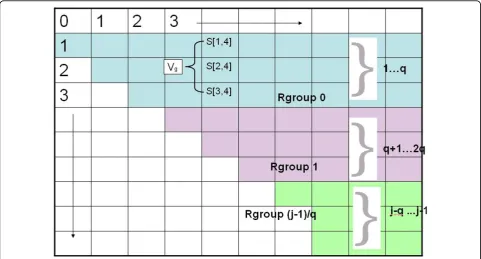
We now begin to explain the speed-up idea. For now, assume thatB(i, j) = 1 if (i,j) is a permitted match, and is 0 otherwise. First, conceptually, divide eachcolumnin the S matrix into groups of q rows, where q will be determined later. For this part of the exposition, sup-pose j- 1 is a multiple of q, and let rows 1... q be in a group called Rgroup 0, rowsq + 1..2q be in Rgroup 1 etc, so that rows j - q...j - 1 are Rgroup Îj- 1c/q. We use gas the index for the groups, sog ranges from 0 to (Îj - 1c/q). See Figure 1. We will modify the Second Dynamic Program so that for each fixedi, jpair, we do not compute Rule d for each k=j - 1 down to i + 1. Rather, we will only do constant-time work for each Rgroup g that falls completely into the interval of rows fromj- 1 down to i+ 1. For the (at most) one Rgroup that falls partially in that interval, we execute the Rule d loop as before. Over the entire algorithm, the time for those partial intervals isO(n2q), and so this detail will be ignored until the discussion of the time analysis. Introducing vector Vgand modified Rule d loop
We first modify the Second Dynamic Program to accu-mulate auxiliary vectorsVginside the Rule d loop. For a fixedj, consider an Rgroupgconsisting of rowsz, z- 1, z - q + 1, for some z <j, and consider the associated consecutive valuesS(z,j),S(z - 1,j)...S(z- q+ 1, j). Let Vgbe the vector ofthosevalues in that order.
The work to accumulateVgmay seem wasted, but we will see shortly howVgis used.
Introducing vg
It is clear that for the simple scoring scheme ofB(i, j) = 1 when (i, j) is a permitted match, andB(i,j) = 0 when (i,j) is not permitted, S(z- 1,j) is either equal to S(z, j) or is one more then S(z, j). This observation holds for each consecutive pair of values in Vg. So for a single Rgroupgin column j, the change in consecutive values ofVgcan be encoded by a vector of lengthq- 1, whose values are either 0 or 1. We call that vector vg. We therefore define the function encode :VgÆ vgsuch that
vg[i] =Vg[i-1]-Vg[i]. Moreover, for any fixedj, immedi-ately after all theS values have been computed for the cells in an Rgroup g, function encode(Vg) can be com-puted and stored inO(q) time, andvgwill then be avail-able in the Rule d loop for all i smaller than the smallest row in g. Note that for any fixed j, the time needed to compute all the encode functions is justO(n). Introducing Table R and the use of vg
Note that the Second Dynamic-Program can findk*(i,g, j) andS*(i,g,j) during the execution of the Ruledloop, but would takeO(q) time to do so. However, by previously doing some preprocessing (to be described below) before column jis reached, we will reduce the work in each RgroupgtoO(1) time. To explain the idea, suppose that before columnjis reached, we haveprecomputeda tableR which is indexed byi,g,vg. TableRwill have the property that, for fixedjandi<j-q, asingle lookupofR(i,g,vg)) will effectively returnk*(i,g,j) for anyg. Sincek- 1 <jand k>i, both valuesS(i,k*(i,g,j) - 1) andS(k*(i,g,j),j) are known when we are trying to evaluateS(i,j), so we can findS(i,k*(i,g,j) - 1) +S(k*(i,g,j),j) inO(1) operations oncek*(i,g,vg) is known.
Since there areO(j/q) Rgroups, it follows that for fixed jandi, by calling table Ronce for each Rgroup, onlyO (j/q) work is needed in the Rule d loop. Hence, for any fixedj, lettingi vary over its complete range, the work will be O(j2/q), and so the total work (over the entire algorithm) in the Rule d loop will beO(n3/q). Note that as long as q <n, some work has been saved, and the amount of saved work increases with increasingq. This use of the R table in the Rule d loop is summarized as follows:
Dependent section using tableR forg=Î(j- 1)/qc toÎ(i+ 1)/qc do
retrievevggiveng
retrieve k*(i,g,j)from R(i,g,vg)
S(i, j) = max( S(i, j),
S(i, k*(i,g,j) - 1) + S(k*(i, g,j),j) );
Of course, we still need to explain how R is precomputed.
Obtaining tableR
Before explaining exactly where and how tableRis com-puted, consider the action of the Second Dynamic-Pro-gramming algorithm in the Rule d loop, for a fixed j. Let gbe an Rgroup consisting of rowsz-q + 1,z-q,..., z, for somez <j. A key observation is that if one knows the single valueS(z, j) and the entire vectorvg, then one can determine all the valuesS(z-q + 1,j)... S(z,j) orVg. Each such value is exactly S(z, j) plus a partial sum of the values in vg. In more detail, for any k ∈ g,
S k j S z j p v pg
p z k
( , ) ( , )
[ ]0 1
. Let decode (vg) be a function that returns the vector V’ where
V p v pg
p z k
[ ]k 0 1 [ ].
Next, observe that if one doesnotknow any of theVg in the rows ofg (e.g., the valuesS(z- q + 1,j),S(z- 1, j)...S(z, j)), butdoesknow all ofvg, then, for any fixed i below the lowest row in Rgroupg(i.e., row z-q+1), one can find the value of indexkin Rgroupgto maximize S (i, k- 1) + S(k,j). That value ofkis what we previously defined as k*(i, g, j). To verify that k*(i, g, j) can be determined fromvg, but without knowing anySvalues in column j, recall that since k - 1 <j, S(i, k - 1) is already known. We call this Fact 1.
Precomputing theRtable
We now describe the preprocessing that is needed to compute tableR.
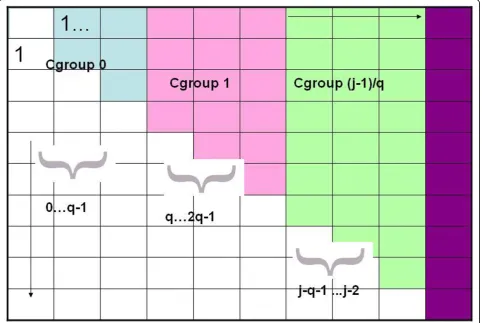
Conceptually divide matrix for S into groups of col-umns of sizeq, i.e., the same size groups that divide each column. Columns 1 through q- 1 are in a group we call Cgroup 0,q through 2q - 1 are in Cgroup 1 etc, and we again usegto index these groups. Figure 2 illus-trates the division of columns into groups of size q. Assume we run the Second Dynamic Program until j reachesq- 1. That means that all the S(i,j) values have been completely and correctly computed for all columns in Cgroup 0. At that point, we compute the following:
foreach binary vectorvof lengthq- 1do V’=decode(v)
foreachisuch thati<q- 1do
R(i, 0,v) is set to the indexkin Rgroup 0 such that S(i, k-1) + V’[k] is maximized. {we let k* denote that optimalk}
The above details the preprocessing done after all the S values in Cgroup 0 have been computed. In general, for Cgroupg > 0, we could do a similar preprocessing after all the entries in columns of Cgroup g have been
computed. That is,k*(i, g, v) could be found and stored in R(i, g, v) for alli<g*q.
This describes the preprocessing that is done after the computation of the S values in each Rgroup g. With that preprocessing, the tableRis available for use when computing S values in any column j>g ×q. Note that the preprocessing computations of table R are inter-leaved with the use of table R. This is different than other applications of the Four-Russians technique that we know of. Note also that the amount of preprocessing work increases with increasingq. Several additional opti-mizations are possible, of which one, parallel computa-tion, is described in Results and Discussion section.
With this, the description of the Four-Russians speed up is complete. However, as in most applications of the Four-Russians idea,qmust be chosen carefully. If not chosen correctly, it would seem that the time needed for prepro-cessing would be greater than any saving obtained later in the use ofR. We will see in the next section that by choos-ingq=log3(n) the overall time bound isO(n3/log(n)).
Pseudo-code for RNA folding algorithm with Four Russians SpeedUp
forj= 2 tondo
[Independent]Calculations below don’t depend on the current column j
fori= 1 toj- 1do
S(i, j) = max( S(i+1, j-1)+B(i, j) , S(i, j-1)) (Rules a, b ) [Dependent] Calculations below depend on the cur-rent column j
fori=j- 1 to 1do
forg=Î(j- 1)/qctoÎ(i+ 1)/qc do
if(i>k), k∈ Rgroup g. then {this statement runs at most once, for the smallestg}
find k*(i, g,j) by directly computing and comparing S (i, k-1)+S(k, j) wherek∈L = {g*qto i}
|L| <q else
retrievevggiveng
retrieve k*(i, g,j)from R(i,g,vg)
S(i, j) = max( S(i, j),S(i,k*(i,g,j) - 1) +S(k*(i,g,j),j) ); if((i - 1) mod q == 0), Compute vg for group g and store it
[Table]once Cgroupg=Îj/qcis complete foreach binary vectorvof lengthq- 1do V’=decode(v)
foreachi1 toi<j- 1do
R(i,g,v) is set to the index kin Rgroup g such that S(i, k-1) +V’[k] is maximized.
Results and Discussion Correctness and Time analysis
From Fact 1, it follows that when the algorithm is in the Rule d loop, for some fixed j, and needs to use R to look upk*(i,g,j) for someg,k*(i,g,j) =R(i,g,vg). It fol-lows immediately that the algorithm does correctly com-pute all of theS values, and fills in the completeStable. A standard traceback can be done to extract the optimal matching, inO(n) time if pointers were kept when theS table built.
Time Analysis
The time analysis for any columnjcan be broken down into the sum of the time analyzes for the [indepen-dent],[dependent],[table] sections.
For any column jthe [Independent] section of the speedup algorithm remains unchanged from the original algorithm and isO(n) time.
For each row i, the [Dependent] section of the speedup algorithm is now broken down inton/qcalls to the tableR. As discussed above, the total time to com-pute all the encode functions isO(n) per column, and this is true for all decode functions as well. Therefore in any column j, the dependent section takes Onq2
time. Also, there is an additional overhead of processing of the one (possible) partial group in any columnjonly takes O(nq) time. Reversing the order of evaluation in the algorithm foriandkwould eliminate this overhead.
However, for simplicity of exposition we leave those details out.
The [Table]section sets R(i, g, v) by computing every binary vector v and then computing and storing the value k*(i, g, v). The variablei ranges from 1 to n and there are 2q-1binary vectors. Hence the table section for any complete groupgtakes O(q * n* 2q-1) time. There aren/qtotal groups possible.
In summary, the total time for the algorithm is
O(n2 * q) +Onq3
+O(n
2
*2q) time.
Theorem 1. If 2 <b <n, then the algorithm runs inO (n3/logb(n)) time.
Proof Clearly,Onq3
=O(n
3
/logb(n)) and O(n2 logb (n) =O(n3/logb(n)), so we concentrate on the third term in the time bound. To show thatn2× 2log ( )b n =O(n3/
logb(n)) for 2 <b<n, we need to show that
2log ( )b n ( / log ( )).
b
O n n
The relation holds if
n O n n
n n O n
b
b
b z
log ( ) ( / log ( ))
( ) ( )
2
if
log
forz= logb(2). 0 <z< 1 sinceb > 2.
The above relation holds if
lim( log ( ))
n
n z b n
n
0
We simplify the above equation to
lim log ( ) / ( )
n b z n n 1
We find the limit by taking the derivative of top and bottom (L’Hopital’s Rule)
limlog ( ) ( )
lim (
ln( ))
( )
lim ln( )
n n n
b n n z
n b
z n z n b
1 1
1
1
(( )
lim
( ) ln( )
. 1 1 1 1 0 1
z n z
z b n z
z
n since
Parallel Computing
By exploiting the parallel nature of the computation for a specific column j, one can achieve an overall time bound ofO(q* n2) with vector computing.
compute the maximum in parallel, for each i, with an asymptotic run time of O(1).
Let’s examine the [Dependent] section at a particular i andg.
It is important to note that when Rgroup g is not complete, in other words iis greater thank(where k∈ Rgroup g), the maximum fold cannot be found in paral-lel. The asymptotic time for the if branch remains the same as in the non-parallel algorithm: O(n*q) compari-sons for a particular column. As stated before, reversing the order of evaluation in the algorithm for i and k would eliminate this overhead. During the execution of the elsebranch (starting with instructionretrieve k*(i,g, j)from R(i,g,vg) ) there are three observations that lead to a parallel algorithm.
First, observe thati is smaller than all the values in Rgroup g. This observation holds true because the else branch is only taken in that case. Second, becausei is smaller than anyk∈Rgroupg, thenvgcan be computed from the values Rgroup g of column j. Third, observe thatR(i’,g,vg) is set tok*(i’,gv,j) for alli’<ifor the par-ticularvg.
We can simultaneously for alli’<irun: retrieve k*(i’,g,j)from R(i’,g,vg)
S(i’,j) =max(S(i’,j),S(i’,k*(i’,g,j) - 1) +S(k*(i’,g,j), j) );
Therefore instead of sequentially examining group g for each i’ (such that i’ <i), the parallel algorithm examines group g simultaneously. When executed in parallel, the else branch computes inO(1) time all k* belonging to g for alli’. For eachi’ there is at mostn/ q entries in the R table - one for every group. As a result the total time spent in column j for the else branch is O(n/q) for all i rows. In addition, each col-umn gets encoded into vectors vg of size q in O(n) time. In total, computing in parallel the maximum folding scores for subsequences starting at every possi-ble position i and ending at position jtakes O(q * n+ n/q) =O(q * n) time.
The [Table] section can also be done in parallel to findk* for all possible v vectors in O(1) time, entering all 2q-1 values into table R simultaneously. The entire algorithm then takesO(q* n2) time in parallel. As stated previously, reordering iand kwould remove the over-head lowering the asymptotic time toO(n2).
Generalized scoring schemes for B(i, j)
The Four Russians Speed-Up could be extended to any B(i, j) for which all possible differences between S(i, j) and S(i+1, j) do not depend onn. LetCdenote the size of the set of all possible differences. The condition that C doesn’t depend on n allows one to incorporate not just pairing energy information but also energy informa-tion that is dependent on the distance between match-ing pairs and types of loops. In fact the tablmatch-ing idea
currently can be applied to any scoring scheme as long as the marginal score (S(i- 1, j) - S(i,j)) is not Ω(n). In
this case, the algorithm takes O(n* (n * Cq-1 + n q
2 +
n)) = O(n2Cq-1+ n q
3
+n2) time. If we let q = logb(n) with b >C, the asymptotic time is again O(n3/log(n)). Based on the proof of Theorem 1, the base of the log must be greater then C in order to achieve the speed up. The scoring schemes in [14,15] have marginal scores that are not dependent on n, so the speedup method can be applied in those cases.
Empirical Results
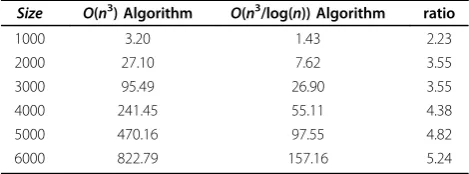
We compare our Four-Russians algorithm to the origi-nal O(n3)-time algorithm. The empirical results shown in Table 1 give the average time for 50 tests of ran-domly generated RNA sequences and 25 downloaded sequences from GenBank, for each size between 1, 000 bp and 6, 000 bp. GenBank sequences varied in actual length and were not exactly the length of the simulated data. However they differed by no more than 30 bp. The algorithm performs identically for randomly gener-ated and GenBank sequences of equal length. This is to be expected because the algorithm’s run time is sequence character independent. For all tests where sequences are of the same length, run-times have a stan-dard deviation of at most .01 seconds.
The purpose of these empirical results is to show that despite the additional overhead required for the Four-Russians approach, it does provide a consistent practical speed-up over theO(n3)-time method, and does not just yield a theoretical result. In order to make this point, we keep all conditions for the comparisons the same, we emphasize the ratio of the running times rather than the absolute times, and we do not incorporate any addi-tional heuristic ideas or optimizations that might be appropriate for one method but not the other. However, we are aware that there are speedup ideas for RNA fold-ing, which do not reduce the O(n3) bound, but provide significant practical speedups. Our empirical results are not intended to compete with those results, or to pro-vide a finished competitiveprogram, but to illustrate the practicality of the Four-Russians method, in addition to
Table 1 Computation time (seconds)
Size O(n3) Algorithm O(n3/log(n)) Algorithm ratio
1000 3.20 1.43 2.23
2000 27.10 7.62 3.55
3000 95.49 26.90 3.55
4000 241.45 55.11 4.38
5000 470.16 97.55 4.82
its theoretical consequences. In future work, we will incorporate all known heuristic speedups, along with the Four-Russians approach, in order to obtain an RNA foldingprogram which can be directly compared to all existing methods.
Conclusions
Extending the Four-Russians speedup by interleaving preprocessing with computation can lead to a practical and simple O(n3/logn) time RNA folding algorithm. Through further analysis this basic algorithm could be applied to a variety of scoring schemes, and energy functions. In parallel the speedup can improve the algo-rithm to run inO(n2) time.
Acknowledgements
This research was partially supported by NSF grants SEI-BIO 0513910, CCF-0515378, and IIS-0803564.
Authors’contributions
YF and DG jointly contributed to the conception, design, analysis and interpretation of the algorithm, and jointly contributed to the writing and editing of the manuscript. Implementaton and testing was done by YF.
Competing interests
The authors declare that they have no competing interests.
Received: 13 August 2009
Accepted: 4 January 2010 Published: 4 January 2010
References
1. Nussinov R, Pieczenik G, Griggs JR, Kleitman DJ:Algorithms for Loop Matchings.SIAM Journal on Applied Mathematics1978,35:68-82. 2. Nussinov R, Jacobson AB:Fast Algorithm for Predicting the Secondary
Structure of Single-Stranded RNA.PNAS1980,77(11):6309-6313. 3. Zuker M, Stiegler P:Optimal computer folding of large RNA sequences
using thermodynamics and auxiliary information.Nucleic Acids Research
1981,9:133-148.
4. Waterman MS, Smith TF:RNA secondary structure: A complete mathematical analysis.Math Biosc1978,42:257-266.
5. Backofen R, Tsur D, Zakov S, Ziv-Ukelson M:Sparse RNA Folding: Time and Space Efficient Algorithms.CPM‘09: Proceedings of the 20th Annual Symposium on Combinatorial Pattern MatchingBerlin, Heidelberg: Springer-Verlag 2009, 249-262.
6. Wexler Y, Zilberstein CBZ, Ziv-Ukelson M:A Study of Accessible Motifs and RNA Folding Complexity.Journal of Computational Biology2007,14(6) :856-872.
7. Akutsu T:Approximation and Exact Algorithms for RNA Secondary Structure Prediction and Recognition of Stochastic Context-free Languages.J Comb Optim1999,3(2-3):321-336.
8. Chan TM:More algorithms for all-pairs shortest paths in weighted graphs.STOC2007, 590-598.
9. Graham SL, Walter L Ruzzo MH:An Improved Context-Free Recognizer. ACM Trans Program Lang Syst1980,2(3):415-462.
10. Durbin R, Eddy SR, Krogh A, Mitchison G:Biological Sequence Analysis: Probabilistic Models of Proteins and Nucleic AcidsCambridge University Press 1998.
11. Zuker M, Sanko3 D:RNA Secondary STructures and their prediction. Bulletin of Mathematical Biology1984,46(4):591-621.
12. Kleinberg J, Tardos E:Algorithm DesignBoston, MA, USA: Addison-Wesley Longman Publishing Co., Inc 2005.
13. Clote P, Backofen R:Computational Molecular Biology: An IntroductionJohn Wiley & Sons, Ltd 2000.
14. Hofacker IL, Fekete M, Stadler PF:Secondary Structure Prediction for Aligned RNA Sequences.Journal of Molecular Biology2002,319(5) :1059-1066.
15. Seemann SE, Gorodkin J, Backofen R:Unifying evolutionary and thermodynamic information for RNA folding of multiple alignments.NAR
2008,36(20):6355-6362. doi:10.1186/1748-7188-5-13
Cite this article as:Frid and Gusfield:A simple, practical and complete O-time Algorithm for RNA folding using the Four-Russians Speedup.
Algorithms for Molecular Biology20105:13.
Publish with BioMed Central and every scientist can read your work free of charge
"BioMed Central will be the most significant development for disseminating the results of biomedical researc h in our lifetime."
Sir Paul Nurse, Cancer Research UK
Your research papers will be:
available free of charge to the entire biomedical community
peer reviewed and published immediately upon acceptance
cited in PubMed and archived on PubMed Central
yours — you keep the copyright
Submit your manuscript here:
http://www.biomedcentral.com/info/publishing_adv.asp